
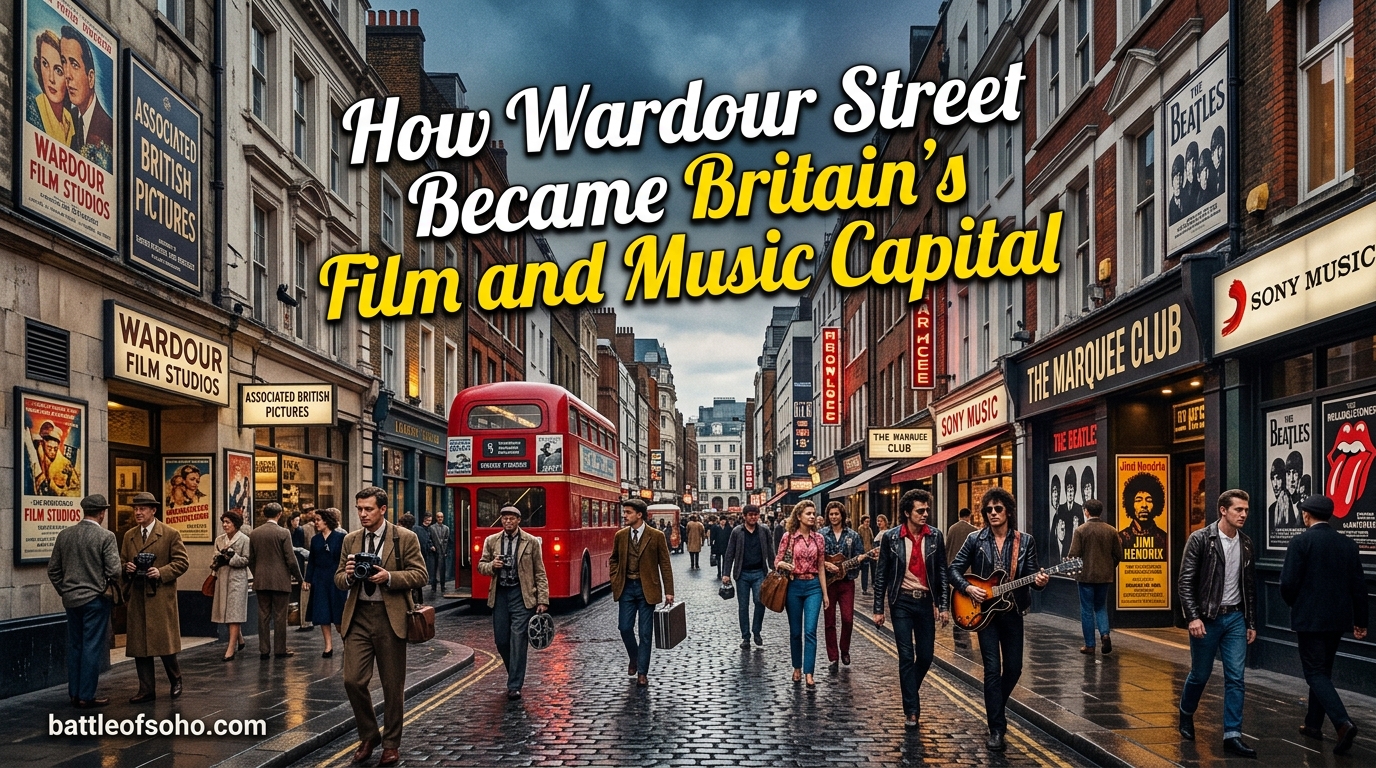
Walk down Wardour Street today and you will see bars, restaurants, and office buildings. But look closer at the facades and brass plaques, and you will find traces of the most culturally significant street in British entertainment history. For nearly a century, this single Soho thoroughfare housed the headquarters of the British film industry and birthed the British rock revolution.
The phrase “spine of British film and music” gets thrown around, but it is not an exaggeration. Wardour Street became the spine of British film and music because it concentrated more creative infrastructure on one street than anywhere else in the country. Film production companies, distributors, post-production houses, recording studios, and legendary music venues all shared the same pavement.
Wardour Street is a street in London’s Soho district that became famous for housing the British film industry and popular music scene throughout the 20th century. At its peak, it contained over 100 film companies and earned the nickname “Film Row,” while legendary venues like the Marquee Club made it the epicentre of British rock and roll.
In this article, we trace how that happened. We start in the Victorian era when Wardour Street was known for furniture and antiques, follow Charles Urban as he planted the first film company flag in 1908, track the explosion of studios through the mid-century golden age, and explore how music venues rose alongside the film industry to create a dual legacy unlike anything else in London.
Our team spent weeks researching historical archives, academic sources, and community discussions to build this narrative. What emerged was not just a history of a street, but a story about how creative industries cluster, grow, and transform urban spaces. The Wardour Street model — where an entire national industry concentrates on a single street — has never been replicated anywhere in Britain.
Table of Contents
What Was Wardour Street Before Film and Music?
Before the cameras and guitars, Wardour Street had an entirely different identity. For most of the 18th and 19th centuries, this was London’s furniture district. Cabinet makers, antique dealers, and furniture brokers lined both sides of the street. If you needed a dining table or a chaise longue in Victorian London, Wardour Street was where you went.
The street itself dates back to at least 1585, when it appeared on maps as a path through fields running south from Oxford Street. It was named after Sir Edward Wardour, though the spelling shifted over the centuries. By the Georgian era, the street was becoming a commercial thoroughfare connecting Oxford Street to the growing entertainment district around Leicester Square and Shaftesbury Avenue.
The street’s physical layout mattered enormously for what came later. Wardour Street is long and narrow, running roughly north-south through the heart of Soho. Its tight configuration meant that buildings were close together, creating a dense commercial environment where neighbours interacted constantly. This density would later prove essential to the creative clustering effect that made the street famous.
The antiques trade gave Wardour Street something unexpected: a reputation for fakery. Dealers were known for producing “spurious antiquities” — convincing replicas sold as genuine historical pieces. This was common enough that the phrase “Wardour Street English” entered the language. It described fake archaic language, the kind of deliberate old-fashioned writing meant to sound historical but was actually manufactured. The street had become synonymous with convincing imitation.
Patrick Hamilton captured this side of Wardour Street in his novel The Midnight Bell, set in the Fitzrovia and Soho area. His descriptions of London’s pub culture and street life in the interwar period give a vivid sense of what the street felt like as the film industry was taking hold. The transition from antiques district to entertainment hub was not overnight — it happened gradually as film companies moved in and furniture dealers moved out.
Immigrant communities shaped the street’s character too. French Huguenots, Italian craftsmen, and Jewish merchants all settled in Soho and traded along Wardour Street. This multicultural fabric would later prove important when a new industry arrived, one that needed cheap space, a central location, and a community open to outsiders and new ideas. Soho’s history as an immigrant neighbourhood meant that newcomers were accepted rather than resisted.
Musical instrument shops and sheet music publishers also appeared on Wardour Street in the late 19th century. Novello, one of Britain’s oldest music publishers, had offices nearby. These music businesses were a quiet precursor to the explosion of recording studios and live music venues that would come decades later. The creative DNA was already present on the street before the first film company arrived.
The Birth of Film Row: Charles Urban and the First Studios
The story of how Wardour Street became the spine of British film and music starts with one man arriving on the street in 1908. Charles Urban was an American-born film entrepreneur who had already made a name for himself in early cinema. When he chose Wardour Street for his new British headquarters, he accidentally launched an entire industry cluster.
Charles Urban: The Man Who Started It All
Charles Urban was not a filmmaker in the artistic sense. He was a businessman, a showman, and a technical innovator. Born in Cincinnati, Ohio, in 1867, he moved to London in the 1890s and quickly recognised that the film industry needed centralised infrastructure. His company, the Charles Urban Trading Company, needed offices, screening rooms, and storage for film stock.
Urban established Urbanora House on Wardour Street as his base of operations. He also developed Kinemacolor, the first commercially successful colour film system, and named another building on the street Kinemacolor House. Urban was effectively building a mini-empire of film on a single Soho street. Other companies noticed.
Kinemacolor itself was a significant technical achievement. It used a rotating filter system to create the illusion of colour from black-and-white film stock. Urban premiered Kinemacolor films to stunned audiences, and the technology put British cinema at the forefront of film innovation. The fact that this breakthrough was administered from Wardour Street cemented the street’s reputation as a serious centre of film technology, not just film business.
Urban’s presence created a magnet effect. Film was a brand-new industry with no established headquarters. No traditional business district expected or welcomed these strange new companies dealing in flammable chemicals and moving pictures. Wardour Street offered something that nowhere else in London did: affordable commercial space, proximity to the West End theatre district, and a landlord community that did not ask too many questions.
Why Film Companies Clustered on One Street
Early celluloid film stock was dangerously flammable. Nitrate film could spontaneously combust if stored improperly, and insurance companies charged premiums that drove many film businesses out of conventional office districts. Wardour Street’s older commercial buildings, with their back courtyards and side alleys, offered storage space that was tolerated by the local council and affordable for startups.
The fire risk was no joke. Film stock fires could destroy entire buildings in minutes, and the chemical fumes were toxic. Insurance companies categorised film businesses as high-risk, which meant that conventional office landlords in places like the City of London or the Strand simply refused to rent to them. Wardour Street’s old warehouse buildings, designed for furniture storage, were sturdier and more forgiving.
The concentration effect kicked in fast. By 1914, Wardour Street housed more than 20 film companies. British Pathe had offices at number 84 and later expanded to 103-109. The Ideal Film Company set up shop, and Harry Rowson’s memoirs provide a detailed account of what the street was like during this period — a buzzing corridor of film offices where deals were struck over lunch and screenings happened in converted back rooms.
Cinema House and Film House became landmark buildings, their very names announcing the street’s new identity. The furniture trade had been replaced by the future. People in the industry started calling Wardour Street “Film Row” or sometimes the “High Street of Film,” nicknames that stuck for decades.
Once the cluster formed, it became self-reinforcing. A filmmaker looking for a distributor, a cinema owner seeking prints, or an actor searching for work all knew to come to Wardour Street. It was the one place in Britain where every thread of the film industry existed within a few hundred yards of each other. You could walk the street in an afternoon and conduct a week’s worth of meetings.
The Golden Age: When Wardour Street Ruled British Cinema
The interwar period and the decades following the Second World War marked the golden age of Wardour Street’s film dominance. The street evolved from a cluster of small pioneers into the command centre of the entire British film industry. Every major studio, distributor, and production company either had offices on Wardour Street or did business with someone who did.
During the interwar period, the British film industry grew rapidly. The Cinematograph Films Act of 1927 introduced quotas for British-made films in British cinemas, which created a surge in domestic production. More production meant more companies, and more companies meant more demand for Wardour Street addresses. The street was booming.
British Pathe at 103 Wardour Street
British Pathe operated from 103-109 Wardour Street, and the building became one of the most recognisable addresses in British media. Pathe was the dominant newsreel company in Britain, producing the footage that cinema audiences saw before the main feature. The Pathe Building on Wardour Street was essentially a newsreel factory, churning out footage of world events for British audiences week after week.
Pathe’s newsreels were how most British people experienced visual news before television. The company’s cameramen covered everything from royal weddings to wartime battles, and the footage was processed, edited, and distributed from the Wardour Street headquarters. When you sat in a cinema in Manchester or Glasgow and watched a Pathe newsreel, that footage had passed through Soho.
The building itself became iconic. Its distinctive facade and signage made it a landmark of Soho. Long after the newsreel era ended, the Pathe name remained attached to the building. Associated-British Pathe, a merger entity that combined newsreel operations with feature film production, also operated from the street during this period.
In 2016, the old Pathe Building was converted into luxury apartments, but the facade and heritage signage were preserved. The name still looks down on Wardour Street today, a reminder that this was once the nerve centre of British visual news.
Hammer Films and the Horror Empire
Hammer Films, the studio that defined British horror cinema, also called Wardour Street home. Hammer House, the company’s headquarters, became synonymous with the gothic horror films that made the studio famous worldwide. Christopher Lee’s Dracula and Peter Cushing’s Baron Frankenstein were administered from an office on a Soho street.
The Hammer story on Wardour Street is particularly fitting. Will Hammer, the company’s co-founder, reportedly took his name from Hammersmith before building a horror empire in Soho. Exclusive Films, Hammer’s parent company, also operated from the street, handling distribution for British cinema exports that terrified and delighted audiences around the world.
Hammer’s presence on Wardour Street gave the street a direct connection to one of Britain’s most successful film exports. The Hammer horror films of the 1950s, 1960s, and 1970s were box-office hits across Europe and America. They were conceived, financed, and managed from a Soho office that was walking distance from the very cinemas where they premiered in London’s West End.
The Sight and Sound Survey of 1951
In 1951, the British Film Institute’s magazine Sight and Sound published a survey of film companies operating on Wardour Street. The list was staggering. British and Hollywood companies alike maintained offices on the street. Warner Brothers had a presence. The Rank Organisation, Britain’s largest film company, conducted business through Wardour Street connections. Associated-British Pathe, a merger entity, operated from the street.
This survey is the best snapshot of Wardour Street at its absolute peak. It confirmed what everyone in the industry already knew: if you wanted to do film business in Britain, you needed a Wardour Street address. The street had become the British equivalent of Hollywood’s business district, the commercial nerve centre of an entire national industry.
The 1951 survey also reveals the international reach of Wardour Street. Hollywood studios maintained offices there to manage their British and European distribution. This meant that deals between British and American film companies were negotiated on a single Soho street, giving Wardour Street an international significance that no other creative street in London possessed.
How Wardour Street Became the Spine of British Film and Music
Here is where the story gets remarkable. The same street that ran the British film industry also became the live music capital of Britain. This was not a coincidence or a gentrification story where one industry replaced another. Film and music grew side by side on Wardour Street, sharing buildings, audiences, and creative energy.
The connection was practical. Film companies needed screening rooms, which could be converted into performance spaces after hours. Post-production houses had sound equipment that could serve recording studios. Film industry workers were young, creative, and hungry for entertainment after long days of editing and distribution work. The same buildings that housed film offices by day hosted music venues by night.
Post-production houses, recording studios, and film distributors filled a single street, creating a creative ecosystem where ideas, talent, and money circulated freely. A musician could record a demo in a Wardour Street studio, walk next door to a film company to pitch a soundtrack, and then perform at a club on the same street that evening. This was the “spine” concept in action — one street connecting every part of Britain’s entertainment industry.
This dual identity is what makes Wardour Street unique. Other London streets had film companies. Other streets had music venues. But no other street had both at the same time, at the same scale, feeding into each other. The film industry provided the infrastructure — buildings, equipment, technical expertise — that the music industry needed. The music industry provided the cultural energy that kept the street alive after office hours.
The Music Revolution: From Jazz to Punk on One Street
The music history of Wardour Street spans four decades and multiple genres. Jazz arrived first in the 1950s, rock and roll exploded in the 1960s, and punk burned through in the 1970s. The street hosted venues that launched careers, shaped movements, and became pilgrimage sites for music fans from around the world.
The musical evolution of Wardour Street mirrors the broader story of British popular music. Each genre that arrived on the street brought its own community, its own culture, and its own stars. But the street itself remained constant — a narrow Soho thoroughfare with basements and back rooms that could be transformed into performance spaces.
The Marquee Club at 90 Wardour Street
The Marquee Club is arguably the most famous music venue in British history, and its time at 90 Wardour Street from 1964 to 1988 was its most legendary period. The club had originally opened on Oxford Street in 1958, but it moved to Wardour Street in 1964 and immediately became the centre of the London music scene.
The move to Wardour Street was prompted by the loss of the Oxford Street lease, but it turned out to be the best thing that ever happened to the Marquee. The new location at 90 Wardour Street put the club in the heart of Soho’s entertainment district, surrounded by music shops, recording studios, and the after-work crowd from the film companies. The synergy was immediate.
The Rolling Stones played their first-ever live gig at the Marquee. David Bowie tested new material on the Wardour Street stage before unleashing it on the world. The Who, Led Zeppelin, The Jam, and Siouxsie and the Banshees all played the venue’s intimate 200-capacity basement room. If a British rock band mattered in the 1960s, 1970s, or 1980s, they almost certainly played 90 Wardour Street.
What made the Marquee special was its size. The room was small enough that fans could literally touch the artists. There was no barrier, no VIP section, no distance between performer and audience. Bands used the Marquee as a testing ground, trying out new songs and new identities before heading out on tour or into the studio.
Reddit users on the r/london and r/TheWho forums frequently share stories about attending Marquee gigs in the 1960s and 1970s. The venue comes up regularly in discussions about London’s lost music heritage. Former audience members describe the heat, the noise, and the intensity of watching future legends in a room the size of a large living room.
The Marquee closed at 90 Wardour Street in 1988, and the building has since been redeveloped. But for music fans, 90 Wardour Street remains a pilgrimage site. TripAdvisor reviewers still seek out the location, and it holds a 3.9 out of 5 rating on the platform based on reviews from visitors who come specifically to see where music history happened.
100 Wardour Street: The Basement That Launched Legends
Just a few doors down from the Marquee sat 100 Wardour Street, another building with an extraordinary musical history. The basement venue at 100 Wardour Street operated for 24 years and hosted performances that shaped British music. David Bowie tested new material here. The Rolling Stones performed in this space too.
100 Wardour Street had its own distinct identity separate from the Marquee. It hosted jazz nights, R&B sessions, and early rock and roll performances. The venue was part of the interconnected network of Wardour Street music spaces that fed into each other, sharing audiences and booking agents and sound engineers.
The building had a previous life as a restaurant and dance hall before being converted into a music venue. Its basement layout made it naturally suited to live performance — the low ceilings and intimate dimensions created an acoustic environment that musicians loved. Performers could hear themselves clearly, and audiences could feel the music physically.
Today, 100 Wardour Street operates as a restaurant and bar that acknowledges its musical heritage. The basement venue has been transformed, but the legacy lives on in the venue’s name and decor. It is one of the few Wardour Street addresses where you can still experience something of the original atmosphere, sipping a drink in a space where rock history was made.
Jazz, Blues, and the Shim Sham Club
Before rock and roll took over Wardour Street, jazz was the dominant sound. The Shim Sham Club was one of the most important jazz venues in London, hosting bebop sessions and American blues musicians. The Flamingo Club, another legendary Wardour Street venue, became famous for its all-night R&B sessions and its connection to the Mod subculture of the 1960s.
The Shim Sham Club took its name from the Shim Sham tap dance routine, a staple of jazz culture. The venue attracted serious jazz musicians and dedicated fans who came to hear bebop — the fast, complex style of jazz pioneered by Charlie Parker and Dizzy Gillespie. The Shim Sham was where London’s jazz community gathered to hear the music that would eventually evolve into British R&B and rock.
The Flamingo was particularly significant for London’s underground scene. It was one of the few West End venues that welcomed mixed-race audiences and Black performers during an era when segregation was still socially enforced in many British nightlife spaces. This openness to diversity connected directly to Wardour Street’s long history as an immigrant-friendly neighbourhood.
The Flamingo’s all-night sessions became legendary. Mod culture in the 1960s was built around all-night dancing, and the Flamingo was one of the few venues in London that could legally stay open until dawn. Young people would arrive at midnight and dance until morning, fuelled by amphetamines and R&B music imported from America.
The St Moritz Club also operated on Wardour Street, adding to the dense concentration of live music venues on a single street. At one point in the 1960s, you could walk down Wardour Street and hear live music pouring out of four or five different basements on the same evening. No other street in London, possibly no other street in the world, offered such density of live music.
Punk Arrives: The Vortex Club
The Vortex Club at 203 Wardour Street represented the next wave of musical rebellion. In the late 1970s, punk arrived on a street already steeped in three decades of music history. The Vortex became a key punk venue, hosting bands that rejected everything the previous generation of Wardour Street musicians had built — even as they played on the same street.
Siouxsie and the Banshees, The Jam, and other punk and new wave acts added Wardour Street to their touring routes. The street that had hosted Tommy Steele and Cliff Richard in the 1950s was now home to spiky-haired musicians singing about anarchy. The fact that punk and classic rock coexisted on the same pavement tells you everything about Wardour Street’s capacity to absorb new movements.
The Jam’s connection to Wardour Street runs deep. They played the Marquee regularly, and their Mod-revival sound was a direct callback to the 1960s R&B scene that had flourished in the very same venues. Punk on Wardour Street was not a rejection of the street’s musical heritage — it was a continuation of it, repackaged for a new generation.
The Eric Gilder School of Music at 195 Wardour Street also deserves mention. This music school trained generations of British session musicians who would go on to play on recordings made in the very studios lining the street. It was yet another layer of the Wardour Street music ecosystem, feeding trained talent directly into the venues and studios nearby.
Key Buildings That Defined an Industry
Wardour Street’s story is written in its buildings. While many have been converted or demolished, their names and functions tell the story of how one street became the spine of British film and music. Here are the most significant addresses that shaped the street’s legacy.
Urbanora House — Charles Urban’s original headquarters and the building that started it all in 1908. The name itself declared that a new industry had arrived on Wardour Street. From this address, Urban ran his film empire and developed Kinemacolor technology.
Kinemacolor House — A second Urban property, named after his revolutionary colour film system. This building housed the technical side of Urban’s operations, including the laboratories where colour film experiments took place.
Film House — A landmark office building that housed multiple film companies. Its name was literal: this was the house of film on Wardour Street. The building operated as a multi-tenant creative hub where small film companies shared facilities and resources.
Cinema House — Another purpose-named building, Cinema House served the exhibition and distribution side of the film industry. Companies based here dealt with cinema chains, booking schedules, and film circulation across Britain.
103-109 Wardour Street (The Pathe Building) — British Pathe’s headquarters and the most iconic address on the street. The building was converted to luxury apartments in 2016 but retains its heritage facade and Pathe signage. It remains the most visually striking reminder of Wardour Street’s film industry past.
Hammer House — The administrative home of Hammer Films, from which the British horror empire was run. Hammer’s gothic classics were conceived, financed, and distributed from this address.
National House — Another multi-tenant film industry building that housed several production and distribution companies during the mid-century golden age. National House was where mid-ranking film companies clustered, benefiting from proximity to the larger players.
90 Wardour Street — The Marquee Club from 1964 to 1988. The most famous music venue address in British history. Though the building has been redeveloped, the location remains a pilgrimage site for music fans worldwide.
100 Wardour Street — The basement venue where David Bowie, the Rolling Stones, and countless others performed. Now a restaurant and bar that honours its musical heritage, offering visitors a chance to experience the space where rock history was made.
203 Wardour Street — The Vortex Club, a key punk and new wave venue in the late 1970s. This address represents Wardour Street’s ability to reinvent itself musically with each new generation.
Why One Street? The Perfect Storm
The question that naturally arises is: why did all of this happen on one street? London is a vast city with hundreds of streets. What made Wardour Street the specific location where British film and music converged? The answer involves a combination of geography, economics, and cultural timing.
Geographically, Wardour Street sits in the perfect position. It runs through the heart of Soho, connecting Oxford Street to the north with Shaftesbury Avenue and Chinatown to the south. It is walking distance from Leicester Square, where London’s biggest cinemas were located, and from the West End theatre district. For a film company that needed to be near cinemas, theatres, and transport links, Wardour Street was ideal.
The proximity to Leicester Square was particularly important. Leicester Square was London’s cinema district, home to the largest and most prestigious movie theatres in Britain. Film distributors on Wardour Street could walk to Leicester Square to check on their latest releases, negotiate with cinema managers, and gauge audience reactions. This physical proximity between the business side and the exhibition side of film was unique to Wardour Street.
Economically, the street offered something that more prestigious addresses could not: affordable, flexible commercial space. The old furniture showrooms and warehouse buildings had large floors and back rooms that could be converted into offices, screening rooms, and storage. Rents were lower than nearby Regent Street or Bond Street, which mattered enormously for startup film companies operating on thin margins.
Culturally, Soho in the early 20th century was London’s most permissive neighbourhood. It was known for nightlife, immigrant communities, bohemian culture, and a tolerance for new and unconventional activities. Film companies dealing with flammable materials and music venues operating late into the night needed a neighbourhood that would accept them. Soho did.
Soho’s reputation for vice and permissiveness was actually an advantage for the creative industries. The area was already associated with activities that respectable London avoided — drinking, dancing, gambling, and mixing across class and racial lines. Adding film studios and music venues to this mix was entirely consistent with what Soho already was. No other neighbourhood would have been as welcoming.
The concentration effect then took over. Once Charles Urban established the first film company, a network formed. Suppliers, technicians, and competitors all wanted to be nearby. Musicians and venue operators followed the same logic. By the 1960s, Wardour Street had achieved critical mass — so much creative infrastructure on one street that it became impossible to imagine the British entertainment industry without it.
Decline and Legacy: What Remains Today
The British film industry on Wardour Street declined in the late 20th century. American competition grew stronger, industry consolidation meant fewer independent companies, and the rise of television and then digital media changed how films were produced and distributed. By the 1990s, most major film companies had moved elsewhere.
But Wardour Street never fully lost its connection to the creative industries. Post-production houses, editing suites, and independent production companies still operate on the street and in the surrounding Soho area. The film industry did not vanish from Wardour Street so much as it shrank and transformed, leaving behind a smaller but still significant creative community.
Gentrification has been the bigger force of change. The affordable commercial space that once attracted film startups and music venues has become some of the most expensive property in London. Many of the legendary buildings have been converted into restaurants, bars, apartments, and offices. The Marquee Club at 90 Wardour Street is gone. The Flamingo Club is gone. The Shim Sham Club is gone.
The LGBTQ+ history of Wardour Street is also part of this decline narrative. Several of the street’s music venues, including the Flamingo and the Rainbow Roof, were important spaces for London’s LGBTQ+ community. As these venues closed, an important piece of queer London history disappeared with them. The connection between Soho’s LGBTQ+ heritage and Wardour Street’s creative industries deserves more recognition than it has received.
What remains is the heritage. The Pathe Building at 103-109 Wardour Street still displays its historic signage. Blue plaques and brass markers identify significant locations. 100 Wardour Street operates as a venue that actively celebrates its musical past. And the street itself, with its narrow width and dense concentration of buildings, still feels like a place where something important happened.
Some observers have noted that Wardour Street’s post-production community, while smaller than its golden age peak, still plays a role in British cinema. Films are still edited, colour-graded, and sound-mixed in Soho. The infrastructure has shrunk but it has not disappeared. The ghost of Film Row still lingers in the digital editing suites that replaced the celluloid cutting rooms.
Visiting Wardour Street Today: What to Look For
If you want to experience Wardour Street’s film and music heritage in person, start at the northern end near Oxford Street and walk south toward Shaftesbury Avenue. The entire street takes about 10 minutes to walk, but the historical layers deserve a longer exploration. In 2026, you can still find visible traces of the street’s extraordinary past if you know where to look.
Look for the Pathe Building at 103-109. The preserved facade and heritage signage make it the most visually striking reminder of the street’s film history. Even though it is now luxury apartments, the building’s exterior tells you immediately what this street once was. The Pathe name on the facade is genuine heritage, not a retro-fitted decoration.
Seek out 90 Wardour Street, the former Marquee Club site. The building has been redeveloped, but the address itself carries enormous weight for music fans. Many visitors take photos at the location and share them online as part of their British rock pilgrimage. Reddit users have posted detailed guides for finding the exact spot.
Visit 100 Wardour Street, which now operates as a restaurant and bar. The venue embraces its musical heritage with music-themed decor and programming. You can have a drink in a basement space where David Bowie once tested new material. The venue regularly hosts live music, maintaining a thread of connection to its past life.
Look for the blue plaque commemorating Willy Clarkson, the theatrical wig-maker whose workshop was on Wardour Street. This plaque represents the theatrical connections that predated and supported the film industry’s growth on the street. Clarkson’s wigs appeared on West End stages and eventually in Wardour Street film productions.
Explore the side streets too. Cecil Court, nearby, was another London location with film industry connections, sometimes called a secondary “Film Row.” Frith Street, Dean Street, and Old Compton Street all hold pieces of Soho’s entertainment history. Wardour Street was the spine, but the body of Soho’s creative heritage extends in every direction.
Frequently Asked Questions
Why is Wardour Street famous?
Wardour Street is famous for being the historic centre of the British film industry and popular music scene throughout the 20th century. Known as Film Row, the street housed over 100 film companies at its peak, including British Pathe, Hammer Films, and Warner Brothers, and hosted legendary music venues like the Marquee Club, where the Rolling Stones, David Bowie, and The Who performed.
What happened to the British film industry on Wardour Street?
The British film industry on Wardour Street declined in the late 20th century due to American competition, industry consolidation, and the shift toward television and digital media. By the 1990s, most major film companies had moved elsewhere. However, post-production houses and independent producers still operate on the street, and the Pathe Building at 103-109 Wardour Street preserves the area’s cinematic heritage.
What is the history of 100 Wardour Street?
100 Wardour Street was home to a legendary music venue that operated for 24 years and hosted performances that shaped British music history. David Bowie tested new material in its basement, the Rolling Stones performed there, and it was a crucible of the British rock revolution. The intimate space hosted jazz, R&B, and rock acts before being converted into a restaurant and bar that continues to honour its musical legacy.
What is the British equivalent of Hollywood?
The British equivalent of Hollywood in terms of film production is commonly considered to be Pinewood Studios in Buckinghamshire or Ealing Studios in London. However, Wardour Street in Soho served as the commercial and administrative heart of the British film industry throughout the 20th century, functioning as London’s Film Row where production companies, distributors, and post-production houses were concentrated.
Conclusion
The story of how Wardour Street became the spine of British film and music is really a story about concentration. One street, in one neighbourhood, brought together the people, buildings, and infrastructure that built two of Britain’s most important creative industries. Charles Urban started it in 1908 with a single office. The Marquee Club kept it alive into the late 1980s. Between those two points, Wardour Street shaped British cinema and British rock in ways that are still being felt in 2026.
The street is different now. The film companies have largely moved on, and the legendary music venues have closed or been converted. But the heritage remains visible in the building facades, the heritage signage, and the blue plaques that mark the spots where history happened. Walking down Wardour Street is still walking through the heart of British entertainment history.
Understanding how Wardour Street became the spine of British film and music helps us understand something bigger about creative industries. They cluster. They need affordable space, permissive communities, and proximity to each other. When those conditions exist, extraordinary things happen on ordinary streets. Wardour Street was not destined to become the centre of British entertainment. It became that centre because the conditions were right and one man named Charles Urban arrived at the right moment.
If this exploration of Wardour Street has sparked your curiosity about Soho’s broader story, there is much more to discover. The streets around Wardour — Frith Street, Dean Street, Old Compton Street — all hold pieces of the same creative legacy. Soho built modern British entertainment, and Wardour Street was its spine.