
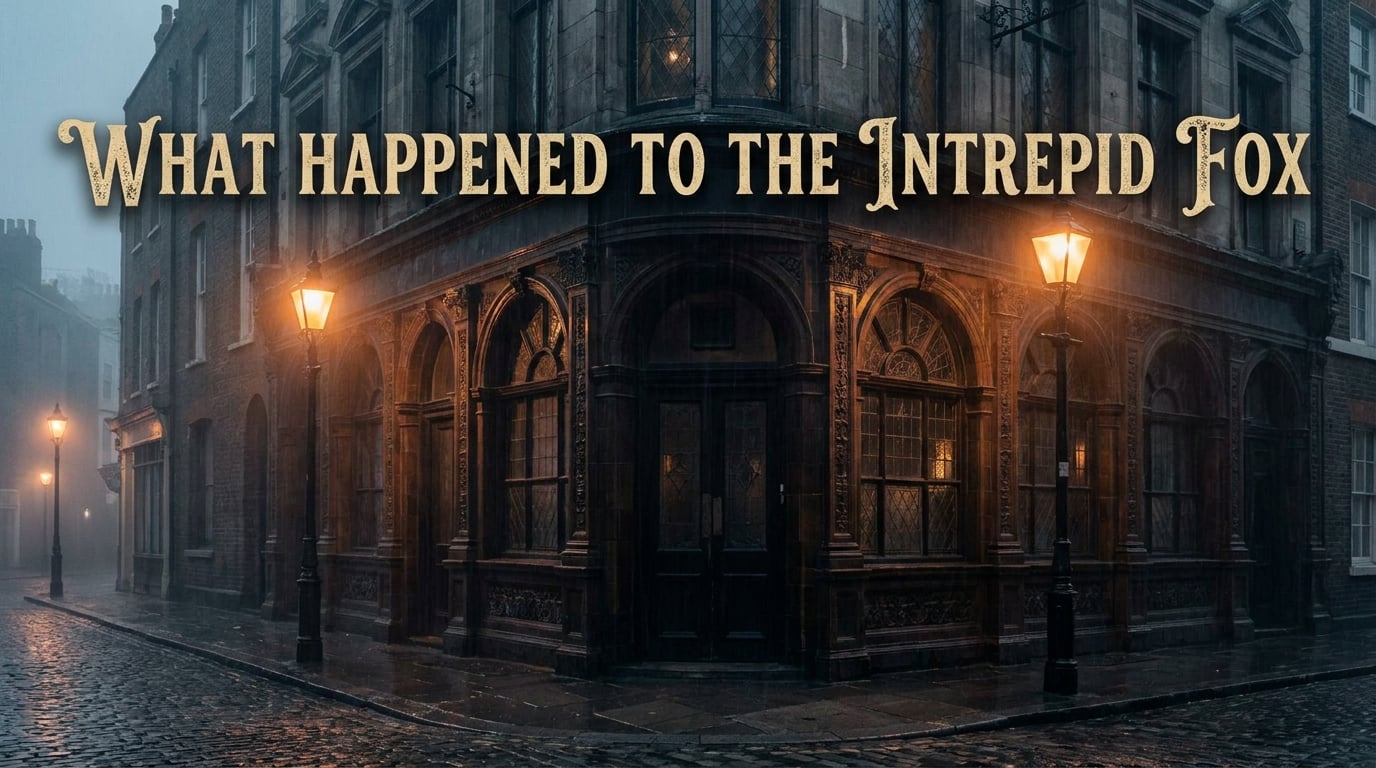
The Intrepid Fox closed in September 2006 when its owner, Mitchells and Butlers, sold the building at 97-99 Wardour Street to property developers as part of a GBP 53 million package deal involving 21 central London pubs. For 222 years, this legendary Soho establishment had served as the beating heart of London’s goth and heavy metal scene, earning a reputation as one of the last true rock and roll pubs in the city centre.
If you have ever wondered what happened to the Intrepid Fox the goth pub of Soho, the story spans three centuries, three locations, two closures, and a cultural shift that transformed one of London’s most characterful neighbourhoods. The pub’s journey from an 18th-century political celebration to a beloved haven for metallers, goths, and punks is one of the most fascinating chapters in London’s pub history.
Our team has traced the full timeline of the Intrepid Fox, from its founding in 1784 to its final incarnation and closure. We have pulled together details from BBC archives, The Guardian’s music coverage, the urban75 community tribute pages, and Wikipedia’s historical records to give you the complete picture. Here is the full story of what happened to the Intrepid Fox, the goth pub of Soho.
Table of Contents
What Was the Intrepid Fox?
The Intrepid Fox was a public house at 97-99 Wardour Street in the heart of Soho, London. Established in 1784, it operated continuously for 222 years until its closure in 2006. For most of its later history, the pub served as one of central London’s most important gathering places for the alternative music community.
What set the Intrepid Fox apart from countless other London boozers was its identity as a dedicated goth and heavy metal venue. While other pubs in Soho catered to media workers, tourists, or the after-work crowd, the Fox threw its doors open to a very different clientele. Metallers, goths, punks, and rock fans made this pub their spiritual home for decades.
The pub stood on the corner of Wardour Street and Peter Street, just a short walk from the Marquee Club and other legendary music venues that once made Soho the epicentre of London’s live music world. Regulars described it as “the only place to go in London if you like your metal.” Another former regular called it home to “one of the friendliest, politest and least tossy crowds of pubs around.”
On TripAdvisor, the Intrepid Fox earned a remarkable 4.9 out of 5 rating from community reviews, with one reviewer calling it “the best metal bar in the UK without a doubt.” That kind of loyalty does not happen by accident. The Fox earned its reputation through decades of hosting the people that other venues ignored.
The 1784 Founding: Charles James Fox and Samuel House
The Intrepid Fox owed its name to one of the most colourful figures in British political history. Charles James Fox was a Whig statesman, a rival of King George III, and one of the most celebrated politicians of the late 18th century. The pub was named in his honour following the 1784 general election.
The story goes that a publican named Samuel House, who ran a tavern near the current site, actively supported Fox’s parliamentary campaign during the volatile 1784 election. House reportedly offered free drinks to anyone who would vote for Fox, a gesture that became part of London’s political folklore. The pub was named the Intrepid Fox to commemorate this colourful episode.
Charles James Fox himself was known as much for his gambling and wit as for his politics. He served as Foreign Secretary and led the Whig opposition for decades. The pub bearing his name carried that same spirit of rebellion and defiance into the modern era, long after the political details were forgotten.
The building at 97-99 Wardour Street was notable for its faience facade, a type of glazed terracotta that was popular in Victorian architecture. The exterior featured a relief of Charles James Fox himself, a detail that survived the pub’s transformation from political landmark to goth music venue. This architectural feature tied the building back to its 18th-century origins even as its interior evolved dramatically over the decades.
For most of its early history, the Intrepid Fox operated as a traditional Soho public house. Wardour Street was a thriving commercial thoroughfare, and the Fox served the working people of the area for well over a century before music culture arrived.
The Goth and Metal Era: Inside the Intrepid Fox
The transformation of the Intrepid Fox into a goth and metal pub happened gradually during the late 1970s and 1980s. As punk exploded across London and heavy metal gained a dedicated following, the Fox positioned itself as the pub where alternative music fans could gather without judgement.
By the 1990s and early 2000s, the Intrepid Fox had cemented its reputation as one of the last rock and roll boozers in central London. The urban75 crew, documenting London’s cultural history, described it with nostalgic affection as a relic of their “tight-trousered, hard rockin’ days.” They called it “a legendary boozer on the music scene for decades.”
Inside, the pub catered to its community with rock and metal playing on the sound system, band posters on the walls, and a dress code that welcomed rather than turned away those in black leather, denim, and spikes. The bar staff were part of the community, not just employees. Manager Patrick Begent ran the pub for 15 years and was widely loved by regulars.
The atmosphere was unlike anything else in Soho. While neighbouring pubs filled with advertising executives and media workers, the Fox drew a crowd of metallers in leather jackets, goths in black lace, and punks with safety pins. It was loud, it was dark, and it was gloriously uncommercial. In a neighbourhood increasingly dominated by chain bars and expensive cocktail lounges, the Intrepid Fox felt like a holdout from a different era.
The BBC described the pub as “an integral part of the alternative music scene in London.” That description captured exactly what was at stake when the closure was announced. This was not just a place to drink. It was a community hub for people who had nowhere else in central London that felt like theirs.
Famous Patrons: Rock Royalty at the Fox
The Intrepid Fox attracted some of the biggest names in rock and roll history. Over the decades, its bar stools were occupied by musicians whose influence shaped entire genres of music.
The most famous anecdote involves Mick Jagger and Ronnie Wood of the Rolling Stones. According to local legend, Jagger first spotted Wood playing at the Intrepid Fox and poached him from Rod Stewart’s band, the Faces. Whether the story is entirely accurate or has grown in the telling, it speaks to the pub’s role as a place where rock history was made over pints.
Lemmy Kilmister of Motorhead was a known regular. Lemmy’s presence alone would have been enough to cement any pub’s rock credentials, but he was far from the only legend to drink there. Malcolm McLaren, the manager of the Sex Pistols and a architect of punk culture, was another name associated with the Fox.
The list of notable patrons extends further. Richard Harris, the hellraising Irish actor known for his roles in This Sporting Life and later the Harry Potter films, was a regular drinker. Slash, the Guns N’ Roses guitarist, reportedly visited. Zodiac Mindwarp, the larger-than-life metal frontman, was another name dropped by the urban75 community in their tribute.
Not everyone was welcomed with open arms. One frequently repeated story involves David Hasselhoff being turned away at the door. Whether apocryphal or not, the tale captures the spirit of the place perfectly. The Fox was for rock and alternative culture. Hollywood television stardom did not automatically grant you entry.
The September 2006 Closure: What Happened to the Intrepid Fox the Goth Pub of Soho
The closure of the original Intrepid Fox on Wardour Street was not the result of declining popularity or a failing business. It was a corporate decision made far from Soho, driven by property values rather than pint sales.
In 2006, the brewing and pub company Mitchells and Butlers announced a massive sell-off of central London properties. The company packaged 21 pubs into a single deal worth GBP 53 million and sold them to property developers. The Intrepid Fox at 97-99 Wardour Street was one of those 21 pubs.
The news hit the alternative music community like a hammer. Manager Patrick Begent, who had run the pub for 15 years, broke the news to regulars. The BBC covered the closure extensively, noting that one of London’s oldest pubs and a haven for fans of goth and metal was shutting its doors after 222 years of continuous operation.
The response from the public was immediate and passionate. Robin Canon launched the “Save the Fox” campaign, which gathered an astonishing 5,000 signatures in just 9 days. Supporters wrote letters, signed petitions, and contacted local councillors in a desperate bid to stop the closure.
It was not enough. The deal was done, the property was sold, and the developers had plans for trendy apartments. The Save the Fox campaign highlighted the broader frustration many Londoners felt about the sanitisation of their city. BBC comment sections filled with emotional responses, with readers calling the closure a “24-carat disgrace” and expressing devastation at the loss.
The urban75 community was equally vocal. Their tribute page described the Fox as “one of the last rock and roll boozers left in central London” and lamented the replacement of cultural landmarks with what they called “faceless designer apartments.” The anger was directed not just at Mitchells and Butlers but at the broader pattern of pubs being sold for property development across London.
In September 2006, the Intrepid Fox on Wardour Street served its last drinks. After 222 years, the building that had hosted Charles James Fox supporters, Rolling Stones legends, and generations of goth and metal fans fell silent.
What Became of the Building: Byron Hamburgers and Beyond
After the Intrepid Fox closed in 2006, the building at 97-99 Wardour Street did not find a new tenant immediately. The Derelict London archive documented the site lying empty and deteriorating for a period after the closure. The faience facade with its Charles James Fox relief remained, but the interior that had hosted decades of rock and metal history was gutted.
Eventually, the site reopened as part of the Byron Hamburgers chain. The building that had served pints to Lemmy and hosted political celebrations in the 18th century was transformed into a burger restaurant. For many former regulars, this felt like the final insult. A punk rock institution had been replaced by a chain restaurant.
The transformation was part of a broader pattern that reshaped Soho in the 2000s and 2010s. Independent pubs with decades or centuries of history were replaced by chain restaurants, luxury flats, and corporate offices. The BBC coverage of the Intrepid Fox closure explicitly connected it to this trend, quoting regulars who decried the “sanitisation” of Soho and the loss of its cultural diversity.
The contrast between what the building was and what it became tells the story of modern London in miniature. A 222-year-old pub named after a radical Whig politician, transformed into a sanctuary for goths and metal fans, ultimately replaced by a burger chain. The faience facade may still bear the relief of Charles James Fox, but the spirit of the place was gone.
The Three Incarnations of the Intrepid Fox
The story of what happened to the Intrepid Fox the goth pub of Soho does not end with the 2006 closure. Remarkably, the Intrepid Fox name and spirit survived in two further incarnations, each carrying the torch before eventually closing as well.
The first successor venue opened at 15 St Giles High Street, near Centre Point, in December 2006, just months after the Wardour Street closure. The urban75 community documented the reopening with photos and updates, celebrating the return of their beloved venue. The St Giles location carried on the goth and metal tradition, hosting gigs and serving the same community that had lost their Wardour Street home.
The St Giles incarnation lasted nearly eight years. In February 2014, The Guardian reported that the venue was facing imminent closure. The Intrepid Fox posted a statement on Facebook announcing the eviction, with a specific date of 1 April 2014. The venue promised a “third chapter” but the writing was on the wall.
The Guardian noted that the closure was linked to the broader impact of Crossrail construction around Tottenham Court Road. While Crossrail did not directly demolish the St Giles venue, the massive infrastructure project drove up property prices across the area and put enormous pressure on independent venues. The Astoria, Astoria 2, Metro, Sin, and Ghetto were all lost to Crossrail development in the same period.
A third incarnation reportedly appeared at the Archway Tavern in north London, but this version of the Intrepid Fox was short-lived and never achieved the same cultural footprint as the Wardour Street original or the St Giles successor. The venue’s Facebook statement about a “third chapter” ultimately proved optimistic.
Here is how the three incarnations compare. The original Wardour Street location ran from 1784 to 2006, operating for 222 years as a traditional pub that became a goth and metal institution. The St Giles High Street location ran from December 2006 to April 2014, lasting nearly eight years as a dedicated rock and metal venue near Centre Point. The Archway Tavern incarnation was brief and represented the final attempt to keep the name alive before the Intrepid Fox disappeared from London’s pub landscape entirely.
No competitor writing about the Intrepid Fox has presented this full timeline connecting all three incarnations. Understanding the complete arc of the venue, from its 18th-century founding to its eventual disappearance, gives you the full picture of what was lost when the Fox finally went dark for good.
The Broader Loss: Soho’s Disappearing Music Venues
The Intrepid Fox was not the only victim of Soho’s transformation. The closure was part of a wider pattern that saw many of the area’s most beloved music venues and independent pubs disappear within a single generation.
The Marquee Club, arguably the most famous music venue in British history, had already closed its Soho location years before the Fox shut down. The Marquee hosted the Rolling Stones, David Bowie, Jimi Hendrix, and countless others, but it could not survive the changing economics of central London.
Gossips Club, another alternative venue on Dean Street, was another casualty. The Dive Bar met the same fate. The urban75 tribute to the Intrepid Fox placed it alongside these lost venues, mourning the disappearance of an entire ecosystem of rock and alternative culture that once thrived in Soho.
The Crossrail project accelerated this trend dramatically. The construction of the new railway line through Tottenham Court Road led to the demolition or closure of the Astoria, the Astoria 2 (formerly the LA2), the Metro club, Sin, and the Ghetto. Each of these venues hosted live music and club nights that served specific communities. When they were demolished, those communities had nowhere else to go.
The Intrepid Fox closures at both Wardour Street and St Giles must be understood in this context. This was not a single venue failing. It was the systematic removal of alternative culture from one of London’s most historic neighbourhoods, driven by rising property values, infrastructure projects, and a planning system that prioritised development over cultural preservation.
Regulars who spoke to the BBC and posted on urban75 expressed a deep sense of loss that went beyond missing a favourite pub. They were watching their community being physically dismantled, building by building. The Fox was not just a place to drink. It was a place where you could walk in wearing anything, be yourself, and belong.
Why the Intrepid Fox Still Matters
It has been years since the last pint was served under the Intrepid Fox name, but the venue’s legacy continues to resonate. The YouTube channel Britain’s Lost and Living Pubs has documented the Fox’s story for a new audience, and online communities still share memories and photographs of all three incarnations.
The Intrepid Fox matters because it represents something that is increasingly rare in modern London. It was a venue with genuine character, a specific community, and a refusal to conform to commercial expectations. In an era where central London pubs increasingly look identical, the Fox stood for individuality, creativity, and a sense of belonging that money cannot buy.
The story of what happened to the Intrepid Fox the goth pub of Soho is ultimately a story about what happens when property values override cultural value. It is about a community that fought hard to save its gathering place and lost. And it is about the importance of remembering what was lost, even when the buildings themselves have been transformed beyond recognition.
If there is a lesson in the Intrepid Fox story, it is that the venues and pubs we take for granted today could be gone tomorrow. The Save the Fox campaign gathered 5,000 signatures in 9 days, but it could not overcome a GBP 53 million property deal. That is worth remembering the next time you walk past a pub that feels like it has always been there.
FAQs
When did the Intrepid Fox close?
The original Intrepid Fox on Wardour Street closed in September 2006. Owner Mitchells and Butlers sold the building at 97-99 Wardour Street to property developers as part of a GBP 53 million package deal involving 21 central London pubs.
Why did the Intrepid Fox close?
The Intrepid Fox closed because its owner, Mitchells and Butlers, sold the building to property developers as part of a GBP 53 million deal involving 21 pubs. The closure was driven by property values, not by a lack of customers or declining business.
Is the Intrepid Fox still open?
No, the Intrepid Fox is no longer open. After the original Wardour Street closure in 2006, a successor venue operated at St Giles High Street from 2006 to 2014. A brief third incarnation at the Archway Tavern also closed. No version of the Intrepid Fox is currently operating.
What replaced the Intrepid Fox on Wardour Street?
The building at 97-99 Wardour Street sat derelict for a period after the 2006 closure before reopening as a Byron Hamburgers restaurant. The faience facade and Charles James Fox relief on the exterior were preserved during the conversion.
Where did the Intrepid Fox relocate to?
The Intrepid Fox relocated to 15 St Giles High Street near Centre Point in December 2006, just months after the Wardour Street closure. This second incarnation operated until April 2014, when it was evicted. A brief third incarnation appeared at the Archway Tavern in north London.
Who frequented the Intrepid Fox pub?
The Intrepid Fox was frequented by London’s goth, heavy metal, punk, and rock communities. Famous patrons included Mick Jagger, Ronnie Wood, Lemmy Kilmister of Motorhead, Malcolm McLaren of the Sex Pistols, actor Richard Harris, guitarist Slash, and metal frontman Zodiac Mindwarp.
Conclusion: The Legacy of the Intrepid Fox
The story of what happened to the Intrepid Fox the goth pub of Soho is a tale of 222 years of history, three incarnations, two passionate closure campaigns, and a community that refused to give up without a fight. From its founding in 1784 as a tribute to a radical politician, through its decades as London’s premier goth and metal venue, to its eventual replacement by a burger chain, the Fox embodied a spirit of rebellion and belonging that is increasingly rare in modern London.
The building at 97-99 Wardour Street still stands today, its faience facade and Charles James Fox relief serving as a silent reminder of what once occupied the space. But the noise, the music, the leather jackets, and the community that made the Intrepid Fox legendary are gone. What remains is the memory, preserved in BBC archives, Guardian articles, urban75 tribute pages, and the stories of everyone who ever walked through those doors.
The Intrepid Fox may be gone, but the lessons it leaves behind are worth holding onto. Cultural venues matter. Communities matter. And once they are gone, no amount of regeneration can bring back what was lost. The next time you pass a pub that feels irreplaceable, remember the Fox, and the 5,000 people who tried to save it.