
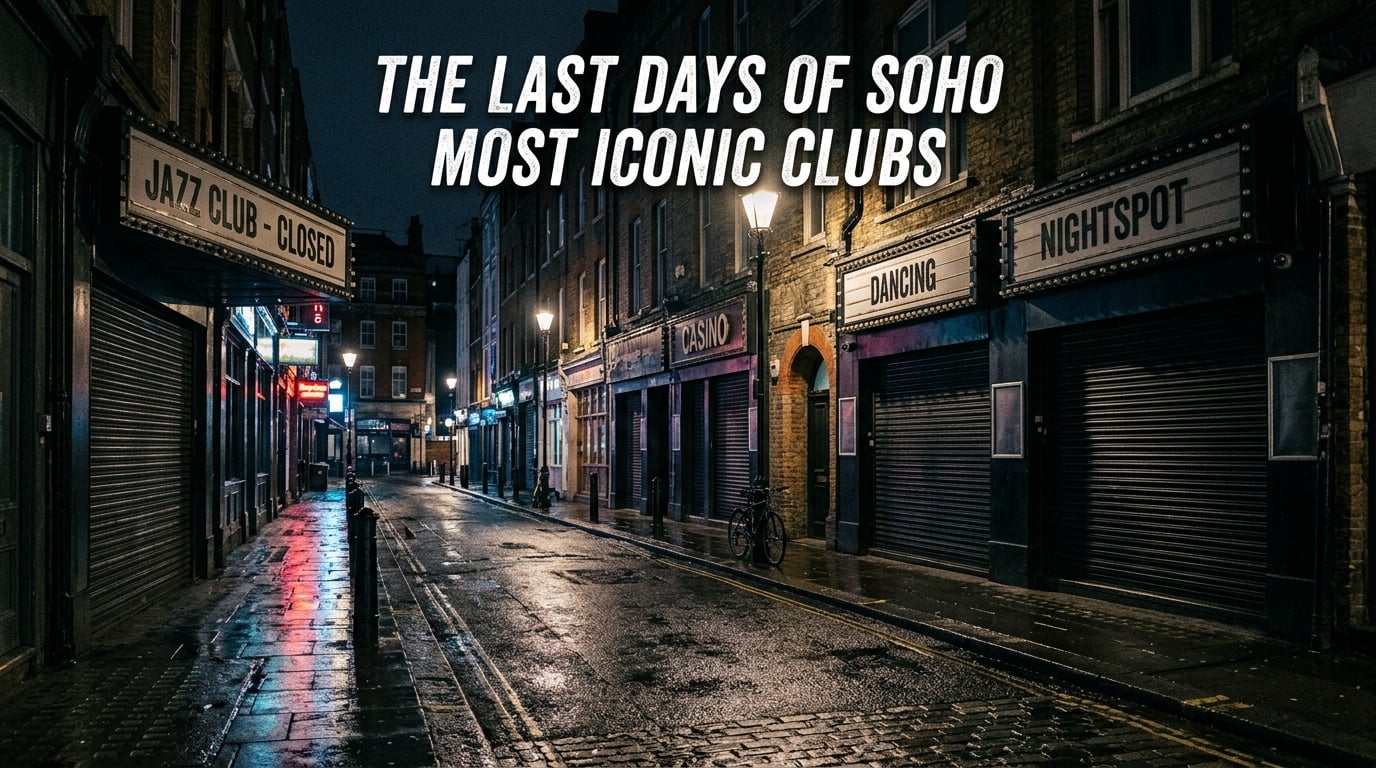
Walk through Soho on a Tuesday night in 2026 and you will notice something strange. The streets that once throbbed with bass lines, drag queens, and spilled pints now feel oddly quiet. Chain restaurants glow where legendary club entrances used to stand. For anyone who lived through Soho’s nightlife heyday, the transformation is hard to swallow.
The last days of Soho’s iconic clubs represent more than just a change in London’s entertainment map. They tell the story of a neighborhood losing its soul. Venue after venue has shut its doors over the past decade, taking with them decades of music history, LGBTQ+ heritage, and cultural rebellion.
I have spent years following this story, talking to promoters, club owners, and regulars who watched the decline happen in real time. What follows is a look at what Soho lost, why it happened, and what remains of the neighborhood that once defined London nightlife.
Table of Contents
The Golden Era of Soho Nightlife
Soho earned its reputation as London’s playground through decades of unchecked hedonism. From the 1960s through the 1990s, this square mile in the West End packed more clubs, bars, and music venues into its narrow streets than anywhere else in the country.
The area’s nightlife ecosystem was unlike anything before or since. Within a few minutes’ walk, you could catch jazz at Ronnie Scott’s, watch burlesque at a subterranean cabaret, hear punk bands tear through a set, and end the night at a drag bar. Each venue had its own crowd, its own rules, and its own mythology.
The 1960s: Birth of a Scene
The Marquee Club on Wardour Street became the center of British rock and roll. The Rolling Stones played their first gig there in 1962. David Bowie, Jimi Hendrix, and The Who all graced its cramped stage. The Marquee was not just a venue. It was a launchpad for an entire generation of musicians.
Down the street, the Flamingo Club hosted American soul acts and R&B nights that shaped the mod movement. Reputations were built here. Careers were launched. And the culture of all-night Soho drinking dens like the Colony Room and the French House fed a mythology that drew people from across the country.
The 1970s: Punk, Disco, and Vice
The 1970s brought grit and glamour in equal measure. The Roxy became the epicenter of punk rock, hosting the Sex Pistols, The Clash, and Generation X in a former strip club on Neal Street. Punk gave Soho a new edge, attracting outsiders and misfits who felt at home in the neighborhood’s seedy corners.
At the same time, Paul Raymond’s Revuebar operated as the most famous strip club in Soho. It carried enough respectability to keep it packed with businessmen, politicians, and celebrities. Raymond himself became one of the most powerful landlords in the area, eventually owning vast stretches of Soho property.
The 1980s and 1990s: New Romantics and Dance Music
The Blitz Club on Great Queen Street launched the New Romantics movement, with Steve Strange at the door deciding who was fabulous enough to enter. Spandau Ballet and Duran Duran played their early shows in Soho venues. The area was at the center of British pop culture.
When The End opened in 1995 on West Central Street, it set a new standard for London clubbing. With a world-class sound system, an underground atmosphere, and bookings from top DJs, The End became a pilgrimage site for dance music fans. It ran for nearly fourteen years before closing in 2009.
The Iconic Clubs We Lost
Each closed venue represents a chapter of Soho’s story that cannot be rewritten. Here are the clubs whose loss hurt the most.
Madame Jojo’s
Madame Jojo’s was the beating heart of Soho’s cabaret and drag scene. Located on Brewer Street, it hosted legendary nights like Kitsch Cabaret and the pioneering tranny drag party Way Out Club. For decades, this was where London’s LGBTQ+ community gathered to celebrate without judgment.
The venue closed abruptly in October 2014 after its premises licence was revoked following a violent incident outside. For many, the closure symbolized the death of old Soho. The building was later earmarked for redevelopment, and the performance space that hosted decades of drag history was erased.
G-A-Y Late
When Jeremy Joseph announced in late 2023 that G-A-Y Late would shut permanently, the LGBTQ+ community reeled. Joseph, who also operates the main G-A-Y venue at Heaven, said keeping the Late bar open had become a losing battle against rising costs and external pressures.
G-A-Y Late was more than a bar. It was a late-night refuge where young LGBTQ+ people could be themselves. Its closure followed a pattern seen across London, where nightlife venues that served marginalized communities disappeared faster than mainstream establishments. Joseph cited building works and the broader cost-of-living crisis as contributing factors.
The End
The End opened in 1995 and operated at the forefront of London’s dance music scene for fourteen years. Founded by DJ Layo Paskin and Mr C, it built a reputation for booking cutting-edge talent and maintaining one of the best sound systems in the country.
The club closed in January 2009. The owners cited the financial pressures of running a large West End venue during a recession. The building was demolished and replaced with a mixed-use development. No replacement venue ever emerged in its place.
The Marquee Club
The original Marquee Club at 90 Wardour Street hosted over 1,000 performances by legendary artists before closing its doors. The venue moved locations several times throughout its history, but the original Soho site remains the most storied.
The building that housed the Marquee was eventually converted into a restaurant. A blue plaque marks the spot, but the plaque cannot capture what was lost. The club that launched the Rolling Stones and hosted Hendrix is now a place where tourists eat dinner.
Raymond’s Revuebar
Paul Raymond’s Revuebar was once the most famous strip club in Britain. Its distinctive neon sign became a Soho landmark. The venue represented the area’s complicated relationship with the sex industry, sitting somewhere between sleaze and glamour.
After Raymond’s death and the gradual cleanup of Soho’s adult entertainment scene, the Revuebar closed. The building was redeveloped. Today, the neon sign is gone, replaced by the kind of signage that would not look out of place in any corporate district.
Why Are Soho Clubs Closing?
No single factor killed Soho’s nightlife. Instead, a combination of economic forces, regulatory changes, and cultural shifts converged to push out venues that had survived for decades.
Gentrification and Skyrocketing Rents
Rent increases are the most cited reason for club closures, and for good reason. As property values in central London soared, landlords realized they could charge far more for residential conversions, offices, or chain restaurants than for late-night venues. Clubs operating on thin margins simply could not compete.
The pattern is familiar. A building changes hands. The new landlord triples the rent. The venue cannot pay. A generic bar or restaurant takes its place. This cycle has repeated across Soho for over a decade, hollowing out the area’s nightlife character one venue at a time.
Licensing Restrictions and NIMBY Pressure
As wealthier residents moved into apartments above and around Soho venues, noise complaints surged. Westminster City Council faced mounting pressure to restrict late-night licenses. Venues that had operated for decades suddenly found their hours cut or their entertainment licenses revoked.
The premise was always the same. New residents moved into an area known for nightlife, then complained about the nightlife. Licensing reviews became weapons. One noise complaint could trigger a review that cost a venue tens of thousands in legal fees, even if the complaint was ultimately dismissed.
The Numbers Tell the Story
The Night Time Industries Association reported that the UK was losing nightlife venues at an alarming rate. According to their figures, approximately 35 independent nightlife venues were being lost every single week. Nightclubs specifically were closing at a rate of three per week, with 461 clubs lost since 2020.
By the end of the first half of 2026, approximately 750 British pubs had closed. The hospitality sector was in crisis, and Soho, with its high overhead costs and dense residential proximity, felt the impact more acutely than most areas.
Corporate Takeover and Homogenization
As independent venues closed, corporate chains moved in. The businesses replacing Soho’s iconic clubs do not need late-night licenses, do not host live music, and do not serve niche communities. They are designed for a different kind of customer entirely.
This homogenization stripped Soho of the very qualities that made it famous. The neighborhood that once attracted outsiders, artists, and rebels now caters to office workers and tourists. The sleazy, wonderful, dangerous heart of old Soho has been replaced by something safe and forgettable.
Changing Clubbing Habits
Demographic shifts played a role as well. Younger generations, particularly Gen Z, go clubbing less frequently than previous generations. Rising costs of a night out, the prevalence of home entertainment, and shifting social habits all contributed to declining foot traffic.
Forum discussions on Reddit and other platforms reveal genuine concern from younger Londoners who feel they missed out on Soho’s golden age. Many express frustration that the venues their older siblings raved about no longer exist.
The Cultural Cost of Losing Soho’s Clubs
The disappearance of Soho’s iconic clubs hits some communities harder than others. For the LGBTQ+ community, each venue closure meant losing a safe space in a city where acceptance is never guaranteed.
London lost roughly half of its LGBTQ+ venues between 2006 and the mid-2020s. These were not just bars and clubs. They were community centers, meeting places, and sanctuaries where people could exist without fear. When venues like G-A-Y Late and Madame Jojo’s closed, the community lost infrastructure that took decades to build.
The loss extends beyond the LGBTQ+ scene. Soho’s music venues nurtured generations of British artists. Its cabaret spaces gave performers room to experiment. Its drinking dens fostered the kind of creative cross-pollination that produces great art. You cannot measure what was lost in a spreadsheet.
What Remains of Soho Nightlife Today
Soho is not dead. Ronnie Scott’s still hosts world-class jazz on Frith Street. A handful of historic pubs, including the French House and the Coach and Horses, continue serving as they have for decades. Some new venues have opened, though they cater to a different crowd with different expectations.
But the Soho that emerges in 2026 is fundamentally different from the one that existed even ten years ago. The question is whether the remaining venues can survive the same pressures that claimed their predecessors, or whether the last days of Soho’s iconic clubs are simply the first chapter of a longer decline.
FAQs
What was the most famous club in Soho?
The Marquee Club on Wardour Street was arguably the most famous, having hosted the Rolling Stones, David Bowie, Jimi Hendrix, and The Who. Raymond’s Revuebar was the most famous strip club, and Madame Jojo’s was the most iconic cabaret and drag venue.
Why are so many night clubs closing?
Nightclubs are closing due to a combination of skyrocketing rents, gentrification, licensing restrictions driven by noise complaints from new residents, declining attendance among younger generations, and the broader cost-of-living crisis. The UK was losing approximately 35 nightlife venues per week, with nightclubs closing at three per week.
Is Soho still good for nightlife?
Soho still has nightlife, including Ronnie Scott’s jazz club and several historic pubs, but the scene is a fraction of what it was. Chain restaurants and corporate venues have replaced many independent clubs, and the area’s character has shifted toward a more mainstream, less edgy atmosphere.
What happened to Madame Jojo’s?
Madame Jojo’s closed in October 2014 after its premises licence was revoked following a violent incident outside the venue. The building on Brewer Street was later earmarked for redevelopment, ending decades of cabaret and drag performances at the iconic Soho location.
Why did G-A-Y Late close?
G-A-Y Late closed permanently in late 2023. Owner Jeremy Joseph stated that keeping the venue open had become a losing battle due to rising costs, building works in the area, and the broader pressures facing the nightlife industry. The closure was a significant loss for London’s LGBTQ+ community.
Conclusion
The last days of Soho’s iconic clubs are not a single event but a slow, painful unraveling. Each closure erased a piece of London’s cultural memory that cannot be replaced by a restaurant or a corporate bar. Madame Jojo’s, The End, G-A-Y Late, the Marquee, and Raymond’s Revuebar were not just businesses. They were institutions that shaped music, fashion, and queer culture for generations.
The forces that closed them, gentrification, licensing crackdowns, and corporate takeover, are not going away. But understanding what was lost is the first step toward preserving what remains. Soho’s nightlife may never return to what it was, but the story of its iconic clubs deserves to be remembered.