
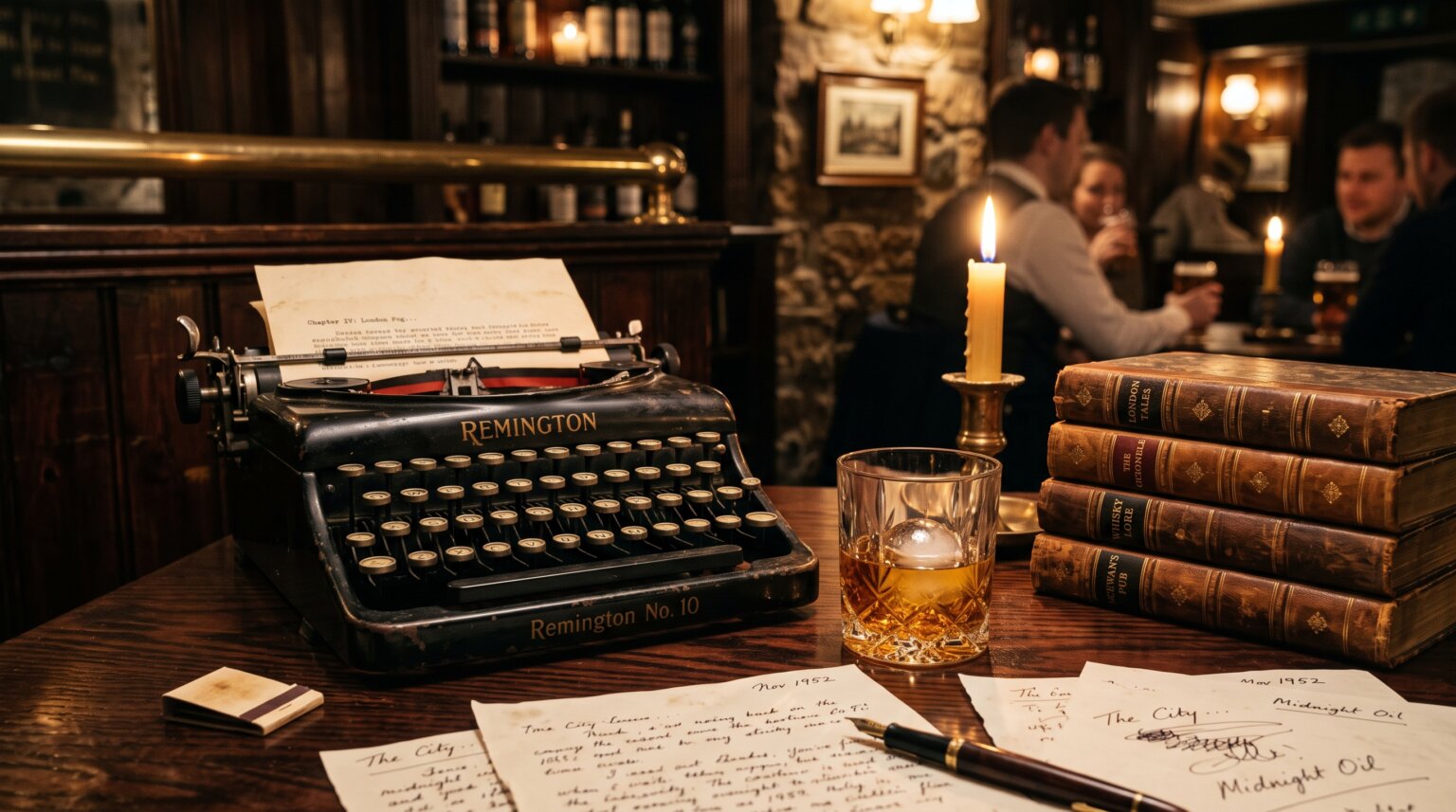
Soho’s literary drinking culture was a centuries-old tradition where London’s writers, poets, and artists gathered in the neighbourhood’s pubs and private members’ clubs — from the French House on Dean Street to the Colony Room above a strip joint — using these spaces as creative salons, editorial offices, and communities that shaped some of the most important literature in the English language.
For over 150 years, a square mile of central London produced more literary gossip, manuscript drafts, and drunken promises than anywhere else in Britain. Writers did not just drink in Soho. They worked there, fought there, fell in love there, and occasionally left unpublished masterpieces on the bar.
The story you usually hear involves Dylan Thomas, the French House, and a lost manuscript. But the real history of Soho’s literary drinking culture goes deeper. It includes French poets in exile, women running the most powerful drinking clubs in London, Cold War spies who wrote novels between intelligence briefings, and American Beat Generation writers who turned Soho’s jazz bars into transatlantic literary salons.
This is the untold story of how a few streets in London’s W1 postcode became the beating heart of British literary bohemia — told through the pubs, the people, and the stories that most guides leave out.
Table of Contents
Soho’s Literary Drinking Culture: Key Pubs at a Glance
Before diving into the stories, here is a reference table comparing the literary pubs that shaped Soho’s drinking culture. Some survive. Many are gone. All of them left their mark on British literature.
| Pub / Venue | Location | Famous Literary Patrons | Era | Status |
|---|---|---|---|---|
| The French House | 49 Dean Street | Dylan Thomas, Brendan Behan, Rimbaud (disputed) | 1910s – present | OPEN |
| The Coach and Horses | 29 Greek Street | Jeffrey Bernard, George Orwell, Francis Bacon | 1850s – present | OPEN |
| The Colony Room Club | 41 Dean Street (upstairs) | Francis Bacon, Jeffrey Bernard, Lucian Freud | 1948 – 2008 | CLOSED |
| The Gargoyle Club | 69 Dean Street | Henri Matisse, Augustus John, Virginia Woolf | 1925 – 1978 | CLOSED |
| Pillars of Hercules | 7 Greek Street | Ian Hamilton, Julian Barnes, Martin Amis | 1730s – 2018 | CLOSED |
| The Wheatsheaf | 25 Rathbone Street (Fitzrovia) | Dylan Thomas, George Orwell, Caitlin Macnamara | 1920s – present | OPEN |
| Cafe Royal | 68 Regent Street | Oscar Wilde, Arthur Conan Doyle, Max Beerbohm | 1865 – present (as hotel) | CONVERTED |
| The Dog and Duck | 18 Frith Street | George Orwell, John Constable (artist) | 1897 – present | OPEN |
| The Gay Hussar | 2 Greek Street | Political journalists, Left Book Club editors | 1940 – present | OPEN |
| Dukes Hotel (Bar) | 35 St James’s Place | Ian Fleming | 1909 – present | OPEN |
As you can see, the landscape has changed dramatically. The Colony Room, Gargoyle Club, and Pillars of Hercules are gone. But the French House, Coach and Horses, and Dog and Duck remain — and they still serve the same streets where literary history was made.
The French Connection: Rimbaud, Verlaine, and the French House
The story of Soho’s literary drinking culture begins, surprisingly, with the French. In the 1870s, the teenage poet Arthur Rimbaud and his lover Paul Verlaine arrived in London, living in what is now the Kings Cross area but drinking in the French-populated cafes and bars around Soho. Their chaotic, violent relationship — Verlaine eventually shot Rimbaud in Brussels — cast a long shadow over French literary culture in London.
The French House on Dean Street opened its doors around 1910 and quickly became a meeting point for the French exile community in London. But its literary reputation was sealed during World War II, when Charles de Gaulle used it as an informal headquarters for the Free French forces. De Gaulle supposedly gave a speech from the bar that helped rally French resistance. Whether or not that exact story is verifiable, the pub’s role as a centre of French exile culture is firmly documented.
One of the French House’s most distinctive traditions — serving only half-pints of beer — dates from this era. The story goes that the pub was so crowded with French patrons that the landlord wanted to keep turnover high and glasses moving. The half-pint-only rule survives to this day, making the French House the only pub in Soho where ordering a full pint is impossible.
For writers, the French House offered something unique: an atmosphere that felt continental rather than British. You could imagine yourself in a Parisian cafe rather than a London pub. That atmosphere attracted the heavy-drinking Welsh poet Dylan Thomas, the Irish playwright Brendan Behan, and a stream of writers who wanted to feel closer to European literary culture without crossing the Channel.
Dylan Thomas and the Under Milk Wood Manuscript
No figure looms larger in Soho’s literary drinking culture than Dylan Thomas. The Welsh poet arrived in London in the 1930s and quickly established himself as one of the most talented — and hardest-drinking — writers of his generation. His preferred Soho base was the French House, though he also drank heavily at the Wheatsheaf in neighbouring Fitzrovia.
The most famous anecdote about Thomas and the French House involves the manuscript of Under Milk Wood, his celebrated radio drama. According to legend, Thomas left the only copy of the manuscript at the French House after a long drinking session. The landlord allegedly retrieved it and kept it behind the bar. Variations of this story place the manuscript at several different pubs, which has led some historians to question whether it happened at all — but the French House version is the most widely cited and is commemorated with a plaque at the pub.
What is certainly true is that Thomas drank at the French House so regularly that he effectively treated it as a second home. He ran up legendary tabs that he could not pay. The landlord at the time, Victor Beucler, reportedly tolerated Thomas’s financial unreliability because his presence attracted other writers and customers who wanted to drink alongside a famous poet.
The Wheatsheaf on Rathbone Street, just north of Soho proper in Fitzrovia, claims an equally important Thomas story. It was here, in 1936, that Thomas first met the dancer Caitlin Macnamara. Their meeting was famously chaotic — Thomas was already drunk, Macnamara was dancing, and within days they were engaged. They married at the register office in Penzance in 1937. Caitlin herself was a writer and memoirist whose own literary output is often overshadowed by her husband’s fame and their turbulent marriage.
Irish playwright Brendan Behan was another French House regular whose drinking was legendary even by Soho standards. Behan, author of The Quare Fellow and The Hostage, reportedly once arrived at the French House with a suitcase full of money from a publishing advance and proceeded to buy drinks for the entire pub until the money was gone. His binges became part of Soho’s oral tradition, repeated by bar staff and regulars long after Behan’s death in 1964.
The Colony Room Club: Muriel Belcher’s Bohemian Salon
If the French House was Soho’s public literary salon, the Colony Room Club was its private one. Founded in 1948 by Muriel Belcher at 41 Dean Street — upstairs, above what was then a strip club — the Colony Room was a members-only drinking club that became the spiritual home of post-war British bohemia.
Belcher herself is one of the most underappreciated figures in Soho’s literary history. A sharp-tongued, charismatic woman from the Midlands, she created an environment that was equal parts salon and snake pit. She insulted her customers freely, refused entry to anyone she disliked, and cultivated a tight-knit community of artists and writers who treated the Colony Room like a second home — or sometimes their only home.
The club’s most famous member was the painter Francis Bacon, who was drinking at the Colony Room on the very first day it opened and remained a fixture for decades. Bacon’s presence attracted other artists, writers, and intellectuals. Lucian Freud, John Deakin, Jeffrey Bernard, and many others passed through the green-walled room, drinking gin and trading insults until the early hours.
Jeffrey Bernard, the journalist and Spectator columnist, was arguably the Colony Room’s most devoted literary figure. His “Low Life” column in The Spectator — which ran from 1975 until his death in 1997 — documented the Soho drinking life with brutal honesty and dark humour. Bernard wrote about alcoholism, gambling, and the slow disintegration of bohemian Soho with a clarity that came from living it every day. His columns remain the most vivid written record of what it was actually like to drink in Soho during the second half of the twentieth century.
The Colony Room’s significance went beyond the drinking. In an era when mainstream British culture was conformist and class-bound, the Colony Room offered a space where class distinctions dissolved, where artists and aristocrats mixed freely, and where the only thing that mattered was whether you could hold your drink and your conversation. It was a bohemian salon in the truest sense — a place where art and literature were debated, deals were struck, and creative relationships were forged over gin.
The Colony Room finally closed its doors in 2008. By then, rents in Soho had risen, the bohemian community had dispersed, and the drinking culture that had sustained it had changed beyond recognition. The room itself — those famous green walls — has been preserved in various forms, but the club as a living institution is gone.
The Coach and Horses: Norman Balon and Jeffrey Bernard
While the Colony Room was a private members’ club, the Coach and Horses on Greek Street was Soho’s public face of literary drinking. And its publican, Norman Balon, became as much a Soho character as any writer who drank there.
Balon ran the Coach and Horses from 1949 to 2006 — an astonishing 57 years behind the same bar. He was famous for his rudeness, which he cultivated into a performance art. He insulted customers, threw people out without warning, and once described himself as “the rudest landlord in London.” That rudeness was part of the pub’s appeal: writers and journalists loved it because Balon treated everyone equally badly, regardless of their fame.
Jeffrey Bernard was the Coach and Horses’ most famous regular, and his corner table became a Soho landmark. Bernard wrote his Spectator columns from the pub, drawing on conversations and characters he encountered there. The Coach and Horses effectively served as Bernard’s office, and his columns made it famous across Britain. When Keith Waterhouse wrote the play Jeffrey Bernard Is Unwell — a tribute to Bernard and his drinking life — the Coach and Horses became cemented in the public imagination as the definitive Soho literary pub.
George Orwell also drank at the Coach and Horses, though he was more closely associated with several other Soho and Fitzrovia pubs. Orwell’s essay “The Moon Under Water” (1946) described his ideal pub — and while the Coach and Horses was not the direct model, its atmosphere matched many of the qualities Orwell described: comfortable, unhurried, and democratic.
The Coach and Horses also functioned as an unofficial editorial office for several publications. Editors from nearby newspapers and magazines would hold court at the pub, conducting meetings over pints rather than at desks. This was a common pattern in Soho’s literary drinking culture: the line between socialising and working was deliberately blurred, and pubs served as extensions of the publishing world’s professional spaces.
Today the Coach and Horses is still open, still on Greek Street, and still leans into its literary heritage. It is one of the few surviving pubs where you can sit in the same room where Bernard, Bacon, and Orwell once drank — though the atmosphere, regulars freely admit, is not quite what it was.
Spies and Literature: Ian Fleming and Graham Greene
One of the most underexplored chapters of Soho’s literary drinking culture is the overlap between writers and intelligence officers. During and after World War II, several of Britain’s most prominent novelists worked for British intelligence — and they brought their espionage world into Soho’s pubs and bars.
Ian Fleming, creator of James Bond, was a regular at Dukes Hotel on St James’s Place, just south of Soho. Fleming reportedly drank at Dukes Bar while drafting the Bond novels in the 1950s, and the bar’s martinis are widely credited as the inspiration for Bond’s famous “shaken, not stirred” Vesper. Dukes Bar still serves the Vesper martini to this day, made to the exact recipe Fleming described in Casino Royale (1953). The connection between Fleming’s real drinking habits and his fictional spy’s tastes gives Dukes a unique place in literary London.
Graham Greene’s connection to Soho’s pub culture was more politically charged. Greene, who worked for MI6 during World War II, was a regular at the Red Lion in Parliament Street and several Soho-area pubs. His intelligence background informed novels like The Third Man and Our Man in Havana, and the conversations he had in pubs with fellow intelligence officers and journalists shaped his political fiction.
The most fascinating figure in this spy-literary crossover is Kim Philby. Philby, the Soviet double agent who defected to Moscow in 1963, was part of the same social circles as Greene and other literary intelligence officers. He drank in the same pubs, attended the same dinner parties, and moved freely between the worlds of espionage and literature. When Philby’s treachery was exposed, it sent shockwaves through the literary-intelligence community — several writers and journalists realised they had been drinking with a man who was passing their country’s secrets to Moscow.
This espionage-literary crossover gave Soho’s pub culture a political edge that is easy to miss if you only focus on the bohemian surface. In the pubs and bars around Soho and St James’s, Cold War secrets were discussed alongside poetry drafts and publishing deals. The line between fiction and intelligence was genuinely blurred, and some of Britain’s best spy novels were born in those boozy Soho conversations.
No other article on Soho’s literary drinking culture fully develops this espionage angle. But it is essential to understanding why Soho’s pubs mattered: they were not just places where writers got drunk. They were places where the cultural and political establishment of post-war Britain collided, mingled, and sometimes betrayed each other.
Women Writers in Soho’s Pub Culture
The standard narrative of Soho’s literary drinking culture is overwhelmingly male. Open any article on the subject and you will find Dylan Thomas, Jeffrey Bernard, Francis Bacon, Brendan Behan, George Orwell, Ian Fleming, and Graham Greene. Women, when mentioned at all, appear as wives, muses, or barmaids. This is a significant distortion of the historical record.
Muriel Belcher, founder and proprietor of the Colony Room Club, was arguably the single most powerful woman in Soho’s post-war cultural scene. She ran the club from 1948 until her death in 1979, controlling access to one of the most exclusive artistic communities in London. Belcher was not a writer herself, but she shaped literary culture by deciding who could drink in her club — and therefore who could participate in the conversations, connections, and creative relationships that formed there. Her influence on British literary and artistic life was enormous, yet she is rarely mentioned outside discussions of the Colony Room itself.
Virginia Woolf and the Bloomsbury Group had a more ambivalent relationship with Soho. Bloomsbury’s literary culture was centred further north, around Gordon Square, but Bloomsbury members drank and dined in Soho regularly. Woolf mentions Soho restaurants and streets in her diaries, and the Bloomsbury set occasionally attended events at the Gargoyle Club on Dean Street, which hosted artistic gatherings from 1925 until its closure in 1978. The Gargoyle, founded by David Tennant (not the actor), was one of the few Soho venues where women could socialise on equal terms with men in a semi-public setting.
Sylvia Plath and Ted Hughes were associated with several London pubs in the late 1950s and early 1960s, before their move to Devon. While their pub culture was more centred on Bloomsbury and Fitzrovia than Soho proper, the literary drinking networks of which they were part overlapped heavily with Soho’s. Plath’s own writing about London social life — and the tensions between literary ambition and domestic life — reflects the gendered dynamics of the pub as a male-coded creative space.
Caitlin Macnamara, whom Dylan Thomas met at the Wheatsheaf in 1936, was a dancer and writer in her own right. Her memoirs — including Caitlin: Life with Dylan Thomas (1986) — provide one of the most honest accounts of what it was like to be married to a genius who drank in Soho. Macnamara’s perspective challenges the romantic myth of the hard-drinking male writer by revealing the cost borne by the women around him.
The absence of women from most accounts of Soho’s literary drinking culture reflects the gender dynamics of the era: pubs were overwhelmingly male spaces, and the literary culture that formed around them was correspondingly male-dominated. But women were present — as proprietors, writers, dancers, muses, and participants — and any honest account of Soho’s literary heritage must include them.
The Lost Pubs: Gargoyle Club, Pillars of Hercules, and What Vanished
Part of what makes Soho’s literary drinking culture feel so romantic is how much of it has disappeared. Forum users on Reddit regularly lament the closure of literary pubs, and the sense of loss is palpable. Several of the most significant venues in Soho’s literary history are gone entirely.
The Gargoyle Club at 69 Dean Street was perhaps the most glamorous lost venue. Founded in 1925 by David Tennant, the Gargoyle was a members-only nightclub that occupied the upper floors of a Georgian townhouse. Its interiors featured a dance floor decorated by Henri Matisse, and its clientele included Virginia Woolf, Augustus John, and later, Francis Bacon. The Gargoyle was the kind of place where a writer could dance with a duchess and argue about modernism until 3 a.m. It closed in 1978, unable to compete with the changing nightlife culture of late twentieth-century London.
The Pillars of Hercules on Greek Street closed in 2018, ending nearly 300 years of continuous operation. The pub was named after a pub mentioned by Dickens — though whether Dickens actually drank at this particular Pillars of Hercules is disputed. What is certain is that in the 1970s and 1980s, the Pillars of Hercules became the unofficial headquarters of a circle of poets and writers associated with the poet and editor Ian Hamilton. Hamilton founded the influential literary magazine The Review and later The New Review, and the Pillars served as the editorial office, post room, and bar for the magazine’s contributors.
Julian Barnes, Martin Amis, Ian McEwan, and Clive James were all associated with the Pillars of Hercules circle. The pub’s closure was met with genuine grief in the literary community. Ian Hamilton had died in 2001, but the tradition of literary gathering that he established at the Pillars survived — in diminished form — until the pub itself was sold and converted.
The Cafe Royal on Regent Street, at the eastern edge of Soho, was where Oscar Wilde held court in the 1890s. Wilde’s preferred drink was absinthe, and the Cafe Royal was one of the few London establishments that served it properly. The Cafe Royal witnessed some of the most famous literary dinners of the 1890s, including the legendary 1893 meeting between Wilde and Lord Alfred Douglas. The Cafe Royal is still open, but as a luxury hotel — the grand restaurant where Wilde drank absinthe has been replaced by modern interiors. The building remains, but the literary atmosphere does not.
These losses matter because pubs were not just backdrops for literature — they were participants in it. When a pub closes, a piece of literary infrastructure disappears. The conversations, the regulars, the unspoken codes of behaviour, the physical layout of the bar — all of these shaped the writing that emerged from Soho. Losing the Gargoyle, the Pillars, and the Colony Room means losing the actual spaces where British literary history happened.
The Beat Generation and 1960s Soho
In the late 1950s and 1960s, a new wave of American writers arrived in Soho. The Beat Generation — Allen Ginsberg, Jack Kerouac, William Burroughs — found in Soho’s drinking culture a British counterpart to their own bohemian scene in New York and San Francisco.
Allen Ginsberg lived in London periodically in the 1960s and drank in several Soho pubs and jazz clubs. The Flamingo Club on Wardour Street, which operated as a jazz and rhythm and blues venue from 1952, was one of the key crossover spaces between Soho’s literary and music scenes. Ginsberg and other Beats attended performances there, and the club became a meeting point for British and American countercultural figures.
Berwick Street Market, on the eastern edge of Soho, was another nexus point. The market area was surrounded by pubs, cafes, and strip clubs that formed a dense cultural ecosystem. Writers, musicians, and artists moved between these spaces freely, creating a version of Soho that was less purely literary than the 1940s Colony Room era but more culturally diverse.
William Burroughs, who lived in London in the 1960s and 1970s, was associated with several Soho venues. His cut-up literary technique — developed with Brion Gysin — was influenced by the visual and auditory collage of Soho’s streets, where neon signs, market shouts, jazz music, and pub conversations layered over each other in a continuous sensory stream.
The 1960s changed Soho’s literary character permanently. The post-war bohemian era of the Colony Room and the Coach and Horses gave way to a more fragmented, youth-oriented culture. Rock and roll, drugs, and the sexual revolution created new social patterns that did not centre on the pub in the same way. The literary drinking culture did not vanish — it fragmented, with different writers and subcultures gravitating to different venues rather than gathering in a single concentrated scene.
Publishing Houses and Editorial Meetings Over Pints
One of the most underappreciated aspects of Soho’s literary drinking culture is the role that publishing houses played. Soho and its immediate surroundings were home to numerous small presses, literary magazines, and publishing offices. These businesses relied on local pubs as extensions of their offices — places where editors could meet writers, negotiate contracts, and review manuscripts in a less formal setting.
The Gay Hussar on Greek Street, a Hungarian restaurant and bar that opened in 1940, was the preferred meeting place of left-wing political journalists and publishers. The Left Book Club, founded in 1936 by Victor Gollancz, was closely connected to the political-literary culture that gathered at the Gay Hussar. Editors from left-wing publishing houses would hold court there, discussing manuscripts and political strategy over goulash and wine.
The Pillars of Hercules served a similar function for poetry and literary fiction. As mentioned above, Ian Hamilton ran The Review magazine from the pub, and contributors would drop in to discuss submissions, argue about poetry, and plan issues. This pattern — of the pub as editorial office — was common across Soho. It reflected a broader truth about mid-twentieth-century British publishing: the informal, personal relationships formed over drinks were often more important to a writer’s career than any formal meeting.
Bookshops were part of this ecosystem too. Soho was home to several secondhand and antiquarian bookshops — including Any Amount of Books on Charing Cross Road, at Soho’s western edge — that served as gathering points for bibliophiles. Writers, collectors, and dealers would browse shelves during the day and drink in Soho’s pubs at night, creating a continuous literary culture that spanned both retail and drinking spaces.
This publishing-pub nexus is largely invisible in most accounts of Soho’s literary heritage, which focus on individual writers rather than the professional infrastructure that supported them. But without the pubs where editors and writers met, much of the literature associated with Soho would never have been written, published, or promoted.
A Walking Route Through Surviving Soho Literary Pubs
For those who want to experience what remains of Soho’s literary drinking culture, here is a self-guided walking route through the surviving pubs. This route takes roughly two hours on foot, not counting time spent drinking.
Stop 1: The French House, 49 Dean Street. Start here. Order a half-pint (you have no choice) and look for the plaque commemorating Dylan Thomas’s lost Under Milk Wood manuscript. The pub’s small size and French atmosphere immediately convey what drew writers here. Arrive early on a weekday to avoid the crowds.
Stop 2: The Coach and Horses, 29 Greek Street. Walk one block east to Greek Street. This is Jeffrey Bernard’s old local. The pub has leaned into its literary heritage, and the interior still has the feel of a traditional Soho boozer. Ask the staff about Norman Balon — some of them still have stories.
Stop 3: The Dog and Duck, 18 Frith Street. Continue east to Frith Street. This small, tile-fronted pub is associated with George Orwell and, before him, the artist John Constable. The Dog and Duck is one of the least touristy of Soho’s literary pubs, and its compact interior gives a genuine sense of what Soho pub drinking felt like in the mid-twentieth century.
Stop 4: Bar Italia, 22 Frith Street. End your walk with a coffee at Bar Italia, an Italian cafe that has been on Frith Street since 1949. It is not a pub, but it is a key Soho literary and cultural landmark — writers and musicians have been drinking espresso here for over 75 years. It is the perfect place to sober up and reflect on the literary ghosts you have been drinking alongside.
For those with more time, extend the walk north into Fitzrovia to visit the Wheatsheaf on Rathbone Street, where Dylan Thomas met Caitlin Macnamara. And for those interested in the espionage angle, walk south to Dukes Hotel on St James’s Place and order the Vesper martini that Ian Fleming made famous.
The key to an authentic Soho literary pub crawl is to go on a weekday afternoon, avoid the obvious tourist pubs on the main streets, and remember that the best stories are in the side streets — exactly where the writers themselves preferred to drink.
FAQs
What is Soho’s literary drinking culture?
Soho’s literary drinking culture was a tradition spanning over 150 years in which London’s writers, poets, and artists used the neighbourhood’s pubs and private members’ clubs as creative salons and editorial offices. Venues like the French House, the Colony Room Club, and the Coach and Horses served as meeting places where manuscripts were discussed, publishing deals were struck, and some of the most important English literature of the twentieth century was shaped.
Which Soho pubs did famous writers frequent?
The most significant literary pubs in Soho include the French House on Dean Street (Dylan Thomas, Brendan Behan), the Coach and Horses on Greek Street (Jeffrey Bernard, George Orwell, Francis Bacon), the Colony Room Club on Dean Street (Francis Bacon, Lucian Freud, Jeffrey Bernard), the Dog and Duck on Frith Street (George Orwell), and the now-closed Pillars of Hercules on Greek Street (Ian Hamilton, Julian Barnes, Martin Amis).
What is the French House Soho famous for?
The French House on Dean Street is famous as the pub where Dylan Thomas allegedly left the only manuscript of Under Milk Wood. It was also a meeting point for the Free French forces during World War II, and it is known for serving only half-pints of beer — a tradition that dates from the wartime era. Writers like Brendan Behan and Dylan Thomas were regulars.
Did Dylan Thomas really leave his manuscript in a Soho pub?
According to legend, Dylan Thomas left the only copy of the Under Milk Wood manuscript at the French House after a drinking session. The landlord reportedly retrieved it and kept it behind the bar. Variations of this story place the manuscript at several different pubs, leading some historians to question its accuracy, but the French House version is the most widely cited and is commemorated with a plaque.
Who was Muriel Belcher and what was the Colony Room?
Muriel Belcher was the founder and proprietor of the Colony Room Club, a private members-only drinking club at 41 Dean Street that operated from 1948 to 2008. Belcher was known for her sharp tongue and selective door policy. The Colony Room became the spiritual home of post-war British bohemia, with Francis Bacon, Jeffrey Bernard, and Lucian Freud among its most famous members.
What happened to the Colony Room Club?
The Colony Room Club closed in 2008 after 60 years of operation. Rising rents in Soho, the dispersal of the bohemian community, and changes in London’s drinking culture all contributed to its closure. The club’s famous green walls have been partially preserved, but it no longer operates as a drinking establishment.
Are there still literary pubs in Soho today?
Yes. Several literary pubs remain open in Soho, including the French House on Dean Street, the Coach and Horses on Greek Street, and the Dog and Duck on Frith Street. The atmosphere has changed — Soho is more commercial and tourist-oriented than it was — but these pubs still preserve elements of the literary heritage that made them famous.
What was the Gargoyle Club in Soho?
The Gargoyle Club was a glamorous members-only nightclub at 69 Dean Street that operated from 1925 to 1978. Founded by David Tennant, it featured interiors decorated by Henri Matisse and attracted clients including Virginia Woolf, Augustus John, and later Francis Bacon. It was one of the most sophisticated drinking venues in Soho’s literary history before its closure in 1978.
Where did the Beat Generation drink in Soho?
Beat Generation writers including Allen Ginsberg and William Burroughs drank at various Soho pubs and jazz clubs in the late 1950s and 1960s. The Flamingo Club on Wardour Street was a key venue where literary and music cultures overlapped. Berwick Street Market and its surrounding pubs formed another nexus point for the American countercultural writers who frequented Soho.
How did Soho become a center for literary bohemia?
Soho became a literary bohemian centre due to a combination of factors: its central London location, its cheap rents in the early twentieth century, its concentration of pubs and cafes that tolerated unconventional behaviour, and its proximity to publishing houses, theatres, and newspapers. The neighbourhood’s French exile community, its wartime history, and its post-war cheap drinking culture all contributed to making it a magnet for writers and artists.
The Legacy of Soho’s Literary Drinking Culture Today
The untold story of Soho’s literary drinking culture is bigger than the familiar anecdotes about Dylan Thomas and the French House. It encompasses French poets in exile, women who ran the most powerful cultural clubs in London, Cold War spies who wrote novels, American Beats who found a second home in Wardour Street jazz bars, and editors who ran literary magazines from pub corner tables.
Many of the venues that made this culture possible are gone. The Colony Room, the Gargoyle Club, the Pillars of Hercules — all closed. But the French House still serves half-pints on Dean Street. The Coach and Horses still stands on Greek Street. The Dog and Duck still welcomes drinkers on Frith Street. These surviving pubs are the last physical connections to a world that produced some of the most important writing in the English language.
Soho’s literary drinking culture matters because it reminds us that literature does not happen in isolation. It happens in communities, in conversations, in the messy overlap between art and alcohol, ambition and self-destruction. The pubs of Soho were not just places where writers happened to drink. They were the infrastructure of British literary culture — and understanding that infrastructure helps us understand the literature itself.
If you want to experience what remains, walk the route described above. Visit the French House and order a half-pint. Sit where Dylan Thomas, Jeffrey Bernard, and George Orwell once sat. And when someone asks you what Soho’s literary drinking culture was, you will have more than the familiar story to tell.