
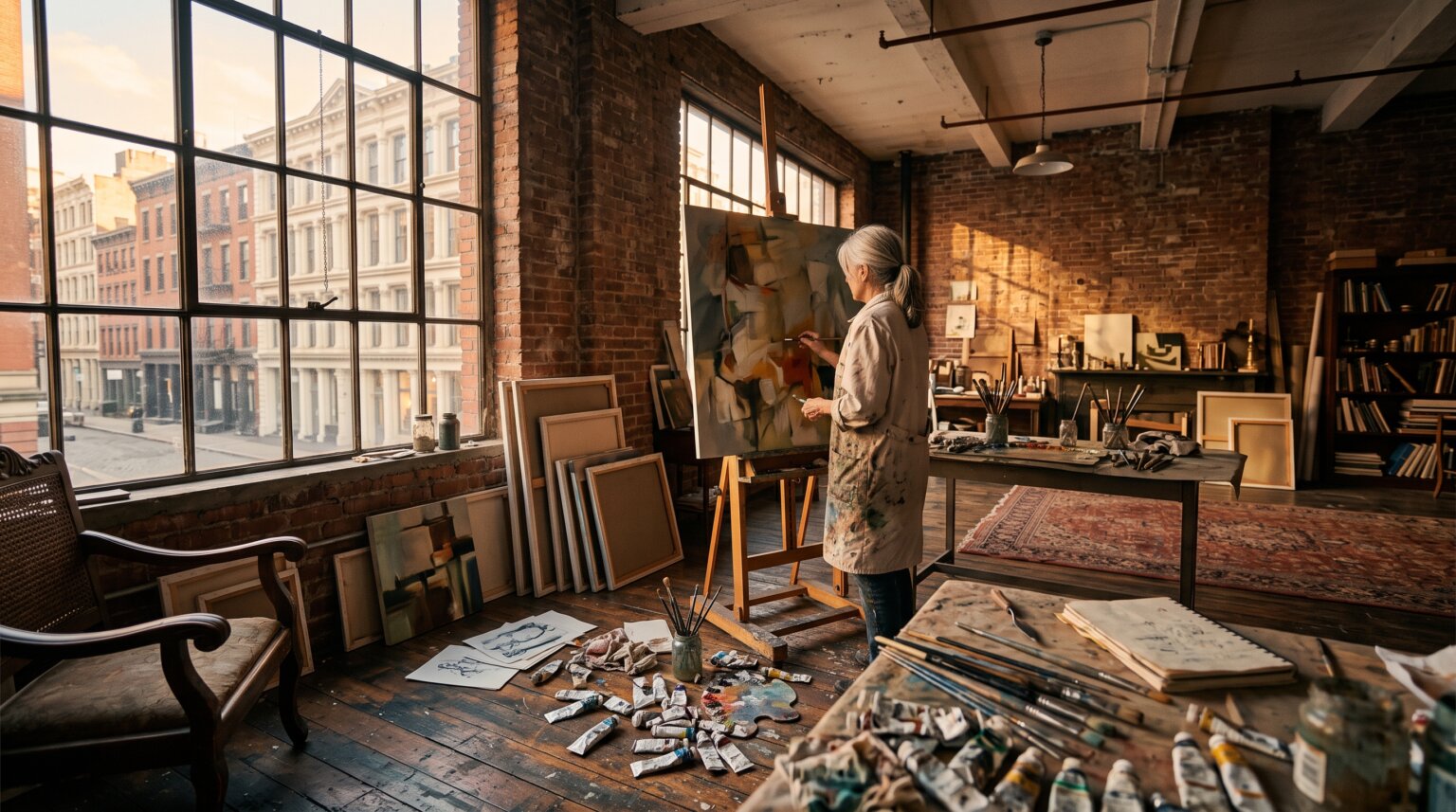
For a few remarkable decades after World War II, a single square mile in central London became the most creative neighborhood in Britain. Bohemian Soho drew painters, writers, drunkards, geniuses, outsiders, and dreamers into a tight-knit counterculture that changed the course of British art. At the center of it all was a tiny upstairs room behind a green door on Dean Street, where Francis Bacon held court, Lucian Freud nursed his drinks, and a sharp-tongued woman named Muriel Belcher ruled over the lot of them.
The bohemian Soho that inspired a generation of artists was not a formal movement with a manifesto or a gallery system. It was a living, breathing community held together by drinking dens, cheap rooms, and a shared refusal to live the way post-war Britain expected. Painters traded ideas over whiskey at the Colony Room Club. Writers slept on each other’s floors after all-night sessions at the Fitzroy Tavern. Muses became famous in their own right simply by being present, vivid, and unapologetically themselves.
The key figures of bohemian Soho included:
- Francis Bacon — the explosive figurative painter whose distorted portraits redefined modern art
- Lucian Freud — the intensely observant portraitist who spent decades painting the people around him
- Muriel Belcher — the formidable founder of the Colony Room Club who assembled the scene
- Nina Hamnett — the “Queen of Bohemia” who bridged the 1920s and post-war eras
- Henrietta Moraes — the legendary muse who sat for Bacon, Freud, and Maggi Hambling
- Frank Auerbach — the compulsive painter whose thick impasto canvases pushed figurative art further
- John Deakin — the photographer who documented every face in the scene
- Dylan Thomas — the Welsh poet who drank at the French House and became part of the furniture
Together, these people and dozens more created something rare: a self-sustaining creative ecosystem where art, alcohol, gossip, and defiance fed each other in equal measure. By the time the Colony Room closed its doors in 2008, bohemian Soho had already become a myth. But for nearly sixty years, it was very real, very messy, and very productive.
In this article, we will trace the full arc of bohemian Soho — what it was, who made it, why it happened there, and how its influence reached far beyond those few cramped streets in West London. Whether you are an art lover, a London history enthusiast, or simply curious about how creative communities actually work, the story of bohemian Soho offers answers that still matter today.
Table of Contents
What Was Bohemian Soho?
Bohemian Soho refers to the period from roughly the late 1940s through the early 1970s when London’s Soho district functioned as an informal artists’ colony and countercultural refuge. It was not a single institution or a formal group with membership lists. It was a living community of painters, writers, musicians, photographers, and professional outsiders who gathered in Soho’s pubs, clubs, cafes, and cheap flats to drink, argue, create, and escape the stifling conventions of post-war British society.
To understand why bohemian Soho mattered, you have to picture what London looked like in 1945. The city was physically scarred by the Blitz. Rationing was still in force. Buildings were bombed out. The atmosphere was one of exhaustion, austerity, and grey conformity. Into that bleakness, Soho offered something different — a labyrinth of narrow streets where the normal rules seemed to bend.
Soho had always been a place apart. For centuries, it had been London’s entertainment district, home to immigrant communities, music halls, theaters, and a thriving night economy. It was noisy, cheap, and slightly disreputable. That made it perfect for artists who could not afford respectable neighborhoods and did not want to live in them anyway.
The concept of “bohemia” itself comes from 19th-century France, where writers and artists in Paris adopted a lifestyle of voluntary poverty, creative intensity, and social nonconformity. The term originally referred to the Romani people (thought to have come from Bohemia, in modern-day Czech Republic), and it carried connotations of wandering, otherness, and living outside the mainstream. By the time Soho’s post-war community took shape, the idea of bohemia had already passed through Paris’s Left Bank and Montmartre, New York’s Greenwich Village, and London’s own Bloomsbury. Soho was the next chapter.
What set bohemian Soho apart from previous bohemias was its rawness. This was not a salon with elegant conversation. It was a drinking culture. The scene centered on pubs and private members’ clubs where artists spent more time than they did in their studios. Ideas were exchanged over pints and whiskey. Rivalries formed and dissolved over card games. Friendships were sealed at 2 a.m. in smoky rooms that smelled of gin and oil paint.
The bohemian Soho that inspired a generation of artists was also defined by its social mixture. Wealthy collectors drank alongside struggling painters. Gangsters rubbed shoulders with poets. Spies, call girls, journalists, and filmmakers all passed through the same rooms. In a Britain still rigidly class-divided, Soho’s bohemian spaces offered a rare social leveler — what mattered was wit, talent, and the ability to hold your drink.
The Colony Room Club: The Heart of Bohemian Soho
If bohemian Soho had a center, it was the Colony Room Club at 41 Dean Street. Founded in 1948 by Muriel Belcher, this tiny first-floor drinking club became the gravitational core of the entire post-war art scene. To understand bohemian Soho, you have to understand the Colony Room.
The club occupied a small room up a steep staircase behind a heavy green door. The walls were painted a distinctive shade of baize green — the color of a card table — and the carpet was famously sticky. It held perhaps forty people at a squeeze. There was no sign on the street. You had to know where to look and you had to be a member, or know one.
That exclusivity was part of the point. London in the 1940s and 1950s had strict licensing laws. Pubs closed at 11 p.m. and afternoon drinking was restricted. Private members’ clubs could serve alcohol outside those hours, which made them essential gathering places for anyone who wanted to drink — and most of the artists in bohemian Soho wanted to drink a great deal.
Muriel Belcher ran the Colony Room from 1948 until her death in 1979. She was the daughter of a Welsh window cleaner and a former dancer at the Windmill Theatre. By all accounts, she was brilliant, terrifying, hilarious, and utterly in control of her domain. She decided who was welcome and who was not. She insulted her regulars mercilessly and they loved her for it. Francis Bacon, who was one of her closest companions, reportedly received a subsidy from Belcher to drink at the club, paid back through his gambling winnings.
Belcher created something that went beyond a bar. She built a community. The Colony Room functioned as a salon, a confessional, a marketplace for ideas, and a surrogate family for people who had nowhere else to go. Regulars described it as a wonderland of caustic badinage — a place where the verbal sparring was as creative as anything happening on canvas.
The membership roll read like a who’s who of post-war British culture. Francis Bacon was the most famous, holding court from his usual spot. Lucian Freud came regularly in the early years, though he and Bacon had a complicated relationship that shifted between admiration and rivalry. Frank Auerbach, Leon Kossoff, Peter Blake, and Michael Andrews all passed through. Writers like Dylan Thomas, Brendan Behan, and Jeffrey Bernard were fixtures. International visitors including William Burroughs and Leonard Bernstein made pilgrimages. The photographer John Deakin documented the scene with his brutal, honest portraits.
The Colony Room was also a haven for people who lived outside conventional society. It welcomed gay men and lesbians at a time when homosexuality was criminalized in Britain. It was comfortable with sex workers, petty criminals, and professional misfits. The club’s atmosphere of acceptance was not political — it was simply that Belcher and her clientele did not care about respectability. They cared about whether you were interesting.
The club survived Belcher’s death in 1979 under new management, notably Ian Board, another larger-than-life figure who maintained the room’s traditions. But the scene had already begun to shift. Property prices in Soho were rising. The art world was becoming more institutionalized. The original post-war generation was aging. When the Colony Room finally closed in 2008, it felt like the definitive end of an era — the moment when bohemian Soho became purely a memory.
Francis Bacon: Soho’s Creative Fire
No single figure embodied bohemian Soho more completely than Francis Bacon. Born in Dublin in 1909 to an English family, Bacon moved to London and made Soho the center of his life and work for over five decades. He was the scene’s most famous artist, its most committed drinker, and its most magnetic personality.
Bacon lived and worked at 7 Reece Mews in South Kensington, but he spent his days and nights in Soho. He treated the Colony Room, the French House, and various gambling dens as extensions of his studio. Friends described his routine: painting furiously in the morning and early afternoon, then heading to Soho to drink, gamble, and socialize until the early hours.
His art was inseparable from the world he inhabited. Bacon’s paintings — with their screaming popes, distorted figures, and raw depictions of violence and desire — drew directly from the energy of bohemian Soho. He painted the people around him: his lover George Dyer, his friends, the muses who populated the bars. Henrietta Moraes, one of the scene’s most vivid personalities, appeared in dozens of his canvases. The grit, danger, and intensity of Soho found its way into every brushstroke.
Bacon was also the social glue of the scene. His presence at the Colony Room attracted others. His willingness to buy drinks (when he had money) and his legendary generosity made him a natural center of gravity. He connected painters to writers, collectors to artists, and outsiders to each other. Without Bacon’s gravitational pull, bohemian Soho would have been a much smaller and quieter place.
His influence on British art is almost impossible to overstate. Bacon’s work is now in the Tate, the Museum of Modern Art, the Centre Pompidou, and virtually every major modern art collection in the world. His paintings have sold for over $140 million. But what is sometimes forgotten is that this towering artistic legacy was forged in the bars and back rooms of Soho, fueled by the community that gathered there.
Lucian Freud: The Intense Observer
If Francis Bacon was the explosion at the center of bohemian Soho, Lucian Freud was the quiet intensity at its edge. Born in Berlin in 1922 and grandson of the psychoanalyst Sigmund Freud, Lucian moved to England as a child and became, along with Bacon, one of the two defining figurative painters of post-war Britain.
Freud was a regular in Soho’s drinking dens, particularly in the 1940s and 1950s. He was close to Bacon in those early years — the two painters influenced each other enormously and shared an obsession with the human figure. But their temperaments were very different. Where Bacon was expansive and social, Freud was watchful and exacting. He observed the people around him with a clinical, penetrating gaze that translated directly into his painting.
Freud painted the people of bohemian Soho. His subjects included friends, lovers, fellow artists, and the various characters who circulated through the scene. He painted them naked, exhausted, unguarded — stripping away every pretense to reveal what lay underneath. His portraits of performance artist Leigh Bowery and benefits supervisor Sue Tilley, painted much later in his career, continued the Soho tradition of painting real people without flattery.
The friendship and rivalry between Freud and Bacon is one of the great relationships in modern art history. They pushed each other to take greater risks. They recognized each other as equals at a time when the British art establishment was largely indifferent to figurative painting. And eventually, as happens with intense creative relationships, they drifted apart. By the 1970s, Freud was no longer a presence at the Colony Room. He had moved into a more solitary working routine that would produce some of his most famous late paintings.
Freud died in 2011, having painted until days before his death. His final painting was left unfinished on the easel. Like Bacon, he is now enshrined in every major museum collection. And like Bacon, his formative years were spent in the cramped rooms of bohemian Soho, drinking with the people he would later put on canvas.
The Women of Bohemian Soho
The story of bohemian Soho has often been told as a story of great male painters. But women were essential to the scene — as artists, as muses, as cultural architects, and as personalities who shaped the community every bit as much as Bacon or Freud. The bohemian Soho that inspired a generation of artists was built as much by women as by men, even if art history has been slow to recognize it.
Nina Hamnett stands as the bridge between pre-war and post-war bohemia. Born in Wales in 1890, Hamnett moved to London and then Paris, where she became part of the original Bloomsbury-adjacent artistic circle and earned the nickname “Queen of Bohemia.” She was a talented painter in her own right, exhibiting alongside Roger Fry and the Omega Workshops. By the time post-war Soho’s scene emerged, Hamnett was a fixture at the Fitzroy Tavern and later the Colony Room, holding court with stories of Picasso, Modigliani, and Cocteau. The Times once asked of her: “Has the world gained or lost by the partial sacrifice of Nina Hamnett the painter to Nina Hamnett the bohemian?” — a question that captured both her charisma and the way women’s artistic output was often overshadowed by their personalities.
Henrietta Moraes was the great muse of bohemian Soho. Born in 1931, she was a presence in the scene from her late teens. She modeled for Francis Bacon dozens of times — her face and figure appear in some of his most important works. Lucian Freud painted her too, most notably in a famous 1950s portrait that shows her lying on a bed with an air of exhausted vulnerability. Moraes was far more than a model. She was a writer, a memoirist, and a personality whose adventures — running away from convent school, marrying three times, spending time in prison — became legendary. Later in life, she became a painter herself, studying under Maggi Hambling.
Muriel Belcher deserves to be understood as far more than a bar owner. She was a cultural organizer who assembled and sustained one of the most important artistic communities of the 20th century. Without her, the Colony Room would have been just another drinking club. With her, it became the engine room of bohemian Soho. Belcher was openly bisexual at a time when that was dangerous. She created a space where women, gay people, and anyone who did not fit the post-war mold could exist freely.
Other women shaped the scene in less visible ways. The painter Maggi Hambling, who came up in the later years of bohemian Soho, became one of Britain’s most distinctive contemporary artists. Sophie Parkin, daughter of artist and model Paddy Pike, spent nearly thirty years as a Colony Room member and became one of its most important chroniclers through her writing. These women were not peripheral. They were central, and the story of bohemian Soho cannot be told accurately without them.
The Pubs and Drinking Dens of Bohemian Soho
The Colony Room may have been the spiritual center, but bohemian Soho was a network of venues. The scene extended across a web of pubs, clubs, and cafes, each with its own character and clientele. To walk through Soho in the 1950s was to move through a map of interconnected spaces, each one a node in the creative community.
The Fitzroy Tavern on Charlotte Street was the gathering place that predated the Colony Room. In the 1920s and 1930s, it was the center of London’s literary bohemia, frequented by Augustus John, Nina Hamnett, Dylan Thomas, and George Orwell. The tradition continued after the war. The Fitzroy was where artists went when the Colony Room was closed or when they wanted a more public atmosphere. Its associations with the earlier bohemian era gave it a mythic quality for the post-war generation.
The French House on Dean Street was another essential stop. Also known as “The French,” this pub had served the French expatriate community since the early 20th century and carried a reputation for intellectual conversation and serious drinking. Dylan Thomas was said to have left the manuscript of Under Milk Wood there (or possibly drunk it away). Charles de Gaulle allegedly used the pub as a base during the war. For the artists of bohemian Soho, the French House was a more civilized alternative to the chaos of the Colony Room — a place where you could actually talk.
The Groucho Club, which opened in 1985 on Dean Street, represented the later, more media-oriented phase of Soho’s creative culture. By the time it arrived, the original bohemian era was fading, but the Groucho picked up the baton as a private members’ club for writers, publishers, and artists. It was a different creature from the Colony Room — more polished, more careerist — but it kept the tradition of Soho as a gathering place for creative people alive into the 21st century.
Other venues played important roles. The Wheatsheaf on Rathbone Place was another literary pub connected to the earlier bohemia. Berwick Street Market provided cheap food and a vivid backdrop. Various unlicensed and after-hours clubs operated in basements and back rooms, their locations passed by word of mouth. The geography of bohemian Soho was compact — most of these places were within a five-minute walk of each other — which contributed to the density and intensity of the community.
What all these venues shared was an atmosphere of tolerance. Soho’s pubs and clubs did not care about your class, your sexuality, or your income. They cared about whether you were interesting and whether you could hold your ground in conversation. That culture of acceptance was what made bohemian Soho possible. Remove it, and the whole thing falls apart.
The LGBTQ+ Dimension of Soho’s Bohemia
One of the most important and least documented aspects of bohemian Soho was its role as a sanctuary for LGBTQ+ people. In post-war Britain, homosexuality was a criminal offense. Men could be — and were — arrested, imprisoned, and publicly ruined for same-sex relationships. It was not until the Sexual Offences Act of 1967 that private homosexual acts between men over 21 were partially decriminalized in England and Wales. Against that backdrop, the spaces of bohemian Soho were literally lifesaving.
The Colony Room Club was a place where gay men and women could be themselves. Muriel Belcher was openly bisexual. Francis Bacon was unapologetically gay at a time when that carried enormous risk. The club’s culture of not caring about respectability meant that people who were criminalized by the wider society could find acceptance within its green walls. The Colony Room did not advertise itself as a gay venue — it was more complex than that — but it functioned as a queer space by default.
Soho itself had a long history as a gathering place for LGBTQ+ people. The district had housed gay bars and clubs since at least the early 20th century. The bohemian scene overlapped with this existing queer infrastructure, creating a neighborhood where sexual minorities could socialize, form relationships, and build community with a degree of safety that was unavailable elsewhere in London.
The legal context of the era made this more than a matter of comfort. The Montagu case of 1954 — in which Lord Montagu of Beaulieu was prosecuted for homosexual acts alongside journalist Peter Wildeblood and others — was a landmark in British LGBTQ+ history. The trial and its aftermath helped galvanize public support for reform, leading to the Wolfenden Report of 1957, which recommended decriminalization. Members of bohemian Soho watched these events unfold from the vantage point of a community that was already living the reality the law was slowly beginning to catch up with.
This dimension of bohemian Soho deserves more attention than it typically receives. The creative outpouring of the scene was inseparable from its function as a queer sanctuary. Artists like Bacon produced work that dealt directly with desire, violence, and the body — themes that were shaped by the experience of living as a sexual outsider in a hostile society. The freedom to be oneself in the Colony Room and Soho’s other spaces was not just a social luxury. It was the precondition for the art that came out of the scene.
How Bohemian Soho Shaped Modern British Art
The influence of bohemian Soho on British art extends far beyond the work of Bacon and Freud. The community’s commitment to figurative painting — to depicting the human body and face with unflinching directness — created a tradition that continued long after the drinking dens closed. Art historians have grouped several of these painters under the label the “School of London,” a loose designation for artists who rejected abstract expressionism and pop art in favor of intense, representational work.
Frank Auerbach is the most striking example. Born in Berlin in 1931 and sent to England as a child refugee, Auerbach settled in London and became part of the Soho circle. His paintings are built up in thick, almost sculptural layers of paint, worked and reworked over months until the canvas becomes a dense topographical record of looking. Auerbach still paints today, working from the same studio in Camden he has occupied since the 1950s, and his connection to the figurative tradition of bohemian Soho is direct and unbroken.
Leon Kossoff was another key figure in this tradition. Like Auerbach, he studied under David Bomberg and developed a painting style of extraordinary physical intensity. Kossoff’s drawings and paintings of London — its streets, its construction sites, its people — carry the same raw engagement with reality that defined the Soho scene. He and Auerbach were close friends who supported each other through decades of relative obscurity before the art world caught up with them.
Michael Andrews was a quieter but equally important member of the circle. His paintings, including the famous “The Colony Room I” (1962), directly depicted the Soho scene. Andrews captured the atmosphere of Belcher’s club with a precision that no photograph could match — the way people arranged themselves, the quality of the light, the sense of being inside a closed world.
The influence also reached artists who worked in different modes. Peter Blake, often called the father of British Pop Art, was a Colony Room member who absorbed the scene’s embrace of popular culture and everyday imagery. His work, which famously included the cover design for the Beatles’ Sgt. Pepper’s Lonely Hearts Club Band, drew on the same democratic, anti-elitist spirit that defined bohemian Soho. The line from the Colony Room to Pop Art is more direct than many people realize.
More broadly, bohemian Soho created a template for how creative communities function. The model — informal gathering spaces, cheap living, cross-disciplinary socializing, a tolerance for eccentricity — has been replicated in neighborhoods around the world. From New York’s East Village in the 1980s to Berlin’s Kreuzberg in the 2000s, the DNA of bohemian Soho lives on wherever artists cluster together and make work that the establishment does not yet understand.
Visiting Soho Today: Tracing the Bohemian Trail
One of the most common questions from people who fall down the rabbit hole of bohemian Soho’s history is simple: can you still see any of it? The answer is complicated. Soho has changed dramatically since the 1950s. Property prices have skyrocketed. Chain restaurants have replaced independent cafes. The sex shops and clip joints that once gave the area its seedy character have mostly closed. But traces of the bohemian era survive, if you know where to look.
Dean Street remains the most evocative street. Number 41, where the Colony Room operated for sixty years, is still there, though the club closed in 2008 and the space has been renovated. The green door is gone. But standing on Dean Street, looking up at the first-floor windows, you can still feel the weight of what happened there. The French House is still open at number 41 Dean Street (a coincidence of numbering — the pub is at the same address block) and remains a pub with literary and artistic associations. Order a pastis and sit where Dylan Thomas and Francis Bacon once drank.
The Fitzroy Tavern on Charlotte Street is still operating and has embraced its bohemian heritage. The pub displays memorabilia from its literary and artistic past. It is the most accessible place to get a sense of what the earlier bohemia felt like, even if the crowd has changed. Berwick Street, with its historic market, still carries some of the gritty energy of the old Soho, though it is considerably cleaned up.
For Francis Bacon enthusiasts, 7 Reece Mews in South Kensington — Bacon’s studio for thirty years — is not open to the public in its original form, but the studio’s entire contents were painstakingly dismantled and reconstructed at the Hugh Lane Gallery in Dublin. Visiting that reconstruction is the closest you can get to stepping inside Bacon’s working space.
A walking tour of bohemian Soho might start at the Fitzroy Tavern, head south to Dean Street via Charlotte Street and Goodge Street, stop at the French House, continue to the former Colony Room address, and end at Old Compton Street — the heart of modern Soho’s LGBTQ+ community, which carries forward the tradition of the area as a place where people live openly. The walk takes about twenty minutes. But the layers of history packed into those few streets could fill a lifetime of exploration.
The most important thing to understand about visiting Soho today is that the bohemian era is genuinely over. You cannot recreate it by walking the same streets. What you can do is pay attention to the physical spaces — the narrow alleys, the old pub fronts, the first-floor windows — and imagine what they contained. Bohemian Soho was made by people, not by buildings. But the buildings are the last physical trace of those people, and they are worth seeking out.
Timeline of Bohemian Soho (1940s-1970s)
Understanding the chronology helps put the bohemian Soho that inspired a generation of artists into perspective. Here are the key dates:
- 1945 — World War II ends. London is scarred by the Blitz. Rationing continues. The conditions for bohemian Soho are set.
- 1948 — Muriel Belcher opens the Colony Room Club at 41 Dean Street. Francis Bacon becomes an early regular.
- 1949 — Lucian Freud and Francis Bacon meet, beginning one of the most important friendships in modern British art.
- 1951 — Bacon paints his breakthrough “Heads” series, influenced by Velazquez and the raw energy of post-war Soho.
- 1952 — Frank Auerbach arrives in London as a child refugee and begins studying art. Within a few years, he is part of the Soho circle.
- 1954 — The Montagu trial brings public attention to the criminalization of homosexuality in Britain. The Colony Room’s role as a queer sanctuary becomes even more significant.
- 1957 — The Wolfenden Report recommends decriminalizing homosexuality. Members of bohemian Soho watch from a community that has been living this reality for years.
- 1962 — Michael Andrews paints “The Colony Room I,” his vivid portrait of the club and its denizens.
- 1967 — The Sexual Offences Act partially decriminalizes homosexuality in England and Wales. The legal landscape that shaped bohemian Soho begins to shift.
- 1969 — Francis Bacon’s major retrospective at the Guggenheim in New York cements his international reputation. The art world catches up with what Soho has known for years.
- 1979 — Muriel Belcher dies. The Colony Room passes to new management, but the original era of bohemian Soho is effectively over.
- 2008 — The Colony Room Club closes permanently. The final physical remnant of bohemian Soho’s central venue is gone.
Frequently Asked Questions
What was bohemian Soho?
Bohemian Soho refers to the period from the late 1940s through the 1970s when London’s Soho district functioned as an informal artists’ colony. Painters like Francis Bacon and Lucian Freud, writers like Dylan Thomas, and dozens of other creative figures gathered in Soho’s pubs and private clubs — especially the Colony Room Club on Dean Street — to form a countercultural community that produced some of the most important British art of the 20th century.
Who were the famous artists of Soho’s bohemian era?
The most famous artists of bohemian Soho were Francis Bacon and Lucian Freud, two of the most significant figurative painters of the 20th century. Other key figures included Frank Auerbach, Leon Kossoff, Michael Andrews, Peter Blake, and the photographer John Deakin. Important women in the scene included Nina Hamnett, Henrietta Moraes, and Colony Room founder Muriel Belcher.
What was the Colony Room Club?
The Colony Room Club was a private members’ drinking club at 41 Dean Street in Soho, founded by Muriel Belcher in 1948. It was a small room behind a green door on the first floor, painted in baize green, that became the central gathering place for post-war Britain’s artistic community. Francis Bacon, Lucian Freud, Frank Auerbach, and many other artists were regulars. The club closed in 2008.
Who was Muriel Belcher?
Muriel Belcher was the founder and proprietor of the Colony Room Club from 1948 until her death in 1979. A former dancer from Wales, she was known for her sharp wit, her absolute control over the club, and her ability to assemble and sustain one of the most important artistic communities of the 20th century. Francis Bacon was one of her closest companions, and she played a crucial role in making bohemian Soho possible.
Why was Soho important for post-war artists?
Soho was important because it offered cheap living spaces, lenient licensing laws through private clubs, an existing infrastructure of pubs and cafes, and a cultural tradition of tolerance for outsiders. After the devastation of World War II, the district’s combination of low costs, social permissiveness, and dense creative energy made it the perfect environment for artists who rejected conventional society and needed a community to sustain their work.
How did bohemian Soho influence modern art?
Bohemian Soho produced or nurtured some of the most important figurative painters of the 20th century, including Francis Bacon, Lucian Freud, and Frank Auerbach. The scene’s commitment to direct, unflinching depiction of the human figure created a tradition (sometimes called the School of London) that continues to influence painting today. The community’s model of informal creative gathering has also been replicated in artistic neighborhoods worldwide.
When did bohemian Soho end?
Bohemian Soho began to fade in the 1970s as property prices rose, the art world became more institutionalized, and the original generation aged. Muriel Belcher’s death in 1979 marked the effective end of the classic era. The final closure came in 2008, when the Colony Room Club shut its doors for good, removing the last physical anchor of the bohemian Soho that inspired a generation of artists.
The Lasting Legacy of Bohemian Soho
The bohemian Soho that inspired a generation of artists was many things at once: a drinking culture, an artists’ colony, a queer sanctuary, a social experiment, and a creative engine that produced some of the most important British art of the 20th century. It was held together by a handful of extraordinary people — Francis Bacon, Lucian Freud, Muriel Belcher, Nina Hamnett, Henrietta Moraes, Frank Auerbach, and dozens of others whose names are less famous but whose presence was equally essential.
The physical spaces are mostly gone. The Colony Room closed in 2008. The green door on Dean Street has been replaced. The cheap rooms that artists could afford have become luxury flats. But the legacy of bohemian Soho persists in every Bacon canvas that hangs in a major museum, every Freud portrait that strips away pretense, and every creative neighborhood in the world where artists gather informally to share ideas, challenge each other, and refuse to conform.
What makes the story of bohemian Soho worth remembering is not nostalgia. It is the reminder that creative communities do not happen by accident. They require physical spaces where people can gather. They require a culture of tolerance for difference. They require cheap enough living conditions that artists can afford to take risks. And they require personalities strong enough to hold it all together — someone like Muriel Belcher, behind a green door, deciding who gets in and who does not.
The bohemian Soho that inspired a generation of artists teaches us that art is not made in isolation. It is made in conversation, in argument, in shared drinks at 1 a.m., in the friction between competing egos, and in the safety of spaces where people can be fully, unapologetically themselves. That lesson is as relevant in 2026 as it was in 1948. The challenge for every new generation of artists is to build their own version of that green door — a space where the impossible becomes possible because the right people are in the room together.