
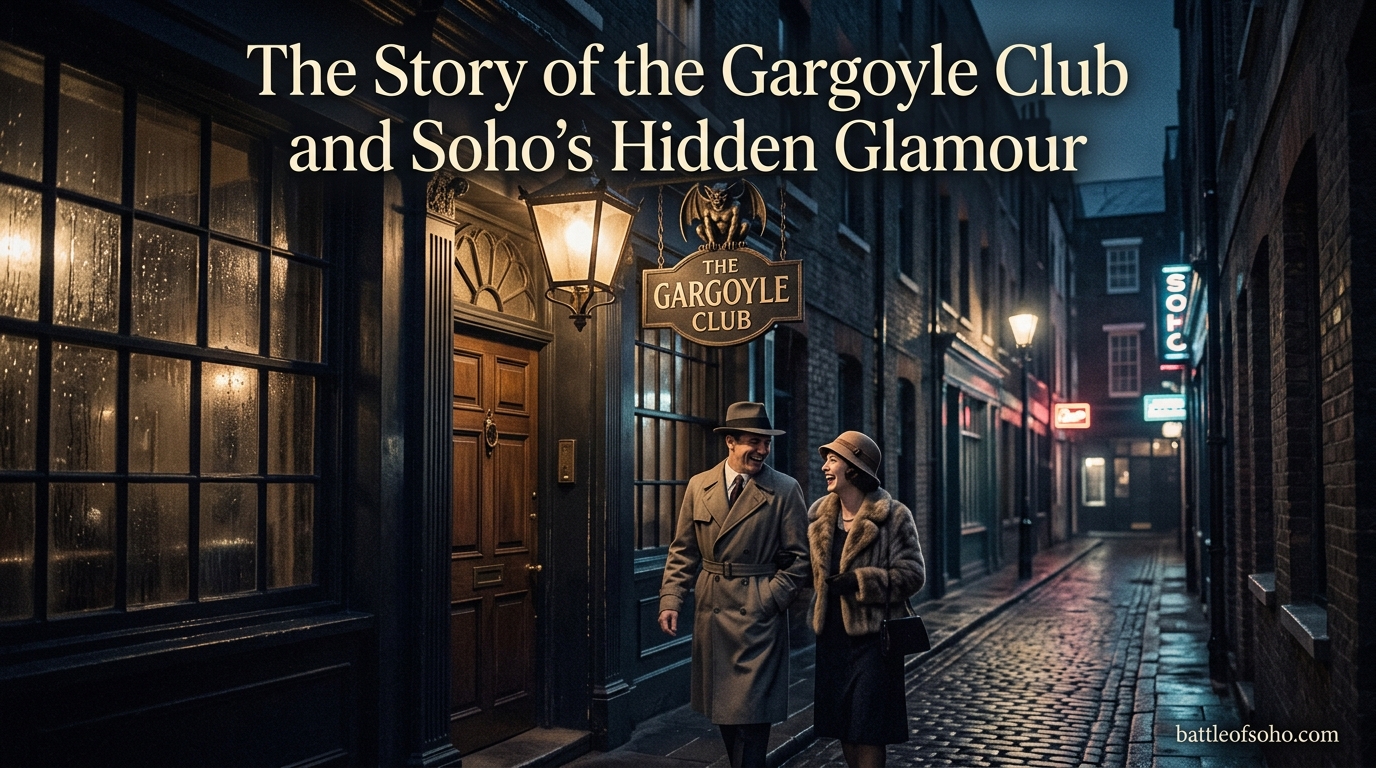
Walk down Dean Street in Soho today and you will pass restaurants, cocktail bars, and members clubs that hum with the energy of modern London nightlife. But few people realise that above the storefronts at number 69, behind ordinary-looking facades, once existed one of the most extraordinary private clubs in British history. The Gargoyle Club, founded in 1925, was a place where aristocrats danced beneath Matisse paintings, where Bright Young Things held legendary costume parties, and where the boundaries between bohemian art and high society dissolved into pure glamour.
The Gargoyle Club Soho represents a chapter of London history that feels almost fictional today. It was a club decorated by one of the greatest artists of the 20th century, haunted by the ghost of a royal mistress, and frequented by some of the most fascinating figures of the interwar years. For over 50 years, 69 Dean Street sheltered a venue that constantly reinvented itself, from elite social hub to strip club to comedy landmark.
In this article, we trace the full story of the Gargoyle Club from its founding by David Tennant to its many afterlives. We explore the Matisse-designed interiors that made it legendary, the famous members who walked through its doors, and the colourful history that followed after Tennant’s departure. We also look at what remains of Soho’s hidden glamour today, and why this story still matters for anyone who loves the cultural history of London.
Table of Contents
The Gargoyle Club Soho: A Brief History
The Gargoyle Club was a private members club located on the upper floors of 69 Dean Street in Soho, London, at the corner with Meard Street. It was founded on 16 January 1925 by David Tennant, an aristocratic socialite who envisioned a space where the creative elite and British high society could mingle in surroundings of extraordinary artistic beauty. The club quickly became the social headquarters of the Bright Young Things, that famous generation of hedonistic young aristocrats who dominated 1920s London with their parties, pranks, and publicity stunts.
What set the Gargoyle apart from every other club in London was its decor. Henri Matisse himself contributed to the interior design, installing original paintings and creating wall decorations that turned the club into a living gallery. Combined with Moorish architectural elements, mirrored walls, gold leaf ceilings, and a rooftop garden, the Gargoyle Club was unlike anything Soho had ever seen before, or has seen since.
The club operated under Tennant’s ownership from 1925 until 1952, when financial pressures forced him to sell. After Tennant’s departure, the venue passed through several incarnations, including a period as a strip club in the 1960s. The building later hosted The Mandrake, the Comedy Store, and the legendary Batcave nightclub, each adding new layers to the cultural history of the site. Today, 69 Dean Street is home to the Dean Street Townhouse, a boutique hotel and restaurant that preserves some of the building’s glamorous heritage.
Before Tennant: The Ghost of Nell Gwyn
Long before David Tennant transformed 69 Dean Street into the Gargoyle Club, the building carried its own reputation for glamour and scandal. The site was originally occupied by a four-storey Georgian townhouse, a classic example of the 18th-century domestic architecture that once lined the streets of Soho. The building itself was not architecturally remarkable, but its history gave it a character that attracted the curious and the superstitious.
The townhouse was famously said to be haunted by the ghost of Nell Gwyn, the celebrated actress and mistress of King Charles II. Gwyn, who lived in the 17th century, was one of the most beloved figures of Restoration England. She was known for her wit, her beauty, and her ability to charm both the public and the King himself. Her connection to the Dean Street site predates the current building, but local legend held that her spirit lingered in the area long after her death.
Whether or not you believe in ghosts, the legend of Nell Gwyn added an atmosphere of romantic history to the site that Tennant recognised and embraced. The idea that this corner of Soho had been touched by royalty, theatrical glamour, and a touch of the supernatural made it the perfect location for a club that would become synonymous with indulgence and artistic brilliance. Tennant understood that a great club needs not just good decor but a story, and the Nell Gwyn legend gave the Gargoyle Club a narrative that stretched back centuries before its founding.
Several historical accounts note that early members of the Gargoyle Club were aware of the ghost legend and some even claimed to have experienced unexplained phenomena during late-night gatherings. Whether these stories were genuine, embellished, or simply good marketing, they became part of the fabric of the club’s identity and contributed to its reputation as a place where the past and present collided in fascinating ways.
David Tennant and the Founding of the Gargoyle Club
David Tennant was not your typical club owner. Born into the Scottish aristocracy in 1902, Tennant was the son of Edward Tennant, 1st Baron Glenconner, and grew up in a world of wealth, privilege, and cultural sophistication. His family connections gave him access to the highest circles of British society, and his natural charisma made him a popular figure in London’s social scene from a young age.
Tennant was part of the Bright Young Things, the loosely defined group of young aristocrats and artists who defined 1920s London culture. He moved in circles that included writers, painters, photographers, and fellow socialites who shared his appetite for new experiences and creative expression. But Tennant wanted more than just to attend parties. He wanted to create a space that embodied the spirit of his generation, a place where art, conversation, and celebration could come together under one roof.
On 16 January 1925, Tennant opened the Gargoyle Club on the upper floors of 69 Dean Street. The name itself was distinctive and memorable, chosen to give the club an identity that stood apart from the more conventional gentlemen’s clubs of Mayfair and St James’s. Tennant’s vision was ambitious. He wanted the Gargoyle to be more than just a nightclub or dining room. He wanted it to be a total aesthetic experience, where every detail from the artwork on the walls to the design of the dance floor contributed to an atmosphere of refined indulgence.
To realise this vision, Tennant spared no expense. He commissioned leading artists and designers to transform the upper floors of the Georgian townhouse into something entirely new. The result was a club that immediately attracted the attention of London’s elite, offering a combination of exclusivity, artistic seriousness, and sheer hedonistic pleasure that was impossible to find anywhere else in the city.
Tennant remained the driving force behind the Gargoyle Club for nearly three decades. During that time, he cultivated an atmosphere that balanced high culture with unapologetic fun. He understood that the best clubs are not just about luxury but about creating a feeling, a sense that anything could happen and probably would. Under his leadership, the Gargoyle Club became one of the most talked-about venues in London, a place where a duchess might find herself dancing next to a struggling painter, where conversations about modern art mixed with gossip about royal affairs.
The Decor: Matisse, Moorish Design, and Opulence
The single most remarkable feature of the Gargoyle Club was its interior design, and at the centre of that design was Henri Matisse. The involvement of one of the world’s greatest painters in the decoration of a London nightclub sounds almost too extraordinary to be true, but it is one of the best-documented facts about the club’s history. Matisse contributed original artwork and design elements that made the Gargoyle’s interiors genuinely unique.
The most famous of Matisse’s contributions was the installation of his painting “The Red Studio” (L’Atelier Rouge), completed in 1911, which was displayed within the club. Matisse also designed decorative elements specifically for the Gargoyle, including wall decorations that reflected his bold use of colour and form. Having original Matisse works on display in a private club was unprecedented and gave the Gargoyle a cultural prestige that no other London venue could match.
Beyond Matisse, the club’s interiors drew heavily on Moorish design influences. Architect Sir Edwin Lutyens, one of the most celebrated British architects of the era, was involved in shaping the club’s layout and architectural details. The Moorish flavour manifested in the use of geometric patterns, arches, and decorative motifs that evoked the palaces of Andalusia. This Eastern-inspired aesthetic was fashionable in 1920s design but was executed at the Gargoyle with a level of sophistication and craftsmanship that set it apart.
The visual centrepiece of the club was its ballroom, which featured a dance floor with a built-in fountain. This was not a subtle decorative element but a genuine working fountain that sprayed water near the dancing area, creating a spectacle that delighted members and their guests. The combination of dancing, music, and moving water made the ballroom one of the most memorable entertainment spaces in interwar London.
Other notable design features included gold leaf ceilings that caught and reflected the light from chandeliers, creating a warm, luminous glow throughout the main rooms. Mirrored interiors multiplied the visual impact of the space, making rooms feel larger and more dramatic than their actual dimensions. Mosaic glass tiles added colour and texture to walls and surfaces, catching the light in ways that changed throughout the evening as the club transitioned from dining to dancing.
The Gargoyle Club also boasted a rooftop garden, an outdoor space where members could escape the heat and noise of the interior rooms. In a neighbourhood as densely built as Soho, having access to an elevated outdoor space was a rare luxury. The garden offered views across the rooftops of central London and provided a more intimate setting for conversation and relaxation away from the energy of the dance floor.
The dining room at the Gargoyle was another key space, reportedly seating up to 140 guests. This was a significant capacity for a private club and allowed the Gargoyle to host large-scale dinners and events alongside its more intimate gatherings. The combination of fine dining, dancing, art appreciation, and socialising made the club a complete entertainment destination rather than just a single-purpose venue.
There was also an external elevator lift, a relatively novel feature for the era, which transported members from the street entrance to the upper floors where the club was located. This added a touch of modernity and convenience to the experience while also reinforcing the sense that entering the Gargoyle Club meant ascending into a different world, literally rising above the ordinary streets of Soho into a space of beauty and exclusivity.
Bright Young Things and Notable Members
The Gargoyle Club’s membership read like a who’s who of interwar British society. Tennant’s connections ensured that the club attracted the most interesting and influential people of the era, drawn from the worlds of art, literature, politics, and the aristocracy. The club became the unofficial headquarters of the Bright Young Things, that celebrated generation of young, wealthy, and creative Londoners who dominated the social columns of the 1920s.
The Bright Young Things were known for their extravagant parties, elaborate costume balls, and talent for generating publicity. They were the celebrities of their day, covered by newspapers and photographed at every opportunity. The Gargoyle Club provided them with a home base, a place where they could gather, celebrate, and plan their next adventure away from the public gaze while still being surrounded by people who understood and shared their lifestyle.
Among the most notable members associated with the club was Cecil Beaton, the legendary photographer and designer whose images defined the visual style of the era. Beaton’s photographs of the Bright Young Things, many taken at or inspired by gatherings at clubs like the Gargoyle, remain some of the most iconic images of interwar British culture. His presence at the club helped cement its reputation as a place where art and social life were inseparable.
The membership also included writers and intellectuals who brought a literary dimension to the club’s atmosphere. Figures connected to the Bloomsbury Group and other literary circles frequented the Gargoyle, drawn by its combination of serious cultural credibility and unpretentious enjoyment. The club was a place where ideas were exchanged as freely as drinks, where a conversation about modernist poetry could happen next to a discussion about the latest scandal in high society.
The aristocratic presence at the Gargoyle was equally significant. Members of the British nobility, including dukes, earls, and their families, held memberships and regularly attended events. This mix of aristocracy and bohemia was what made the club special. In most London venues, these two worlds remained separate, with the aristocracy patronising traditional gentlemen’s clubs and the artistic community gathering in more fringe establishments. The Gargoyle Club brought them together in a way that few other spaces ever managed.
Costume parties were a particular specialty of the Gargoyle, with members often arriving in elaborate themed outfits that reflected the club’s creative spirit. These events were not just casual dress-up affairs but serious productions involving professional costume designers, set decoration, and coordinated themes. Photographs from these parties show guests in outfits ranging from historical recreation to avant-garde fantasy, all set against the backdrop of the Matisse-decorated interiors.
Wartime and the Post-Tennant Era
The outbreak of the Second World War in 1939 changed everything for London’s social scene, and the Gargoyle Club was no exception. The club remained open during the early years of the war, but the atmosphere inevitably shifted. Blackout regulations, rationing, and the constant threat of bombing made the kind of carefree celebration that defined the Gargoyle’s heyday increasingly difficult to sustain. Many members left London for military service or retreated to country estates, and the club’s character changed with them.
Despite the challenges of wartime, the Gargoyle Club retained a core of dedicated members who continued to gather throughout the conflict. The club became a place of continuity and comfort for those who remained in London, offering a semblance of normal life amid the disruption and danger of the Blitz. The fact that the building survived the extensive bombing of Soho and the West End was itself remarkable, and the club’s endurance through the war years added to its legend.
After the war, Tennant attempted to revive the club to its former glory, but the world had changed. The Bright Young Things had grown up, many had died during the war, and the social landscape that had made the Gargoyle possible no longer existed in the same form. Financial pressures mounted, and by 1952, Tennant was forced to sell the club. His departure marked the end of the Gargoyle’s golden age, but it was not the end of the story for 69 Dean Street.
After Tennant sold the club, the venue passed through a series of different owners and incarnations. The 1960s brought a particularly dramatic transformation, as the former Gargoyle Club space became associated with Soho’s adult entertainment scene. During this period, the building housed a strip club, a far cry from the artistic salon that Tennant had created. The contrast between the two eras is striking and reflects the broader trajectory of Soho itself, which cycled between respectability and seediness throughout the 20th century.
The strip club era, while not as culturally elevated as the Gargoyle’s original incarnation, nevertheless contributed to the building’s mythology. Some accounts suggest that elements of the original Matisse decor were still partially visible during this period, creating a surreal juxtaposition between high art and adult entertainment. The idea of patrons in a 1960s Soho strip club sitting beneath the faded remnants of Matisse masterpieces is a image that captures the strange, layered history of this address.
The Mandrake, Comedy Store, and Batcave Legacy
The story of 69 Dean Street did not end with the strip club era. In the 1970s, the building became home to The Mandrake, another private members club that attempted to recapture some of the Gargoyle’s original spirit. The Mandrake operated on the site for several years, offering a more contemporary take on the private club concept while drawing on the cultural cachet of the building’s Gargoyle heritage.
The Mandrake Club attracted its own notable clientele and maintained the tradition of 69 Dean Street as a destination for people seeking something beyond ordinary nightlife. While it never achieved the same level of fame as the original Gargoyle, it kept the building’s identity as a space for exclusive social gatherings alive during a period when many historic London venues were being lost to redevelopment.
A more dramatic transformation came with the arrival of the Comedy Store London, which established itself at the site and brought an entirely new form of entertainment to 69 Dean Street. The Comedy Store, modeled on the American comedy club format, helped launch the careers of numerous British comedians and became a fixture of the London entertainment scene. The fact that the same building that once hosted aristocratic costume balls under Matisse paintings was now a launching pad for stand-up comedy speaks to the remarkable adaptability of the space.
The building’s nightlife credentials were further enhanced by its association with the Batcave, the legendary nightclub that is credited as one of the birthplaces of the goth subculture. The Batcave, which emerged in the early 1980s, attracted a very different crowd from the Bright Young Things of the 1920s, but it carried forward the same tradition of using 69 Dean Street as a space for people who wanted to dress up, socialise, and push cultural boundaries.
This succession of venues at the same address reveals something important about the enduring appeal of the site. Whatever the era or the subculture, 69 Dean Street has consistently attracted people who are looking for something more adventurous than mainstream entertainment. From aristocratic bohemians to punk goths, the building has served as a canvas for London’s most creative and unconventional social movements for nearly a century.
Modern Soho: Dean Street Townhouse and Beyond
Today, 69 Dean Street is home to the Dean Street Townhouse, a boutique hotel and restaurant operated by the Soho House group. The Townhouse occupies the building where the Gargoyle Club once held court, and while the interiors have been extensively renovated, the site retains a connection to its glamorous past. The hotel’s design pays subtle homage to the building’s history, and guests dining or staying there are occupying the same physical space where some of the most celebrated figures in British cultural history once gathered.
The Dean Street Townhouse gained additional modern fame when it was reported as the location of one of Prince Harry and Meghan Markle’s early dates. This connection to contemporary celebrity culture is a fitting continuation of the building’s long history as a destination for the famous and the influential. While the current occupants of 69 Dean Street may be from a very different world than the Bright Young Things, the building continues to serve as a backdrop for stories of glamour, romance, and cultural significance.
The transformation of the Gargoyle Club site reflects the broader evolution of Soho itself. Once known primarily for its adult entertainment venues and late-night bars, Soho has undergone significant gentrification in recent decades. Today, the neighbourhood is home to some of London’s best restaurants, media companies, and cultural institutions. The question of whether Soho is still seedy is one that Londoners debate with passion, and the answer depends on what you are looking for and where you go.
There are still pockets of Soho that carry echoes of its rougher past, particularly in the late-night hours and around certain establishments. But the overall character of the neighbourhood has shifted dramatically, with independent venues and adult businesses giving way to high-end dining, luxury apartments, and corporate offices. For some, this transformation represents progress and improvement. For others, it represents the loss of the gritty, creative energy that made Soho one of the most distinctive neighbourhoods in the world.
The Gargoyle Club’s story offers a useful perspective on this debate. The club was itself a product of Soho’s unique character, a place that could only have existed in a neighbourhood that was simultaneously disreputable and glamorous, dangerous and exciting. The fact that the Gargoyle was located above ordinary storefronts on a street that also housed less reputable businesses was part of its appeal. It was a hidden treasure, a secret world accessible only to those who knew where to look and who had the right connections.
This quality of hidden glamour is what makes the Gargoyle Club story so enduringly fascinating. In an era when exclusivity often means expensive entry fees and velvet ropes, the Gargoyle represented a different kind of privacy. It was exclusive not just because it cost money but because it required taste, connections, and a willingness to venture into a neighbourhood that respectable society often avoided. The club’s location in Soho was not incidental to its identity but central to it.
Why the Gargoyle Club Still Matters
The Gargoyle Club Soho may be gone, but its cultural significance endures. The club represents a moment in British history when the boundaries between different social worlds were unusually porous, when artists and aristocrats could share a dance floor and when a nightclub could serve as a genuine centre of artistic innovation. This combination of social mixing and creative energy is something that many modern venues strive for but few achieve.
The Matisse connection alone ensures the club’s place in art history. The idea that one of the foundational figures of modern art chose to decorate a London nightclub speaks to the cultural ambitions of the era and the unique appeal of the Gargoyle project. Art historians continue to study the club’s decor as an example of how modernist art moved beyond galleries and into everyday spaces, blurring the line between fine art and interior design.
For anyone interested in the history of London nightlife, the Gargoyle Club is an essential reference point. It set a standard for what a private club could be, not just a place to eat and drink but a complete aesthetic and social experience. Modern members clubs, from Soho House to the Groucho Club, owe a debt to the template that Tennant and his collaborators established at 69 Dean Street nearly a century ago.
The club also matters as a reminder of Soho’s hidden glamour, that quality of secret beauty and exclusive excitement that has defined the neighbourhood across multiple eras. Whether the Soho of 2026 still possesses this quality is debatable, but the memory of places like the Gargoyle Club keeps the ideal alive. They remind us that behind the ordinary facades of city streets, extraordinary things can happen, and that the most interesting stories are often the ones you have to know where to find.
FAQs
What is the history of The Gargoyle Club?
The Gargoyle Club was a private members club at 69 Dean Street, Soho, London, founded on 16 January 1925 by aristocratic socialite David Tennant. It operated under Tennant’s ownership until 1952 and became famous for its Matisse-decorated interiors, its rooftop garden, and its role as the social hub of the Bright Young Things. After Tennant sold the club, the venue passed through several incarnations including a strip club, The Mandrake Club, the Comedy Store, and the Batcave nightclub. Today the building houses the Dean Street Townhouse.
Who founded the Gargoyle Club?
The Gargoyle Club was founded by David Tennant, a Scottish aristocrat born in 1902 and the son of Edward Tennant, 1st Baron Glenconner. Tennant was part of the Bright Young Things social circle and envisioned a club where artists, writers, and aristocrats could socialise surrounded by world-class art, including original works by Henri Matisse.
Where was the Gargoyle Club located?
The Gargoyle Club was located on the upper floors of 69 Dean Street in Soho, London, at the corner with Meard Street. The building was originally a four-storey Georgian townhouse reportedly haunted by the ghost of Nell Gwyn, the actress and mistress of King Charles II. The site is now occupied by the Dean Street Townhouse hotel and restaurant.
Was Henri Matisse really involved with the Gargoyle Club?
Yes, Henri Matisse was directly involved in decorating the Gargoyle Club. His 1911 painting The Red Studio was displayed within the club, and he also created wall decorations and design elements specifically for the interiors. This made the Gargoyle one of the few nightlife venues in the world to feature original works by one of the most important artists of the 20th century.
What happened to the Gargoyle Club after David Tennant left?
After David Tennant sold the Gargoyle Club in 1952 due to financial pressures, the venue went through multiple transformations. In the 1960s it operated as a strip club during Soho’s adult entertainment era. Later, the building housed The Mandrake Club, the Comedy Store London, and the Batcave nightclub, each adding new cultural layers to the history of the site.
Is Soho still seedy?
Soho has undergone significant gentrification and is no longer as seedy as it was during the mid-20th century. The neighbourhood is now home to high-end restaurants, media companies, and boutique hotels like the Dean Street Townhouse. However, some pockets of Soho’s late-night and adult entertainment past remain, and opinions on whether the area has lost its distinctive character divide Londoners.
Can you visit the site of the Gargoyle Club today?
Yes, you can visit 69 Dean Street today, which is now the Dean Street Townhouse, a hotel and restaurant operated by the Soho House group. While the original Gargoyle Club interiors have been extensively renovated, the building retains its historic character and connections to its glamorous past, including reports that Prince Harry and Meghan Markle had an early date at the venue.
Conclusion: The Enduring Allure of Soho’s Hidden Glamour
The story of the Gargoyle Club and Soho’s hidden glamour is ultimately about the power of place. A single building at 69 Dean Street managed to host some of the most remarkable moments in British social and cultural history, from Matisse-decorated ballrooms to the birth of goth nightlife. The Gargoyle Club may be gone, but its legacy lives on in the way we think about private clubs, artistic spaces, and the unique magic of Soho itself.
Whether you are a history enthusiast, a lover of London nightlife, or simply someone who enjoys a good story, the Gargoyle Club Soho offers a reminder that the most extraordinary things often happen in unexpected places. The next time you walk down Dean Street, look up at the upper floors of number 69 and imagine what once took place there, behind closed doors, beneath gold leaf ceilings and Matisse masterpieces, in the secret heart of Soho’s hidden glamour.