
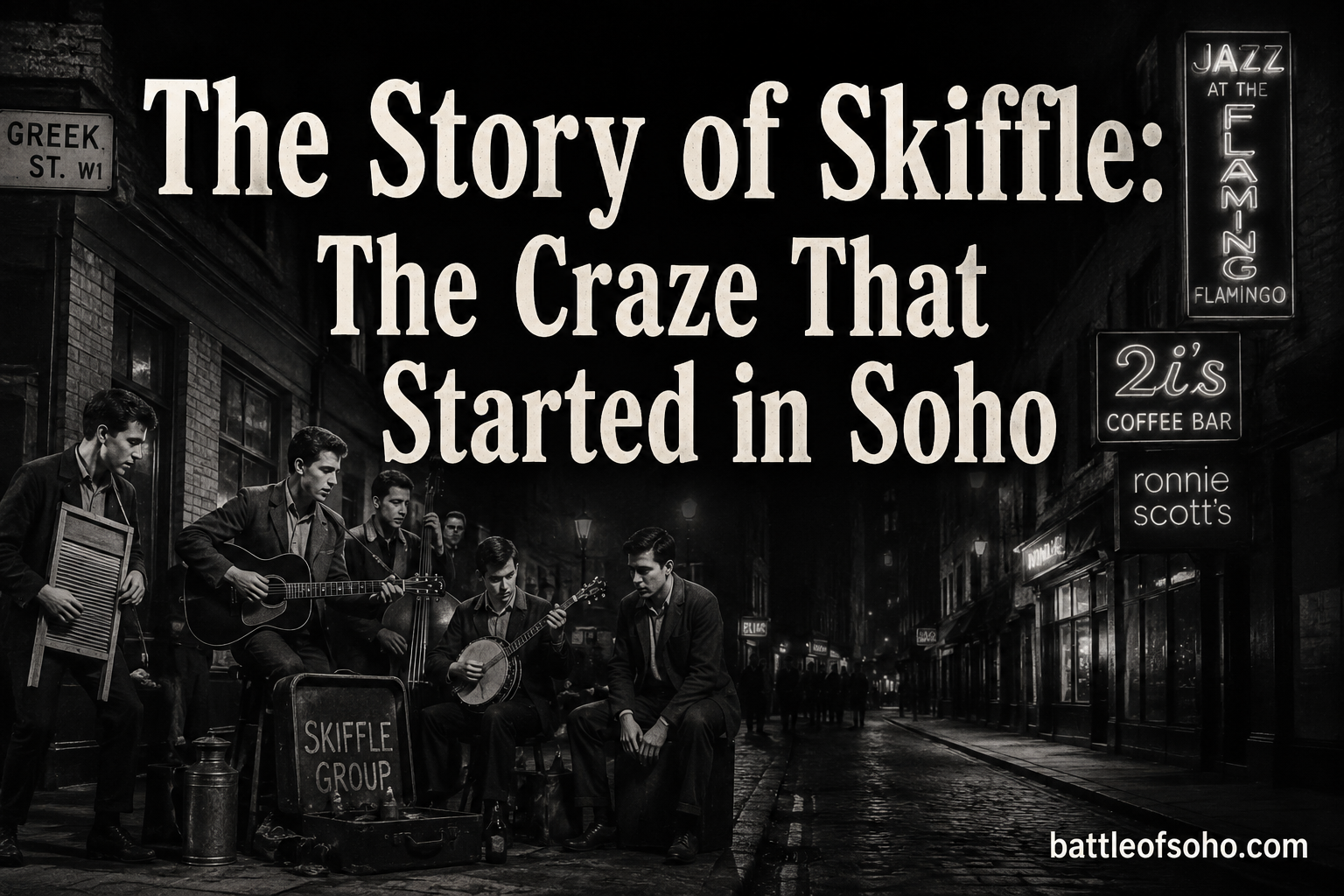
Picture Soho in 1955. The narrow streets off Old Compton Street are thick with cigarette smoke and the smell of espresso. Teenagers in drainpipe trousers crowd into basement coffee bars, clutching instruments they built themselves from tea chests, washboards, and broom handles. Nobody in these dim, sweaty cellars has any idea that they are about to change the course of popular music. This is the story of skiffle, the craze that started in Soho.
Skiffle was a musical explosion that gave ordinary British teenagers the tools to make music for the first time. It required no formal training, no expensive equipment, and no record deal. All you needed was a guitar, a makeshift bass, a sense of rhythm, and the willingness to make some noise in the back room of a pub or the corner of a coffee bar.
Within two years, the movement would produce the biggest-selling British record of the decade, launch the career of the man they called the King of Skiffle, and plant the seeds for everything that followed. Without skiffle, there is no British Invasion. Without skiffle, there are no Beatles.
The story of how skiffle rose from the smoke-filled folk clubs of Soho to dominate British popular culture is one of the most remarkable chapters in music history. It is a story about class, about access, about the hunger of post-war youth, and about a handful of London jazz musicians who stumbled upon something extraordinary.
And it all began in a few rooms in one London neighbourhood.
Table of Contents
What Is Skiffle? A Working Definition
Skiffle is a genre of folk music with influences from American folk, blues, country, bluegrass, and jazz, generally performed with a mixture of manufactured and homemade instruments. Think acoustic guitars paired with washboards, tea-chest basses, kazoos, and whatever else could produce a rhythm. The result was raw, fast, loud, and utterly infectious.
The term itself has murky origins. Some historians trace it to the American slang phrase “rent party,” where musicians in African American communities in the 1920s South would play informal music to help cover the rent. These gatherings were sometimes called “skiffle parties.” The word drifted into obscurity in America but was resurrected in post-war Britain with an entirely new meaning.
In the British context, skiffle referred specifically to the upbeat, do-it-yourself folk-blues played by young groups who drew their repertoire from American roots music. Songs by Lead Belly, Woody Guthrie, and traditional folk standards formed the backbone of the skiffle songbook. The music was simple, the energy was enormous, and the barrier to entry was almost zero.
Billy Bragg, the singer-songwriter who wrote the definitive history of the movement in his book Roots, Radicals and Rockers: How Skiffle Changed the World, describes skiffle as Britain’s first authentic teenage music craze. It preceded rock and roll in the UK by several years and gave working-class kids something that had never been available to them before: the chance to be musicians.
American Roots: From Jug Bands to Lead Belly
To understand skiffle, you have to go back to the American South in the 1920s and 1930s. Jug bands in Memphis and Louisville were playing raucous, informal music using improvised instruments. Ceramic jugs were blown into to produce bass tones. Washboards were scraped for percussion. Kazoos, combs covered with tissue paper, and cheap guitars filled out the sound.
These jug bands played blues, folk, and early jazz standards. Their music was informal, communal, and built on the idea that anyone could participate. This was music made in backyards, on porches, and at social gatherings. The recording industry barely noticed it, but it left a deep imprint on American roots music.
Meanwhile, performers like Huddie Ledbetter, better known as Lead Belly, were developing a style of folk-blues that would prove transformative. Lead Belly’s 12-string guitar playing, powerful vocals, and vast repertoire of folk songs made him a living library of American traditional music. Songs like “Rock Island Line,” “Cotton Fields,” and “Goodnight Irene” would later become foundational skiffle material.
During and after World War II, American folk and blues records began reaching Britain through several channels. American GIs stationed in Britain brought records and radio programmes with them. The BBC broadcast American folk music shows. Dedicated record collectors, particularly within the traditional jazz scene, sought out obscure American recordings with near-religious dedication.
These records found their most receptive audience among young British jazz enthusiasts in London. Musicians in the traditional jazz, or “trad jazz,” scene were obsessed with the roots of the music they played. They discovered that behind the polished sound of New Orleans jazz lay a rougher, simpler, and more immediate tradition of folk and blues. That discovery would change everything.
Soho in the 1950s: Coffee Bars and Cellars
Post-war Britain was a grey place. Rationing did not fully end until 1954. Bomb sites still scarred London’s landscape. Entertainment options for young people were limited, and the cultural atmosphere was one of austerity and restraint. But in one corner of the city, something was stirring.
Soho had been London’s bohemian heart for decades. By the early 1950s, its narrow streets were home to an emerging network of coffee bars that catered to a youthful clientele. These were not the polite cafes of the Edwardian era. They were cheap, loud, and open late. Most importantly, they needed live entertainment but could not afford professional bands.
The 2i’s Coffee Bar on Old Compton Street became the most famous of these venues. Its cellar, a cramped and claustrophobic space, hosted some of the most important musical performances in British history. The Cat’s Whisker, another Soho establishment, served a similar function. These venues were tiny, often holding fewer than fifty people, but their cultural reach was enormous.
What made Soho different from everywhere else in Britain was its density. Within a few streets, you had coffee bars, record shops, instrument dealers, and a population of young people hungry for something new. The area attracted musicians, artists, writers, and outsiders. It was the natural breeding ground for a cultural movement.
Into this environment came a group of young traditional jazz musicians. They had been playing New Orleans-style jazz in clubs across London, but they were increasingly fascinated by the American folk and blues records they were discovering. During breaks in their jazz sets, they started playing around with these simpler songs. The audiences loved it.
These informal sessions became known as “skiffle breaks.” The musicians would put down their trumpets and clarinets, pick up guitars and washboards, and launch into a Lead Belly song or a folk standard. The energy was different from jazz. It was faster, louder, and more direct. And the crowds responded with an enthusiasm that surprised everyone.
The skiffle craze that started in Soho was born in those breaks. What began as a between-sets diversion quickly became the main attraction. Audiences were coming not for the jazz but for the skiffle. The musicians took notice.
Ken Colyer: The Purist Who Lit the Fuse
If anyone deserves the title of skiffle’s founding father, it is Ken Colyer. A trumpet and guitar player from the traditional jazz scene, Colyer was a dedicated purist with an almost scholarly obsession with New Orleans music. In 1953, he did something remarkable: he signed on as a deckhand on a cargo ship and worked his passage to New Orleans.
Colyer spent his time in New Orleans immersing himself in the local music scene. He played with veteran jazz musicians, absorbed the authentic sound of the city, and discovered a wealth of folk and blues material that was virtually unknown in Britain. When he returned to London, he brought back not just musical knowledge but a vision for something new.
Back in Soho, Colyer joined forces with other jazz musicians and began organising informal skiffle sessions in the basement of the Roundhouse pub on Wardour Street. These sessions were open, participatory, and raw. Anyone who showed up with an instrument could join in. The atmosphere was communal and electric.
Colyer’s approach to skiffle was rooted in authenticity. He believed in staying true to the American source material. His repertoire drew heavily from Lead Belly, Guthrie, and traditional folk sources. He was not interested in commercialising the music or adapting it for mainstream tastes. For Colyer, skiffle was about connecting with the real roots of American vernacular music.
This purist philosophy would eventually create a rift. Colyer’s bandmate, a young banjo and guitar player named Lonnie Donegan, had very different ideas about where skiffle could go. Donegan heard commercial potential in the music. He saw an audience that wanted more than just faithful reproductions of American folk songs. That creative tension between purist and populariser would define the skiffle movement from its earliest days.
Before that split, however, Colyer’s sessions achieved something crucial. They established skiffle as a distinct musical activity, separate from jazz but connected to it. They created the template that thousands of groups would follow: guitars, washboard, tea-chest bass, and American folk songs played with British energy.
Lonnie Donegan: The King of Skiffle
Anthony James Donegan was born in Glasgow in 1931 and grew up in East London. A jazz fan from childhood, he was playing guitar and banjo in trad jazz bands by his late teens. When he joined Ken Colyer’s band in 1953, he brought with him an encyclopaedic knowledge of American folk and blues music and a natural showmanship that set him apart.
Donegan’s contribution to skiffle was not as a purist but as a communicator. He understood instinctively that the energy of skiffle could reach a mass audience. His voice was rough and urgent. His guitar playing was rhythmic and driving. And his choice of material, particularly Lead Belly’s “Rock Island Line,” would prove to be one of the most consequential song selections in music history.
In 1954, Donegan recorded “Rock Island Line” and “John Henry” during a session for Decca Records. The tracks were recorded quickly and cheaply, almost as an afterthought. At first, nothing happened. The record sat on shelves, largely ignored.
Then, in late 1955, something shifted. The record began to receive airplay, and demand built slowly but relentlessly. By early 1956, “Rock Island Line” was a sensation. It reached the top of the charts not just in Britain but internationally, becoming a hit in the United States and across Europe. It sold over a million copies and became the first debut record to achieve gold status in Britain.
The impact was seismic. Here was a record made by a working-class British musician, playing American folk music on simple instruments, and it had conquered the charts. If Lonnie Donegan could do it, anyone could. And that realisation lit the fuse of the skiffle craze that started in Soho and spread across the entire country.
Donegan followed “Rock Island Line” with a string of hits that defined the skiffle sound: “Lost John,” “Cumberland Gap,” “Don’t You Rock Me Daddy-O,” and “Putting on the Style.” Each one drove the craze further into the national consciousness. He toured relentlessly, appearing on television and radio and becoming one of the most recognisable figures in British entertainment.
The press dubbed him the King of Skiffle, and the title was well earned. Donegan was not the first musician to play skiffle, but he was the one who brought it to the masses. His influence on a generation of British musicians cannot be overstated.
George Harrison later offered perhaps the most famous assessment of Donegan’s importance: “If there was no Lead Belly, there would have been no Lonnie Donegan; no Lonnie Donegan, no Beatles.” Paul McCartney was equally direct, crediting Donegan as the reason he and millions of other British teenagers picked up guitars in the first place.
As for what happened to Lonnie Donegan himself, his career took a more complex path. As skiffle faded in the late 1950s, Donegan adapted, moving toward a more polished pop and novelty style. He continued to tour and record for decades, though he never again reached the cultural heights of his skiffle years. He experienced health problems in later life, suffering several heart attacks, and passed away in 2002 at the age of 71. By then, his legacy as the man who sparked the British music revolution was firmly established.
The 1956 to 1958 Skiffle Craze That Swept Britain
Once “Rock Island Line” broke through, the skiffle craze exploded with a speed and intensity that nobody predicted. Between 1956 and 1958, skiffle was everywhere in Britain. It was not just a musical genre. It was a full-blown youth movement.
The statistics tell a staggering story. Billy Bragg estimates that at the height of the craze, there were between 30,000 and 50,000 skiffle groups operating in Britain. That figure comes from guitar sales data, which shows annual guitar imports rising from roughly 3,000 instruments before the craze to over 30,000 at its peak. In a few short years, skiffle had turned Britain into a nation of guitar players.
Every town had skiffle groups. Every church hall, youth club, and school hosted skiffle nights. Teenagers who had never touched an instrument were forming bands, building tea-chest basses in their garages, and performing at local events. The music press ran features on skiffle technique. Music shops sold out of guitars, washboards, and banjos. It was a genuine grassroots phenomenon.
Television accelerated the spread. In 1957, the BBC launched the Six-Five Special, a television programme that featured live music and was aimed directly at the teenage audience that skiffle had created. The show was an instant hit and gave skiffle groups a national platform. For many viewers, the Six-Five Special was their first exposure to the music, and it sent thousands more rushing to form their own groups.
Beyond Lonnie Donegan, the skiffle scene produced several notable groups and performers. The Vipers Skiffle Group, formed in London, became one of the most popular acts of the era. They appeared regularly on television and had several chart hits, including a version of “Cumberland Gap” that competed directly with Donegan’s recording.
Chas McDevitt was another key figure. His group, featuring vocalist Nancy Whiskey, scored a major hit with “Freight Train,” a song written by American folk singer Elizabeth Cotten. The record was a transatlantic success and demonstrated that skiffle was not a one-man phenomenon. Nancy Whiskey’s clear, unaffected vocal style became one of the defining sounds of the era.
Johnny Duncan and the Bluegrass Boys had success with “Last Train to San Fernando.” The City Rambers Skiffle Group, the Wally Whyton Group, and dozens of others filled the charts, the airwaves, and the concert halls. For a brief, intense period, skiffle was the dominant force in British popular music.
What made the craze so powerful was its democratic nature. Skiffle did not require wealth, training, or connections. A factory worker’s son in Liverpool had the same access to the music as a middle-class student in London. All you needed was the desire to play and the willingness to build your own instrument. For the first time in British history, popular music was being made by the people who consumed it.
This was the real cultural significance of skiffle. It was not just a musical fad. It was a fundamental democratisation of music-making. It told an entire generation of working-class youth that they could be creators, not just consumers. That shift in consciousness would have consequences that extended far beyond the skiffle era itself.
Tea-Chest Basses, Washboards, and Homemade Instruments
The instruments of skiffle were as important to the movement as the songs. Part of what made the craze so explosive was that you could build your entire kit for pocket money. The homemade instrument was not a gimmick in skiffle. It was a defining feature of the genre.
The tea-chest bass was the iconic skiffle instrument. Building one was simple. You took a wooden tea chest, the kind used to ship tea from India, and cut a hole in the top. Through the hole, you threaded a broom handle or similar stick. Then you attached a single string, usually a length of heavy twine or a clothesline, from the top of the stick to the base of the chest. By pulling the stick to change the tension of the string, you could produce different notes. The sound was deep, resonant, and surprisingly musical.
The washboard served as the primary percussion instrument. Skiffle musicians would strap a washboard to their chest and play it with thimbles on their fingers, scraping and tapping to create a rhythmic backdrop. The washboard provided the drive and momentum that gave skiffle its distinctive energy. Some players added cowbells, cymbals, and other noisemakers to the washboard frame, creating a one-person rhythm section.
The comb-and-paper kazoo was the cheapest instrument of all. You took a standard pocket comb, placed a piece of tissue paper or wax paper over the teeth, and hummed into it. The paper vibrated, producing a buzzing, nasal tone that cut through the mix. It cost literally nothing and could be made in seconds.
Acoustic guitars were the melodic and harmonic backbone of the group. At the height of the craze, demand for cheap guitars outstripped supply. Manufacturers produced budget instruments specifically for the skiffle market. These were not high-quality instruments by any standard, but they were affordable and they got the job done.
Other instruments appeared regularly in skiffle groups. Banjos, mandolins, and even pianos showed up in various configurations. The beauty of the genre was that there were no rules. If it made a sound and you could play it in time, it belonged in a skiffle group.
This DIY ethic was not just practical. It was ideological. Skiffle was a rejection of the polished, professional, and often elitist culture of mainstream British entertainment. It said that music did not belong to conservatories and orchestras. It belonged to anyone with the nerve to pick up an instrument and play.
The Decline: Why Skiffle Faded by 1959
The skiffle craze burned brightly but briefly. By late 1958, the movement was already losing momentum. By 1959, it was effectively over as a commercial force. The decline was as rapid as the rise, and several factors contributed to it.
The most obvious cause was the arrival of rock and roll. Elvis Presley, Buddy Holly, Chuck Berry, and Little Richard burst into British consciousness in the mid-1950s, and their impact was devastating to skiffle. Rock and roll offered everything skiffle did, but louder, more exciting, and with a swagger that homemade instruments could not match. Teenagers who had been playing tea-chest basses suddenly wanted electric guitars.
The music industry also contributed to skiffle’s demise. Record labels had signed dozens of skiffle groups in the rush to capitalise on the craze. Many of these acts were mediocre, and the market became flooded with low-quality skiffle records. The genre began to be seen as a novelty, something quaint and slightly embarrassing rather than cutting-edge.
Lonnie Donegan himself began to move away from the raw skiffle sound that had made him famous. His later records were more polished, more pop-oriented, and less connected to the American folk roots that had defined the genre. As the King of Skiffle drifted toward mainstream entertainment, the movement lost its focal point.
There was also a natural generational turnover. The teenagers who had formed skiffle groups in 1956 were growing up. Many moved on to other interests or joined the military through national service. The influx of new, younger musicians that had sustained the craze began to slow.
The skiffle infrastructure collapsed quickly. Coffee bars stopped hosting skiffle nights. Television programmes moved on to rock and roll. Music shops that had cleared their shelves of guitars now struggled to sell washboards. The DIY spirit that had defined the movement was redirected toward electric instruments and amplifiers.
But the decline of skiffle was not the end of its story. The movement may have lasted only a few years, but it had fundamentally altered the landscape of British music. The thousands of teenagers who had learned to play guitar during the skiffle era did not simply disappear. They took their skills, their ambition, and their DIY attitude into the next phase of British popular music.
The Beatles Connection: How Skiffle Launched British Rock
The most famous skiffle group in history never had a hit record under the skiffle banner. In 1957, a sixteen-year-old named John Lennon formed a skiffle group in Liverpool called the Quarrymen. The group played the standard skiffle repertoire of Lead Belly songs, folk standards, and fast-paced blues numbers. Lennon sang and played guitar, and his friends filled out the lineup with washboard, tea-chest bass, and banjo.
On 6 July 1957, the Quarrymen played a garden party at St. Peter’s Church in Woolton, Liverpool. In the audience that day was a fifteen-year-old named Paul McCartney, who had been brought along by a mutual friend. McCartney was impressed by Lennon’s performance and, more importantly, by his willingness to adapt lyrics and make songs his own. A few weeks later, McCartney was invited to join the group.
That meeting at a skiffle gig was the founding moment of the Beatles. Every subsequent member of the band, including George Harrison, came through the skiffle scene. Harrison was a fan of Lonnie Donegan before he was a fan of anything else. His first instrument was a guitar bought for him by his father specifically so he could play skiffle songs.
The Beatles connection is not a coincidence or a minor footnote. It is the direct lineal descendant of the skiffle craze that started in Soho. The Quarrymen were a skiffle group before they were a rock and roll band. The DIY ethic, the emphasis on American roots music, and the belief that working-class teenagers could create music worth hearing all came directly from the skiffle tradition.
The Quarrymen eventually evolved into the Beatles, but the skiffle influence remained visible in their early work. Songs like “Love Me Do,” “Ask Me Why,” and “Misery” contain traces of the skiffle aesthetic: simple chord structures, folk-derived melodies, and a rhythmic drive that echoes the washboard-and-bass sound of the coffee bar era.
And it was not just the Beatles. Mick Jagger formed his first group, Little Boy Blue and the Blue Boys, as a skiffle-inspired outfit. Jimmy Page, later of Led Zeppelin, was a skiffle enthusiast who appeared on television as a young guitarist playing skiffle material. Van Morrison’s earliest musical experiences in Belfast were rooted in the skiffle tradition. Graham Nash, later of Crosby, Stills and Nash, started in a skiffle group in Manchester.
Billy Bragg argues that skiffle was the boot camp for the British Invasion. Every major British rock musician of the 1960s came through the skiffle door. The Rolling Stones, the Who, the Yardbirds, the Animals, the Kinks: all of them trace their origins to teenagers who first picked up instruments because of Lonnie Donegan and the skiffle movement.
The historian and broadcaster Mark Kermode has called skiffle “the most influential music movement that nobody remembers.” That may be slightly unfair, but it captures the paradox. Skiffle’s direct influence lasted barely three years, yet its indirect influence shaped the next three decades of popular music worldwide. Every British band that conquered America in the 1960s did so on foundations built by skiffle.
The Story of Skiffle: A Lasting Legacy
The story of skiffle, the craze that started in Soho, is one of the most remarkable narratives in the history of popular music. In a few basement rooms in one London neighbourhood, a handful of musicians stumbled upon a formula that would transform British culture forever. They took American folk songs, added British energy, reduced the instrumentation to its simplest possible form, and created something that millions of young people could call their own.
The craze lasted only a few years, but its impact was permanent. Skiffle gave Britain its first generation of guitar players. It democratised music-making in a country where culture had historically been the preserve of the elite. It proved that working-class teenagers from Liverpool, Newcastle, Belfast, and London could create music that mattered.
The Soho coffee bars where it all began are mostly gone now. The 2i’s Coffee Bar closed long ago, and the cellars that once echoed with washboard rhythms and tea-chest bass lines have been repurposed or demolished. But the cultural DNA of skiffle lives on in every British band that has followed in its wake.
Billy Bragg’s assessment remains the most powerful: skiffle changed the world. Not through sophistication or virtuosity, but through accessibility and attitude. It told a generation of young people that music belonged to them. And they listened.
Without those early sessions in Soho’s coffee bars, there is no Lonnie Donegan. Without Lonnie Donegan, there are no Quarrymen. Without the Quarrymen, there are no Beatles. And without the Beatles, the entire landscape of modern popular music looks fundamentally different. The craze that started in Soho turned out to be the beginning of everything.
FAQs
What is skiffle music?
Skiffle is a genre of folk music with influences from American folk, blues, country, bluegrass, and jazz, generally performed with a mixture of manufactured and homemade instruments like washboards, tea-chest basses, and acoustic guitars. It became extremely popular in Britain in the 1950s.
Why was skiffle popular in 1950s Britain?
Skiffle was popular because it was the ultimate do-it-yourself music. Young people could cheaply buy, improvise, or build their own instruments and perform without requiring formal musical training or expensive equipment. It gave working-class British youth their first opportunity to participate in music creation.
How did skiffle influence the Beatles?
John Lennon formed the Quarrymen as a skiffle group in 1957. Paul McCartney and George Harrison both joined through the skiffle scene. George Harrison famously said: ‘If there was no Lead Belly, there would have been no Lonnie Donegan; no Lonnie Donegan, no Beatles.’ Skiffle was the direct foundation of the Beatles.
What happened to Lonnie Donegan?
Lonnie Donegan continued to perform and record for decades after the skiffle era, moving toward a more polished pop style. He suffered several heart attacks in later life and passed away in 2002 at age 71. He is remembered as the King of Skiffle and one of the most influential figures in British music history.
When did the skiffle craze start and end?
The skiffle craze began around 1954 to 1955 in the coffee bars of Soho, London. It exploded nationally after Lonnie Donegan’s recording of ‘Rock Island Line’ became a hit in early 1956. The craze peaked in 1957 and declined rapidly by 1959 as rock and roll took over.
Why did skiffle decline?
Skiffle declined primarily because of the arrival of rock and roll in Britain. Artists like Elvis Presley and Buddy Holly offered a more exciting sound. The market also became flooded with low-quality skiffle records, turning the genre into a perceived novelty. Lonnie Donegan’s shift toward mainstream pop also removed the movement’s focal point.
What instruments were used in skiffle?
Skiffle groups typically used acoustic guitars, tea-chest basses (made from wooden tea chests, broom handles, and string), washboards played with thimbles, comb-and-paper kazoos, banjos, and sometimes mandolins or pianos. The DIY nature of these instruments was central to skiffle’s appeal.
Where did the skiffle craze start?
The skiffle craze started in Soho, London, specifically in coffee bars like the 2i’s on Old Compton Street and the Roundhouse pub on Wardour Street. Ken Colyer’s informal skiffle sessions in these Soho venues in the early 1950s are widely regarded as the birthplace of the movement.