
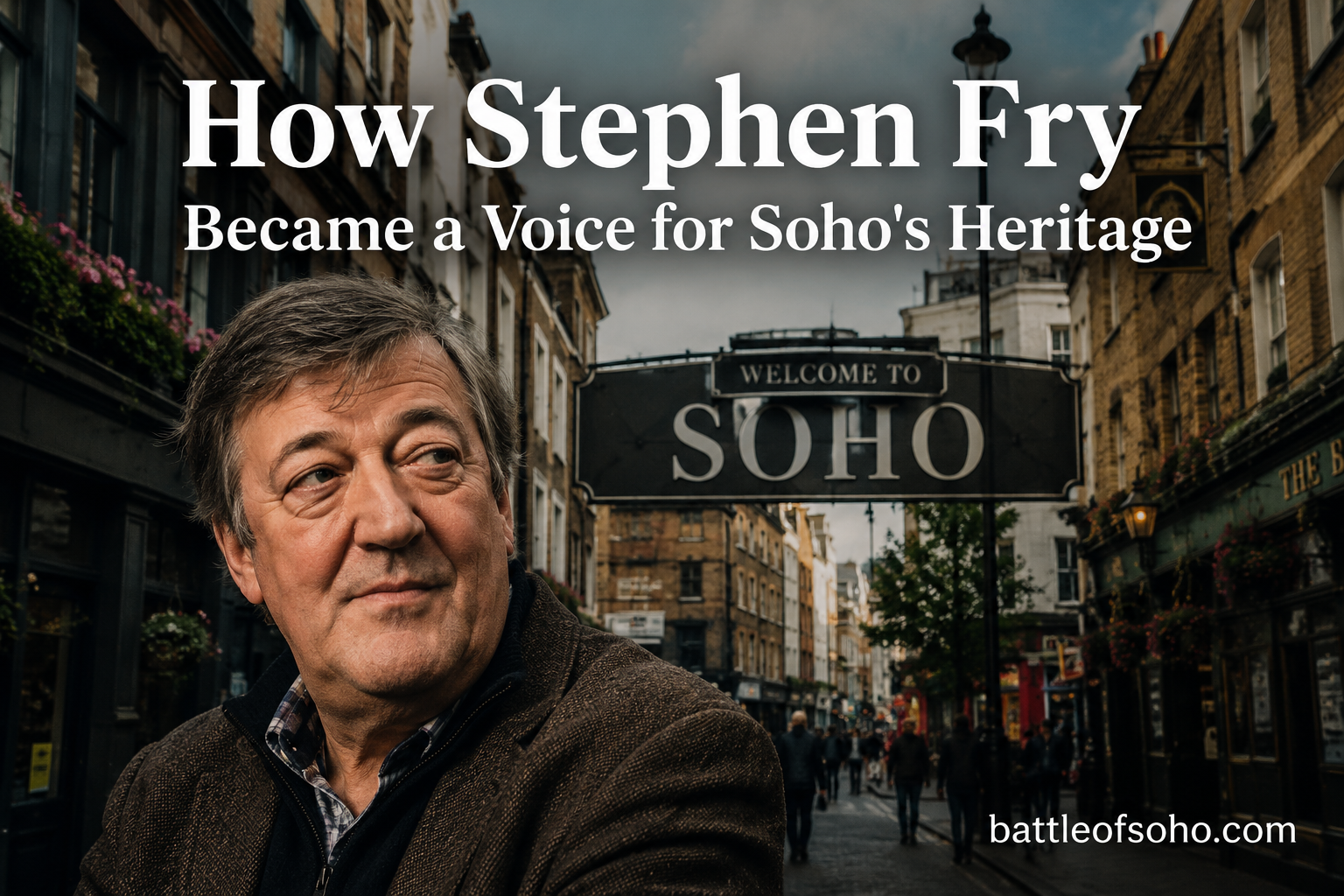
Stephen Fry became a voice for Soho’s heritage by narrating the 2025 feature documentary “This Is Soho,” which chronicles the historic London district’s LGBTQ+ legacy and its fight against gentrification. As an openly gay cultural icon with decades of advocacy work, Fry lent his distinctive voice and platform to draw national attention to a cultural preservation crisis threatening one of Britain’s most iconic neighbourhoods.
When the announcement landed in August 2025 that Sir Stephen Fry would narrate a feature documentary about London’s most storied square mile, it felt less like a casting decision and more like an inevitability. For anyone who has followed Fry’s career, his connection to Soho runs deeper than a single film credit. It threads through decades of personal history, public advocacy, and a stubborn belief that places with cultural memory deserve protection.
The documentary, titled “This Is Soho,” arrived at a moment when the neighbourhood stands at what director Ahmed Peerbux called a “crossroads.” Rising commercial rents, venue closures, and the steady creep of chain retail have put Soho’s identity as London’s LGBTQ+ and bohemian heart under unprecedented pressure. Fry’s involvement brought something the crisis needed desperately: mainstream attention from a voice people trust.
In this article, we explore how Stephen Fry became a voice for Soho’s heritage, tracing his personal connection to the area, the making of the documentary, and what his advocacy means for the future of one of London’s most culturally significant districts.
Table of Contents
Quick Overview: This Is Soho at a Glance
Before we get into the deeper story, here are the key facts about the documentary that brought Fry and Soho’s heritage fight together.
“This Is Soho” is a feature documentary directed by Ahmed Peerbux, produced by DARE Pictures and Bad Tattoo, with international sales handled by Sphere Abacus. The film uses verite storytelling to capture the daily reality of a neighbourhood in flux, following the drag queens, landlords, bouncers, and local legends who call Soho home.
Fry signed on as narrator, bringing his instantly recognisable voice to guide viewers through the area’s layered history. The documentary premiered at MIPCOM 2025 in Cannes in October, before heading to a UK theatrical release and subsequent international distribution across cities including Toronto, Sydney, and Berlin.
The film’s central question is simple but urgent: can a neighbourhood that has served as a safe haven for marginalised communities for over half a century survive the economic forces reshaping central London? Fry’s narration gives that question weight and gravity, anchoring the on-the-ground footage in historical context.
For DARE Pictures co-founder Derren Lawford, the choice of Fry was deliberate. His voice carries decades of cultural authority, and his personal connection to the LGBTQ+ community means the narration never feels detached or clinical. It reads like someone telling the story of their own neighbourhood.
Soho’s Bohemian Legacy: From Jazz Clubs to LGBTQ+ Haven
To understand why Stephen Fry’s involvement matters so much, you have to understand what Soho has meant to London for the better part of a century.
Soho’s identity as a cultural pressure cooker did not happen overnight. The square mile bounded by Oxford Street, Shaftesbury Avenue, Charing Cross Road, and Regent Street has been reinventing itself since the 1940s, when jazz clubs began drawing crowds to basement venues and late-night bars. Musicians, writers, and artists gravitated to the area for its cheap rents and tolerant atmosphere, establishing a bohemian character that would define Soho for generations.
The 1950s and 1960s cemented Soho’s reputation as the creative heart of London. The 2i’s Coffee Bar on Old Compton Street launched the careers of British rock and roll pioneers. The Colony Room, a private members’ club frequented by Francis Bacon and Lucian Freud, became legendary for its artistic conversations and self-destructive excess. Soho was messy, creative, and gloriously unrespectable.
By the 1970s, the punk rock movement found a home in Soho’s gritty venues. The Marquee Club hosted the Sex Pistols, and the area became a flashpoint for countercultural expression. This was the era when Soho solidified its reputation as a place where outsiders could belong, whether they were musicians, artists, or people whose sexuality mainstream society refused to accept.
The 1980s and 1990s marked the transformation that matters most to this story. Old Compton Street became the undisputed centre of London’s gay district. Venues like G-A-Y Bar, Heaven, and the Admiral Duncan created a visible, vibrant LGBTQ+ community that was impossible to ignore. Drag performers became local celebrities. For many LGBTQ+ people across Britain, Soho was not just a nightlife destination but a sanctuary, the place where you could be yourself without fear.
Stephen Fry came of age as a public figure during exactly this period. His early career in Cambridge Footlights, his partnership with Hugh Laurie, and his emergence as one of Britain’s most beloved entertainers coincided with Soho’s golden age as an LGBTQ+ haven. He was a familiar face in the area’s bars and restaurants during a time when being openly gay in public life required genuine courage.
That shared history is what makes his narration of “This Is Soho” so resonant. When Fry describes what the neighbourhood has meant to generations of LGBTQ+ people, he is not reading from a script. He is describing a place he has known intimately for decades.
How Stephen Fry Became a Voice for Soho’s Heritage
The question of how Stephen Fry became a voice for Soho’s heritage is really a question about a lifetime of advocacy converging with a single project at the right moment.
Sir Stephen John Fry was born on 24 August 1957 and has been one of Britain’s most prominent cultural figures for over four decades. He is an actor, comedian, writer, and broadcaster whose career spans television, film, radio, and literature. But what makes Fry uniquely suited to speak for Soho is not his fame alone. It is the intersection of his personal identity, his advocacy work, and his deep roots in London’s cultural life.
Fry is openly gay and has been a vocal LGBTQ+ advocate since long before it was common for public figures to be so. He came out publicly in the late 1990s, at a time when being an openly gay celebrity in Britain still carried professional risk. His 2014 marriage to Elliott Spencer was celebrated as a milestone for LGBTQ+ visibility in British public life. For many LGBTQ+ people in the UK, Fry is not just an entertainer but a symbol of what visibility and authenticity can look like.
Beyond his LGBTQ+ advocacy, Fry has a long track record of heritage and cultural preservation work. He served as president of Mind, the mental health charity, from 2011 to 2023, using his platform to destigmatise mental illness. He has been a passionate advocate for the Foundation for Jewish Heritage, reflecting his own Hungarian Jewish ancestry and his belief that cultural memory deserves protection. He has narrated dozens of documentaries on topics ranging from endangered species to Greek mythology, always bringing a warmth and erudition that makes complex subjects accessible.
What is Stephen Fry’s heritage? He has described himself as having Hungarian Jewish roots on his mother’s side, with his maternal grandfather, Martin Neumann, being a Hungarian Jew who settled in the UK. This personal understanding of heritage, of how family history and cultural identity shape who we are, directly informs his approach to preservation advocacy. Fry knows that when a community’s cultural landmarks disappear, something irreplaceable is lost.
When Ahmed Peerbux and the DARE Pictures team were developing “This Is Soho,” Fry was the natural choice. His voice is instantly recognisable to British audiences, carrying an authority that is both intellectual and warm. His decades of connection to London’s LGBTQ+ community meant he understood what was at stake without needing it explained. And his track record of using his platform for advocacy meant that his involvement would signal to audiences that this was not just entertainment but a story that mattered.
Fry’s narration style in the documentary reflects this personal investment. Rather than the detached, encyclopaedic tone of some documentary voiceovers, his delivery has an intimate quality, as if he is walking you through a neighbourhood he has loved for decades. It is this quality that transforms “This Is Soho” from a well-made film into something that feels like a personal plea for cultural preservation.
Is Stephen Fry LGBTQ? Yes, he is openly gay and has been one of Britain’s most visible LGBTQ+ public figures for over two decades. This is not incidental to his role in the Soho heritage story. It is central to it. When Fry speaks about the importance of preserving LGBTQ+ spaces, he is speaking as a member of the community, not an outside observer. That authenticity is what makes his voice so powerful in this context.
The Economic Squeeze: Gentrification and Venue Closures
The crisis that prompted “This Is Soho” and drew Fry into the heritage fight is not abstract. It is visible on every street in the neighbourhood, and the numbers tell a stark story.
Commercial rents in Soho have increased by approximately 32% since 2019, according to data compiled from estate agents and business surveys. For independent venues that operate on thin margins, this kind of increase is not a challenge to overcome but an existential threat. Long-standing businesses that helped define the area’s character have been forced to close or relocate as landlords chase higher returns from chain retailers and corporate tenants.
The LGBTQ+ venue closures have been particularly painful. G-A-Y Late, one of the most prominent late-night venues on Old Compton Street, closed its doors after years of financial pressure. The sale and potential redevelopment of G-A-Y Bar sent shockwaves through the community, with many fearing that the heart of London’s gay district was being hollowed out. Heaven nightclub, while still operating, has faced its own battles with rising costs and licensing pressures.
These are not just businesses closing. Each venue that shuts down represents a loss of community space, of somewhere that LGBTQ+ people could gather without fear, of the specific kind of safety that comes from being surrounded by people who understand your experience. When Fry narrates the story of these closures, the weight in his voice comes from knowing what these spaces have meant to real people.
The economic forces driving the change are well documented. Tourism accounts for an estimated 55% of Soho’s daily foot traffic, which means the area’s economy is heavily dependent on visitors rather than residents. While this brings revenue, it also creates pressure to cater to tourist expectations rather than local community needs. Chain restaurants and branded retail have proliferated, replacing the independent venues that gave Soho its distinctive character.
The acquisition of significant Soho property portfolios by investment firms like Urban Capital Partners, reportedly valued at around 45 million pounds, has accelerated concerns about the area’s future. When property is treated primarily as a financial asset rather than a community resource, the cultural life that depends on affordable space is inevitably squeezed out.
Community resistance has been fierce. Local campaigners, business owners, and heritage advocates have organised to push back against the tide of closures and commercialisation. The “Save Soho” movement and similar grassroots groups have raised awareness, lobbied local councils, and worked to keep the conversation in the public eye. But without broader public support, their efforts face long odds against the economic interests reshaping the neighbourhood.
This is where Fry’s involvement becomes more than symbolic. His narration of “This Is Soho” takes a story that was being told primarily within the LGBTQ+ community and Soho’s immediate networks and amplifies it to a national, even international, audience. A documentary narrated by one of Britain’s most beloved public figures is far harder to ignore than a community campaign, however passionate.
The documentary also features voices from across Soho’s ecosystem, creating a fuller picture of what is at stake. Drag queens who have performed on Old Compton Street for decades share their fears about losing their stages. Landlords discuss the impossible economics of keeping rents affordable. Bouncers, bartenders, and venue owners describe the daily reality of trying to keep independent businesses alive in a neighbourhood that is increasingly hostile to them.
Behind the Documentary: Ahmed Peerbux and the Voices of Soho
The making of “This Is Soho” is itself a story of patience, trust, and a commitment to telling the truth about a community in transition.
Director Ahmed Peerbux spent over a year building relationships within the Soho community before filming began in earnest. This was not a case of a film crew dropping in for a few weeks of shooting. Peerbux and his team embedded themselves in the neighbourhood, attending community meetings, spending time in venues, and earning the trust of people who had good reason to be suspicious of outsiders with cameras.
The result is a documentary that feels lived-in rather than observational. The verite approach, which prioritises capturing real life as it unfolds rather than staging scenes or conducting formal interviews, gives “This Is Soho” an immediacy that traditional documentary techniques might have missed. You see Soho the way the people who live and work there see it: messy, vibrant, precarious, and deeply loved.
The production team behind the film brings serious credentials. DARE Pictures, co-founded by Derren Lawford, has built a reputation for socially engaged documentary filmmaking. Bad Tattoo brought additional production expertise, and Sphere Abacus handled the international sales strategy that secured the documentary’s distribution across multiple territories.
Fry’s involvement in the narration came at a crucial stage in the production. His voice provides the connective tissue that links the verite footage to the broader historical and cultural context. When the camera lingers on a closed venue or a drag performer preparing for a show, Fry’s narration fills in the backstory without overwhelming the visual narrative.
The film also features Dr. Amelia Reed, an academic from King’s College London who has studied the economic and social forces reshaping Soho. Her analysis provides the data-driven backbone of the documentary’s argument, while the community voices give it emotional depth. Peerbux’s achievement is weaving these elements together into something that works as both journalism and advocacy.
The decision to premiere at MIPCOM 2025 in Cannes was strategic. MIPCOM is one of the world’s most important television and content markets, and premiering there ensured that international buyers would see the film before it reached general audiences. The subsequent festival circuit screenings in Toronto, Sydney, and Berlin helped build momentum for a wider theatrical release.
For Fry, the narration work on “This Is Soho” fits into a broader pattern of using his voice, both literally and figuratively, for causes he believes in. His narration credits include natural history documentaries, historical series, and literary adaptations. But “This Is Soho” is different because the subject is personal. This is not a distant landscape or an abstract historical period. It is a neighbourhood he has known and loved for most of his adult life.
What Comes Next for Soho’s Heritage?
The fight for Soho’s cultural identity is far from over, and the documentary is just one part of a broader preservation movement.
One of the most talked-about proposals is a cultural preservation levy, which would use a portion of local commercial revenue to fund independent venues and cultural spaces. The idea has gained traction among local councillors and heritage advocates, though implementation remains a challenge. Councillor Priya Patel and others have championed the concept as a way to ensure that the economic activity in Soho contributes to preserving the very culture that draws people there in the first place.
The Greater London Authority has also explored heritage protection schemes specifically designed for cultural districts. These could include special planning protections for LGBTQ+ venues, reduced business rates for independent operators, and planning restrictions that make it harder to convert cultural spaces into generic retail or office units.
Community groups continue to play a central role. The activists, local historians, and business owners who appear in “This Is Soho” have not stopped their work just because the cameras have moved on. Regular meetings, public campaigns, and engagement with local government all continue, supported by the increased visibility that the documentary has brought to their cause.
For audiences who want to support Soho’s heritage, the film’s theatrical and streaming release offers an opportunity to learn about the issues and get involved. Supporting independent venues, joining local preservation campaigns, and raising awareness through social media are all concrete ways to contribute. The fight for Soho’s soul is not something that can be won by a single documentary, but Fry’s narration ensures that far more people now know there is a fight happening at all.
Frequently Asked Questions
Why did Stephen Fry narrate the This Is Soho documentary?
Stephen Fry narrated This Is Soho because of his decades-long personal connection to London’s LGBTQ+ community and his track record of cultural heritage advocacy. As an openly gay public figure who has been associated with Soho’s cultural scene since the 1980s, Fry brought authenticity and authority to the narration that an outside voice could not have provided. Director Ahmed Peerbux and the DARE Pictures team selected Fry specifically for his ability to bridge mainstream audiences and LGBTQ+ heritage storytelling.
What is the This Is Soho documentary about?
This Is Soho is a feature documentary directed by Ahmed Peerbux that examines the cultural heritage, LGBTQ+ legacy, and economic challenges facing London’s Soho district. Produced by DARE Pictures and Bad Tattoo, the film uses verite storytelling to follow drag queens, landlords, bouncers, and local legends as they navigate rising rents, venue closures, and the commercialisation threatening the neighbourhood’s identity.
What LGBTQ+ venues in Soho have closed recently?
Several prominent LGBTQ+ venues in Soho have closed or faced significant pressure in recent years. G-A-Y Late on Old Compton Street closed due to financial pressures, and the sale of G-A-Y Bar raised major concerns about the future of the gay district. Commercial rents in Soho have risen approximately 32% since 2019, forcing many independent venues to shut down or relocate.
When does This Is Soho premiere?
This Is Soho premiered at MIPCOM 2025 in Cannes in October 2025. Following the Cannes premiere, the documentary screened at festivals in Toronto, Sydney, and Berlin before heading to a UK theatrical release. International distribution is handled by Sphere Abacus, with streaming availability planned for later.
Who directed the This Is Soho documentary?
Ahmed Peerbux directed This Is Soho. He spent over a year building trust within the Soho community before filming began, using a verite approach to capture daily life in the neighbourhood. The film was produced by DARE Pictures, co-founded by Derren Lawford, in partnership with Bad Tattoo, with international sales managed by Sphere Abacus.
Is Stephen Fry involved in London LGBTQ+ activism?
Yes, Stephen Fry has been one of Britain’s most visible LGBTQ+ advocates for over two decades. He is openly gay and has used his platform consistently to support LGBTQ+ rights, mental health awareness through his presidency of Mind, and cultural heritage preservation through the Foundation for Jewish Heritage. Narrating This Is Soho is an extension of his long-standing commitment to using his voice for advocacy.
Conclusion
How Stephen Fry became a voice for Soho’s heritage is a story about the right person arriving at the right moment with the right project. His lifetime of LGBTQ+ advocacy, his deep personal connection to London’s cultural life, and his instantly recognisable voice made him the natural narrator for a documentary about a neighbourhood fighting for its survival.
“This Is Soho” is more than a film. It is a call to pay attention to what gets lost when cultural districts are treated primarily as real estate. With Fry’s voice behind it, that call reaches far beyond the boundaries of a single London postcode and into a conversation about how cities everywhere decide what is worth preserving.