
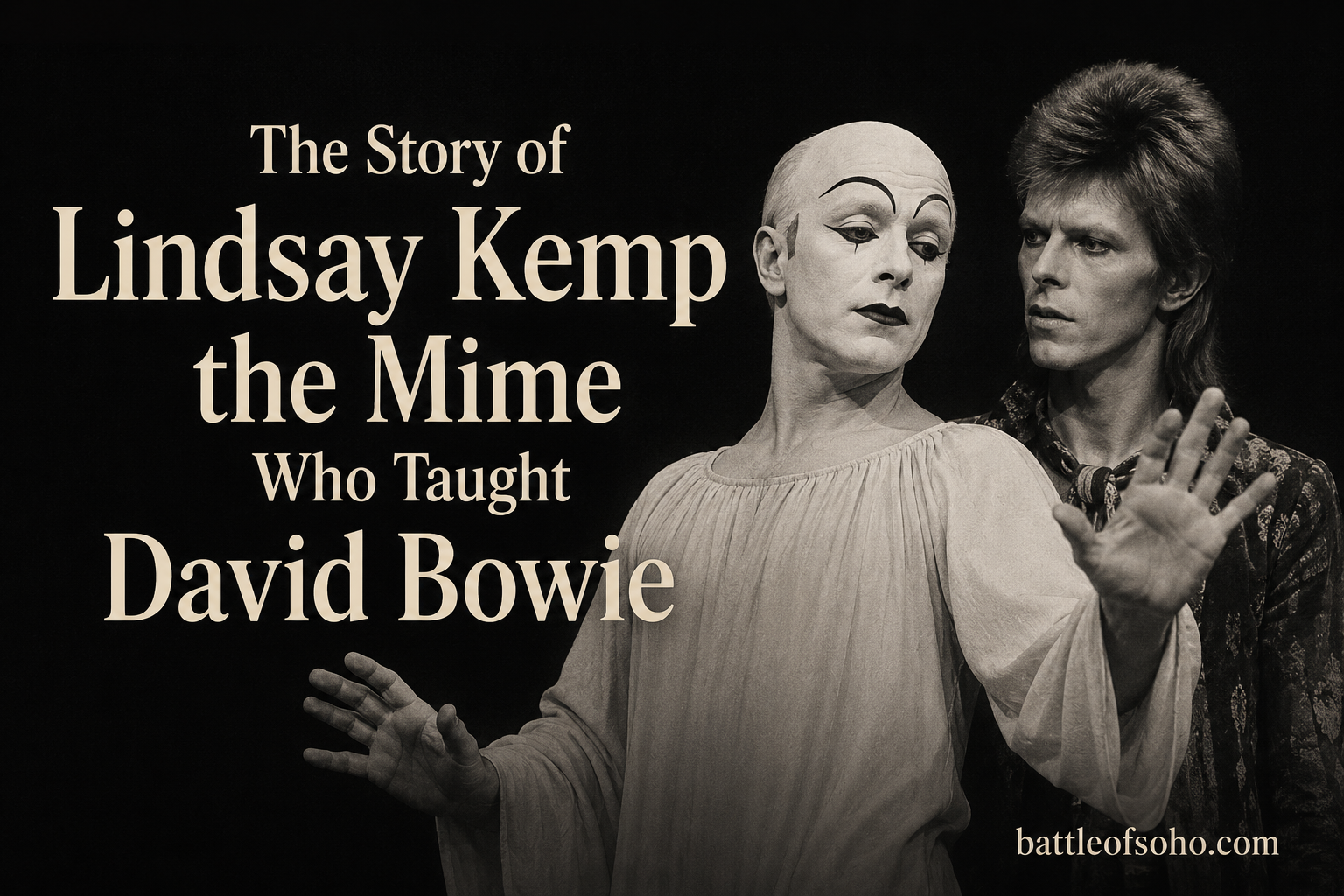
Lindsay Kemp (3 May 1938 – 24 August 2018) was a Scottish dancer, mime artist, actor, teacher, and choreographer who profoundly influenced British performance art and famously taught David Bowie the art of theatrical movement. His unique blend of mime, dance, and avant-garde theatre shaped the visual language of some of the most iconic performers of the 20th century. The story of Lindsay Kemp the mime who taught David Bowie is one of artistic obsession, theatrical daring, and a mentorship that changed the face of popular music forever.
Long before the glam rock era or the glittering alter egos, a young David Bowie walked into a London dance studio and encountered a performer who would reshape his entire approach to stagecraft. Kemp did not just teach Bowie how to move. He taught him how to transform.
In this article, I trace the full arc of Lindsay Kemp’s life, from his Scottish childhood through his revolutionary dance company, into the legendary partnership with Bowie, and across a teaching career that touched generations of performers. His story deserves to be told in full, not just as a footnote in rock history but as the biography of one of Britain’s most original theatrical minds.
Table of Contents
Early Life and Artistic Beginnings
Lindsay Kemp was born on 3 May 1938 in South Shields, then part of County Durham, to a Scottish family. His father, a seaman in the merchant navy, was frequently away at sea, leaving young Lindsay in the care of his mother and grandmother. He was raised largely in a household of women, an experience that shaped his sensitivity and his lifelong fascination with feminine archetypes in performance.
The family relocated to Liverpool during his childhood, and Kemp often credited the vibrant port city with opening his eyes to performance and spectacle. Liverpool in the postwar years was a place of music halls, street entertainers, and theatrical traditions that stretched back generations. He absorbed all of it. The young Kemp would watch variety shows and pantomimes with rapt attention, already studying how bodies could tell stories without words.
His early life was marked by hardship. During World War II, he was evacuated to the countryside, separated from his family at a formative age. That experience of displacement and loneliness, he later said, taught him the power of silence and gesture. When you cannot speak to the people around you, you learn to communicate with your body, your eyes, and your hands.
Kemp did not set out to become a mime artist. He initially trained as a painter, studying at Bradford College of Art. Visual art gave him a compositional eye that would later define his stage work. Every performance he created was a living painting, carefully composed and visually deliberate. But painting alone could not contain his restless energy.
The turning point came when he discovered dance. He began studying movement and was drawn to the expressive potential of the body as a storytelling instrument. This led him to the work of modern dance pioneers and, eventually, to the study of mime under some of the greatest practitioners of the discipline.
After completing his art studies, Kemp moved to London in the late 1950s. The city was emerging from postwar austerity and entering a period of creative explosion. London’s fringe theatre scene was fertile ground for experimentation, and Kemp threw himself into it completely. He studied with Hilde Holger, an Austrian expressionist dancer who had fled Nazi Europe and settled in London. Holger’s expressionist approach to movement, which emphasized emotional truth over technical perfection, became a cornerstone of Kemp’s philosophy.
He also trained briefly with the legendary French mime Marcel Marceau, one of the most celebrated mime artists of all time. Marceau’s influence is visible in Kemp’s respect for silence and precision, but Kemp was never content to imitate. Where Marceau was classical and refined, Kemp would become raw, theatrical, and unapologetically flamboyant. He took the discipline of mime and infused it with the energy of music hall, cabaret, and drag.
Career as a Mime Artist and Dancer
By the mid-1960s, Lindsay Kemp had established himself as one of the most distinctive performers in London’s underground theatre scene. He founded the Lindsay Kemp Company, a collective of dancers, actors, and performance artists who shared his vision of total theatre, a form that merged mime, dance, music, and visual art into a single unified experience.
Kemp’s performances were unlike anything British audiences had seen. He drew on influences as diverse as Vaslav Nijinsky, the revolutionary Russian dancer whose athletic intensity redefined ballet in the early 20th century, and Japanese kabuki theatre, with its stylized gestures and elaborate makeup. He synthesized these traditions into something entirely his own.
His breakthrough production was Flowers, a wordless theatrical piece inspired by Jean Genet’s novel Our Lady of the Flowers. First performed in 1968, Flowers told the story of imprisoned men and their fantasies through movement, gesture, and haunting visual tableaux. The production was a sensation. It played to packed houses in London and then toured internationally, earning acclaim across Europe and beyond. Critics described it as viscerally beautiful and emotionally devastating, a piece that communicated more in silence than most plays did with pages of dialogue.
Flowers became Kemp’s signature work, and he continued to perform and revive it for decades. Its success established him not just as a performer but as a significant choreographer and director. He had proven that mime could carry the emotional weight of a full-length theatrical production.
Following Flowers, Kemp created a string of ambitious works. His production of A Midsummer Night’s Dream, performed entirely through movement, demonstrated his ability to reinterpret classical texts through a physical vocabulary. Bare, another notable piece, pushed boundaries further with its exploration of vulnerability, the body, and raw emotional exposure. Each production reinforced Kemp’s reputation as an artist who refused to be categorized.
His style defied easy description. It was mime, but not in the tradition of white-faced street performers trapped in invisible boxes. It was dance, but without the rigid formalism of ballet. It was theatre, but stripped of conventional narrative. Kemp called it simply performance, and he meant the word in its purest sense: the act of being fully, dangerously alive in front of an audience.
Kemp was also a gifted character actor who appeared in films by Federico Fellini and Derek Jarman. His role in Jarman’s Jubilee (1978) and Sebastiane placed him at the center of British avant-garde cinema. He brought to film the same intense physical presence that defined his stage work. Fellini, himself a master of visual spectacle, cast Kemp in his 1979 film City of Women, a testament to the international reach of Kemp’s reputation.
Throughout the 1970s and 1980s, Kemp toured relentlessly. He performed in venues ranging from grand opera houses to tiny fringe theatres. His company became a training ground for young performers, and his workshops attracted students from around the world. He was building not just a career but an institution, a school of thought about what the body could communicate.
The David Bowie Connection
The meeting between Lindsay Kemp and David Bowie in 1967 is one of the most consequential encounters in the history of popular music. Bowie, then a 20-year-old singer searching for his artistic identity, had been introduced to Kemp through a mutual friend. Bowie was fascinated by Kemp’s performances and asked to study with him. Kemp agreed, and what followed was a mentorship that would help define Bowie’s entire career.
Bowie began attending Kemp’s dance classes and workshops in London. Under Kemp’s guidance, he studied mime, movement, and the principles of theatrical self-transformation. Kemp taught him that the body could be a mask, a costume, and a character all at once. This was a revelation for a young musician who was already obsessed with identity and reinvention.
The training was rigorous. Kemp pushed Bowie to explore extremes of movement, from exaggerated gestures to micro-expressions. He introduced Bowie to the concept of the grotesque as a theatrical tool, the idea that distortion and exaggeration could reveal deeper emotional truths than naturalism ever could. Bowie absorbed these lessons and would apply them to every stage of his career.
Kemp and Bowie did not just share a teacher-student relationship. They collaborated directly on stage. In 1967, Bowie appeared in Kemp’s production of Pierrot in Turquoise, a mime and music piece also known as The Looking Glass Murders. Bowie co-wrote the music and performed alongside Kemp’s company. The production aired on Scottish television in 1970, offering a rare glimpse of their artistic partnership.
This collaboration was a testing ground for Bowie. It allowed him to fuse his musical abilities with the theatrical techniques he was learning from Kemp. The seeds of Ziggy Stardust, Aladdin Sane, and the Thin White Duke were planted in Kemp’s studio. Every time Bowie adopted a new persona on stage, he was drawing on the principles of transformation that Kemp had taught him.
The influence is visible in specific, concrete ways. Bowie’s use of mime and stylized gesture in his 1970s performances, his deliberate manipulation of body language to signal character shifts, his willingness to be visually confrontational on stage, all of these trace directly back to Kemp’s teachings. When Bowie performed “Rock ‘n’ Roll Suicide” at the final Ziggy Stardust concert in 1973, the dramatic gestures and theatrical collapse were pure Lindsay Kemp.
Kemp also introduced Bowie to a wider artistic world. Through Kemp, Bowie encountered the work of mime artists, avant-garde dancers, and performance pioneers who expanded his understanding of what a popular music performance could be. Kemp connected Bowie to traditions that stretched from commedia dell’arte to modern dance, and Bowie synthesized them into something entirely new.
Their relationship was not always smooth. As Bowie’s fame grew, the balance of power shifted. Some accounts suggest tension over credit and artistic direction. But Kemp always spoke of Bowie with warmth and pride, and Bowie consistently acknowledged his debt to his first movement teacher. In interviews decades later, Bowie still referred to Kemp as a transformative figure in his artistic development.
When news of Kemp’s death broke in 2018, tributes from across the music and theatre worlds poured in. Many noted that without Lindsay Kemp, there may have been no Ziggy Stardust, no theatrical rock spectacle, no merging of music and performance art that defined the glam rock era. The mime who taught David Bowie had, in a very real sense, taught the world a new way to see a rock star.
Teaching Career and Philosophy
Teaching was never secondary to Lindsay Kemp’s career. It was central to his identity as an artist. He believed that performance was a living tradition, something passed body to body, and he devoted enormous energy to transmitting his knowledge to the next generation. His dance studio in London became a legendary space, a place where performers from all disciplines came to study movement, expression, and the art of transformation.
Kemp’s teaching philosophy was built on several core principles. First, he believed that every body could communicate. You did not need to be a trained dancer to express profound emotion through movement. He worked with actors, singers, painters, and people with no performance background at all. His gift was unlocking the expressive potential that already existed in each student.
Second, Kemp emphasized emotional truth over technical perfection. He was not interested in producing dancers who could execute flawless pirouettes. He wanted performers who could make an audience feel something. His exercises often involved accessing deep personal emotions and channeling them through physical movement. This could be an intense, even cathartic experience for students.
Third, he taught transformation. Kemp believed that the performer’s job was to become something other than themselves. This principle, which he passed on to Bowie, was the foundation of his approach. Through mask work, costume, gesture, and character study, students learned to shed their everyday identity and become a vessel for the performance.
Kemp’s workshops were famous for their intensity. Sessions could last for hours, pushing students to physical and emotional extremes. He used improvisation, contact improvisation, guided visualizations, and structured exercises to break down inhibitions and open new channels of expression. Students described the experience as both exhausting and exhilarating, a kind of artistic awakening.
Beyond Bowie, Kemp taught and influenced many other notable performers. His students and collaborators included actors, dancers, and musicians who went on to shape British and international performance. His company members carried his methods into their own work, spreading his influence outward in concentric circles. Kate Bush, another artist known for her theatrical approach to performance, was connected to the same artistic milieu and has acknowledged the influence of Kemp’s work on British performance art.
Kemp also taught internationally. He conducted workshops across Europe, in Japan, South America, and Australia. His reputation as a teacher meant that performers traveled great distances to study with him. In his later years, he settled in Italy and continued teaching, maintaining a studio where students came to learn his methods from the source.
His impact on British mime and physical theatre is difficult to overstate. Before Kemp, mime in Britain was often seen as a marginal art form, a curiosity associated with street performance. Kemp helped establish it as a serious theatrical discipline capable of carrying major artistic statements. He paved the way for the physical theatre movement that would flourish in the UK in the 1980s and 1990s, influencing companies like DV8 Physical Theatre and Complicite.
Later Years, Death, and Tributes
In his later years, Lindsay Kemp settled in Livorno, a port city on the Tuscan coast of Italy. Italy had been a spiritual home for him since his early career, drawn by its theatrical traditions, its love of spectacle, and the warmth of its artistic community. He lived in a 15th-century tower, filling it with costumes, masks, and the accumulated artifacts of a lifetime in performance.
He never stopped working. Even into his late seventies, Kemp continued to perform, teach, and create new work. He toured with revival productions of Flowers and developed new pieces that reflected on aging, memory, and mortality. His later performances had a poignancy that only deepened his legend, the aging mime still commanding attention through sheer force of presence.
Kemp was also a passionate supporter of younger artists. He attended performances, offered guidance, and served as a living connection to the golden age of avant-garde theatre. His presence at a performance, sitting in the audience in one of his signature hats, was considered a benediction by young performers.
Lindsay Kemp died on 24 August 2018 at the age of 80. His death prompted an outpouring of tributes from across the artistic world. Theatre companies, dance schools, and individual performers shared stories of how Kemp had influenced their work. The Guardian published a detailed obituary that traced his career from Liverpool to Livorno, calling him a singular figure in British performance art.
Bowie fans marked his passing with particular sadness, recognizing that a direct link to the formation of one of rock’s greatest careers had been severed. Many took to social media to share clips of Kemp’s performances and interviews, introducing his work to new audiences. The mime who had operated largely outside the mainstream spotlight was, in death, finally recognized by a wider public for the role he played in shaping modern performance.
Tribute performances and memorial events followed. In Italy, where he had made his home, the artistic community held celebrations of his life and work. In London, the fringe theatre scene that he had helped create acknowledged its debt to him. His company members and former students organized performances that honored his methods and philosophy.
Lindsay Kemp’s Lasting Legacy
The story of Lindsay Kemp the mime who taught David Bowie is really a story about the power of artistic mentorship and the ways performance traditions cross boundaries between disciplines. Kemp’s influence flows through British theatre, physical performance, and popular music in ways that are still being mapped today. He showed that the body could be as expressive as the voice, that silence could be as powerful as sound, and that transformation was the performer’s most fundamental gift.
Every time a musician uses theatrical movement on stage, every time a dancer reaches beyond pure technique to find emotional truth, every time a performer adopts a character and becomes someone else, they are drawing on traditions that Lindsay Kemp helped keep alive and vital. His methods continue to be taught in workshops and studios around the world, passed from teacher to student in the way he always intended.
As of 2026, Kemp’s company archives, recordings of his performances, and the testimony of his students remain the primary record of his work. But the living legacy is in the bodies of every performer he influenced. The best way to understand Lindsay Kemp is not to read about him but to watch a performer move with intention, transform with courage, and communicate without saying a word.
FAQs
Who was Lindsay Kemp in relation to David Bowie?
Lindsay Kemp was David Bowie’s mime and movement teacher. They met in 1967, and Bowie studied mime, gesture, and theatrical transformation under Kemp’s guidance in London. Kemp also directed Bowie in the stage production Pierrot in Turquoise, a collaboration that helped shape Bowie’s theatrical performance style.
What did David Bowie learn from Lindsay Kemp?
David Bowie learned mime, theatrical movement, character transformation, and the use of stylized gesture from Lindsay Kemp. Kemp taught Bowie that the body could function as a mask and a character, principles that directly influenced the creation of Ziggy Stardust and Bowie’s other theatrical stage personas.
Where did Lindsay Kemp die and when?
Lindsay Kemp died on 24 August 2018 in Livorno, Italy, where he had lived for many years. He was 80 years old. He had continued performing and teaching up until his final years.
What was Lindsay Kemp known for besides teaching David Bowie?
Besides teaching David Bowie, Lindsay Kemp was known for founding the Lindsay Kemp Company, creating landmark mime and dance productions such as Flowers and Bare, acting in films by Federico Fellini and Derek Jarman, and running an influential dance school in London. He was one of the most significant figures in British avant-garde theatre and physical performance.