
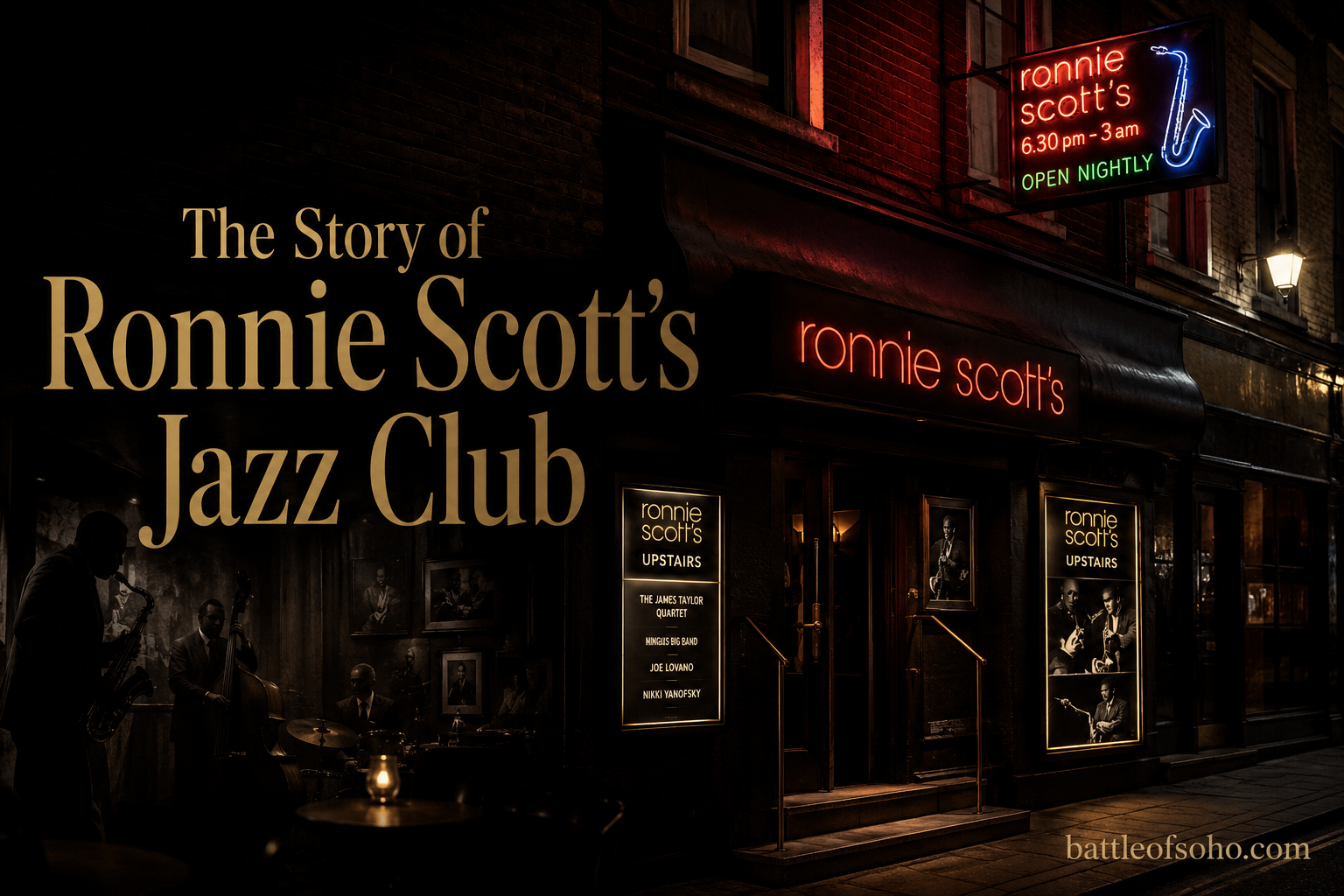
Ronnie Scott’s Jazz Club is a legendary jazz venue in Soho, London, founded in 1959 by tenor saxophonists Ronnie Scott and Pete King. Starting in a basement on Gerrard Street with a £1,000 loan, it became the first UK club to regularly host American jazz musicians and has hosted icons including Ella Fitzgerald, Jimi Hendrix, Nina Simone, and Amy Winehouse. More than six decades later, it remains one of the oldest and most celebrated jazz clubs in the world.
But the story of Ronnie Scott’s is not just about music. It is a story of a smoky Soho basement, of gangsters and police raids, of two men who refused to give up even when the money ran dry. It is the story of a club that became the beating heart of London’s jazz scene and, in doing so, defined an entire neighbourhood.
Walk down Frith Street today and you will find the club still pulsing with live music every night. The air inside carries the same charge it did when Chet Baker played to a room of fifty people, or when Jimi Hendrix walked in unannounced to jam past midnight. This is how Ronnie Scott’s, the jazz club that defined Soho, came to be.
Table of Contents
Soho Before 1959: The Jazz Hunger
To understand why Ronnie Scott’s mattered so much, you have to picture Soho in the late 1950s. The neighbourhood was a tangle of strip clubs, cheap cafés, betting shops, and dive bars. It was also the closest thing London had to an entertainment district, and it thrived on the kind of after-hours energy that jazz musicians craved.
Jazz had arrived in Britain decades earlier, but by the post-war years there was a genuine hunger for the real thing. British audiences had heard American records thanks to places like Dobell’s record shop on Charing Cross Road, where enthusiasts gathered to trade vinyl and argue about bebop. But hearing a tenor saxophonist live, in a small room where you could feel the reed vibrate, was something else entirely.
A handful of venues around London hosted occasional jazz nights. The 51 Club, the Flamingo, and basement spots in Soho and nearby drew crowds of young people hungry for modern jazz. What was missing was a dedicated room, a proper jazz club run by musicians who understood the music, where American greats could come and play without feeling like they were slumming it in a pub back room.
That gap in the market, and that cultural hunger, is exactly what two young saxophonists set out to fill.
The Founding Story: Two Saxophonists and a Basement (1959)
Ronnie Scott was born Ronald Schatt in Aldgate, East London, in 1927. The son of a Jewish musician, he picked up the saxophone as a teenager and by his early twenties was regarded as one of Britain’s finest tenor players. He had played in the Johnny Claes band, toured with the Ted Heath orchestra, and spent time in New York absorbing the bebop revolution firsthand. He returned to Britain convinced that London needed a proper jazz club.
Pete King was a tenor saxophonist from Surrey who shared that conviction. The two met on the London jazz circuit and bonded over their frustration at the lack of venues that treated jazz seriously. King was the businessman of the pair, practical and relentless, while Scott was the magnetic frontman, a natural entertainer with a sharp wit and a contacts book full of musicians.
In October 1959, Scott and King scraped together around £1,000, found a basement at 39 Gerrard Street in Chinatown, on the edge of Soho, and opened the doors. The room was small, dark, and barely furnished. It held perhaps fifty people if they stood close together. The bar was rudimentary. The stage was barely a platform. But on that opening night, the jazz community showed up, and a legend was born.
The original concept was a jazz club by musicians, for musicians. Scott and King wanted a place where British players could perform in a serious setting, and where audiences could hear modern jazz played live rather than on crackling records. The early weeks drew regulars from the London jazz scene, and word quickly spread that something real was happening on Gerrard Street.
What made the club different from the start was its ambition. Scott and King were not content to host only local talent. They wanted to bring American jazz musicians to London, artists whose records British fans had been worshipping for years without ever seeing them play. That ambition, combined with the intimate basement atmosphere, set Ronnie Scott’s on a path that would change British jazz forever.
Early Struggles: Hand-to-Mouth Finances and Soho’s Underworld
The dream of running a jazz club hit reality fast. The early years at 39 Gerrard Street were a constant financial battle. Scott and King were often paying musicians out of their own pockets, sometimes literally passing the bar takings straight to the band at the end of the night. There were weeks when the club survived on a single good Friday or Saturday crowd covering the losses of every other night.
Musician wages were the biggest drain. American artists commanded fees that a fifty-seat basement could barely cover, and Scott and King regularly took home nothing. The club lived hand-to-mouth, sustained by the owners’ stubborn belief that if they could just survive long enough, the audiences would grow.
Then there was Soho itself. In the late 1950s and early 1960s, Soho was not the polished entertainment district it is today. It was a neighbourhood where rival gangs carved up territory, where protection rackets operated openly, and where club owners were expected to pay the right people or face the consequences. Ronnie Scott’s sat right in the middle of this world.
The Kray twins, Ronnie and Reggie, controlled large swathes of Soho and the West End through the 1960s. Their enforcers collected protection money from clubs, bars, and restaurants, and jazz venues were no exception. Ronnie Scott’s operated in this environment, and stories persist of tense encounters, quiet arrangements, and the unspoken understanding that certain people were not to be crossed. The club was, by some accounts, treated as neutral ground, a place where gangland figures rubbed shoulders with musicians, celebrities, and ordinary fans without trouble erupting. That neutrality was a survival tactic as much as a courtesy.
Police raids were another constant threat. Licensing laws in the 1960s were strict, and after-hours drinking was technically illegal. Jazz clubs that stayed open late, and Ronnie Scott’s certainly did, lived with the risk of officers bursting through the door to check for serving hours violations. These raids were part of the texture of running a club in Soho, and they added an edge of danger to every late-night session.
Somehow, through the financial chaos, the gangland tensions, and the police attention, the club endured. The music was simply too good to let it die.
The Move to Frith Street and the Golden Years (1965)
By 1965, the Gerrard Street basement had become too small for what Scott and King had built. The club had a reputation, a loyal audience, and a growing list of American musicians who wanted to play there. They needed a bigger room.
The move to 47 Frith Street, deeper into the heart of Soho, was a turning point. The new venue was larger, seating around 200 people, with a proper stage, a real bar, and a kitchen. It felt like a proper jazz club at last, the kind of room that could attract world-class talent and the audiences willing to pay to see them. The move also cemented Ronnie Scott’s identity as a Soho institution, planted firmly in the neighbourhood’s cultural geography.
The Frith Street years became what many call the Golden Age of Ronnie Scott’s. Through the late 1960s and 1970s, the club established itself as the premier jazz venue in Britain and one of the most important in Europe. The intimacy of the room, the quality of the sound, and the calibre of the performers created a formula that nobody else could match.
A key part of that formula was the house band. Ronnie Scott’s maintained a resident rhythm section, a house pianist, house drummer, and bassist who backed visiting artists and played their own sets. These musicians were the backbone of the club, and many of them became stars in their own right. The house band gave the club a consistent musical identity even as visiting headliners changed from week to week.
This was also the era when the club began recording live performances. The Jazz House record label, established by Scott and King, captured sets by both British and American musicians in the Frith Street room. These recordings became treasured documents of an extraordinary period, preserving performances that might otherwise have been lost to the smoky air of a single night.
The Frith Street move also transformed the social dynamics of the club. It became, by the mid to late 1960s, the go-to place for celebrities, musicians, faces, and even figures from London’s underworld. You might find a film star at one table, a jazz critic at another, and a notorious gangster at the bar, all watching the same saxophonist wring a ballad from the darkness. That mix was pure Soho, and Ronnie Scott’s was its epicentre.
Famous Performers: The Legends Who Graced the Stage
The list of artists who have performed at Ronnie Scott’s reads like a history of modern music. Over six decades, the tiny stage on Frith Street has hosted some of the greatest musicians who ever lived, from jazz royalty to rock icons to pop superstars who wanted to prove they could hold a room with nothing but a band and their voice.
American jazz greats were the foundation. Tenor titan Sonny Rollins played there. So did Stan Getz, whose lyrical saxophone style felt almost designed for the club’s intimate acoustics. Trumpeter Chet Baker became something of a regular, his fragile, melancholic sound finding a perfect home in the Soho basement. Ella Fitzgerald performed at the club, her voice filling the room with a warmth that left audiences stunned.
The list of saxophonists alone could fill a book. Rahsaan Roland Kirk played his multiple instruments on that stage. Michael Brecker, Joe Henderson, Dexter Gordon, and countless others blew through the club on European tours, making Ronnie Scott’s a mandatory stop.
Then came the surprises. In 1967, Jimi Hendrix sat in for a jam session at the club, an event that has passed into Soho legend. Prince played a surprise set at Ronnie Scott’s in the 2000s, performing in the tiny room that held a fraction of the crowds his arena shows would draw. Tom Jones, a serious music fan beneath the pop-star image, performed jazz sets at the club that stunned audiences who only knew him from Las Vegas.
Nina Simone brought her fire and her pain to the Frith Street stage, her performances as emotionally devastating as anything the club has witnessed. Jeff Beck, the guitar virtuoso, played extended residencies that sold out instantly. Van Morrison, never one to shy away from a jazz room, performed sets that blurred the lines between rock, blues, and jazz.
In 2026, Amy Winehouse performed at Ronnie Scott’s in a series of intimate shows, her voice raw and devastating in the small room. Those performances became some of the most celebrated of her later career, and they cemented the club’s role as a venue where artists could strip away the spectacle and just play.
British musicians were not overlooked. Tubby Hayes, the virtuoso multi-instrumentalist and arguably the greatest British jazz musician of his generation, was a regular. The club also hosted visiting European players, South African exiles, and Japanese jazz artists, making it a truly international stage. Every name on that list chose to play Ronnie Scott’s because the room demanded something real, and the audience expected it.
Ronnie Scott: The Man Behind the Mic
Ronnie Scott the man was as much a part of the club’s identity as the music itself. For decades, he served as the club’s Master of Ceremonies, introducing acts with a stream of one-liners, anecdotes, and barbed jokes that became legendary in their own right. His wit was dry, fast, and often ruthless, and musicians both feared and adored being on the receiving end of his introductions.
Scott was a fine tenor saxophonist in his own right, though he often joked that his playing took second place to running the club. He had a rich, warm tone influenced by Coleman Hawkins and Sonny Rollins, and he would sit in with visiting Americans and hold his own. Those who knew him said he could have had a major international career as a player, but the club became his life’s work and his creative outlet.
Behind the jokes and the showmanship, Scott was a complicated man. He could be difficult, demanding, and fiercely protective of his club. He had little patience for musicians who did not take the music seriously, and he expected the same standards from his staff and his audiences. But he was also generous, loyal to the musicians who had been with him through the lean years, and deeply committed to the art form he loved.
Scott’s health declined in the 1990s. He suffered from various ailments, and the strain of running the club for nearly four decades took its toll. On 23 December 1996, Ronnie Scott died at the age of 69. His death marked the end of an era, the loss of the man whose name was on the door and whose voice had introduced every act for thirty-seven years.
The club survived him, as he would have wanted. But the room was never quite the same without his voice cutting through the applause, setting up the next act with a joke that was probably in bad taste and definitely funny.
Cultural Significance: How Ronnie Scott’s Defined Soho
Ronnie Scott’s did not just host jazz. It shaped how Britain understood jazz. Before the club, American jazz was something British fans experienced through records. After the club, it was something you could hear live, in person, played by the actual musicians who made it. That shift changed British musical culture permanently.
The club’s role in breaking down barriers between British and American jazz cannot be overstated. Scott and King built relationships with agents, managers, and musicians in the United States, convincing major artists to fly to London for residencies that might last a week or more. Those residencies gave British audiences extended exposure to world-class playing, and they gave British musicians the chance to share stages with their heroes.
The Late Late Show became one of the club’s most beloved traditions. After the main evening performances, the club would open up for a late jam session, often starting around 11pm and running into the small hours. These sessions were loose, unpredictable, and electric. Visiting American musicians would sit in with the house band, unexpected guests would appear, and the music would stretch into territory that the scheduled sets never reached.
The house musicians became local heroes in their own right. Drummers like Martin Drew, pianists like John Critchinson, and bassists who anchored the rhythm section night after night became as much a part of the Ronnie Scott’s experience as the headliners. Regulars came to see them as much as the visiting stars, and their consistency was what gave the club its musical backbone.
Beyond the music, Ronnie Scott’s helped define what Soho meant as a cultural space. The club drew people into the neighbourhood who might never have visited otherwise. It gave Soho a cultural credibility that balanced its seedier reputation. And it proved that a small, dedicated venue could have an outsized impact on an entire country’s relationship with an art form. Condé Nast Traveler ranks Ronnie Scott’s alongside the Tate Modern and the Royal Albert Hall as a London essential, and that recognition speaks to how far the club’s cultural reach extends.
The Modern Era: A New Chapter (2026 and Beyond)
After Ronnie Scott’s death in 1996, Pete King continued running the club for several years. But by the early 2000s, the financial pressures that had haunted the club since its earliest days had returned. The Frith Street venue needed investment, the business model needed updating, and the club needed new leadership to survive into the 21st century.
In 2005, theatre impresario Sally Greene and businessman Michael Watt took over ownership of Ronnie Scott’s. Their acquisition saved the club and began a period of reinvestment and renewal. The Frith Street venue was refurbished, the sound system was upgraded, and the club’s programming expanded to include a broader range of jazz and related music.
Under the new ownership, the club also expanded its spaces. Upstairs at Ronnie’s opened as a 140-capacity intimate venue, offering a different experience from the main club. Reviewers from The Times and Wallpaper Magazine praised the new space for maintaining the club’s historic charm while adding a fresh dimension to the experience.
Looking ahead, the club has announced plans for The Greene Rooms, a new venue named after Sally Greene, slated to open in 2027. This expansion signals that Ronnie Scott’s is not content to rest on its history. The club continues to operate nightly with two shows per evening, maintaining the tradition that Scott and King established in 1959.
Some longtime fans and jazz purists have voiced concerns that the club has become more tourist-oriented than in its rough-and-tumble Soho days. Ticket prices are higher, the dining experience is more polished, and the crowd can skew more toward visitors than the hardcore jazz regulars of the past. But the music remains the point. World-class artists still play the room, and the intimate atmosphere that made the club famous is still there, preserved in the low ceiling and the close quarters of 47 Frith Street.
Ronnie Scott’s today is both a museum of jazz history and a living, breathing venue. It is the kind of place where you can see a rising British pianist on a Tuesday and a visiting American legend on a Friday, and both performances will matter. The club that Ronnie Scott and Pete King built on a £1,000 loan and a stubborn dream is still standing, still swinging, and still defining what a jazz club in Soho can be.
The story of Ronnie Scott’s, the jazz club that defined Soho, is really a story about what happens when two people refuse to give up on something they believe in. Through gangsters and police raids, through financial ruin and personal loss, through the death of its founder and the changing face of the neighbourhood around it, the club has endured. The neon sign still glows on Frith Street, the music still starts every night, and the tradition that began in a Chinatown basement in 1959 carries on. That is the real legacy of Ronnie Scott’s, and it is one that Soho, and the world of jazz, will never let go.
FAQs
What is the history of Ronnie Scott’s jazz club?
Ronnie Scott’s Jazz Club was founded in October 1959 by tenor saxophonists Ronnie Scott and Pete King in a basement at 39 Gerrard Street, London. It moved to its current location at 47 Frith Street in Soho in 1965 and became the first UK club to regularly host American jazz musicians, growing into one of the world’s most famous jazz venues.
What is the famous jazz club in Soho London?
The famous jazz club in Soho is Ronnie Scott’s Jazz Club, located at 47 Frith Street. Founded in 1959, it is one of the oldest and most celebrated jazz clubs in the world and has hosted legendary performers including Ella Fitzgerald, Jimi Hendrix, Nina Simone, and Amy Winehouse.
Who owns Ronnie Scott’s jazz club now?
Ronnie Scott’s has been owned by theatre impresario Sally Greene and businessman Michael Watt since 2005. They purchased the club, invested in refurbishing the Frith Street venue, and have expanded it with spaces like Upstairs at Ronnie’s and the planned Greene Rooms venue.
What happened to Ronnie Scott?
Ronnie Scott co-founded and ran the club for 37 years, serving as its MC and host. He suffered declining health in the 1990s and died on 23 December 1996 at the age of 69. The club continued operating under co-founder Pete King before being taken over by Sally Greene and Michael Watt in 2005.
Is it hard to get into Ronnie Scotts?
Ronnie Scott’s is open to the public with tickets available for purchase, but popular shows and headline acts can sell out quickly. The club operates two shows nightly and also hosts Late Late Show jam sessions. Booking in advance is recommended, especially for weekend performances and well-known artists.
What celebrities went to Ronnie Scotts?
Ronnie Scott’s has hosted and attracted countless celebrities over the decades. Performers include Ella Fitzgerald, Chet Baker, Jimi Hendrix, Sonny Rollins, Nina Simone, Prince, Tom Jones, Van Morrison, Jeff Beck, and Amy Winehouse. The club has also been a haunt for actors, writers, politicians, and figures from London’s cultural and social scenes.