
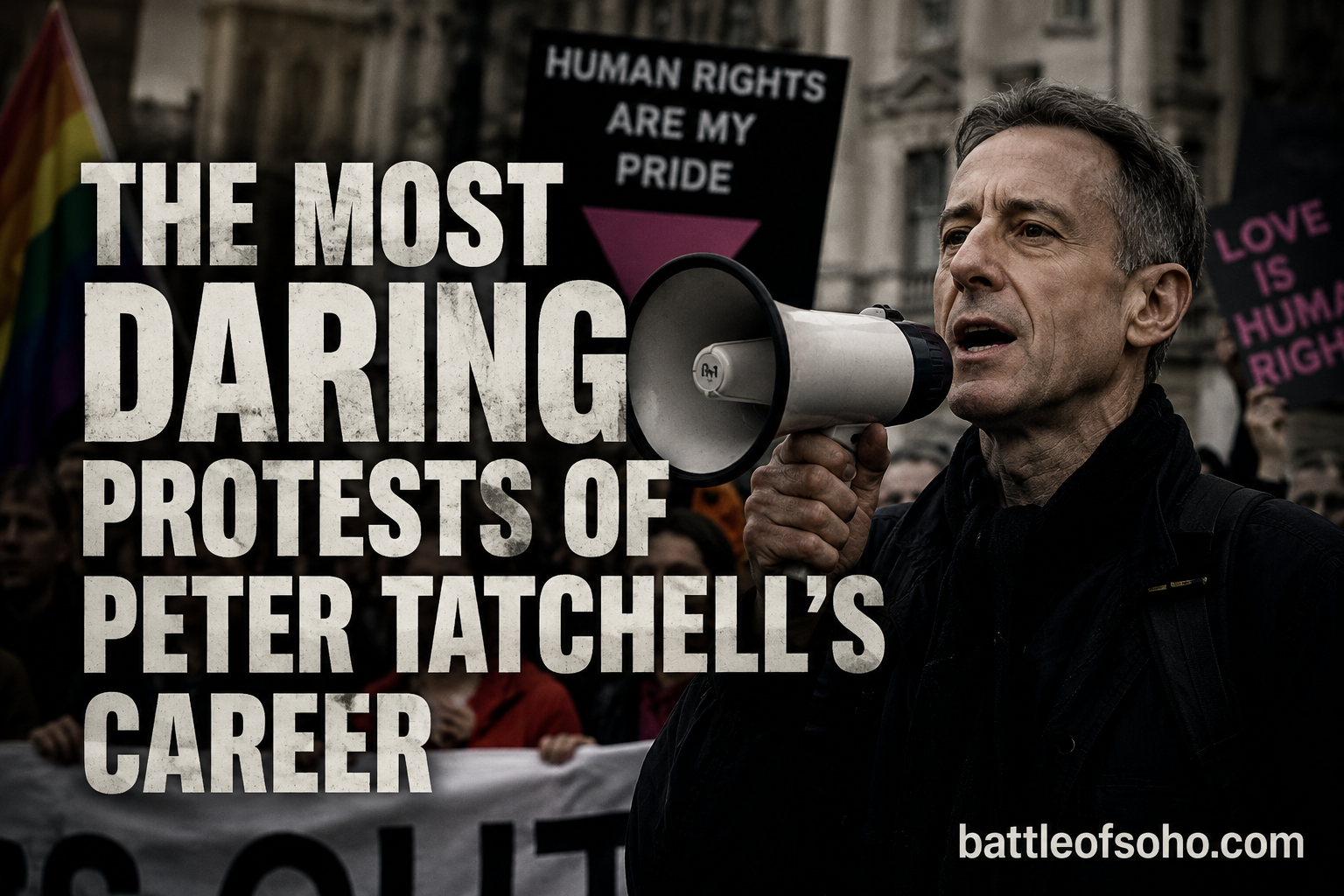
Over more than five decades, Peter Tatchell has staged roughly 3,000 protests, endured 300 violent assaults, and faced 100-plus arrests. His career as a human rights campaigner spans continents and causes, from the streets of London to the halls of power in Moscow, Harare, and Doha. Few activists have put their bodies on the line so consistently, or so dramatically.
When we look back at the most daring protests of Peter Tatchell’s career, we see a pattern of escalating courage. He has confronted dictators, challenged religious authorities, and stood alone in countries where being gay can mean a death sentence. Each action was calculated not for personal glory, but to expose injustice and force the world to pay attention.
This article ranks his ten most daring protests by the level of personal risk involved and the impact they achieved. We also explore the philosophy behind his methods, the personal cost he has paid, and the lasting legacy of his work for human rights. Whether you are studying the history of activism, looking for inspiration, or simply curious about one of Britain’s most relentless campaigners, these stories show what direct action looks like when pushed to its absolute limits.
Table of Contents
Who Is Peter Tatchell?
Peter Tatchell is a British-Australian human rights campaigner who has dedicated his life to non-violent direct action. Born in Melbourne, Australia, in 1952, he grew up in a working-class family and came out as gay at the age of 15. He was drawn to activism early, inspired by the civil rights movement in the United States and the anti-apartheid struggle in South Africa.
In 1971, at the age of 19, Tatchell moved to London and joined the Gay Liberation Front (GLF), one of the first organizations in Britain to demand full equality for LGBTQ+ people rather than mere tolerance. The GLF organized the first London Pride march in 1972, and Tatchell was at the forefront. He has not stopped campaigning since.
His activism has never been limited to LGBTQ+ rights. He has campaigned against the death penalty, supported self-determination for West Papua, opposed war in Iraq and Afghanistan, fought for Palestinian rights, and challenged religious homophobia across multiple faiths. In 1990, he co-founded OutRAGE!, the direct action group that would become synonymous with his most theatrical and daring protests.
Today, Tatchell runs the Peter Tatchell Foundation, which describes its mission as fighting for “human rights, democracy and global justice.” The foundation operates on small donations and receives no government funding. Tatchell himself has lived modestly throughout his career, choosing to dedicate his resources to campaigning rather than personal comfort.
Protest as Performance: The Philosophy Behind the Daring
Understanding Peter Tatchell’s protests requires understanding his philosophy of “protest as performance.” Tatchell and OutRAGE! developed a method of activism that combined theatrical spectacle, drag, humor, and civil disobedience. The goal was to make protests so visually striking and entertaining that the media could not ignore them.
In his essay “The Art of Activism,” Tatchell explained that OutRAGE! rejected the dull, worthy marches that had become standard in British protest culture. Instead, the group staged “zaps,” which were short, surprise interventions designed for maximum media impact. They dressed as bishops, kissed in public when same-sex affection was taboo, and draped banners from statues.
The logic was simple. In a media-saturated age, a polite demonstration with 200 people holding placards would generate zero news coverage. But ten drag queens storming a church service or chaining themselves to the gates of Buckingham Palace would make front pages. The spectacle drew attention, and the attention drew debate, and the debate drove change.
This approach was not universally popular. Some LGBTQ+ people felt the theatrical tactics reinforced stereotypes or handed ammunition to homophobes. But Tatchell argued that visibility was the point. Queer people had been invisible for centuries. Forcing society to see them, even in ways that made people uncomfortable, was the first step toward acceptance.
The “protest as performance” philosophy influenced later movements, including the direct action tactics of Extinction Rebellion and trans rights groups. The idea that protest should be creative, memorable, and impossible to ignore is now embedded in modern activism. Tatchell and OutRAGE! helped pioneer that shift.
The Most Daring Protests of Peter Tatchell’s Career
Ranking Peter Tatchell’s protests requires looking at two factors: the level of personal risk involved and the significance of the outcome. Some protests were physically dangerous. Others were politically explosive. The most daring combined both elements, putting Tatchell in genuine jeopardy while challenging powerful institutions or individuals.
Here are ten of the most daring protests of Peter Tatchell’s career, ranked from highest to lowest risk.
1. Citizen’s Arrest Attempt on Robert Mugabe (1999 and 2001)
Perhaps the single most dangerous action of Tatchell’s career was his attempt to perform a citizen’s arrest on Robert Mugabe, the authoritarian president of Zimbabwe. Mugabe’s regime was responsible for systematic human rights abuses, including the torture and murder of political opponents and the violent persecution of LGBTQ+ people. Tatchell wanted to hold him accountable under international law.
The first attempt came in 1999 in London, where Mugabe was shopping with his wife. Tatchell approached him on the street, grabbed his arm, and announced that he was making a citizen’s arrest under the UN Convention Against Torture. Mugabe’s bodyguards immediately attacked Tatchell, leaving him with severe bruising and a detached retina in his right eye. The attempt was short-lived but generated enormous media coverage.
Undeterred, Tatchell tried again in Brussels in 2001. This time, Mugabe’s security detail beat him even more severely, leaving him with permanent brain damage from repeated blows to the head. He was hospitalized and has suffered lasting effects from the assault, including memory problems and persistent pain. Despite the violence, the protests succeeded in keeping international attention on Mugabe’s atrocities.
The citizen’s arrest attempts were audacious in the extreme. Mugabe was a sitting head of state with a violent security apparatus. Tatchell, armed with nothing but a legal argument and his own body, challenged one of the world’s most dangerous dictators twice. The personal cost was devastating, but the principle was clear: no one is above the law.
2. Moscow Pride Protest and Beating by Neo-Nazis (2007 and 2011)
Tatchell traveled to Moscow multiple times to support Russian LGBTQ+ activists who were banned from holding Pride marches by the city government. The Mayor of Moscow, Yuri Luzhkov, had called gay pride marches “satanic” and ordered police to arrest anyone who tried to march. Tatchell and other activists defied the ban.
In 2007, Tatchell joined Russian activists attempting to deliver a petition to the Moscow city government. They were set upon by a combination of neo-Nazi groups and Orthodox Christian extremists. Tatchell was punched, kicked, and hit with objects while Russian police stood by and watched. He was later arrested by the same police who had failed to protect him. The attack was captured on camera and broadcast around the world.
In 2011, Tatchell returned to Moscow for another banned Pride demonstration. This time, he was punched in the face by a counter-protester in full view of international journalists. The assault left him visibly injured, with bruises spreading across his face. Russian police detained him once again rather than his attackers.
These protests were extraordinarily brave. Russia under Putin was becoming increasingly hostile to LGBTQ+ people, and the violence against activists was escalating. By standing in the streets of Moscow knowing he would be attacked, Tatchell drew global attention to the suppression of gay rights in Russia years before the 2013 “gay propaganda” law made international headlines.
3. First LGBTQ+ Protest in Qatar (2022)
During the 2022 FIFA World Cup in Qatar, Tatchell staged what is believed to be the first ever LGBTQ+ rights protest in a Gulf state. Homosexuality is illegal in Qatar, punishable by up to seven years in prison. Despite this, Tatchell stood outside the National Football Museum in Doha wearing a t-shirt supporting LGBTQ+ Qataris and holding a sign highlighting the persecution of gay people in the country.
The protest lasted only minutes before Qatari security forces intervened. Tatchell was surrounded, questioned, and moved from the location. He later reported that security personnel confiscated his phone and told him to leave the country. The situation was genuinely precarious. Qatar’s legal system offers no protections for LGBTQ+ people, and foreign nationals have been detained for far less.
The timing was deliberate. The World Cup brought the global media to Qatar, and Tatchell used that spotlight to expose the country’s human rights record. His protest forced a conversation that the Qatari government and FIFA had worked hard to suppress. While the immediate risk was enormous, the media amplification made it one of the most impactful single-person protests of the decade.
Tatchell later said he was aware he could have been arrested and imprisoned. He went ahead because the suffering of LGBTQ+ Qataris, who live in fear every day, deserved international attention. The protest was a powerful reminder that visibility itself can be an act of resistance in places where existence is criminalized.
4. Buckingham Palace Wink-In and Royal Protests (1990s)
In the early 1990s, OutRAGE! turned its attention to the British monarchy, which they accused of reinforcing anti-gay prejudice through centuries of institutional discrimination. One of their most provocative actions was the so-called “Wink-In” at the gates of Buckingham Palace. The group arrived unannounced and staged a theatrical protest complete with drag queens and banners accusing the Royal Family of homophobia.
The Wink-In was a play on the “sit-in” format, but with a queer twist. Activists winked, blew kisses, and camped it up for the cameras while making serious political points about the monarchy’s refusal to acknowledge LGBTQ+ subjects. At the time, the Royal Family had never publicly supported gay rights, and same-sex relationships were still stigmatized at every level of British society.
OutRAGE! also targeted royal events more broadly. They disrupted the Royal Household Christmas Ball, projecting messages onto public buildings, and staged protests at events attended by members of the Royal Family. These actions challenged one of Britain’s most revered institutions at a time when criticizing the monarchy was considered socially risky.
The royal protests were daring not because of physical danger but because of the political and social backlash they invited. Attacking the monarchy in 1990s Britain was almost taboo. OutRAGE! deliberately broke that taboo to highlight the establishment’s complicity in anti-gay discrimination, and they did it with enough humor and spectacle to make the news.
5. Interrupting the Archbishop of Canterbury (1998 and 2008)
Tatchell has confronted the Church of England multiple times over its opposition to LGBTQ+ equality. In one notable action, he interrupted the Archbishop of Canterbury’s Easter sermon at Canterbury Cathedral, challenging the Church’s stance on homosexuality from the congregation. He stood and spoke during the service, forcing one of Britain’s most senior religious figures to respond publicly to accusations of homophobia.
In a separate protest, Tatchell targeted then-Archbishop George Carey at a public event, accusing him of using his position to block legal protections for gay and lesbian people. Carey had been instrumental in maintaining the Church of England’s opposition to equal rights, arguing that homosexuality was incompatible with Christian teaching. Tatchell confronted him face to face, demanding to know why the Church treated LGBTQ+ people as second-class Christians.
In 2008, Tatchell again challenged the Church of England during a debate about same-sex partnerships. He argued that religious institutions should not be allowed to use their moral authority to deny civil rights to LGBTQ+ citizens. These protests were risky because they invaded sacred spaces and challenged deeply held religious convictions, generating fury from conservative Christians and sections of the press.
The church protests mattered because the Church of England is embedded in the British state. Its bishops sit in the House of Lords and influence national legislation. By confronting the Archbishop directly, Tatchell exposed the connection between religious authority and legal discrimination. The Church has since softened its tone on LGBTQ+ issues, though full equality remains a work in progress.
6. Stop Murder Music Campaign (2002 to 2009)
One of Tatchell’s most sustained and controversial campaigns targeted reggae and dancehall artists whose lyrics incited violence against LGBTQ+ people. Songs by artists such as Buju Banton, Beenie Man, and Elephant Man contained lyrics calling for the murder and burning of gay men. In Jamaica, where many of these artists were based, homophobic violence was rampant and largely unpunished.
Tatchell and OutRAGE! launched the Stop Murder Music campaign to pressure venues, record labels, and radio stations to stop promoting artists who glorified anti-gay violence. The campaign organized protests outside concert venues, lobbied for prosecution under hate speech laws, and worked with local LGBTQ+ groups in Jamaica and the Caribbean.
The campaign achieved tangible results. Several concerts were cancelled, artists were forced to drop violent lyrics from their repertoires, and the issue of homophobic music was placed on the international agenda. However, Tatchell faced accusations of racism from some quarters, with critics arguing he was singling out Black Caribbean artists while ignoring homophobia in white Western music.
Tatchell rejected this criticism, pointing out that the campaign worked alongside Black LGBTQ+ Caribbean activists and targeted all artists promoting anti-gay violence regardless of race. The Stop Murder Music campaign required sustained courage over seven years. Tatchell received death threats from fans of the artists and was accused of cultural imperialism. He persisted because people were dying.
7. Queer Remembrance Day at the Cenotaph (1990s)
In the 1990s, OutRAGE! organized a series of protests at the Cenotaph in Whitehall, Britain’s most sacred war memorial. The protests, which became known as Queer Remembrance Day, were designed to highlight the fact that LGBTQ+ people had served and died in Britain’s wars but were never acknowledged by the nation they fought for.
The protests involved laying pink wreaths at the Cenotaph and reading the names of LGBTQ+ service members. At the time, gay people were still banned from serving openly in the British armed forces. The ban was not lifted until 2000, making these protests a direct challenge to official government policy.
Protesting at the Cenotaph was considered almost sacrilegious by many in Britain. The memorial is deeply sacred to the British public, and any demonstration there was guaranteed to provoke outrage. OutRAGE! knew this and chose the location precisely because the discomfort it caused would force people to confront the hypocrisy of a nation that demanded LGBTQ+ people fight for it while denying them basic rights.
Queer Remembrance Day drew attention to the hidden history of queer military service. It also connected the LGBTQ+ rights struggle to broader traditions of British patriotism and sacrifice, challenging the notion that being gay and being a patriot were mutually exclusive. The campaign was a masterful example of protest as performance, using a deeply familiar national ritual to make a radical point.
8. Romanian Opera Disruption at Royal Albert Hall (1994)
In 1994, OutRAGE! disrupted a performance of the Romanian National Opera at the Royal Albert Hall in London. The protest targeted Romania’s draconian anti-gay laws, which at the time criminalized homosexuality with prison sentences of up to five years. The opera was a state-sponsored cultural event, and OutRAGE! saw it as an opportunity to expose Romania’s persecution of LGBTQ+ people on a high-profile stage.
Activists stormed the stage during the performance, unfurling banners condemning Romania’s anti-gay laws. The disruption was brief but dramatic, played out before an audience of thousands at one of Britain’s most prestigious cultural venues. Security personnel removed the protesters, but not before their message had been delivered to a captive audience and, more importantly, to the media.
The protest was daring because it invaded a formal cultural event and confronted an international audience. The Royal Albert Hall is not a political space, and disrupting a performance there was guaranteed to generate controversy. But OutRAGE! understood that cultural events are inherently political, especially when they are sponsored by states that violate human rights.
Romania eventually decriminalized homosexuality in 2001, partly due to international pressure from campaigns like this one. The Royal Albert Hall protest was a single moment in a broader movement, but it exemplified OutRAGE!’s ability to find creative, high-impact ways to challenge injustice.
9. Kiss-In at Piccadilly Circus (1990s)
In the early 1990s, same-sex public displays of affection were still met with hostility, violence, and arrest in many parts of Britain. OutRAGE!’s Kiss-In at Piccadilly Circus was a mass demonstration in which LGBTQ+ couples gathered in one of London’s busiest public spaces and kissed openly. The protest challenged the unwritten social code that required queer people to hide their relationships in public.
Piccadilly Circus was chosen because it was a symbol of London’s public life. It was a place where heterosexual couples kissed freely while same-sex couples lived in fear of being attacked or arrested. The Kiss-In flipped that dynamic, filling the square with queer affection and forcing passers-by to confront their own assumptions about what was acceptable in public space.
The Kiss-In was less physically dangerous than some of Tatchell’s other protests, but it carried significant social risk. Participants risked harassment, assault, and public humiliation. For many, it was the first time they had shown affection in public, and the act itself was a form of personal liberation that mirrored the political message.
Kiss-Ins became a recurring tactic for OutRAGE! and have since been adopted by LGBTQ+ groups around the world. What started as a daring act of defiance in Piccadilly Circus is now a recognized protest format used from Moscow to Istanbul. The simplicity of the idea, kissing in public, made it both radical and replicable.
10. Palestine Solidarity Protest Arrest (2026)
In 2026, Tatchell was arrested at a Palestine solidarity demonstration in London for carrying a placard that read “Globalise the Intifada.” Police detained him under the Public Order Act, arguing that the sign constituted an incitement to violence. Tatchell maintained that the phrase was a call for international solidarity with Palestinian resistance, not an endorsement of terrorism.
The arrest sparked immediate debate about the limits of free speech in Britain. Supporters argued that Tatchell was being punished for expressing a political opinion, while critics claimed the placard crossed a legal line. The incident drew attention from civil liberties groups, politicians, and the international press.
For Tatchell, the protest was consistent with his long history of supporting Palestinian rights. He has been arrested at previous Palestine demonstrations and has criticized both Stop The War Coalition stewards and the police for restricting protesters’ freedom of expression. The 2026 arrest showed that even after 55 years of activism, he continues to push boundaries and provoke debate.
While the physical risk of this protest was lower than confronting Mugabe or standing in Doha, the political stakes were enormous. The debate over Palestine solidarity and free speech is one of the most polarizing issues in British politics. By placing himself at the center of it, Tatchell demonstrated that his willingness to challenge power has not diminished with age.
The Personal Cost: Arrests, Violence, and Lasting Injuries
The daring of Peter Tatchell’s protests is best measured by the toll they have taken on his body and life. Across his career, he has been arrested more than 100 times, physically assaulted over 300 times, and targeted with countless death threats. The injuries he has sustained are permanent and ongoing.
The most severe damage came from the two attempts to perform a citizen’s arrest on Robert Mugabe. Mugabe’s bodyguards beat Tatchell so badly that he suffered permanent brain damage. He has spoken openly about the lasting effects, including memory problems, concentration difficulties, and persistent pain. The detached retina he suffered in the 1999 assault has never fully healed.
In Moscow, the neo-Nazi attacks left him with facial injuries that were visible on television screens around the world. In other protests, he has been spat on, dragged by his hair, pelted with objects, and subjected to attempted strangulation. He has required hospital treatment on multiple occasions.
Despite this, Tatchell has never retaliated with violence. His commitment to non-violent direct action has been absolute, even when facing brutal physical attacks. He has argued that violence undermines the moral authority of a protest and hands propaganda to opponents. This discipline has been tested repeatedly throughout his career, and he has held firm every time.
The psychological cost is harder to quantify but no less real. Living under constant death threats, knowing that any protest could result in serious injury, takes a toll that few people will ever experience. Tatchell has said that his commitment to justice outweighs his fear, but he has also acknowledged the emotional weight of decades of confrontation and violence.
Legacy and Impact on Human Rights
What impact has Peter Tatchell had? The answer is measurable in laws changed, attitudes shifted, and movements inspired. His work with OutRAGE! and the Peter Tatchell Foundation contributed directly to the repeal of all anti-gay laws in Britain by 2014. This was described as the fastest law reform campaign in British history, transforming the legal landscape for LGBTQ+ people in less than two decades.
Specific victories include the equalization of the age of consent, the lifting of the ban on LGBTQ+ people serving in the military, the repeal of Section 28, the introduction of civil partnerships and later equal marriage, and the passage of anti-discrimination protections in employment and goods and services. Tatchell and OutRAGE! were not the only voices in these campaigns, but they were among the most visible and persistent.
Internationally, his protests in Zimbabwe, Russia, Qatar, and elsewhere have kept human rights abuses on the global agenda. His willingness to travel to dangerous countries and stand alone with a placard has inspired activists around the world who face similar risks. The Kiss-In, the zap action, and the “protest as performance” methodology have been adopted and adapted by movements far beyond LGBTQ+ rights.
Tatchell has received numerous awards for his work, including Campaigner of the Year at the Observer Ethical Awards. New Statesman readers voted him the sixth greatest “Hero of our Time.” He has been the subject of a documentary, “Hating Peter Tatchell,” which introduced his story to a new generation. At 70-plus years old, he continues to campaign, proving that his commitment has no expiration date.
Frequently Asked Questions
What impact has Peter Tatchell had?
Peter Tatchell has participated in over 3,000 protests across 55 years of activism, contributing to the repeal of all anti-gay laws in Britain by 2014. His campaigns helped achieve an equal age of consent, the lifting of the military ban, the repeal of Section 28, and the introduction of equal marriage. Internationally, his protests in Zimbabwe, Russia, and Qatar have exposed human rights abuses on the global stage.
Does Peter Tatchell have a job?
Peter Tatchell works full-time as a human rights campaigner through the Peter Tatchell Foundation, which he directs. He does not hold a traditional salaried job. His work involves organizing protests, lobbying governments, writing articles, speaking at events, and coordinating international campaigns for LGBTQ+ rights and broader human rights causes.
Who pays Peter Tatchell?
Peter Tatchell is funded through small donations to the Peter Tatchell Foundation, which receives no government funding. He has lived modestly throughout his career, choosing to dedicate his resources to campaigning rather than personal comfort. The foundation operates on grassroots contributions from supporters who believe in his work.
What awards has Peter Tatchell received?
Peter Tatchell has received numerous awards including Campaigner of the Year at the Observer Ethical Awards. New Statesman readers voted him the sixth greatest Hero of our Time. He has also been recognized by international human rights organizations and was the subject of the documentary film Hating Peter Tatchell, which chronicled his decades of activism.
How many times has Peter Tatchell been arrested?
Peter Tatchell has been arrested more than 100 times during his 55 years of activism. His arrests span multiple countries and causes, from LGBTQ+ rights protests in London to Moscow Pride demonstrations and Palestine solidarity marches. Despite the arrests, he has maintained a strict commitment to non-violent direct action throughout his career.
Is Peter Tatchell still protesting?
Yes, Peter Tatchell is still actively campaigning and protesting. Even in his 70s, he continues to organize demonstrations, speak at events, and challenge injustice. His arrest at a Palestine solidarity protest in 2026 demonstrates that his willingness to put himself on the line for human rights has not diminished with age.
Conclusion
The most daring protests of Peter Tatchell’s career reveal a man who has consistently chosen courage over comfort. From attempting citizen’s arrests on dictators to staging the first LGBTQ+ protest in a Gulf state, his actions have pushed the boundaries of what non-violent direct action can achieve. Each protest carried real risk, and many resulted in lasting physical and psychological harm.
But the impact is undeniable. Tatchell’s work helped transform Britain from a country that criminalized homosexuality into one with some of the strongest LGBTQ+ legal protections in the world. His international protests have shone light on persecution in countries where gay people face imprisonment and death. And his philosophy of protest as performance has influenced a generation of activists fighting for causes far beyond his own.
At a time when many assume progress is inevitable, Tatchell’s career is a reminder that every right was won by someone willing to fight for it. The most daring protests of Peter Tatchell’s career were not stunts or publicity grabs. They were calculated acts of resistance by a man who understood that injustice thrives in silence and that sometimes the bravest thing you can do is refuse to be ignored.