
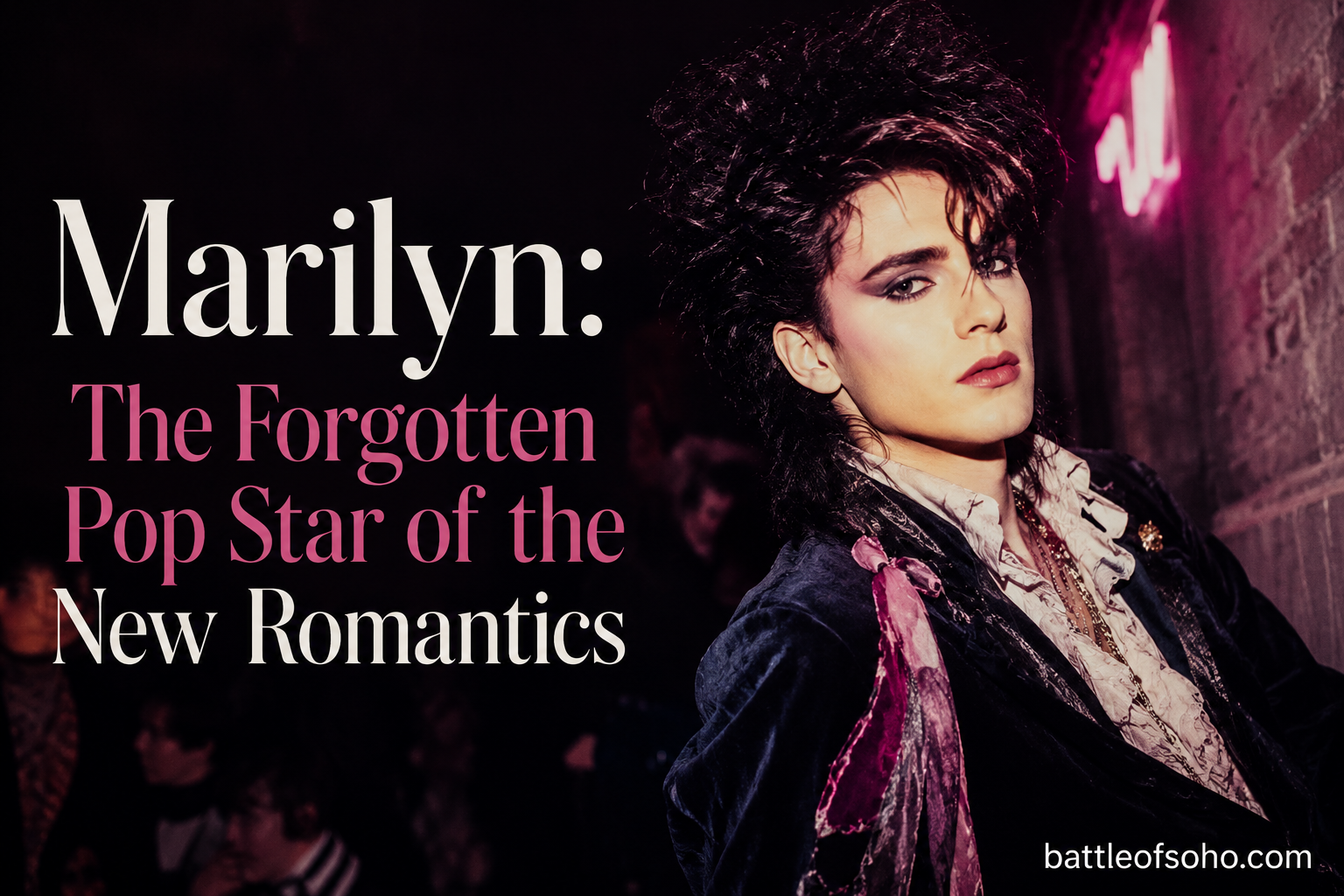
In the spring of 1983, a striking figure appeared on Top of the Pops with cascading blonde hair, bold makeup, and a voice that dripped with synth-pop longing. The song was “Calling Your Name,” and the singer went simply by the name Marilyn. For a brief, brilliant moment, this androgynous performer was everywhere in British pop culture. Then, almost as quickly as he arrived, he vanished.
The story of Marilyn the forgotten pop star of the New Romantics is one of the most compelling and tragic arcs in 1980s music. He stood at the center of a cultural revolution in fashion, gender expression, and sound. He shared club nights with Boy George, danced at the Blitz Club alongside Spandau Ballet, and helped define what it meant to be a Blitz Kid in post-punk London. Yet while his contemporaries became global icons, Marilyn faded into near-total obscurity for two decades.
In this article, we trace the complete arc of Marilyn’s life and career. We cover his Jamaican childhood, his arrival in London, the electric atmosphere of the New Romantic movement, the smash hit that made him famous, the record label pressures that followed, the long dark years of addiction and isolation, and the remarkable comeback that few expected. Along the way, we explore why history remembered some Blitz Kids and forgot others, and what Marilyn’s legacy means for today’s conversations about gender fluidity in pop music.
Whether you discovered Marilyn through a YouTube rabbit hole, a Reddit thread about the Blitz Kids, or a 2026 Classic Pop Magazine interview, this is the full story of the man born Peter Robinson who became the androgynous icon of an era that nearly erased him.
Table of Contents
From Kingston to London: Peter Robinson’s Early Years
Peter Antony Robinson was born on November 3, 1962, in Kingston, Jamaica. His family relocated to London when he was still a young child, settling into a Britain that was far from welcoming to a mixed-race kid who did not fit conventional molds. Growing up in the city, Robinson faced relentless bullying at school for his appearance, his mannerisms, and his refusal to conform to expectations of how a boy should look or act.
The bullying became severe enough that Robinson left school at the age of 15. He had no qualifications, no clear path forward, and no support system that understood him. What he did have was an instinct for transformation. Even as a teenager, Robinson was drawn to glamour, theatricality, and self-reinvention. He understood that identity could be constructed rather than simply inherited.
London in the late 1970s was a city in creative upheaval. Punk was burning out, and something new was stirring in the clubs of Soho and Covent Garden. For a young outsider searching for a place to belong, the timing could not have been more perfect. Robinson found his way into the emerging club scene and began crafting the persona that would soon captivate the country.
He adopted the name Marilyn as a deliberate homage to Marilyn Monroe, signaling from the start that his artistic identity was built on the interplay between femininity, glamour, and provocation. It was a statement of intent. The boy from Kingston who had been told he did not fit was about to make himself impossible to ignore.
What Was the New Romantic Movement?
The New Romantic movement emerged in London around 1979 and 1980 as a direct reaction to the aggression and austerity of punk. Where punk had been about tearing things down, New Romanticism was about building something beautiful, theatrical, and exquisitely styled. It drew from glam rock, cabaret, Hollywood golden age cinema, and European art fashion.
The movement centered on a handful of nightclub spaces where fashion was treated as a competitive sport and music was the soundtrack to a living art installation. The Blitz Club in Covent Garden became the most famous of these venues, but the scene extended to places like the Club for Heroes in Great Titchfield Street and Billy’s in Soho. These were not just nightclubs. They were incubators for a new visual and musical culture.
Steve Strange, the Welsh singer and club promoter, was the charismatic gatekeeper of the scene. Along with DJ Rusty Egan, Strange ran the Blitz with a strict door policy that demanded effort and imagination. If you showed up looking ordinary, you were not getting in. This exclusivity created an environment where outrageous creativity was the price of admission.
Marilyn arrived in this scene as a natural. His instinct for theatrical gender presentation, his love of dramatic makeup, and his willingness to push boundaries made him a perfect fit. He became one of the recognized faces of the movement before he had ever recorded a note of music.
The Blitz Kids and the Club for Heroes Scene
The Blitz Kids were the inner circle of the New Romantic movement, a loosely defined collective of young creatives who orbited the Blitz Club and the Club for Heroes. The group included figures who would go on to define the decade: Boy George, who would front Culture Club and become a global superstar; Spandau Ballet, who turned the scene’s aesthetic into stadium-sized success; and Visage, the synth-pop supergroup featuring Steve Strange and Rusty Egan.
Marilyn was part of this circle from the early days. He and Boy George developed a friendship that would shape both of their careers. The two were often photographed together, their matching dedication to androgynous glamour making them the visual emblem of the scene’s radical approach to gender presentation. In an era before mainstream conversations about gender fluidity, the Blitz Kids were living it nightly.
The Club for Heroes, located on Great Titchfield Street, was another critical venue. It operated as a more intimate counterpart to the Blitz, and it drew an eclectic crowd that included musicians, fashion designers, artists, and scene-makers. Marilyn was a regular presence, known for his elaborate outfits and his willingness to take fashion risks that even other Blitz Kids found audacious.
What made the Blitz Kids phenomenon so significant was the way it merged fashion, music, and identity politics before anyone was calling it that. The looks were not costumes. They were expressions of genuine identity, worn by young people who had been told their whole lives that they did not fit. In the clubs of Soho and Covent Garden, they built a world where fitting in meant standing out.
Calling Your Name: The Hit That Changed Everything
In 1983, Marilyn released “Calling Your Name” as his debut single. The track was a slice of pristine synth-pop with a melancholic vocal delivery and a production sheen that captured the New Romantic sound at its most accessible. It was the kind of song that could work on a dancefloor at the Blitz and on mainstream radio simultaneously.
The song climbed the UK Singles Chart and eventually peaked at number four. It was not just a domestic hit. “Calling Your Name” crossed borders, charting across Europe and reaching audiences in Japan and Australia. The global reach surprised many who had assumed the New Romantic aesthetic was too niche for international appeal.
The performance on Top of the Pops in 1983 was the moment that cemented Marilyn in the public consciousness. Dressed in his signature glamorous style, with full makeup and flowing hair, he delivered the song with a confidence that dared viewers to look away. For many people watching at home, it was their first encounter with the androgynous aesthetic that the Blitz Kids had been developing in private for years.
The reaction was immediate and polarized. Some viewers were captivated by the bold visual presentation and the catchy hook. Others were confused or hostile. But nobody was indifferent. That single television appearance generated more conversation than most artists generate in an entire campaign cycle.
“Calling Your Name” became the song that defined Marilyn’s career, for better and for worse. It was a remarkable achievement for a debut single, and it proved that the underground club scene could produce mainstream pop stars. But it also created a benchmark that Marilyn would spend the rest of his career chasing and never quite matching.
The Pressure of Being a One-Hit Wonder
After the success of “Calling Your Name,” the expectations on Marilyn were enormous. The record label wanted another hit in the same vein. The music press wanted to know whether this Blitz Kid flash-in-the-pan could sustain a career. And Marilyn himself was still a young man, barely into his twenties, navigating sudden fame without the tools or support to manage it.
The follow-up singles struggled to replicate the chart success of the debut. Songs were released, videos were filmed, and promotional campaigns were mounted, but lightning did not strike twice. The British music press, never known for patience, began writing the narrative of Marilyn as a one-hit wonder before the ink was even dry on his early success.
Marilyn released only one album during his initial run. The record failed to capitalize on the momentum of the debut single, and the combination of chart disappointment, label frustration, and personal turmoil created a pressure cooker environment. By the mid-1980s, Marilyn was already being written off by an industry that had once rushed to embrace him.
Looking back, the speed of the rise and fall is staggering. In less than three years, Marilyn went from unknown club kid to chart-topping pop star to industry afterthought. The machinery of 1980s pop was not designed to nurture artists who existed outside the mainstream. It was designed to extract hits and move on. When the hits stopped coming, the support vanished.
Marilyn vs Boy George: Two Paths From the Blitz Club
The parallel careers of Marilyn and Boy George offer one of the most instructive comparisons in 1980s pop history. Both emerged from the same Blitz Club scene. Both built their identities on androgynous fashion and gender-bending presentation. Both released their breakthrough singles around the same time. Yet their trajectories diverged dramatically.
Boy George and Culture Club achieved sustained global success that Marilyn never matched. Culture Club scored multiple hit singles across several albums, conquered the American market, and became one of the defining acts of the decade. Boy George’s personality, his distinctive voice, and his willingness to play the media game all contributed to a career that had staying power.
Marilyn, by contrast, had one hit and then struggled. The reasons are complex. Some of it came down to material and production. Some of it came down to label support and promotional strategy. Some of it came down to the personal challenges that Marilyn was already beginning to face, which made it difficult to sustain the grind of a pop career.
There was also an element of the industry deciding how many androgynous gender-bending performers it could tolerate at once. Boy George became the acceptable face of that aesthetic for mainstream audiences. Marilyn, who was arguably even more radical in his presentation, was treated as a secondary figure. The cultural conversation had room for one gender-bending star, and Boy George occupied that space.
The friendship between the two survived the professional divergence, though it was tested by the disparity in their fortunes. In later years, Boy George would become one of the people who helped pull Marilyn back from the brink, both personally and professionally.
What Happened to Pop Singer Marilyn?
After the initial burst of fame, Marilyn entered a period of personal crisis that would last for roughly two decades. Drug addiction took hold with a ferocity that dismantled every aspect of his life. In a 2016 interview with The Guardian, Marilyn described sitting in a room for 20 years, taking crack cocaine and watching Alien films on repeat. It was a chilling portrait of isolation and self-destruction.
In 1986, Marilyn was arrested and appeared at Marylebone Magistrates’ Court. The arrest was linked to drug-related issues that were consuming his life. The legal trouble added another layer of difficulty to a career that was already struggling. Rather than a comeback story, the late 1980s and 1990s became a story of disappearance.
While Boy George toured the world and Spandau Ballet played reunion shows, Marilyn was invisible. He released no new music. He made no public appearances. He gave no interviews. For an entire generation of music fans, he simply ceased to exist. The man who had once commanded millions of television viewers had become a ghost.
The drug use was not recreational or casual. It was totalizing. Marilyn has been open about the way addiction consumed every part of his existence, leaving no room for creativity, relationships, or hope. The androgynous pop star who had dazzled the Blitz Club and conquered Top of the Pops spent what should have been the prime of his career locked in a cycle of dependency that nearly killed him.
The 2014 hospitalization was a turning point. Marilyn’s health had deteriorated to the point where continued survival required intervention. The hospital stay forced a reckoning with the addiction and its consequences. It was from this lowest point that the possibility of a comeback began to take shape.
The Comeback: Love or Money and Beyond
In 2016, more than three decades after “Calling Your Name,” Marilyn released a new single called “Love or Money.” The track was produced in collaboration with Boy George, who had been instrumental in encouraging Marilyn to return to music. The reunion of two Blitz Kids, now both in their fifties, was a powerful symbol of endurance.
The 2016 Guardian interview that accompanied the comeback single was remarkable for its candor. Marilyn spoke openly about the 20 lost years, the addiction, the isolation, and the slow process of reclaiming his life. The headline quote, about sitting in a room for two decades taking crack and watching Alien films, captured the brutal reality of what had happened.
In 2026, Classic Pop Magazine published an extensive interview with Marilyn that represented his most significant media appearance in years. The interview revealed an artist who was reflective, grateful, and cautiously optimistic. Marilyn expressed amazement that people still wanted to hear from him. “People want me back,” he said. “That’s amazing.”
The Classic Pop interview also confirmed that Marilyn had been writing and producing new music with Boy George. The collaboration between the two old friends was more than nostalgia. It was a genuine creative partnership that drew on decades of shared history and mutual understanding. For fans who had waited decades for new material, the news was a cause for celebration.
The comeback is still unfolding. Marilyn has not returned to the mainstream chart dominance of 1983, and he likely never will. But the fact that he is making music, giving interviews, and engaging with a fanbase that never forgot him is itself a victory. The forgotten pop star of the New Romantics is no longer entirely forgotten.
Marilyn’s Legacy: The Forgotten Pioneer of Gender-Fluid Pop
Marilyn’s cultural significance extends far beyond one hit single. As one of Britain’s most visible androgynous performers in the early 1980s, he helped normalize the idea that gender presentation in pop music could be fluid, theatrical, and deeply personal. The Blitz Kids collectively pushed these boundaries, but Marilyn was among the most committed and the most radical.
In today’s pop landscape, where artists like Harry Styles, Sam Smith, and others openly explore gender-fluid aesthetics, it is easy to forget how transgressive this was in 1983. Marilyn was appearing on mainstream television in full makeup and feminine styling at a time when such visibility carried genuine risk. He was not performing in a safe, niche venue. He was on Top of the Pops, in millions of living rooms, daring people to expand their definitions.
Museum exhibitions and cultural retrospectives have begun to recognize the New Romantic movement as a pivotal moment in British cultural history. The V&A and other institutions have featured Blitz Kids fashion and photography, and Marilyn’s image has appeared in these contexts as a reminder of the movement’s visual radicalism.
The question of why Marilyn was forgotten while others were remembered is complex. Part of it is the simple math of one hit versus sustained chart success. Part of it is the way addiction removed him from public life for two critical decades. And part of it is the way cultural history tends to simplify movements, anointing a few representatives and discarding the rest.
But the forgotten narrative is not the whole story. Marilyn’s influence persists in the DNA of British pop. Every gender-fluid performance on a modern stage owes something to the Blitz Kids who cleared the path. Marilyn may have been overlooked by the mainstream, but he was never forgotten by the culture he helped create.
The Reddit community that still researches his discography, the fans who search YouTube for rare B-sides, and the music enthusiasts who keep the New Romantic conversation alive are all proof that Marilyn’s story continues to resonate. The forgotten pop star of the New Romantics has an audience that refuses to let him disappear again.
FAQs
What happened to pop singer Marilyn?
After his 1983 hit ‘Calling Your Name,’ Marilyn struggled with severe drug addiction that effectively ended his career for nearly 20 years. He was arrested in 1986 on drug-related charges, then spent the following decades in isolation, using crack cocaine and avoiding public life entirely. A 2014 hospitalization forced a turning point, and he began recovering. In 2016 he released the comeback single ‘Love or Money’ with help from Boy George and has been writing new music since.
Is Boy George still friends with Marilyn?
Yes, Boy George and Marilyn remain friends. Their friendship dates back to the Blitz Club days in the early 1980s. Boy George played a key role in Marilyn’s comeback by encouraging him to return to music and collaborating on new material, including the 2016 single ‘Love or Money.’ They continue to write and produce together.
What was Marilyn’s biggest hit?
Marilyn’s biggest hit was ‘Calling Your Name,’ released in 1983. The single peaked at number four on the UK Singles Chart and also charted across Europe, Japan, and Australia. It remains his only major chart success and the song he is universally associated with.
Why was Marilyn forgotten?
Marilyn was forgotten for a combination of reasons. He had only one major hit, which limited his commercial staying power. Severe drug addiction then removed him from public life for roughly 20 years, during which he released no music and gave no interviews. While contemporaries like Boy George and Spandau Ballet sustained long careers, Marilyn’s absence allowed cultural history to sideline him.
Is Marilyn still making music?
Yes. Marilyn returned to music with the 2016 comeback single ‘Love or Money,’ produced with Boy George. In a 2026 Classic Pop Magazine interview, Marilyn confirmed he has been writing and producing new material with Boy George and expressed gratitude that fans still want to hear from him.
Who were the Blitz Kids?
The Blitz Kids were a group of young, fashion-forward creatives who gathered at the Blitz Club in Covent Garden, London, in the late 1970s and early 1980s. The group included Marilyn, Boy George, Steve Strange, and members of Spandau Ballet and Visage. Their theatrical, androgynous style became the visual signature of the New Romantic movement.
Conclusion: Reclaiming Marilyn’s Place in Pop History
The story of Marilyn the forgotten pop star of the New Romantics is ultimately a story about who gets remembered and who gets left behind. Peter Robinson arrived in London as a bullied kid from Jamaica, transformed himself into one of the most visually radical pop stars of the 1980s, scored a hit that millions still recognize, and then lost everything to addiction. That he survived and returned to music at all is remarkable.
Marilyn’s legacy lives on in every artist who treats gender presentation as a canvas rather than a constraint. The Blitz Kids changed British culture, and Marilyn was among their most daring members. He may have spent two decades in the shadows, but the light he helped create has never gone out. The forgotten pop star of the New Romantics deserves to be remembered not as a footnote, but as a pioneer.