
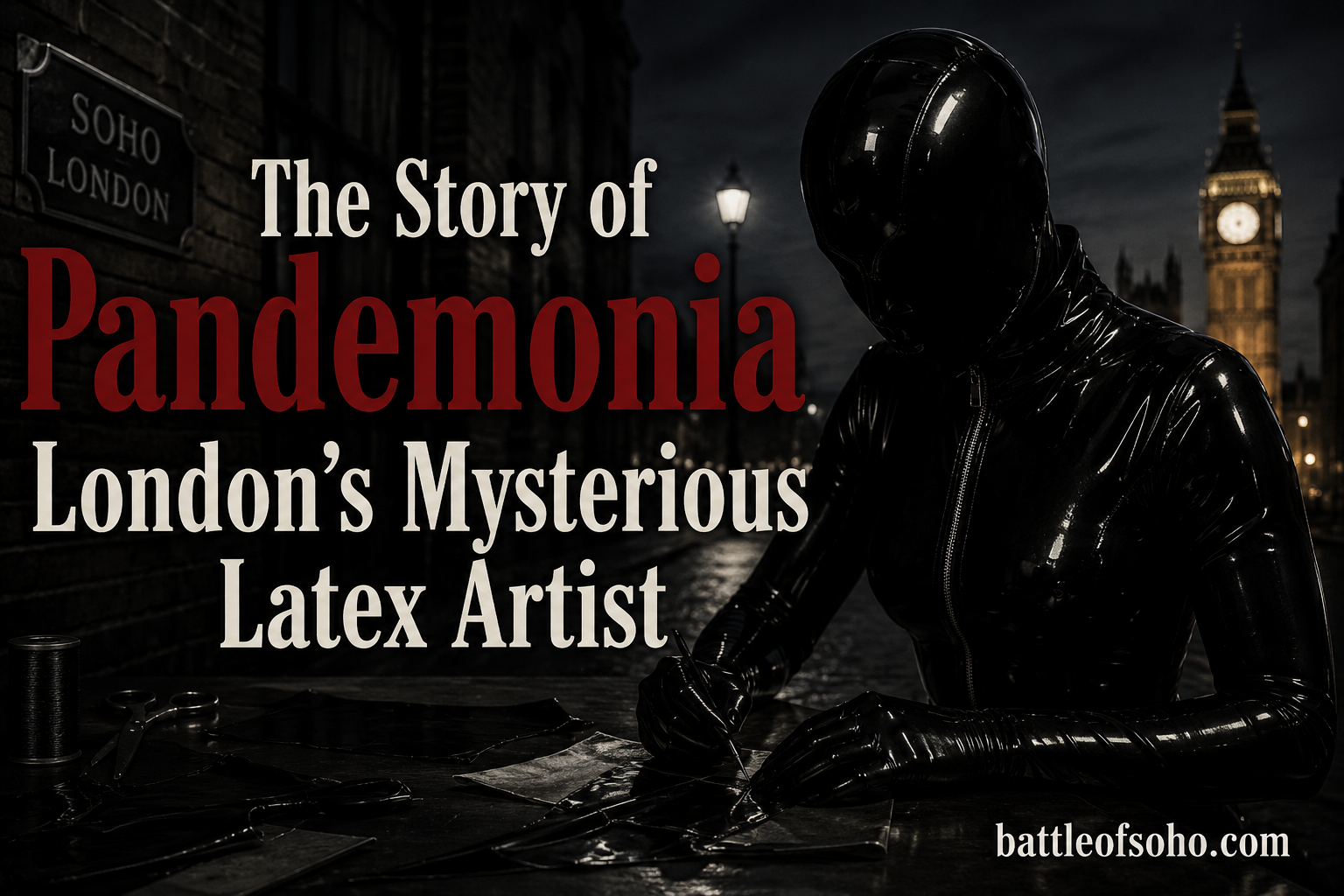
Walk through Soho on any given evening and you might catch a glimpse of something impossible: a seven-foot-tall blonde figure in a latex mask, gliding past the pubs and galleries like a cartoon that escaped its frame. That figure is Pandemonia, and she is one of the most fascinating conceptual art projects to ever emerge from the London underground scene.
Pandemonia is a character and persona created as conceptual art by an anonymous London-based artist. She has appeared in the art and fashion world since 2009, instantly recognizable by her towering latex-clad form, oversized blonde hair, and constant companion, an inflatable white dog named Snowy.
For over fifteen years, the artist behind Pandemonia has guarded their identity with absolute discipline. No name. No face. No slip-ups. What started as a street-level art intervention has grown into something far bigger, a living satire of celebrity culture that has gatecrashed London Fashion Week, walked red carpets, and caught the attention of some of the biggest names in fashion and media.
This is the story of Pandemonia, the Pandemonia London latex artist who turned anonymity into art and latex into legend. From her creation in the mid-2000s to her recent directorial debut, we will trace every milestone, every mystery, and every moment that made her impossible to ignore.
Table of Contents
Who Is Pandemonia? The Concept Behind the Persona
Pandemonia is not a person in the traditional sense. She is a constructed character, a walking artwork, and a sustained piece of performance art that has been running continuously since her first public appearance in 2009.
The anonymous artist behind the project describes Pandemonia as a vessel in female form, designed to travel through society and into what they call the intersubjective world of myth and brand. In simpler terms, Pandemonia is a living parody of celebrity itself. She embodies every trope of fame, the glamour, the branding, the constant visibility, and reflects them back at a culture obsessed with image.
Critics and curators have classified Pandemonia within the Post Pop-Art movement. Like Andy Warhol before her, she takes the iconography of mass culture and holds it up for examination. But where Warhol printed soup cans, Pandemonia walks among us in the flesh, or at least in the latex.
What makes this conceptual art project so compelling is its totality. The artist never breaks character in public. There are no candid moments, no behind-the-scenes peeks. Every appearance is the artwork, and every photograph taken of Pandemonia becomes part of the piece.
The Origin Story: How Pandemonia Was Born
The concept for Pandemonia was developed in the mid-2000s by an anonymous London artist who has never been publicly identified. The character first appeared on the streets and at art events around 2009, immediately drawing attention for her uncanny, larger-than-life presence.
According to interviews conducted while in character, the artist was interested in the idea of creating a figure who could exist in the real world the way celebrities exist in the media, as a pure surface, a brand, an image detached from any underlying human reality. Pandemonia was the answer to that question.
The name itself carries weight. It evokes pandemonium, chaos, and uproar, which is fitting for a figure designed to disrupt whatever space she enters. But there is also something playful about it, a wink at the absurdity of a world where a person in a latex mask can become a genuine celebrity.
From the very beginning, Pandemonia was designed to be photographed. In an era before Instagram dominated visual culture, this anonymous artist understood that images would travel further than any gallery exhibition. Pandemonia was built for the camera, and the camera loved her back.
The Mystery of Anonymity: Why the Artist Stays Hidden
The single most discussed aspect of Pandemonia is the identity of the artist behind her. After more than fifteen years of public appearances, major media coverage, and high-profile collaborations, we still do not know who they are.
This is not accidental. The anonymity is the point. In interviews, the artist has spoken about the power that comes from remaining unknown. When the creator disappears, the artwork takes on a life of its own. Pandemonia becomes real in a way that no signed, credited piece of art ever could.
There is also a sharp satirical edge to the secrecy. We live in an age of relentless self-disclosure, where every public figure shares their breakfast, their workouts, and their inner thoughts online. Pandemonia’s absolute refusal to do so is itself a commentary on the exhaustion of personal branding.
Forums and art communities regularly debate the question: is Pandemonia a man or a woman? The artist has deliberately left this ambiguous. Some observers have noted that the artist has referred to Pandemonia using both male and female pronouns in different contexts, deepening the mystery. The gender of the artist, like their name, is part of the art.
What makes this anonymity genuinely remarkable is its endurance. In a city like London, where gossip flows freely and the art world is tightly connected, keeping a secret of this magnitude for over a decade and a half is itself an artistic feat.
The Physical Appearance: A Seven-Foot Latex Figure
How tall is Pandemonia? She stands approximately seven feet tall, making her impossible to miss in any crowd. Her height alone turns every appearance into an event.
Her face is a smooth latex mask with a fixed expression, blonde hair swept back, and features that read as both beautiful and slightly unsettling. The mask never changes expression, which gives her a mannequin-like quality that reinforces the idea of her as an image rather than a person.
Pandemonia is always impeccably dressed. She designs her own outfits, which have ranged from latex dresses to sculptural coats to avant-garde ensembles that reference designers like Schiaparelli, Gaultier, and Moschino. Each outfit is a fashion statement in itself, carefully chosen for the context of wherever she appears.
Then there is Snowy, the inflatable white dog who accompanies her everywhere. Snowy is as much a part of the Pandemonia brand as the mask itself. The inflatable canine is a knowing reference to Tintin’s beloved dog, and it adds a layer of cartoonish absurdity to a figure who already exists somewhere between art object and living cartoon.
Cultural Commentary on Celebrity Culture
At its core, Pandemonia is a critique of celebrity culture. She is a celebrity who is famous for being famous, a brand with no product, an influencer without an interior life. And that is exactly the point.
Long before Instagram turned everyone into their own personal brand, Pandemonia was already exploring what it means to exist as pure image. The artist created a figure who does everything a celebrity does, attends events, walks runways, gives interviews, poses for photographs, but with nothing behind the surface. She is the empty center of the fame machine, made visible.
Forum discussions frequently highlight Pandemonia as a proto-influencer, an early example of a constructed online identity that predicted the influencer economy by years. She appeared on social media feeds and in paparazzi shots at a time when the concept of the influencer was still in its infancy.
The satire works because it is affectionate. Pandemonia does not sneer at celebrity culture from a distance. She dives into it, wearing it, performing it, and in doing so, she reveals its mechanics from the inside. The fact that real celebrities have embraced her, posed with her, and invited her to their events only sharpens the commentary.
This is what separates Pandemonia from simple parody. She is not mocking fame. She is inhabiting it so completely that the line between critique and participation dissolves entirely.
Fashion Milestones and Career Highlights
Pandemonia’s career is a timeline of increasingly high-profile appearances that blur the line between art world legitimacy and fashion world spectacle.
Her early days saw her gatecrashing gallery openings and art events across London. She would appear uninvited, posed for photographs, and disappeared. These interventions caught the attention of photographers and bloggers, and her image began circulating online.
The breakthrough into mainstream fashion came when she was invited to London Fashion Week. Rather than being turned away, the seven-foot latex figure was welcomed, photographed alongside models and designers, and treated as a legitimate presence in the front row. This acceptance by the fashion establishment was itself part of the artwork.
One of the most significant milestones was her appearance at Jean Paul Gaultier’s final ready-to-wear show. Being present at such a historic moment in fashion cemented Pandemonia’s status as more than a curiosity. She was now a recognized figure within the industry itself.
Her reach extended beyond London. Pandemonia has been featured in Vice, Vogue, Stylist, and Grazia China, among other major publications. International coverage has made her a globally recognized figure in contemporary art and fashion circles.
Collaboration has also been central to her career. She has worked with the Rambert dance company and appeared in projects that span photography, performance, and digital media. Each collaboration extends the Pandemonia project into new territory while maintaining the core concept of the anonymous, image-only persona.
She has exhibited work in galleries as well, creating art objects that exist independently of her physical appearances. These pieces extend the conceptual framework of the project, ensuring that Pandemonia functions as an artist and not merely a spectacle.
Pandemonia and the London Underground Art Scene
To understand Pandemonia, you have to understand the city that created her. London’s underground art scene has always thrived on spectacle, anonymity, and the willingness to disrupt. From the YBA movement of the 1990s to the street art explosion of the 2000s, this city has a tradition of artists who refuse to play by gallery rules.
Pandemonia emerged directly from this tradition. Her early appearances were not in white-walled exhibition spaces but on the streets, at impromptu events, in the kind of venues that populate Soho and East London after dark. The underground scene is where she was forged.
Soho itself has always been the beating heart of London’s bohemian culture. The area’s mix of nightlife, art spaces, fashion boutiques, and creative chaos makes it the natural habitat for a figure like Pandemonia. Walking through Soho as a seven-foot latex art piece is not just a visual stunt. It is a statement about who belongs in public space and what counts as art.
This is the angle that almost no other coverage of Pandemonia explores. Competitor articles treat her as a curiosity or a fashion figure, but they miss the deeper London context. Pandemonia is a product of a specific place and a specific culture. She could not have emerged from any other city.
The Battle of Soho name itself speaks to a kind of creative combat, the ongoing struggle to maintain artistic authenticity in a neighborhood under constant pressure from commercial development. Pandemonia represents that spirit of resistance. She is art that refuses to be sanitized, packaged, or explained away.
The London underground scene also provided the community that allowed the project to survive its early years. Before mainstream media attention, it was photographers, bloggers, and fellow artists in the underground who amplified Pandemonia’s image and helped the concept find its audience.
Recent Developments: From Pop Art Icon to Filmmaker
Pandemonia continues to evolve. In 2026, she made her directorial debut with a surrealist fashion film called The Castle. The move into filmmaking represents a natural extension of a project that has always been concerned with image-making and visual narrative.
The Castle is described as a surrealist fashion film, which fits perfectly within Pandemonia’s aesthetic universe. The transition from physical appearances to directed film allows the anonymous artist to control every frame, every angle, and every detail of the image in a way that street appearances cannot.
This expansion into new media suggests that the Pandemonia project is far from finished. The artist behind it has demonstrated a consistent ability to adapt the core concept to whatever platform or format best serves the work, from street performance to fashion shows to gallery exhibitions and now film.
Coverage of recent developments has noted the collaboration with Rambert and growing international visibility. Each new project adds another layer to a body of work that has been accumulating for over fifteen years, and each one is produced with the same absolute commitment to anonymity that defined the project from day one.
FAQs
Who is the Pandemonia artist?
Pandemonia is a character and persona created as conceptual art by an anonymous London-based artist who has never been publicly identified. The artist has maintained total anonymity since the project began in 2009.
How tall is Pandemonia?
Pandemonia stands approximately seven feet tall, making her impossible to miss in any crowd or event she attends.
Why is Pandemonia anonymous?
The artist stays anonymous because the anonymity is a core part of the artwork itself. By removing the creator, the character of Pandemonia takes on a life of her own and becomes a stronger commentary on celebrity culture and constructed identity.
When did Pandemonia first appear?
The concept was developed in the mid-2000s, and Pandemonia made her first public appearances around 2009 at art events and on the streets of London.
Is Pandemonia a man or a woman?
The gender of the anonymous artist behind Pandemonia has never been confirmed and remains deliberately ambiguous. The artist has used both male and female pronouns in different contexts, keeping this detail part of the ongoing mystery.
Conclusion: The Legacy of Pandemonia London’s Mysterious Latex Artist
The story of Pandemonia, the Pandemonia London latex artist, is still being written. What began as a street-level art intervention in the mid-2000s has grown into one of the most sustained and ambitious conceptual art projects of our time.
By refusing to reveal a name, a face, or even a gender, the anonymous artist behind Pandemonia has created something that feels almost mythic. She is a living artwork, a satirical mirror held up to celebrity culture, and a product of London’s fiercely independent underground art scene.
Whether she is walking through Soho, sitting in the front row at London Fashion Week, or directing her own surrealist films, Pandemonia continues to do what she has always done: make us look, and then make us wonder what we are really seeing.