
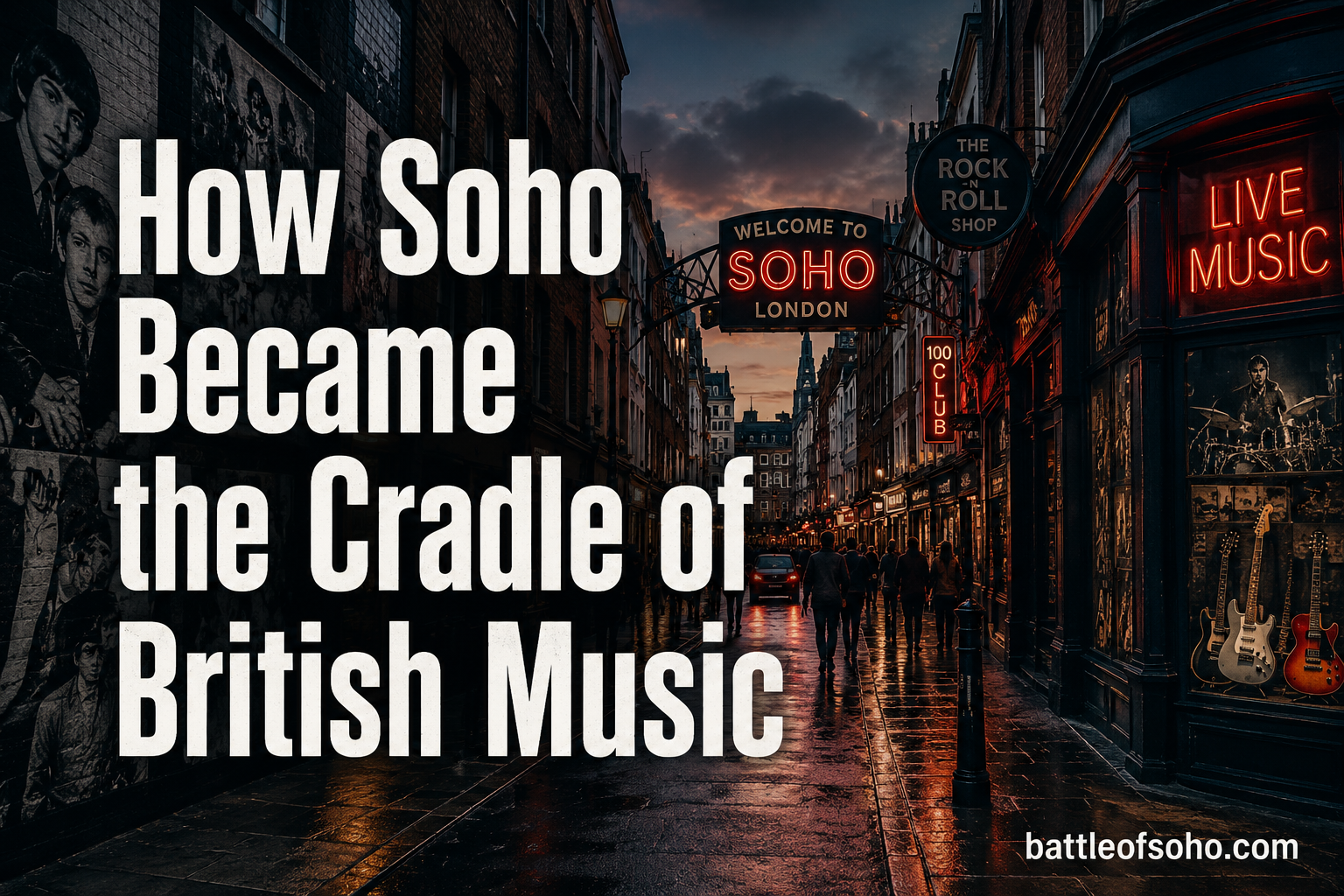
Soho became the cradle of British music because its centuries-long tradition of welcoming immigrants, outsiders, and nonconformists created a uniquely tolerant environment where jazz, skiffle, and rock musicians could experiment, perform, and be discovered. Starting with the 2I’s Coffee Bar in the 1950s and continuing through legendary venues like the Marquee Club, Trident Studios, and Ronnie Scott’s, a single square mile of central London launched more world-changing musical careers than anywhere else in Britain.
The history of music in Soho traces back to 1948, when Club Eleven became the first venue in the UK to host modern jazz, or bebop. From there, a chain reaction followed: espresso bars opened, young musicians found stages, impresarios scouted talent, and recording studios captured the results. By the time The Rolling Stones played their first gig at the Marquee in 1962, Soho had already been quietly building the infrastructure of British music for over a decade.
As one Reddit user on r/Music put it: “Incredible how an island the size of Britain can produce some of the world’s most innovative, influential and transformative artists.” The answer to that question runs straight through Soho. This is the story of how a neighborhood known for vice, immigrants, and late-night culture became the engine room of British music.
Our team spent months tracing the streets, venues, and stories that made Soho the undisputed birthplace of British rock and roll. We walked Old Compton Street, Wardour Street, Denmark Street, and St Anne’s Court to understand why this specific patch of London produced so many legendary acts. What we found is a story about tolerance, density, and the radical idea that music happens when different cultures collide in a small space where nobody asks too many questions.
Table of Contents
The Immigrant Foundations: Why Soho Was Different
To understand how Soho became the cradle of British music, you have to go back centuries before the first guitar was strummed in a coffee bar. Soho was built on immigration, and that is the single most important factor in everything that followed.
In the late 1600s, French Huguenot refugees fleeing religious persecution settled in Soho after the Edict of Nantes was revoked. They brought textile skills, a distinct language, and a refusal to conform to the English mainstream. This established a pattern that would define Soho for the next 300 years: if you were an outsider, Soho would take you in.
Over the following centuries, the area absorbed waves of newcomers. Italian, Greek, French, Jewish, and Chinese communities each carved out their own corners of Soho. By the Victorian era, it was the most cosmopolitan square mile in London. Karl Marx lived and wrote at 28 Dean Street during the 1850s, surrounded by poverty, cholera, and an intellectual culture that thrived on the margins.
This multicultural character created something unusual: a culture of tolerance. Soho became known as a place where you did not ask questions about your neighbors. What they did, who they loved, where they came from, what music they played at midnight. That silence was not indifference. It was a survival strategy that became a creative one.
The bohemian reputation of Soho grew from this foundation. Artists, writers, prostitutes, gangsters, jazz musicians, and immigrants all shared the same narrow streets. The Colony Room on Dean Street, run by the formidable Muriel Belcher, became a legendary drinking club where Francis Bacon, Lucian Freud, and the artistic establishment mingled with musicians and misfits. That cross-pollination between visual artists, writers, and musicians is essential to understanding how creative energy concentrated in Soho.
Reddit users on r/cxd have pointed out that UK music history has often been “spun as a white man’s game” when in reality it was deeply multicultural. Soho proves that point. The immigrant communities that built Soho did not just tolerate music. They demanded it. Italian cafes wanted live entertainment. Caribbean and West Indian communities brought new rhythms. The skiffle movement that kickstarted British rock drew directly from American folk and blues traditions filtered through an immigrant neighborhood hungry for new sounds.
Without Huguenots, Italian espresso bar owners, Greek cafe proprietors, and the Chinese community that gave Soho its late-night energy, there would have been no coffee bars. Without coffee bars, there would have been no stages for young musicians. And without those stages, there would have been no British rock and roll.
The Jazz Roots: Club Eleven and the Bebop Revolution (1948)
The music scene in Soho can be traced back to 1948 and Club Eleven, which is generally regarded as the first venue where modern jazz, or bebop, was performed in the UK. This is the moment Soho’s musical identity was born, and everything that followed grew from those smoke-filled jazz sessions.
Club Eleven was founded by a group of jazz musicians and enthusiasts who wanted to create a space dedicated to bebop, the revolutionary new style of jazz pioneered by Charlie Parker and Dizzy Gillespie in New York. Post-war London was gray, rationed, and culturally conservative. But inside Club Eleven, something completely different was happening. Musicians were experimenting with complex harmonies, blistering tempos, and improvisational freedom that shocked traditional jazz audiences.
The club operated in a legal grey area. Licensing laws in post-war Britain made it difficult to run a straightforward music venue, so Club Eleven functioned as a members-only club. You paid a small subscription, signed in as a member, and were then free to drink and listen long after conventional pubs had closed. This underground structure became the template for nearly every music venue that followed in Soho.
Around the corner, the Harmony Inn and other late-night establishments served a similar function for musicians who wanted to keep playing after the formal clubs shut. These were not glamorous spaces. They were basements, back rooms, and converted shops where the music mattered more than the decor.
Then came Ronnie Scott’s, which opened in 1959 in a basement on Gerrard Street before moving to its current home on Frith Street. Ronnie Scott, a saxophonist who had played at Club Eleven, created what would become one of the most important jazz clubs in the world. Over the decades, Ronnie Scott’s hosted everyone from Ella Fitzgerald and Miles Davis to Jimi Hendrix and Nina Simone. It remains open today and is still considered one of the finest jazz venues anywhere.
The jazz era of Soho is critical because it established two things the rock and roll explosion would later depend on. First, it proved that Soho audiences would embrace challenging, unfamiliar music. Second, it built a community of musicians, promoters, and venue owners who understood how to run live music spaces in a neighborhood where the authorities were willing to look the other way.
Reddit users who have visited Ronnie Scott’s consistently describe it as “incredibly intimate,” noting that you can sit close enough to see the musicians’ fingers on their instruments. That intimacy, that closeness between performer and audience, is a Soho trademark that goes all the way back to Club Eleven.
Skiffle, Coffee Bars, and the 2I’s Phenomenon (1950s)
The 1950s were when Soho truly became the cradle of British music. The catalyst was not a grand concert hall or a government initiative. It was a coffee bar.
In 1952, the Mocha Bar on Frith Street became the first espresso bar in London, introducing the Gaggia coffee machine to Britain. Within months, espresso bars were opening across Soho. These were not your typical British cafes. They were small, dark, stayed open late, and attracted young people who wanted somewhere to gather that was not a pub or a dance hall.
The genius move was hiring live musicians. Espresso bar owners realized that a teenager with a guitar would draw crowds, and crowds bought coffee. This simple economic calculation created an entire ecosystem of small stages where young musicians could perform. No other part of London had this density of low-pressure performance opportunities.
Into this scene came skiffle. Led by Lonnie Donegan, whose 1955 recording of “Rock Island Line” sold over a million copies, skiffle was a do-it-yourself music movement that combined American folk, blues, and jug band influences. It was cheap to play. You needed a guitar, a washboard, a tea chest bass, and enthusiasm. Thousands of young people across Britain formed skiffle groups, and they needed somewhere to play. Soho’s coffee bars became their stages.
Then came the 2I’s Coffee Bar on Old Compton Street, and everything changed.
The 2I’s is widely regarded as the birthplace of British rock and roll. It was not a large space. The performance area was an 18-inch stage in a basement that held roughly 25 people. Performers were paid less than a pound plus a meal. But from that tiny cellar, a staggering number of careers were launched.
The 2I’s was run by two Australian wrestling promoters turned impresarios: Paul Lincoln, known as “Dr Death” for his theatrical wrestling persona, and Tom Littlewood. They had no background in music. But they understood showmanship, and they recognized that the teenagers packing into coffee bars wanted something more exciting than polite pop songs.
Tommy Steele was the first star discovered at the 2I’s. In 1956, the 19-year-old merchant seaman was singing and playing guitar in the basement when he was spotted by manager John Kennedy and music publisher Larry Parnes. Within months, Steele had a number one single and was being positioned as Britain’s answer to Elvis Presley.
After Steele came Adam Faith, whose smooth vocals and sharp suits made him a teen idol. Then Marty Wilde, Cliff Richard, and dozens of others. Cliff Richard’s debut at the 2I’s led directly to his signing with EMI and his first single “Move It” in 1958, often cited as the first authentic British rock and roll record.
The 2I’s also had a powerful ally: television. The BBC’s 6.5 Special, which launched in 1957, was the first British television program dedicated to popular youth music. The show regularly featured acts that had been discovered at the 2I’s, creating a direct pipeline from a Soho coffee bar basement to national television screens.
Other coffee bars in Soho followed the 2I’ model. The Condor Club, the Mocha Bar, and the Heaven and Hell all offered stages to young musicians. But the 2I’s was the one that mattered. It was the first rock club in Europe, and its influence on British popular music is impossible to overstate.
What made the 2I’s work was the same thing that made Soho work: tolerance and density. A 25-person basement on Old Compton Street does not become the birthplace of British rock by accident. It becomes that because the surrounding neighborhood accepts noise, accepts youth culture, accepts outsiders, and because there are enough other venues, publishers, and studios within walking distance to turn a basement performance into a career.
The Marquee Club: Where British Rock Grew Up
If the 2I’s was where British rock and roll was born, the Marquee Club was where it grew up. The Marquee was the venue that defined British rock music for thirty years, and its story is inseparable from the story of Soho.
The Marquee Club opened in 1958 at 165 Oxford Street, just on the edge of Soho, before moving to its legendary address at 90 Wardour Street in 1964. The Wardour Street location became the center of British rock music, a pilgrimage site for musicians and fans alike.
The list of artists who performed at the Marquee reads like a hall of fame for British music. The Rolling Stones played their first-ever live gig at the Marquee on July 12, 1962. The Who made the venue their second home, developing their explosive live style on its stage. David Bowie, then still David Jones, played there with early bands. Led Zeppelin, Pink Floyd, The Yardbirds, Manfred Mann, Jimi Hendrix, and hundreds of others all graced the Marquee stage.
Manfred Mann performed at the Marquee an extraordinary 102 times. That statistic alone tells you how central this venue was to the British music scene. Bands did not just play the Marquee once and move on. They came back repeatedly, building audiences and honing their craft night after night.
The Marquee was also the venue where the BBC recorded live sessions for television and radio, further amplifying its reach. When a band played well at the Marquee, word spread fast through the tightly knit Soho music community, and labels took notice.
The venue survived multiple changes in musical fashion. It weathered the transition from rhythm and blues to psychedelic rock, from progressive rock to punk, and from new wave to heavy metal. Iron Maiden, Def Leppard, and other bands associated with the New Wave of British Heavy Metal all played the Marquee in the late 1970s and early 1980s.
But nothing lasts forever. The Marquee Club closed its doors on Wardour Street in 1988, a victim of rising rents, changing nightlife culture, and the slow erosion of Soho’s live music infrastructure. The building was demolished, and although the Marquee name was revived at other locations in later years, none captured the magic of the original.
Walking past 90 Wardour Street today, there is little to mark the spot where British rock history was made. This is a recurring frustration for music fans visiting Soho. As one Reddit user on r/london noted, many historic music venues in Soho no longer exist and have no clear markers. The ghosts are there, but you have to know where to look.
Trident Studios: Where the Hits Were Recorded
The venues of Soho discovered and developed talent, but Trident Studios is where that talent was captured for the world to hear. Opened in 1968 at 17 St Anne’s Court, Trident Studios became one of the most important recording facilities in the history of British music.
What set Trident apart was technology. When The Beatles were recording the White Album in 1968, Abbey Road Studios was still using four-track recording equipment. Trident had an Ampex eight-track machine, which gave musicians and producers far more flexibility to layer sounds and experiment. This technical superiority drew the biggest names in music to a small street in Soho.
The Beatles recorded “Hey Jude” at Trident Studios, along with several tracks from the White Album. The studio’s eight-track capabilities allowed for the kind of layered, ambitious arrangements that defined the late Beatles period.
David Bowie recorded “Ziggy Stardust and the Spiders from Mars” at Trident. The album, released in 1972, transformed Bowie from a cult figure into a global star and remains one of the most influential rock records ever made. Lou Reed recorded “Transformer” at Trident, with Bowie producing. The partnership between Bowie and Reed, forged in a Soho studio, produced some of the most enduring songs in rock history, including “Walk on the Wild Side.”
Elton John recorded early sessions at Trident. Queen worked on their debut album there. James Taylor, Marc Bolan, and dozens of others chose Trident over more famous studios because of the quality of its equipment and the expertise of its engineers.
The studio was also where “Candle in the Wind” was recorded, Bernie Taupin and Elton John’s tribute to Marilyn Monroe that would later be rewritten for Princess Diana’s funeral and become one of the best-selling singles of all time.
Trident Studios closed in 1981, but its recordings continue to define British music. The fact that some of the most important albums in rock history were made in a small building on St Anne’s Court rather than at a major-label flagship studio says everything about how Soho operated. The best work happened off the main streets, in basements and back rooms, where musicians had the freedom to take risks.
Denmark Street and Tin Pan Alley: The Business Spine
While the venues and studios get most of the attention, Denmark Street played an equally important role in how Soho became the cradle of British music. Known as London’s Tin Pan Alley, Denmark Street has been the center of British music publishing and the music instrument trade since the early 1900s.
Denmark Street runs from Charing Cross Road toward St Giles High Street, sitting just at the edge of Soho. For decades, it was lined with music publishers’ offices, songwriting rooms, rehearsal spaces, and instrument shops. If you were a musician in London, Denmark Street was where you bought your guitar, found a publisher, rehearsed your set, and networked with the industry.
The Rolling Stones rehearsed in a basement on Denmark Street in their early days. Elton John worked as an office boy at a music publisher on the street, writing songs in the back room before he became famous. The Small Faces, David Bowie, and countless others all spent time on Denmark Street, drawn by the concentration of music business professionals.
Regent Sound Studios, located on Denmark Street, was another important recording space. It was where the Rolling Stones recorded their first album in 1964. The studio was small and basic compared to Trident or Abbey Road, but for young bands making their first recordings, it was perfect.
The proximity of Denmark Street to the 2I’s, the Marquee, and Soho’s coffee bars is not a coincidence. It is the secret to why Soho became the cradle of British music. Within a ten-minute walk, a musician could discover a new act at a coffee bar, rehearse at a Denmark Street studio, meet a publisher, record a demo, and sign a deal. No other part of London, and arguably no other part of Britain, offered this level of concentration.
This density is what separated Soho from Manchester, Liverpool, or Birmingham. Those cities produced great bands, but those bands had to come to London, and specifically to Soho, to get signed, recorded, and promoted. Denmark Street was the business end of that pipeline.
Today, Denmark Street retains some of its musical character, with several guitar shops and music-related businesses still operating, though redevelopment has changed the street significantly. For music fans walking through Soho, it remains one of the most important stops on any musical walking tour.
Swinging London: Carnaby Street and the 1960s Explosion
The 1960s transformed Soho from a local music scene into a global cultural phenomenon. This was the era of Swinging London, and Soho sat at the dead center of it.
Carnaby Street, just south of Soho, became the fashion capital of the world. Boutiques like Lord John, Lady Jane, and His Clothes drew crowds of young people hungry for the sharp, colorful styles that defined the Mod movement. But fashion and music were never separate in 1960s Soho. The people buying clothes on Carnaby Street were the same people going to gigs at the Marquee. The musicians shopping for stage outfits were the same artists recording at Trident.
The Mod subculture was the bridge. Mods were obsessed with American rhythm and blues, Italian fashion, scooters, and all-night dancing. They filled the clubs of Soho, demanding music that was faster, sharper, and more rhythmically complex than the polite pop that dominated the charts. The Who, The Small Faces, and The Kinks all fed directly off Mod culture, and their music was shaped by what they saw and heard in Soho’s clubs.
The Colony Room on Dean Street was the unofficial headquarters of Swinging London’s creative class. Founded in 1948 by Muriel Belcher, this private drinking club was open from lunchtime until late at night and attracted an extraordinary mix of artists, writers, musicians, and eccentrics. Francis Bacon was a regular. Lucian Freud drank there. Music industry executives, journalists, and musicians all circulated through its narrow rooms.
The Colony Room matters to this story because it represents how creative networks formed in Soho. A musician might meet a journalist at the Colony Room who would then write about their gig at the Marquee. A record producer might encounter a painter who would introduce them to a singer. These informal connections, fueled by alcohol and proximity, were the social infrastructure of British music.
The 1960s also cemented Soho’s reputation as the place where new things happened first. If a new sound, a new look, or a new attitude was emerging, it appeared in Soho before anywhere else. This reputation attracted ambitious musicians from across Britain and the world, all of them drawn to the same few streets where they believed their careers could take off.
By the end of the 1960s, Soho’s music ecosystem was operating at full capacity. The 2I’s had launched the first generation of British rock stars. The Marquee was hosting the biggest names in rock. Trident Studios was recording landmark albums. Denmark Street was publishing songs. And the Colony Room was keeping everyone connected. No other square mile in Britain could match this concentration of talent, infrastructure, and attitude.
Punk and Post-Punk: Soho in the 1970s and 1980s
The story of how Soho became the cradle of British music does not end with the 1960s. The 1970s and 1980s brought new genres, and Soho adapted once again.
The Roxy Club, which opened in 1976 on Neal Street just north of Soho, became one of the most important punk venues in London. In its brief existence, it hosted The Clash, The Jam, Buzzcocks, Wire, and Generation X. The Vortex on Wardour Street served a similar function, giving punk and early post-punk bands a stage in the heart of Soho.
What punk needed from Soho was the same thing skiffle and rock and roll had needed: small, cheap, tolerant venues where unknown bands could make noise. The infrastructure that had been built for the 1950s coffee bar scene was repurposed for punk, then for post-punk, then for new wave and synth-pop.
Soho also played a role in the birth of UK dance music culture. The club scene that developed in Soho in the 1980s, including venues like Madame Jojo’s and the Wag Club on Wardour Street, created spaces where different musical traditions collided. As Reddit users on r/cxd have noted, this history is more multicultural than it is often given credit for, with Black British and LGBT communities driving innovation in dance music long before it was commercialized.
The Limelight on Shaftesbury Avenue, at the edge of Soho, became one of the most influential clubs of the late 1980s and early 1990s. It bridged the gap between the live music tradition of the Marquee era and the DJ culture that would dominate the following decades. Soho’s ability to absorb each new musical movement and provide it with a home is what kept the neighborhood relevant long after the original rock and roll boom had ended.
Why Britain? The Soho Answer to a Global Question
One of the most common questions on music forums, as noted in our research, comes from a Gen Z American on Reddit who asked: “Why did England produce so many great bands throughout the 60s all the way to the 90s?” The answer, in significant part, is Soho.
The reason Britain produced so many world-changing bands is not because British musicians were inherently more talented than anyone else. It is because Britain had Soho, and Soho had a unique concentration of infrastructure, tolerance, and cross-cultural exchange that turned talented musicians into global stars.
Think about what a young band needed in the 1950s and 1960s to succeed. They needed somewhere to play. They needed someone to hear them. They needed a place to rehearse. They needed a studio to record in. They needed a publisher to sell their songs. They needed a producer who understood their sound. They needed a journalist to write about them. And they needed a culture that accepted what they were doing.
In Soho, all of these things existed within walking distance. You could play the 2I’s on a Tuesday, get spotted by a manager on Wednesday, rehearse on Denmark Street on Thursday, record a demo at Regent Sound on Friday, meet a publisher on Saturday, and drink with a music journalist at the Colony Room on Sunday. Try doing that in any other city in Britain in 1960. You could not.
The multicultural dimension is equally important. As forum users have rightly pointed out, the story of British music has often been whitewashed. But Soho’s music scene was built by immigrants. Italian cafe owners created the coffee bar culture. Caribbean and West Indian musicians brought new rhythms. American jazz and blues records came through Soho’s record shops. The skiffle movement was inspired by Lead Belly and Woody Guthrie. British rock and roll was a fundamentally multicultural product, and Soho is where that mixing happened most intensely.
This is the real answer to why Britain dominated popular music for so long. It was not just talent. It was infrastructure plus tolerance plus multiculturalism, all concentrated in one small neighborhood where nobody asked too many questions.
FAQs
Why is Soho London so famous?
Soho is famous for its nightlife, entertainment, and cultural history. For music specifically, Soho earned its reputation as the birthplace of British rock and roll through venues like the 2I’s Coffee Bar, the Marquee Club, and Trident Studios, which launched and recorded some of the biggest names in British music from the 1950s onward.
When did Soho become popular for music?
Soho’s music scene began in 1948 with Club Eleven, the first UK venue for bebop jazz. The area became widely popular for music in the mid-1950s when coffee bars like the 2I’s on Old Compton Street started hosting live performances, launching the careers of Tommy Steele, Cliff Richard, and other early British rock stars.
What is the history of the music in Soho?
Music in Soho began with jazz at Club Eleven in 1948, expanded through the skiffle and coffee bar scene of the 1950s centered on the 2I’s, exploded during the rock era of the 1960s with the Marquee Club and Trident Studios, and continued through punk and post-punk in the 1970s and 1980s. Each genre found a home in Soho’s dense network of small venues and recording studios.
Is Soho still a music destination?
Yes, though on a smaller scale. Ronnie Scott’s on Frith Street remains one of the world’s premier jazz clubs. Denmark Street still has guitar shops and music businesses. While many historic venues like the Marquee and the 2I’s no longer exist, contemporary artists including Coldplay, Arctic Monkeys, and Mumford and Sons have performed at Soho venues in recent years.
What was the 2I’s Coffee Bar?
The 2I’s Coffee Bar was a venue on Old Compton Street in Soho that is widely regarded as the birthplace of British rock and roll. Opened in the mid-1950s, it featured an 18-inch stage in a basement holding about 25 people. Tommy Steele, Cliff Richard, Adam Faith, and other early British rock stars were discovered there, making it the most influential small venue in British music history.
Did the Beatles record in Soho?
Yes. The Beatles recorded portions of the White Album and the single Hey Jude at Trident Studios on St Anne’s Court in Soho in 1968. Trident had superior eight-track recording equipment that Abbey Road Studios lacked at the time, which is why the Beatles chose to work there.
Conclusion: The Enduring Legacy of Soho’s Music Scene
How Soho became the cradle of British music is a story about geography, tolerance, and the willingness of a small neighborhood to embrace anyone with talent and ambition. From Club Eleven in 1948 to the punk clubs of the late 1970s, Soho provided the stages, the studios, the publishers, and the social networks that turned raw musical talent into global success.
The chain of events is remarkable in its simplicity. Immigrant communities created a demand for coffee bars. Coffee bars hired musicians to attract customers. Impresarios scouted those musicians. Record labels signed them. Studios like Trident and Regent Sound recorded them. Publishers on Denmark Street sold their songs. And journalists drinking at the Colony Room wrote about all of it. Every link in this chain existed within a few hundred yards of each other, and that concentration is what made Soho different from anywhere else.
What remains today is thinner but still visible. Ronnie Scott’s continues to host world-class jazz on Frith Street. Denmark Street retains a few guitar shops and echoes of its Tin Pan Alley past. Visitors can walk the same streets where Tommy Steele was discovered, where the Rolling Stones played their first gig, where Bowie recorded Ziggy Stardust, and where some of the most important music of the twentieth century was made. The buildings may be gone or changed, but the geography of musical history is still there for anyone willing to look.
The multicultural story matters more now than ever. As forum users have rightly pointed out, the history of British music has often been told in a way that erases the immigrant and minority communities who made it possible. Soho’s music scene was built by Huguenots, Italians, Greeks, Caribbean immigrants, Jewish refugees, and the LGBTQ+ community. British rock and roll is a multicultural achievement, and Soho is the proof.
If you want to understand why Britain produced so many world-changing bands, you have to walk the streets of Soho. The answer is not in a recording studio or a concert hall. It is in the narrow streets where different cultures collided, where nobody asked too many questions, and where a 25-person basement could launch a career that would define a generation. That is how Soho became the cradle of British music, and that legacy is still being felt every time a new artist picks up a guitar and dreams of playing in London.