
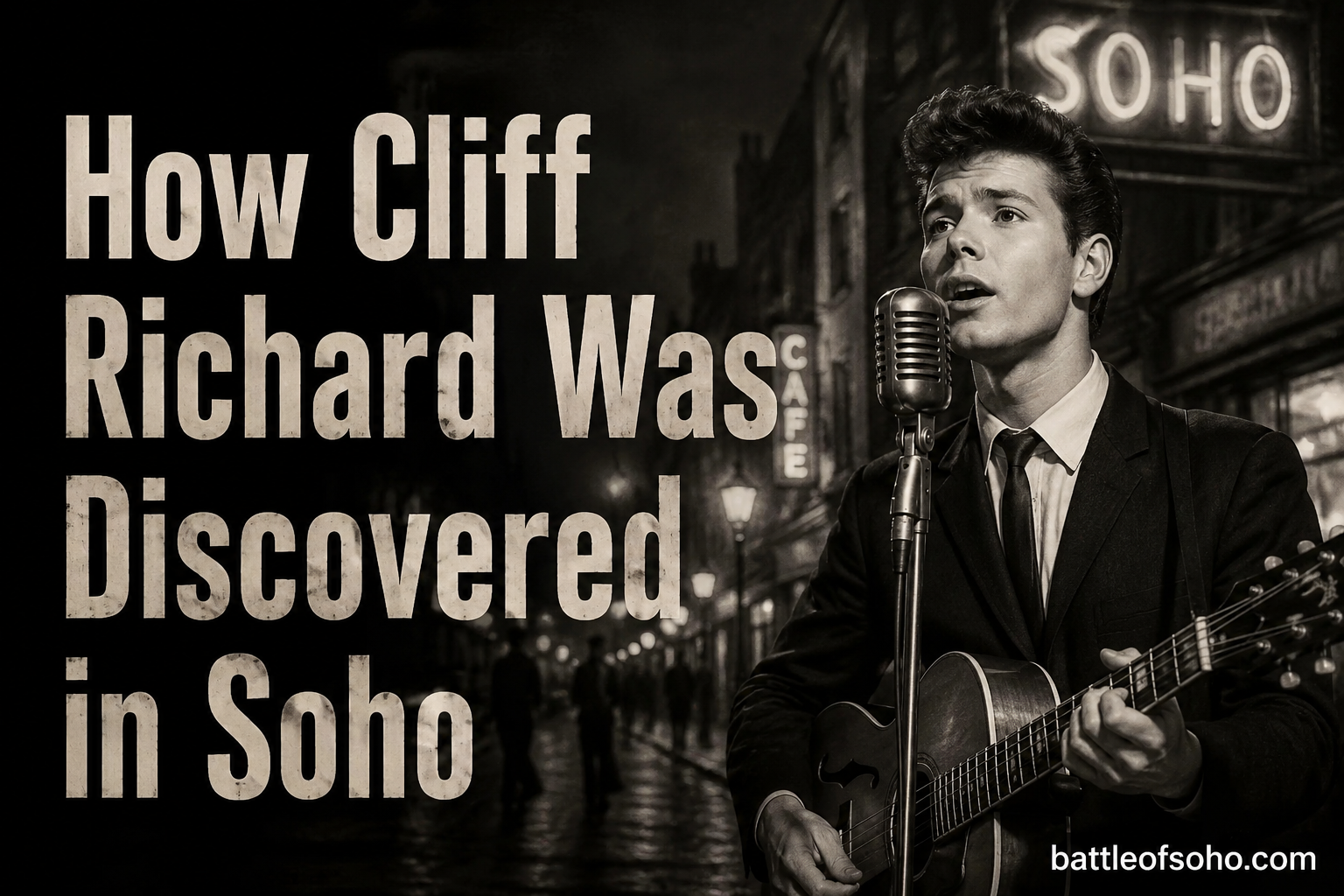
Soho in the 1950s was a neighborhood vibrating with post-war energy, coffee bars on every corner, and teenagers hungry for a new kind of music. Tucked away at 59 Old Compton Street sat a small basement venue called the 2i’s Coffee Bar, a place that would change the course of British music forever. It was here, in that cramped, smoke-filled room, that two of Britain’s biggest rock and roll stars were discovered within months of each other.
Tommy Steele, born Tommy Hicks in Bermondsey, was talent-spotted in the summer of 1956 by publicist John Kennedy during a performance with the Vipers Skiffle Group. Cliff Richard, born Harry Rodger Webb in Lucknow, India, was discovered shortly after when local promoter Johnny Foster caught him performing at the same venue with his band the Drifters in 1958. The story of how Cliff Richard and Tommy Steele were discovered in Soho is really the story of how British rock and roll was born, not in a grand concert hall, but in a basement coffee bar that could barely hold a hundred people.
The 2i’s became the gravitational center of a musical revolution. Teenagers from across London descended on Soho every weekend, cramming down narrow stairs to hear raw, electric performances by young musicians who had been shaped by American rockabilly records and the British skiffle movement. The venue’s reputation grew so quickly that talent scouts, record label representatives, and music journalists made it a regular stop on their nightly rounds.
What makes this story so remarkable is that two artists who would define an era of British popular music both emerged from the same tiny stage. Tommy Steele became Britain’s first homegrown rock and roll star, scoring hits like “Rock with the Caveman” and “Singing the Blues.” Cliff Richard followed close behind with “Move It,” a single widely regarded as the birth of authentic British rock and roll recording.
Our team has spent months tracing the histories, scouring record collector archives, and piecing together the timelines to tell both stories side by side. No existing source has ever placed these two discovery narratives in direct conversation with each other. Understanding how Cliff Richard and Tommy Steele were discovered in Soho means understanding the 2i’s Coffee Bar as more than a venue. It was a cultural engine, a place where working-class kids with guitars could become national icons overnight.
Table of Contents
The Short Answer
Tommy Steele was discovered at the 2i’s Coffee Bar in Soho in the summer of 1956 when publicist John Kennedy saw him performing with a skiffle group and arranged a recording deal with Decca Records within two weeks. Cliff Richard was discovered at the same venue roughly a year later when promoter Johnny Foster booked him to perform with his band the Drifters, leading to a demo recording that eventually secured a deal with Columbia Records through producer Norrie Paramor. Both discoveries took place at 59 Old Compton Street in London’s Soho, a basement coffee bar now widely recognized as the birthplace of British rock and roll.
The Soho Music Scene of the 1950s
London in the mid-1950s was a city still recovering from the devastation of the Second World War. Rationing had only ended in 1954, bomb sites still scarred whole blocks, and the teenage demographic was something entirely new. For the first time in British history, young people had disposable income, leisure time, and a cultural identity that was distinctly their own.
American rock and roll records had started crossing the Atlantic, carried over by merchant seamen and American servicemen stationed in Britain. Elvis Presley, Bill Haley, and Little Richard were electrifying young audiences, but the British music industry had no homegrown equivalent. The establishment dismissed this new music as noise. The BBC barely played it. Record labels were unsure what to do with it.
Into this vacuum stepped skiffle, a do-it-yourself music movement built on guitars, washboards, tea-chest basses, and American folk and blues songs. Lonnie Donegan had launched the craze with “Rock Island Line” in 1955, a single that sold over a million copies and inspired thousands of teenagers to form their own skiffle groups. Skiffle was cheap to play, required no formal training, and could be performed anywhere. It was the gateway drug to rock and roll for an entire generation of British musicians.
Soho was the natural epicenter for this cultural shift. For decades, the neighborhood had been London’s entertainment district, packed with theaters, music halls, clubs, pubs, and late-night cafes. It was the kind of place where bohemians, musicians, actors, and hustlers all rubbed shoulders. By the mid-1950s, a new phenomenon was transforming the area: the espresso coffee bar.
Italian-style coffee bars began opening across Soho, offering teenagers a place to gather that was cheaper and more welcoming than pubs. Many of these coffee bars featured live music, and the 2i’s was the most famous of all of them. The coffee bar phenomenon was perfectly suited to skiffle and early rock and roll, which required minimal equipment and small performance spaces. A basement room with a low ceiling and terrible acoustics was all these young musicians needed to create something explosive.
The Soho Fair, an annual neighborhood celebration, played an unexpectedly important role in this story. On July 14, 1956, the Soho Fair parade featured the 2i’s Coffee Bar contingent, helping to draw attention to the venue and its performers. This exposure helped transform the 2i’s from a neighborhood curiosity into a destination that attracted music industry attention from across London.
What made the Soho scene different from anything happening elsewhere in Britain was its density. Within a few streets, teenagers could hear live music in multiple venues, buy imported American records, meet other young musicians, and potentially be seen by someone who could change their career. The ecosystem was tight, fast-moving, and brutally meritocratic. If you were good enough, word spread. If you were not, the crowd moved on to the next act.
The 2i’s Coffee Bar – Soho’s Legendary Discovery Venue
The 2i’s Coffee Bar was opened in 1956 at 59 Old Compton Street in the heart of Soho. The venue was founded by two Iranian brothers, Freddie and Sammy Irani, who had previously run a coffee stall in the area. The name “2i’s” reportedly referred to the brothers’ shared initial, though some accounts suggest it stood for “two Irani’s” or simply was a catchy abbreviation.
The venue occupied a narrow storefront with a basement performance space that became its beating heart. Customers would enter through a small ground-floor coffee area and then descend a steep staircase into a cramped basement room. The performance space was tiny, with a low ceiling, poor ventilation, and room for perhaps 80 to 100 people standing shoulder to shoulder. By any conventional measure, it was an awful place to hear live music.
But the 2i’s had something that grand concert halls lacked: raw, immediate energy. The cramped basement created an intimacy between performers and audience that was electric. There was no stage separation, no barrier between the musicians and the crowd. A singer could reach out and touch the people watching them. The poor acoustics barely mattered when the music was this loud and this close.
Paul Lincoln, an Australian wrestler known professionally as “Ray Hunter,” took over the management of live entertainment at the 2i’s. Lincoln had a background in show business and understood how to build a nightly program that would attract crowds. He booked skiffle groups, rock and roll singers, and novelty acts, creating a revolving door of talent that kept the venue packed every evening.
The house band at the 2i’s was the Vipers Skiffle Group, one of the most accomplished skiffle outfits in London. The Vipers were regulars at the venue, performing multiple sets per night and serving as the musical backbone of the entertainment program. Their members included Wally Whyton, Johnny Martyn, and others who would go on to have their own music industry careers. The Vipers were good enough to be a draw on their own, but they also served as the backing group for visiting singers who wanted to perform at the venue.
Bruce Welch, who would later find fame as the rhythm guitarist of the Shadows, captured the 2i’s mythology perfectly when he described how young musicians viewed the venue: “When Hank and I came to London at the age of 16 we went to the 2 I’s coffee bar to be discovered, as did Cliff as did lots of other people.” The 2i’s was not just a venue. It was a destination, a place you went specifically because you believed it could change your life. That belief was well-founded, because it already had.
Billy Bragg, in his authoritative book “Roots, Radicals and Rockers,” placed the 2i’s at the center of the skiffle movement’s transformation into British rock and roll. Bragg documented how the Vipers Skiffle Group served as a catalyst for the discoveries that occurred at the venue. Their presence gave the 2i’s musical credibility and created a platform where raw talent could be showcased to industry insiders who increasingly dropped by to see what all the fuss was about.
The atmosphere inside the 2i’s was unlike anything else in 1950s London. The basement was hot, crowded, and impossibly loud for its size. Teenagers would queue down Old Compton Street for the chance to get in. Performers played on a tiny raised area that barely qualified as a stage. The smell of espresso, cigarette smoke, and sweat was overwhelming. And yet, for the young musicians who performed there, it was the most exciting room in Britain.
The venue’s location in Soho was no accident. Old Compton Street was a major thoroughfare in the heart of London’s entertainment district, easily accessible by Underground and within walking distance of theaters, record shops, and music publishers. The 2i’s was positioned at the intersection of everything that mattered in 1950s British popular culture. Record label A&R men could stop by after dinner in nearby restaurants. Music journalists could pop in between assignments. And teenagers from across the city could make the pilgrimage on a Saturday night.
What happened at the 2i’s in the mid-to-late 1950s was not planned. Nobody set out to create the birthplace of British rock and roll. But a combination of factors, the right location, the right music, the right cultural moment, and the right people running the venue, converged to make it exactly that. Two of the most important discoveries in British music history happened on the same tiny basement stage, and the 2i’s earned its place in rock and roll mythology.
How Tommy Steele Was Discovered in Soho
Tommy Steele was born Thomas William Hicks on December 17, 1936, in Bermondsey, South London. His father was a racing tipster, and the family lived in a working-class neighborhood where entertainment meant the music hall, the pub, or the cinema. Young Tommy showed an early interest in music and performance, but nobody in his circle had any connection to the music industry.
As a teenager, Steele left school and joined the Merchant Navy, a decision that would change his life in ways nobody could have predicted. During his voyages, he visited American ports where he heard rock and roll, rhythm and blues, and country music firsthand. He absorbed the sounds of Elvis Presley, Bill Haley, and other American artists, learning their songs and studying their performance styles. The Merchant Navy experience gave Steele something most British teenagers lacked: direct exposure to the music that was transforming American culture.
When Steele returned to London, he brought with him a repertoire of American rock and roll songs and a performance style that was raw, energetic, and unmistakably influenced by what he had heard in American port cities. He began performing informally at various London venues, but it was the 2i’s Coffee Bar that would become his launching pad.
In the summer of 1956, Steele began singing at the 2i’s, sometimes with the Vipers Skiffle Group and sometimes with his own informal band that would become known as the Cavemen. His performances were magnetic. Steele had a natural stage presence, a willingness to move and perform rather than simply stand and sing, and a voice that could deliver both rock and roll energy and ballad tenderness. Word about the dynamic young singer at the 2i’s began to spread through Soho.
The pivotal moment came when John Kennedy, a photographer and publicity agent who frequented the 2i’s, saw Steele perform. Kennedy was not a record label executive or a powerful impresario. He was a hustler, a fixer, someone who understood how publicity worked in the entertainment industry. But he recognized something special in Steele’s performances and decided to act on it.
Kennedy became Steele’s first manager, or more accurately, his first champion. He began spreading the word about Steele to his contacts in the music industry, generating buzz and arranging opportunities. Kennedy’s belief in Steele was absolute, and he worked tirelessly to turn the young singer’s 2i’s performances into a professional career.
The speed of Steele’s transition from coffee bar singer to recording artist was astonishing. Within approximately two weeks of Kennedy’s initial involvement, Steele was signed to Decca Records, one of Britain’s most established record labels. This rapid trajectory from the 2i’s basement to a major label deal was unprecedented and demonstrated both Steele’s undeniable talent and the 2i’s growing reputation as a talent factory.
At Decca, Steele was paired with songwriters Lionel Bart and Mike Pratt, who wrote original material for him rather than simply having him cover American rock and roll songs. Bart, who would later achieve immortality as the composer of the musical “Oliver!,” was then a young songwriter with a knack for catchy, accessible pop-rock songs. “Rock with the Caveman,” written by Bart and co-writer Larry Parnes, became Steele’s first single and a significant hit in late 1956.
The choice to record original British songs rather than American covers was important. It meant that Steele was not simply an Elvis imitator but a genuine British rock and roll artist with his own material. “Rock with the Caveman” was playful, energetic, and distinctly British in its humor and sensibility. The record proved that British songwriters could create rock and roll that stood on its own merits.
Steele’s breakthrough to true stardom came in 1957 with “Singing the Blues,” a cover of an American country-pop song originally recorded by Marty Robbins. Steele’s version topped the UK Singles Chart in January 1957, making him the first British rock and roll artist to reach number one. The single stayed at the top of the charts for multiple weeks and established Steele as a genuine national phenomenon.
The media dubbed Steele “Britain’s Elvis Presley,” and while the comparison was inevitable, it undersold what Steele actually achieved. He was not an imitation of an American star. He was the first British artist to translate the energy and appeal of rock and roll into a domestic context that British teenagers could identify with. His Bermondsey roots, his Merchant Navy adventures, and his performances at the 2i’s all contributed to a backstory that felt authentically British.
Steele’s success opened the floodgates. Once record labels saw that a British singer could top the charts with rock and roll, the search was on for more talent. The 2i’s Coffee Bar, already buzzing from Steele’s discovery, became the first stop for every A&R man and talent scout in London. If the 2i’s had produced one star, surely it could produce more. This assumption would prove correct, and the next major discovery at the venue would cement its legendary status.
Steele himself quickly moved beyond music into films, appearing in “The Tommy Steele Story” in 1957 and a string of movies that made him a genuine all-round entertainer. His career path would eventually encompass theater, sculpture, and writing, making him one of the most versatile performers in British entertainment history. But all of it traced back to that basement in Soho, where John Kennedy first saw him sing with the Cavemen.
How Cliff Richard Was Discovered in Soho
Cliff Richard was born Harry Rodger Webb on October 14, 1940, in Lucknow, India, where his father worked for the Indian railways. The Webb family moved to Britain in 1948 following Indian independence, eventually settling in Cheshunt, Hertfordshire, a commuter town north of London. Young Harry showed musical talent as a teenager, singing in the church choir and learning guitar, but like Tommy Steele, he had no direct connections to the music industry.
Webb’s path to the 2i’s was different from Steele’s. There was no Merchant Navy voyage, no exposure to American music in foreign ports. Instead, Webb absorbed rock and roll through imported records, radio broadcasts, and the skiffle movement that had swept through suburban Britain. He formed a skiffle group with friends from school and local youth clubs, performing at church halls and community events around Cheshunt.
The group that would become Cliff Richard’s vehicle to stardom originally called themselves the Drifters, a name they would later change to the Shadows to avoid confusion with the American vocal group of the same name. The early Drifters included Harry Webb on vocals and rhythm guitar, along with several other young musicians from the Cheshunt area. They were enthusiastic but amateur, playing covers of American rock and roll and skiffle songs for local audiences.
The key figure in Cliff Richard’s discovery was Johnny Foster, a local promoter and music enthusiast who recognized something special in the young singer. Foster had connections to the Soho music scene and understood that the 2i’s Coffee Bar was the place to be seen. He arranged for Webb and the Drifters to perform at the 2i’s, a significant step up from church halls in Cheshunt.
Foster’s decision to bring Webb to the 2i’s was inspired. By late 1957 and early 1958, the venue’s reputation as a talent discovery site was well established thanks to the Tommy Steele success story. Performing at the 2i’s meant exposure not just to enthusiastic teenage audiences but to the music industry professionals who now regularly frequented the venue. Foster understood that Webb needed to be seen by the right people, and the 2i’s was where those people gathered.
At the 2i’s, Webb’s performances attracted attention. He had a powerful voice, good looks that appealed to teenage audiences, and a natural charisma on stage. The basement venue suited his energetic performing style, and the close quarters meant that audiences could feel the intensity of his delivery. It was during this period that Webb adopted the stage name Cliff Richard, a decision that may have been influenced by the advice of music industry contacts who saw his potential.
The next critical step in the discovery process involved George Ganjou, a music hall performer turned agent who saw Cliff Richard and the Drifters at the 2i’s. Ganjou recognized their commercial potential and took action to move them from coffee bar performers to recording artists. He arranged for the group to make a demonstration recording, a crucial step in the pre-digital era when record labels needed to hear how an artist sounded on tape.
The demo was recorded at the HMV shop on Oxford Street, one of London’s most prominent music retailers. The session produced recordings of “Lawdy Miss Clawdy” and “Breathless,” songs that showcased Richard’s rock and roll voice and the Drifters’ musical capabilities. The demo was then shopped to record labels, a process that initially resulted in rejection from Decca Records, the same label that had signed Tommy Steele.
Decca’s rejection is one of the great “what-ifs” of British music history. The label that had gambled on an unknown singer from the 2i’s barely a year earlier now passed on another one. The reasons for the rejection are not entirely clear, but it may have been that Decca felt they already had their rock and roll star in Tommy Steele and did not want to dilute their investment.
Fortunately for Richard and for British music, the demo found its way to Columbia Records, where it was heard by Norrie Paramor, one of the most respected producers and A&R men in the British music industry. Paramor saw potential in Richard that Decca had missed and arranged for the singer to be signed to Columbia, a subsidiary of EMI. This signing would prove to be one of the most consequential decisions in the history of British popular music.
Paramor’s production approach and the songwriting of Ian Samwell, a member of the Drifters, combined to create the sound that would define Cliff Richard’s early career. Samwell wrote “Move It,” originally intended as the B-side to a song called “Schoolboy Crush.” The story goes that Samwell scribbled the lyrics on the back of an envelope, possibly a guitar string envelope, during a moment of inspiration. The song was recorded at Abbey Road Studios with a live audience brought in to capture the energy of a 2i’s-style performance.
“Move It,” released in August 1958, was a revelation. It was raw, urgent, and unmistakably British in its attitude while drawing on American rock and roll for its energy. The record reached number two on the UK Singles Chart, an extraordinary achievement for a debut single by a new artist. Many music historians consider “Move It” to be the first genuine British rock and roll record, as opposed to a cover of an American song or a novelty number.
The success of “Move It” launched Richard into the stratosphere of British pop stardom. Television producer Jack Good, who was creating the pioneering music show “Oh Boy!,” booked Richard for appearances that showcased his dynamic performing style to a national audience. The show was essential viewing for British teenagers, and Richard’s appearances on it transformed him from a club performer into a household name.
The Shadows, as the Drifters were renamed, evolved into one of the most influential instrumental groups in British music history. With Hank Marvin on lead guitar, Bruce Welch on rhythm guitar, Jet Harris on bass, and Tony Meehan on drums, the Shadows developed a distinctive sound that would influence British guitar music for decades. Their instrumental hits like “Apache” were as important as Richard’s vocal singles in shaping the sound of British rock.
Richard’s debut album “Cliff,” recorded live at Abbey Road Studios with an audience in 1959, captured the raw energy of his 2i’s performances in a studio setting. The album was a commercial success and demonstrated that the electricity of the coffee bar basement could translate to vinyl. His follow-up singles, including “Living Doll” which became his first number one, solidified his position as the biggest new star in British music.
The cultural impact of Richard’s discovery extended beyond his own career. The Expresso Bongo film, released in 1959, told a fictionalized story of a Soho coffee bar discovery that was clearly inspired by the real events at the 2i’s. The film captured the atmosphere of the Soho music scene and dramatized the relationship between young performers and the agents and managers who shaped their careers. It remains one of the best cultural documents of the era that birthed British rock and roll.
Tommy Steele vs Cliff Richard: Two Paths from the Same Basement
The discovery stories of Tommy Steele and Cliff Richard share remarkable similarities but also significant differences that are worth examining side by side. Both were found at the 2i’s Coffee Bar, both were working-class young men with no industry connections, and both would become foundational figures in British rock and roll. But the circumstances of their discoveries, the people involved, and the speed of their rises to fame were different.
Tommy Steele came to the 2i’s from Bermondsey by way of the Merchant Navy, bringing direct exposure to American music that gave him an authentic rock and roll sensibility. Cliff Richard came from Cheshunt, a suburban commuter town, with a more indirect relationship to American music absorbed through records and radio. Steele was discovered by John Kennedy, a publicity agent. Richard was brought to the venue by Johnny Foster, a local promoter, and then talent-spotted by George Ganjou, an agent.
The timeline of their discoveries was compressed. Steele was found in the summer of 1956, roughly eighteen months before Richard began performing at the 2i’s in late 1957 and early 1958. Steele’s path from discovery to record deal was remarkably fast, with Decca signing him within approximately two weeks of Kennedy’s initial interest. Richard’s path was slightly longer and more complicated, involving a demo at HMV Oxford Street, a rejection from Decca, and eventually a deal with Columbia through Norrie Paramor.
Steele’s first single “Rock with the Caveman” was an original British song written by Lionel Bart. Richard’s breakthrough “Move It” was also an original, written by Ian Samwell. Both artists benefited from having British songwriters create material specifically for them rather than simply recording covers of American hits. This commitment to original British songwriting was a key factor in establishing a distinct British rock and roll sound.
Steele became Britain’s first rock and roll star, reaching number one with “Singing the Blues” in January 1957. Richard followed with “Move It” reaching number two in 1958 and “Living Doll” hitting number one in 1959. Steele’s career quickly diversified into films and theater, while Richard’s remained more focused on music, particularly through his partnership with the Shadows. Both became teen idols, but their trajectories diverged as their careers developed.
The irony of Decca Records is impossible to ignore. The label signed Tommy Steele after his 2i’s discovery, then rejected Cliff Richard from the same venue barely a year later. This decision ranks alongside Decca’s later rejection of the Beatles as one of the most consequential missed opportunities in music business history. Columbia and producer Norrie Paramor reaped the benefits that Decca left on the table.
What unites both stories is the 2i’s Coffee Bar itself. Without that basement venue at 59 Old Compton Street, neither discovery might have happened in the way it did. The 2i’s created a space where raw talent could be seen by the right people, where young performers could develop their craft in front of demanding audiences, and where the music industry could find the next big thing. It was the common denominator in two of the most important discoveries in British music history.
The Key People Behind the Discoveries
The discovery of Tommy Steele and Cliff Richard at the 2i’s was not a solo effort. A network of individuals, each playing a different role, contributed to transforming two unknown performers into national stars. Understanding who these people were adds crucial depth to the story.
John Kennedy was the publicist and photographer who discovered Tommy Steele at the 2i’s. Kennedy was not a powerful industry figure when he spotted Steele, but he had connections and understood how to generate publicity. His quick action in bringing Steele to the attention of Decca Records set in motion a chain of events that would make Steele a star within weeks. Kennedy’s role demonstrates that sometimes the most important person in a discovery story is the one who simply decides to act.
Johnny Foster was the local promoter who brought Cliff Richard and the Drifters from Cheshunt to the 2i’s. Foster recognized Richard’s potential when the singer was still performing in church halls and suburban youth clubs. His decision to arrange a booking at the 2i’s was the catalyst that put Richard in front of the people who could advance his career. Foster’s contribution is often overlooked in favor of the more dramatic moments that followed, but without his initiative, Richard might never have reached Soho.
George Ganjou was the music hall performer turned agent who saw Richard at the 2i’s arranged the crucial demo recording at HMV Oxford Street. Ganjou’s experience in entertainment gave him an eye for commercial potential, and his arrangement of the demonstration recordings was the practical step that moved Richard from live performer to recording artist. His role bridges the gap between the excitement of a live 2i’s performance and the business of getting a record deal.
Norrie Paramor was the Columbia Records producer who signed Cliff Richard after hearing the demo. Paramor was one of the most respected figures in British music production, and his decision to sign Richard gave the young singer credibility and access to EMI’s formidable recording and distribution infrastructure. Paramor would produce many of Richard’s biggest hits and remained a key figure in his career for years.
Lionel Bart wrote “Rock with the Caveman” for Tommy Steele and was part of the creative team that shaped Steele’s early recorded output. Bart’s songwriting gave Steele original material that was distinctively British rather than derivative of American rock and roll. Bart would go on to write the musical “Oliver!” and become one of the most celebrated British songwriters of his generation.
Ian Samwell was a member of the Drifters who wrote “Move It” for Cliff Richard. Samwell’s songwriting captured the raw energy of rock and roll in a way that few British writers had managed before. His contribution to British music history through a single song is immense, as “Move It” is widely regarded as the first authentic British rock and roll recording.
Larry Parnes was the flamboyant impresario who managed several 2i’s discoveries, including Tommy Steele at various points. Parnes was famous for giving his performers catchy stage names and packaging them as teen idols. His influence on the commercialization of British rock and roll was significant, though his management style was sometimes controversial.
Jack Good was the television producer who created “Oh Boy!,” the pioneering music show that gave Cliff Richard and other 2i’s discoveries a national television platform. Good understood that rock and roll was visual as well as musical, and his production style emphasized the excitement and energy of live performance. His show was instrumental in turning 2i’s discoveries into national stars.
Other Stars Discovered at the 2i’s
The 2i’s Coffee Bar was not just the birthplace of Tommy Steele and Cliff Richard. It was a talent factory that produced an extraordinary number of performers who went on to significant careers in British music. The venue’s reputation as a discovery site attracted aspiring musicians from across the country, and the presence of industry professionals meant that talented performers had a genuine chance of being noticed.
Vince Eager was one of the first performers to follow in Tommy Steele’s footsteps at the 2i’s, building a career as a rock and roll singer and later becoming an important figure in British rock history. Adam Faith, who would become one of the biggest British pop stars of the early 1960s, was another 2i’s alumnus who parlayed his coffee bar performances into a recording career and beyond.
Joe Brown, Tony Sheridan, Eden Kane, and Johnny Kidd all passed through the 2i’s on their way to recording careers. Perhaps most remarkably, two future members of Deep Purple, Ritchie Blackmore and session guitarist Big Jim Sullivan, were among the young musicians who performed at the venue. Carlo Little and Clem Cattini, who would go on to play in some of the most successful British bands of the 1960s, were also 2i’s regulars.
The depth of talent that flowed through the 2i’s is staggering. Marty Wilde, Albert Lee, and numerous other performers who shaped British popular music all spent time on that tiny basement stage. The 2i’s was not just a lucky venue that happened to produce two stars. It was a genuine cultural institution that functioned as the unofficial training ground and audition room for an entire generation of British musicians.
The Legacy of the 2i’s Coffee Bar
The 2i’s Coffee Bar is widely recognized as the birthplace of British rock and roll. This is not a marketing claim or a tourist board slogan. It is a factual description of what happened at 59 Old Compton Street in the mid-to-late 1950s. The discoveries of Tommy Steele and Cliff Richard at the venue set in motion a chain of events that would transform British popular music and, ultimately, global music through the British Invasion of the 1960s.
Today, the building at 59 Old Compton Street is occupied by Poppies Fish and Chips, a restaurant that actively celebrates the site’s musical heritage. Poppies has embraced its role as the custodian of the 2i’s legacy, displaying memorabilia, photographs, and informational materials about the venue’s history. Visitors can eat fish and chips in the same building where British rock and roll was born, and the restaurant’s decor pays tribute to the performers who launched their careers in the basement below.
A blue plaque commemorating the 2i’s Coffee Bar has been installed at the site, marking it as a location of historical significance. The plaque ensures that even as the neighborhood around Old Compton Street continues to evolve, the cultural importance of what happened there is not forgotten. For music history enthusiasts visiting Soho, the former 2i’s site has become a destination in its own right.
The connection between the 2i’s discoveries and the later explosion of British music is direct and significant. The success of Tommy Steele and Cliff Richard proved that British artists could create and perform rock and roll that resonated with domestic audiences. This proof of concept encouraged record labels to invest in British talent, created a performance infrastructure for rock and roll, and inspired the generation of musicians who would become the Beatles, the Rolling Stones, and the other pillars of the British Invasion.
Gary Kemp of Spandau Ballet is among the many musicians who have made pilgrimages to the former 2i’s site, publicly acknowledging the venue’s importance on social media. This ongoing reverence from later generations of British musicians underscores the 2i’s foundational role in the country’s musical heritage. Every British rock star who came after the 1950s, whether they know it or not, stands on the shoulders of the performers who sang in that Soho basement.
FAQs
How was Tommy Steele discovered?
Tommy Steele was discovered in the summer of 1956 at the 2i’s Coffee Bar in Soho, London. Publicist and photographer John Kennedy saw Steele performing with a skiffle group in the venue’s basement and quickly arranged a recording deal with Decca Records. Within approximately two weeks, Steele went from singing in a coffee bar to being a signed recording artist, making him Britain’s first rock and roll star.
How was Cliff Richard discovered?
Cliff Richard was discovered at the 2i’s Coffee Bar in late 1957 or early 1958. Local promoter Johnny Foster arranged for Richard and his band the Drifters to perform at the venue. Agent George Ganjou then saw Richard perform and arranged a demo recording at the HMV shop on Oxford Street. After being rejected by Decca, the demo reached Columbia Records producer Norrie Paramor, who signed Richard and produced his breakthrough single Move It.
Where was the 2i’s Coffee Bar located?
The 2i’s Coffee Bar was located at 59 Old Compton Street in the Soho district of London. The venue featured a small ground-floor coffee area and a cramped basement performance space where musicians performed live music nightly. Today the building is occupied by Poppies Fish and Chips, which celebrates the site’s musical heritage.
What was the 2i’s Coffee Bar famous for?
The 2i’s Coffee Bar was famous as the birthplace of British rock and roll. It was the venue where Tommy Steele and Cliff Richard were both discovered in 1956 and 1958 respectively, along with numerous other musicians including Adam Faith, Vince Eager, Joe Brown, Ritchie Blackmore, and many others. The venue is widely considered the most important early site in the development of British rock and roll music.
Is the 2i’s Coffee Bar still open today?
The 2i’s Coffee Bar is no longer open as a music venue. The building at 59 Old Compton Street in Soho is now occupied by Poppies Fish and Chips, a restaurant that actively celebrates the site’s musical heritage with memorabilia and historical displays. A blue plaque at the location commemorates the venue’s significance as the birthplace of British rock and roll.
Who else was discovered at the 2i’s Coffee Bar?
In addition to Tommy Steele and Cliff Richard, the 2i’s Coffee Bar was the launching pad for numerous other British musicians. These include Adam Faith, Vince Eager, Joe Brown, Tony Sheridan, Ritchie Blackmore, Big Jim Sullivan, Eden Kane, Johnny Kidd, Carlo Little, Clem Cattini, Albert Lee, Marty Wilde, and Bruce Welch and Hank Marvin of the Shadows. The venue functioned as an unofficial audition room for an entire generation of British rock musicians.
The Basement That Changed British Music
The story of how Cliff Richard and Tommy Steele were discovered in Soho is really the story of a single basement room at 59 Old Compton Street and the extraordinary cultural moment that converged there. The 2i’s Coffee Bar was not designed to be the birthplace of British rock and roll. It was a coffee bar with a basement performance space, opened by two Irani brothers in a neighborhood full of similar establishments. But the right people, the right music, and the right timing turned it into something historic.
Tommy Steele’s discovery by John Kennedy in the summer of 1956 proved that British singers could perform rock and roll that connected with domestic audiences. Cliff Richard’s discovery by Johnny Foster and George Ganjou, followed by his signing to Columbia Records through Norrie Paramor, proved that lightning could strike twice in the same place. Together, these two discoveries established the 2i’s Coffee Bar as the most important venue in the early history of British rock music.
The 2i’s is gone now, replaced by Poppies Fish and Chips, but its legacy is permanent. Every British musician who has picked up an electric guitar since the 1950s, from the Beatles to the Stones to every pub rocker and stadium act that followed, is connected by an unbroken chain to that cramped basement in Soho. The discoveries of Tommy Steele and Cliff Richard at the 2i’s Coffee Bar were the moment British rock and roll stopped being an imported novelty and became something homegrown, authentic, and world-changing.