
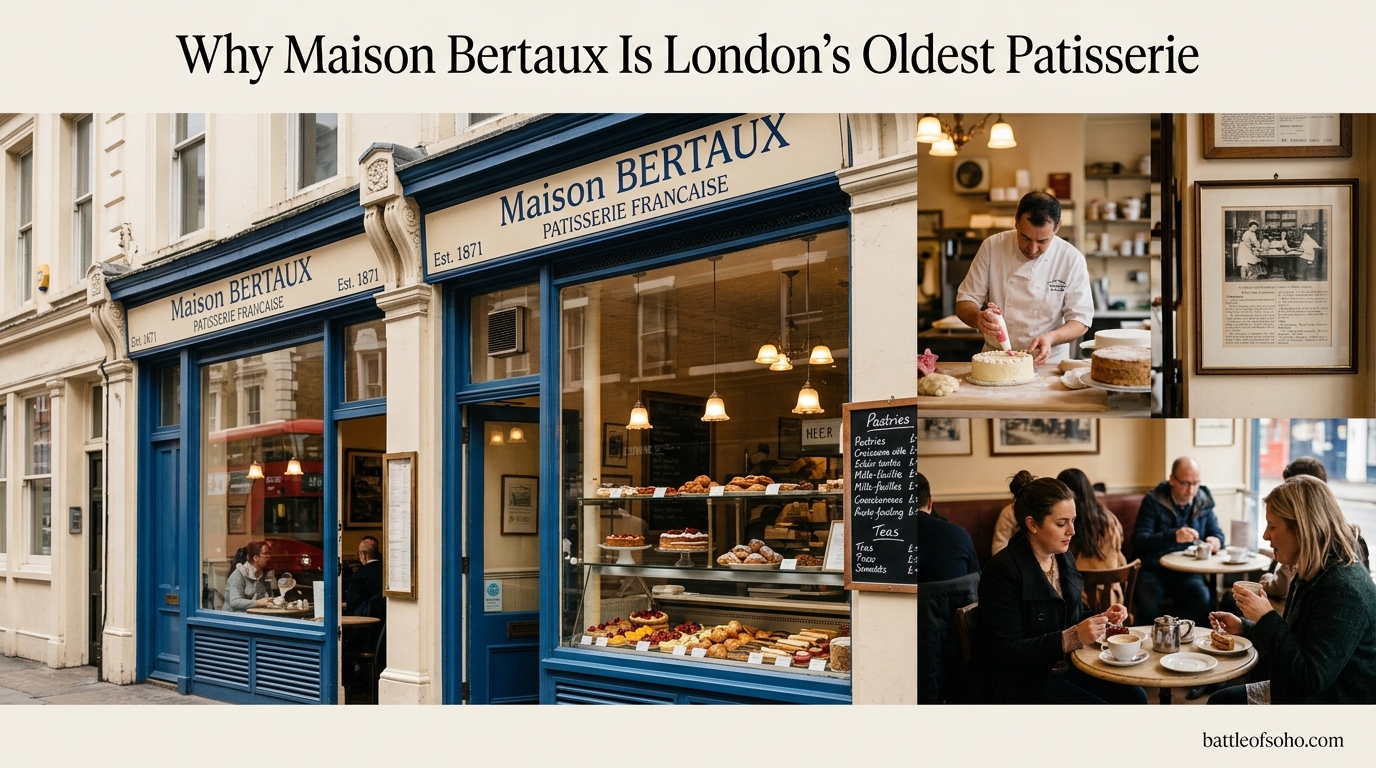
Walk down Greek Street in Soho and you will pass restaurants that opened last month, bars that rebranded last year, and cafes that will be gone by next summer. Then you reach number 28. Maison Bertaux has been standing here since 1871, making it London’s oldest French patisserie by a margin that no competitor comes close to matching.
Maison Bertaux is London’s oldest patisserie because it has been in continuous operation at 28 Greek Street since 1871, when a French communard named Monsieur Bertaux opened its doors. That is over 150 years of daily baking, cake decorating, and tea serving without interruption, surviving two world wars, countless economic downturns, and a global pandemic.
In a city where restaurants open and close with alarming speed, that kind of staying power raises an obvious question. How did a single patisserie survive when thousands of others did not? The answer is a story about a political refugee, a tiny street in Soho, and a woman who started working there at age 14 and never left.
Table of Contents
The Founding Story: A Communard’s Escape in 1871
The year 1871 was one of the most turbulent in French history. The Paris Commune, a radical socialist government, seized control of Paris for two and a half months before being brutally suppressed by the French army. Thousands of communards were killed, imprisoned, or forced to flee for their lives.
Monsieur Bertaux was one of those who fled. He crossed the English Channel and made his way to London, settling in Soho, which had been the center of French immigrant life in the city for decades. There, in the same year the Commune fell, he opened a patisserie on Greek Street.
The choice of 1871 was no coincidence. Many French political refugees arrived in London during this period, and they brought with them a hunger for the food of home. Bertaux saw an opportunity to serve the growing French community while building a new life far from the political violence that had driven him out of Paris.
He brought with him the skills of a properly trained French patissier. This was not a bakery selling bread. It was a pâtisserie, focused on the elaborate cakes, tarts, and gateaux that defined French confectionery. That distinction mattered then and it still matters now, because it is what set Maison Bertaux apart from every other establishment in London at the time.
Greek Street and the French Community Connection
To understand why Maison Bertaux has lasted so long, you need to understand where it is. Greek Street sits in the heart of Soho, and in the late nineteenth century, this neighborhood was effectively London’s French quarter.
The French Protestant Church stood nearby on Soho Square, serving the Huguenot descendants and newer French arrivals. Notre Dame de France, the French Catholic church, was just around the corner on Leicester Place. French immigrants could worship, socialize, shop, and eat within a few streets of each other.
Monsieur Bertaux chose his location with care. By opening on Greek Street, he placed himself at the exact center of the French community in London. His customers did not need to seek him out, because he was already where they lived, worked, and gathered.
That community sustained the patisserie through its early decades. Long after the original wave of communard refugees had settled and assimilated, the French connection remained. The patisserie became a meeting point for anyone in London who wanted a taste of authentic French baking.
Why Maison Bertaux Is London’s Oldest Patisserie
The claim is straightforward. No other patisserie in London has been operating continuously for as long as Maison Bertaux. It opened in 1871 and has never closed its doors.
Part of the reason the claim holds is the distinction between a bakery and a pâtisserie. London has older bakeries, some dating back centuries. But a pâtisserie is a specific thing, a shop dedicated to French-style cakes, tarts, pastries, and confectionery. By that definition, Maison Bertaux was first and has remained the longest.
The ownership history supports the continuity. The Bertaux family ran the shop from 1871 until 1901, when it was purchased by the Vignaud family. That kind of orderly transfer between families who understood the trade kept the patisserie running through the transition periods that might have killed a less carefully managed business.
The Wade family later took over, and sisters Michelle and Tania Wade run it today. Each transition preserved the core mission rather than reinventing it. The recipes, the premises, and the commitment to baking on site never changed hands without those traditions being protected.
That is why Maison Bertaux is the oldest. Not because nobody else tried, but because nobody else survived this long doing the same thing in the same place with the same standards.
Michelle Wade: From Age 14 to Owner
The current chapter of Maison Bertaux belongs to Michelle Wade, and her story is one of the most remarkable in London’s food scene. She started working at the patisserie when she was 14 years old.
She was not born into ownership. She walked through the door as a teenager, began learning the trade from the ground up, and eventually became the person responsible for keeping the entire institution alive. That kind of dedication is almost impossible to find in any industry, let alone in the brutal world of London hospitality.
Her sister Tania Wade works alongside her, making Maison Bertaux a family-run business in the truest sense. The two of them have maintained the patisserie’s traditions while steering it through challenges that would have defeated most operators.
When the COVID-19 pandemic threatened to destroy businesses across London in 2020, Maison Bertaux faced the same existential crisis as every other hospitality venue. But this patisserie had something most did not: a community that considered it irreplaceable.
A crowdfunding campaign was launched to save the patisserie, and the response demonstrated exactly what Maison Bertaux means to London. Customers, neighbors, and people who had visited once and never forgotten it contributed to keep the doors open. The campaign succeeded, and the patisserie survived.
What Makes Maison Bertaux So Special
Visit Maison Bertaux today and you will immediately notice something that almost no other establishment in Central London can claim. All the cakes and pastries are baked on the premises, daily, using traditional methods.
That sounds simple until you realize how rare it is. Most cafes and patisseries in central London receive deliveries from commercial kitchens elsewhere. The idea of a small shop on a narrow Soho street mixing, baking, and decorating everything on site is almost anachronistic. Maison Bertaux does it anyway, the way it has always been done.
The famous strawberry tart is the item people remember. Visitors on food forums consistently single it out as the standout, a perfect combination of crisp pastry shell, rich creme patissiere, and fresh strawberries glazed to a shine. One reviewer described Maison Bertaux as a “magical patisserie kingdom,” and the strawberry tart is the crown jewel.
The interior tells its own story. Three mirrors on the wall bear the words of the French Republic: Liberte, Egalite, Fraternite. A piano sits in the corner with a copy of The Art of French Baking resting on it, as if someone might sit down and play at any moment. Marble-topped tables fill the tea rooms upstairs.
Nothing here has been redesigned to look old. It simply is old. The worn paint and creaky floors that some online reviewers complain about are the same surfaces that have been there for decades. That is not a failure of maintenance. It is the texture of history, and it is part of what makes the experience real.
The Celebrity and Cultural Legacy
Maison Bertaux has never chased publicity, but it has attracted some of the most creative people in London anyway. The list of famous names associated with the patisserie reads like a who’s who of British art and culture.
Filmmaker Derek Jarman was a regular. Fashion designer Alexander McQueen visited. Singer Lily Allen, pop icon Kylie Minogue, and artist Tracey Emin have all been connected to the patisserie over the years. These are people who could go anywhere in London, and they chose a tiny cake shop on Greek Street.
The connection to the art world is not accidental. Central Saint Martins, one of the world’s most famous art and design colleges, was located nearby for decades. Art students, designers, and creative professionals made Maison Bertaux their unofficial second home, drawn by the atmosphere as much as the cakes.
Upstairs, the patisserie houses an art gallery that continues this tradition. The space has hosted exhibitions that reflect the eclectic, bohemian spirit of Soho itself. Where else can you eat a mille-feuille and look at contemporary art in the same building?
The Guardian and other major publications have featured Maison Bertaux repeatedly over the years. Each article tends to say the same thing in different words: this place is special, it is fragile, and it is worth protecting.
Bastille Day and French Traditions in Soho
Every year on July 14th, Maison Bertaux celebrates Bastille Day the way only a French patisserie in London can. The tricolor goes up, the atmosphere turns festive, and the connection to that original 1871 founding gets renewed for another year.
These celebrations are not just a marketing exercise. They are a continuation of the French cultural presence in Soho that has been part of this neighborhood since well before Monsieur Bertaux arrived. The patisserie is one of the last living links to that heritage.
The COVID crowdfunding campaign proved that the community understands this. When the patisserie needed help, people did not just donate money. They shared memories of childhood visits, first dates, celebrations, and quiet afternoons spent upstairs with a book and a slice of cake. Maison Bertaux is not just a business to them. It is part of their personal history.
What to Order When You Visit
If you are planning a visit, the strawberry tart is the obvious starting point and the item most recommended by regulars. It is the thing people travel across London for and the one most likely to sell out on busy days.
The mille-feuille is another classic worth trying. Layers of crisp puff pastry and cream, made the traditional way, represent exactly the kind of French technique that has kept this patisserie relevant for over 150 years.
Afternoon tea is available in the tea rooms upstairs, offering a slower, more deliberate experience than grabbing a pastry at the counter. The marble-topped tables and historic decor make it feel less like a cafe visit and more like stepping back in time.
For special occasions, Maison Bertaux creates celebration and wedding cakes to order. These are the same skills and recipes that have been in use since the nineteenth century, applied to whatever you need to celebrate.
FAQs
What are London’s oldest patisseries?
Maison Bertaux is London’s oldest patisserie, having opened in 1871 at 28 Greek Street, Soho. No other patisserie in London has been in continuous operation for as long.
What is Maison Bertaux famous for?
Maison Bertaux is famous for being London’s oldest French patisserie, baking all cakes and pastries on the premises daily using traditional methods. It is known for its strawberry tarts, mille-feuille, celebrity clientele including Derek Jarman and Alexander McQueen, its upstairs art gallery, and annual Bastille Day celebrations.
What is the oldest bakery in the UK?
The UK has several very old bakeries, some claiming origins in the 16th or 17th centuries. However, Maison Bertaux holds the specific distinction of being London’s oldest patisserie, meaning a shop dedicated to French-style cakes and pastries, continuously operating since 1871.
How old is the Maison Bertaux?
Maison Bertaux was founded in 1871, making it over 150 years old. It has been in continuous operation at 28 Greek Street, Soho since its founding in the same year as the Paris Commune.
What is the history of Maison Bertaux?
Maison Bertaux was founded in 1871 by Monsieur Bertaux, a French communard who fled to London after the fall of the Paris Commune. He opened the patisserie on Greek Street in the heart of Soho’s French community. The Bertaux family ran it until 1901 when the Vignaud family took over. Today it is owned by Michelle Wade, who started working there at age 14, and her sister Tania Wade.
Who owns Maison Bertaux?
Maison Bertaux is currently owned and operated by sisters Michelle Wade and Tania Wade. Michelle started working at the patisserie when she was 14 years old and worked her way up to ownership. The Wade family has maintained the patisserie’s traditional baking methods and historic character.
Why Maison Bertaux Still Matters
Maison Bertaux is London’s oldest patisserie for reasons that go beyond a date on a calendar. It survived because a political refugee chose the right street, because each generation of owners protected what mattered, and because a woman who started at 14 refused to let it disappear.
The patisserie still bakes everything on the premises. It still celebrates Bastille Day. It still displays Liberte, Egalite, Fraternite on its mirrors. And it still serves the strawberry tarts that people remember decades after their first visit.
In 2026, when so much of Soho has been demolished, rebuilt, and homogenized, Maison Bertaux is one of the last places where you can experience something genuinely old and genuinely good at the same time. That is why it matters, and that is why Maison Bertaux is London’s oldest patisserie.
Visit 28 Greek Street, order the strawberry tart, sit upstairs by the marble-topped table, and you will understand immediately.