
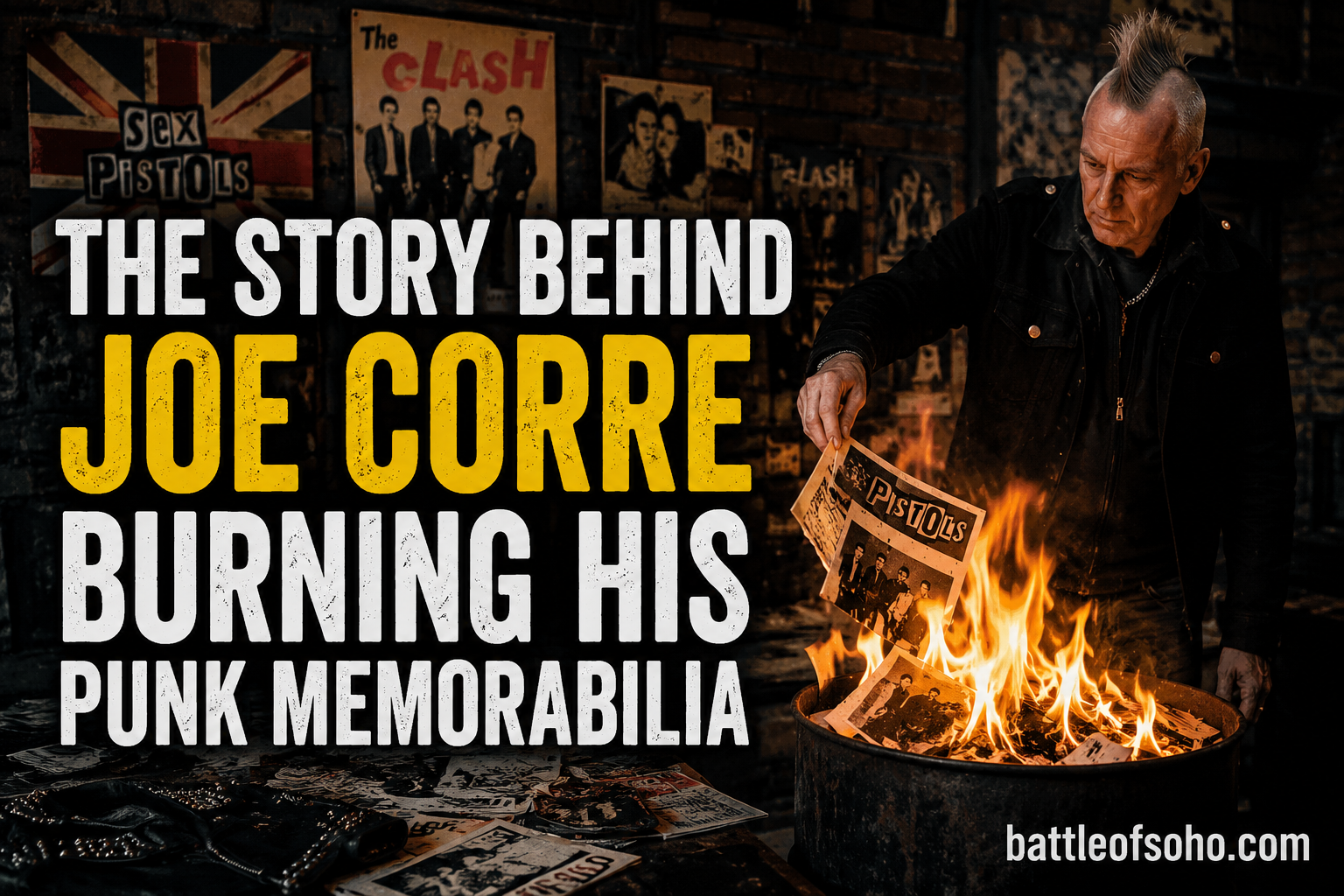
On November 26, 2016, Joe Corre loaded a barge with an estimated £5 million ($6 million) worth of rare punk memorabilia, floated it onto the River Thames near Chelsea, and set the entire collection on fire. The son of Sex Pistols manager Malcolm McLaren and fashion legend Vivienne Westwood staged the burning as a direct protest against what he saw as the corporate hijacking of punk’s fortieth anniversary. He declared that punk had been reduced to “conformity in another uniform” and accused the establishment of turning rebellion into a nostalgia product. The story behind Joe Corre burning his punk memorabilia is about a family legacy, a cultural movement, and one man’s decision to torch his inheritance rather than watch it get sold back to the public.
Table of Contents
Who Is Joe Corre?
Joe Corre was born into the very heart of British punk. His father, Malcolm McLaren, managed the Sex Pistols and co-owned the legendary SEX boutique on London’s King’s Road with Vivienne Westwood. His mother designed the clothes that defined the visual language of punk: torn shirts, bondage trousers, and provocative slogans screen-printed onto fabric. Corre grew up surrounded by the artifacts, people, and chaos that shaped a movement.
Despite that heritage, Corre built his own reputation outside of music. He co-founded Agent Provocateur, the luxury lingerie brand, in 1994 with then-wife Serena Rees. The company became wildly successful, turning Corre into a wealthy businessman in his own right. He later launched other ventures, but his connection to punk never faded. He inherited a massive collection of memorabilia from his parents’ era, including rare Sex Pistols recordings, original clothing from the SEX shop, posters, and ephemera that represented the birth of British punk.
That collection sat at the intersection of personal inheritance and cultural history. Corre was not just a custodian of punk artifacts. He was the literal offspring of punk’s founding couple. When he spoke about what punk meant, he spoke with a lineage that nobody else in the world could claim. That made his decision to destroy the collection all the more provocative.
Corre’s identity as both a punk heir and a commercial success became central to the debate surrounding the burning. Critics pointed out that a man who built a luxury brand was hardly in a position to lecture anyone about commercialization. Supporters argued that growing up inside the machine gave him unique clarity about how punk was being repackaged and sold.
The Burning Event: What Happened on the Thames
The protest took place on November 26, 2016, a date chosen with deliberate precision. Exactly forty years earlier, on November 26, 1976, the Sex Pistols released “Anarchy in the UK,” their debut single that detonated British culture and launched punk into the mainstream. Corre picked the anniversary to make a point about how far the movement had strayed from its origins.
The staging was theatrical to the point of performance art. Corre organized the event from a barge moored on the River Thames near Albert Bridge in Chelsea. He wore a Grim Reaper costume. Effigies of corporate and political figures were placed alongside the memorabilia. Fireworks were launched. A banner reading “Extinction” hung visibly from the boat. The scene looked like a funeral pyre for an entire cultural era.
The memorabilia itself was reported to include some of the most sought-after punk artifacts in existence. Among the items Corre claimed to destroy were rare Sex Pistols recordings, original clothing from the SEX and Seditionaries shops, posters, flyers, and personal items connected to his parents’ role in shaping the movement. The total estimated value was placed at £5 million, or roughly $6 million at the time.
Whether every item described actually went into the fire became a subject of intense debate, which we will address later. But on that November afternoon, the imagery was unmistakable. Flames consumed what looked like the physical archive of British punk while onlookers watched from the riverbank. Photographers and camera crews documented the event, and the story immediately went global.
Corre framed the spectacle as a “punk funeral.” He was not celebrating. He was mourning what he believed punk had become: a brand, a commodity, a museum piece stripped of its danger. The Thames setting added historical weight. This was the same river that runs through the heart of London, the city where punk was born in squats and rehearsal rooms and a tiny shop on the King’s Road.
The Story Behind Joe Corre Burning His Punk Memorabilia: The Motivation
The core motivation was opposition to Punk London, a year-long, officially sanctioned festival celebrating the fortieth anniversary of British punk. Backed by the National Lottery through Arts Council England and the Heritage Lottery Fund, Punk London featured exhibitions, gigs, film screenings, and events across the city. Major institutions including the British Library, the Museum of London, and the Roundhouse participated.
To Corre, this was not celebration. It was betrayal. He argued that punk was fundamentally anti-establishment, born out of anger at a broken system, and that no government-backed institution had any right to commemorate it. The idea of lottery money funding punk anniversary events struck him as a grotesque inversion of everything the movement stood for.
His language was blunt. Corre described punk as having been drained of meaning, turned into a “marketing tool” and reduced to “nostalgia.” His most quoted line from the protest captured his thesis: punk had become “conformity in another uniform.” He argued that the same institutions that would have shut punk down in 1976 were now eager to host exhibitions about it in 2016, and that this hypocrisy was the real story.
Corre also connected his protest to a broader political message. He and his mother used the platform to speak about climate change and what they saw as the planet’s march toward extinction. The “Extinction” banner on the barge was not just about the death of punk. It was about the death of the natural world, and the complicity of governments and corporations in that destruction. The protest fused cultural critique with environmental activism in a way that echoed punk’s original spirit of confrontation.
He rejected the idea that the memorabilia should have been donated to museums or auctioned for charity. In his view, handing the items over to institutions would have completed the process of absorption he was protesting against. Burning them was, in his framing, the only act that could not be recuperated, branded, or sold.
The Punk London Controversy
To understand why Corre felt so strongly, it helps to look at what Punk London actually was. Launched in January 2016, the festival was billed as a celebration of punk’s lasting cultural impact. It received significant public funding and partnered with some of the most establishment-aligned institutions in the country. The framing was respectful, even reverent. Punk was being treated as heritage.
That was exactly the problem for Corre and others who shared his view. Punk in 1976 was not heritage. It was a threat. The Sex Pistols were banned from television. Their lyrics provoked moral panic. Politicians denounced them. Record labels dropped them. The idea that forty years later the same culture would be celebrated with lottery funding and museum exhibits felt, to Corre, like a victory lap for the forces punk had originally fought against.
Corre publicly withdrew his support for Punk London months before the burning. He issued statements condemning the festival and calling for a boycott. When those calls went unheeded, he escalated. The Thames burning was the culmination of a year of frustration with what he saw as the commodification of his parents’ legacy and the hollowing out of punk’s meaning.
The controversy also tapped into a longer-running debate about who owns cultural movements. Punk was created by working-class kids, outsiders, and misfits. By 2016, it was being curated by arts administrators and celebrated by cultural institutions that bore no resemblance to the world that produced it. Corre’s protest forced that contradiction into the open.
Reactions: Praise, Outrage, and Skepticism
The burning drew an immediate and divided response. Glen Matlock, the original bassist for the Sex Pistols and co-writer of many of their songs, was dismissive. He called the protest “dopey” and questioned the logic of destroying artifacts rather than using them productively. Matlock’s reaction carried weight because he was there in 1976. He lived through the original moment that Corre was eulogizing.
Vivienne Westwood, Corre’s mother, supported the protest and used the occasion to deliver a speech about climate change and environmental collapse. She arrived on a double-decker bus painted with environmental slogans and spoke about the need to shift from fossil fuels to green energy. Her presence gave the protest additional legitimacy. If the mother of punk said the movement was being misused, that was not easily dismissed.
The Observer published a scathing opinion piece three days after the event. The article, titled “Joe Corre’s Bonfire Stunt Was the Least Punk Protest Ever and a Hoax,” argued that the entire spectacle was a con. It claimed Corre never actually burned £5 million worth of memorabilia, that no manifest or inventory was ever produced, and that the valuation was wildly inflated. The piece compared the event unfavorably to the KLF’s burning of one million pounds in 1994, arguing that at least the KLF destroyed real, verifiable money.
Online forums lit up with similar skepticism. Reddit users on r/punk and r/Music debated whether the protest was genuine or a publicity stunt. Many questioned why no independent observer was allowed to verify the contents before the burning. Others pointed out the irony of a multimillionaire businessman lecturing the public about commercialization. The Observer’s debunking was widely shared and cited in those discussions.
Some defenders argued that whether the full £5 million went up in flames was beside the point. The protest, they said, succeeded in starting a global conversation about what punk means and who gets to define it. The theatrical nature of the event, the imagery of the Grim Reaper and the burning barge, generated coverage that no op-ed or press release could have matched.
Was It a Hoax? The £5 Million Question
The question of what actually burned on the Thames remains the most contentious part of the story. Corre never produced a detailed inventory of the items destroyed. No independent appraiser verified the collection beforehand. No journalist was given access to inspect the memorabilia before it was loaded onto the barge and set alight.
The Observer’s reporting was the most aggressive challenge. The article argued that the £5 million figure was essentially invented for dramatic effect. It pointed out that rare punk recordings and original SEX shop clothing do have significant collector value, but that assembling £5 million worth on a single barge would require an extraordinary concentration of one-of-a-kind items. The piece called Corre “the Eric Trump of Punk Rock,” a comparison intended to frame him as an heir coasting on his family name rather than earning his own credibility.
The comparison to the KLF is instructive. In August 1994, Bill Drummond and Jimmy Cauty of the KLM took one million pounds in cash to the island of Jura and burned it. They filmed the event. They documented the money. They were unable to fully explain why they did it. The act was criticized, debated, and mythologized, but nobody disputed that the money was real. The Observer argued that Corre’s protest lacked that same verifiable core.
Corre never directly responded to the hoax allegations with a detailed rebuttal. He continued to defend the protest on its symbolic merits, arguing that the point was the message, not the accounting. For some, that was sufficient. For others, it confirmed the suspicion that the event was more performance than substance.
What is not in dispute is that the protest generated enormous attention. Whether £5 million or £500,000 worth of memorabilia was destroyed, the act itself became a defining moment in the conversation about punk’s legacy and its relationship to money, institutions, and authenticity.
Impact on Punk History and Collectors
For punk memorabilia collectors, the burning raised uncomfortable questions. The market for original punk artifacts has grown significantly since the 1990s. Original SEX shop clothing, handwritten Sex Pistols lyrics, and rare pressings from 1976-1977 command enormous prices at auction. Destroying any portion of that finite archive means those items are gone permanently.
Collectors and archivists argued that the items had value beyond their monetary worth. They were primary sources. They told the story of a movement that changed fashion, music, and social attitudes. Burning them, regardless of the political intent, removed pieces of history that could never be recovered. Some suggested Corre should have donated the collection to a publicly accessible archive rather than destroying it.
Corre’s counter-argument was that donation would have meant surrendering the artifacts to the very institutions he was protesting against. A museum exhibit funded by lottery money was, in his view, no different from a corporate sponsorship deal. Both turned punk into content. Burning was the only option that kept the items out of the system entirely.
The long-term impact on the memorabilia market is harder to measure. No broad price surge was directly attributed to the burning, but the event did draw attention to how scarce original punk artifacts have become. It also reinforced the idea that punk memorabilia is not just collectible merchandise but culturally significant material that carries the weight of a movement. The debate about preservation versus protest continues to divide collectors, historians, and fans.
Conclusion
The story behind Joe Corre burning his punk memorabilia is not a simple tale of a man destroying his inheritance. It is a confrontation with the fundamental question of what happens when rebellion becomes heritage. Corre believed that punk was being hollowed out, repackaged, and sold back to a public that had no memory of why it mattered. He chose fire as his answer.
Whether he was right depends on who you ask. Glen Matlock thought it was dopey. Vivienne Westwood saw it as a call to action on climate. The Observer called it a hoax. Collectors mourned the loss of irreplaceable artifacts. What nobody could deny was that the protest forced a conversation that the carefully curated Punk London festival never intended to have.
Punk was born as a rejection of everything safe, funded, and institutional. The fact that it needed a government-backed anniversary to be properly celebrated may be the strongest argument Corre ever made. Whether £5 million actually burned on that barge or not, the question he raised still hangs over every museum exhibit, every anniversary tour, and every commemorative box set that tries to package rebellion for resale.
FAQs
Who is Joe Corre and why is he significant to punk history?
Joe Corre is the son of Sex Pistols manager Malcolm McLaren and fashion designer Vivienne Westwood. He co-founded the luxury lingerie brand Agent Provocateur and inherited a major collection of original punk memorabilia from his parents, making him one of the most significant private custodians of British punk artifacts.
Why did Joe Corre burn his punk memorabilia?
Joe Corre burned his punk memorabilia on November 26, 2016 to protest the Punk London festival, which he saw as a corporate and government-backed hijacking of punk’s 40th anniversary. He argued that punk had been reduced to conformity in another uniform and turned into a nostalgia marketing tool.
How much was Joe Corre’s punk memorabilia worth?
Joe Corre estimated the memorabilia he burned was worth approximately 5 million pounds or about 6 million dollars. However, The Observer and other critics disputed this figure, noting that no independent inventory or appraisal was ever produced to verify the valuation.
What happened when Joe Corre burned punk memorabilia on the Thames?
On November 26, 2016, Joe Corre loaded a barge near Albert Bridge in Chelsea with punk memorabilia, wore a Grim Reaper costume, and set the collection on fire. The event featured fireworks, effigies, and a banner reading Extinction, and was documented by international media.
How did Vivienne Westwood react to her son’s protest?
Vivienne Westwood supported the protest and attended the event, arriving on a double-decker bus painted with environmental slogans. She delivered a speech about climate change and the need to transition from fossil fuels to green energy, connecting the death of punk to environmental extinction.
What did Glen Matlock say about Joe Corre’s protest?
Glen Matlock, the original Sex Pistols bassist and co-writer of many of their songs, called the protest dopey. He questioned the logic of destroying valuable artifacts rather than using them productively, and his reaction carried particular weight as someone who was part of the original 1976 punk moment.