
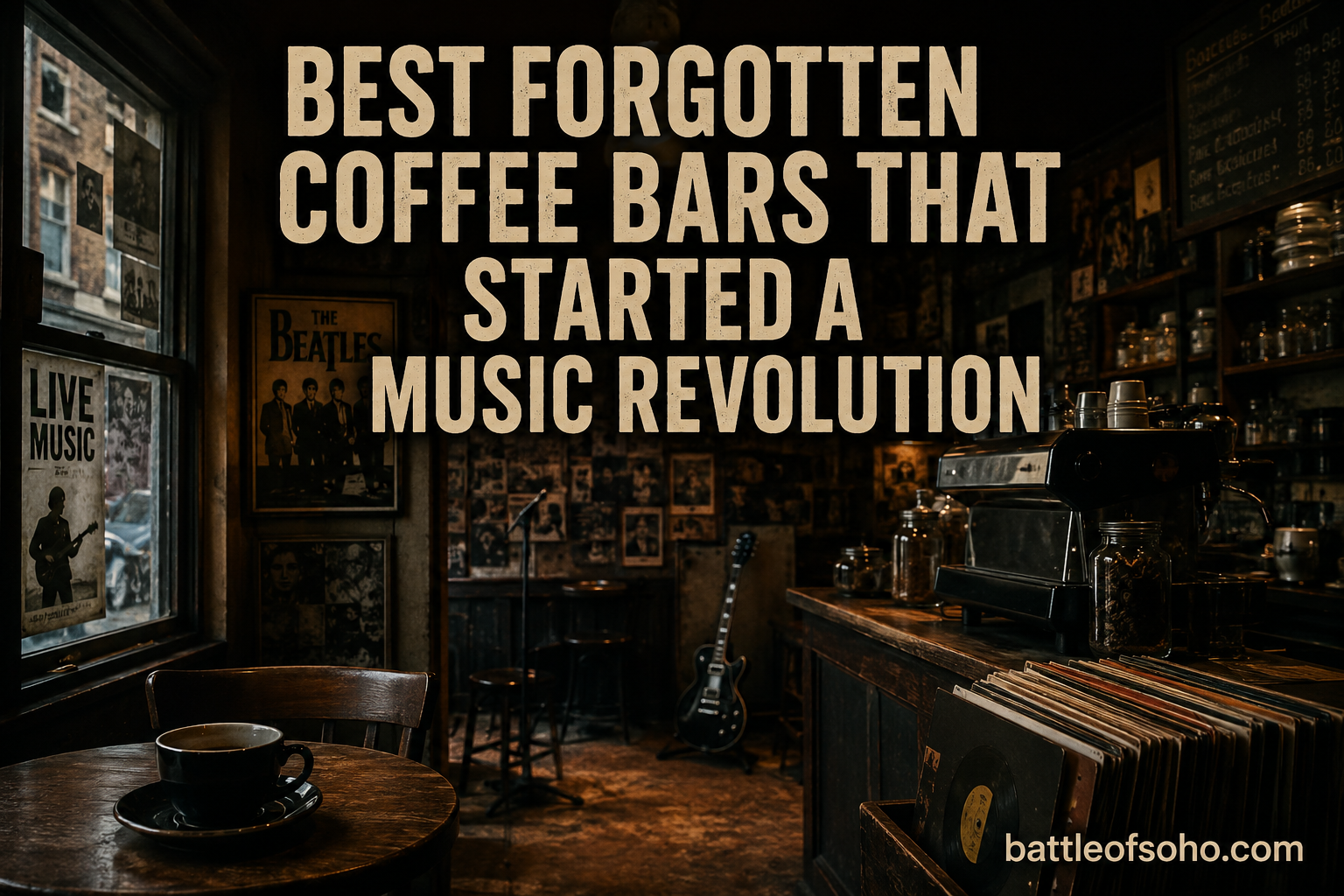
Before stadiums, before arena tours, and before streaming platforms decided what we heard, the entire trajectory of popular music was being shaped in rooms barely larger than a decent-sized kitchen. I am talking about coffee bars. The forgotten coffee bars that started a music revolution were small, dimly lit, espresso-scented rooms tucked into London backstreets, New York basements, and Liverpool cellars, and without them, rock and roll, skiffle, and the folk revival might never have reached your ears.
When I first started digging into the origins of British rock and the American folk movement, I kept hitting the same wall. Every legendary artist seemed to trace their beginnings back to the same type of venue. Not a grand concert hall. Not a polished nightclub. A coffee bar. The more I researched, the more I realized these tiny rooms had done something extraordinary. They had taken raw, untested musicians and given them a stage, an audience, and a path to the wider world.
The coffee bars that started a music revolution were places where a teenager with a guitar could walk in off the street, plug into a tiny amp on an 18-inch stage, and walk out with a record deal. Tommy Steele, Britain’s first rock and roll star, was discovered in one. Cliff Richard played his earliest gigs in one. Bob Dylan honed his craft in the American equivalent. The Beatles cut their teeth in a Liverpool coffee club before they ever played the Cavern.
In this article, I want to take you inside these forgotten venues. We will walk down Old Compton Street in Soho, step into the cellar of the Casbah Coffee Club in Liverpool, cross the Atlantic to Greenwich Village and North Beach, and uncover how a handful of espresso machines and milk-crate stages changed the sound of the twentieth century.
Table of Contents
What Made a Coffee Bar a Music Incubator
The question I kept asking myself was simple: why coffee bars? Why not pubs, dance halls, or community centers? The answer comes down to a unique collision of timing, economics, and culture that existed in the postwar years and never quite repeated itself.
In 1950s Britain, a peculiar licensing quirk made coffee bars enormously attractive. Pubs closed in the afternoon and served an aging clientele. Dance halls charged admission and expected big bands. But coffee bars, fueled by the recent arrival of Gaggia espresso machines from Italy, could stay open late, serve teenagers without a liquor license, and charge next to nothing for entry. A cup of espresso cost about the same as a bus ticket. That meant young people with limited pocket money could sit for hours, socialize, and listen to live music without breaking the bank.
The physical layout mattered enormously. Most coffee bars were tiny. The 2i’s, for example, had a stage that measured roughly 18 inches deep. Performers were literally face-to-face with their audience, close enough to see every reaction and adjust in real time. That intimacy forced musicians to develop stage presence quickly. There was nowhere to hide on a stage the size of a coffee table.
The economics worked because coffee bar owners did not need to pay performers much, if anything. Musicians played for exposure, for tips, for the chance to be spotted by one of the talent scouts or record producers who haunted these rooms. In the American folk coffeehouse scene, performers were often paid from a donation basket passed around the room. It was a pay-what-you-wish model that kept venues alive while giving unknown artists a platform.
Talent scouts were the hidden engine of the whole system. Record labels in the late 1950s had no A&R infrastructure for rock and roll or skiffle because those genres barely existed yet. So producers like Norrie Paramor and Jack Good literally walked into coffee bars, watched teenagers perform, and signed them on the spot. The BBC sent television crews to film live broadcasts from these rooms, turning local sensations into national stars overnight.
There was also a cultural factor that is harder to quantify but impossible to ignore. Coffee bars felt modern. They had Italian names, chrome espresso machines, and a continental atmosphere that felt rebellious and sophisticated to a generation still emerging from wartime rationing. Walking into a coffee bar was a statement. You were choosing the future over the past.
The 2i’s Coffee Bar: Birthplace of British Rock and Roll
If there is one venue that deserves the title of ground zero for British rock and roll, it is the 2i’s Coffee Bar at 59 Old Compton Street in Soho. From its opening in 1956 to its closure in 1970, this unassuming room launched more careers than some entire record labels. I have spent more time than I care to admit researching this place, and the roster of artists who passed through its doors still astonishes me.
The 2i’s was founded by Paul Lincoln, an Australian wrestler who performed under the stage name Dr Death. Yes, you read that correctly. A professional wrestler opened the most important music venue in British history. Lincoln and his business partners Freddie Glyn and Ray Hunter created a space that was part coffee bar, part talent factory. Lincoln had a sharp eye for performers, and he operated as an informal talent scout, pushing his best acts toward record labels and television producers.
The physical description of the 2i’s reads almost like a joke about how unglamorous the music industry can be in its earliest stages. The stage was approximately 18 inches deep, barely enough room for a singer and a guitar. It was reportedly built from milk crates and plywood. The venue served coffee, orange juice from a dispenser, and sandwiches displayed on the counter. Capacity was somewhere around 60 to 80 people standing. And from this cramped, improbable room came the sound that would define a nation.
The story of Tommy Steele’s discovery at the 2i’s has become the stuff of legend. In 1956, Steele (then known as Thomas Hicks) was performing skiffle in the coffee bar when he was spotted by music manager Larry Parnes and photographer John Kennedy. Within months, Steele had a recording contract and became Britain’s first homegrown rock and roll star. His hit single “Rock With the Caveman” cracked the UK charts, proving that British artists could do what Elvis and Buddy Holly were doing. Steele later paid tribute to the coffee bar in his music, cementing the 2i’s in the public imagination.
But Tommy Steele was only the beginning. The roster of musicians who performed or were discovered at the 2i’s reads like a Who’s Who of early British popular music. Cliff Richard played some of his first professional gigs there. Adam Faith, another teen idol of the era, was a regular performer. The Vipers Skiffle Group, one of the most popular skiffle acts in the country, served as a resident band. Wee Willie Harris, known for his wild stage antics, became a fan favorite in the tiny room.
Beyond the performers, the 2i’s attracted an extraordinary behind-the-scenes cast. Lionel Bart, who would go on to write the musical Oliver!, was a regular. Mickie Most, who became one of the most successful record producers of the 1960s and 1970s, spent time at the venue. Perhaps most remarkably, Peter Grant, who would later manage Led Zeppelin to global domination, worked as a bouncer at the 2i’s. The connections made in that tiny room shaped the music industry for decades.
The BBC played a decisive role in amplifying the 2i’s beyond Soho. The television program Six-Five Special, which debuted in 1957, was the BBC’s first major foray into youth music programming. The show filmed segments at the 2i’s, broadcasting its atmosphere and performers into living rooms across Britain. For young viewers in Manchester, Glasgow, or Cardiff, the 2i’s became a mythical place, a destination they dreamed of visiting. That national exposure turned the coffee bar from a local haunt into a cultural institution.
The venue also operated with a system of resident groups that provided continuity and drew regular crowds. These bands would play multiple sets per night, six or seven days a week, developing their craft through sheer repetition. It was a finishing school for performers. By the time an act was ready to move on from the 2i’s, they had logged hundreds of hours of live performance experience in front of unpredictable, demanding audiences.
The 2i’s closed its doors in 1970, a victim of changing musical tastes and the rise of larger, purpose-built venues. But its legacy was permanently enshrined in 2006 when English Heritage installed a green plaque on the building at 59 Old Compton Street. The plaque reads: “The 2i’s Coffee Bar, the birthplace of British rock and roll.” For anyone interested in the forgotten coffee bars that started a music revolution, this is ground zero.
The Cat’s Whisker and Soho’s Other Pioneering Coffee Bars
The 2i’s may have been the most famous, but it was never the only coffee bar making noise in 1950s Soho. Old Compton Street and the surrounding lanes were packed with similar venues, each with its own character, clientele, and musical offerings. To understand the coffee bar phenomenon, you have to look at the entire ecosystem, not just its brightest star.
The Cat’s Whisker, located just a short walk from the 2i’s, was one of its most significant rivals. Also operating in the mid-to-late 1950s, the Cat’s Whisker featured live music in a similarly intimate format. The two venues competed for talent, audiences, and reputation, creating a creative ferment that benefited everyone. Musicians would sometimes play both venues in a single night, walking between them with their guitars slung over their shoulders.
Soho in the 1950s was the perfect incubator for this kind of cultural explosion. The neighborhood had a long history as London’s bohemian quarter, known for its Italian immigrants, French restaurants, nightlife, and anything-goes atmosphere. Rents were affordable. Coffee bar owners could lease small ground-floor spaces and set up shop without massive capital investment. The density of venues meant that a music fan could spend an entire evening walking from one coffee bar to another, sampling different acts.
Beyond the 2i’s and the Cat’s Whisker, Soho had dozens of smaller, less documented coffee bars that contributed to the scene. Some hosted jazz sessions. Others featured folk singers or poetry readings. The boundaries between musical genres were fluid in these spaces. A skiffle group might share a bill with a jazz quartet and a solo folk singer, exposing audiences to styles they would never encounter in more conventional venues.
The coffee bar scene also benefited from Soho’s existing infrastructure of record shops, music publishers, and recording studios. Denmark Street, known as Britain’s Tin Pan Alley, was within walking distance. A musician discovered at the 2i’s could literally walk ten minutes to Denmark Street, find a publisher, and cut a demo the same afternoon. This geographic concentration of music industry infrastructure made Soho uniquely suited to turning raw talent into commercial success.
What strikes me most about the Soho coffee bar scene is how ephemeral it was. Many of these venues operated for only a few years. Records were poorly kept. Photographs are scarce. The people who frequented them were teenagers who are now in their eighties or have passed away. Much of what happened in these rooms lives only in oral histories and scattered memoirs. That fragility is exactly why documenting the forgotten coffee bars that started a music revolution feels so urgent.
The American Coffeehouse Folk Revival
While Soho was brewing its skiffle and rock and roll revolution, a parallel movement was unfolding across the Atlantic. The American coffeehouse folk revival of the 1950s and 1960s produced its own constellation of legendary venues, its own roster of discovered artists, and its own cultural mythology. The story of coffee bars that started a music revolution is incomplete without this American chapter.
The American folk revival was deeply intertwined with coffeehouse culture. As the Library of Congress has documented in its research on the topic, coffeehouses became the primary performance venues for folk musicians starting in the early 1950s. Unlike the British coffee bars, which were commercially driven businesses aiming to sell espresso and discover pop stars, the American folk coffeehouse had a more explicitly countercultural and community-oriented character.
Italian immigration played a surprising role in this story. The arrival of Italian immigrants in American cities in the late nineteenth and early twentieth centuries brought espresso culture to neighborhoods like Boston’s North End, New York’s Greenwich Village, and San Francisco’s North Beach. The coffeehouses they established became gathering places, and by the 1950s, those spaces were being repurposed for live folk music.
Greenwich Village in New York became the epicenter of the folk coffeehouse movement. Venues like Gerde’s Folk City, the Gaslight Cafe, and Cafe Wha? hosted performances by artists who would become legendary. A young Bob Dylan played the coffeehouse circuit in the early 1960s, developing the songs and stage presence that would make him one of the most influential musicians of the century. Other artists who passed through Village coffeehouses included Joan Baez, Pete Seeger, Phil Ochs, and Joni Mitchell.
The economic model of American folk coffeehouses differed significantly from the British coffee bar system. Many operated on a nonprofit or volunteer-run basis. Performers were paid from donation baskets passed through the audience, a pay-what-you-wish approach that kept music accessible. Some coffeehouses sold memberships or operated as cooperatives. This model meant that commercial pressures did not dictate artistic choices, allowing folk musicians to perform politically charged or traditional material that mainstream venues would not touch.
Caffe Lena in Saratoga Springs, New York, holds the distinction of being the longest continuously running coffeehouse in the United States. Founded by Lena Spencer in 1960, it hosted Bob Dylan, Arlo Guthrie, and Don McLean, among many others. The venue operated as a nonprofit, reflecting the communal ethos of the folk coffeehouse movement. Its survival to the present day is a remarkable exception in a landscape where most folk coffeehouses have long since closed.
Club 47 in Cambridge, Massachusetts, was another foundational venue. Starting as a jazz coffeehouse in 1958, it pivoted to folk music and became the hub of the Boston-area folk scene. Joan Baez performed there before her national breakthrough. The club fostered a community of folk musicians, fans, and political activists who saw coffeehouse culture as inseparable from the civil rights and antiwar movements of the era.
The folk coffeehouse also served a social function that went beyond music. These were among the few venues in the 1950s and early 1960s that were genuinely integrated, welcoming audiences and performers across racial lines. They functioned as what folklorists call nexus venues, places where different communities, artistic traditions, and political movements intersected. That social dimension is part of what made the folk coffeehouse such a powerful force in American culture.
Beatnik Culture and the Poetry-Jazz Connection
No discussion of coffee bars that started a music revolution would be complete without the Beatnik phenomenon. The Beat Generation, with its rejection of postwar conformity and its embrace of spontaneity, Eastern spirituality, and artistic experimentation, found its natural home in coffeehouses from Greenwich Village to North Beach. The connection between beat poetry and music was deeper and more significant than most people realize.
The term Beatnik emerged in the late 1950s, coined by San Francisco Chronicle columnist Herb Caen as a play on the Beat Generation label that Jack Kerouac had popularized. The movement had roots in the friendship and artistic collaboration of Kerouac, Allen Ginsberg, and William S. Burroughs, who met in New York in the 1940s. By the 1950s, the Beat aesthetic had spread to coffeehouses on both coasts, where it blended with jazz, folk, and poetry in ways that would influence music for decades.
Coffeehouses became the primary performance spaces for beat poetry. Poets would read their work accompanied by jazz musicians playing in the background, creating a hybrid art form that blurred the line between spoken word and song. Bongo drums became a visual and auditory symbol of the scene. The combination of poetry, jazz, and coffee created an atmosphere that felt intellectually serious and culturally rebellious simultaneously.
In San Francisco’s North Beach neighborhood, coffeehouses like the Co-Existence Bagel Shop and the Coffee Gallery became gathering places for the Beat community. Lawrence Ferlinghetti’s City Lights Bookstore, while not a coffeehouse itself, was nearby and served as the publishing engine for Beat literature. The neighborhood functioned much like Soho in London, with a density of venues, cheap rents, and a bohemian atmosphere that attracted artists and free spirits.
The Beat coffeehouse scene also featured jazz performances that stood on their own merits. Many of the coffeehouses that hosted beat poets also booked jazz acts, creating a cross-pollination between the literary and musical countercultures. Musicians who played in these rooms absorbed the improvisational ethos of the Beat aesthetic, which valued spontaneity over polish. That improvisational spirit would later influence the folk rock and psychedelic music of the 1960s.
The gender dynamics of the Beat coffeehouse scene deserve attention. While the most famous Beat figures were men, women participated actively as poets, musicians, and cultural organizers. However, the documentation of their contributions has been sparse, a gap that historians and archivists are only beginning to address. Recognizing the role of women in these coffeehouse scenes is part of telling the complete story of how these venues shaped music and culture.
The Casbah Coffee Club and the Liverpool Sound
The story of coffee bars that started a music revolution extends beyond London and New York. In Liverpool, a coffee club in a suburban cellar played a role in launching the most successful band in history. The Casbah Coffee Club, opened by Mona Best in 1959, was where the Quarrymen, who would become the Beatles, played some of their most important early gigs.
Mona Best started the Casbah in the basement of her home at 8 Haymans Green in the West Derby area of Liverpool. She originally intended it as a social club for her sons and their friends, an alternative to the pubs and dance halls that dominated Liverpool’s nightlife. The cellar room could hold roughly 200 people, a step up in size from the 2i’s but still intimate enough to maintain the direct connection between performer and audience that defined the coffee bar format.
The Quarrymen, featuring John Lennon, Paul McCartney, and George Harrison, were hired as the opening act for the Casbah in August 1959. They played a residency that lasted for months, performing multiple sets per evening. The band developed their sound, their stage presence, and their group dynamic in that cellar. Ringo Starr, who would not officially join the Beatles until 1962, occasionally sat in on drums with other bands at the Casbah, making the venue a meeting point for all four future Beatles.
Pete Best, Mona’s son, became the Beatles’ drummer during their Casbah period and played with the band during their Hamburg residencies and early recording sessions. The family connection between the Casbah and the Beatles was direct and personal. Mona Best continued to operate the club into the 1960s, hosting numerous Liverpool beat groups who were part of the Merseybeat scene that the Beatles helped launch.
The Casbah mirrored the broader pattern of coffee bar music culture but with a distinctly Liverpool flavor. Liverpool’s status as a port city meant that American rhythm and blues records arrived there before they reached other parts of Britain. Sailors brought imported vinyl, and local musicians absorbed those sounds. The coffee clubs of Liverpool, including the Casbah and later the Cavern Club (which started as a jazz-oriented venue modeled on a Parisian cellar club), were the laboratories where this imported sound was fused with British skiffle traditions to create Merseybeat.
What makes the Casbah story particularly compelling is that the physical venue survived. Unlike the 2i’s, which exists only as a green plaque on a building that has been repurposed, the Casbah Coffee Club cellar was preserved and eventually reopened as a heritage site. Visitors can stand in the room where the Beatles played their earliest gigs, see the original decor painted by the band members themselves, and experience the atmosphere that incubated the Liverpool sound. It is one of the few surviving physical spaces from the coffee bar music revolution.
UK vs US Coffeehouse Music Scenes
Comparing the British and American coffeehouse music scenes reveals fascinating parallels and differences. Both countries used coffee as the vehicle for a musical transformation, but the specific dynamics of each scene produced distinct outcomes. Understanding these differences is key to appreciating the full scope of the coffee bar music revolution.
The British coffee bar scene was overwhelmingly commercial in orientation. Owners like Paul Lincoln at the 2i’s were running businesses, and their goal was to attract paying customers through entertainment. Talent scouts, record producers, and television cameras were welcome because they generated buzz and drove foot traffic. The music that emerged from this system, skiffle and early British rock and roll, was designed for mass appeal. The British coffee bar was a launchpad for pop stars.
The American folk coffeehouse, by contrast, operated with a more communal and political ethos. Many venues were nonprofit, volunteer-run, or cooperatively owned. The donation basket model prioritized accessibility over profit. The music that thrived in this environment, traditional folk, protest songs, and acoustic ballads, reflected the values of the community. The American folk coffeehouse was a gathering place for activists, intellectuals, and countercultural thinkers as much as it was a performance venue.
The genres that emerged from each scene reflected these structural differences. British coffee bars produced rock and roll, pop, and eventually the beat music that evolved into the British Invasion. American folk coffeehouses produced folk music that evolved into folk rock, protest music, and the singer-songwriter tradition. Both scenes valued intimacy and directness, but they channeled those values into different musical outcomes.
There were also interesting crossover points. The skiffle movement in Britain was directly inspired by American folk and blues records, particularly the catalog of Lead Belly and Woody Guthrie that Lonnie Donegan popularized through his hit “Rock Island Line.” When British teenagers formed skiffle groups in coffee bars, they were essentially playing American folk music with a British accent. That transatlantic exchange, facilitated by imported records and the shared format of the coffee bar venue, was one of the most productive cultural conversations of the twentieth century.
The physical spaces also differed in telling ways. British coffee bars were typically street-level storefronts with espresso machines prominently displayed. American folk coffeehouses were often in basements, converted storefronts, or back rooms. Both emphasized intimacy, but the British model was more visible and public, while the American model was more hidden and subcultural. These spatial differences contributed to the distinct cultural identities of each scene.
Legacy: How These Venues Changed Music Forever
The impact of the forgotten coffee bars that started a music revolution extends far beyond the 1950s and 1960s. The model they pioneered, intimate venues where unknown artists could develop their craft, connect with audiences, and be discovered by industry professionals, became the template for live music culture that persists to this day. Every open mic night, every basement show, every small venue that gives a new artist their first chance is a descendant of the 2i’s and the coffeehouses of Greenwich Village.
The talent discovery mechanism that operated in coffee bars was effectively the first A&R system for rock, pop, and folk music. Record labels had no infrastructure for finding artists in these new genres because the genres themselves were brand new. Coffee bars filled that gap, concentrating talent in physical spaces where scouts could evaluate multiple acts in a single evening. The efficiency of this model was extraordinary. Within months of opening, the 2i’s had produced a national star. That speed of discovery was unprecedented.
The BBC’s decision to broadcast from coffee bars like the 2i’s also established a pattern for how media could amplify grassroots music scenes. Six-Five Special and later programs like Ready Steady Go! and Top of the Pops built on the foundation of coffee bar broadcasts, creating a pipeline from tiny venue to national television. That pipeline shaped the entire British music industry, creating a system where live performance was the first step toward commercial success.
The green plaque at 59 Old Compton Street, installed in 2006, is one of several commemorative markers that recognize the historical importance of these venues. Heritage organizations in both Britain and the United States have increasingly sought to preserve and mark the physical locations of coffee bar music history. The Casbah Coffee Club’s survival as a heritage site demonstrates that there is public appetite for connecting with these spaces directly.
The coffee bar model also influenced later music movements. The punk scene of the 1970s, with its emphasis on small venues and do-it-yourself ethos, drew directly on the coffee bar tradition. The indie and alternative scenes of the 1980s and 1990s similarly relied on small, intimate venues as incubators for new sounds. Even the open mic nights and acoustic showcases that populate coffee shops today are distant descendants of the format pioneered in the 1950s.
However, the spirit of the original coffee bars has proven difficult to replicate. Modern coffee shops, with their curated playlists and laptop-focused clientele, rarely host live performances. The economic pressures that made the original coffee bar model possible, cheap rents, minimal regulation, and a captive teenage audience with limited entertainment options, no longer exist in the same form.
What endures is the lesson these venues taught us. Great music does not require a grand stage or an enormous budget. It requires a room, an audience willing to listen, and a culture that values raw talent over polished production. The coffee bars that started a music revolution proved that the most important moments in music history can happen in the most unassuming spaces.
FAQs
What was the 2i’s Coffee Bar and why was it important?
The 2i’s Coffee Bar was a venue at 59 Old Compton Street in Soho, London, that operated from 1956 to 1970. It is widely regarded as the birthplace of British rock and roll because it launched the careers of Tommy Steele, Cliff Richard, Adam Faith, and numerous skiffle acts. Founded by wrestler Paul Lincoln (known as Dr Death), the venue featured an 18-inch stage and hosted BBC television broadcasts that introduced these artists to a national audience.
Which musicians were discovered in coffee bars?
Musicians discovered or developed in coffee bars include Tommy Steele, Cliff Richard, Adam Faith, and members of the Vipers Skiffle Group at the 2i’s Coffee Bar in London. In the American folk coffeehouse scene, Bob Dylan, Joan Baez, Phil Ochs, and Don McLean performed at venues like Gerde’s Folk City, the Gaslight Cafe, and Caffe Lena. The Beatles played early residencies at the Casbah Coffee Club in Liverpool.
How did coffeehouses influence folk music in America?
Coffeehouses served as the primary performance venues for the American folk revival of the 1950s and 1960s. They provided alcohol-free, acoustic-friendly spaces where folk musicians could perform for politically engaged audiences. The donation-basket payment model kept music accessible, while the community-oriented atmosphere made coffeehouses hubs for the civil rights and antiwar movements that were deeply connected to folk music.
What was the Casbah Coffee Club’s connection to the Beatles?
The Casbah Coffee Club was opened by Mona Best in a Liverpool cellar in 1959. The Quarrymen, who later became the Beatles, played a residency there starting in August 1959. The band developed their sound and stage presence in the venue. Mona Best’s son Pete became the Beatles’ drummer, and Ringo Starr performed at the Casbah with other bands before officially joining the Beatles in 1962. The cellar venue is now a preserved heritage site.
Are there still coffee bars that host live music today?
Yes, but they are far less common than in the 1950s and 1960s. A few historic venues like Caffe Lena in Saratoga Springs, New York, continue to host live folk music. Some modern coffee shops and cafes occasionally feature acoustic performances or open mic nights. However, the coffee bar music culture of the postwar era, where coffee bars were primary music discovery venues, has largely disappeared due to changing economics, noise regulations, and the rise of purpose-built live music venues.
What was skiffle music and how did it start in coffee bars?
Skiffle was a fusion of American folk, blues, and jazz played on improvised instruments like washboards, tea chest basses, and cheap guitars. It became wildly popular in Britain in the mid-1950s after Lonnie Donegan’s hit ‘Rock Island Line.’ Skiffle was easy for teenagers to play, which made it perfect for coffee bar performances. The 2i’s Coffee Bar was a center of the skiffle scene, with groups like the Vipers Skiffle Group serving as resident bands.
What happened to the original 2i’s Coffee Bar building?
The 2i’s Coffee Bar closed in 1970 after 14 years of operation. The building at 59 Old Compton Street in Soho was subsequently repurposed for other commercial uses. In 2006, English Heritage installed a green plaque on the building commemorating it as the birthplace of British rock and roll. The physical venue no longer exists as a coffee bar, but the location remains a recognized landmark in music history.
Why were coffee bars important to 1950s music culture?
Coffee bars were important because they filled a gap in the entertainment landscape. They were affordable, stayed open late, did not require a liquor license, and welcomed teenagers. They provided small stages where untested performers could develop their craft, and they attracted talent scouts and BBC producers who could launch careers overnight. Without coffee bars, the skiffle craze, British rock and roll, and the American folk revival would have had no physical infrastructure to grow in.
Conclusion
The forgotten coffee bars that started a music revolution were never meant to change the world. They were small businesses serving espresso to teenagers in rooms that were too small, too cramped, and too makeshift for anyone to take seriously. And yet, from the 18-inch stage of the 2i’s Coffee Bar to the cellar of the Casbah Coffee Club, these venues produced the artists, the genres, and the cultural movements that defined the second half of the twentieth century.
What I find most powerful about this story is its improbability. British rock and roll was born in a room run by a wrestler named Dr Death. The Beatles learned to be the Beatles in a Liverpool basement. Bob Dylan became Bob Dylan in Greenwich Village coffeehouses that passed a basket for tips. The music industry as we know it was built on foundations laid by people who were mostly trying to sell coffee and have a good time.
The coffee bars that started a music revolution remind us that great art rarely begins in grand circumstances. It begins in small rooms, with unknown performers, in front of audiences who are there simply because they love the experience. If you want to understand where music comes from, do not look at the stadiums. Look at the coffee bars. That is where everything started.