
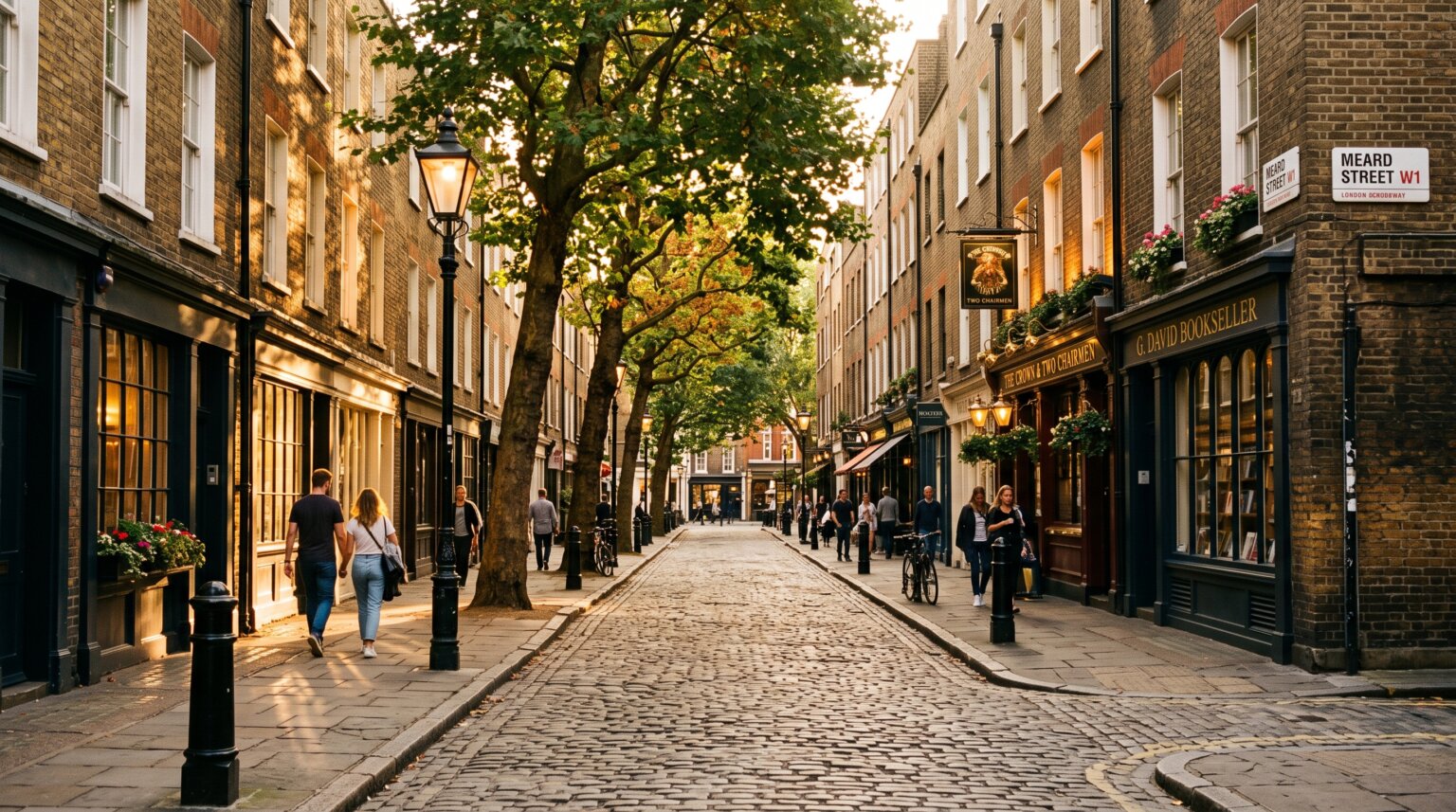
If you want to understand London, you need to walk Soho. This compact neighborhood packs more history per square foot than almost anywhere else in the city, and the right Soho London walking route takes you through centuries of rebellion, art, plague, and reinvention in a single afternoon.
I have walked these streets dozens of times, and every pass reveals something new. A blue plaque you somehow missed before. A pub where a rock legend played their first gig. A forgotten pump that changed medicine forever. This guide gives you the exact route I follow, with 15 numbered stops, historical context for each, and practical tips that most walking tour guides leave out.
Whether you are a first-time visitor or a lifelong Londoner, this self-guided tour covers the landmarks that shaped Soho from a rural hunting ground into the cultural heart of the West End. Grab comfortable shoes, charge your phone for photos, and let us walk.
Table of Contents
A Brief History of Soho: Why This Neighborhood Matters
Soho was not always a dense grid of streets packed with restaurants, clubs, and theaters. For most of its early existence, it was open farmland and royal hunting territory. The name itself likely comes from a hunting cry used when chasing game across the fields. When Henry VIII dissolved the monasteries in the 1530s, the land that would become Soho passed into private hands and development slowly began.
The real transformation came in the late 1600s. After the Revocation of the Edict of Nantes in 1685, thousands of Huguenot refugees fled France and settled in Soho. These French Protestants brought silk-weaving skills, established businesses, and gave the area a distinctly continental character. You can still see their influence in the street layout and surviving Georgian architecture from that period.
During the Georgian era of the 1700s, Soho became known for its coffee houses. These were not just places to drink. They were centers of political debate, literary discussion, and business deals. Think of them as the social media of the 18th century, where ideas spread face to face over strong coffee and newspapers.
The 19th century brought darkness and discovery in equal measure. A devastating cholera outbreak swept through Soho in 1854, killing hundreds in a matter of days. But it was here that Dr John Snow made his groundbreaking discovery about how the disease spread, changing public health forever. I will show you the exact spot where he traced the outbreak to a single water pump.
By the 20th century, Soho had become the bohemian soul of London. Writers, artists, musicians, and intellectuals flocked to its cheap rooms and late-night pubs. The skiffle and rock and roll scenes of the 1950s and 1960s were born on these streets. The Colony Room Club, the 2i’s Coffee Bar, and countless other venues hosted names that would become legends.
Today, Soho sits at the intersection of food, fashion, nightlife, and history. Walk its streets with open eyes and you will spot traces of every era layered on top of each other. That is what makes this route so rewarding for anyone who loves the past.
Walk Overview: What to Expect on This Soho London Walking Route
This self-guided walking route covers approximately 2.7 miles and takes between 2.5 and 3.5 hours depending on how long you linger at each stop. The terrain is mostly flat with well-maintained pavements throughout. It is suitable for all fitness levels and accessible for wheelchair users on nearly every section.
You will start at St Giles Church near Tottenham Court Road station and finish at Shaftesbury Avenue, close to Piccadilly Circus station. This linear route means you never retrace your steps and you end up in the heart of the West End with plenty of options for dinner or a drink afterward.
Nearest tube stations: Start at Tottenham Court Road (Northern and Central lines). End at Piccadilly Circus (Bakerloo and Piccadilly lines). Leicester Square and Oxford Circus stations are also useful if you need to join or leave the route midway.
Best time to walk: Weekday mornings between 9am and 11am offer the quietest streets and the best light for photography. Weekends are busier but more atmospheric, especially around Berwick Street Market and Carnaby Street. Avoid late Friday and Saturday nights if you prefer a calmer experience, as the area gets very crowded with nightlife crowds.
What to bring: Comfortable walking shoes, a refillable water bottle, and a camera. Most stops have nearby cafes and pubs if you need a break. Public restrooms are available at Tottenham Court Road station, in Soho Square Gardens (during daylight hours), and at various pubs along the route.
The Soho London Walking Route: 15 Historic Stops
Follow these 15 stops in order for a logical, geographically sensible walk through Soho’s history. Each stop includes the historical context you need, plus practical details about what to look for when you arrive.
Stop 1: St Giles Church and St Giles High Street
Your walk begins at St Giles Church, one of the last surviving medieval churches in the area. The original church dated back to the 12th century and served a small village surrounded by fields. The current building, designed by Henry Flitcroft, was completed in 1733 in a classical style that still dominates the courtyard today.
St Giles has a darker history too. The surrounding parish was once one of London’s most notorious slums, known as the Rookery. By the 18th century, it was a maze of overcrowded tenements, home to criminals, the destitute, and immigrants struggling to survive. Charles Dickens drew inspiration from this area for several of his novels.
Look for the stone pillars at the churchyard entrance and the memorial inside dedicated to those buried in the plague pits nearby. During the Great Plague of 1665, St Giles was one of the first areas hit, and the churchyard overflowed with the dead.
What to see: The church exterior, the historic courtyard, and the plaque marking the old Rookery. Walk south along St Giles High Street toward Denmark Street, known today as London’s Tin Pan Alley for its musical instrument shops and recording studios.
Stop 2: Denmark Street (Tin Pan Alley)
Denmark Street is one of the most musically significant streets in London. Since the 1950s, it has been the center of the British music industry. Music publishers, recording studios, and instrument shops lined both sides of this short street. The Rolling Stones recorded their first album in a studio here. David Bowie, Jimi Hendrix, and Elton John all spent time in these buildings.
The street’s Grade II listed buildings date back to the late 17th century and were originally built as residential townhouses. They became music-related businesses in the early 1900s when sheet music publishing was the dominant force in the industry. The nickname Tin Pan Alley came from the constant sound of pianos playing different songs simultaneously, which reminded people of tin pans clattering.
Look for number 23, the former Regent Sound Studios where the Rolling Stones recorded in 1963. The Sex Pistols also lived above number 6 for a period in the 1970s. Today the street still has music shops and cafes, though many of the historic venues have been converted.
What to see: The surviving music shops, blue plaques and historical markers, and the distinctive narrow Georgian architecture. This is a great spot for photographs.
Stop 3: Soho Square
Walk west from Denmark Street along Shorts Gardens and turn into Soho Square, one of the most historic green spaces in central London. Laid out in the 1670s during the reign of Charles II, Soho Square was originally called King Square and was designed as an upscale residential garden surrounded by fashionable townhouses.
The square has seen its share of famous residents. Mary Seacole, the Jamaican-born nurse who cared for wounded soldiers during the Crimean War, lived near here. Her autobiography, Wonderful Adventures of Mrs Seacole in Many Lands, remains a powerful account of her determination and skill in the face of racial prejudice.
In the center of the square, you will find a small half-timbered gardener’s hut that sits above an entrance to an underground reservoir. Some people mistakenly believe it is a Tudor structure, but it was actually built in the 1920s. During the summer, the gardens are filled with office workers on lunch breaks, a far cry from the aristocrats who once strolled these paths.
The square also has connections to the early film industry. The House of St Barnabas, on the south side, was used as a location for several early British films. Several of the buildings surrounding the square carry blue plaques marking notable former residents.
What to see: The central garden, the gardener’s hut, the statue of Charles II (a modern copy of the original), and the blue plaques on surrounding buildings. Take a moment to sit on a bench and soak in the atmosphere.
Stop 4: 28 Dean Street (Karl Marx’s Residence)
Head south out of Soho Square onto Dean Street. At number 28, now marked with a blue plaque, Karl Marx lived with his family in two cramped rooms above a shop in 1851. The conditions were dire. Three of his children died in infancy while the family lived here, partly due to the poverty and poor sanitation of the area.
Despite the hardship, this period was one of Marx’s most intellectually productive. He spent his days in the reading room of the British Museum, researching and writing what would become Das Kapital. The British Library estimates he spent over 25 years researching in that institution. His time in Soho gave him firsthand experience of the urban poverty that would shape his political philosophy.
Dean Street itself is one of Soho’s oldest streets, laid out in the 1680s. It has housed everything from Huguenot silk workers to Italian political refugees to the current mix of restaurants and bars. The building where Marx lived is now a restaurant, but the plaque remains a reminder of the radical ideas that were forged in these cramped rooms.
What to see: The blue plaque at 28 Dean Street, the historic street architecture, and the mix of old and new buildings that tell the story of Soho’s constant reinvention.
Stop 5: Old Compton Street (LGBTQ+ History)
Continue south along Dean Street and turn onto Old Compton Street, the beating heart of London’s LGBTQ+ community and one of the most historically rich streets in Soho. This street has been a center of queer culture since at least the early 20th century, though its significance goes back even further.
Old Compton Street takes its name from Henry Hyde, Earl of Rochester and Viscount Cornet, though the exact etymology is debated among historians. What is certain is that by the 1900s, this street had become a gathering place for people who did not fit into mainstream society. Gay bars, clubs, and cafes opened here when homosexuality was still criminalized in Britain.
The Admiral Duncan pub at 54 Old Compton Street is one of the most famous LGBTQ+ venues in London. Tragically, it was the target of a nail bomb attack in 1999 that killed three people and injured dozens more. The community responded with defiance, and the pub reopened and remains a symbol of resilience. A plaque nearby commemorates the victims.
Today, Old Compton Street is a vibrant mix of LGBTQ+ bars, restaurants, theaters, and shops. During Pride month, it becomes the epicenter of celebrations. But even on an ordinary Tuesday afternoon, walking down this street you can feel the layers of history and the ongoing story of a community that fought for its right to exist openly.
What to see: The Admiral Duncan pub and memorial plaque, the variety of LGBTQ+ venues, the historic theater buildings, and the street’s distinctive energy. This is one of the best stops for people-watching on the entire route.
Stop 6: The Colony Room Club Site (Frith Street)
Walk west along Old Compton Street and turn up Frith Street. At number 41, you will find the former site of the Colony Room Club, one of the most legendary drinking establishments in Soho’s history. Founded in 1948 by Muriel Belcher, this members-only private drinking club became the epicenter of Soho’s bohemian scene for nearly 60 years.
The Colony Room was famously small, cramped, and painted a vivid shade of green that earned it the nickname The Club in the Bog. Its members included Francis Bacon, Lucian Freud, Dylan Thomas, Peter O’Toole, and virtually every notable British artist, writer, and actor of the postwar era. The club operated from lunchtime until the early hours, fueled by unlimited alcohol and sharp conversation.
Francis Bacon was reportedly so devoted to the Colony Room that he visited almost every day. The club’s atmosphere was notoriously abrasive, with Belcher insulting her customers as a sign of affection. Despite this, it was the place to be seen for the bohemian elite of 1950s, 60s, and 70s London.
The club finally closed in 2008, and the building now houses a different business. But standing outside number 41, you can imagine the scene inside: artists arguing about form and color, writers nursing hangovers from the night before, and the smell of gin and cigarettes filling that tiny green room.
What to see: The building at 41 Frith Street (now a restaurant), the narrow character of Frith Street itself, and the surrounding buildings that housed Soho’s postwar creative community.
Stop 7: Carnaby Street
From Frith Street, head north to Carnaby Street, perhaps the most famous street in Soho and arguably one of the most famous shopping streets in the world. Carnaby Street became globally known in the 1960s as the center of Swinging London, the cultural revolution that put British fashion and music on the international map.
Before the 1960s, Carnaby Street was a quiet backwater with a few tailors and food shops. The transformation began when John Stephen, a young Scottish tailor, opened a shop here in 1957 and started making flamboyant, affordable clothes aimed at young people. Other fashion entrepreneurs followed, and by 1965, Carnaby Street was drawing crowds of international tourists eager to buy the latest Mod fashion.
The street’s connection to music history is equally important. Small clubs and venues in the surrounding alleys hosted emerging bands. The Rolling Stones, The Who, and The Kinks were all regulars in the area. The street became so famous that American magazines ran features about it, and visitors from around the world came specifically to shop where their favorite musicians shopped.
Today, Carnaby Street is pedestrianized and lined with chain stores and independent boutiques. The 1960s boutiques are long gone, but the street’s heritage is marked by plaques and historical signage. Look up at the buildings above the shop fronts to see the original Georgian and Victorian architecture that predates the fashion explosion.
What to see: The pedestrianized shopping street, the heritage plaques, the nearby Kingly Court (a three-story courtyard of independent shops and restaurants), and the historic pub at the corner of Ganton Street.
Stop 8: The John Snow Pump (Broadwick Street)
Walk west from Carnaby Street to Broadwick Street (formerly called Broad Street). Here, outside the John Snow pub, you will find a replica of the water pump that changed the course of medical history. This is one of the most important stops on the entire Soho London walking route, and many visitors walk right past it without knowing what it represents.
In August 1854, a devastating outbreak of cholera struck Soho. Over 600 people died in a single neighborhood within ten days. At the time, the prevailing theory was that cholera was caused by miasma, or bad air. No one understood that contaminated water was the real culprit. Dr John Snow, a physician who had long suspected waterborne transmission, saw this outbreak as his chance to prove it.
Snow methodically mapped every cholera death in the area and discovered they clustered overwhelmingly around one water pump on Broad Street. He convinced the local Board of Guardians to remove the pump handle, making the pump unusable. The outbreak subsided dramatically. Snow’s map and his investigation became foundational to the field of epidemiology.
Standing at this spot, you are at the exact location where modern public health was born. The pump replica sits in the pavement with an informational plaque nearby. The John Snow pub, named in his honor, is an excellent place to stop for a drink and reflect on how one person’s careful observation saved countless lives.
What to see: The replica pump with its missing handle, the informational plaque, and the memorial to Dr Snow on the pub wall. Take time to read the details of his investigation. This is one of the most photographed stops on the route.
Stop 9: Berwick Street Market
Walk south from Broadwick Street to Berwick Street, home to one of London’s oldest street markets. Berwick Street Market has been operating since the early 19th century, when local costermongers (street vendors) set up stalls to sell fruit, vegetables, and fish to the surrounding neighborhood.
At its peak in the early 1900s, the market was one of the busiest in London. Berwick Street itself was laid out in the late 1600s and was named after the Duke of Berwick, an illegitimate son of James II. The street was historically a working-class area, and the market served the dense population of Soho residents who had no other access to fresh food.
Berwick Street also has a place in music history. The street and its market appear on the cover of the Rolling Stones’ 1971 album Sticky Fingers, with the building at 23 Berwick Street prominently featured. The cover was designed by Andy Warhol, making this unassuming street a piece of pop art history.
Today, the market still operates Monday through Saturday, selling fresh produce, street food, and household goods. The surrounding buildings are a mix of 19th-century shop fronts and modern developments. It is a great place to grab a quick lunch or a coffee before continuing the walk.
What to see: The market stalls (if visiting during market hours), 23 Berwick Street (the Sticky Fingers album cover building), the mix of old and new architecture, and the variety of independent food vendors.
Stop 10: Wardour Street (Film Industry History)
Head south to Wardour Street, the historic center of the British film industry. Wardour Street was laid out in the 1680s and was named after the Wardour family, local landowners. For most of its early history, it was a residential and commercial street like many others in Soho.
Everything changed in the early 20th century when film distribution and production companies began setting up offices here. By the 1930s, Wardour Street was the undisputed headquarters of British cinema. Major studios, distributors, and cinema chains all had offices in the buildings along this street. If you worked in film in Britain, you came to Wardour Street.
The Film House at 142 Wardour Street was one of the most important buildings, housing numerous film companies under one roof. The Crown Film Unit, which produced documentaries during and after World War II, was based nearby. Even today, film post-production companies, sound studios, and casting agencies operate from offices on and around Wardour Street.
As you walk along the street, look for the older buildings that still bear the names of long-defunct film companies carved into their stonework. These ghost signs are physical evidence of the street’s cinematic past. The tradition continues with modern production companies and visual effects studios occupying renovated spaces.
What to see: The surviving film industry buildings and ghost signs, the mix of architectural styles spanning three centuries, and the ongoing presence of entertainment industry businesses.
Stop 11: Greek Street (Literary History)
Continue south to Greek Street, one of Soho’s most historic and literary streets. Named after the Greek merchants who settled here in the 18th century, this street has been home to writers, intellectuals, and political radicals for over 200 years.
The most famous literary association on Greek Street is with the Turks Head Club, a gathering place for some of the greatest minds of the 18th century. Samuel Johnson, Joshua Reynolds, Edmund Burke, and David Garrick met regularly at a tavern here to eat, drink, and argue about literature, politics, and philosophy. These gatherings were essentially an informal literary club that shaped intellectual life in Georgian London.
Later, Greek Street became associated with the radical political movements of the 19th century. Political refugees from across Europe gathered in its pubs and coffee houses to debate revolution and social reform. The street was also known for its French and Italian restaurants, which served the immigrant communities who made Soho their home.
Today, Greek Street retains its character as a place to eat, drink, and talk. Several historic pubs survive, including The Pillars of Hercules, a literary pub frequented by writers throughout the 20th century. The street’s narrow pavements and mixed architecture create one of the most atmospheric stretches of the entire walk.
What to see: The Pillars of Hercules pub, the narrow historic street character, surviving 18th and 19th century architecture, and the variety of independent restaurants and bars.
Stop 12: The House of St Barnabas (Soho Square South Side)
Walk back toward Soho Square and stop at 1 Greek Street, the House of St Barnabas. This stunning Georgian townhouse, built in 1746, is one of the best-preserved historic buildings in Soho and offers a rare glimpse into how the wealthy lived in 18th-century London.
The house served as the headquarters of the House of St Barnabas charity from 1862 to 2006, providing shelter and support for homeless women. The charity’s work represented an important chapter in Soho’s social history, addressing the poverty that existed alongside the area’s wealth and glamour. In recent years, the building has been converted into a private members’ club and event space, but its historic interiors have been carefully preserved.
Inside, you can see original Georgian features including ornate plasterwork, a grand staircase, and period fireplaces. The garden at the back is one of the hidden gems of Soho, a quiet green space that feels miles away from the surrounding bustle. Check their website for public opening times, as access is sometimes limited.
The building is also notable for its architectural style. It represents the type of high-status residential construction that dominated Soho Square in the mid-18th century, before the area began its slow slide into the mix of rich and poor that characterized 19th-century Soho.
What to see: The Georgian exterior, the preserved interior features (if open), and the private garden. Even if you cannot go inside, the exterior alone is worth studying for its architectural detail.
Stop 13: Golden Square
Walk west from Soho Square through Beak Street to Golden Square, a quieter and less-visited green space that rivals its more famous neighbor for historical interest. Golden Square was laid out in the 1670s, making it slightly older than Soho Square, and it was originally designed as an upscale residential development.
In the late 17th and early 18th centuries, Golden Square was one of the most fashionable addresses in London. Aristocrats, diplomats, and wealthy merchants lived in the elegant townhouses surrounding the central garden. The square’s prestige declined as the West End expanded westward toward Mayfair, and by the 19th century, many of the townhouses had been converted into offices and lodgings.
The statue in the center of the square is widely believed to represent George II, though some historians dispute this. The square has appeared in several works of literature, most notably Charles Dickens’ Nicholas Nickleby, where the old Ralph Nickleby lives in a grand house on the square. Dickens knew Soho well and used its streets as settings and inspiration throughout his career.
Today, Golden Square is a peaceful spot surrounded by media companies and creative agencies. The garden is open to the public during daylight hours and provides a quieter alternative to the busier Soho Square. It is an excellent place to sit, rest your feet, and review what you have seen so far on the walk.
What to see: The central statue, the surrounding historic townhouses (many now converted to offices), the garden, and the general sense of quiet grandeur compared to the surrounding streets.
Stop 14: Charing Cross Road (Bookshop History)
Head south and east toward Charing Cross Road, the western boundary of Soho and one of the most important literary streets in London. Charing Cross Road was created in the 1880s as part of a major road improvement scheme, cutting through older neighborhoods to connect Oxford Street with Trafalgar Square.
Almost from its creation, Charing Cross Road became known for its bookshops. Secondhand book dealers, antiquarian specialists, and large general bookstores lined both sides of the street. For much of the 20th century, this was the place to come in London if you were looking for rare books, out-of-print editions, or just wanted to browse for hours among towering shelves.
The northern end of Charing Cross Road borders Soho, and the transition between the two areas is gradual but noticeable. As you walk along the Soho side, you pass music shops, pubs, and restaurants that spill out of side streets. Look for surviving independent bookshops that still carry on the street’s literary tradition, even as many of the historic stores have closed.
The most famous literary landmark on this stretch is the site of the original Foyles bookshop, which occupied several buildings on Charing Cross Road from 1903 until its move in 2014. For decades, Foyles held the Guinness World Record for the largest bookshop in the world by shelf space. The building is now a mixed-use development, but the Foyles name is still remembered with affection by book lovers.
What to see: Surviving independent bookshops, the site of the original Foyles, historic pub fronts, and the distinctive character of this literary thoroughfare. This is a good spot to browse for souvenirs or rare finds.
Stop 15: Shaftesbury Avenue (The Finale)
Your walk concludes on Shaftesbury Avenue, the grand boulevard that forms the southern boundary of Soho and the heart of London’s theaterland. Shaftesbury Avenue was built in 1886 and named after the 7th Earl of Shaftesbury, the social reformer who campaigned for better conditions for the urban poor.
The avenue was created to improve traffic flow between Piccadilly Circus and New Oxford Street, cutting through the dense slums that had developed in the area. The construction displaced thousands of residents and fundamentally changed the character of southern Soho. Within a few years of its completion, theaters began opening along the avenue, establishing the area as the entertainment district it remains today.
Standing at the corner of Shaftesbury Avenue and Wardour Street, you can see the intersection of all the threads of Soho history. To your north, the narrow streets where Huguenots, writers, musicians, and radicals lived and worked. To your south, the bright lights of theaterland. Behind you, the historical walking route you just completed. Ahead of you, Piccadilly Circus and the wider West End.
The famous illuminated advertising boards of Piccadilly Circus are just a short walk east along Shaftesbury Avenue. The area around the Lyric Theatre, the Apollo Theatre, and the Gielgud Theatre represents the commercial entertainment industry that grew out of Soho’s bohemian culture. Without the creative energy that built up in the streets to the north, this theater district might never have developed the way it did.
What to see: The historic theater buildings, the intersection of Soho and the wider West End, the energy of the area day or night, and the view toward Piccadilly Circus. This is the perfect place to end your walk with a show, a meal, or a drink.
Tips for Getting the Most Out of Your Soho Walking Route
Having walked this route many times in different seasons and weather conditions, I have learned a few things that will help you enjoy it more. Here are the practical tips that most guides leave out.
Pace yourself with pub stops. Soho has some of the oldest and most characterful pubs in London. The John Snow pub at Stop 8, The Pillars of Hercules on Greek Street, and the numerous historic pubs around Soho Square all make excellent rest points. A pint and a packet of crisps is a perfectly valid way to break up a three-hour walk.
Visit Berwick Street Market on a weekday. The market operates Monday through Saturday, but weekday mornings offer the best experience with fewer crowds and fresher produce. Saturday is lively but packed. If your schedule allows, plan Stop 9 for a weekday between 10am and 2pm.
Bring a notebook or use your phone. You will encounter blue plaques, historical markers, and architectural details that you will want to look up later. Jotting down names and addresses helps you research the history further after your walk.
Check opening times in advance. The House of St Barnabas has limited public opening hours. Some pubs and venues may have restricted access during private events. If there is a specific stop you are particularly interested in, check online before you set out.
Combine with a museum visit. The British Museum is a short walk north of Stop 1 (St Giles Church) and is free to enter. The Wallace Collection is a short walk west of Golden Square. Either makes an excellent addition if you want to extend your day of history and culture.
Take photos of plaques and signs. Blue plaques and historical markers are easy to miss in the moment but make excellent research references later. Snap them as you go so you can read them properly when you get home.
Is Soho Safe for Walkers?
This is one of the most common questions I see on travel forums, and the short answer is yes. Soho is one of the most heavily policed and surveilled areas in central London. During the day, it is as safe as any busy urban neighborhood. The streets are crowded, well-lit, and constantly patrolled.
In the evening, Soho comes alive with nightlife. The area around Old Compton Street, Frith Street, and Greek Street gets busy with bar and restaurant crowds. This is generally safe, but like any nightlife district, it pays to stay aware of your surroundings and keep an eye on your belongings.
The reputation Soho earned in the 1960s and 70s as a seedy area is largely a thing of the past. Gentrication and redevelopment have transformed most of the neighborhood. The sex shops and adult venues that once dominated certain streets have mostly closed or relocated. What remains is a lively, diverse, and generally welcoming area.
If you are concerned about safety, walk the route during daytime hours on a weekday. You will encounter mostly office workers, tourists, and locals going about their day. Use common sense, keep valuables secure, and you will have no problems.
FAQs
What is the history of London’s Soho?
Soho began as rural farmland and royal hunting grounds before being developed in the late 1600s. Huguenot refugees from France settled here in 1685, bringing silk-weaving skills and a continental character. During the Georgian era, Soho became known for its coffee houses and intellectual life. The 19th century brought a devastating cholera outbreak in 1854 that led to Dr John Snow’s medical breakthrough. By the 20th century, Soho had become the bohemian and entertainment heart of London.
What is the most famous street in Soho London?
Carnaby Street is the most famous street in Soho. It became globally known in the 1960s as the center of Swinging London, where fashion boutiques and music venues defined youth culture. The Rolling Stones, The Who, and other British Invasion bands were regulars in the area. Today it remains a pedestrianized shopping destination with heritage plaques marking its fashion and music history.
Is Soho still seedy?
No, modern Soho is not seedy. The area underwent significant gentrification and redevelopment from the 1990s onward. The sex shops and adult venues that once defined parts of Soho have largely closed. Today it is a vibrant neighborhood known for restaurants, theaters, LGBTQ+ venues, and creative businesses. It is safe to walk during the day and evening, though late-night weekends can be busy with nightlife crowds.
What are some hidden gems in London to walk to?
Hidden gems in Soho include the John Snow cholera pump replica on Broadwick Street, the Colony Room Club site on Frith Street, the garden at the House of St Barnabas, Golden Square’s quiet green space, and 23 Berwick Street which appears on the Rolling Stones’ Sticky Fingers album cover. The gardener’s hut in Soho Square and the ghost signs of former film companies on Wardour Street are also worth seeking out.
How long does a Soho walking tour take?
A self-guided walking tour of Soho takes approximately 2.5 to 3.5 hours to complete. The route covers about 2.7 miles of mostly flat terrain with 15 historic stops. The duration depends on how long you spend at each landmark, whether you stop for food or drinks, and how many photos you take. Guided tours with companies like London Walks typically run about 2 hours.
Wrapping Up Your Soho London Walking Route
This Soho London walking route takes you through 400 years of history in under three miles. From medieval plague pits to 1960s fashion revolutions, from a physician who changed medicine to writers who changed literature, every street tells a story. That is what makes Soho unlike anywhere else in London.
The beauty of this self-guided walk is that you can adapt it to your interests. Spend more time at the music history stops if that is your passion. Linger in the pubs if you love architectural detail and atmosphere. Use the route as a starting point and let your curiosity guide you down side streets and alleys you were not expecting to find.
Soho rewards repeat visits. The area changes constantly, with new businesses opening and old ones closing, but the historical layers remain. Walk this route once and you will understand why generations of artists, writers, musicians, and radicals chose to make this small corner of London their home. Walk it again and you will discover details you missed the first time.
If you found this guide helpful, bookmark it for your visit and share it with anyone planning a trip to London. The more people who walk these streets with historical context, the more Soho’s stories stay alive for the next generation of history lovers.