
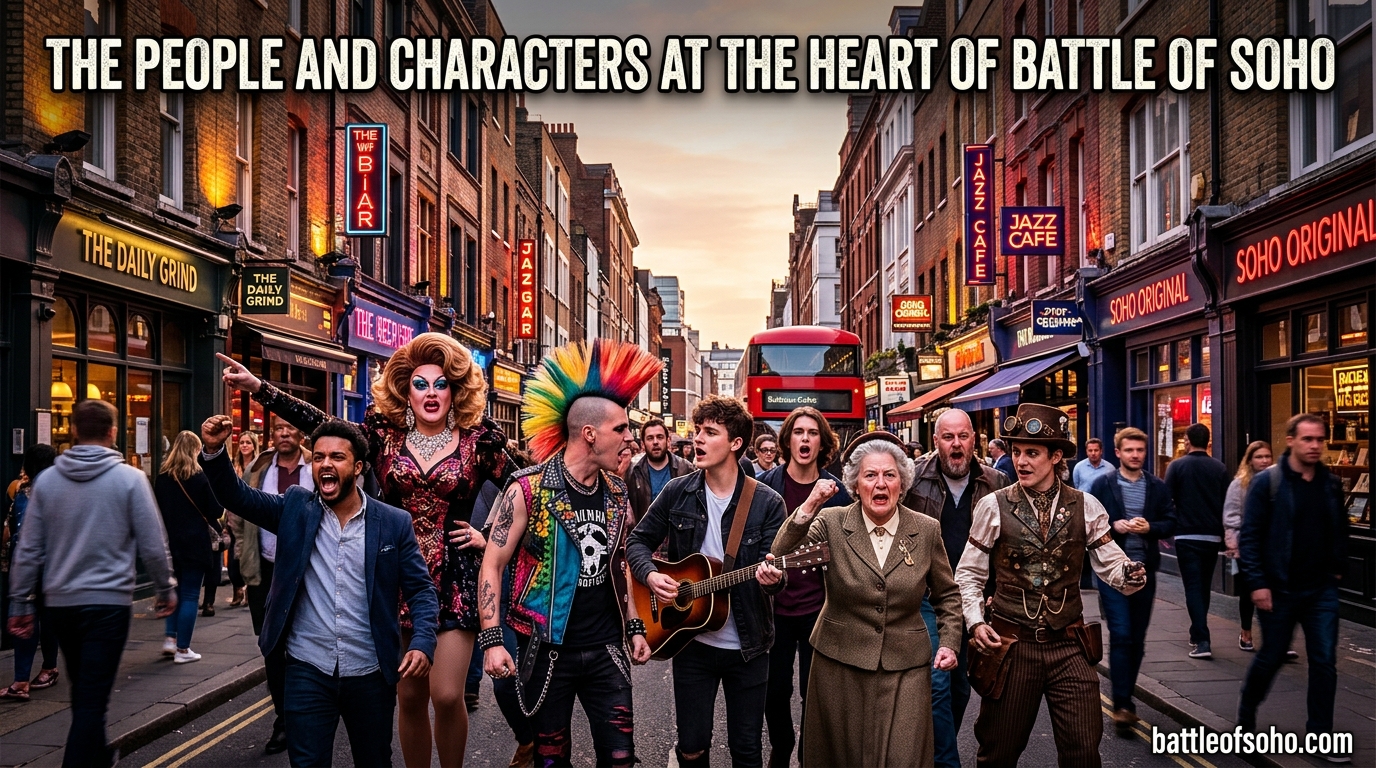
Soho has always been more than a postcode. For decades, this wedge of central London has been a refuge for outsiders, artists, performers, and anyone who did not quite fit anywhere else. The 2017 documentary Battle of Soho captures that spirit through the voices of the people who lived it.
Directed by Aro Korol, the film assembles a remarkable cast of real-life characters who tell the story of a neighbourhood fighting to survive. In this guide, we explore the people and characters at the heart of Battle of Soho, what they represent, and why their stories matter in 2026.
Whether you are researching the film, studying London’s cultural history, or simply curious about who appears on screen, this breakdown covers every key figure and theme. From legendary performers to grassroots activists, these are the faces behind the fight for Soho’s soul.
Table of Contents
What Is Battle of Soho?
Battle of Soho is a 2017 documentary that examines the rapid gentrification of London’s Soho district and its impact on the community that defined the area’s identity. Released in the UK on 20 October 2017, the film runs approximately 75 minutes and blends interviews, archival footage, and street-level storytelling.
The documentary was directed by Aro Korol, a Polish-born filmmaker who made London his home. Korol focused the lens on the people he believed were being erased by property development, rising rents, and corporate chain stores replacing independent businesses. The result is part love letter, part protest film.
At its core, the documentary is about community preservation. It asks a simple but urgent question: what happens to a neighbourhood when the people who gave it its character can no longer afford to stay?
The BFI Player, which hosts the film for streaming, describes Korol’s approach as concentrating on “Soho’s characters; the outsiders and eccentrics who’ve helped define its history.” That description captures exactly what makes this documentary stand out from other films about urban change.
The People and Characters at the Heart of Battle of Soho
The cast of Battle of Soho is not a cast in the traditional sense. These are real people sharing real experiences. According to IMDb, the film features over a dozen named contributors, each bringing a different perspective on what Soho means and what is being lost. The Battle of Soho characters range from internationally recognised stars to unsung local heroes.
Stephen Fry
Stephen Fry is perhaps the most recognisable voice in the documentary. The actor, writer, and comedian has deep connections to Soho and London’s broader cultural landscape. His involvement lends the film a sense of gravitas and historical weight.
Fry speaks about Soho as a place of freedom and creative energy. His reflections help frame the documentary’s argument that what is being lost is not just buildings but a way of life. For Fry, Soho was a sanctuary where people could be themselves at a time when much of Britain was far less accepting.
Lindsay Kemp
Lindsay Kemp was a legendary dancer, mime artist, and choreographer who profoundly influenced British avant-garde performance. Born in 1938, Kemp trained a young David Bowie and was known for his flamboyant, theatrical style. He appears in Battle of Soho as a living connection to the area’s bohemian past.
Kemp’s presence in the film is especially poignant. He passed away in August 2018, roughly a year after the documentary’s release. His contributions preserve the memory of a Soho that was fiercely artistic, unapologetically theatrical, and gloriously unconventional.
Through Kemp, the documentary illustrates what gentrification actually destroys. It is not just affordable rent. It is the ecosystem that allowed artists like him to experiment, fail, and create without the pressure of corporate viability.
Tim Arnold
Tim Arnold is a musician and activist who has been one of the most vocal campaigners for Soho’s preservation. Known as the “Godfather of Soho” by some in the community, Arnold has fought tirelessly to protect the area’s music venues, independent shops, and cultural spaces.
In the documentary, Arnold serves as both a subject and a guide. He walks viewers through the changes he has witnessed firsthand, pointing out what was there before and what has replaced it. His perspective is deeply personal, grounded in years of actually living and working in the neighbourhood.
Arnold’s activism extends beyond the film. He has campaigned against the closure of legendary venues and has been involved in broader efforts to protect Soho’s heritage from overdevelopment.
Drag Performers and Cabaret Artists
The documentary features several drag performers and cabaret artists who represent the heart of Soho’s nightlife culture. Performers like Arkadius, TeTe Bang, and others appear in the film, sharing their experiences of working in an area that has historically welcomed gender nonconformity and theatrical expression.
These performers are not just entertainers. They are cultural archivists in their own right, carrying forward traditions of cabaret, drag, and performance art that have defined Soho for generations. Their inclusion in the documentary ensures that the story of Soho is told by the people who actually shaped its nightlife.
The film also features contributors like Bethany Baderinwa, Elizabeth Baderinwa, Jen Brown, Drew Caiden, and Ally Clow, among others. Each adds a thread to the broader tapestry of voices that make up the Battle of Soho cast.
Community Activists and Residents
Beyond the performers and public figures, the documentary gives screen time to everyday residents and community organisers. These are the people who run local campaigns, attend council meetings, and push back against planning applications that threaten independent businesses.
Their stories ground the film in reality. While celebrities draw attention, it is the grassroots activists who do the unglamorous work of resistance. The documentary recognises this by weaving their voices throughout the narrative rather than treating them as background noise.
Aro Korol: The Director Behind the Camera
Aro Korol is the driving force behind Battle of Soho. Born in Poland and based in London, Korol brought an outsider’s appreciation to a neighbourhood that has always been defined by outsiders. His background in independent filmmaking gave him the tools to tell this story with intimacy and urgency.
Korol’s approach is character-driven. Rather than relying on statistics or policy analysis, he lets the people of Soho speak for themselves. This choice gives the documentary its emotional core. Viewers do not just learn about gentrification in the abstract. They hear about it from the people experiencing it in real time.
The director has described his motivation as a desire to document what was disappearing before it was gone completely. That sense of urgency permeates every frame of the film.
How the Documentary Addresses Gentrification
Gentrification is the central conflict of Battle of Soho. The Guardian’s review memorably described the phenomenon as the “insidious Starbucking of London’s bohemian backstreets.” That phrase captures the film’s argument: corporate homogenisation is replacing the quirky, independent character that made Soho famous.
The documentary shows this process in action. Viewers see chain stores where independent businesses once stood, luxury flats where affordable housing existed, and rising rents that push out the very people who made the area desirable in the first place.
Korol connects Soho’s struggle to a global pattern. The film references similar battles in other major cities, suggesting that what is happening in Soho is not an isolated incident but part of a worldwide trend of cultural erasure driven by property speculation.
The documentary also highlights the role of local government policy. Decisions about licensing, planning permissions, and property development have accelerated the changes sweeping through Soho. By featuring voices from across the community, the film shows how these policies play out on the ground.
What makes the film’s treatment of gentrification effective is its specificity. This is not a generic argument about urban development. It is rooted in particular streets, particular venues, and particular people whose lives have been directly affected.
The Impact on Soho’s LGBT Venues
One of the most significant threads in Battle of Soho is the disappearance of LGBT venues. Soho has been a centre of London’s queer culture for decades, and its bars, clubs, and performance spaces have served as gathering points for a community that often had nowhere else to go.
The documentary documents the closure of several iconic venues and explores what those losses mean. These spaces were not just places to drink or dance. They were sites of political organising, artistic experimentation, and mutual support. When they close, something irreplaceable is lost.
The film features interviews with performers and patrons who describe what these venues meant to them. Their testimonies are a powerful reminder that cultural preservation is not an abstract cause. It is about real places where real people built community.
The documentary also connects the decline of LGBT venues to broader patterns of erasure. When queer spaces disappear, the visibility and safety of the community diminish along with them. This is one of the film’s most urgent messages.
Soho’s Cultural Legacy and Community Resistance
Despite the losses documented in the film, Battle of Soho is not a story of defeat. Throughout the documentary, the spirit of resistance shines through. Community activists continue to campaign, performers continue to create, and residents continue to fight for the neighbourhood they love.
The film serves as both a historical record and a call to action. By documenting what has been lost, it makes the case for protecting what remains. The people featured in the documentary are not passive victims of change. They are active participants in the ongoing battle for Soho’s identity.
In 2026, the issues the documentary raised remain relevant. Gentrification has not slowed, but neither has community resistance. The voices captured in Battle of Soho continue to inspire those who believe that neighbourhoods belong to the people who make them vibrant.
FAQs
Who are the main people featured in Battle of Soho documentary?
The main people featured in Battle of Soho include Stephen Fry, the celebrated actor and writer; Lindsay Kemp, the legendary dancer and choreographer who mentored David Bowie; Tim Arnold, a musician and community activist known as the Godfather of Soho; and numerous drag performers, cabaret artists, and grassroots activists. The cast also includes Arkadius, TeTe Bang, Bethany Baderinwa, Elizabeth Baderinwa, Jen Brown, Drew Caiden, and Ally Clow, among others.
What is Battle of Soho documentary about?
Battle of Soho is a 2017 documentary directed by Aro Korol that explores the gentrification of London’s Soho district. Through interviews with local artists, performers, activists, and residents, the film documents the displacement of the community that gave Soho its unique character and highlights the ongoing fight to preserve the area’s LGBT venues and bohemian culture against property development and corporate commercialisation.
How does Battle of Soho address gentrification?
Battle of Soho addresses gentrification by showing its real-world impact on the people of Soho. The documentary highlights how chain stores replace independent businesses, rising rents push out long-term residents, and luxury developments displace affordable housing. Director Aro Korol connects Soho’s struggle to a global pattern of cultural erasure driven by property speculation and unsupportive local government policies.
What happened to Soho’s LGBT venues according to the documentary?
According to the documentary, numerous iconic LGBT venues in Soho have closed due to rising rents, property redevelopment, and changing licensing conditions. The film features interviews with performers and patrons who describe these venues as vital spaces for community building, political organising, and artistic expression, arguing that their closure represents a profound loss for queer visibility and safety in London.
Why the People and Characters at the Heart of Battle of Soho Still Matter
The people and characters at the heart of Battle of Soho represent something larger than a single neighbourhood. They stand for every community facing erasure in the name of progress. Stephen Fry, Lindsay Kemp, Tim Arnold, and the many performers and activists in the film remind us that places are defined by people, not property values.
Aro Korol’s documentary is a testament to the power of storytelling as resistance. By giving screen time to the outsiders and eccentrics who shaped Soho, the film ensures their voices will not be forgotten even as the landscape around them changes. That is what makes this documentary essential viewing for anyone who cares about culture, community, and the places we call home.
If you want to watch Battle of Soho, it is available to stream on the BFI Player. The film is also listed on IMDb and Rotten Tomatoes, where you can find additional cast details and critical perspectives. For anyone interested in London history, LGBT activism, or the human cost of gentrification, this documentary remains as relevant in 2026 as it was at its release.