
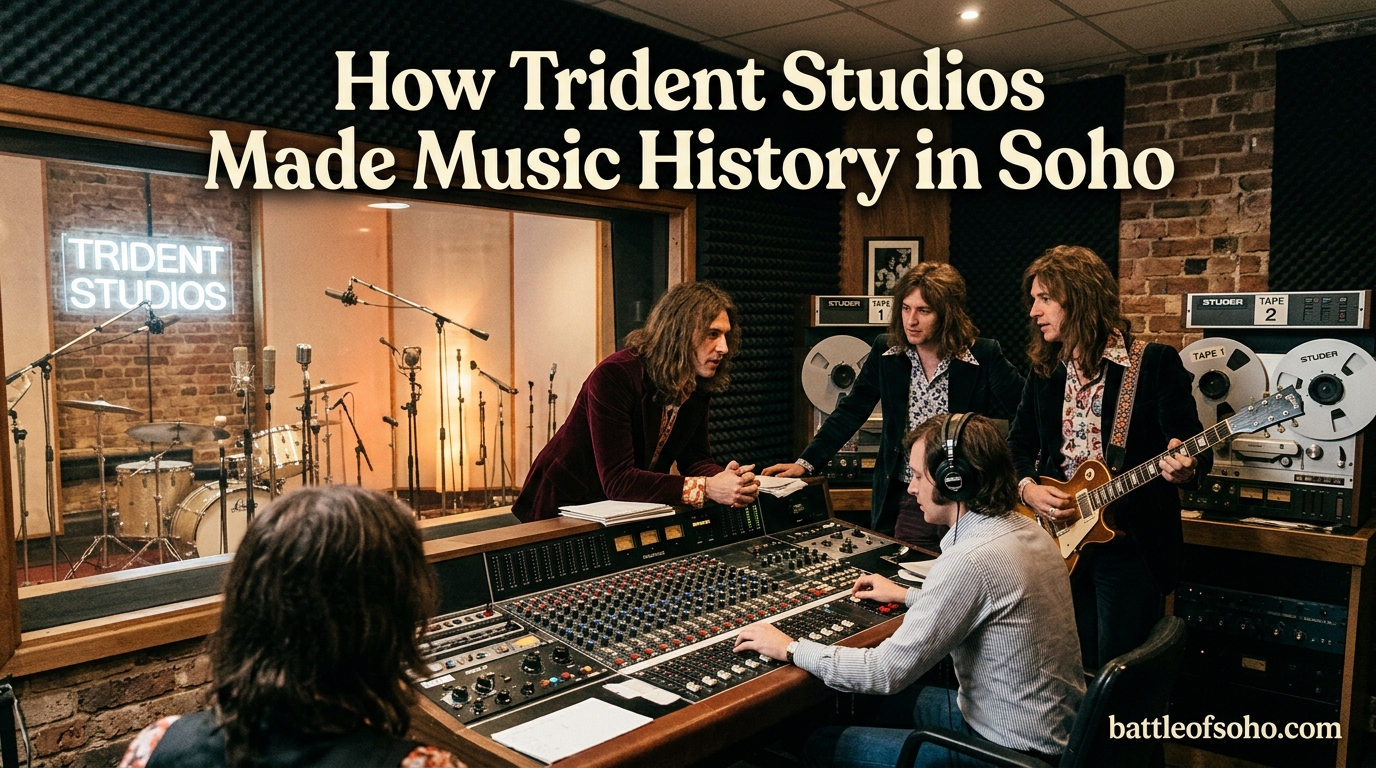
Walk down St Anne’s Court in Soho today and you might stroll right past a small, unassuming doorway that once changed the course of popular music. Behind that door stood Trident Studios, the recording facility where The Beatles laid down “Hey Jude,” David Bowie birthed Ziggy Stardust, and Queen recorded their earliest albums. For thirteen extraordinary years, this Soho building served as the creative engine room of British rock and pop.
What made Trident Studios Soho music history so remarkable was not just the calibre of artists who walked through its doors. It was the combination of pioneering technology, a famously relaxed atmosphere, and the visionary leadership of brothers Norman and Barry Sheffield. Together, they built a space where musical legends felt free to experiment, take risks, and produce some of the most enduring recordings of the twentieth century.
In this article, we explore how a modest Soho premises became one of the world’s most legendary recording studios. From its founding in 1968 to its closure in 1981, Trident Studios hosted sessions that shaped the sound of a generation and left a legacy that still resonates through music today.
Table of Contents
How Trident Studios Made Music History in Soho: The Founding Story
The story of Trident Studios begins with two brothers from London who understood music from the inside out. Norman and Barry Sheffield were musicians themselves, having played in an instrumental band called The Hunters during the late 1950s and early 1960s. That first-hand experience of the recording industry gave them an insight that most studio owners of the era simply did not possess: they knew what artists actually wanted from a studio.
In 1967, the Sheffield brothers purchased a building at 17 St Anne’s Court, a narrow street tucked between Wardour Street and Dean Street in the heart of Soho. The premises had previously operated as a bar and entertainment venue, and converting it into a professional recording facility was an ambitious undertaking. Norman Sheffield oversaw the construction and design, working to create an acoustic environment that could compete with the best studios in London.
Trident Studios officially opened its doors in 1968, and from the very beginning it offered something that set it apart from competitors like Abbey Road and IBC. The Sheffields installed an eight-track recording machine, making Trident one of the very first studios in the UK to offer this technology. At a time when most British studios were still working with four-track recorders, this gave Trident an enormous technical advantage that would soon attract the biggest names in music.
Beyond the equipment, Norman Sheffield cultivated an atmosphere that artists genuinely appreciated. Unlike some of the more institutional studios of the era, Trident felt like a creative playground rather than a corporate facility. The vibe was relaxed, the staff were accommodating, and musicians were encouraged to experiment. This culture of creative freedom became Trident’s calling card and the foundation of its legendary status.
The studio also operated a tape duplication business alongside its recording services, which provided a steady revenue stream in the early days and helped fund continued investment in equipment. It was this combination of business savvy and artistic sensitivity that allowed Trident to thrive in the competitive Soho landscape.
The Beatles and Trident Studios
The Beatles’ connection to Trident Studios began in July 1968, and it would prove to be the moment that put the studio on the map. The band had been working extensively at EMI’s Abbey Road Studios, but they had run into a significant problem. Abbey Road was still using four-track recording equipment, and The Beatles were pushing the boundaries of what was possible with that limitation.
When the band wanted to record “Hey Jude,” their ambitious new single that ran over seven minutes long, they needed more sonic room to work with. Abbey Road’s four-track machine simply could not handle the layered arrangement Paul McCartney had envisioned. The solution was Trident Studios and its state-of-the-art eight-track recorder.
The “Hey Jude” session at Trident has become the stuff of legend. The recording featured a thirty-six piece orchestra and the famous extended coda where the entire ensemble joins in on the “na na na nananana” refrain. The eight-track technology allowed engineer Barry Sheffield to capture each element with far greater clarity and separation than would have been possible at Abbey Road. The result was a single that topped charts around the world and remains one of the Beatles’ most beloved recordings.
But “Hey Jude” was just the beginning of The Beatles’ relationship with Trident. The band returned to the studio to record several tracks for what would become known as the White Album, officially titled simply “The Beatles.” Among the songs recorded at Trident were “Dear Prudence,” “Honey Pie,” “Martha My Dear,” “Savoy Truffle,” and “Glass Onion.” Each of these tracks benefited from the studio’s superior technical capabilities and creative atmosphere.
The Beatles’ patronage was transformative for Trident. When the biggest band in the world chooses your studio over the most famous recording facility on the planet, people take notice. Other major artists soon followed, and Trident’s reputation as a world-class recording destination was firmly established.
The connection extended beyond The Beatles themselves. Their Apple Records label used Trident for various projects, and the studio became closely associated with the late-1960s London music scene that The Beatles epitomized. For a studio that had been open barely months when “Hey Jude” was recorded, this was an extraordinary ascent.
David Bowie and the Birth of Ziggy Stardust
If The Beatles put Trident Studios on the map, David Bowie made it a legend. Bowie’s relationship with Trident began in the early 1970s and would produce some of the most influential recordings in rock history. The studio became something of a creative home base for Bowie during the most transformative period of his career.
In 1971, Bowie entered Trident Studios to begin work on the album that would define him: “The Rise and Fall of Ziggy Stardust and the Spiders from Mars.” Recorded with his band the Spiders from Mars, featuring Mick Ronson on guitar, Trevor Bolder on bass, and Mick Woodmansey on drums, the album was a landmark moment in music history. It introduced the world to Bowie’s androgynous alien rock star persona and launched the glam rock movement into the mainstream.
The Trident sessions produced iconic tracks including “Starman,” “Moonage Daydream,” “Soul Love,” “Five Years,” and “Rock ‘n’ Roll Suicide.” The studio’s eight-track setup and distinctive acoustic character contributed significantly to the album’s raw yet polished sound. Producer Ken Scott, who had previously worked with The Beatles at Abbey Road, helped capture performances that crackled with electricity and theatrical drama.
Bowie’s earlier 1971 album “Hunky Dory” had also been partially recorded at Trident, featuring the classic tracks “Life on Mars?” and “Changes.” “Life on Mars?” in particular showcased the studio’s celebrated Bechstein grand piano, and the recording remains one of the most dramatic and beloved songs in the Bowie catalogue.
Trident was also where Bowie produced Lou Reed’s seminal 1972 album “Transformer.” As producer, Bowie brought Reed into the studio and helped craft the sound that would make tracks like “Walk on the Wild Side” and “Perfect Day” enduring classics. The fact that Bowie chose Trident as his creative base for production work speaks volumes about the trust he placed in the studio and its staff.
The Bowie-Trident partnership exemplified what made the studio special. It was not just about the equipment, though that was exceptional. It was about an environment where an artist as boundary-pushing as David Bowie felt supported enough to create his most daring work. The Ziggy Stardust sessions alone would have secured Trident’s place in music history.
Queen: From Trident to the World
Among all the legendary acts associated with Trident Studios, Queen’s story may be the most remarkable. When the band first walked through the doors of 17 St Anne’s Court, they were a talented but unsigned group struggling to get a record deal. By the time they left, they were on their way to becoming one of the biggest rock bands in history.
The connection between Queen and Trident went far beyond a typical studio-client relationship. Norman and Barry Sheffield were so impressed by the band that they signed Queen to a management deal through their production company, Neptune Productions. This arrangement gave Queen access to studio time at Trident during off-peak hours, allowing them to develop their sound and record demos without the financial pressure of standard studio rates.
Queen’s self-titled debut album was recorded at Trident Studios and released in 1973. The album showcased the band’s distinctive blend of hard rock, progressive rock, and elaborate vocal harmonies. Tracks like “Keep Yourself Alive” and “Liar” demonstrated the studio’s ability to capture the complexity of Queen’s multi-layered arrangements, particularly Brian May’s guitar work and Freddie Mercury’s powerful vocals.
The band’s second album, “Queen II,” was also recorded at Trident in 1974, featuring the ambitious two-sided structure that divided the album into “White Queen” and “Black Queen” sides. The album’s rich, theatrical sound was tailor-made for the studio’s capabilities and its famous Bechstein piano, which Mercury used extensively.
Queen’s third and fourth albums, “Sheer Heart Attack” (1974) and “A Night at the Opera” (1975), continued the Trident association. “A Night at the Opera” featured the groundbreaking “Bohemian Rhapsody,” a six-minute operatic rock epic that pushed recording technology to its limits. While the band had begun recording at other studios by this point, the Trident sessions laid the foundation for everything that followed.
The Queen-Trident story is not without its tensions. The management deal with the Sheffield brothers eventually soured, and the band famously referenced their frustrations in later years. However, there is no denying that Trident Studios provided Queen with the platform they needed at a critical moment in their career. Without the Sheffields’ belief and the studio’s facilities, Queen’s path to global stardom might have been very different.
Elton John and Other Legendary Artists
While The Beatles, Bowie, and Queen are the names most commonly associated with Trident Studios, the list of legendary artists who recorded there goes far beyond those three. Elton John was an early and frequent visitor, recording several tracks at the studio during his prolific early-1970s period. The studio’s grand piano and warm acoustic environment suited Elton’s style perfectly.
Marc Bolan and T.Rex brought their glam rock magic to Trident, recording tracks that helped define the early 1970s British rock scene. Bolan’s partnership with producer Tony Visconti produced some of the most infectious rock and roll of the era, and Trident’s facilities provided the perfect backdrop for their creative partnership.
Genesis recorded at Trident during their progressive rock period with Peter Gabriel as frontman. The band’s complex, multi-part compositions required a studio capable of capturing intricate layering, and Trident’s multi-track capabilities were ideally suited to the task. The sessions contributed to the distinctive sound that made Genesis one of the most influential progressive rock bands of the era.
Free, the British rock band featuring guitarist Paul Kossoff and singer Paul Rodgers, also recorded at Trident. Their bluesy, stripped-down sound was captured with clarity and power at the studio, and tracks from their sessions remain touchstones of British hard rock.
The Rolling Stones, already established as one of the biggest bands in the world, also used Trident for various recordings. Their presence at the studio further cemented Trident’s status as a facility that attracted artists at the very pinnacle of the music industry.
Other notable artists who passed through Trident’s doors include James Taylor, Carly Simon, Joe Cocker, Harry Nilsson, and Cat Stevens. The sheer breadth of talent that recorded at 17 St Anne’s Court is staggering, and it reflects the studio’s reputation as a place where serious musicians went to do their best work.
The Trident A-Range Console and Equipment Legacy
What truly set Trident Studios apart from its competitors was its equipment, particularly the legendary Trident A-Range console. Designed and built in-house, the A-Range was a custom mixing desk that became renowned throughout the recording industry for its distinctive warm sound and exceptional flexibility.
The A-Range console featured four-band EQ on every channel, which was advanced for its time, and its Class A amplifier circuitry gave recordings a richness and depth that other consoles struggled to match. Only thirteen A-Range consoles were ever built, and they became so sought after that decades later, engineers and producers still seek them out for their unique sonic character. The console’s design philosophy prioritized musicality over clinical accuracy, which is exactly what artists like Bowie and Queen needed for their larger-than-life productions.
Trident was also at the forefront of multi-track recording technology in the UK. When the studio opened in 1968, its eight-track Ampex machine was cutting-edge. Most British studios were still limited to four tracks, which severely constrained how complex an arrangement could be. Trident’s eight-track capability was the reason The Beatles came to record “Hey Jude,” and it gave every artist who used the studio far more creative freedom in layering and separating instruments.
The studio later upgraded to a sixteen-track machine, staying ahead of the technological curve and ensuring that artists always had access to the best tools available. Trident was also an early adopter of Dolby noise reduction technology, which dramatically reduced the tape hiss that plagued analog recordings and resulted in cleaner, more professional-sounding masters.
Then there was the Bechstein piano, perhaps the most famous single instrument associated with Trident Studios. This was no ordinary studio piano. It was a beautiful Bechstein grand that was reportedly over one hundred years old, and it had a warm, rich tone that musicians adored. David Bowie played it on “Life on Mars?,” Freddie Mercury pounded it on numerous Queen tracks, and countless other artists fell in love with its distinctive voice. The Bechstein became so iconic that it was almost a member of the studio staff.
Monitoring at Trident was handled by Lockwood Tannoy speakers, which were the industry standard for professional British studios. These large cabinet speakers provided accurate, powerful sound reproduction that gave engineers confidence their mixes would translate well to any playback system.
One of the most charming pieces of Trident lore involves the studio’s unconventional echo chamber. Rather than building a dedicated reverb room, the engineers at Trident discovered that the building’s tiled toilet produced an excellent natural reverb. They ran microphones into the bathroom and used it as an echo chamber for recordings, a wonderfully Soho approach to audio engineering that demonstrated the ingenuity and resourcefulness of the studio’s staff.
Later History and Legacy
Despite its extraordinary contributions to music history, Trident Studios had a relatively short lifespan. The studio operated from 1968 until 1981, when changing economics in the music industry and the rise of larger, more modern facilities made it increasingly difficult for a studio of Trident’s size to compete.
By the late 1970s, the recording landscape was shifting. New studios with more space and newer equipment were opening, and the economics of running a commercial recording facility in central London became increasingly challenging. The Sheffield brothers made the difficult decision to close Trident Studios in 1981, ending a thirteen-year run that had produced some of the most important recordings in popular music history.
The studio’s tape duplication business continued for a time after the recording operation closed, reflecting the Sheffields’ pragmatic approach to the industry. The Trident name also lived on through various audio ventures, including Trident Audio Developments, which manufactured equipment based on the studio’s innovations.
The building at 17 St Anne’s Court remained, and it continued to be used for audio-related purposes. In later years, the space operated as Trident Sound Studios, maintaining a connection to its musical heritage. The current status of the facility has been a topic of discussion among audio engineering enthusiasts and music history buffs, many of whom have taken to forums like Reddit to ask whether the studio still exists and what has become of the building.
In 2017, Trident Studios received official recognition when a blue plaque was installed at the St Anne’s Court location. The ceremony was attended by music industry figures and celebrated the studio’s role in shaping British music. For fans of recording history, the plaque serves as a tangible marker of the building’s significance and a reminder of the extraordinary music created within its walls.
Norman Sheffield documented the studio’s story in his book, providing a first-hand account of what it was like to run one of the world’s most important recording facilities during one of its most creative periods. His perspective as both a musician and a businessman offers unique insights into the challenges and triumphs of the Trident years.
FAQs
Who recorded at Trident Studios?
Trident Studios hosted an extraordinary roster of artists including The Beatles, David Bowie, Queen, Elton John, Lou Reed, Marc Bolan and T.Rex, Genesis, Free, The Rolling Stones, James Taylor, Carly Simon, Joe Cocker, Harry Nilsson, and Cat Stevens. The studio operated from 1968 to 1981 and was one of the most sought-after recording facilities in London during that period.
Did the Beatles ever record at Trident Studios?
Yes, The Beatles recorded at Trident Studios in 1968. They chose Trident because it had an eight-track recording machine, while their usual studio, Abbey Road, still only had four-track equipment. At Trident they recorded the single Hey Jude and several White Album tracks including Dear Prudence, Honey Pie, Martha My Dear, Savoy Truffle, and Glass Onion.
What is the history of Trident Studios?
Trident Studios was a British recording facility located at 17 St Anne’s Court in London’s Soho district. It was founded by brothers Norman and Barry Sheffield in 1968 and quickly became one of the most important studios in the UK thanks to its advanced eight-track recording technology and relaxed creative atmosphere. Over thirteen years, it hosted sessions by The Beatles, David Bowie, Queen, Elton John, and many more before closing in 1981.
When did Trident Studios close?
Trident Studios closed in 1981 after thirteen years of operation. Changing economics in the music industry and competition from larger, more modern facilities contributed to the decision. The building at 17 St Anne’s Court received a blue plaque in 2017 commemorating its role in music history.
Trident Studios: Soho’s Enduring Musical Echo
Trident Studios existed for just thirteen years, but in that time it helped create music that has lasted for decades and will endure for decades more. The list of recordings made at 17 St Anne’s Court reads like a roll call of the greatest albums in rock and pop history. From “Hey Jude” to Ziggy Stardust, from Queen’s debut to Lou Reed’s “Transformer,” the studio’s discography is simply staggering.
What made Trident special was not any single factor but the convergence of several. The Sheffield brothers built a studio with the best equipment available and staffed it with talented engineers who cared about music. They cultivated an atmosphere where artists felt free to push boundaries and take creative risks. And they positioned themselves in Soho, the cultural heart of swinging London, surrounded by the energy and creativity of the era’s most exciting music scene.
The story of how Trident Studios made music history in Soho is ultimately a story about what happens when technical excellence meets artistic vision. The Bechstein piano, the A-Range console, the eight-track machine, and yes, even the toilet echo chamber, all played their part. But it was the people who mattered most: the musicians who brought their dreams to St Anne’s Court and the team who helped them turn those dreams into records.
Today, the blue plaque at 17 St Anne’s Court stands as a small but fitting tribute to a building that changed music forever. For anyone interested in the history of popular music, Trident Studios remains an essential chapter, a Soho landmark whose recordings continue to inspire new generations of artists and music lovers alike.