
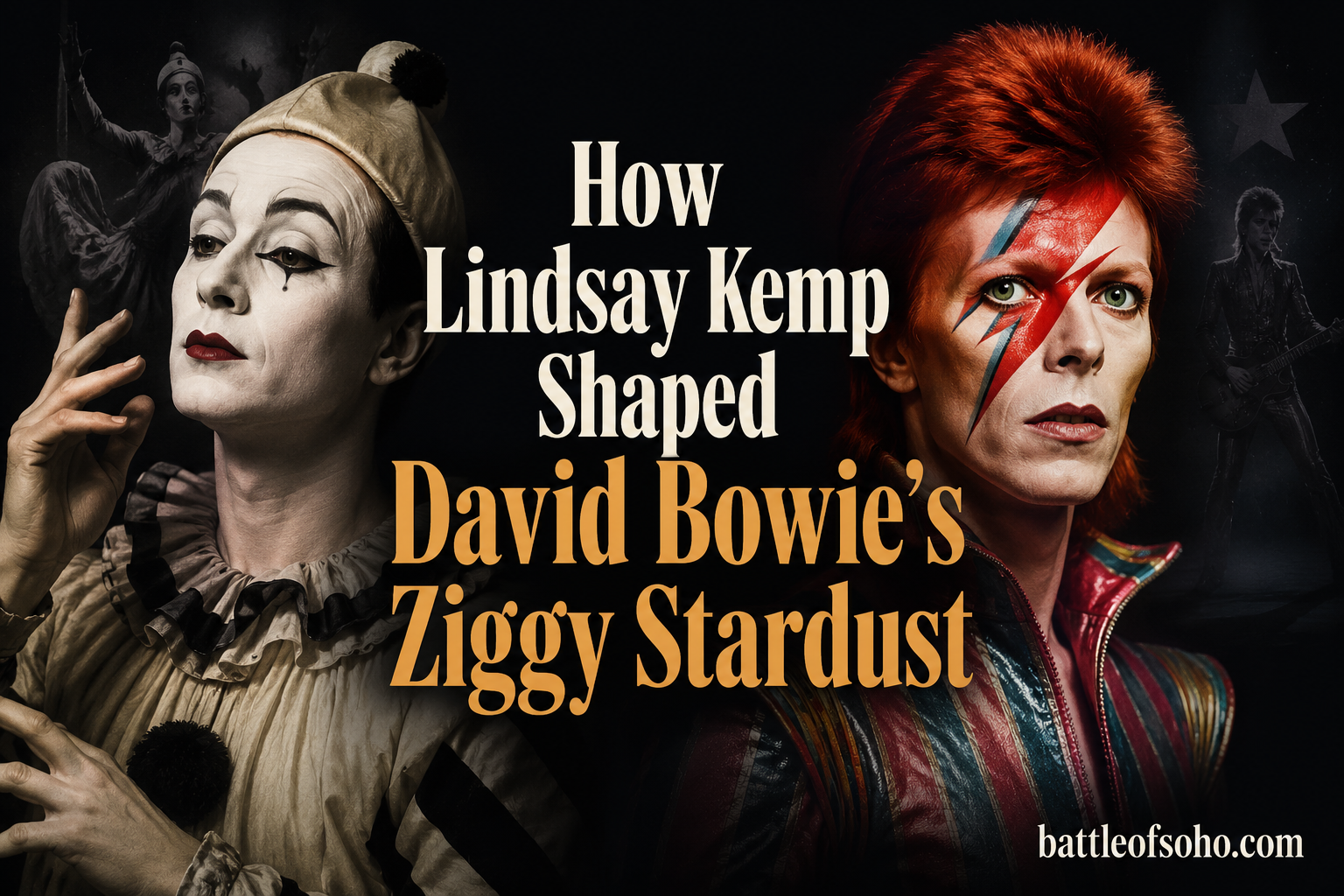
Picture David Bowie on a London stage in the summer of 1972. The lights drop. A figure in a quilted jumpsuit steps forward, deliberate and slow, commanding every eye in the room before a single note rings out. That entrance, that calculated stillness before the storm, did not come from nowhere. It came from a mime artist named Lindsay Kemp.
When most people think about Ziggy Stardust, they picture the hair, the lightning bolt, the alien glamour. What gets lost is the person who taught Bowie how to inhabit a stage like a character in a play. Lindsay Kemp was a British mime artist, dancer, choreographer, and teacher whose influence on David Bowie was both profound and enduring. He gave Bowie the physical vocabulary to become someone else entirely.
In this article, I want to trace the full arc of that relationship. From their first meeting in 1966 through the Dance Centre classes, the Pierrot in Turquoise collaboration, and finally the Ziggy Stardust stage show at the Rainbow Theatre. This is the story of how one theatrical mentor shaped one of the most iconic personas in rock history. Understanding how Lindsay Kemp shaped David Bowie’s Ziggy Stardust means understanding that the Starman was not born. He was built, movement by movement, gesture by gesture, in a dance studio in Covent Garden.
Table of Contents
Who Was Lindsay Kemp?
Lindsay Kemp was a British mime artist, dancer, choreographer, and theatrical visionary born on May 3, 1938, in South Shields, County Durham. He trained in classical dance and mime, studying under some of the most demanding teachers in European physical theatre. His influences ranged from silent cinema legends like Buster Keaton and Charlie Chaplin to the European mime tradition of Marcel Marceau and Etienne Decroux. He also drew heavily from avant-garde theatre, kabuki, and the raw spectacle of British music hall.
What set Kemp apart was his refusal to separate art from life. He lived in a world of costume, makeup, and theatrical transformation. His flat was a stage. His classroom was a performance. He believed the body could communicate truths that words could never reach. This was not just technique. It was a philosophy.
By the mid-1960s, Kemp had become a fixture of the bohemian London art scene. He ran dance and mime classes at the Dance Centre in Covent Garden, drawing students who were hungry for something beyond conventional theatre training. His teaching style was intense, physical, and deeply emotional. He pushed students to use their bodies as instruments of expression, to find meaning in a gesture, a pause, or the angle of a tilted head.
Kemp was also an openly gay man in an era when homosexuality had only recently been decriminalized in England. His unapologetic embrace of androgyny, theatricality, and fluid identity made him a magnet for artists who felt constrained by the rigid norms of 1960s Britain. He created a space where performance, sexuality, and self-invention could blend together freely. That environment would prove transformative for a young musician still searching for his voice.
How David Bowie Met Lindsay Kemp (1966-1967)
The story of how Bowie and Kemp met has been told many times, but it never loses its charge. According to Kemp himself, it was close to love at first sight. The year was 1966, and Bowie was still David Jones, a 19-year-old singer who had released a handful of singles without commercial success. He was performing at the Marquee Club in London when Kemp first saw him.
Bowie was, by most accounts, not a natural mover. He was stiff on stage, unsure of what to do with his body, and still performing in the style of a conventional pop singer of the era. But there was something in his presence that captivated Kemp. In interviews years later, Kemp recalled being struck by Bowie’s face, his intelligence, and his hunger to learn. Bowie, for his part, was mesmerized by Kemp’s theatrical world and asked to study with him almost immediately.
By the fall of 1967, Bowie was taking regular dance and mime lessons from Kemp. This was a period of deep disillusionment for Bowie. His debut album had flopped. He was working in an office to pay rent. He felt trapped between his ambition and his lack of a clear artistic identity. Kemp offered him a way out. Not just technique, but a completely new way of thinking about what performance could be.
Many people wonder about the personal nature of their relationship. Were David Bowie and Lindsay Kemp lovers? By both accounts, yes. Kemp spoke openly about their romantic and physical relationship in interviews. Bowie himself acknowledged Kemp as one of the great loves of his life. Their bond blended mentorship, artistic collaboration, and romance in a way that was characteristic of the bohemian world they inhabited. This was not a tidy professional arrangement. It was a passionate, messy, transformative partnership.
That personal intensity fueled the artistic one. When Bowie moved into Kemp’s world, he was not just learning steps. He was absorbing an entire philosophy of performance, identity, and self-creation that would define the rest of his career.
Inside Kemp’s Classroom at the Dance Centre
The Dance Centre in Covent Garden was where the transformation happened. Kemp held classes there regularly, and Bowie became one of his most dedicated students. The training was rigorous and unlike anything Bowie had experienced before. It was not about learning choreography in the traditional sense. It was about learning to use the body as a tool for communication.
Kemp’s classes began with physical conditioning. Flexibility exercises, posture training, and breathing work formed the foundation. Bowie was reportedly tight and inflexible when he started. Kemp pushed him to stretch, to lengthen, to find fluidity in his movements. This was not about looking graceful. It was about unlocking the body’s capacity to express emotion.
The core of Kemp’s teaching was mime technique. Students learned to communicate without words, using gesture, facial expression, and body language to tell stories. Kemp drew on the traditions of Marcel Marceau and the classical French mime school, but he filtered everything through his own theatrical sensibility. He wanted his students to understand that every movement on stage carried meaning.
Then came the improvisations, and this is where the classes came alive. Kemp would set scenarios and let students explore them physically. They pretended to be drowning sailors, animals hunting prey, figures caught in storms. These exercises were designed to strip away self-consciousness and force students to respond instinctively with their bodies. For Bowie, who had spent years performing with a kind of polite stiffness, this was revelatory.
Here is a breakdown of the specific techniques Bowie learned from Kemp:
1. Entrance and exit technique. How to command attention the moment you step on stage, and how to leave an impression that lingers after you depart. Kemp believed these were the most important moments in any performance.
2. Stillness and breathing. The power of doing nothing. Kemp taught that a performer who can hold a stage in silence is more powerful than one who fills every moment with noise.
3. Gesture and body language. How a single hand movement, a tilt of the head, or a shift in weight could communicate an entire emotional landscape.
4. Improvisation and instinct. The ability to react physically in the moment, to let the body lead the mind rather than the other way around.
5. Character embodiment. Not just playing a role, but physically becoming someone else. Using the body to signal transformation, not just costume and makeup.
6. Spatial awareness. Understanding where you are on stage at every moment, how you occupy space, and how you direct the audience’s eye.
By the time Bowie finished his training with Kemp, he was a fundamentally different performer. The stiff office worker had become someone who could move, hold, and release a room. That transformation would soon reverberate across the entire landscape of popular music.
Pierrot in Turquoise: Their First Major Collaboration
The classroom was only the beginning. In 1967, Bowie and Kemp began work on a collaborative theatrical production called Pierrot in Turquoise. This was where their teacher-student relationship evolved into a full creative partnership, and where the seeds of Ziggy Stardust were first planted.
Pierrot in Turquoise was a mime and music piece that drew on the commedia dell’arte tradition of the sad clown. Bowie wrote songs for the production, including “Threepenny Pierrot” and “Columbine,” while Kemp directed and choreographed. The show blended Kemp’s theatrical sensibility with Bowie’s emerging musical voice. It was an experiment in what happens when rock music and avant-garde theatre collide.
The production was staged at the Intimate Theatre in Palmers Green, London, in late 1967 and early 1968. It was not a commercial success, but it was a critical step in Bowie’s development. For the first time, he was not just performing songs. He was inhabiting a character, telling a story through movement and music combined. The Pierrot character, with its painted face and tragic clown imagery, would echo through Bowie’s work for years.
The collaboration deepened when the BBC adapted elements of Pierrot in Turquoise for television in 1970 under the title The Looking Glass Murders. This version featured Bowie performing alongside Kemp’s troupe, and it gave Bowie his first real experience of translating theatrical performance to the screen. The visual language they developed, heavy makeup, exaggerated gesture, and symbolic costume, would become central to Bowie’s artistic identity.
Kemp later recalled that Bowie was a remarkably fast learner who threw himself into the work with total commitment. He was not content to simply follow instructions. He wanted to understand why each choice mattered, how each movement served the story. That curiosity and discipline would serve him well when it came time to build something far more ambitious.
Pierrot in Turquoise was the bridge. It connected Kemp’s world of pure theatre to Bowie’s world of popular music. And it proved that the combination could create something neither art form could achieve alone. The idea of merging rock and roll with full theatrical spectacle was born in that small theatre in Palmers Green.
The Theatrical Techniques Bowie Absorbed from Kemp
To understand how deep Kemp’s influence went, it helps to look at the specific techniques that became part of Bowie’s performance DNA. These were not abstract concepts. They were concrete, learnable skills that Bowie practiced until they became second nature.
The most famous of these was the art of the entrance. Kemp taught that an audience forms its impression in the first few seconds a performer appears. Everything that follows either confirms or fights that impression. He drilled Bowie on how to walk on stage with intention, how to pause, how to let the audience come to you rather than rushing to meet them. This philosophy would later define every Ziggy Stardust entrance Bowie ever performed.
Equally important was the art of stillness. Kemp was deeply influenced by Japanese kabuki theatre, where performers hold dramatic poses for extended periods. He taught Bowie that the space between movements is as expressive as the movements themselves. A held breath, a frozen pose, a deliberate pause. These were not empty moments. They were charged with tension and meaning.
Kemp also introduced Bowie to the concept of theatrical costume and makeup as extensions of performance rather than decoration. In Kemp’s world, the way you painted your face changed the way you moved. A mask was not something you wore. It was something you became. This understanding would inform every character Bowie created, from Ziggy to Aladdin Sane to the Thin White Duke.
The music hall tradition was another influence Kemp passed on. British music hall was a form of popular variety theatre that emphasized direct audience connection, comedy, and broad physical performance. Kemp loved its energy and lack of pretension. He taught Bowie to think of the audience as a collaborator, not a passive observer. A performer who could read a room and respond to it in real time was performing at the highest level.
Finally, there was the philosophy of transformation itself. Kemp believed that every person contained multiple characters within them, and that the performer’s job was to unlock and embody those characters fully. This was not acting. It was channeling. And it became the central principle of Bowie’s entire career. Every persona he created was a different version of himself, given physical form through the techniques Kemp had taught him.
How Lindsay Kemp Shaped David Bowie’s Ziggy Stardust
Now we arrive at the heart of it. The Ziggy Stardust stage show that premiered at the Rainbow Theatre in August 1972 was the moment everything Kemp had taught Bowie converged into a single, electrifying vision. And Kemp was not just an indirect influence on that show. He was directly involved in creating it.
Bowie invited Kemp to help choreograph the Ziggy Stardust stage production. According to accounts from members of the production, Bowie initially offered Kemp free rein to design the entire visual and theatrical presentation. In practice, Kemp’s role was somewhat scaled back, and he focused on choreographing the small troupe of performers who accompanied Bowie on stage. But his fingerprints were everywhere.
The Ziggy Stardust show was unlike anything the rock world had seen. It was not a concert in the traditional sense. It was a theatrical production set to music. There were costume changes, character interactions, dramatic lighting inspired by 1920s constructivist theatre design, and choreographed movement that owed everything to Kemp’s teachings. Lou Reed and Iggy Pop were in the audience. They had never seen anything like it.
Watch footage of Bowie performing as Ziggy and you can see Kemp’s influence in every frame. The deliberate, slow entrances. The moments of held stillness between songs. The way Bowie used his arms and hands to create shapes and direct attention. The way he draped himself over the microphone stand, not casually but with the precision of a mime artist who understands exactly how every angle reads from the back of the theatre.
Consider the famous moment when Bowie drops to his knees during “Rock ‘n’ Roll Suicide.” That is not a spontaneous rock gesture. It is a controlled descent, a piece of physical theatre that Kemp would have recognized instantly. The way Bowie extends his arms, the way he holds his head, the timing of the rise. Every element is choreographed with the discipline of someone trained in mime and movement.
Or watch the way Bowie moves during “Starman,” reaching out to the audience with a gesture that is half invitation and half benediction. That open-handed reach, that deliberate connection between performer and audience, is straight out of Kemp’s classroom. It is the music hall tradition of direct audience engagement filtered through the precision of classical mime.
The costume and makeup of Ziggy Stardust also bear Kemp’s influence. The mullet, the face paint, the theatrical jumpsuits. These are not rock star fashion choices. They are character designs, created with the same logic Kemp used in his own productions. The makeup changes the face. The costume changes the body. Together, they signal transformation. And transformation, as Kemp taught, is the essence of great performance.
Bowie himself acknowledged the debt. In interviews throughout his career, he credited Kemp with teaching him how to perform. Not how to sing or play guitar, but how to be on a stage. How to make an entrance. How to make an exit. And, as Kemp famously put it, “quite a few things in between.”
The Ziggy Stardust persona was a fusion of influences. The music came from Marc Bolan, Iggy Pop, and Lou Reed. The alien concept drew from science fiction and the counterculture. But the performance itself, the way it looked and moved and breathed on stage, came from Lindsay Kemp. Without those months in the Dance Centre, without Pierrot in Turquoise, without Kemp’s philosophy of theatrical transformation, Ziggy Stardust would have been a character with a great soundtrack and no body to inhabit.
Beyond Ziggy: Kemp’s Lasting Influence on Bowie’s Career
The influence did not stop with Ziggy. Every persona Bowie created afterward carried traces of Kemp’s teaching. Aladdin Sane, with his lightning bolt face paint, was another exercise in character design through costume and makeup. The Thin White Duke, with his rigid posture and minimal movement, was a masterclass in the power of stillness that Kemp had drilled into him years earlier.
Even in his later career, when Bowie moved away from overt theatrical personas, his stage presence retained the physical intelligence Kemp had instilled. Watch any live Bowie performance from any era and you will see an artist who understands entrances, exits, stillness, gesture, and spatial awareness at a level that few rock musicians ever achieve. That understanding came from one place.
Kemp’s influence extended beyond Bowie, too. Kate Bush, another of Kemp’s students, carried his theatrical sensibility into her own groundbreaking career. The tradition of theatrical rock performance that runs through artists like Peter Gabriel, Grace Jones, and Lady Gaga all connects, directly or indirectly, back to the philosophy that Kemp developed in his tiny studio in Covent Garden.
Frequently Asked Questions
Were David Bowie and Lindsay Kemp lovers?
Yes. Both Kemp and Bowie acknowledged their romantic and physical relationship in interviews. Kemp described it as close to love at first sight when they met in 1966. Their bond blended mentorship, artistic collaboration, and romance.
Who influenced the creation of Ziggy Stardust?
Ziggy Stardust drew from multiple sources including Marc Bolan, Iggy Pop, Lou Reed, science fiction, and the counterculture. However, the theatrical performance style, stage movement, and physical presence were directly shaped by mime artist and choreographer Lindsay Kemp, who taught Bowie stagecraft from 1967 and helped choreograph the Ziggy Stardust stage show.
Who is Lindsay Kemp?
Lindsay Kemp (3 May 1938 to 25 August 2018) was a British mime artist, dancer, choreographer, and teacher. He trained in classical dance and mime, was influenced by silent cinema, European mime, kabuki, and music hall, and ran influential classes at the Dance Centre in Covent Garden. He taught both David Bowie and Kate Bush.
What did Lindsay Kemp teach David Bowie?
Kemp taught Bowie entrance and exit technique, stillness and breathing, gesture and body language, improvisation, character embodiment, spatial awareness, and the philosophy of using costume and makeup as extensions of performance. Kemp famously said he taught Bowie how to make an entrance, how to make an exit, and quite a few things in between.
The Teacher Behind the Starman
Lindsay Kemp gave David Bowie something that no guitar teacher, vocal coach, or producer could provide. He gave him a body. A way of moving through space, commanding attention, and becoming someone else that transformed Bowie from a struggling pop singer into one of the most magnetic performers in the history of popular music.
The story of how Lindsay Kemp shaped David Bowie’s Ziggy Stardust is really a story about mentorship at its most powerful. One artist saw potential in another and devoted himself to unlocking it. The mime techniques, the stagecraft philosophy, the collaboration on Pierrot in Turquoise, the choreography at the Rainbow Theatre. Every piece contributed to the persona that would redefine what a rock star could be.
Kemp passed away on August 25, 2018, but his influence lives on every time an artist steps on a stage and understands that performance is not just about sound. It is about presence, transformation, and the courage to become someone new. If you want to see Kemp’s legacy, watch any Ziggy Stardust performance. Every entrance, every held pose, every deliberate gesture is a lesson he taught, written in the body of his most famous student.