
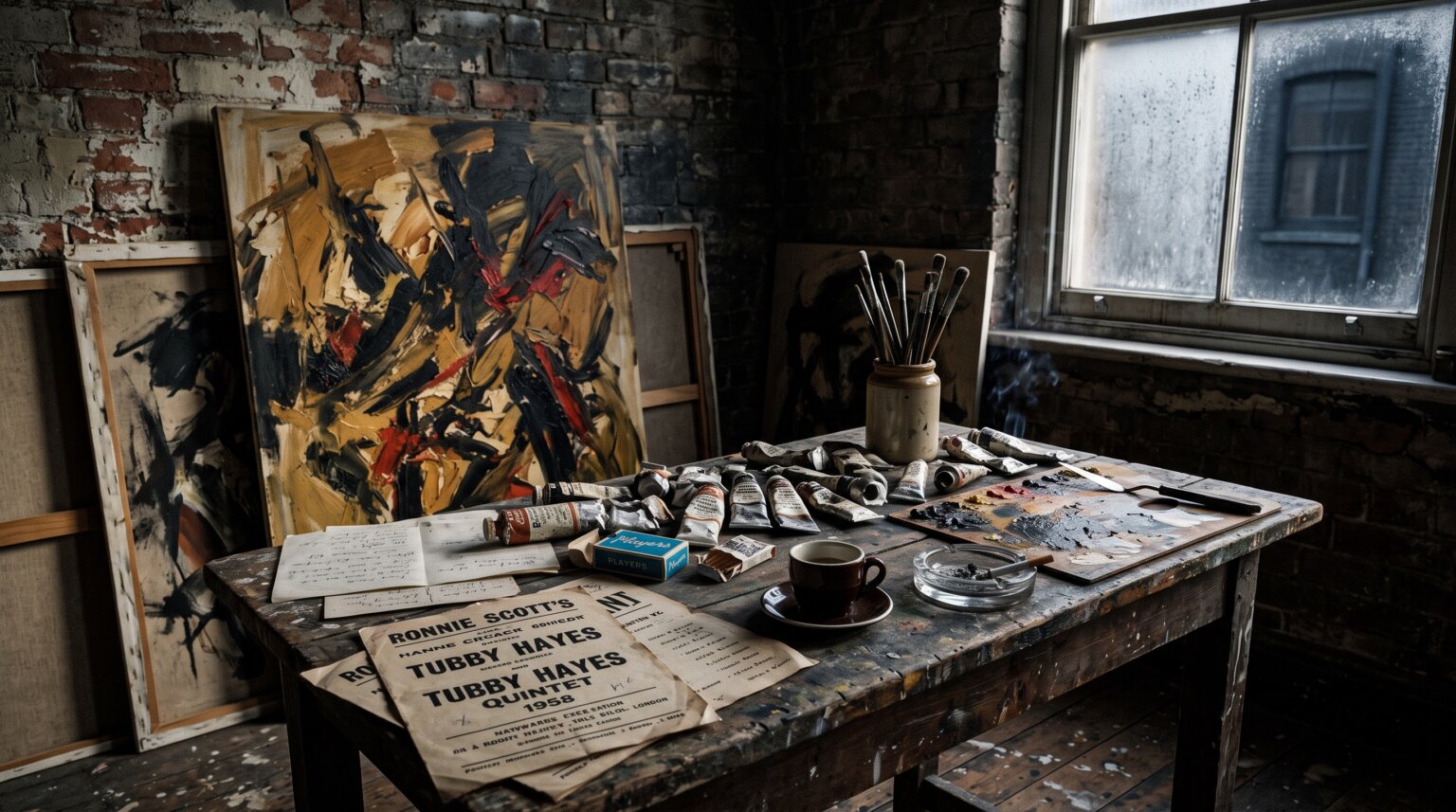
Imagine a single square mile in London where bombsites sat next to all-night cafes, where a painter could drink until dawn with a poet, a burglar, and a countess, and where nobody asked what you did for a living. That was postwar Soho. Between the late 1940s and the early 1960s, this cramped grid of streets between Oxford Street and Shaftesbury Avenue became the most concentrated bohemian community Britain has ever produced.
The lost bohemian world of postwar Soho was not a single movement or institution. It was an ecosystem of drinking clubs, cheap cafes, art studios, and bedsits that gave shelter to people who refused to fit into the grey conformity of austerity Britain. Artists like Francis Bacon and Lucian Freud painted there. Writers like Dylan Thomas and Jeffrey Bernard drank there. And behind it all stood a remarkable cast of women who held the whole fragile world together.
When I first started researching the postwar Soho bohemian scene, I expected to find a straightforward story about a few famous painters and their favorite pub. What I found instead was something far richer: an entire vanished civilization of misfits, muses, queens, and geniuses who built a counterculture from nothing and then watched it disappear. Our team spent weeks tracing the streets, reading the memoirs, and piecing together the oral histories that survive.
In this guide, I want to walk you through what made postwar Soho bohemian culture so extraordinary. We will explore the Colony Room Club, the drinking den that sat at the center of everything. We will meet the artists, muses, queens, and oddities who populated the scene. And we will try to understand what was lost when the old Soho disappeared beneath rising rents and corporate chains.
Table of Contents
Austerity and Rebellion: Why Soho?
To understand why Soho became a bohemian utopia, you have to picture Britain in the years immediately after the Second World War. The war ended in 1945, but rationing actually got worse before it got better. Bread rationing began in 1946. Clothes, fuel, meat, and sweets were all strictly controlled. Cities were still scarred by bomb damage, and the national mood was one of exhaustion and restraint.
Postwar London offered very little in the way of pleasure. The establishment promoted an ideal of quiet, obedient reconstruction. Mainstream culture was conservative, class-bound, and deeply suspicious of anyone who lived differently. Sexual freedom did not exist in any legal sense. Homosexuality was criminalized. Divorce was scandalous. Conformity was not just expected — it was enforced.
Soho was different. The area had always been a place apart. Even in the 18th century, it was known for immigrants, entertainment, and things that happened after dark. Its narrow streets and mixed-use buildings meant that nobody could easily control what went on there. After the war, that slight lawlessness became a magnet for anyone who could not breathe in the rest of Britain.
Soho offered cheap rooms, late-opening pubs, and an existing infrastructure of cafes, restaurants, and clubs. It had a reputation as a permissive space where hedonists, beatniks, impresarios, restauranteurs, and spivs could operate freely. War had hollowed out parts of the neighborhood, leaving empty buildings that could be rented for almost nothing. An artist could find a studio for a few pounds a week, eat cheaply at a Greek or Italian cafe, and drink through the night at a members-only club.
The postwar Soho bohemian scene drew its energy from this contrast. The rest of Britain was drab, rationed, and watched. Soho was loud, cheap, and anonymous. People who had been ostracized elsewhere could find a table, a drink, and a conversation here. That was enough to build a counterculture on.
It was not a political movement. There were no manifestos. The bohemians of Soho were united not by ideology but by a shared appetite for freedom, for art, for alcohol, and for each other’s company. That appetite, as much as anything they painted or wrote, was their defining characteristic. The term bohemian itself dates back to 19th century France, where writers and artists adopted a lifestyle of voluntary poverty, creative freedom, and rejection of bourgeois values. Postwar Soho inherited that tradition and gave it a distinctly British, distinctly postwar flavor.
The Colony Room Club: Heart of the Bohemian World
The Colony Room Club was a private members’ drinking club at 41 Dean Street in Soho, London, founded in 1948 by Muriel Belcher, that served as the epicenter of postwar bohemian culture for over 60 years. It was the single most important venue in the entire Soho scene, and no account of the period can omit it.
The club occupied a small first-floor room above an Italian restaurant. You reached it by climbing a long, dark staircase that smelled of cooking and stale beer. The room itself was tiny — often described as living-room-sized — with bare green walls, a bar, and a few tables and chairs. There was no music, no entertainment, and no food beyond crisps. What there was, in abundance, was alcohol and feverish conversation.
Because it was a private members’ club, it could stay open well beyond normal licensing hours. In postwar London, where pub hours were strictly regulated and pubs closed in the afternoon, this was revolutionary. The Colony Room opened at lunchtime and kept serving until late at night. It became the natural gathering point for anyone who wanted to drink, talk, and create without interruption.
The atmosphere was intense and often cruel. Regulars traded insults as a form of affection. Arguments were frequent and sometimes physical. The painter Francis Bacon, one of the club’s most devoted members, described it as the only place where he felt at home. For decades, the Colony Room functioned as a combined salon, studio annex, gossip exchange, and refuge for people who had nowhere else to go.
Membership was selective and entirely at Muriel Belcher’s discretion. She decided who was interesting enough to belong. Once you were in, you were part of an exclusive world that operated by its own rules. The club attracted artists, writers, actors, musicians, gangsters, aristocrats, and outright eccentrics. The only requirement was that you could hold Muriel’s attention and survive her verbal assaults without crying.
The writer Frank Norman, himself a Colony Room regular and former borstal boy, captured the club’s spirit perfectly. He described it as a place of intellectual vigor and badly behaved bohemians, where the conversation was herculean and the drinking was heroic. His description remains one of the best surviving portraits of what it actually felt like to sit in that small green room surrounded by geniuses and lunatics.
The Colony Room survived until 2008, an astonishing run for a drinking den above a restaurant. But by then, the world that had created it was already long gone. The club outlived its era by decades, kept alive by nostalgia and the momentum of habit. When it finally closed, it took with it the last physical remnant of the postwar Soho bohemian world.
Muriel Belcher: The Formidable Proprietor
Muriel Belcher was the founder, owner, and absolute ruler of the Colony Room Club from its opening in 1948 until her death in 1979. She was one of the most important figures in the entire Soho scene, though she painted nothing and wrote nothing. Her creation was the club itself, and through it, she shaped an entire cultural generation.
Accounts of Muriel describe a woman of formidable intelligence, savage wit, and zero tolerance for boredom. She was small in stature but enormous in presence. Her preferred method of management was verbal assault. She insulted members constantly, sometimes brilliantly, sometimes cruelly, and the members loved her for it. An insult from Muriel was a sign that you mattered.
She was openly lesbian at a time when homosexuality was illegal. The Colony Room was one of the few places in Britain where gay men and women could socialize without fear of arrest. Muriel did not make speeches about this. She simply created a space where sexuality was nobody’s business, and that act of quiet defiance was itself radical in 1950s Britain.
Francis Bacon was reportedly paid by Muriel to bring people into the club and keep the conversation flowing. He was her unofficial recruiter, her star attraction, and her friend. Their relationship defined the Colony Room in its early decades. When Muriel died in 1979, the club continued under her longtime bar manager Ian Board, himself a legendary Soho character. But the energy shifted. The Belcher era was the golden age.
The Artists: Bacon, Freud, and the Figurative Revolution
The postwar Soho bohemian scene produced some of the most important British art of the 20th century. The artists who drank at the Colony Room and other Soho haunts were not a formal school or movement. They were individuals who happened to share a neighborhood, a social circle, and a commitment to painting the human figure at a time when abstraction dominated the international art world.
Francis Bacon was the towering figure. He lived and worked in Soho for most of his life, maintaining studios in the neighborhood that were as chaotic and intense as his paintings. Bacon’s work — screaming popes, distorted bodies, raw studies of human flesh — drew directly from the world around him. The drunks, the lovers, the violence, and the desperation he observed in Soho’s clubs and streets all fed into his canvases.
Bacon was a Colony Room regular from the club’s earliest days. He drank there almost every day, often staying until closing. His routine was legendary. He would paint in the morning, drink in the afternoon, gamble in the evening, and start again the next day. Soho was not just his social scene. It was his subject matter, his palette, and his spiritual home.
Lucian Freud was the other great painter of the Soho milieu. The grandson of Sigmund Freud, he arrived in Britain as a child refugee and became one of the most significant figurative painters of his generation. Freud spent decades working in Soho studios. His early paintings, with their sharp lines and nervy energy, captured something of the atmosphere of postwar bohemian life.
Freud was associated with the Colony Room circle, though he was less of a fixture than Bacon. He was close friends with many of the women who served as muses in the scene, including Henrietta Moraes. His portraits of Soho characters remain some of the most vivid records of the era, capturing the raw intelligence and damage behind every face that drank at the bar.
John Minton was another key figure. A talented painter and illustrator, Minton was deeply embedded in the Soho drinking culture. His relationship with the scene was darker than Bacon’s or Freud’s. He struggled with alcohol and depression, and he took his own life in 1957. His death is often cited as a marker of the human cost of the bohemian lifestyle, a reminder that the freedom Soho offered could destroy as easily as it liberated.
What united these artists was not a shared style but a shared world. They painted people, not ideas. They valued emotional truth over formal purity. And they all believed that the messy, drunk, chaotic life of Soho was a legitimate subject for serious art. In that belief, they were vindicated by history. Their work now hangs in major museums worldwide, and the prices it commands would astonish the artists who scraped by in cheap Soho studios.
The Bohemian Queens: Women Who Ruled Soho
Every account of the postwar Soho bohemian scene mentions the male artists. Far fewer mention the women who were equally central to the culture. The women of Soho were not just muses or wives. They were painters, writers, performers, salon hostesses, and power brokers. Without them, the scene would have collapsed. They organized the social world, held the relationships together, and in many cases provided the money that kept everyone drinking.
These women have been called the bohemian queens of Soho, and the title fits. They ruled not through institutions but through personality, through the salons they hosted, and through the sheer force of their presence in rooms full of men who were nominally more famous. Rediscovering them is one of the most rewarding parts of exploring this lost world.
Nina Hamnett: Queen of Bohemia
Nina Hamnett was known in her lifetime as the Queen of Bohemia. Born in Wales in 1890, she was a generation older than the postwar Soho crowd but remained a central figure in the neighborhood until her death in 1956. She had been part of the prewar bohemian scene in Paris and London, studying art, dancing on tables, and living with a reckless freedom that made her legendary.
By the postwar years, Hamnett was no longer producing significant art. She had become, in effect, a professional bohemian — a living embodiment of a way of life. She held court at the Fitzroy Tavern and other Soho drinking spots, dispensing opinions, stories, and sherry to anyone who would listen. She was a familiar and beloved figure, though her later life was marked by poverty and declining health.
Her presence connected the postwar scene to an earlier bohemian tradition. She had known Modigliani in Paris. She had been part of the original Bloomsbury and Fitzrovia circles. When younger artists like Bacon and Freud drank alongside her, they were drinking with a living link to the great bohemian tradition of the early 20th century. Her death in 1956, the result of a fall from her Soho flat window, was one of the era’s most haunting losses.
Henrietta Moraes: Muse and Free Spirit
Henrietta Moraes was the quintessential Soho muse. She was painted by Francis Bacon, Lucian Freud, and Maggi Hambling, making her one of the most depicted women in modern British art. But she was far more than a subject. She was a writer, an adventurer, and a personality so vivid that her presence in a room changed the room.
Moraes lived a life of extraordinary chaos. She was married multiple times, spent time in prison for fraud, drank with abandon, and moved through the Soho scene as both participant and catalyst. Bacon painted her reclining on a bed, her face distorted and raw. Freud painted her with a searching intensity that captured both her beauty and her damage. She was the embodiment of the hedonistic lifestyle that defined bohemian Soho.
She wrote a memoir later in life that offered a firsthand account of the Soho bohemian world. It is one of the few surviving primary sources from someone who was at the center of the scene rather than observing it from the margins. Her voice is funny, unrepentant, and deeply informative about what it was actually like to live in that world of all-night drinking and artistic obsession.
The Lesser-Known Queens: Countess Eileen and Iris Orton
Some of the most fascinating women of postwar Soho remain almost entirely unknown outside specialist circles. Countess Eileen de Visnes was a mysterious figure who moved through the Soho scene with an aura of aristocratic intrigue. She was reportedly Norwegian, connected to nobility, and prone to appearing and disappearing without explanation. She frequented the Mandrake Club and the French cafe, moving between bohemian Soho and a more shadowy world of secrets and adventure.
Iris Orton was a lost poetess who was rediscovered through archival footage of the period. She embodied the literary side of the Soho scene, writing verse that captured the atmosphere of the cafes and clubs. Unlike the painters, the writers of postwar Soho left fewer durable records. Their work was often published in small magazines or performed at readings that went unrecorded. Orton’s survival in the historical record is due largely to a newsreel interview that captured her speaking about her life in Soho.
Then there were the women whose names are barely remembered at all. The barmaids, the models, the hangers-on, the women who kept flats where artists could crash, the women who cooked meals for men too drunk to feed themselves. The postwar Soho bohemian world depended on a vast amount of invisible female labor that has never been properly documented. These anonymous queens held the scene together as surely as Muriel Belcher held together the Colony Room.
Beyond the Colony Room: Soho’s Other Haunts
The Colony Room gets the most attention, but the postwar Soho bohemian world extended far beyond 41 Dean Street. The scene was spread across a network of pubs, cafes, and clubs that together formed a complete social ecosystem. Each venue had its own character, its own regulars, and its own role in the culture.
The Fitzroy Tavern on Charlotte Street was the most important prewar bohemian pub and remained central in the postwar years. It sat technically in Fitzrovia, the area just north of Soho, but the two neighborhoods bled into each other socially. The Fitzroy was where Nina Hamnett held court. It was where Dylan Thomas drank during the war years. It was larger and more public than the Colony Room, functioning as the outer ring of the bohemian world where newcomers and hangers-on could gain entry.
The French House — formally the York Minster pub on Dean Street — was another essential stop. Soho had been home to a French community since the 17th century, and French cafes and pubs served as natural meeting places for the bohemian crowd. The French House offered cheap food, strong coffee, and a continental atmosphere that felt different from the traditional English pub. Artists and writers could sit for hours over a single glass, arguing about art and literature without being hurried.
The Mandrake Club was a more mysterious establishment that operated as a kind of salon where the wilder members of the bohemian scene gathered. It attracted figures like Countess Eileen and others who existed on the experimental edges of the counterculture. The Mandrake embodied the drug-fueled, boundary-pushing side of Soho life that the Colony Room, for all its wildness, kept at arm’s length.
There were dozens of other venues that formed the geography of this lost world. Wheeler’s restaurant on Old Compton Street served as a kind of dining room for the bohemian set. Bacon ate there regularly, ordering oysters and wine. The 2Is coffee bar on Old Compton Street became a center for the emerging skiffle and rock music scene, drawing a younger, louder crowd into the Soho mix.
Together, these venues formed a map of the bohemian world. An artist could move from studio to pub to club to cafe, never leaving the neighborhood, never running out of company. The physical density of Soho made this possible. Everything was within walking distance. The scene was literally built into the streets.
The Music and Literary Scene
The visual artists get most of the attention, but postwar Soho was equally alive with music and literature. The 2Is coffee bar on Old Compton Street is often credited as the birthplace of the British skiffle craze. Skiffle was a raw, DIY form of folk-blues played on homemade instruments — washboards, tea-chest basses, cheap guitars. It was the music of people who had no money and no formal training but had something to say.
Skiffle bands played in the basement of the 2Is to crowds of young bohemians, and the music spread from there across Britain. The relationship between the skiffle scene and the older bohemian crowd of painters and writers was loose but real. They shared the same streets, the same cafes, and the same conviction that culture should be made by anyone who felt like making it.
Jazz was equally important to Soho nightlife. The neighborhood’s clubs hosted jazz musicians throughout the postwar period, and the music fit the atmosphere perfectly — improvisational, emotional, late-night. Jazz clubs like the Cy Laurie Jazz Club on Great Marlborough Street drew crowds that overlapped with the Colony Room set. The beatnik culture that filtered in from America in the late 1950s found a natural home in this musical milieu.
The literary side of Soho included novelists, poets, and journalists. Bernard Kops, a young playwright and novelist, was part of the scene and wrote about it with a mixture of affection and alarm. The poet and performer Ironfoot Jack, born Jakob Israel, was one of the legendary characters of Soho. He styled himself as the self-proclaimed king of the bohemians and presided over a salon that drew artists, writers, and assorted misfits.
Journalists like Jeffrey Bernard turned their Soho experiences into copy. Bernard’s column in The Spectator, famously titled Low Life, documented the drinking, the arguments, and the slow-motion disasters of the Soho set. His writing, along with Daniel Farson’s memoirs and the oral histories collected by later researchers, provides much of what we know about the texture of daily life in this world. Without these literary witnesses, the bohemian world of postwar Soho would be almost invisible to us today.
What Was Lost: Gentrification and the End of Bohemia
The question that hovers over the entire story of postwar Soho is simple. What happened? Where did the bohemian world go? The answer is complicated, but it comes down to economics. The same cheap rents that made Soho attractive to artists in the 1940s and 1950s were destined not to last.
By the 1970s and 1980s, London property prices began their long climb upward. Soho’s central location made it increasingly valuable to developers and corporations. The cheap studios and bedsits that artists had rented for a few pounds a week started to disappear as landlords discovered they could charge far more to advertising agencies, media companies, and sex industry businesses. The economics that had sustained the bohemian world quietly collapsed.
The clubs and cafes faced the same pressure. Rising rents meant that small, idiosyncratic venues could not survive on the income from cheap drinks and long-staying customers. The Fitzroy Tavern changed character. The French House survived but became a heritage landmark rather than a working bohemian space. The Colony Room lingered on under Ian Board’s management but lost its connection to the creative world that had given it meaning.
The broader culture changed too. The legalization of homosexuality in 1967 meant that gay men and women no longer needed a private drinking club to socialize openly. The permissiveness that bohemian Soho had championed spread to the rest of society in the 1960s and beyond. In a sense, Soho’s bohemians won their battle for freedom, and their victory made the specific world they had built unnecessary.
But something real was lost in the transition. The physical density of the scene, the fact that all these people lived and worked and drank within a few streets of each other, created a creative intensity that dispersed communities cannot replicate. When the artists were priced out and the clubs closed, the web of relationships that had produced extraordinary art and literature simply dissolved. You can visit Soho today and eat at excellent restaurants and shop at expensive boutiques, but the bohemian world that gave the place its soul is gone.
The loss is not just nostalgic. It raises a question that remains pressing in 2026. Where does that kind of creative community form now? If artists cannot afford to live in central London, if the pubs and cafes are replaced by chains, if the physical spaces where strangers meet and argue and make things disappear, then something essential to cultural production disappears with them. The lost bohemian world of postwar Soho is a case study in what cities gain and what they lose when they modernize.
If there is a lesson in all of this, it is that bohemia is always temporary. It exists in the gaps between what a city was and what it will become. Soho’s gap lasted two decades and produced genius. We should remember it, not just because it was remarkable, but because it reminds us what is at stake when we let the spaces where creativity lives disappear. For more about how Soho’s creative spirit lives on today, explore our complete guide to Soho history. You might also enjoy reading about the lasting legacy of the Colony Room Club and how the bohemian art movements of the 20th century shaped modern British culture. To understand the broader cultural context, our article on London counterculture through the decades traces the networks of resistance that made places like Soho possible.
FAQs
What is the Colony Room Club in Soho?
The Colony Room Club was a private members’ drinking club at 41 Dean Street in Soho, London, founded in 1948 by Muriel Belcher. It served as the central gathering place for postwar bohemian artists, writers, and outsiders for over 60 years, staying open well beyond normal licensing hours in a tiny first-floor room above an Italian restaurant.
Who were the notable artists in bohemian Soho?
The most prominent artists in postwar Soho included Francis Bacon, Lucian Freud, and John Minton. Bacon and Freud drew direct inspiration from the Soho drinking culture, painting portraits of muses like Henrietta Moraes and channeling the raw atmosphere of clubs like the Colony Room into their figurative work.
Who were some notable Colony Room Club members?
Notable Colony Room Club members included Francis Bacon, Lucian Freud, Jeffrey Bernard, John Minton, Daniel Farson, Ian Board, Henrietta Moraes, and many other artists, writers, journalists, and bohemian figures. Membership was controlled by founder Muriel Belcher, who handpicked everyone she found interesting enough to join.
What was the history of Bohemianism?
Bohemianism originated in early 19th century France, where artists, writers, and free thinkers adopted a lifestyle of voluntary poverty, creative freedom, and rejection of bourgeois values. The movement took its name from Roma travelers thought to come from Bohemia. By the 20th century, bohemian communities had formed in cities worldwide, with postwar Soho becoming one of the most vibrant examples in Britain.
What happened to Soho’s bohemian scene?
Soho’s bohemian scene gradually disappeared as rising property prices in the 1970s and 1980s priced artists out of the neighborhood. Key venues closed or changed character, and the legalization of homosexuality in 1967 reduced the need for private clubs. The Colony Room itself survived until 2008, but the creative community that had given it meaning was already long gone.
The Lost Bohemian World of Postwar Soho: A Lasting Legacy
The lost bohemian world of postwar Soho was a brief, intense period when a few narrow London streets became the most creative place in Britain. The artists who drank there changed the course of modern painting. The women who ran the salons and clubs built communities that gave shelter to people who had nowhere else. The writers and musicians who passed through left behind work that still reverberates.
What makes this story worth telling in 2026 is not just nostalgia for a vanished past. It is a reminder that creative communities need physical spaces, cheap rents, and permissive atmospheres to thrive. When those conditions disappear, something irreplaceable goes with them. The postwar Soho bohemian scene lasted perhaps twenty years. But in those twenty years, it produced art and literature that will outlast us all.
If there is a lesson in all of this, it is that bohemia is always temporary. It exists in the gaps between what a city was and what it will become. Soho’s gap lasted two decades and produced genius. We should remember it, not just because it was remarkable, but because it reminds us what is at stake when we let the spaces where creativity lives disappear.