
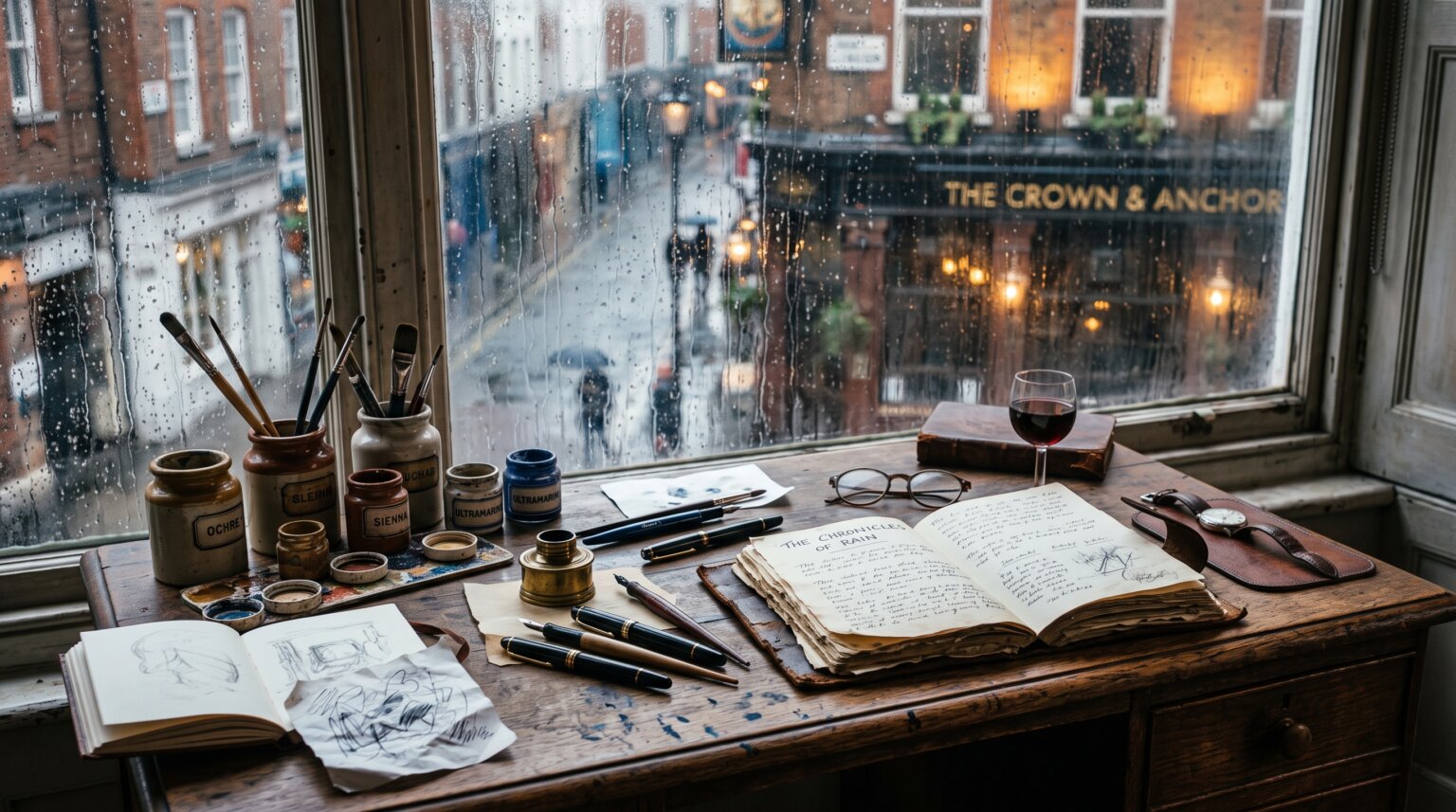
If you walked through Soho in the 1950s, you might have bumped into Francis Bacon at the French House, caught Dylan Thomas holding court at the Fitzroy Tavern, or spotted Lucian Freud sketching in a smoky corner of the Colony Room. Soho was not just a neighborhood. It was a living, breathing creative community where writers and painters shared drinks, ideas, studios, and sometimes the same cramped rooms above Dean Street bars.
The writers and painters who made Soho their home turned a square mile of cheap rents, late licenses, and permissive attitudes into one of the most important artistic communities in 20th-century Europe. This was London’s answer to the Left Bank in Paris, a bohemian utopia where post-war austerity met unbridled creative energy.
I have spent years researching this scene, walking the same streets, visiting the same pubs (those that survive), and digging through archives to understand what made Soho such a magnet for creative people. What I found is a story that goes far beyond Francis Bacon at the Colony Room. It is a story of writers who are nearly forgotten in this context, of women painters and muses who deserve more credit, and of a community that was always more diverse and international than the standard narrative suggests.
In this guide, I want to give you a fuller picture of Soho’s creative community than you will find anywhere else. That means covering the writers alongside the painters. It means naming specific addresses where these people actually lived. And it means being honest about what has changed and what remains.
Whether you are an art history student, a London enthusiast, or someone who stumbled onto the story of Bacon’s wild Soho nights and wanted to know more, this is the complete guide to the writers and painters who made Soho their home.
Table of Contents
Why Soho? The Making of a Bohemian Utopia
Soho became an artistic haven because it offered something nowhere else in post-war London could: cheap rooms, late-opening pubs, and a refusal to judge how anyone lived. After World War II, central London was scarred by bombing, rationing, and austerity. Soho, tucked between Oxford Street and Shaftesbury Avenue, had survived largely intact and had developed its own culture of resilience.
The neighborhood had always been a place for outsiders. Since the 17th century, Soho had been home to successive waves of immigrants, from French Huguenots to Italian and Jewish communities. This layered history gave Soho a cosmopolitan character that set it apart from the more homogeneous districts surrounding it.
For artists in the 1940s and 1950s, three things made Soho irresistible.
First, rent was cheap. Bomb-damaged buildings and neglected Georgian townhouses meant studios and bedsits could be had for a few shillings a week. An artist could actually afford to live and work in central London, something almost unimaginable today.
Second, the pubs stayed open. Soho had an exceptional concentration of licensed premises, many of which catered to an after-hours crowd. The French House on Dean Street famously served only half-pints, which meant drinkers had to return to the bar frequently, creating a constant swirl of conversation and encounter. This was not a bug. It was a feature of the community.
Third, Soho was permissive. At a time when homosexuality was criminalized in Britain, when censorship was enforced through the Lord Chamberlain’s office, and when conventional morality was enforced rigidly, Soho offered a sanctuary. Queer artists, writers exploring controversial subjects, and anyone who did not fit the post-war mold found that Soho’s streets and back rooms allowed them to exist more freely.
The result was an informal salon culture that no institution could replicate. You did not need a gallery to show your work when the walls of a pub would do. You did not need a publisher’s invitation to read poetry when the Fitzroy Tavern had an audience every Friday night. The creative infrastructure of Soho was its social life.
This is what competitors describing Soho’s art scene often miss. The pubs were not just where artists drank. They were where art was made, deals were struck, reputations were built, and movements were born. The French House, the Colony Room, the Fitzroy Tavern, and Gallery One were as important to British art history as any museum.
The Painters Who Made Soho Their Home
When people talk about the writers and painters who made Soho their home, the painters usually get all the attention. Francis Bacon and Lucian Freud dominate the conversation, and for good reason. They were towering figures who produced some of the most important paintings of the 20th century while living, drinking, and working in and around Soho.
But the painting community in Soho was larger and more varied than the Bacon-Freud duo suggests. Let me profile the key painters and give you a sense of who they were, where they worked, and what they created.
Francis Bacon: The Darling of Soho
Francis Bacon was Soho’s most famous artist and its most devoted resident. Born in Dublin in 1909, Bacon settled in London and made Soho the center of his universe from the 1940s until his death in 1992. He lived and worked at 7 Reece Mews in South Kensington but spent almost every waking hour in Soho’s pubs and clubs.
Bacon’s routine was legendary. He would start the day at the French House on Dean Street, move to the Colony Room on Frith Street for the afternoon, and end up gambling at private clubs late into the night. Michael Peppiatt, the art historian who knew Bacon personally, described how Bacon moved through Soho from breakfast to bed, treating the neighborhood as his living room, studio, and social circle all at once.
The paintings that made Bacon one of the most important artists of the 20th century, the screaming popes, the distorted triptychs, the raw studies of the human body, were fed by what he saw and felt in Soho. His lover and model George Dyer came from that world. His muse Henrietta Moraes was a Soho regular. The danger and intensity of Bacon’s work was the danger and intensity of Soho itself.
Bacon was also famously generous in Soho pubs. He would buy rounds for strangers, hand cash to people he barely knew, and treat the drinking den as his personal salon. The Colony Room’s proprietor Muriel Belcher once said Bacon was the only person who could keep up with her financially behind the bar.
Lucian Freud: The Intense Observer
Lucian Freud, grandson of Sigmund Freud, was Bacon’s friend, rival, and fellow Soho fixture. Born in Berlin in 1922, Freud moved to England as a child and established himself as one of the most powerful realist painters of his generation. His intense, psychologically penetrating portraits of friends, lovers, and working-class sitters were shaped by the same Soho world that produced Bacon’s work.
Freud lived at various addresses in and around Soho during his early career. He frequented the French House alongside Bacon, though the two painters had very different temperaments. Where Bacon was extroverted and chaotic, Freud was focused and methodical about his work. Their friendship was deep but competitive, and each pushed the other toward greater artistic risks.
Freud’s sitters often came from the Soho demimonde. He painted criminals, performers, and people from the margins of society with the same intense scrutiny he gave to aristocrats and royalty later in his career. His time in Soho gave him access to a world of faces and bodies that mainstream portraiture never touched.
Frank Auerbach, another towering figure in post-war British painting, was part of this same orbit. Though Auerbach is more closely associated with Camden Town, he was part of the same School of London circle that included Bacon and Freud. His thickly layered, almost sculptural paintings of London scenes captured the post-war city in a way that resonated with the Soho community’s sensibility.
Augustus John: The Early Bohemian
Before Bacon and Freud, there was Augustus John. Born in 1878, John was the original bohemian artist of Soho. He was famous for his charismatic personality, his many lovers, his Romany lifestyle, and his remarkable portrait drawings that captured the character of everyone from Thomas Hardy to Tallulah Bankhead.
John was a regular at the Fitzroy Tavern in the 1920s and 1930s, before the Colony Room existed. He helped establish the idea of Soho as a place where artists lived differently, where conventional morality did not apply, and where creative genius was its own justification. Every painter who came to Soho after John was walking through a door he had opened.
F.N. Souza and Gallery One: The International Voice
Francis Newton Souza is one of the most important and most overlooked figures in Soho’s art history. Born in Goa in 1924, Souza moved to London and became a central figure in the Soho scene of the 1950s. He was a co-founder of the Progressive Artists’ Group of Bombay before relocating to London, where his bold, provocative paintings of religious and erotic subjects attracted attention and controversy.
Victor Musgrave opened Gallery One at 1 Litchfield Street in Soho in 1953, and it became one of the most important galleries in post-war London. Gallery One showed Souza’s work alongside that of Yves Klein and other international artists. The Tate has called Gallery One a truly extraordinary space, and its role in bringing international and non-Western artists into the London art conversation cannot be overstated.
Souza’s presence in Soho challenges the narrative that this was a purely British phenomenon. The Soho art scene was international from the start, and artists from India, Europe, and elsewhere found in Soho the same freedom and community that British artists did.
The Writers Who Made Soho Their Home
Here is where this article departs from almost every competitor on the topic. The writers and painters who made Soho their home are usually treated as though only the painters mattered. But Soho’s literary history is just as rich, and the writers who drank, worked, and socialized in Soho pubs were as essential to the community as any painter.
Let me introduce you to the writers who made Soho their home, starting with the two most significant figures that competitors consistently underplay or omit entirely.
Dylan Thomas: The Poet of Soho Pubs
Dylan Thomas is one of the most important English-language poets of the 20th century, and Soho was his London territory. Born in Swansea in 1914, Thomas moved between Wales, London, and the United States, but whenever he was in London, he was in Soho.
Thomas was a fixture at the Fitzroy Tavern and later at the French House. He was famous (and sometimes infamous) for his drinking, but what gets lost in the stereotype is that Thomas was also a serious, disciplined writer who used Soho’s pub culture as his social and creative network. He read poetry, held court with other writers, and found in Soho the kind of literary community that sustained him between periods of intense work.
The Fitzroy Tavern on Charlotte Street, just north of Soho, was the heart of literary London in the 1930s and 1940s. Its Friday night literary gatherings, organized in part by the pub’s association with the local bohemian crowd, drew writers from across the city. Thomas was one of its most famous regulars, and his presence helped define the pub as a literary landmark.
Thomas died in New York in 1953 at age 39, but his legacy in Soho endured. The French House still keeps a connection to his memory, and you cannot tell the story of Soho’s literary scene without him.
George Orwell: Soho and the Real London
No competitor covering Soho’s creative community mentions George Orwell, and this is a significant oversight. Orwell’s connection to Soho was deep, documented, and central to some of his most important work.
Orwell lived at various addresses in central London throughout his career. His famous essay “Down and Out in Paris and London” drew on his experiences of poverty in the kinds of cheap lodging houses that dotted the Soho area. His time as a book reviewer, essayist, and political writer kept him in and around the Soho district, which he used as a kind of laboratory for understanding working-class London life.
Orwell’s essay “The Moon Under Water” describes his ideal pub, and many of the qualities he lists, the friendly atmosphere, the traditional decor, the sense of community, were drawn from Soho pubs he frequented. The pub culture that Orwell described and valued was the same culture that sustained the Soho creative community.
In “1984,” Orwell created one of the most powerful visions of totalitarian control in literature. The loss of personal freedom that Winston Smith experiences is the opposite of what Soho represented for creative people. Orwell understood, better than almost any writer, what was at stake when communities like Soho came under pressure from conformity and commercialization.
Orwell also worked as a literary editor and reviewer in the Soho-adjacent Fitzrovia area, and his journalism was deeply informed by the street-level reality of London life that Soho epitomized. To leave him out of the story of Soho’s literary community is to miss one of its most important voices.
Nina Hamnett: The Queen of Bohemia
Nina Hamnett deserves her own profile because she was both a painter and a writer, making her the literal embodiment of the writers and painters who made Soho their home. Born in Tenby, Wales in 1890, Hamnett was one of the most colorful and talented figures of the Soho scene.
Hamnett was a serious painter who studied at the Royal College of Art and exhibited with the London Group. She worked in both figurative and abstract styles and was friends with Roger Fry and the Bloomsbury Group. Her paintings hang in major collections including the Tate.
But Hamnett was also a writer. Her memoir “Laughing Torso,” published in 1932, is one of the essential documents of bohemian London and Paris between the wars. In it, she describes her encounters with Modigliani, her life in the Paris art world, and her circle of friends in London’s creative communities.
Hamnett was known as the Queen of Bohemia and was a fixture at the Fitzroy Tavern, where she held court with writers, artists, and musicians. The Times obituary described her as a brilliant and tragic figure, someone who embodied both the creative possibilities and the personal costs of the bohemian life.
Hamnett’s story is essential to understanding Soho because she bridges the gap between writers and painters. She was both. She lived the creative life to its fullest, and she wrote about it with honesty and flair.
Spike Milligan and Dan Farson: The Entertainer-Writers
Spike Milligan, the comedian and writer behind The Goon Show, was a regular presence in Soho pubs, particularly the French House and the Colony Room. Milligan’s surreal, boundary-pushing comedy was shaped by the permissive, anything-goes atmosphere of Soho. He was as much a writer as a performer, and his presence connected Soho’s literary and comedy scenes.
Dan Farson was a writer, broadcaster, and photographer who documented Soho’s nightlife in books and television. His memoirs provide some of the most vivid firsthand accounts of the Colony Room and its regulars. Farson’s work is essential reading for anyone who wants to understand what Soho actually felt like during its creative peak.
Women of Soho: Beyond the Canvas
One of the biggest gaps in competitor coverage is the role of women in Soho’s creative community. Most articles mention Nina Hamnett and Henrietta Moraes, but they are usually described as muses rather than as creative figures in their own right. This needs correcting.
Henrietta Moraes was a writer as well as a model. She was painted by Bacon, Freud, and Maggi Hambling, and her memoir “Henrietta” is a powerful account of Soho life in the 1950s and 1960s. She was not just a muse. She was an author, a personality, and a participant in the creative community on her own terms.
Molly Parkin is another essential figure. A painter, novelist, and fashion editor, Parkin was part of the Soho social scene and became friends with Bacon and other regulars. In a Tate interview, she described the Colony Room with vivid specificity, recalling how Muriel Belcher ran the club and how the atmosphere was simultaneously dangerous and liberating. Parkin went on to have a significant career as a writer and broadcaster.
Maggi Hambling, one of Britain’s most important contemporary painters, is part of the Soho tradition even though she is more associated with Suffolk and later periods. She painted Henrietta Moraes and was connected to the Soho social world through the French House and its network of artists.
The women of Soho were not accessories to the male artists’ genius. They were writers, painters, models who became artists, and personalities who shaped the community as much as anyone. Any account of the writers and painters who made Soho their home that omits them is incomplete.
The Pubs and Clubs That Built an Art World
Soho’s creative community was built on its social spaces. The pubs, clubs, and galleries of Soho were not backdrops to artistic production. They were the infrastructure of it. Here is a guide to the key venues where the writers and painters who made Soho their home gathered, worked, and created.
The Colony Room: Muriel Belcher’s Private Kingdom
The Colony Room at 41 Frith Street was the epicenter of Soho’s artistic social life from 1948 until it closed in 2008. Founded by Muriel Belcher, it was a private members’ drinking club that operated during the restrictive post-war licensing hours when ordinary pubs had to close.
Belcher was the force behind the Colony Room. She was sharp-tongued, fiercely intelligent, and absolutely in control of who got in and who did not. She cultivated an atmosphere that was simultaneously exclusive and welcoming to the right kind of creative misfit. Francis Bacon was one of her closest friends and most loyal regulars.
The Colony Room attracted painters, writers, actors, and anyone Belcher found interesting. It was a place where you could be yourself, no matter how unconventional that self was. For queer artists in an era when homosexuality was illegal, the Colony Room offered a rare safe space.
The French House: Half Pints and Full Talent
The French House at 49 Dean Street is one of the most storied pubs in London’s art history. Run for decades by Gaston Berlemont and later by Lesley Lewis, the French House served only half-pints, a tradition that forced patrons to return to the bar frequently and created a constant circulation of conversation and encounter.
Bacon and Freud were both regulars. Dylan Thomas drank there. The pub’s walls functioned as an informal gallery, and many artists got their first exposure by hanging work there. The French House was not a gallery, but it served the same purpose. It was where the art world met, traded ideas, and discovered new talent.
The French House is still open today, and it maintains a connection to the art world. Contemporary artists including John Claridge, whose “Soho Faces” photography project documented the neighborhood’s characters, and staff-artists like Eva Karkut-Law and Harry Spike have kept the pub’s creative tradition alive.
The Fitzroy Tavern: Literary Heart of Soho
The Fitzroy Tavern on Charlotte Street, at the northern edge of Soho, was the literary anchor of the neighborhood. From the 1920s through the 1950s, it was the gathering place for writers including Dylan Thomas, Augustus John, and Nina Hamnett. Its Friday night crowds were legendary in literary London.
The Fitzroy Tavern is where writers felt most at home. While the Colony Room was dominated by painters and the French House by a mix of both, the Fitzroy was where you went to talk about literature. It was less visually dramatic than the Colony Room but no less important to the creative ecosystem.
The Gargoyle Club: Above the Streets
The Gargoyle Club, located at 69 Dean Street on the upper floors, was a private members’ club that operated from 1925 to 1978. Founded by David Tennant, it attracted a mix of aristocrats, artists, and bohemians. Its Miró-decorated interior and exclusive atmosphere made it a more rarefied counterpart to the Colony Room.
The Gargoyle was where the Soho creative community overlapped with high society. Artists mixed with wealthy patrons, and careers were launched over cocktails rather than half-pints. It represented one side of Soho’s appeal, the possibility of moving between worlds.
Gallery One: Where the Art Actually Hung
Gallery One at 1 Litchfield Street was the real gallery in Soho’s creative ecosystem. Run by Victor Musgrave from 1953, it showed F.N. Souza, Yves Klein, Ida Kar, and other artists who challenged the conventions of the London art world. Gallery One brought international art into Soho and exported Soho’s artists to the world.
Without Gallery One, the Soho art scene would have lacked a critical platform. The Colony Room and French House were where artists socialized, but Gallery One was where they exhibited, sold work, and built the reputations that sustained their careers.
Addresses Where They Lived and Worked
One of the things competitors consistently fail to provide is specific addresses. For anyone interested in walking Soho and connecting creative figures to physical locations, here is a guide to where the writers and painters who made Soho their home actually lived and worked.
41 Dean Street was the address of the Colony Club, the forerunner of the Colony Room’s social scene. This address and its surroundings were ground zero for the Soho artistic community. Francis Bacon’s social world orbited around this block.
49 Dean Street remains the French House, still operational as a pub. The tradition of serving half-pints continues. The pub is a living piece of Soho’s creative history that you can visit today.
41 Frith Street was the Colony Room’s address from 1948 until its closure. The room is gone, but the building and the street retain the atmosphere of mid-century Soho.
1 Litchfield Street was Gallery One. It was here that F.N. Souza and other international artists showed work that changed the London art conversation.
48 Howard Street is where Christo and Jeanne-Claude, the environmental artists famous for wrapping buildings and landscapes, lived and worked for over 50 years. Their long Soho tenancy represents the international creative community that found a home in the neighborhood.
7 Reece Mews in South Kensington, just outside Soho proper, was Francis Bacon’s studio. He kept this address for decades but lived his social and creative life in Soho’s pubs and streets. The studio has been preserved and is a key site for Bacon scholars.
Walking these streets today, you can trace the geography of a creative community. The blocks between Dean Street, Frith Street, Old Compton Street, and Charlotte Street contain the entire world that the writers and painters who made Soho their home built together.
Soho Then and Now: The Changing Creative Landscape
If the writers and painters who made Soho their home were to visit today, they would recognize the street grid but not much else. Soho has undergone a dramatic transformation, and the creative community that defined it for decades has largely moved on.
Rising rents are the primary driver of this change. The cheap studios and bedsits that once made Soho accessible to struggling artists now cost as much as luxury apartments. Gentrification has replaced the bohemian population with corporate offices, chain restaurants, and upscale developments.
The licensing laws that made Soho’s pub culture unique have also changed. When pubs can stay open late everywhere, the special status that drew artists to Soho late at night no longer exists. The Colony Room closed in 2008. The Gargoyle Club has been gone since 1978. Gallery One closed decades ago.
People who actually lived in Soho during its artistic peak describe a village feeling that is impossible to recreate. On Reddit, users who remember Soho in the 1960s and 1970s talk about how you could walk down the street and know everyone, how the pub was an extension of your living room, and how creative encounters happened spontaneously rather than being scheduled.
Today, artists in London have migrated to other neighborhoods. Clerkenwell, Fish Island in East London, and other areas with cheaper rents have become the new creative hubs. The community that once defined Soho still exists, but it has been dispersed.
However, echoes remain. The French House is still open and still connected to the art world. John Claridge’s “Soho Faces” photography project documented the neighborhood’s characters, and exhibitions of Soho photography continue to draw audiences. The legacy of the writers and painters who made Soho their home has not been erased. It has been transformed.
The question for 2026 is whether Soho can maintain any of its creative heritage as commercial pressures intensify. Some argue that the spirit of the place, the permissiveness, the willingness to welcome outsiders, can survive even if the artists themselves cannot afford the rent. Others believe that without the actual presence of working artists and writers, Soho becomes just another commercial district with a historical plaque.
FAQs
What is the history behind Soho’s artistic community?
Soho became a bohemian utopia in the mid-20th century where writers, painters, poets, and performers lived, worked, and socialized together in a thriving counterculture. Its cheap rents, late-opening pubs, and permissive atmosphere made it London’s answer to the Left Bank in Paris, attracting artists like Francis Bacon, Lucian Freud, Nina Hamnett, and Dylan Thomas from the 1920s through the 1960s.
Who is the most famous artist associated with Soho?
Francis Bacon is the most famous artist associated with Soho. He lived and worked in and around the neighborhood from the 1940s until his death in 1992, treating Soho’s pubs like the French House and the Colony Room as his living room and creative network. His raw, intense paintings were deeply influenced by the Soho demimonde.
Where did writers hang out in Soho?
Writers in Soho gathered primarily at the Fitzroy Tavern on Charlotte Street, which hosted legendary Friday night literary gatherings, and the French House on Dean Street. Dylan Thomas was the most famous literary regular, but Nina Hamnett, Spike Milligan, and Dan Farson were also fixtures of the Soho pub scene.
Why did artists move to Soho in the 1940s and 1950s?
Artists moved to Soho because of cheap rent in bomb-damaged buildings, late-opening pubs that served as informal salons, and a permissive atmosphere that welcomed queer artists and unconventional lifestyles during a period of rigid post-war morality. Soho offered community, affordability, and freedom that no other London district could match.
What happened to Soho’s artistic community?
Soho’s artistic community gradually dispersed as rising rents, changing licensing laws, and gentrification pushed artists out. The Colony Room closed in 2008, and working artists migrated to cheaper areas like Clerkenwell and Fish Island in East London. The French House remains open and connected to the art world, but the village-like creative community is gone.
The Enduring Legacy of the Writers and Painters Who Made Soho Their Home
The writers and painters who made Soho their home created something that cannot be replicated, even though it has been romanticized, commercialized, and memorialized for decades. They built a community where creative people could live, work, and socialize without conforming to the expectations of mainstream society.
What made Soho special was not just the individual genius of Francis Bacon or Lucian Freud or Dylan Thomas. It was the network. The pubs where painters met writers. The galleries where international artists showed alongside British ones. The cheap rooms where a young artist could afford to fail and try again. The permissive atmosphere where queer artists could exist at a time when the law criminalized them.
The painters gave us some of the most important art of the 20th century. Bacon’s screaming popes, Freud’s intense portraits, Souza’s provocative religious canvases, and Hamnett’s bohemian figure studies all emerged from this specific time and place. Take Soho away and these works might not exist.
The writers gave us memoirs, poems, and journalism that documented a world that was already disappearing even as they wrote about it. Hamnett’s “Laughing Torso,” Farson’s memoirs, Orwell’s essays, and Thomas’s poetry all draw on the Soho experience. Their work is the record of a creative community that we can visit through their words.
The legacy of the writers and painters who made Soho their home is not just in the paintings on museum walls or the books on library shelves. It is in the idea that a creative community can exist outside institutional structures. It is in the proof that cheap rent, open pubs, and a refusal to judge can produce extraordinary art.
For anyone visiting Soho today, I recommend starting at the French House on Dean Street. Walk to Frith Street where the Colony Room once operated. Cross to Charlotte Street and the Fitzroy Tavern. Visit Litchfield Street where Gallery One showed Souza and Klein. And remember that every one of these addresses was once part of a living, breathing creative community that changed British art and literature forever.
The writers and painters who made Soho their home are gone from these streets. But what they created, the art, the writing, the legend, and the example, belongs to everyone who believes that creativity thrives best in communities where people are free to be themselves.