
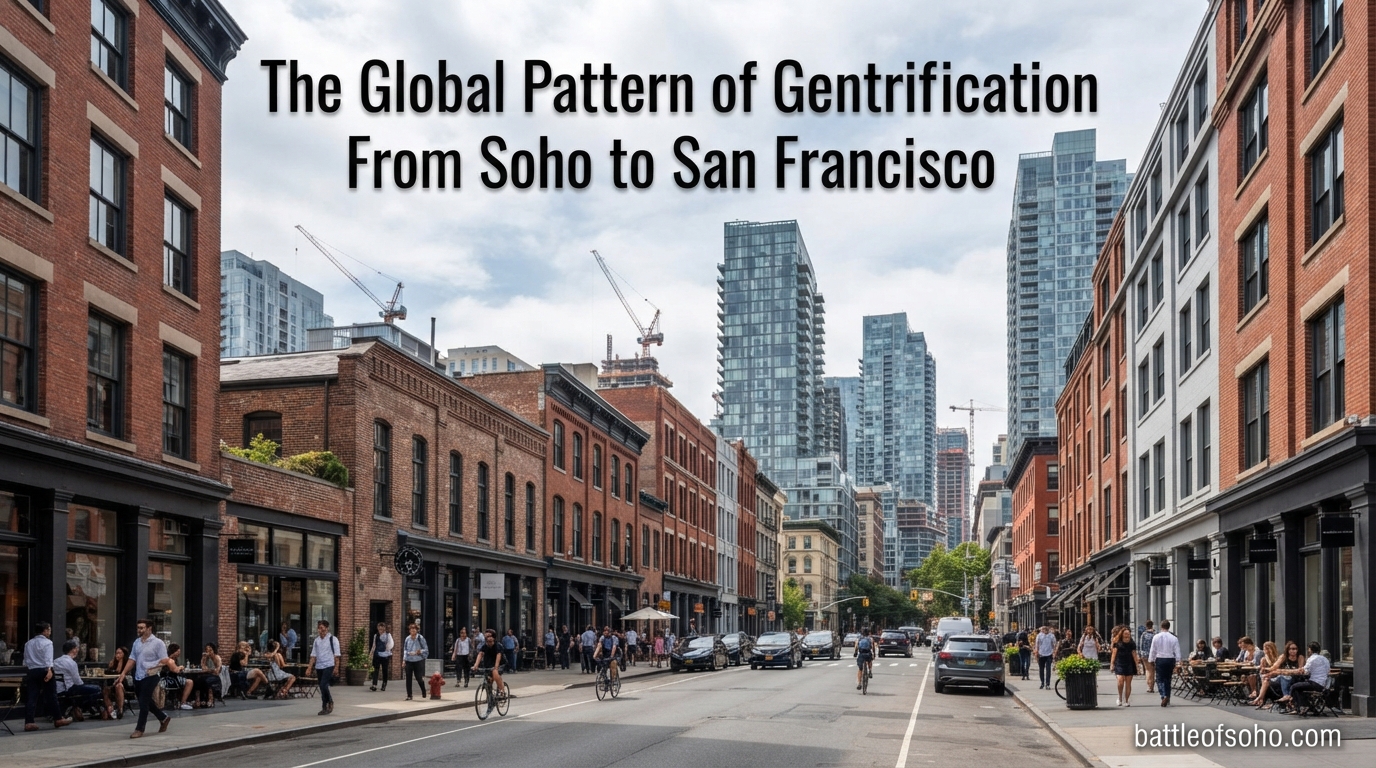
Gentrification is the process of urban renewal in which higher-income residents move into lower-income neighborhoods, driving up property values and displacing long-time residents. The global pattern of gentrification stretches from the artist lofts of SoHo in 1960s New York to the tech-fueled housing crisis in modern-day San Francisco, transforming communities in remarkably similar ways across decades and continents.
Our team has spent years studying urban development patterns across American cities. What we have found is that gentrification follows a predictable cycle. It starts with pioneers seeking affordable space, accelerates with capital investment, and ends with the displacement of the communities that gave these neighborhoods their character in the first place.
In this article, we trace that cycle from SoHo to San Francisco. We examine the history, the statistics, and the human cost. We also look at what makes these two cases different, what ties them together, and what the future holds for neighborhoods caught in the path of urban change in 2026.
Whether you are an urban planner, a community advocate, a sociology student, or someone who has watched your own neighborhood transform, this guide breaks down the global pattern of gentrification in clear, practical terms.
Table of Contents
What Is Gentrification? Understanding the Global Pattern of Gentrification
The global pattern of gentrification describes a worldwide phenomenon where working-class and low-income urban neighborhoods undergo transformation as wealthier residents move in, property values rise, and original residents face displacement. The term itself comes from the British sociologist Ruth Glass, who coined it in 1964 to describe the influx of middle-class “gentry” into working-class London neighborhoods.
Glass noticed something striking happening in London neighborhoods like Islington. Young professionals were buying up modest Victorian flats, renovating them, and pushing out the working-class families who had lived there for generations. She warned that this process would fundamentally change the social character of these areas. Sixty years later, her prediction has proven accurate on a global scale.
Today, gentrification is recognized as one of the most significant forces shaping modern cities. Researchers use census tract analysis and socioeconomic indicators to track its spread. The Freeman measure of gentrification, widely used in academic studies, identifies gentrifying neighborhoods based on changes in median household income, education levels, and property values over time.
Key characteristics define the gentrification process. Property values and rental prices climb sharply. New businesses, restaurants, and retail establishments replace long-standing community shops. The demographic makeup of the area shifts toward higher-income, often younger and more educated residents. And critically, lower-income residents face increasing pressure to leave as housing becomes unaffordable.
What makes this a global pattern rather than an isolated phenomenon is that it repeats with striking consistency across different cities, cultures, and economies. From New York to London, from Berlin to San Francisco, the same dynamics play out. Capital flows into undervalued neighborhoods, transforms them, and displaces the people who made them interesting in the first place.
What Are the 4 Types of Gentrification?
Urban researchers have identified several distinct types of gentrification, each driven by different mechanisms and producing different outcomes. Understanding these categories helps explain why the global pattern of gentrification takes different forms in different cities. The most widely recognized framework identifies four primary types.
1. Expeditionary Gentrification
Expeditionary gentrification occurs when individual pioneers, typically artists, students, or young professionals, move into a low-cost neighborhood on their own initiative. They are drawn by affordable rents, interesting architecture, or proximity to urban centers. SoHo in the 1960s is a classic example. Artists moved into vacant industrial lofts illegally at first, creating communities that eventually attracted wider attention and investment. This type of gentrification is bottom-up and organic in its early stages, but it sets the stage for more systematic transformation.
2. Incumbent Gentrification
Incumbent gentrification involves the upgrading of existing residents’ social and economic status within a neighborhood. Instead of new, wealthier residents moving in, the original residents experience income growth, educational advancement, or career success. They invest in their properties and the neighborhood gradually transforms. This type is less commonly discussed but represents a form of community change that does not necessarily involve displacement, at least in its early phases.
3. Super-Gentrification
Super-gentrification is a second wave of gentrification that hits neighborhoods already considered affluent. A 2025 study published in The Professional Geographer mapped super-gentrification across large US cities from 1990 to 2020. The researchers found that even neighborhoods that gentrified decades earlier are experiencing a second transformation as ultra-high-income residents, particularly finance and tech professionals, move in and push property values to extraordinary levels. Brooklyn Heights and parts of San Francisco exemplify this pattern. Super-gentrification represents the extreme end of the gentrification spectrum.
4. Transformation Gentrification
Transformation gentrification involves large-scale, often developer-driven or policy-driven changes to a neighborhood. This can include industrial conversion of buildings, massive condo development, or urban renewal projects backed by city governments. Unlike expeditionary gentrification, which starts organically, transformation gentrification is top-down and capital-intensive. San Francisco’s Mission District, where tech shuttles and new housing developments reshaped the community rapidly, fits this category.
These four types are not mutually exclusive. Many neighborhoods experience multiple waves of gentrification over time, blending expeditionary origins with transformation-scale development and eventually super-gentrification. SoHo itself has gone through all four stages over the past six decades.
The SoHo Transformation: How Artist Lofts Became Luxury Condos
SoHo, short for “South of Houston Street,” is one of the most famous examples of gentrification in the world. Its transformation from a declining industrial district to one of the most expensive neighborhoods in Manhattan illustrates the global pattern of gentrification in vivid detail. The story of SoHo spans roughly two decades, from 1960 to 1980, and it set the template for gentrification cycles that would repeat in cities worldwide.
The Industrial Origins
In the 1950s and early 1960s, SoHo was a grimy manufacturing district. Cast-iron buildings from the 19th century housed textile factories, tool shops, and small manufacturers. By day, the streets bustled with workers. By night, the area was largely deserted. The neighborhood was considered so undesirable that city planner Robert Moses proposed running a highway straight through it. That highway was never built, thanks to community opposition led by activist Jane Jacobs, but the episode illustrates how little value the city placed on the area at the time.
The Artist Invasion (1960s-1970s)
Everything changed when artists discovered SoHo’s industrial lofts. These vast, light-filled spaces were perfect for painting, sculpting, and living. Rents were astonishingly cheap because no one else wanted industrial space in a declining manufacturing zone. Artists like Chuck Close, Donald Judd, and Philip Glass moved in, technically violating zoning laws that prohibited residential use of industrial buildings.
The artists formed the Artist Tenant Association and lobbied the city for legal status. In 1971, New York passed the Artist in Residence (AIR) program, which legalized loft living for certified artists. This was a turning point. What had been a clandestine community of creative pioneers suddenly had official recognition. And once the legal barriers fell, wider interest followed.
Galleries and the Cultural Boom
By the mid-1970s, SoHo had become the center of the New York art world. Galleries opened on nearly every block. The neighborhood attracted collectors, critics, and tourists. Restaurants, cafes, and boutiques followed the galleries. What had been a desolate industrial zone was now a cultural destination. The very artists who had made SoHo desirable were now sharing their neighborhood with a much wealthier crowd.
Real Estate Transformation (Late 1970s-1980s)
The real estate industry noticed. Developers began buying up industrial buildings, converting them into luxury loft apartments, and marketing them to wealthy professionals who wanted to live in the trendy new neighborhood. Cast-iron facades that had been neglected for decades were restored to their original grandeur. Prices soared. The artists who had pioneered the neighborhood found themselves unable to afford the rents they had once paid.
By 1980, SoHo had completed its transformation. The manufacturers were gone. Most of the artists had been priced out. In their place were high-income residents, upscale retail, and some of the most expensive real estate in New York City. The neighborhood that artists had rescued from demolition had become unaffordable to artists.
The SoHo Legacy
SoHo became the blueprint for gentrification worldwide. The pattern it established, artists discover cheap space, culture flourishes, capital follows, original residents are displaced, has been repeated in neighborhoods from London’s Shoreditch to Berlin’s Kreuzberg. The SoHo transformation demonstrates how cultural creativity becomes a catalyst for economic speculation, often with painful consequences for the communities that created the cultural value in the first place.
Forums and community discussions we have reviewed reveal the lasting emotional impact. Many families who lived or worked in SoHo before the transformation describe a profound sense of loss. Some talk about being unable to recognize the neighborhood where they grew up. The physical buildings remain, but the community that once filled them is gone.
San Francisco Gentrification: The Tech Industry Effect
If SoHo represents the artist-driven model of gentrification, San Francisco represents the tech-driven model. The San Francisco Bay Area has experienced some of the most intense gentrification pressures of any American city in the 21st century. The global pattern of gentrification here is accelerated, fueled by enormous concentrations of wealth from the technology industry, and the displacement numbers are staggering.
The Scale of the Problem
According to data from the Urban Displacement Project at UC Berkeley, ongoing and advanced gentrification is most prevalent in San Francisco, affecting 18.5% of all census tracts in the city. Neighboring Alameda County, which includes Oakland, follows at 11.1% of tracts. These numbers represent tens of thousands of residents living in neighborhoods undergoing rapid transformation.
One analysis of San Francisco displacement data found that displacement was nearly twice as high in the 2000s compared to the 2010s. Specifically, approximately 11,645 households were displaced in the 2000s versus about 1,750 in the 2010s. While the rate slowed somewhat in the later decade, the cumulative damage to communities was already done. Those thousands of families did not return.
The Tech Boom and Housing Costs
The primary driver of San Francisco gentrification is the technology industry. The rise of companies like Google, Apple, Facebook, and countless startups created enormous wealth concentrated in a relatively small geographic area. Tech workers earning six-figure salaries flooded into San Francisco and the broader Bay Area, competing for limited housing stock.
The result was predictable and devastating for working-class residents. Housing costs skyrocketed. By 2026, San Francisco consistently ranks among the most expensive housing markets in the United States. Median rents far exceed what most non-tech workers can afford. Long-time residents, particularly in neighborhoods like the Mission District, Bayview-Hunters Point, and the Tenderloin, found themselves priced out of communities they had called home for decades.
The Mission District Story
The Mission District illustrates the San Francisco gentrification story better than any other neighborhood. Historically a working-class, predominantly Latino neighborhood, the Mission was known for its murals, family-owned restaurants, and tight-knit community. In the 2000s and 2010s, tech workers drawn by the neighborhood’s culture and central location began moving in.
Google and other tech companies ran private shuttle buses through the Mission, picking up employees for the commute to Silicon Valley campuses. The sight of these sleek buses rolling through streets that had once been the domain of local businesses became a flashpoint for community anger. Protesters blocked the buses, arguing that they symbolized the tech industry’s colonization of working-class neighborhoods.
Rents in the Mission doubled and then doubled again. Family-owned taquerias and bodegas were replaced by artisanal coffee shops and coworking spaces. The Latino population, which had been the cultural backbone of the neighborhood for generations, declined steadily. For many residents, this was not just an economic loss but a cultural catastrophe.
Cultural Displacement in San Francisco
Research from the National Community Reinvestment Coalition (NCRC) emphasizes that gentrification in San Francisco and other American cities is not only an economic phenomenon but a cultural one. Black cultural displacement has been a particularly severe consequence. Across the 50 largest US cities, the NCRC documented that the number of gentrifying neighborhoods increased from 246 in the 1970s to nearly 1,000 in more recent decades.
In San Francisco specifically, the Black population has declined dramatically over the past several decades. Communities that were once centers of Black culture and commerce have been hollowed out. The NCRC report, titled “Displaced By Design,” argues that this displacement was not accidental but resulted from policy choices, housing discrimination, and economic forces that systematically displaced vulnerable communities.
The Bay Area Ripple Effect
Gentrification in San Francisco does not stop at the city limits. As housing prices push residents out of San Francisco proper, they move to surrounding areas. Oakland, Berkeley, Richmond, and even cities farther out like Antioch and Stockton have absorbed displaced San Francisco residents. But this ripple effect spreads gentrification pressures outward, creating new displacement in communities that were previously affordable. The Urban Displacement Project’s interactive maps document this chain reaction across the entire Bay Area.
Forum discussions we analyzed reveal the human side of these statistics. On Reddit’s r/SanJose, r/Urbanism, and r/povertyfinance, users share stories of being forced to leave neighborhoods where their families lived for generations. Many describe the pain of watching their communities transform beyond recognition. Some express frustration that neighborhood improvements, like new parks or better transit, only accelerate the displacement process by making the area more attractive to wealthy newcomers.
SoHo vs San Francisco: Comparing the Global Pattern of Gentrification
Comparing SoHo and San Francisco side by side reveals both the universal nature of gentrification and the unique factors that shape it in different contexts. Both cases follow the same fundamental pattern, but the drivers, timelines, and outcomes differ in instructive ways. Understanding these parallels and contrasts is key to grasping the global pattern of gentrification.
Drivers: Artists vs Tech
SoHo’s gentrification was originally driven by individual artists seeking affordable creative space. The transformation was organic at first, grassroots and cultural. It was years before large-scale developers entered the picture. San Francisco’s gentrification, by contrast, has been primarily driven by a single industry with enormous concentrated wealth. Tech companies and their highly paid employees moved into existing neighborhoods and immediately disrupted housing markets. The pace was faster, the scale larger, and the cultural displacement more rapid.
Timeline: Decades vs Years
SoHo’s transformation unfolded over roughly two decades, from the early 1960s to around 1980. This gave the community time to adapt, resist, and negotiate, though ultimately the outcome was still displacement. San Francisco’s transformation has been compressed. The tech boom that began in the late 1990s accelerated dramatically in the 2000s and 2010s. Neighborhoods changed character in a matter of years, not decades. This compressed timeline left even less room for community response or policy intervention.
Displacement Patterns
Both cases produced significant displacement, but the nature of that displacement differed. In SoHo, the displaced were primarily artists, manufacturers, and working-class families. The displacement was real but affected a relatively contained geographic area. In San Francisco, displacement has affected tens of thousands of households across the entire Bay Area, creating a regional housing crisis that extends far beyond any single neighborhood.
Common Patterns
Despite these differences, the common patterns are striking. In both cases, capital flowed into undervalued neighborhoods. Property values rose sharply. New businesses replaced established community institutions. Long-time residents were priced out. And the cultural character that made these neighborhoods attractive in the first place was largely erased by the time the transformation was complete. This is the essence of the global pattern of gentrification: the very qualities that attract investment are the qualities that investment ultimately destroys.
Both SoHo and San Francisco also demonstrate the role of policy in either accelerating or mitigating gentrification. New York’s AIR program legalized artist living in SoHo but also opened the door to wider residential conversion. San Francisco’s housing policies, zoning restrictions, and limited affordable housing stock all contributed to the severity of its gentrification crisis. In both cases, policy decisions shaped who could stay and who was forced to leave.
Causes and Drivers of Gentrification
The causes of gentrification are complex and interconnected. No single factor produces gentrification on its own. Instead, a combination of economic, policy, cultural, and demographic forces converge to create the conditions for neighborhood transformation. Understanding these drivers is essential for anyone trying to address or prevent displacement in vulnerable communities.
Economic Factors
Economic inequality is the root driver of gentrification. When there is a large gap between what wealthy residents can pay and what low-income residents can afford, neighborhoods become targets for investment. Real estate developers and investors seek out undervalued properties in areas with potential for appreciation. The profit motive is powerful. A building purchased cheaply in a working-class neighborhood can be renovated and resold or rented at a substantial premium once the area gentrifies.
The concentration of wealth in specific industries amplifies this dynamic. In SoHo, the growth of the financial sector in Manhattan created a pool of high-income professionals seeking urban housing. In San Francisco, the tech industry performed the same function. In both cases, the influx of high-earning workers created demand that the existing housing supply could not meet without massive price increases.
Policy and Government Action
Government policy plays a crucial role in shaping gentrification. Zoning laws determine what can be built where. Historic preservation designations can protect buildings but also drive up property values. Tax incentives for development can channel investment into specific neighborhoods. Public transportation decisions make some areas more accessible and therefore more desirable.
In some cases, government policies actively accelerate gentrification. Urban renewal programs, tax abatements for developers, and infrastructure investments can all increase property values in ways that benefit new residents while pricing out existing ones. The NCRC report on cultural displacement argues that many of these policies are not neutral but effectively design displacement into the urban planning process.
Cultural and Demographic Shifts
Cultural preferences drive gentrification as well. The growing appeal of urban living among young, educated, and affluent populations has increased demand for city neighborhoods. After decades of suburban flight, cities are once again seen as desirable places to live. This cultural shift has put enormous pressure on the urban neighborhoods that were historically home to working-class and minority communities.
Research published in Urban Studies found that immigration also plays a role in gentrification dynamics. The rise of immigration after 1965 brought new pioneers to many low-income central-city neighborhoods, spurring demographic change that sometimes preceded or accompanied gentrification. The interplay between immigration, class upgrading, and gentrification is complex and varies significantly by city and neighborhood.
Effects on Original Residents and Communities
The effects of gentrification on original residents are profound and multifaceted. While proponents often point to neighborhood improvements like reduced crime, better services, and new amenities, the costs for existing residents frequently outweigh these benefits. The global pattern of gentrification consistently produces both economic and cultural displacement, and the human toll is significant.
Economic Displacement
Economic displacement is the most direct and measurable consequence of gentrification. As property values and rental prices rise, low-income residents can no longer afford to stay. Renters face eviction or non-renewal of leases as landlords seek higher-paying tenants. Homeowners face rising property taxes that can force them to sell. The NCRC study documented that across American cities, thousands of lower-income and minority households have been displaced by gentrification over the past five decades.
The impact extends beyond housing. Local businesses that served the original community often close as their customer base is displaced and rents increase. Grocery stores, barbershops, community centers, and places of worship disappear. The economic infrastructure of the neighborhood is dismantled along with its residential base.
Cultural Displacement
Cultural displacement is harder to quantify but equally devastating. When a neighborhood’s demographic composition changes dramatically, the cultural identity of the community changes with it. The NCRC report focuses specifically on Black cultural displacement, documenting how gentrification has erased Black community institutions, businesses, and social networks from neighborhoods across the United States.
This cultural erasure is what many residents feel most acutely. Forum users we studied describe walking through their former neighborhoods and feeling like strangers. The language they hear has changed. The stores they frequented are gone. The community bonds that sustained families for generations have been severed. This sense of loss, of being pushed out of your own home, is at the heart of why gentrification is considered harmful.
Health and Well-Being Impacts
Research has linked gentrification to negative health outcomes for displaced residents. Forced relocation is associated with increased stress, anxiety, and depression. Displaced residents often move to areas with fewer resources, less access to healthcare, and weaker social support networks. Children who are forced to change schools experience educational disruption that can affect them for years. The full human cost of gentrification extends far beyond housing statistics.
The Paradox of Improvement
One of the most challenging aspects of gentrification is that it often brings genuine improvements to neighborhoods. Crime rates may decline. Public spaces may be improved. New businesses add amenities and services. But these improvements primarily benefit the incoming affluent residents, not the existing community that was displaced to make way for them. As forum users noted, this creates a painful paradox: the neighborhood gets better, but not for the people who needed it to get better.
FAQs
Is SoHo an example of gentrification?
Yes, SoHo is one of the most famous examples of gentrification in the world. In the 1960s, artists moved into vacant industrial lofts in this declining Manhattan manufacturing district. Over the next two decades, their creative presence attracted galleries, restaurants, and eventually developers who converted the lofts into luxury apartments. By 1980, the artists and manufacturers had been largely priced out, and SoHo had become one of the most expensive neighborhoods in New York City.
Is San Francisco being gentrified?
Yes, San Francisco is actively experiencing gentrification. According to the Urban Displacement Project at UC Berkeley, 18.5% of San Francisco census tracts are undergoing ongoing or advanced gentrification. The tech industry has been the primary driver, with high-paid workers driving up housing costs and displacing long-time residents, particularly in neighborhoods like the Mission District and Bayview-Hunters Point.
What is the most gentrified city in America?
Studies vary in their rankings, but San Francisco, New York, Boston, and Washington, D.C. consistently rank among the most gentrified cities in America. The NCRC identified nearly 1,000 gentrifying neighborhoods across the 50 largest US cities. San Francisco has the highest percentage of census tracts experiencing active gentrification at 18.5%, making it one of the most intensely gentrified cities in the country.
What are the 4 types of gentrification?
The four main types of gentrification are: (1) Expeditionary gentrification, where artists and young professionals organically move into affordable areas. (2) Incumbent gentrification, where existing residents experience income growth and upgrade their neighborhood. (3) Super-gentrification, a second wave that affects already-wealthy areas as ultra-high-income residents move in. (4) Transformation gentrification, involving large-scale developer-driven or policy-driven changes like industrial conversions and condo development.
Why is gentrification bad for original residents?
Gentrification harms original residents through economic displacement, as rising rents and property taxes force them out of their homes and neighborhoods. It also causes cultural displacement, erasing community institutions, businesses, and social networks that existed for generations. Research links gentrification-driven relocation to increased stress, anxiety, disrupted education for children, and reduced access to healthcare and social support networks.
How does gentrification start in neighborhoods?
Gentrification typically begins when artists, students, or young professionals discover an affordable neighborhood with appealing characteristics like historic architecture or central location. Their presence creates cultural cachet that attracts galleries, cafes, and new businesses. This increased attention draws real estate investors and developers, who begin buying and renovating properties. Property values rise, rents increase, and the original residents face mounting pressure to leave as the cycle accelerates.
The Future of the Global Pattern of Gentrification
The global pattern of gentrification, traced from SoHo to San Francisco, shows no signs of slowing. If anything, the forces driving neighborhood transformation are intensifying. Super-gentrification is reshaping already-affluent areas. The spread of remote work in the post-pandemic era has extended gentrification pressures beyond traditional urban cores into smaller cities and towns. The pattern that began in SoHo in the 1960s has gone global, reaching cities on every continent.
What can be done? Community land trusts, affordable housing mandates, tenant protections, and inclusive zoning policies offer potential tools for mitigating displacement. Some cities are experimenting with anti-displacement strategies that aim to capture the benefits of neighborhood investment without expelling existing residents. But these solutions require political will, sustained funding, and a willingness to prioritize people over property values.
The story of gentrification from SoHo to San Francisco is ultimately a story about who gets to live in a city. As we move through 2026 and beyond, that question will only become more urgent. The global pattern of gentrification will continue to reshape neighborhoods, but whether it does so at the expense of existing communities or in partnership with them is a choice that cities, policymakers, and residents still have the power to make.
Understanding this pattern is the first step toward changing it. We hope this guide has given you a clear picture of how gentrification works, why it matters, and what is at stake for communities around the world.