
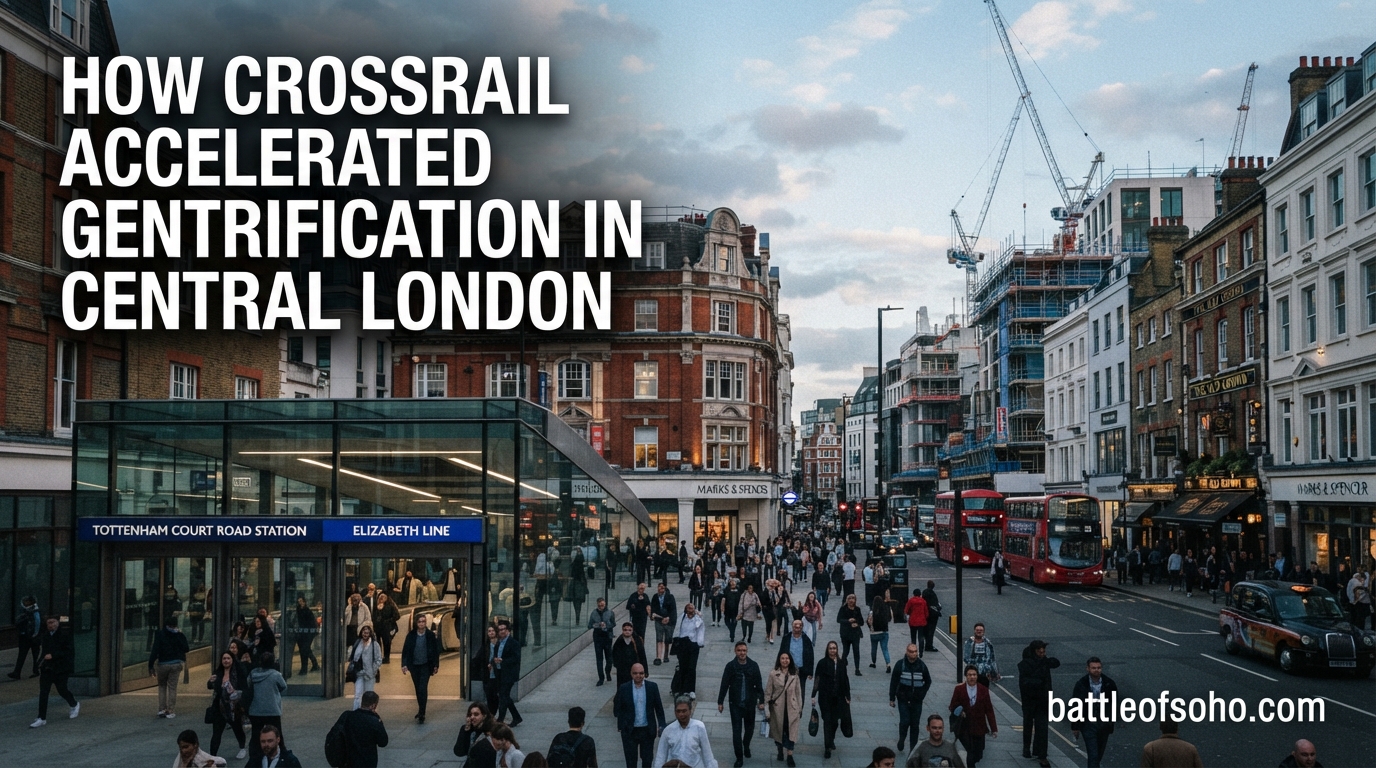
When the Elizabeth line finally opened its doors in May 2022, it was supposed to be the crowning achievement of London’s transport infrastructure. Instead, it became something far more complicated. Crossrail, as the project was known during its long and troubled construction phase, has accelerated gentrification across central London at a pace that has caught residents, planners, and even developers off guard.
The numbers tell part of the story. According to the London Property Alliance, areas within a 10-minute walk of Elizabeth line stations accounted for 51% of all central London office take-up in 2023. Nearly 200,000 new office jobs emerged alongside the line, bringing 171 hotels, 2,666 food and beverage outlets, and 12 museums. But behind those figures lies a more human story about how Crossrail accelerated gentrification in Central London, one of displacement, rising rents, and communities transformed beyond recognition.
In this article, our team breaks down exactly how a rail project became a gentrification engine. We look at property price data, neighborhood-level changes, community displacement patterns, and the economic opportunities that came with the transformation. Whether you are a London renter feeling the squeeze, a property investor eyeing the next hotspot, or an urban planner studying the social effects of mega transport projects, the Crossrail story offers lessons that extend well beyond the M25.
Table of Contents
What Is Crossrail and the Elizabeth Line?
Crossrail is one of the largest infrastructure projects Europe has ever undertaken. Conceived in the 1940s but not approved until 2008, the project aimed to build a new east-west railway crossing through central London, connecting 41 stations across 100 kilometres of track. The result is a hybrid urban-suburban rail service known today as the Elizabeth line.
Construction began in 2009, with an original completion target of 2018. Delays, budget overruns, and engineering challenges pushed the opening to May 2022 for the central section, with the full line operational by November 2022. The final cost reached roughly 19 billion pounds, nearly 4 billion over the original budget.
The Elizabeth line serves key stations including Paddington, Bond Street, Tottenham Court Road, Farringdon, Liverpool Street, Canary Wharf, Abbey Wood, and Shenfield. It connects Heathrow Airport to the west with Reading and Shenfield to the east, passing through some of London’s most economically diverse neighborhoods. This connectivity was the whole point. But the same feature that made the line so useful for commuters also made the surrounding areas attractive to developers, investors, and higher-income residents.
The relationship between transport infrastructure and gentrification is well-documented in academic literature. When a new high-capacity rail line improves accessibility to an area, property values rise, new businesses move in, and wealthier residents follow. Crossrail simply applied this pattern at a scale London had not seen since the Jubilee Line extension in 1999.
How the Elizabeth Line Affected Property Prices
Property prices along the Elizabeth line route began climbing years before the first train ran. Estate agents and property investors understood what was coming, and the market responded accordingly. Knight Frank, in partnership with the London Property Alliance, documented some of the most striking figures in their Crossrail Effect research.
Here is what the data shows about how the Elizabeth line affected property prices across different station areas:
Central London stations saw the most dramatic commercial effects. The London Property Alliance reported that 51% of central London office take-up in 2023 happened within a 10-minute walk of Elizabeth line stations. Office occupancy rates near stations jumped by 11 percentage points compared to pre-Crossrail levels. This concentration of commercial activity drove up demand for nearby residential property as well.
East London areas experienced steep residential price increases. Areas like Abbey Wood, Custom House, and Ilford, previously considered affordable pockets of London, saw property values surge by 20% to 30% in the years leading up to and following the Elizabeth line opening. Abbey Wood, in particular, became a poster child for Crossrail gentrification, with some reports suggesting price growth well above the London average.
Rents spiralled in station catchment areas. Reddit users on r/london and r/AskLondon have repeatedly described Elizabeth line rents as having spiralled out of control. A flat that might have rented for 1,200 pounds per month in 2019 near a station like Canary Wharf or Stratford saw significant increases by 2026. The pattern repeated across the route, with landlords citing improved transport links as justification for above-inflation rent hikes.
The price premium extended well beyond the immediate station vicinity. Research from academic institutions including work published on ResearchGate showed that the gentrification effects of Crossrail rippled outward. Properties up to a kilometre from Elizabeth line stations experienced price uplifts, though the effect diminished with distance. This created concentric rings of gentrification pressure around each station.
Outer London and beyond saw a different pattern. In areas like Slough and Ealing, the Elizabeth line brought a different kind of transformation. While property prices rose, residents in these areas tended to view the changes more positively than those in central London. The TfL baseline evaluation case study found that gentrification was perceived more negatively by participants from central London stations compared to outer areas.
It is worth noting that these price increases did not happen in a vacuum. London’s broader housing crisis, driven by decades of underbuilding and population growth, amplified the effects. Some argue that Crossrail was simply making existing problems more visible in specific postcodes rather than creating them from scratch.
Neighborhood Transformation Along the Elizabeth Line
The neighborhood-level changes along the Elizabeth line route go far beyond property prices. Whole streetscapes have been reshaped, with independent shops replaced by chain stores, local pubs turned into cocktail bars, and cultural venues pushed out by rising commercial rents. Our team looked at how Crossrail changed specific areas to understand the pattern.
East London bore the brunt of residential gentrification. Areas along the eastern stretch of the Elizabeth line, including Whitechapel, Mile End-adjacent pockets, Stratford, and Custom House, experienced the most visible transformation. Whitechapel, long a working-class area with a vibrant Bangladeshi community, saw an influx of young professionals drawn by the new station. Local markets and family-run businesses found themselves competing with new coffee shops, co-working spaces, and artisanal food outlets catering to the new demographic.
Canary Wharf and the Isle of Dogs intensified their existing trajectory. The Elizabeth line station at Canary Wharf accelerated changes already underway. The area, already dominated by financial services, saw further residential development aimed at high-earning professionals. The 11 percentage point increase in office occupancy near stations was particularly pronounced here, drawing even more corporate activity and the services that support it.
Cultural venue displacement became a flashpoint. One of the most under-covered aspects of how Crossrail accelerated gentrification in Central London is the displacement of cultural spaces. Music venues, independent galleries, and community arts spaces near Elizabeth line stations faced rent increases that made continuation impossible. Forum discussions on Reddit and SkyscraperCity repeatedly highlighted the loss of local pubs and grassroots music venues as areas gentrified. This is a content gap that most competitors fail to address in depth.
Small businesses were squeezed between chains. Local shop owners along the route reported mounting pressure as commercial rents rose alongside residential ones. Family-run businesses that had operated for decades near stations like Tottenham Court Road and Bond Street found themselves unable to compete with national chains willing to pay premium rents for the now-prime locations. The arrival of 2,666 new food and beverage outlets along the line sounds impressive on paper, but many of those replaced existing local establishments rather than adding to the total.
The transformation was not uniform. Some areas resisted change more successfully than others. Neighborhoods with strong existing community networks, active resident associations, and heritage protections experienced slower gentrification. But even these areas felt the indirect pressure as displaced residents and businesses from neighbouring postcodes moved in, bringing their own changes with them.
Community Displacement and Social Impact
This is where the story of Crossrail gentrification gets most uncomfortable. Behind the statistics and the gleaming new stations are real people who lost their homes, their communities, and their sense of place. Understanding these impacts is essential if we are to have an honest conversation about what mega transport projects actually do to cities.
Long-term residents faced unaffordable rent increases. The most immediate social impact of Crossrail gentrification was the squeeze on renters. Tenants in privately rented accommodation near Elizabeth line stations faced rent increases that far outpaced wage growth. Some Reddit users described being forced to move multiple times within a few years as each new landlord sought to capitalise on the area’s improved desirability. The TfL case study report confirmed that gentrification was perceived negatively by central London residents, particularly around displacement pressures.
Working-class communities were disproportionately affected. The academic research published on ResearchGate applied multi-criteria analysis to assess the likelihood of gentrification and displacement around Crossrail stations. The findings were clear. Areas with lower average incomes, higher proportions of social housing, and more diverse populations were the most vulnerable to displacement. The Elizabeth line effectively accelerated a pattern that had been building for decades, concentrating its effects on communities least able to absorb them.
The commute paradox hit displaced renters hard. One of the cruellest ironies of Crossrail gentrification is that the people who needed the line most were the ones pushed away from it. Renters forced to move further from Elizabeth line stations often found their commutes longer and more difficult, even as the new railway promised faster journeys for those who could afford to live nearby. Forum users on r/london described this dynamic vividly, noting that the line they had looked forward to for years was now serving wealthier newcomers rather than the communities who had endured the construction disruption.
Social diversity eroded in station catchment areas. The Royal Geographical Society’s educational resource on the Elizabeth line noted the influx of young professionals and, in their words, incomers into previously marginalised areas. While the language used in academic sources can be careful, the lived experience described in forums was more direct. Residents spoke of streets that no longer felt familiar, of neighbours replaced by strangers, and of a loss of community character that no amount of new coffee shops could compensate for.
The housing crisis context matters. Some commentators on forums pushed back against placing all the blame on Crossrail. They argued that London’s failure to build enough housing, particularly social housing, was the root cause of displacement. In this view, gentrification is a symptom of the housing shortage, and Crossrail simply made the symptoms more visible in specific locations. There is truth to this argument, but it does not change the fact that the Elizabeth line concentrated gentrification pressure along its route in ways that other transport projects had not.
Displacement is not always physical. Some residents stayed in their homes but found their neighborhoods unrecognisable. This cultural displacement, where people remain in place but feel alienated from their changing surroundings, is harder to measure but equally significant. The closure of familiar shops, the replacement of community venues with corporate spaces, and the shift in the social makeup of an area all contribute to a sense of loss that does not show up in housing statistics.
It is important to acknowledge that not all displacement stories are the same. Some residents benefited from the changes, welcoming improved transport, cleaner streets, and new amenities. The picture is not monolithic, and pretending otherwise undermines the credibility of any analysis. But the weight of evidence, both academic and anecdotal, suggests that for many long-term residents, the costs of Crossrail gentrification outweighed the benefits.
Economic Opportunities Brought by Crossrail
To present a balanced picture, we need to look at the economic opportunities that came with the Elizabeth line. The same forces that displaced communities also created jobs, attracted investment, and regenerated areas that had been neglected for decades. Understanding these benefits is not about dismissing the costs but about seeing the full picture.
The headline figures are genuinely impressive. The London Property Alliance’s Crossrail Effect report documented that the Elizabeth line has sparked almost 200,000 new office jobs. This is not a projection or a forecast. It is a measured outcome. The opening of 171 hotels, 2,666 food and beverage outlets, and 12 museums along the route represents real economic activity and real employment.
Central London’s office market was revitalised. The 51% figure for office take-up near Elizabeth line stations in 2023 is staggering. It means that more than half of all new office leases in central London were signed within a short walk of an Elizabeth line station. This concentration of commercial activity has made London more competitive internationally, attracting businesses that might otherwise have chosen Paris, Frankfurt, or Dublin.
Construction and related industries benefited during the build phase. The 13-year construction period supported thousands of jobs in engineering, construction, and related trades. While the project faced criticism for delays and cost overruns, the employment generated during construction was a genuine economic positive, particularly for workers in east London and the Thames Gateway area.
Improved connectivity created new commuting patterns. The Elizabeth line made it possible to travel from Reading to central London in under an hour, and from Shenfield to Paddington in a single change-free journey. This improved connectivity opened up new housing options for commuters and allowed businesses to draw from a wider labour pool. For some workers, the line genuinely improved quality of life by reducing travel times and expanding access to jobs.
Regeneration brought tangible improvements to some areas. In places like Abbey Wood and Custom House, the Elizabeth line brought infrastructure investment that these areas had lacked for decades. New public spaces, improved station environments, and better pedestrian access were genuine upgrades. The question is not whether these improvements happened but whether they were distributed equitably and whether existing residents were able to benefit from them.
The economic story of Crossrail is real and should not be dismissed. But it is also a story that tends to be told by those who benefited from it, including property developers, estate agents, and business lobby groups. The voices of displaced residents, closed businesses, and changed communities deserve equal weight in any honest assessment.
What the Future Holds for Crossrail Communities
The Elizabeth line is now fully operational, but the gentrification pressures it created are still unfolding. Property markets typically take years to fully adjust to major infrastructure changes, and the Elizabeth line is no exception. What can we expect in the coming years?
Gentrification pressure will continue to spread outward from stations. The concentric rings of price increases that researchers identified will keep expanding. Areas that are currently on the edge of the Elizabeth line effect will see intensifying pressure as developers and investors look for the next opportunity. This means communities in places like Ilford, Romford, and even beyond the M25 may face the same dynamics that transformed Whitechapel and Abbey Wood.
Policy responses remain inadequate. Despite the evidence of displacement, policy measures to protect existing residents have been limited. Some boroughs have introduced selective licensing schemes, rent review processes, and affordable housing requirements on new developments. But these measures are piecemeal and vary significantly from one borough to another. A coordinated, route-wide approach to managing Crossrail gentrification has yet to emerge.
The lessons extend beyond London. Cities around the world are watching the Crossrail experience closely. Mega transport projects in Sydney, Paris, and other major cities face similar questions about who benefits and who pays the price. The Crossrail story offers a case study in both the transformative potential and the social costs of large-scale transport investment, and policymakers would do well to study it carefully before committing to similar projects elsewhere.
Frequently Asked Questions
What areas in London have been most affected by Crossrail gentrification?
The areas most affected by Crossrail gentrification include Whitechapel, Abbey Wood, Custom House, Canary Wharf, Stratford, Ilford, and Paddington. East London stations experienced the most visible residential transformation, while central London stations saw concentrated commercial gentrification.
How has the Elizabeth line affected property prices?
The Elizabeth line increased property prices by 20% to 30% in previously affordable areas like Abbey Wood and Ilford. In central London, 51% of office take-up in 2023 occurred within a 10-minute walk of Elizabeth line stations. Rents near stations rose significantly above inflation, with Reddit users describing spiralling costs.
What are the negative effects of Crossrail on local communities?
The negative effects include displacement of long-term residents due to unaffordable rent increases, loss of cultural venues and independent businesses, erosion of social diversity in station areas, and longer commutes for renters forced to move away from stations. Working-class communities were disproportionately affected.
How has Crossrail changed east London neighborhoods?
Crossrail transformed east London neighborhoods by attracting young professionals, replacing independent shops with chains, driving up rents, and changing the cultural character of areas like Whitechapel and Abbey Wood. Family-run businesses and community spaces were particularly affected by rising commercial rents.
What is the relationship between transport infrastructure and gentrification?
Transport infrastructure accelerates gentrification by improving area accessibility, which raises property values and attracts higher-income residents and new businesses. This process displaces existing communities who can no longer afford rising rents. Crossrail applied this pattern at an unprecedented scale across central and east London.
Conclusion
Understanding how Crossrail accelerated gentrification in Central London requires holding two truths at once. The Elizabeth line is a remarkable engineering achievement that has brought genuine economic benefits, improved connectivity, and new opportunities to parts of London that needed investment. It is also a project that concentrated gentrification pressure along its route, displaced communities, and accelerated changes that many residents experienced as loss rather than progress.
The data is clear on both sides. Nearly 200,000 new jobs, billions in economic activity, and transformed public spaces stand alongside rising rents, displaced families, and eroded community character. The challenge for London and for other cities considering similar projects is to find ways to capture the benefits of mega transport investment without leaving existing communities behind.
If there is a lesson from the Crossrail story, it is that infrastructure does not happen in a vacuum. Every new station, every new line, and every improved connection has social consequences that extend far beyond the railway itself. Planning for those consequences, rather than treating them as an afterthought, is the real test of whether transport investment serves everyone or simply those who can already afford to benefit.