
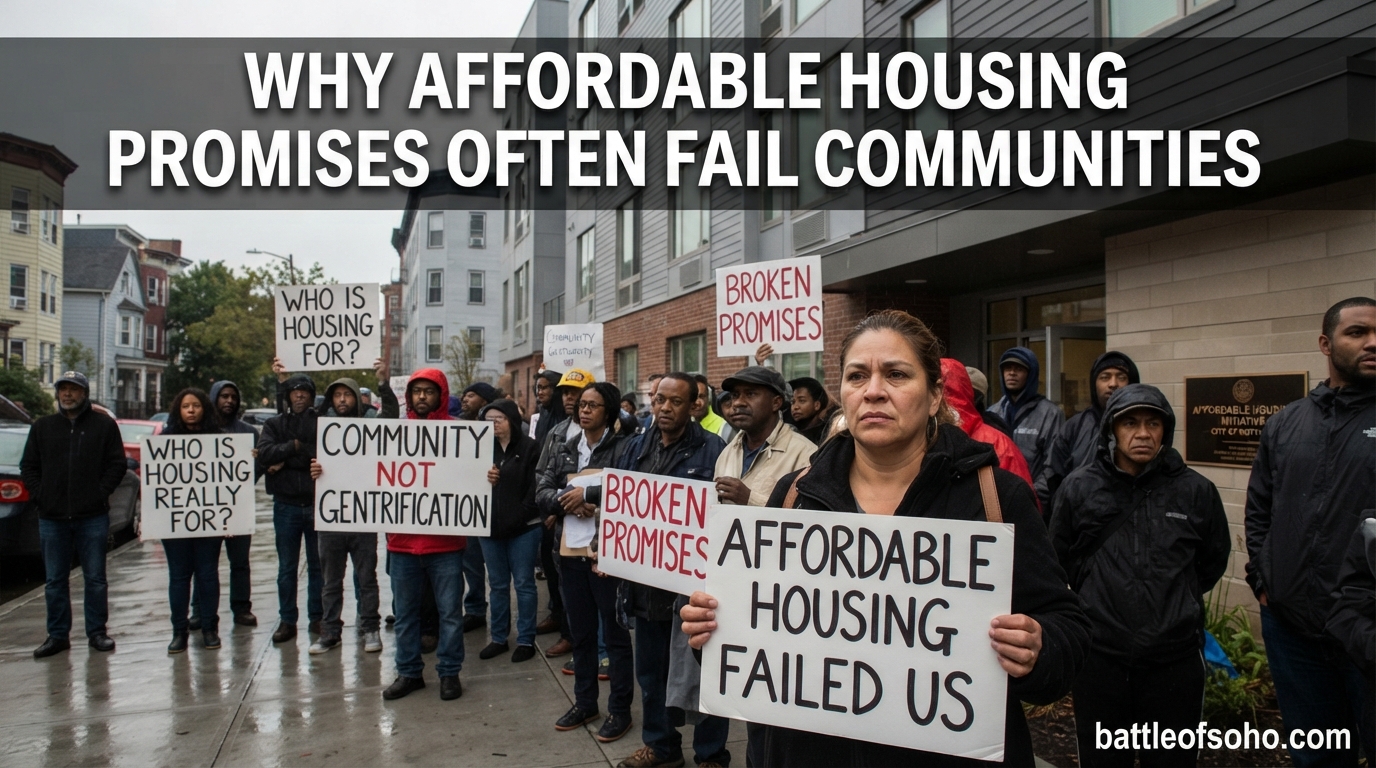
Every election cycle, politicians stand at podiums and promise affordable housing. They point to glossy renderings of mixed-income developments, announce ambitious unit targets, and cut ribbons at groundbreakings. Yet years later, the same neighborhoods remain priced out, the same families spend half their income on rent, and the same communities watch helplessly as promises evaporate into policy memos and forgotten press releases.
Affordable housing promises often fail communities because the delivery system is broken at every level. The income benchmarks used to define affordability are inflated beyond recognition. Zoning laws ban the exact types of housing that working families need. Financing structures reward profit extraction over resident stability. Political processes create endless veto points that kill projects before a shovel ever hits dirt. And the for-profit operators who manage subsidized buildings often cut corners on maintenance while collecting generous public subsidies.
The result is a gap between what is promised and what is delivered so wide that entire communities fall through it. In this article, we examine the seven interconnected reasons why affordable housing promises repeatedly fail the communities they are supposed to serve, drawing on data from housing researchers, tenant experiences documented in community forums, and policy experiments from cities across the country.
Whether you are a renter fighting to stay in your neighborhood, a community organizer demanding accountability, or simply a citizen trying to understand why the crisis keeps getting worse despite constant political attention, understanding these failure mechanisms is the first step toward demanding solutions that actually work.
Table of Contents
The Seven Root Causes: A Quick Overview
Before diving into each failure point, here is the short version of why affordable housing promises so rarely translate into real, lived affordability for the communities that need it most:
- The AMI calculation problem: Income benchmarks are distorted by wealthy suburbs, making “affordable” units unaffordable to the people they are meant to serve.
- Zoning and land use barriers: Single-family zoning, minimum lot sizes, and parking mandates make it illegal to build affordable housing in most of the country.
- Financing failures: Rising construction costs, high interest rates, and inadequate subsidy programs create a math problem that kills projects before they start.
- Policy fragmentation: Federal, state, and local governments pass responsibility back and forth while nothing gets built.
- The for-profit pitfall: Profit-driven operators collect subsidies while neglecting maintenance and exploiting tenants.
- Community opposition and NIMBYism: Organized opposition at community meetings routinely delays or kills affordable projects.
- The product mismatch: Even when housing gets built, it is often the wrong type, in the wrong location, for the wrong income levels.
Each of these failure mechanisms reinforces the others. AMI distortion makes units too expensive for the poorest families, zoning restrictions limit where those units can go, financing gaps prevent construction of enough units, and for-profit operators siphon resources away from the residents who finally do get a unit. Understanding how these systems interact is essential to understanding why individual fixes never seem to work.
The AMI Calculation Problem: Why the Benchmark Is Broken
The Area Median Income, or AMI, is the single most important number in affordable housing. It determines who qualifies for subsidized units, how much rent they pay, and whether a development meets its affordability requirements. It is also fundamentally broken as a measure of who actually needs help.
AMI is calculated by the Department of Housing and Urban Development for every metropolitan area in the country. It represents the median income for the entire metro region, which often includes wealthy suburbs far from the urban core where affordable housing is most needed. A city with a struggling downtown and affluent suburbs can have a surprisingly high AMI, because the wealthy suburban earners pull the median upward.
Here is where the system breaks down. Affordable housing units are typically priced for households earning a percentage of AMI. A unit at 60% AMI sounds like it serves moderate-income families. But when the AMI itself is inflated by wealthy suburbanites, 60% of AMI can easily exceed the actual median income of the neighborhood where the unit is located. The result is housing labeled “affordable” that working families in the community cannot actually afford.
For example, in many coastal metros, the AMI for a family of four exceeds $120,000 per year. A unit priced at 80% AMI would then be aimed at families earning $96,000 annually. For a neighborhood where the actual median household income is $45,000, that “affordable” unit is completely out of reach for the people who live there. This is not a rounding error. It is a structural feature of the system.
The AMI distortion also creates a perverse incentive. Developers can satisfy affordability requirements by building units at 80% or even 100% of AMI, which generates higher rents than units priced for extremely low-income families. The system rewards building housing for moderate-income earners while leaving the poorest households with almost nothing.
The numbers tell the story starkly. For every 100 extremely low-income renter households in the United States, only about 35 affordable and available units exist. That gap is not an accident. It is the direct result of a measurement system that systematically overstates who counts as needing help and understates the depth of the crisis for those at the bottom of the income ladder.
Forum discussions on r/AffordableHousing and r/urbanplanning repeatedly highlight this frustration. Residents describe applying for “affordable” units with rents that consume 40% or more of their income, only to discover that the AMI-based pricing was designed for someone earning far more than them. Gig workers and self-employed individuals face an additional barrier: their variable income often disqualifies them entirely, even when their annual earnings fall well below the threshold.
Zoning and Land Use Barriers: The Invisible Wall
If AMI distortion explains why affordable housing is priced wrong, zoning explains why so little of it gets built in the first place. Zoning is the invisible wall that determines what can be built, where it can be built, and at what density. In most American cities, that wall is designed to block exactly the kind of housing that would address the affordability crisis.
Single-family zoning is the most powerful barrier. In many cities, 70% or more of residential land is zoned exclusively for detached single-family homes. This means it is literally illegal to build a duplex, a triplex, an apartment building, or any other form of multifamily housing on the vast majority of available land. When politicians promise affordable housing, they are often promising something that current zoning makes illegal to build.
Minimum lot sizes compound the problem. Many suburbs require lots of a half-acre, an acre, or even more for each single-family home. This artificially inflates the cost of land per housing unit and makes dense, affordable development impossible by design. A community that requires one-acre minimum lots is a community that has decided, through its zoning code, that low-income families are not welcome.
Parking requirements are another silent killer of affordability. Many cities require developers to build one, two, or even more parking spaces per residential unit. Each surface parking space costs roughly $5,000 to $10,000 to build, and structured parking can cost $25,000 to $50,000 per space. These costs are passed directly to residents in the form of higher rents, making units that might have been affordable suddenly out of reach.
The permitting process adds another layer of obstruction. In many cities, getting approval for a multifamily housing project requires years of environmental reviews, design hearings, planning commission meetings, and city council votes. Each step is a potential veto point where opponents can delay, downsize, or kill a project entirely. The longer a project sits in permitting, the more its costs rise, and the less likely it becomes that the final units will actually be affordable.
NIMBY opposition, or “Not In My Back Yard,” is the social enforcement mechanism for these zoning barriers. Community meetings about affordable housing routinely devolve into hostile confrontations. Opponents cite concerns about property values, crime, traffic, and neighborhood character. Research consistently shows that well-designed affordable housing does not decrease surrounding property values or increase crime rates. But the fear persists, and it is weaponized at public hearings to kill or shrink projects.
The racism and classism underlying much NIMBY opposition is rarely discussed openly but is well documented by housing researchers. When affluent, predominantly white neighborhoods organize to block affordable housing, they are often perpetuating patterns of segregation that date back to the era of redlining and restrictive covenants. The zoning code becomes a socially acceptable way to maintain those patterns without using explicitly discriminatory language.
Minneapolis made headlines by becoming the first major city to eliminate single-family zoning citywide in 2019, allowing triplexes on lots previously reserved for detached homes. Other cities have followed with similar reforms. But zoning change is slow, implementation is uneven, and the political backlash from homeowners can be fierce. The wall is starting to crack, but it is far from down.
Financing Failures: When the Math Stops Working
Even when zoning allows affordable housing and the AMI benchmark is set correctly, financing often kills the project. Building housing is enormously expensive, and the economics of affordable housing are particularly challenging because the rent revenue cannot cover the development costs without significant subsidies.
Construction costs have risen dramatically over the past decade. Labor shortages, material price increases, supply chain disruptions, and tariff impacts have all contributed to per-unit costs that can exceed $400,000 or even $500,000 in high-cost markets. A development that would have been financially feasible at $200,000 per unit in 2015 may be completely unworkable at today’s costs, even with the same subsidy levels.
Interest rates play a decisive role. When borrowing costs are low, developers can finance projects with thinner margins and still make the numbers work. When rates rise, as they have significantly in recent years, the cost of capital jumps and many affordable housing projects become financially impossible overnight. The financing window opens and closes with interest rate cycles, meaning that affordable housing production can stall for years even when demand remains constant.
The Low-Income Housing Tax Credit, or LIHTC, is the largest source of affordable housing funding in the United States. Created in 1986, LIHTC provides federal tax credits to investors who fund affordable housing development. The credits are allocated to states based on population, and states award them to projects through competitive applications.
LIHTC has funded millions of affordable units since its creation, but it has structural limitations. The credits are not large enough to make deeply affordable housing viable without additional subsidies, meaning that projects often need to layer LIHTC with other funding sources. Each additional funding source brings its own requirements, deadlines, and compliance rules. This subsidy layering process is so complex that it can add years to a project timeline and hundreds of thousands of dollars in transaction costs.
LIHTC-funded buildings are typically required to remain affordable for 15 to 30 years. After the compliance period expires, owners can convert units to market rate, which often means displacing the low-income residents who have been living there. This time-limited affordability means that the country is constantly losing affordable units at the back end even as it struggles to build new ones at the front end.
The subsidy gap is the core problem. For housing to be truly affordable to the lowest-income households, rents need to be far below what it costs to build and operate the unit. The difference must be made up by subsidies. But federal housing funding has been flat or declining in real terms for decades, while the need has grown dramatically. State and local funding varies wildly, with some jurisdictions investing heavily and others contributing almost nothing.
Private equity has also entered the affordable housing space in ways that further strain the system. Investment firms have purchased manufactured home parks, LIHTC properties, and other forms of affordable housing, treating them as income-generating assets rather than community resources. Residents of manufactured home parks have reported rent spikes, new fees, and aggressive eviction tactics after private equity takeovers, as discussed extensively on community forums.
Policy Fragmentation: Too Many Hands, Too Little Action
Affordable housing policy in the United States is fragmented across federal, state, and local governments in ways that make accountability nearly impossible. The federal government sets funding levels and broad eligibility rules. State governments allocate tax credits and establish enabling legislation. Local governments control zoning, permitting, and land use decisions. When projects fail, each level can blame the others, and no one is held responsible.
This fragmentation creates endless veto points. A single city council member can block a project in their district. A neighborhood association can file an environmental challenge that delays construction for years. A state legislature can fail to pass enabling legislation that would streamline approvals. A federal administration can cut housing budgets without any single actor bearing the full blame for the resulting crisis.
The permitting process exemplifies this dysfunction. In some California cities, a typical affordable housing project requires more than a dozen separate approvals from different agencies, each with its own timeline, fee structure, and criteria. The total time from project conception to construction start can exceed seven years. During that time, construction costs rise, political winds shift, and funding sources may expire.
Political caution makes the problem worse. Elected officials are often reluctant to support affordable housing projects that might generate community opposition, even when those projects are desperately needed. The political cost of angering homeowners who show up to city council meetings is immediate and visible. The political cost of failing to build affordable housing is diffuse and long-term, spread across thousands of families who may not vote or attend hearings.
Broken campaign promises follow a predictable pattern. A candidate announces an ambitious affordable housing target during a campaign, generates positive media coverage, and wins the election. Once in office, the target runs into zoning barriers, funding shortfalls, community opposition, and bureaucratic inertia. The target is quietly revised downward or pushed to a future year. By the time the next election arrives, the original promise has been forgotten, and a new, equally ambitious promise takes its place.
Forum users in r/urbanplanning describe this cycle with weary familiarity. One user noted that their city had announced the same affordable housing initiative three times over a decade, each time with great fanfare, and each time the project quietly died in the permitting phase. Another pointed out that the gap between approved units and built units in their city was nearly 60%, meaning that even the numbers politicians cite as successes are often theoretical rather than real.
The political veto points are not accidental. They are the result of decades of policy choices designed to give existing homeowners maximum control over what gets built in their neighborhoods. Reforming this system requires challenging the power of those homeowners, which is why meaningful change is so slow and so politically costly.
The For-Profit Pitfall: How Market-Driven Models Fail Residents
One of the least understood failures in affordable housing is the role of for-profit operators. The LIHTC program, by design, relies heavily on private developers and investors to finance and operate affordable housing. While many of these operators are responsible, the profit motive creates inherent tensions with the goal of providing safe, stable, affordable homes.
The Urban Habitat report on for-profit affordable housing documented systematic problems in LIHTC-funded buildings operated by profit-seeking landlords. Tenants reported mold infestations, broken elevators, non-functional heating systems, and months of unaddressed maintenance requests. These are not isolated incidents. They are the predictable result of a system where the operator’s financial interest is served by cutting maintenance costs while collecting guaranteed subsidy revenue.
Tenant protections in subsidized housing are often weaker than in market-rate housing. In some jurisdictions, residents of LIHTC buildings have fewer rights to organize, challenge evictions, or demand repairs than tenants in rent-regulated apartments. The gap between the promise of safe, affordable housing and the reality of living in a poorly maintained building is where many residents feel the system’s failure most acutely.
Tenant experiences documented in community forums paint a vivid picture. A Portland resident described property managers who were extremely slow to respond to maintenance requests, rent for the affordable unit that was still too close to market rate, and a system that rejected gig workers with variable income despite their actual earnings falling well within the eligibility range. An Indianapolis resident reported rent spikes of 12% in a single year in what was supposed to be an affordable unit, with no real alternatives available.
The Bay Area tenant organizing scene has produced some of the most detailed documentation of these failures. Tenant unions have catalogued cases where LIHTC-funded buildings had persistent mold problems, broken security systems, and management companies that cycled through staff so quickly that no one was ever accountable for resolving complaints. In some cases, tenants discovered that the buildings had been cited repeatedly by code enforcement without any meaningful consequences for the operators.
Private equity’s growing role in affordable housing compounds these problems. Investment firms have purchased portfolios of LIHTC properties and manufactured home parks, attracted by the steady revenue from government subsidies. Once in control, these firms often raise rents to the maximum allowed under affordability agreements, add new fees for services that used to be included, and cut maintenance and resident services to boost returns. The residents, who have few alternatives and limited legal protections, bear the cost.
Nonprofit operators and community-controlled housing models consistently perform better on maintenance, resident satisfaction, and long-term affordability. Community land trusts, in particular, are cited by housing advocates as the most trustworthy model because they remove the profit motive entirely and give residents a direct stake in the governance of their housing. But nonprofit operators face the same financing and zoning barriers as for-profit developers, limiting their ability to scale.
The structural issue is that the LIHTC program was designed to leverage private capital by offering tax credits to investors. This means that affordable housing is built with money that expects a return, which means that someone is always extracting profit from a system that is supposed to serve the poorest families. The tension between investor returns and resident welfare is baked into the program’s DNA.
How Communities Are Harmed: The Human Cost of Broken Promises
Behind every statistic about housing shortages and cost burdens are real people whose lives are shaped by these systemic failures. The human cost of broken affordable housing promises falls hardest on the communities with the least political power to demand change.
Essential workers are among the most visible victims. Teachers, nurses, restaurant workers, janitors, childcare providers, and delivery drivers are increasingly unable to afford to live in the communities they serve. When a city’s teachers must commute an hour each way because they cannot afford to live near their schools, the entire community suffers. Staffing shortages in healthcare, education, and hospitality are directly linked to housing costs in high-demand metros.
Racial equity is inseparable from the affordable housing crisis. Black and Hispanic households are disproportionately cost-burdened, meaning they spend more than 30% of their income on housing. They are also more likely to experience eviction, displacement, and homelessness. These disparities are not the result of random market forces. They are the direct legacy of decades of explicitly discriminatory housing policy.
Redlining, the federal government’s practice of refusing to insure mortgages in Black and immigrant neighborhoods, systematically denied generational wealth-building opportunities to non-white families from the 1930s through the 1960s. Urban renewal projects demolished Black neighborhoods to build highways and civic buildings, displacing thousands of families with little compensation. Federal housing policy explicitly excluded non-white families from the subsidized mortgage programs that built the white middle class in the postwar era.
The effects of these policies are still visible today. The racial wealth gap, in which white families hold roughly ten times the median wealth of Black families, is largely a housing wealth gap. Neighborhoods that were redlined in the 1930s still have lower homeownership rates, lower property values, and higher poverty rates today. When affordable housing promises fail, they fail most often in the communities that were already harmed by these historical policies.
Displacement is the most immediate and painful consequence. When neighborhoods gentrify without adequate affordable housing protections, long-term residents are pushed out by rising rents and property taxes. The cultural fabric of communities is torn apart. Family networks that provided childcare, eldercare, and mutual support are scattered across distant suburbs. The people who made a neighborhood desirable in the first place are the first to be priced out.
Environmental justice is another dimension that receives far too little attention. Affordable housing is frequently located in areas with worse air quality, higher flood risk, greater exposure to industrial pollution, and less access to green space. When affordable housing is built at all, it is often placed in the least desirable locations, far from transit, grocery stores, and employment centers. A Harvard Law Review analysis noted that where housing is affordable, it is often located in undesirable and difficult-to-access parts of town, away from grocery stores, public transit, and employment centers.
The quality of affordable housing units themselves is a daily reality for residents. Forum discussions reveal a pattern of poorly constructed units with mold, lead paint, pest infestations, and contaminated water. Salt Lake City community members expressed skepticism after a large affordable housing project faced quality concerns and construction delays. In some cases, buildings that were celebrated as victories for affordable housing at their ribbon-cutting were already deteriorating within a few years of opening.
The psychological toll of housing insecurity is enormous but difficult to quantify. Families who live in constant fear of rent increases, eviction, or building code violations experience chronic stress that affects their health, their children’s development, and their ability to participate in community life. Housing is not just shelter. It is the foundation of stability that everything else depends on. When that foundation is unreliable, everything built on top of it becomes precarious.
Community Opposition and NIMBYism: The Human veto
Community opposition to affordable housing deserves its own examination because it is one of the most powerful and least understood forces blocking delivery on housing promises. NIMBYism is not simply a matter of selfish homeowners. It is a complex phenomenon rooted in fear, identity, power, and in many cases, racial and class bias.
The stated objections to affordable housing projects almost always focus on practical concerns: traffic, parking, school crowding, property values, and neighborhood character. These concerns are often sincerely held. But research consistently shows that well-designed affordable housing does not decrease surrounding property values, does not increase crime, and generates less traffic than market-rate housing because residents are less likely to own cars.
The unstated objections are often more revealing. Urban planning professionals who frequent r/urbanplanning note that NIMBY opposition frequently intensifies when proposed affordable housing would serve families with children, people experiencing homelessness, or formerly incarcerated individuals. The specific populations that most need housing are the populations that generate the most organized opposition. This pattern suggests that objections are not purely about density or traffic but about who the new neighbors would be.
Community meetings about affordable housing can become deeply hostile environments. Residents who support a project rarely attend in the same numbers as opponents, creating a false impression of unanimous opposition. Housing advocates describe meetings where speakers used coded language about “those people” or “the element” that affordable housing would bring to the neighborhood. The racism and classism behind these statements is rarely acknowledged explicitly, but it shapes the outcome of public hearings.
The structure of public participation in housing decisions gives disproportionate power to opponents. Projects often require discretionary approvals, which means that planning commissions and city councils have the authority to deny or downsize projects based on community feedback. Since opponents are more motivated to attend meetings and submit objections than supporters, the feedback that decision-makers receive is heavily skewed toward rejection.
Some states and cities have begun reforming this process. By-right approval, which allows projects that meet existing zoning requirements to proceed without discretionary review, eliminates the opportunity for NIMBY vetoes. California has implemented by-right approval for certain affordable housing projects, reducing timelines and increasing production. But these reforms face fierce political resistance from homeowners who view their ability to veto neighboring development as a property right.
The Product Mismatch: Wrong Housing for Wrong People
Even when affordable housing is built, it is often the wrong type of housing for the people who need it most. This product mismatch is one of the most frustrating failures because it means that money is spent, units are counted as successes, and yet the crisis persists because the units do not match the need.
The most common mismatch is the gap between studio and one-bedroom units and the families who need two, three, or four bedrooms. Developers prefer smaller units because they are cheaper to build per door and generate higher rent per square foot. But the families on affordable housing waiting lists often need larger units. A single mother with two children cannot use a studio, no matter how affordable it is.
Location is the other critical mismatch. Affordable housing built on the outskirts of a metro area, far from jobs, transit, and services, does not actually solve the problem it is supposed to address. A family that moves into an affordable unit an hour and a half from their workplace faces transportation costs and time burdens that can be as destabilizing as high rent. True affordability requires proximity to opportunity, not just a cheap unit in an isolated location.
The income targeting mismatch relates back to the AMI problem. When affordable units are priced at 60%, 80%, or even 100% of AMI, they serve moderate-income households rather than the extremely low-income families who face the most severe shortage. A city can build hundreds of affordable units and still leave its poorest residents with nowhere to go, because the new units are priced for people who earn more than they do.
The tenure mismatch is less discussed but equally important. Most affordable housing programs produce rental units, not homeownership opportunities. For families trying to build generational wealth, renting an affordable unit forever is better than being cost-burdened in a market-rate unit, but it does not close the wealth gap. Community land trusts and shared-equity homeownership models address this by creating pathways to ownership while maintaining long-term affordability, but these models remain a small fraction of total affordable housing production.
What Has Been Tried: Policy Experiments and Their Outcomes
Cities across the country have experimented with different approaches to addressing the affordable housing crisis. The results offer important lessons about what works, what fails, and what tradeoffs come with each approach.
Minneapolis made history by eliminating single-family zoning citywide, allowing triplexes by right on all residential lots. The reform was part of the city’s 2040 comprehensive plan and was aimed at increasing housing supply and reducing racial segregation. Early results have been mixed: the pace of new triplex construction has been slower than hoped, in part because financing for small-scale multifamily projects remains difficult to obtain. But the symbolic impact has been enormous, inspiring other cities to consider similar reforms.
St. Paul, Minnesota offers a cautionary tale about rent stabilization. In 2021, voters approved a strict rent cap limiting annual increases to 3%. The policy had immediate unintended consequences: developers canceled planned apartment projects, and some landlords exited the rental market entirely. The city subsequently amended the policy to exempt new construction, but the initial shock demonstrated that rent caps without supply-side reforms can actually reduce the housing that affordable families need.
Inclusionary zoning, which requires developers to include affordable units in market-rate projects, has been adopted in hundreds of cities. The results depend heavily on design. Programs with strict requirements and no offsetting incentives can discourage development, reducing overall housing supply. Programs that offer density bonuses, expedited permitting, or other incentives in exchange for affordable units tend to perform better. The key lesson is that inclusionary zoning works best as part of a comprehensive housing strategy, not as a standalone solution.
Community land trusts offer a fundamentally different model. A CLT is a nonprofit organization that owns land and leases it to residents who own the buildings on it. The ground lease includes affordability restrictions that remain in place when the home is sold, ensuring permanent affordability. The Champlain Housing Trust in Burlington, Vermont, is the largest and most studied CLT in the country. During the foreclosure crisis, CLT homes had foreclosure rates roughly ten times lower than conventional mortgages, demonstrating the resilience of the model.
Adaptive reuse has gained attention as a potential solution to both the housing crisis and the problem of vacant office buildings in post-pandemic downtowns. Washington, DC has been a leader in office-to-residential conversions, supported by tax incentives and streamlined permitting. The approach has potential, particularly in downtown cores with high office vacancy rates. But conversions are expensive and technically complex, and not all office buildings can be realistically converted to residential use.
Homelessness response systems have increasingly adopted the Housing First model, which prioritizes getting people into permanent housing without preconditions like sobriety or employment. Research consistently shows that Housing First is more effective and less expensive than approaches that require participants to meet conditions before receiving housing. But Housing First requires a sufficient supply of affordable units to work, and that supply does not exist in most communities.
The most successful approaches combine multiple strategies. Cities that have made progress on affordability typically pair zoning reform with increased public funding, streamlined permitting, tenant protections, and support for alternative models like CLTs. No single intervention is sufficient because the crisis is driven by multiple, interconnected failures.
What Would Actually Work
Understanding why affordable housing promises often fail communities is only useful if it leads to solutions that actually deliver. The research, the tenant experiences, and the policy experiments all point toward a set of principles that distinguish effective housing policy from political theater.
First, affordability must be measured against actual local incomes, not inflated regional medians. Replacing or supplementing AMI with local median income measures would ensure that affordable units are priced for the people who actually live in the community. Some cities have begun experimenting with local income targeting, but the federal system remains anchored to the broken AMI framework.
Second, zoning must allow the housing that communities need. Single-family-only zoning, excessive minimum lot sizes, and parking mandates should be reformed to allow multifamily housing by right in more locations. Minneapolis proved that political change is possible, and other cities are following. But zoning reform must be paired with financing tools that actually make construction viable at the newly allowed densities.
Third, affordable housing should be permanently affordable. The 15-to-30-year compliance periods in LIHTC mean that communities are constantly losing affordable units as they expire. Community land trusts and other models that embed permanent affordability into the ownership structure prevent this loss and stabilize neighborhoods over the long term.
Fourth, residents must have power. Tenant protections, the right to organize, and meaningful enforcement of habitability standards are essential to ensuring that affordable housing is not just affordable on paper but livable in practice. Tenant unions have demonstrated that organized residents can hold even well-funded for-profit operators accountable.
Fifth, accountability must follow promises. When politicians announce affordable housing targets, those targets should be tracked publicly with regular progress reports. When projects are approved but never built, the gap should be documented and explained. Transparency about the difference between promises and delivery is the only way to create political consequences for failure.
The affordable housing crisis is not an unsolvable problem. Other countries have achieved far better outcomes through different policy choices. The United States has the resources to house every family. What has been missing is the political will to override the systems that benefit from scarcity and the accountability mechanisms to ensure that promises become reality.
Communities that understand why affordable housing promises fail are better equipped to demand better. By insisting on local income benchmarks, zoning reform, permanent affordability, tenant power, and transparent tracking, residents can push their elected officials from performance to delivery. The crisis was created by policy choices. It can be solved by different ones.
FAQs
What is the biggest issue with affordable housing?
The biggest issue with affordable housing is the structural mismatch between how affordability is defined and who actually needs help. The Area Median Income (AMI) benchmark, used to set eligibility and pricing for affordable units, is calculated across entire metro regions and inflated by wealthy suburban earners. This means units labeled affordable are often priced beyond the reach of the lowest-income families who face the most severe housing shortage. For every 100 extremely low-income renters, only about 35 affordable and available units exist nationally.
How does affordable housing affect communities?
Affordable housing affects communities in both positive and negative ways depending on how it is designed and managed. Well-designed affordable housing stabilizes neighborhoods by preventing displacement, allowing essential workers to live near their jobs, reducing commute times and traffic, and supporting local businesses. However, when affordable housing is poorly constructed, poorly maintained, or concentrated in already disadvantaged areas, it can reinforce segregation and expose residents to substandard conditions. Research consistently shows that well-managed affordable housing does not decrease surrounding property values or increase crime rates.
What is the 30% rule in housing?
The 30% rule is the standard definition of housing affordability used by the federal government. It states that a household should spend no more than 30% of its gross income on housing costs, including rent or mortgage payments plus utilities. Households spending more than 30% are considered cost-burdened, and those spending more than 50% are considered severely cost-burdened. This benchmark is used to determine eligibility for many affordable housing programs, though critics note that the 30% threshold does not account for variations in other living costs like transportation, healthcare, and childcare.
What are common issues found in affordable housing projects?
Common issues in affordable housing projects include inflated AMI benchmarks that price out the poorest families, poor construction quality leading to mold and pest problems, unresponsive property management in for-profit operated buildings, locations far from jobs and transit, insufficient unit sizes for families needing multiple bedrooms, expiration of affordability requirements after 15 to 30 years leading to displacement, and tenant protections that are weaker than those in market-rate housing. Additionally, many projects face years of permitting delays and community opposition that inflate costs and prevent timely delivery.
Moving Forward: Accountability and Action
The pattern is clear by now. Affordable housing promises fail communities because the system that delivers them is designed to produce scarcity, not abundance, and to protect the interests of existing property owners rather than the families who need homes. Every failure mechanism we have examined, from AMI distortion to zoning barriers to for-profit exploitation, serves the same underlying purpose: limiting who gets to live where.
But understanding the problem is only the beginning. Communities across the country are organizing to demand better. Tenant unions are winning improvements in building conditions and rent protections. Housing advocates are pushing zoning reforms through city councils and state legislatures. Community land trusts are demonstrating that permanently affordable, resident-controlled housing is possible. Researchers are documenting the gap between promises and delivery, making it harder for politicians to hide behind announcements without results.
The question is not whether the affordable housing crisis can be solved. It can be. The question is whether communities will have the political power to demand the structural changes that solving it requires. That power is built through education, organizing, and the kind of persistent accountability that turns promises into units and units into homes.
If there is one takeaway from this analysis, it is this: affordable housing does not fail by accident. It fails because specific systems, policies, and power structures produce failure as their default outcome. Changing those outcomes requires changing those systems. And changing those systems requires communities that understand exactly where the failures lie and what it will take to fix them.