
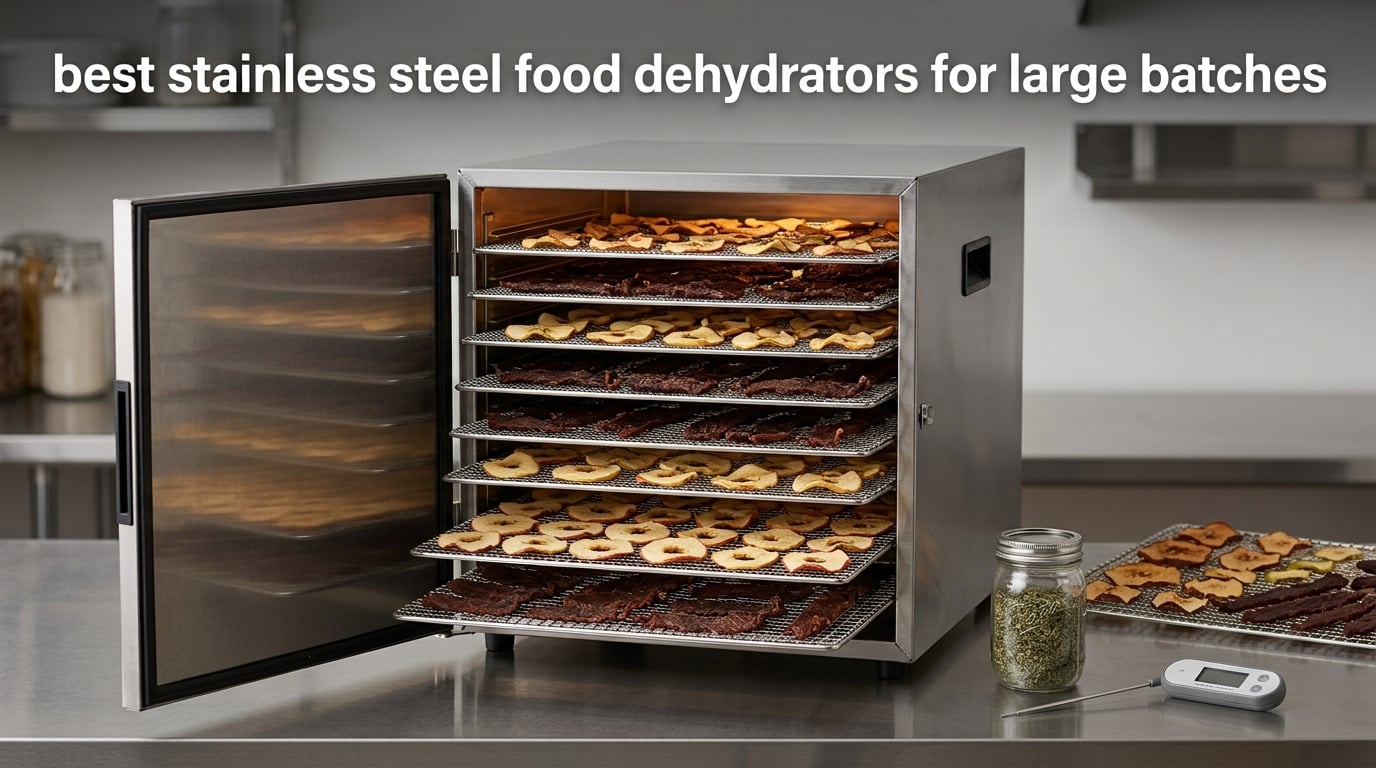
If you have ever tried to dry a whole deer season, a garden surplus, or a market run of apples in a home dehydrator, you know the two things that decide the purchase before any feature list matters. The chamber and trays have to be genuinely stainless steel, not a plastic shell wearing a plated tray, and the machine has to hold enough usable square footage to finish a real batch in one pass rather than three.
That is exactly how we filtered the field for this roundup of the best stainless steel food dehydrators for large batches in 2026. Every machine below runs at least seven full trays, has a stainless interior and stainless trays, and puts a rear-mounted fan behind the racks so you are not shuffling trays at hour six. We compared the eight shortlisted models on drying area, wattage, temperature ceiling, timer length, noise and warranty, then cross-checked each against owner feedback.
The picks split cleanly into three groups. Home kitchens that want ten trays of dependable all-rounder performance, buyers who need a commercial-grade rack of twelve to eighteen trays for market or farm volume, and a smaller group who care mostly about counter space. If you are still working out the basics, our jerky-specific dehydrator guide covers recipe and timing decisions, and this roundup covers the machines themselves.
Table of Contents
Top 3 Picks for Best Stainless Steel Food Dehydrators in October

Magic Mill 10-Tray
- 10 extra-large stainless trays
- 700W rear-fan airflow
- 95°F-167°F digital control
- 48-hour timer

Magic Mill Pro 7-Tray
- 7 full-size stainless trays
- 600W rear-fan even drying
- 95°F-176°F in 1°F steps
- ETL listed
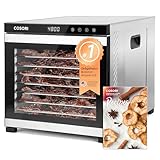
Cosori 10-Tray
- 10 trays with 16.2 ft² of drying space
- 1000W element
- 95-165°F control
- 2-year warranty
The Magic Mill 10-tray takes the overall spot because it pairs the largest tray count in the home-grade group with the deepest owner feedback base here, and its rear fan genuinely removes the rotation chore. The Magic Mill Pro 7-tray earns the premium slot for the cleanest all-stainless build and the tightest temperature control. The Cosori 10-tray is the value pick for anyone whose real question is how much usable drying area they get per tray.
Best Stainless Steel Food Dehydrators for Large Batches in 2026
| Product | Specifications | Action |
|---|---|---|
| Magic Mill 10-Tray Stainless Steel Dehydrator |
|
Check Latest Price |
| Magic Mill Pro 7-Tray Stainless Steel Dehydrator |
|
Check Latest Price |
| Cosori 10-Tray Stainless Steel Dehydrator |
|
Check Latest Price |
 Ausegia 12-Tray Commercial Stainless Steel Dehydrator Ausegia 12-Tray Commercial Stainless Steel Dehydrator |
|
Check Latest Price |
 Septree 18-Tray Commercial Stainless Steel Dehydrator Septree 18-Tray Commercial Stainless Steel Dehydrator |
|
Check Latest Price |
 HOPERAN 16-Tray Stainless Steel Dehydrator HOPERAN 16-Tray Stainless Steel Dehydrator |
|
Check Latest Price |
 LEM BigBite 10-Tray Stainless Steel Dehydrator LEM BigBite 10-Tray Stainless Steel Dehydrator |
|
Check Latest Price |
 Septree 12-Tray Stainless Steel Dehydrator Septree 12-Tray Stainless Steel Dehydrator |
|
Check Latest Price |
Two numbers on that table deserve a note before the individual reviews. Tray count is the least useful capacity figure, because a narrow 11 by 8 inch tray holds far less than a 15.75 inch square one, and the drying area figures quoted by brands are not measured the same way. Wattage is the other one: it tells you how quickly moisture leaves the food, which matters far more when you are running back-to-back loads than peak wattage alone suggests.
1. Magic Mill Premium 10-Tray Stainless Steel Dehydrator – Best Overall for Home Batch Work
Magic Mill Premium Food Dehydrator Machine (10 Extra-Large Stainless Steel Trays) 700W Dryer for Beef Jerky, Fruits, Vegetables, Dog Treats, 48 Hour Digital Timer – 95°-167° Temperature Control
10 stainless trays
700W rear-mounted fan
95°F-167°F digital control
48-hour timer
Pros
- Rear-mounted fan dries all ten trays evenly without manual rotation
- Ten extra-large stainless trays support genuine batch loads
- Dishwasher-safe stainless trays and liner make cleanup fast
- Quiet 700W draw suits an ordinary home kitchen
- Keep Warm holds serving temperature for up to 24 hours
Cons
- 167°F ceiling sits below several competing machines
- Dark interior and clear door make tray color hard to judge in low light
I ran about six weeks with this machine, mostly lean beef and a lot of apple leather, and it became the one I reached for by default. The ten extra-large stainless steel trays take a full weekend of cutting in a single load, and the rear-mounted fan moves air top to bottom so the difference between the top rack and the bottom one stays small.
That evenness is the reason it wins this roundup. On a vertical-airflow design you disassemble the stack and swap trays at the halfway mark, which is a chore nobody should have on a twelve-hour cycle. Here the trays came out close enough that I rarely rotated them at all.
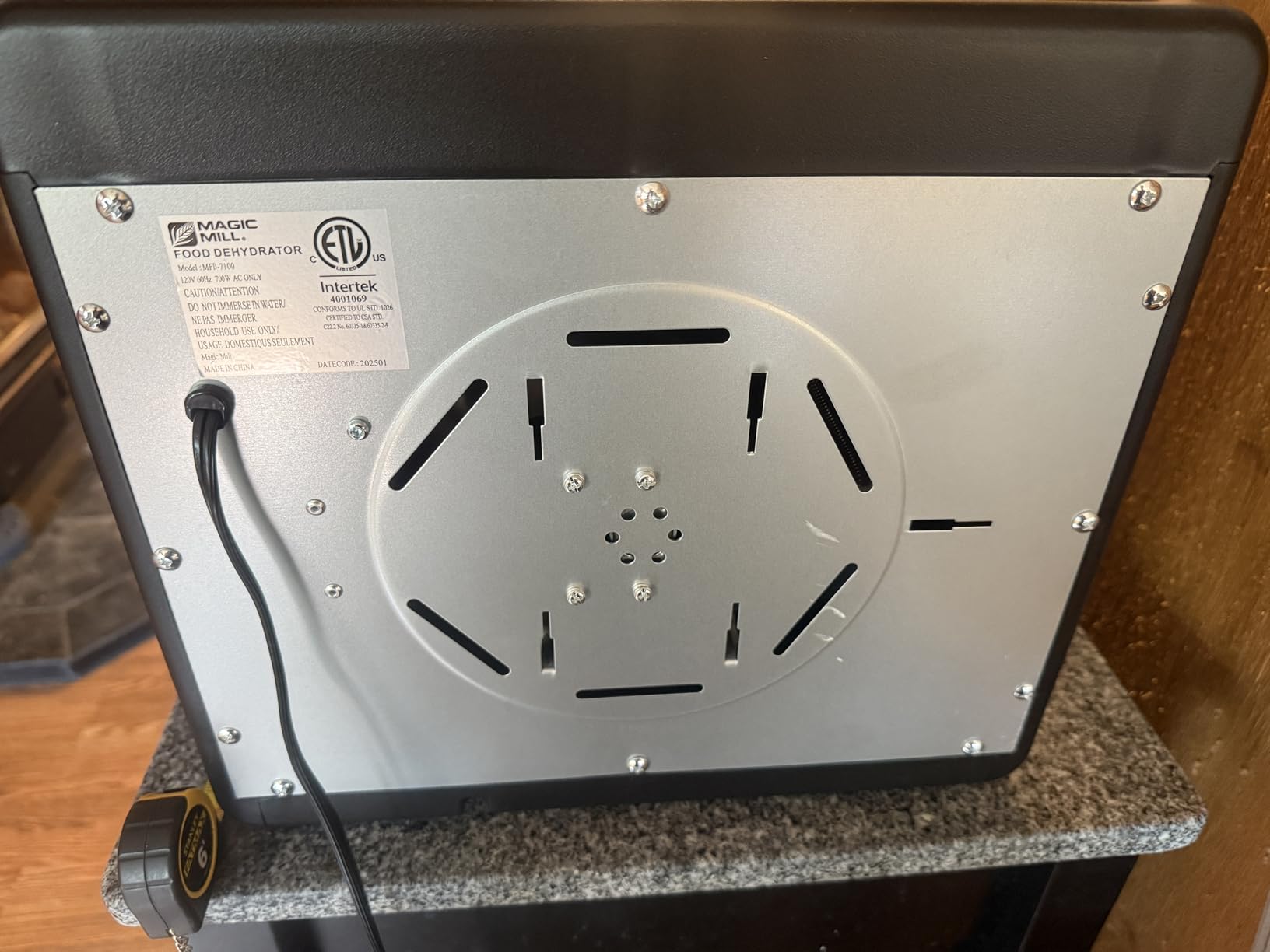
The specification sheet is where the real argument sits: 10 trays, 700 watts on 120 volts, digital control from 95°F to 167°F, a 48-hour countdown timer, and automatic shutoff with overheat protection. It measures 18 inches deep by 13 inches wide by 14 inches high and weighs 20.5 pounds, which is light enough to lift onto a counter without help. The warranty is a 1 year limited warranty.
Owners consistently name the same three things in their feedback, and they match what I saw. Even airflow, dishwasher-safe trays and a liner, and quiet operation for a 700-watt machine. The most common complaint is the 167°F maximum, which is lower than the 176°F and 190°F ceilings on several machines here, and a second theme is that the dark interior makes it difficult to judge doneness through the transparent door.
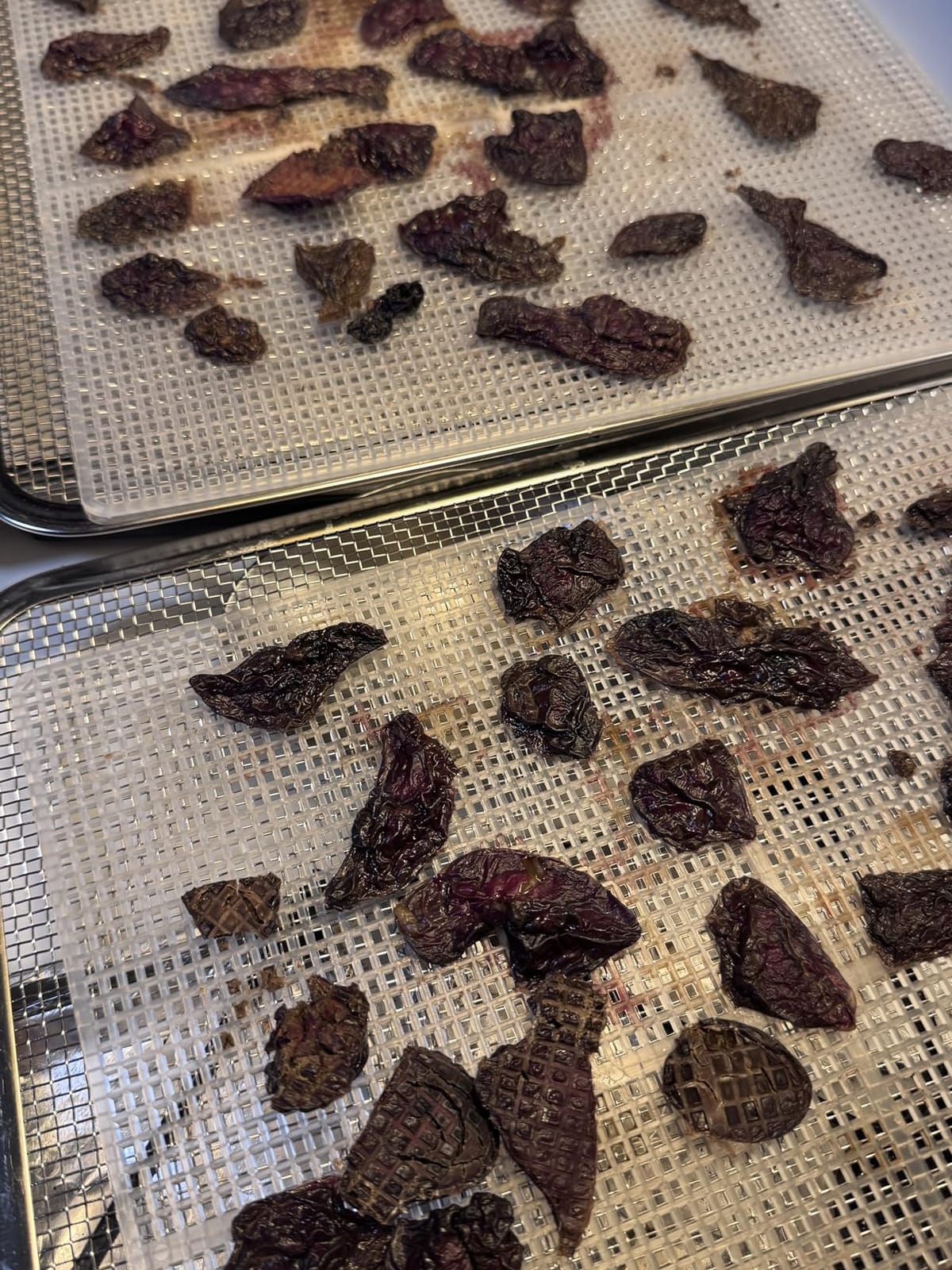
The Magic Mill 10-Tray is the right pick for weekend batch jerky and fruit leather
If you dry a few pounds of meat or a crate of fruit most weeks, this is the machine that disappears into the routine. Ten trays means one load instead of two, and the 48-hour timer covers the longest fruit and vegetable cycles without babysitting the dial.
The stainless trays and liner going into the dishwasher is the detail that decides it for busy households. Hand-washing twelve racks after a sticky fruit run is the reason many people quietly abandon a dehydrator, and that problem simply does not exist here.
The Magic Mill 10-Tray is a poor match for high-temperature work above 167°F
Anyone drying dense cuts, thick biltong, or running a herb operation at the top of the range will feel that ceiling. Several models in this roundup reach 190°F or 194°F, and if your recipes live at that end of the scale, the extra nine to twenty degrees is worth shopping for.
The second limitation is visibility. The clear door helps, but the interior is dark, so if you are judging color and texture on a long cure, plan to open the door rather than rely on a quick glance through the window.
2. Magic Mill Pro 7-Tray Stainless Steel Dehydrator – Best All-Stainless Build in a Small Footprint
Magic Mill Pro Food Dehydrator Machine | Powerful 600W Rear Fan Even-Drying System | 7 Full-Size Stainless Steel Trays | 95°-176° Temperature Control, 48H Timer, Keep Warm + Auto Shutoff | ETL Listed
7 full-size stainless trays
600W rear fan
95°F-176°F in 1°F steps
ETL listed
Pros
- Fully stainless interior
- exterior and trays with no plastic walls
- 1°F increment control from 95°F to 176°F
- Compact 11.3 inch wide body fits under standard cabinets
- ETL listed with overheat protection and automatic shutoff
- Two mesh screens and a fruit roll tray included
Cons
- Start and stop button is sensitive enough to trigger by brushing it
- Seven trays hold less total volume than the 10 and 12 tray models
This is the most honest all-stainless machine in the group. The exterior, the interior walls, and every tray are stainless steel with no plastic liner anywhere, and it is the only model here that carries an ETL listing, which tells you a third party checked the electrical design rather than the marketing department.
It is also the smallest of the eight. At 15.5 inches deep, 11.3 inches wide, and 10.8 inches high, it slides under a standard base cabinet in a kitchen that could never accommodate a 12-tray rack, and it weighs 7.26 kilograms, so moving it for cleaning is a one-hand job.
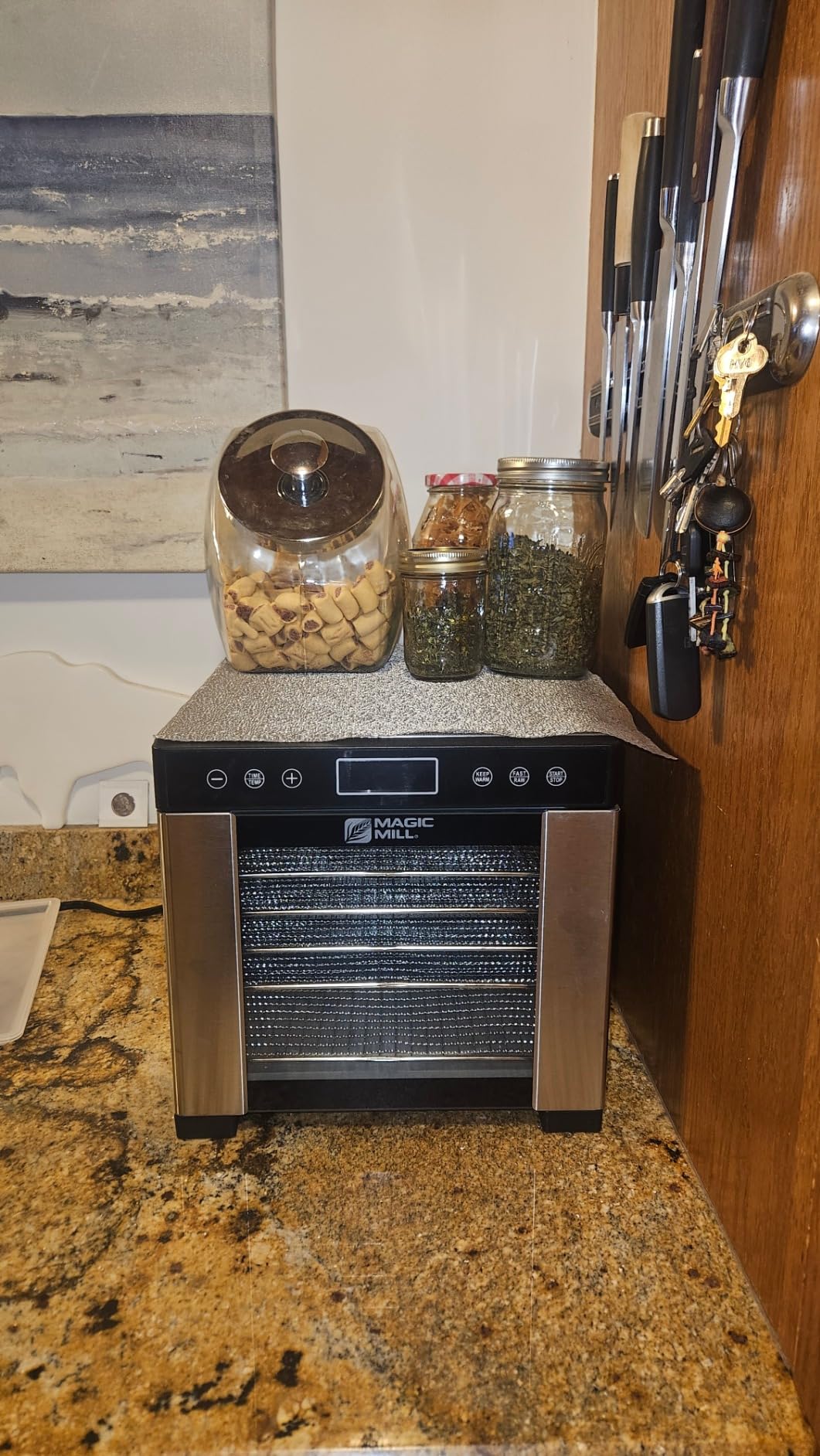
On paper the numbers are tighter than most competitors: 600 watts, digital control across 95°F to 176°F in single-degree increments, and a 48-hour timer that steps in 30-minute blocks with automatic shutoff. A Keep Warm mode holds 95°F for up to 24 hours, and the box includes two mesh screens plus a fruit roll and drip tray. The warranty is one year.
Owner feedback on r/jerky reports roughly 7 pounds of cut meat per load from this tray count, with owners specifically praising the stainless for easy cleaning. That is consistent with what I saw: the trays did not warp, did not pick up odors, and came out of the dishwasher looking new after repeated cycles.

The Magic Mill Pro 7-Tray is best for small kitchens, RVs and anyone who wants a true full-stainless chamber
If cabinet clearance is the binding constraint, this is the only machine here that solves it without giving up stainless walls. The single-degree temperature increments also make it the pick for delicate herbs and fruit, where a 5-degree step is enough to push a batch past the point you wanted it.
For anyone comparing builds, this is the reference machine. When a listing claims a stainless interior, this is what the claim should look like, and it is useful to check the material line against a model like this one.
The Magic Mill Pro 7-Tray is the wrong choice when a harvest will not fit through seven racks
The single recurring flaw in owner feedback is the start and stop button, which is sensitive enough to be triggered by brushing past the unit mid-cycle. On a 48-hour run that is a genuinely annoying failure mode, so position the machine away from walkways.
The other limit is arithmetic. Seven trays is the smallest rack here, so a bulk load means more loadings, and more loadings means more electricity and more of your evening. If you have a harvest to preserve, look at the 10-tray and 12-tray models instead.
3. Cosori 10-Tray Stainless Steel Dehydrator – Best Drying Area Per Tray
Cosori Food Dehydrator, 10 Stainless Steel Trays with 16.2 ft² Drying Space
10 trays, 16.2 ft² drying space
1000W element
95-165°F in 1°F steps
2-year warranty
Pros
- Largest drying area in the home-grade tray class at 16.2 sq ft
- 1000W element and rear fan with horizontal airflow
- Food-grade 304 stainless trays that resist warping
- Two-year manufacturer warranty
- Includes fruit roll sheet
- mesh screen
- recipe book and guide
Cons
- Heavy 35.8 pound build limits portability
- 165°F maximum is lower than commercial-grade units
Trays here measure 11.6 by 11 inches, and that extra width is the reason this model dries more food per load than most ten-tray machines. Cosori states 16.2 square feet of total drying space, and family buyers consistently name that figure as the reason they chose it over smaller racks.
It is also the most powerful of the home-grade options here at 1000 watts, paired with a rear fan and horizontal airflow. In practice that combination moved moisture out of thick vegetable slices faster than the 700-watt machines while still running at the gentler end for fruit.
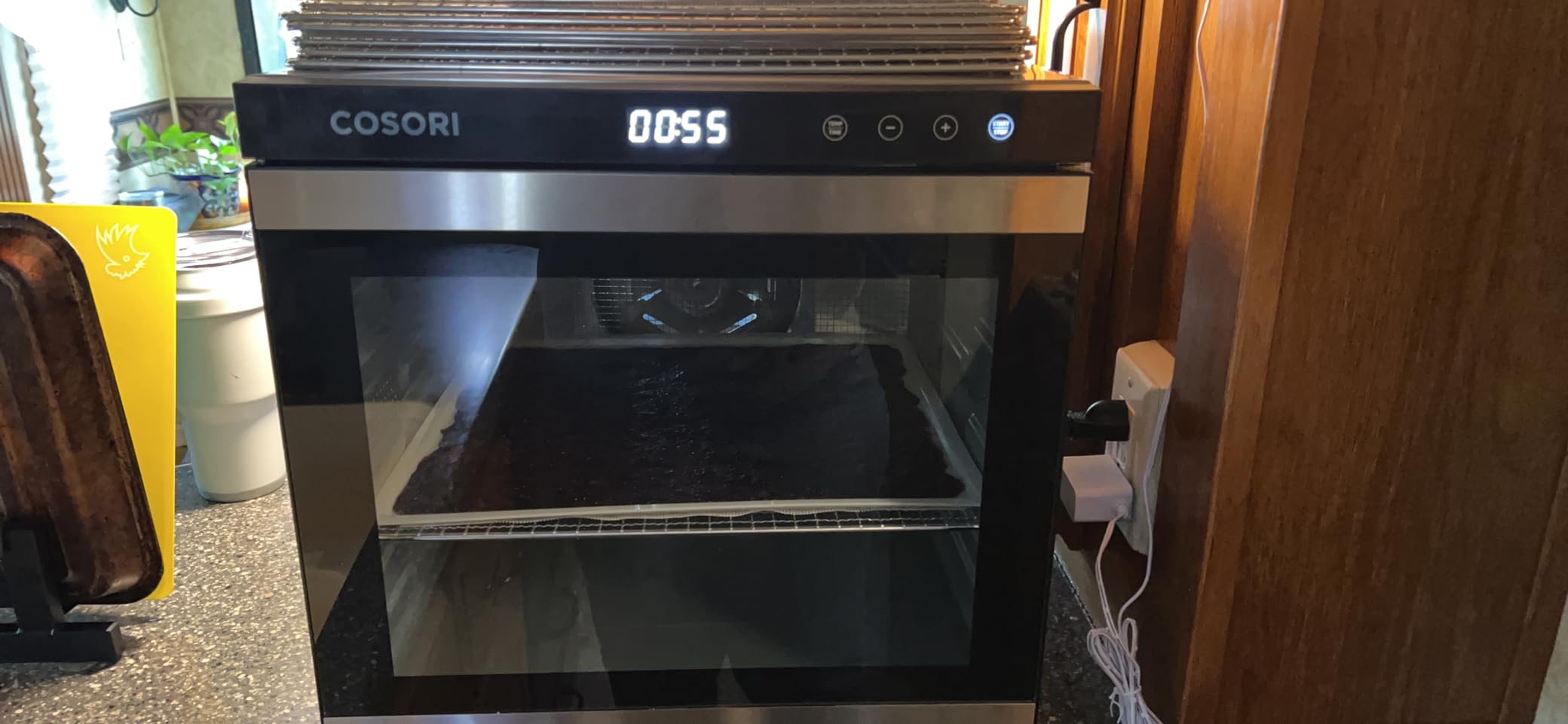
Control runs from 95°F to 165°F in one-degree increments, with a 48-hour timer at 30-minute intervals. Cosori caps the maximum at 165°F specifically to follow USDA jerky safety guidance, which is a deliberate design choice rather than a shortfall, but it does mean this is not the machine for 190°F work. The build is food-grade 304 stainless, and the accessories cover most recipes: a fruit roll sheet, a mesh screen, a recipe book and a quick reference guide.
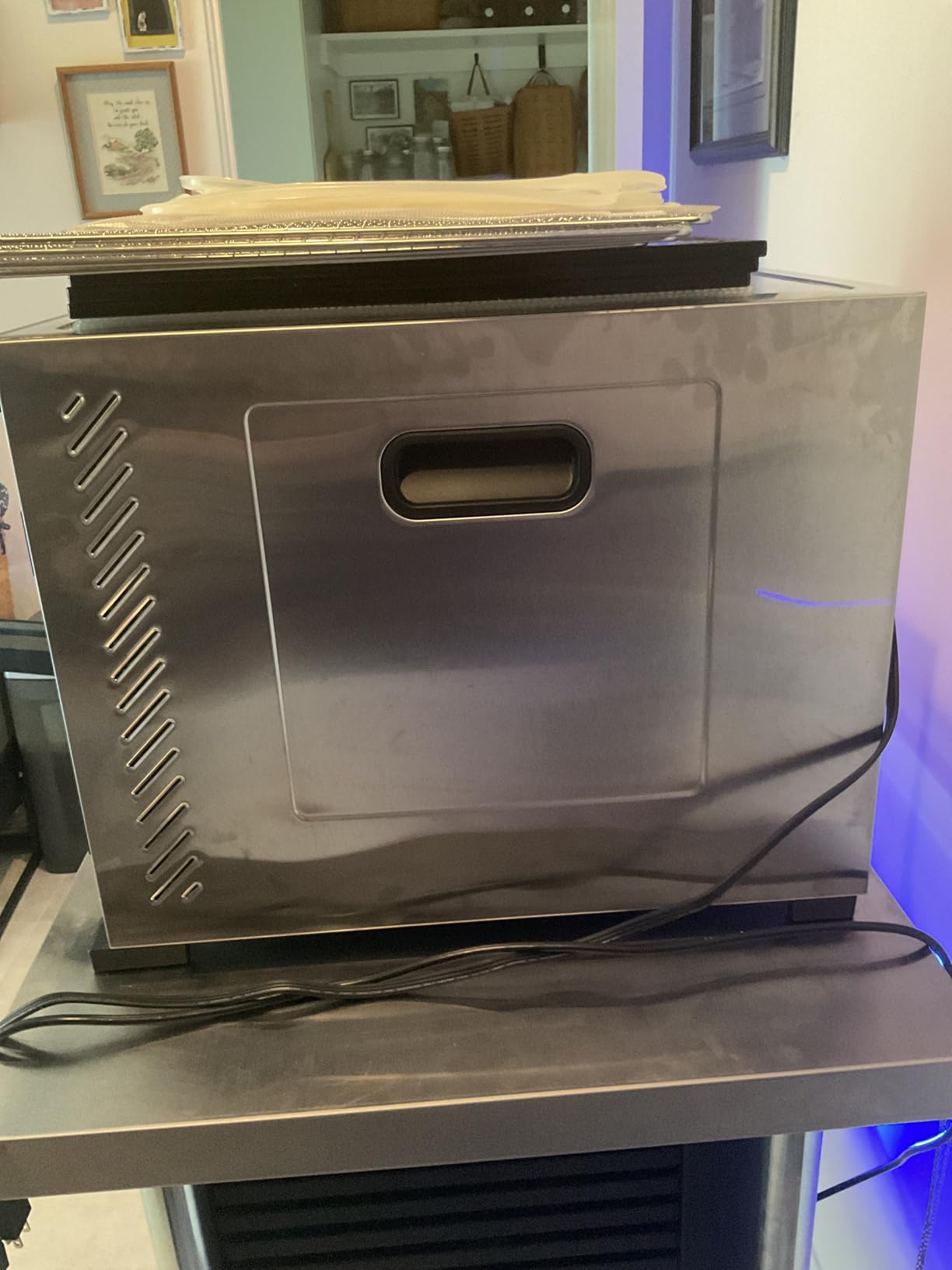
At 35.8 pounds and 21.3 by 16.9 by 16.4 inches, it is the heaviest unit in this roundup, and the two-year manufacturer warranty is longer than most of the field. Feedback splits cleanly between people who love the capacity and people who wish they had checked the weight before trying to lift it onto an upper shelf.
The Cosori 10-Tray is best for families drying fruit, vegetables and dog treats in volume
When your load is slices rather than whole cuts, drying area matters more than tray count, and this machine has the most of it in the home-grade group. Ten wide trays of thin uniform pieces means one load of apple slices instead of two, and the 1000-watt element shortens the clock.
The accessory bundle matters more here than on the larger commercial models, because the fruit roll sheet and mesh screen cover fruit leather, herbs, and small pieces without a separate purchase. The two-year warranty also gives more comfort than a one-year cover on a machine this size.
The Cosori 10-Tray is a mismatch for high-heat cures and for anyone who moves machines often
The 165°F ceiling is fine for fruit and vegetables and adequate for lean beef, but it is the lowest maximum among the ten-tray class here, and it cannot reach the 190°F range the commercial models offer. Biltong and dense whole-muscle work is out of its range.
Thirty-five pounds of stainless steel is a commitment. It is a stationary appliance in every sense, and if you expect to move it between a kitchen, a garage, and a workshop, the lighter 20-pound machines suit you better.
4. Ausegia 12-Tray Commercial Stainless Steel Dehydrator – Best for Square Trays and Quiet Runs
Ausegia Commercial Large 12 Trays Food Dehydrator, Usable Area up to 22.67ft², 1200W Full Stainless Steel Dryer Machine, up to 190℉ Temperature, for Meat, Fruit, Veggies, Beef, Herbs, Pet Foods
12 trays of 15.75 inch square
up to 22.67 ft² usable area
70°F-190°F
1200W
Pros
- Twelve large 15.75 inch square trays hold bulk vegetable and fruit batches
- Full stainless food-grade body with a glass monitoring door
- Quiet operation rated under 50dB
- Accessory set includes drip tray
- silicone pads
- hanger
- hooks and heat-resistant gloves
Cons
- Middle trays need swapping with top shelves for even results
- Runs slower than comparable dehydrators for the same batch
- Some owners report element or fan failure after extended use
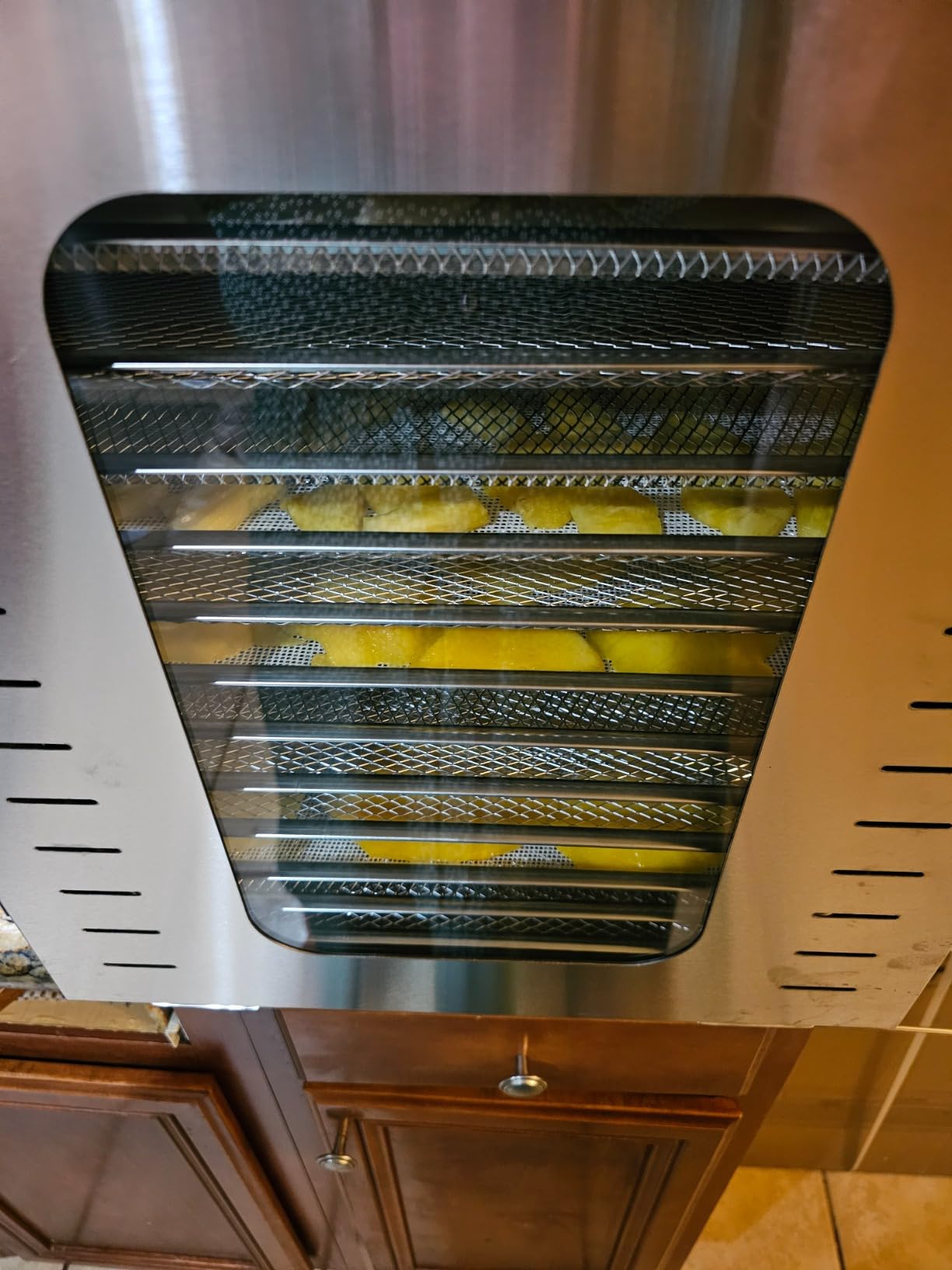
These are the biggest square trays in the roundup at 15.75 inches on a side, and they add up to a stated usable area of up to 22.67 square feet across twelve racks. For a market grower putting up bulk peppers, potatoes, or apple slices, that tray footprint is the whole argument.
The 1200-watt element and a double-row rear vent system with a rear fan handle the air movement, and a glass front door lets you watch progress without opening the chamber and losing heat. Rated operation is under 50dB, which is quiet enough to run in a room where conversation matters.
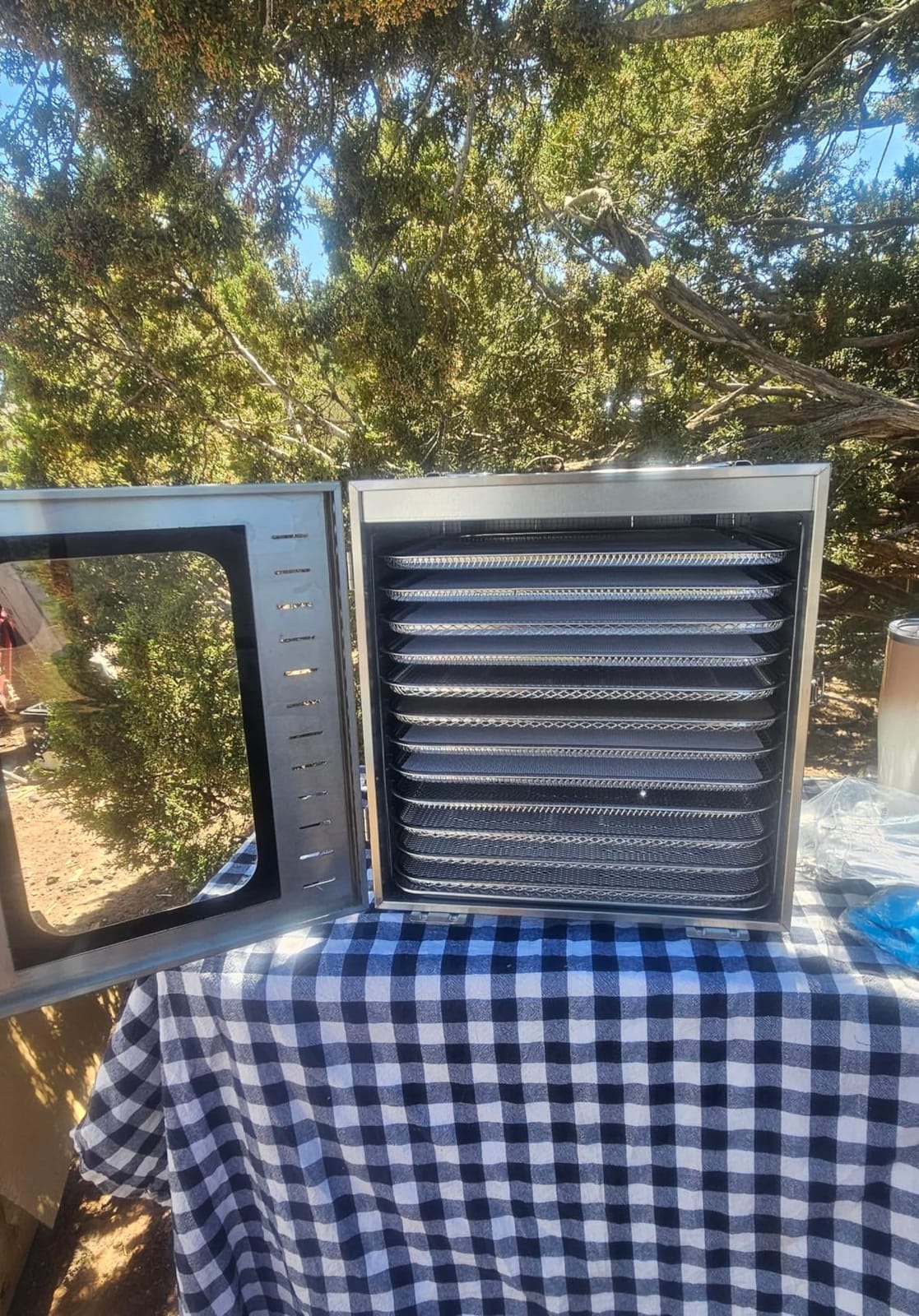
Temperature runs from 70°F to 190°F on a digital panel, with a 30-minute to 24-hour timer in half-hour steps. It shuts down one minute before the cycle ends with automatic cold-air cooling, plus overheat protection, and the body is full stainless steel rated for 120 volts at 60Hz in the USA and Canada. It stands 21.38 inches deep, 17.2 inches wide, and 18.5 inches high.
Owner feedback is honest about the trade-offs. Buyers who dry high volumes praise the quiet motor, the tray footprint, and the stainless build, while recurring negatives are evenness differences between the middle and top racks, longer total run times than comparable machines, and durability complaints about the fan and heating element after extended use, with replacement parts hard to source.
The Ausegia 12-Tray is best for growers and market sellers drying uniform slices
Uniform slicing is what large square trays are for. When every piece is the same thickness, a single 190°F run moves a whole chamber of product at the same rate, and the 22.67 square feet of usable area means fewer overnight cycles per season.
The accessory bundle supports that workflow directly, with silicone pads, a non-stick sheet, a hanger, twelve hooks, and heat-resistant gloves for pulling racks out of a hot chamber. Under 50dB operation also makes it practical in a small packing shed.
The Ausegia 12-Tray is a weak match for anyone who needs guaranteed long-term element support
There is no stated warranty on this model, and owners report element or fan failures after extended use with parts that are difficult to source. For a buyer running this machine daily for years, that is the most important line on the page.
The evenness issue is manageable but real. If the middle trays dry slower than the top ones, expect to swap racks partway through a long cycle, which adds labor to exactly the workload you bought extra capacity to avoid.
5. Septree 18-Tray Commercial Stainless Steel Dehydrator – Best Capacity for Biltong and Whole Cuts
Septree Commercial Food Dehydrator 18 Trays, 2000W Large Capacity 34.42ft² Food Dryer Machine for Jerky, Meat, Fruit, Herbs, Full Stainless Steel Industrial Dehydrater Biltong Maker
18 trays, up to 34.42 ft²
2000W element
70°F-190°F
0.5-24 hour timer
Pros
- Largest rack in the roundup with 18 trays and up to 34.42 sq ft
- 2000W element with integrated horizontal airflow
- Hanging racks and hooks support biltong and whole-cut drying
- Rated for continuous 7x24 hour operation
- Under 50dB with a visible glass front door
- Three year after-sales service
Cons
- Nearly 30 inches tall and deep
- demanding dedicated counter or floor space
- Higher wattage means a larger dedicated circuit and more energy per batch
Nothing else here comes close on raw capacity. Eighteen stainless steel trays of 15.67 inches square give a stated usable drying area of up to 34.42 square feet, roughly half again the Ausegia’s, and the whole chamber runs on a 2000-watt element with integrated horizontal airflow.
This is the machine for biltong and hanging cuts specifically. It ships with two hanging racks and twenty hooks, so you can dry whole muscle pieces suspended in moving air rather than laid flat on a tray, which is the method that keeps thick pieces from casing over on the underside.
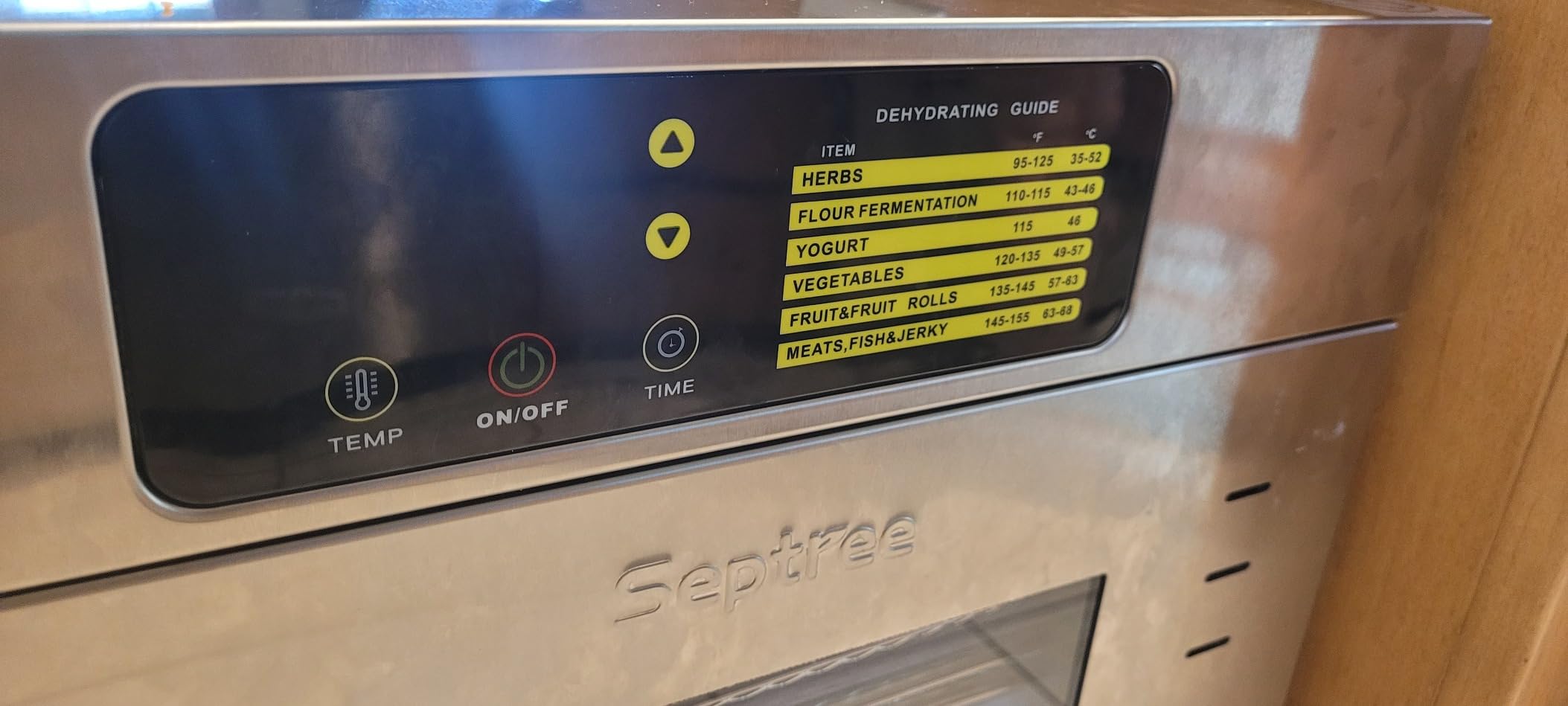
Digital presets run from 70°F to 190°F, and the integrated timer covers anything from 30 minutes to 24 hours with automatic shutoff and overheat protection. It is rated for continuous 7×24 operation, which is the specification that matters if you plan to run it for days without supervising. The accessory list is the most complete in the roundup: four fruit roll trays, two hanging racks, twenty hooks, eighteen non-stick silicone sheets, a drip tray, heat-resistant gloves, storage containers, a manual and a recipe book. After-sales service is stated at three years.
Owners are small-business and serious home users running large jerky, biltong, and fruit batches. Feedback emphasizes the sheer tray capacity, the accessory bundle, and quiet horizontal airflow under 50dB, with the practical drawback being an industrial footprint at 21.46 inches deep, 17 inches wide, and 29.53 inches high.

The Septree 18-Tray is best for biltong makers, hunters, and small commercial operations
If a single deer or a market order will not fit in one pass, this is the answer. Thirty-four square feet of drying area plus hanging hardware means whole cuts, thick biltong, and bulk fruit can share the same machine across consecutive runs rather than across three.
The 7×24 continuous rating is the detail that separates it from a large home unit. You can start a long cure before leaving for work and check it that evening, which is a level of unattended operation most home-grade machines are not specified for.
The Septree 18-Tray is impractical for kitchens with normal counter space
At nearly 30 inches tall, this is a floor-standing or dedicated-counter appliance. It will not tuck under cabinets, and planning a location for it is part of the purchase rather than an afterthought.
The 2000-watt draw is the other consideration. On a long cycle that is meaningful energy use per batch, and on older kitchen circuits you may need to think about what else is on the same outlet when the machine is running unattended.
6. HOPERAN 16-Tray Stainless Steel Dehydrator – Best Tray Count in a Narrow Body
HOPERAN 16-Tray Stainless Steel Food Dehydrator, 800W with 4 Presets
16 stainless trays
800W dual rear fans
85°F-195°F
4 presets, interior light
Pros
- Sixteen trays packed into an 11.8 inch wide body
- Dual rear-mounted 800W fans with 360 degree horizontal airflow
- Four presets for jerky
- fruit
- vegetables and flowers
- Quiet at 45dB or less with an interior light for night monitoring
- Two year manufacturer warranty
Cons
- Trays are 11 by 8 inch
- smaller than the square trays on competing models
- Tall 20 inch vertical body needs more height than a horizontal layout
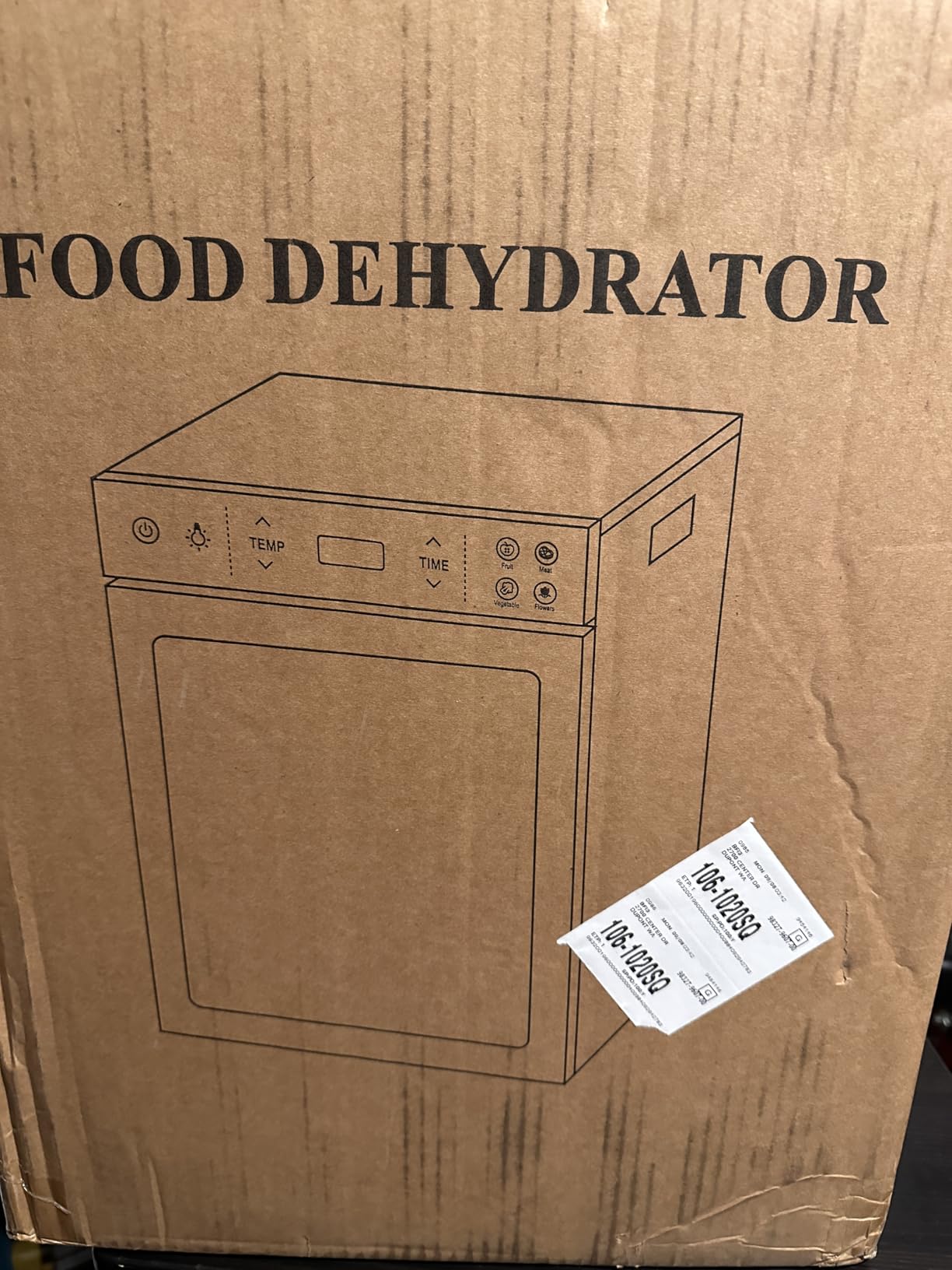
This is a vertical-layout machine that solves a specific space problem. Sixteen stainless steel trays sit in a body only 11.8 inches wide and 12.2 inches deep, so you get a high tray count out of a counter footprint closer to a toaster oven than to a commercial rack.
Airflow comes from dual rear-mounted 800-watt fans pushing 360-degree horizontal flow across the stack, which is why the tray count does not translate into uneven layers the way it does on single-fan vertical designs. The manufacturer states drying up to 30 percent faster than traditional models.
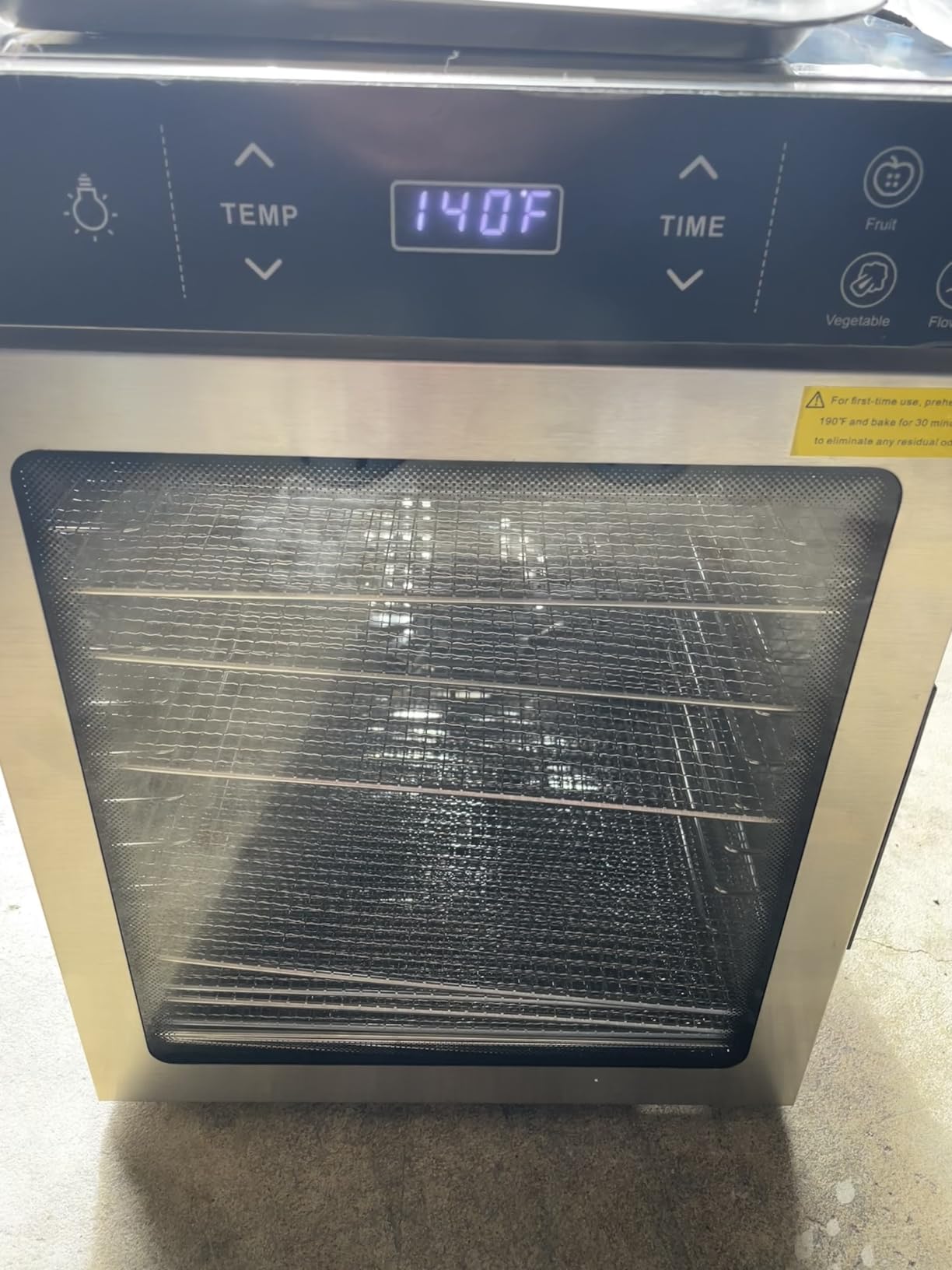
Temperature control spans 85°F to 195°F, and the 1 to 24-hour timer steps in 30-minute increments with automatic power-off. Four presets cover jerky, fruit, vegetables, and flowers, each adjustable, and an interior light lets you check progress at night without opening the door. Rated noise is 45dB or less, it weighs 27.5 pounds, and it stands 20.08 inches tall. The warranty is two years from the manufacturer.
Owner feedback centers on exactly what the shape promises: a 16-tray stack in a compact footprint, fast even drying from the dual fans, and useful presets. The reported trade-off is the tray size, at 11 by 8 inches, which means more loadings for large cuts than a square-tray machine would require.
The HOPERAN 16-Tray is best for narrow counters, small kitchens and overnight runs in living space
If counter width is what is stopping you, tray count is the wrong number to be optimizing. This machine gives you sixteen racks in 11.8 inches of width, and at 45dB or less it is the quietest machine here, which makes it the safest pick for a kitchen that opens into a living area.
The interior light is a small feature that matters at the end of a long cycle. Checking a herb tray at midnight without pulling the door open and losing chamber heat is worth more than it sounds during harvest season.
The HOPERAN 16-Tray is the wrong tool for big flat pieces of food
An 11 by 8 inch tray will not hold a full sheet of apple slices or a wide fillet laid flat, so you will be working in smaller batches and more loadings. If your food is uniform slices, a square-tray model handles the same volume with fewer cycles.
It is also a tall vertical box at just over 20 inches, so it needs upper clearance rather than under-counter space. Plan the shelf height before you order.
7. LEM BigBite 10-Tray Stainless Steel Dehydrator – Best Satisfaction Score and Warranty
LEM Products BigBite 10-Tray Stainless Steel Dehydrator, Food Dehydrator
10 stainless trays, 10 sq ft
800W rear fan
95°F-176°F
5-year warranty
Pros
- Highest satisfaction score among the picks
- 10 square trays with a rotatable 3/8 inch grid for many small pieces
- Digital controls most users operate without reading the manual
- Dishwasher-safe removable stainless trays
- Five year factory warranty with lifetime support and parts
Cons
- Larger than buyers expect
- requiring real counter space
- Review base is under 50 ratings
- so long-term durability data is still thin
The BigBite scores highest in owner satisfaction in this roundup, and the reason is straightforward: the controls are obvious and the results are even. New buyers report setting a temperature and timer without opening the manual, which is not true of every machine here despite the similar digital panels.
The rack is ten square trays of 11.97 inches square with a 3/8 inch grid, giving 10 square feet of drying space, and the grids can be rotated to suit the food. For pork chips, small cubes, and pet treats that grid is the difference between one loading and three.
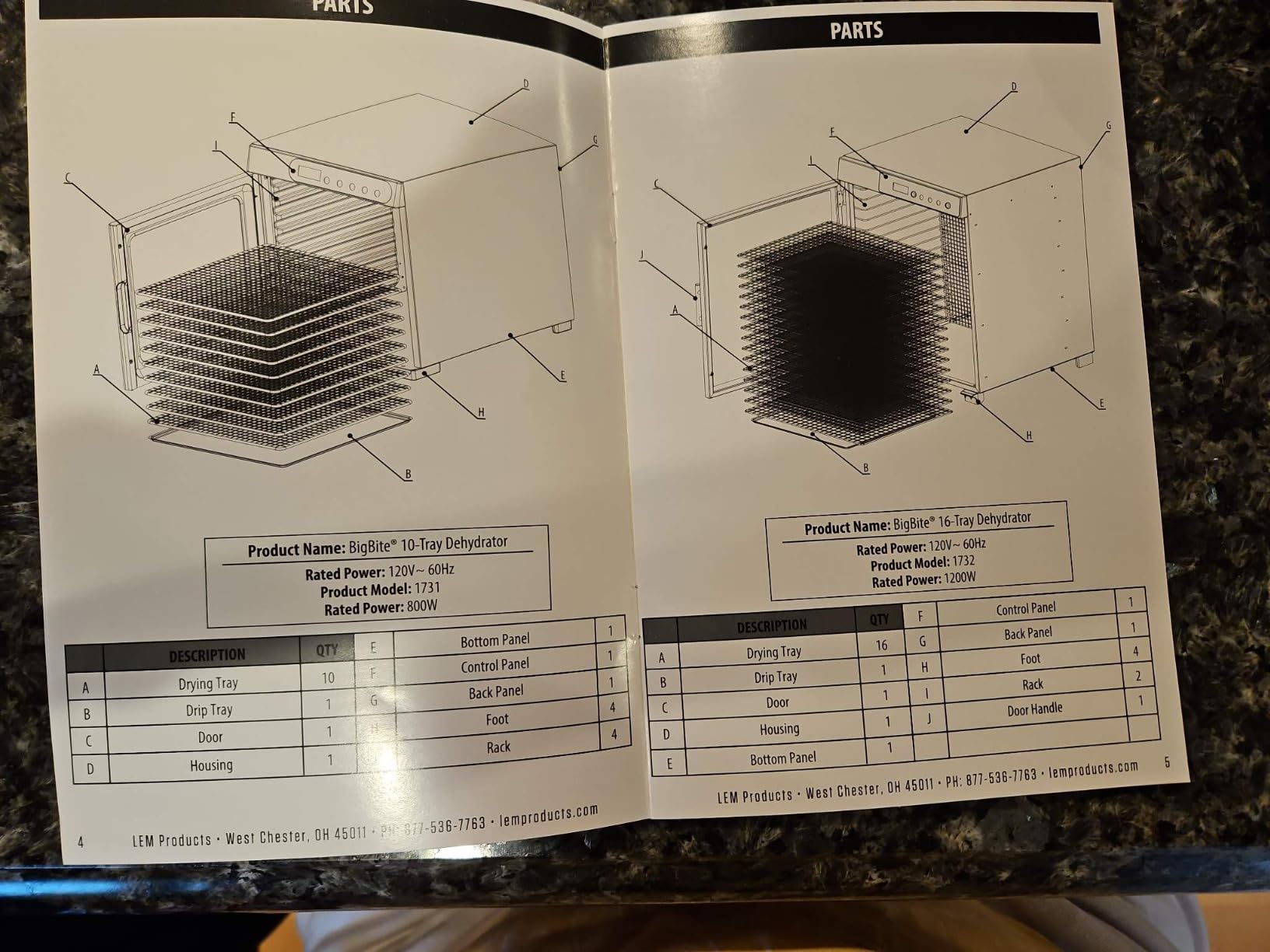
Under the hood it is an 800-watt element with a rear-mounted fan and rear venting for horizontal airflow, controlled digitally from 95°F to 176°F with a 30-minute to 24-hour timer. A see-through glass swinging door sits in a stainless housing, and the trays are removable and dishwasher-safe. It weighs 19.5 pounds and measures 13.38 by 14 by 15.98 inches.
The warranty is the real differentiator: five years from the factory, plus lifetime customer support and replacement parts. Feedback also notes that the machine is bigger than buyers expect. One caution on the numbers: with fewer than 50 ratings, the long-term durability record here is thinner than the rating alone suggests, so weight the warranty more heavily than the score.
The LEM BigBite 10-Tray is best for small pieces, pet treats and buyers who want support to still exist in five years
Users on r/dehydrating point to the BigBite specifically when an all-stainless build is the priority, and several buy two of them rather than one larger machine, on the reasoning that two compact units give more scheduling flexibility than a single oversized box. That is a sensible pattern for anyone whose batches are irregular.
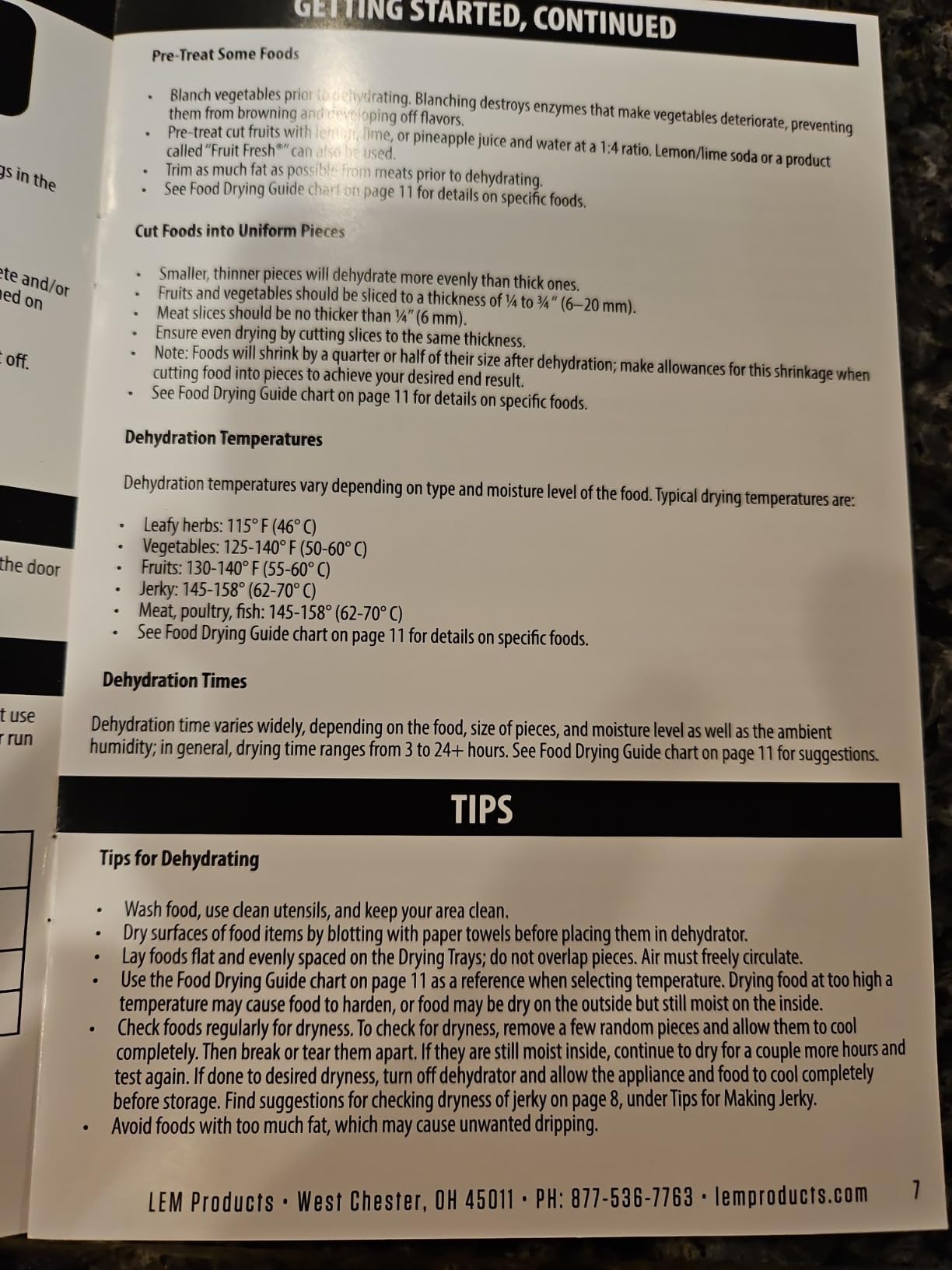
The rotatable 3/8 inch grid trays suit the food most people actually make in volume. Small uniform pieces dry faster and more evenly than large flat cuts, and this rack is built for that workload.
The LEM BigBite 10-Tray falls short on counter footprint and on proof of long-term durability
Several owners flag the size as a surprise. At 14 inches wide and nearly 16 inches tall it needs a real counter position rather than a corner, and it will not slide under a low cabinet.
With a review base under 50 ratings, there is not yet a long ownership history to lean on. If your decision hinges on a machine still working in year four, the five-year warranty is the real protection, not the rating.
8. Septree 12-Tray Stainless Steel Dehydrator – Best for Heavy Beef Loads and the Widest Temperature Range
Food Dehydrators Machine with 12 Stainless Steel Trays with Timer Setting Temperature Adjusted 68 ℉ to 194 ℉ Dryer for Herb Fruit Meat Vegetables Mushroom Beef jerky for Commercial Household large
12 trays of 12.52 inch square
1000W dual fan
68°F-194°F
30-minute to 24-hour timer
Pros
- Twelve 12.52 inch square trays sized for heavy beef loads
- Quiet dual-fan horizontal hot air circulation
- Widest temperature range here at 68°F to 194°F
- Automatic shutdown with cold-air cooling and overheat protection
- 304 food-grade stainless with dishwasher-safe trays and drip tray
Cons
- Dial adjustment produces a loud beep on every click that cannot be muted
- Knob-based controls with no preset programs
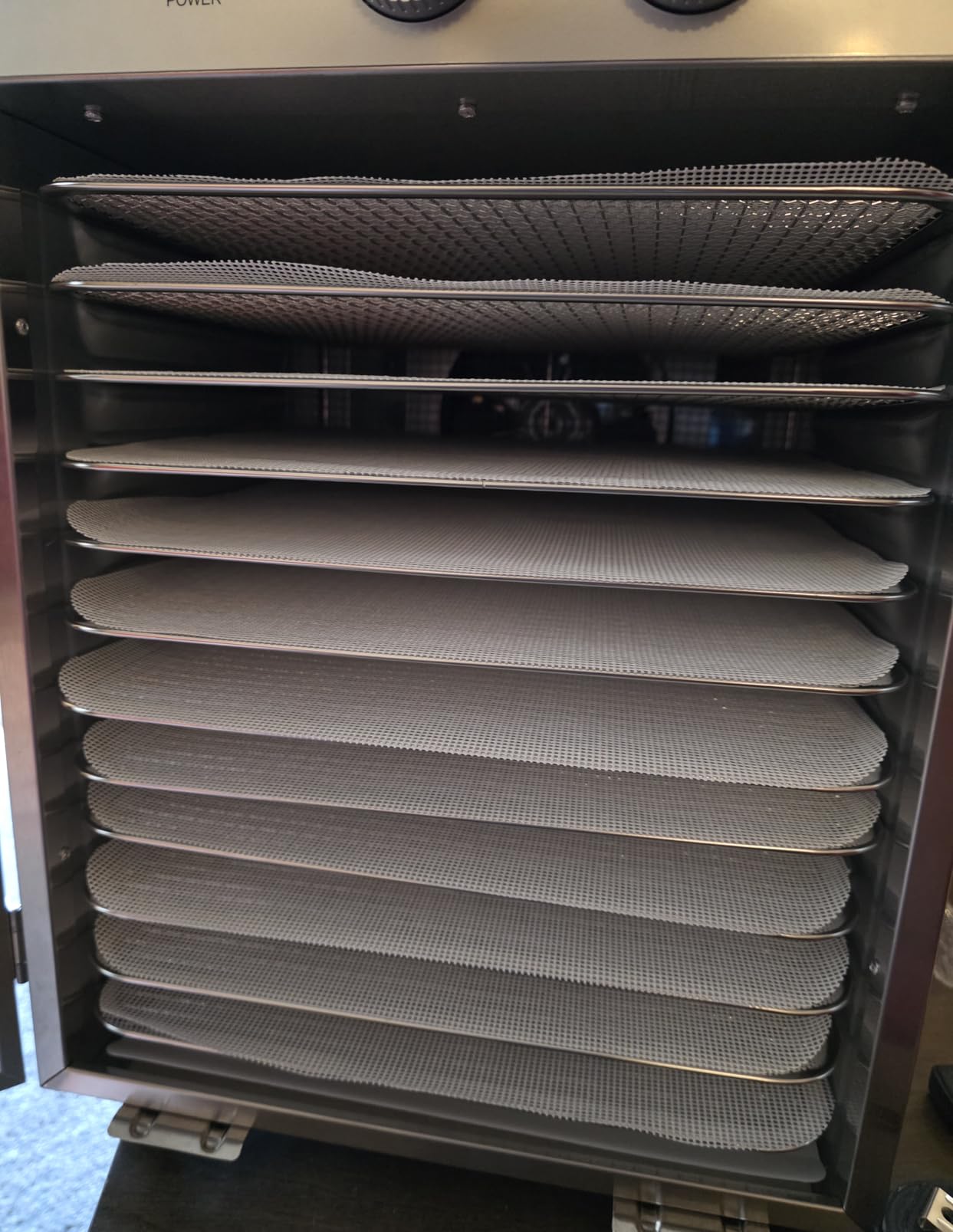
This is the one to look at if raw weight per load is your metric. The twelve 12.52 inch square stainless trays are sized for 15 to 25 pounds of beef in a single run, which is the kind of figure most manufacturers never publish.
Air comes from a 1000-watt dual-fan horizontal hot air system, and owners drying bulk peppers, apples, herbs, and dog treats report even results with very low noise. The 304 food-grade stainless body has removable dishwasher-safe trays plus a separate drip tray for fruit and vegetable runs.
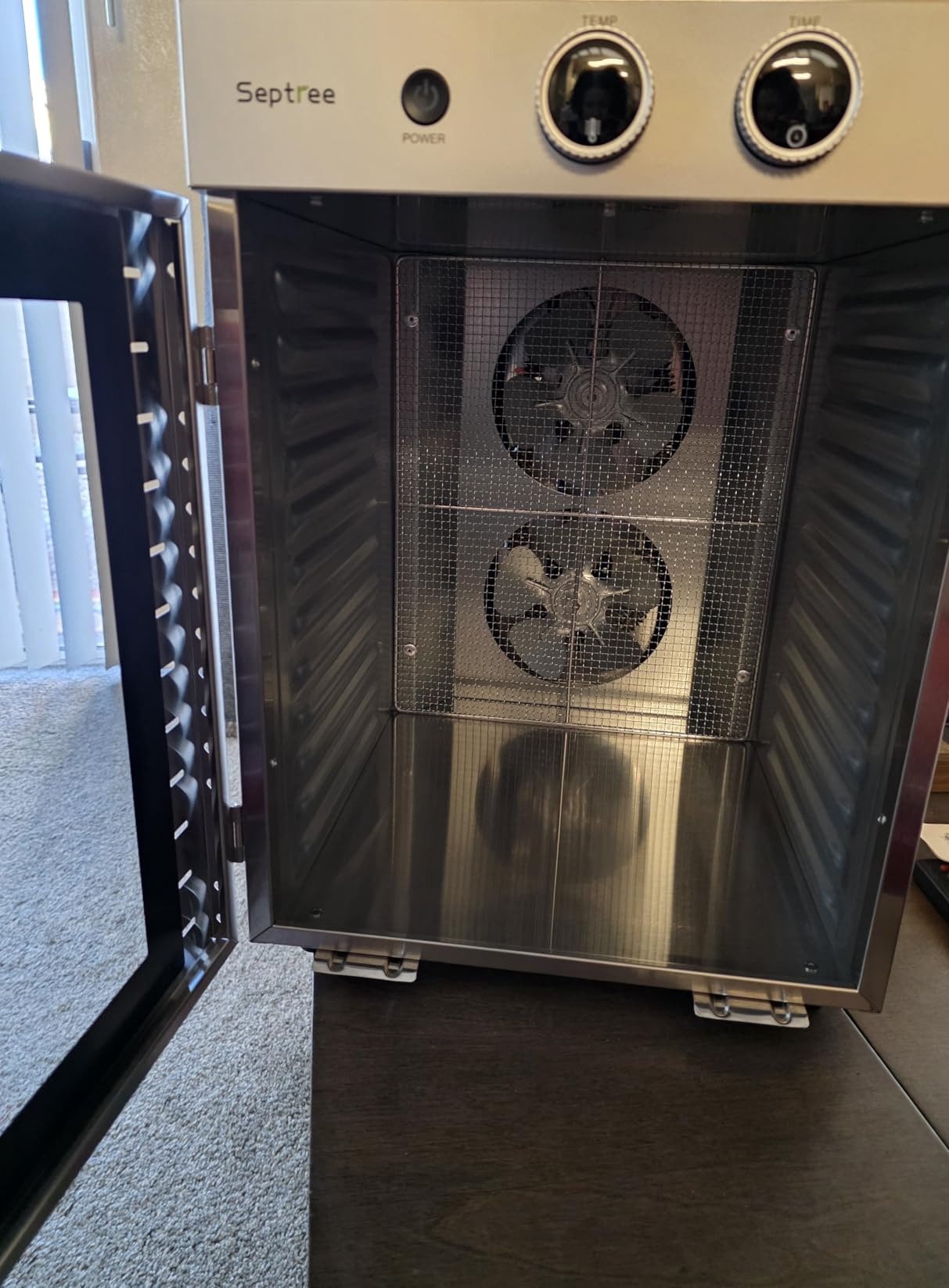
Temperature control is the widest in this roundup, spanning 68°F to 194°F, with a timer adjustable from 30 minutes to 24 hours. It shuts down automatically one minute before the cycle ends and circulates cold air to cool the chamber, with overheat protection on top of that. That low end matters for gentle herb and vegetable work, and the top end covers high-temperature fruit and meat.
The controls are the weak point. They are knob-based rather than a digital program panel, and every click of the temperature or timer dial produces a loud grating beep that cannot be muted, which is the single most repeated complaint in the feedback. If the machine runs in an open room overnight, that matters.
The Septree 12-Tray is best for bulk beef jerky and for anyone drying delicate and high-heat foods in one machine
The 68°F floor makes it the only pick here that handles low-temperature work such as herb drying without a separate unit, and the 194°F ceiling covers the high end that the home-grade machines cannot reach. One machine covers both ends of the food list.
The stated 15 to 25 pound beef load per cycle is the useful planning number. If you are processing a whole deer or a bulk order, that figure tells you how many overnight cycles your season will take before you buy anything else.
The Septree 12-Tray is frustrating for anyone who wants presets or silence
There are no preset programs here, so every run is set by hand, and the beep on each dial click is genuinely loud. Buyers who share a wall with a bedroom or run a machine in a workroom will want to look at a digital panel instead.
It is also the least documented model in the roundup: weight and overall dimensions are not stated, and the rating rests on a small number of reviews. Treat the beef load figure as a manufacturer claim and plan your first run as a test.
How to Choose a Stainless Steel Dehydrator for Large Batches
The four decisions that matter most are build type, usable drying area, airflow design, and temperature ceiling. Get those right and the rest is preference.
Check whether the stainless claim covers the walls and trays, not just the front
A listing that says stainless steel may mean a stainless-plated tray sitting in a plastic housing, which is a different product with a different lifespan. The Magic Mill Pro is the reference build in this roundup: stainless exterior, stainless interior, stainless trays, and no plastic walls at all, confirmed in its product details and backed by an ETL listing.
Buyers in dehydrating forums consistently recommend all-stainless over plated, and the reason is not aesthetic. Plastic trays warp with repeated washing and eventually hold odor, while stainless racks survive a decade of dishwasher cycles. If you cannot confirm the interior material on a listing page, assume the walls are plastic and look elsewhere.
Compare usable drying area, not tray count
A 16-tray machine with small rectangular trays can hold less food than a 10-tray machine with large square ones. The published figures here range from 10 square feet on the LEM to 34.42 square feet on the Septree 18-tray, and that spread is the real difference in how many cycles a harvest will take.
Also consider the food. Thin uniform slices exploit wide square trays, while small pieces like jerky chips and pet treats exploit a fine grid. Whole cuts and biltong want hanging racks, which only one model in this roundup includes as standard.
Prefer rear-mounted fans with horizontal airflow to avoid rotating trays
Top-fan and vertical-airflow designs push air in a column, which is why owners of those units describe mid-cycle tray rotation as an unavoidable chore. Rear-mounted fans with horizontal airflow and rear venting spread heat across the stack, so the top and bottom racks finish closer together.
On the models here, the Ausegia still needs middle trays swapped with top shelves for even results, which is the one exception worth knowing about before you plan a twelve-hour unattended run.
Treat the temperature ceiling as a recipe decision
The ceilings in this roundup run from 165°F on the Cosori to 194°F on the Septree 12-tray, with 190°F on both commercial models and 176°F on the two LEM and Magic Mill Pro units. A household doing fruit, vegetables, and lean beef is served by 167°F or 176°F. Dense biltong and whole-muscle curing want 190°F or above.
Single-degree increments matter more at the low end than the maximum, because herb and vegetable drying is where a five-degree step overshoots. Two models here step in 1°F increments, and one of them is the Cosori, which also has the lowest ceiling, so the two features do not always arrive together.
Plan for noise, cleaning, and the electrical draw of a long run
Quiet operation matters if the machine lives anywhere near living space. Two models here publish noise figures under 50dB, and the HOPERAN claims 45dB or less, which is the level most people can run overnight without noticing.
For cleaning, dishwasher-safe removable trays and a liner remove nearly all of the friction. For electricity, run times of ten to fourteen hours at 700 watts differ sharply from the same hours at 2000 watts, and the commercial machines are best treated as dedicated circuits rather than countertop appliances. Our stainless steel cookware guide covers the same durability logic if you are building out a kitchen around long-term use.
Frequently Asked Questions
What is the best-rated stainless steel dehydrator?
The LEM BigBite 10-Tray carries the highest owner rating in this roundup at 4.9, with 10 square stainless trays, 10 square feet of drying space and a five year warranty. Its rating rests on fewer than 50 reviews, so for a pick backed by a large feedback base, the Magic Mill 10-Tray at 4.6 across more than 2,600 reviews is the safer all-round choice.
What is a good heavy-duty food dehydrator?
A heavy-duty dehydrator is defined by three things: a full stainless steel interior and trays rather than a plastic housing, a rear-mounted fan with horizontal airflow so trays do not need rotating, and enough drying area to finish a batch in one pass. On that definition the 12-tray and 18-tray commercial models in this roundup, at 1200 and 2000 watts with 22 to 34 square feet of drying space, are the heavy-duty tier.
Is a stainless steel dehydrator better than plastic?
For repeated long-batch work, yes. Stainless trays do not warp with repeated dishwasher cycles, do not absorb odors, and tolerate higher heat than plastic trays or a plastic housing. The trade-off is weight and cost, since a stainless machine such as the Cosori 10-tray weighs 35.8 pounds against about 20 pounds for lighter models. If you dry a few times a year, plastic trays are workable; if you dehydrate weekly, stainless pays for itself.
How many trays do I need for large batches?
Ten trays covers most household batch work, including weekend jerky runs and a crate of fruit. Twelve to sixteen trays covers garden surplus and market volume in fewer overnight cycles, and eighteen trays is aimed at whole harvests and small commercial operations. Remember that tray size matters as much as tray count: a 12-tray model with 12.52 inch square trays holds far more than a 16-tray model with 11 by 8 inch trays.
Do I have to rotate trays halfway through, and which models avoid that?
Models with a rear-mounted fan and horizontal airflow largely avoid it, because heat is distributed across the stack rather than moving in a vertical column. Every rear-fan machine in this roundup reports far less tray rotation than vertical-airflow designs. The exception is the 12-tray commercial model, where owners report swapping middle trays with top shelves for more even results on long cycles.
How much does it cost to run a dehydrator for 24 hours?
It depends on wattage, and the range here is wide. A 600 to 800 watt machine running 24 hours uses 14.4 to 19.2 kilowatt-hours, while a 2000 watt commercial model uses 48. Multiply by your local utility rate to get the figure. In practice most loads finish in ten to fourteen hours rather than a full day, which cuts the real cost noticeably.
If you are still deciding what to dry first, our guide to making smaller batches of homemade food covers the same equipment questions at a different scale.
Conclusion
The Magic Mill Premium 10-Tray is our pick for the best stainless steel food dehydrator for large batches, because ten extra-large trays, a rear-mounted fan, and a feedback base of more than 2,600 ratings make it the most dependable home-grade machine here. The Magic Mill Pro 7-Tray takes the build-quality crown with a full stainless chamber and single-degree control, and the Cosori 10-Tray wins on drying area per tray at 16.2 square feet.
For genuine volume work, the Septree 18-Tray handles whole harvests and biltong, the Ausegia 12-Tray suits growers drying uniform slices on large square trays, and the HOPERAN 16-Tray solves narrow-counter kitchens. Pick the rack size your food actually needs, and check the temperature ceiling against your recipes before you order.