
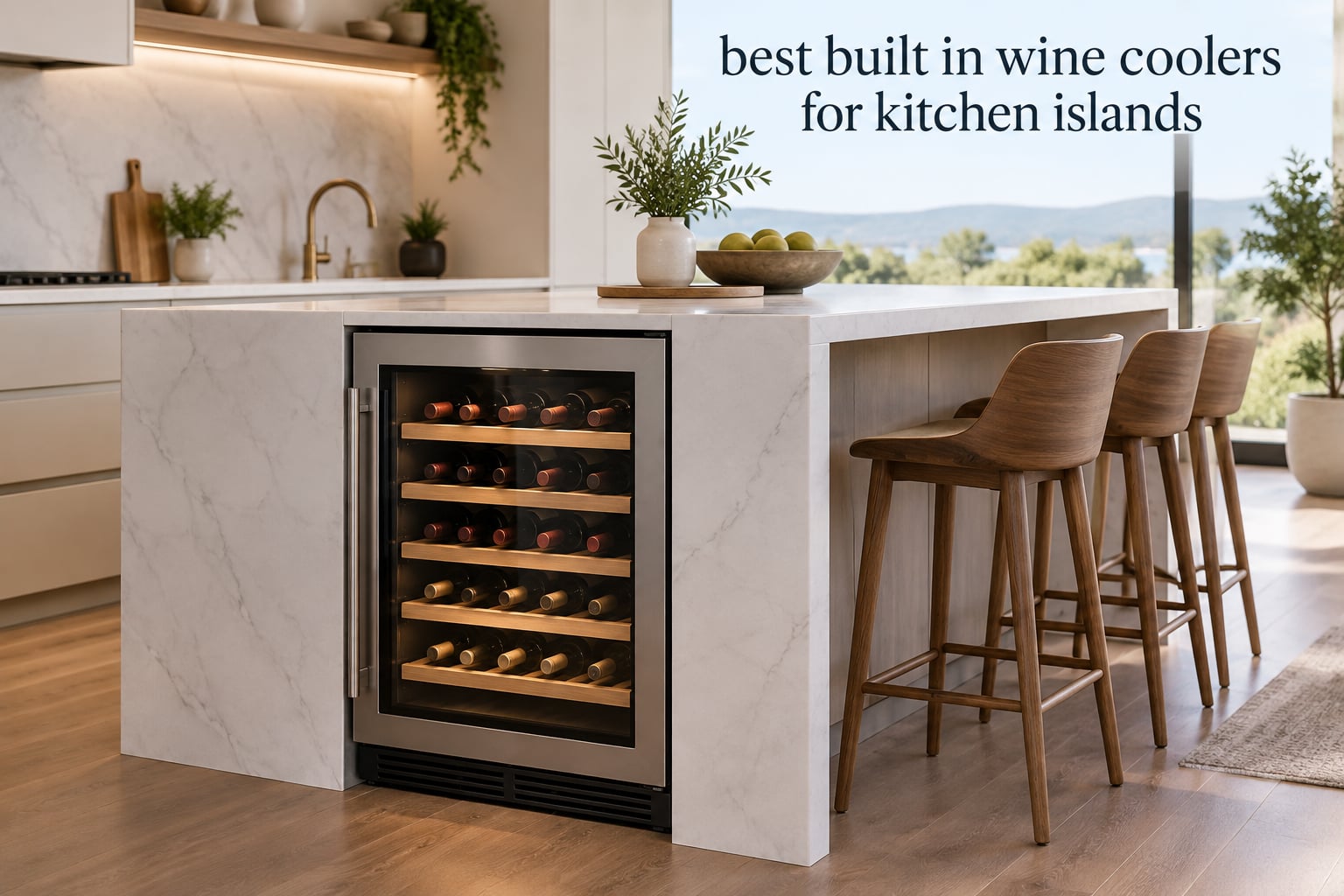
Most wine cooler buying guides ignore the kitchen island entirely. That is a mistake, because an island turns every ordinary fridge decision into a construction problem.
A built-in wine cooler has to fit inside a cutout you cut before the countertop goes on, vent air through the front of its own door, and swing open without hitting a bar stool or a drawer rail. Get any of those three wrong and the appliance is fine but the kitchen is not. The best built in wine coolers for kitchen islands are the models whose manufacturer publishes an exact cutout template, states a cooling type, and vents forward.
We spent weeks comparing 12 undercounter and built-in models on the four things that actually decide an island install: cutout dimensions, venting direction, noise, and how the door face relates to the island cabinetry. We also flagged the ones with misleading capacity claims, because a headline bottle count assumes bottles packed neck-to-foot in rows with no air gap.
If your island is still at the design stage, start with our small kitchen island guide so the cutout depth and cabinet layout are settled before the appliance is chosen. If seating overhangs the counter, our bar stool picks for kitchen islands explain the clearance math that decides whether a door can open past a seated guest.
Table of Contents
Top 3 Best Built In Wine Coolers for Kitchen Islands in 2026
These three cover the widest range of island situations. The first wins on review volume and dual-zone flexibility, the second on capacity and warranty, the third on fitting a narrow 15 inch cabinet cavity.

Velieta 24 Inch Dual Zone Wine and…
- Independent wine and beverage zones
- Front-vent for built-in install
- 9 removable wire shelves

Ca’Lefort 24 Inch 52-Bottle Dual Zone Cooler
- 52 bottles in 5.7 cu. ft.
- 40-64F dual zone
- 3-year compressor warranty

ROVSUN 15 Inch 26-Bottle Dual Zone Cooler
- 15 inch narrow body
- 41-64F dual zone
- Beech wood shelves on rails
All 12 Built-In Wine Coolers Compared Side by Side in October
This table lists every model in the roundup with its width, cooling type and defining feature. Use it to narrow the field before you measure your island cutout.
1. Velieta 24 Inch Dual Zone Wine and Beverage Cooler – Best Overall for Islands
Velieta Wine and Beverage Refrigerator, 24 Inch Dual Zone Fridge with Glass Door, Built-In Cooler with Powerful and Quite Cool System/18 Bottles and 88 Cans Capacity Bverage Cooler
4.24 cu. ft.
Front-vent for built-in use
Left beverage zone 35-50F, right wine zone 41-64F
9 wire shelves
Pros
- Independent wine and beverage zones
- Quiet fan-assisted compressor
- Front-vent works built-in or freestanding
- Removable wire shelves
- Blue LED ambient lighting
Cons
- Listed height of 76.2 inches suits a full-height cabinet
- not a standard under-counter island base
- Some owners report a low hum and faint gurgle on the compressor cycle
- Capacity claims differ between listing variants
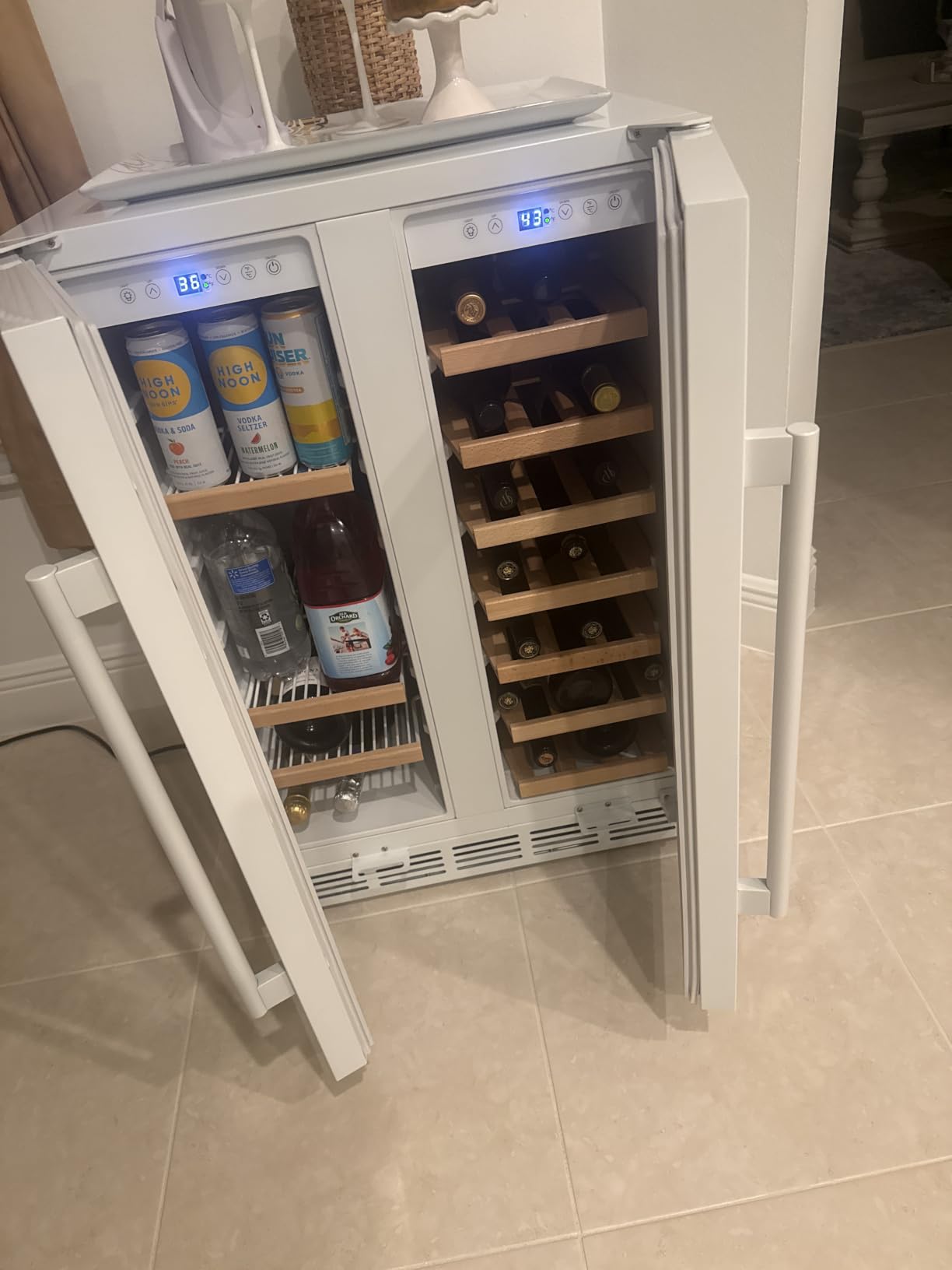
This is the model we kept coming back to while measuring islands, mainly because it has the deepest review base in the group at 1,129 ratings and a 73 percent five-star share. The wine zone holds 41-64F and the beverage zone runs 35-50F, so a kitchen island can serve whites and sodas without fighting each other over one setpoint.
Cooling is compressor based with fan circulation, and the front-vent design is what makes it island legal. Air enters and exits at the front face, so the cabinet behind it does not need a rear cutout or a ventilation grille.
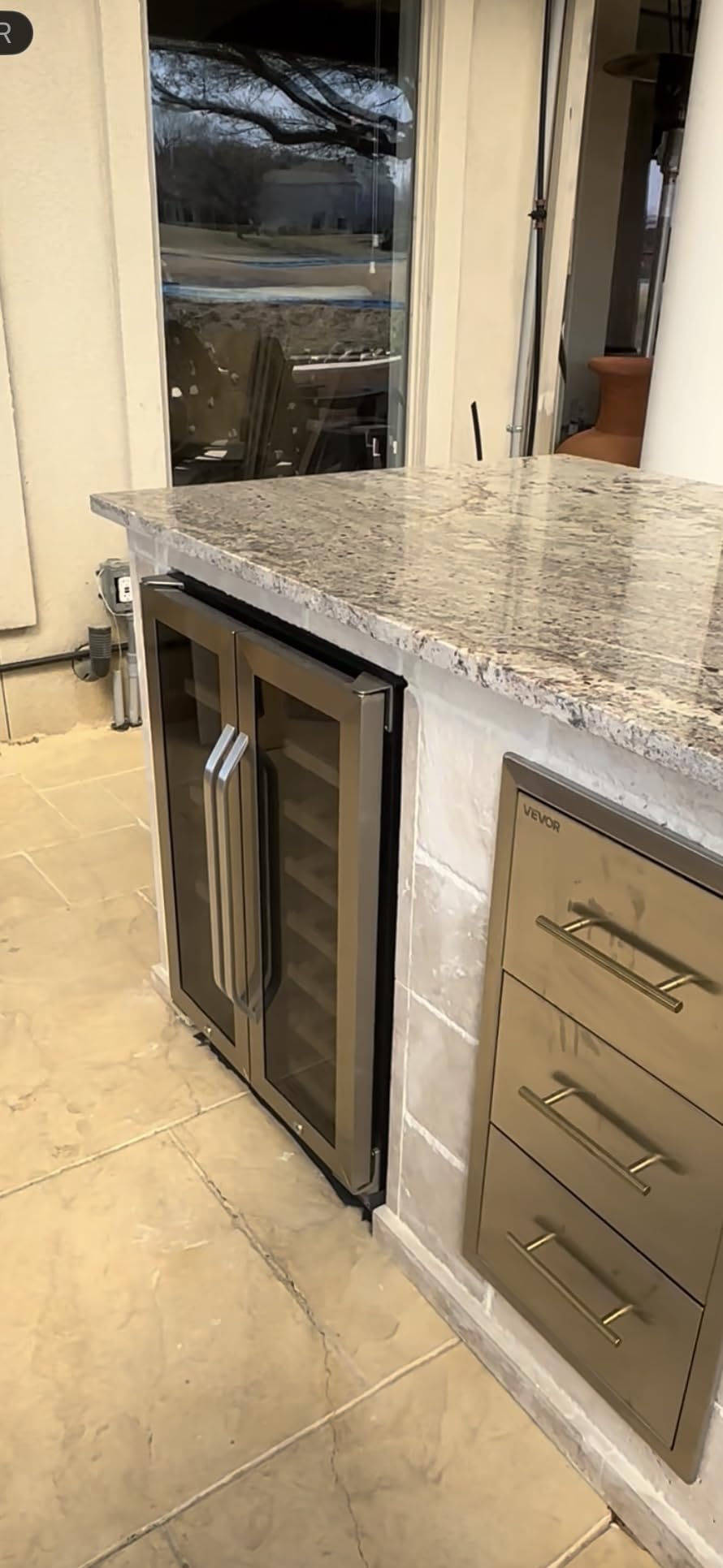
The specification that needs care is the height. The listing gives 25 inches deep by 24.4 inches wide by 76.2 inches high, which reads as a full-height beverage column rather than a 34 inch under-counter cavity. Before you cut anything, pull the installation template for model KMYL120 and measure your island base against it. The stated 162.2 kWh annual consumption and R-600A refrigerant are both typical for the class.
Owners also note the door orientation is fixed to one side, and a safety door lock is fitted to the interior. It runs on a three-pin 115 volt plug rather than a hardwire, which simplifies the electrical conversation with your electrician considerably.
How it fits an island with a 24 inch opening
At 24.4 inches wide this is one of the two picks here that fills a full 24 inch cabinet bay, which is the most common island base width in custom kitchens. The 25 inch depth means your island cabinet needs to be 26 inches or deeper internally, and standard 24 inch deep island bases will not clear it.
Owners who fitted it in a bar cart or garage setup describe it as compact for the capacity, but the wire shelves mean wide Champagne bottles will need the door open wider than a tight cavity allows.
Where the spec sheet oversells
The bottle capacity is the weak point. Manufacturer listings for this family mix capacity figures between variants, and several owners call out the inconsistency directly. Treat the stated 18 bottles and 88 cans as a ceiling, not a target.
The compressor hum is real but modest. In an open-plan kitchen with the island six to ten feet from a seating area, that hum sits at the edge of audibility rather than dominating conversation.
2. ROVSUN 15 Inch Dual Zone Wine Cooler – Budget Pick for a Narrow Island Bay
ROVSUN 15 Inch Dual Zone Wine Fridge, 26 Bottle Wine Cooler Refrigerator
2.8 cu. ft.
15 inch wide x 23 inch deep x 34.3 inch high
41-64F dual zone, +/-1F
Front-venting
Pros
- Slim 15 inch body fits a narrow cabinet bay
- Reaches genuine low cellar temperatures on compressor cooling
- Near-silent running in an open kitchen
- Removable beech wood shelves on rails
- Leveling feet for uneven floors
Cons
- Real bottle count drops once larger sparkling formats are loaded
- Temperature lockout must be unlocked before setting
- Some buyers report the listing switching to a different capacity variant
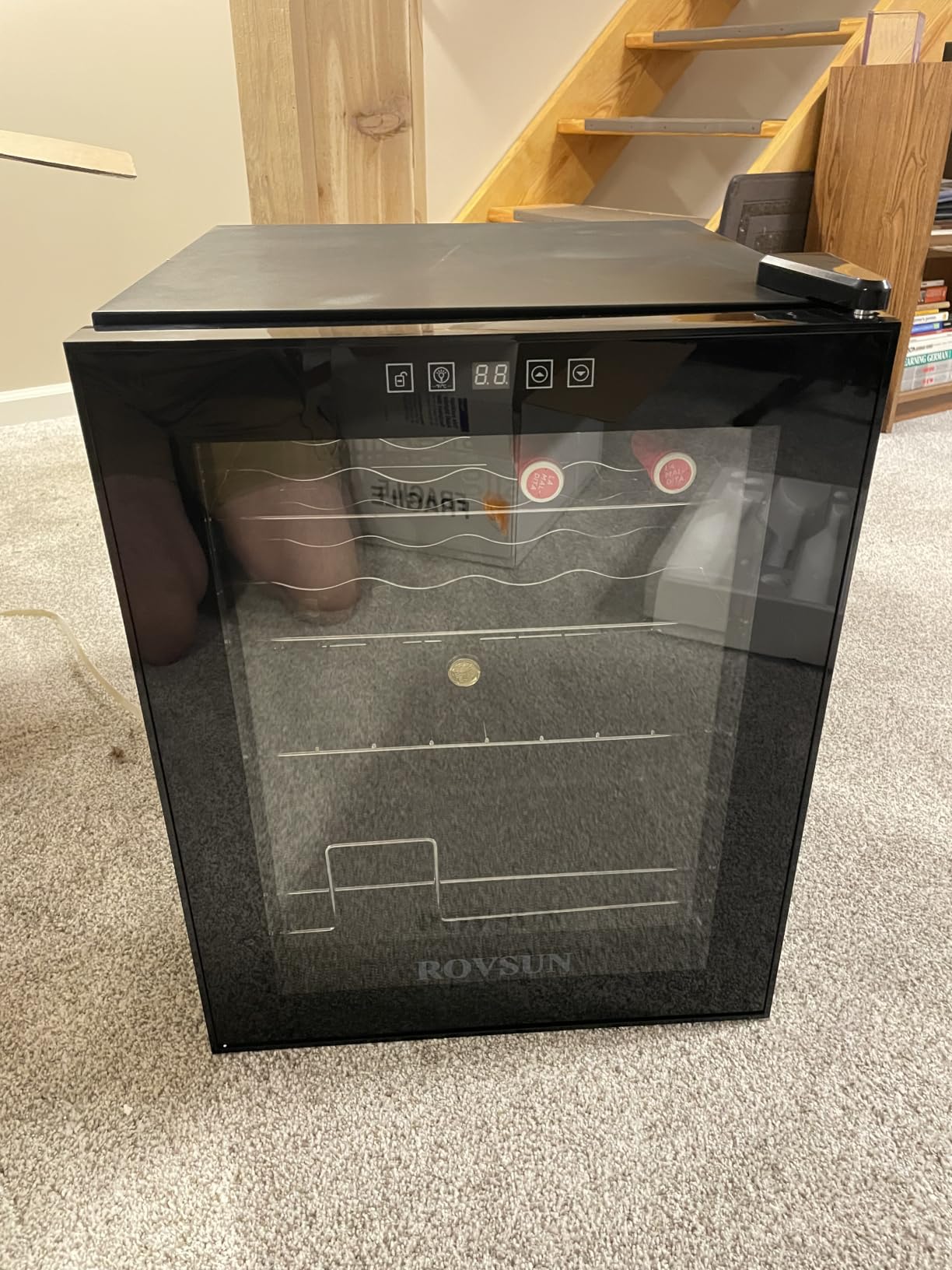
If your island is a 15 inch bay, most 24 inch wine coolers are simply impossible, and this is the pick we would specify. It measures 23 inches deep by 15 inches wide by 34.3 inches high, which is a genuine under-counter footprint rather than a tall cabinet column.
Dual zone setpoints run from 41F to 64F with roughly plus or minus one degree accuracy, and cooling is compressor based rather than thermoelectric. That distinction matters in a kitchen, because a kitchen near a cooktop regularly sits well above the temperature where a thermoelectric element can pull a cabinet down.
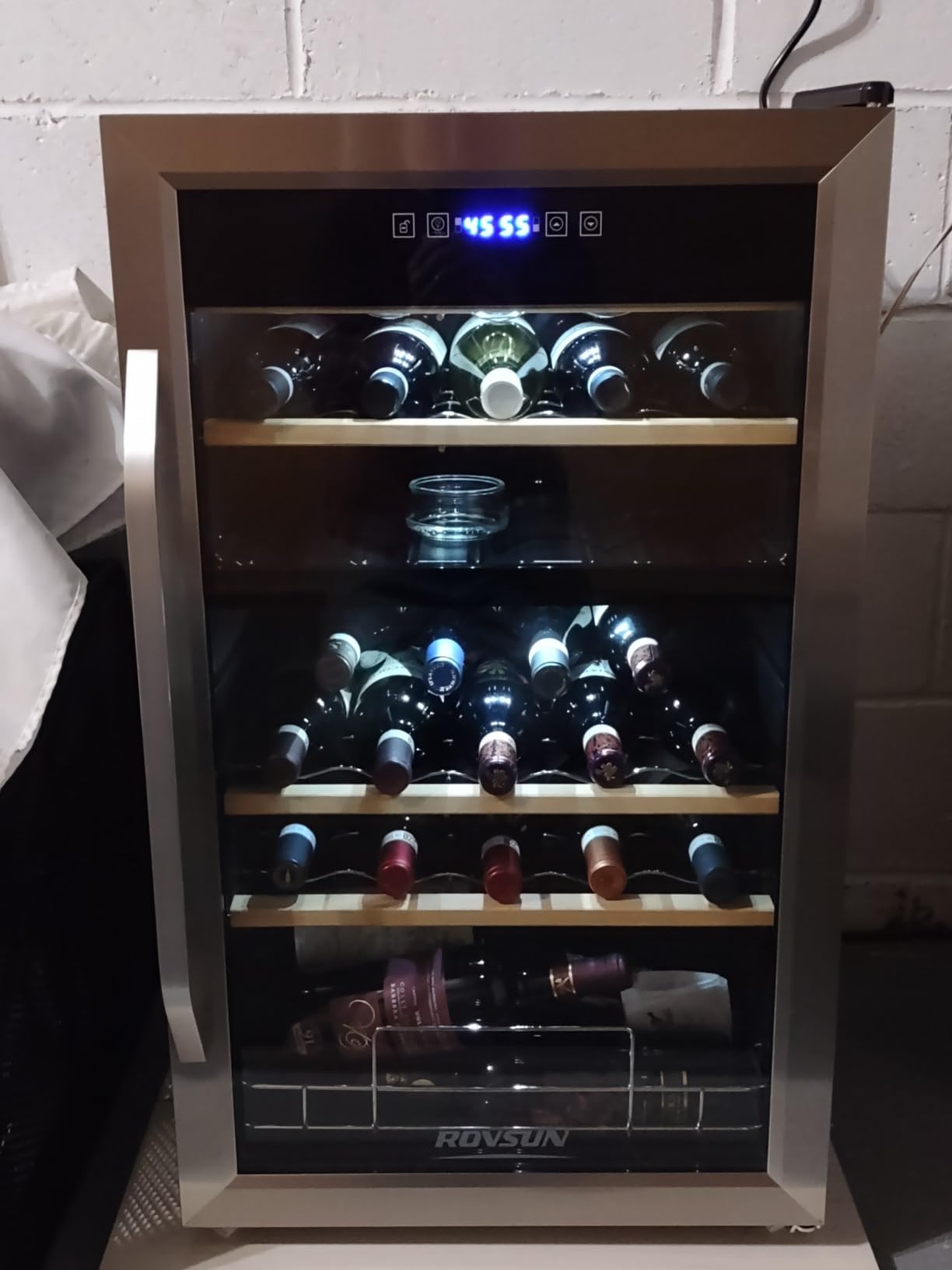
Reviewers consistently confirm a fast pull-down into the low 40s and near-silent running, which is why 74 percent of its 700 ratings are five star. The double-layer tempered glass door sits in a stainless steel frame, and the removable beech wood shelves glide out and are said to reduce vibration on the bottles.
Two practical notes. The front venting means the cabinet must be open at the face, and the 23 inch depth means a 24 inch deep island leaves only an inch of clearance, so measure the plinth and any rear rail before ordering.
Why 15 inches changes the island layout
A 15 inch cooler lets a cabinetmaker keep a standard 18 inch filler or a drawer bank beside it, which is impossible with a 24 inch appliance. In a small kitchen, that leftover strip is often where the trash pull-out goes.
Owners also praise the leveling feet, because island floors are rarely as flat as a wall run. It is one of the easier models here to set level on an uneven base.
When the capacity claim will disappoint you
The 26 bottle figure assumes standard 750ml bottles packed tightly. Several reviewers report the real number falls well short of that once larger sparkling or Champagne bottles go in, and Champagne is a taller format that eats a full shelf gap.
The temperature lockout is also a genuine friction point. You have to unlock the panel before any setpoint change, which some owners read as a fault until they find the sequence.
3. Kalamera 24 Inch Built-In Wine Cooler for 120 Cans and 16 Bottles – Best for a Mixed Bar Island

Beverage Fridge 24 Inch Beverage and Wine Cooler Built-in or Freestanding – 120 Cans & 16 Bottles Capacity Wine Refrigerator Cooler
5.3 cu. ft.
22.4 in deep x 23.4 in wide x 33 in high
120 cans and 16 bottles
Compressor
Pros
- Reversible door swaps in about 25 minutes without tools
- Whisper-quiet running
- Automatic defrost every six hours
- Temperature memory restores setpoint after power loss
- Heavy-duty packaging with pallet and foam surround
Cons
- Controls and light switch sit inside the cabinet
- Wood slats will not take wider bottle formats
- 116 pounds means a two-person install
Not every island holds only wine. This 24 inch Kalamera is rated for 120 cans and 16 bottles in 5.3 cubic feet, which makes it the pick for an island that also functions as a drinks station during a party.
Compressor cooling with automatic defrost every six hours keeps the evaporator clear without the owner ever opening a freezer compartment. The stainless frame carries two layers of tempered glass, and the whole cabinet is listed as ETL certified and freezerless.
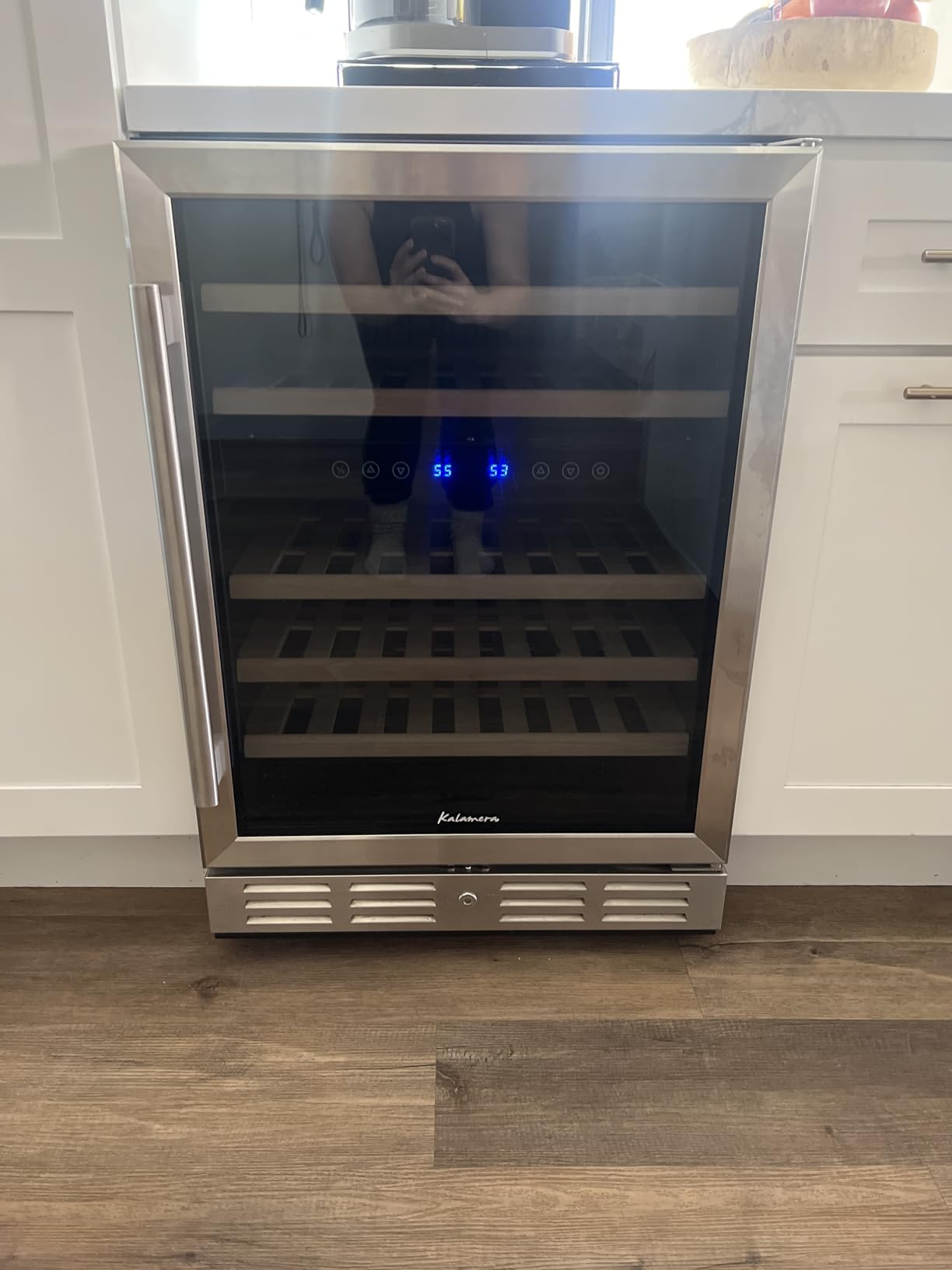
The reversibility is the detail that matters most in an island build, because it lets the hinge face whichever direction your seating and worktop layout allow. Owners report a swap in roughly 25 minutes with no special tools, and repeat buyers say this model has replaced failed appliances in the same slot.
Its FSC-certified wooden frame is designed to reduce vibration and friction on bottles, and temperature memory restores your setpoint after a power cut, which protects a collection during any kitchen remodel.
What the 116 pound weight means for your installer
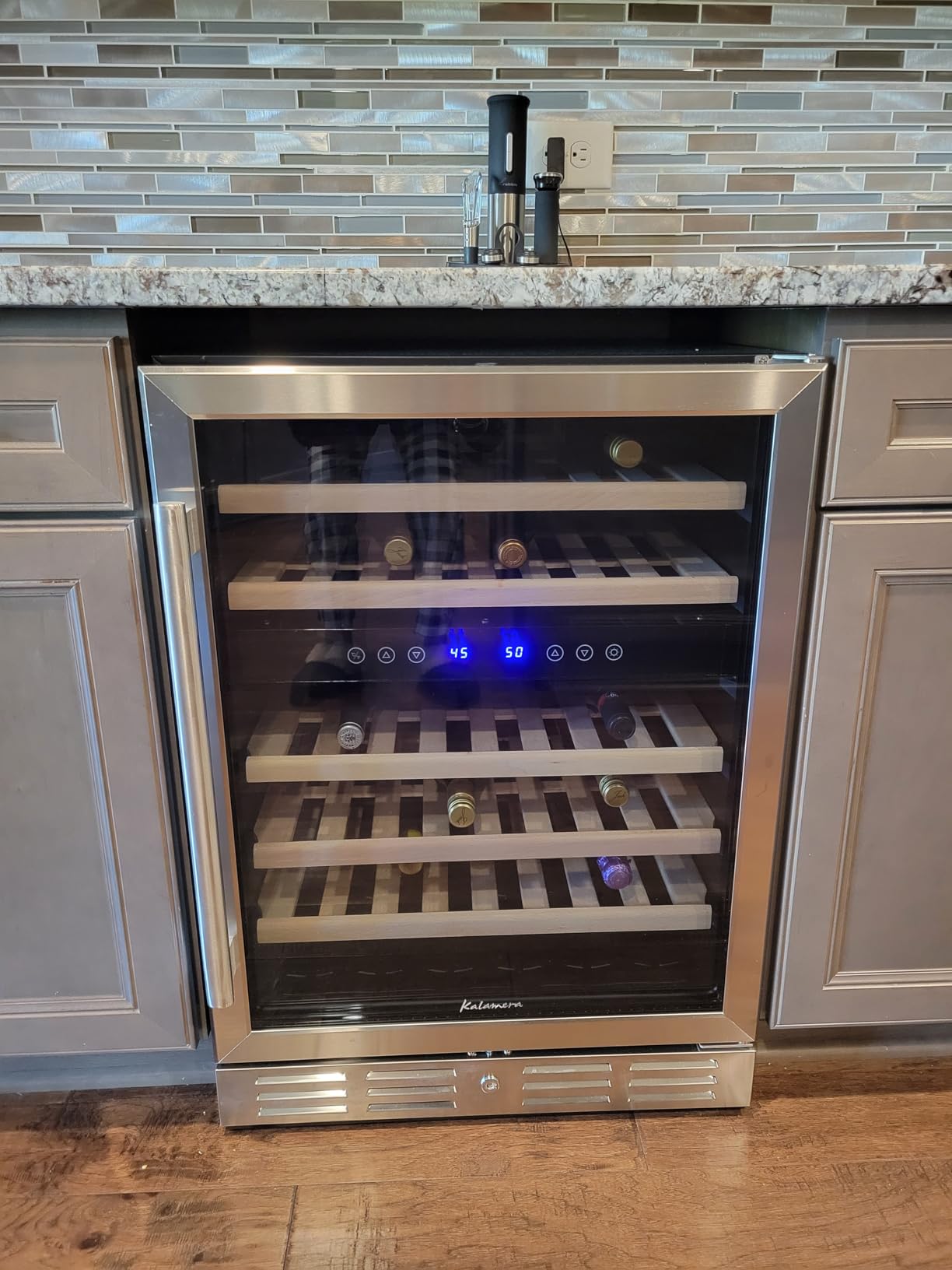
At 116 pounds this is a two-person install, and it is one of the heavier models in the roundup. If your island is already built, you will need to remove a countertop panel or a cabinet door to get it into the cavity, and the cabinetmaker should be on site for that step.
The good news is that the packaging is built for this. Owners specifically praise a foam surround and pallet, because built-in glass doors crack easily in transit when a unit is shipped loose.
Where owners push back
The controls and light switch are inside the cabinet, so adjusting anything means opening the door in front of your guests. On a display-style island that is a small but constant irritation.
The wood shelf slats are spaced so that wider bottles do not sit in them properly, and real bottle capacity falls short of the headline figure once you load anything that is not a standard slim format.
4. Kalamera 24 Inch 37-Bottle Dual Zone Built-In Wine Cooler – Best for Split Red and White Storage

Kalamera 24 inch Wine Cooler, 37 Bottle Dual Zone Built-in or Freestanding
5.3 cu. ft.
Upper zone 40-50F, lower zone 50-66F
Fits a 23.4W x 33H x 22.4D cavity
Key lock
Pros
- Dual zone thermostat splits reds and whites cleanly
- Removable wood shelves have side stoppers so bottles do not tip
- Temperature memory protects the collection after a power loss
- Works built-in or freestanding
- LED control display for setpoint changes
Cons
- 4.0 average with a 15 percent one-star share
- the weakest rating in the set
- Listing alternates between 37 bottle and 46 bottle claims
- 332 kWh annual consumption is high
- Uses an HFC-style refrigerant rather than R-600A
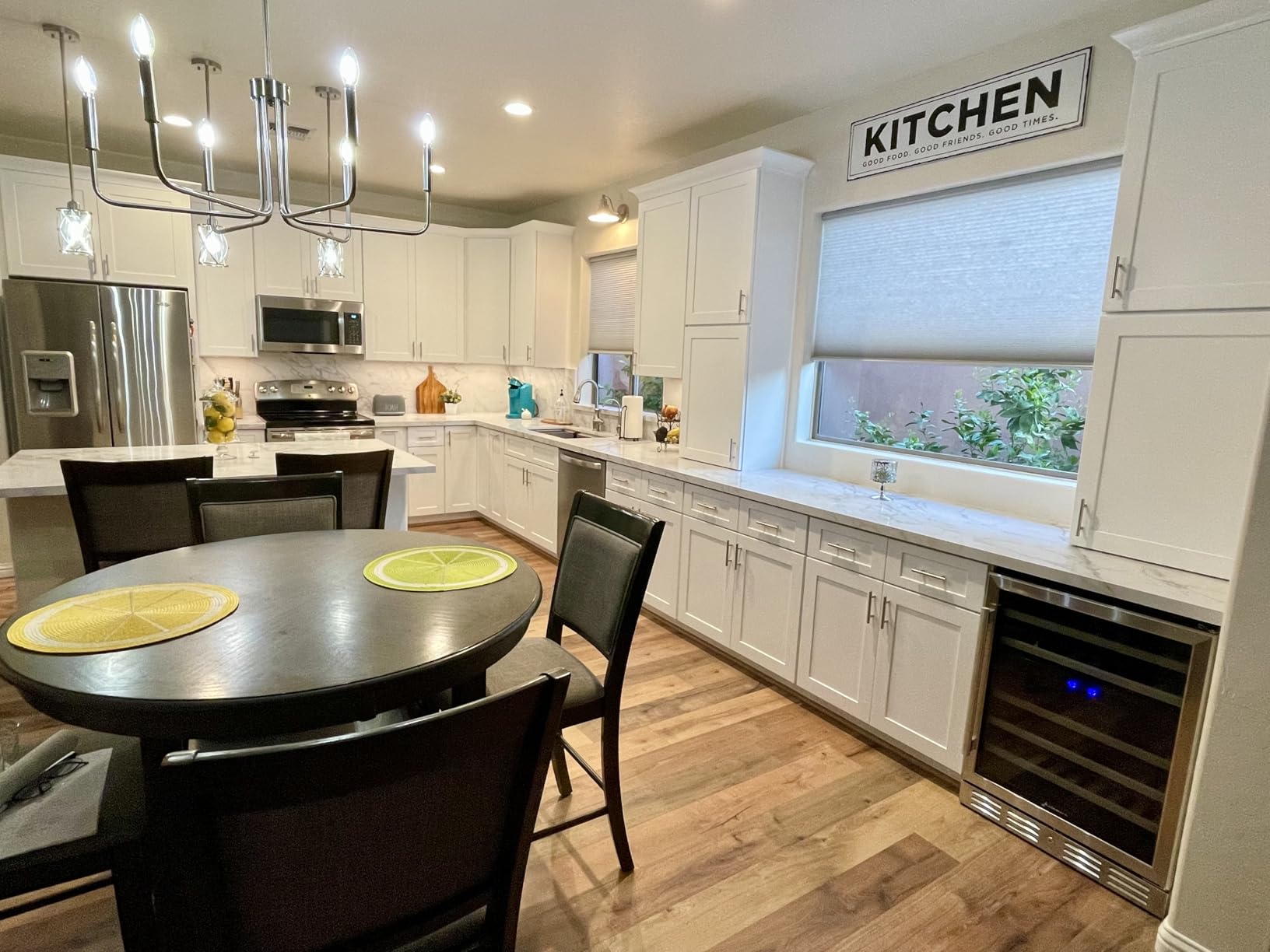
This is the same cabinet footprint as the Kalamera above but configured as a proper two-zone wine cooler. The upper zone runs 40-50F and the lower zone 50-66F, which is a sensible split for a household that serves whites chilled and reds at cellar temperature in the same sitting.
The published cavity is the useful number for a cabinetmaker: a 23.4 inch wide by 33 inch high by 22.4 inch deep opening. At 102 pounds it is a two-person lift, and the listed maximum depth with the door open is 22.4 inches, which is what you need to clear a seating overhang.
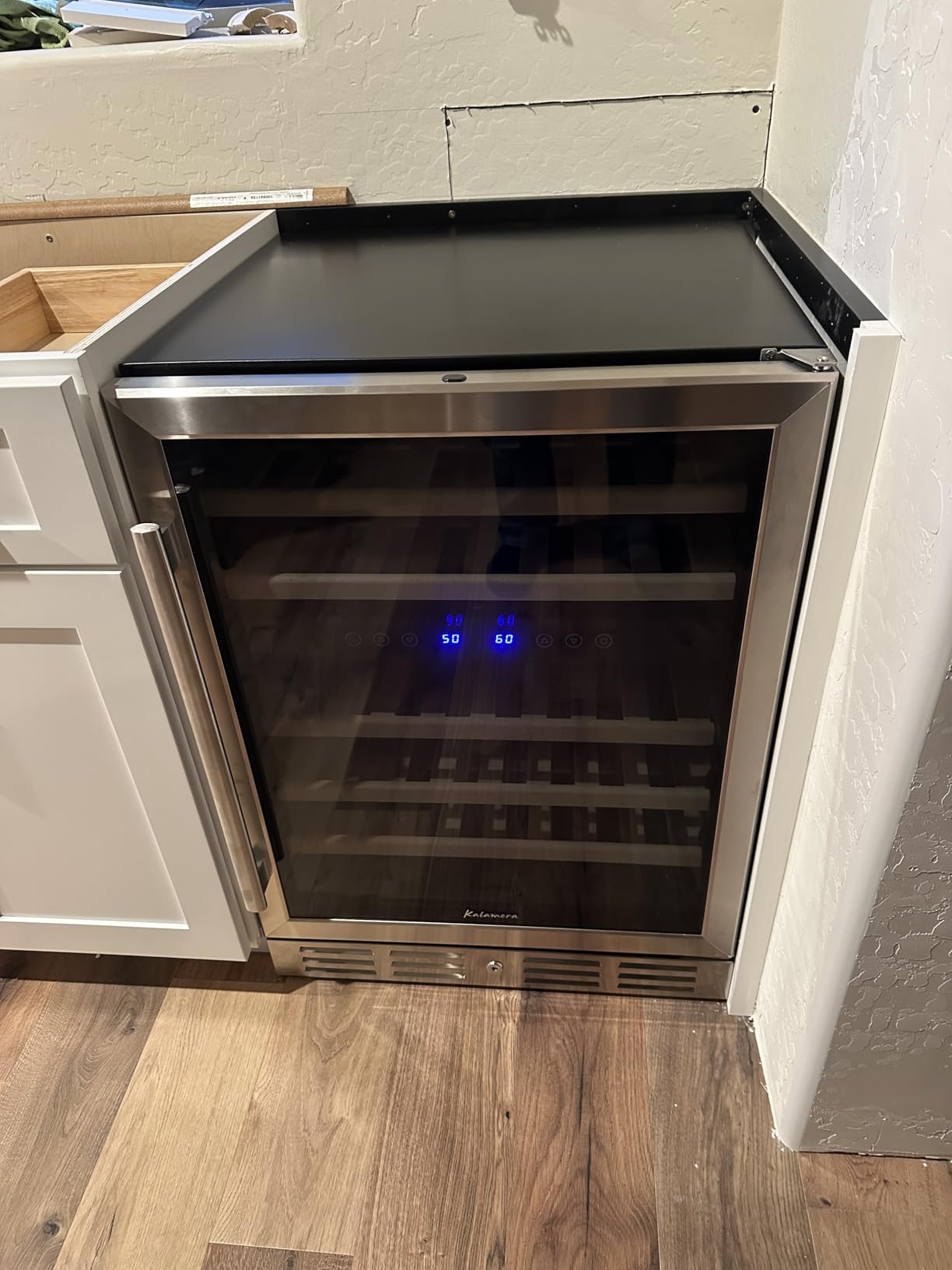
The FSC-certified wooden frame and five removable shelves with side stoppers are the parts owners mention most. The stoppers stop bottles rolling when a shelf is pulled out, which matters in an island where someone will grab a bottle while talking to you.
A key lock is fitted, and the door orientation is listed as fixed. Temperature memory restores settings after a power interruption, which is worth having if the island shares a circuit with a microwave or an oven circuit.
Reading the zone split before you commit
A 40-50F upper zone is red wine service temperature rather than long-term aging temperature, so this split works for drinking wine, not for laying down bottles for a decade. Buyers building a proper aging wall want a single steady zone near 55F instead.
The 50-66F lower zone is wide. It is useful because it can hold reds just before service, but it is not a precision cellar, and the reviews flag temperature accuracy across the two zones as a recurring theme.
Why the rating is the lowest in the group
Its 4.0 average and 15 percent one-star share are the weakest numbers in this roundup. Two things drive that: real-world capacity landing well below the stated bottle count, and doubt about the listing itself, which alternates between 37 bottle and 46 bottle claims.
Energy use is also the highest here at 332.15 kWh per year, and it uses an HFC-style refrigerant rather than the R-600A used by most competitors here. If your island runs the cooler year round, that running cost adds up.
5. BODEGA 15 Inch 30-Bottle Dual Zone Wine Cooler – Best for Warm Kitchens

BODEGA 15 Inch Wine Fridge, 30 Bottle Dual Zone Wine Cooler, 41-72℉ Compressor Wine Refrigerator with Tempered Glass Door, Built-in or Freestanding Wine Cooler for Home Kitchen Bar (3.2 cu.ft).
3.2 cu. ft.
22.44 in deep x 14.96 in wide x 33.58 in high
41-72F dual zone, 1F increments
42 dB
Pros
- Dual zone setpoints adjust in single degree increments
- Front air vent cooling suits a built-in island cavity
- Double-glazed tempered glass blocks 99 percent of UV
- Five removable shelves allow champagne sizes
- Key lock and 12-month support with 24 hour response
Cons
- 72F upper limit is warmer than most wine coolers
- Wood-look shelves described as a finish rather than solid wood
- Review volume for this specific model is thinner than the brand's larger listings
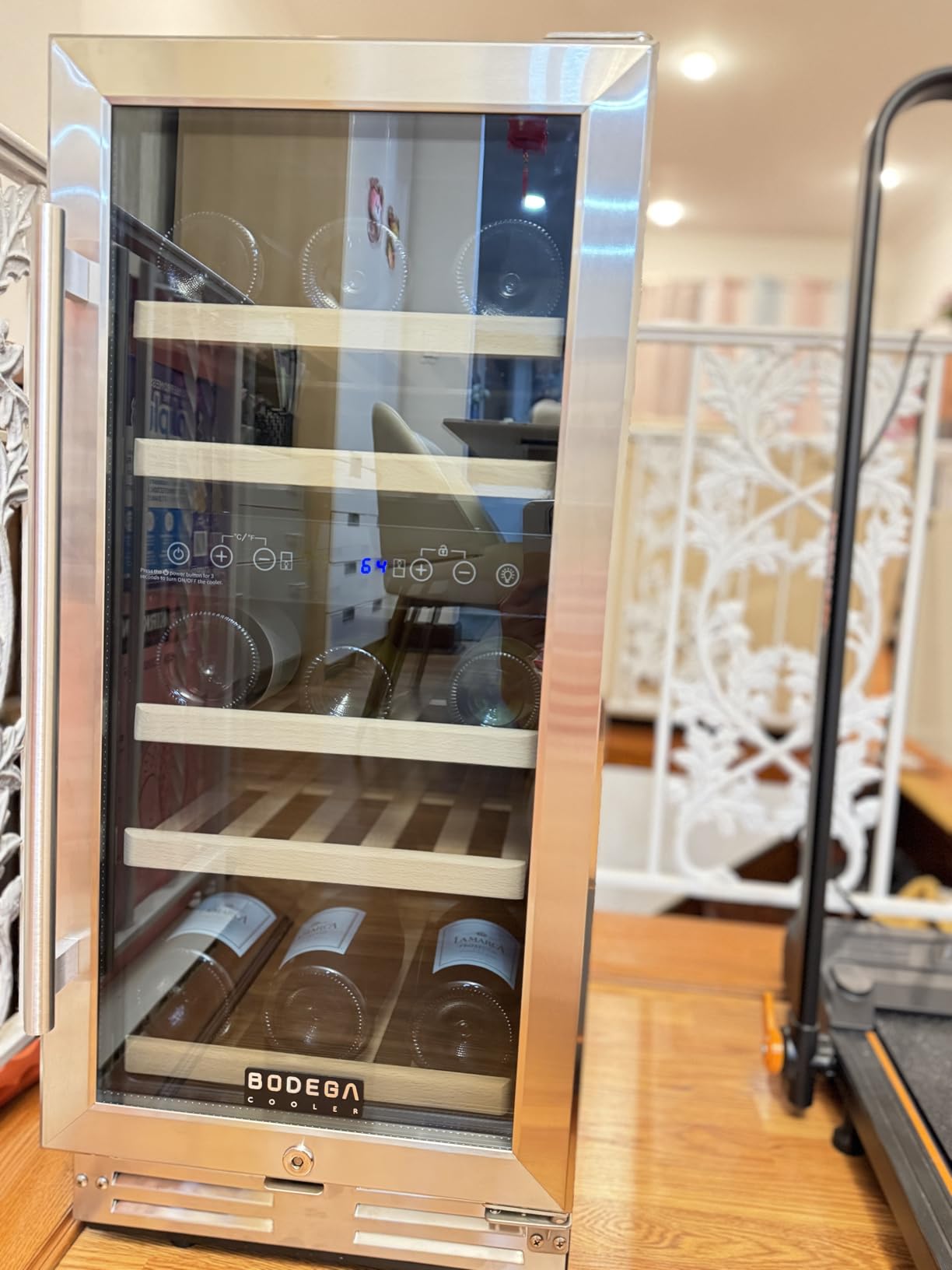
This is the pick when the island sits next to a cooktop or a wall oven. Its 41-72F range is the widest in the roundup, and that width is useful in a warm kitchen where you need headroom above a red wine setpoint rather than a cellar-cold floor.
At 22.44 inches deep by 14.96 inches wide by 33.58 inches high, it drops into a narrow 15 inch island bay. Compressor cooling with built-in air circulation is rated as low as 42 dB, and the double-glazed tempered glass door blocks 99 percent of UV rays, which protects bottles in an island that sits next to a window.
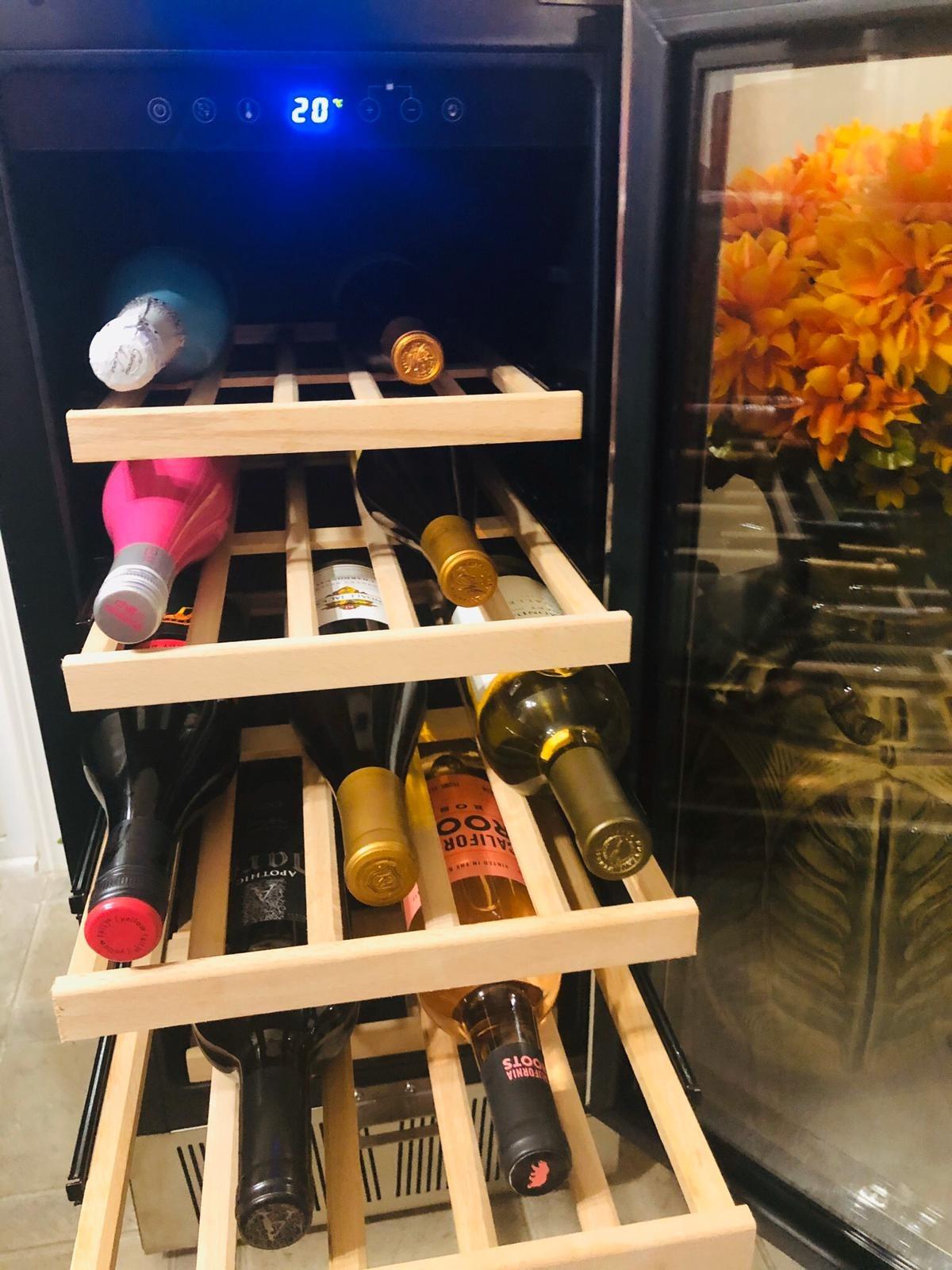
Control granularity is the standout feature. Setpoints move in one degree increments on a clear digital display, so you can dial reds to 66F for service and whites down to 46F without overshooting, and temperature memory plus an automatic lock stop accidental changes.
Blue LED interior lighting, a key security lock, and adjustable feet that raise the body up to 2 inches round out a well-specified package. The brand also commits to 12 months of product support with a 24 hour response promise.
Is 42 dB quiet enough for an open kitchen?
It sits in the middle of the range here. A dedicated bar in a basement tolerates 45 dB. An island that opens onto a living room does not, because there is no wall to absorb the compressor cycle. In that setting, most owners treat anything under 40 dB as the safe threshold.
The 2 inch adjustable foot height also helps with ventilation in a shallow island plinth, which is where freestanding coolers boxed into cabinetry usually overheat.
What the wide temperature range costs you
A 72F ceiling is a red wine convenience, not a storage safeguard. Wine stored near 70F ages faster, and cork closures let more oxygen through as the temperature climbs. Use the upper part of the range for short-term service, not for a collection you intend to keep for years.
The wood-look shelves are a finish rather than solid wood, and reviews for this specific model are thinner than the brand’s larger listings, so treat the rating as a smaller sample than the numbers suggest.
6. Ca’Lefort 24 Inch 52-Bottle Dual Zone Wine Cooler – Best for Large Dual-Zone Islands
Ca’Lefort 24 Inch Wine Fridge, 52-Bottle Dual Zone Wine Cooler Refrigerator
5.7 cu. ft.
23.4 in deep x 23.8 in wide x 33.8 in high
40-64F dual zone, sapele wood shelves
3-year compressor warranty
Pros
- Lowest one-star share in the set at 6 percent
- Cools down in roughly 45 minutes after first power-on
- Front ventilation slides cleanly under a countertop
- Three switchable LED colors from the control panel
- Owners report fitting more bottles than the stated count
- Three year compressor warranty
Cons
- Shelves are removable but not height-adjustable
- Controls sit inside the door so changes need the door open
- No door lock on this configuration
- About 100 pounds empty so two people are needed
This is the pick for an island that needs real capacity without stepping up to a full-size column. It holds up to 52 standard 750ml Bordeaux bottles in 5.7 cubic feet, and the 23.4 by 23.8 by 33.8 inch body still fits a standard 24 inch under-counter bay.
The dual zone holds 40-64F with fan-assisted circulation, and the sapele wood shelves are chosen to reduce vibration. Ambient LED lighting switches between amber, blue and white, so you can pick a setting that does not throw colour onto a countertop you eat on.
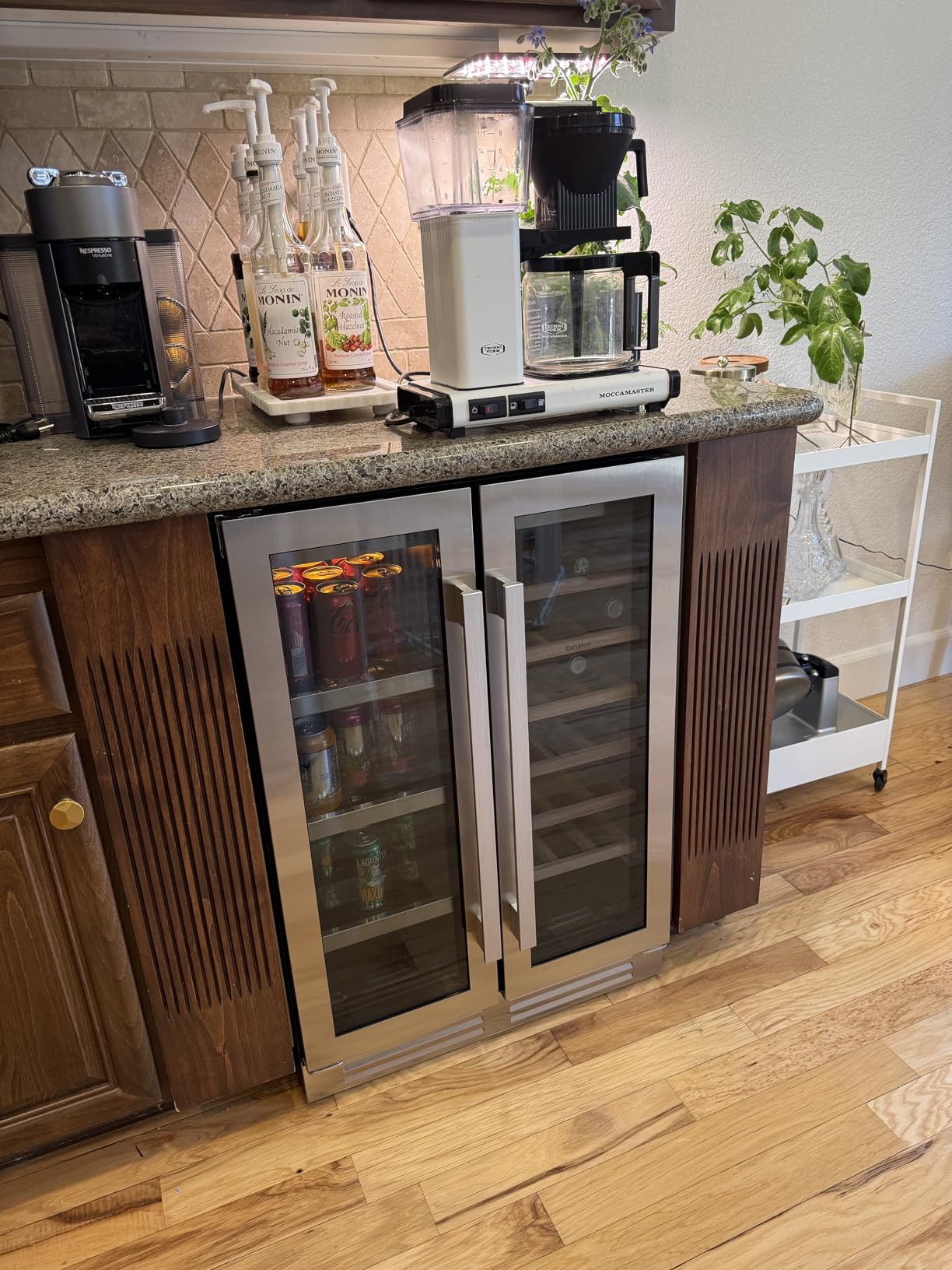
The warranty is the standout. It runs one year on the complete machine, two years on parts and three years on the compressor, which is longer than anything else in this roundup and the single most useful spec for a unit that will run year round in an open kitchen.
Owners report a cool-down of roughly 45 minutes after first power-on, a clean slide under a countertop thanks to the front ventilation grille, and one unit that fits more bottles than advertised. The manufacturer instructs that the appliance stand for 24 hours before first power-on after delivery.
Why a 3-year compressor warranty matters here
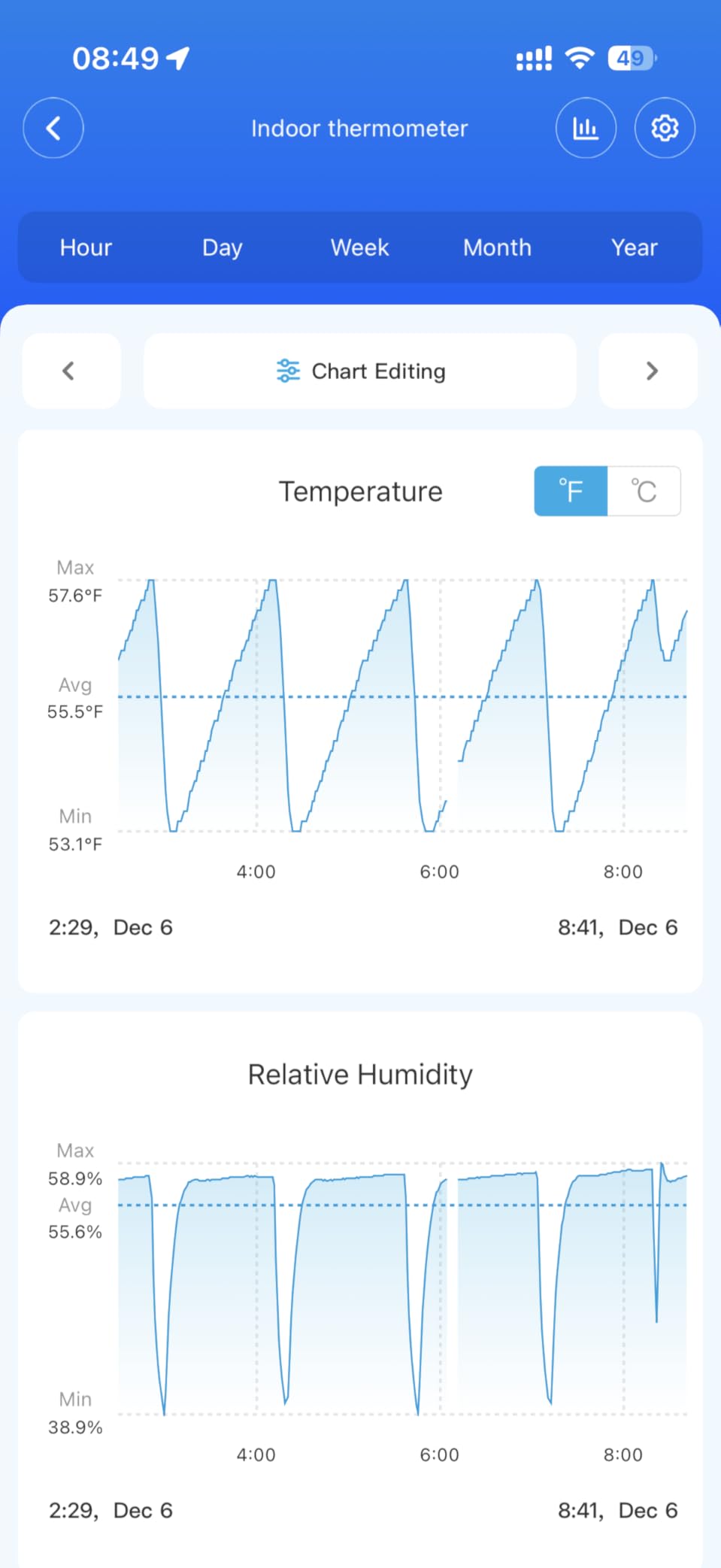
An island cooler is rarely serviced easily. Pulling a column out of cabinetry to reach a failed compressor is a much bigger job than unplugging a freestanding fridge, and labour usually costs more than the appliance. A 3-year compressor term covers the most likely failure before you pay to move cabinetry.
The 6 percent one-star share is also the lowest in the set, which is unusual for a model in this price band. That tracks with the quietness praise, since owners directly compare it to a standard kitchen refrigerator.
What you give up for the capacity
The shelves come out but do not adjust in height, so Champagne has to go on the top or bottom rack. If your island is a service station where people pull bottles while standing, that is a real annoyance.
Controls are mounted inside the door and there is no door lock on this configuration. Two people are needed to move it at roughly 100 pounds empty, so plan the install path before the countertop goes on.
7. Yeego 24 Inch 52-Bottle Dual Zone Wine Cooler – Best Finish and Build Quality

Yeego 24 Inch Wine Fridge, 52 Bottle Dual Zone Wine Cooler with Left Hinged
5.12 cu. ft.
22.4 in deep x 23.4 in wide x 32.3 in high
40-65F independent zones
5 beech wood shelves
Pros
- Owners rank finish and quietness above costlier alternatives
- Stainless frame and double-layer tempered glass look built to last
- Door closes securely without bouncing back
- Responsive service that sent a replacement part free
- Bottom shelf takes wide Champagne bottles
Cons
- Fixed hinge cannot be reversed on this model
- Middle pull-out shelves stop at half extension
- Setpoint needs adjusting before it settles
- One owner reported electronics failure at six months on a parts-only warranty response
This is the one reviewers compare against more expensive brands and then choose. Several owners say they weighed higher priced stainless and glass units before landing on this one, which is unusual praise at this tier and the reason we rank it here.
It measures 22.4 inches deep by 23.4 inches wide by 32.3 inches high, so it is the shortest 24 inch unit in the roundup and easier to fit under a tighter island worktop. Zones run independently from 40-65F on compressor cooling with an internal fan.
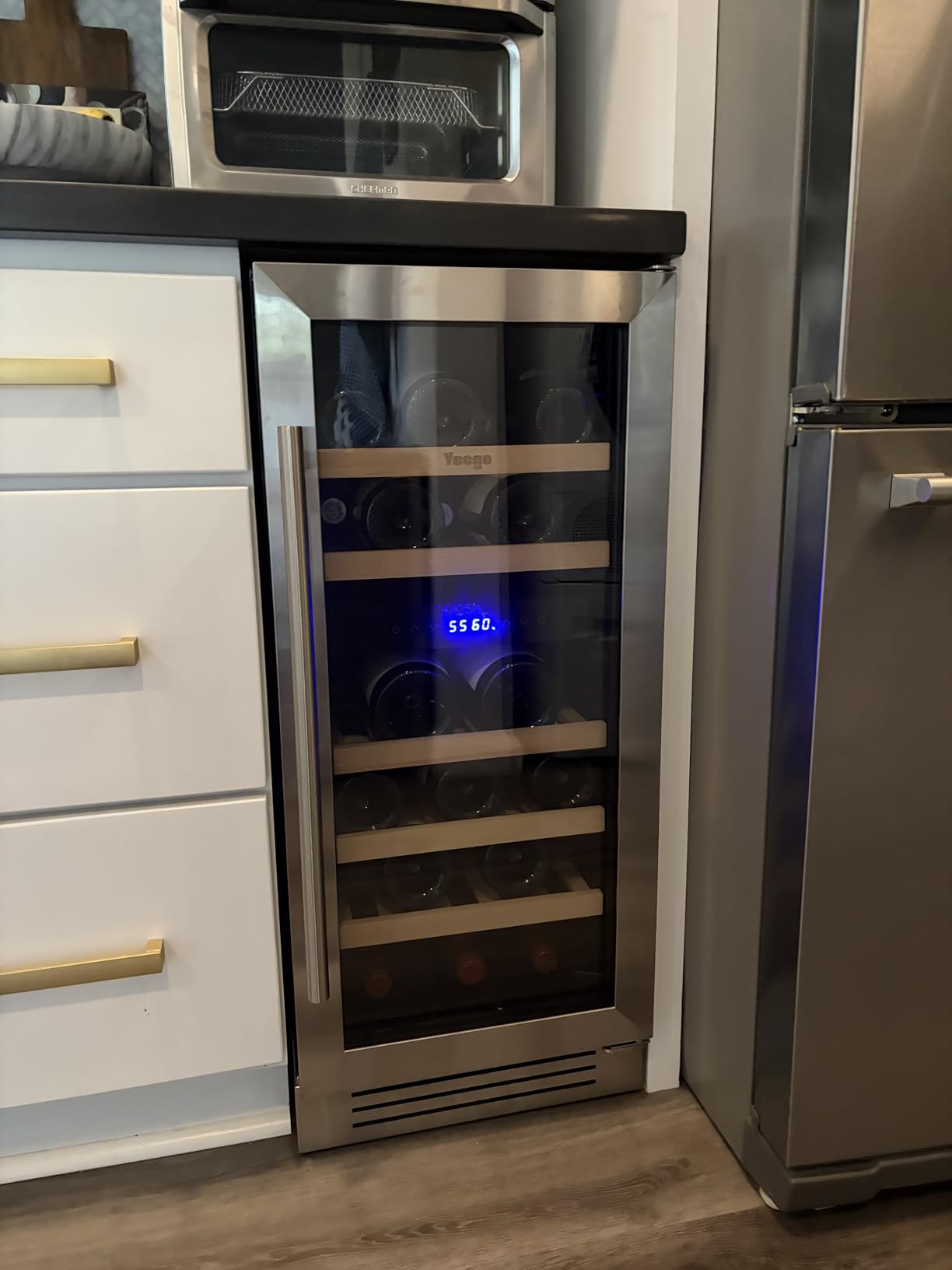
Build details that reviewers single out are the door that closes securely without bouncing back and the stainless frame around a double-layer tempered glass door. Customer service is also praised, with a replacement part sent free when one was needed.
Five removable beech wood shelves hold 52 standard Bordeaux bottles, and the bottom shelf is wide enough for Champagne formats that will not sit on the middle racks. The manufacturer advises allowing 24 to 36 hours upright before first use.
Check the hinge side before the cabinet is ordered
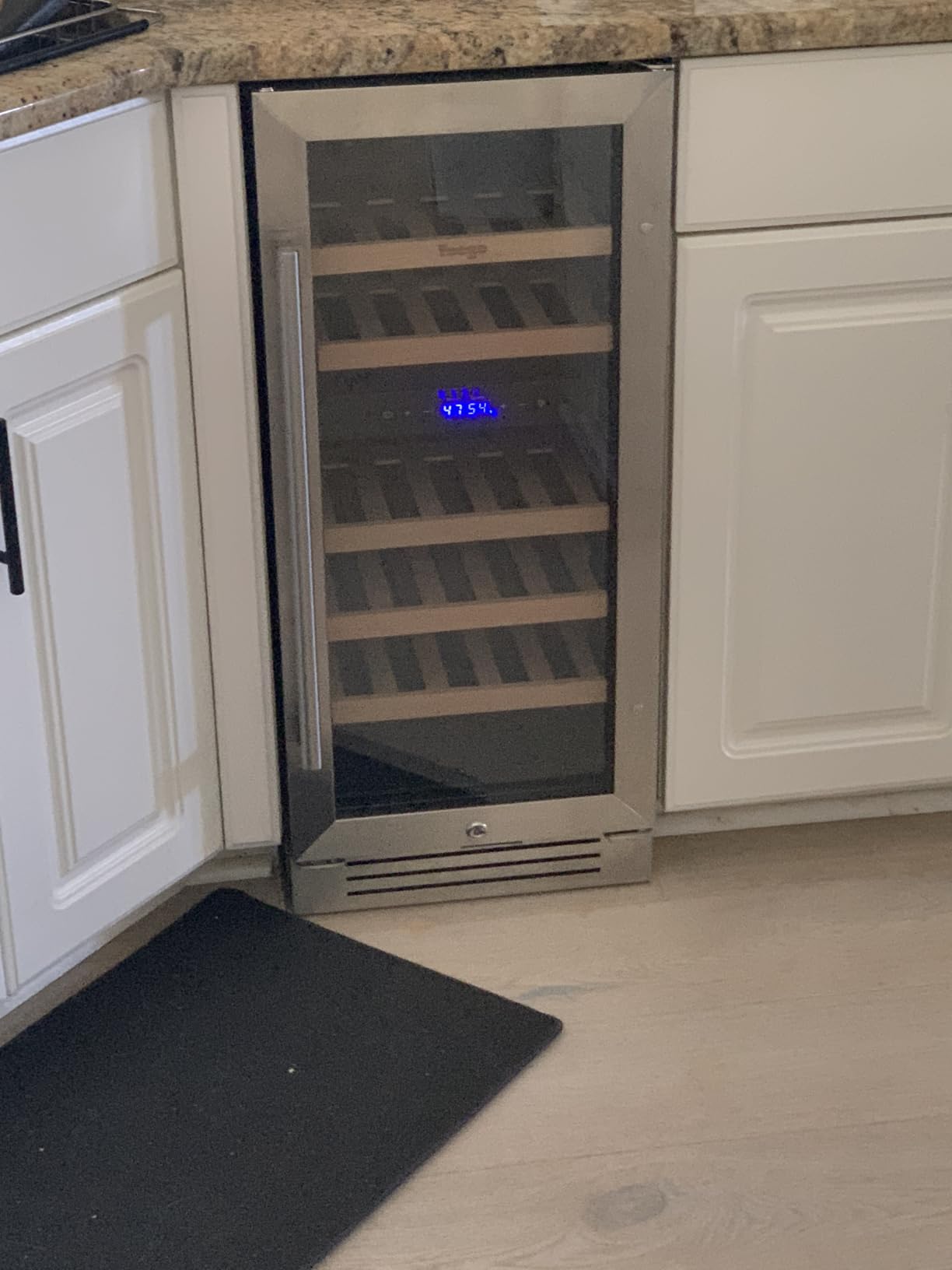
This model has a fixed hinge and cannot be reversed. That is a dealbreaker in an island where the door must open away from a seating overhang, and it is the single spec we would ask a cabinetmaker to confirm before the countertop is templated. Several competing models here offer a reversible door.
Confirm which side the hinge falls on, then check that the door swing clears bar seating. Our counter stool clearance guide covers how far a seated diner projects past the counter edge.
Where the service experience breaks down
Warranty is one year on the complete machine, and one owner reported an electronics failure at six months handled as a parts-only response. That is the weakest support story in the roundup, and it is a real difference from the 3-year compressor term on the Ca’Lefort above.
Middle pull-out shelves stop at half extension, so back labels stay hidden. Fine for storage, awkward if you sort by vintage the way many collectors do.
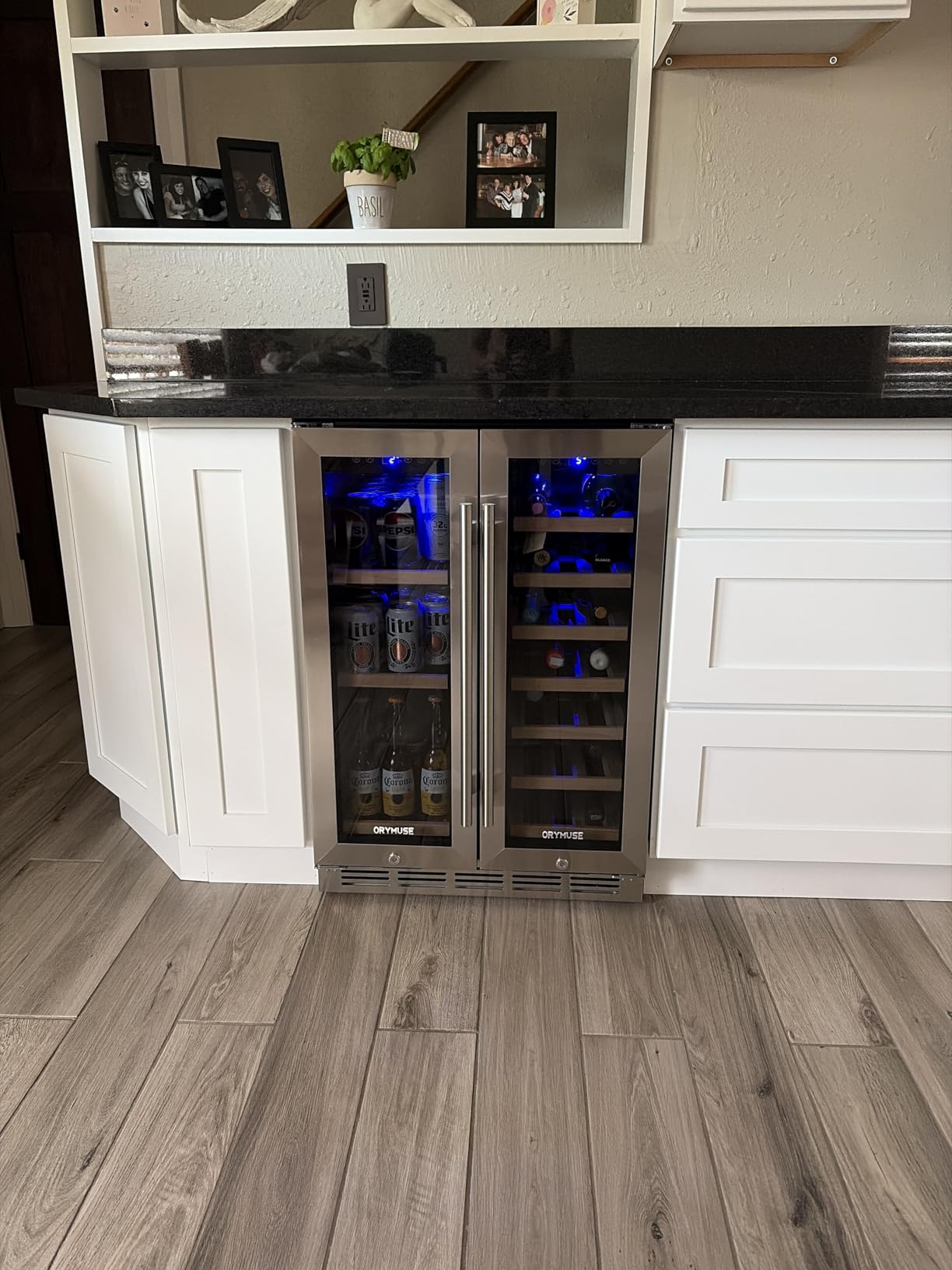
8. ORYMUSE 15 Inch 30-Bottle Built-In Wine Cooler – Best for Single-Zone Setups

ORYMUSE 15 Inch Wine Fridge, 30 Bottle Under Counter Wine Cooler Built-In
3.1 cu. ft.
23.03 in deep x 14.96 in wide x 33.46 in high
40-65F digital setpoint
38 dB, 52 pounds
Pros
- Highest average rating in the set at 4.5 with 76 percent five star
- Quietest published figure here at about 38 dB
- Lightest at 52 pounds so it is the easiest to install
- Cools quickly and holds setpoint steadily
- Responsive service that replaced a mismatched handle within days
Cons
- Single zone so reds and whites share one setpoint
- One reviewer reports the door bouncing open from a weak magnet
- Wire shelves can tip forward when front-loaded
- One handle shipped with mismatched hole spacing
If you only ever drink one style of wine, a second zone is wasted capacity. This 15 inch single-zone cooler has the highest average rating in the entire roundup at 4.5, with 76 percent five star and only 5 percent one star.
Cooling is compressor based at approximately 38 dB, the lowest published figure among these picks, and it weighs 52 pounds. In an open kitchen island, that combination of quietness and low weight is why we recommend it for anyone working with a cabinetmaker on a tight build.
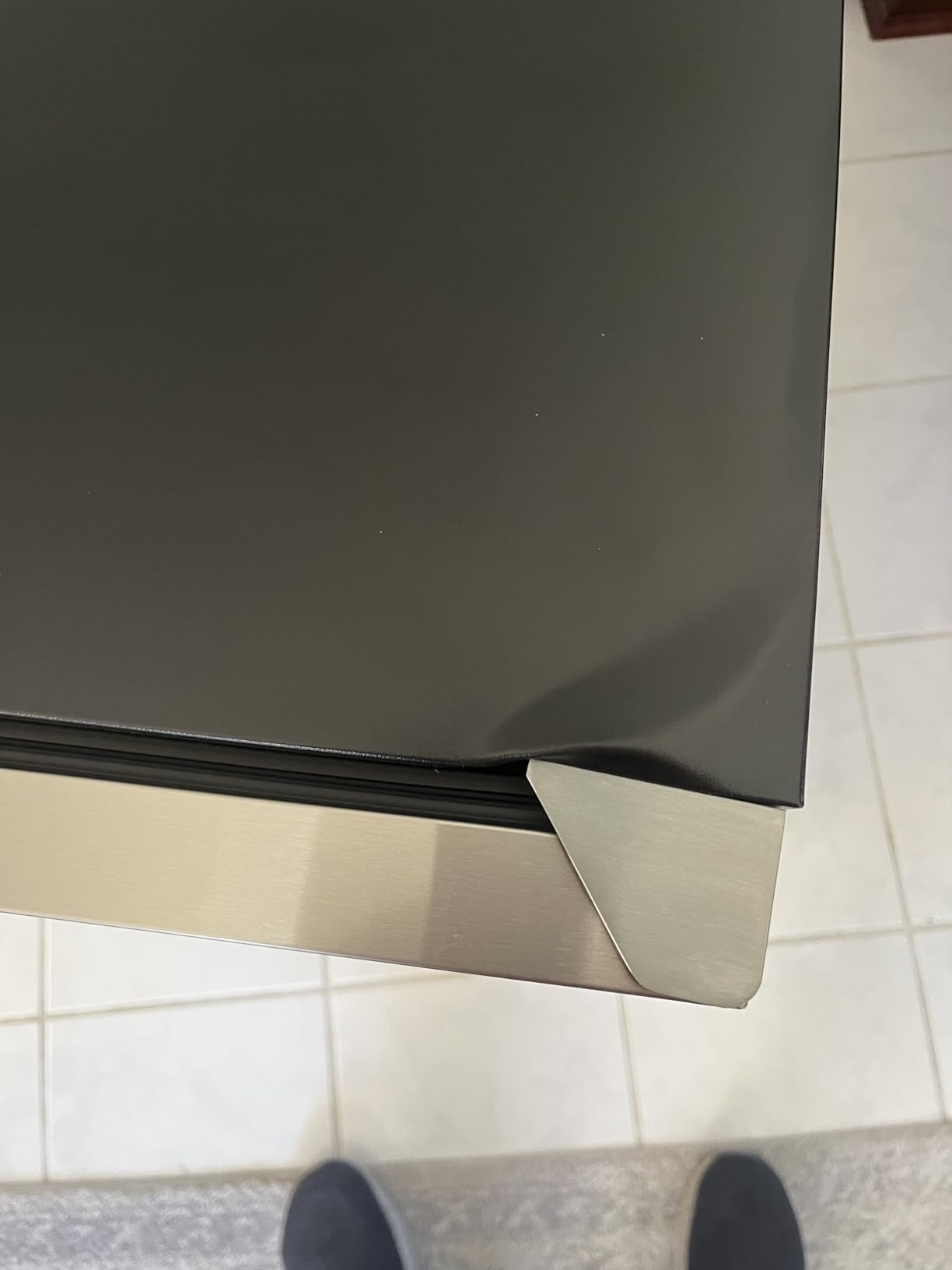
The published built-in cavity is 14.96 inches wide by 23.03 inches deep by 33.46 inches high, which is the cleanest cutout figure any manufacturer in this roundup gives you. Temperature memory restores your setting after a power interruption, and adjustable leveling feet help on an uneven island base.
It is built-in key door lock equipped, uses R-600A refrigerant, and lists 162 kilowatt hours per year of consumption. Owners report fast cooling and steady setpoint holding, plus service that replaced a mismatched door handle within days.
When one zone is genuinely enough
A single zone set between 50F and 58F serves most households fine, because reds and light-bodied whites overlap in the low-to-mid 50s for casual drinking. You only need two zones if you regularly serve whites chilled straight from the door while reds are already at temperature.
At 40-65F the setpoint range is wide enough to do either job, just not both at once. If your island is a service station for a single bottle type, that is a better use of the cubic feet.
What the reviews flag on build quality
Two physical details come up repeatedly. One owner reports the door bouncing back open rather than sealing firmly, which points to a weak magnet, and several mention wire shelves that tip forward when the front row is loaded heavily. Load from the back.
Another owner received a door handle with mismatched hole spacing. Worth checking the handle before the cabinetmaker closes the door, since it is a five minute fix but an awkward one later.
9. Antarctic Star 24 Inch Dual Zone Wine Cooler – Best for Large Bottle Formats

Antarctic Star 24 Inch Wine Fridge, 52 Bottle Wine Cooler Refrigerator. 39-64°F Dual Zone Wine Refrigerator Glass Door, Built in or Freestanding Under Counter Fridge for Home Bar Office
5 cu. ft.
22.52 in deep x 23.43 in wide x 34.45 in high
Upper zone 39-50F, lower 50-64F
6 wood racks
Pros
- Only pick here holding the top Amazon rank in Built-In Wine Cellars
- Low-vibration compressor lets sediment settle undisturbed
- Spacious interior fits larger bottles without shelf removal
- Double-paned tempered glass window gives UV protection and a full view
- Stainless and wood styling that matches existing kitchen furniture
Cons
- Listing inconsistent on capacity
- title says 52 bottles and the feature list says 46
- Manual defrost rather than automatic
- Smallest review base in the set at 110 ratings
Big bottles are where most built-in coolers fall apart, because a 3 liter bottle does not fit between two shelves set for 750ml. This one is the pick for magnums and large formats. The interior is described as spacious enough to fit larger bottles without removing a shelf, across six adjustable wood racks.
It measures 22.52 inches deep by 23.43 inches wide by 34.45 inches high, and the published cavity is 22.76 by 23.43 by 34.25 inches. At 92.4 pounds it is a two-person lift, and its 34.45 inch height is one of the taller bodies here, so a 33 inch under-counter cavity will not take it.
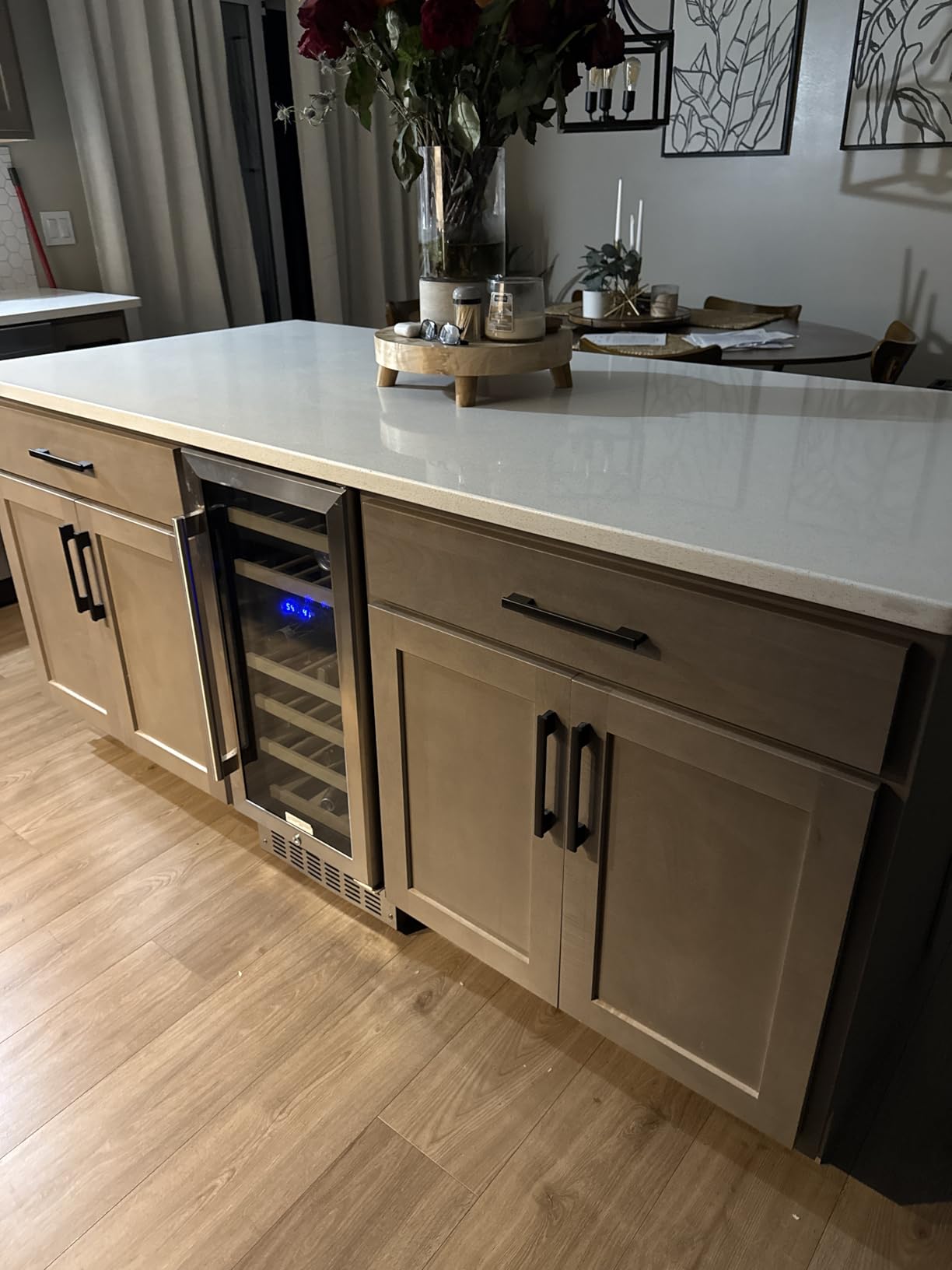
Cooling is a low-vibration compressor with fan circulation, and owners specifically credit the gentle vibration profile with letting sediment settle undisturbed. Zones split into 39-50F on top and 50-64F below, which gives a colder white zone than most competitors in this roundup.
It has the smallest one-star share in the set at 3 percent, a double-layered tempered glass window that blocks UV while keeping a full view, and stainless steel with wood styling that reviewers say matches existing kitchen furniture.
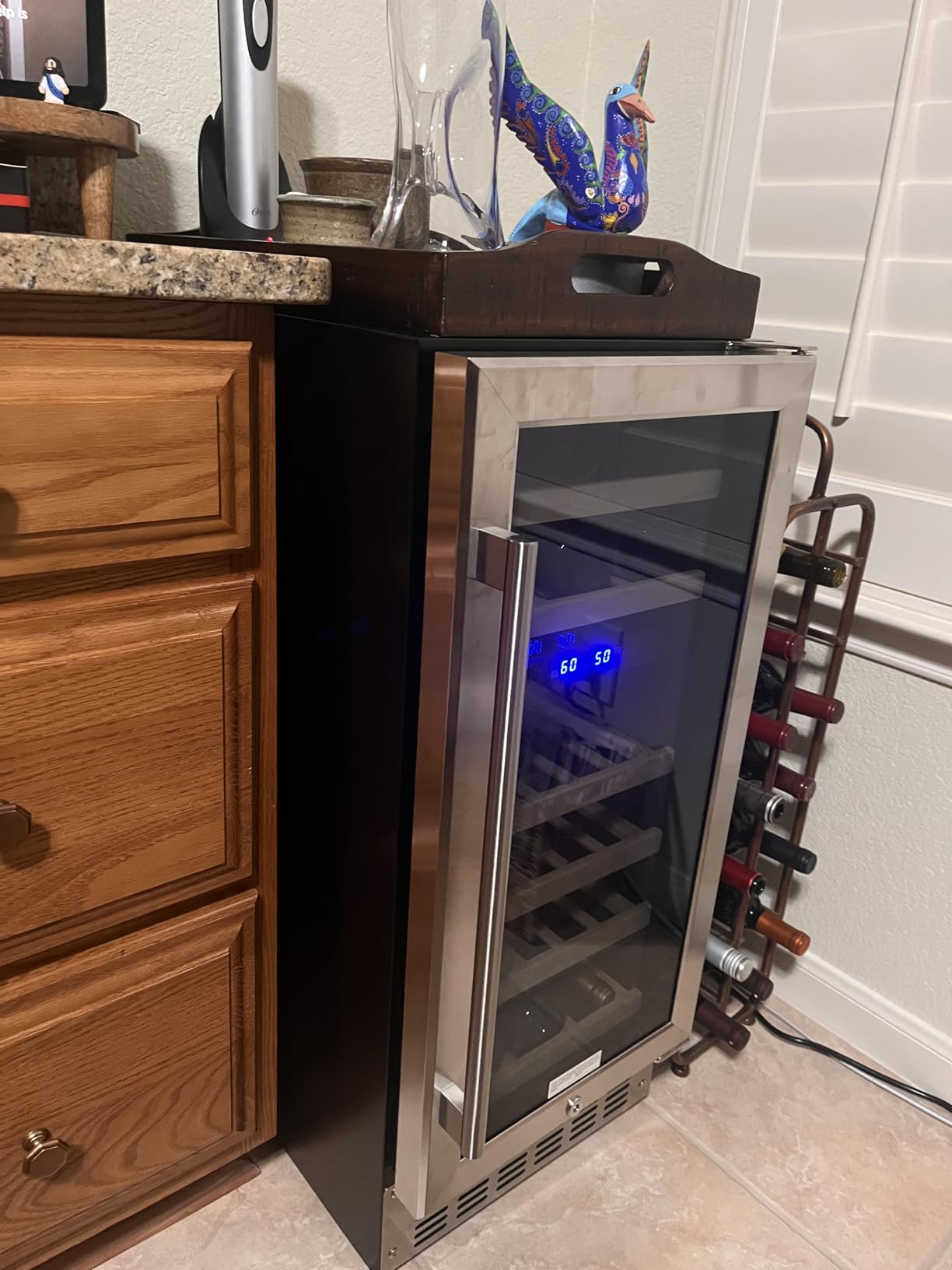
Do not skip the height check on this one
Most 24 inch island bases give a 33 inch opening. This unit is 34.45 inches tall, so it needs either a taller cabinet or a raised toe kick, and that decision has to be made at the design stage rather than after the countertop is templated. Measure the internal height of your island cavity, not the external face frame.
Its 191 kWh annual consumption is mid-range here, and the door is a frost-free stainless steel and glass design with a right-side orientation listed.
Manual defrost and an inconsistent capacity claim
This is one of only two picks here with manual rather than automatic defrost. In a wine context that is arguably a feature, since a defrost cycle produces condensation and temperature swings, but it does mean occasional attention.
The listing also contradicts itself on capacity, with 52 bottles in the title and 46 in the feature list. Plan shelf layout against the lower number and you will not be short.
10. ICEVIVAL 24 Inch 54-Bottle Dual Zone Wine Cooler – Best With Mounting Hardware Included

ICEVIVAL 24 Inch Wine Cooler Refrigerator, 54 Bottle Wine Fridge, 40-65°F Dual Zone UV-Resistant Glass Door, Quiet Compressor Cooling, Built-in or Freestanding Fridge for Home/Bar/Kitchen, Black
4.2 cu. ft.
22.6 in deep x 24 in wide x 34.3 in high
40-65F dual zone, 7 wood shelves
Includes mounting hardware and spare levelers
Pros
- Includes mounting hardware and spare levelers for cabinet installation
- Very quiet running according to owners
- Both zones held setpoint when checked with separate thermometers
- Good packaging with foam surround and metal corner guards
- Reasonable running draw of about 67 watts
Cons
- 4.0 average with a 12 percent one-star share
- the highest here
- Reaching 54 bottles needs neck-to-foot alternating rows
- Standard three prong cord blocks a flush wall fit
- Door reversal instructions are diagram only
The reason this one is worth a place is practical rather than romantic. It ships with mounting hardware and spare levelers for the cabinet installation, which on a built-in island is exactly the part that is otherwise missing from the box on a Saturday afternoon.
It measures 22.6 inches deep by 24 inches wide by 34.3 inches high in black glass with a reversible door and a key lock. Seven removable wood shelves cover an advertised 54 standard Bordeaux bottles across a 40-65F dual zone range.
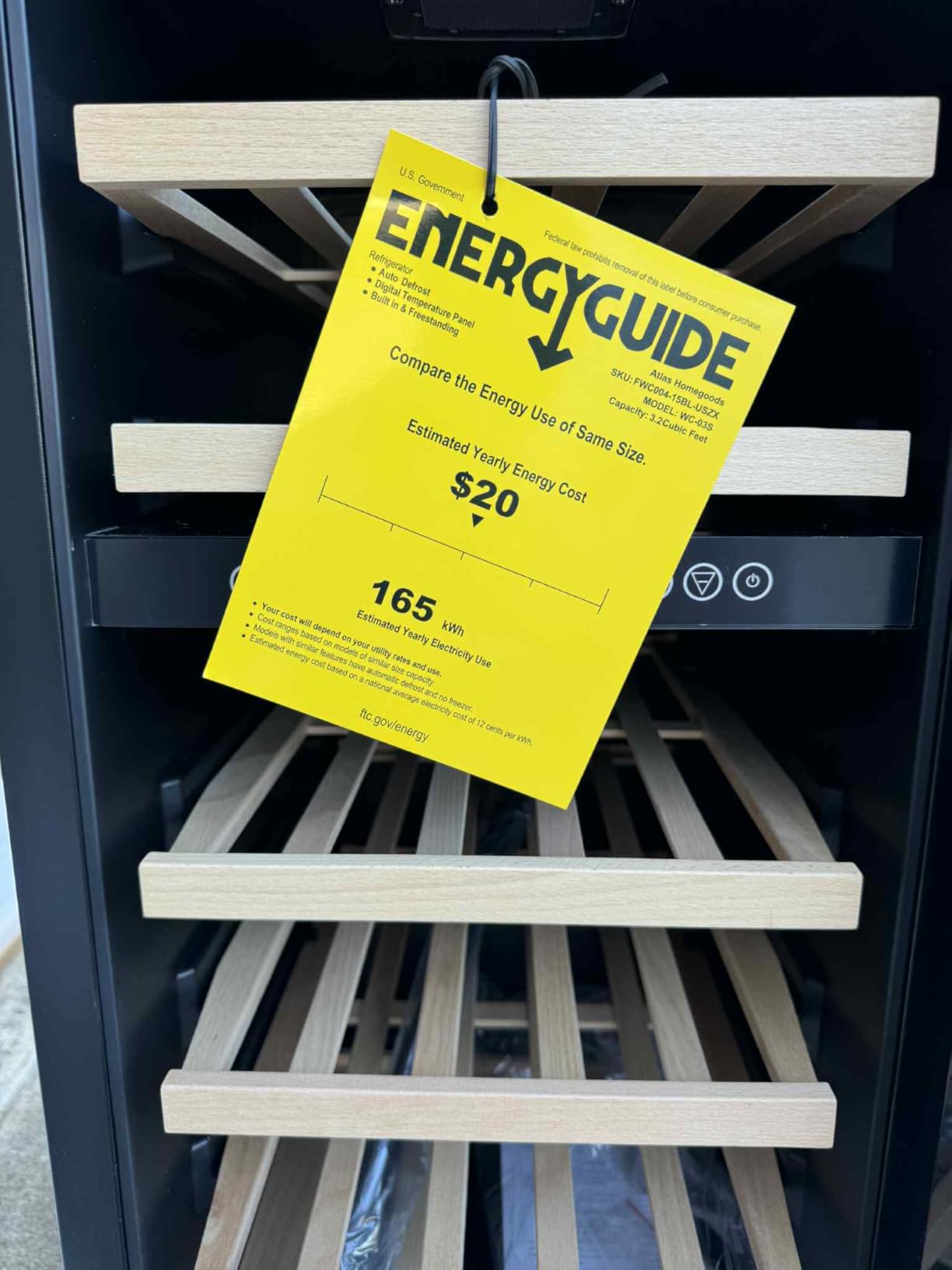
Satisfied owners praise genuine silence, dual zone accuracy confirmed with separate thermometers, and bottles reaching target temperature within 48 hours. The 4.2 cubic foot cavity is smaller than the 5 cubic foot units here, so the seven shelves are doing more work in the same width.
Energy use is listed at 170 kilowatt hours per year with maximum running wattage around 67W, and the refrigerant is R-600A. Packaging is unusually careful, with a foam surround, metal corner guards and plastic door protection.
The cord problem in a tight cavity
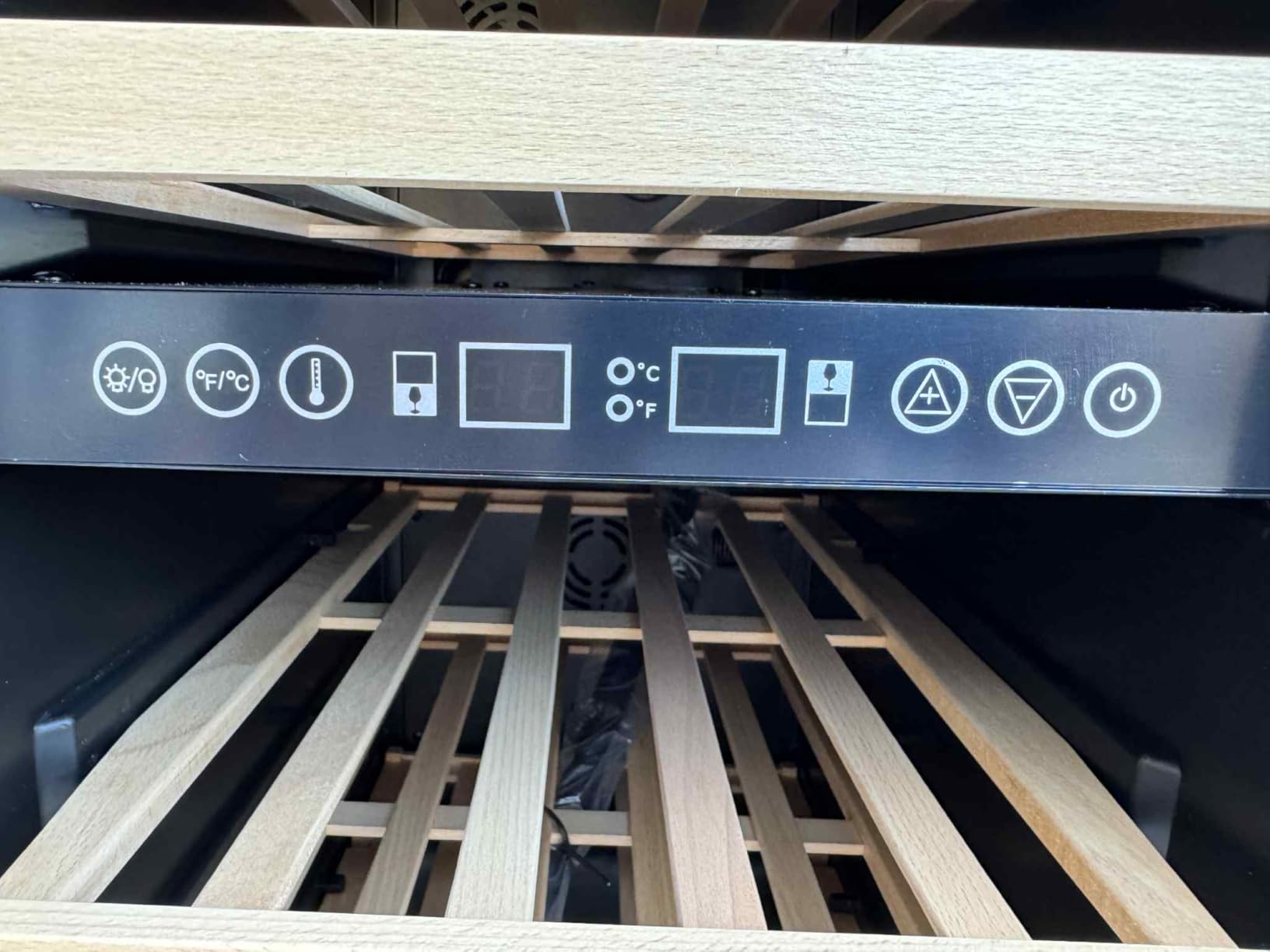
The standard three-prong cord sticks out far from the outlet, so the appliance cannot sit flush against a wall or the back of a cabinet run. In a 24 inch island bay with limited depth this can stop the unit going fully into the cutout, and it is a measurement worth taking before you order rather than after.
Reversing the door is a further wrinkle. The instructions are a diagram only, and attaching the handle means holding the gasket aside, so allow time for it or have the cabinetmaker do it during install.
What the 54 bottle figure really means
Reaching the advertised 54 requires storing bottles neck-to-foot in alternating rows, which is how every manufacturer in this category inflates its count. Real capacity with standard rows is lower, and with a 4.2 cubic foot interior the space for wide bottles is limited.
At 93.7 pounds it is a two-person install, and the 4.0 average with a 12 percent one-star share is the highest one-star share in this roundup, with two owners reporting units that failed in the first months.
11. Icyglee 15 Inch 30-Bottle Dual Zone Wine Cooler – Best Value

Icyglee 15″ Wine Cooler Refrigerator,30 Bottle Dual Zone Wine Fridge,Silver
3.6 cu. ft.
23 in deep x 14.9 in wide x 34.25 in high
Zones 40-55F and 55-65F
R-600A compressor
Pros
- Two independent zones spanning 40-65F
- Reversible door with key security lock
- Temperature memory protects the collection
- No two-star ratings in the review distribution
- Stylish glass door with blue interior lighting
Cons
- Shelves described as flimsy light wood with narrow row spacing
- Large round-base bottles such as some Pinot and Chardonnay do not fit
- Several owners describe the motor as noticeably loud
- Manual defrost and 256 kWh annual consumption
This is the cheapest way to get a genuine two-zone compressor cooler into a 15 inch island bay, and the reversible door removes the orientation risk that trips up several other picks here.
It measures 23 inches deep by 14.9 inches wide by 34.25 inches high, with a published cavity of 23 by 14.9 by 34.25 inches. Zones split into 40-55F and 55-65F, which is a sensible red and white separation, and the low-vibration R600 compressor is ETL certified.
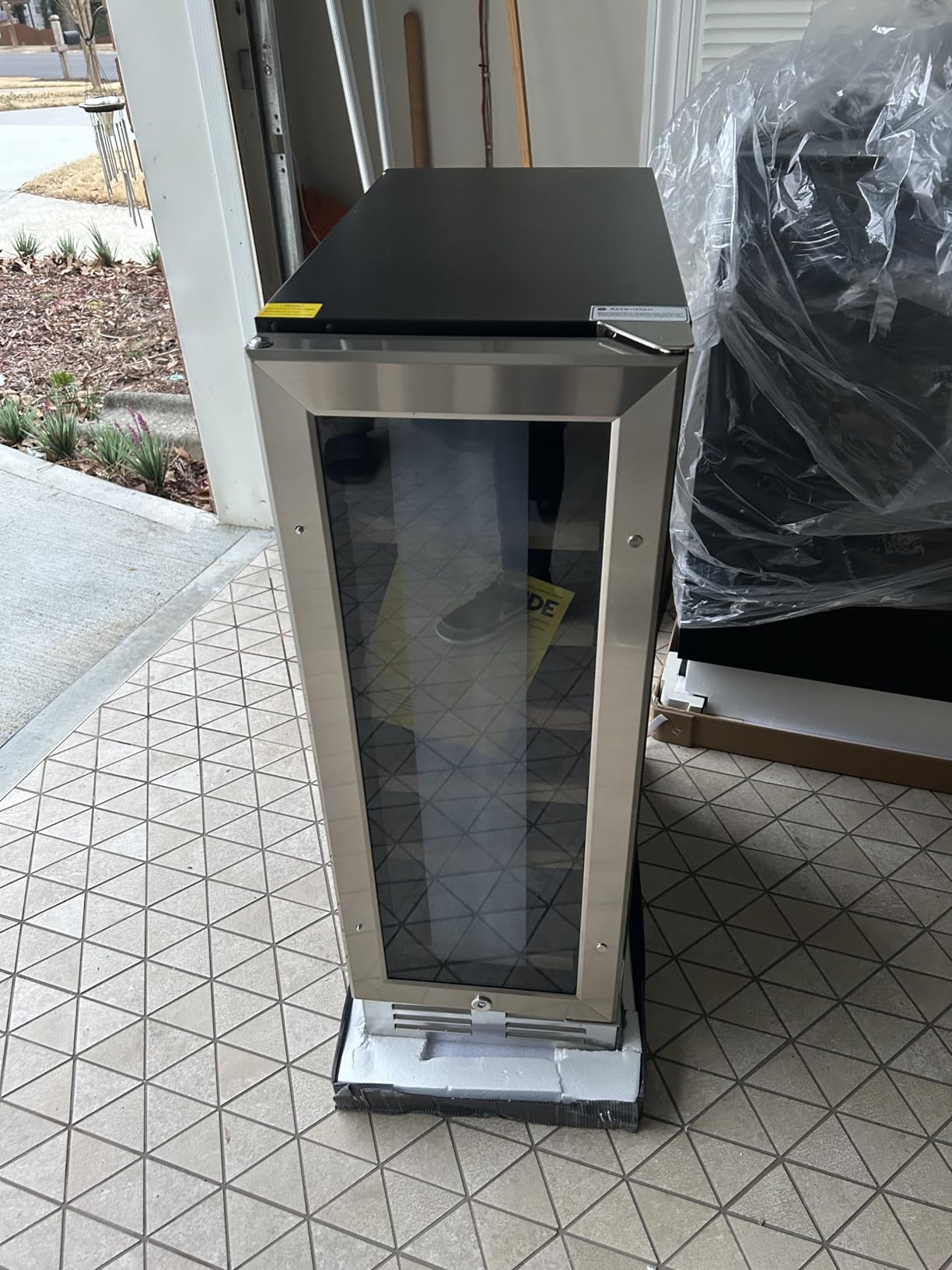
One owner who compared 17 different models praises the quiet operation, which is a more credible noise claim than most. The double-glazed UV-resistant glass door sits in a stainless frame, and the tight seal is designed to hold both temperature and humidity steady.
Support is 12 months with online service, and temperature memory restores your setpoints after an interruption. The review distribution is unusually clean, with zero two-star ratings.
The shelf spacing is the real limitation
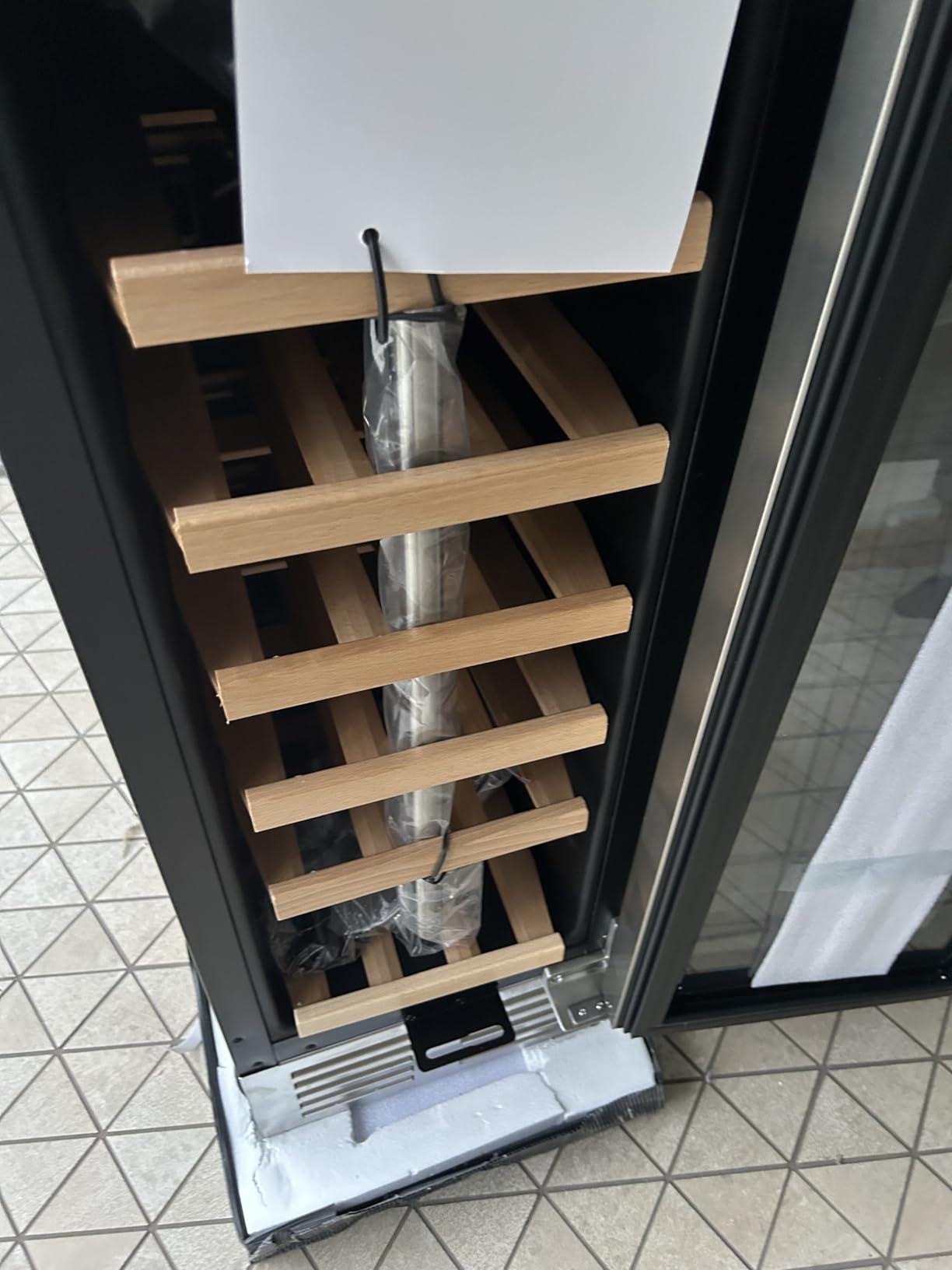
Several reviewers describe the shelves as flimsy light wood with narrow row spacing, and say large round-base bottles such as some Pinot and Chardonnay will not sit in them at all. If your collection leans Burgundy shaped, this is the wrong pick regardless of how good the zones are.
It is a 30 bottle rating on 6 adjustable shelves, so the count assumes slim standard formats throughout.
Noise and energy tradeoffs
Against the quiet praise, a few owners describe the motor as noticeably loud, which directly contradicts the brand’s own claims. In an open kitchen island, that variance is why we would demo it if possible.
It also uses manual defrost and lists 256 kilowatt hours per year, the second highest consumption in this roundup. At 78.8 pounds it is manageable for two people but not a solo lift.
12. EdgeStar 24 Inch 36-Bottle Built-In Dual Zone Wine Cooler – Best for Side-by-Side Doors
EdgeStar 24 Inch 36 Bottle Built-In Dual Zone Wine Cooler
4.36 cu. ft.
22.63 in deep x 23.44 in wide x 33.88 in high
Dual doors, dual cooling zones
12 slide-out shelves
Pros
- Reported by owners to run quietly through years of continuous built-in service
- Dual doors suit a wide cabinet cavity and separate reds from whites
- 12 slide-out shelves for organization
- Reversible door with integrated key lock
- LED lighting and digital temperature display
Cons
- Display shows the setpoint rather than the true cabinet temperature
- Control panel cannot be locked out
- Not Energy Star certified
- Heaviest pick in the set at 121 pounds
- Handle holes misaligned on one unit and needed drilling
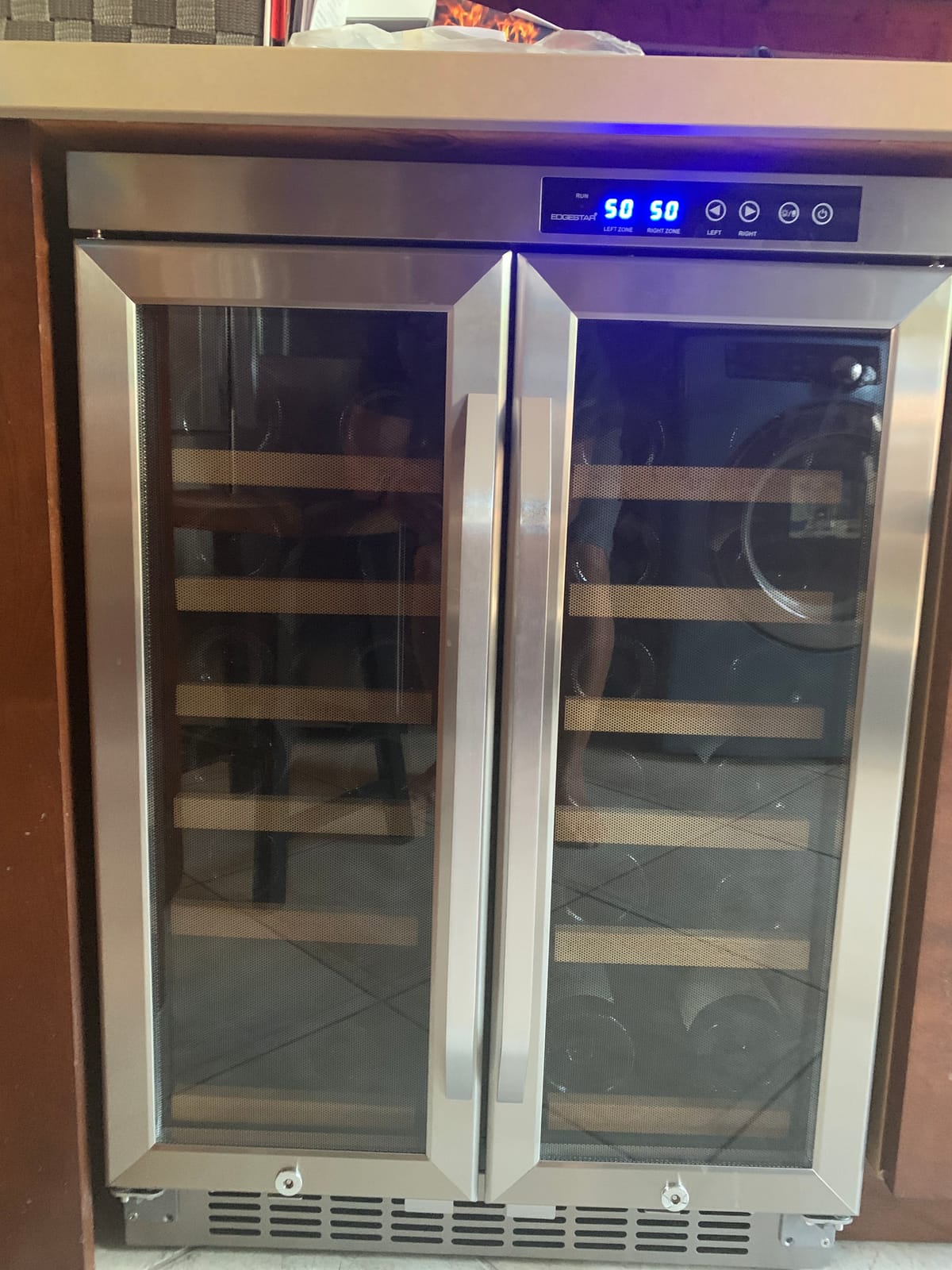
This is the only pick here with two doors, and that changes how it works in an island. A side-by-side pair of doors each open half the width, which means one person can pull a bottle without swinging a full-width door through a seating overhang or a person standing at the prep sink.
It measures 22.63 inches deep by 23.44 inches wide by 33.88 inches high and carries 12 slide-out shelves with dual cooling zones. The reversible door adds flexibility if the cavity is not where you first expected it.
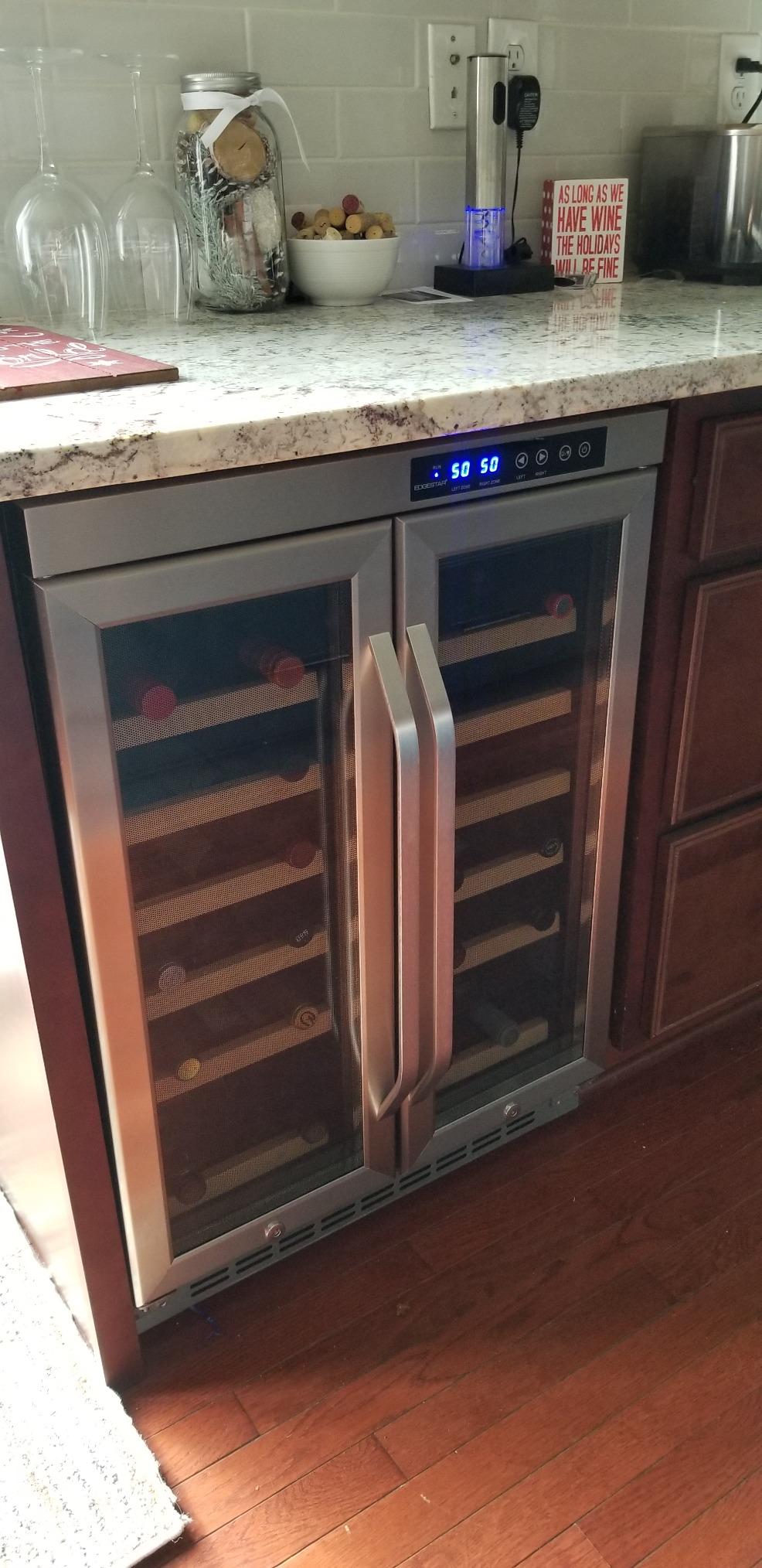
The strongest claim here is longevity. One owner reports six years of continuous built-in service during a kitchen remodel with quiet running, and another says the dimensions arrived spot on and it fit under the counter precisely. The brand has built coolers, kegerators and ice makers for over 20 years.
It is also noted as being rated among the quietest in its tested class by Consumer Reports, and the LED lighting with a digital temperature display is genuinely useful in a dark cabinet interior.
Read the display carefully before you trust it
The screen shows the setpoint rather than the actual cabinet temperature, so you need a separate thermometer to confirm where the air really is. In a hot kitchen, a setpoint reading that says 55F does not prove the cabinet is at 55F. The control panel also cannot be locked out, so it can be changed by a sleeve brushing past it or by a small child.
If you are building for children, that matters more than it sounds.
The weight and the price of this build
At 121 pounds this is the heaviest pick in the roundup and firmly a three-person or professionally installed job. The 12 slide-out shelves are also the highest part count to load, which is a real time cost if you are stocking it yourself.
It is not Energy Star certified, consuming 189 kilowatt hours per year, and it sits at roughly double the cost of the nearest alternatives here. One owner also received a unit with misaligned handle holes that needed drilling to fit, so inspect it on arrival before the cabinetmaker closes the doors.
Island Cutout Sizing – 7 Measurements to Confirm Before Ordering
Cut the opening to the manufacturer’s template, not to the dimensions of the appliance you liked online. Here is the checklist we would hand a cabinetmaker before the countertop is templated.
1. Cavity width. Measure the internal width between cabinet panels, not the external width of the island. The 15 inch picks here need roughly 15 inches of internal width, and the 24 inch models need about 23.4 to 24 inches.
2. Cavity height. Most under-counter coolers in this roundup stand 32.3 to 34.5 inches tall, so a standard 33 inch opening rules out the taller bodies. Check the internal height after accounting for the countertop substrate.
3. Cavity depth. Depths run from 22.4 to 25 inches. A 24 inch deep island base only works with the shallower models, and the Velieta at 25 inches deep effectively requires a 26 inch or deeper base.
4. Toe kick clearance. Front-vented coolers draw air at the bottom of the door face. If the island has a recessed plinth, leave the opening unobstructed or add a ventilation grille, because a boxed-in intake is the most common cause of an overworked compressor.
5. Door swing and handle projection. A hinged door needs clear space in front of the cabinet. Where bar seating overhangs the counter, add the door width to the seating projection before you commit to a full-width door model.
6. Electrical. Most of these run on a standard 115 volt three-pin plug and draw well under 200 watts, so a countertop-style receptacle inside the island will usually serve. Check that the outlet sits within reach of the cord without blocking the unit at full depth, and confirm whether the model is plug or hardwire.
7. Service access. Leave enough room to slide the appliance back out for a compressor repair without destroying the countertop. Built-in units are harder to service than freestanding ones, and that is where a 3-year compressor warranty earns its value.
Front Vent vs Rear Vent – Why Rear-Vent Coolers Fail in an Island
A front-vented cooler draws and exhausts air through its own door face, which is the only arrangement that works inside a cabinet. A rear-vented cooler pushes heat out the back into the cabinet cavity, where the air has nowhere to go.
When a rear-vented model is boxed into an island, the compressor runs hotter, cycles more often and short-cycles against its own thermostat. Owners report this as constant cycling, warm interior temperatures and a short compressor life, and the fix is never in the appliance. It is a cabinet design error.
Every pick in this roundup is front venting or convertible, which is why we excluded rear-vent-only models from the list entirely. Confirm the word front vent in the manual, not just the word built-in, because plenty of listings use built-in to describe a freestanding chassis.
Compressor vs Thermoelectric for a Warm Kitchen Island
Compressor cooling is the right answer for a kitchen, and every product in this roundup uses it. Thermoelectric units are genuinely silent but they cool by moving heat rather than removing it, so they lose their grip once the ambient temperature rises, and a kitchen next to a cooktop is exactly that environment.
There is a cost to compressor cooling: a measurable hum and a real energy draw. A kitchen island lives in the middle of the room, usually with hard surfaces around it, so that hum travels further than it would in a basement bar. Forum discussions on appliance installs consistently frame 40 to 45 dB as acceptable in a closed bar and unacceptable in a kitchen open to a living room, which is why the lowest published figure here, the ORYMUSE at about 38 dB, is worth paying attention to.
Vibration is the other half of the noise problem. Vibration transfers through the cabinet carcass into the countertop, so a heavy glass door on a hollow base can be felt in the worktop. Solid wood or metal shelves and a well-levelled body reduce it, and every pick here has adjustable feet.
Panel Matching, Electrical and the Installation Checklist
None of the models in this roundup ships as a true panel-ready wine column with a flat wood face for a cabinetmaker to cover. What you can do is match finish rather than build a full panel, and that is a much smaller job.
The stainless and silver finishes in this group will read as appliances against painted or wood cabinetry. If your island is a full wood column, ask for a matched panel sample before committing, because the colour mismatch is the complaint that shows up years later, not at install.
On electrical, none of these models needs a dedicated 20-amp circuit on the numbers we have. Consumption figures run from 162 to 332 kilowatt hours per year, and maximum running wattage on the highest-draw model is about 67W. A standard 115 volt receptacle inside the island will usually do. Confirm with your electrician that the receptacle sits clear of the unit at full depth so the cord is not pinched, and let the appliance stand upright for 24 to 36 hours after delivery before the first power-on.
The sequence that works is designer, then cabinetmaker with the exact cutout template, then electrician for the receptacle, then installer for the appliance. Most island problems we see traced back to a template that arrived after the cabinet was already built.
For the rest of the island build, our pendant lighting guide for islands covers the lighting decisions that interact with a glass-door cooler.
Frequently Asked Questions
Can a wine fridge be installed in a kitchen island?
Yes, as long as the unit is front-vented and the cabinet is cut to the manufacturer template. Air enters and leaves through the door face, so the cavity behind the unit can be closed. You also need clear space for the door swing, a 115 volt receptacle within reach of the cord, and enough internal height and depth for the exact model.
Which built-in wine cooler is the best?
For most kitchen islands, a 24 inch front-vented compressor model with two independent zones and removable wood shelves is the best balance. Our top pick holds separate wine and beverage zones and has the largest review base in the group. If your island has a 15 inch bay, a slim 15 inch dual-zone compressor cooler is the only realistic option.
Which brand is the most reliable for wine coolers?
Reliability tracks the warranty and the service response more than the badge on the front. In this group the strongest warranty is a 3-year compressor term with 2 years on parts. Look for a manufacturer with an ETL or DOE listing, a published cutout template, and local service. Brands that ship replacement parts quickly tend to age better than brands that only honour the complete unit.
How loud is a built-in wine cooler?
A good compressor model runs between about 38 and 45 dB, with published figures in this group from 38 dB up to 42 dB. In a closed bar that range disappears. On an island open to a living room, anything under 40 dB is the safer target, because hard countertops and stone floors carry the hum further than carpeted rooms do.
Do built in wine coolers need ventilation?
Front-vented models need the lower front of the door face open to air, which is why they are the only type that works inside cabinetry. Never box a rear-vented or freestanding-only cooler into an island cavity, because the heat has nowhere to escape and the compressor will short-cycle. If the island has a recessed toe kick, leave the intake unobstructed or add a grille.
How many bottles should a wine cooler hold for a kitchen island?
For most households a 15 inch unit holding about 30 bottles or a 24 inch unit holding 40 to 52 bottles covers a normal collection with room to grow. Manufacturer counts assume bottles packed tightly with no air gap, so treat the number as a ceiling. Larger formats such as magnums and 3 liter bottles need a wider shelf pitch than a standard count allows.
What size cutout does a built in wine cooler need?
Cut to the manufacturer template rather than to the appliance’s exterior dimensions. In this group internal widths run 14.9 to 24 inches, heights 32.3 to 34.5 inches, and depths 22.4 to 25 inches. The opening is always larger than the unit itself, and a 33 inch cabinet height rules out the taller bodies in the group.
Does a wine cooler need a dedicated electrical circuit?
Most undercounter models here run on a standard 115 volt three-pin plug and draw well under 200 watts, so a normal receptacle is usually enough. Annual consumption figures in this group run from 162 to 332 kilowatt hours. Confirm the cord can reach a receptacle without preventing the unit from sitting flush at full depth, and check whether your model is plug or hardwire.
Conclusion – Which Built-In Wine Cooler Fits Your Island
Start with the cavity, not the capacity. If you have 24 inches of internal width and 33 inches of height, the Ca’Lefort or Yeego 24 inch dual-zone coolers fit the standard bay, and the Yeego only works if the fixed hinge faces the right direction. If the bay is 15 inches, the ROVSUN, BODEGA, ORYMUSE and Icyglee are the shortlist.
Our pick as the best built in wine cooler for a kitchen island is the Velieta 24 inch dual-zone model, because the largest review base in the group backs up its claims about quiet, front-vented operation and it separates wine and beverage storage in one cabinet. Just verify the listed height against your island before you cut anything.
Whichever you choose, give the cabinetmaker the manufacturer’s cutout template, keep the toe kick clear of the front intake, and check the door swing against any bar seating before the countertop is templated. Those three checks prevent almost every island install problem we see in 2026.