
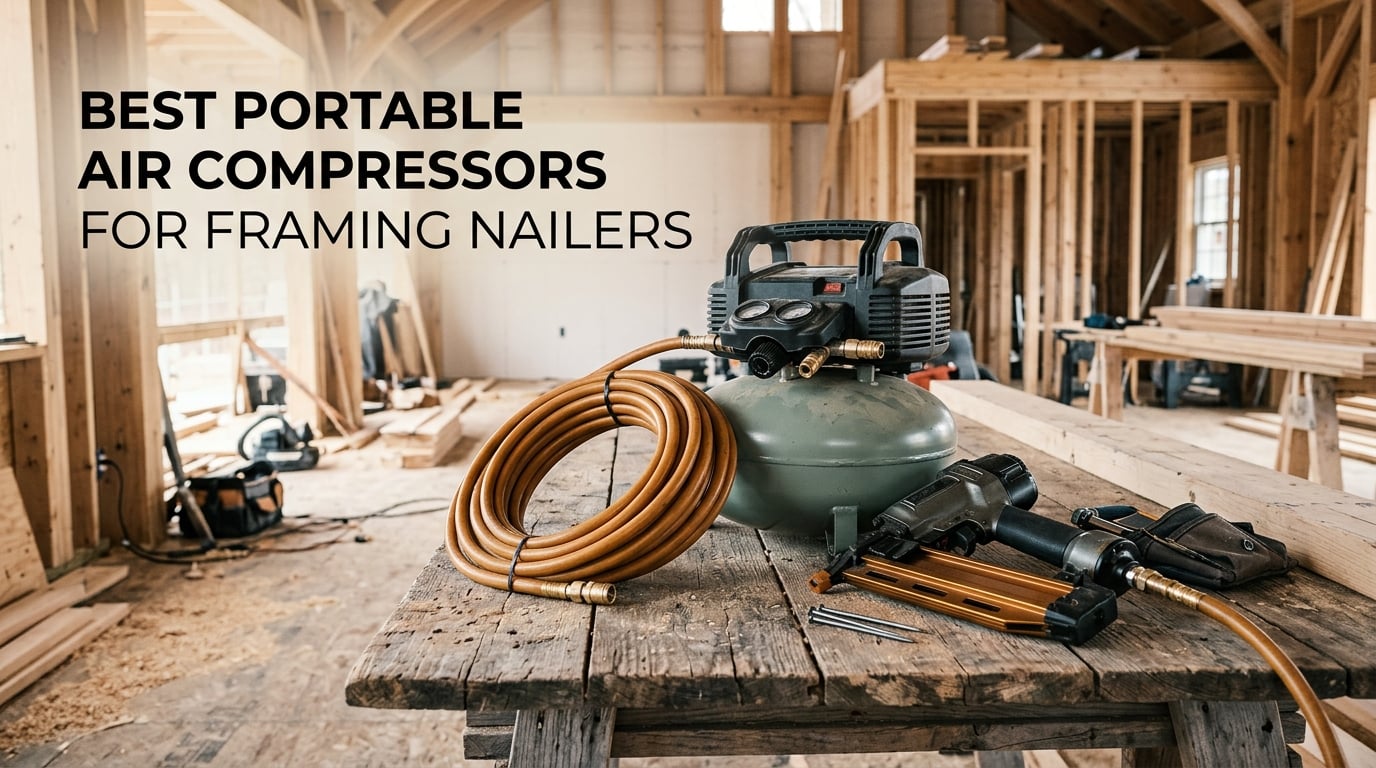
The best portable air compressors for framing nailers are the ones that deliver about 4 CFM at 90 PSI from a tank in the 4.5 to 6 gallon range. The Metabo HPT EC914S is our pick at the top: 4 CFM, 6 gallons, 42 lb, and it runs two framing guns without stalling. If you only ever drive one nailer on weekend projects, a 3-gallon unit will fire every nail but will make you wait on recovery pauses.
Here is the sizing rule we use for every pick in this guide. A full-size pneumatic framing gun pulls roughly 3.5 to 4 CFM while it is firing continuously, so you want a compressor rated at 4 CFM or better at 90 PSI, a tank of at least 6 gallons for regular single-nailer work, and a maximum tank pressure of about 150 PSI. Pressure above that adds weight and cost without helping a nail gun seat a nail.
That last point is where most buyers go wrong. Max tank PSI is a storage rating, not an output rating. What decides whether your workflow feels smooth is airflow at working pressure and how fast the pump refills the tank between shots. We ranked the ten units below on those numbers first, then on weight, because portability is the whole point of the category.
We compared every compressor here on published CFM at 90 PSI, tank capacity, unit weight, pump type, noise rating and review volume, and we read the owner complaints closely enough to flag the recurring ones. Where reviewers disagree with the spec sheet, we side with the owners.
Table of Contents
Top 3 Best Portable Air Compressors for Framing Nailers in October

All 10 Best Portable Air Compressors for Framing Nailers in 2026
| Product | Specifications | Action |
|---|---|---|
 Metabo HPT EC914S 6 Gallon 200 PSI Pancake Metabo HPT EC914S 6 Gallon 200 PSI Pancake |
|
Check Latest Price |
| Makita MAC2400 2.5 HP Big Bore Compressor |
|
Check Latest Price |
 PORTER-CABLE C2002-WK Pancake Compressor PORTER-CABLE C2002-WK Pancake Compressor |
|
Check Latest Price |
 ECOMAX 6 Gallon 150 PSI Oil-Free Pancake ECOMAX 6 Gallon 150 PSI Oil-Free Pancake |
|
Check Latest Price |
 Limodot 68 dB Quiet Oil-Free 5 Gallon Limodot 68 dB Quiet Oil-Free 5 Gallon |
|
Check Latest Price |
 CRAFTSMAN 6 Gallon 150 PSI Oil-Free Pancake CRAFTSMAN 6 Gallon 150 PSI Oil-Free Pancake |
|
Check Latest Price |
 VEVOR 10 Gallon Oil-Free 125 PSI Compressor VEVOR 10 Gallon Oil-Free 125 PSI Compressor |
|
Check Latest Price |
 RIDGID 6 Gallon Portable Electric Pancake RIDGID 6 Gallon Portable Electric Pancake |
|
Check Latest Price |
 DEWALT D55146 225 PSI 4.5 Gallon Wheelbarrow DEWALT D55146 225 PSI 4.5 Gallon Wheelbarrow |
|
Check Latest Price |
 Ingersoll Rand 2 HP Twin-Stack Compressor Ingersoll Rand 2 HP Twin-Stack Compressor |
|
Check Latest Price |
1. Metabo HPT EC914S – the best portable compressor for framing nailers overall
Metabo HPT Portable Pancake Air Compressor, 6 Gallon 200 PSI, EC914S
6 gal tank
4 CFM at 90 PSI
200 PSI max
42 lb oil-free pump
Pros
- 200 PSI tank gives real headroom
- 4 CFM at 90 PSI runs two framing nailers at once
- 42 lb body one person can lift
- Oil-free pump needs no oil changes
Cons
- 73 dB is loud across a long day
- 6-gallon tank drains fast on big framing runs
- 200 PSI ceiling adds weight without helping the nailer
We used the EC914S as our reference unit for this whole roundup, and it stayed the hardest to argue with. Metabo HPT rates it at 4 CFM at 90 PSI from a 6-gallon tank, which puts it in the narrow band where a single framing nailer fires without the recovery stutter that ruins a rhythm. The published claim is that it will drive two framing nailers, two roofing nailers, two siding nailers, three finish nailers, or five brad nailers. In practice one gun is the comfortable limit and two is genuinely usable on a sheathing run.
The 200 PSI tank rating is the headline number on the box, and reviewers tend to fixate on it. In practice the tank holds a deep reserve of air, and that reserve is why a 6-gallon unit feels larger than it is during a long nailing sequence. Owners also like that it weighs 42 lb, roughly 22 percent lighter than the twin-stack designs it replaces, so moving it between floors is a one-person job rather than a two-person argument.
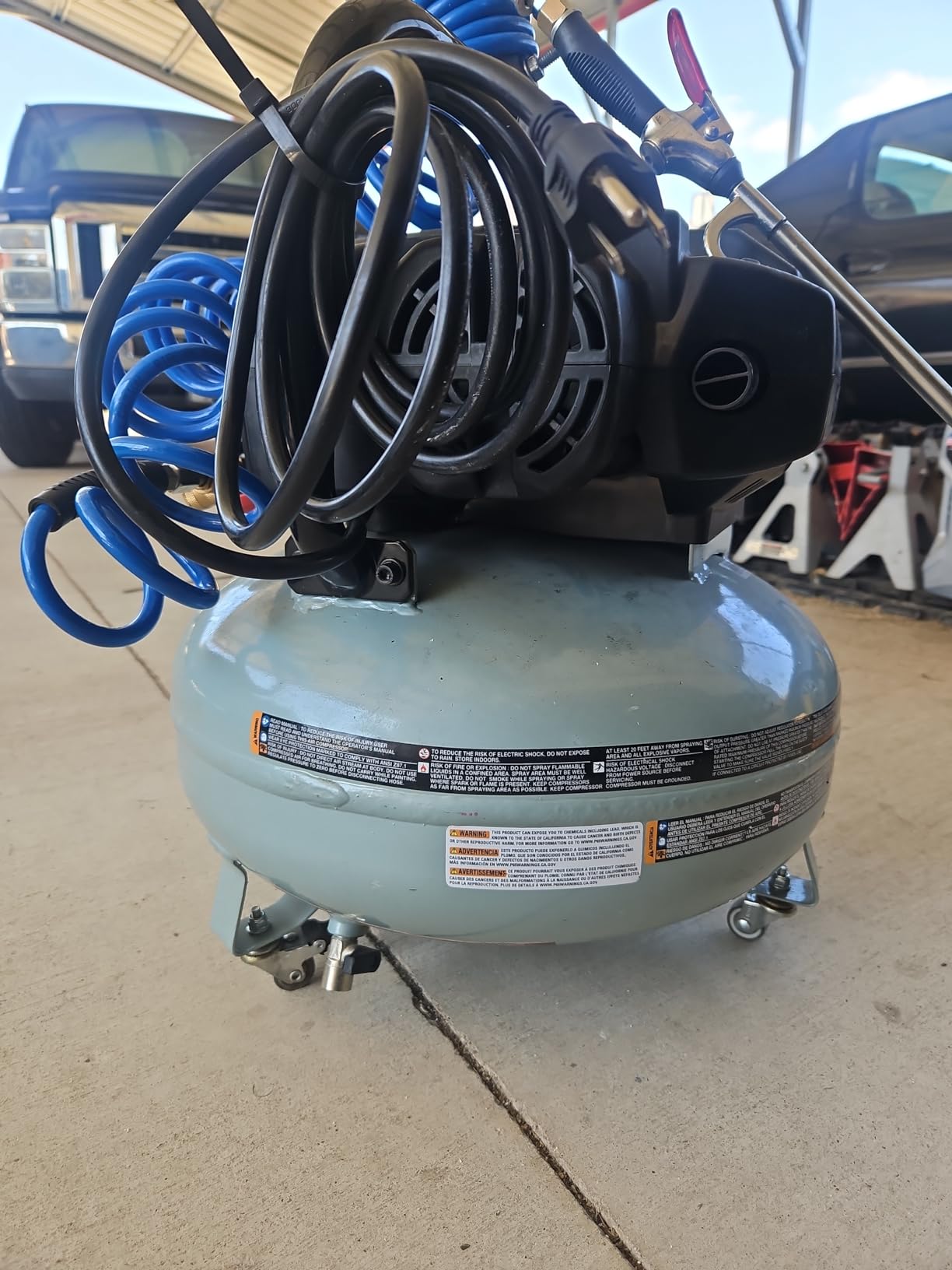
The pump is oil-free, so there is no oil-change interval to track and no oil to find its way onto finished subfloor. Metabo HPT backs it with a 1-year warranty and rates the noise at 73 dB. That is the honest drawback. It is not a quiet machine, and if you are framing inside an occupied house with a neighbour one wall away, 73 dB becomes the deciding factor against this pick.
The second drawback is tank size. Six gallons sounds generous until you are standing up a full two-story wall with two people working. You will empty it more often than you expect, and you will hear the pump kick on more than you expect. For a single framer running one wall at a time, that is a fair trade for the weight saving.
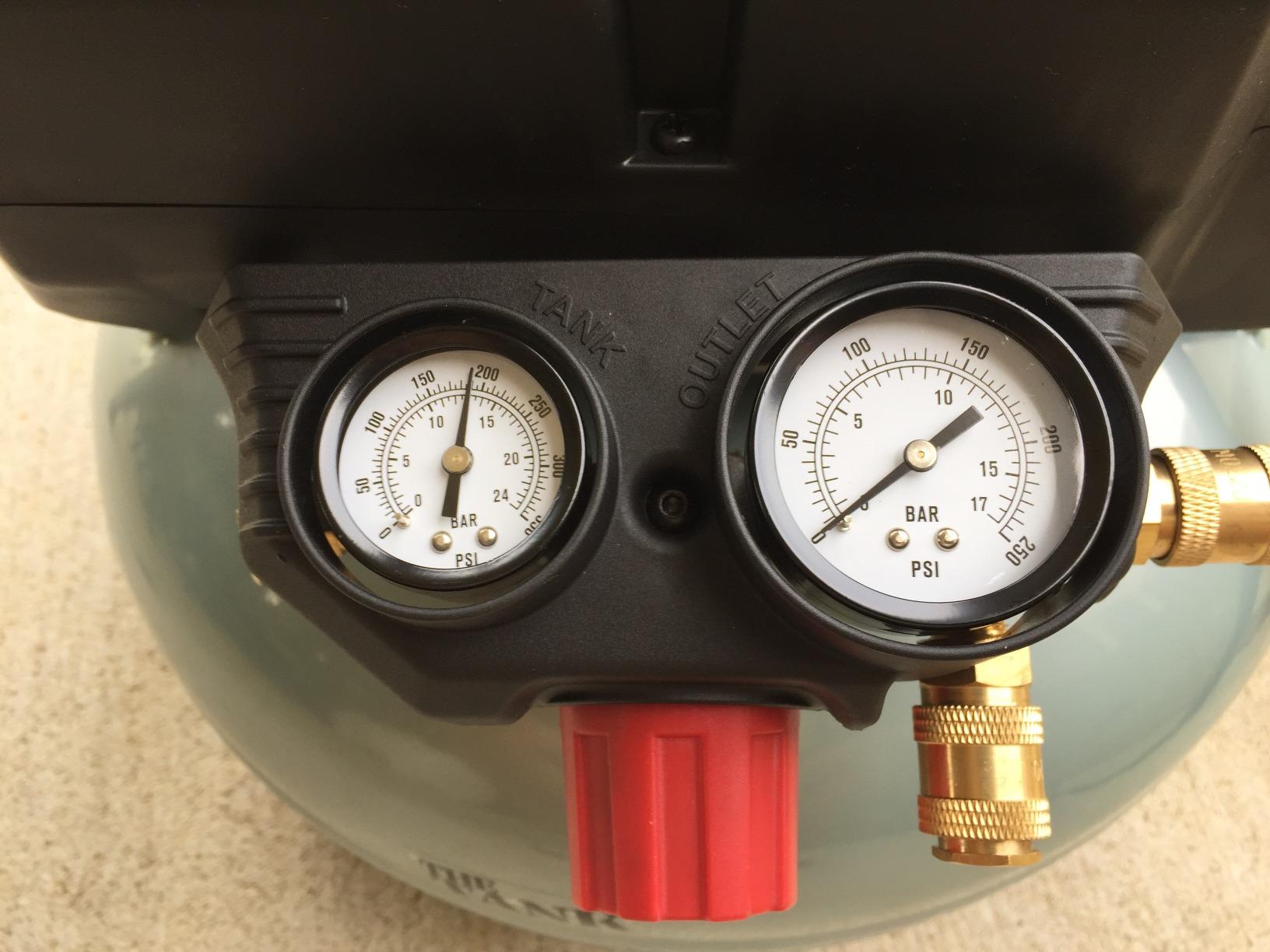
Who the EC914S suits best
Buy this one if you frame regularly, work alone or as a pair, and have to move the compressor more than once a day. The 4 CFM figure is the number that matters and it clears the bar with room, while 42 lb keeps it carryable up a stair without a second pair of hands.
It is also the safest recommendation for someone who wants one compressor to cover more than framing. The dual-tool capability means the same unit handles roofing, siding, subflooring, and finish work without a second purchase.
Who should skip the EC914S
Skip it if noise matters more than airflow. In an apartment, a townhouse, or an occupied renovation, 73 dB is genuinely disruptive and you should be shopping the quieter induction-motor units instead.
Also skip it if you are framing a whole house with two or three guns running flat out. Six gallons is a single-nailer tank, and at that duty level you want a larger reserve and a wheelbarrow format rather than a second carry handle.
2. Makita MAC2400 Big Bore – the pick for full-time framers who want pump durability
Makita MAC2400 2.5 HP* Big Bore™ Air Compressor
4.2 CFM at 90 PSI
2.5 HP 4-pole motor
Cast iron Big Bore
79 dB oil-lubricated
Pros
- Highest 4.7 star average in the group
- 4.2 CFM at 90 PSI keeps a framing gun firing
- Roll cage protects the pump on rough sites
- Low 12.3A start-up draw rarely trips a breaker
Cons
- 4.2-gallon tank is the smallest reserve here
- Oil-lubricated pump needs oil checks and changes
- 79 dB is one of the loudest ratings here
The MAC2400 has the best average rating in this group at 4.7 stars across 1319 ratings, and the reason is durability rather than headline convenience. The cast iron Big Bore cylinder and piston are sized for faster recovery, and the 2.5 HP four-pole motor pushes 4.2 CFM at 90 PSI. That is more airflow than the EC914S from a smaller tank, which tells you how the pump is built.
Two details make it a genuine pro tool. The roll-cage frame is welded to protect the pump when the unit gets clipped by a stud or dropped off a curb, and the low 12.3A start-up draw means it will not trip a shared jobsite breaker the first time the pump comes on. Both of those matter more over a season than any spec on a spec sheet.
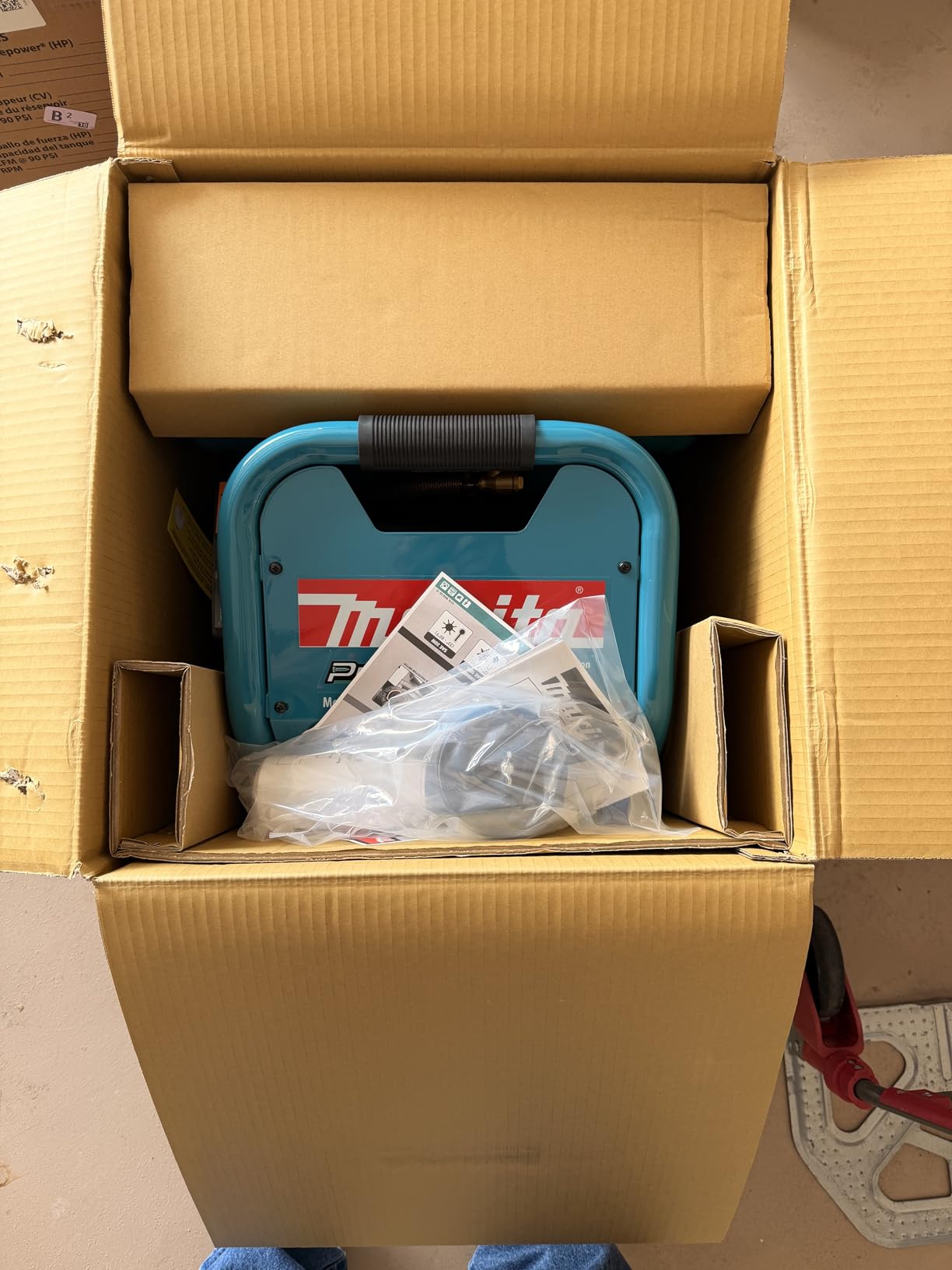
The pump is oil-lubricated rather than oil-free, which is the trade you make for longevity. The oil runs cooler, the moving parts wear slower, and the pump is repairable rather than disposable. The 1,730 RPM running speed is what produces the 79 dB rating and the durability, so the noise is not an accident. An automotive-style industrial air filter with a replaceable cartridge keeps intake dust out of a pump you will depend on for years.
The real weakness is the tank. At 4.2 gallons this is the smallest reserve in the roundup, and with 4.2 CFM moving air you will cycle the pump constantly during a wall. Owners who frame all day report planning around it. If your sessions are long, pair it with a nailer with a modest demand or accept more pump cycling than you would with a bigger tank.
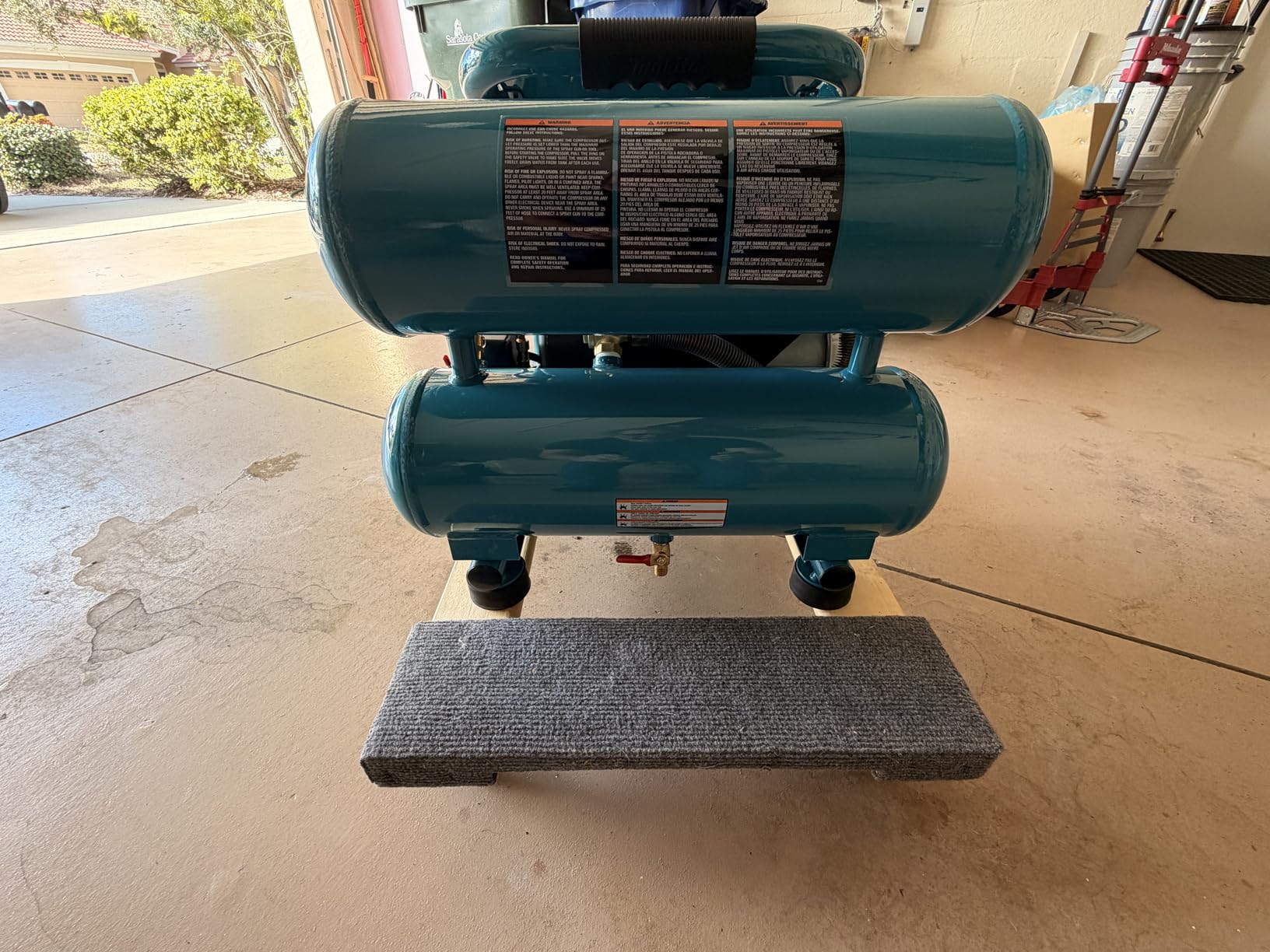
What you gain by going oil-lubricated
The reason experienced framers gravitate to this class is service life. An oil-lubricated cast iron pump that gets a weekly oil-level glance can run for a decade, and this unit carries a 1-year parts and labor warranty on top of that. Oil-free pumps are cheaper to ignore, and they punish you for ignoring them under continuous duty.
The low amp draw is the sleeper feature. On older job sites and extension cords, a compressor that tries to start at 15 amps will trip a breaker mid-wall, and a stopped nailer in the middle of a lift is a bad afternoon.
Where it falls short
The 4.2-gallon tank is the deal-breaker for two-person crews. Combined with 79 dB, this is also one of the louder units here, so it belongs outdoors on a new-build site rather than inside an occupied remodel.
If you are a weekend DIYer framing one wall a month, you are paying maintenance attention and weight for airflow you will never draw. A 6-gallon oil-free pancake is the better fit for that job.
3. PORTER-CABLE C2002 – the Best Value and the forum DIY favourite
Black & Decker/dewalt C2002-WK Pancake Compressor
6 gal tank
2.6 SCFM at 90 PSI
150 PSI max
30 lb oil-free
Pros
- Most-reviewed unit here with 2406 ratings
- Lightest pancake here at 30 lb for one-person carry
- Two factory-installed couplers for two tools
- Includes a 25 ft hose and 13-piece accessory kit
Cons
- 2.6 CFM will starve a framing nailer on long fast runs
- 82 dB is the loudest rating in this roundup
- 150 PSI ceiling is modest next to 200 PSI units
The C2002 is the most reviewed compressor in this roundup at 2406 ratings and 4.6 stars, and that volume is itself informative. It is the pairing that DIY forums keep recommending for occasional framing, and the reason is simple: at 30 lb it is the lightest full-size pancake here and one person can carry it anywhere without planning.
Out of the box you get a 25 ft hose with the coupler and plug already factory-installed, a 13-piece accessory kit, two factory-installed regulated air couplers, and an oil-free pump that starts on a cold morning without hesitation. For a first compressor or a garage unit that also inflates tires and runs a blow gun, that box contents list is hard to argue with.
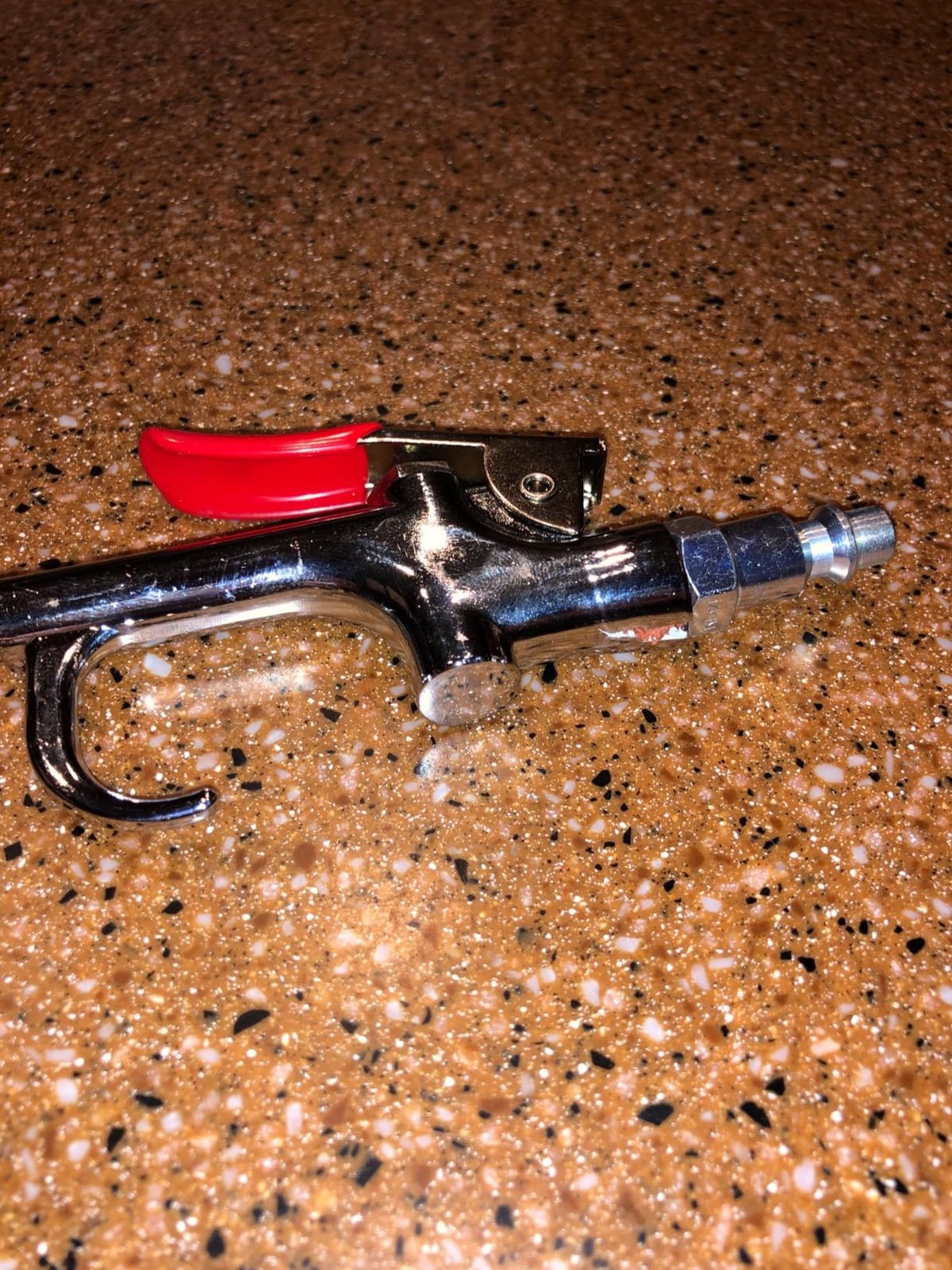
Now the part that decides your purchase. The rated airflow is 2.6 SCFM at 90 PSI to ISO1217, which is measured and honest but low for continuous framing. It fires every nail. What you feel is the pause, because the tank empties faster than the pump refills it and you stand there holding a framing gun at 200 pounds of pull waiting for the motor to catch up.
The 82 dB rating is the loudest figure in this roundup, and that is consistent with what owners report. For outdoor work at a distance it is irrelevant. For a basement or a closed floor plan it is the first thing a neighbour hears.
Best reasons to buy the C2002
The weight is the headline. At 30 lb with a top handle, it is the easiest unit here to carry up a set of stairs solo, which is why it keeps showing up as the answer for small jobs and tight access work. The oil-free pump and low-voltage start also mean zero winter hassle.
The two factory couplers let a second person run a second, lighter tool off the same tank. For a framing gun plus a finish nailer on the same day, that works reasonably well.
Where 2.6 CFM bites
Continuous framing is not this compressor’s job. Sheathing a wall or nailing off a roof deck means long sustained runs, and 2.6 SCFM will not sustain them. You will hear the pump cycling constantly and your wall time will stretch.
If you frame more than a weekend a month, spend up to the EC914S or the ECOMAX and get 3 to 4 CFM. The gap in workflow smoothness is worth more than the gap in cost.
4. ECOMAX 6 Gallon 150 PSI – Budget Pick for a working framer
ECOMAX Air Compressor 6 Gallon 150 PSI Pancake Portable Oil-free Tank with 10 PCS Accessories Kit
6 gal tank
3 CFM at 90 PSI
150 PSI max
34 lb oil-free
Pros
- 3 CFM at 90 PSI beats most 6-gallon oil-free pancakes
- Dual quick couplers and dual gauges
- 25 ft hose plus 10-piece accessory kit included
- 4.7 star average from 316 ratings
Cons
- Thin 316-rating base and a newer brand name
- 150 PSI ceiling is modest against 200 PSI units
- Oil-free pump is not the choice for all-season daily duty
The ECOMAX is the unit that makes the rest of this list make sense. It is a 6-gallon oil-free pancake with a 1.5 HP pump delivering 3 CFM at 90 PSI, which puts it in the useful middle: substantially more air than the 2.6 CFM entry-level units and less than the 4 CFM pro machines, at a weight of 34.17 lb with a flip-up carry handle.
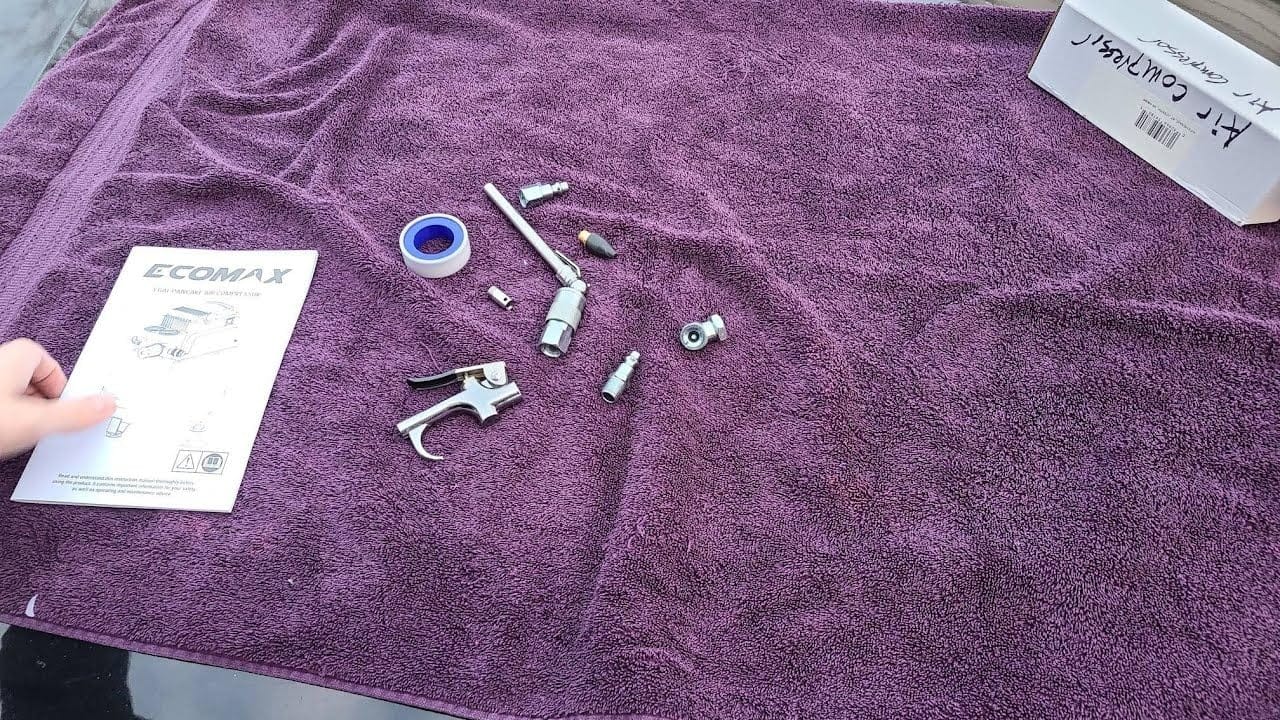
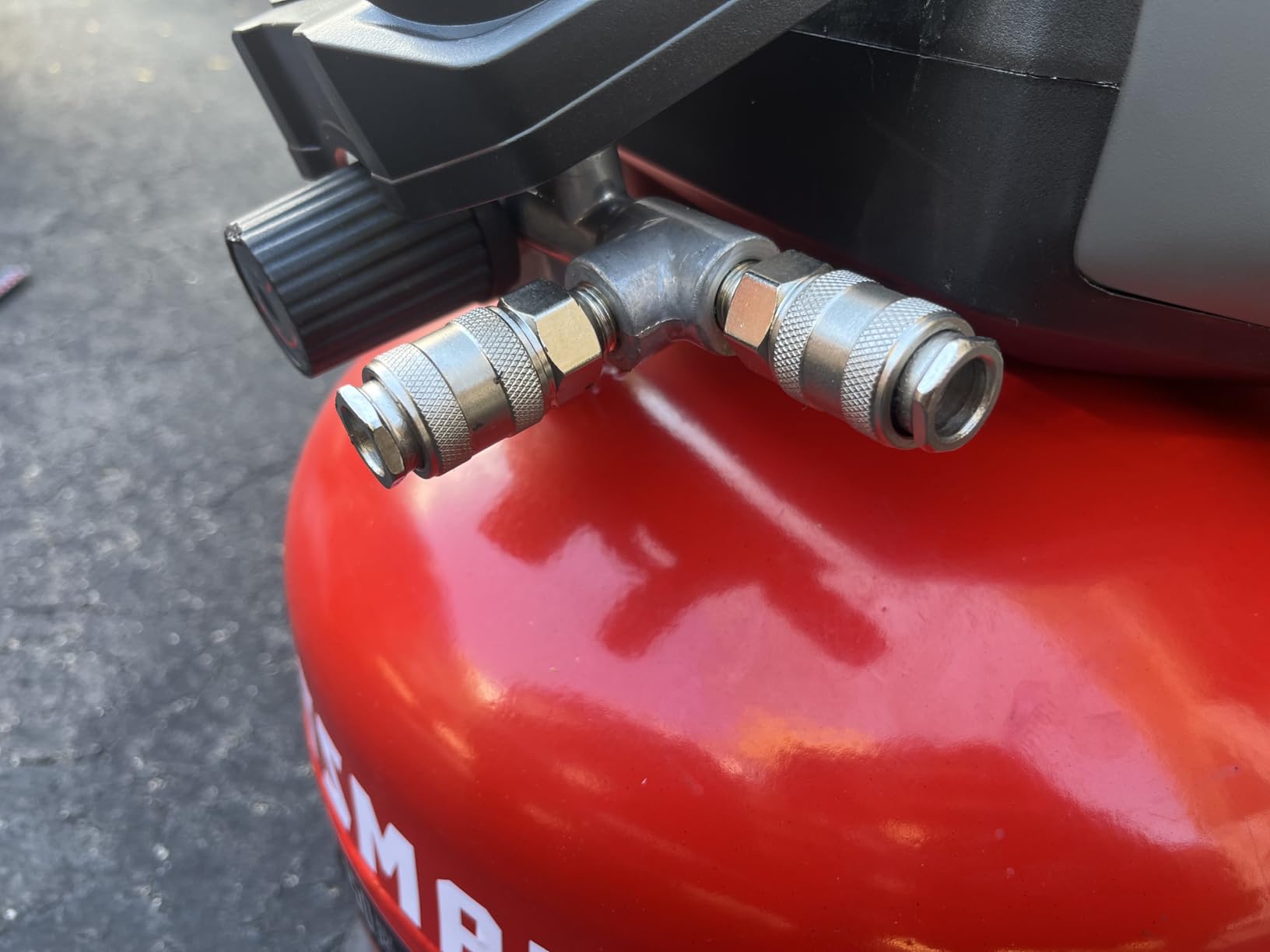
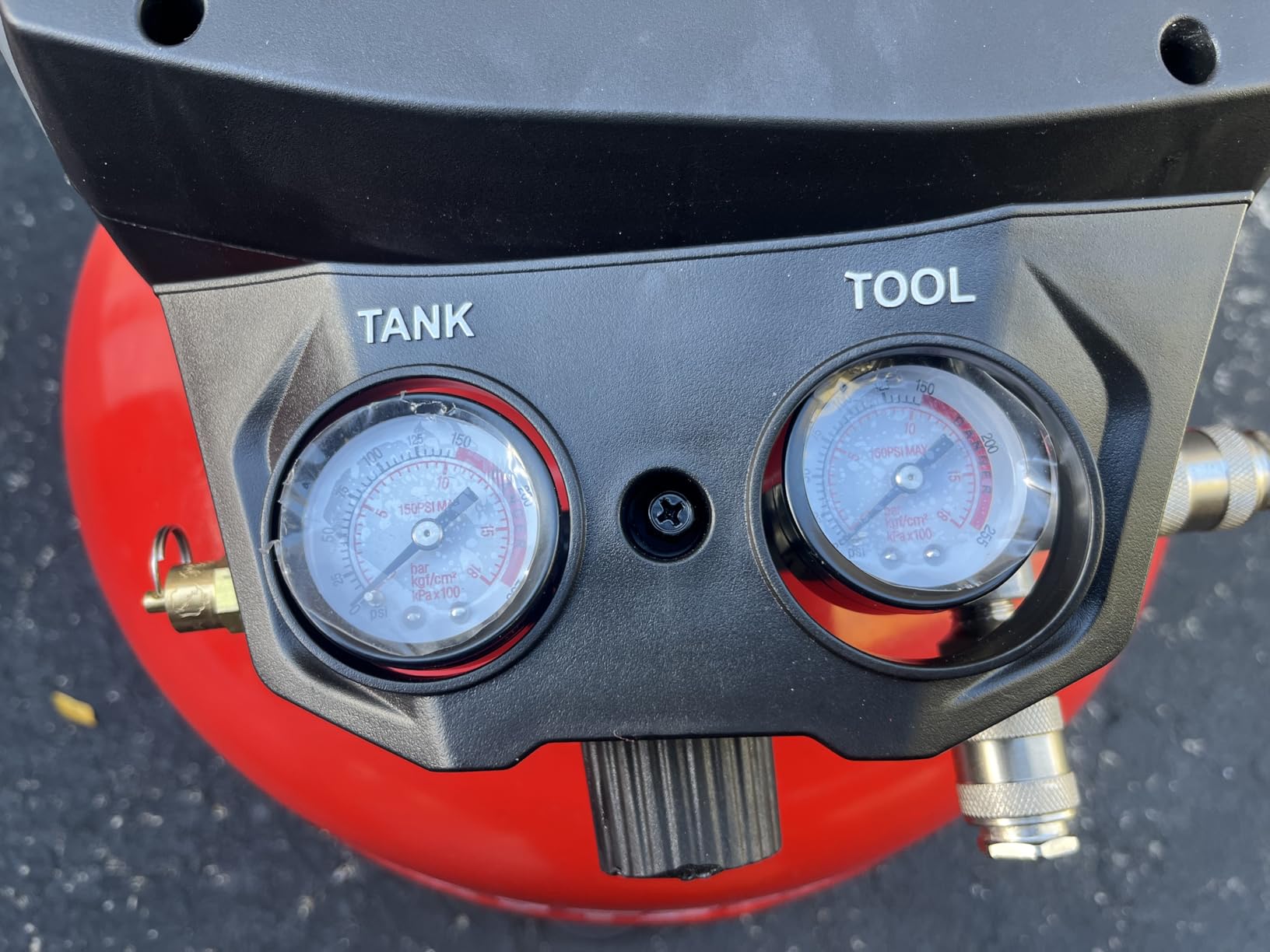
The dual quick couplers and dual gauges are the details that matter. Two couplers means two tools without a splitter, and two gauges mean you can watch tank pressure and regulated output pressure at the same time, which is exactly how you diagnose a nailer that is not driving nails fully. The box also includes a 25 ft PVC hose and a 10-piece accessory kit.
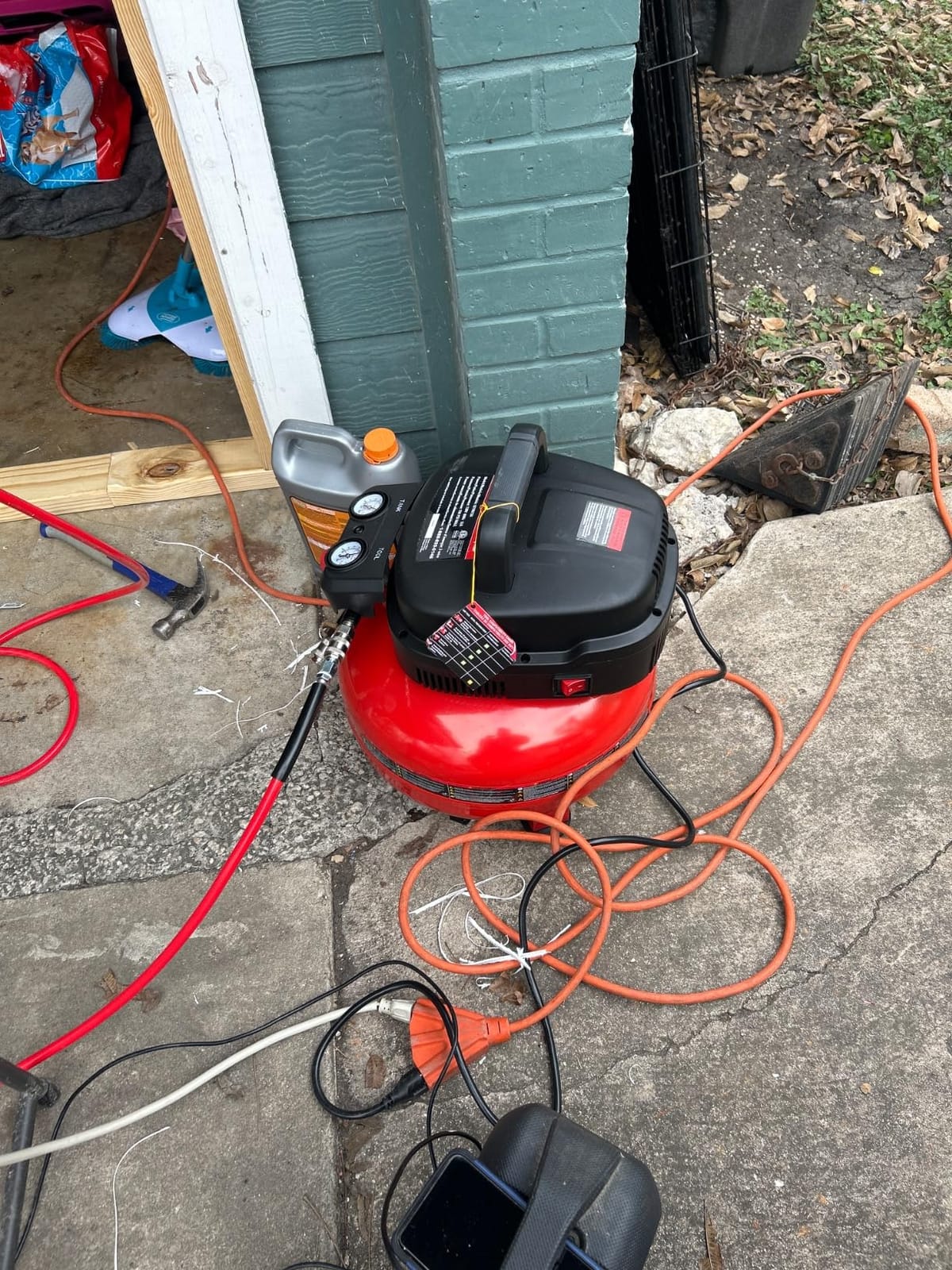
Rated at 75 dB it sits in the middle of the noise range here, quieter than the 82 dB units and louder than the 68 dB induction-motor pick. It is also cold-weather start capable, which matters if you are framing a shed in February.
The honest caveat is the brand. ECOMAX sits at number 5 in the Portable Air Compressors category with 316 ratings, and a four-star-plus average built on a few hundred reviews tells you less about five-year durability than the 2406 ratings behind the Porter-Cable. The 150 PSI ceiling is also modest, though a framing nailer typically works well below that.
Why 3 CFM is the sweet spot for most people
Forum consensus keeps landing in the same place: a compressor with roughly 3 CFM keeps a single framing nailer moving with occasional short waits, and anything below that turns nailing into a series of pauses. At 3 CFM you get close to that behaviour without paying for pro pump hardware.
For an owner who frames regularly on their own, this is the balance point between airflow, tank size, and how often you are waiting.
Where the trade-off bites
An oil-free pump under continuous daily framing duty wears sooner than a lubricated cast iron pump. If you are framing full-time for a living, you will be doing this every day and the maintenance-free advantage turns into a durability question.
The thin review base also means you have less owner data to lean on. If your work depends on a machine not failing mid-wall, the older designs with thousands of ratings give you a better read.
5. Limodot 68 dB – best for framing indoors and in occupied homes
Quiet Oil-Free Air Compressor, 68 dB, 2.8 CFM @ 90 PSI, 5 Gallon Air Tank
68 dB induction motor
2.8 CFM at 90 PSI
5 gal tank
80-second refill
Pros
- Quietest rated output in the group at 68 dB
- Refills empty to full in about 80 seconds
- Wheels kit and 25 ft hose included
- Oil-free with no maintenance schedule
Cons
- 120 PSI max is the lowest ceiling here
- 5-gallon tank is the smallest listed
- 2.8 CFM is modest for sustained framing
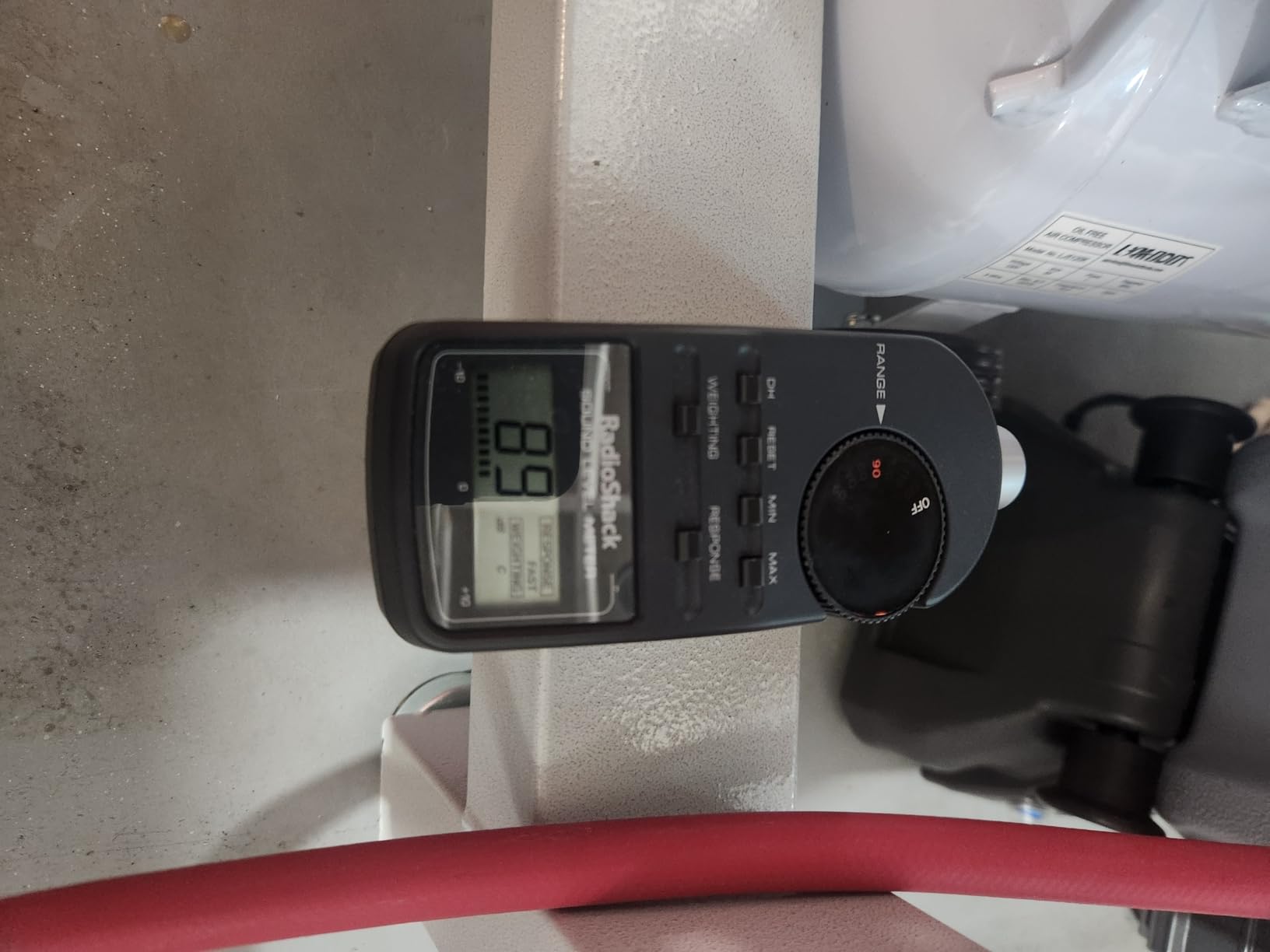
Most compressors in this roundup are direct-drive units that scream. This one runs a 1.2 HP induction motor at 3400 RPM and is rated at 68 dB, which is the quietest published figure in the group and the reason we recommend it for interior work. Induction motors are quieter by design, and the manufacturer also rates it at 4 CFM at 40 PSI, so it still has real air behind it at lower pressures.
The 80-second refill from empty to full is the number that matters for nailing. Recovery speed is what you feel between shots, and a fast refill is why this unit keeps up with a framing gun despite the modest 2.8 CFM at 90 PSI. It also carries a wheels kit, a 25 ft hose, and a 13-piece accessory kit out of the box.
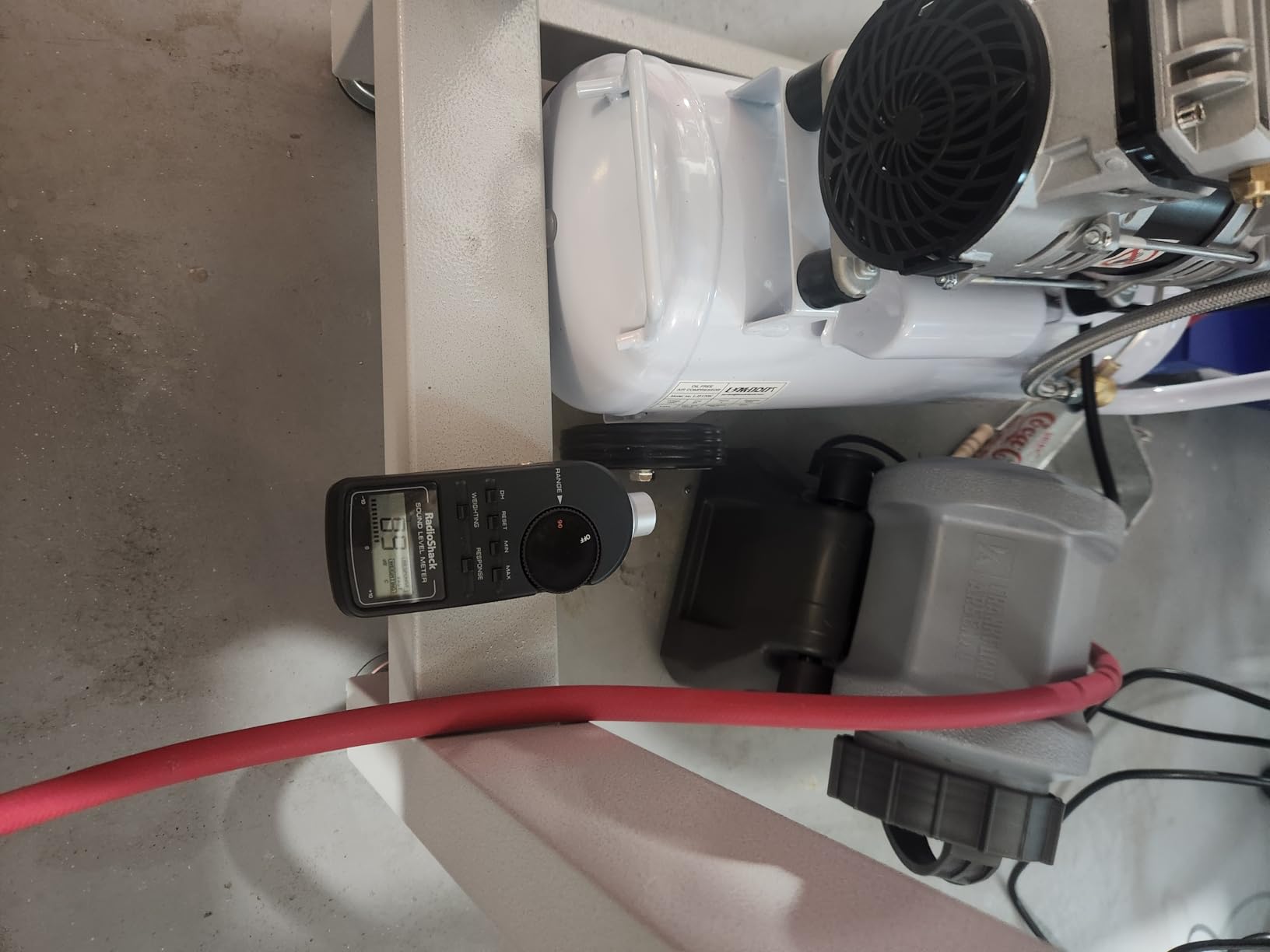
Owners report it handling framing nailers, roofing nailers, and brad nailers as well as airbrush and spray work. That versatility is real, and the fact that it also handles inflation tasks means one machine covers more of a shop’s air needs.
Now the constraint, and it is a real one. The maximum pressure is 120 PSI, the lowest ceiling in this roundup. Framing nailers commonly run at 100 to 120 PSI, so you are working at the top of the regulator range with nothing in reserve. The 5-gallon tank is also the smallest listed here. That combination makes this a good second machine or a finish-and-brad compressor rather than a full framing compressor.
When quiet beats everything else
If you are framing inside an occupied house, an apartment, or a townhouse with neighbours close, 68 dB versus 73 dB versus 82 dB is the difference between a normal job and an argument. This is the one unit here that can run in a finished room without anyone noticing it.
The oil-free design also means nothing to maintain and nothing to spill. For interior finish work and trim, that combination is very hard to argue against.
Why it is not a full framing compressor
At 120 PSI you have no headroom above a nailer’s typical working pressure, so a long run of hard nails into dense lumber will pull the regulator down and slow recovery further. The 5-gallon tank gives you less reserve than a 6-gallon pancake at the same moment you need it most.
If your framing is exclusively outdoors, you are giving up real airflow for a noise rating you cannot hear. Take the EC914S instead.
6. CRAFTSMAN 6 Gallon 150 PSI – best for carrying and awkward access
CRAFTSMAN 6 Gallon 150 PSI Oil-Free Pancake Air Compressor CMXECXA02106410
6 gal tank
2.6 SCFM at 90 PSI
30.8 lb iron body
150 PSI max
Pros
- Compact 30.8 lb iron build one person can carry
- Dual quick couplers for two tools at once
- Low-voltage start helps on cold mornings or weak circuits
- CRAFTSMAN service support with a 1-year warranty
Cons
- 82 dB is among the loudest here
- 2.6 SCFM is entry-level for a framing nailer
- Some owners report units arriving with a broken handle or gauge bracket
This is the same 6-gallon, 150 PSI, 2.6 SCFM architecture as the PORTER-CABLE, and it competes with it on build and brand rather than on flow. The iron body, the dual quick couplers, and the 30.8 lb weight make it a solid second option when you want a different manufacturer’s warranty behind the same performance class.
Two things stand out for jobsite use. The low-voltage oil-free start helps on cold mornings and on weak circuits, which is the same advantage that makes the PORTER-CABLE popular. The 15.8 by 16.4 by 17 inch footprint is small enough to fit in a truck bed or a garage shelf without dominating the space.
The complaints are worth repeating. A small share of owners report units arriving with a broken carry handle or a cracked gauge bracket, which is a shipping and packaging issue rather than a design flaw, but it is a real annoyance. Some owners also report the unit shutting off under sustained high-draw use such as spray painting, which is consistent with a 2.6 SCFM pump reaching its limit.
At 82 dB it is among the loudest here, tied with the PORTER-CABLE for the worst published rating. That reflects direct-drive oil-free pump design at this output level more than any fault in this particular unit.
Why carry weight is the deciding factor here
At 30.8 lb this is one of the two lightest units in the roundup, and that changes which jobs you can take. Crawlspace access, upper-floor work without a ramp, and moving between rooms mid-task all become one-person operations. If you have ever had to wait for a second person to move a compressor, you understand the value.
The dual couplers also let one framer and one helper run two lighter tools, which covers more of a day than the single-coupler units.
Where it will let you down
2.6 SCFM is the same ceiling as the PORTER-CABLE and it means the same thing: this is a brad and finish machine that can also frame slowly, not a framing machine that happens to be small. Continuous sheathing work will be pause-heavy.
If you frame every week, the difference between this and the ECOMAX at 3 CFM is the difference between waiting on every wall and waiting occasionally.
7. VEVOR 10 Gallon 125 PSI – best airflow for non-stop nailing
VEVOR Air Compressor, 10 Gallon Steel Tank, 2HP 5.3 CFM@90 PSI Oil Free Air Compressor & Max. 125PSI Pressure, 78dB Ultra Quiet Portable Compressor, for Auto Repair, Tire Inflation, Spray Painting
5.3 CFM at 90 PSI
10 gal steel tank
125 PSI max
78 dB oil-free
Pros
- Highest airflow here at 5.3 CFM at 90 PSI
- 10-gallon steel tank gives the largest reserve
- Three-layer anti-rust coating with seamless welds
- Automatic overheat and pressure-relief protection
Cons
- Lowest average rating here at 4.3 stars
- 70.6 lb is heavy for one-person lifting
- 125 PSI ceiling is low for stored-air headroom
- Short cord and sensitivity to extension cords
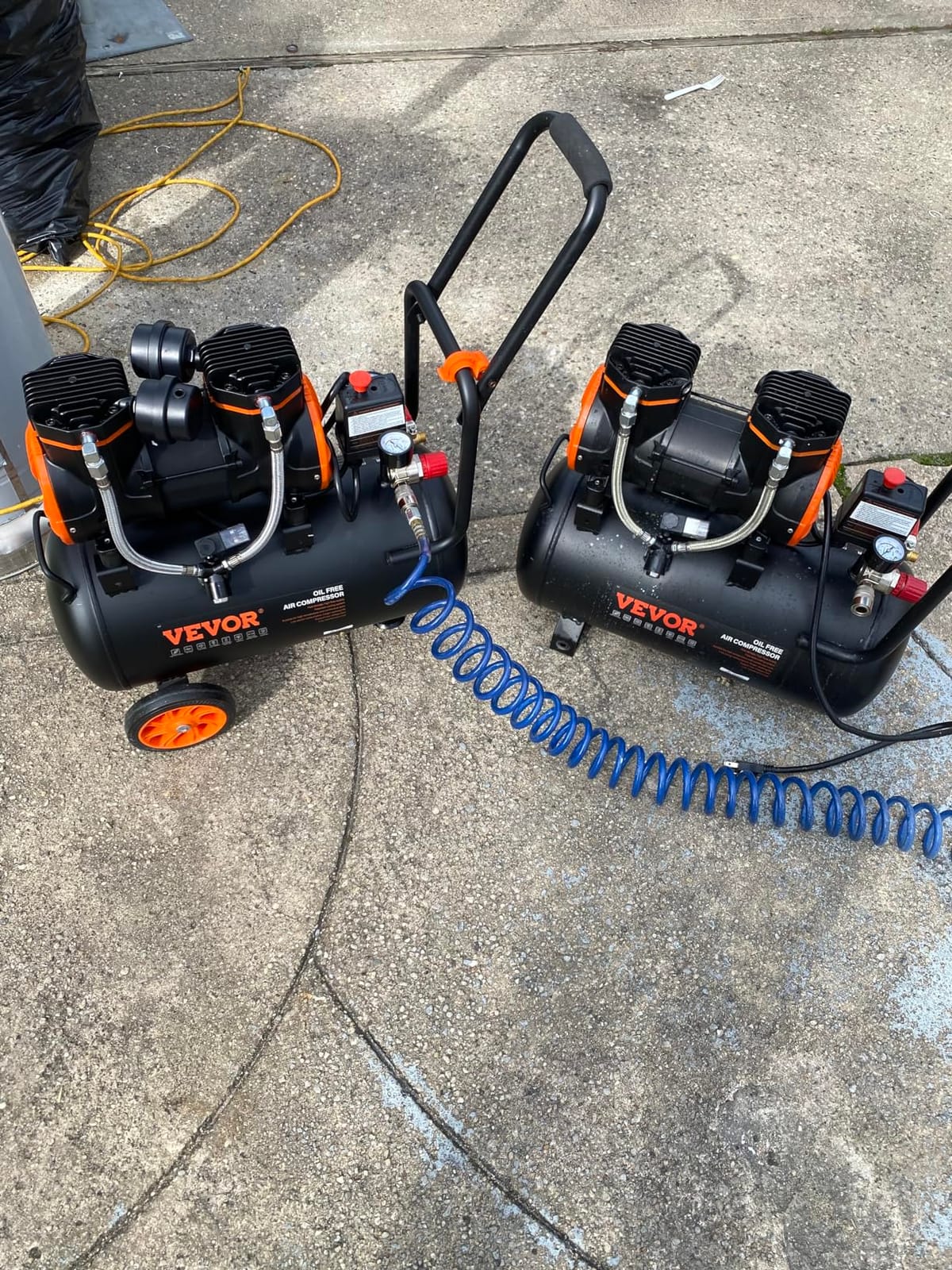
On raw output this is the most capable compressor in the guide. It delivers 5.3 CFM at 90 PSI from a 10-gallon steel tank, which is more air than everything else here combined in practical terms, and it is the only unit in this roundup with a 10-gallon reserve. If your problem is a nailer that stops mid-wall, this is the machine that fixes it.
The tank construction is unusually well thought out for the category: three layers of rust and wear-resistant coating over Q235B structural steel with seamless welding, a high-temperature silicone and stainless steel braided intake pipe, a large cooling fan, and automatic overheat protection with current and pressure shut-off. The muffler stack on a thickened cover is how it holds 78 dB while moving this much air.
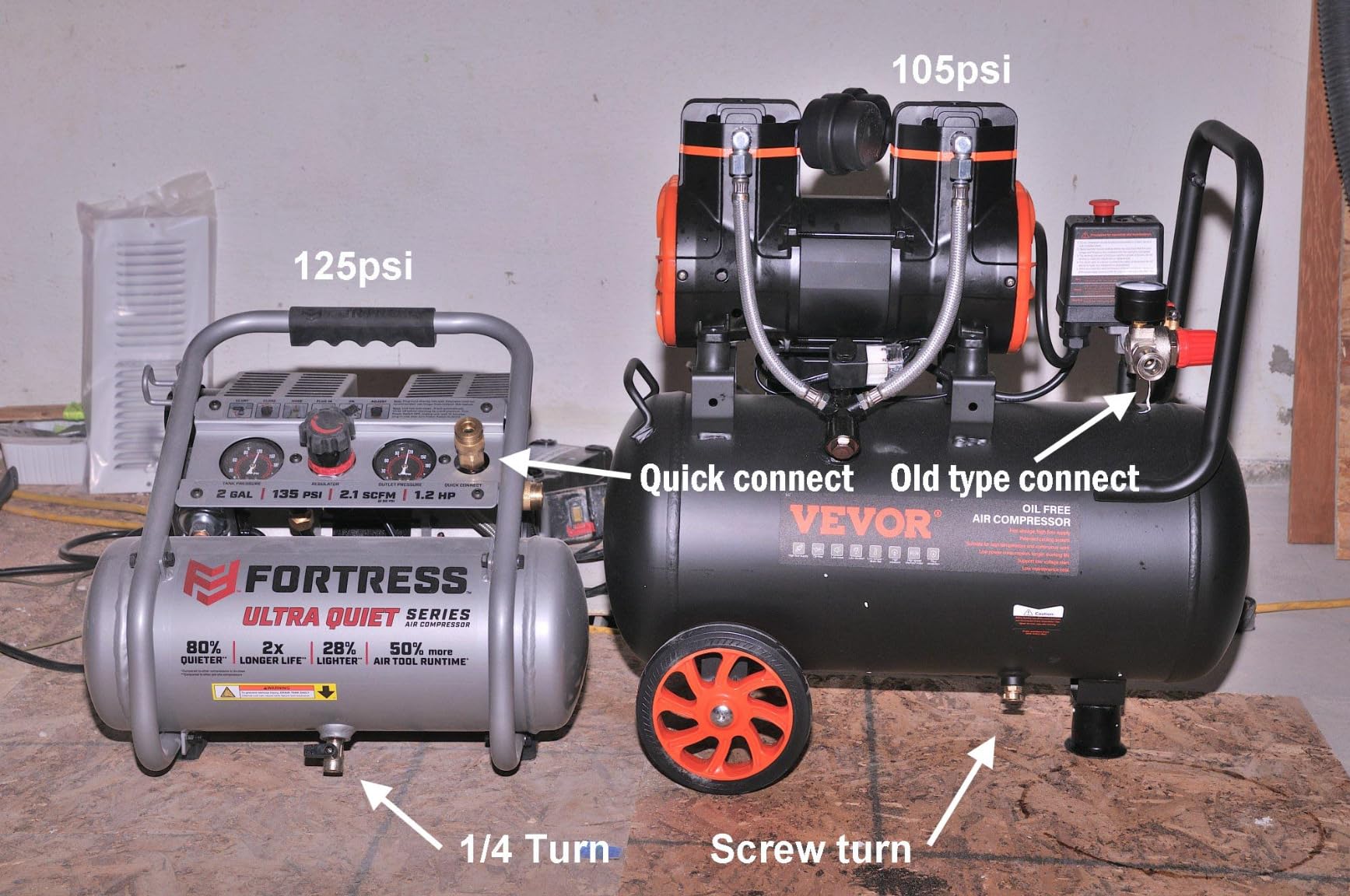
Owners report no air leaks and recovery fast enough to keep up with nailing, which matches the spec sheet. It is also offered in 6.3 and 15 gallon sizes, so if you like the pump you can pick the tank that fits your van.
The negatives are mostly electrical. The power cord is short, and owners specifically report that the unit is picky about extension cords and daisy-chained circuits. At 4.3 stars it also has the lowest average rating in this roundup with a 10 percent one-star share. The 70.6 lb weight and small, tip-prone wheels limit one-person handling.
What you gain from the extra air
Recovery speed is the whole game. A compressor with 5.3 CFM refills a 10-gallon tank so fast that the pump barely cycles during a heavy run, which means your nailer fires at a consistent pressure rather than sagging and recovering. Two people can work off this unit without negotiating for air.
If you ever move to roofing, siding, or repeated sheathing work, this is the class of machine that keeps pace with the job instead of dictating its pace.
Where this one gets awkward
The 125 PSI ceiling is low for stored-air headroom. You will be running near the top of the range to hold working pressure, and with a 10-gallon tank you do not get the deep reserve a higher-rated tank would give you.
At 70.6 lb with small wheels, this is a two-person lift or a cart job. It is portable in the sense of rolling around a site, not in the sense of carrying up a staircase. If stairs are part of your day, this is the wrong format.
8. RIDGID 6 Gallon Pancake – best warranty and best small-shop unit
RIDGID 6 Gal. Portable Electric Pancake Air Compressor
6 gal tank
150 PSI max
35 lb unit
3-year warranty
Pros
- 3-year limited warranty
- the longest coverage in this roundup
- 35 lb body is easy to load and reposition
- Reliable for nail guns
- tire inflation and blow guns
Cons
- Smallest rating base here at 155 ratings
- 150 PSI ceiling limits heavy framing duty
- Owners warn it will not keep up with long continuous high-draw runs
The RIDGID’s distinguishing feature is the warranty. A 3-year limited warranty is the longest coverage offered by any compressor in this guide, and for a buyer who plans to keep a compressor for a decade that is a meaningful difference against the 1-year terms most of the field carries.
The body is a 6-gallon pancake at 35 lb with an oil-free pump that fills and recovers quickly for its size. Owners like the straightforward operation and report that it runs at or below the published 80 dB in practice. It handles nail guns, tire inflation and air blowing without complaint, which covers most of what a weekend builder needs from a compressor.
At 35 lb with a carry handle it is portable in the true sense of the word, and 6 gallons is the right tank size for intermittent framing and general shop work. The oil-free pump means no winter starts, no oil checks, and nothing to spill on a garage floor.
Why the warranty matters here
Most compressors in this category carry a 1-year warranty, and a compressor failure a few months past that point is a real cost with no recourse. The 3-year limited warranty on the RIDGID OF60150 covers the failure window where owner reviews suggest problems are most likely to appear.
RIDGID is also one of the better-known names for replacement parts, so if something does fail the service side is easier to navigate than with a newer brand. That matters for anyone who plans to run this unit past a few seasons.
Where the RIDGID falls short
This is not a machine for continuous high-draw work. Owners are explicit about staying below 80 percent of its limits and warn against long uninterrupted runs of the kind a framing session produces. The 150 PSI ceiling caps the heavy end as well.
It is also the least-reviewed unit here at 155 ratings, which means less long-term owner data behind the reputation. The RIDGID brand and its parts availability offset some of that, but not all of it.
9. DEWALT D55146 225 PSI – best for a two-nailer crew
DEWALT Air Compressor, 225-PSI Max, Hand Carry with Wheels, 4-1/2 Gallon (D55146)
225 PSI max
5 CFM airflow
4.5 gal tank
88 lb roll cage
Pros
- 5 CFM flow comfortably drives a framing nailer
- 10-inch run-flat pneumatic tires roll over rough ground
- Oil-free pump runs cool and needs no oil changes
- Owners report 5 and 10 years of service
Cons
- 88 lb is the heaviest unit here
- Draws close to a full 15A circuit
- Couplers need an adapter for high-flow connectors
- Regulator tops out near 150 PSI despite the 225 PSI tank
When two people are nailing at once, you stop shopping for a pancake and start shopping for airflow and stored reserve. This DEWALT answers with 5 CFM and the highest tank pressure ceiling in the roundup at 225 PSI, which is a serious reserve of stored air for a 4.5-gallon tank. Owners running two guns report that the pair keeps working without either one stalling.
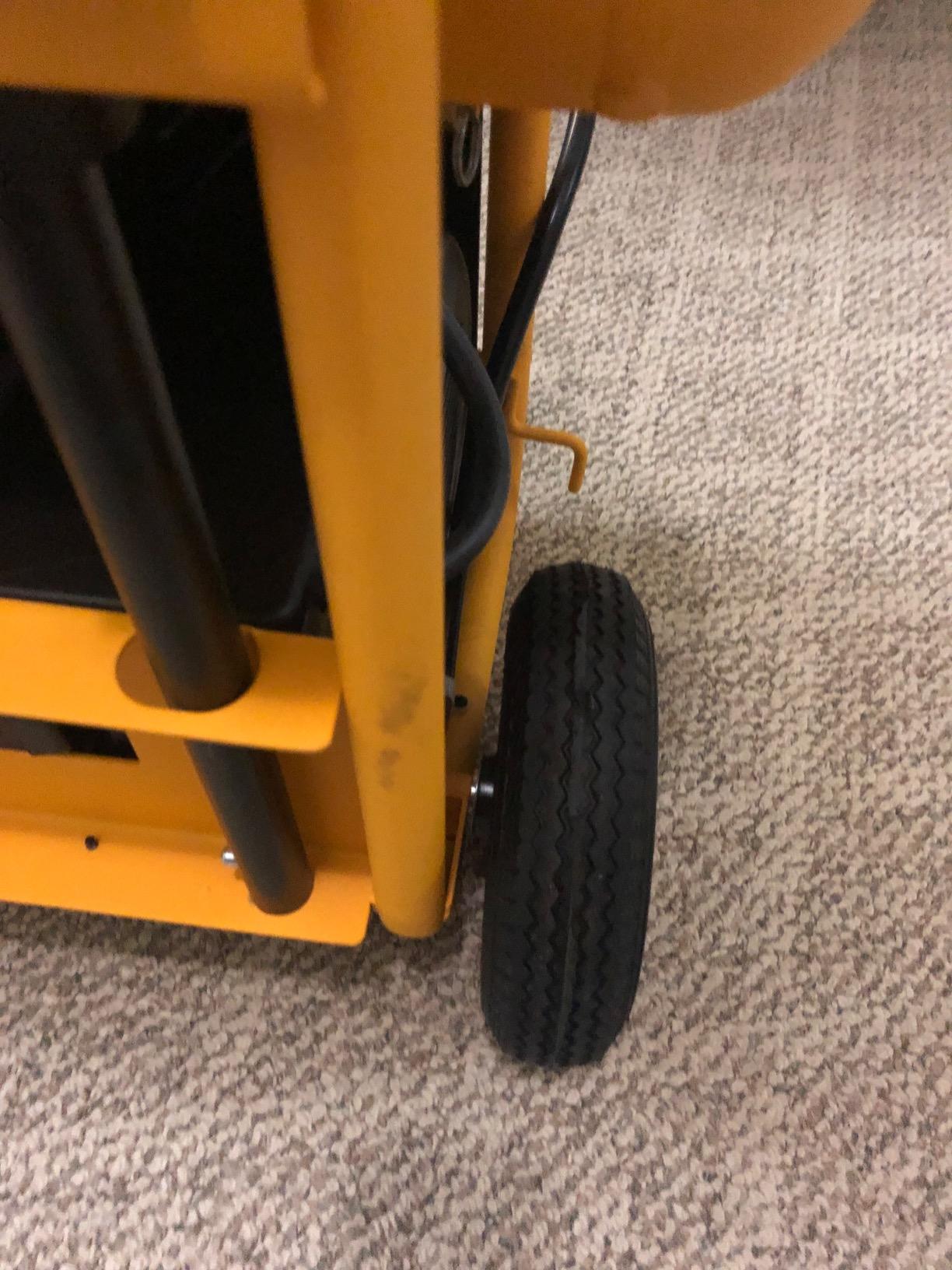
The longevity record is what separates it. Reviewers describe units in service for 5 years and some at 10 years, which is longer than anything else in this guide. The 10-inch non-flat pneumatic tires roll over gravel and broken ground far better than the small casters on the lighter units, and the welded tubular roll-cage frame protects the pump and console from a hit.
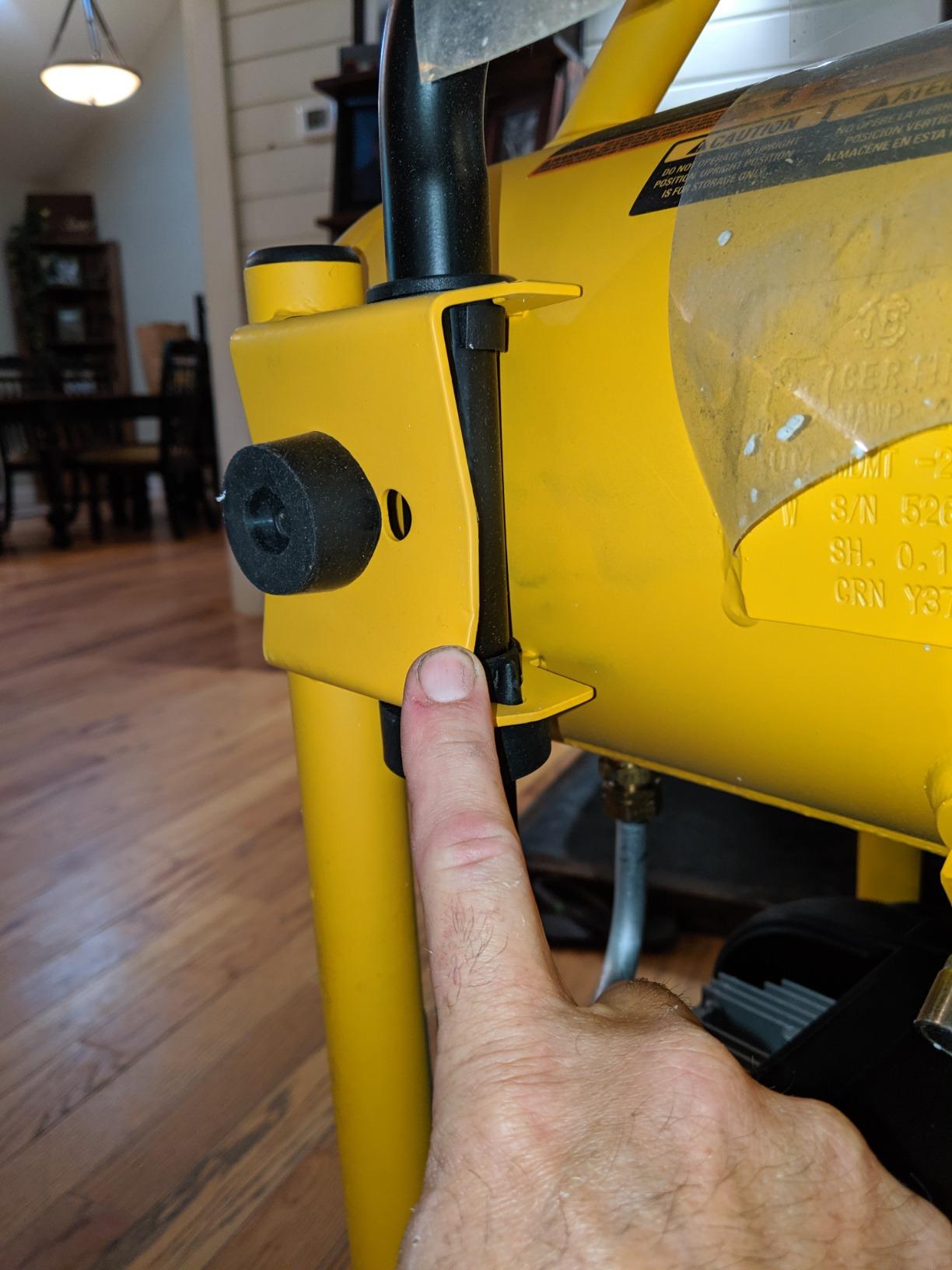
There is no single criticism of this machine that is not a consequence of its size. At 88 lb it is the heaviest unit here and loading it into a pickup alone is a two-person job. It draws close to a full 15A, so it needs a dedicated outlet and it will not share a circuit with anything else. The couplers are standard 3-in-1 industrial style, so high-flow 7.2 mm connectors need an adapter.
One detail worth knowing before you commit: the regulator tops out around 150 PSI even though the tank is rated to 225. For nail work that changes nothing, since a framing gun rarely needs more, but it explains why the extra tank pressure never shows up at the hose.
What makes it the crew pick
Two people, two nailers, one compressor. The 5 CFM figure covers the combined demand of a framing gun plus a second lighter tool, and the high tank ceiling means the reserve stays deep even when both are firing. On rough ground the pneumatic tires mean you are not fighting the machine across a site.
For a two-man crew framing houses regularly, this is the durability-to-effort ratio that matters. Ten-year owner accounts suggest it outlives several compressors over a career.
Where it stops being practical
Weight and power draw are the limits. If you are working in a building where you carry the compressor up stairs between floors, 88 lb is not a realistic one-person carry and the 15A requirement means you need power at the work face, not just at the panel.
If your framing is single-nailer and occasional, this is far more machine than the job requires, and the 4.5-gallon tank will still empty faster than you expect during a long run.
10. Ingersoll Rand Twin-Stack – best for continuous all-day duty
Ingersoll Rand 42672949 2 HP Portable Twin-Stack Air Compressor
2 HP continuous duty motor
3.2 CFM at 90 PSI
4 gal twin-stack
79 dBA
Pros
- 100% continuous-duty motor rated for all-day work
- Cast iron cylinder built for tough duty
- Two quick disconnect couplers
- Synthetic lubricant rated for 2000 hours between changeouts
- 2-year pump warranty
Cons
- 135 PSI max is a low ceiling
- 77 lb makes it one of the heaviest listed
- 4-gallon tank is small for sustained framing
This is the only unit in the roundup rated as a 100 percent continuous-duty compressor, and that rating is the entire argument for it. Continuous duty means the motor and pump are built to run all day without the thermal cycling that wears an intermittent-duty machine out. For a framer who runs a compressor from first light to last light, that is the specification that predicts survival.
The cast iron cylinder handles tough duty, and the All Season Select synthetic lubricant is rated for 2000 hours between changeouts, roughly four times longer than a petroleum lubricant. That is what earns the 2-year pump warranty, the longest pump coverage in this guide, on top of the 1-year full package coverage.
Note the airflow figure carefully, because the two numbers in the listing are different things. The rated air flow is 4.3 CFM, and the manufacturer states up to 3.2 CFM at 90 PSI, which is the number that describes what you get at the hose while a nailer is running. Two quick disconnect couplers are fitted so a second tool can run alongside.
The 135 PSI maximum is the second-lowest ceiling here, and the 4-gallon tank is small. At 77 lb it is also one of the heavier units listed. Operating noise is rated at 79 dBA, which sits between the loud pancakes and the ultra-quiet induction units.
Why continuous duty is worth paying for
An intermittent-duty compressor that gets run for eight hours a day will cook its motor windings and wear its pump bearings long before its warranty clock is done. Continuous duty is not a marketing line here, it is a different motor and pump design, and it is why owners of this class report machines still working after years of daily use.
The long lubricant interval matters as much as the motor. Two thousand hours between changes means you check the sight glass occasionally rather than scheduling oil service around every framing job.
Where it is the wrong choice
If you frame intermittently, you are buying capability you will rarely use and carrying 77 lb to access it. The tank is only 4 gallons, so despite the continuous-duty rating you still have a smaller reserve than a 6-gallon pancake.
The 135 PSI ceiling also means less headroom above working pressure than most units here. For a full-time crew working a single site with power at the panel, it holds up. For anyone carrying equipment up stairs, the lighter oil-free options are simply easier to live with.
How to Size a Portable Air Compressor for Framing
Sizing is simpler than the spec sheets make it look. Three numbers decide the purchase: CFM at 90 PSI, tank capacity in gallons, and how far you have to carry it. Everything else on a compressor listing is either a detail or a distraction.
CFM at 90 PSI decides your workflow
CFM at 90 PSI is the number that determines whether you will experience a smooth run or a series of pauses. A full-size pneumatic framing gun draws close to 4 CFM at operating pressure while firing continuously, so anything rated at 4 CFM or higher at 90 PSI will keep up with one gun. Units at 2.6 to 3 CFM will fire every nail and still leave you waiting.
A caution about spec mismatch. Airflow quoted at 40 PSI is not the airflow you get at 90 PSI, and CFM quoted without a pressure is close to meaningless. Always look for the figure stated at 90 PSI, and prefer figures measured to ISO1217 where the manufacturer provides them.
Why max tank PSI above 150 does nothing for a nail gun
Framing nailers are commonly adjusted between 100 and 120 PSI at the regulator. A compressor with a 150 PSI tank has plenty of margin over that. Going to 200 or 225 PSI adds heavier tank steel, a bigger frame and a higher price, and none of it reaches the hose because the regulator cannot pass it through.
The DEWALT in this roundup is the clearest illustration. Its tank is rated to 225 PSI and its regulator tops out near 150. The extra tank pressure mostly buys a deeper stored-air reserve, which matters under two-nailer demand. For single-nailer framing, treat 150 PSI as the sensible ceiling and ignore anything marketed on higher numbers.
Tank capacity: 3 gallon versus 6 gallon
Tank size is a reserve buffer, not a flow number. It decides how long you can fire between pump cycles, and how much pressure you lose in one long burst. Six gallons is the practical sweet spot for one nailer because it holds enough air to cover a run of nails while the pump catches up.
A 3-gallon tank works. It will fire a framing nail and it will frame a small project. What it will not do is let you keep a rhythm going, because the reserve empties in a handful of shots and you stand there listening to the motor restart. Forum users describe 3-gallon behaviour as workable but constantly interrupted, and that is accurate.
Eight gallons and up is for two or more nailers, or for long uninterrupted runs on sheathing and roofing.
One nailer or a two-man crew
For a single nailer, target 4 CFM at 90 PSI and 6 gallons. That combination lets you frame all day without planning your work around the pump. For two nailers firing together, you need roughly double the flow or a much larger tank acting as a buffer, which is the wheelbarrow format.
This is the question that comes up most on framing forums and the one most roundups skip. The honest answer is that a 6-gallon pancake will support a second person on a lighter tool, such as a finish nailer, while a framing gun and a finish gun at once will push it. Two framing guns need a wheelbarrow class unit with real airflow behind it.
Oil-free versus oil-lubricated pumps
Oil-free pumps need nothing. No oil changes, no sight glass, no cold-weather start problems, nothing to clean off finished flooring. They are the right choice for intermittent use, interior work, and anyone who wants a machine they can leave in a truck for a year without thinking about it.
Oil-lubricated pumps with cast iron cylinders run cooler and wear slower. They are the better choice under continuous daily duty, and they are repairable rather than disposable. The cost is a maintenance routine and a slightly heavier machine. Our view is that oil-free is right below roughly 10 hours a week of use, and oil-lubricated is right above it.
Hose length and pressure drop
The compressor is only half the system. A thin hose or a very long run steals pressure at the nailer, and the symptom reads like a weak compressor: nails not seating fully, inconsistent depth, the nailer slowing under load. If your compressor seems weak, check the hose before you blame the pump.
For framing, a 25 ft hose of reasonable diameter is the practical minimum, and the included hose on several units here is that length. If you are running two tools, use a manifold with two proper high-flow couplers rather than a cheap splitter, which restricts flow and steals pressure at the junction.
Noise indoors versus outdoors
Published dBA figures come from controlled test conditions, so treat them as relative comparisons rather than absolute predictions. A compressor rated at 68 dB and one rated at 73 dB sound very different inside a house and very similar at fifty feet.
For outdoor framing at a distance, anything in this roundup works. For interior work in an occupied home, an induction-motor unit in the 68 dB class is the only sensible choice. Structural sound travels through floors and joists, so the quietest option you can buy is the right call in a townhouse or an apartment.
Portability: weight, roll cage and wheelbarrow formats
Portable splits into three practical classes. One-hand carry units under about 35 lb are for stairs, crawlspaces and frequent repositioning. Pancakes in the 40 to 50 lb range move between rooms and up stairs with effort. Wheelbarrow units above 70 lb roll on real tires and are for one site, moved on a cart or by two people.
Roll cages are worth paying for on any machine that gets moved around a live site. They protect the pump and the console from the single most common form of damage, which is being knocked by lumber, hose, or a ladder. We also cover the pancake format in more detail in our guide to pancake air compressors for nail guns.
What Owners Actually Say About 3 Gallon Versus 6 Gallon
Owners disagree about tank size more than they should, and the reason is that they are answering different questions. The most useful comparison we found compares airflow rather than capacity. On r/Carpentry, a 2.2 CFM / 110 PSI compressor running near-continuously during nailing was contrasted with a 5.0 CFM / 150 PSI unit that has plenty of downtime, and the conclusion was that recovery speed rather than tank size alone is the deciding variable.
That reframing settles most of the argument. Two compressors with the same 6-gallon tank can feel completely different depending on how fast the pump refills. Conversely a 10-gallon tank paired with a slow pump can feel worse than a 6-gallon tank with a fast one.
On the specific minimum, the most-cited practical answer on r/Tools is a 6-gallon pancake, with one brand of 6-gallon pancake specifically named as not the recommendation. Woodnet users report that 3-gallon units are workable but require waiting regularly, and frame 4 gallons plus a full-size framing nailer as a common build. Forum consensus broadly settles on 6 gallons for a single nailer and 8 gallons or more when two people are nailing.
The recurring complaint we saw most often was not about failure but about workflow. Owners describe a small compressor that fires nails perfectly but stops mid-wall, and the frustration is entirely about the pause rather than the driving power. That is the symptom the sizing rule in this guide is designed to prevent.
If a nailer will not drive nails fully, the cause is more often pressure at the hose than tank pressure. Check the regulator output, then the hose length and diameter, before concluding the compressor is undersized. If you want help with moisture and air quality in the line, our air dryers for compressors guide covers that side of the system.
Frequently Asked Questions
What size air compressor do I need for a framing nailer?
Look for a compressor rated at 4 CFM or higher at 90 PSI with a tank of at least 6 gallons and a maximum pressure of about 150 PSI. A full-size pneumatic framing gun draws close to 4 CFM while firing, so airflow at 90 PSI is the number that decides whether the compressor keeps up. Tank size is a reserve buffer rather than a flow number.
What is the recommended air compressor PSI for a framing nailer?
Most framing nailers are adjusted between 100 and 120 PSI at the regulator, so a compressor with a 150 PSI maximum tank pressure gives you comfortable margin. Pressure above 150 PSI does not reach the hose because the regulator cannot pass it, and it mostly adds tank weight and cost.
Is a 6-gallon air compressor sufficient for a framing nailer?
Yes. Six gallons is the practical sweet spot for a single nailer because it holds enough air to cover a run of nails while the pump refills. It only falls short when two people are framing at the same time, which calls for 8 gallons or more of tank or a wheelbarrow-class unit.
Will a 3 gallon air compressor run a framing nailer?
It will fire every nail, but it is not comfortable for continuous framing. A 3-gallon tank paired with roughly 2 CFM of airflow empties in a handful of shots and you wait for the pump to catch up. Forum owners describe it as workable for short weekend projects but constantly interrupted during a full wall.
Can you run a framing nailer on a pancake compressor?
Yes, as long as the pancake is rated at 3 to 4 CFM at 90 PSI and has a 6-gallon tank. That covers a single nailer with only occasional short pauses. The limit is two nailers, where a pancake struggles to keep both guns fed at once.
Can one compressor run two framing nail guns?
Not comfortably on a pancake. Two framing guns together need roughly double the airflow, so look for a unit rated at 5 CFM or higher at 90 PSI with a tank of at least 4.5 gallons and ideally a wheelbarrow format. A 6-gallon pancake can support a second, lighter tool such as a finish nailer.
Should I buy oil-free or oil-lubricated for a nail gun?
Oil-free suits intermittent use, interior work and cold weather because it needs no oil changes and starts reliably. Oil-lubricated cast iron pumps run cooler, wear slower and are repairable, which makes them better for continuous daily framing duty. A general rule is oil-free below about 10 hours of use per week and oil-lubricated above it.
How loud should a framing nailer compressor be for indoor use?
For interior work pick the quietest unit you can find. Induction-motor compressors rated around 68 dB are the practical choice, while direct-drive oil-free pancakes commonly rate 73 to 82 dB. Treat published figures as relative comparisons rather than absolute predictions, since they are measured in controlled conditions.
The Verdict by Buyer Type
The best portable air compressors for framing nailers come down to airflow at 90 PSI, tank size and how far you have to carry it. For most people buying one machine in 2026, the Metabo HPT EC914S is the answer: 4 CFM at 90 PSI, 6 gallons, 42 lb, and enough output to keep a framing gun running without pauses.
A weekend DIYer who frames one wall a month should take the PORTER-CABLE C2002 at 30 lb and use it for finish and brad work more often than framing. A full-time framer who wants pump life should pay up for the Makita MAC2400 Big Bore and its cast iron lubricated pump. Anyone framing indoors or in an occupied home needs the quiet induction-motor class rather than the loudest direct-drive option.
A two-person crew needs a wheelbarrow format with real airflow, whether that is the DEWALT D55146 at 5 CFM or the higher-flow VEVOR with its 10-gallon tank. And for all-day continuous duty on one site, the Ingersoll Rand twin-stack is the only unit here rated as 100 percent continuous duty.
Whatever you pick, read the CFM figure at 90 PSI rather than the tank pressure, keep the hose short and wide, and check the regulator output at the nailer before you blame the compressor. For general shop duty rather than framing, our air compressors for home garages guide covers the wider range.