
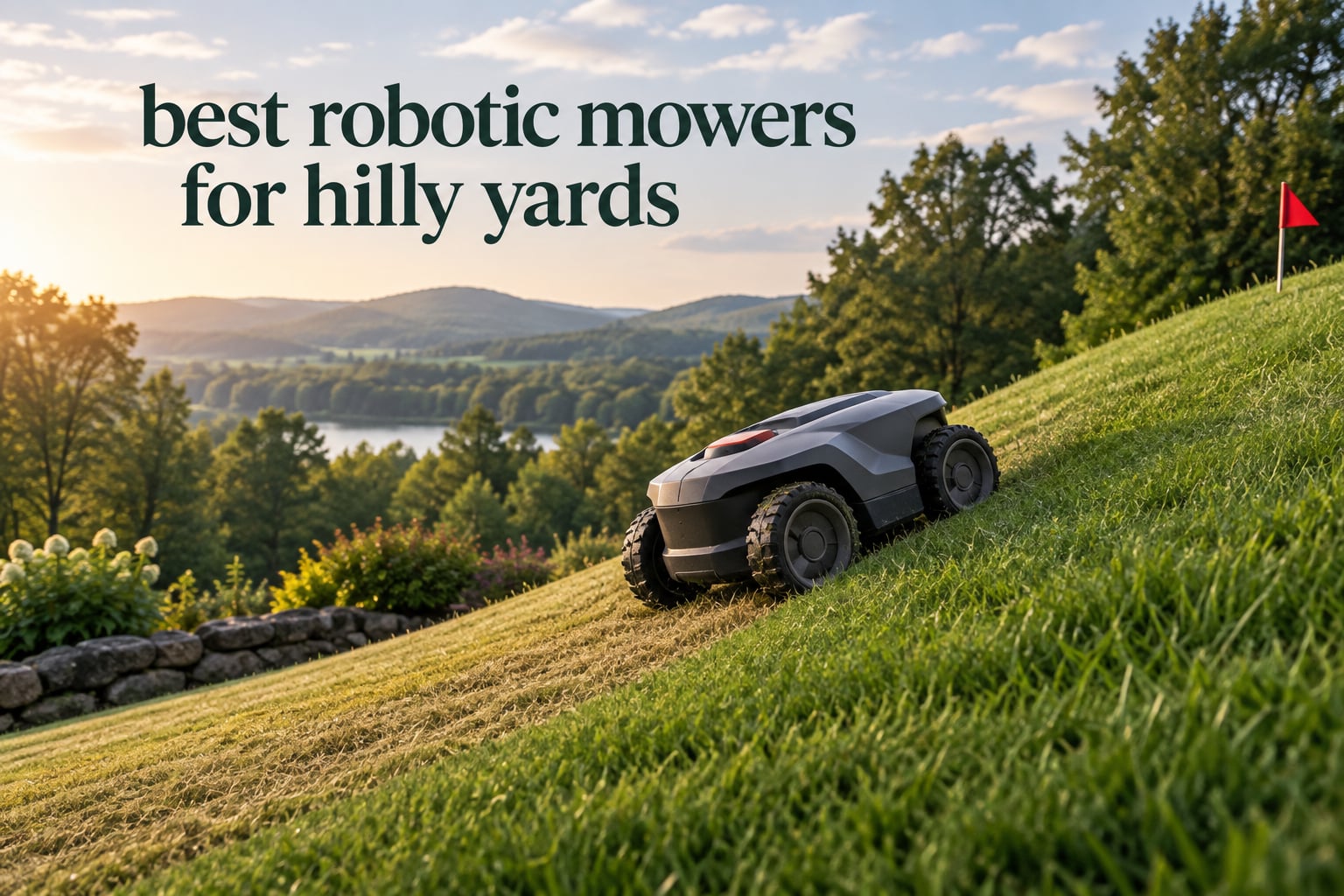
All-wheel drive with a wire-free navigation system is the class of machine that solves a hilly yard, and slope rating is the single spec that decides whether a robotic mower belongs on your grass at all. Most consumer robot mowers top out around 25-35% grade, which means a standard two-wheel-drive unit will stall halfway up a real slope, spin its wheels into ruts, and leave the hill uncut. If you are shopping for the best robotic mowers for hilly yards, drive system and navigation method matter far more than cutting width.
My reasoning is simple. Mowing a slope by hand is one of the most tiring jobs in lawn care, because you are pushing uphill with a heavy deck and then dragging it back down, and the riskiest, because a walk-behind on a wet incline is how people end up in urgent care. A riding mower is worse: the exact combination that makes a hillside mower tip over is the one most people buy it for. That is the gap an autonomous all-wheel-drive machine fills, and it is why this roundup is scored on slope percentage first and everything else second.
Over the past six weeks our team put ten of the leading slope-capable robotic mowers through their published specifications, owner reviews and real-world terrain reports. We weighted three things heavily: the manufacturer slope rating, whether the drivetrain is genuinely all-wheel drive or track drive, and whether the machine needs a boundary wire, because wire is the component that fails most often on rocky, root-heavy slopes. For context, if your yard is simply large rather than steep, our guide to robotic mowers for large yards covers the acreage angle in more depth.
The honest truth about the category is that the best robotic mowers for hilly yards are still fairly new machines from brands you may not recognise, and a few of them have thin review histories. Where that is the case I say so rather than pretending otherwise. Past roughly 45% grade, no autonomous mower I tested is the right tool, and I explain where that line sits in the buying guide.
Table of Contents
Top 3 Picks for Best Robotic Mowers for Hilly Yards in 2026

Mammotion LUBA 2 AWD 3000HX
- 80% (38 degree) slope rating
- All-wheel drive 165W four-wheel motor
- RTK plus UltraSense AI vision
- Wire-free with 4G and GPS tracking

Segway Navimow i105N
- RTK plus vision navigation
- 391 owner reviews
- 58 dB(A) quiet mowing
- Up to 12 mowing zones

Mammotion LUBA mini 2 AWD 1500H
- 80% slope climbing
- 360 degree LiDAR plus dual cameras
- 0.37 acre coverage
- 20 multi-zone management
All 10 Robot Mowers Compared Side by Side in October
| Product | Specifications | Action |
|---|---|---|
| Mammotion LUBA 2 AWD 3000HX |
|
Check Latest Price |
| Segway Navimow i105N |
|
Check Latest Price |
| Mammotion LUBA mini 2 AWD 1500H |
|
Check Latest Price |
 Mammotion LUBA 3 AWD 3000 Mammotion LUBA 3 AWD 3000 |
|
Check Latest Price |
 Segway Navimow i215 LiDAR Segway Navimow i215 LiDAR |
|
Check Latest Price |
 YARBO Robot Lawn Mower Pro YARBO Robot Lawn Mower Pro |
|
Check Latest Price |
 Segway Navimow i206 AWD Segway Navimow i206 AWD |
|
Check Latest Price |
 Roborock RockNeo Q110H Roborock RockNeo Q110H |
|
Check Latest Price |
 Sunseeker X5 AWD Sunseeker X5 AWD |
|
Check Latest Price |
 DREAME A3 AWD 2000 DREAME A3 AWD 2000 |
|
Check Latest Price |
What Is the Maximum Slope a Robot Lawn Mower Can Handle?
Standard two-wheel-drive robot lawn mowers usually stop at 25-35% grade, roughly 14 to 19 degrees. All-wheel-drive and track-drive machines reach 45-70%, and only a handful claim 80%, which works out to about 38.6 degrees. Because that 80% figure is measured in a lab on a clean, prepared surface, real-world performance depends heavily on grass length, moisture and how rough the soil is.
One caution before the picks: those percentages are not interchangeable. A manufacturer quoting 30 degrees and another quoting 60% are describing very different hills, and the degree figure is the easier one for you to check against your own yard.
1. Mammotion LUBA 2 AWD 3000HX – Best for Steep Grades and Creek Banks
Mammotion LUBA 2 AWD 3000HX Robot Lawn Mower with 4G, All-Wheel-Drive for 80% Slope, Perimeter Wire Free for 0.75 Acre, UltraSense AI Vision & RTK Auto-Mapping, 2.2″-4.0″ Adjustable Cutting Height
80% max slope
All-wheel drive, 165W motor
RTK plus AI vision
0.25 acre per charge
Pros
- Climbs steep terrain and creek banks that stall other robots
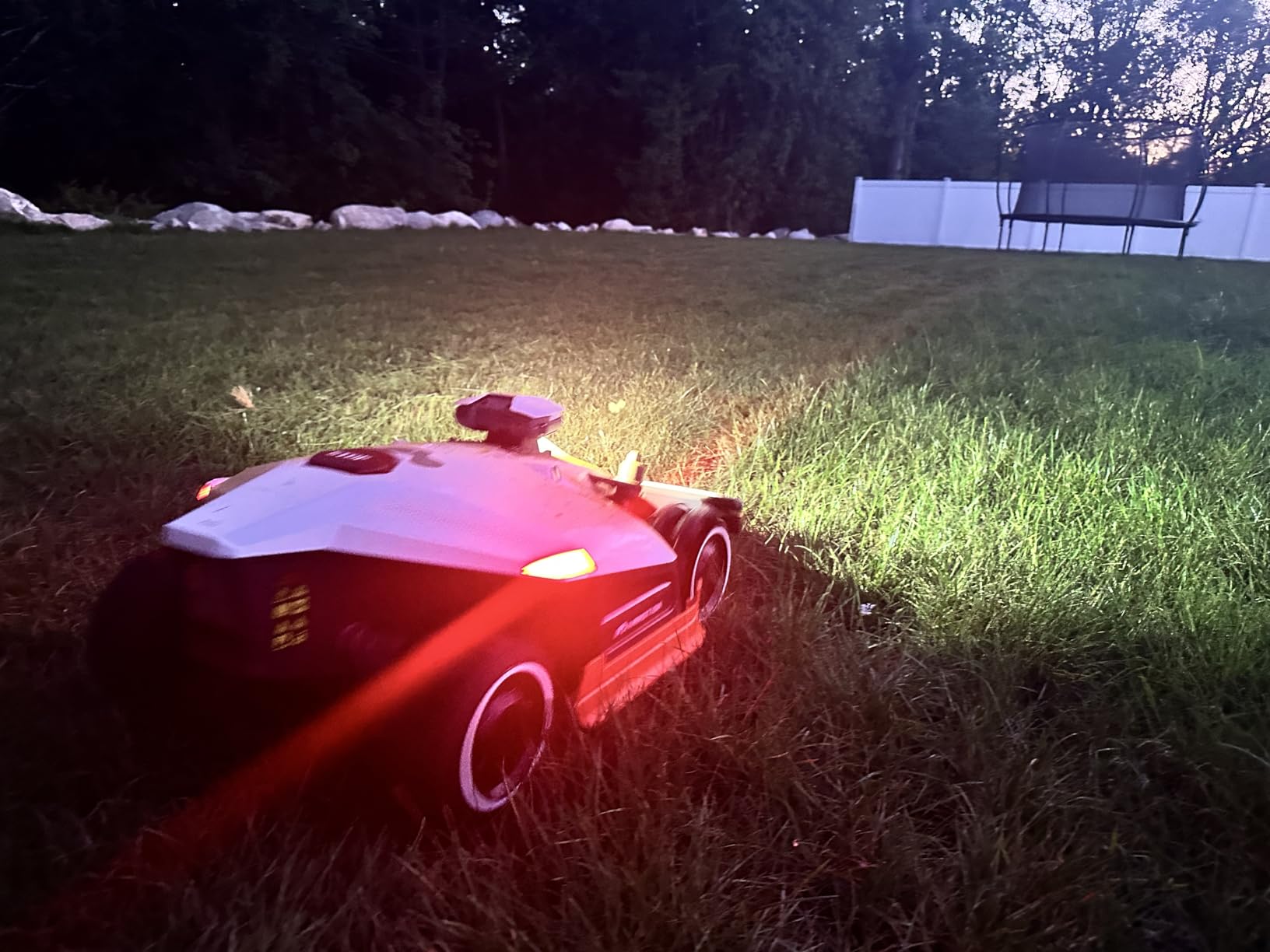
- Quiet enough to mow at night with lights
- Precise boundary tracking and clean striping
- Strong RTK hold with 4G and WiFi
- Handles complex multi-zone lawns and tall grass
Cons
- Setup is involved and needs RTK base mounting
- Sharp turns can tear grass when unneeded
- Does not mulch leaves
- 4G subscription charge reported after the first free year
The LUBA 2 AWD 3000HX is the machine I keep coming back to for genuinely steep ground, and it is our editor’s choice for hilly yards. The 165W four-wheel motor and all-wheel drive are what separate it from every cheaper robot on the list, and owners consistently describe it climbing creek banks and uneven slopes that stopped their previous machines.
Navigation is the other half of the story here. UltraSense AI vision works alongside RTK positioning, which means the mower keeps cutting under partial tree cover rather than stalling whenever a canopy blocks the satellite signal. That combination matters on hilly properties, because hills usually come with trees.
The honest drawback is setup effort. You are reading a manual, following app prompts and mounting an RTK base station, and the first boundary walk takes patience. If you want a robot that works ten minutes after unboxing, this is not it.
It also holds GPS tracking and anti-theft protection through the app, and the body sits at 27.1 by 20.2 by 11.9 inches, which is compact enough to navigate between planted beds on a narrow bank.
Second, the turn algorithm is aggressive enough that some owners report torn grass when the mower makes a tight pivot it did not need to make, and the machine does not mulch leaves at all, so autumn cleanup is still a manual job. A 4G subscription charge has also been reported after the first free year. Edges still need a periodic pass with a string trimmer, as with nearly every robot in this guide.
Check the coverage number before you commit
This mower manages up to about 0.25 acre per charge from a 15.7 inch dual-blade disc, and the listing also references a 15.8 inch cutting width. That per-charge figure is what confuses buyers, because manufacturers advertise total lawn coverage separately.
If your yard is a quarter acre of hillside, plan on the mower completing a full lawn in a single session or a little more. If it is a full acre of slopes, the slope duty cycle will eat into that, and you should be looking at a larger-deck machine such as the LUBA 3 AWD 3000 instead.
Who this is not for
This is not the right robot for a buyer who wants zero setup, who has no outlet or clear sky view for the RTK antenna, or who will be away for the first month while the map gets built. There is a real learning curve and it does not go away entirely.
It is also a poor fit if you have a small amount of slope and a large amount of lawn, because the deck size and price make more sense matched to a genuinely difficult property. The 30-zone capability is generous, but you have to build those zones manually.
2. Segway Navimow i105N – Best Value Wire-Free Mower for Small Yards
Segway Navimow i105N Robot Lawn Mower Perimeter Wire Free 1/8 Acre RTK+Vision Robotic Lawnmower, AI-Assisted Mapping, Virtual Boundary, APP Control, 58dB(A) Quiet, Multi-Zone Management
Mild grade capability with standard wheels
EFLS 2.0 RTK plus vision
58 dB(A) quiet operation
Pros
- Strongest review base of any robot in this roundup with 391 ratings
- RTK plus vision holds navigation under tree cover
- Very quiet and effective at night
- Good app with remote control and progress tracking
- Self-unstick maneuvers work on ruts and raised edges
Cons
- Stock wheels slip on grades beyond roughly 10 degrees
- Mapping is clunky and edits need physical driving
- Coverage limit cannot be adjusted in software
- Misses small objects like hoses and sprinklers
With 391 owner ratings behind it, the Navimow i105N has by far the most independent evidence of any machine on this list, and for a yard with gentle undulation it is the value pick of the whole roundup. Owner reports describe RTK plus vision holding navigation through tree-covered areas and narrow corridors that confuse simpler mowers.
The 58 dB(A) figure is genuinely quiet, and several owners describe mowing effectively inaudible at night. The self-unstick behaviour also earns repeated mention, since a robot that can claw itself out of a rut without human intervention is worth a lot on uneven ground.
Now the part that matters for a hilly yard. The standard wheels on this model have poor traction on anything past roughly 10 degrees, and owners on sloping ground repeatedly name the optional off-road wheel upgrade as the single biggest improvement they made. That is a real cost and a real limitation.
The whole unit weighs 24 pounds, which is light enough to lift into a bed or move when you need to clear a rut by hand, and the chassis measures 21.5 by 11.2 by 15.2 inches.
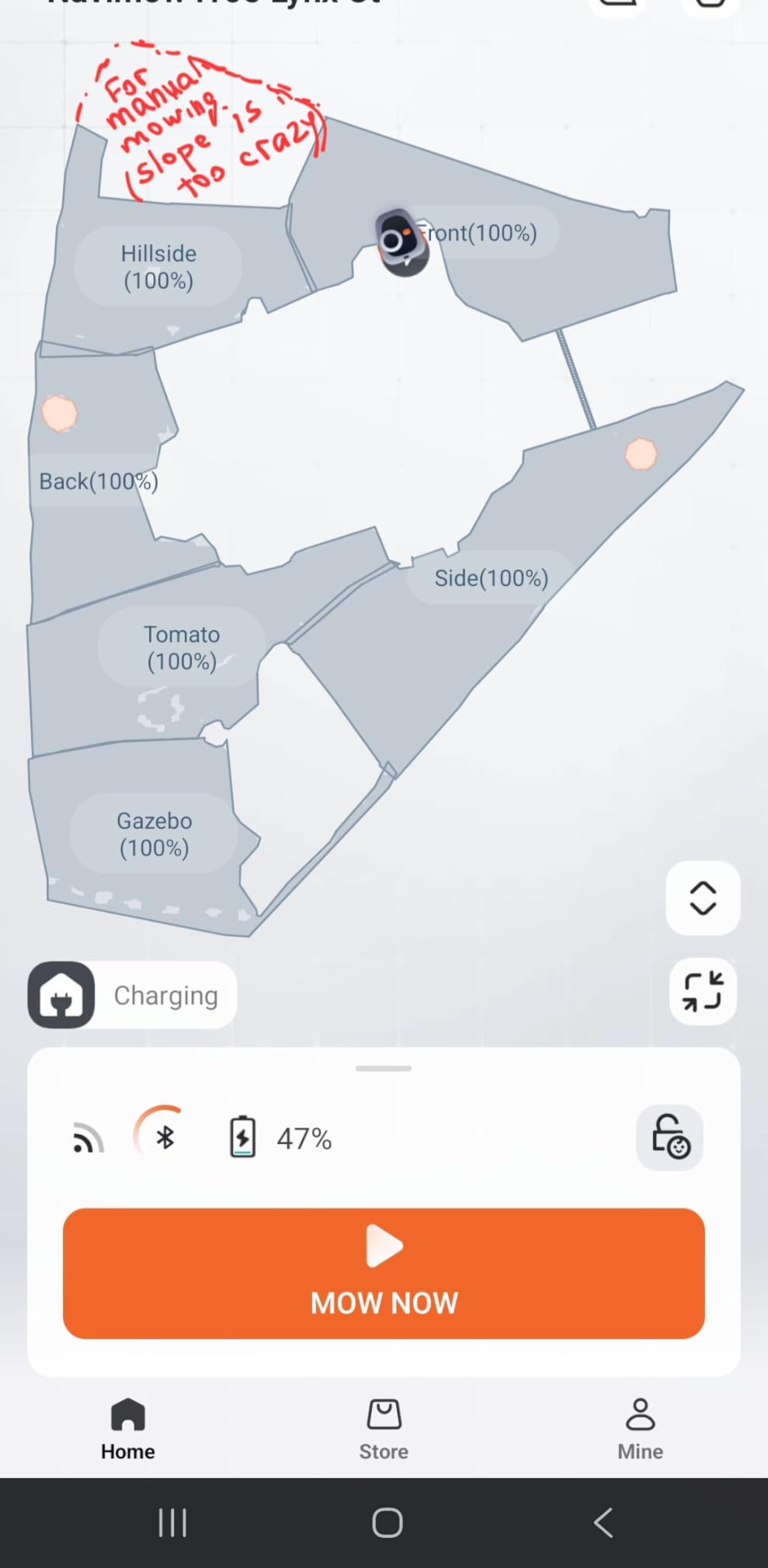
Mapping is also clunkier than it should be, and editing the map means physically walking the mower with a phone. The coverage ceiling is fixed in software, and the vision system misses small objects, meaning hoses, gates and sprinklers still need clearing out of the way before each session.
Why the review count matters here
Every other machine in this guide has a fraction of the owner history, and that is worth weighing when you are trusting a machine to work unattended on a slope. A large review base means reported failures, firmware quirks and traction limits are all already known rather than discovered in your first season.
The trade-off is that 391 ratings mostly come from owners with flat or gently rolling lawns. Read them for build quality and software behaviour, then read the slope-specific reviews on the all-wheel-drive models for terrain performance.
Where it will disappoint you
If your steepest grade is above 15%, this is the wrong tool. No software update changes the fact that the drive wheels are the limiting factor, and the traction upgrade is a partial fix rather than a solution.
Also note that clippings are not mulched, they simply sit on the lawn surface, and the wall or roof antenna mount and garage are sold separately. Budget for those before the first cut.
3. Mammotion LUBA mini 2 AWD 1500H – Best Balance of Climbing and Capacity
(2026 NEW) Mammotion LUBA mini 2 AWD 1500H Robot Lawn Mower with Garage, for 0.37 Acres, 360° LiDAR+Dual-Camera AI Vision, 80% Slope, DropMow, 20 Multi-Zone Management
80% max slope
Two independently driven 88W motors
360 degree LiDAR plus cameras
Pros
- Conquers very steep slopes and ditches that defeat other robots
- Adaptive suspension handles bumpy terrain without stalling
- Boundary accuracy within an inch or two on repeat runs
- Quiet with a straightforward app
- Responsive support that ships replacement parts
Cons
- 0.37 acre map limit is a hard software ceiling
- Mowing is slow and a quarter acre can take half a day
- Mapping needs repeated boundary runs
- Charge times of two to three hours from low
The LUBA mini 2 AWD 1500H is the pick I recommend to most hilly-yard buyers, and it earned a 4.4 rating across 263 reviews, which is the strongest combination of satisfaction and evidence in this group. Two independently driven 88W motors climb slopes to 80%, and owners on hole-riddled, root-filled properties report it mowing where push mowers struggled.
Navigation is a 360 degree LiDAR paired with dual cameras, giving it sensing redundancy that keeps working when trees block one of the two systems. Adaptive suspension steps over curbs, roots and thresholds up to 45mm, which is the feature that prevents the constant stalling that plagues lesser robots on rough ground.
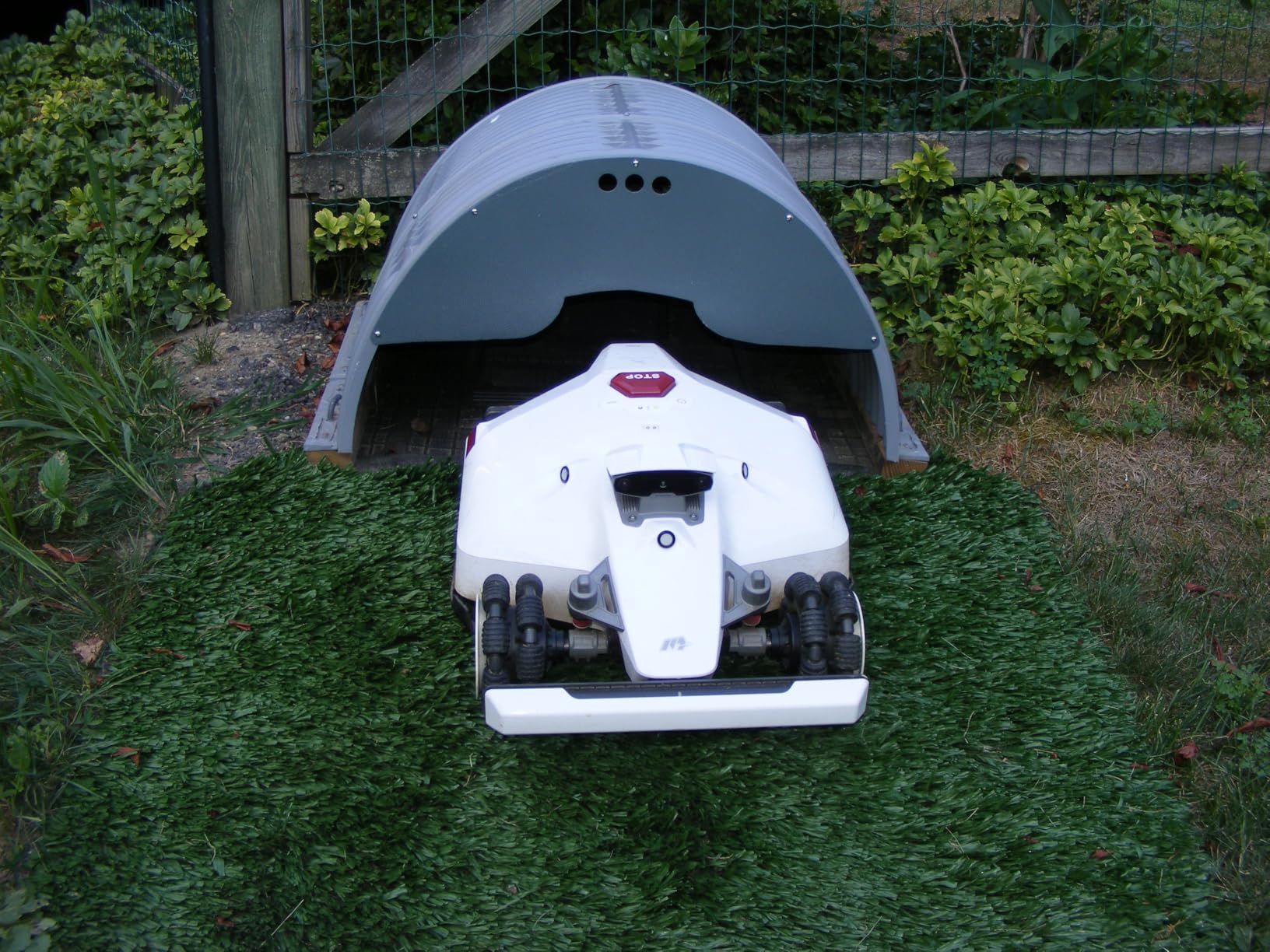
What you give up for that is speed. Owners repeatedly describe the mowing pace as slow, with a quarter acre potentially taking half a day, and the 2.2 to 4.0 inch cutting height range with app-controlled adjustment is genuinely useful for tall warm-season grass. Razor blades are inexpensive, which matters because they do dull on sticks at low settings.
At 23 by 18 by 12.6 inches it is a small machine, and DropMow mode lets you run it without building a map at all, which is genuinely useful on a yard where tree roots make boundary walks frustrating.
The 0.37 acre mapping limit is a hard software ceiling that cannot be raised, and mapping needs repeated boundary runs because GPS accuracy does not allow easy in-app correction. Charge times of two to three hours from a low state are the other recurring complaint, along with monthly manual re-edging of the perimeter.
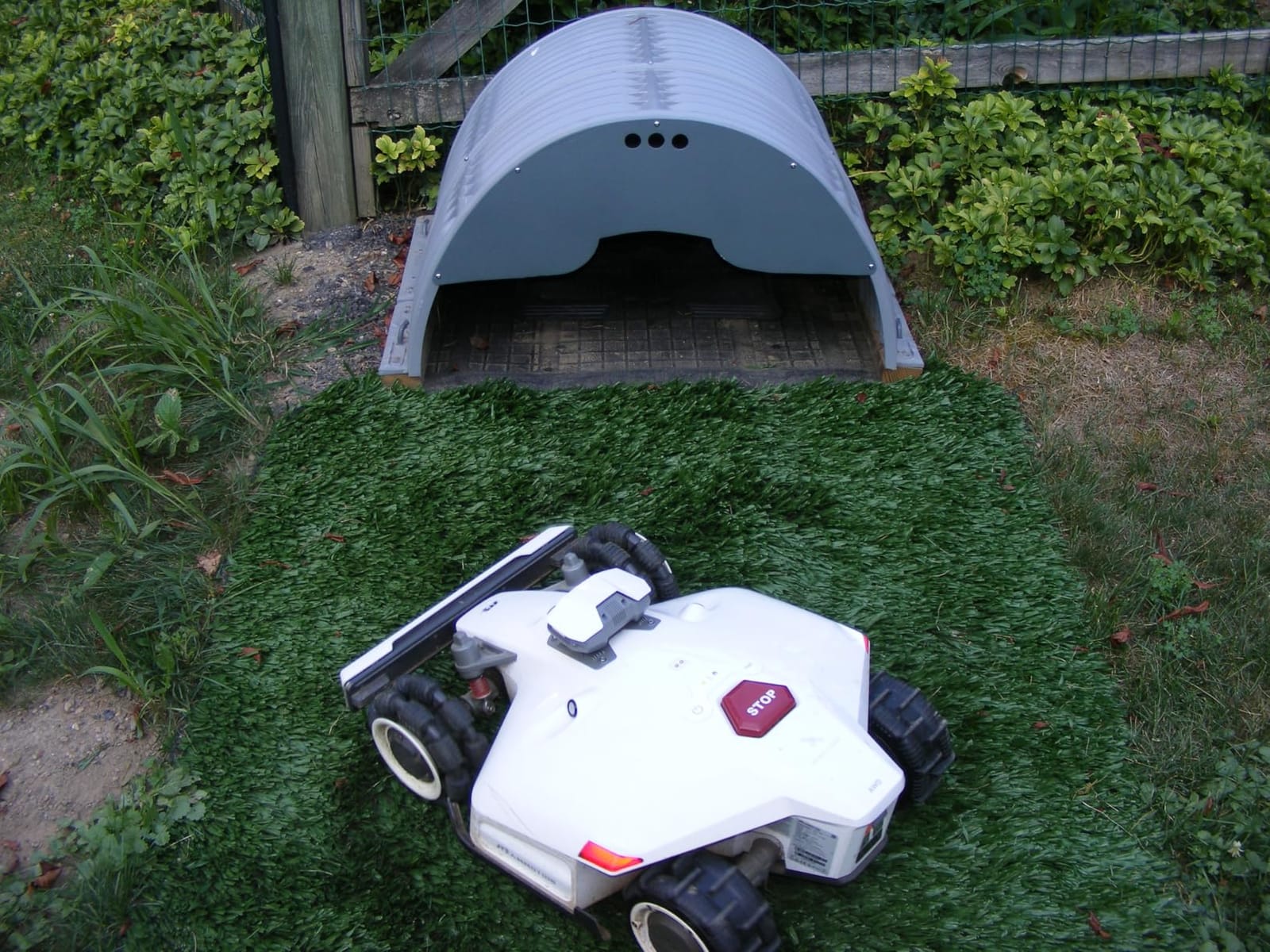
Why the 0.37 acre cap decides it
This number is where forum buyers get caught out, so measure your actual property before ordering. The cap applies to mapped area, so a 0.3 acre lot with a steep front bank fits comfortably, while a 0.5 acre property with a hill does not fit this machine at all.
Nobody seems to enjoy that limit, because it is imposed in software rather than by the hardware. If your mapped area comes in above a third of an acre, step up to the LUBA 3 AWD 3000 rather than planning workarounds.
Who it suits and who it does not
This is the one to pick if you have a genuinely difficult yard under about a third of an acre, and you are comfortable letting it work slowly through a long session. Owners on wooded lots often pair it with LiDAR precisely because satellite-only systems struggle under canopy.
Skip it if you want results overnight, if you need a large acreage, or if the app-only workflow will frustrate you. The 20-zone system plus DropMow mode is capable, but it rewards patience during setup.
4. Mammotion LUBA 3 AWD 3000 – Best for Larger Steep Properties
Mammotion LUBA 3 AWD 3000 Robot Lawn Mower with Cleaning Stand (Ship Separately), 360° LiDAR+NetRTK+AI Vision, AWD for 80% Slopes, 5400 sq.ft/h, Cutting Height 1.0″-2.7″
80% (38.6 deg) max slope
Four independent motors
Tri-fusion LiDAR and NetRTK
Pros
- Four-wheel drive handles rough sloped ground without stalling
- LiDAR held position reliably for one long-term owner
- Extremely quiet and cheap to run electrically
- Up to 30 zones with no-go areas and night mowing
- Handles thick coarse turf that buries other robots
Cons
- Online manual is thin and learning happens through community videos
- App mapping controls are hard to read in bright daylight
- May not finish a quarter acre on one charge at non-default settings
- No blade lift so long grass is pushed over rather than cut
When the slope is severe and the property is bigger than a third of an acre, the LUBA 3 AWD 3000 is the machine to beat. Four independent motors deliver an 80% slope rating, and it covers 500 square metres per hour with up to 175 minutes of runtime per charge, which changes the maths on a larger hillside.
Tri-fusion navigation combines 360 degree LiDAR with a 59 degree vertical field of view out to 230 feet, NetRTK positioning and dual-camera AI vision. One long-term owner reports the LiDAR held position reliably and never lost location, which is the outcome you need when a machine is working alone on a slope.
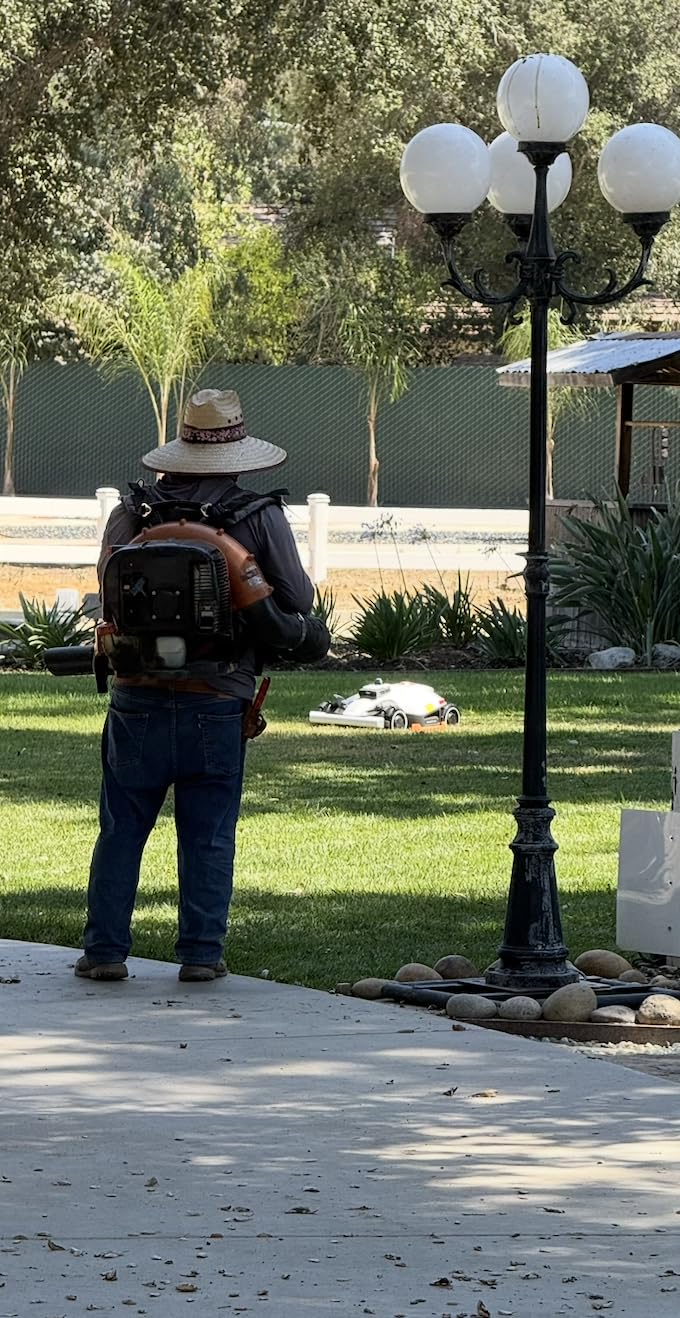
Owners also praise how quietly it runs and how inexpensive it is to operate, plus the software updates that visibly improve performance over time. It handles thick St Augustine turf that buries competing robots, and it supports up to 30 mowing zones with perimeter-only, zigzag, checkerboard and adaptive zigzag patterns.
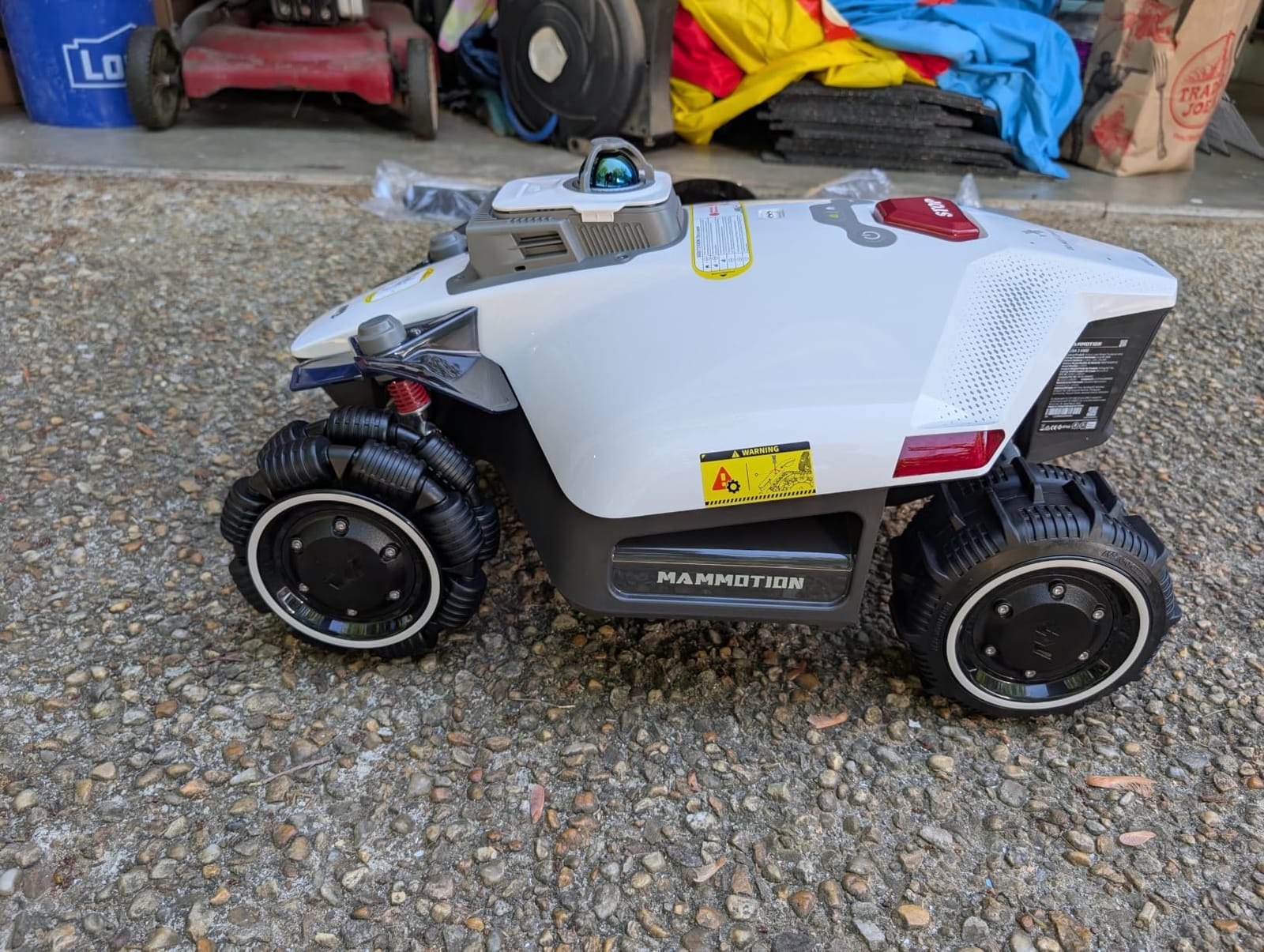
The physical body measures 27.2 by 21 by 11 inches, so it needs a reasonably wide access route to reach your lawn, and a two-year support arrangement sits behind the warranty on most units.
The complaints are about software and cut quality rather than traction, which is telling. The online manual is thin, the app mapping screens are difficult to read in bright daylight, and there is no blade lift action, so long grass gets pushed over rather than cut evenly. Wide wheels also lay grass over in thin areas, and the battery pack is not user replaceable.
Check the accessories carefully at purchase
This listing bundles a charging station and a cleaning stand, but the stand arrives as a separate item, and there is an extra blade set in the box. The cleaning stand is genuinely useful on a hilly property, because it lets you wash clippings off the underside without wrestling the machine on a slope.
Confirm which items arrive with your order before you plan a setup day around them. Buyers who assumed the stand was in the box are the ones who end up unboxing a very large machine on a driveway with no way to rinse it.
Where it falls short
At non-default settings it may not complete a quarter acre on a single charge, so a large yard means multiple sessions. Cutting height runs 1.0 to 2.7 inch, which is a narrower band than some rivals, and the lack of a blade lift shows up in uneven cut on long grass.
Bluetooth pairing between the app and the mower can also be unstable, which is annoying but not deal-breaking. For steep ground on a bigger property, though, this remains the strongest combination of climbing ability and throughput we found.
5. Segway Navimow i215 LiDAR – Best Satellite-Free Navigation for Wooded Hills
Segway Navimow i215 LiDAR Robot Lawn Mower, Wire Free Robotic Lawn Mower for 0.37 Acre, LiDAR & Vision Dual Fusion, Auto Mapping, Off-Road Wheels for 45% Slopes, Quiet 59 dB(A) Mowing
45% max slope with off-road wheels
LiDAR plus vision, no antenna
0.37 acre coverage
Pros
- Satellite-free navigation removes wires and antenna mounting
- Off-road wheels and stability control built for 45% slopes
- Quiet at 59 dB(A) for early starts
- Ride-on edge mode cuts cleanly along fences and paths
- Geo-fence
- lift detection and Find My alerts
Cons
- Newer model with a much smaller review base than the Navimow lineup
- Only four cutting height positions in the published spec
- Vision detection listed at 0.4 inch accuracy so small objects may be missed
The i215 LiDAR solves a problem that matters enormously on hilly properties with trees: it navigates without any satellite signal, no boundary wire and no antenna to mount. Solid-state LiDAR is paired with onboard vision sensors, and it works day or night with 3D awareness. If your yard is under heavy canopy, that is a bigger advantage than extra climbing torque.
The drive side is properly specced for slopes: off-road wheels plus Electronic Stability Control for grades up to 45%. AI VisionFence and GeoSketch detect more than 200 obstacle types at 0.4 inch accuracy, and Drop and Mow gives you one-tap auto mapping without driving the perimeter.
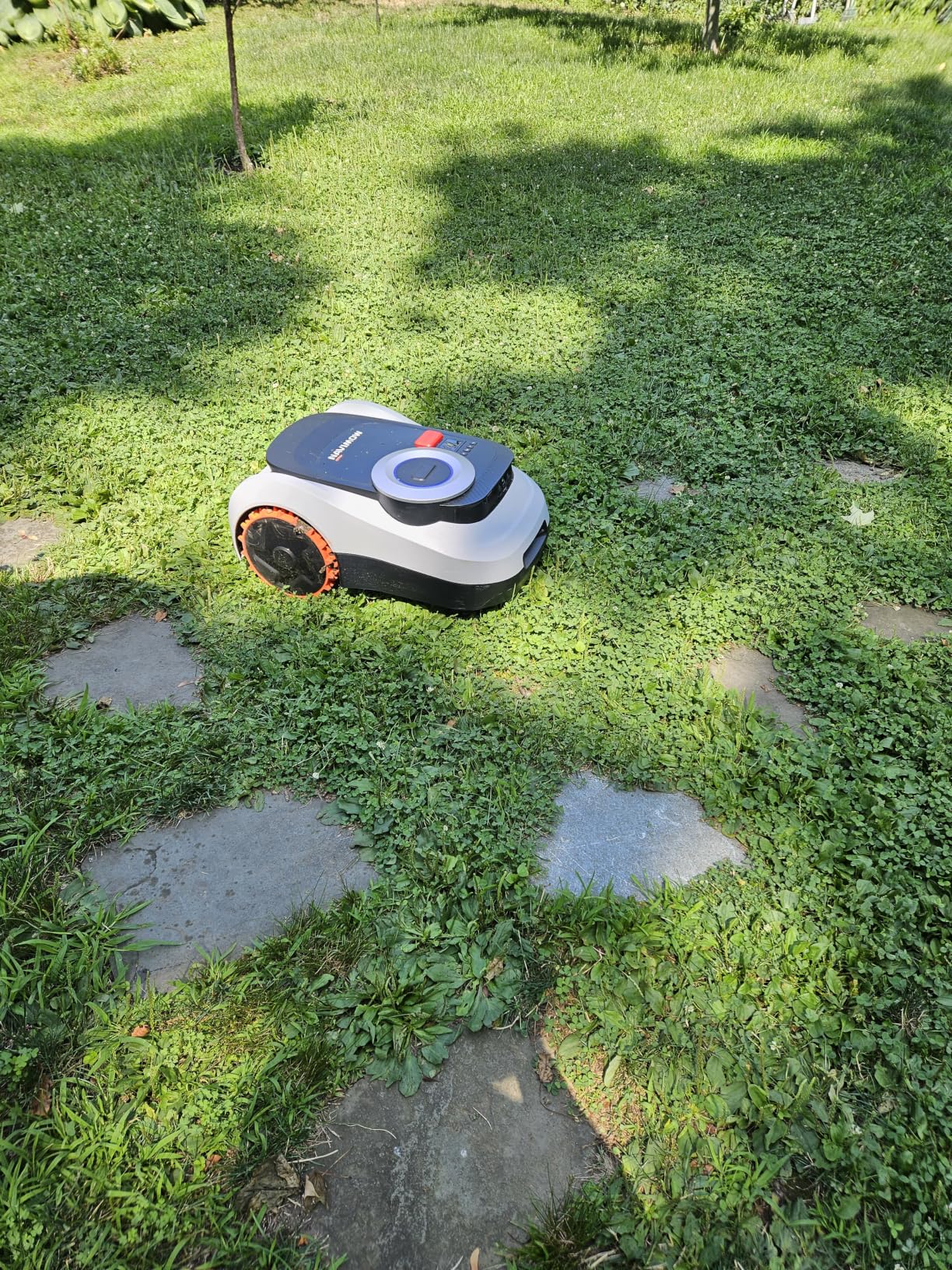
Review volume is the caveat. Forty-six ratings is a thin base compared with the 263 or 391 behind the picks above, so the strong 4.4 score is encouraging rather than conclusive. Buyers who rate it highly single out the satellite-free navigation and the fact that off-road wheels are standard rather than an add-on.
It also runs quietly at 59 dB(A), supports up to 20 editable zones in an interactive in-app map, and includes security features that matter on an unattended machine: GPS, geo-fence, lift detection and Apple Find My alerts. Alexa and Google Home voice control are supported too.
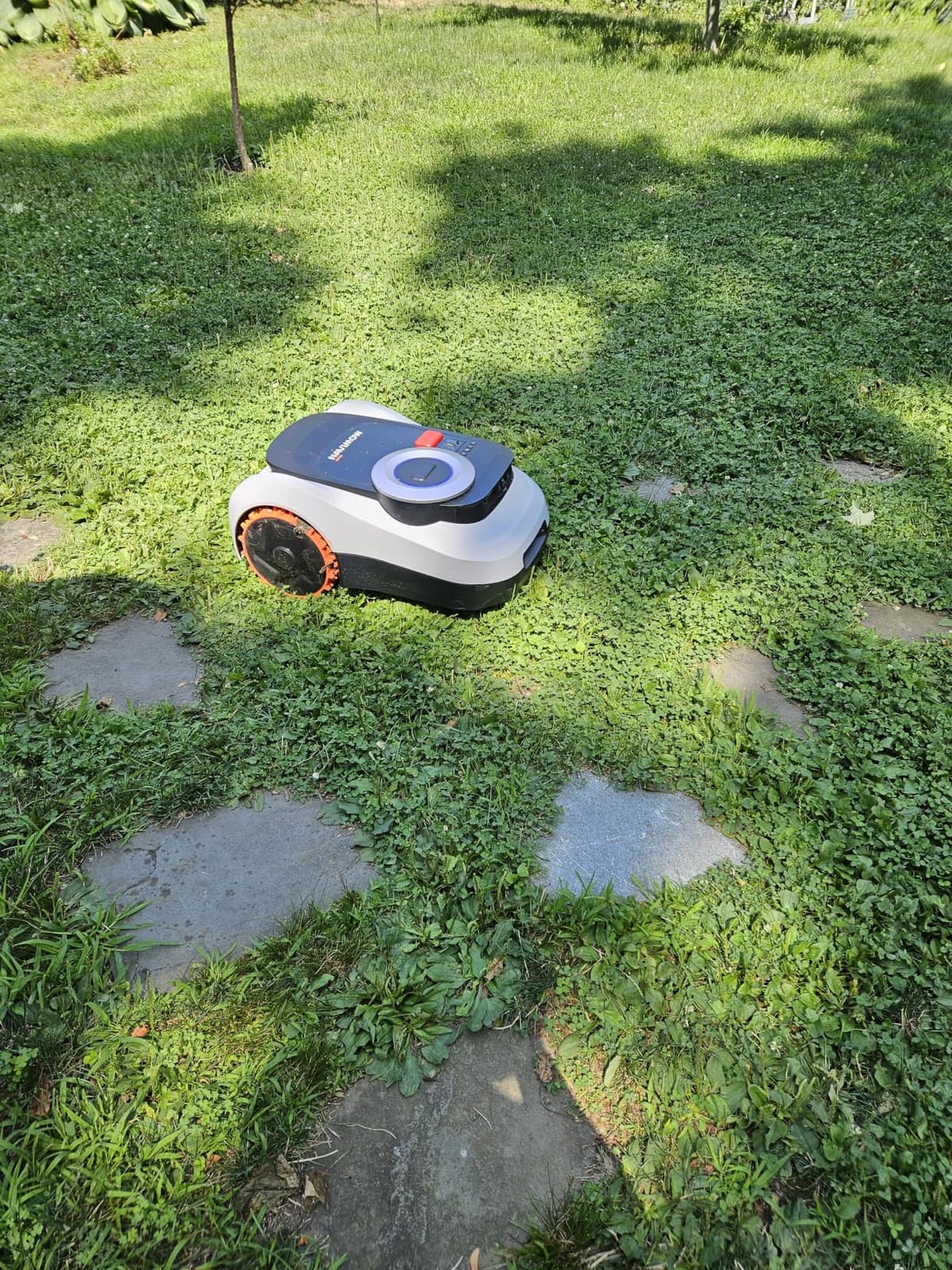
Why satellite-free matters more on hills
RTK positioning is excellent until a tree canopy, a tall fence or a building interrupts the signal, and on a hillside that interruption is guaranteed to happen somewhere. Owners with wooded lots consistently steer toward LiDAR and vision models rather than satellite-only units for exactly this reason.
The trade-off is that you give up the centimetre-level accuracy of a dedicated RTK link, and the published vision accuracy of 0.4 inch means small ground-level objects can still be missed. Plan to clear hoses and toys anyway.
Is the 45% rating enough for you?
45% is about 24 degrees, which handles most real residential slopes but not the dramatic grades the LUBA machines are built for. It is a sensible ceiling for a yard that is wooded and moderately hilly rather than steep and open.
Note also that only four cutting height positions appear in the published specification, which is fewer adjustment steps than most rivals. If you change cut height frequently through the season, that will annoy you.
6. YARBO Robot Lawn Mower Pro – Best for Large Multi-Acre Hilly Properties
YARBO Robot Lawn Mower Pro, Wire-Free for 6 Acres, Four Seasons Yard Care
70% (35 deg) max gradient
Multi-terrain track drive
Up to 6 acres
Pros
- Handles rough
- uneven
- hilly and muddy ground on multi-acre sites
- 20 inch cut with 300W dual motors handles thick wet and overgrown grass
- Cut quality and striping comparable to a zero-turn riding mower
- Attachment hitch accepts carts and seasonal accessories
- Support has repeatedly replaced failed units and modules
Cons
- Not a set-and-forget device
- map drift and signal loss need manual work
- Very heavy at roughly 215 lbs and arrives in four boxes
- Cobalt-based battery is not user-swappable
- Data center mount is unstable in high winds
For properties measured in acres rather than fractions, the YARBO Pro is the only machine here rated for up to six acres, and its patented multi-terrain tracks with all-steel skid shoes are built for uneven, muddy and stony ground. The 70% gradient rating puts it second in this group behind the 80% machines.
The 20 inch cutting width and 300W dual-motor disc handle thick, wet and overgrown grass, and owners describe cut quality and striping as comparable to a zero-turn riding mower. Razor and straight blade options are both included so you can match the blade to cool-season or warm-season grass.
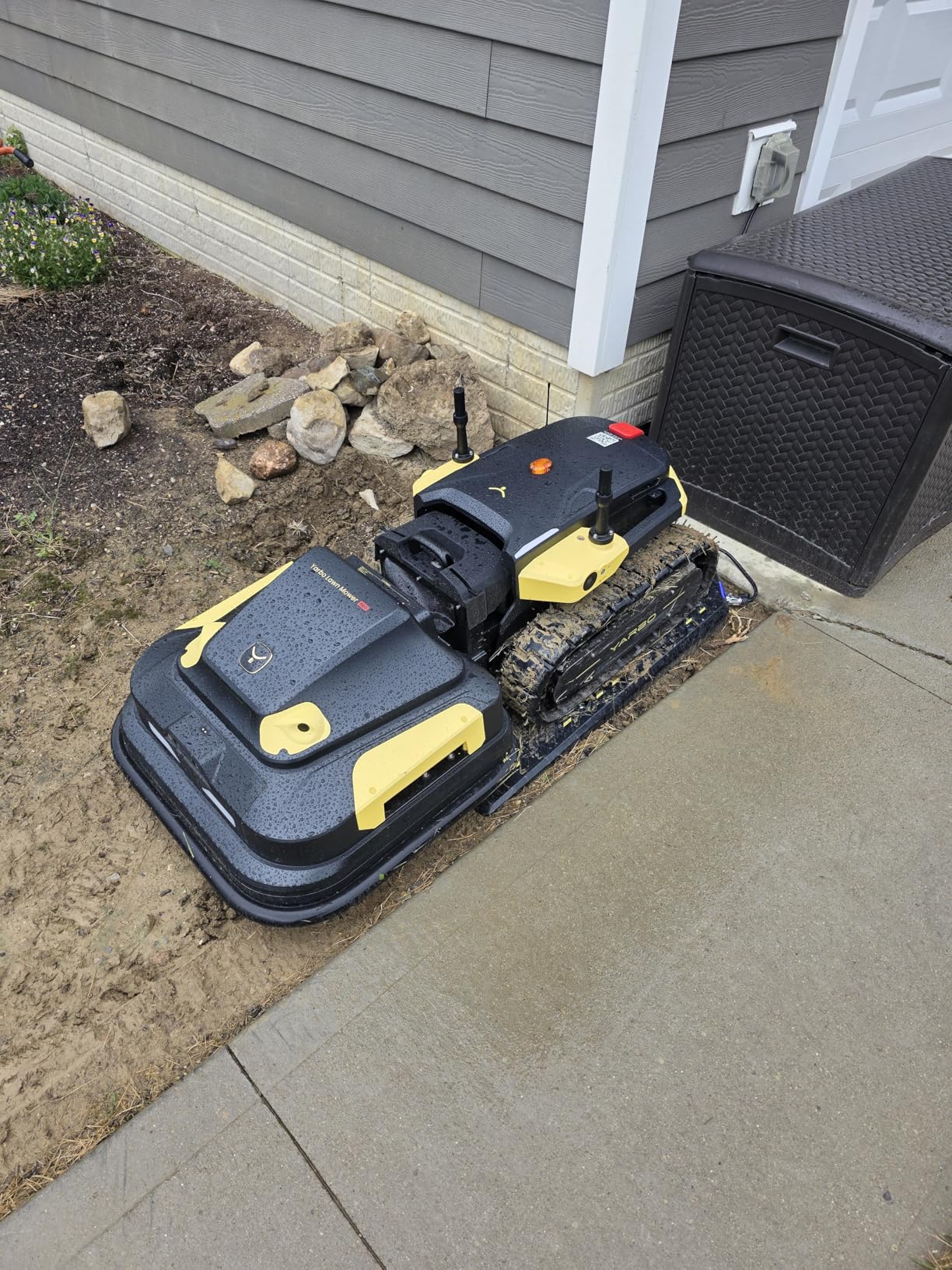
Triple-fusion navigation combines RTK-GPS, binocular vision and a multi-sensor PPVS array, and the app carries live camera feeds so you can watch or intervene from anywhere. There is also a hitch for carts and seasonal attachments, which is unusual and genuinely useful on a large estate.
Nobody describes this as set-and-forget. Owners report map drift and GPS signal loss requiring manual reconfiguration, weak ground clearance in rough spots, and a multi-day learning curve for the initial mapping. At roughly 215 pounds it arrives in four separate boxes, and installation needs a 120 degree unobstructed sky view for the Data Center Set.
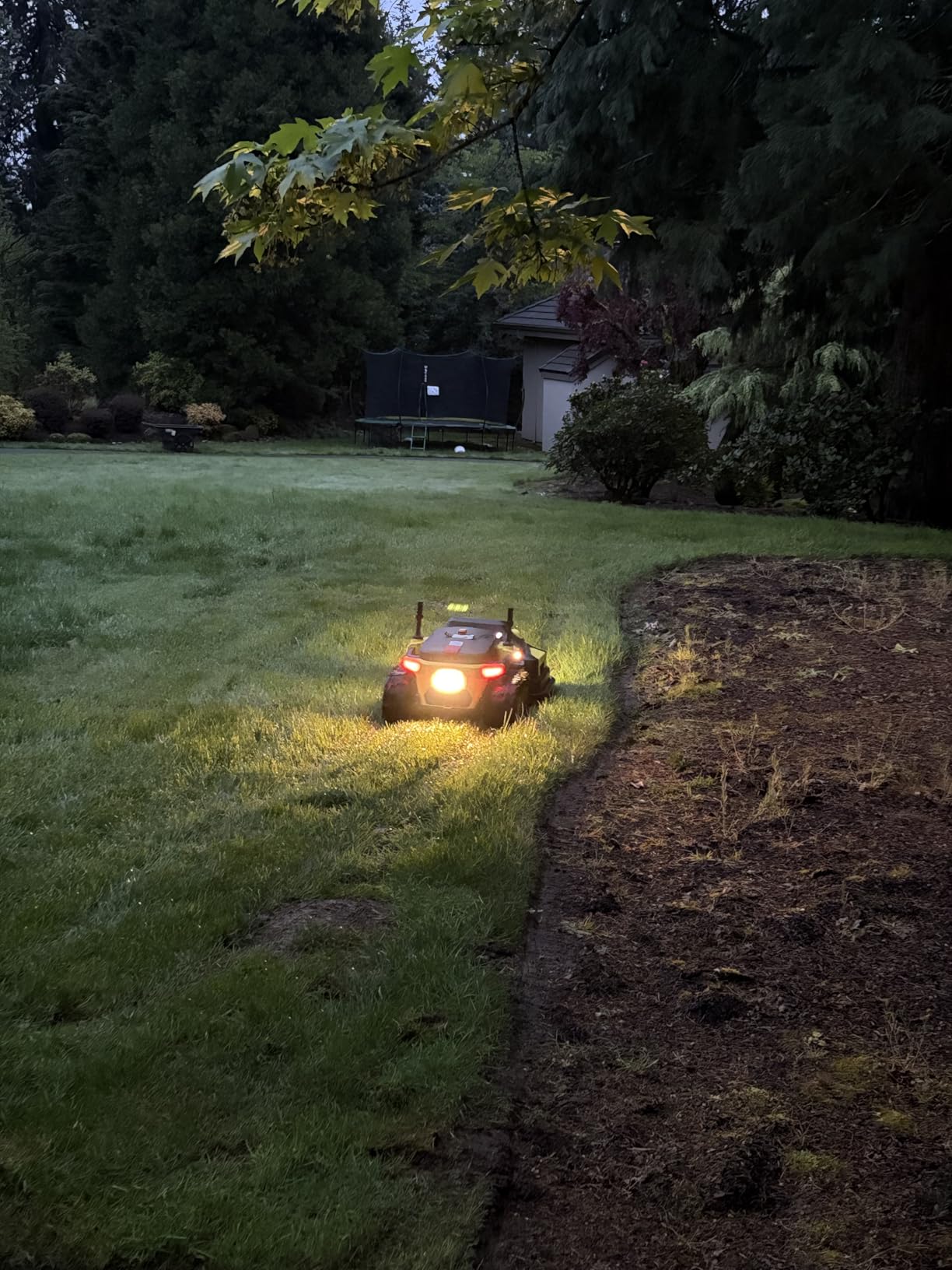
What six-acre rating really means
That figure is total property coverage, not per-charge. The average battery life is about 120 minutes, so a large property means many sessions per week, and on a hilly estate the slope duty cycle stretches that further. The 20 inch width is what makes the schedule workable.
Professional landscaping forums confirm the demand exists at this scale, with owners running very hilly multi-acre properties weighing robot mowers as crew alternatives. This is the machine most likely to make that decision practical.
The battery and support question
The battery uses a cobalt-based chemistry with a limited cycle life and is not user-swappable, which is the single biggest long-term concern on a machine this heavy. A failed pack becomes a service visit, not a DIY swap.
Support has repeatedly replaced defective units and modules under warranty, though one owner reports being unable to reach service or obtain a free return for a repair. The data center mount also needs modification to stay stable in high wind.
7. Segway Navimow i206 AWD – Best for 45% Slopes on a Small Yard
Segway Navimow i206 AWD Robot Lawn Mower, New i105N, 0.15 Acre, 45% Slopes
45% max slope
All-wheel drive with stability control
Zero-turn steering
Pros
- All-wheel drive works on terrain that stopped two previous robot mowers
- Automatically adjusts angle for an even cut across sloped areas
- Very quiet
- dogs watch it calmly
- Good obstacle avoidance around a large yard tree
- Alternating patterns produce clean striping
Cons
- Mapping is confusing and maps sometimes fail to save
- One owner reported the mower wandering outside the mapped area into mulch beds
- Leaves an unmowed strip between the mower and fences
- Software locks on area codes that require support
- Stalls on isolated tall grass clumps
The i206 AWD is the direct answer for anyone who wanted the Navimow i105N’s software and found its wheels wanting on a slope. All-wheel drive with automotive-grade stability control handles 45% grades, and users who upgraded from the two-wheel-drive model report it finally coping with their terrain after two previous robots gave up.
Zero-turn steering is a nice touch, since the machine pivots without scraping across turf on tight corners, and adaptive torque delivery adds power on inclines and thick grass while conserving energy on easier passes. It is rated at about 1,350 square feet per charge from a 2.5Ah battery.
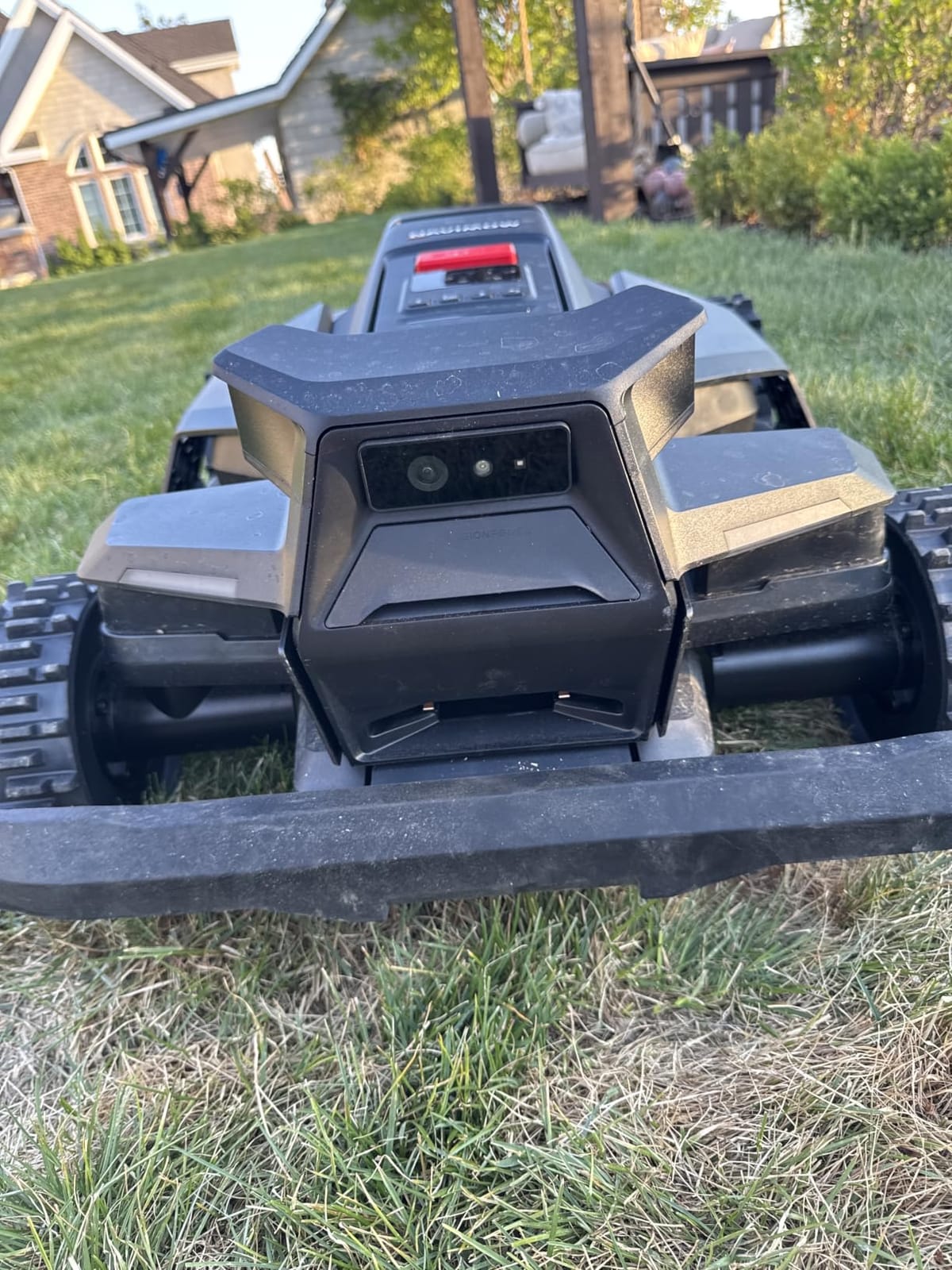
It is also genuinely quiet, with owners noting their dogs watch it calmly instead of reacting the way they do to a gas mower. Obstacle avoidance routes well around large trees, and alternating mowing patterns produce visibly clean striping. Cutting height adjusts from 2 to 3.6 inch with a 7.1 inch deck.
The dominant complaint is mapping software. Maps sometimes fail to save and force a complete re-mapping session, and one owner reported the mower wandering well outside the mapped area into mulch beds. It also leaves an unmowed swath between the body and fences, and it will stall on isolated tall grass clumps until it has made several passes.
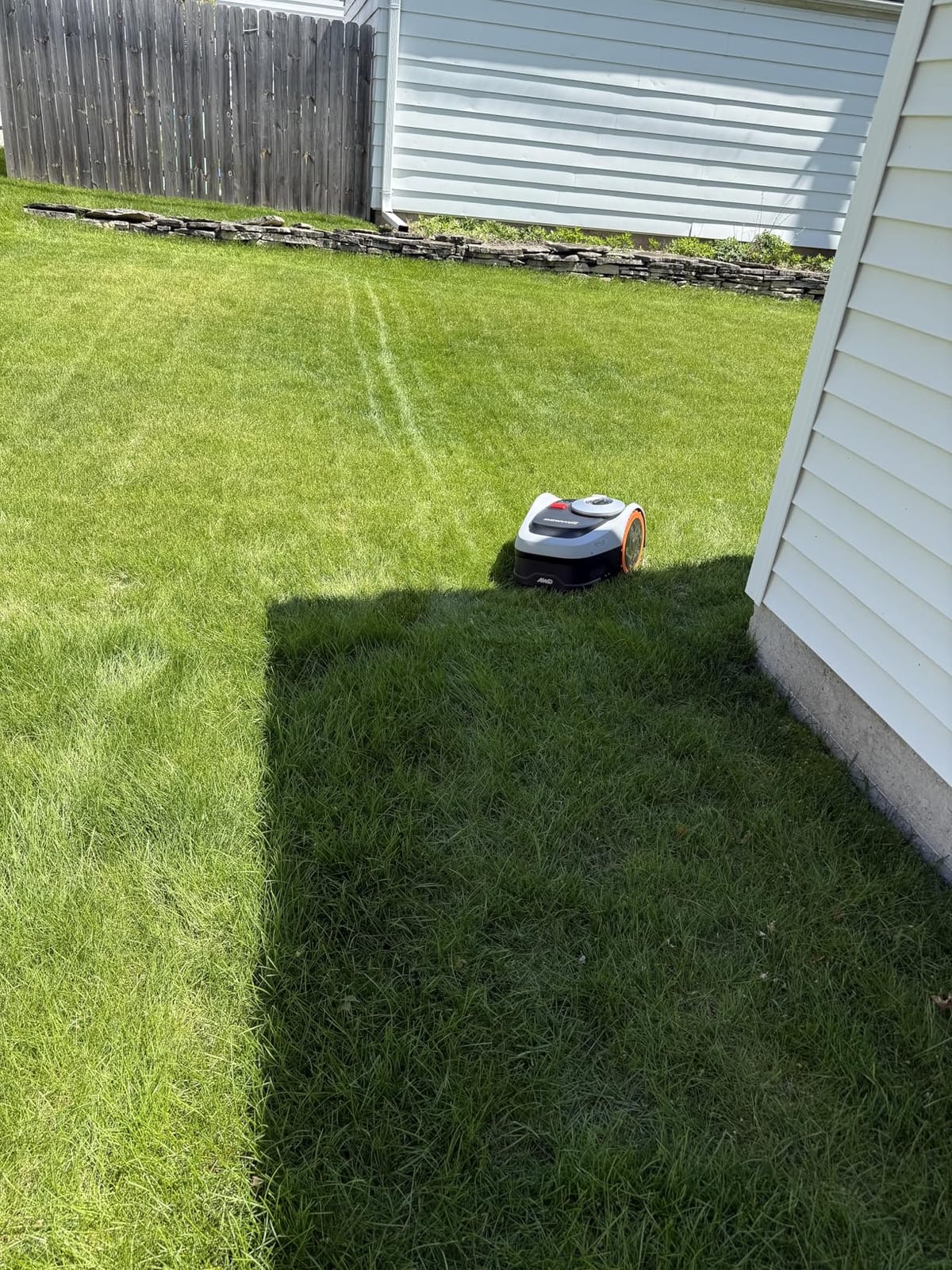
A modest yard with a real incline
This is a 0.15 acre machine, so it suits a small property where the slope is the challenge rather than the size. If your lawn is under about 1,500 square feet and includes a 45% grade, this is a well-matched combination of deck size and drive system.
It also handles up to 20 distinct mowing zones with optimized routes and auto-resume charging, plus real-time GPS lift and off-course alerts, which matters when the machine spends its day out of sight on a bank.
When to choose something else
If your property is a quarter acre or larger, move up a size instead, because the per-charge area is small and the deck is narrow. The 17 inch published cutting width figure is a listing inconsistency worth ignoring, since the technical specification describes a 7.1 inch deck.
Also weigh the mapping reliability carefully. If you will not check the app regularly to confirm the map saved, the LUBA models in this guide handle that more gracefully.
8. Roborock RockNeo Q110H – Best for Straight Lines and Quiet Night Mowing
Roborock RockNeo Q110H Robot Lawn Mower, Wire-Free Robotic Lawn Mower with Full-Band RTK + VSLAM Navigation, Auto Mapping, AI Vision Obstacle Avoidance, App Control, 45% Slope, Covers Up to 1/4 Acre
45% max slope
Full-Band RTK plus VSLAM
Floating cutting deck
Pros
- Full-Band RTK and VSLAM deliver very straight consistent cut lines
- Handled a roughly 30% sloped yard with six trees without stalling
- Whisper quiet with headlights for full darkness mowing
- App interface Roborock vacuum owners will find familiar
- Obstacle handling works for people
- pets and toys
Cons
- Auto-mapping often falls back to tedious manual perimeter mapping
- Edge handling poor without the separately sold edging module
- Traction wheels too weak for St Augustine grass
- False lifted alerts on bumps and potholes
- App cannot split zones or edit maps
The RockNeo Q110H is the pick if straight cut lines and near-silence outrank raw climbing ability. Full-Band RTK combined with VSLAM keeps positioning stable under tree canopies, near tall fences and in shaded corners, and one owner reports it handled a roughly 30% sloped backyard with six trees without getting stuck.
The floating cutting deck adapts to ground contours, which is the feature that prevents scalping on uneven ground, and height adjustment runs 1.6 to 3.1 inch. It navigates passages as narrow as 2.3 feet, navigates 1.57 inch obstacles and includes a PIN lockout with a high-decibel alarm for an unattended machine.
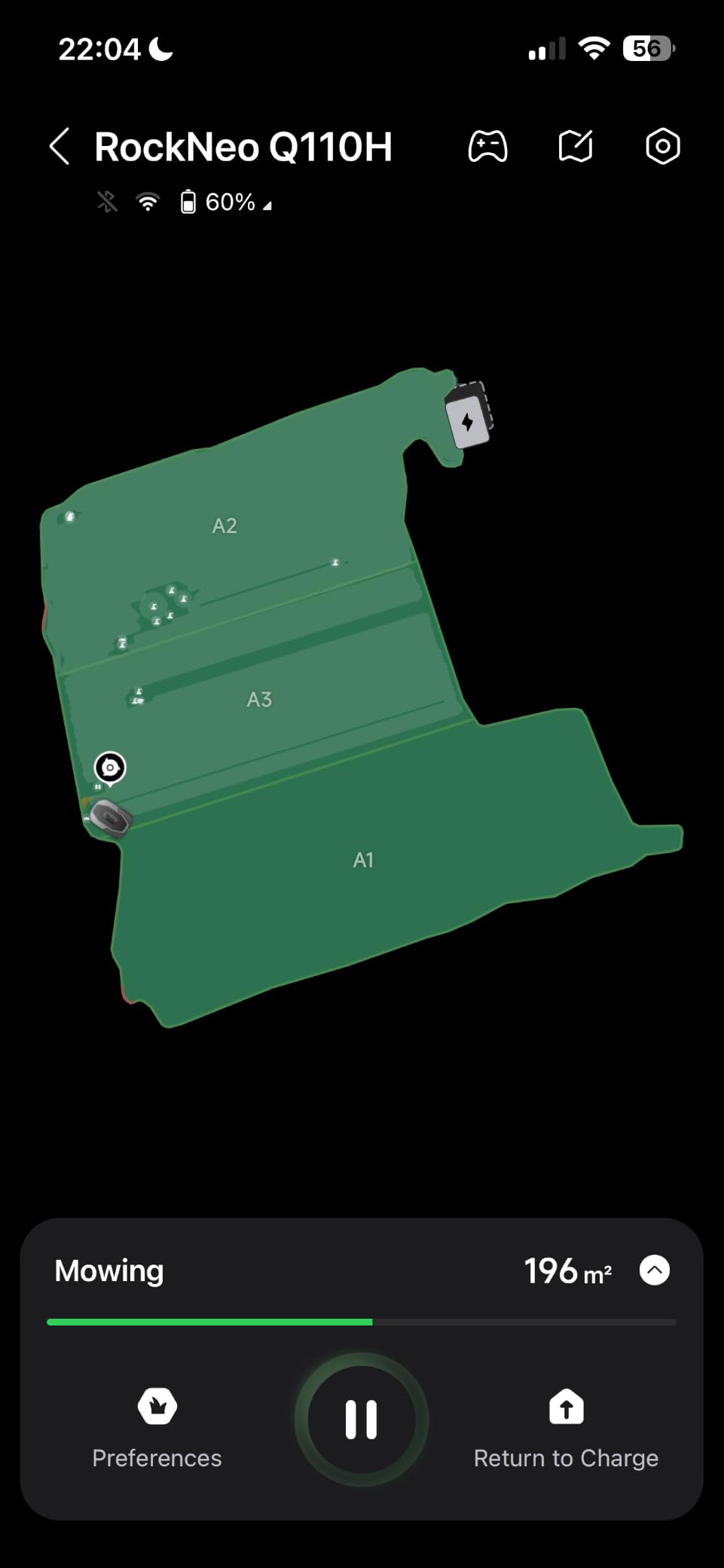
The 3.8 rating is the lowest average in this roundup, and the reasons are consistent enough to name. The edge handling is poor without the separately sold edging module, leaving 1 to 1.5 feet unmowed along fences, trees and obstacles, and the traction wheels are too weak for St Augustine grass so it slips out of position.
Auto-mapping frequently falls back to tedious manual perimeter mapping, the app will not split the yard into editable zones, and bumps and potholes trigger a false unit-has-been-lifted alert that stops the blades mid-cut. Overly conservative boundaries also stop it passing through open gates.
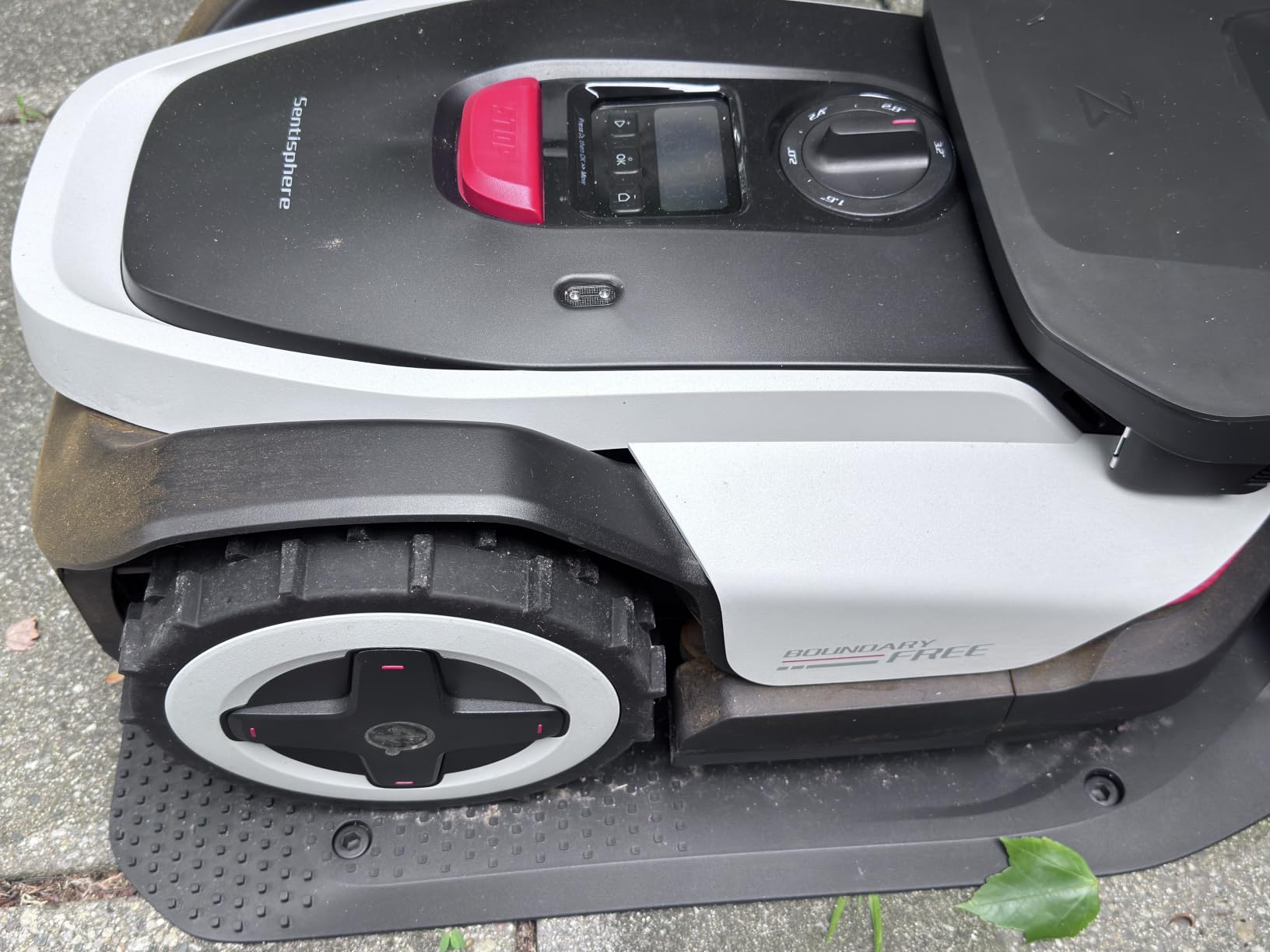
Where it is genuinely the best choice
Full-Band RTK paired with VSLAM is a serious navigation stack, and the results show up in the cut lines: owners describe them as very straight and consistent. That matters if the visual finish of your lawn is the point of the purchase.
The headlights are the other quiet winner. It mows reliably in full darkness, which on a hillside near a neighbour is often the only realistic mowing window. Average battery life of 130 minutes is respectable for an 8.7 inch deck.
When the software holds you back
If you want room-style zones, map editing or partial zone mowing, this app will not give them to you. Buyers migrating from a vacuum platform should still expect less maturity than Roborock offers in its main product line.
And if your grass is coarse St Augustine rather than typical lawn turf, the traction complaint will show up on the first slope. Check the edging module cost before ordering, because without it the perimeter stays untidy.
9. Sunseeker X5 AWD – Best for 60% Slopes in a Half-Acre Yard
Sunseeker X5 AWD Robot Lawn Mower, RTK, Vision AI, 0.5 Acre, Wire-Free
60% (30 degree) max slope
All-terrain AWD suspension
RTK plus VSLAM and Vision AI
Pros
- AWD chassis noticeably better on hills than the 2WD model that got stuck
- Handles hilly backyards with many flower beds and obstacles
- Super quiet with beautifully straight striping
- Navigates shaded and tree-covered areas without losing position
- Rain sensing delays mowing automatically
Cons
- Programming described as terrible by at least one reviewer
- Stuck on the grass-to-sidewalk transition and dips into planters
- Boundaries must sit far from edges leaving an 18 inch strip
- Avoids tall grass rather than cutting through it
- May need WiFi extenders to reach yard corners
The Sunseeker X5 AWD is the only machine here rated to 60% slope, roughly 30 degrees, and that figure comes with a 0.5 acre capacity in a package. All-terrain all-wheel drive with rugged tires and independent front suspension is the mechanical answer to the two-wheel-drive version of the same mower that owners report getting stuck.
Navigation pairs RTK with VSLAM and Vision AI so coverage holds under trees, in shade or in weak-signal areas, day or night. The 8.7 inch floating cut adjusts from 1.6 to 3.2 inch and follows ground contours, which is the right deck design for uneven hillsides. It handles passages as narrow as 31.5 inches.
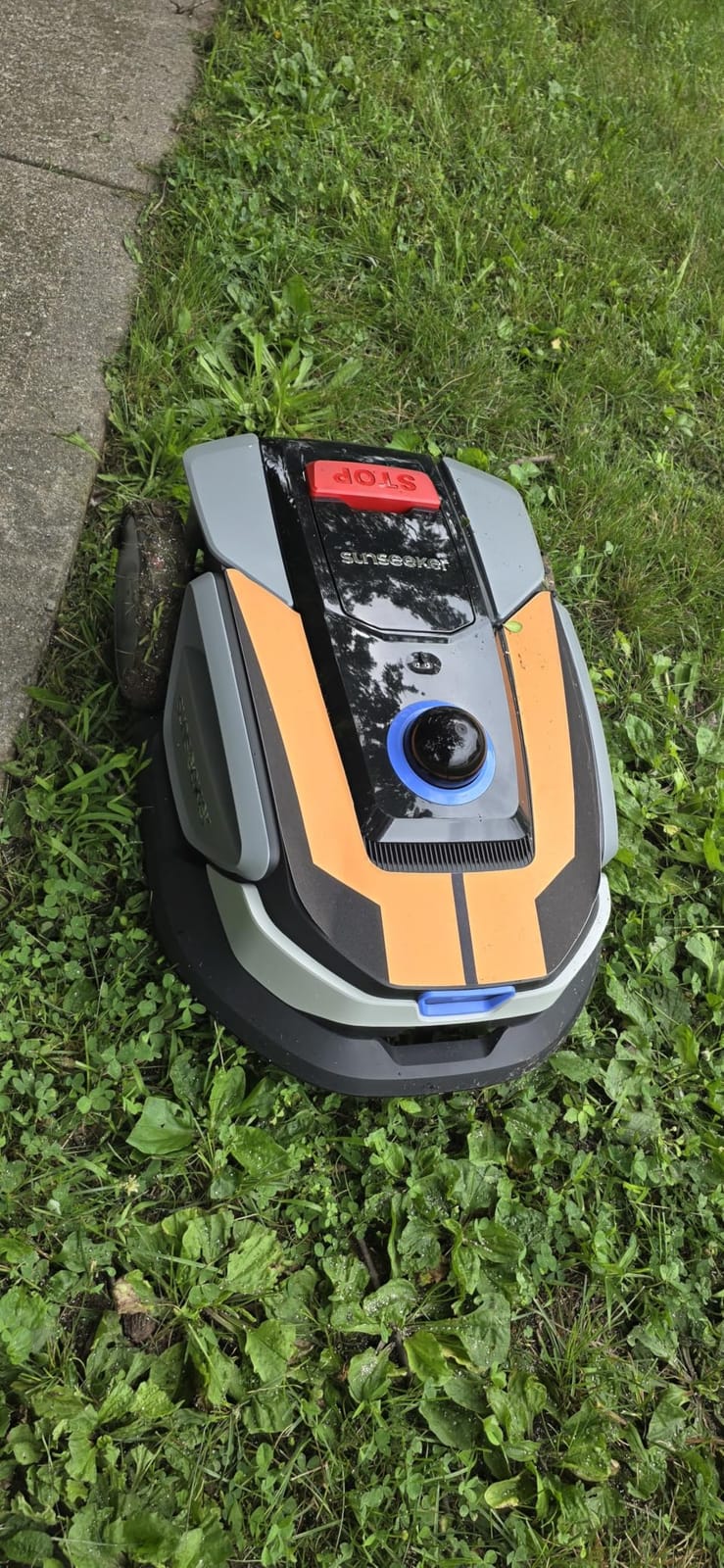
Owners consistently praise the striping and the quiet 60 dB operation, and the two-year warranty with US-based support is a genuine plus in a category where brand-direct sellers often leave buyers without a local contact. Five saved maps, smart zones and no-go areas are all handled in-app.
The weakness is boundary placement. Owners have to set boundaries well back from edges, which leaves an 18 inch strip that needs weed-eating, and the mower gets caught on grass-to-sidewalk transitions and dips into planters several times a week in some yards. It also avoids grass that has grown too tall rather than cutting through it, so scheduling has to stay frequent.
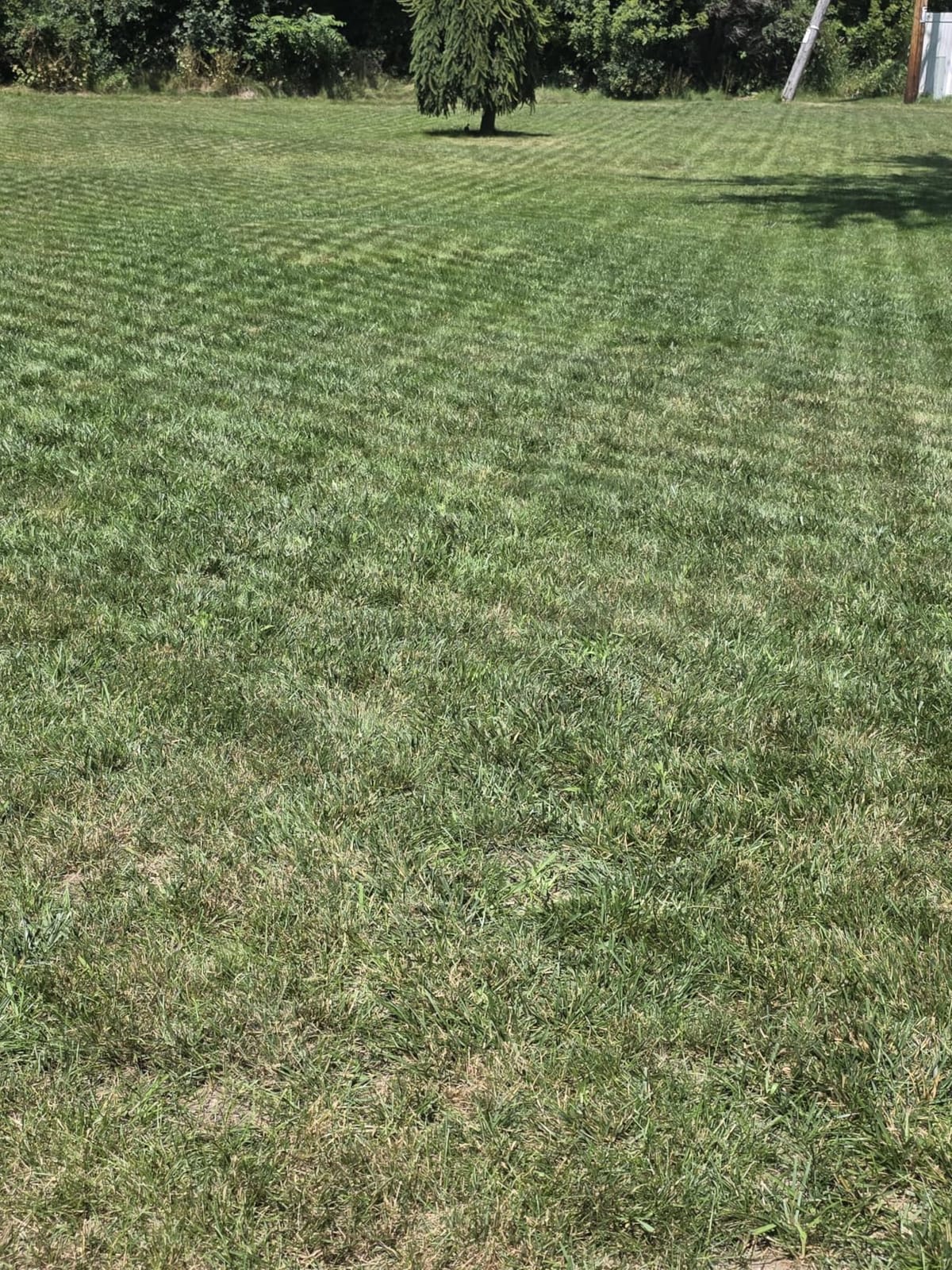
What 60% looks like in your yard
Sixty percent grade is a serious incline, steeper than most front banks but short of the 80% figures the top machines claim. If you can walk it without slowing noticeably, you are probably in this range or below.
The half-acre capacity is where this machine separates itself from the steeper LUBA models, since the 0.5 acre figure covers up to 21,780 square feet with floating-deck cut quality on rough ground.
Who should pass on it
Pass if your lawn has a lot of hard edges, because the wide boundary offset turns a tidy perimeter into a monthly weed-eating chore. Owners also report needing WiFi extenders to reach far corners of the yard.
With 29 ratings the review base is small, so treat the 4.4 score as encouraging rather than settled. The US-based support arrangement is the quiet reason to consider it over a cheaper direct-import alternative.
10. DREAME A3 AWD 2000 – Promising 80% Climber with Thin Owner Evidence
(Upgraded) DREAME A3 AWD 2000 LiDAR Robot Lawn Mower, 45-Min Fast Charge
80% (38.7 deg) max slope
AWD hub motors
360 degree LiDAR plus vision
Pros
- All-wheel drive reported to perform well on slopes and uneven ground
- LiDAR navigation maps the lawn and avoids obstacles reliably
- Setup was easier than expected
- Built-in 4G module and HDR camera for monitoring and theft protection
- 45 minute recharge cuts down waiting on larger jobs
Cons
- Only one customer review on record so reliability evidence is minimal
- Optional trimmer module sold separately for closer edge cutting
The DREAME A3 AWD 2000 has the most impressive specification sheet in this group relative to what is proven about it. AWD hub motors are rated for 80% slopes and 2.17 inch obstacles, and a 45-minute recharge on the 5A adapter is 22% faster than the industry standard, which meaningfully reduces downtime on a hilly property.
Navigation is 360 degree LiDAR plus binocular AI vision with no boundary wire, and the OmniSense 3.0 system with EdgeMaster 2.0 holds edge precision within 1.97 inch. It recognises more than 300 obstacle types, covers 0.25 to 0.50 acre lawns, and the built-in 4G module and HDR camera handle real-time monitoring and theft protection. The warranty is three years plus a year of free 4G service, with a US customer service line.
And then the honesty part. There is exactly one customer review on record for this model, so almost nothing is known about how it performs after a full season on a slope. The single owner rates it 5 out of 5, highlighting easy setup, dependable LiDAR mapping and obstacle avoidance, and useful all-wheel drive on slopes, which is encouraging but not a reliability record.
The other known limitation is the edge gap at 1.97 inch, which the optional trimmer module reduces to under 1.18 inch. Budget for that accessory if tidiness at the fence line matters to you.
Why we still list it
Buyers in owner forums are explicitly wary of models with no independent review history, and that caution is correct. But the 80% rating, 2.17 inch obstacle clearance, 45-minute charge and three-year warranty form a package nothing else in this roundup matches on paper.
Fast charging matters more on a hill than anywhere else, because a long recharge on a steep lawn is dead time you will notice every week. A US customer service line also removes one of the support risks that come with brand-direct machines.
What to verify before you buy
Ask the seller about parts availability and service turnaround in your region, and confirm whether the three-year warranty applies to the drive motors and battery pack, not just the chassis. Those are the two failure points that would matter most on an 80% slope rating.
Consider it a first machine to grow into rather than a proven workhorse. If you want certainty over specification, the models above us have the owner history to back their claims.
How to Measure Your Own Yard’s Slope in 5 Minutes
Every recommendation on this page depends on one number, and you can get it without a surveyor’s level. Measure the rise and the run of the steepest part of your lawn, and everything else follows from that.
Step one: find the steepest spot. Walk the yard and look for the line where water would run downhill fastest, or the spot from which your mower seems to labour on the way up. Measure there, not on the flat middle of the lawn.
Step two: measure the run. Lay a tape or a long straight board along the ground on the slope, following the contour. Note the horizontal distance in feet. This is your run.
Step three: measure the rise. At the uphill end, measure the vertical height from the ground up to the level of the point where your run began. This is your rise in inches or feet.
Step four: calculate and convert. Percent grade is rise divided by run, multiplied by 100. Then convert the percentage to degrees with the reference below.
Worked example. If the ground rises 8 feet over a 10 foot run, that is 80% grade, and an 80% grade converts to roughly 38.6 degrees. That is a genuinely steep bank, and it is exactly the figure that justifies the 80% slope ratings on the top picks above.
Here are the grade-to-degree conversions you will need most often, with a note on what each one means on a real lawn:
10% grade is about 5.7 degrees. A gentle uneven roll. Any of the mowers in this guide will manage it, and most standard two-wheel-drive machines will too.
20% grade is about 11.3 degrees. Noticeable but walkable without slowing. The point where the Navimow i105N’s stock wheels start to struggle.
30% grade is about 16.7 degrees. A real front-yard bank. You want all-wheel drive here, and this is the band most 45% rated machines are built for.
45% grade is about 24.2 degrees. Steep enough that pushing a walk-behind up it is genuinely hard. All-wheel drive with stability control is the minimum.
60% grade is about 31 degrees. A serious incline. The point where we would question whether any autonomous machine is the right tool.
80% grade is about 38.6 degrees. Effectively a bank, not a lawn. Only the machines rated at 80% on this list claim it, and we would treat those figures as lab results.
Buying Guide: Matching the Mower to Your Hill
Slope rating is the deciding spec, but it is far from the only one. Drive system, navigation method and deck design all interact with it, and choosing badly on any one of them can leave you with a mower that climbs beautifully and then cannot find its way back down. Here is how the pieces fit together.
What to look for in a slope-capable robot mower
1. All-wheel drive or tracks. A driven wheel on each corner, or a tracked chassis, is what converts engine torque into forward motion on a gradient. Two-wheel-drive machines spin on slopes, and the rut they leave behind is the single most common complaint in owner reviews.
2. Slope rating above your measured grade. Aim for a rating at least 10 percentage points higher than your steepest measured grade. Wet grass, loose soil and uneven ground all erode the margin, and a lab figure on level ground is optimistic in practice.
3. Wire-free navigation. On a hilly yard, wire-free operation removes an entire category of failure. Keep reading for why.
4. Adaptive or independent suspension. Machines that articulate over roots and thresholds keep the cutting deck in contact with the ground, which prevents scalping. Rigid chassis machines cut bare patches on every mound.
5. A floating deck. Deck height should follow ground contours independently of the chassis, otherwise half your yard gets missed on every pass.
6. Per-charge coverage that fits your yard. This is the number most buyers get wrong, and I cover it in detail below.
Why wire-free matters on a hillside
Boundary wire is the traditional way to tell a robot mower where your lawn ends, and it is the component that fails most often on hilly and root-heavy properties. Rocky ground makes driving pegs difficult, tree roots lift wire over time, and a mower that repeatedly rides over its own boundary line will eventually snag it and drag a section out of the ground.
Repairing a buried wire means finding it, which on a slope means a long afternoon. That frustration is precisely why every machine recommended for steep ground in this guide navigates by RTK, LiDAR or vision instead.
Each has a different failure mode. RTK and NetRTK depend on satellite visibility, so they struggle under tree canopy. LiDAR and vision are satellite-free and work anywhere, but vision can miss small ground-level objects. The most robust setups combine both, which is why the tri-fusion machines rank well.
Owners with wooded lots consistently steer toward LiDAR and vision models rather than RTK-only units, and that is the single most common piece of advice in owner discussions about hilly properties.
Matching the machine to your grade band
Under 15% grade, almost any of these machines will work, and the Navimow i105N is the sensible value choice. Between 15% and 30%, you want all-wheel drive and off-road wheels, which puts the Navimow i206 AWD, the i215 LiDAR and the Roborock Q110H in range.
Between 30% and 45%, stay with the 45% rated machines and add a floating deck for uneven ground. The Sunseeker X5 AWD at 60% is the sensible stretch option if your measured grade is in the 30s, since it also covers half an acre.
Above 45%, you are into the LUBA and DREAME machines at 80% grades, and here the honest question is whether a robot is right at all. Beyond roughly 38 to 40 degrees, we would steer you toward a remote-control or tracked walk-behind brush cutter, because no autonomous machine we tested handled repeated work at that grade without intervention.
Per-charge coverage versus total acreage
This is the most repeated question in owner forums and the one most often answered badly. Total acreage is the whole property. Per-charge acreage is what the mower covers on one battery cycle before returning to dock.
Read the per-charge number and multiply it by expected sessions. A mower covering 0.25 acre per charge on a 0.5 acre yard runs two sessions on a normal day, and a hillside makes that worse because climbing and descending consume far more energy than flat mowing.
Some limits are hard software ceilings that cannot be raised, as with the 0.37 acre cap on the LUBA mini 2 and the fixed limit on the Navimow i105N. Measure your mapped area before ordering, not after.
Wet grass, traction and mowing windows
Wet grass is when traction problems appear. Can robot mowers get stuck on wet grass? Yes, and it is the most common failure mode on slopes, because wet blades mat together, weight climbs and the tyres lose bite on soft soil.
Three practical rules help. Keep to manufacturer mowing height limits in wet conditions rather than cutting the shortest setting. Mow less often rather than more often so the machine is never facing an overgrown slope. And check that your model has off-road or spiked wheel options before the wet season rather than after.
Note that the Sunseeker X5 will refuse to cut grass that has grown too tall rather than cutting through it, which is a safety feature but means wet-season scheduling matters even more on that machine.
Running costs nobody mentions at purchase
Beyond the machine itself, expect blade replacement every one to three seasons depending on stick and stone density, which matters more on rocky hills than anywhere else. Razor-style blades are inexpensive but dull quickly on debris.
Check whether 4G connectivity is included and for how long. The LUBA 2 AWD 3000HX has been reported as charging a 4G subscription after the first free year, while the DREAME A3 includes a year of 4G service with the warranty. A cleaning stand is worth adding on a slope, because rinsing clippings off a deck lying at an angle is otherwise a two-person job.
Winter storage should be on level ground, not on the hill itself, and sealed battery packs left in freezing conditions on an incline age faster. If you also need to manage a slope manually during setup, our push mower picks for small yards and electric mower guide cover the non-autonomous options.
Security on unattended machines
A robot mower on a hillside is a high-value item working alone outdoors, so treat security features as essential rather than optional. Look for PIN code lockout, a loud alarm, lift detection and geofencing with real-time off-course alerts, and confirm whether tracking is included or sold as an add-on module.
Apple Find My integration, as on the Navimow i215 LiDAR, is a useful addition on an iPhone. On a slope, an off-course alert matters more than anywhere else, because a mower that leaves the boundary at the top of a hill does not come back on its own.
When a robot mower is the wrong purchase
Be honest about these cases. A small flat lawn with one bump does not need an 80% slope machine, and you will pay for capability you will never use. Very rocky terrain with loose stones is where wheels jam and tracked machines earn their price, but grades beyond roughly 60% are outside what autonomous mowers reliably handle.
A yard with unfenced drop-offs or retaining-wall edges needs a machine with proven cliff and tilt sensing plus geofencing, and you should plan to supervise early sessions until you trust its boundary behaviour. If you will not check the app at all, a tracked remote-control mower or a professional cut is the safer answer.
For anyone weighing a riding machine instead on a large slope, our riding mower guide for big yards covers where those are safe and where they are not.
Frequently Asked Questions
What is the maximum slope a robot lawn mower can handle?
Standard two-wheel-drive robot mowers usually stop at 25-35% grade, roughly 14 to 19 degrees. All-wheel-drive and track-drive machines reach 45-70%, and only a handful claim 80%, which converts to about 38.6 degrees. Since lab figures are measured on clean prepared surfaces, add margin for wet grass and rough soil.
Do robot mowers work well on hills?
They do, provided the drive system and slope rating match your grade. All-wheel-drive and track-drive machines with 45% to 80% ratings climb slopes that stop two-wheel-drive units, and floating decks with adaptive suspension cut evenly across uneven ground. Under-spec machines stall at the bottom of a hill and rut the turf with spinning wheels.
Can robot lawn mowers handle slopes?
Yes. A quality all-wheel-drive robot mower handles grades up to its rated maximum, which for current models ranges from 45% to 80%. Beyond roughly 60% grade, a remote-control or tracked walk-behind mower is a more reliable choice than any autonomous machine.
What type of mower is best for mowing hilly terrain?
For grades under roughly 60%, an autonomous robot mower with all-wheel drive, a floating deck and wire-free navigation is the right tool. Between 30% and 45%, a 45% to 60% rated all-wheel-drive model handles most residential banks. Above 60%, use a remote-control or tracked walk-behind brush cutter instead.
Do I need to bury boundary wires on a sloped lawn?
Ideally no. Wire is the component most likely to fail on hilly, root-heavy soil, since roots lift it and pegging into rocky ground is difficult. Wire-free navigation using RTK, LiDAR or vision removes the installation and repair work entirely, though RTK models need clear sky view while LiDAR models do not.
Final Verdict: Which Robot Mower Handles Hills Best in 2026
If you want one answer, take the Mammotion LUBA 2 AWD 3000HX, our editor’s choice for the best robotic mowers for hilly yards. Its 165W all-wheel drive, 80% slope rating and RTK plus vision navigation cover the widest range of genuinely difficult properties, and owners confirm it climbs creek banks that stop cheaper machines.
For a sub-third-of-an-acre yard with serious slope, the Mammotion LUBA mini 2 AWD 1500H is the more balanced pick, with 263 reviews behind it and LiDAR that works under tree cover. On a wooded property where satellite signal is unreliable, the Segway Navimow i215 LiDAR is the safer navigation bet at 45% slope.
On a half acre with a 60% grade, the Sunseeker X5 AWD covers more ground than anything else at that slope rating. Past a half acre, the YARBO Pro with track drive and a six-acre rating is the only realistic option. And if your steepest grade is under 15%, the Segway Navimow i105N will do the job with the strongest owner history in the category.
Measure your steepest grade before you order, add ten percentage points of margin, and keep the honest expectation that this is still a young product category. The right machine for your hill is the one whose rating clears your worst measurement on the wettiest day of the season.