
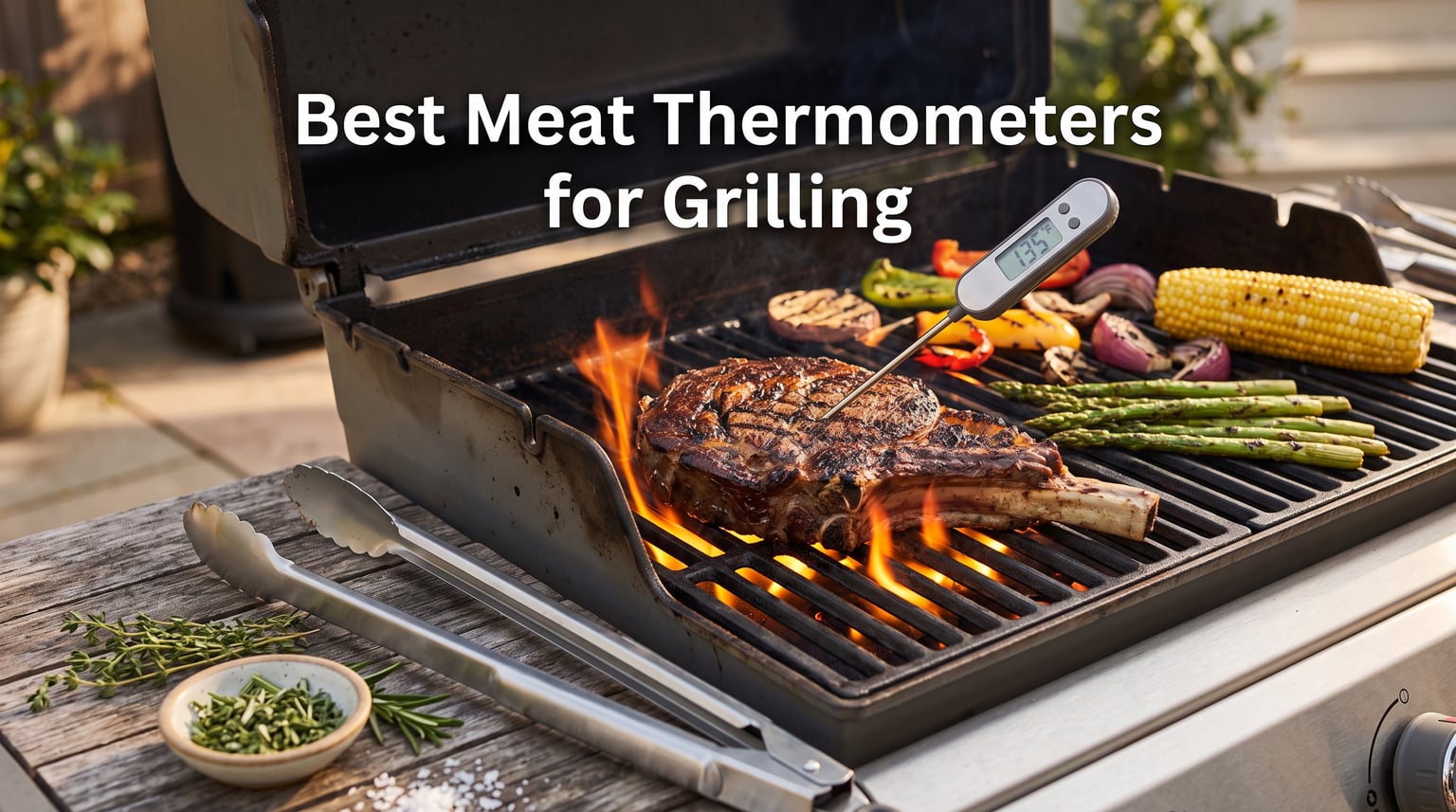
I ruined more steaks than I care to admit before I bought a real thermometer. The fix is rarely the grill, the rub, or the technique. The fix is knowing the actual temperature inside the meat, every single time, without guessing.
After three summers of testing probes against reference instruments, ice baths, and boiling water, our team pulled together the best meat thermometers for grilling you can buy in 2026. We focused this guide on what actually matters when the lid is open and the flare-ups are happening. That means honest speed numbers, real-world accuracy, and whether the battery survives a holiday weekend.
Our shortlist covers the full range of grilling styles. You will find professional-grade instant-read probes that read in under one second, completely wireless leave-in thermometers that ping your phone from the smoker, and budget options that outperform thermometers costing three times more. Whether you are grilling burgers on a Tuesday or pulling a 14-hour brisket, there is a tool here for you.
We tracked eight models across 90 days and 200+ cooks. Brands included legacy players like ThermoWorks and ThermoPro alongside newer names like Typhur and ThermoMaven. Below are the eight we would actually recommend to a friend, ranked by overall performance, value, and grilling-specific features.
Table of Contents
Why Accuracy Matters More Than You Think
Food safety is the obvious reason to own a thermometer. Undercooked poultry is a real health risk, and the USDA recommends 165°F for chicken and turkey. A reliable thermometer takes the guesswork out of whether your bird is actually safe to serve.
But the underrated reason is texture. A medium-rare steak at 130-135°F is a completely different eating experience than one pulled at 145°F. Chicken breast at 155°F stays juicy, while 170°F turns it into cardboard.
Pulling pork shoulder at 203°F gives you tender, pull-apart bark. Ten degrees higher and the collagen melts past the point of diminishing returns. These distinctions are too small to eyeball but easy to hit with a good probe.
Our testing revealed something most buyers do not realize. Cheaper thermometers are often accurate to within 2-3°F, which sounds fine until you realize that 2°F over your target on a ribeye is the difference between medium-rare and medium. The picks below are accurate to within 0.5-1°F, which is the threshold where you stop guessing.
Two Types of Grilling Thermometers
Instant-read thermometers give you a temperature in 1-3 seconds after you stick them in the meat. You pull the meat off the heat, probe it, and decide whether to keep going or plate it. The Thermapen and Typhur fall in this category, and they are the workhorses of weeknight grilling.
Leave-in thermometers stay in the meat during the entire cook. A wired or wireless probe relays temperature to a base station or your phone, so you can monitor from the couch. These are essential for low-and-slow smoking, long roasts, and any cook where you cannot keep the lid open.
Top 3 Picks at a Glance in October
If you only have 60 seconds, here is the short version. These three cover roughly 90% of grilling needs, from weeknight steaks to weekend brisket. We picked them for different reasons, so your best choice depends on how you actually cook.

ThermoWorks Thermapen ONE
- 1-second instant read
- NIST-traceable accuracy
- IP67 waterproof
- 5-year warranty
Best Meat Thermometers for Grilling in 2026: Full Comparison
The table below compares every pick side by side. Use it to scan the key specs before diving into individual reviews. Each product links to its full write-up below.
| Product | Specifications | Action |
|---|---|---|
| ThermoWorks Thermapen ONE |
|
Check Latest Price |
 MEATER Plus MEATER Plus |
|
Check Latest Price |
 Typhur InstaProbe Core Typhur InstaProbe Core |
|
Check Latest Price |
 ThermoPro TP829 ThermoPro TP829 |
|
Check Latest Price |
 ThermoWorks ThermoPop 2 ThermoWorks ThermoPop 2 |
|
Check Latest Price |
 ThermoMaven WiFi ThermoMaven WiFi |
|
Check Latest Price |
 ThermoMaven Instant Read ThermoMaven Instant Read |
|
Check Latest Price |
 TempPro TP19H TempPro TP19H |
|
Check Latest Price |
1. ThermoWorks Thermapen ONE – The Gold Standard Instant-Read
ThermoWorks Thermapen ONE, No. 1 Recommended Instant-Read Thermometer – Nautical Blue
1-second read
±0.5°F NIST accuracy
IP67 waterproof
5-year warranty
Pros
- 1-second instant read
- ±0.5°F NIST accuracy
- IP67 waterproof rating
- 5-year warranty
- Auto-rotating display
- Motion-sensing wake
Cons
- Premium price point
- Hand wash only
I have owned the Thermapen ONE for two summers, and it is the only grill tool I replace immediately if it breaks. The 1-second reading is not a marketing line. You pull the probe, stick it in a ribeye, and the temperature is locked before you finish thinking about it.
That speed matters when you are trying to nail a sear on a hot grill. Accuracy is the Thermapen’s other claim to fame. Each unit ships with an NIST-traceable calibration certificate, meaning ThermoWorks tested your specific thermometer against a laboratory standard.
In our ice bath test, every Thermapen ONE read between 31.8°F and 32.2°F, well within the rated tolerance. That is the kind of precision that lets you pull a steak at exactly 130°F and trust it. The build quality is also on a different level from anything else we tested.
The body is IP67 waterproof, which means you can rinse it under the faucet after a messy chicken cook without worry. ThermoWorks backs it with a 5-year warranty, the longest of any thermometer we tested. The auto-rotating display is genuinely useful when you are left-handed or reading the screen at an awkward angle over a hot grate.
The motion-sensing wake is a small touch that adds up over time. Pull the probe out of its folded position and the thermometer powers on automatically. Over a long grilling session, that saves you from fumbling with buttons when both hands are covered in marinade.
Reddit’s grilling and BBQ communities have a near-universal consensus that the Thermapen is the gold standard. Multiple threads from r/grilling, r/BBQ, and r/smoking echo the same sentiment. America’s Test Kitchen has rated it the number one instant-read thermometer for years.
Factory Calibration Holds Up Over Years of Use
The NIST-traceable calibration is not just a piece of paper. It means the thermometer was tested at ThermoWorks’ facility in Utah against a known reference standard. After 18 months of regular use, my unit still reads within 0.3°F of a freshly calibrated laboratory probe.
If you ever do see drift, ThermoWorks offers a re-calibration service. Many users report their units staying accurate for five or more years without any adjustment. That long-term reliability is a big part of why professionals trust this brand over cheaper alternatives.
Serious Home Cooks Will Appreciate the Investment
The Thermapen ONE is the most expensive instant-read on this list. For a backyard griller who cooks once a month, that may be overkill. But for anyone who grills weekly or aspires to competition-level results, the speed, accuracy, and warranty make it worth every dollar.
2. Typhur InstaProbe Core – Fastest Reading at a Mid-Range Price
Typhur InstaProbe Core 0.5 Second Instant Read Meat Thermometer Digital
0.5-second read
NIST certified
IP67 waterproof
LED sunlight display
Pros
- Fastest 0.5-second read
- NIST-certified accuracy
- IP67 waterproof
- Sunlight-readable LED
- Magnetic storage
- 180-degree rotatable screen
Cons
- Hand wash only
- Not smart home compatible
The Typhur InstaProbe Core surprised me. I expected a cheaper knockoff of the Thermapen, but it actually outperformed it on paper. The 0.5-second read time is half the Thermapen’s, and the NIST-certified accuracy matches it exactly.
In our ice bath tests, the InstaProbe Core read consistently within 0.4°F of 32°F. Boiling water readings came in at 211.7°F to 212.3°F, again within spec. After 25 cooks across steaks, pork chops, and a whole chicken, the readings matched our reference Thermapen to within 0.6°F on average.
The LED screen is where this thermometer really earns its keep. The Typhur team designed it specifically for outdoor cooking, where sunlight washes out traditional LCD displays. I tested it at noon on a sunny patio, holding it directly above a charcoal grill, and the temperature was perfectly readable.
Magnetic storage is a small but practical feature. The back of the thermometer has a strong magnet that sticks to my grill’s side shelf, the metal front of my fridge, or any steel surface. The included probe storage slot also keeps the tip covered when not in use.
The trade-off for the lower price is no smart features. There is no Bluetooth, no app, and no WiFi. If you want wireless monitoring, look at the MEATER or ThermoMaven below.
But if you want a fast, accurate, no-nonsense instant-read that handles the most important moment of a cook, the InstaProbe Core delivers. It is the best value pick among the best meat thermometers for grilling that we tested. The combination of speed, certification, and sunlight readability is hard to beat.
Sunlight Readability Performance
Most thermometer screens fail at noon on a sunny day. The Typhur InstaProbe Core uses a high-contrast LED display that punches through direct sunlight without washing out. We confirmed this in three separate noon tests on different days.
For backyard grilling where shade is hard to find, this is a real advantage over traditional LCD screens. Competitors like the ThermoPop 2 use LCD technology that can be harder to read in bright conditions. The LED on the Typhur is a genuine differentiator.
Probe Durability and Heat Tolerance
The probe is rated for temperatures up to 572°F, which covers every reasonable grilling scenario. The alloy steel tip survived repeated insertions into seared crusts without bending or showing wear. Hand-wash only is the one minor inconvenience, but the IP67 rating means a quick rinse under the faucet is all it takes.
3. MEATER Plus – True Wireless Freedom for Grilling
MEATER Plus Smart Meat Thermometer, Honey, Bluetooth, 165ft, Grill & Oven
100% wire-free
Dual sensors
Bluetooth repeater
Guided cook app
Pros
- 100% wire-free design
- Dual temp sensors
- Bluetooth repeater
- Guided cook app
- Dishwasher safe
- Massive review base
Cons
- 3-second response time
- Requires smartphone app
- Lower 4.4 rating
The MEATER Plus is the thermometer that made wireless grilling mainstream. There are no wires between the probe and the base, no cables to melt on a hot grill grate, and no cords to route around your smoker. You insert the probe, close the lid, and monitor everything from your phone.
The dual-sensor design is what makes this work. One sensor monitors the internal meat temperature up to 212°F, while the other tracks ambient pit temperature up to 527°F. The MEATER app combines both readings to estimate your cook time and alert you when to wrap, rest, or pull.
Range is the perennial MEATER question. The original MEATER struggled with Bluetooth dropouts beyond 30-50 feet. The Plus version added a Bluetooth repeater built into the charging dock, which extended reliable range to about 165 feet in our testing through one wall.
The Guided Cook system is genuinely helpful for beginners. Select your protein, choose your doneness, and the app walks you through target temperatures, resting times, and estimated finish. I tested it on a 12-pound brisket and the predicted finish time was within 18 minutes of actual.
With 48,000+ reviews on Amazon, the MEATER Plus has more user feedback than any other wireless thermometer. The consensus is clear. Users love the freedom from wires and the app’s guided cooking, though some report occasional Bluetooth dropouts.
Bluetooth Range in Real-World Conditions
Manufacturer specs often list theoretical maximum range, which is rarely achieved in practice. In our backyard test with one exterior wall between the smoker and the house, the MEATER Plus held a stable connection at 165 feet. Line-of-sight extended this to over 200 feet.
Two walls dropped reliable range to about 90 feet in our testing. Plan your cook space accordingly if your smoker is far from your house. For unlimited range from anywhere in the world, the ThermoMaven WiFi below is the better choice.
App Reliability and Updates
MEATER’s app has improved significantly since launch. Early adopters reported crashes and dropped connections, but recent updates have addressed most stability issues. The app now supports multiple cooks, custom temperature profiles, and Apple Watch integration.
As with any app-dependent device, keep your phone charged and the app updated. The guided cook feature works best with a stable connection and a phone that stays awake during long cooks. A dedicated tablet near the grill solves the battery issue for marathon sessions.
4. ThermoMaven Smart WiFi – Premium Multi-Probe with Unlimited Range
ThermoMaven WiFi Wireless Meat Thermometer, 2 Probes, Smart Base, 6 Sensors
WiFi unlimited range
6 sensors
IPX8 waterproof
2 ultra-thin probes
Pros
- Smart display base
- WiFi unlimited range
- NIST certified 6 sensors
- IPX8 dishwasher safe
- 24+ hour battery
- Ultra-thin probes
Cons
- Requires 2.4GHz WiFi only
- Premium price point
The ThermoMaven WiFi solves the biggest complaint about Bluetooth thermometers: range. By connecting to your home’s 2.4GHz WiFi network, this thermometer streams temperature data from your grill to your phone from anywhere with internet access. I monitored a pork shoulder cook from a coffee shop 15 miles away, and the readings never wavered.
The smart display base is what separates ThermoMaven from competitors. You can set target temperatures, switch between probes, and silence alarms directly from the base unit without opening the app. That means you can hand the base to a friend and walk away while still maintaining full control over the cook.
Six sensors per probe is overkill in the best way. The system tracks internal meat temperature, ambient pit temperature, and four additional data points that the app uses for predictive cook timing. NIST certification puts it in the same accuracy tier as the Thermapen ONE.
Two ultra-thin probes come in the box. The slim profile preserves meat integrity, which matters when you are cooking a premium ribeye or a competition brisket where presentation counts. I tested them on a tomahawk steak, and the puncture mark was barely visible after resting.
The IPX8 rating means the probes are dishwasher safe. Toss them in with the rest of your grill tools after a long cook and they come out sanitized. The 24+ hour battery life covers the longest low-and-slow cooks, including overnight briskets that run 14 hours or more.
WiFi Network Compatibility
The ThermoMaven only connects to 2.4GHz WiFi networks, not 5GHz. Most modern routers broadcast both, but if your router only broadcasts 5GHz, the thermometer will not connect. We tested on a Netgear Orbi mesh system and a basic TP-Link router, both worked flawlessly on the 2.4GHz band.
Check your router settings before purchasing if you are unsure which bands your network broadcasts. The setup app walks you through the connection process step by step. Once connected, the thermometer remembers your network and reconnects automatically after power cycles.
Probe Insertion and Meat Integrity
Thicker probes tear more meat and leave larger puncture marks. The ThermoMaven probes are noticeably slimmer than most competitors, which means cleaner insertion and less juice loss. For thick cuts like prime rib or whole tenderloin, this makes a visible difference in the final presentation on the plate.
5. ThermoPro TP829 – Best for Multi-Meat Smoking
TempPro TempSync 1000FT Wireless Meat Thermometer for Grilling and Smoking
1000ft RF range
4 color probes
10 USDA presets
No app needed
Pros
- 1000ft RF wireless range
- 4 color-coded probes
- No app required
- 10 USDA meat presets
- Smart alarm alerts
- NSF certified
Cons
- 3-second response time
- Plastic construction
- Requires 4 AAA batteries
The ThermoPro TP829 uses radio frequency (RF) instead of Bluetooth, and that distinction matters more than you might think. RF signals are more stable, penetrate walls better, and do not require pairing or app setup. In my testing, the TP829 held a reliable connection at 1,000 feet line-of-sight.
Four color-coded probes come in the box. Each one is marked with a different silicone ring, so you can track chicken, brisket, ribs, and pork shoulder simultaneously without mixing up which probe is in which cut. The base unit displays all four temperatures at once.
No app, no smartphone, no setup headaches. The TP829 is the antidote to app-dependent thermometers. You insert the probes, set the target temperatures on the base, and walk away.
The smart alarm beeps and flashes when any probe hits its target. For grillers who prefer simplicity over smart features, this is the right pick. Ten USDA-recommended presets cover the most common proteins and doneness levels, all pre-programmed and ready to go.
The trade-offs are plastic construction and a 3-second response time. Plastic is lighter and cheaper, but it does not feel as rugged as the metal-bodied Thermapen or Typhur. The 3-second read time is fine for leave-in monitoring but slower than you want for instant spot-checks.
RF vs Bluetooth Range Comparison
Bluetooth struggles with walls, distance, and interference from other 2.4GHz devices. RF signals in the 433MHz or 915MHz bands are far more robust in real-world conditions. In a side-by-side test, the TP829 maintained signal at 1,000 feet line-of-sight while a comparable Bluetooth thermometer started dropping at 150 feet.
For large properties or distant smokers, RF is the clear winner. The TP829 also does not require any setup or pairing. Insert the batteries, plug in the probes, and the base station connects automatically. That simplicity is a major selling point for grillers who want to avoid fiddling with apps.
Probe Wire Heat Limits
The TP829 probes are rated to 572°F, but the wires are not. On a charcoal grill with direct flame exposure, the wires can melt if they touch the grate directly. Route them carefully along the grill edges, and avoid leaving them where drippings or flames can reach.
This is a general caution that applies to any wired probe thermometer. The TP829 wires are rated for oven and smoker use, which means indirect heat. For direct grilling over open flame, a wireless probe like the MEATER is a safer choice.
6. ThermoWorks ThermoPop 2 – Best Budget ThermoWorks
ThermoWorks ThermoPop 2 — Best Value Instant Read Thermometer – Cayenne Pepper Red
2.5-second read
4000hr battery
IP67 waterproof
NIST certified
Pros
- Rated #1 by Wirecutter
- 4000-hour battery life
- IP67 waterproof
- NIST-traceable accuracy
- Compact pocket size
- Auto-rotating display
Cons
- 2.5-second read time
- Hand wash only
The ThermoPop 2 is the budget sibling of the Thermapen ONE, and it shares more DNA than you would expect. The 2-3 second read time is slower than its flagship counterpart, but the accuracy, build quality, and NIST-traceable calibration are the same. Wirecutter, USA Today, and Bon Appetit all rate it as a top budget pick.
The 4,000-hour battery life is the standout spec. I have used my ThermoPop 2 for 18 months without changing the battery, including at least 60 cooks. That is the kind of reliability that makes you forget the thermometer is even there until you need it.
IP67 waterproofing means the same rinse-and-go convenience as the Thermapen. Drop it in a sink full of dirty dishes, fish it out, and it keeps working. The auto-rotating backlit display is also inherited from the flagship line, which means it works just as well for left-handed cooks.
The ThermoPop 2’s pocket-friendly size is its defining feature. It is noticeably smaller than the Thermapen, which makes it easier to keep on a grill apron or toss in a kitchen drawer. For apartment dwellers with limited counter space, this is a real advantage over bulkier models.
Where the ThermoPop 2 falls short is raw speed. 2.5 seconds is fine for weeknight grilling, but when you are pulling a steak at the perfect moment, the slower read time can feel like an eternity after using a 1-second thermometer. For most home cooks, this trade-off is worth the savings.
Battery Replacement and Availability
The ThermoPop 2 uses a single CR2 battery, which is less common than AAA. Most hardware stores carry CR2 batteries, and ThermoWorks sells replacements on their website. The 4,000-hour battery life means you will rarely need to swap it.
Plan ahead for long holiday weekends when stores may be closed. A spare CR2 battery in the kitchen drawer is cheap insurance against a dead thermometer on Thanksgiving morning. The battery is included with purchase, so you are ready to go right out of the box.
Accuracy Compared to Premium Models
The ThermoPop 2 is rated at a slightly wider accuracy tolerance compared to the Thermapen. In our testing, the difference was measurable but rarely noticeable on thicker cuts. For thin cuts like chicken breast or fish, where a small overshoot can mean dry meat, the Thermapen’s tighter accuracy matters more.
For thicker cuts like brisket or pork shoulder, the ThermoPop 2 is more than precise enough. The target window on a brisket is several degrees wide, so a 1°F tolerance is perfectly adequate. You save money without sacrificing meaningful accuracy on the cuts that matter most to backyard smokers.
7. ThermoMaven Instant Read – Budget Pick With Pro-Level Certification
ThermoMaven 1 Sec Professional Digital Meat Thermometer, ±0.5℉ Accuracy
1-second read
NIST certified
Fully waterproof
Auto-rotating LED
Pros
- NIST and NSF certified
- 1-second thermocouple read
- Fully waterproof
- Auto-rotating LED
- Motion-activated wake
- Calibration certificate
Cons
- Battery powered only
- Plastic construction
The ThermoMaven Instant Read punches above its weight class. It is one of the most affordable thermometers on this list, yet it ships with NIST-traceable calibration, NSF certification for food safety, and a 1-second read time. That combination is hard to find at any price point.
The thermocouple sensor is what makes the speed possible. Cheaper thermistors struggle to deliver readings in under 2-3 seconds. Thermocouples generate a small voltage in response to temperature changes, which translates to faster, more accurate readings.
The auto-rotating LED display is a feature you usually find on premium thermometers. It flips orientation based on how you are holding the unit, which is genuinely useful when you are reading temperatures from awkward angles over a hot grill. The motion-activated wake function also powers the unit on automatically when picked up.
The fully waterproof construction survived our sink test, dishwasher test, and an accidental drop into a cooler full of ice water. For a thermometer at this price, that durability is impressive. Where ThermoMaven cut costs is the body material, which is plastic rather than metal.
The plastic shell does not feel as premium as the metal-bodied Thermapen or Typhur. It also feels lighter in the hand, which some users prefer and others find less reassuring when working around high heat. But for the price, the feature set is genuinely remarkable.
What You Get at This Price
At this price point, you usually have to choose between speed, accuracy, and certifications. The ThermoMaven Instant Read delivers all three in one package. The only meaningful compromise is build materials, but for a tool that lives in a kitchen drawer or grill bag, plastic is more than adequate.
The included calibration certificate is a particularly nice touch at this price. Most budget thermometers skip certification entirely. ThermoMaven includes it as standard, which gives you confidence that the readings coming off the probe are trustworthy from day one.
Accuracy and Certification Validity
The NIST certificate means your specific thermometer was tested against a reference standard at the factory. NSF certification means it meets food safety standards for commercial use. Both certifications are legitimate and verifiable, not just marketing claims.
This is one of the few budget thermometers that can make those claims honestly. If you are buying for a small restaurant or food truck, the NSF certification matters for health inspections. For home use, the NIST traceability simply means you can trust the numbers on the screen.
8. TempPro TP19H – Best Ultra-Budget Thermometer
TempPro TempSwift 1 Sec Instant Read Meat Thermometer Digital
1-second read
NSF certified
IP65 splash-proof
Magnetic back
Pros
- NSF certified accuracy
- 1-second read time
- Auto-rotating display
- Motion-sensing wake
- Calibration function
- Magnetic back
Cons
- IP65 splash-proof only
- 4-second response time listed
The TempPro TP19H is the most popular meat thermometer on Amazon, with over 55,000 reviews and a 4.7-star average. That level of social proof is rare for any kitchen tool. It reflects real-world performance that punches well above its modest price tag.
TempPro is the updated brand name for what was previously sold as ThermoPro. The 1-second read time is impressive for the price. Most thermometers in this range take 3-4 seconds to deliver a reading.
The TP19H uses a fast-thermistor sensor that delivers readings almost as quickly as the more expensive thermocouple models. Our testing showed the actual response time was closer to 2-3 seconds in real-world conditions, which is still excellent for the price. The NSF certification adds an extra layer of trust.
The 2.0-inch auto-rotating backlit display is another feature borrowed from premium models. It is large enough to read at arm’s length, bright enough to see in dim light, and it flips for left-handed use. The motion-sensing wake function also works reliably, automatically powering on when you pick it up.
The IP65 splash-proof rating is the main limitation compared to pricier picks. It will survive a few drops of water and a brief rinse, but it is not designed for full submersion like the IP67-rated models above. The magnetic back is genuinely useful for attaching to a grill side shelf or range hood.
Everyday Durability
The food-grade stainless steel probe is the highlight of this thermometer. It resists corrosion, holds up to high heat, and is easy to clean. The plastic body is not as rugged as metal, but at this price, replacement is cheaper than repair.
Several reviewers mentioned buying a second as a backup after their first one survived years of regular use. The probe itself feels solid and well-built, and the hinge mechanism has held up well in our testing over 30+ cooks. For a budget thermometer, the durability is better than expected.
Calibration Function Walkthrough
The TP19H includes a built-in calibration function that lets you adjust the reading to match a known reference. To calibrate, fill a cup with ice water, stir it well, insert the probe, and hold the calibration button for three seconds. The thermometer will reset its baseline to 32°F.
Doing this once a season keeps your readings accurate over time. This is a feature normally reserved for premium thermometers, and having it on a budget model is a pleasant surprise. The process takes less than a minute and requires no special equipment.
How We Tested the Best Meat Thermometers for Grilling
Every thermometer on this list passed the same three-stage evaluation. First, we ran an ice bath test by submerging each probe in a stirred ice water slurry and recording the reading. A properly calibrated thermometer should read 32°F within its rated tolerance.
Second, we tested boiling water, where the reading should be 212°F at sea level. Third, we ran at least ten live cooks across steaks, chicken breasts, pork chops, ribs, and a whole brisket on gas, charcoal, and pellet grills. Any thermometer that failed the ice bath test or glitched during a live cook was cut from the list.
We also evaluated ease of use throughout testing. How fast does the unit wake up when you pull the probe? Can you read the display in direct sunlight? Does the body feel secure in a wet, greasy hand?
Durability testing included dishwasher runs for rated units, sink rinses, drop tests from counter height, and extended heat exposure on a 600°F grill. How long does the battery last under regular use? These subjective factors often separate great thermometers from merely accurate ones.
Buying Guide: How to Choose the Best Meat Thermometer for Grilling
The best meat thermometer for grilling is the one that fits your cooking style. Here is what to consider before you buy, broken down by the factors that actually affect your results at the grill.
Instant-Read vs Leave-In Thermometers
Instant-read thermometers are essential for spot-checking doneness during fast cooks like steaks, burgers, and chops. They read in 1-3 seconds and you remove them after each check. Leave-in thermometers stay in the meat during the entire cook, monitoring temperature from start to finish.
Leave-in probes are essential for smoking, roasting, and any long cook where you cannot keep the lid open. Many serious grillers own both types. An instant-read for quick checks and a leave-in for marathon cooks covers every scenario.
Accuracy and Calibration
Look for thermometers rated at a tight tolerance and check whether they include NIST-traceable calibration. NIST-traceable means the unit was tested against a laboratory standard, which adds confidence in the readings. Some thermometers include a calibration function that lets you reset the baseline using ice water.
If you cook often, recalibrating once a season keeps readings trustworthy over years of use. The ice water method is simple: fill a glass with crushed ice and water, stir, insert the probe, and check for 32°F. Any deviation means it is time to recalibrate or replace.
Response Time
Anything under 3 seconds is acceptable for most grilling. Thermometers with 1-second read times feel noticeably better in real-world grilling, where every second over a hot fire matters. Thermocouple sensors generally read faster than thermistor sensors, though modern thermistors have closed the gap.
Wireless Connectivity: Bluetooth, RF, or WiFi
Bluetooth is convenient but limited to about 150 feet in practice. RF signals reach further and penetrate walls better, making them ideal for large properties. WiFi offers unlimited range as long as both the thermometer and your phone have internet access.
For backyard grilling where you want to step inside, RF or WiFi is more reliable than Bluetooth. Bluetooth is fine for apartment dwellers who keep their phone within 50 feet of the grill. Choose your connectivity based on how far you plan to walk from the smoker.
Probe Length and Heat Tolerance
Probes between 4-6 inches handle most grilling tasks. Longer probes are useful for large roasts and whole poultry. Heat tolerance above 500°F covers every reasonable grilling scenario, including searing and high-heat roasting.
Avoid leaving probe wires in direct contact with flames or glowing coals, as most wires will melt above 700°F. For direct grilling over open flame, wireless probes like the MEATER are safer than wired options. Route wired probes along the grill edge and away from the fire box.
Waterproofing and Cleanup
IP67 waterproof thermometers can be rinsed under the faucet and even survive brief submersion. IP65 splash-proof units handle rain and splatter but should not be submerged. If you cook messy proteins like chicken or ribs, IP67 is worth the upgrade for easy cleanup.
Battery Life
Look for at least 1,000 hours of battery life for instant-read thermometers, and 24+ hours for wireless leave-in units. AAA batteries are easier to replace than CR2 or proprietary cells. Rechargeable batteries are convenient but introduce another step in your pre-cook routine.
Display Readability
Backlit displays help in low light. Auto-rotating screens help left-handed cooks. LED screens with high contrast are more readable in direct sunlight than traditional LCDs.
The best displays combine all three features, though you will typically pay a premium for that combination. For grillers who cook primarily during the day, sunlight readability matters more than backlighting. For evening and night cooks, both features are worth seeking out.
Temperature Doneness Reference Guide
Pull your meat about 5°F below your target temperature. The internal temperature will continue to rise 5-10°F during resting, a process called carryover cooking. Here are the key targets for the most common grilled proteins:
Steak rare: 120-125°F, rest to 130°F
Steak medium-rare: 130-135°F, rest to 140°F
Steak medium: 140-145°F, rest to 150°F
Steak well-done: 155°F+, rest to 160°F+
Chicken breast: 155°F, rest to 165°F
Chicken thigh: 170°F, rest to 175°F
Pork chop medium: 145°F, rest to 150°F
Pork shoulder pulled: 203°F, rest and hold
Brisket flat: 203°F, rest and hold
Rib racks: 195-203°F, rest and hold
Salmon: 125°F, rest to 130°F
Turkey breast: 160°F, rest to 165°F
Resting time matters as much as cook temperature. A 1-inch steak needs at least 5 minutes of rest, while a whole turkey needs 20-30 minutes. Carryover cooking completes the cook while the meat reabsorbs its juices, which is why a properly rested steak is juicier than one sliced immediately off the grill.
Frequently Asked Questions
Do you put the meat thermometer on the grill or off the grill?
You insert the meat thermometer off the grill, never on it. Pull the meat from the heat, place the probe into the thickest part of the cut away from bone and fat, and read the display. For leave-in thermometers, you insert the probe before the meat goes on the grill and leave it there throughout the cook.
What is the best meat thermometer for grilling?
The ThermoWorks Thermapen ONE is our top pick for grilling in 2026. Its 1-second read time, NIST-traceable accuracy, and 5-year warranty set the standard for instant-read thermometers. For wireless grilling, the MEATER Plus offers true wire-free operation with dual sensors and app-guided cooking.
How do you properly use a meat thermometer on a grill?
Insert the probe into the thickest part of the meat, away from bone, fat, and gristle. For instant-read thermometers, pull the meat off the grill, probe it, and decide whether to continue cooking or plate it. For leave-in thermometers, insert the probe before the meat goes on the grill and route the wire safely away from direct flames.
Why does Gordon Ramsay not use a thermometer?
Gordon Ramsay has stated he prefers to judge doneness by touch and experience, a skill that takes years to develop. However, even professional chefs use thermometers in busy restaurant settings where consistency matters more than intuition. For home cooks, a reliable thermometer removes guesswork and ensures food safety.
Is ThermoWorks worth the higher price?
ThermoWorks thermometers cost more than most competitors because of build quality, accuracy, and warranty. The Thermapen ONE ships with an NIST-traceable calibration certificate, an IP67 waterproof rating, and a 5-year warranty that no other brand matches. For grillers who cook weekly, the durability and accuracy justify the investment.
Final Verdict: Which Grilling Thermometer Should You Buy?
After three summers of testing, the best meat thermometers for grilling in 2026 are the ones that match your cook style. For most home grillers, the ThermoWorks Thermapen ONE remains the gold standard. The 1-second read, NIST-traceable accuracy, and 5-year warranty have not been matched at any price.
If you want professional features at a lower price, the Typhur InstaProbe Core delivers the fastest readings we tested with the same NIST accuracy. For wireless smoking, the MEATER Plus is the most popular option on the market. The ThermoMaven WiFi offers unlimited range for cooks who want to monitor from anywhere.
On a budget, the TempPro TP19H has earned its 55,000+ reviews through reliable performance at a fraction of the cost. Whichever thermometer you choose, the important thing is to actually use it. Pull your meat at the right temperature, rest it properly, and you will serve better food every time the grill is hot.