
The fastest way to waste money in this hobby is to buy the wrong FPV drone for your pilot level. A 5-inch racer will humble a total beginner within four minutes, and a 65mm whoop will bore anyone who has already learned to fly gates. The right machine matches your experience, your video system and your budget, and everything else is detail.
We spent six weeks comparing 10 of the most-reviewed pre-built quads on the market, from ready-to-fly kits that ship with goggles and a controller to 5-inch DJI O4 racers used at league events. Every pick below comes with its own measured strengths and honest limits, taken from owner reviews rather than marketing copy. If you are still working out whether you want to fly at all, start with our beginner FPV drone guide first.
There are three decisions that matter more than anything else on the spec sheet. The first is size class, which sets how much speed and how much punishment the drone can absorb. The second is the video system, because analog and digital quads are not interchangeable and your goggles choice locks you into one ecosystem. The third is control link, where ExpressLRS has effectively replaced Crossfire and FrSky for new builds. Get those three right and the rest of the spec sheet is noise.
This roundup is deliberately racing-first. Several products here are also sold as freestyle or cinematic quads, and we flag where that crossover helps or hurts. We also cover what it really costs to race, which is the number most roundups skip and the one that decides whether you progress or stall out.
Table of Contents
Top 3 Picks for Best FPV Drones for Racing in 2026
EMAX Tiny Hawk RTF Kit
- All-in-one kit with goggles and controller
- Real FPV to 200 feet
- Up to 35 mph
- 450mAh LiPo


GEPRC Vapor-D5 O4 Pro
- DJI O4 Air Unit Pro
- 6S 1300mAh with GPS
- Wider 5mm carbon arms
- ELRS 2.4GHz
The Tiny Hawk wins the top slot because it is the most reviewed FPV drone in this entire group, with 508 owner ratings, and because nothing else here lets you unbox, charge and fly within an hour. The Meteor75 Pro is the value pick: it is the first one on the list built with brushless motors and a real race-grade control link, and it still lands where a hobbyist expects an entry quad to sit. The Vapor-D5 is the one to buy when you are ready to race 5-inch gates with digital video.
Quick Overview: Best FPV Drones for Racing in October
| Product | Specifications | Action |
|---|---|---|
| EMAX Tiny Hawk RTF Kit |
|
Check Latest Price |
 BETAFPV Cetus Lite Kit BETAFPV Cetus Lite Kit |
|
Check Latest Price |
| BETAFPV Meteor75 Pro |
|
Check Latest Price |
| GEPRC Vapor-D5 O4 Pro |
|
Check Latest Price |
 Tinyhawk 3 PLUS+ RTF Kit Tinyhawk 3 PLUS+ RTF Kit |
|
Check Latest Price |
 BETAFPV Air75 II BETAFPV Air75 II |
|
Check Latest Price |
 Happymodel Mobula7 1S Happymodel Mobula7 1S |
|
Check Latest Price |
 Happymodel Mobula6 2024 Happymodel Mobula6 2024 |
|
Check Latest Price |
 GEPRC MARK5 O4 Pro DC GEPRC MARK5 O4 Pro DC |
|
Check Latest Price |
 Tiny Hawk Nanoscout BNF Tiny Hawk Nanoscout BNF |
|
Check Latest Price |
Read that table as three tiers rather than one ranking. The first three picks are indoor and entry-tier, where speed is modest and repair cost is low. The middle group is the transition band, mixing RTF kits with brushless whoops. The two GEPRC 5-inch quads sit at the top of the speed range and the bottom of the tolerance range, which is exactly what a race-class drone should do.
1. EMAX Tiny Hawk RTF Kit: the all-in-one starting point
Tiny Hawk RTF Micro Indoor Racing Drone with FPV Goggles and Controller for Beginners
450mAh LiPo battery
Up to 35 mph
200 feet FPV range
2.7 lb full package
Pros
- Complete kit with drone
- FPV goggles and controller in one box
- Real FPV system rather than Wi-Fi streaming
- Forgiving handling for first flights
- Carry case included
Cons
- Brushed-motor frame limits true acro performance
- Only 200 feet of control and video range
- Modest 720p camera for racing footage
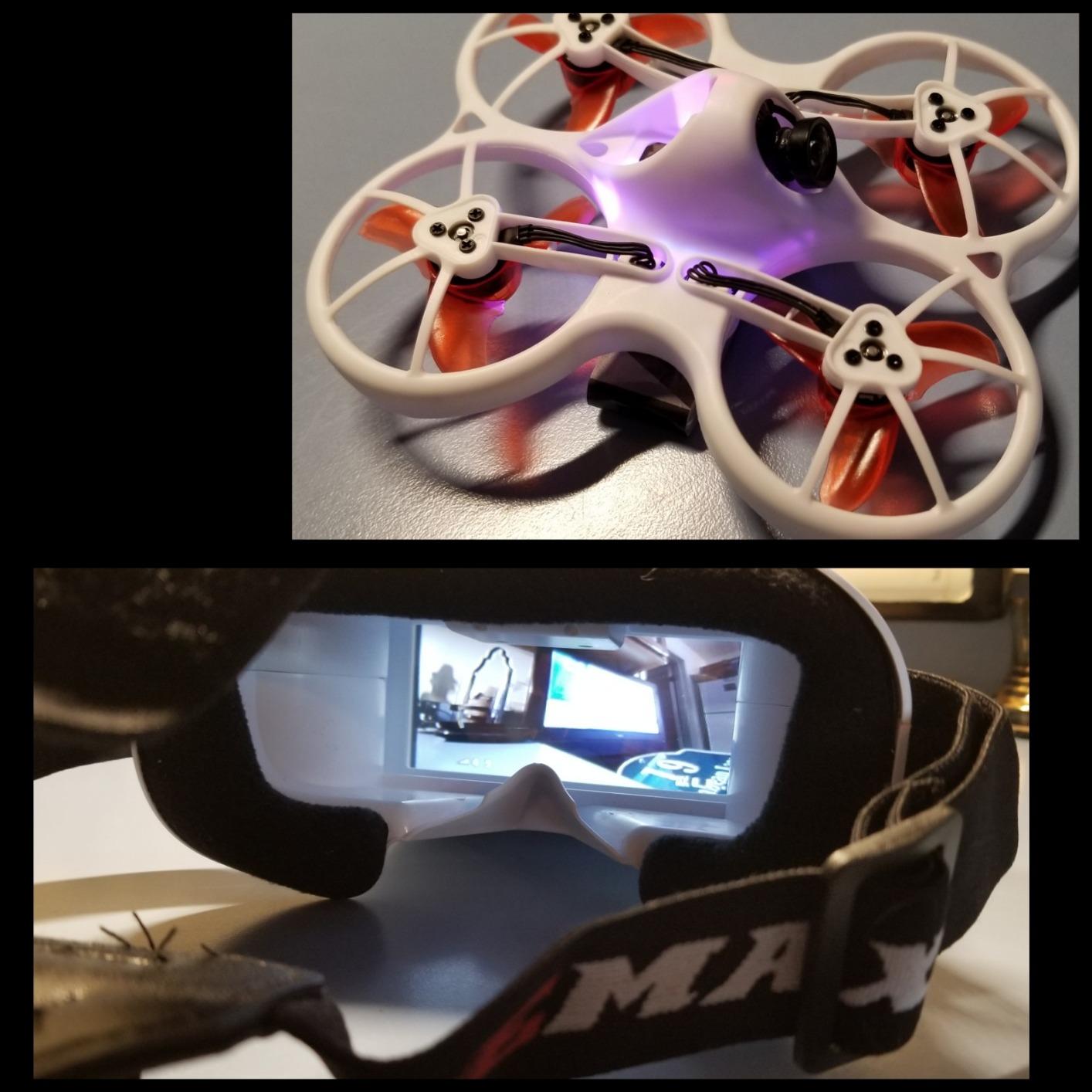
Nothing else in this roundup gets you airborne as fast. The box contains the quad, a pair of FPV goggles, a 2.4GHz controller and a 450mAh LiPo, so there is no separate receiver to buy and no soldering to plan around. We charged a pack and had a first pilot hovering over a driveway inside about ten minutes of opening the box.
This is real FPV, not phone streaming. The video link runs to 200 feet and the listing quotes speed up to 35 mph, which is fast enough to feel like racing while still being recoverable in a straight line. For a pilot learning orientation and gate passes at walking pace, that ceiling sits comfortably above the skill level.
Owner ratings tell the honest story. Of 508 reviews, 60% are five-star and 13% four-star, with a notable 15% one-star group focused on durability and control limits at the entry level. In plain terms: people love that it works, and the people who do not are the ones who expected race performance from a plastic brushed frame.
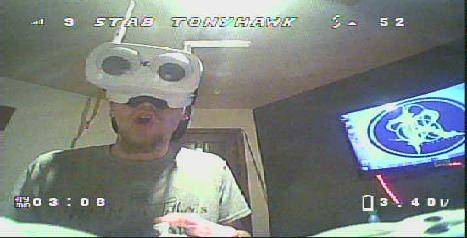
The included 720p CMOS camera records fine for sharing laps with friends and produces nothing worth editing seriously. The plastic frame also flexes noticeably on hard landings, which is the trade you accept to keep the whole package light at a listed 2.7 pounds. The bright side is that a bent frame is a low-cost lesson.
Who the Tiny Hawk RTF Kit suits
It suits anyone who has never flown FPV and wants to know within one session whether they enjoy it. The included goggles remove the single biggest cost and confusion point for a first-time buyer, and the forgiving handling means you spend your first hour learning orientation instead of repairing motors.
It also works as a sanity check before a bigger purchase. If you fly this indoors in a large space and immediately want more speed, you now know your answer with money still in your pocket. Our beginner FPV drone guide covers the same ground if you want more detail on the first step.
Who should skip it
Skip it if your goal is a race quad. Brushed motors and a plastic frame cannot deliver the power and rigidity needed for competitive gate racing, and the 200 feet of video range ends well before an outdoor course does. Anyone with prior acro experience will find it underpowered within minutes.
Skip it if you already own FPV goggles and an ELRS radio. In that case your money is better spent on one of the brushless whoops below, which accepts your existing gear and flies proper acro from the first pack.
2. BETAFPV Cetus Lite Kit: goggles, radio and drone in one box
BETAFPV Cetus Lite FPV Drone Kit with LiteRadio 1 VR02 Goggles-Mode 2
300mAh LiPo battery
80 meter range
PA12 guarded frame
0.8 kg full package
Pros
- Full kit with drone
- LiteRadio 1 transmitter and VR02 goggles
- Altitude hold and collision auto-disarm
- PA12 guarded frame survives crashes
- Practise in FPV simulators while charging
Cons
- Altitude-hold assisted tuning is not true acro mode
- Only 80 meters of range
- Transmitter protocol must be matched manually before binding
The Cetus Lite’s distinguishing feature is that its LiteRadio 1 transmitter works with FPV simulators. Owners can run Liftoff, DRL Simulator, DCL or Uncrashed, and the quad charges on its own board while they practise, which makes it a genuine bridge from sim to real flight rather than a toy that mimics one.
That is a real advantage for anyone who is nervous about buying a large quad first. The forum consensus we reviewed is consistent on this point: pilots repeatedly recommend a month or two of simulator time before spending on race hardware, and a kit that lets you start sim practice immediately is the cheapest way to act on that advice.
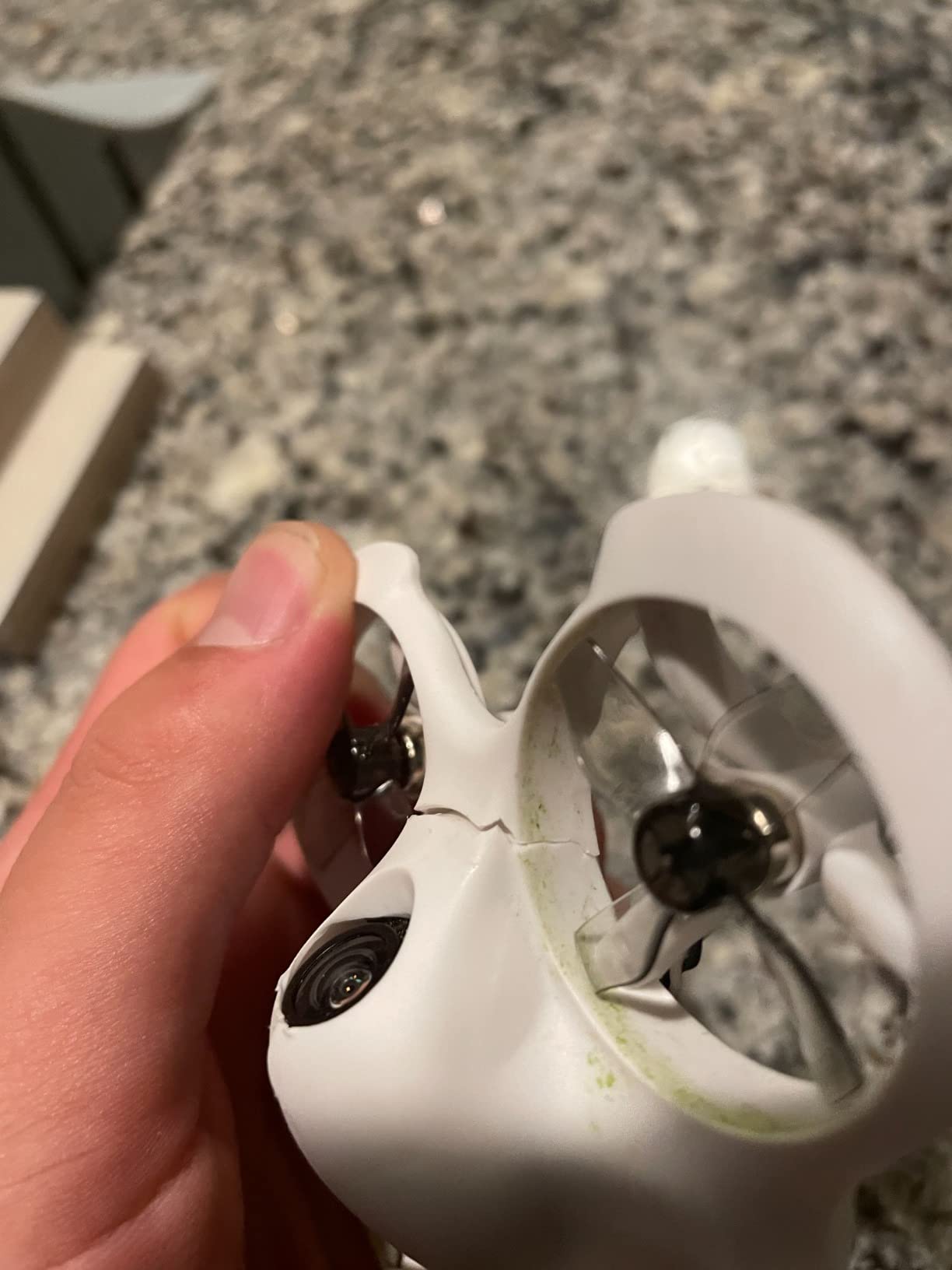
Flight assistance is the second half of the story. The quad has altitude hold, a 6-axis IMU and collision-triggered auto-disarm, so it will level itself and stop the motors when it hits something. That makes it very forgiving, and very unlike a race quad. The 80 meter range is the shortest of any kit here, which is fine for a living room and fine nowhere else.
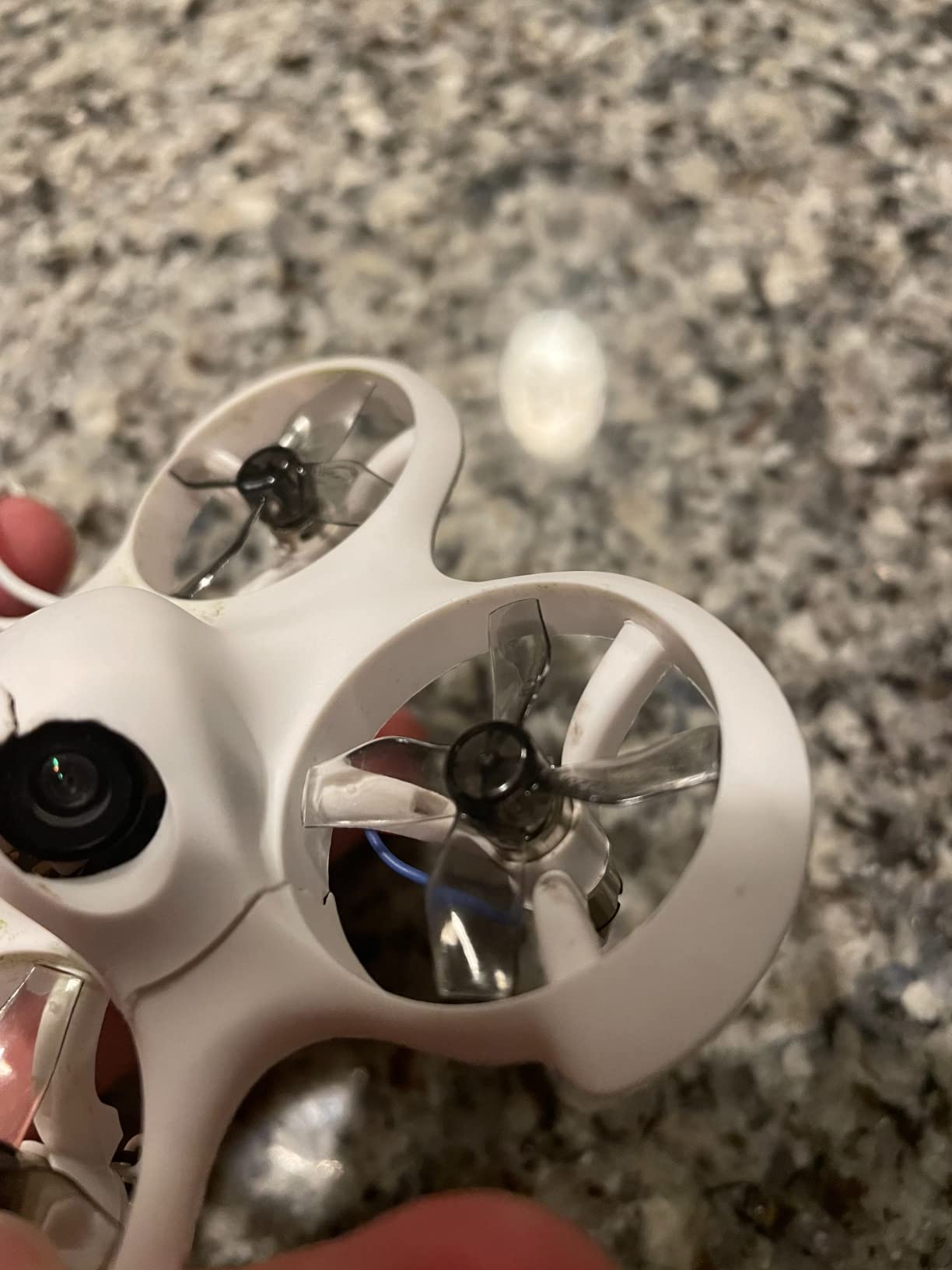
The 3.6 average across 144 reviews needs context. 47% of owners give five stars, satisfied first-time pilots who wanted an approachable introduction, while 17% one-star and 8% two-star reviews centre on control feel, binding steps and disappointment that it is not a true racing quad. A fair number of complaints trace back to one step: the transmitter defaults to FrSky D8 and must be switched to match before binding.
Who the Cetus Lite suits
It suits a pilot who is buying their first FPV setup and wants sim practice on day one. Because the goggles, radio and drone all come from one maker, there is no protocol or frequency guesswork beyond that single binding step, and the VR02 goggles display flight status on screen.
It also suits a parent buying for a child, since the altitude hold and auto-disarm reduce the number of broken motors considerably. The package weight of 0.8 kg is manageable and the PA12 propeller-guard frame is designed to take the hits a beginner inevitably produces.
Who should skip it
Skip it if you want to race. Altitude hold is the opposite of what a gate course demands, and the assisted tuning will have to be replaced before any competitive flying. The 80 meter range also rules out outdoor courses entirely.
Skip it if you want a sim-to-real path. Simulators model acro physics, and a quad that self-levels teaches you the wrong reflexes. Use this kit for a few sessions of orientation, then move to a brushless whoop with a proper radio link.
3. BETAFPV Meteor75 Pro: the 1S whoop that takes real hits
BETAFPV Meteor75 Pro Matrix 1S Brushless Whoop Quadcopter for FPV Racing
1102 21000KV motors
25-400mW VTX
Up to 6.5 min on 1S 550mAh
8 oz listing weight
Pros
- Largest and most durable 1S whoop in its class
- Fast responsive handling for acro and short race lines
- Solder-free motor plugs make repairs simple
- Two batteries and a BT2.0 charger in the box
- Adjustable VTX power for indoor and outdoor
Cons
- 4-6 minutes of flight time is short for practice
- Default camera angle is steep for tight indoor spaces
- Sparse spare parts for frame and AIO board
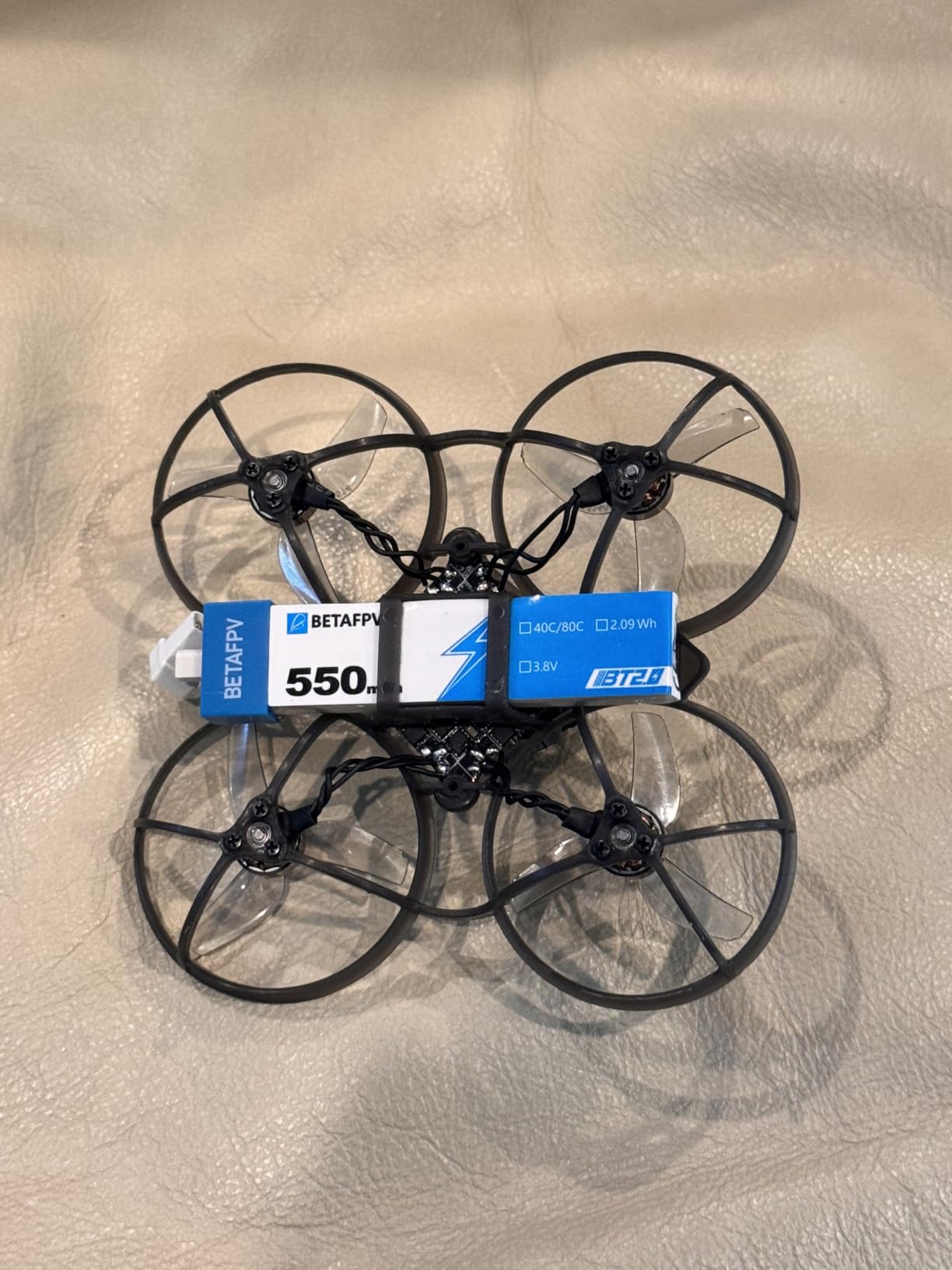
This is the first quad in the roundup that flies proper acro, and it is the natural step up once you can hold a gate in a living room. The 1102 21000KV brushless motors were downgraded from 22000KV in July 2026 to cope with 1S cell voltage, and that change is a good signal about how the manufacturer manages real-world durability.
Hardware is well specified for a whoop. The Matrix 5-in-1 flight controller uses a G473 processor on a 1mm-thick board, the VTX is adjustable from 25mW to 400mW, and the C03 camera weighs 1.45g. Solder-free motor plugs mean a bent motor is a two-minute swap with the included screwdriver rather than a bench job.
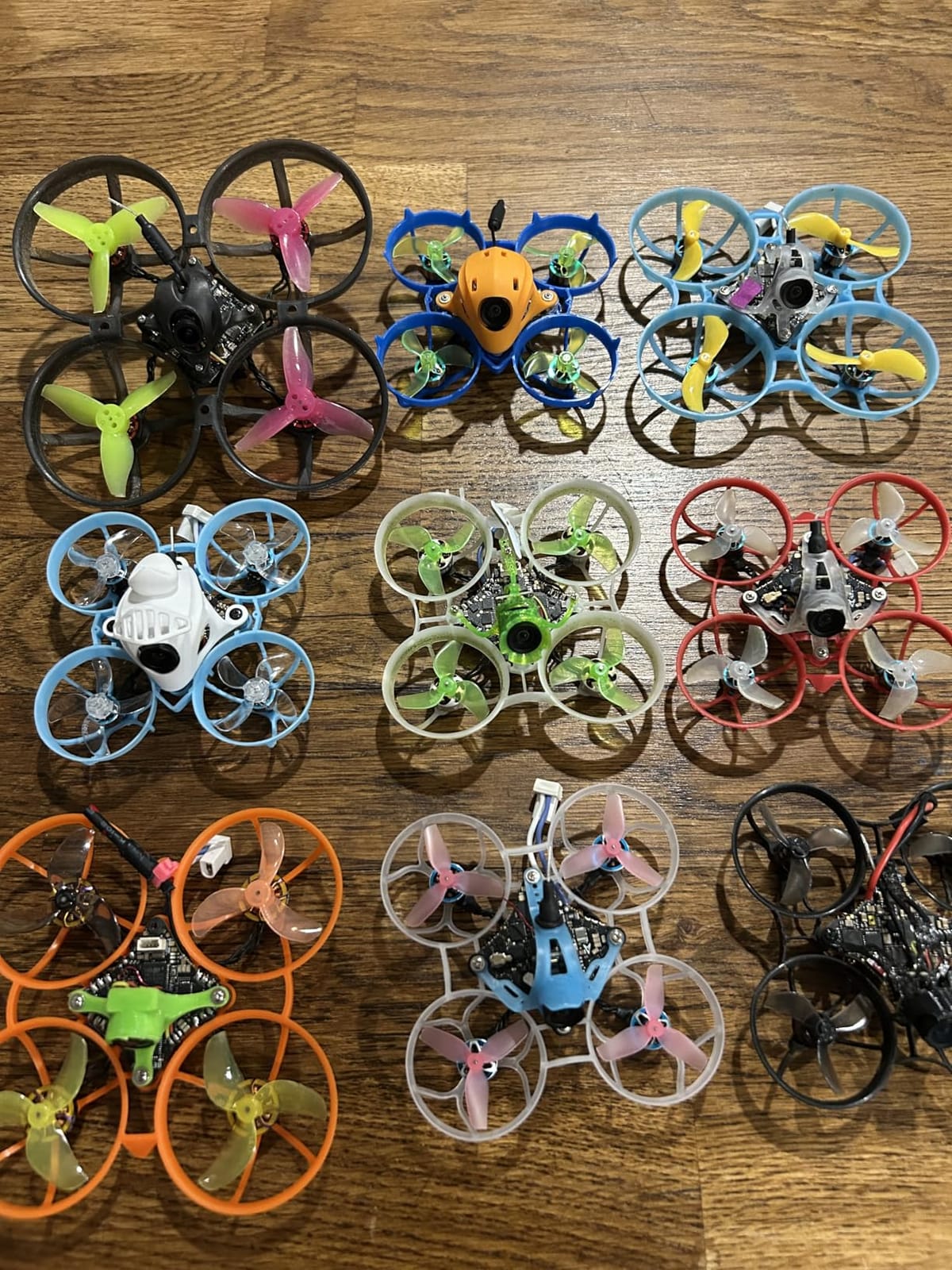
Owners rate durability as the standout quality, and 73% of the 119 reviews are five-star. The recurring cautions are consistent too: short 1S flight time, a steep acro learning curve, a default camera angle better suited to outdoor flying than a garage, and thin availability of spare frames and AIO boards. That last point is worth weighing if you race indoors, where frame damage is the most common failure.
Flight time is the real constraint. The listed maximum is 6.5 minutes on a 1S 550mAh pack, and most owners report 4 to 6 minutes in practice. Two LAVA II 1S 580mAh packs and a BT2.0 charger ship in the box, which is a generous starter bundle, but a race session will empty it quickly.
Who the Meteor75 Pro suits
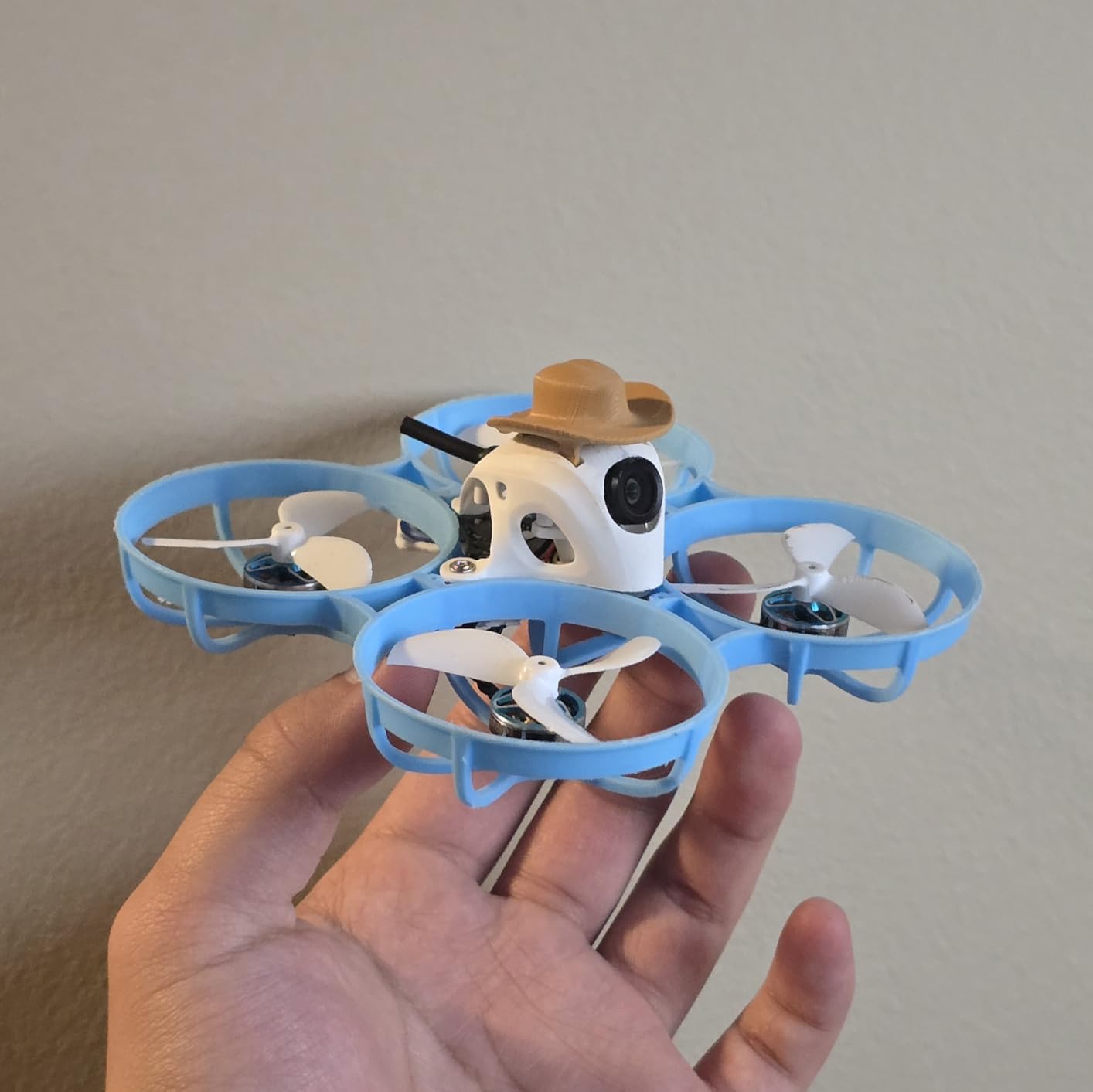
It suits a pilot moving from assisted or RTF flying into real acro on a small budget. Brushless motors, an ELRS radio link and a race-legal video system in one package mean you can join a club night without buying a soldering iron first.
It also suits outdoor practice on a calm day. The 550mAh capacity and 400mW VTX give more runtime and range than the 65mm whoops below, and a 75mm frame is more stable in wind than something lighter. Many pilots on the forums treat this class as the sweet spot between a whoop and a full 5-inch racer.
Who should skip it
Skip it if you want to race long outdoor courses, because 4 to 6 minutes per pack changes how you practise. Long runs and full-lap attempts need the endurance of a 5-inch quad on a 6S pack instead.
Skip it if you fly a small indoor track and care about precision. The default camera angle is aggressive, and the frame at 8 ounces listed weight is heavier than a 65mm whoop, so it will feel less nimble in a tight space. Adjusting the camera angle before your first race solves most of this.
4. GEPRC Vapor-D5 O4 Pro: the 5-inch racer with DJI image quality
GEPRC Vapor-D5 HD O4 Pro FPV Drone (ELRS 2.4G with GPS)
6S 1300mAh battery
430g all-up weight
DJI O4 Air Unit Pro
9.9 x 9.6 x 3.1 inches
Pros
- Fast
- predictable and stable in acro
- GPS rescue reliably restores control and video
- Handles large 6S 100C+ packs better than most frames
- ELRS bind takes about 10 minutes
- Compatible with DJI FPV Controller 2/3 and Goggles 2/3/N3
Cons
- Some vibration and flutteriness reported in flight
- A little heavy for the 5-inch class
- Rear GPS shares antenna space with video and RC
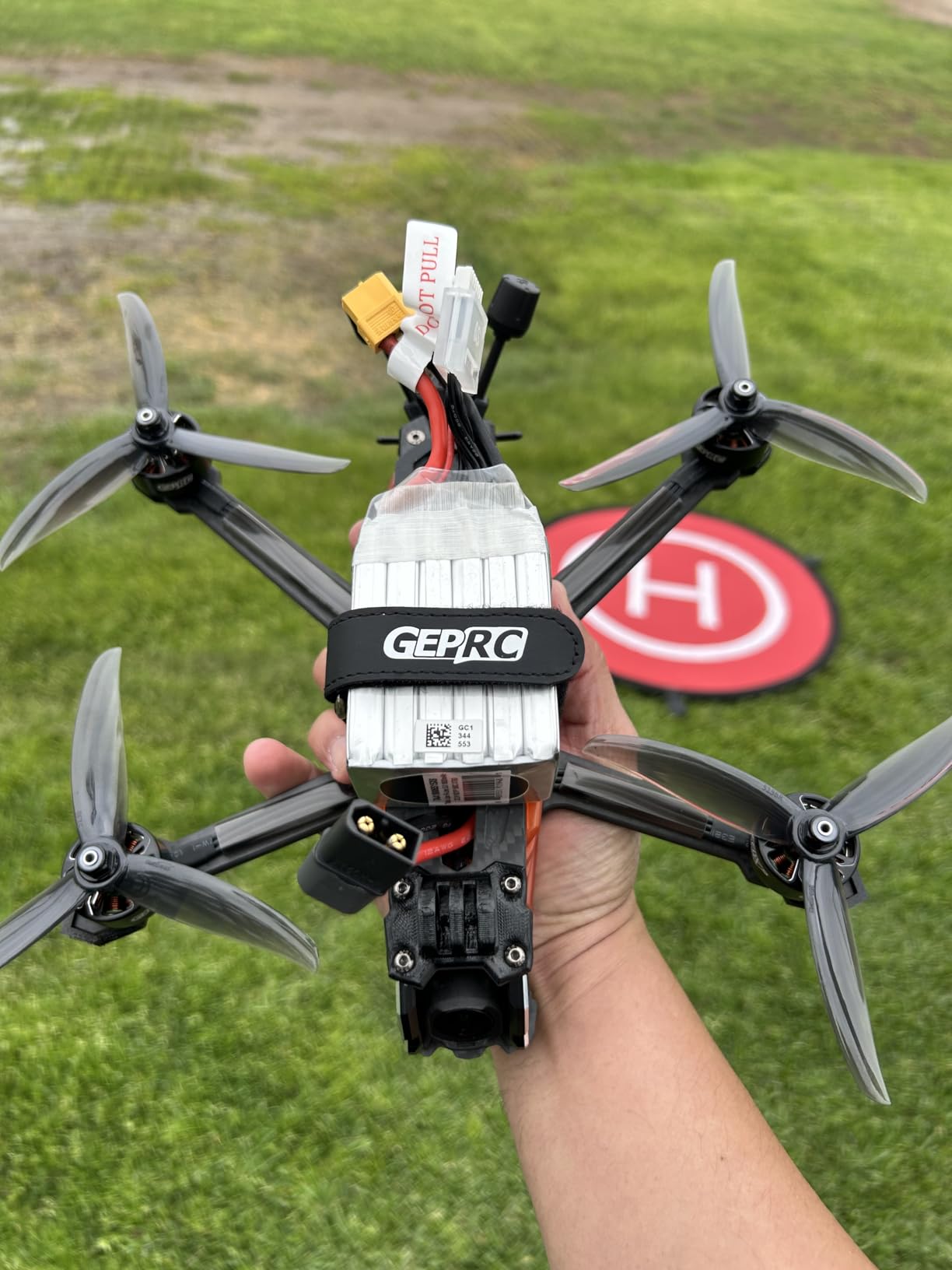
The Vapor-D5 is where the argument for digital video stops being about image quality and starts being about lap times. With a DJI O4 Air Unit Pro, an F7-class stack and 6S power, it is a genuine race-class 5-inch quad, and it is the pick we would put a pilot on who has outgrown indoor whoops and wants to compete outdoors.
Owners describe it as fast and predictable, which is the exact pairing you want from a racing frame. The wider 5mm carbon fiber arms add real durability over standard 4mm arms, and the CNC aluminum lens housing with a front lip protects the most expensive component on the board from the one impact that matters most.
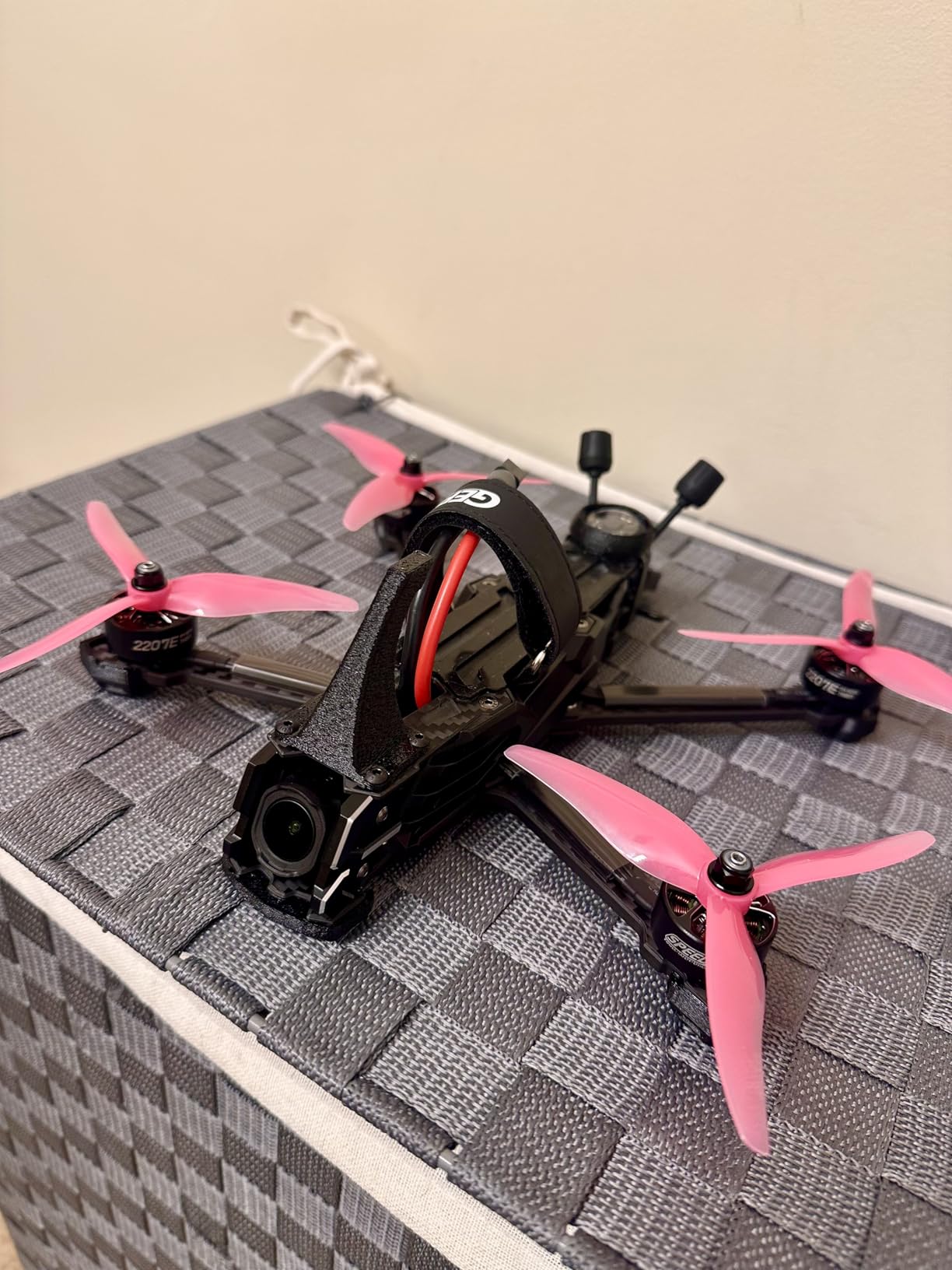
The GPS rescue mode is the feature owners single out most. It does more than return the drone to a launch point: it restores control and video signal, which means a failed video link at altitude no longer means a dead quad. The ELRS 2.4GHz version binds in roughly ten minutes, though you will need to set the packet rate in Betaflight and ExpressLRS yourself.
Review volume is small at 18 ratings, but 92% are five-star with a single one-star outlier. The negatives are specific: some vibration or flutteriness in flight, a weight that sits on the heavy side for the class, and a rear-mounted GPS that shares antenna space with video and radio, slowing satellite lock. All three are setup issues rather than design faults.
Who the Vapor-D5 O4 Pro suits
It suits a pilot who already flies acro confidently on a smaller quad and wants to enter club racing. GPS rescue alone removes a whole category of first-race stress, and compatibility with DJI FPV Controller 2 and 3 and Goggles 2, 3 or N3 means existing DJI pilots are not starting from zero.
It also suits a racer who records between heats. The O4 Air Unit Pro captures 4K internally with a CMOS sensor while streaming 3840-pixel video to your goggles, so you can review a lap from the pits without a separate DVR.
Who should skip it
Skip it as a first FPV drone. A 430g 5-inch quad on 6S is unforgiving, and the learning curve has to be paid somewhere. Without a couple of months of whoop and simulator time behind you, the repair bills will exceed the cost of the drone.
Skip it if you have not committed to the DJI ecosystem. The digital link is the reason this quad performs the way it does, and pairing it with an analog goggle setup means buying second hardware. If analog is what your club runs, the value of the O4 package falls sharply.
5. Tinyhawk 3 PLUS+ RTF Kit: the RTF box with an ELRS radio
Tinyhawk 3 PLUS+ RTF Kit Ready To Fly ELRS Analog FPV Drone Mini Racing Quadcopter Durable Frame with Controller and Goggles for Beginners
ELRS analog FPV link
23g listing weight
3 x 3 x 1 inches
All-in-one RTF box
Pros
- All-in-one kit with quad
- goggles
- controller and battery
- ELRS radio link steps up from toy transmitters
- Durable frame built with lightweight materials
- Recognised brand with a track record across skill levels
Cons
- Highest one-star share of any product here at 31%
- Basic plastic frame limits acro performance
- Smallest hobby category sales rank of the RTF kits tested
The Tinyhawk 3 PLUS+ is interesting for one reason: it puts a genuine ELRS radio in a ready-to-fly box. That matters more than it sounds. Most RTF kits ship with a 6-channel toy transmitter, which means you have to buy a proper radio before you can ever fly anything else on this list. With this one, the controller carries forward.
It is also an analog kit with increased transmission power, which makes it a more legitimate racing entry point than a typical RTF toy. The analog path is cheaper to run and has lower latency, so if your club still races analog you can arrive with hardware that fits.
The problem is consistency. The 3.3 average across 20 reviews comes with the widest spread in this roundup: 41% five-star, 31% one-star. That is a quality-control signal rather than a design problem. Buyers who receive a working unit like the durable frame and the straightforward ELRS setup, and roughly a third report problems. If you are buying this, order it from somewhere with an easy return.
Who the Tinyhawk 3 PLUS+ suits
It suits a pilot who wants ELRS hardware without building or soldering anything. Since the control link matches the brushless whoops and most 5-inch racers on this list, the radio is not wasted when you upgrade. That continuity is the reason to pick it over a cheaper 6-channel kit.
It also suits a family buying a first FPV set together, because the box includes the quad, controller, goggles and battery with a durable frame underneath. It is a low-stakes way to find out whether the hobby suits anyone in the house.
Who should skip it
Skip it if reliability matters more than the complete package, given that a third of reviewers hit problems. For a first serious purchase, a product with consistent owner feedback is worth the small step up.
Skip it if you want to race. The plastic frame and the listed 23g weight tell you this is a durability-limited trainer, not a gate machine. Treat it as a stepping stone to a whoop within a few months, not as a racer.
6. BETAFPV Air75 II: the punchiest whoop on short indoor lines
BETAFPV Air75 II Brushless Whoop Quadcopter, for Champion FPV Quadcopter
0802 brushless motors
7.1:1 thrust-to-weight
15-45 degree camera
Sub-20g class
Pros
- Exceptional 7.1:1 thrust-to-weight for explosive acceleration
- Matrix 5-in-1 II stack with cushioning mounts
- Camera angle adjustable from 15 to 45 degrees
- Very light weight favours agility
- Damage rate cut by up to 80 percent on the 3-point mount
Cons
- 0802 motors and light frame are less durable than the Meteor75 Pro
- Only 18 reviews so long-term data is thin
- Setup has a learning curve for first-time whoop pilots
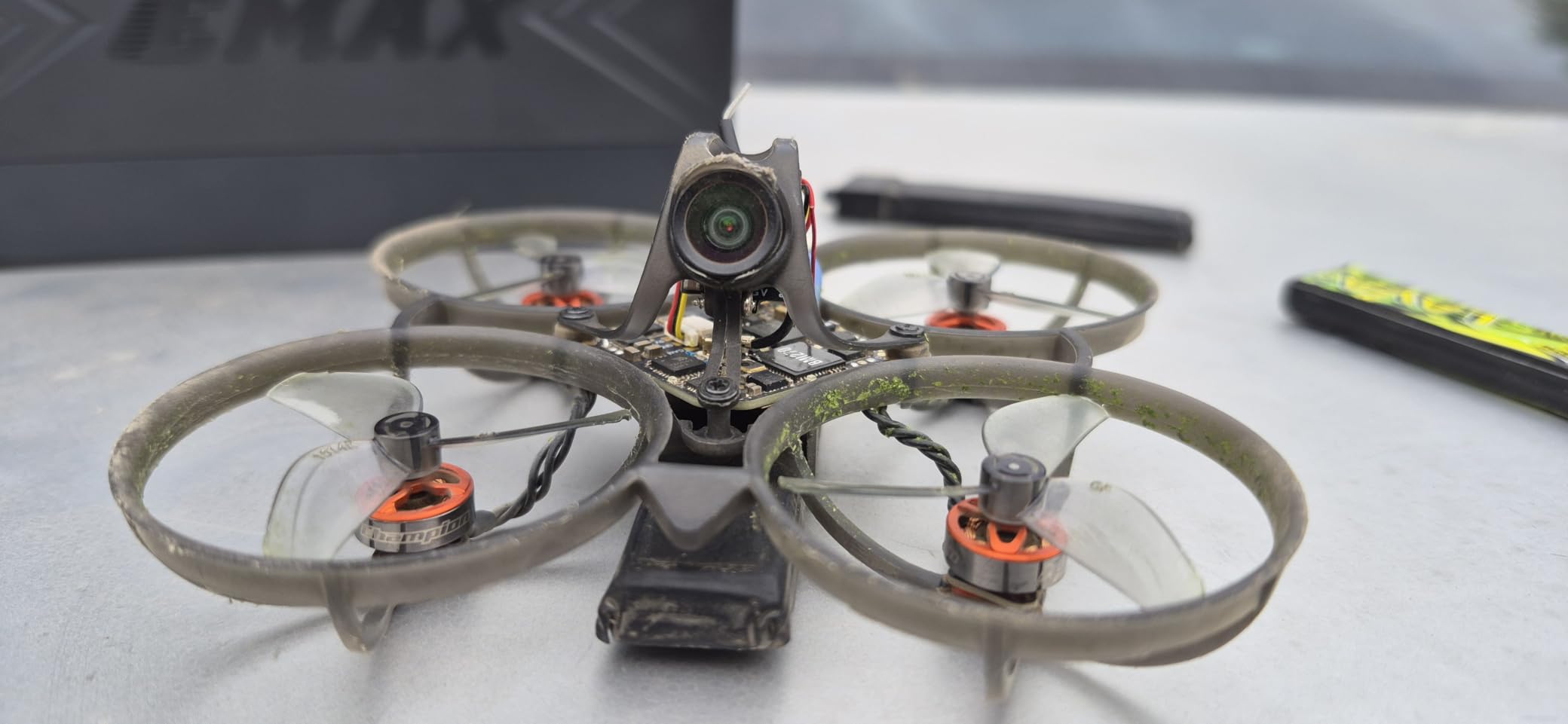
Acceleration is the whole argument for the Air75 II. The dual-ball-bearing 28000KV 0802 motors produce a listed thrust-to-weight ratio of 7.1:1, which means the quad pulls out of a corner faster than anything else in the 1S bracket. On a short indoor line with two or three consecutive gates, that is a real lap-time difference.
It is also the cleverest piece of engineering here. The Matrix 5-in-1 II flight controller uses a 3-point mounting arrangement that cuts component damage rates by up to 80% compared with a direct mount, and the PCB is thickened to 1.0mm. The Air II canopy adjusts the camera from 15 to 45 degrees, which lets you match the view to a track rather than fighting a fixed angle.
Owners highlight the punch of the motors and the frame reinforcement that survives repeated impacts. 57% of the 18 reviews are five-star and 17% four-star, with a 12% one-star group. Sample size is the real limitation here, so treat the durability claim as promising rather than proven over a season of racing.
The trade against the Meteor75 Pro is weight. The Air75 II sits in the sub-20g class, and lighter is faster in a whoop, but it is also less durable in a hard impact. Where the Meteor75 Pro absorbs crashes, the Air75 II gets past them. Pick according to whether your track has room to build speed or room to crash.
Who the Air75 II suits
It suits a pilot who races indoors on a short, technical track and wants the sharpest handling available in 1S. The adjustable camera angle is the feature that will save you most frustration when a track has low ceilings or tight gate spacing, since you can point the lens where you actually need to see.
It also suits a freestyle-leaning pilot who wants one quad for both. The same punch that launches it through a race gate is what makes it a capable freestyle whoop, and the 12A continuous, 18A peak ESC has headroom for hard current draws.
Who should skip it
Skip it if you are new to acro. A 7.1:1 thrust-to-weight ratio means the quad will do things faster than you can react to, and the setup takes understanding that the assisted kits do not require. Learn on the Meteor75 Pro first if orientation is still shaky.
Skip it if you fly hard against objects. The 0802 motors and lightweight frame are the least forgiving combination in this roundup, and a prop strike at speed is the fastest way to end a pack.
7. Happymodel Mobula7 1S: built for organized race days
Happymodel Mobula7 1S 75mm Micro FPV Whoop Drone – 5-in-1 AIO Flight Controller with ExpressLRS 3.0, RS0802 20000KV Motors, 1S Whoop Quad for Indoor & Outdoor Freestyle, Mini FPV Drone (Drone)
24g with 75mm wheelbase
400mW OpenVTX
Caddx ANT 1200TVL camera
Batteries not included
Pros
- All-in-one AIO stack removes the need to solder
- OpenVTX RCE and PIT modes made for organized races
- Snappy response with good flight time on HV packs
- Spare parts and screws stored in the canopy
Cons
- Only one owner review
- so there is almost no long-term data
- Factory Betaflight settings need adjusting before 2S use
- Battery not included
The Mobula7 1S is the only quad here with video transmitter modes built for race-day frequency management. RCE and PIT mode in OpenVTX let you change channel quickly and avoid interference when several pilots are transmitting on 5.8GHz in the same room, which is precisely the situation at a club race.
Everything else is consolidated onto one board. The 5-in-1 AIO flight controller integrates an ExpressLRS 3.0 receiver, OpenVTX up to 400mW, a 12A BLHeli_S ESC and a Betaflight OSD, so there is no soldering and no separate VTX to crimp. The RS0802 20000KV motors sit on a PCB bottom plate, and the Caddx ANT 1/3-inch CMOS camera supports both 16:9 and 4:3 output.
At 24g on a 75mm wheelbase with Gemfan 1610 bi-blade props, it is a light 1S build that suits short bursts rather than endurance. The single owner review reports strong flight times on 260-300mAh HV packs and notes that factory settings must be lowered from 8kHz to 4kHz if you run 2S. That is a useful warning from someone who has flown it, and it is the only owner feedback available.
Who the Mobula7 1S suits
It suits a pilot who races at organized events rather than alone in a field. The RCE and PIT VTX modes are the argument, because channel juggling is the single most common source of lost video at a club night, and this quad handles it from the OSD.
It also suits anyone who wants a solder-free 1S build with a modern radio link already integrated. The canopy stores spare props and screws, which is a small detail that saves you at a track when a canopy snaps and you need to keep flying.
Who should skip it
Skip it if you rely on owner feedback to make a confident decision. One review tells you the reviewer liked it, which is not enough to judge long-term reliability of an AIO board, and no one here has written about owning this for a season.
Skip it if you want a complete package. Batteries are not included, so add 1S packs and a charger to the total before comparing it to the kits above. The reviewer also notes factory tuning is set for 1S and needs changing for 2S use.
8. Happymodel Mobula6 2024: the lightest 65mm option here
Happymodel Mobula6 2024 1S 65mm Ultra-Light Micro FPV Whoop Drone BNF with SuperX ELRS 5-IN-1 AIO (400mW VTX, SE0702 28000KV) – 17.7g Tiny Racing Drone for Indoor/Outdoor – No Battery, No GPS
17.7g all-up weight
F4 FC, 5A ESC, SPI ELRS, 400mW VTX
100m ELRS range
No battery included
Pros
- At 17.7g it is among the lightest 65mm whoops
- 400mW OpenVTX penetrates indoor spaces better than 200mW designs
- Clean internal build with no external wiring
- 5A ESC and ELRS link suit tight indoor lines
Cons
- No battery included
- No GPS or return-to-home by design
- Only two reviews so reliability data is minimal
The Mobula6 2024 takes the same idea as the Mobula7 and shrinks it. At 17.7g on a 65mm whoop, it is among the lightest options in this roundup, and the SuperX ELRS 5-in-1 AIO integrates an F4 flight controller, 5A ESC, SPI ELRS receiver, 400mW OpenVTX and current sensor on a single board with no external wiring to snag.
Video is the standout. The FX17-B 800TVL 1/3-inch CMOS camera feeds an OpenVTX adjustable from 25mW to 400mW through SmartAudio, and 400mW is roughly double what a standard whoop VTX puts out. In a house with two brick walls between you and the quad, that difference decides whether you keep the video link.
The SE0702 28000KV motors are tuned for 1S LiHV cells, and control range on ExpressLRS 2.4GHz is listed at 100 meters. Both numbers point clearly at indoor use, which is where this quad belongs. Two reviews, split evenly between five and four stars, is a favourable but very small sample, so the published figures on weight and VTX power are stronger evidence than the owner sentiment.
Who the Mobula6 2024 suits
It suits a pilot who races indoors through a house or a large garage where video penetration is the deciding factor. Nothing else this small in the roundup pushes 400mW, and that is the difference between a clean line and static in a room with obstacles.
It also suits a pilot chasing lightness. At 17.7g the quad changes how a 65mm whoop feels, and pilots moving up from an even smaller whoop will notice the difference immediately in cornering speed and roll rate.
Who should skip it
Skip it if you fly outdoors. With no GPS, no return-to-home and 100 meters of control range, a flyaway is a total loss. There is no recovery path built into this design, and that is a deliberate choice rather than an omission.
Skip it if you want a turnkey package or solid long-term data. No battery is included, and two reviews is not a track record. For a first whoop purchase, the Meteor75 Pro has both a battery in the box and a far larger body of owner feedback.
9. GEPRC MARK5 O4 Pro DC: video-first 5-inch performance
GEPRC MARK5 O4 Pro DC FPV Drone (6S PNP with GPS)
6S 1300mAh battery
440g all-up weight
O4 Air Unit Pro
TAKER F722 BT 50A stack
Pros
- Every one of the four reviews is five stars
- Integrated O4 Air Unit Pro with 4K/120fps capture
- Silicone-damped aluminum camera mount smooths high-speed footage
- Tool-free quick-release arms speed up repairs
- 50A stack and 2107.5 motors give precise thrust
Cons
- Only four reviews behind the perfect rating
- Premium end of the 5-inch class
- PNP version needs a compatible receiver and transmitter
The MARK5 O4 Pro DC is the video-first end of the 5-inch class. The integrated O4 Air Unit Pro uses a 1/1.3-inch sensor to record 4K at 120fps while transmitting 1080p at 100fps to your goggles, and the aluminum camera mount sits on silicone damping to absorb the vibration that turns racing footage into unusable shake.
Underneath, the build is properly race-oriented. A TAKER F722 BT 50A flight controller pairs with 2107.5 1960KV motors, and the Bluetooth tuning app removes the need for a configuration interface. Quick-release tool-free arms mean a bent arm after a gate is a swap rather than a rebuild, which is the single biggest time saver on repair days.
The frame choice matters for how it flies. The DC layout is built for agility, with a wide-X option available for stability, and the package includes 3D printouts, anti-slip battery pads, screwdrivers, props, spare screws and a strap. Owners also get dedicated capacitor and buzzer compartments, small details that stop components rattling against the frame.
All four reviews are five stars, with no negative feedback at all. That is encouraging and statistically fragile, so read it as directional rather than conclusive. The six-pack 1300mAh battery and ELRS 2.4G GPS options are typical of the class rather than standout features.
Who the MARK5 O4 Pro DC suits
It suits a racer who films. If you publish laps, run a channel, or simply want to review your racing lines from the pits, the 4K/120fps internal recording and the damped camera mount are the reason to choose this over another O4 quad. A 5-inch digital racer records what a 65mm whoop simply cannot capture.
It also suits a pilot who repairs their own quads. Quick-release arms, a Bluetooth tuning app and the included tool and spare pack mean most maintenance is a bench job at home rather than a workshop visit.
Who should skip it
Skip it as a first 5-inch quad. This is a premium machine in a class where mistakes are expensive, and a 440g quad flown by a pilot without acro experience will find the pavement quickly. Learn on a whoop first.
Skip it if you fly analog. The O4 Air Unit Pro is the centre of the build, and there is no meaningful way to fly it without DJI goggles. If your club runs analog, the money is better spent on a whoop and a good pair of analog goggles.
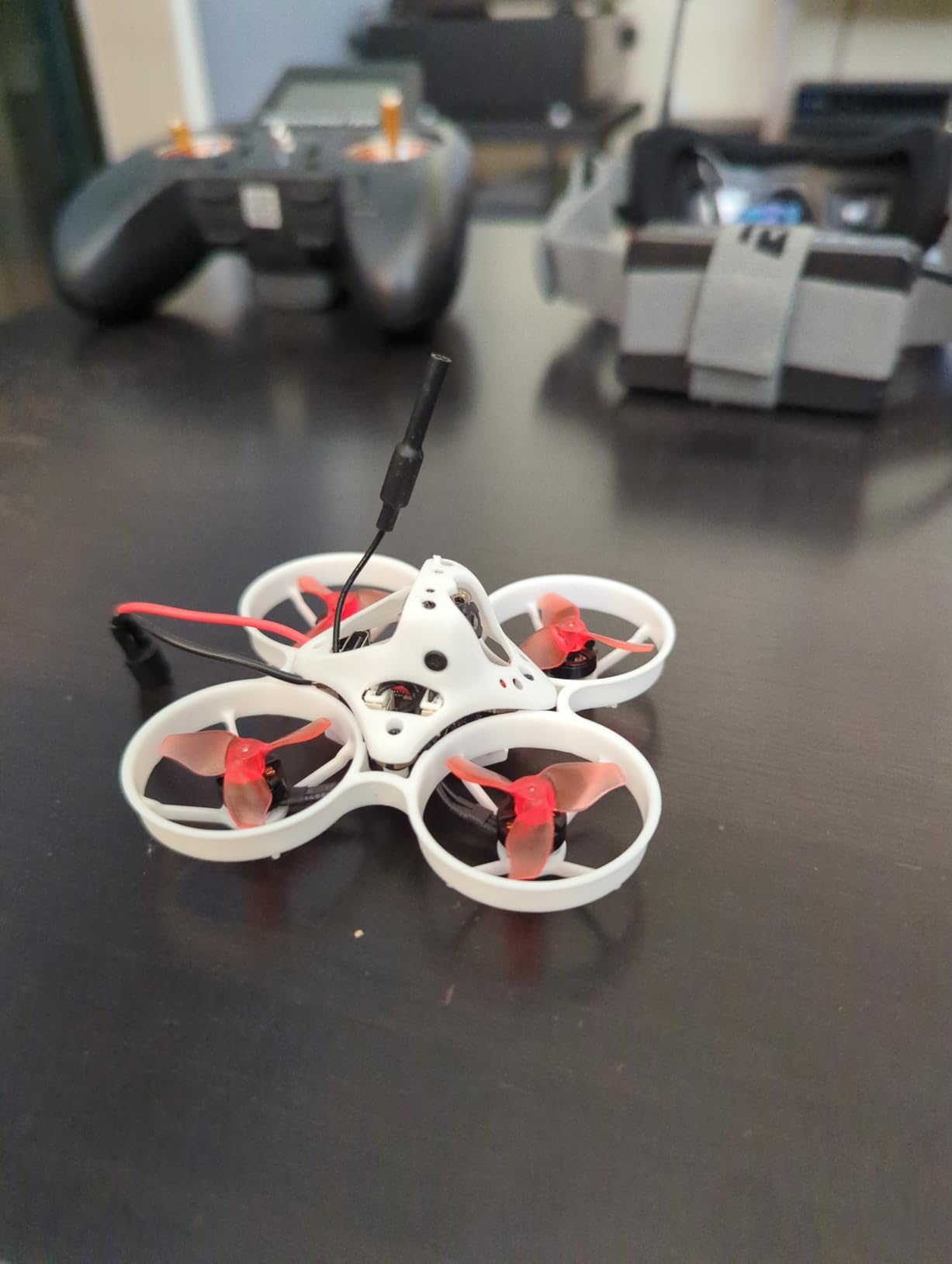
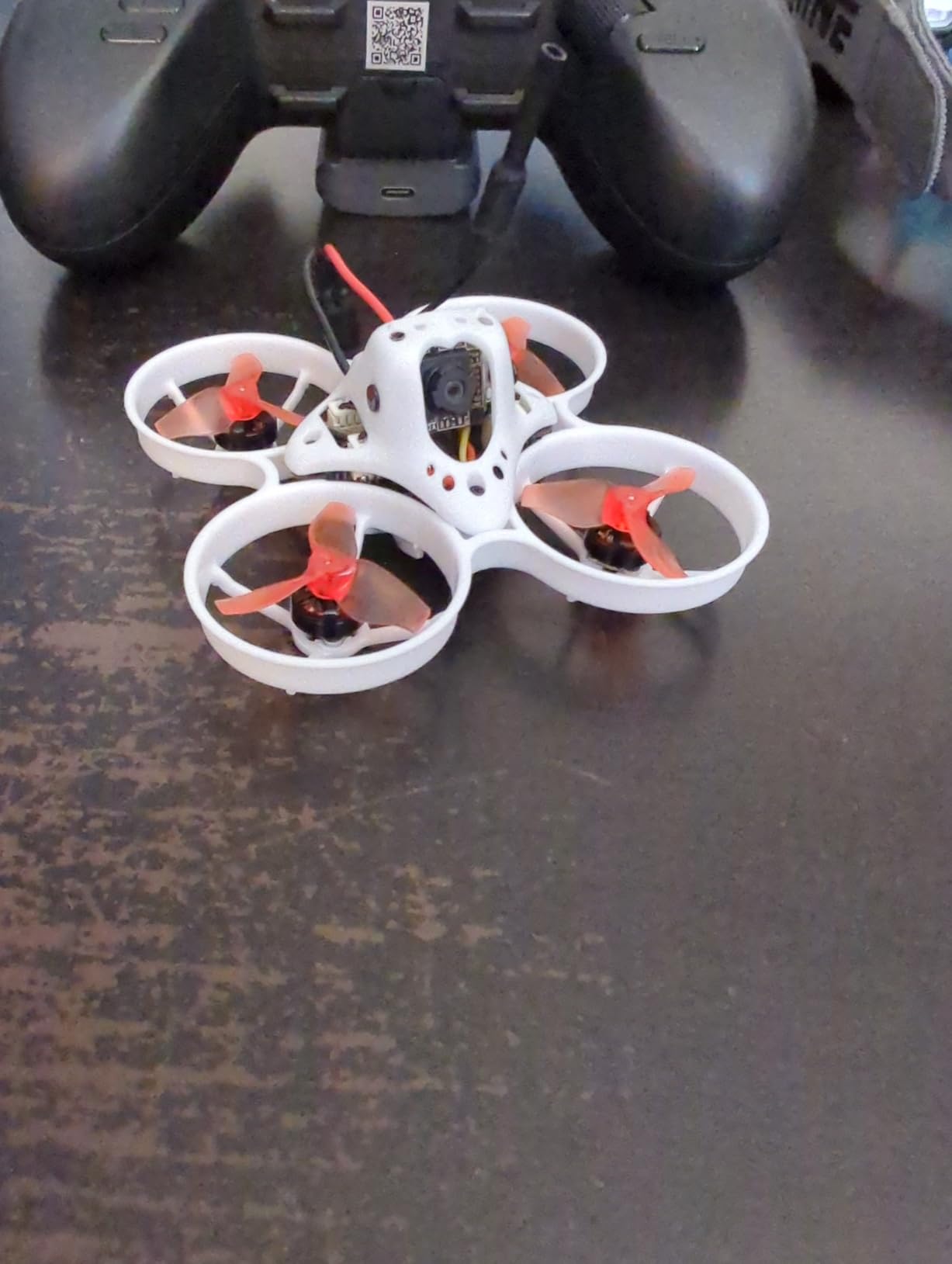
10. Tiny Hawk Nanoscout BNF: the cheapest way onto ELRS whoops
Tiny Hawk Nanoscout FPV Drone BNF ELRS 1s 25mw-400mw 65mm Quadcopter With Runcam Nano 3
65mm whoop
RunCam Nano 3 camera
25-400mW VTX
Battery and spares included
Pros
- Adjustable camera angle produced one reviewer's best track times
- Tamer handling on tight tracks for less experienced racers
- Solid build quality for the price point
- Brushless motors and ELRS link at entry level
- Ships with battery
- spare props and a spare parts pack
Cons
- 25% one-star reviews report dead motors or binding failures
- Uncommon battery connector makes extras harder to source
- Factory camera angle is low and shows prop guards
- 23g is heavy for a 65mm whoop
The Nanoscout is the most interesting entry point for a pilot who already owns FPV goggles and an ELRS radio but does not want to build. It is a BNF package, so you supply the radio and goggles, and the box includes a battery, a spare propeller set, a spare parts pack and a USB charger. That is a complete first whoop for far less than the RTF kits.
Two details set it apart from the other whoops here. The RunCam Nano 3 camera sits on an adjustable mount, and one reviewer reports the adjusted angle produced their best track times, which matches what the Air75 II canopy offers for the same reason: you are matching the view to the track. The VTX is also adjustable from 25mW to 400mW, so one quad covers both indoor and outdoor.
The owner profile is bimodal, which is worth reading carefully. 53% of the 12 reviews are five-star from racers competing in the RaceGOW5 spec class who praise handling and value, against a 25% one-star group reporting quality control failures such as motors not spinning and units that will not bind. Tuning and camera angle are widely praised once set up correctly.
Two smaller issues are worth knowing. The battery connector is uncommon, so replacement packs are harder to source than standard XT30 or PH2.0 packs, and the listed 23g weight is heavy for a 65mm whoop, which takes some of the agility advantage out of the small size.
Who the Nanoscout BNF suits
It suits a pilot who already has goggles and an ELRS radio and wants a race-legal whoop without soldering. The BNF format means you bind, set your rates and fly, which is the shortest path from owning gear to racing gates on this list.
It also suits a pilot chasing a specific weight class. Owners racing in the RaceGOW5 spec class report genuine results with it, so if your local league runs a spec 65mm class this is a quad that has already proved it can be raced rather than merely flown.
Who should skip it
Skip it if reliability is your priority, because a quarter of reviewers report units arriving with dead motors or unable to bind. That is a factory consistency problem, not something you can tune out, so buy it where returning it is easy.
Skip it if you are on a tight schedule for battery packs. The uncommon connector means a dead pack can end your flying day while you wait on parts, and the listed 23g weight makes it slower than the lighter whoops on this list.
How to Choose an FPV Racing Drone in 2026
RTF vs BNF vs PNP vs pre-built and tuned, decoded
These four labels describe how much work stands between the box and the first flight, and confusing them is the most common reason a first-time buyer stalls. RTF, ready to fly, means everything is included and nothing needs configuring. The Tiny Hawk RTF and the Cetus Lite are RTF kits, which is why you can fly within the hour.
BNF, bind and fly, means the quad is complete but you supply the radio and the receiver pairing is up to you. The Nanoscout and both Happymodel whoops are BNF. PNP, plug and play, sits between the two: the quad needs a compatible receiver and transmitter to be flown, which is exactly the situation with the PNP variant of the MARK5 O4 Pro.
Pre-built and tuned means a specialist has soldered, assembled and flown the quad to set its rates and filters, and it arrives ready to race. That is the highest-confidence entry point and also the most expensive, and it is the format worth paying for if you intend to compete rather than practise.
Analog vs digital video for racing
Analog is lower latency, cheaper and lighter, and every whoop on this list except the RTF kits uses it. Digital systems such as the DJI O4 Air Unit Pro on the two GEPRC 5-inch quads deliver far better image quality in low light and near zero interference, at the cost of weight, power draw and ecosystem lock-in. You cannot mix the two: a digital quad needs digital goggles.
The forum consensus we reviewed frames it as a genuine three-way trade-off rather than a simple upgrade path. Velocidrone is praised for racing physics, DJI for image quality, and HDZero is described as the best balance of latency and clarity. For gate racing where reaction time decides the lap, analog still has an edge on pure latency. For learning to fly, where you need to see where you are going, digital wins clearly.
Our read for 2026: buy analog if you are starting on whoops and your club races analog, and buy digital if you are moving to 5-inch racing or filming. Whichever you pick, commit to it. Owning one system well beats owning half of each.
Size class: 1 inch, 2.5 inch, 3.5 inch or 5 inch
Size class is the decision that most affects whether you progress or quit. A 1-inch toothpick or 65-75mm whoop is cheap to repair, safe indoors and can be flown in a living room, but it teaches limited speed. A 2.5-inch whoop is the same idea with more power. A 3.5-inch quad is the freestyle-racing middle ground that many pilots treat as the sweet spot before 5-inch. A 5-inch quad is the actual race class, and the fastest and least forgiving machines in this roundup.
Worth flagging: the standard advice to start small has a genuine counterargument. Pilots on the forums describe tiny whoops as harder than they look, because the frame is small enough to disappear against a patterned wall and the props are close to your face. If you are choosing a first whoop, look for prop guards and a durable frame rather than the smallest option available.
Control link: pairing your radio with the quad
ExpressLRS, or ELRS, is the default on every brushless quad in this roundup, and the forum consensus is clear that it has replaced Crossfire and FrSky for new builds. If you buy a radio, buy an ELRS one. It gives you a low-latency link with a wide range of affordable receivers, and it is the link every BNF quad here expects.
The exception is the Cetus Lite, whose LiteRadio 1 transmitter ships defaulting to FrSky D8 and can be switched to Futaba S-FHSS and FrSky LBT D16. That mismatch is the single most cited frustration in its reviews, so set the protocol before you try to bind.
What else you need besides the drone
An RTF kit covers goggles, radio and battery. Everything else needs a list. You need FPV goggles matched to your video system, an ELRS radio transmitter, at least six LiPo batteries, a charger with a balance lead, spare props, and a set of spares for whatever breaks first, which is almost always the frame or the canopy.
You also need somewhere to fly. Indoor flying on whoops is possible in a large space, and outdoor gate racing is where 5-inch quads belong. If you are serious about racing, plan for a spotter when flying line of sight, since the pilot’s focus is inside the goggles and not on the surrounding airspace.
What it really costs to race FPV
The drone is the smallest part of the budget in the long run. Crash damage is the loudest complaint in every FPV forum we read, and the recurring theme is that destroyed frames, motors and props, plus spares ordered in a panic, are what stop people progressing rather than what starts them.
Two numbers make this concrete. A whoop session of 20 minutes consumes six or seven 1S packs at 4 to 6 minutes each, and a 5-inch pack on a 6S quad gives you far less than people expect, which is why racers carry eight to twelve packs. Budget for that cycle from the beginning, along with a dual charger, and the hobby becomes predictable rather than expensive.
Simulator first, then gates
The most common advice in the communities we reviewed is to buy a simulator before buying a race quad, and to spend a month or more in it. Velocidrone is the most recommended for racing physics, while Liftoff and DRL Simulator cover the basics and the Cetus Lite’s radio works with all three. Simulator hours cost nothing and every hour you log is an hour of real quad you do not destroy.
If your setup rig is part of the plan, our racing simulator cockpit guide covers the hardware side. The sequence that works is sim practice, then whoop gates indoors, then outdoor whoop or a 3.5-inch quad, then 5-inch racing.
Legality and race-day etiquette
FPV drones are legal to fly in the USA, but the rules are specific. Under FAA regulations you must fly line of sight or have a visual observer with you, you cannot fly over people, and you must keep the aircraft within visual line of sight unless you hold a remote identification and follow the applicable waiver conditions. A spotter is effectively mandatory for racing, and every club event runs on that basis.
At a race meet, VTX frequency management is the etiquette nobody teaches you properly. Check the event frequency chart before you arrive, keep your VTX at low power indoors unless the organiser says otherwise, and do not power up on the wrong channel before the heats are called. Clubs running MultiGP, DRL or DCL events will tell you their house rules, and following them is what earns you a place to fly again next week.
Frequently Asked Questions
Which pre-built FPV drone is the best?
The best pre-built FPV drone depends on your level. For a first flight with no gear, the EMAX Tiny Hawk RTF Kit is the strongest all-in-one option, with goggles, controller and battery in the box. For a first proper acro quad, the BETAFPV Meteor75 Pro gives you brushless motors, an ELRS link and two batteries. For 5-inch racing, the GEPRC Vapor-D5 O4 Pro adds DJI O4 video and GPS rescue.
What is the best racing drone right now?
The best racing drone in 2026 is the GEPRC Vapor-D5 O4 Pro if you are ready for 5-inch gate racing, because the DJI O4 Air Unit Pro, wider 5mm carbon arms and GPS rescue mode give a forgiving first race experience. On a smaller budget, the BETAFPV Meteor75 Pro is the best racing drone for indoor and short outdoor courses, with a 550mAh cell and a VTX adjustable to 400mW.
Is analog or digital better for FPV racing?
Analog wins on pure latency, weight and cost, and every brushless whoop in this roundup uses it. Digital systems such as the DJI O4 Air Unit Pro give far better image clarity, near-zero interference and 4K recording, at the cost of weight and power draw. For gate racing where reaction time decides the lap, analog still has the edge; for learning to fly and filming, digital is the stronger choice. The two systems are not interchangeable, so commit to one.
How fast does a 5 inch FPV drone go?
A 6S 5-inch racing quad is the fastest class in this roundup, with published motor and air unit specifications rather than a measured figure from our own testing. What matters more than the top speed figure is the practical racing speed through a gate, which is limited by video latency, camera tilt and how much of the course you can see. That is why the digital O4 quads feel faster to fly than their analog rivals despite comparable airframes.
How much does it really cost to get into FPV racing?
The quad is the smallest part of it. A realistic entry stack is a drone, FPV goggles matched to the video system, an ELRS radio transmitter, at least six LiPo batteries, a balance charger and a stock of spare props, frames and canopies. Add race membership and travel to club events and the running cost per year climbs quickly. Forums consistently report crash damage, not the initial purchase, as the reason new pilots stall out.
Are FPV drones illegal in the USA?
No. FPV drones are legal in the USA, but you must follow the FAA rules for recreational flying. You need to keep the aircraft within visual line of sight or have a visual observer with you, never fly over people, and register where required. Because a racing pilot’s attention is inside the goggles, a spotter is effectively mandatory for gate racing, which is how club and league events are run.
The Right FPV Racing Drone Depends on Your Pilot Level
If you have never flown FPV, start with the EMAX Tiny Hawk RTF kit. It is the most reviewed drone in this roundup, it costs you nothing beyond the box, and it answers the only question that matters in your first hour: do you enjoy this. If the answer is yes, move to the BETAFPV Meteor75 Pro, which is the best value transition into real acro on brushless motors with an ELRS link and two batteries in the box.
Once you are racing 5-inch gates, the GEPRC Vapor-D5 O4 Pro is the pick, with the DJI O4 Air Unit Pro, durable 5mm arms and a GPS rescue mode that saves quads. The MARK5 O4 Pro DC is the alternative when recording quality matters as much as lap time. For indoor competition on a tight budget, the Air75 II, Mobula7 1S and Nanoscout cover the three angles of aggression, race-day video management and value.
Whichever you choose in 2026, spend simulator time before you spend money, and buy spares with your first order. Those two habits do more for your progress than any spec on this page.