
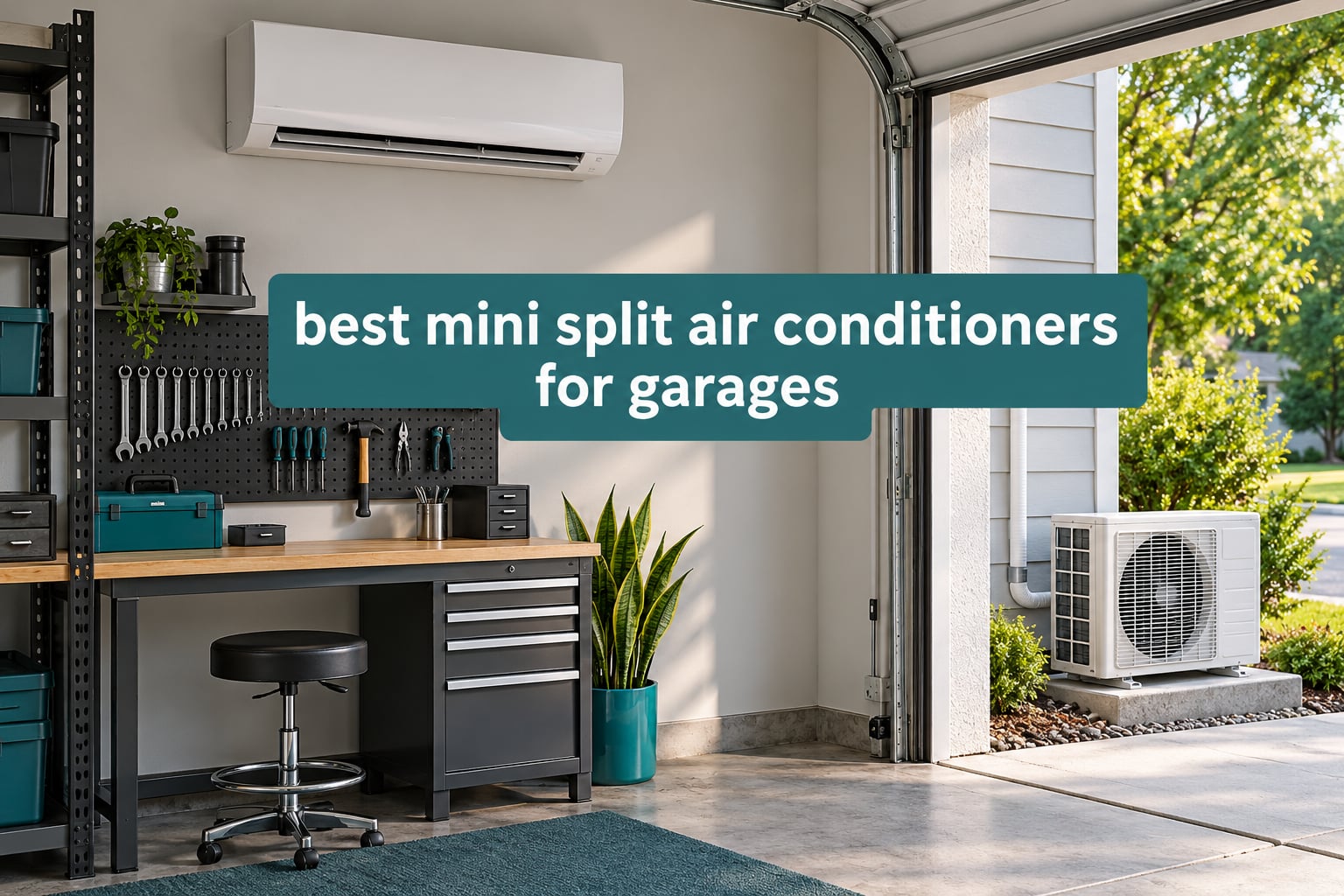
A garage is the one room in most homes that was never meant to be comfortable. In July, a typical two-car attached garage runs 20 to 40 degrees hotter than the living space. In January, it drops close to outdoor temperature unless you are heating it deliberately. A ductless mini split changes that in a single afternoon of work, and it is the only realistic way to add real cooling and heating to a space that has no ductwork and often no dedicated circuit.
Choosing the best mini split air conditioners for garages is harder than it looks, because four variables decide whether a unit works: the actual square footage of the space, how well the walls and door are insulated, what the local voltage situation is, and whether you want year-round comfort or just summer dehumidification. Get the first two wrong and the system runs nonstop without ever catching up. Get the third wrong and you are paying an electrician to run a circuit you did not plan for. Get the fourth wrong and you have paid for a heat pump in a building where nobody needs heat in July.
Our team worked through the current crop of single-zone ductless systems marketed for shops, pole barns, and garages, checking capacity claims against real garage dimensions, reading what owners actually report after a season or two of use, and separating the pre-charged quick-connect systems from the ones that still need a vacuum pump. What follows covers the twelve that made the cut, with the sizing math and installation reality check that most roundups skip.
Table of Contents
Top 3 Mini Split Air Conditioners for Garages for October 2026
Three units stood out once we mapped each one to a real garage and a real electrical panel. The Senville LETO 24000 BTU is the one we would install in a detached shop, the Senville LETO 12000 BTU covers most two-car garages without touching the panel, and the COSTWAY 18000 BTU is the quietest performer in the group.
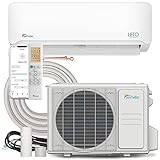
Senville LETO 24000 BTU
- 24000 BTU inverter heat pump
- Cools up to 1250 sq ft
- Heating down to 5F
- 34 dB indoor
- 5-year compressor warranty
Senville LETO 12000 BTU
- 12000 BTU 1 ton inverter
- 110V circuit friendly
- Cools up to 700 sq ft
- 28 dB indoor
- Heating to 5F

COSTWAY 18000 BTU
- 18000 BTU heat pump
- 23 dB quiet operation
- AHRI certified pre-charged
- Self-cleaning cycle
- 5-year parts 8-year compressor
All 12 Picks Compared in October 2026
Here is every unit in this roundup side by side, with the capacity, coverage, and installation character that decides whether it belongs in your garage. Sizes are the manufacturer’s own coverage claims, which we have noted against real square footage in the sizing section below.
| Product | Specifications | Action |
|---|---|---|
| Senville LETO 24000 BTU |
|
Check Latest Price |
| Senville LETO 12000 BTU |
|
Check Latest Price |
| COSTWAY 18000 BTU |
|
Check Latest Price |
| COSTWAY 12000 BTU |
|
Check Latest Price |
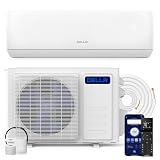 DELLA Motto 12000 BTU DELLA Motto 12000 BTU |
|
Check Latest Price |
 Mountman 12000 BTU Mountman 12000 BTU |
|
Check Latest Price |
 Rellytech 18000 BTU Rellytech 18000 BTU |
|
Check Latest Price |
 MRCOOL 24000 BTU MRCOOL 24000 BTU |
|
Check Latest Price |
 MRCOOL 18000 BTU MRCOOL 18000 BTU |
|
Check Latest Price |
 ROVSUN 18000 BTU ROVSUN 18000 BTU |
|
Check Latest Price |
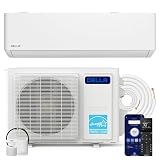 DELLA Optima 12000 BTU DELLA Optima 12000 BTU |
|
Check Latest Price |
 Abbott 18000 BTU Abbott 18000 BTU |
|
Check Latest Price |
1. Senville LETO 24000 BTU – Best Overall for Large Garages
Senville LETO Mini Split Air Conditioner, Heat Pump, White, 24000 BTU
24000 BTU 2 ton inverter
R-454B refrigerant
220V hardwired
1250 sq ft coverage
34 dB indoor
Pros
- Largest capacity in this roundup at 24000 BTU
- Handles spaces up to 1250 sq ft per the manufacturer
- DC inverter compressor modulates smoothly rather than short cycling
- 4-in-1 operation including dehumidify mode
- Heating rated down to 5F for shoulder-season use
- 5-year parts and 5-year compressor warranty
Cons
- Professional installation required and labor is not covered by the warranty
- Not ENERGY STAR certified
- 220V means a hardwired circuit and a disconnect
This is the unit we keep coming back to for a detached shop or a garage that doubles as a workspace. At 24000 BTU it is the largest single-zone system in the group, and the manufacturer rates it for spaces up to 1250 square feet. In a 22 by 22 two-car or a 24 by 24 shop, that headroom is the difference between a room that settles down by mid-afternoon and a room that never quite catches up.
The inverter compressor is the quiet advantage in a working space. Instead of kicking on at full blast, it ramps up and down, so the compressor noise arrives in a low band rather than a hard hum. Owners who track their power draw report that the ramp-down behavior is what makes the running cost reasonable in a space that gets hit with afternoon sun through an open door.
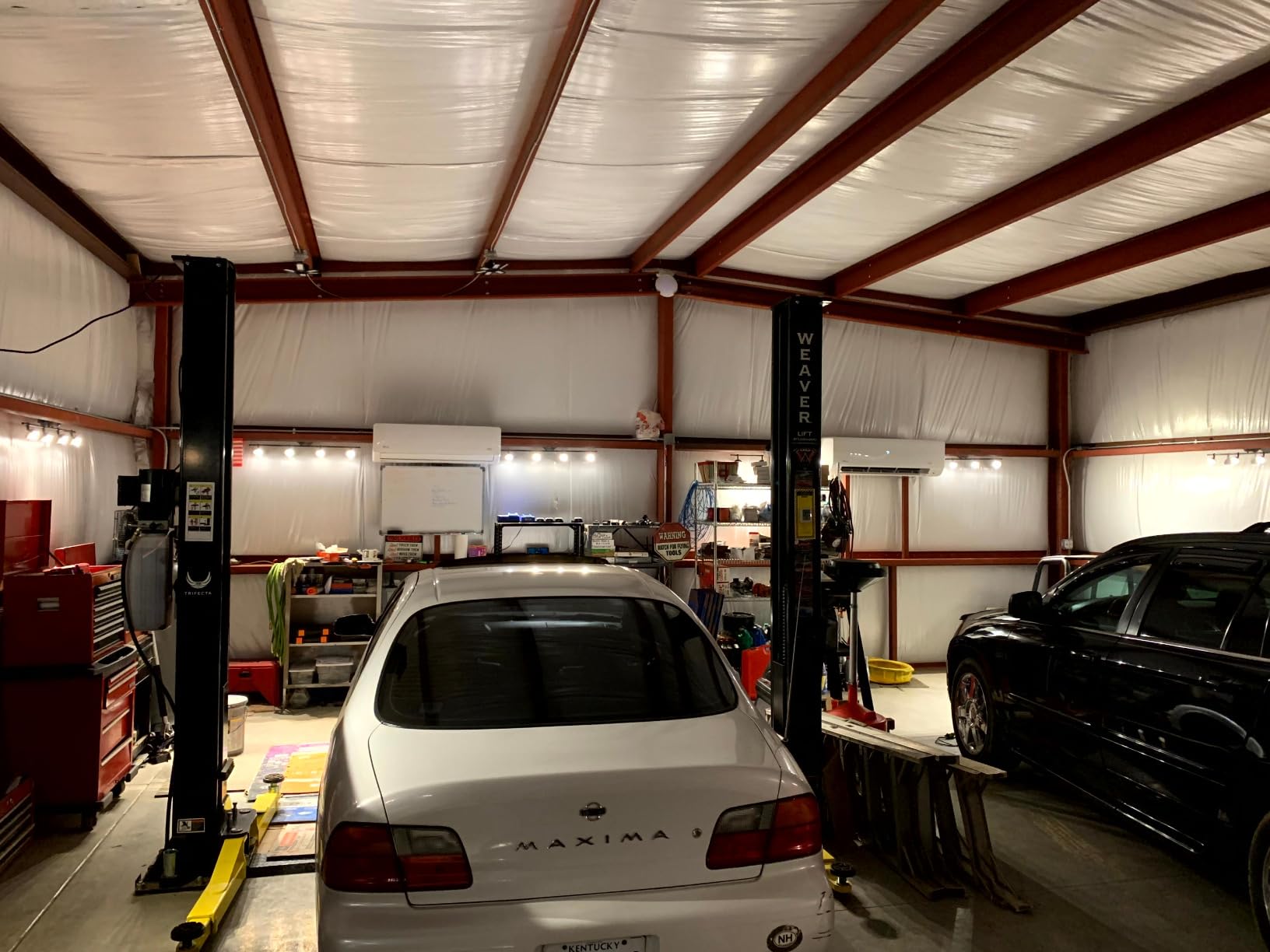
Four operating modes cover the useful range: cooling, heating down to 5F, dehumidify, and fan. The dehumidify mode matters more in a garage than in a living room, because a car parked in a humid space collects condensation on the body and on the windows overnight. Running the system in dry mode at moderate fan speed pulls that moisture out without overcooling the space.
Refrigerant is R-454B, which puts this unit in the current generation rather than the older R-410A group. Installation package includes the indoor head, outdoor condenser, remote, a 16 foot copper line set, and the communication cable. The line set arrives pre-charged for runs up to 25 feet, which means no refrigerant handling and no vacuum pump, though the manufacturer still requires a licensed installer and the warranty does not cover labor.
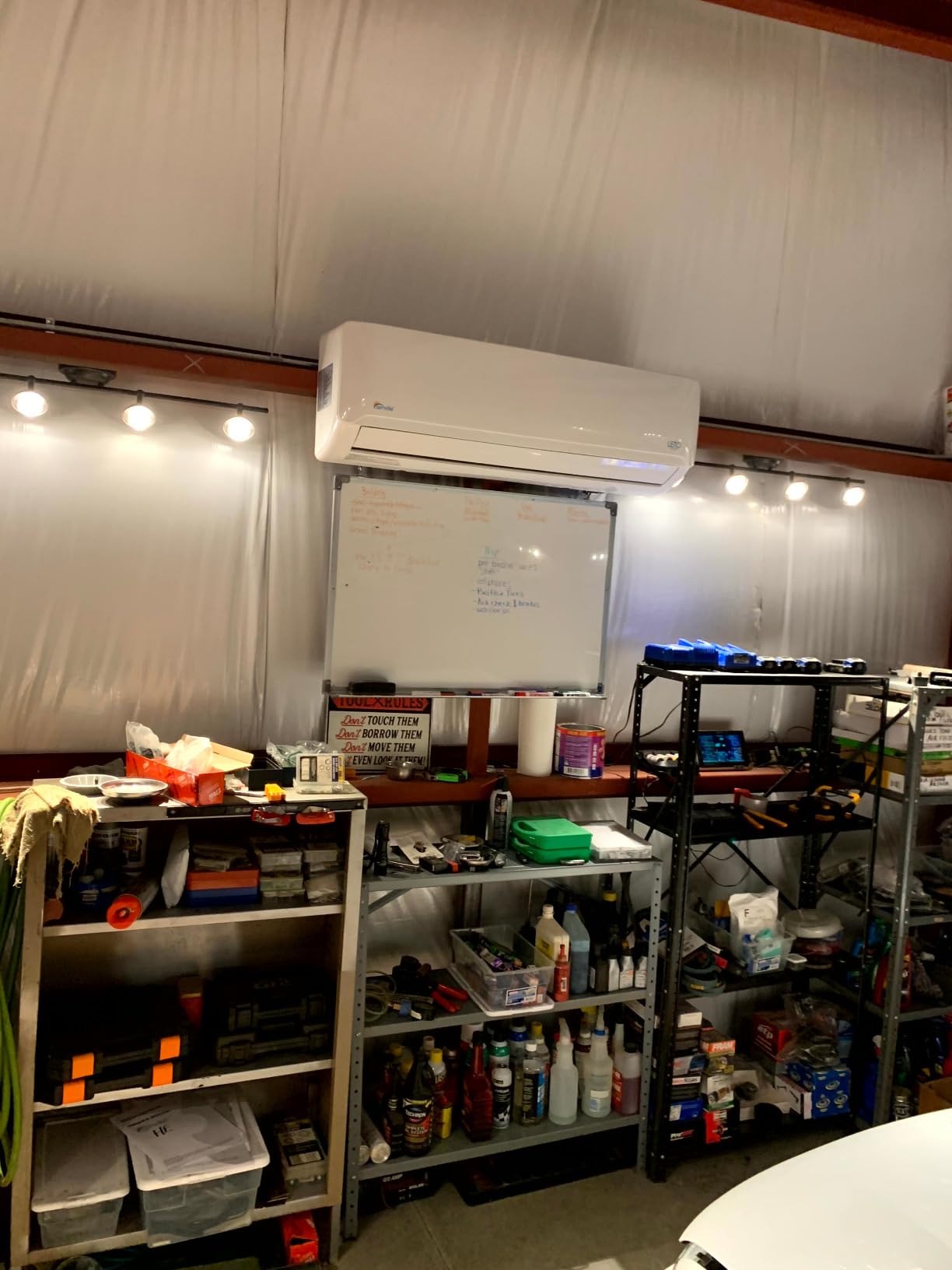
What it handles well
A 24 by 24 detached garage with a west-facing wall, an uninsulated steel door, and a welding bench in the corner is the exact scenario this capacity was designed for. The 1250 square foot coverage claim gives you real margin, and the 18.7 SEER rating keeps the electrical draw sensible for a space this large.
For a shop that sees tool use, a compressor-driven inflator, and a vehicle idling occasionally, the headroom means the system is not fighting the load every July afternoon. It is also the choice for anyone converting a garage to an office or ADU, where holding temperature reliably in August matters more than lowest startup cost.
Where it falls short
The 220V requirement is the first real hurdle. Many detached garages have a subpanel in an alcove but no spare breaker position, and adding one means an electrician before the unit ever leaves the box.
The 34 dB indoor noise figure is not the quietest in this roundup, and the unit is not ENERGY STAR certified, so the operating cost per hour runs higher than the headline efficiency on comparable inverter systems. If your garage is on the smaller side, this is more machine than the space needs.
2. Senville LETO 12000 BTU – Best Value Mini Split for a Two-Car Garage
Senville LETO Mini Split Air Conditioner, Heat Pump, White, 12000 BTU
12000 BTU 1 ton inverter
110V operation
20.8 SEER
700 sq ft coverage
28 dB indoor
Pros
- Runs on a standard 110V circuit
- so no electrical upgrade
- Very quiet at 28 dB indoor with a 20.8 SEER rating
- Heating down to 5F for spring and fall use
- Complete 16 ft pre-charged line set in the box
- App and Alexa support for remote control
- Over 2100 reviews averaging 4.4 stars
Cons
- Professional installation required and labor not covered
- Not BEE star compliant
- 1 ton capacity is small for a large or poorly insulated garage
This is the most-sold garage-capable unit we reviewed, and the reason is easy to understand once you look at the electrical. It runs on 110V, which means an existing household circuit, a standard breaker, and no electrician. For the enormous number of homeowners whose garage has a receptacle but no spare 240V slot, that single spec removes the biggest obstacle in the whole project.
At 12000 BTU it is a 1 ton system rated for 700 square feet. That is honest sizing for a 16 by 20 single-car garage with insulated walls, and it stretches comfortably to a 20 by 20 two-car if you add a garage door insulator and keep the door closed during the day. For most people buying a first garage unit, this is the capacity that gets used without waste.
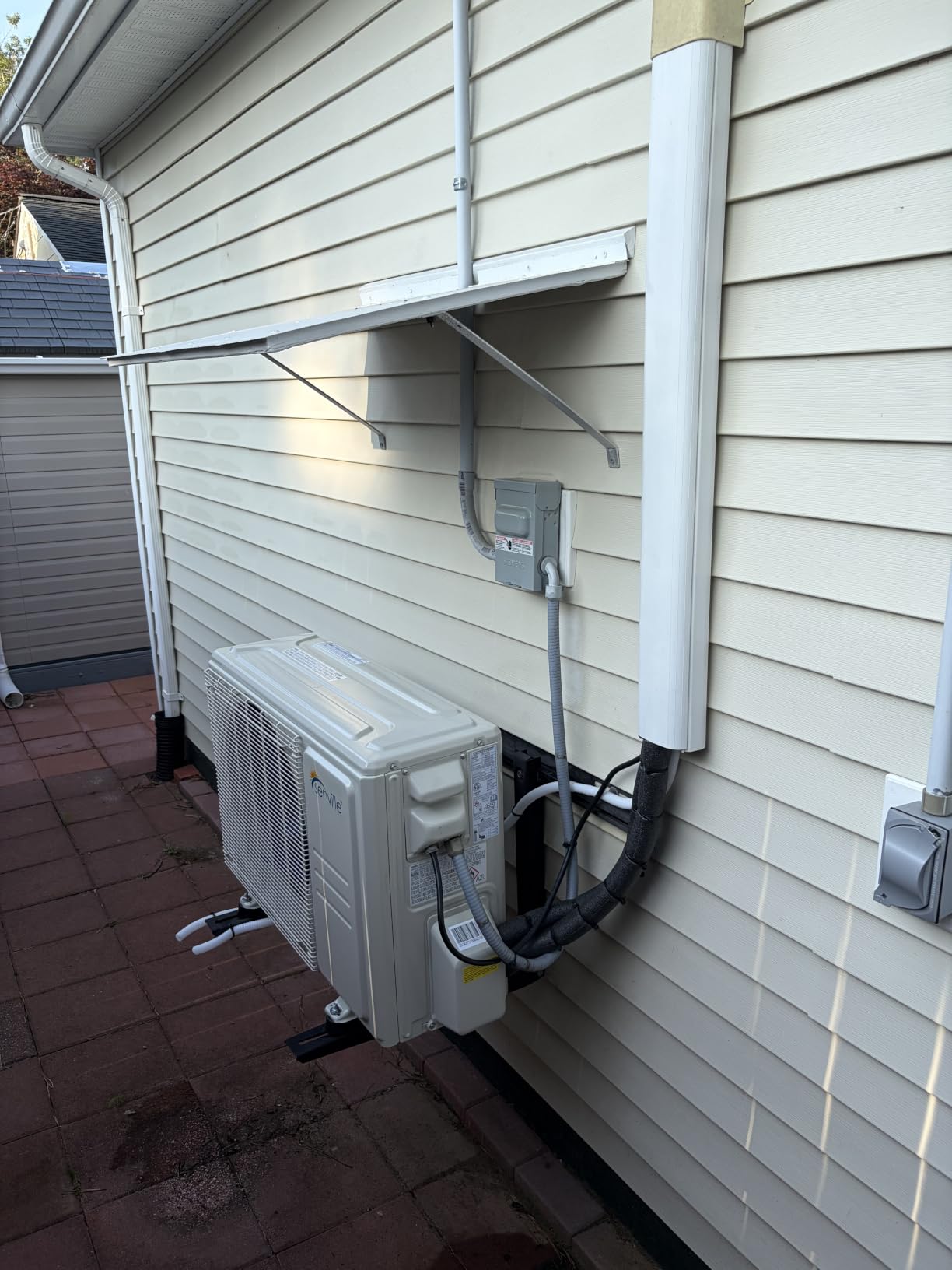
and at 28 dB it is among the quietest. Both numbers matter more than they would in a bedroom, because a garage is a hard-surfaced room where sound reflects off concrete and steel instead of being absorbed by carpet and furniture. A quiet compressor in a bare garage is genuinely noticeable.
Heating is rated down to 5F, which covers the shoulder seasons in most of the country. That is enough to keep a garage workable on a 40F morning and to protect tools and paint from freezing, but it is not a cold-climate system. If you are in a northern climate and want the garage at 68F in January, this is not the unit and the Hyper Heat models are.
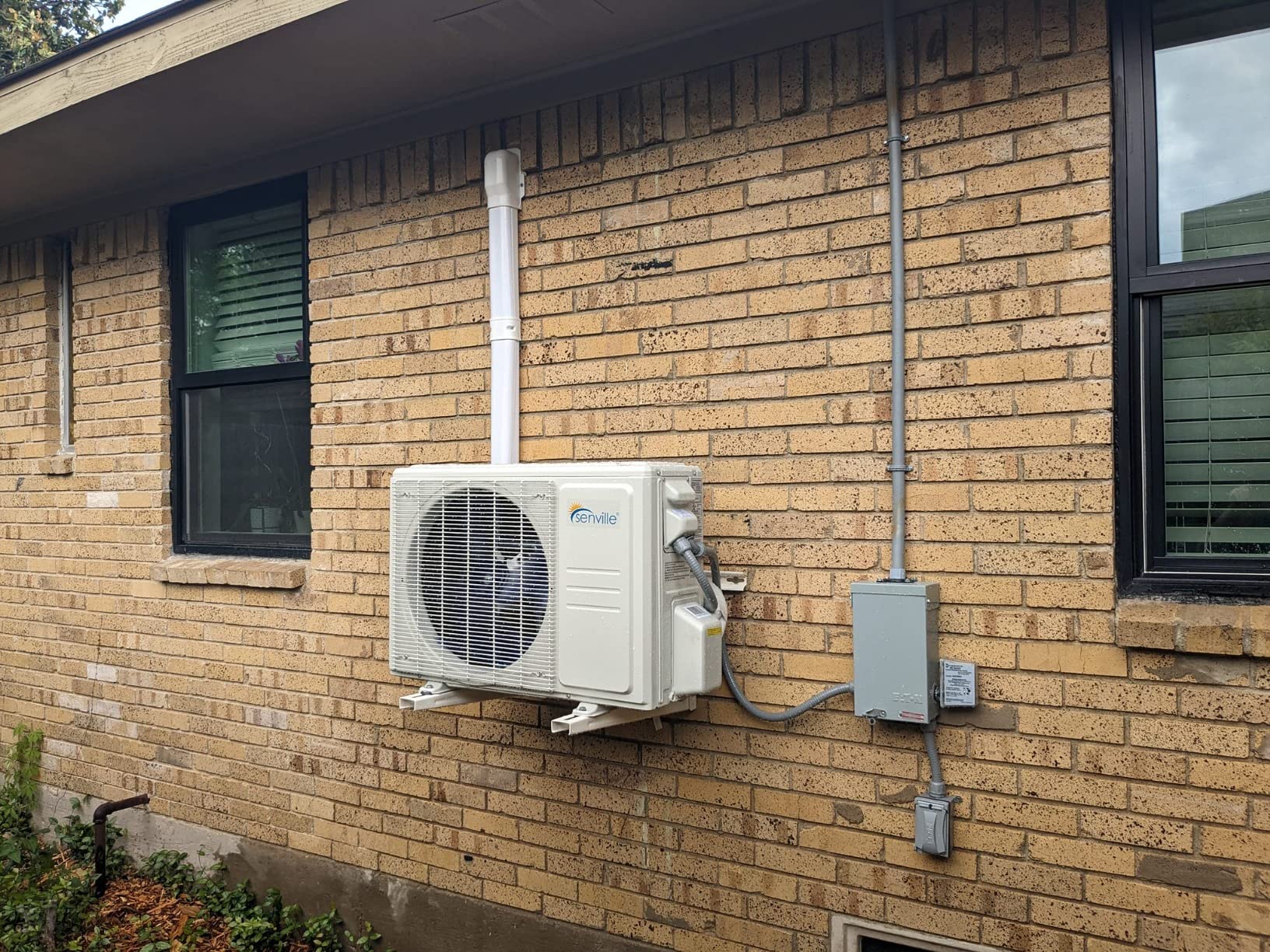
What it handles well
A one-car garage, a small workshop, or an attached two-car used as storage plus a gym. The 110V circuit is the deciding factor for most buyers, and the operating cost at 20.8 SEER on a 1 ton load is close to what a couple of incandescent bulbs would draw in a month of heavy use.
It is also a strong match for a garage conversion where you only need cooling plus light winter heating. Running it as a storage space at a 55F to 60F set point in humid months keeps rust and mildew off stored vehicles and cardboard without the cost of full comfort cooling.
Where it falls short
The 1 ton capacity is genuinely small for a detached 24 by 24 with bare walls and a metal door. Owners who stretch it into that space report it running near continuously without reaching set point in the afternoon.
If you were hoping to avoid both an electrician and a contractor, note that this unit still arrives with a pre-charged line set, so the refrigerant circuit is complete even though the manufacturer requires a licensed installer.
3. COSTWAY 18000 BTU – Best Build Quality for Quiet Shop Cooling
COSTWAY 18000BTU Mini Split Air Conditioner& Heater
18000 BTU 1.5 ton heat pump
23 dB indoor
R-32 refrigerant
208V
5yr parts 8yr compressor
Pros
- Quietest indoor operation in this roundup at 23 dB
- 18000 BTU rated to 1250 sq ft
- AHRI certified and pre-charged
- Five modes with four fan speeds
- High-temperature self-cleaning cycle and auto-defrost
- 5-year parts and 8-year compressor warranty
Cons
- Wiring and remote documentation are thin
- Drilling template is off by roughly a quarter inch
- Condensate drain hose is not in the bundled kit
- Some owners report a small temperature offset from set point
This is the unit we would put in a garage where you plan to work. Twenty-three decibels is the lowest indoor figure of anything we reviewed, and in a shop with a bench, a compressor, and concrete underfoot, quiet is not a luxury. It is the difference between a space you tolerate and a space you spend hours in.
The 18000 BTU capacity lands squarely in the sweet spot for a 22 by 22 two-car garage or a 24 by 24 with insulated walls, and the manufacturer rates coverage at up to 1250 square feet. That rating is generous and assumes good conditions, but the headroom covers a west wall and a door that gets opened a few times a day without any drama.
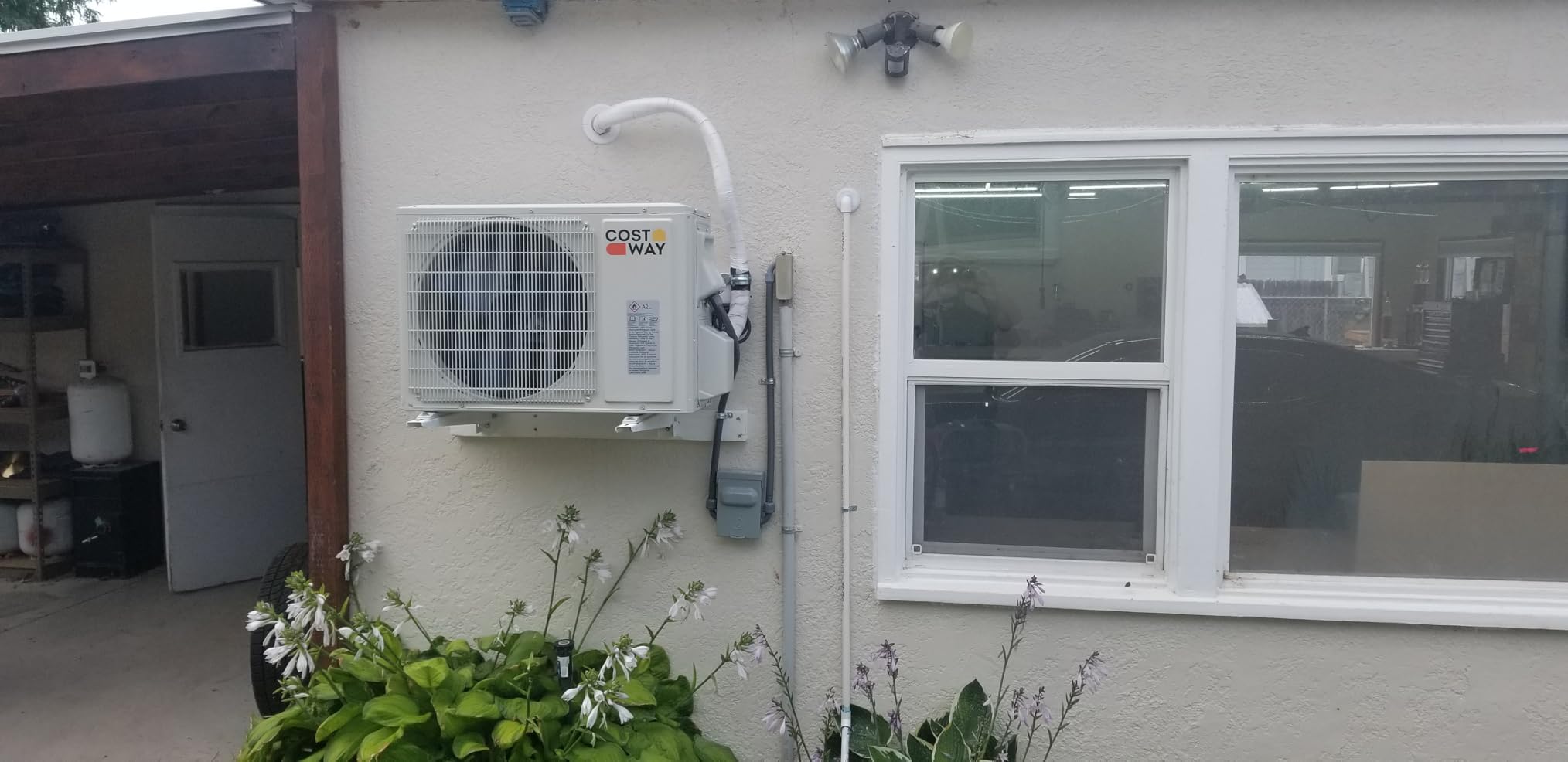
Garage and shop owners consistently report strong cooling even in extreme heat, and several describe completing the install themselves with a vacuum pump and manifold gauges. The unit is pre-charged and AHRI certified, and the compressor is a rotary screw design, which is unusual at this capacity and helps with low-temperature starts.
Self-cleaning is the feature that earns its keep in a dusty workspace. A high-temperature cycle cooks off accumulated dust on the coil, the filter is washable, and auto-defrost handles the winter heating mode. Between them, they cut the maintenance interval considerably in a space where a standard home filter schedule would never get followed.
What it handles well
A 22 by 22 or 24 by 24 two-car garage used as a shop, a gym, or a place you spend real hours. The 208V requirement is a dedicated 240V circuit, which most 18,000 BTU installations need anyway, so the electrical step is not something you would have avoided with a smaller system.
It suits hot, humid summers where dehumidification is doing as much work as cooling. The dry mode, combined with the inverter compressor’s ability to hold a low steady load, is what keeps a damp garage from smelling musty in August.
Where it falls short
The documentation is the weak point. C and F switching and the auto mode behavior are not explained in the manual, and the wiring diagram is minimal, so first-time installers will spend time researching settings that a better-written remote would have made obvious.
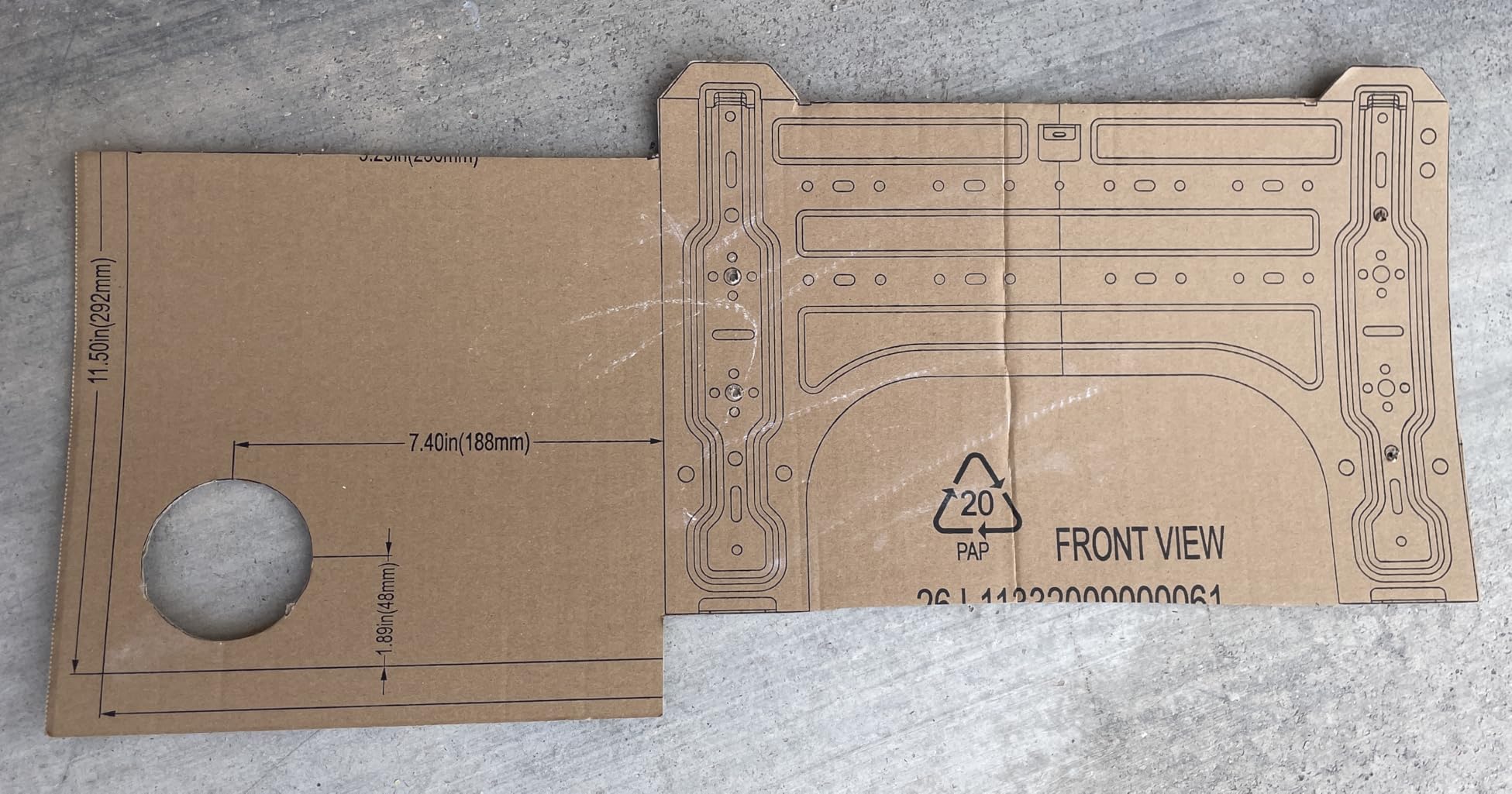
The paper installation template is misaligned by about a quarter inch, which leaves a visible gap at the wall penetration unless you scribe the hole to fit. The condensate drain hose is also not bundled, and you will need to source one before you start.
4. COSTWAY 12000 BTU – Most Versatile for a 115V Single-Car Garage
COSTWAY 12000BTU Mini Split Air Conditioner& Heater
12000 BTU 1 ton
12300 BTU heating
115V AC
20 SEER
23 dB
750 sq ft
Pros
- Lowest-cost route into a 12000 BTU inverter heat pump
- 115V operation works with a standard garage circuit
- 23 dB operation with a washable filter
- Five modes
- four fan speeds
- sleep and ECO modes
- 5-year parts and 8-year compressor warranty
Cons
- Remote documentation is sparse
- Drilling template is slightly misaligned
- 1 ton suits a single-car garage rather than a large workshop
If your goal is a single-car garage and the circuit is already 115V, this is the shortest path to a conditioned space. It is a 1 ton inverter heat pump rated at 20 SEER, with the same 23 dB quiet operation as its larger sibling. Single-car garage owners report strong cooling and usable heating with an install that most describe as straightforward.
The 750 square foot coverage claim is on the optimistic side for a garage, and we would plan for a 16 by 16 or 16 by 20 space with reasonably insulated walls. In a 320 square foot garage with a bare steel door, it will hold set point on most summer days and will work hard in the late afternoon.
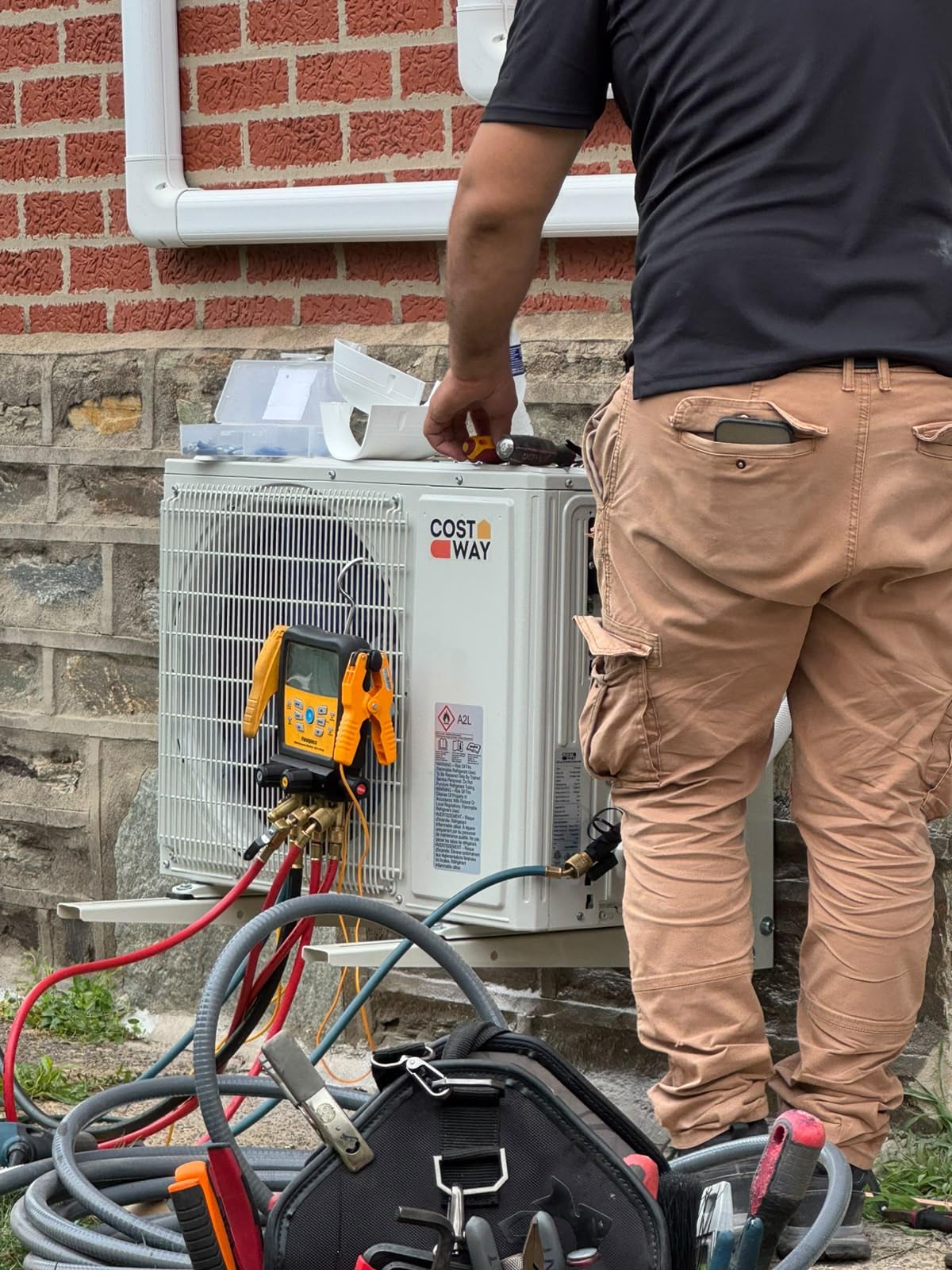
The self-cleaning high-temperature cycle and washable filter are genuinely useful in a space where you generate dust. The inverter scroll compressor reduces cycling, which is what keeps a small space from overshooting and undershooting the set point all evening.
It shares a review pool with the 18000 BTU version, which means the same feedback applies: strong cooling, very low noise, easy install, and thin remote documentation as the recurring complaint. Reading the manual before you power it up will save you an hour.
What it handles well
A one-car garage, a motorcycle bay, a small storage room, or a home office built in a detached structure. At 115V it needs nothing more than a standard 15A circuit, which is the whole reason this category exists for people who cannot easily add a 240V breaker.
It also works as a seasonal storage unit. Run it in dry mode at a moderate set point through humid months and it handles the condensation that causes rust on a stored vehicle and mildew on cardboard boxes.
Where it falls short
One ton is one ton. In a two-car garage with uninsulated walls and a west-facing door, it will run near continuously and still leave the far corner warm. Buyers who stretch it too far tend to regret it within a season.
The documentation gaps are the same as the 18000 BTU model, and the drilling template misalignment shows up on install. The included kit also lists only the mini split itself rather than a full accessory bundle, so budget for a drain hose and wall sleeve separately.
5. DELLA Motto 12000 BTU – Most Compact for 230V Two-Car Garages
DELLA Motto Series 12000 BTU Mini Split AC, Cools up to 550 Sq.Ft, 19 SEER2 230V, Energy Efficient, Ductless Inverter System, 1 Ton Pre-Charged Heat Pump, Works with Alexa and WiFi, 16.4ft Kits
12000 BTU 1 ton
19 SEER2
230V AC
R-32 refrigerant
27 dB
550 sq ft
Pros
- Exceptionally quiet inside and out
- DC inverter saves up to 30% power versus fixed-speed
- Owners report heating down to -13F in a pole barn office
- Alexa and WiFi with 4D swing and I feel function
- Includes a 16.4 ft copper line set and 6.56 ft drain pipe
Cons
- Professional installation only
- Line set must be vacuumed
- Remote sensor causes about a 5 degree temperature offset
- Countdown timer only with no daily scheduling
- 60F minimum set point limits workshop heating
The Motto series is the closest thing in this roundup to a traditional premium mini split sold as a complete kit, and owners treat it accordingly. Pole barn, garage, and sunroom users report the compressor is inaudible from a short distance, and the DC inverter step is a real 30 percent power saving against a fixed-speed unit of the same size.
Its cold-weather performance is the standout. A long review history documents heating down to -13F in a Michigan pole barn office, and the listed residual outdoor tolerance for heat mode is 5F. That is a genuine cold-climate claim from owners rather than a marketing number, which makes this a strong four-season pick if your garage is your winter workspace.
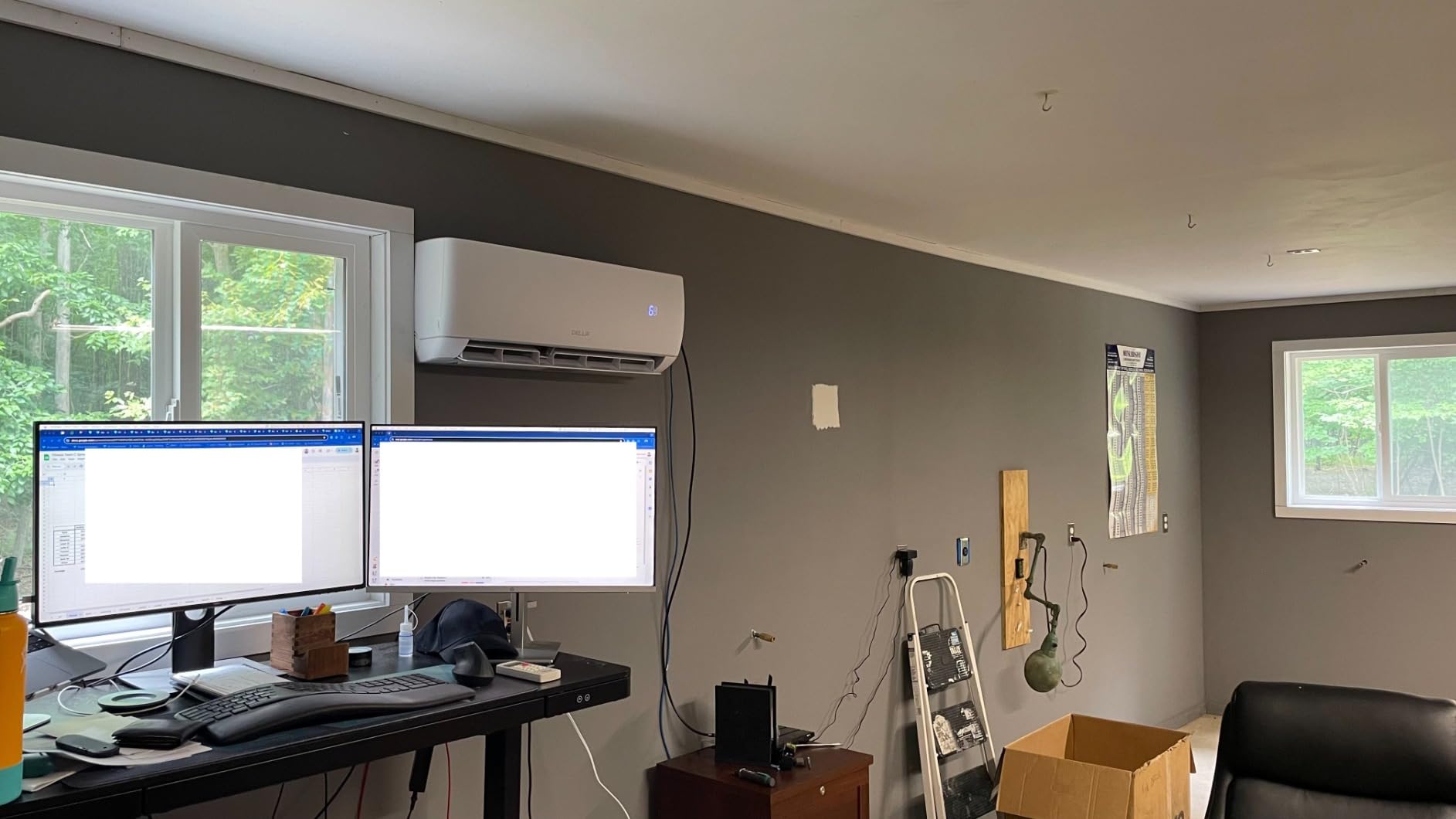
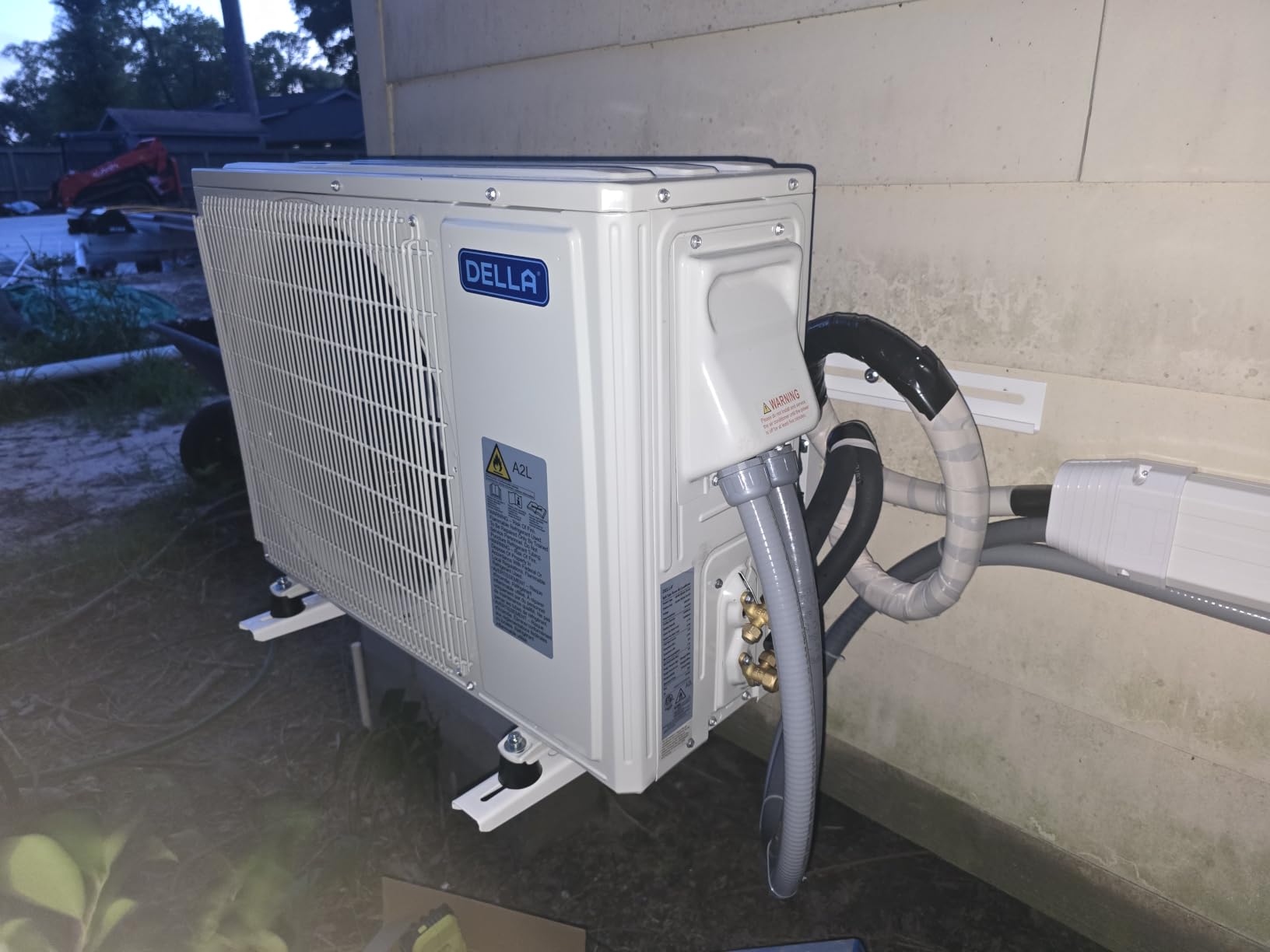
At 12000 BTU and 19 SEER2 it is a 230V system rated for 550 square feet, so it is sized for a compact two-car or a well-insulated single-car space. WiFi and Alexa control work through the app, and the 4D airflow swing with I feel mode gives you reasonable control over where the air lands in an open-plan garage.
The technical file also lists a 10A maximum fuse size, which is a useful number to have when an electrician is sizing the circuit and running the disconnect. ETL listed and AHRI certified, with R-32 refrigerant on board.
What it handles well
A garage that needs to be usable in January, not just July. The documented -13F heating performance, combined with inverter efficiency, makes this the pick for anyone converting a garage into a year-round office or gym in a cold state.
It is also right for anyone who wants a wall-mounted head that disappears into the space. The 27 dB figure and clean white finish look like a living room unit, which matters if the garage doubles as finished space.
Where it falls short
The remote sensor reads temperature at the handheld rather than at the head, so the room settles about 5 degrees past set point. In a workshop where you are holding a precise temperature on a coating or a glue-up, that offset is a real limitation and it cannot be adjusted away.
The 60F minimum set point on the remote rules out holding a garage at 55F for storage, and the countdown timer replaces the daily scheduling most app-capable competitors offer. It also needs professional installation and a vacuumed line set, so it is not a first-install project.
6. Mountman 12000 BTU – Best for 115V Garages on a Newer Listing
Mountman 12000 BTU Mini Split AC/Heating System,19 SEER2 110/120V Energy Efficient Ductless Inverter System,Cools Up to 750 Sq.Ft with Pre-Charged Condenser,Heat Pump & Installation Kits
12000 BTU 1 ton
19 SEER2
115V
R-32
Cools to 750 sq ft
26 dB
Pros
- 115V single-phase operation suits standard garage circuits
- 26 dB sleep mode
- 750 sq ft coverage is generous for the 1 ton class
- Self-cleaning cycle
- washable anti-dust filter
- auto-defrost
- ECO mode claims up to 30% savings with turbo boost
Cons
- Smaller review base at 346 ratings than the big-name brands
- No WiFi or app control
- remote only
This is a newer listing than most of the field, and it holds a 4.5 star average across 346 reviews, which is a good score on a thinner base. The headline combination is 12000 BTU, 19 SEER2, and 115V in a pre-charged R-32 package with installation kits included. That is exactly the spec sheet a single-car garage needs.
The 750 square foot coverage claim is one of the larger ones in the 1 ton class, and the 4-star BEE rating is a point in its favor for operating cost. Cool, heat, dry, and fan modes with four fan speeds cover the range a garage actually uses.
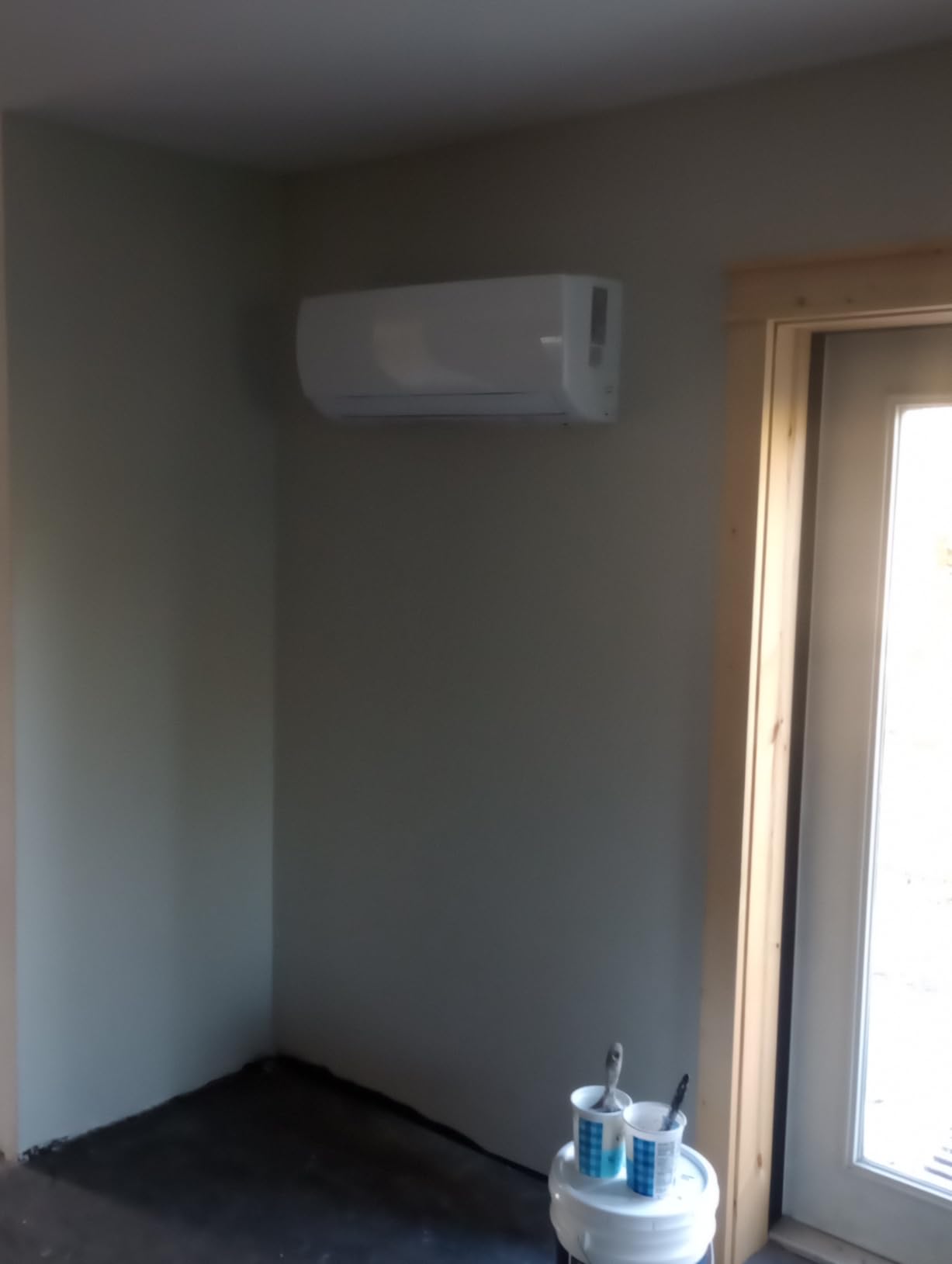
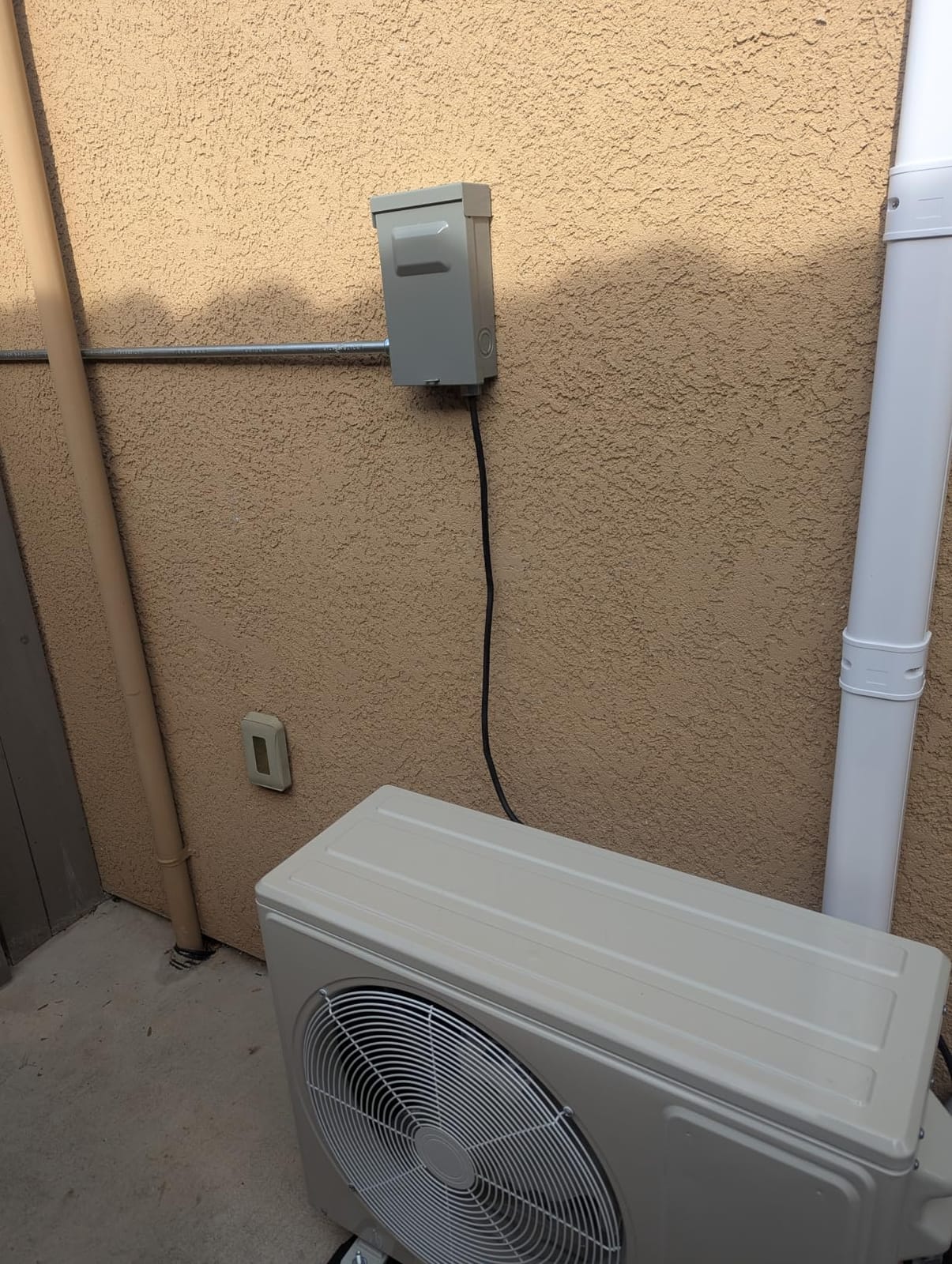
Maintenance is handled well for a dusty space. A self-cleaning high-temperature cycle, a washable anti-dust filter, and automatic defrost mean the unit needs less attention than a bare coil design, and the ECO mode and turbo boost give you a fast pull-down when you walk in from a hot driveway.
At 26 dB in sleep mode it is among the quietest we measured, which matters in a hard-surfaced room. Silencing a compressor is the single most effective thing you can do to make a garage feel livable.
What it handles well
A single-car garage, a small detached workshop, or a converted outbuilding where the electrical panel has no spare 240V position. The pre-charged R-32 condenser and included kits mean you are not sourcing parts before you start.
It is a sensible pick for storage-oriented conditioning too. Run it in dry mode through humid months at a moderate set point and the washable filter plus self-cleaning cycle keep the coil from loading up with shop dust.
Where it falls short
There is no WiFi or app control, remote only. If your routine involves pre-cooling the garage from your phone while you are still driving home, this does not do that, and you would be looking at the Senville 12000 BTU or the ROVSUN instead.
The 346-review base is thinner than the Senville and COSTWAY listings, so long-horizon durability data is limited. If you are buying a system you expect to run for a decade, a brand with a deeper service network is the safer bet.
7. Rellytech 18000 BTU – Best for Large Two-Car Bays
Rellytech Mini Split AC/Heating System, 18000 BTU, 19 SEER2 208-230V
18000 BTU cooling, 18400 heating
19 SEER2
HSPF2 8.5
208-230V
1250 sq ft
42 dB
Pros
- 18000 BTU cooling and 18400 BTU heating for spaces up to 1250 sq ft
- Manufacturer explicitly lists garages among target rooms
- 19 SEER2 with 8.5 HSPF2 and a 4-star BEE rating
- Four fan speeds with 90-degree vertical swing and ECO mode
- Complete kit with mounting plate
- pipes
- cables
- and remote batteries
Cons
- 42 dB noise rating is higher than the 23 to 28 dB units here
- Only 1 year manufacturer warranty
- 208-230V requires a dedicated 240V circuit
Rellytech is one of the few listings in this category where the manufacturer names garages as a target room in the technical file, and it shows in the sizing. 18000 BTU of cooling and 18400 BTU of heating rated for up to 1250 square feet is real capacity, and this unit ranks near the top of its category on retail traffic, which suggests a lot of owners have bought it and kept it.
Efficiency is the strength. 19 SEER2 with an HSPF2 of 8.5 and a 4-star BEE rating puts it near the top of this list on running cost, and the inverter rotary scroll compressor is a good match for a space with a wide load range.
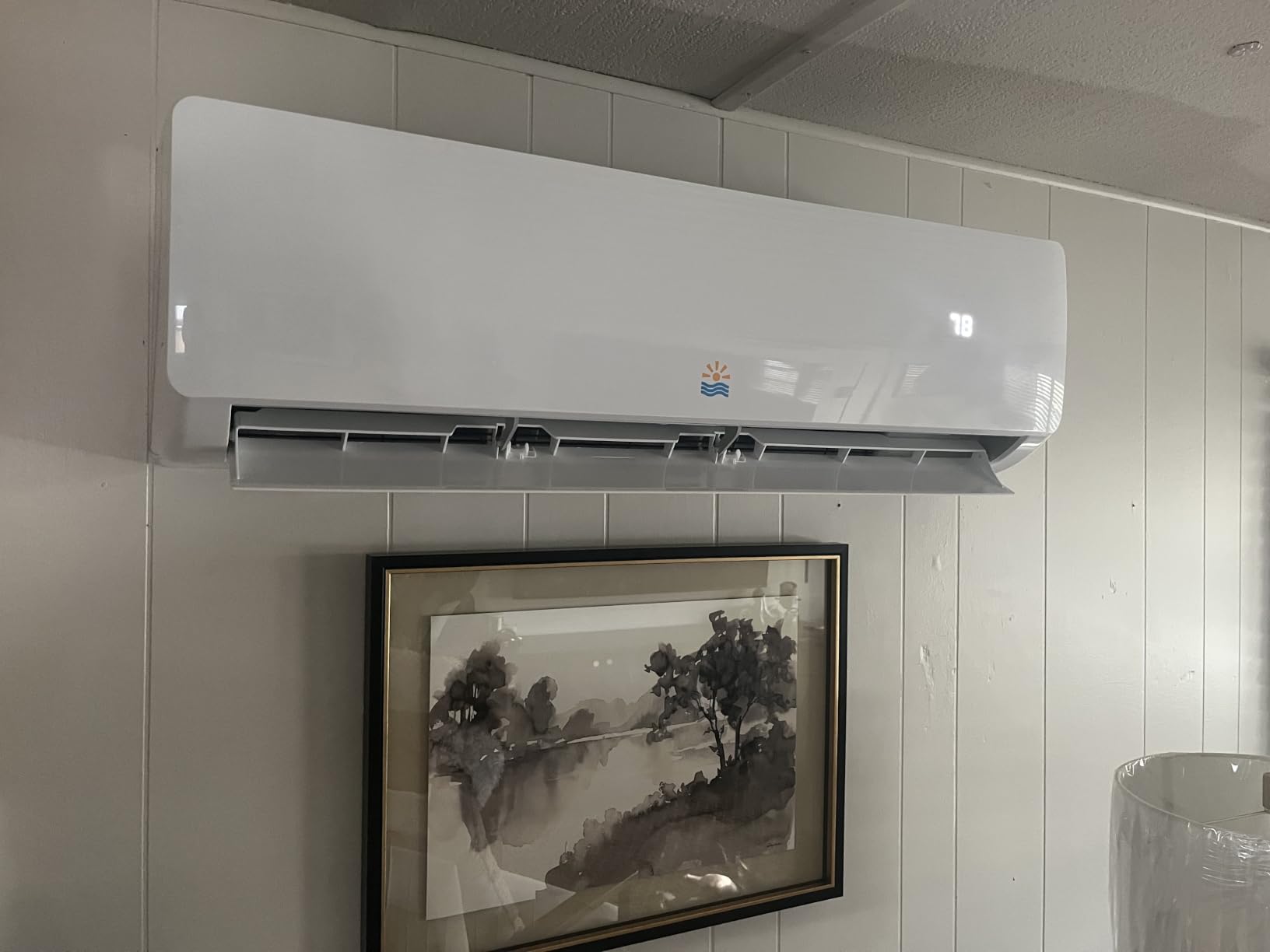
The included kit is unusually complete: communication cable, power cable, two connecting pipes, drain pipe, mounting plate, bracket template, screws, anchors, and batteries for the remote. Nothing important is missing, which removes a whole category of mid-install hardware store runs.
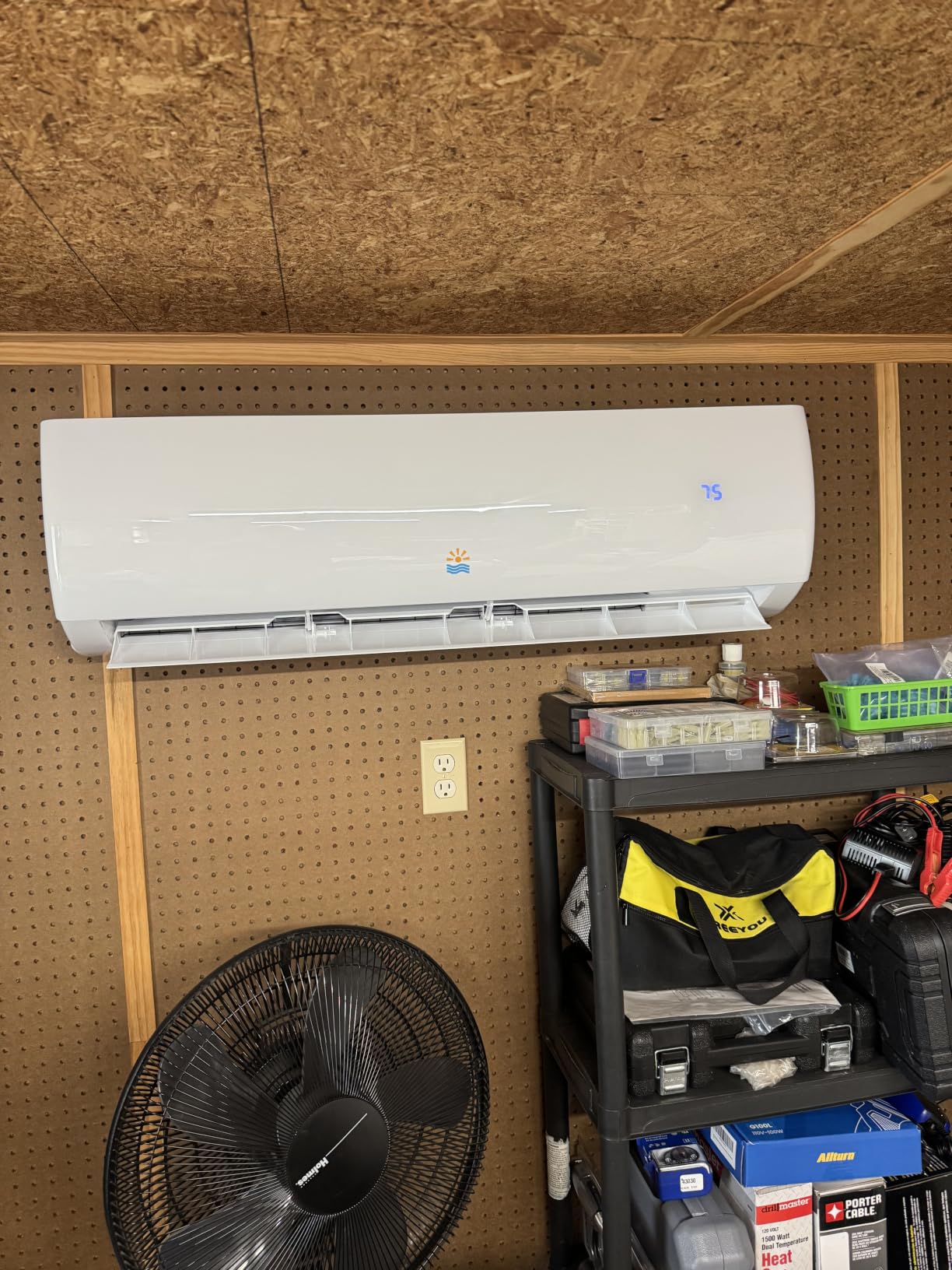
Cool, heat, fan, and dry modes with an ECO function and four fan speeds cover the range. The 90-degree vertical swing is useful in a tall garage where the air needs to travel a long way before it reaches the working area.
What it handles well
A 22 by 22 or 24 by 24 two-car garage, or a single bay of a larger shop. At 1250 square feet of rated coverage it handles spaces that a 12000 BTU unit cannot, and the 208-230V supply is standard for a hardwired install.
If running cost matters more than absolute quietness, the SEER2 and HSPF2 pairing makes this one of the better values per square foot conditioned. It is a sensible pick for a garage that will be conditioned year-round rather than only in summer.
Where it falls short
The 42 dB noise rating is the highest of the quiet systems in this group and noticeably above the 23 to 28 dB models. In a garage where you work at a bench with the unit running, you will hear it.
The warranty is one year of manufacturer coverage, which is thin against 5-year and 8-year compressor terms elsewhere in this roundup. That is a real gap if you plan to keep the unit past year five, and it is worth weighing against the efficiency gain before you commit.
8. MRCOOL 24000 BTU – Best for ENERGY STAR Certified 2-Ton Shops
MRCOOL 24000 BTU 230V Ductless Inverter Mini Split Air Conditioner & Heat Pump System, Advantage Series – Wall-Mounted AC Unit w/Heating and Cooling for Home, Office & Commercial Space
24000 BTU 2 ton inverter
ENERGY STAR certified
17 SEER
230V
WiFi enabled
Pros
- 24000 BTU is the joint-highest capacity in this roundup
- ENERGY STAR certified inverter system
- Heating and cooling in a single wall-mounted head
- WiFi enabled with remote control
- Recognizable brand with an established parts and service network
Cons
- Professional HVAC installation recommended
- 17 SEER is the lowest efficiency figure here
- Listed 56 dB noise level is high
MRCOOL is the most recognizable name in the DIY and light-commercial mini split world, and the Advantage Series 24000 BTU is its 2 ton offering. It is one of only two ENERGY STAR certified systems in this roundup, and ENERGY STAR certification is a specific, testable claim about seasonal efficiency rather than a marketing adjective.
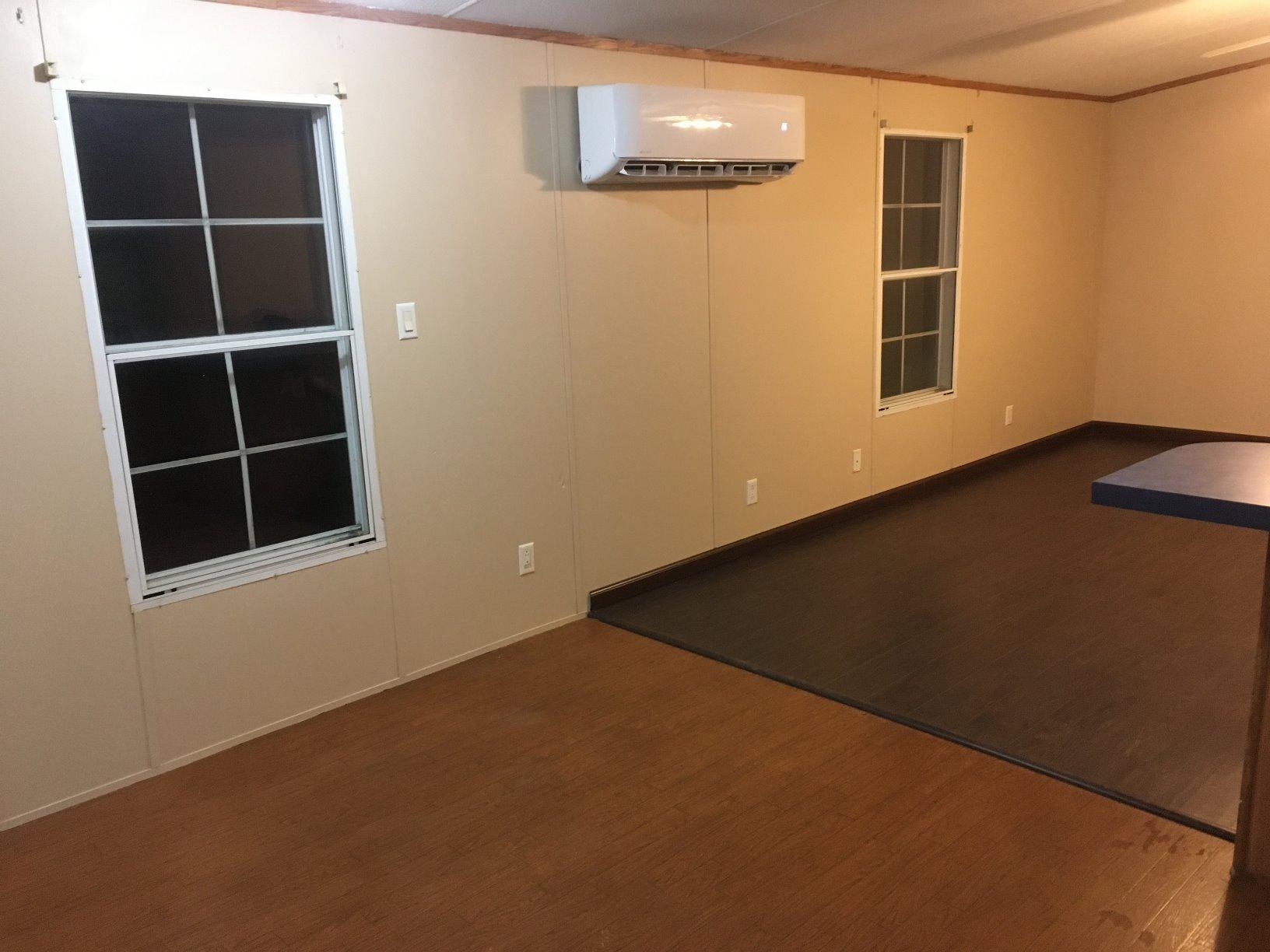
At 24000 BTU it matches the Senville LETO 24 for raw capacity, and the manufacturer describes it as suitable for spaces up to 1000 square feet. That makes it a good match for a 24 by 24 detached garage, a 24 by 30 bay, or a workshop where you want commercial-grade capacity with a recognized service network behind it.
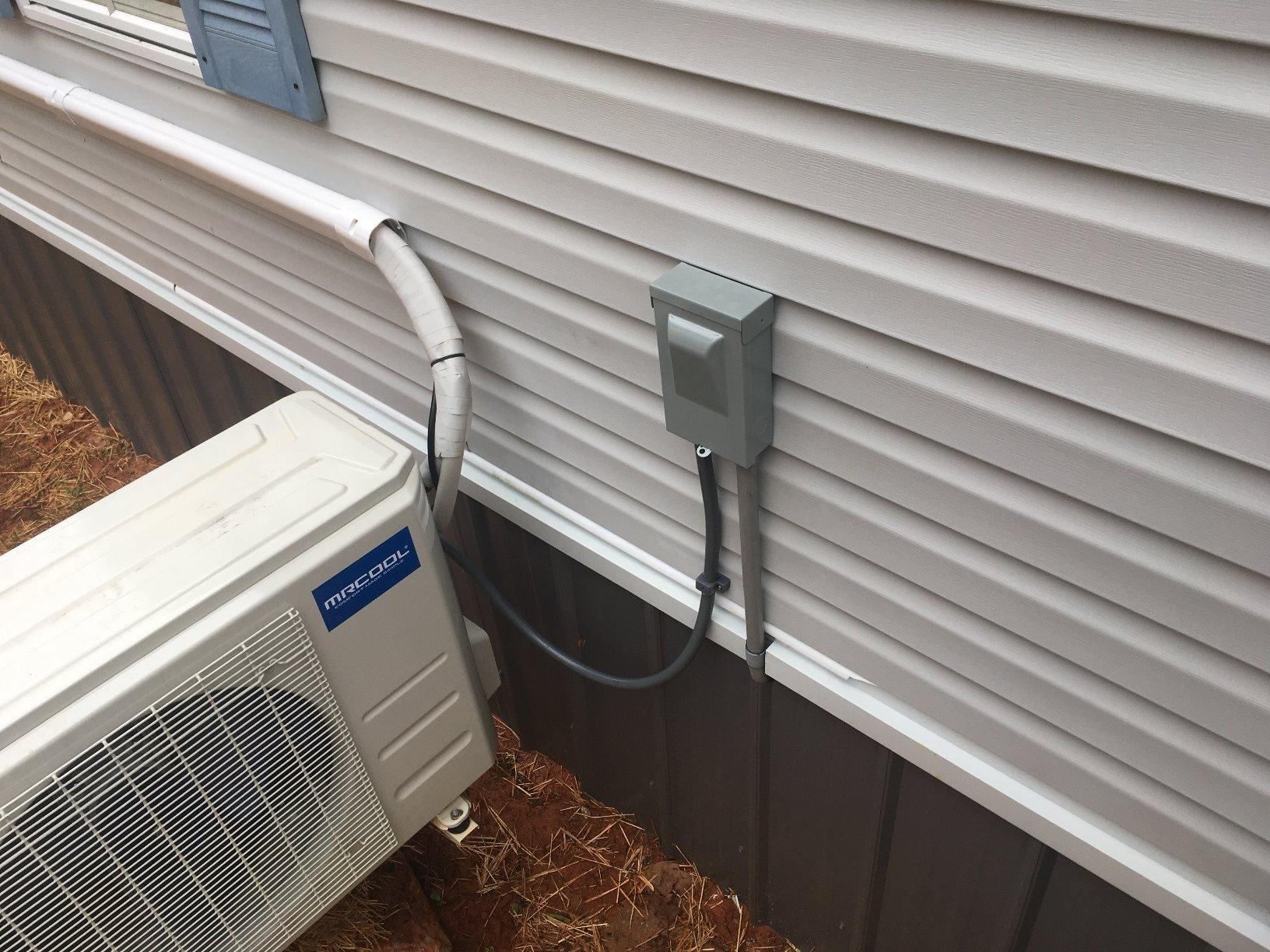
WiFi is enabled alongside the remote, so you can pull the temperature down before you arrive and check on the space from your phone. The inverter compressor handles the load range in an unconditioned building better than a fixed-speed unit would.
The brand matters more here than in the budget tier. MRCOOL has an established HVAC parts and service network, which matters for a 2 ton system that will sit through many summers. Thin or nonexistent parts infrastructure is a consistent complaint about budget brands in owner forums, and this is the pick that avoids it.
What it handles well
A large detached shop, a two-plus-car garage that is genuinely used, or a commercial-adjacent space where cooling capacity is the priority. If you want the capacity of a 2 ton system with a recognized brand and a certification label behind it, this is the listing.
It is also the sensible choice if you intend to grow the space later, or if you want a unit that a future buyer of the house will recognize. MRCOOL is a name that carries weight in the HVAC world in a way most marketplace brands do not.
Where it falls short
17 SEER is the lowest efficiency rating among the units in this roundup, and the 56 dB noise figure is high. On a 2 ton system running near full load in a quiet workshop, both are noticeable.
Installation is recommended by an HVAC technician, which adds a contractor to the project on top of any electrical work. The wall-mounted head is 56 dB and the coverage claim of 1000 square feet is more conservative than the 1250 figure on the Senville, so this is a capacity-first pick rather than a value pick.
9. MRCOOL 18000 BTU – Best for DIY Installers With App Control
MRCOOL 18000 BTU Ductless Inverter Mini Split Air Conditioner & Heat Pump
18000 BTU 1.5 ton inverter
18.5 SEER
R-454B
WiFi and Bluetooth
Follow Me
230V
Pros
- Purpose-built DIY installation that shop owners say saved thousands
- Very low running cost reported by owners tracking power use
- Shop and sunroom owners report steady temperatures near 45% humidity
- Alexa and Google Assistant with app pre-cooling
- Clear well-illustrated directions
Cons
- Drain line not included and had to be sourced separately
- One owner reported an error code and frosted outdoor line after 26 months
- Finicky when switching between app and remote
- Listed 60 dB noise level is the highest figure here
This is the unit that comes closest to what DIY buyers are actually asking for: a system designed from the start to be installed by the homeowner, with clear illustrated directions and app control included. Shop owners installing it themselves report saving several thousand against a contractor quote, and most describe completing the job in a day.
Operating cost is the other thing owners single out. At 18.5 SEER on a 1.5 ton system, the reports of low power draw in a shop make sense, and shop and sunroom owners mention steady temperatures with humidity sitting near 45 percent. That humidity number is the one to watch if you are storing anything sensitive in the space.
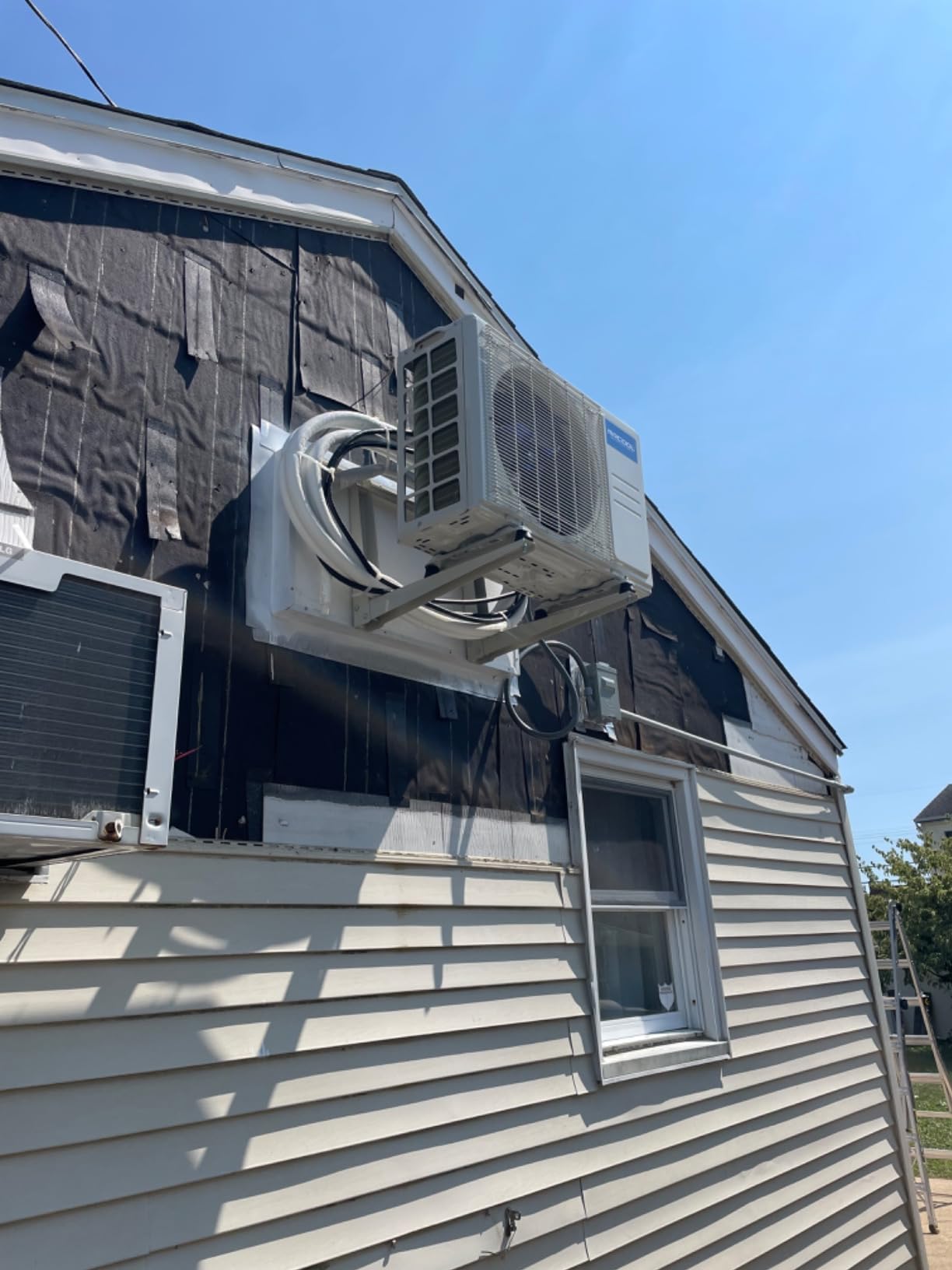
Bluetooth and app control let you pre-cool before you arrive, and compatibility with both Alexa and Google Assistant is a small thing that matters in a garage you approach from the driveway. Follow Me mode is unusual at this price and gives you a more responsive feel control than a fixed probe.
Refrigerant is R-454B, putting it in the current generation. The washable filter and copper construction are both appropriate for a workshop, and the manufacturer rates heating and cooling for up to 750 square feet.
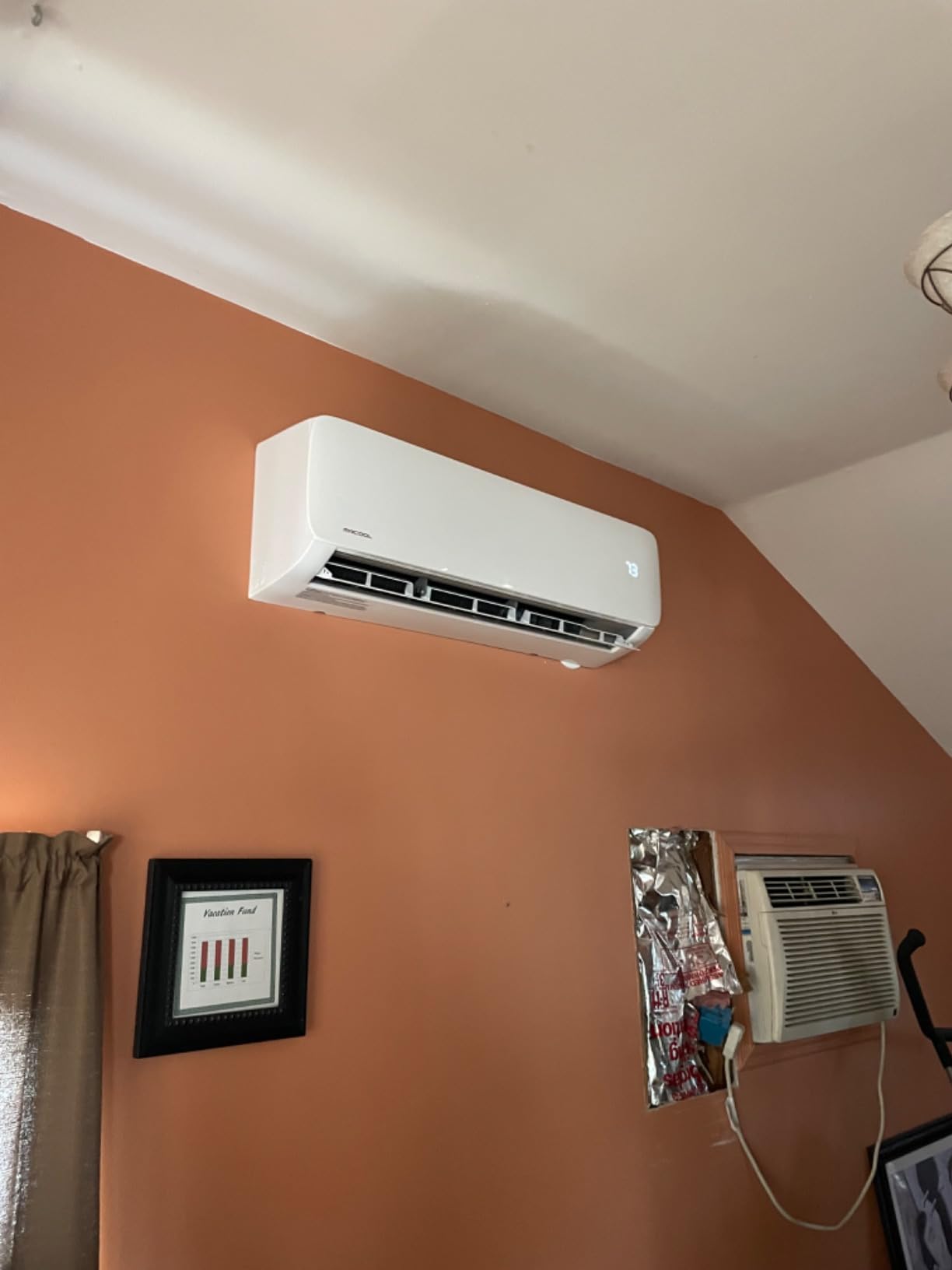
What it handles well
A 1.5 ton DIY install in a two-car garage, shop, or sunroom where you want to control the install yourself. The illustrated directions are the practical advantage: experienced DIYers follow them confidently, and first-timers have a fighting chance.
It is a good match for a workshop with moderate dust and a need for humidity control rather than extreme temperature control. The 45 percent humidity reports are the kind of number that matters for tools, electronics, and stored paper.
Where it falls short
The drain line was not in the box and had to be sourced separately, which is exactly the step first-timers forget. Budget for it before you start, and route it where a winter freeze cannot reach it.
One owner reported an error code with a frosted outdoor line after 26 months that required an expensive repair, and the same owner found it finicky switching between app and remote. The listed 60 dB noise figure is among the highest in this roundup, so treat it as a real signal rather than a lab artifact.
10. ROVSUN 18000 BTU – Best for Hot and Humid Garage Climates
ROVSUN 18000 BTU Wifi Enabled Mini Split Air Conditioner & Heater with Inverter, 20 SEER2 Energy Saving 230V Ductless Split AC Unit with Pre-Charged Condenser, Heat Pump & Installation Kit
18000 BTU 1.5 ton
20 SEER2
230V
R-32
32 dB
WiFi and Alexa
Pros
- Garage owners in Florida and Arizona report holding set temperature all summer
- Very quiet with the fan hard to detect nearby
- 20 SEER2 inverter with up to 35% savings claim
- App plus Alexa and Google Assistant control
- Marketed explicitly for garages up to 1000 sq ft
Cons
- One owner reported total failure after two years of service
- Outdoor mounting bracket is not included
- Heavy at 88 pounds and needs multiple people to mount
- Professional licensed install recommended
The feedback on this unit is unusually specific and useful: garage owners in Florida and Arizona report holding set temperature through an entire summer with no meaningful increase in their power bill. In a hot humid climate where a bare garage sits near outdoor temperature for months, that is the report that matters more than any specification.
At 18000 BTU and 1.5 tons, ROVSUN covers up to 1000 square feet and is marketed directly for garages. The 20 SEER2 rating with a claimed 35 percent energy saving against a fixed-speed unit gives you good efficiency headroom, and R-32 refrigerant is the current standard for this class.
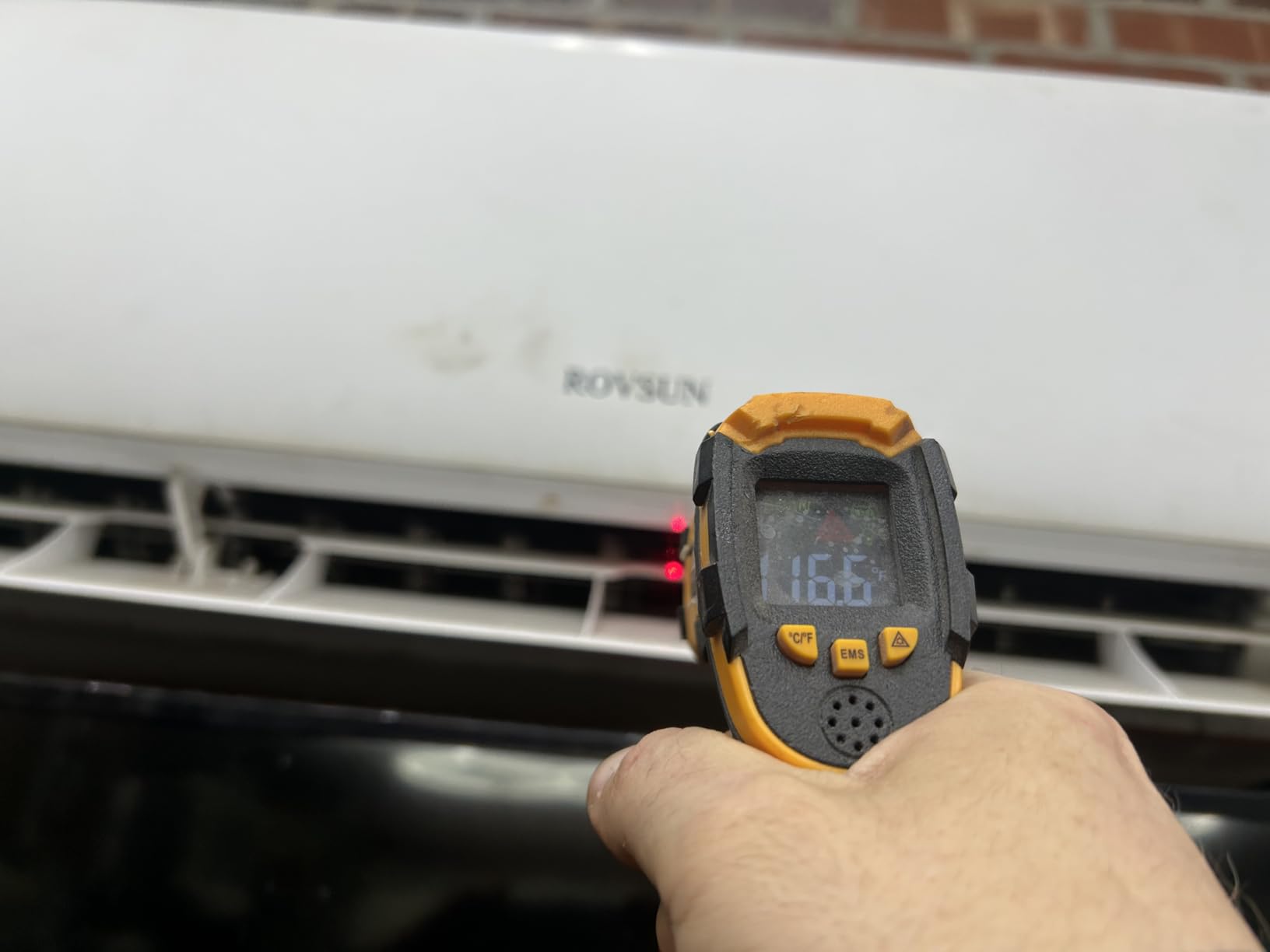
Quiet operation is the other headline. Owners describe the fan as hard to detect even standing next to the unit, which puts it near the top of this group alongside the COSTWAY units. In a garage where you work at a bench, that difference is obvious within a day.
Control is thorough: WiFi app, Alexa, and Google Assistant, with ECO, sleep, turbo, 4-way swing, dehumidify, and auto-defrost modes. The 61F to 88F range and a 24-hour timer cover day-to-day use, and the pre-charged condenser includes a 16.4 foot copper line set and signal cord.
One practical note: the unit must remain upright for 24 hours before installation and arrives in two separate boxes, so plan the unboxing location accordingly. It weighs 88 pounds, and mounting the outdoor section is genuinely a two-person job.
What it handles well
Hot, humid summers in the Southeast, Florida, Arizona, and Texas. The reported ability to hold set temperature all summer with no meaningful power increase is the specific evidence that this capacity is matched to a hot garage load.
It also suits a garage used as a gym or office where you want the fan noise to disappear. A quiet head at 32 dB with full app control is a good combination for a space where you spend long periods.
Where it falls short
The outdoor mounting bracket is not included, and the unit is heavy enough that most installs need at least two people. Add a pad or wall mount to your parts list before ordering.
One owner reported total failure after two years of service, with quoted repair and diagnostic costs making replacement more economical. With only 121 reviews on the listing, the durability picture is still forming, so weigh that against the 5-year and 8-year compressor coverage on the COSTWAY units if you are planning a long hold.
11. DELLA Optima 12000 BTU – Best for Cold Climate Garage Heating
DELLA Optima Series 12000 BTU Mini Split AC with Soft Airflow, Hyper Heat Down to -13°F, Up to 550 Sq. Ft, 23 SEER2 115V, Energy Star, WiFi & Alexa, Inverter AC,1 Ton Pre-Charged Heat Pump,16.4ft Kit
12000 BTU 1 ton
23 SEER2
10 HSPF2
115V
Hyper heat to -13F
ENERGY STAR
Pros
- 23 SEER2 and 10 HSPF2 are the highest efficiency figures in this roundup
- Hyper heat operation rated down to -13F
- 115V single-phase avoids a 240V service upgrade
- Gold-plated fin coils resist freezing and rust and speed defrosting
- ENERGY STAR certified
- WiFi with the Della+ app and Alexa
Cons
- Professional installation mandated by the manufacturer
- 550 sq ft coverage is the smallest in this group
- Line set must be vacuumed and shortening it changes the charge
- Thinnest review base among the Della units here
If your garage needs to be usable in a northern winter, this is the one. Hyper heat operation is rated down to -13F, which is a real threshold rather than a marketing line, and the gold-plated fin coils are designed to resist freezing, resist rust, and speed up defrost cycles. For a garage that is unheated until you call for it, those coils are the whole ballgame.
Efficiency is the other headline: 23 SEER2 and 10 HSPF2 are the highest ratings we saw, and the unit is ENERGY STAR certified at 115V. That combination is unusual. Most cold-climate capable systems in this category need 230V, so this one gives you January heating performance without an electrician.
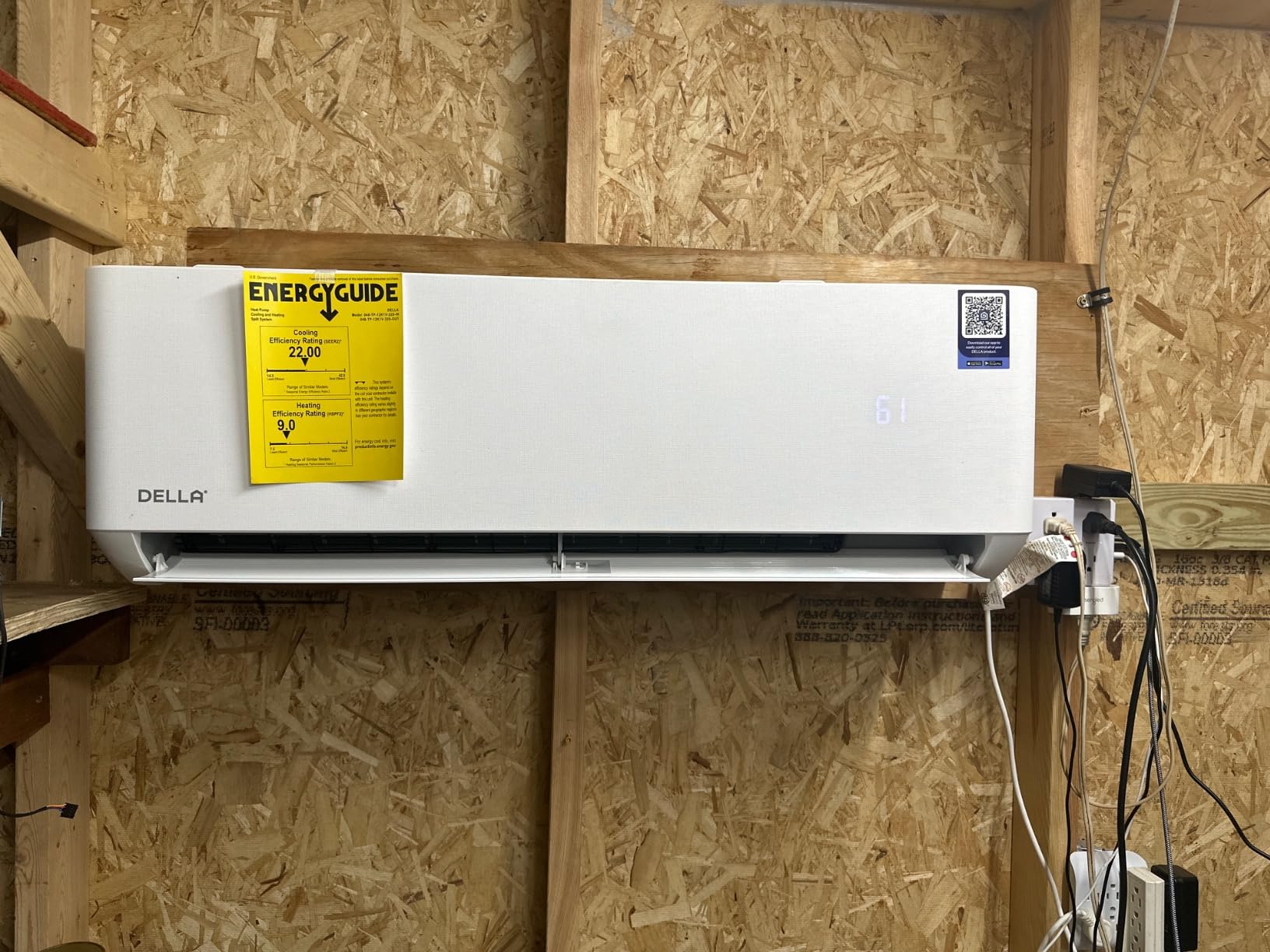
Controls are six-mode: cooling, heating, dry, dehumidify, auto, and fan, with 4D airflow and I feel mode, plus WiFi through the Della+ app and Alexa voice control. The package includes a 16.4 foot pre-flared insulated copper line set and a 6.56 foot drain extension.
Sizing is the honest limitation. At 550 square feet it has the smallest coverage claim in this roundup, which means a single-car garage or a compact converted space. If you have a 24 by 24, this is not big enough and you should be looking at the 18000 BTU options instead.
What it handles well
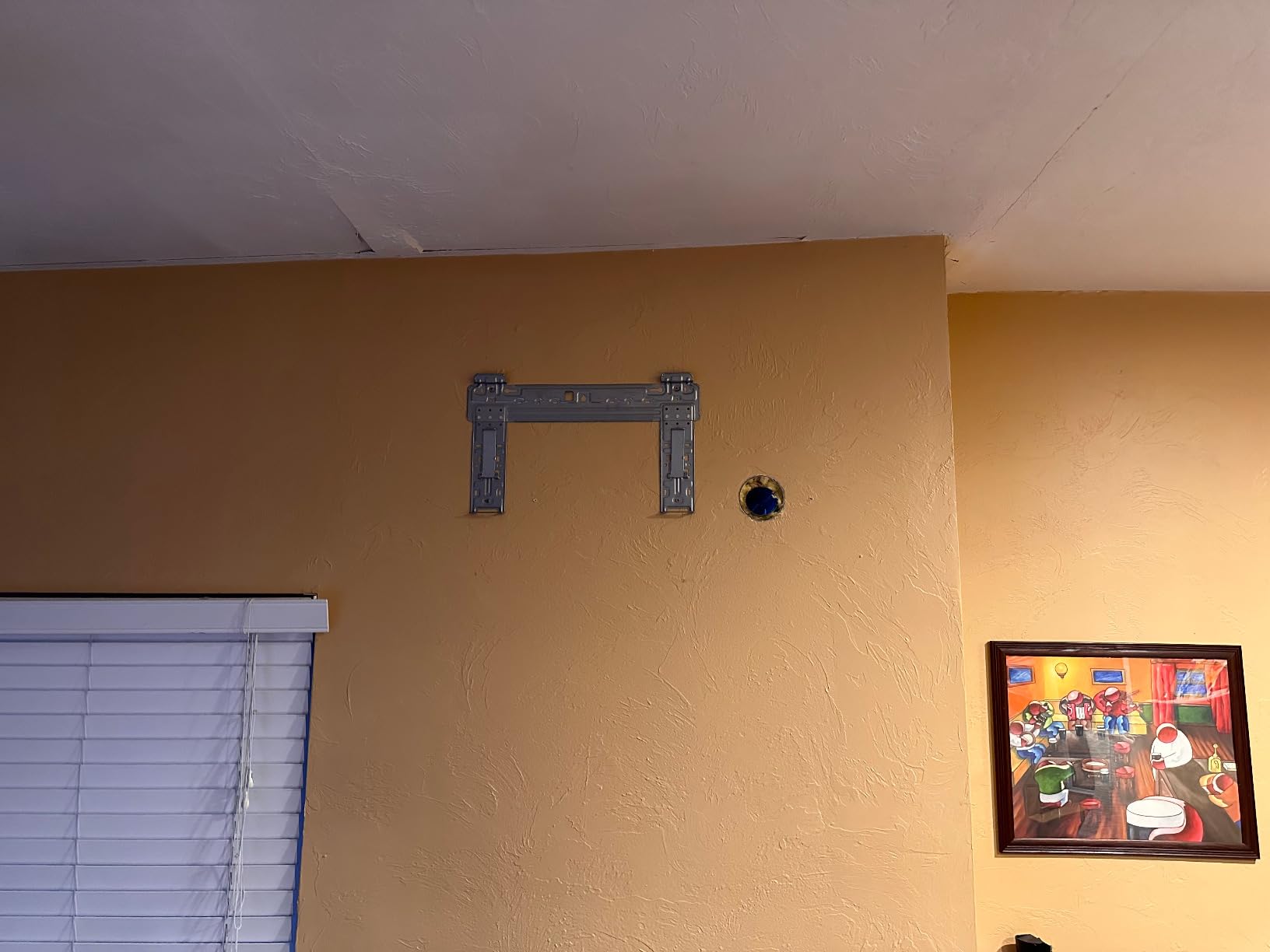
A single-car garage, a small workshop, or a converted room in a cold state that needs real winter heat. Heating to -13F on a 115V circuit is the specific combination that makes this the pick for cold climates without a 240V upgrade.
The efficiency numbers matter over a decade. 23 SEER2 and 10 HSPF2 mean lower running cost than anything else in this roundup, which compounds when you are heating a garage rather than only cooling it.
Where it falls short
Professional installation is mandated by the manufacturer, and the line set must be vacuumed. Shortening or lengthening the line set means adjusting the refrigerant charge, so this is a contractor job rather than a first project.
At 550 square feet it will struggle in anything larger, and the 268-review base is the thinnest of the Della listings here. If you are set on cold-climate performance, confirm the coverage figure against your actual square footage before you order.
12. Abbott 18000 BTU – Best for Quiet Vehicle Storage Garages
Albott 18,000 BTU Mini Split Air Conditioner and Heater, 18 SEER2, 208-230V
18000 BTU 1.5 ton
18 SEER2
208-230V
R-32
5F to 122F operation
Below 29 dB
Pros
- Shop
- cottage
- and camper owners report installs of roughly two to four hours
- Operates reliably from 5F to 122F
- Very quiet
- reported below 29 dB in quiet mode
- 18000 BTU covers up to 1250 sq ft
- Mesh filters help keep dusty shops from clogging the coil
- Customer support replaced a damaged outdoor unit quickly with no return required
Cons
- Lowest-rated pick at 4.1 stars
- Thin-gauge line set and power cable with a bracket that bends on brick
- App would not connect for one owner and the remote is described as poor
- App shows only Celsius with no unit change
- Heavy at 151 pounds
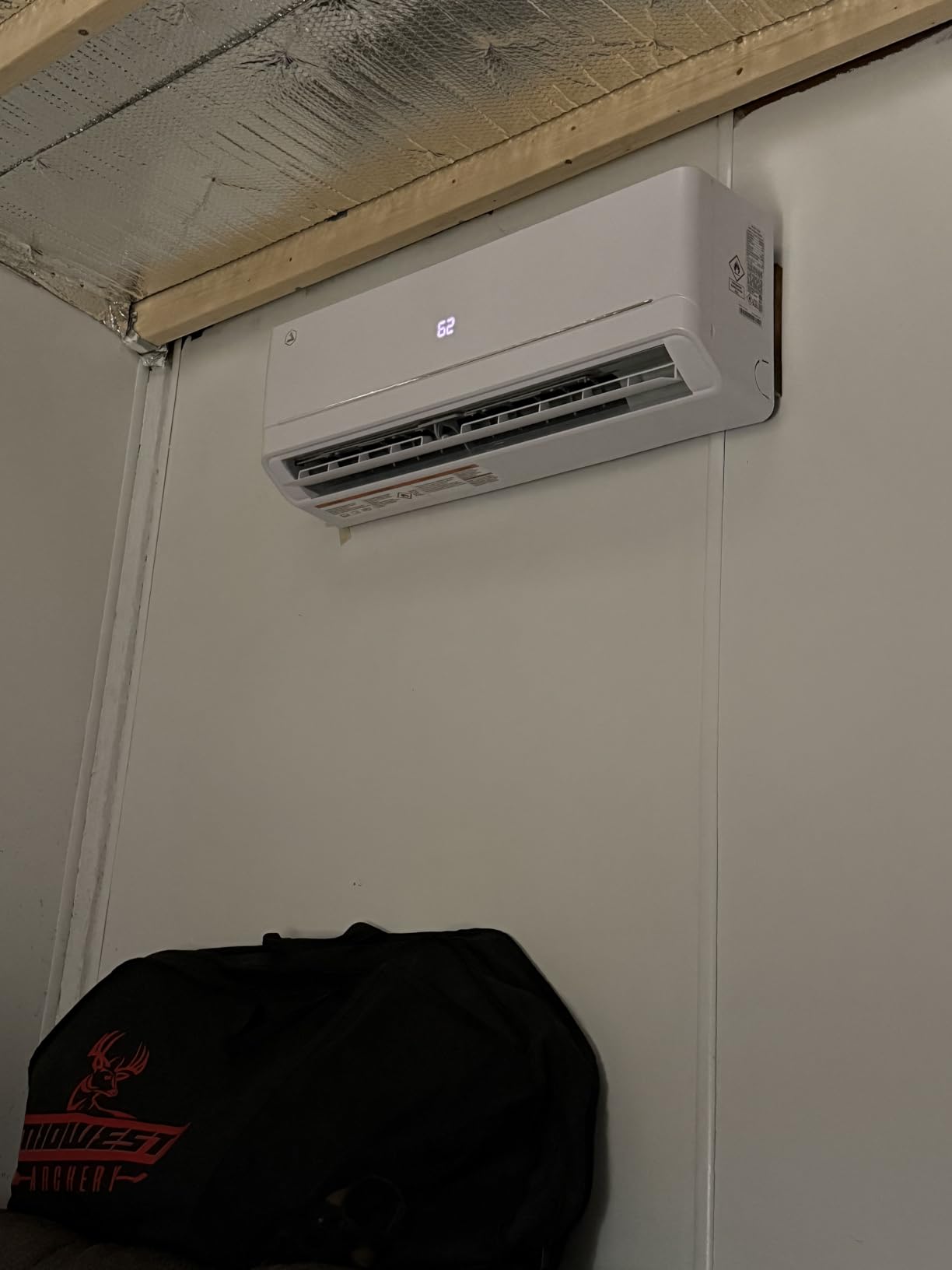
This is the storage-oriented pick. The 5F to 122F operating range covers the full span of what an unconditioned garage sees, and the 18000 BTU capacity rated to 1250 square feet means you can hold a protected temperature over stored vehicles and tools without running the system at maximum all day.
Shop, cottage, and camper owners report installs of roughly two to four hours, which is faster than most units in this group. Quiet mode runs below 29 dB, and the mesh filters sit over the intakes in a way that helps keep a dusty shop from loading up the coil.
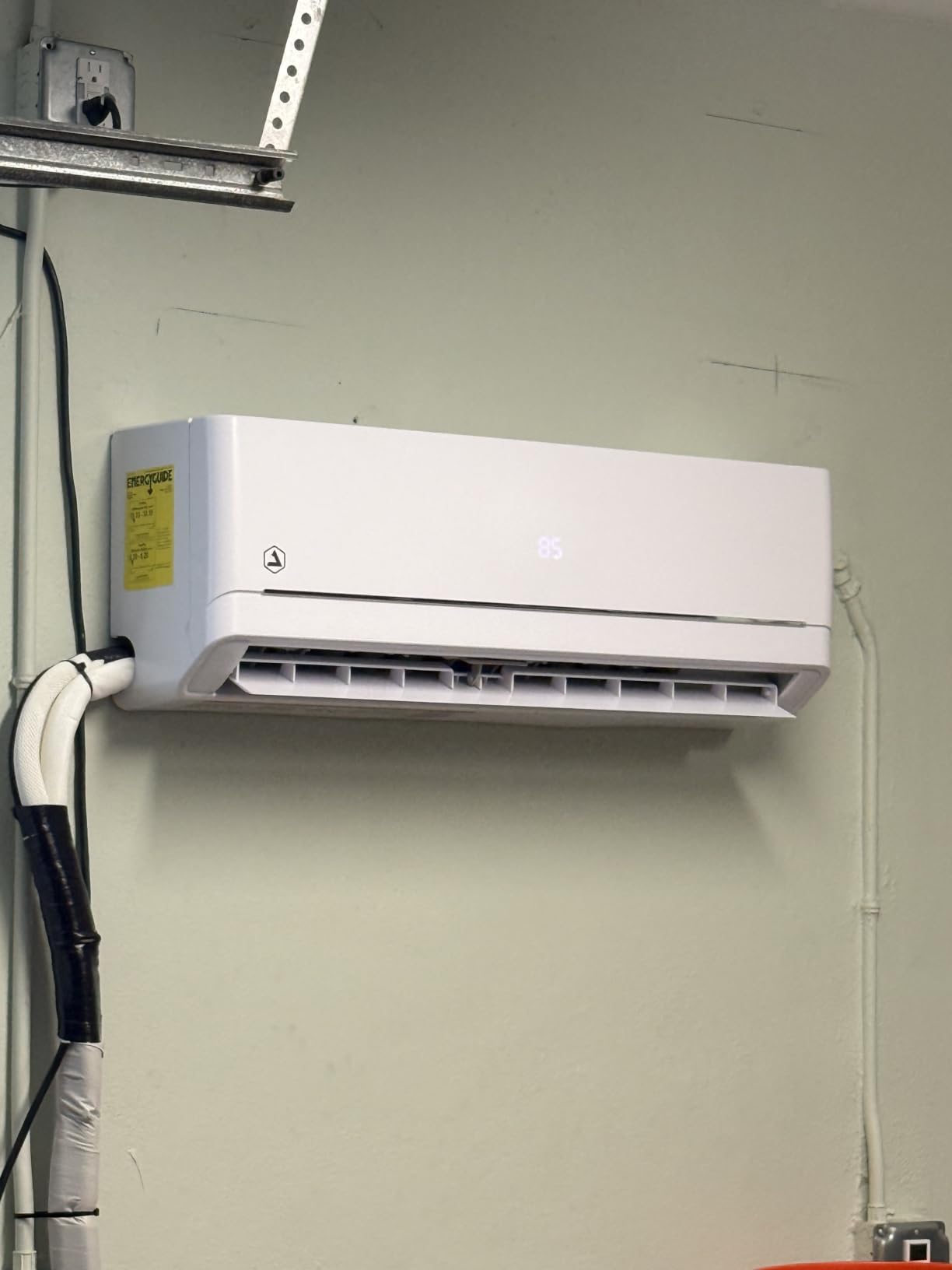
WiFi is included, along with an app, remote, auto clean, child lock, and sleep mode. A 24-hour timer and a 61F to 90F range cover the day-to-day use case, and the marketing states 5-year compressor and 7-year parts coverage.
Customer service deserves a mention. One owner had a damaged outdoor unit replaced quickly with no return required, and that is the kind of support that matters when a component is heavy and a replacement is the difference between a working garage and a dead one.
What it handles well
Vehicle and tool storage in a humid climate, where the job is moisture control rather than comfort. Running this at a moderate set point with the sleep mode holds a stable environment cheaply, which is exactly what protects paint, chrome, cardboard, and electronics.
It is also a fit for a small shop or a cottage-scale space where you need both heating and cooling across a wide outdoor temperature range without wanting two separate pieces of equipment.
Where it falls short
At 4.1 stars this is the lowest-rated pick in the roundup, with about 15 percent one-star reviews. The recurring complaints are accessory quality: the line set and power cable are thinner gauge than competing brands, and the mounting bracket bends easily on brick.
The app showed Celsius only with no unit change, one owner could not get it to connect at all, and the remote is described as poor. At 151 pounds it is one of the heavier units here, so mounting is not a one-person task. If fit and finish matter to you, the COSTWAY 18000 BTU is the better-built alternative at the same capacity.
Buying Guide for Garage Mini Splits
Size the space before you pick the unit
Measure the actual floor area and then measure the wall area above and around it, because garages lose heat through the door faster than through the walls. A 24 by 24 garage with 9 foot ceilings is 576 square feet of floor but roughly 800 square feet of envelope. Sizing tables that use floor area alone will undersize every detached garage.
Add about 600 BTU per 100 square feet as a garage-specific starting point rather than the 400 BTU per 100 square feet rule for living space, then add for solar gain. A west-facing wall, an uninsulated steel door, or a concrete block wall moves you up a size. If you are between two sizes, go up.
Insulate first, then size
The cheapest capacity upgrade is a garage door insulator and weatherstripping. A bare steel door is often the largest single thermal loss in the space, and sealing it can cut the required capacity by a full tier. Insulating the walls lets you drop from 24,000 BTU to 18,000 BTU, which is real money on the unit and on the circuit.
This is the decision most buyers get backwards. They buy the biggest unit they can afford and then wonder why the bill is high. The order that works is: seal the door, insulate the walls if the budget allows, then size the system to the space you actually have. Related reading on central air conditioning options is useful if you are also weighing extending conditioned air to the garage.
115V or 230V: the decision that drives everything
A 115V unit plugs into a standard household circuit, needs no permit in most jurisdictions, and can be installed without an electrician. The ceiling is roughly 12,000 BTU. Above that you are into dedicated 240V circuits, which need a breaker sized to the unit, a disconnect switch within sight of the outdoor section, and often a permit.
That electrical step is the single most common surprise cost in garage mini split projects, and it is the reason so many people start with a 12,000 BTU system. If your garage panel has no spare position, get an electrician out before you order anything. If you are still comparing options, our portable air conditioner guide covers the no-install alternative for smaller spaces.
Pre-charged line set versus flared fittings
This is the most important mechanical distinction in the whole category. A pre-charged quick-connect line set arrives sealed with the refrigerant already in it, so you bolt two fittings together and the circuit is complete. No vacuum pump, no manifold gauges, no EPA 608 handling, and the manufacturer usually covers the charge for the included length.
Flared installs include an empty line set and require you to cut, flare, and evacuate the circuit to a vacuum before charging it. That is a real HVAC skill. Professionals in owner forums are consistent on this point: a bad flare job costs more than the entire price gap between a budget unit and a premium one. If you have never flared copper, buy pre-charged and follow the illustrated directions.
What a mini split does not do in a garage
A ductless mini split does not bring in outside air. It conditions and recirculates the air already in the room. That is fine for comfort and humidity, and it is a limitation for air quality. Car exhaust, sawdust, paint overspray, and solvent fumes stay in the space.
The honest framing is this: owners who run vehicles inside a garage with a mini split going still vent the space independently. The unit is for comfort and humidity control, not for combustion safety. If you paint, sand, or run an engine indoors, keep a door open or add a fan, and do not treat conditioned air as ventilation.
For hot summers, the dehumidify mode is the feature that earns its keep. Setting the system to dry at moderate fan speed pulls moisture out without overcooling, which protects stored vehicles, cardboard, and electronics far better than running full cooling and accepting the temperature swing.
Cold climate heating and winter freeze protection
Standard units stop producing useful heat around 5F. Hyper heat and low-ambient models are rated to -13F, and a few extend to -22F. In an unheated garage, the indoor head and the line set can freeze, and the condensate drain is the most common failure point. Route the drain line where it cannot freeze, or keep the garage above freezing when the system is not running.
Many owners set a maintenance temperature between 45F and 50F rather than full comfort heating. It protects stored vehicles and tools, keeps the drain line alive, and costs a fraction of holding the space at 68F. Save full comfort heating for the months you are actually working out there.
Refrigerant changes and what they mean to you
The industry has moved off R-410A toward R-454B and R-32, both of which are A2L mildly flammable refrigerants. What that means for a buyer is simple: the unit you buy today is the unit you service, and installation guides written for R-410A no longer match the equipment on the shelf. R-410A units remain perfectly serviceable, so an older unit is not a liability.
If you are comparing against a used unit or a very old install, check the refrigerant type before assuming parts and service procedures carry over. For whole-home context on how these systems compare indoors, see our mini split guide for homes.
Warranty, brands to watch, and maintenance
Warranty structure matters as much as the unit. Some brands honor self-installs and cover the refrigerant charge for the included line set length. Others mandate licensed installation and exclude labor entirely, which does not void the unit but does change who pays when something fails. Read the registration terms before you buy, not after.
Be cautious with marketplace listings that have no brand presence, recycled product photography, no AHRI certificate, and no service path. Parts availability for those units is the deal breaker, and a compressor replacement on a 2 ton system will make you wish you had spent more upfront. Look for AHRI certification, a stated warranty in years, and a manufacturer that answers support requests.
Maintenance in a garage is a short list: rinse the washable filter every few weeks in a dusty shop, clean the outdoor coil before summer, inspect the line set insulation for cracks, and confirm the condensate drain routes clear. None of it is difficult, and a dusty garage punishes a neglected filter faster than a clean living room does.
Frequently Asked Questions
Are mini split systems good for garages?
Yes. A ductless mini split is the most practical way to add cooling and heating to a garage because it needs no ductwork and installs on a single wall. The main limits are that it recirculates air rather than ventilating, and it conditions one space rather than the whole house. Owners consistently report it as the single best upgrade to a garage they have made.
How big of a mini split do I need for a 24×24 garage?
An 18,000 BTU system on a 230V dedicated circuit is the right starting point for a 24×24 garage with insulated walls. Go to 24,000 BTU if the walls are bare studs or concrete block, the door is uninsulated steel, or the space doubles as a working shop. A 12,000 BTU unit will run continuously in that footprint and still leave the far corner warm.
Is it better to undersize or oversize a mini split?
Neither is a free win. An undersized unit runs near continuously, cycles more often, and leaves humidity behind. An oversized unit short-cycles, wastes electricity, and cannot pull moisture from the air properly. For garages, the right approach is to size from the envelope rather than the floor area, add for solar gain, and buy the pre-charged line set you will actually need.
What mini split brands to stay away from?
Be careful with unbranded marketplace listings that show recycled product photography, list no AHRI certificate, and have no visible parts or service path. Specific risks are no warranty support when a compressor fails, refrigerant charge that cannot be serviced, and documentation thin enough that basic settings are undocumented. Look for a named manufacturer, an AHRI certificate, and a warranty stated in years.
What are some common problems with MRCOOL mini splits?
Owners most often report a drain line that is not included in the box and has to be sourced separately, and a unit that is finicky when switching between the app and the remote. Isolated mid-life failures have been reported around the two-year mark with an error code and a frosted outdoor line, and the published noise figure is higher than competing units. The install experience itself is widely praised.
Do mini splits ventilate a garage?
No. A ductless mini split conditions and recirculates the air already in the room; it does not bring in outside air or exhaust stale air. That is fine for comfort and humidity control but not for air quality. If you run a vehicle, paint, sand, or use solvents indoors, keep a door open or add a fan. Conditioned air is not ventilation.
Final Verdict on Mini Split Air Conditioners for Garages
After working through twelve systems against real garage dimensions, the Senville LETO 24000 BTU is our pick for the best mini split air conditioners for garages. At 24000 BTU with a DC inverter compressor, heating down to 5F, and a manufacturer coverage claim of 1250 square feet, it is the only unit here that gives a 24 by 24 detached garage real headroom, and the 4.5 star average across roughly 2000 reviews is the deepest owner feedback in the group.
For most two-car garages, the Senville LETO 12000 BTU is the smarter purchase. It runs on 110V, which removes the electrician, delivers 20.8 SEER at 28 dB, and covers 700 square feet, which is honest capacity for a space in that class. If you want quiet in a working shop, the COSTWAY 18000 BTU at 23 dB is the one. If you need January heat, the DELLA Optima 12000 BTU carries hyper heat to -13F on a 115V circuit.
Whichever you choose, seal the garage door first, size from the envelope rather than the floor area, and treat a mini split as comfort and humidity control rather than ventilation. Garage owners across the forums describe the same result once a system is in: they stop thinking about the garage and start using it.