

There is nothing worse than standing in a cold shop at 7am with a half-finished weld in your hands. The best natural gas garage heaters for workshops solve a problem electric units cannot: they put real heat into a big, drafty, uninsulated space without needing a 240V circuit or a sub-panel you do not have room for. I have spent the last few months going through the units that owners actually run in garages, basements and small shops, and the differences between them are bigger than the spec sheets suggest.
Start with the sizing math, because it settles most of the argument before you pick a brand. In a lightly insulated garage with an 8 to 9 foot ceiling, plan on 40 to 50 BTU per square foot. So a 24×24 workshop at 576 square feet wants roughly 23,000 to 29,000 BTU of input, and most buyers land on a 30,000 BTU unit with a little headroom. An insulated, drywall-finished shop can get by near 20 BTU per square foot, which is the 12,000 BTU range for that same 24×24 room. Ceiling height matters more than most people expect, since warm air collects above head level and a 10 foot ceiling throws usable heat farther than an 8 foot one.
Beyond size, three decisions do the real work: whether you vent to the outside or burn vent-free, whether you want forced air that circulates the room or radiant heat that warms you directly, and how much of the installation you are willing to take on. Get those right and the model choice is easy. Get them wrong and you can spend good money on a heater that never performs the way you imagined.
If your shop has no gas line yet, start there rather than with a product page. A new natural gas line to a detached building involves a permit, a licensed gas fitter, and possibly trenching, and that cost lands on top of the heater no matter which one you buy. If you are still comparing heat sources rather than fuels, our guides to electric garage heaters for workshops and infrared heaters for workshops cover the cases where a gas line is not realistic.
Table of Contents
Top 3 Picks for Natural Gas Garage Heaters in October 2026
The three units below are the ones I would put in front of most people. The Mr. Heater 30,000 BTU vent-free blue flame is the single most proven option here, with the deepest review base in the group by a wide margin. The 50,000 BTU forced-air Mr. Heater is the one to buy when the space is large and you want air circulation. The ProCom 30,000 BTU infrared plaque gives you the most coverage per dollar with a thermostat already built in.

Mr. Heater 30,000 BTU Vent Free
- 30000 BTU blue flame
- Heats up to 1000 sq ft
- Battery electronic ignition
- Vent-free with low oxygen shut-off

Mr. Heater 50,000 BTU Unit Heater
- 50000 BTU forced air
- Covers up to 1667 sq ft
- Ceiling mounted
- Works with Wi-Fi thermostats

ProCom 30,000 BTU Infrared Plaque
- 30000 BTU radiant output
- Covers up to 1400 sq ft
- Built-in thermostat
- Push button ignition with ODS
All 10 Natural Gas Garage Heaters Compared in October 2026
Here is the whole lineup on one page, with the details that actually separate these units: output, stated coverage, how the heat reaches you, and what the install demands. Ratings and review counts are the aggregate figures reported by the manufacturer listing.
| Product | Specifications | Action |
|---|---|---|
| Mr. Heater 30,000 BTU Vent Free Blue Flame |
|
Check Latest Price |
| Mr. Heater 50,000 BTU Forced Air |
|
Check Latest Price |
 Dyna-Glo 20,000 BTU Blue Flame Dyna-Glo 20,000 BTU Blue Flame |
|
Check Latest Price |
| ProCom 30,000 BTU Infrared Plaque |
|
Check Latest Price |
 Modine Hot Dawg 45,000 BTU Modine Hot Dawg 45,000 BTU |
|
Check Latest Price |
 Heatstar MH25NG Radiant Overhead Heatstar MH25NG Radiant Overhead |
|
Check Latest Price |
 Ashley Hearth DVAG11N Direct Vent Ashley Hearth DVAG11N Direct Vent |
|
Check Latest Price |
 ProCom 10,000 BTU Blue Flame ProCom 10,000 BTU Blue Flame |
|
Check Latest Price |
 Heatstar HS125NG Salamander 125K Heatstar HS125NG Salamander 125K |
|
Check Latest Price |
 Comfort Glow KWN521 30,000 BTU Comfort Glow KWN521 30,000 BTU |
|
Check Latest Price |
What usually is not in the box: the gas connector hose and the pressure regulator are separate on most models, and the thermostat almost always is. Vent kits are the big one: on the forced-air and direct-vent units, the flue pipe, roof flashing and wall thimble are bought separately and can add several hundred dollars to a project. The Mr. Heater 30,000 BTU vent-free unit does ship with a built-in adjustable thermostat and a wall-mount bracket, which is part of why it is so popular.
1. Mr. Heater 30,000 BTU Vent Free Blue Flame – Best Overall for Most Workshops
Mr. Heater 30,000 BTU Vent Free Blue Flame Natural Gas Heater
30,000 BTU blue flame
Heats up to 1,000 sq ft
No electricity required
Low oxygen safety shut-off
Pros
- Heats up to 1000 sq ft from a compact cabinet
- Runs without electricity during outages
- Built-in adjustable thermostat
- Vent-free so no flue or roof work
- Low oxygen depletion shut-off included
Cons
- Blower fan kit sold separately
- Raises room heat rather than blowing air
- Not approved for sale in some jurisdictions
This is the unit I recommend to more people than any other on this page, and the reason is durability rather than raw numbers. Roughly 4,469 ratings at a 4.5-star average tells you this design has been running in real basements, garages and porches for years. The 30,000 BTU output covers up to 1,000 square feet according to the manufacturer, which lines up neatly with a two-car garage or a small shop bay.
What makes it forgiving is the lack of hard dependencies. It does not need electricity, so a power cut during a winter storm does not take your only heat source with it. It does not need a flue, so there is no roof penetration and no draft hood to worry about in a cold building. Battery-operated electronic ignition handles the startup, and the built-in adjustable thermostat means it holds a setpoint instead of running wide open.
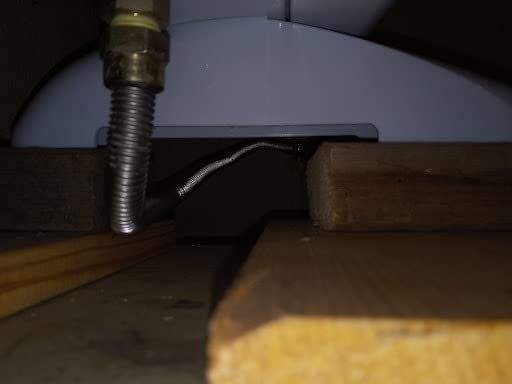
The low oxygen depletion shut-off is the safety feature to understand rather than fear. It monitors the concentration of oxygen in the room while the burner runs and shuts the heater down if it drops, which is what protects a small room with poor air exchange. That protection has a practical consequence: a tightly sealed workshop in a cold climate can trip it more often than a leaky garage, and the heater will need air supply in the room before it will stay on. If you plan to run this in a small, well-insulated, sealed room, that is a design decision, not a defect.
Owners note that the cabinet is a pedestal or wall-mount unit about 30 inches deep, 13 inches wide and 28 inches tall, weighing roughly 24.7 pounds. It is small enough to sit out of the way on a wall and light enough that one person can handle it. The one accessory that comes up again and again in reviews is the optional blower fan kit, which adds air movement so the heat spreads past the cabinet instead of rising and stratifying near the ceiling.
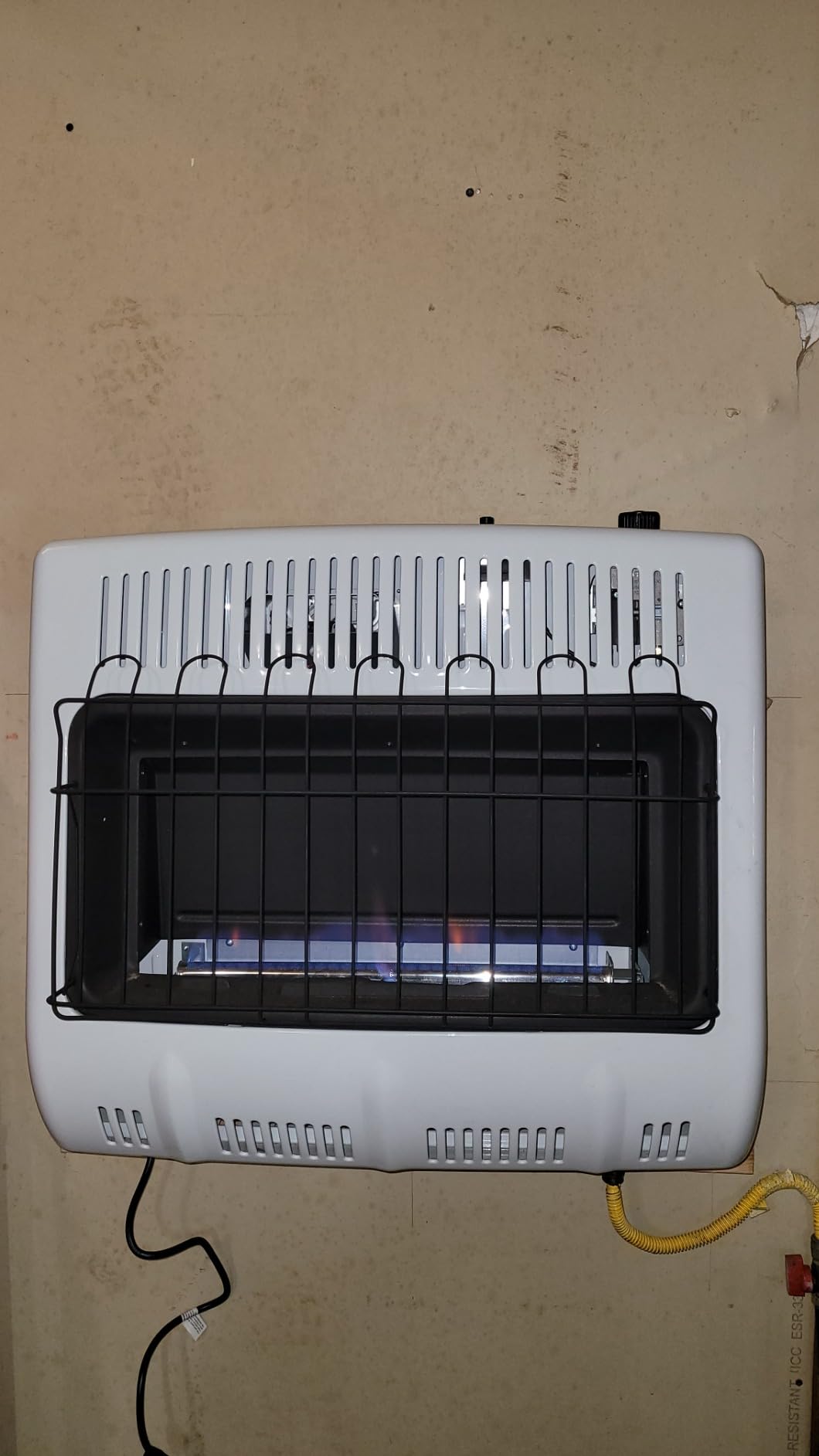
When this is the right heater for your shop
Pick this if your workshop is roughly 1,000 square feet or smaller, you want heat now rather than in an hour, and you would rather avoid a gas fitter booking. It is the best answer for a basement workshop, a detached one-car shop, a home office conversion or a garage you use on weekends.
It is also the strongest pick if the shop is heated only intermittently. Because the thermostat is built in and there is no power requirement, you can set it to hold a freeze-protection temperature and let it idle without babysitting anything.
When it is the wrong heater for your shop
A vent-free blue flame heater puts combustion byproducts into the room air by design, and some jurisdictions restrict or ban their sale outright. If your local code requires direct vent combustion air, or if you want the cleanest indoor air possible in a space you spend eight hours in, this is the wrong category and you should be looking at a sealed combustion model instead.
It also does not do a good job of moving air through a large volume. In a tall shop with a high ceiling, expect a warm layer overhead and cooler air at floor level, which is exactly the problem an optional blower kit exists to fix.
2. Mr. Heater 50,000 BTU Forced-Air Unit Heater – Best Forced Air for Larger Shops
Mr. Heater 50,000 BTU Forced-Air Unit Heater (Propane or Natural Gas)
50,000 BTU forced air
Heats up to 1,667 sq ft
Ceiling mounted
Works with 24V and Wi-Fi thermostats
Pros
- Highest forced-air output in the group
- Covers up to 1667 sq ft or a 3-car garage
- Ceiling mount keeps floor and walls clear
- Works with 24V and Wi-Fi thermostats
- LP conversion kit included
Cons
- Requires vent pipe and gas line work
- Minimum 10 ft ceiling and 8 ft clearance
- Some units arrive with a loose fan set screw
This is the highest-output forced-air unit in the group and the one I point people toward when the shop is genuinely large. At 50,000 BTU the manufacturer rates it for up to 1,667 square feet, roughly a three-car garage, and the ceiling-mounted format keeps the floor clear for a welder’s cart, a motorcycle lift or a stacked lumber rack. The cabinet weighs about 60.3 pounds, which is a two-person lift.
Forced air changes how heat feels in a space. Instead of warming you where you sit, the fan pulls room air through the burner and pushes it back out, which means the temperature becomes reasonably even from bench height to head height. One owner with an insulated 700 square foot shop reported a rise from 30F to 53F in 30 minutes, and other reviews describe holding 58F to 65F indoors through cold weather with short burner run times.
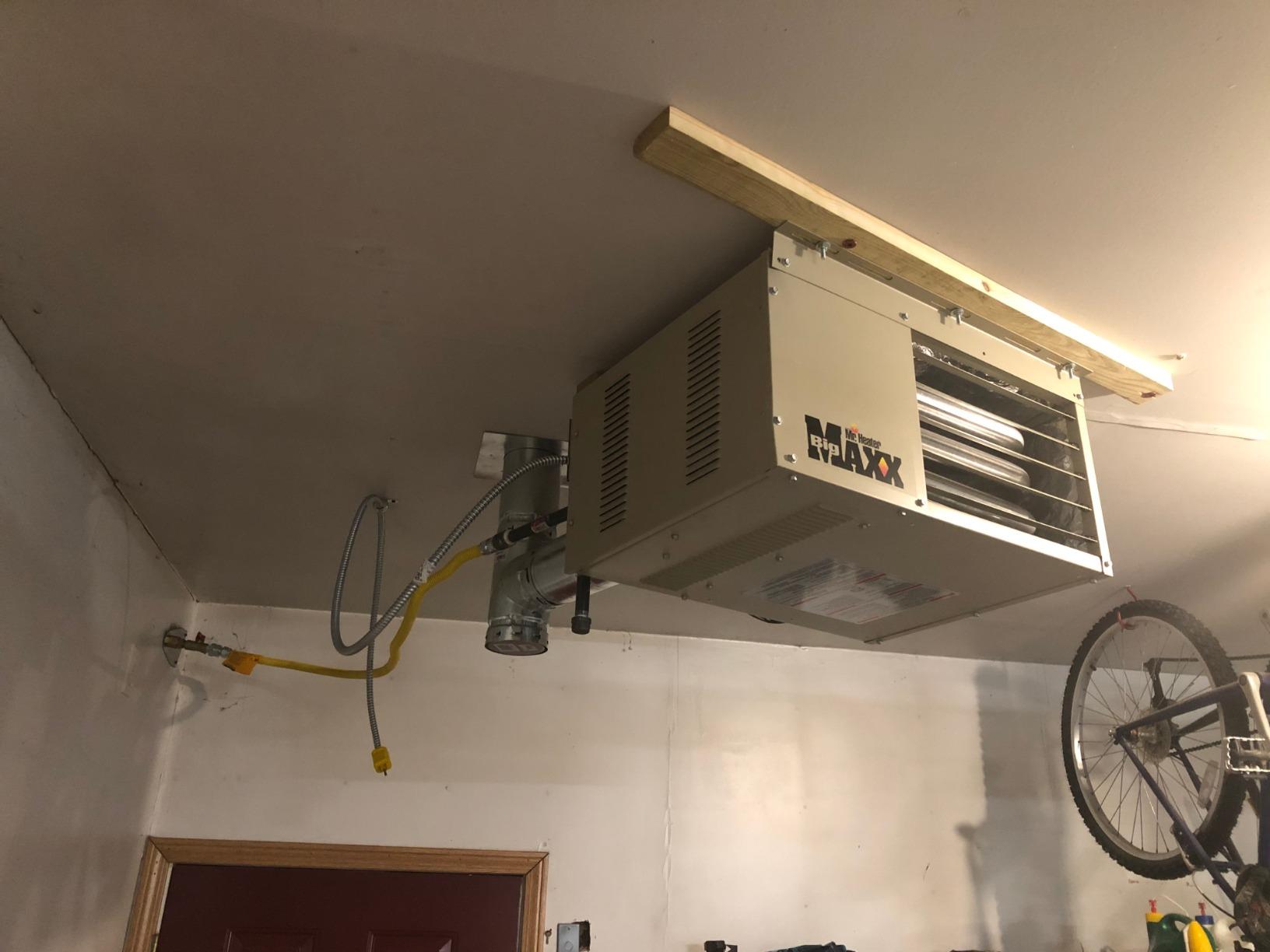
Two installation details decide whether this unit works for you. It needs a minimum 10 foot ceiling height and 8 feet of clearance from the base of the heater to the floor, so it is not a low-ceiling shop. And it needs a vent pipe run through the roof or an exterior wall, plus a gas line connection and a 24-volt thermostat, none of which come in the box.
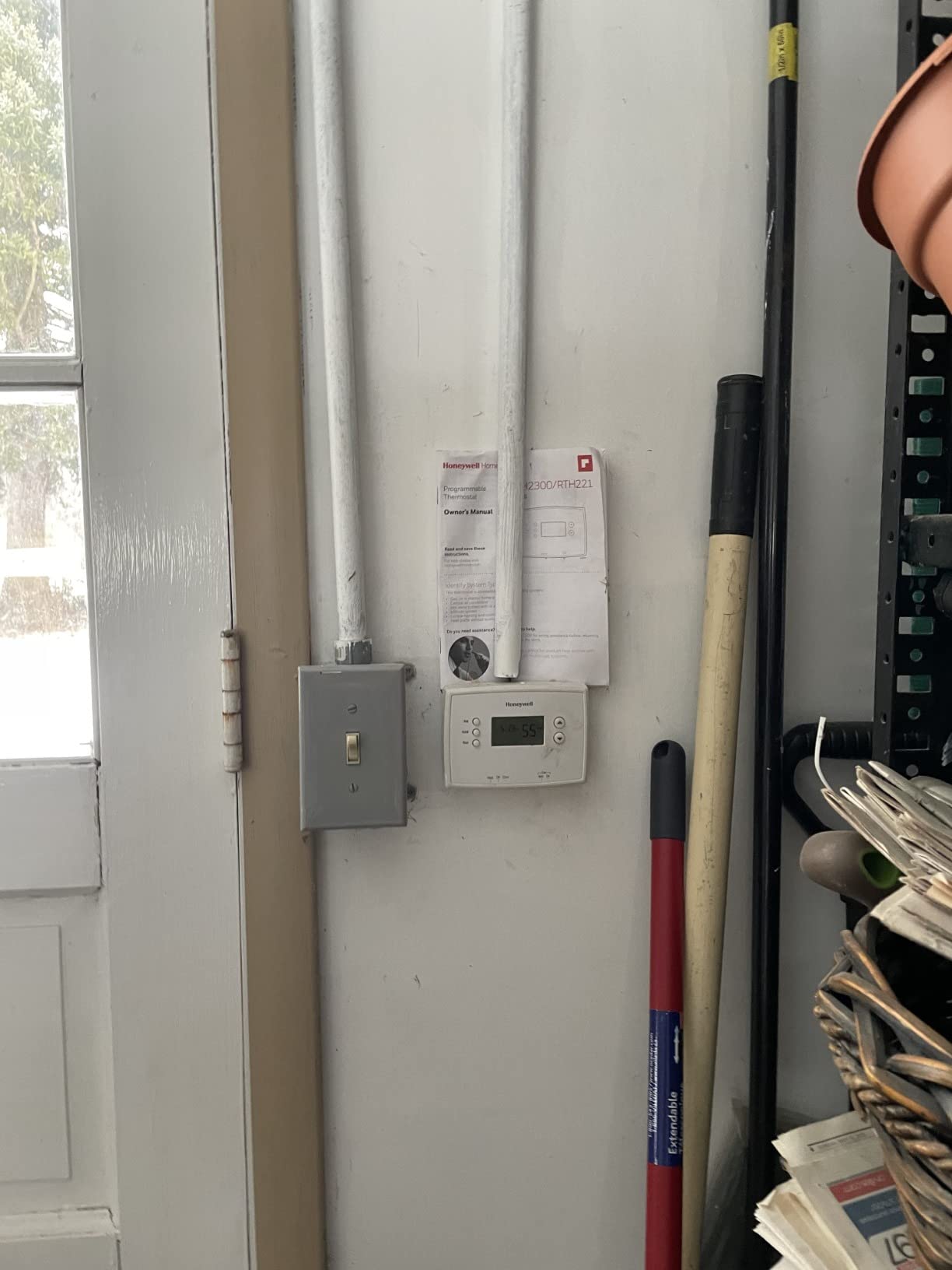
On the thermostat, this is where the forum pattern that works so well in practice shows up: owners pair the unit with a 24-volt model or a Wi-Fi model such as the Sensi ST55, set it low for freeze protection and crank it up for a working session. A natural gas to liquid propane conversion kit is included, and high-temperature shut-off plus a gas safety flame sensor cover the failure cases. A few buyers report a loose fan set screw or bent fan blade tabs causing a rattle until tightened, which is a two-minute fix rather than a defect.
What you gain with a forced-air unit
You gain even temperature distribution and the ability to heat the whole volume rather than a local zone. That matters for anyone moving around a shop, working at a bench in the far corner, or finishing a coat of finish that needs consistent warmth across the room rather than a hot spot overhead.
You also gain thermostat flexibility. This unit accepts standard 24-volt controls, so any conventional or smart thermostat you already trust will drive it without a proprietary controller.
What it costs you to install
Budget for the vent kit, the thermostat, the gas connector hose and regulator, and the labor. Owners consistently describe the install as costing more than the heater itself, and that is the honest picture for anyone without an existing gas line and a clean exhaust path.
There are also recurring reports of control board failures after the warranty period combined with frustrating manufacturer support, so keep the install manual and consider the wiring diagram before you mount it high on a ceiling.
3. Dyna-Glo 20,000 BTU Blue Flame Wall Heater – Best Small Garage Starter
Dyna-Glo 20,000 BTU Natural Gas Blue Flame Vent Free Wall Heater
20,000 BTU max natural gas
Covers up to 700 sq ft
Three heat settings on one knob
No electricity required
Pros
- Three output settings from a single knob
- Covers up to 700 sq ft
- No electricity needed
- Wall mounted to keep the floor clear
- Straightforward ignition and setup
Cons
- Manual control with no thermostat
- Medium and high flame settings are hard to tell apart
- Natural gas only
- conversion not permitted
The Dyna-Glo 20,000 BTU is the honest budget entry for a small garage, a basement or a cabin where you want warmth without a project. It puts out 20,000 BTU at maximum and the manufacturer rates it for up to 700 square feet, with a variable knob offering 10,000, 15,000 and 20,000 BTU. Those three steps are the only temperature control you get, but they are more control than most vent-free heaters of this size offer.
At roughly 20.2 pounds and 24 inches square, this is a genuinely easy wall mount. The blue flame burner warms the room air rather than just radiating at you, which some people prefer in a space where they move around. It needs no electricity, so ignition is manual and the whole thing keeps working through an outage.
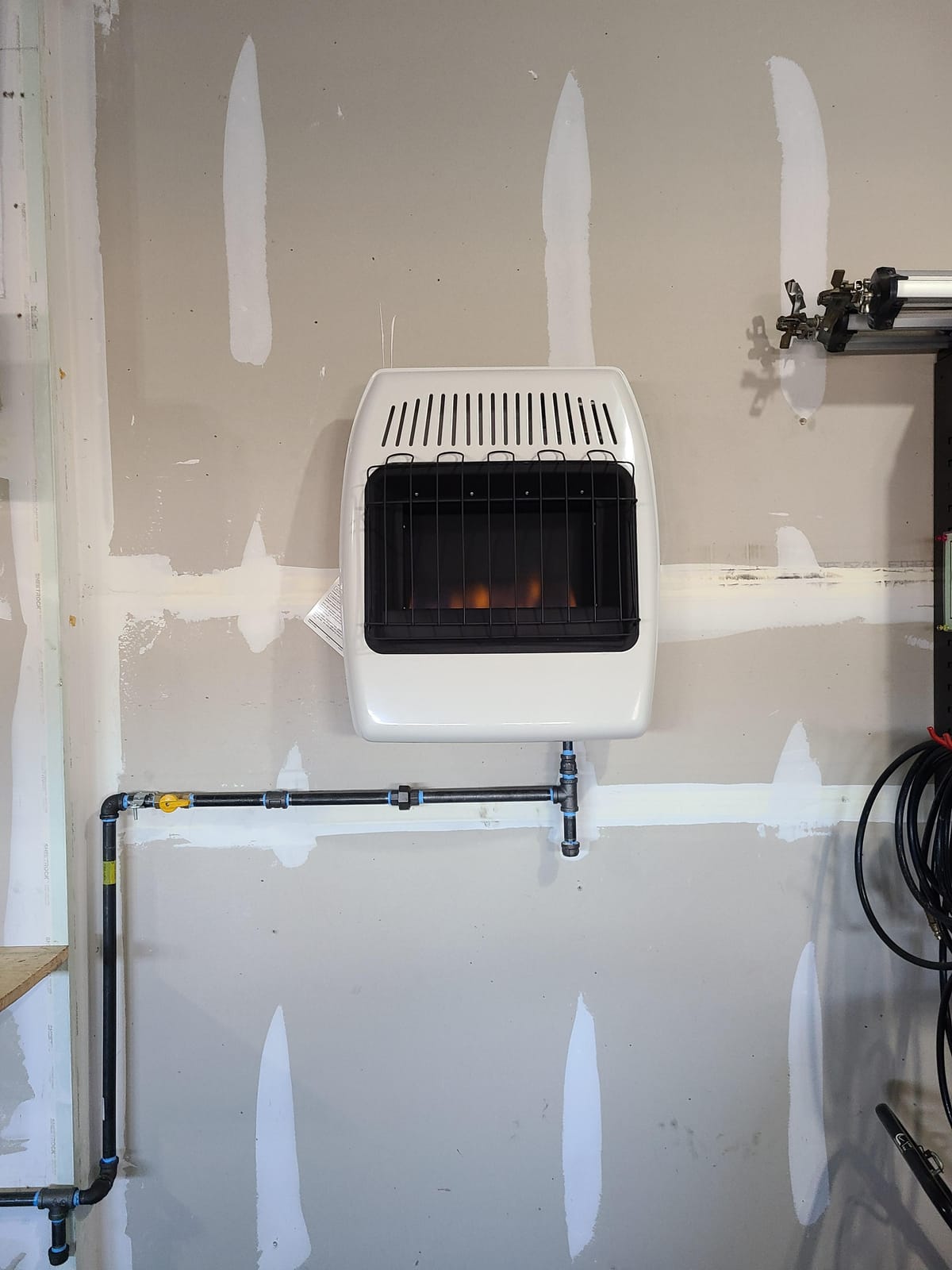
The honest limitation is control. This model, the BF20NMDG, has manual control and is not thermostatically controlled. If you want a setpoint, the manufacturer points you at a different model in the same family. The three flame sizes are also coarse, and reviewers repeatedly note that the medium and high settings look similar enough to be hard to distinguish in practice.
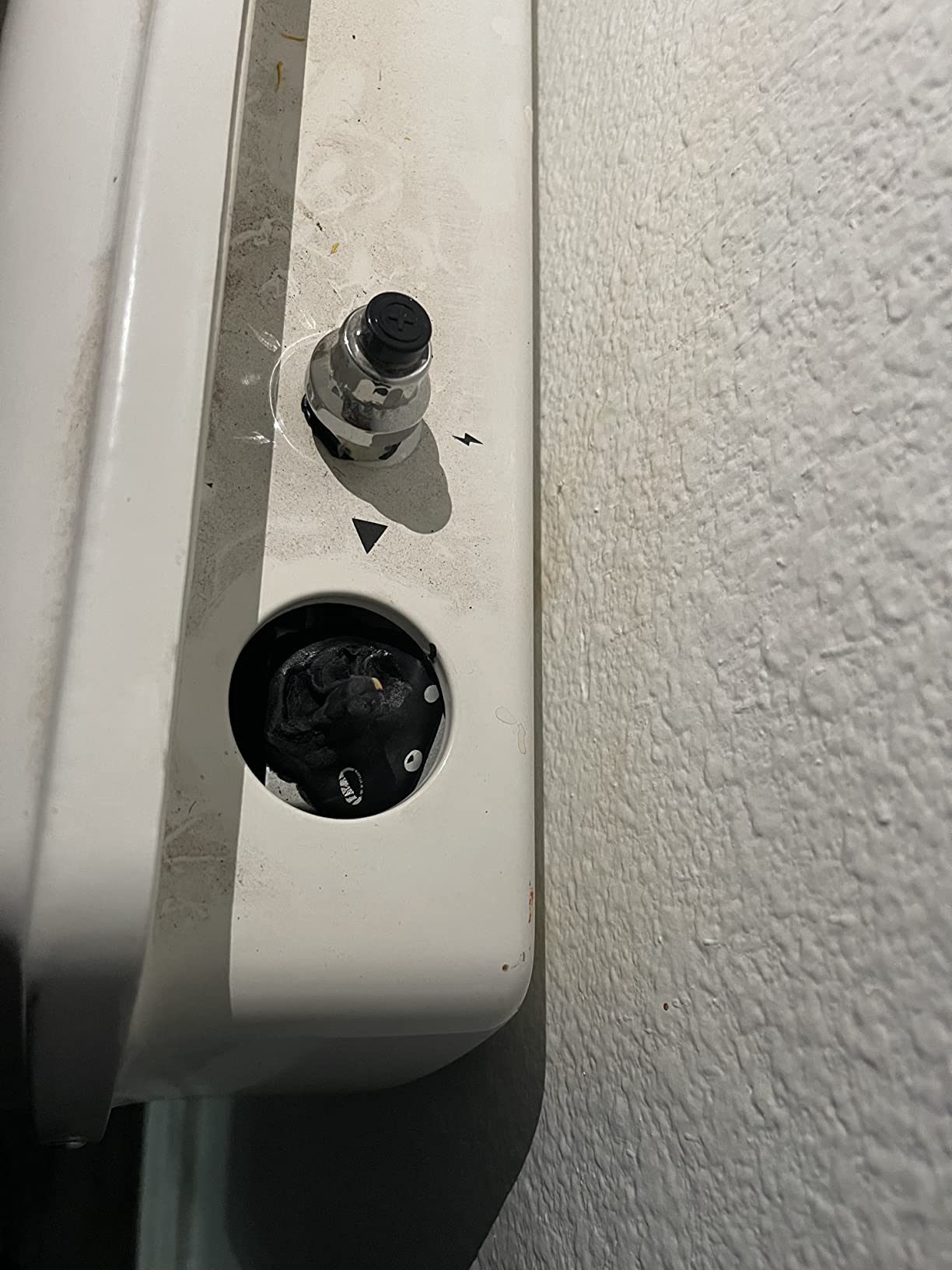
This is natural gas only, and the listing states that fuel conversion is not permitted, so it cannot be converted to run on propane. That is fine if you have a gas supply, and a non-starter if you were planning to buy a single unit that covers both fuels. One reviewer also reports a unit catching fire after about a year, an isolated report against roughly 283 ratings at 4.5 stars, but it is worth having a working carbon monoxide alarm in any case.
Where the Dyna-Glo earns its place
It suits a one-car garage, a storage space, a finished basement corner or a small cabin where 700 square feet of coverage is genuinely enough. The wall mount keeps the floor free, which matters in a space already crowded with a bicycle or a mower.
It also suits anyone who wants to avoid both electricity and a vent kit. Gas, a wall and a manual knob is the whole installation.
Where it falls short
If you need the room held at a specific temperature while you work, the lack of a thermostat is the dealbreaker. You will be adjusting a knob by feel, and the difference between the middle and top settings is hard to read.
At 700 square feet of rated coverage it is also the wrong size for an uninsulated 24×24 workshop, and because conversion is not permitted it is a natural gas or nothing purchase.
4. ProCom 30,000 BTU Infrared Plaque Heater – Most Versatile With a Built-In Thermostat
ProCom Heating Natural Gas Ventless Infrared Plaque Heater With Base Feet – 30,000 BTU, T-Stat Control – Model# MN300TPA-B
30,000 BTU natural gas
Covers up to 1,400 sq ft
Built-in high/medium/low thermostat
Oxygen depletion sensor
Pros
- Rated for up to 1400 sq ft
- strong coverage per dollar
- Built-in thermostat is unusual at this output
- Push button ignition with oxygen depletion sensor
- Ships with wall hardware and base feet
- No electricity required
Cons
- Natural gas version only on this listing
- Infrared warms people more than it moves air
- Instructions are confusingly written
- Base feet leave the gas connector without clearance
This is the one I keep coming back to as the value pick, because it does something the other vent-free units in this range do not: it has a real thermostat. The ProCom MN300TPA-B produces up to 30,000 BTU on natural gas and is rated for up to 1,400 square feet, which is a bigger coverage claim than most 30,000 BTU wall heaters make. At 803 ratings and a 4.4-star average, the feedback base is wide enough to trust.
The thermostat has high, medium and low settings with a minimum setting of 40F, which makes it a genuine freeze-protection unit rather than a dial you set once. Push-button ignition with a built-in oxygen depletion sensor shuts the burner down if carbon monoxide or low oxygen is detected, and the unit is ANSI certified with overheat protection. It needs no electricity, so it stays useful during a power cut.
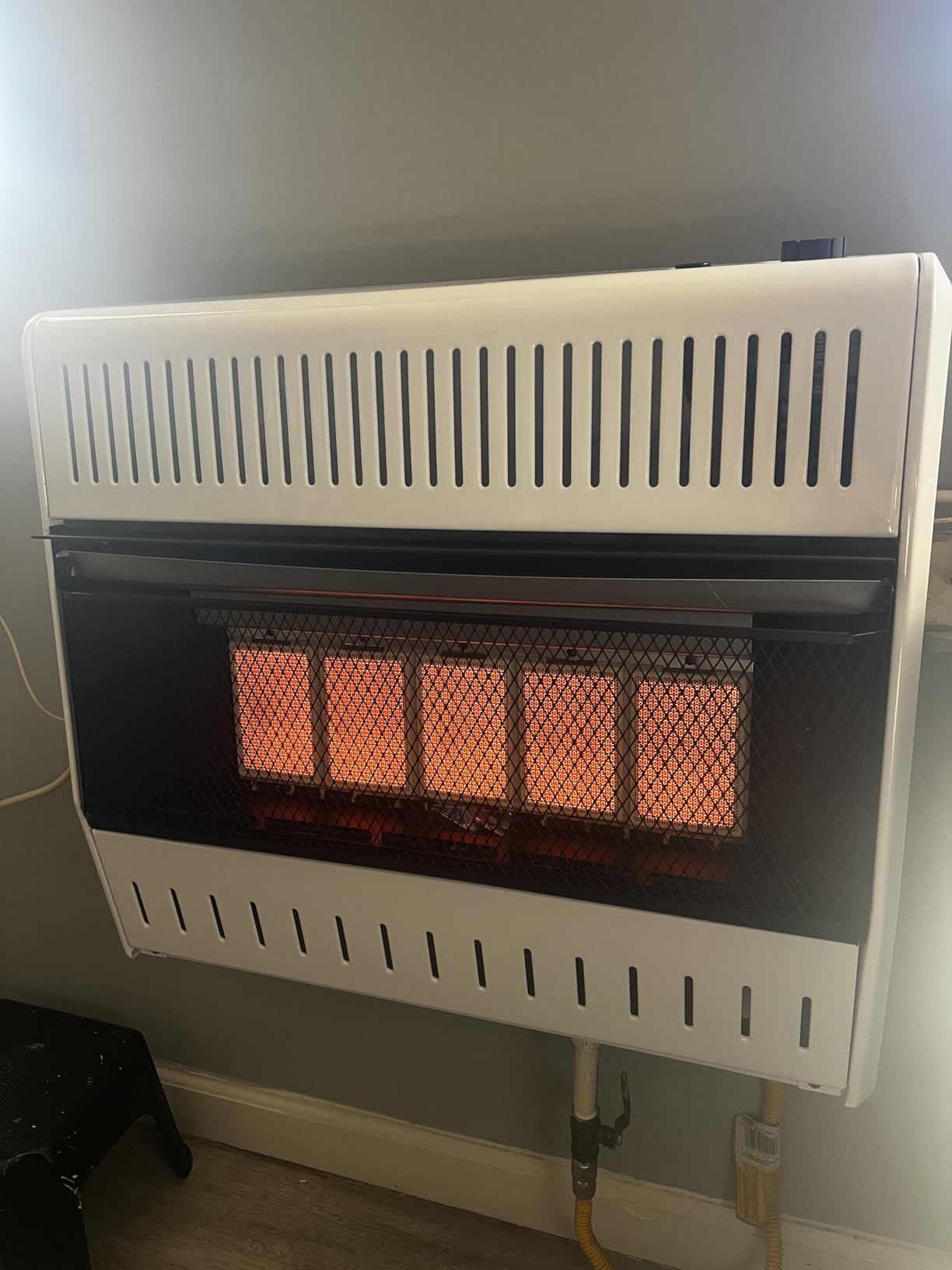
The installation detail that trips people up is worth knowing before you buy. The heater ships with both wall-mount hardware and base feet, but when you use the base feet the bottom gas connector does not have enough clearance to screw the hose in properly, so wall mounting ends up being the practical choice. The slim profile, at 8 inches deep, 26.6 inches wide and 23.5 inches tall, suits a wall in a finished room as well as a shop.
Two other honest notes. This listing is the natural gas version; propane operation requires a different variant in the same range. And because it is infrared, it heats occupants and surfaces more than it circulates air through the room, so a bench directly in front of it gets warm while the far end stays cool unless you add a fan.

Why the built-in thermostat matters so much
Most vent-free heaters at this output force you to choose between saving money and having any control at all. This one has both, and the 40F minimum setting means you can leave it in place year round and let it hold the shop above freezing without thinking about it.
That is the pattern owners describe in workshop forums: the heater idles at a freeze-protection setpoint and gets turned up for a working session. Having the thermostat on the unit removes the excuse not to do it.
What to plan around
Vent-free means the unit draws combustion air from the room and vents byproducts into the room. It needs reasonable air exchange, and it is not the right choice for a sealed, finished, drywall-lined space you plan to sit in all day.
Expect to wall mount it, and expect the instructions to take some reading. The hardware is right, but several buyers report the written directions make a simple setup feel far more complicated than it is.
5. Modine Hot Dawg 45,000 BTU – Best Quiet Forced-Air Power Heat
Modine HD45AS0111Natural Gas Hot Dawg Garage Heater 45,000 BTU with 80-Percent Efficiency Grey
45,000 BTU natural gas
80 percent efficiency
Power exhaust
Quiet operation
Pros
- Quiet forced air operation
- 80 percent efficiency rating
- Power exhaust simplifies side wall or roof venting
- Field wiring and knockouts speed installation
- Certified for residential and industrial use
Cons
- Highest cost in the group
- Requires 115V power so it stops in an outage
- Needs a small diameter vent pipe run
- 700 sq ft listed coverage is modest
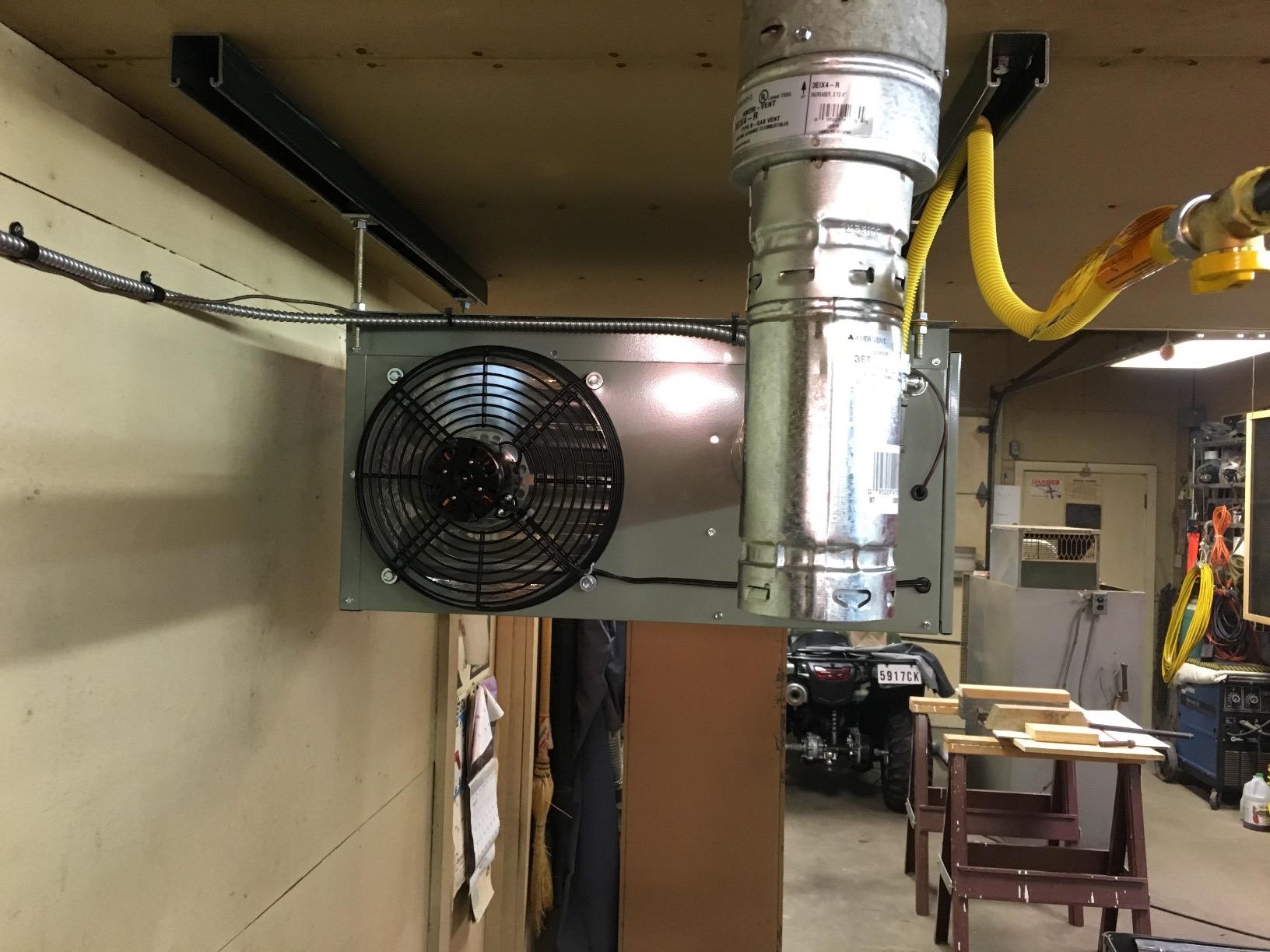
The Modine Hot Dawg is the one to consider if you work in the shop all day and fan noise is the thing that would drive you out. Its listed selling point is quiet operation, paired with an 80 percent efficiency rating, and 45,000 BTU of natural gas output. At 60 pounds and 26 by 12 by 16.5 inches, it is a compact cabinet rather than a hanging unit, which gives you flexibility on ceiling height that hanging models do not.
The power exhaust is the feature that separates it from the ceiling-mounted Mr. Heater. Instead of relying on draft induced by the burner, an exhaust fan pushes combustion gases out, so you can vent through a side wall or a roof with small-diameter vent pipe. That can be the difference between a straightforward install and one that needs a chimney chase.
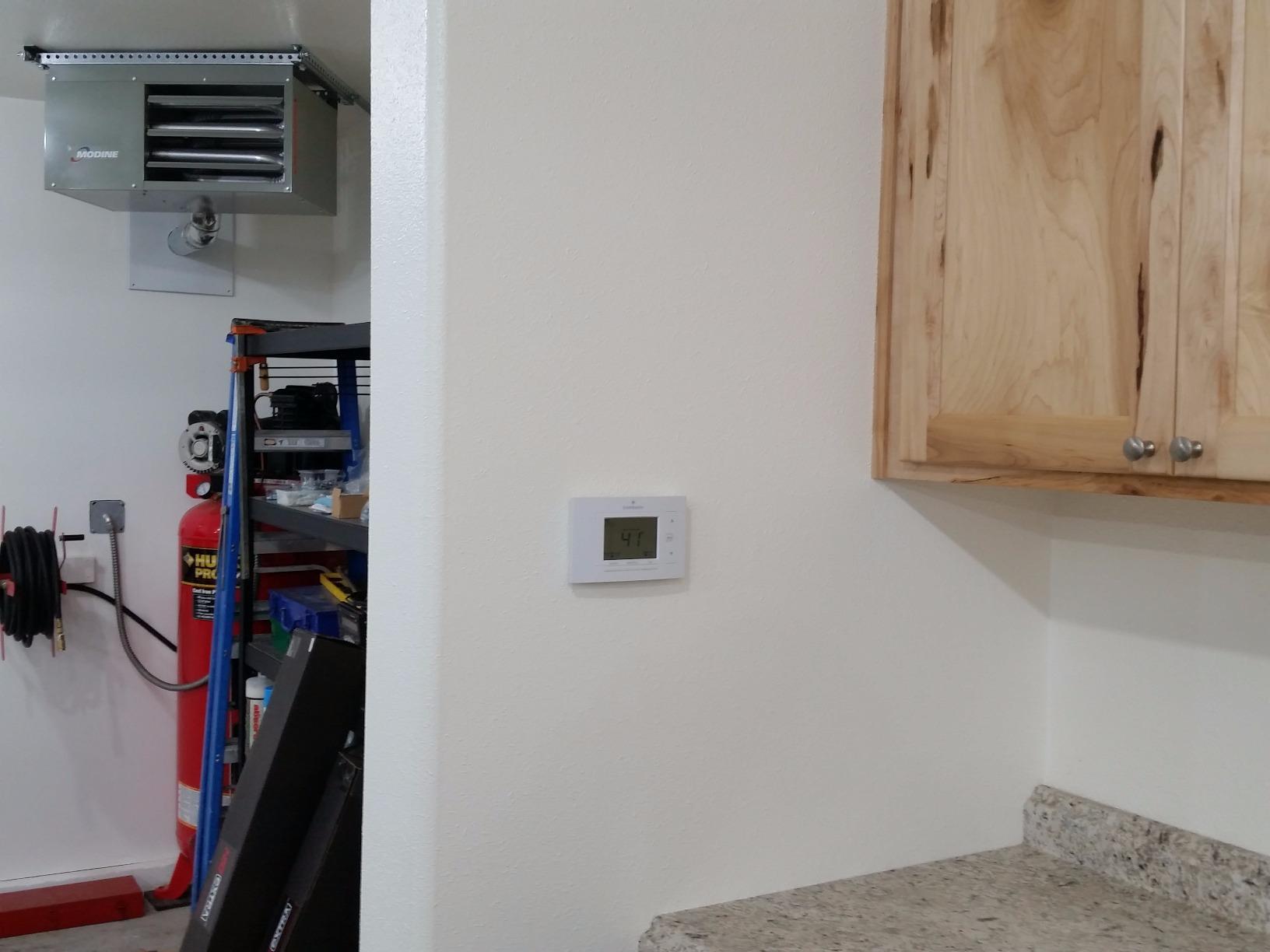
Two tradeoffs are worth weighing carefully. This unit needs 115V electrical power in addition to gas, so when the power goes out the heater goes out with it, which removes the emergency heat argument that the vent-free units make. And the listed heating coverage of 700 square feet is modest for 45,000 BTU of output, so a larger shop would need insulation on the envelope to get the rated result.
The review base here is smaller, about 150 ratings at 4.5 stars, so the evidence is thinner than the Mr. Heater or ProCom listings. What those reviews do say is consistent: quiet running, straightforward installation using the field wiring connections and knockouts, and a low-profile neutral grey cabinet that does not look out of place in a finished space.
Who this heater fits
Choose the Hot Dawg when noise is a real constraint, when you want the highest efficiency rating in this group, and when you are comfortable running a small-diameter vent pipe to a side wall or roof. It suits a working studio, a shop with a woodshop attached, or any room where you need to hear a radio or hold a conversation.
It is also a good fit for a shop that occasionally loses power but where you have a secondary heat plan, since the fan and controls need electricity.
Who should look elsewhere
If the shop is your only heat source during a winter outage, skip it. The electric dependency is the defining limitation of this model.
If your budget is fixed, this is the most expensive unit on the page and the total goes up further with the vent pipe run. And if your shop is much bigger than 700 square feet, the listed coverage means you would be chasing heat the unit cannot deliver.
6. Heatstar MH25NG Radiant Overhead Heater – Fastest Warm-Up at the Bench
Heatstar By Enerco F125444 Radiant Overhead Garage Heater MH25NG Natural Gas
Radiant overhead natural gas heat
Wall mount bracket included
Thermostat included
Vent kit compatible
Pros
- Fast radiant heat at the working position
- Design is dimensionally identical to units owners have run for 20 plus years
- Simple install with gas and thermostat wiring
- Quiet operation
- Runs minimal gas when holding 45 to 50F
Cons
- Included thermostat is poorly made
- Only about 10 ft of thermostat wire supplied
- Included wall bracket is flimsy
- Radiant heat needs a circulation fan
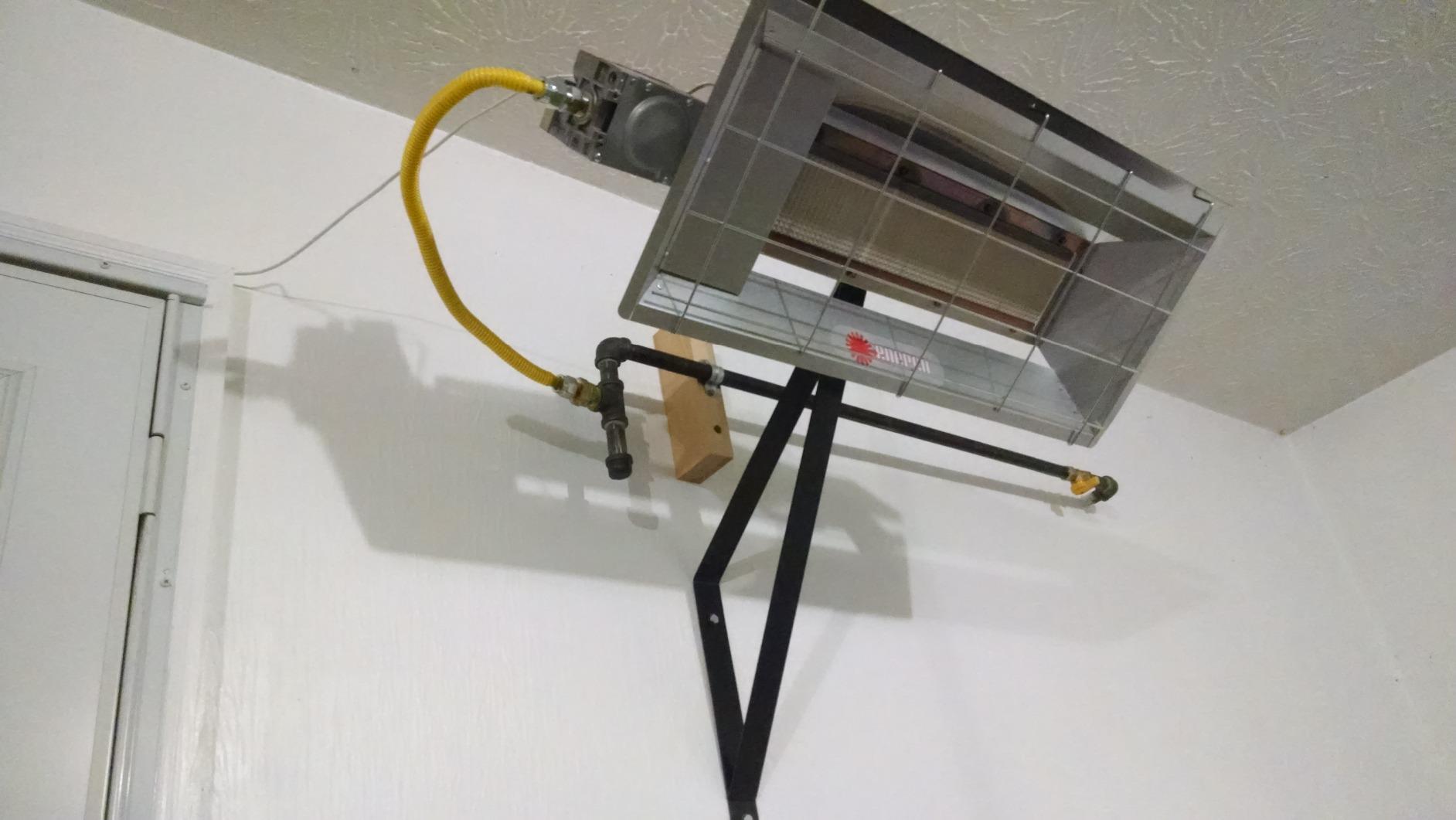
This is a radiant overhead unit, and the reason owners like it is the same reason the other radiant units in this roundup are popular: it warms you where you stand. If your work is at a bench, at a welding position or on a vehicle lift, radiant heat lands on your body and the surface in front of you instead of on the air several feet away, and you feel the difference within a minute or two.
The MH25NG is also a long-proven chassis. Owners frequently report that the unit they received is dimensionally identical to ones they have run for 20-plus years, which means the old mounting holes line up when you replace a failed heater. That kind of continuity is rare in a category full of redesigns.
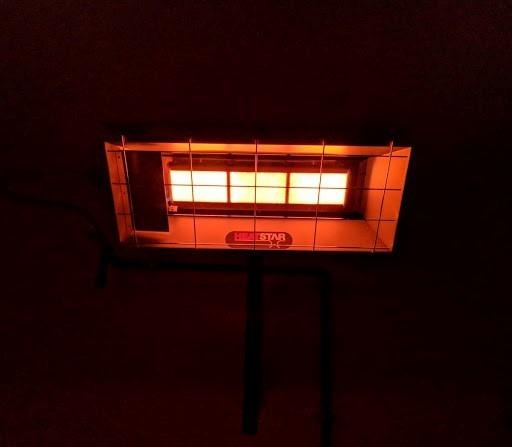
On running cost behavior, owners report that set to hold a garage in the mid 40s to low 50s it burns very little gas, which makes it a reasonable freeze-protection unit for a detached building you visit intermittently. A unit in the heating trade described it as dependable and said he sells it regularly.
The honest complaints are about the accessories. The included thermostat is widely criticized because its setting arm and thermometer do not correspond, so you cannot tell what temperature is set, and only about 10 feet of thermostat wire is supplied, which is too short to place the thermostat away from the unit. The included wall bracket is also described as flimsy, sometimes needing a shim for a tight fit.
Where radiant overhead heat wins
It wins in open or drafty spaces where you want heat on people rather than heat in air, and in workshops with frequently open doors. Workshop owners describe radiant heat as the sensible answer for a space where you are on and off the site during a workday, because the heat you feel does not disappear every time the door opens.
It also suits detached shops held at a freeze-protection temperature, where minimal gas use matters more than fast recovery.
Where it falls short
If you want the whole air temperature up, radiant heat alone will disappoint. It does not raise air temperature quickly, so a circulation fan is effectively part of the system for most shops.
Plan to replace the included thermostat and run proper thermostat wire, and expect a carbon monoxide risk to manage since this is a vented indoor unit that needs proper venting or adequate ventilation. One serious carbon monoxide poisoning report appears among the reviews of an otherwise well-regarded product, which is a reminder to test alarms after any install.
7. Ashley Hearth DVAG11N Direct Vent Wall Heater – Cleanest Indoor Air
Ashley Hearth DVAG11N Natural Gas Direct-Vent Wall Heater
11,000 BTU direct vent
Sealed combustion from outside air
Heats up to 375 sq ft
Vent kit included
Pros
- Sealed combustion draws intake air from outside and exhausts outdoors
- Vent kit and mounting bracket are in the box
- Runs without electricity on an AA battery
- Compact steel cabinet
- Approved for mobile home use in the USA
Cons
- Smallest capacity here at 11000 BTU and 375 sq ft
- Lowest average rating in the group
- Manual pilot lighting will not restart on its own
- Optional blower sold separately
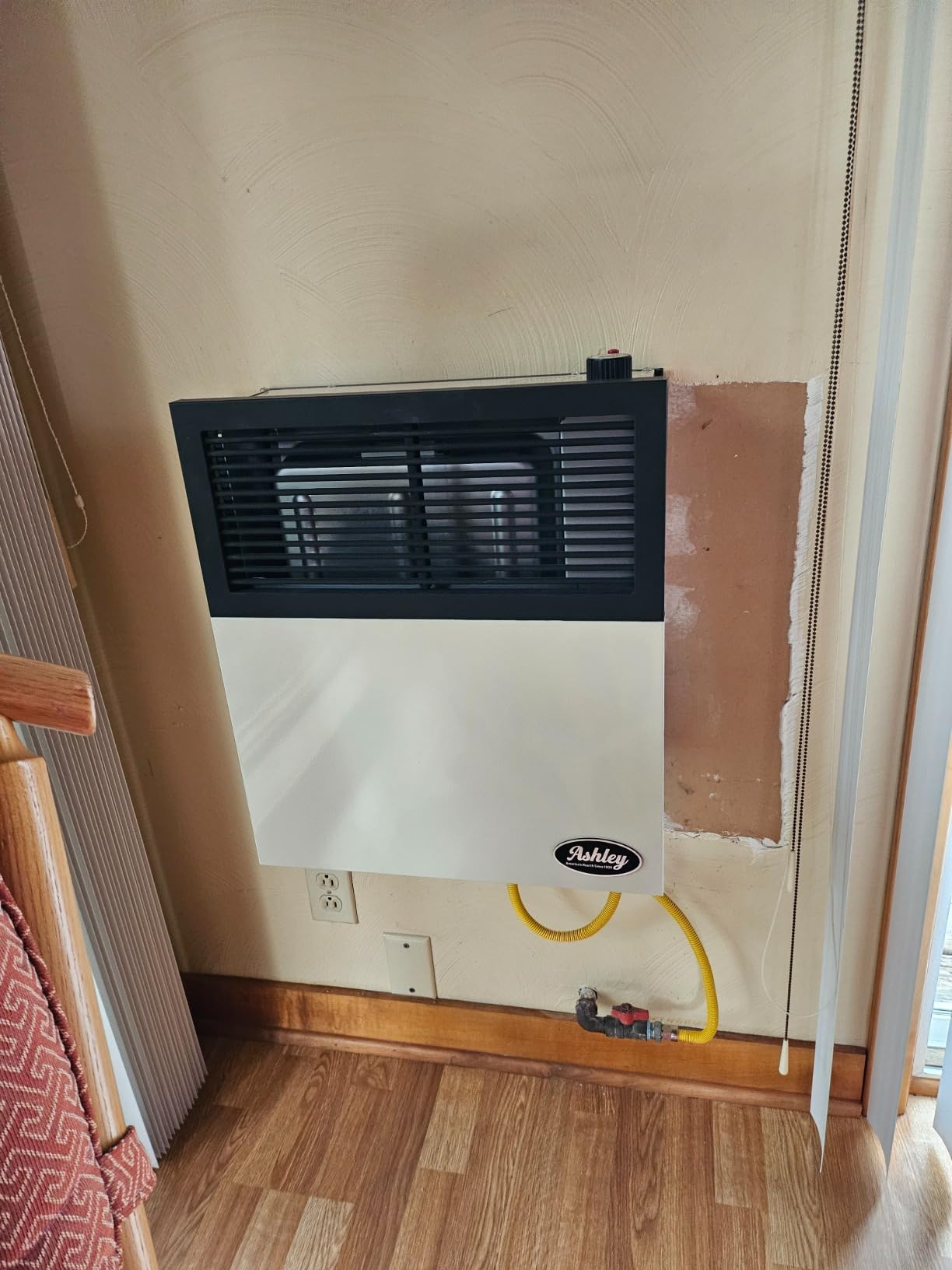
If indoor air quality is your top concern, this is the design that answers it cleanly. The sealed combustion direct-vent arrangement pulls combustion air from outdoors through an intake pipe and sends exhaust out through a separate vent pipe, so the garage air is never involved in burning. No ventless model can promise that, and in a space where you spend a full workday, that difference is worth a smaller heater.
It is also one of the few in this roundup where the vent kit is actually included. The box contains the mounting bracket, vent pipe, air intake pipe, flashing, cap, heat shield and connecting rod. On most competitors those pieces are a separate purchase that meaningfully changes the installed cost, so this one starts ahead on a total-project basis even though the heater itself is modest.
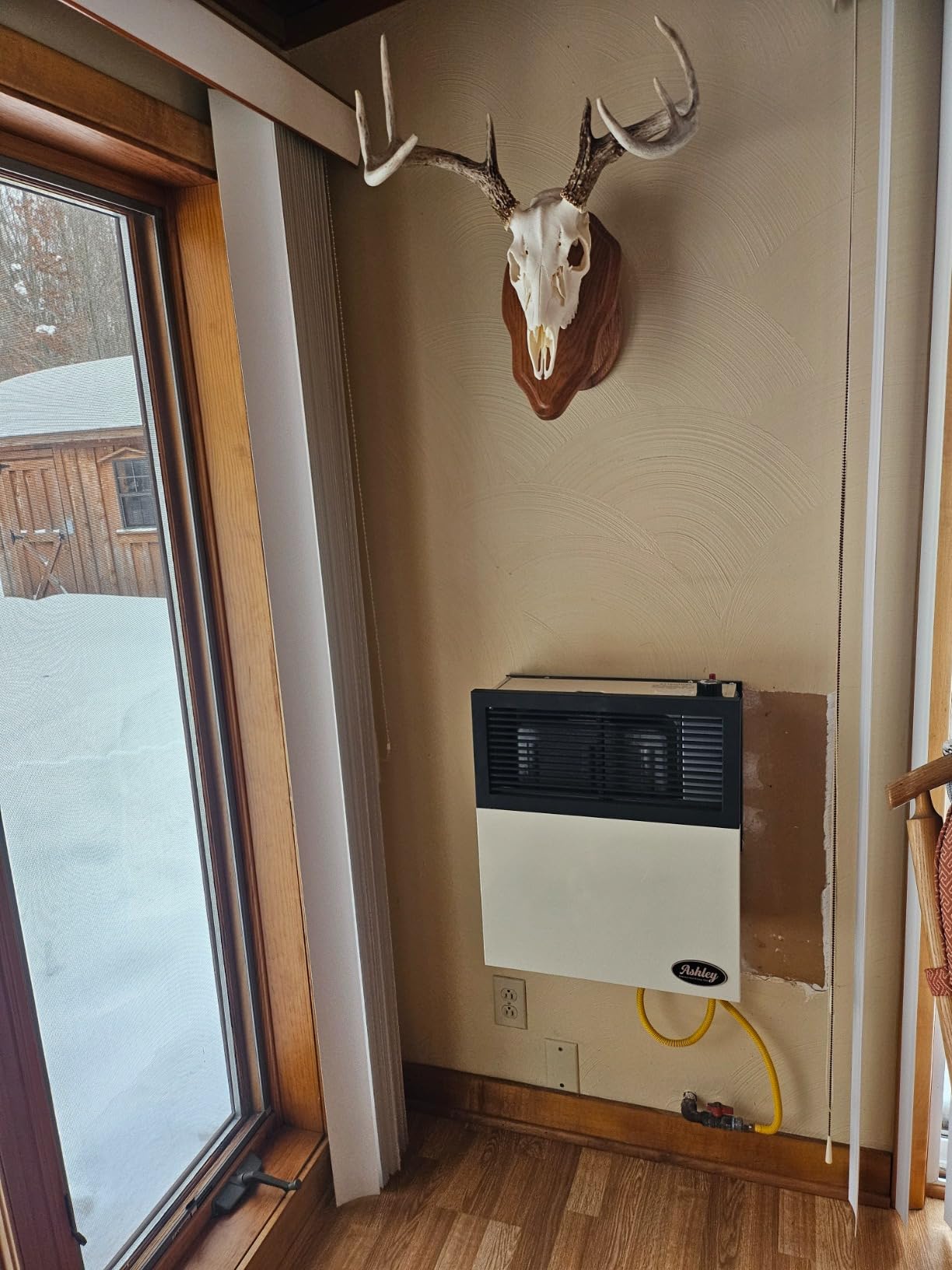
Operation is simple. It runs without electricity and lights from a single included AA battery, and once the pilot is lit an internal thermostat takes over with an adjustable top control knob. That makes it a genuinely useful emergency heat source during a power failure, in a small cabin, or in a garage bay you heat only in winter.
At 11,000 BTU and a listed 375 square feet of coverage, this is the smallest capacity on the page and it is rated for bedrooms, offices, kitchens and living spaces as well as garages. The rating here, about 131 reviews at 4.1 stars, is the lowest in the group, with roughly 16 percent of ratings at one star. That reflects the modest output rather than poor build, but it is a real signal to weigh.
Reasons to choose a sealed combustion wall heater
Choose it when people are in the room for long hours, when the space is tight and well sealed, or when a local code requires direct vent combustion. It is the pick for a home office, a finished room, a small shop annex or a garage bay where you do not want combustion byproducts at all.
The included vent kit is a genuine advantage for anyone comparing total installed cost, and the electricity-free operation is useful in an outage.
Reasons to skip it
At 375 square feet, it will not heat a working shop. It is a room heater with garage approval, not a shop heater.
Manual pilot lighting is the other friction point. Because it lights from a battery rather than a push button, it will not restart itself after a power interruption, and adding air circulation means buying an optional blower that itself needs electricity, which partly defeats the electricity-free argument.
8. ProCom 10,000 BTU Blue Flame Heater – Best for Small Outbuildings
ProCom Heating Natural Gas Ventless Blue Flame Heater With Base Feet – 10,000 BTU, T-Stat Control – Model# MN100TBA-B
10,000 BTU natural gas
Covers up to 500 sq ft
Thermostat controlled
Vent-free, no electricity
Pros
- Highest average rating in the group at 4.6 stars
- Built-in thermostat at this size and price
- Push button ignition with oxygen depletion sensor
- No electricity required
- Owners report decades of reliable service
Cons
- Lowest output here
- rated for just 500 sq ft
- Base feet leave the gas connector without clearance
- Vent-free operation adds humidity to the space
At 4.6 stars across roughly 110 ratings, this is the highest-rated product in the set, and it earns that on the combination of thermostat control, straightforward installation and a long service record. Owners report replacing a 30-year-old unit of the same type, which is the strongest reliability signal in this roundup short of the sheer review volume on the first pick.
At 10,000 BTU and a listed 500 square feet of coverage, it is a small heater for a small space: a storage room, a sunroom, a small outbuilding, a garage bay rather than a whole workshop. It weighs about 16 pounds, mounts on a wall or stands on the included base feet, and needs no electricity because ignition is push button and the burner runs on gas alone.

The thermostat with high, medium and low control is the standout feature at this size, along with the oxygen depletion sensor that shuts the burner down if carbon monoxide or low oxygen is detected. The unit is ANSI certified and has overheat protection. Owners describe the heat as quiet and odor-free.
Same caveat as its larger sibling in this family: with the base feet installed, the bottom gas connector does not have enough clearance to screw in fully, so most owners end up wall mounting it. The instructions are also described as more complicated than the job warrants. And because it is vent-free, it draws room air for combustion and adds humidity to the space, so it wants a room with some air exchange.
Best uses for a 10,000 BTU gas heater
This is the right tool for a small detached shed, a garage workshop annex, a home office or study, or a space where you only need to keep pipes and paint from freezing. It costs little to run and needs nothing beyond a gas tap and a wall.
For anyone who wants thermostat control at the smallest possible commitment, it is hard to beat. Most heaters in this class give you a manual knob and no setpoint at all.
Where it is simply too small
A 500 square foot rating means it will not keep a two-car garage comfortable, and radiant blue flame heat is local, so the far corners stay cold. If you want a working space you can sit in, you need to step up to a 30,000 BTU model such as the ProCom plaque heater or the Mr. Heater vent-free unit.
Be aware that the vent-free design also adds moisture to the room, which can be a problem in a storage space holding cardboard, paper or finished wood.
9. Heatstar HS125NG Salamander 125K – Highest Output Radiant Heat
Heatstar By Enerco F170850 Radiant Natural Gas Heater HS125NG Salamander, 125K
125,000 BTU radiant natural gas
Variable from full burn to pilot
No electricity needed
Requires gas line and venting
Pros
- Very high radiant output
- Simple mechanical design with few electronics
- Variable output from full burn to pilot only
- Low profile upright cabinet is wind stable
- Useful temporary heat on new construction
Cons
- No built-in thermostat
- Pilot light reliability is the biggest complaint
- Several units failed within weeks or one season
- Needs a half inch gas line for full output
- Hot enough to burn on contact
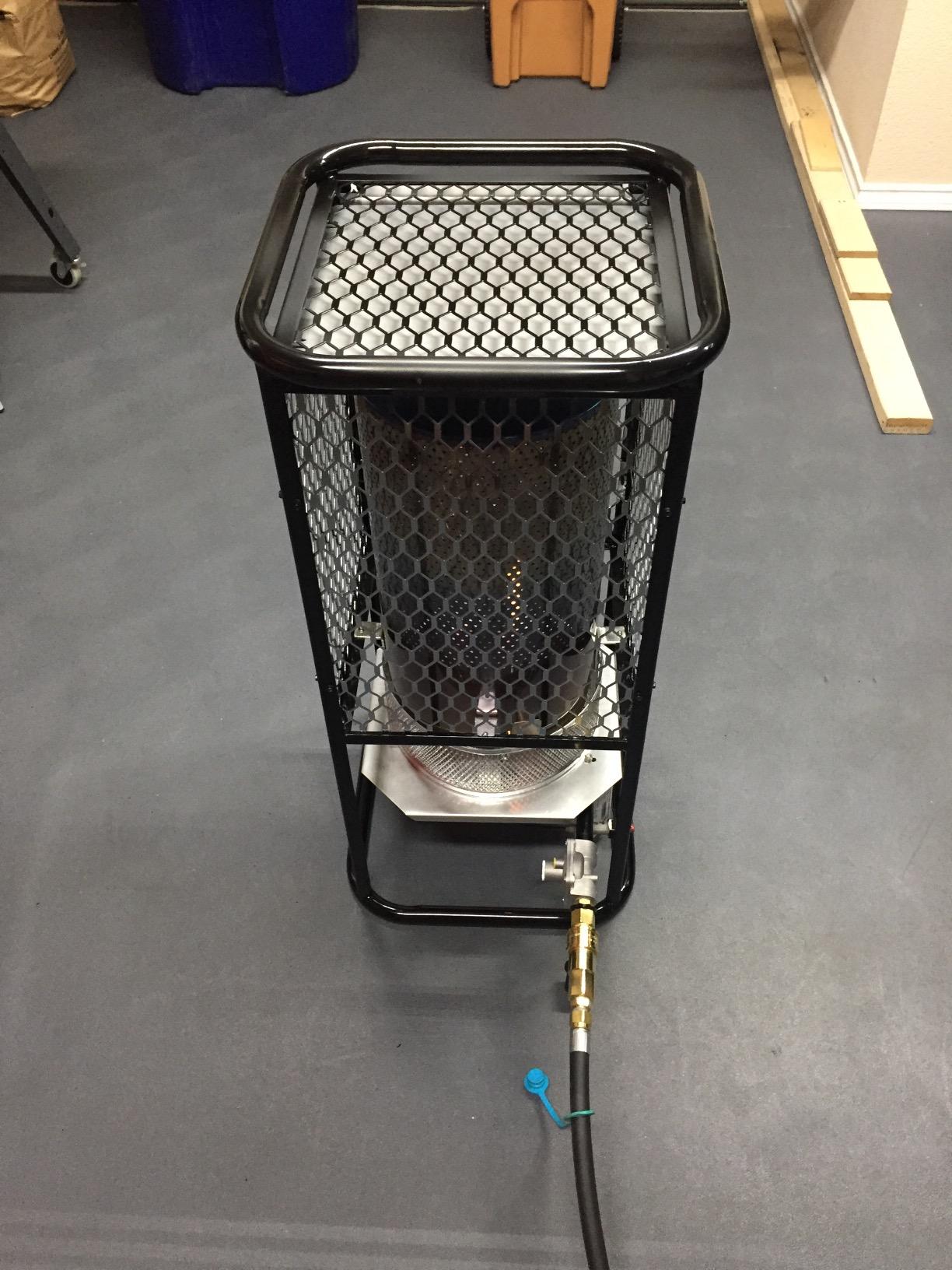
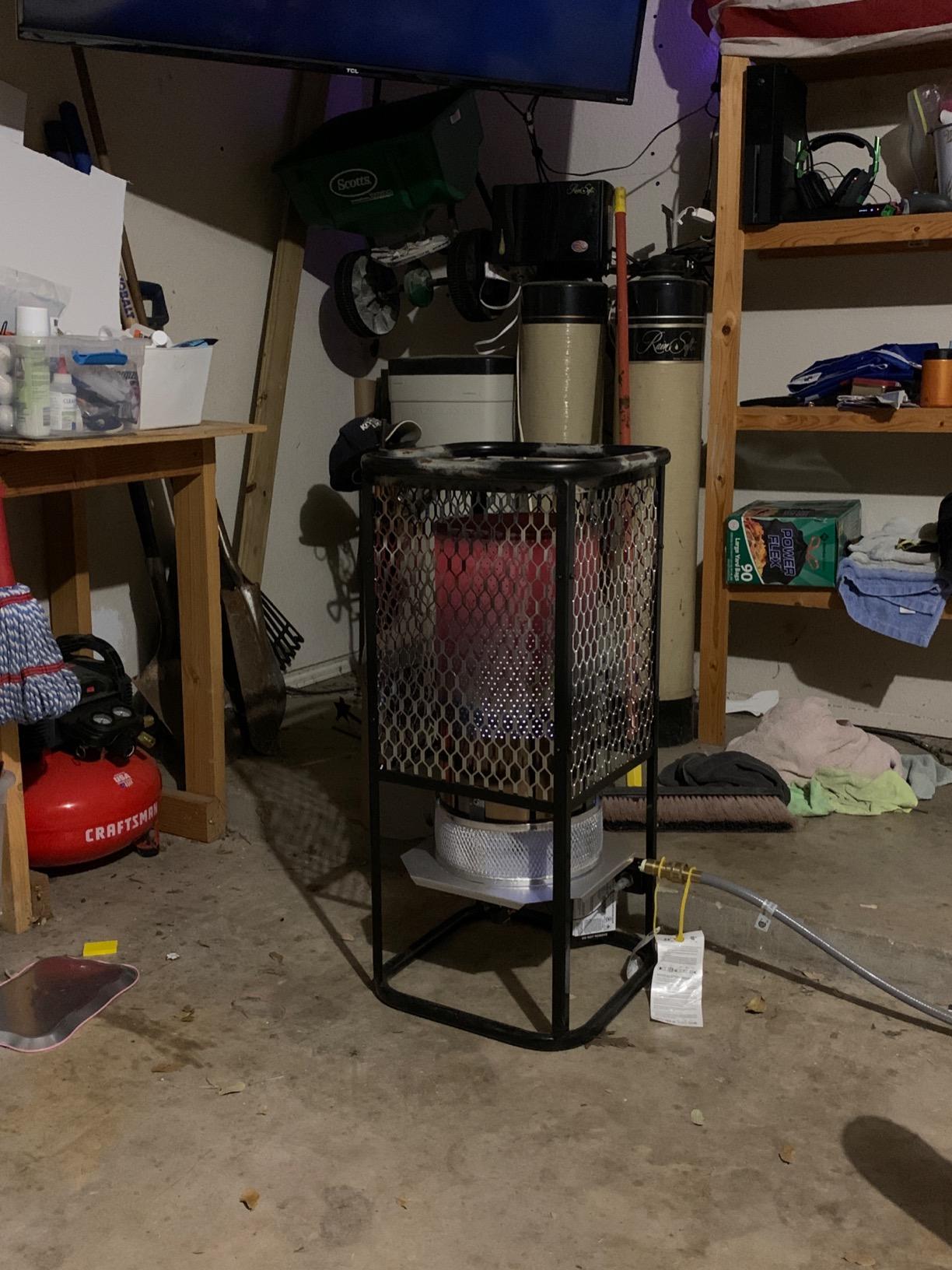
The Salamander 125K is the biggest number in this roundup at 125,000 BTU, and that output matters in a large, poorly insulated space where you need to bring a volume of cold air up to working temperature fast. Owners report a garage going from 30F to 62F in about two hours, and several use the unit as temporary heat on new construction jobs where a permanent install is not in play yet.
The design is deliberately simple. There is a mechanical gas control with adjustable output from full burn down to pilot only, no electronics to fail, and a low-profile upright cabinet that will not tip over in wind and does not look like a patio heater. It requires a gas supply line and venting, so it is an installed appliance rather than a drop-in.
Reliability is the problem here, and the ratings show it. At roughly 73 reviews and a 4.0-star average, this is the lowest-rated unit on the page, with about 16 percent of ratings at one star. The dominant complaint is not output, it is the pilot: multiple reviewers report a pilot that will not stay lit or cuts out minutes after starting, and several units failed entirely within weeks or after one season.
Two more practical details. The unit needs a half inch gas supply line, and with a three-eighth inch line it fires but produces noticeably less heat than the rating suggests. It also gets hot enough to burn on contact, so where you mount it matters when there are people working nearby.
When maximum output is the priority
Pick it for a large open bay, a barn, a new construction site needing temporary heat, or a workshop with a very high ceiling where you need to push a lot of energy into the volume. The adjustable output lets you drop to pilot when the space is warm, which helps on a shop that is used in bursts.
The all-mechanical design also appeals to anyone wary of control boards, and owners who get a working unit describe the build as sturdy and the heat as excellent.
When the pilot risk is not worth it
Skip it if you need unattended or overnight heat you cannot easily check on. A pilot that drops out in an unheated building in January is exactly the failure you do not want in a freeze-protection role.
It is also the wrong shape of heater for a normal two-car garage, where 125,000 BTU is far more than the space can use and the gas line size becomes a constraint rather than a benefit.
10. Comfort Glow KWN521 30,000 BTU Five Plaque Wall Heater – Low Cost Heat to Run
WORLD MKTG OF AMERICA/IMPORT KWN521 5 Plaque 30000 BTU Gas Wall Heater,gray, 24.41×28.15×10.25
30,000 BTU natural gas infrared
Covers up to 1,000 sq ft
Five plaque burner with adjustable output
Vent-free
Pros
- Low operating cost reported by long-term owners
- Five plaque burner with adjustable heat settings
- No electricity required
- Built-in oxygen depletion sensor
- Easy install with no duct work
Cons
- No built-in thermostat
- Not approved for installation in Canada
- Vent-free design needs openable windows or ventilation
- Optional floor stand and blower sold separately
The Comfort Glow KWN521 is the pick if your priority is the gas bill rather than the feature list. Its 30,000 BTU infrared output is rated for up to 1,000 square feet, and the five-plaque burner has adjustable heat settings for real output control rather than a single on or off. The dominant theme in the reviews is cost: one owner heated an uninsulated 1930s 1,000 square foot house as the sole heat source and calculates the mid setting at a modest monthly cost.
It is a vent-free infrared cabinet weighing about 25.5 pounds at 10.25 by 28.15 by 24.41 inches, needs no electricity, and has a built-in oxygen depletion sensor for safety. Installation needs no duct work at all, and optional floor stand and blower accessories are available separately.
The gaps are the same ones the ProCom plaque heater was built to fix. There is no built-in thermostat, only manual control, though a thermostat is available as an option. Fifteen percent of ratings are one star, the second-highest complaint rate in this group, and the unit may arrive with transit dents given how many heavy cabinets get knocked around in shipping. The warranty is 2 years, defect only.
Why the running cost story matters here
Infrared vent-free heat is inexpensive per hour because you are burning a modest amount of gas to warm surfaces and people rather than heating all the air in a large volume, and the adjustable plaque output lets you dial it to the lowest setting that keeps the space workable. Owners using it as supplemental or primary heat report that the cost stays low across a full season.
For a shop where you spend evenings out there but do not need the whole room at 70F, that is a sensible operating profile. Just be honest with yourself about the thermostat, since there is none.
What to watch for
Vent-free means the unit consumes room air for combustion and releases byproducts into the space, so the room needs openable windows or ventilation. It is also not approved for installation in Canada, which is a hard stop for anyone north of the border.
If you want thermostat control from a vent-free infrared unit, look at the ProCom 30,000 BTU plaque heater instead, which has one built in for a similar footprint.
How Many BTUs Do You Actually Need?
Use 40 to 50 BTU per square foot for an uninsulated garage with an 8 or 9 foot ceiling, and around 20 BTU per square foot for an insulated, drywall-finished shop with a higher ceiling. A 24×24 workshop is 576 square feet, so that is roughly 23,000 to 29,000 BTU uninsulated or about 12,000 BTU insulated. Round up to the next available size rather than trying to hit a number exactly.
Three variables push the number higher. Ceiling height above 10 feet means more volume to heat, and a garage door that opens regularly dumps heat continuously. If the door is a weak point, our picks for garage man doors for workshops are worth a look before you size the burner. Exposed concrete floors and uninsulated steel doors behave like holes in the envelope. If any of those apply, size for the larger figure.
Do not oversize. A heater far larger than the room cycles on and off, which shortens burner life and wastes gas without making the space any warmer. If you are between two sizes, choose the smaller one and add insulation before you go bigger. You can also stage it: set a low fire and a high fire, or use a thermostat with a wide deadband, so the burner matches how much heat the shop is losing right now.
Vented vs Ventless Natural Gas Garage Heaters
Vented models, including direct vent and power exhaust designs, draw combustion air from outside and send exhaust outdoors through a flue. The air in your shop stays clean, the heater is safe in a sealed room, and it is the only category most local codes allow in some jurisdictions. The cost is a vent kit, a roof or wall penetration, and more installation work.
Ventless models use a draft hood and burn room air, releasing combustion byproducts into the space. That makes the install trivial and the running cost low, but it puts humidity and combustion products into a room you work in, and the low oxygen sensor will shut the burner down in a sealed space. Ventless heaters are not for sale in California and are restricted or prohibited in parts of Canada, so check your local rules before planning around one.
The practical rule: direct vent or power vent if you are in the shop daily or the space is tight and sealed. Ventless if the shop is large and leaky, you heat it intermittently, and local code permits it.
Forced Air vs Infrared vs Radiant Overhead Heat
Forced air moves heated air through the room, so the temperature is even and the whole space participates. That is what you want when you walk around, when you are spraying finish that needs consistent conditions, or when a CNC machine has to hold tolerance. It is also what you lose every time the garage door opens, because all that hot air leaves.
Infrared and radiant units warm you and the surface in front of you directly. You feel the heat immediately, and it is not lost when the door opens because the surfaces stay warm. Workshop owners describe it as the better choice for spaces with frequently open doors and for people who stand still at a bench. The trade-off is that air temperature stays low, so a circulation fan usually belongs in the plan, and radiant heat cannot effectively warm a large empty volume quickly.
Radiant overhead units, ceiling or high wall mounted, combine the two ideas. They are the format owners pick when the work position is the thing that needs to be warm. A blended approach, one radiant unit at the bench and one forced-air unit for the volume, covers more cases than either alone.
Installation, Venting, and What Usually Isn’t Included
Start the plan with clearances, because they disqualify heaters before you spend anything. The 50,000 BTU forced-air Mr. Heater requires a minimum 10 foot ceiling and 8 feet from the base of the heater to the floor. Direct vent units need a wall or roof penetration sized to the flue, generally a Category 1 vertical vent for a draft-assisted appliance or a Category 3 horizontal vent for a power exhaust unit. Check the manual for the exact diameter and connector spacing.
Then budget the pieces that are not in the box. On almost every unit here you are buying a gas connector hose and a pressure regulator. On forced-air and direct-vent units you are also buying vent pipe, a roof flashing and wall thimble or ceiling collar, and a code-compliant termination. Thermostats are separate everywhere except the Mr. Heater 30,000 vent-free unit, the two ProCom models, the Heatstar MH25NG and the Ashley Hearth, which all include some form of thermostat.
Finally, understand who can legally connect the gas. A new line, a new appliance connector and any permit-required work need a licensed gas fitter, and some jurisdictions require a permit and inspection. If the gas supply itself is not in place yet, our roundup of natural gas generators for whole house backup covers the equipment that keeps essential power running while the line work happens. That is also the right moment to add a hardwired carbon monoxide alarm near the unit, since a licensed installer can place it where it actually catches combustion problems.
Safety, Clearances, and Carbon Monoxide
Install carbon monoxide alarms in the garage and in any sleeping space above or adjacent to it, and test them after the heater is installed rather than before, because clearance and venting decisions change where combustion problems would show up. Oxygen depletion sensors on vent-free models are a real safety device, but they are a backup, not a replacement for an alarm.
Keep the required clearances to combustibles free, and treat the radiant units with particular care: both radiant models here get hot enough to cause a burn on contact, so mount them away from a walking path. Above about 4,500 feet of altitude, gas appliances are typically derated and oxygen depletion sensors can trip more readily, which is a known complaint from owners in high-elevation towns.
If a vehicle is stored or refueled in the same space, think carefully. Gasoline vapour is heavier than air and pools low, and a running combustion appliance in that space is the classic arrangement reviewers and safety forums warn about. If you refuel indoors, do it with the heater off, doors open and the engine off, and never run a gas heater while refuelling.
Running Costs Without the Guesswork
Do the math in therms and you will see why gas wins for a workshop. A 50,000 BTU heater at full burn for one hour uses about 50,000 BTU, which is 5 therms, and a 30,000 BTU unit uses 3 therms. Electric resistance heat rated to deliver the same room temperature moves the same energy, but electric units rarely run at full output continuously, and where power is billed per kilowatt-hour the hourly cost lands several times higher than the gas equivalent in most markets. Propane falls between the two and needs a tank.
The number that matters more than the hourly rate is the setpoint. Running a 50,000 BTU unit to hold a shop at 68F all winter costs far more than the same unit cycling to hold 45F overnight and warming up in the morning. That is why the thermostat pairing owners describe, a Wi-Fi model with a 40F idle setpoint and a higher working setpoint, pays for itself in a single season.
One more lever worth knowing: the Comfort Glow owners who use vent-free infrared as primary heat report very low bills in their reviews, because radiant output warms the work zone instead of the entire air volume. If your shop is large and you only need heat where you stand, that is a low-cost way to run a workshop.
Frequently Asked Questions
What is the best heater for a garage workshop?
For most workshops the best choice is a 30,000 BTU natural gas unit if your space is around 1,000 square feet and you want no vent work, or a 50,000 BTU ceiling-mounted forced-air unit if the shop is larger and you want even circulation. Pick forced air when you move around the space and pick radiant infrared when you work in one spot. Whichever you choose, size at 40 to 50 BTU per square foot for an uninsulated garage.
What are the best natural gas heaters for garages?
The strongest options for garages are the Mr. Heater 30,000 BTU vent-free blue flame for the most proven all-round choice, the Mr. Heater 50,000 BTU forced-air unit heater for larger shops that need air circulation, and the ProCom 30,000 BTU infrared plaque heater for the most coverage with a built-in thermostat. For cleanest indoor air the Ashley Hearth direct vent model takes outside combustion air.
How many Btus do I need to heat a 24×24 garage?
A 24×24 garage is 576 square feet. Uninsulated with an 8 to 9 foot ceiling, plan on 40 to 50 BTU per square foot, which is roughly 23,000 to 29,000 BTU, so a 30,000 BTU unit is the usual answer. If the shop is insulated and finished with a taller ceiling, closer to 20 BTU per square foot, about 12,000 BTU, will do.
What is the most economical way to heat a workshop?
Once a gas line exists, natural gas is the most economical option by a wide margin, and a 50,000 BTU unit at full burn uses about 5 therms per hour while a 30,000 BTU unit uses about 3. The biggest savings come from setpoint control rather than equipment choice: idle the shop at 40 to 45F on a thermostat and warm up only when you are working.
Are Mr. Heater Big Maxx units any good?
Mr. Heater Big Maxx and Big Maxx-adjacent unit heaters are among the most proven gas heaters sold, with ratings in the mid 4s across thousands of reviews. Owners credit fast warm-up, even heat distribution and quiet running. The recurring complaints are installation cost from vent kit and gas line work, occasional fan noise from factory assembly, and control board failures outside the warranty window.
Do I need a gas line installed to use a natural gas garage heater?
Yes. A natural gas heater needs a properly sized gas supply line and a shutoff valve, and a new line to a detached garage needs a permit, a licensed gas fitter and sometimes trenching. Most heaters also need a connector hose and a pressure regulator bought separately, so budget for those alongside the heater and vent kit.
Is a ventless natural gas garage heater safe in an enclosed garage?
A ventless heater burns room air and releases combustion byproducts into the space, so it needs reasonable air exchange and should not be run in a tightly sealed room. It is designed to shut down through an oxygen depletion sensor if oxygen drops, and that can happen in a small well-sealed shop. If you spend long hours in the space, a sealed combustion direct vent or power vent model is the safer choice.
What is the quietest gas garage heater?
The Modine Hot Dawg 45,000 BTU is built around quiet forced-air operation and is the quietest option in this roundup by design. Among forced-air units, owners also report the 50,000 BTU Mr. Heater running quietly once any loose fan set screw is tightened. Vent-free radiant and blue flame units have no fan at all, so they are silent by design.
Which One Is Right for Your Workshop
If you want one recommendation, take the Mr. Heater 30,000 BTU vent-free blue flame. It has the deepest review history in the group, a built-in thermostat, no electricity requirement and no vent work, which makes it the lowest-friction way to get a garage warm this 2026.
Move up to the 50,000 BTU Mr. Heater forced-air unit if your shop is over 1,000 square feet and you want even circulation and thermostat control, and accept the vent kit and gas line as part of the project. Go sealed combustion, such as the Ashley Hearth direct vent model, if you work in the space all day and indoor air quality comes first. Choose the Modine Hot Dawg when noise is the deciding factor, and the ProCom plaque heater when you want a thermostat and radiant heat without a fan decision to make.
Whatever you buy, measure the space, check the ceiling and floor clearances, and get the gas line and venting designed before you pick a model. Those three steps prevent almost every disappointing install in this category, and they are the reason the best natural gas garage heaters for workshops feel different in one shop than another.