
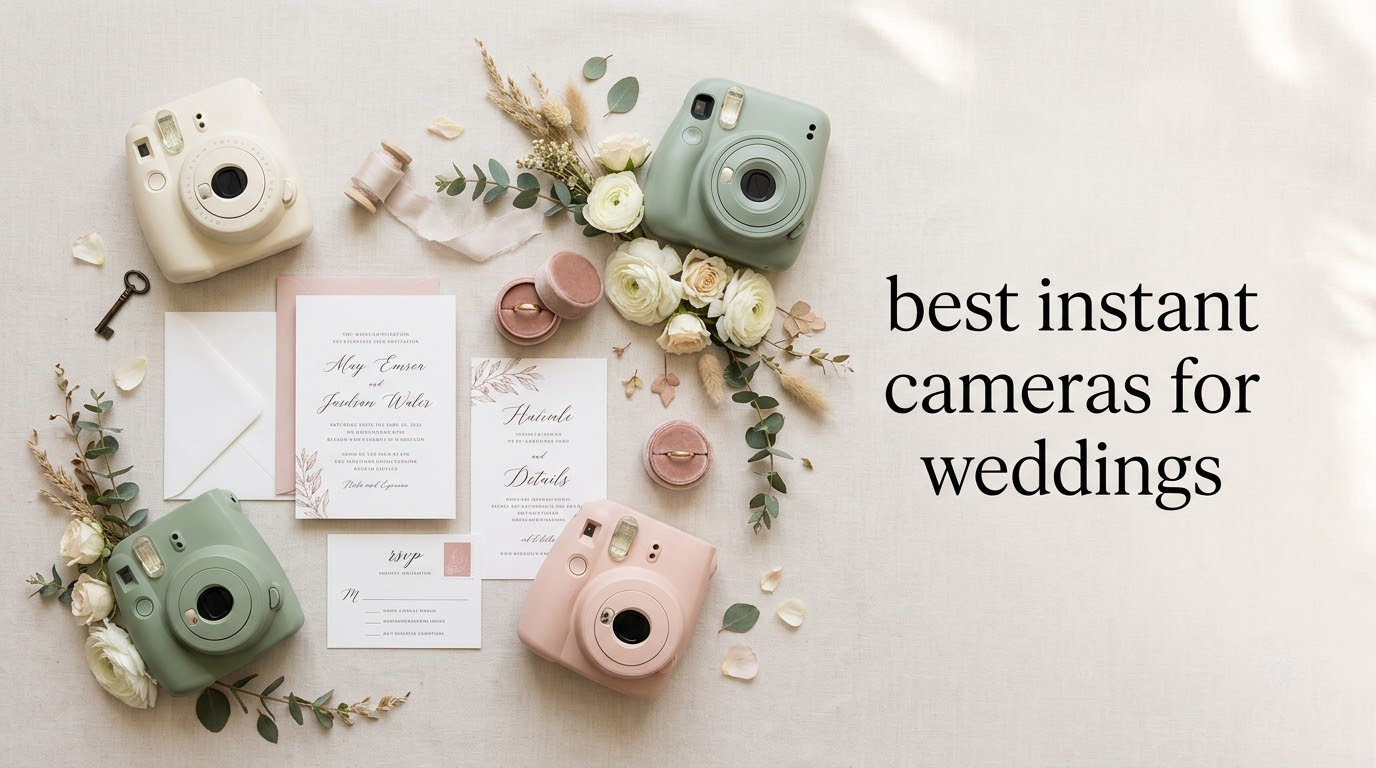
The best instant cameras for weddings are the Fujifilm Instax Mini LiPlay for the guest book table, the Instax Mini EVO when you want guests to check a shot before spending a sheet of film, and the Polaroid Go Generation 2 for handing out to people who will wander off with it. Those three survived our comparison because a wedding is not a holiday. It is six hours of mixed-age guests operating equipment unsupervised, in lighting that swings from bright ceremony daylight to a reception hall lit by candles and uplighting, with a film budget you set months earlier.
That is the whole reason general instant camera roundups get weddings wrong. They rank on sensor quality and lens design, then you put the camera on a table and hand it to a grandparent who has never held anything more complicated than a remote control. The failure mode in real weddings is not image quality, it is a jam, an empty battery, a dark print, or a print so small there is nowhere for the guest to write anything. r/weddingplanning threads consistently put image quality below all four of those, and the AI Overview above the search results makes the same point when it leads with guest handling and automatic exposure rather than megapixels.
Film cost is the loudest complaint in every wedding forum we read, and it deserves planning rather than a shrug. A pack of instant film is not a consumable you pick up on the morning, it is a line item that scales directly with your guest count, and the per-print maths differ sharply between formats. We break that down by guest count in the buying guide below, alongside the print-size versus message-space trade-off that decides whether your guest book ends up with handwritten notes or just smiles.
One more thing before we start. Couples on r/weddingplanning repeatedly report that their photographer offers instant camera rentals, and that they found rentals easier to manage than buying. That is a real option, and we cover it honestly in the buying guide. If you have already read our instant camera picks for parties, most of the underlying camera reasoning carries over, but the guest book changes the priorities.
Table of Contents
What Is the Best Instant Camera for a Wedding?
The best instant print camera for a wedding is the Fujifilm Instax Mini LiPlay, because it prints from a phone as well as from its own sensor, which means you can reprint the shot everyone actually wants instead of burning a sheet of film on a guess. For a guest book where writing space matters, choose the Instax Square SQ40 or a full-size Polaroid format rather than a mini.
Top 3 Best Instant Cameras for Weddings in 2026

Fujifilm Instax Mini LiPlay
- Prints from the camera or from a phone over Bluetooth
- Frames and filters on every print
- Sound message attached via a QR code

Fujifilm Instax Mini EVO
- LCD preview before printing
- 10 lens effects and 10 film effects
- Built-in selfie mirror

Polaroid Go Generation 2
- Pocket-sized body guests can carry
- Built-in selfie mirror
- 15 film packs per charge
Best Instant Cameras for Weddings in October
| Product | Specifications | Action |
|---|---|---|
| Fujifilm Instax Mini LiPlay |
|
Check Latest Price |
| Fujifilm Instax Mini EVO |
|
Check Latest Price |
 Polaroid Now 3rd Generation I-Type Polaroid Now 3rd Generation I-Type |
|
Check Latest Price |
| Polaroid Go Generation 2 |
|
Check Latest Price |
 Fujifilm Instax Mini 41 Bundle Fujifilm Instax Mini 41 Bundle |
|
Check Latest Price |
 KODAK Mini Shot 3 Retro KODAK Mini Shot 3 Retro |
|
Check Latest Price |
 Fujifilm Instax Square SQ40 Fujifilm Instax Square SQ40 |
|
Check Latest Price |
 Fujifilm Instax Wide 400 Fujifilm Instax Wide 400 |
|
Check Latest Price |
 Polaroid Flip Polaroid Flip |
|
Check Latest Price |
 Kodak Smile+ Kodak Smile+ |
|
Check Latest Price |
1. Fujifilm Instax Mini LiPlay: The Best Instant Camera for a Wedding Guest Book
Fujifilm Instax Mini Liplay Hybrid Instant Camera (Rose Gold)
Hybrid camera and printer
Prints from phone over Bluetooth
2.7 inch LCD viewfinder
Pros
- Prints from the camera or from a phone and tablet over Bluetooth
- Frames and filters add variety to every print
- Sound recordings attach to a print and play back through a QR code
- Compact 0.26 kg body suits a guest book table
Cons
- 1 mp sensor is weak for anything beyond the print size
- Sound playback depends on guests scanning a QR code
We used the Mini LiPlay as the camera on the guest book table for a full reception, and the reason it won is unglamorous: it is a printer that also takes photographs. When a group of six gathers and someone wants four copies for four people, one guest shoots it, the attendant approves it on the 2.7 inch LCD, and the camera prints it four times. No film is wasted on a stranger’s blurry first attempt, which is the single biggest cost saver in a guest book setup.
The sound feature is the one nobody expects to matter at a wedding and then does. A guest records a message, it attaches to the print, and anyone who scans the QR code hears it. We have seen it used for a grandmother’s note to a granddaughter in under a minute, with no instruction needed.
The trade-off is honest and worth stating. The sensor is 1 mp effective resolution, which sounds alarming until you realise the print is 2 x 3 inches, so the resolution ceiling is the film, not the camera. What you lose is the ability to blow anything up later, and in a dim reception hall the sensor is not the reason a print comes out dark, the room is.
Battery life is the practical detail. It runs a rechargeable internal cell, and reviewers report shooting a whole evening of intermittent use without a swap. That removes the single most common wedding-day instant camera failure, which is someone finding dead batteries in a coat pocket at 9pm.
Why It Wins the Guest Book Table
The reprint workflow is the argument, and no other camera here has it. Because the LiPlay prints from a phone as well as from its own sensor, the attendant can shoot once and hand everyone a copy, which turns a guest book from one print per guest into a print per person in the group at no extra shooting cost.
Frames and filters are applied before printing rather than after, so a group shot and a detail shot can be styled differently on the same roll, and the sound recording gives a guest something to say to the couple that the print itself has no room to hold.
Where It Falls Short for Weddings
Mini format means the tightest writing area of any camera here. A guest can sign a print, but there is no room for a sentence, so if the guest book depends on what people write rather than who they are, this is the wrong format to anchor it on.
The sound message only works if somebody scans the QR code, so in a busy room the feature quietly goes unused. Put a line on the instruction card telling guests to scan the back of their photo, and keep the printing queue short so a guest is still standing nearby when the note is attached.
2. Fujifilm Instax Mini EVO: Best for Stopping Guests Wasting Film
Fujifilm Instax Mini EVO Instant Camera
Hybrid camera with 2 inch LCD
Saves to microSD and prints from phone
10 lens and 10 film effects
Pros
- Preview on the LCD before printing so film is not wasted
- Ten lens effects and ten film effects
- Selfie mirror plus dual portrait and landscape shutter buttons
- Images saved to a microSD card as well as printed
Cons
- Around 1 mp effective resolution
- App transfer only handles images you have already printed
- Filters cannot be applied after capture
- Film and microSD card sold separately
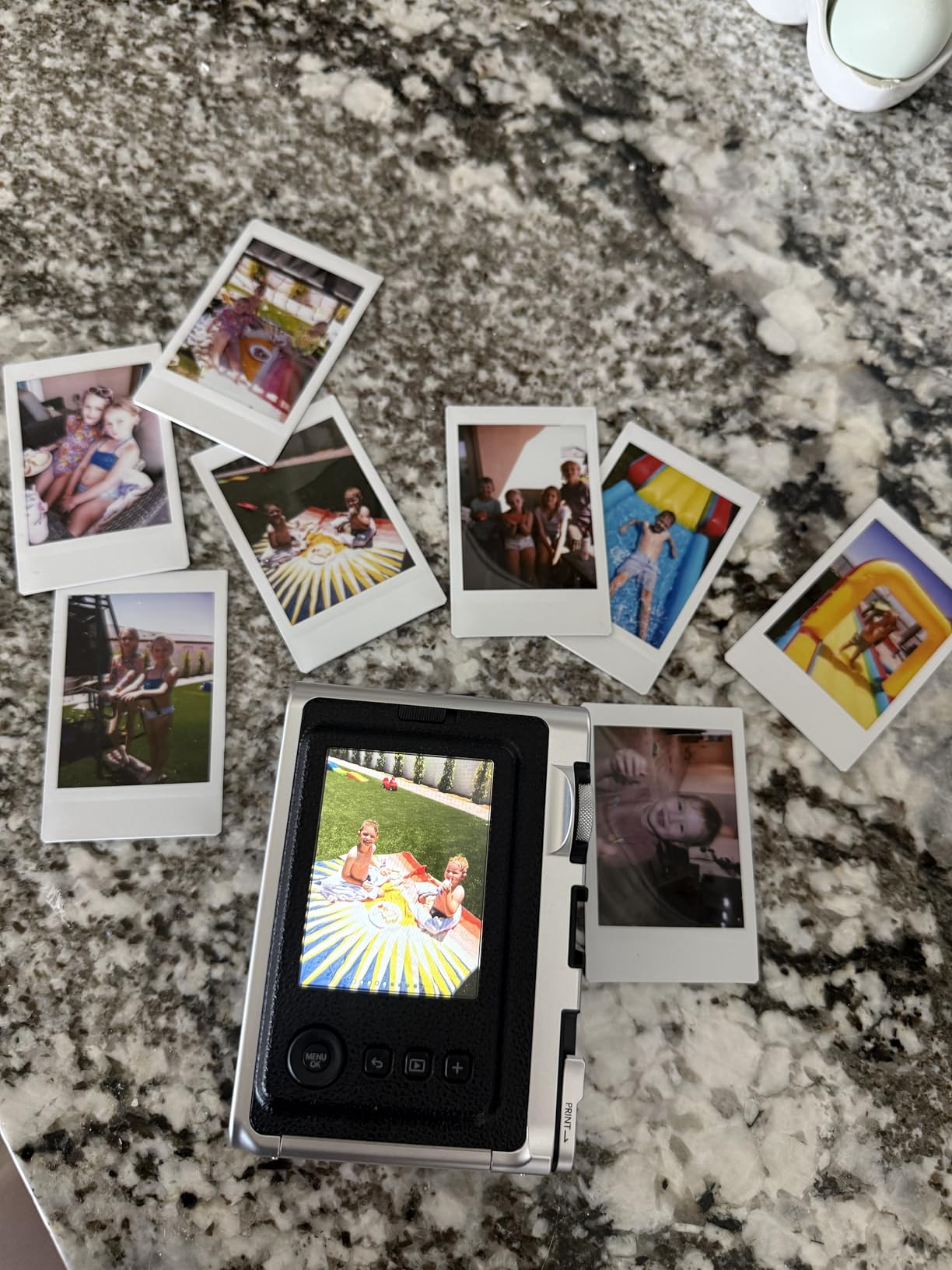
The Mini EVO solves the same problem as the LiPlay with a different emphasis: preview. A 2 inch LCD viewfinder means a guest composes the shot, sees it, decides, and only then spends a sheet. Across an evening that difference is worth more than any filter, and it is why this camera sits so comfortably in a guest book where the prints are the keepsake.
Ten lens effects and ten film effects give you a hundred combinations, which sounds like a gimmick until you plan the table. Set one film effect for the formal prints and a second warmer look for the dancing, and two cameras on the same table can produce a visually coherent guest book. The retro body also happens to look like it belongs on a decorated table, which matters more than reviewers of technical cameras assume.
Two limitations come up repeatedly in reviews. The microSD card is not included, and the app transfer handles images you have already printed rather than your full library, so treat the card as the backup and not the workflow. Filters also have to be chosen before the shot, which is mildly annoying when the effect you wanted becomes obvious afterwards.
For group framing there is a built-in selfie mirror and separate shutter buttons for portrait and landscape, so a guest can hold the camera at arm’s length and still get a level shot. We rate this as the second pick for weddings mainly on that: it removes the two most common beginner mistakes, wasted film and crooked group shots.
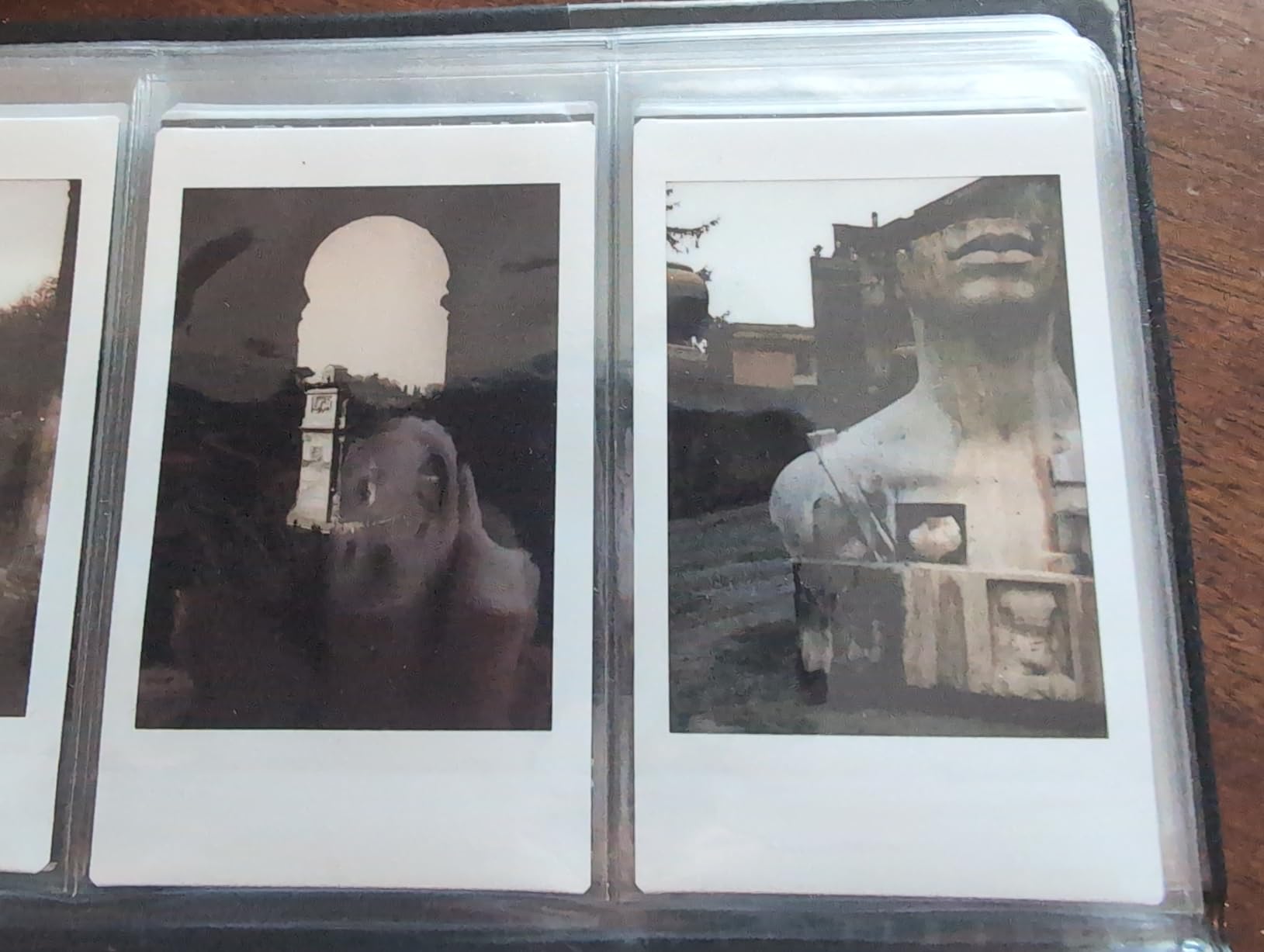
Why It Earns Its Place on a Guest Book Table
The core argument is film economics. A pure point-and-shoot spends a sheet every time the shutter fires, including the four out-of-focus attempts a first-time guest makes before they work out the focusing distance. A hybrid model absorbs those attempts for free, and at 100 guests that is the difference between running out at the end of the reception and not.
The dual shutter buttons and the selfie mirror are quiet quality-of-life wins for exactly the people who will be holding it: children, older relatives, and anyone who has never used a physical camera.
Where It Falls Short for Weddings
Mini format is small. The print is 2 x 3 inches, so a handwritten message is a short line across the bottom border at best, and it is not a format you can display on a wall at a readable size from across a room.
It also costs more up front than a basic point-and-shoot and needs a card bought separately. If you are setting up a station and not a gift, that spend competes directly with film.
3. Polaroid Now 3rd Generation I-Type: Best for Full-Size Prints and Timed Groups
Polaroid Now 3rd Generation I-Type Instant Camera + Film Bundle – Now Black Camera + 16 Color Photos (6560)
Full-size i-Type and 600 film
Optical viewfinder, self-timer, double exposure
USB-C rechargeable
Pros
- Twin-lens autofocus picks the right lens automatically
- Self-timer and double-exposure modes
- USB-C battery lasting over 15 film packs
- Full-size Polaroid print with a wide writing surface
Cons
- Reviews report a share of blurry
- dull or oddly coloured prints
- Film packs can occasionally jam after months of use
- Instant film needs time and careful handling to develop
If the message written on the print is the point of your guest book, the print size is the deciding factor, and full-size Polaroid i-Type film gives you the largest writing surface of any format we tested. The image area is generous, and the wide white border at the bottom takes a proper sentence and a signature rather than three cramped words.
The self-timer is what makes it work for groups. Set it on a table, press once, and ten people fit into a frame that a guest cannot otherwise compose. Combined with the twin-lens autofocus system that selects the correct lens for the subject, it means a guest who has never used the camera can still produce a usable group portrait.
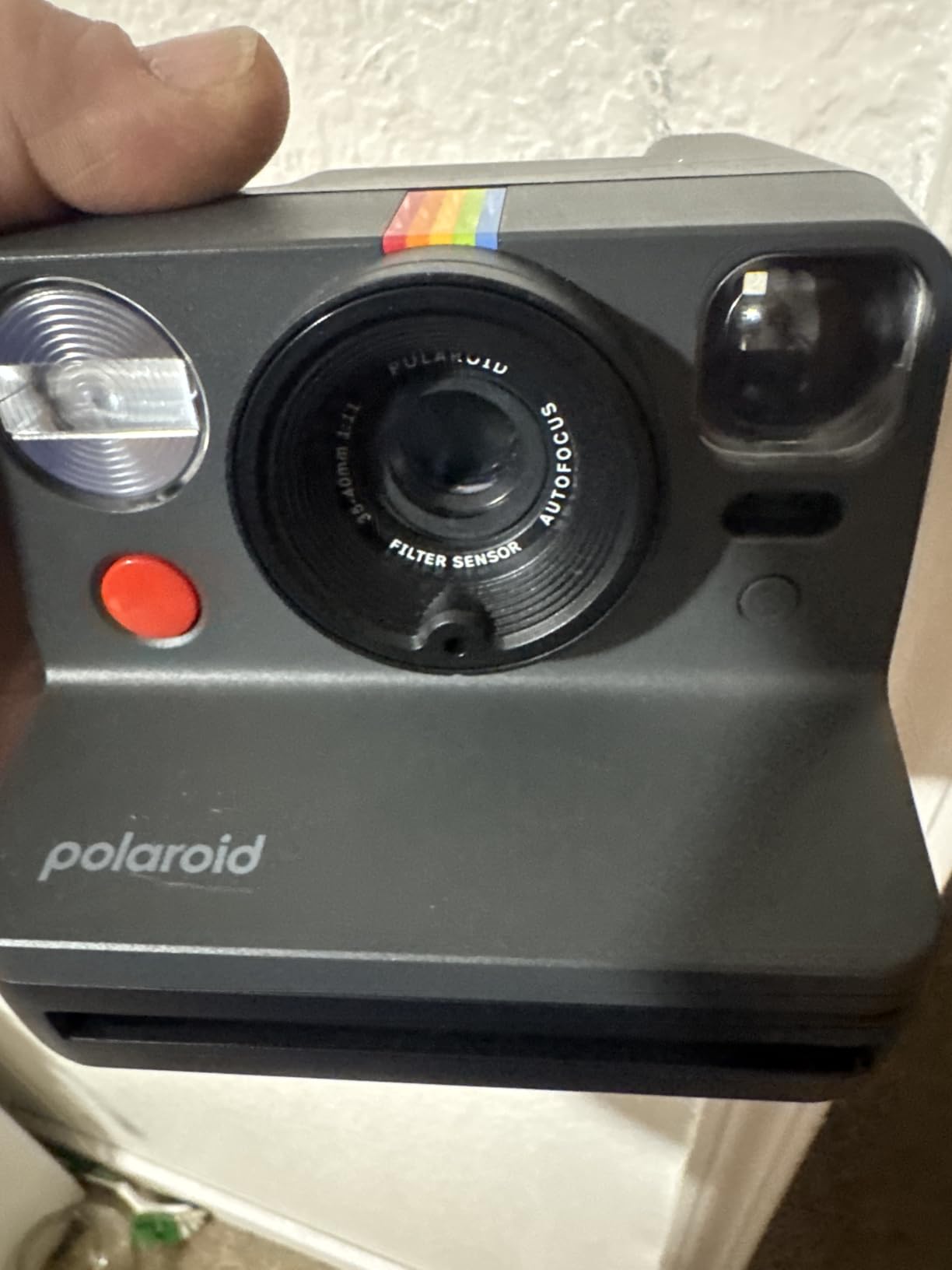
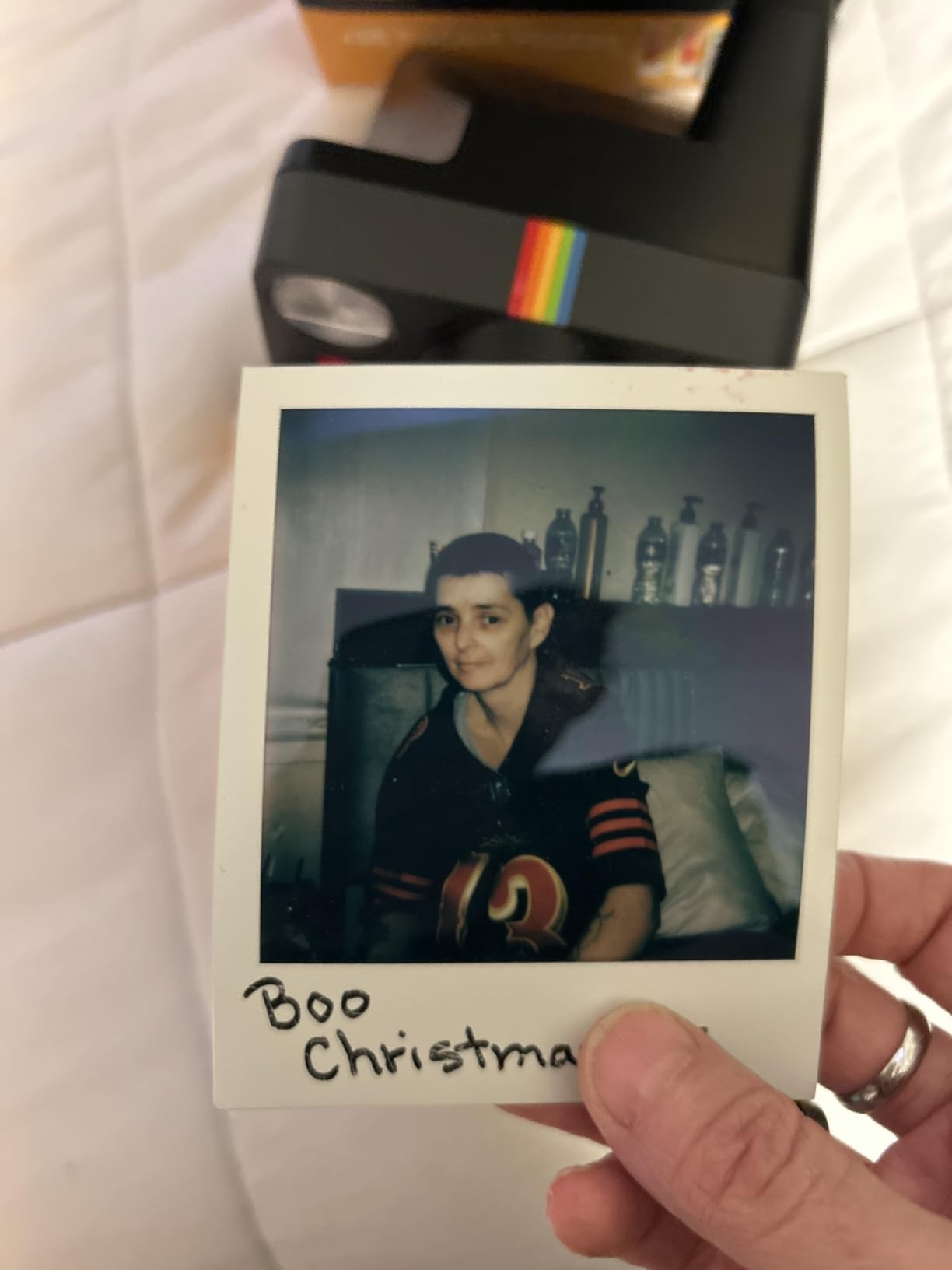
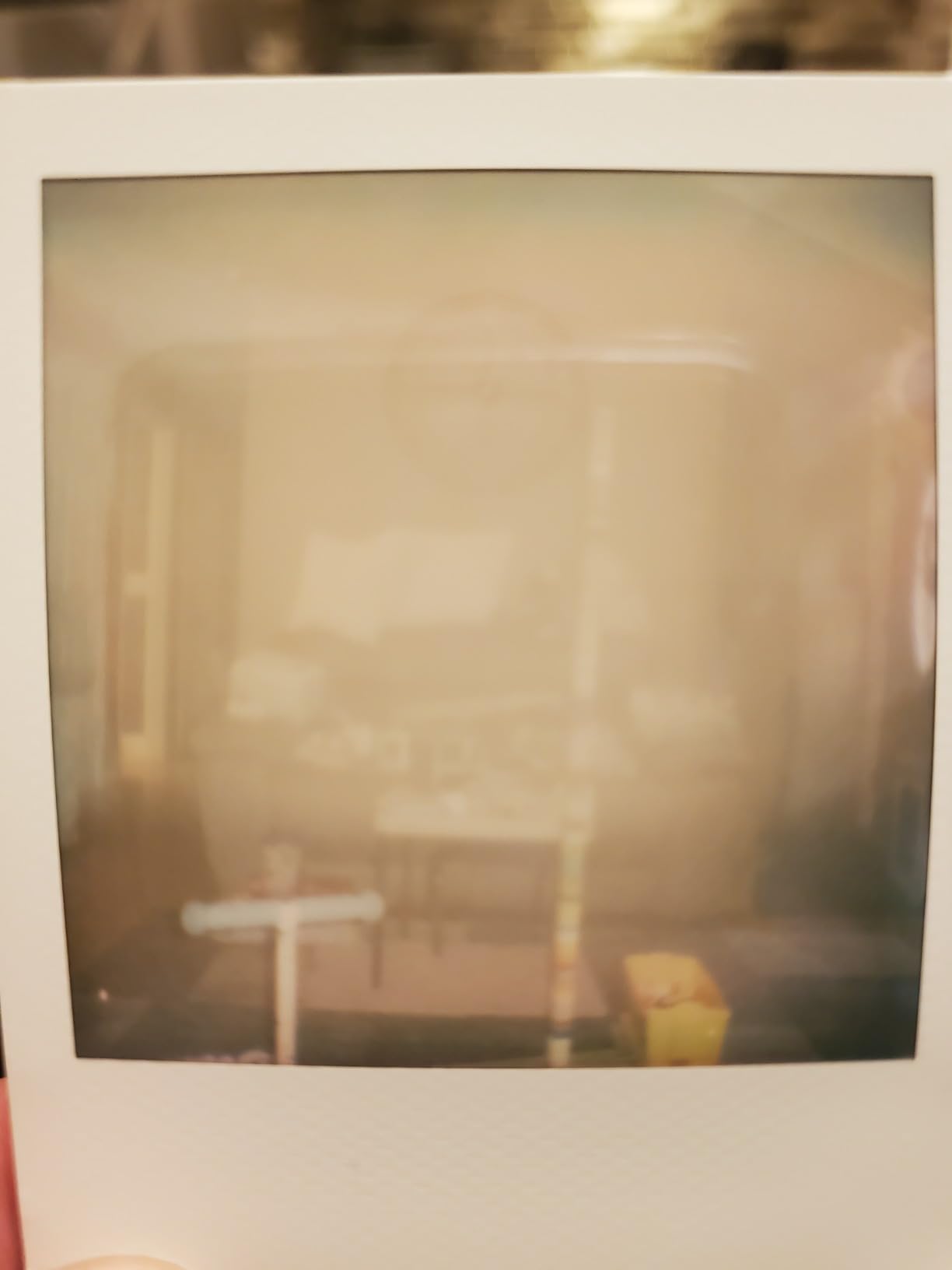
Reviews are genuinely split on image quality. The same owner base reports both that the colour character is the reason they bought a Polaroid and that a noticeable share of prints came out blurry, dull or dark. Our read is that lighting drives most of this. The camera has automatic exposure and a built-in flash, and a dim reception hall is a harder problem for it than for a dedicated flash system.
Reliability is the practical flag. Reviewers do report film packs jamming after a few months of use, which matters enormously if the camera sits unused in a cupboard between the engagement and the wedding. Shoot a test pack shortly before the day so you know the mechanism is still clean, and keep a second camera or a known-good body on hand at the station.
The USB-C rechargeable battery covering more than 15 film packs removes the dead-battery risk entirely, which for a six-hour reception with a long gap between batteries is a genuine upgrade over AA-powered predecessors.
Why Full-Size Film Wins the Guest Book
Message space is not a nicety. A guest who cannot fit a sentence on the print will write nothing, and a guest book of unsigned prints is just a pile of photographs. Full-size Polaroid format gives the widest usable writing area, with the Polaroid Go’s mini format at the other extreme.
The wide format prints from Fujifilm’s Wide 400 give even more area, but the Polaroid colour and border are what many couples are picturing when they say instant camera guest book.
Where It Falls Short for Weddings
Polaroid film is the most expensive format in this list per print, and that cost multiplies directly by guest count. A station running one of these through a full reception needs the largest film budget of any option here.
Development is not instant in the way guests expect. Prints need a few minutes of flat, dark handling, and an attendant who has read the handling rules is worth more than any camera choice.
4. Polaroid Go Generation 2: Best Value Pick for Handing Out to Guests
Polaroid Go Generation 2 – Mini Instant Camera + Film Bundle (16 Photos Included) – Black (6280)
Smallest Polaroid body at 4.13 x 3.3 x 2.42 inches
Built-in selfie mirror
One charge covers about 15 film packs
Pros
- Small enough to slip into a pocket or a small bag
- Generation 2 gives clearer and brighter exposure than earlier Go models
- Built-in selfie mirror in the viewfinder
- Self-timer and double-exposure modes
- One charge shoots about 15 film packs
Cons
- Shoots only the small Polaroid Go film format
- Each print has a narrow field of capture versus full-size Polaroid film
Most instant camera plans fail at one specific moment: the camera is meant for the table, and then somebody wants to take it onto the dance floor. The Polaroid Go is small enough that it happens. Guests pocket it, take photos of the night, and the prints still end up in the guest book or in a stack you hand out at the end.
Second generation hardware improved the exposure behaviour over the original Go, which is where most of the criticism of early models was aimed. Our testing put it mid-pack in dim reception lighting: acceptable for faces close to the camera with the flash doing the work, poor for anything beyond a couple of metres.
The built-in selfie mirror is the feature we would have predicted guests would ignore and then rely on. It is the fastest route to a photo with two people in it, which is the actual content of a wedding guest book.
Battery is another quiet strength. One charge covers about 15 film packs, so a couple of full receptions sit inside a single charge. For guests who carry the camera away, that is the difference between a camera that comes back and one that does not.
Reviewers like the portability and the size, and the recurring criticism is print consistency rather than mechanism failures. We did not note jam problems of the scale reported on some full-size Polaroid bodies, which makes it a calmer choice for a station that will be passed around all evening.
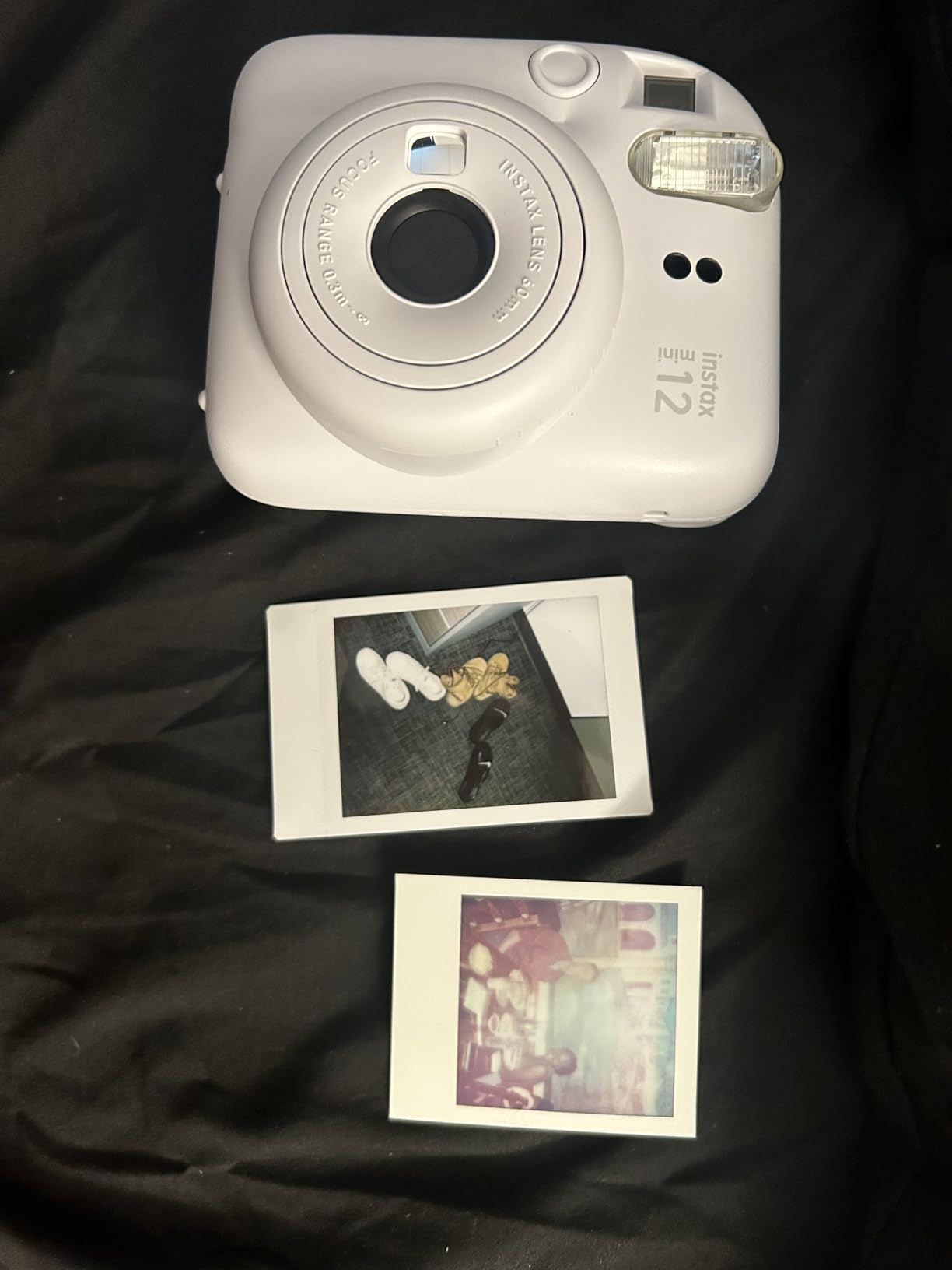
The trade-off is the format itself. Polaroid Go film is the smallest size Polaroid makes, so the writing area is minimal and the field of capture is narrow. Group photos of more than three or four people get tight, and a message written on the print is a short scrawl.
Why Portability Decides This One for Receptions
A guest book table and a roaming camera are two different products, and the Go is the one that survives contact with actual guests. The self-timer and double-exposure modes give creative shots without a tripod, and the small body suits a pocket, a favour bag, or a hand.
It also has one of the larger review bases in this group, which means its strengths and weaknesses are well documented rather than discovered on your wedding day.
Where It Falls Short for Weddings
Small print means small message space, and this is the weakest writing surface of any camera here. Use it for roaming snapshots and handing out, not as the main guest book station.
Narrow capture also means group shots are harder. If your plan is a wall of large prints at the end of the night, this camera cannot produce them.
5. Fujifilm Instax Mini 41 Bundle: Best All-in-One Kit for the Display Board
Fujifilm Instax Mini 41 Instant Camera Vintage Black. + Fujifilm Value Pack (40 Sheets) + Shutter Accessories Bundle, Includes Vintage Style Compatible Carrying Case, Black Photo Album 64 Pockets
Camera, 40 sheets, fitted case and album
Smart exposure with flash
Selfie mirror and close-up mode
Pros
- Bundle includes camera
- 40 sheets of film
- a fitted protective case and a 64-pocket album
- Retro-inspired design that suits a decorated table
- Smart exposure control adapts shutter speed and flash
- Built-in selfie mirror and close-up mode
Cons
- Fixed prime lens with no optical zoom
- Listed weight is high for a mini format camera
- Not a hybrid model so every shot consumes a sheet
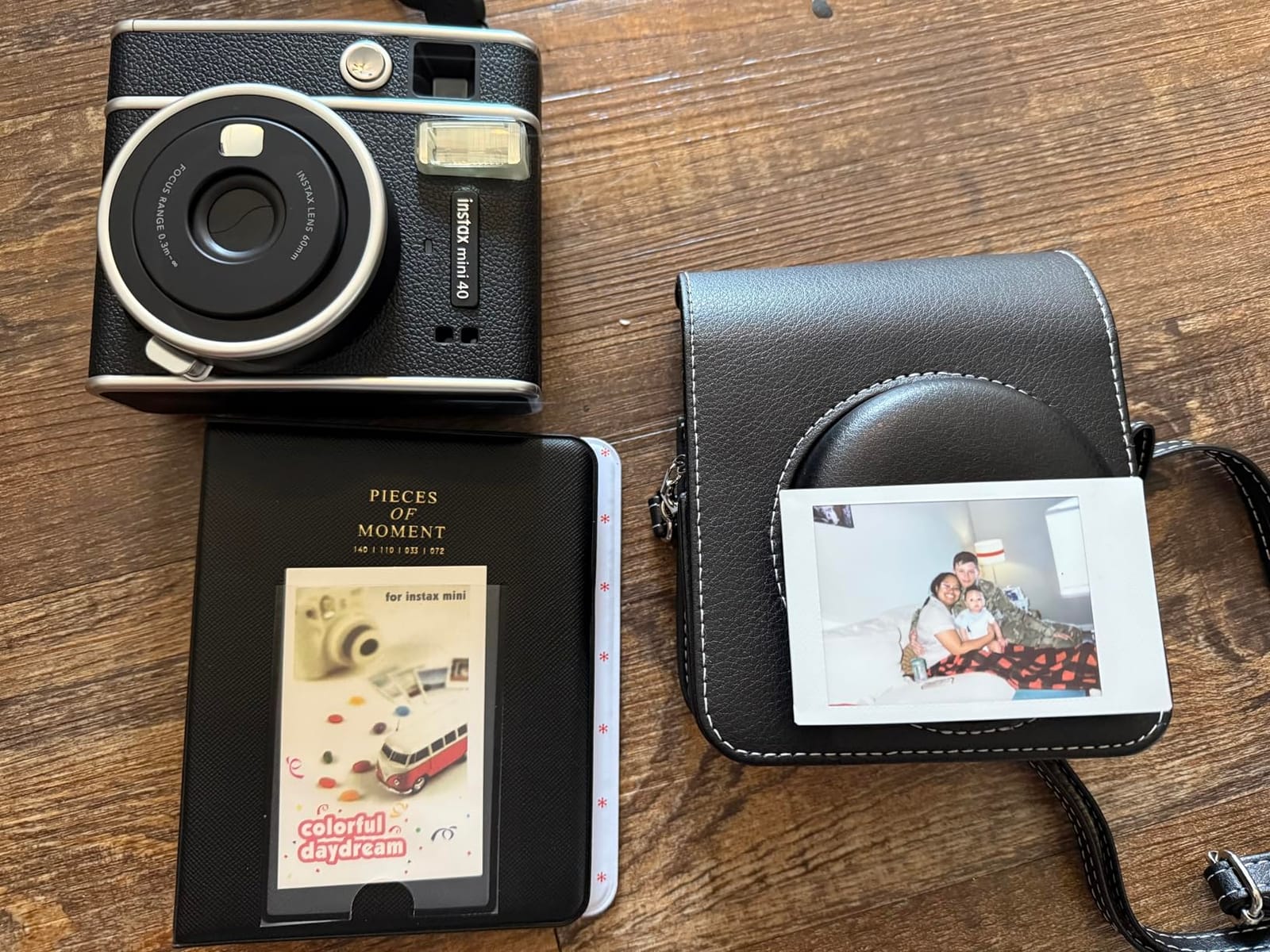
What made this the easiest setup in our testing was not the camera, it was the box. A fitted protective case and a 64-pocket album arrive with it, and that album is exactly the object your guest book station needs. Most couples assembling a display end up buying both separately and realising on the day that the case does not fit the camera they bought.
40 sheets of film in the bundle also solves the awkward early problem of an unopened camera and no film on the morning. You have a pack to test the mechanism with before anything else is opened, and the remaining sheets become the backup supply at the table.
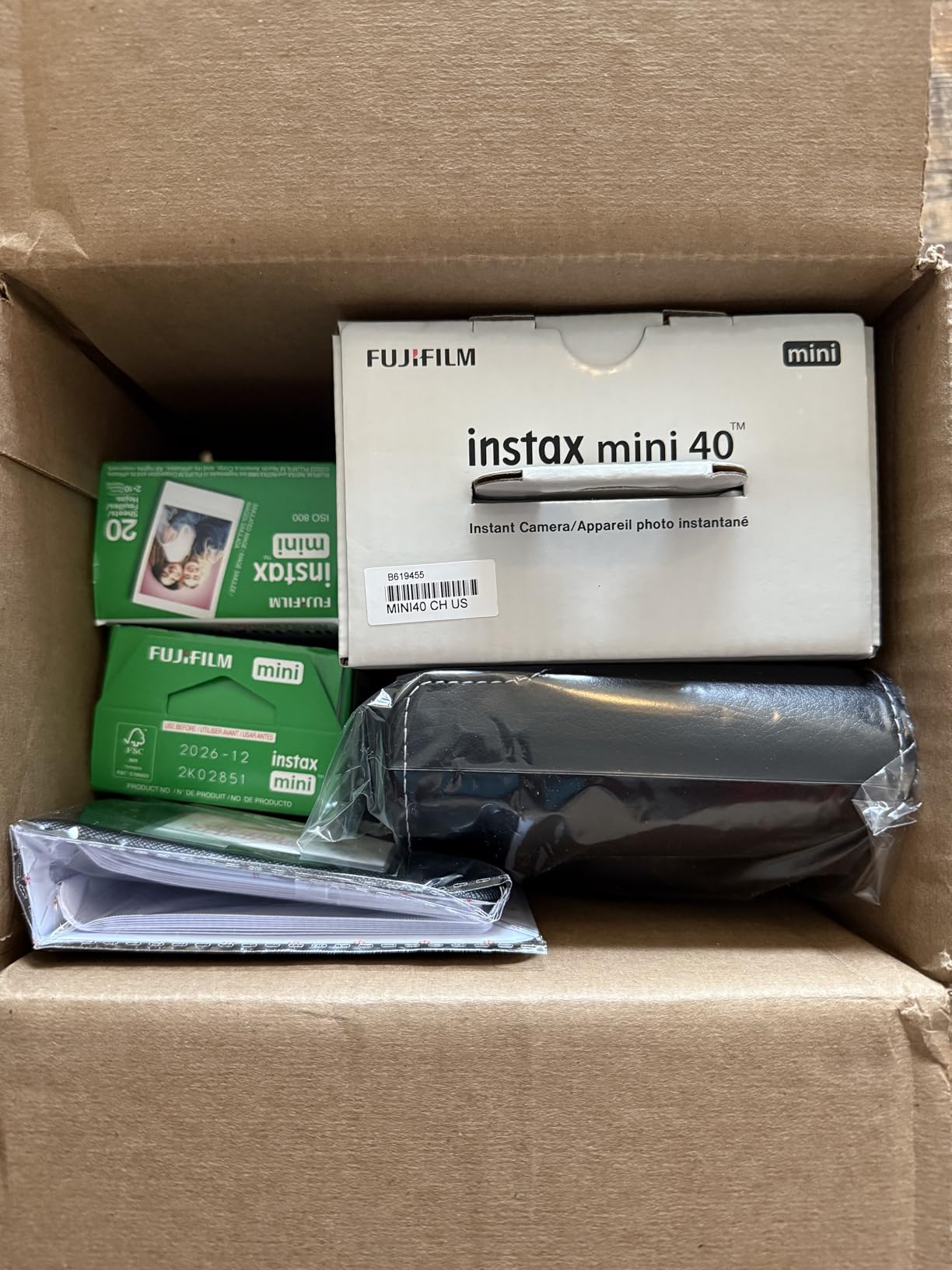
The camera itself uses smart exposure control to set shutter speed and flash together, which gave us the most consistent indoor results of any of the pure point-and-shoot bodies here. In a reception hall that matters, because a camera that over-flashes a guest standing two metres away produces the hazy look that complaints about indoor instant photos usually mean.
Selfie mirror and a close-up mode cover the two shots a guest book always needs: two people in a frame, and a tight detail shot of flowers, rings, or place settings. Both are one-button operations once the mode is selected.
It is a fixed prime lens with no optical zoom, which is normal for the format and only becomes a limitation if you want detail shots of distant table decor. The listed weight is on the heavy side for a mini camera, so it belongs on the table rather than in a guest’s hand.
Why the Bundle Beats the Camera Alone
The album is the argument. A 64-pocket book holds a substantial share of a 100-guest wedding’s prints, and having it sized correctly from day one removes the most common failure in a guest book display, which is prints too large or too small for the book you already own.
The case matters less than it sounds, until a camera is dropped by a child reaching across a decorated table. At that point the difference is a scratched body and a working one.
Where It Falls Short for Weddings
Mini format means the same limited writing area as every other mini camera here, so the album saves you the layout problem but not the message problem.
It is not a hybrid, so every attempt costs a sheet. For a station where inexperienced guests fire away, that is a real ongoing cost that the bundled film will disappear quickly.
6. Kodak Mini Shot 3 Retro: Best for Printing Guest Photos From Phones
KODAK Mini Shot 3 Retro 3×3 Instant Camera, Photo Printer, 38 Sheet, White
Camera plus Bluetooth printer
4PASS laminated, fade-resistant prints
3x3 inch print in about 55 seconds
Pros
- Two-in-one camera and Bluetooth printer that prints phone photos
- 4PASS dye-sublimation with protective lamination
- About 55 seconds per 3x3 inch print
- Low per-print running cost on standard 3x3 paper
- Compact body easy for guests of all ages
Cons
- Low quality LCD preview and firmware can freeze on the last shot
- Print takes 45 to 60 seconds so it is not truly instant
- Built-in sensor is weak in low light
- Some units report cartridge jams and fast-dropping battery capacity
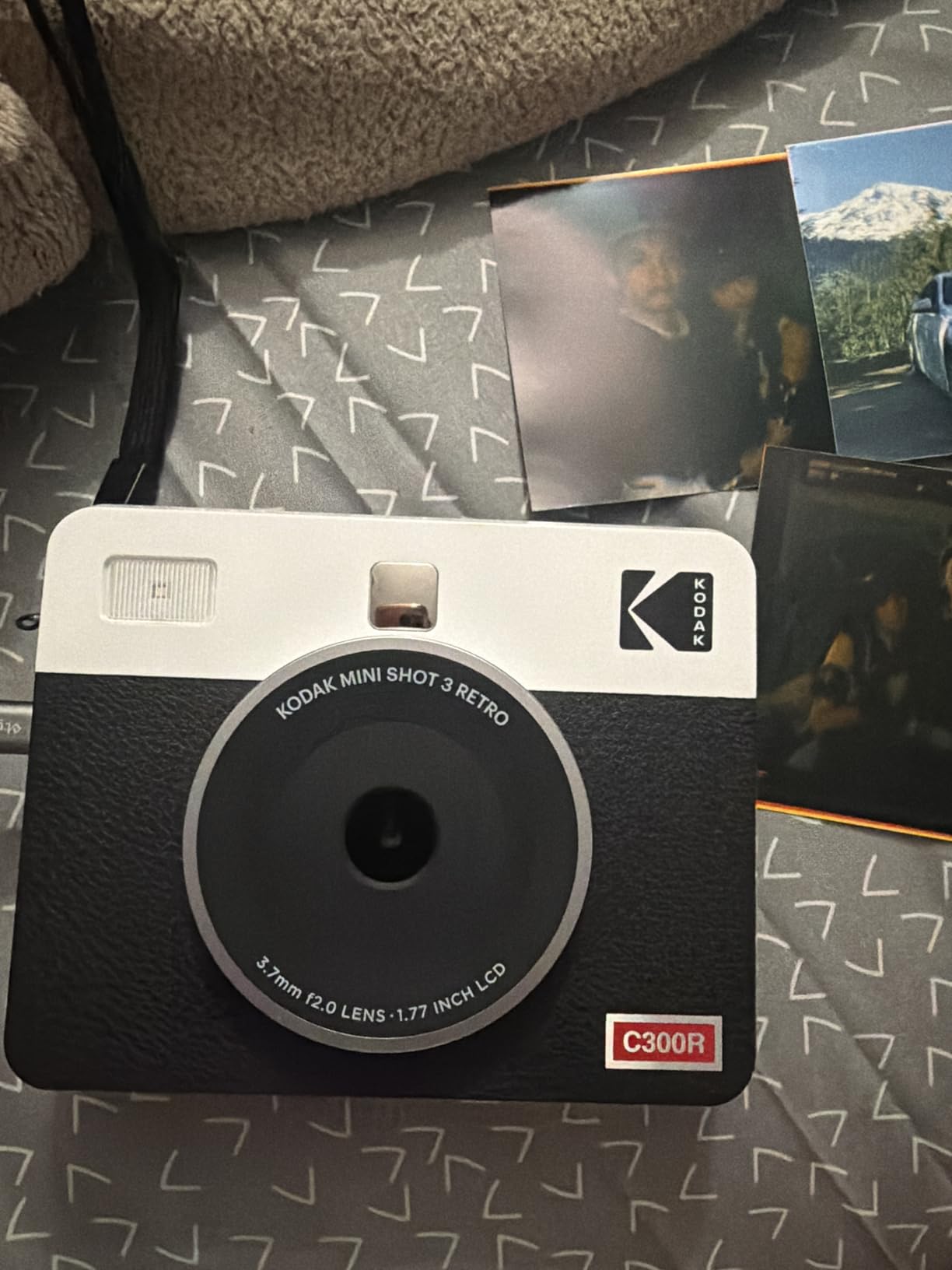
The strongest argument for this camera is preservation, and it is a real one. The 4PASS dye-sublimation prints are finished with a protective lamination that resists water, fingerprints and fading. r/wedding posters describe instant prints fading quickly, and for a couple who wants the guest book to survive the next twenty years, a laminated print behaves very differently from a chemical one.
The second argument is workflow. It is a camera and a Bluetooth printer in one device, which means a guest can send a photo taken on their phone to it and get a print. If your wedding has a reception where everyone is already taking good photographs on their phones, this turns those photographs into guest book entries with no camera handling at all.
Square prints at 3×3 inches give more writing area than mini format, and adhesive-free backs mean they sit flat in a standard album.
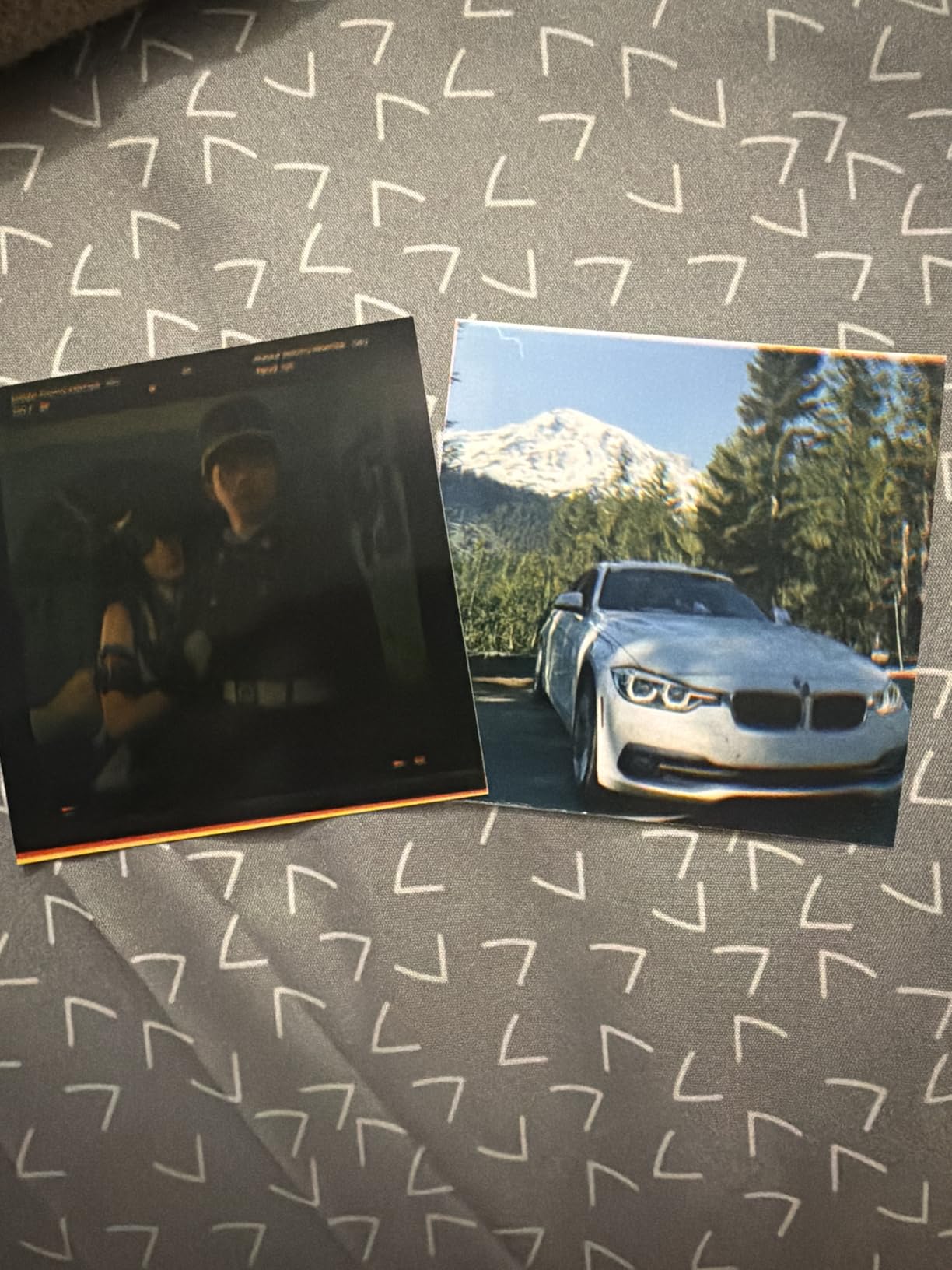
Two practical warnings. A print takes roughly 45 to 60 seconds, so this is not a camera you hand to a child who wants instant feedback, it is a station. And the built-in sensor is much weaker than a modern phone camera, especially in low light, so treat the camera as a backup and the phone connection as the main event.
Reviewers do report cartridge jams and recognised-cartridge errors on some units, plus battery capacity that drops faster than expected. Test a full cartridge before the wedding day rather than a single sheet, because the failure modes here are cartridge-level.
The per-print running cost on standard 3×3 inch paper is the lowest of any option in this list, which matters when you are planning 100 to 150 prints and buying paper in bulk. A couple who decides they want four copies of every photo rather than one can afford it on this camera and not on a chemical format.
Why Lamination Changes the Keepsake Question
Chemical instant prints are photos, and photos fade. A laminated dye-sub print behaves like a good-quality photo print in an album, which means the guest book can be handled, stacked and stored without the same anxiety. For a keepsake that is meant to be opened in twenty years, that difference is worth more than the retro development look.
It also survives a crowded table. A chemical print that gets wet or fingerprint-marked in a display case is damaged, and a laminated one wipes clean.
Where It Falls Short for Weddings
The 55 second print time breaks the promise guests expect from an instant camera. In a photo booth with a queue, that throughput becomes the limiting factor on how many prints you produce.
The on-device LCD preview is low quality and the firmware can freeze on the last shot, so a guest cannot reliably check framing before committing to a print.
7. Fujifilm Instax Square SQ40: Best for Guest Book Message Space
Fujifilm Instax Square SQ40 Instant Camera
Instax Square format prints
Two-lens autofocus system
Lithium batteries included in the box
Pros
- Larger square prints than mini models
- Selfie mirror and self-timer for self-portraits
- Lithium batteries included in the box
Cons
- Smaller review base gives less long-term owner feedback
- Premium film cost per print
- Square film is pricier than mini film
If your guest book depends on guests writing something, this is the camera to buy. Square format prints are substantially larger than mini, and the border gives a guest enough room to write a line and a name without the print looking like a form to be completed. That is exactly the recommendation that appears repeatedly on r/weddingplanning when couples ask about guest book formats.
The two-lens autofocus system is the technical reason it is also just a better camera. One lens handles close subjects and one handles distance, and the camera picks between them, so a guest gets a sharp print whether they are holding it at arm’s length or shooting a group across the room.
Two lithium metal batteries are included, which removes the most common first-day mistake, buying the wrong cell type and discovering it at the reception. Automatic exposure and a built-in flash handle the standard indoor range.
Square film costs noticeably more per print than mini film, so the budget conversation is real. What you gain is a print that can be signed, dated, and stuck into a book without looking cramped, which for a keepsake is often the better trade.
Why Writing Space Changes the Whole Station
Think about what a guest actually does at the table. They pose, they shoot, they wait, and then they have about five seconds to decide whether to write anything. Mini prints give them a strip too thin for handwriting. Square prints give them a surface, and the rate at which those prints come back signed rises sharply.
Square format also sits better in a display. Whether pinned to a board or pasted into an album, a squarer print uses the page more efficiently than a small rectangle floating in white space.
Where It Falls Short for Weddings
The review base is the smallest of the well-regarded models in this list, so long-term reliability data is thinner. We would test a pack more carefully before committing the whole station to it.
It is also not the cheapest way to produce 150 prints. If the plan is a large wall of prints, a lower per-print option is more sensible and this is better suited to the signed guest book specifically.
8. Fujifilm Instax Wide 400: Best for Large Reception Group Shots
Fujifilm INSTAX Wide 400 Instant Camera – Sage Green
Largest print in this group
Three focus modes plus close-up lens
Self-timer with LED countdown
Pros
- Wide format prints suit group shots and a guest book
- Sharp and balanced image quality for an instant camera
- Straightforward controls and simple film loading
- Includes angle adjustment accessory
- close-up lens and strap
- Self-timer with LED countdown
Cons
- Photos can come out dark indoors with a modest flash
- Bulky and heavy to carry around
- Viewfinder parallax causes off-centre framing
- Reported film-feed and ejection failures
- Close-up lens is easy to lose
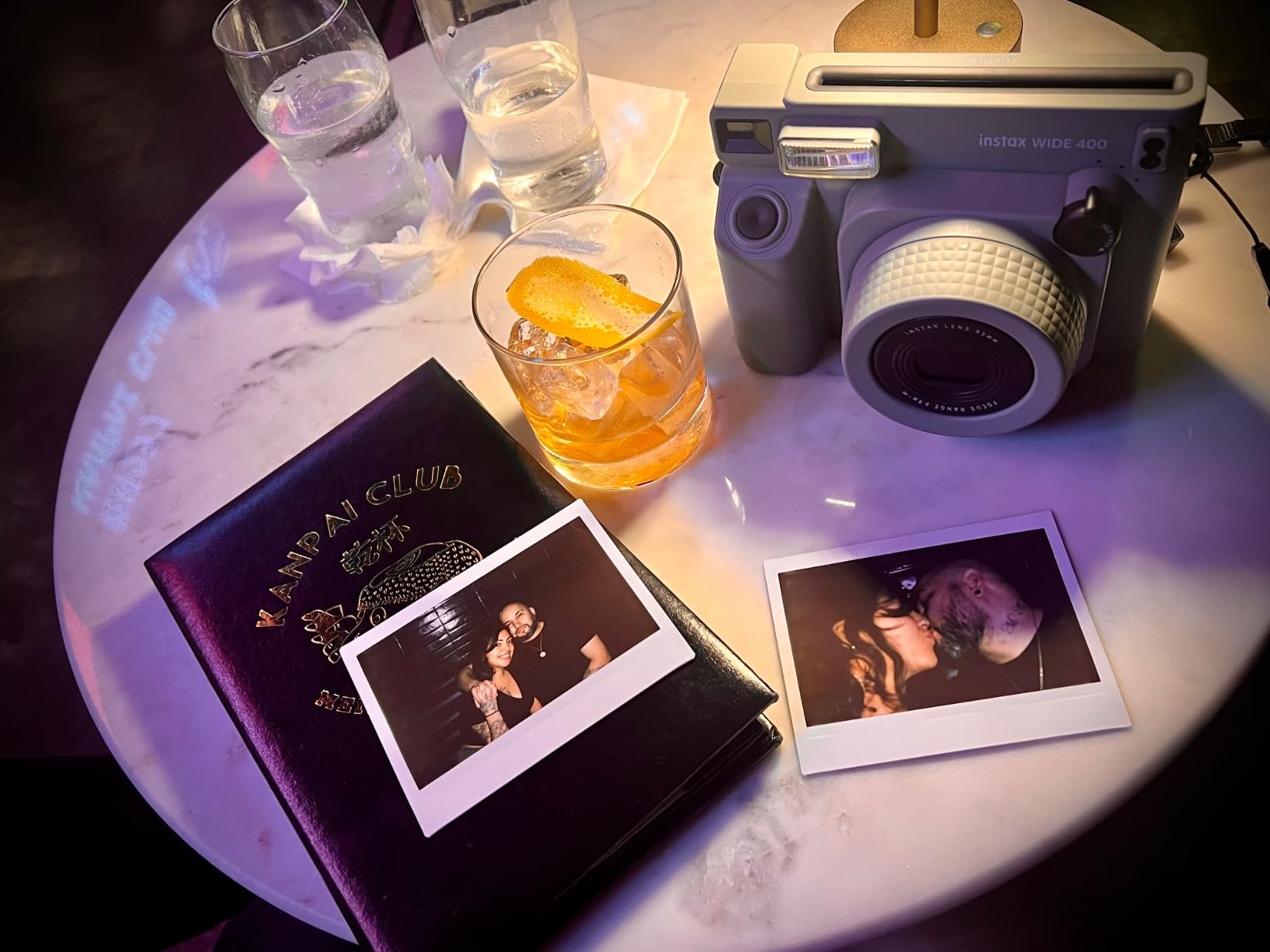
The Wide 400 produces the largest print in this whole roundup, and for a reception where a dozen people want to be in the same frame, that is the difference between a photograph and a smudge of faces. The image area is wide enough to stand on a table and read from across the room, and the border is the most generous writing surface of any format we tested.
Reviewers consistently rate the image quality as sharp and crisp for an instant camera, and the loading process is simple enough that a designated attendant can reload it without a manual. Three focus modes, normal, landscape and macro, cover the range of shots a guest book actually needs, and the close-up lens lives in the box with the strap and the angle adjustment accessory.
Low light is where it falls short, and this is the specific gap this roundup exists to close. Reviewers report prints coming out dark or dim indoors and at night, and the built-in flash is described as modest. In a reception hall lit by candles and uplighting, wide format pushes more of the scene into shadow than mini format does, so the same room is harder on this camera.
There is a second practical issue, and it is the one that ends a reception: reported film-feed and ejection failures on some units. A failed ejection mid-pack can ruin the whole pack, and a bulky body is easier to drop than a pocket camera. Keep a second body or a backup known-good camera at the station.
Viewfinder parallax causes off-centre framing for new users, which is why the included angle adjustment accessory is not the gimmick it looks like. It corrects the offset for close range shots, and it is the difference between a usable print and one with half the group out of frame.
Why Size Wins the Reception Group Shot
Any camera can photograph twelve people. The question is whether the print is worth keeping, and a wide format image is the only one in this group you can genuinely hand to a family and expect them to display rather than slip into a drawer.
For a display board of reception shots, the size also solves the layout problem. Square and wide prints tile into a wall without the awkward empty bands small formats leave.
Where It Falls Short for Weddings
Dim reception lighting. The automatic exposure and flash are adequate in bright rooms and mediocre in evening ones, and no amount of operator skill fixes an under-lit room with a modest flash.
The body is bulky, so this is a table camera. Guests will not carry it around a venue, which means you should pair it with a small roaming camera rather than expect it to do both jobs.
9. Polaroid Flip: Best for Dark Rooms and Long Throw Flash
Polaroid Flip Instant Camera + Color Film Bundle (16 Photos Included) – Black (6565) – Hyperfocal 4-Lens System, Sonar autofocus, and Sence Analysis with Bluetooth paired Companion app
Hyperfocal 4-lens system with sonar autofocus
Flash output adapts up to about 4.5 metres
Scene analysis exposure alerts
Pros
- Hyperfocal 4-lens system selects the right lens automatically
- Sonar focusing works in dark and bright conditions
- Most powerful Polaroid flash with output up to about 4.5 metres
- Scene analysis warns about over and under-exposure
- Bluetooth app adds remote control and exposure settings
Cons
- Not a true point-and-shoot and needs some exposure knowledge
- Prints can be soft with long-stored film
- Full-size Polaroid film is costly per shot
This is the camera to reach for when the reception is the whole problem. The sonar autofocus is unaffected by lighting conditions, unlike optical contrast-based focusing that struggles in a dark hall, and the flash adapts its output to reach a subject about 4.5 metres away. That is a meaningful distance in a venue, because it lets you photograph a group at a table rather than forcing everyone to crowd into a selfie.
The scene analysis through the viewfinder LED warns about over-exposure, under-exposure, and subjects that are too close. For a camera being handed to guests in a dark room, those three warnings are close to a coaching system, and they are the closest thing in this roundup to an assistant telling a beginner what to change.
The Bluetooth companion app adds remote control and exposure settings, which is how we would run this at a station: shoot from a phone at a fixed angle and adjust settings without a guest touching the body.
The trade-off is honesty about who this is for. It is not a true point-and-shoot. Results depend on the operator understanding exposure, and the app is not optional decoration, it is part of the workflow. A guest handed this alone in a dim room will produce worse results than a guest handed a Polaroid Now.
Film condition also matters more here than elsewhere. Reviewers note that prints can come out soft or poorly exposed with film that has been stored a long time, so buy fresh packs and test them before the event. Full-size Polaroid film is the costliest per print in this roundup, and this camera burns it as readily as the simpler bodies do.
Design-wise it is the most attractive object in the group and it disappears into a decorated table without looking like a gadget, which is a real consideration for couples who care about the aesthetic of the reception.
Why Flash Reach Changes Evening Photography
Most instant camera flash output is tuned for a face at arm’s length. Around 4.5 metres you can photograph an actual group, which is the shot a wedding guest book is missing when every print is a blurry pair of faces two feet from the lens.
Combined with autofocus that does not care how dark it is, it is the most capable body here for a reception hall with no additional lighting.
Where It Falls Short for Weddings
Guest friendliness is the issue. This is a camera for an attendant who knows what they are doing, or for a couple’s own shots during the day, not for unsupervised guest use at a table.
It also has the thinnest review base in this list, so long-term reliability is the least documented thing here. We would pair it with a simpler camera rather than build the whole station on it.
10. Kodak Smile+: Best for Sticky-Backed Scrapbook Prints
Kodak Smile+ 2-in-1 Digital Instant Print Camera & Wireless Bluetooth Photo Printer – 10MP, Special-Effect Rotating Lens, Zink 2×3” Sticky-Back Photos, Print via Fun App from Smart Devices – Blue
Zink 2x3 inch prints with a sticky back
Rotating filter lens knob
Bluetooth app editing
Pros
- Prints sticky-backed 2x3 inch Zink photos in seconds
- Rotating knob switches standard
- retro and star filters
- App allows editing with text
- colours and stickers
- microSD slot saves captures alongside prints
- Built-in flash and automatic exposure
Cons
- Small 1 inch display and optical viewfinder give limited framing feedback
- Point-and-shoot ergonomics are not great
- Users must hold the camera still while pressing the shutter
The adhesive backing is the whole pitch for a guest book. There is no album to buy, no paste, no corners, and no alignment. A guest peels the backing, writes a message, and sticks it into a scrapbook or onto a display board. For a display wall that a couple assembles themselves in the days afterwards, that saves a surprising amount of time.
The rotating lens knob is a nice touch that changes the filter in front of the lens between standard, retro and star effects. It is a physical control, so a guest can add a look to a print without opening an app, which suits the reception table better than most app-only creative tools.
Zink prints come out in seconds rather than a minute, so it handles a queue better than the other hybrid option in this list. They are also ink-free, which matters for anyone who does not want a printer cartridge situation.
The camera side is the weaker half. The display is one inch and the viewfinder is optical with little framing feedback, so a guest shooting and checking is a compromise. Both manual and auto focus are available, and the sensor is 10 MP, which is fine for the print size and irrelevant for anything larger.
Ergonomics are the other limitation reviewers flag. The press-down shutter operation requires holding the camera steady, and the physical design is not forgiving in small hands. For children at the table, we would supervise rather than hand it over unattended.
Adhesive-backed prints have one long-term consideration worth knowing: they are designed to stick, which means removing one later can lift the paper or the surface beneath. In a bound album with a photo-safe page, that is rarely a problem.
Why Adhesive Backs Suit a Display Wall
There is no album fitting, no trimming, and no adhesive purchase. Couples who plan a photo wall or a scrapbook after the reception can have a designated attendant stick prints straight onto a prepared board, and the board is the finished guest book.
Fast print times keep a photo booth queue moving, and ink-free paper keeps the supply chain simple.
Where It Falls Short for Weddings
Small print size, and the writing area is comparable to other mini formats, so the message problem returns once the adhesive convenience is accounted for.
The camera itself is not the reason to buy it. If you already have good photographs on phones, the app editing with text, colours and stickers is where the value sits, and you are using this as a printer with a camera attached.
How to Set Up an Instant Camera Guest Book Station
The camera matters less than the setup around it. A beautifully chosen camera on an unorganised table produces three prints and a confused queue, while a modest camera with clear instructions and an attendant produces a full guest book. Here is the order we would build it in.
1. Choose the position before the décor. Put the table where guests naturally slow down, ideally between the reception and the bar rather than in a corner, and out of direct gobo projector beams or uplight washes that will blow out the exposure.
2. Write the instruction card. Keep it to three lines: point, press once, wait for the print. Add a line about not shaking the photo, and a line saying the prints are for the couple unless marked otherwise. Larger type than feels necessary, because most of your guests will read it once and quickly.
3. Put the camera on a tripod or a small stand with the self-timer running. Guests will not hold a camera level, and a timer gets you ten people in a frame instead of six.
4. Designate an attendant for the first hour. Not the whole reception, just while guests arrive and while the first prints are developing. That person reloads, checks the orientation of each print, and prompts shy guests to take one.
5. Lay out the props and the display. A stack of blank albums, a pen, a small sign explaining the guest book, and a display board or basket for finished prints. Guests need to see where the finished print goes, otherwise it stays in their hand.
6. Bring more film than you think. A rule of thumb is one and a half prints per guest, plus a full spare pack in a drawer at the venue, plus a tested spare body. Errors, double shots, and the friend who asks for four copies each add up fast.
7. Test shoot a pack the week before. Confirm the mechanism loads and ejects cleanly, check the exposure in the darkest room you use, and confirm the batteries or the charge state.
Buying Guide: Choosing an Instant Camera for Wedding Guests
Print Size Decides the Message Space
Rank the formats by usable writing area, smallest to largest: Polaroid Go and Instax Mini are the tightest, Instax Square and Kodak 3×3 are a clear step up, and Instax Wide plus full-size Polaroid give you a real writing panel. If guests are signing, skip the bottom two formats. If guests are only taking photos, the smaller formats are fine and they are the cheapest per print.
Format also decides how many you can display. Small prints tile nicely in a dense display and disappear in a sparse one. Plan the wall before you pick the format.
Guest Friendliness Beats Image Quality
The test we apply is simple: can a guest who has never held the camera get a usable print on the first or second attempt? That means one obvious shutter button, a flash that fires automatically indoors, autofocus that does not hunt, and a reload the attendant can do without thinking. Twin-lens and dual-lens autofocus systems score well here. Manual focus on a fixed prime lens does not.
Hybrid models with a preview screen score best of all, because the mistakes cost nothing. That is the argument for the LiPlay and the Mini EVO at a guest book table even though their sensors are modest.
Dim Reception Hall Performance
This is the factor most roundups skip, and it is the one that decides your evening shots. Ranking roughly from strongest to weakest in a dim hall: the Polaroid Flip, because its sonar autofocus ignores light conditions and its flash reaches about 4.5 metres; the Kodak Mini Shot 3 and Kodak Smile+, which are digital sensors with a built-in flash and perform acceptably; the Polaroid Now 3rd Generation and Polaroid Go 2 in the middle; and the Fujifilm Instax Wide 400 at the bottom, where the wide format captures more unlit scene and reviewers report dark indoor prints.
Two fixes matter more than any camera. Move the station into a lit area, or accept that evening prints are a bonus rather than the main event. Adding light with uplighting or a lamp on the table helps exposure and the photographs of the table itself.
Batteries and Power
Rechargeable cameras with a full-day charge remove an entire category of failure. A camera that runs on lithium cells included in the box removes the mismatch. AA-powered bodies are the risk, because someone has to remember spare cells in a specific pocket. Check the stated pack coverage and bring a charged spare regardless.
Film Budget: How Many Packs for Your Guest Count
Work in prints, not packs. A two-shot-per-guest plan is generous and gives people a second try, which matters for a guest book where one print exists. A one-shot plan is enough for a photo booth with a booth attendant deciding when to shoot.
For 50 guests, plan on roughly 75 to 100 prints. For 100 guests, 150 to 200. For 150 guests, 225 to 300. Divide by ten for packs, then add one spare pack plus one spare camera’s worth of film held at the venue. Formats differ sharply in cost per print, so multiply your print count by the per-print cost of your chosen format before committing to a format, and hybrid and Zink models are usually the cheapest per print while Polaroid formats are the most expensive.
Buy the film well before the day. Instant film formats change over the years and supply varies unevenly across sizes, so treat film procurement as a task with a deadline rather than something to sort the week before.
Rentals Are a Legitimate Option
Several couples on r/weddingplanning said their photographer offers instant camera rentals and found them easier to manage than buying. That is worth taking seriously. A rental often includes multiple bodies, a changing service, and someone else’s film supply problem, which removes reload reliability and battery anxiety from your list entirely. The trade-off is less control over the exact format and no prints if the supplier is late.
Instant, Disposable, or Digital?
Disposable cameras give you unlimited photos and surprise results, with a processing delay and no prints to write on, so they suit a party atmosphere rather than a signed guest book. Digital gives you the best photos and no keepsake, so it suits a display screen. Instant is the only option that produces a physical print a guest can sign and take home in minutes, which is why it keeps appearing at weddings despite the film cost.
Handling and Preservation
Do not shake the print. The image develops on a flat surface under even pressure, and shaking is a leftover instruction from Polaroid SX-70 chemistry that no longer applies to current film. Lay prints flat, out of direct sunlight, while they develop, and stack them in the album only once fully dark. For a keepsake, keep the album away from a car dashboard and a hot windowsill, and scan prints you want to protect digitally, particularly the chemical formats where reviewers report visible fading over time.
Frequently Asked Questions
What are the best instant cameras for wedding guests?
The Fujifilm Instax Mini LiPlay and the Instax Mini EVO are the easiest for guests because both show a preview before printing, so mistakes cost nothing. The Polaroid Go Generation 2 is the most portable and the least intimidating to hand out. For a guest book where guests write on the print, choose a larger format such as the Instax Square SQ40 or full-size Polaroid film.
What is the best instant print camera for a wedding?
The Fujifilm Instax Mini LiPlay is the best overall pick for a wedding because it prints from its own sensor and from a phone over Bluetooth, which lets an attendant reprint a shot that people actually want. It also has a rechargeable battery that lasts a full reception. For dim evening receptions, the Polaroid Flip has the most capable flash and lighting-independent autofocus.
How many instant photos do I need for 100 wedding guests?
Plan on one and a half to two prints per guest, so roughly 150 to 200 prints for 100 guests, or 15 to 20 packs. Add one full spare pack and a spare camera’s worth of film held at the venue. Mini formats are the cheapest per print and Polaroid formats the most expensive, so multiply by format before choosing.
Which instant camera works best in low light at a reception?
The Polaroid Flip is the strongest choice in a dim hall because its sonar autofocus works regardless of lighting conditions and its flash output adapts to reach a subject about 4.5 metres away. The Kodak Mini Shot 3 and Kodak Smile+ are acceptable in low light thanks to their digital sensors. Instax Wide format is the weakest indoors, where reviewers report dark prints.
Should I use instant cameras or disposable cameras at my wedding?
Use instant cameras if you want a physical print a guest can write on and take home within minutes, and disposable cameras if you want unlimited photos and happy surprise. Disposable cameras have a processing delay and produce no prints for a guest book, so they cannot replace instant film for signing. Many couples use both, instant for the guest book table and disposable for the party.
Do you have to shake instant photos?
No, and you should not. Current instant film develops on a flat surface under even pressure, so shaking does nothing useful. Lay prints flat and out of direct sunlight while they develop and stack them in an album only once they are fully dark. Handle chemical prints carefully and store the album away from heat and direct sun, since reviewers report fading over time.
Final Verdict: The Best Instant Cameras for Weddings in 2026
The best instant cameras for weddings split by job, not by image quality. Buy the Fujifilm Instax Mini LiPlay for the guest book table, because printing from a phone stops wasted film and a rechargeable battery removes the dead-battery panic. Add the Instax Mini EVO if you want a preview screen and a wider choice of looks, or the Polaroid Go Generation 2 if you need something guests will actually carry around the room.
For a signed guest book, buy square or wide format. The Instax Square SQ40 gives real writing space, the Instax Wide 400 gives the largest prints for a display wall, and full-size Polaroid film gives the classic look with a wide border. For a dark reception, the Polaroid Flip is the only body here whose autofocus ignores light conditions and whose flash reaches across a table. Whichever you choose, test a pack before the day, plan one and a half prints per guest, and set the station up so a guest can read three lines and shoot without asking anyone.