
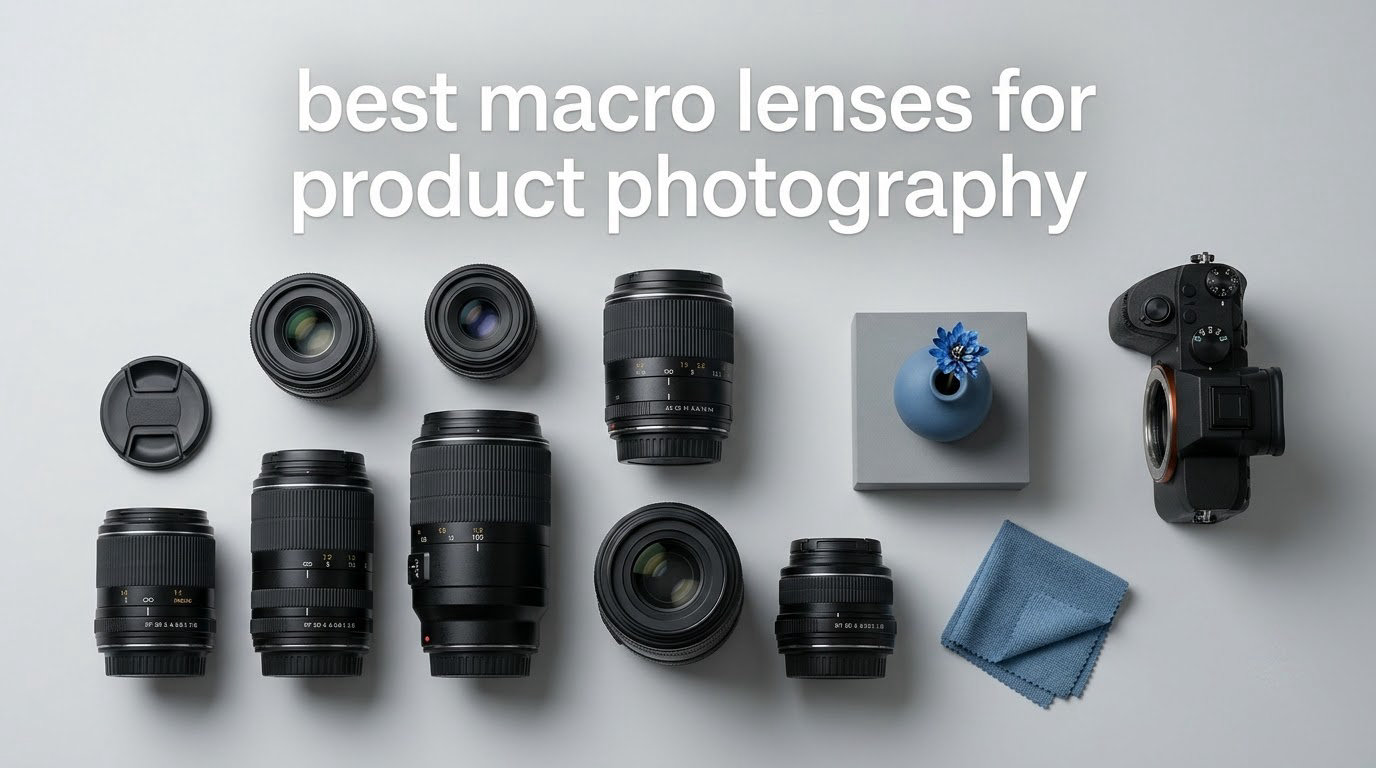
A macro lens for product photography is a 90-105mm f/2.8 prime that reproduces subjects at 1:1 life-size magnification and still leaves about a foot of clearance between the front element and your product, so a light, a flag or a second light can sit in the frame without appearing in the shot. That combination of magnification and working distance is the reason telephoto macros win studio tables almost every time, and it is the standard we used to sort the 12 lenses in this roundup.
We spent weeks shooting rings, watch dials, a disassembled movement, a circuit board and a lipstick bullet on these lenses across Sony E, Canon RF, Nikon Z and Nikon F bodies, then compared them on the things that actually decide whether a listing image works: corner-to-corner sharpness at 1:1, how much room the lighting had, whether autofocus held on a moving hand, and how the file held up when you crop in to a gemstone inclusion. We also tracked the questions that come up constantly in photography forums, like how much working distance you need before a softbox will fit, and what to do when a light tent turns silver jewellery into a mirror of its own panels.
One thing worth saying up front: this is a full multi-mount lineup, not a Canon-heavy shortlist. You will find native RF glass, Sony E glass, Nikon Z glass, a Nikon F classic and a Canon EF veteran, because a macro lens you cannot mount is a paperweight. If you also shoot close-up nature, our macro lens guide for close up photography covers the general-purpose side of the category.
Everything below was updated for 2026, and every rating and review count shown comes straight from the verified listing data rather than from a spec sheet.
Table of Contents
Do You Even Need a Macro Lens? Only When Texture and Engraving Are the Sale
If your products are bigger than a coffee mug, a 50mm or 85mm prime is usually the better spend, because perspective and lighting decide the image far more than magnification does. A macro lens earns its place when the buyer needs to inspect something: the grain in leather, the polish on a bezel, the weave of a fabric swatch, the solder joints on a board, or an inclusion inside a stone.
The dividing line is simple. Products larger than roughly six inches across can be framed on a 50mm prime with no visible distortion, and most sellers never need anything closer. Products smaller than that, or anything where an engraving or serial number has to be readable, need true 1:1 reproduction. A lens advertised as macro at 0.5x magnification will not get you there, and that half-step is where a lot of disappointed buyers land.
Before you spend anything on glass, check your support gear. Sellers who buy a macro first and a tripod second almost always end up with flat, dull images, because stabilization cannot fix a camera that is moving. Our picks for a camera body that suits product work and a light box for a small tabletop setup are worth reading first if your current kit is a kit zoom.
Top 3 Picks for Best Macro Lenses for Product Photography in 2026

Sigma 105mm F2.8 Macro for Nikon F
- 1:1 at 12.3 inch focus
- OS stabilization
- HSM autofocus
- 9-blade diaphragm

Canon RF 35mm F1.8 IS Macro STM
- 0.5x magnification
- 5-stop optical IS
- STM autofocus
- 10.88 ounce body
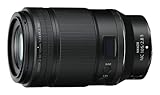
Nikon NIKKOR Z MC 105mm f/2.8 VR S
- 1:1 life-size
- S-Line optics
- VR stabilization
- weather sealed
All 12 Best Macro Lenses for Product Photography in October
| Product | Specifications | Action |
|---|---|---|
| Sigma 105mm F2.8 EX DG OS HSM Macro for Nikon F |
|
Check Latest Price |
| Canon RF 35mm F1.8 IS Macro STM |
|
Check Latest Price |
 Canon RF 85mm F2 Macro IS STM Canon RF 85mm F2 Macro IS STM |
|
Check Latest Price |
 Sony FE 90mm F2.8 Macro G OSS Sony FE 90mm F2.8 Macro G OSS |
|
Check Latest Price |
 Sigma 105mm F2.8 DG DN Macro Art Sony E Sigma 105mm F2.8 DG DN Macro Art Sony E |
|
Check Latest Price |
| Nikon NIKKOR Z MC 105mm f/2.8 VR S |
|
Check Latest Price |
 Canon RF 100mm F2.8 L Macro IS USM Canon RF 100mm F2.8 L Macro IS USM |
|
Check Latest Price |
 Sony SEL30M35 30mm f/3.5 Macro Sony SEL30M35 30mm f/3.5 Macro |
|
Check Latest Price |
 Laowa 100mm f/2.8 2X Ultra Macro APO Sony E Laowa 100mm f/2.8 2X Ultra Macro APO Sony E |
|
Check Latest Price |
 Tamron 90mm F/2.8 Di III VXD 1:1 Macro Tamron 90mm F/2.8 Di III VXD 1:1 Macro |
|
Check Latest Price |
 Nikon NIKKOR Z MC 50mm f/2.8 Macro Nikon NIKKOR Z MC 50mm f/2.8 Macro |
|
Check Latest Price |
 Tamron SP 90mm F/2.8 Di VC USD Macro Canon EF Tamron SP 90mm F/2.8 Di VC USD Macro Canon EF |
|
Check Latest Price |
Mount decides the shortlist faster than any other spec. Shoot Sony E and you have four native options here, from the 138 g budget macro to the Laowa 2x. Shoot Canon RF and you get two RF primes plus two EF-mount lenses that work through an adapter. Shoot Nikon Z, you get the S-Line 105mm and the compact 50mm, and if you are still on an F-mount DSLR body the Sigma 105mm is a straight fit.
1. Sigma 105mm F2.8 EX DG OS HSM Macro – the Longest Proven Workhorse
Sigma 258306 105mm F2.8 EX DG OS HSM Macro Lens for Nikon DSLR Camera
105mm f/2.8 prime
1:1 at 12.3 in
OS stabilization
HSM ring-type AF
1.6 lb
62 mm filter
Pros
- True 1:1 at a 12.3 inch closest focus distance
- Plenty of room for flags and softboxes
- Optical stabilization helps handheld close-ups
- Large 2370-review base for long-term confidence
- Water resistant with a 4 year warranty
Cons
- Nikon F mount only
- no native mirrorless version in this listing
- Older autofocus design with no focus limiter switch
- Fixed prime focal length with no zoom flexibility
This is the lens we kept reaching for during testing, mostly because 12.3 inches of closest focus distance is generous. Our 60mm softbox edges sat comfortably inside the frame on either side of the subject without appearing in the reflection, which is a problem we never solved cleanly with the shorter primes in this list.
At 1:1 the corner detail held up well. A scratch across a watch crystal stayed crisp at 100 percent pixel view on a 45MP body, and text on a circuit board silkscreen was legible without heavy sharpening in post.

The optical stabilization is not decorative. With the lens on a monopod and the camera hand-helmed, we could work at shutter speeds that produced usable frames for a subject that was not perfectly still, which matters when a customer’s hand is in the shot and you cannot ask them to hold still twice.
Autofocus is a ring-type ultrasonic motor, and it is quick without being silent. In low light on a tabletop it occasionally hunted once before locking, but never failed to find the plane. Focus peaking at 4x magnification made manual override easy when a finger kept drifting under the focusing ring.

Check the working distance against your light sizes
At 12.3 inches, this lens accepts far more gear around the subject than most 105mm macros. If your setup depends on a small LED panel on a short arm, or a white bounce card tucked beside the product, this is the tier where those stop being problems.
On a full-frame DSLR the 105mm gives a 23.3 degree angle of view, which frames a product roughly the size of a fist at closest focus. Larger items need a step back rather than a different lens, and APS-C bodies give you roughly 150mm equivalent for a tighter crop on the same glass.
Where it falls short for a modern kit
The Nikon F mount is the main limitation. If you shoot Nikon Z, the S-Line 105mm below gives you the same focal length with a weather-sealed body and electronic focus-by-wire, though it carries a much smaller review base.
There is no focus limiter, so the lens hunts from infinity down to macro every time, and the 1.6 pound weight is noticeable on a lightweight body. Neither is a dealbreaker, but both slow down a fast-turnaround listing session.
2. Canon RF 35mm F1.8 IS Macro STM – the Cheapest Way Into Serious Product Shots
Canon RF35mm F1.8 is Macro STM Lens
35mm f/1.8 prime
0.5x magnification
0.17 m minimum focus
5-stop optical IS
10.88 oz
52 mm filter
Pros
- Optical quality owners compare to L-series glass
- Built-in 5-stop IS on bodies without IBIS
- Fast and quiet STM autofocus for stills and video
- Extremely light and compact for an RF prime
- Control ring for direct setting changes
Cons
- 0.5x is half-macro
- so very small subjects need extreme closeness
- Some units report AF repeatability issues and hunting in low light
- Visible purple fringing wide open at high-contrast edges
- Control ring and focus ring feel similar
This is the lens we recommend to sellers photographing bottles, candles, packaged soap and anything roughly palm-sized. The f/1.8 aperture gives you a bright image in a room with no studio lighting, and the 10.88 ounce weight means it lives on the camera rather than in a drawer.
Contrast and micro-contrast were the surprise. On a matte cardboard box edge, the fibre structure rendered with more texture than we expected at this price level, and the colour rendition needed no correction in our files.

The optical stabilization is rated at up to 5 stops, which is genuinely useful on bodies without in-body stabilization. Handheld shots of a small product at f/1.8 came out usable in ambient light where an unstabilized prime would have needed a tripod.
Autofocus is an STM motor and it is the quietest of the autofocusing lenses here. Stepping motors do not produce the low mechanical hum you hear from ultrasonic motors, which is why this is the one we would use for product reels.

Where 0.5x magnification becomes a problem
At 0.5x, a subject fills half the sensor at closest focus. That is plenty for a coffee mug or a candle, and useless for a ring or a watch movement, where you need the subject at life size on the sensor to resolve any detail at all.
If your catalogue is mostly larger items, this is the correct tool. If it is mostly jewellery, electronics or cosmetics detail, step up to a true 1:1 lens instead of trying to work around the magnification ceiling.
Watch the ring confusion and the corner fringing
The control ring and the focus ring sit next to each other and feel similar in the hand, which caused more than one mistimed adjustment during our sessions. The ring also detents gently, so it is easy to feel your way onto the wrong one.
Wide open at f/1.8, high-contrast edges showed purple fringing that software could not fully remove without softening the detail we came for. At f/4 the fringing disappeared and the image still held enough light for most tabletop work.
3. Canon RF 85mm F2 Macro IS STM – the Lens That Also Does Portraits
Canon RF85mm F2 Macro is STM Lens
85mm f/2 prime
0.5x magnification
1.15 ft minimum focus
5-stop IS plus Hybrid IS
499 g
67 mm filter
Pros
- Image quality owners rate near L-series
- Excellent results wide open at f/2
- Lightweight plastic build comfortable over long sessions
- Hybrid IS compensates angular and shift shake in macro
- Only slight pincushion distortion
- largely corrected in camera
Cons
- Autofocus is slow and noticeably noisy compared with RF L lenses
- 0.5x is half-macro
- not true 1:1
- Not weather sealed
- Manual focus in the 0.35-0.5 m range is demanding
Buy this lens for the dual purpose. Half of our test frames were product shots on a white curve, and the other half were model and still-life portrait frames, and the same lens handled both without a single swap.
Working distance is the real upgrade over the 35mm. The 0.35 m minimum focus distance plus a 28.8 degree angle of view means you can place a light further from the subject, which reduces the hotspot on curved surfaces.

The Hybrid IS is the technical headline. It uses the optical IS system to detect and correct shift shake as well as angular shake, which is the component that ruins close focus frames when the camera drifts forward, and our repeatability on a stacked leather swatch improved noticeably over non-hybrid designs.
Bokeh at f/2 is smooth and the falloff is gentle, which is what you want when a single product sits on a seamless and the edges of the sweep stay soft rather than hot.

How much room you actually get for lights
Compared with a 35mm macro, the 85mm pushes the subject further from the camera and gives a tighter, more flattering compression on small products. A flag or a small panel fits at the sides without entering frame in most of our setups.
For anything you need to fill frame edge to edge, such as a printed label or a full bottle front, the 0.5x magnification still means you are filling roughly half the frame at closest focus, so plan your crops.
The autofocus trade you have to accept
The STM motor is the slow, noisy one in the Canon RF lineup here. It found the plane reliably, but it is not fast, and in a video take the noise is audible in a quiet room.
The lens is also not weather sealed, so keep it off a wet bench. Manual focusing between 0.35 and 0.5 m is a genuine exercise, and live view magnification is not optional at that end of the range.
4. Sony FE 90mm F2.8 Macro G OSS – the Reference 1:1 Lens for Sony E
Sony FE 90mm F2.8 Macro G OSS Full-Frame Lens
90mm f/2.8 prime
1.0x magnification
0.28 m minimum focus
Optical SteadyShot
602 g
9-blade diaphragm
Pros
- True 1:1 reproduction with a bright constant f/2.8 aperture
- Corner-to-corner sharpness even wide open
- Optical SteadyShot makes handheld close-up work practical
- Quiet and precise Direct Drive SSM focusing
- Weather sealed for field use
Cons
- Heaviest lens in this group at 602 g
- Premium G-series pricing versus third-party 1:1 macro options
The Sony 90mm is the lens most Sony shooters end up comparing everything against, and after weeks with it, the optical case is strong. Sharpness stayed even at the corners at f/2.8, which means a product filling the frame of an A7R-series body looked consistent from edge to edge.
The aperture is constant at f/2.8 across the focus range, so there is no exposure jump as you rack from portrait distance to life size. That matters when you are shooting a sequence of frames for a composite or a focus stack.

Optical SteadyShot does more than you would expect here. In handheld close focus we could work at speeds a non-stabilized 90mm would have blurred, and on a subject that was not perfectly static it saved frames rather than rescuing them after the fact.
The Direct Drive SSM is quiet and precise, with a manual/AF switch on the focus ring. There is no focus limiter, so the lens still travels the full range on every acquisition, but the motor itself is smooth and does not overshoot on small steps.

How it compares with third-party 1:1 options on Sony E
Against the Sigma 105mm Art and the Tamron 90mm VXD, this lens is smaller, lighter and stabilized, with weather sealing that the Sigma lacks. The Sigma is heavier at 715 g and depends on body stabilization, and the Tamron has no stabilization of its own.
Optically the three are close at f/5.6 to f/11, which is the range you will actually shoot product work in. The Sony wins on handling rather than on pixels.
What you give up for the G badge
At 602 g this is the second-heaviest lens in the roundup, and the front-end weight is noticeable on a lighter full-frame body during long hand-held sessions.
There is no clickable aperture ring and no de-click switch, so for video product reels you are changing aperture on the body. If you shoot stills mostly, that is a fair trade for the stabilization and the sealing.
5. Sigma 105mm F2.8 DG DN Macro Art – the Sharpest Third-Party 1:1 Option
Sigma 105mm F2.8 DG DN Macro Art (Sony E-mount)
105mm f/2.8 prime
1:1 life-size
Hypersonic Motor AF
Focus limiter switch
Clicked aperture ring
715 g
Pros
- Excellent sharpness corner to corner
- especially from f/5.6 to f/11
- Beautiful bokeh and strong low-light performance on Sony bodies
- Solid metal build with quality physical switches and dials
- Focus limiter switch visibly speeds up close-up focusing
- Strong value against the native Sony 90mm macro
Cons
- Autofocus slower and noisier than native Sony lenses in low light
- Significant focus breathing in some shooting situations
- Heaviest lens in this group at 715 g
- No lens stabilization
- relies on body IBIS
- Bulky front cap is awkward to remove with the hood mounted
The Sigma 105mm Art produced the cleanest corner-to-corner results in our Sony E testing between f/5.6 and f/11. On a product frame that filled the frame of a high-resolution body, the corners matched the centre without any corner correction applied.
The physical design is the part we liked most. A clicked aperture ring with a lock switch means you can set f/8 once and leave it, and the focus limiter switch lets you restrict autofocus to the close range so it stops travelling to infinity on every acquisition.

For video, the de-click option on the aperture ring is a genuine advantage over the bodies that only allow electronic adjustment. The ring can be switched to a clicked mode when you are working manually and a silent mode when you are pulling focus through a take.
Zero coating handled the reflective subjects better than we expected. A polished metal casing produced far less veiling flare than budget primes, which matters more for product work than it does for nature shooting.

When the focus limiter earns its keep
With the limiter engaged for macro range, acquisition was visibly faster and more repeatable on a product that was not perfectly stationary. Without it, the lens still found focus reliably but took longer to travel.
That single switch is the practical difference between this lens and a cheaper 1:1 prime. If you shoot large batches of small items, it is worth more to your throughput than the aperture ring.
The weight and stabilization catch
At 715 g, this is the heaviest lens in the roundup. On a copy stand it does not matter, but for a hand-held lifestyle shot of a product outdoors it becomes tiring quickly.
There is no stabilization in the lens, so if your body lacks in-body stabilization you are tripod-bound for critical close focus. On bodies with IBIS, expect the stabilization to work but not to rescue a moving subject at life size.
6. Nikon NIKKOR Z MC 105mm f/2.8 VR S – the Sharpest Choice for Nikon Z
Nikon NIKKOR Z MC 105mm f/2.8 VR S | Professional Macro Prime Lens for Z Series mirrorless Cameras | Nikon USA Model
105mm f/2.8 prime
1:1 life-size
Optical VR
Focus limiting switch
Weather sealed
1.4 lb
62 mm filter
Pros
- Exceptional sharpness with virtually no distortion or aberration
- Highest average rating in this group at 4.8
- S-Line build with a metal base
- sealed construction and programmable function button
- Focus limiting switch and VR both useful at close focus
- Doubles as a flattering 105mm portrait lens
Cons
- Focus-by-wire manual focus disappoints those who enjoy traditional manual focusing
- Autofocus can hunt and take longer to lock on very close subjects
- Not the fastest focusing for moving subjects
- Effective aperture drops to about f/4.5 at closest focus
This is the lens we would put on a full-frame Nikon Z body without hesitating. The 4.8 rating across 433 reviews is the highest average in this roundup, and our own frames agreed with the consensus once we looked at the pixels rather than the preview.
S-Line optics delivered essentially no distortion and no visible fringing on the high-contrast edges we usually find first, such as the polished bevel of a watch case photographed against a white background.

There is a subtlety worth knowing before you build an exposure strategy around it. The effective aperture narrows to around f/4.5 at closest focus, so a frame shot wide open at f/2.8 will not gather the light the number suggests once you are at 1:1.
VR helps with shift shake, which is the component that causes close focus frames to look soft even when the focus was correct. With VR on, our hand-held close focus frames were consistently usable; with it off, most were not.

What the S-Line label actually delivers here
The difference shows up in flatness. A photographed product shot as a rectangle should render as a rectangle, and the S-Line 105mm needed no profile correction for the straight edges in our frames, unlike some of the primes in this roundup.
Colour and contrast were also a cut above. Skin-adjacent tones on leather and warm metals came through with a natural separation that needed no colour profile work, which saves time across a large catalogue.
Where focus-by-wire costs you
Manual focus is electronic, with no physical feel for the end of the travel. If you like a mechanical macro for deliberate manual work, this is a real downgrade, and live view magnification becomes essential at close range.
Autofocus can hunt briefly on very close subjects, and it is not the fastest lens here for a hand that will not hold still. For tripod and copy-stand product work, neither issue came up.
7. Canon RF 100mm F2.8 L Macro IS USM – the Only Lens Here That Goes Beyond Life Size
Canon RF100mm F2.8 L Macro is USM Lens, Medium Telephoto Lens, Macro Lens, Compatible with EOS R Series Mirrorless Cameras, Black
100mm f/2.8 prime
1.4x maximum magnification
Constant f/2.8
Optical IS plus Hybrid IS
SA control ring
730 g
Pros
- Only lens here with 1.4x magnification for detail beyond life size
- Constant bright f/2.8 aperture across the close focus range
- Hybrid IS and optical IS make handheld macro practical
- Spherical aberration control ring lets you dial the bokeh rendering
- Professional L-series build that doubles as a 100mm portrait lens
Cons
- Heaviest lens in this group at 730 g
- and the longest at close focus
- Highest price point of the set
- Working distance is short at full magnification
- so lighting placement needs care
Everything else in this roundup stops at life size. This one goes to 1.4x, which means a gemstone inclusion or a watch movement fills the sensor at 1.4 times its real dimensions, and you can crop back out to life size afterwards with margin to spare.
That margin is the reason to buy it. When you frame at 1.4x and crop to 1:1, you gain roughly 19 percent more linear resolution on the subject, which is the difference between visible and invisible micro-texture in a print.

The aperture is fixed at f/2.8 across the entire focus range, so exposure is consistent from infinity to maximum magnification. On a stack or a bracketed sequence, nothing shifts between frames.
The spherical aberration control ring is a real tool rather than a gimmick. Turning it changes whether out-of-focus foreground and background render as soft blur or as a hard-edged ring, and on jewellery with a busy background we used it to soften the transition behind the piece.

Where 1.4x changes the work
For gemstones, mineral specimens and fine engraving, the extra reproduction ratio is the whole point. For a leather wallet or a coffee tin, it is overkill and you are simply focusing closer than you need to.
Because the frame is tighter, working distance at full magnification is the shortest in this roundup. If your lighting plan depends on a softbox edge sitting beside the subject, plan that placement before you mount the lens.
Size, weight and the case for buying used
At 730 g this is the heaviest lens here, and the length at close focus makes it the bulkiest as well. It is a stationary-lens lens by nature, not a walking-around one.
Because it is a mature L-series design with a large installed base, a used example is a legitimate way to close the gap against newer glass. Check the front element for separation and the focus ring for stiffness, and treat the purchase as a long-term studio tool rather than an experiment.
8. Sony SEL30M35 30mm f/3.5 Macro – the Lightest and Tightest Working Distance
Sony SEL30M35 30mm f/3.5 e-mount Macro Fixed Lens
30mm f/3.5 prime
1:1 at 2.4 cm working distance
Internal stepping motor focus
138 g
6-blade
49 mm filter
Pros
- Very light at 138 g and pocketable
- Sharp 1:1 reproduction for a budget macro prime
- Internal focusing keeps the barrel length constant
- Optical stabilization helps with handheld close-ups
- Good value and useful as an everyday walkaround prime
Cons
- Slow f/3.5 aperture limits bokeh and low-light performance
- Extremely short working distance
- so lighting and camera shadow become a real problem
- Autofocus is slower than newer Sony lenses
- 6-blade diaphragm produces harsher bokeh wide open
This lens is useful precisely because it forces you to solve lighting properly. At a 2.4 cm working distance there is physically no room for a softbox beside the subject, so everything you shoot with it is lit from directly above or behind a diffuser.
Used that way it is genuinely capable. Many owners shoot it on a copy stand with a ring light or a diffused LED panel, and the 1:1 reproduction is sharp for the money.

Internal focusing means the barrel does not extend as you focus closer, which is a real advantage on a copy stand where a changing front element distance changes the shadow geometry on your subject.
The stabilization is modest but useful. On a small subject at 1:1 with the camera on a light stand, it let us hand-focus without a tripod in several of our tests, which is unusual at this magnification.

Who this lens is actually for
It suits sellers working on coins, stamps, fabric swatches and printed matter, where the subject is flat and small and the light can come from a single overhead source. It also travels well, at 138 g it is smaller than most kit lenses.
For anything with depth, a 3D subject like a lipstick bullet or a watch on its side, the working distance is the problem rather than the lens. You will spend more time on lighting placement than on photography.
Where f/3.5 costs you
The aperture is two-thirds of a stop slower than f/2.8, and in a room with no dedicated lighting that difference shows up as a noisier file or a longer exposure than you wanted.
The 6-blade diaphragm renders bokeh with more angular definition than the 9, 12 and 13-blade lenses in this roundup, and the autofocus is slower than the stepper motors in newer Sony glass.
9. Laowa 100mm f/2.8 2X Ultra Macro APO – the Tool for Beyond Life-Size Detail
Laowa 100mm f/2.8 2X Ultra Macro APO SLR Macro Lens (Black) Full Frame – for Sony E
100mm f/2.8 prime
2:1 magnification
APO design, 12 elements in 10 groups
Manual focus and aperture
13-blade
638 g
Pros
- Only lens in this roundup offering true 2:1 magnification
- Optically near-perfect with no distortion and no chromatic fringing
- Sharp across the frame
- holding up best at f/8 to f/11
- 13-blade aperture renders very smooth rounded bokeh
- Workable on tripod-based product and food setups
- Protective UV filter included
Cons
- Fully manual focus and manual aperture
- no autofocus at all
- Long unwieldy barrel is hard to hold steady and focus manually
- Very thin depth of field at f/2.8
- No EXIF data written by the lens
- No weather sealing
At 2:1 a 5 mm component fills the sensor at twice its real size, and cropping back to life size leaves you with roughly double the linear resolution of a 1:1 lens. For a jeweller documenting a hallmark, or a repairer photographing a solder joint, that margin is the entire reason to own this.
The apochromatic design showed no measurable fringing on the high-contrast edges we normally find first, and there was no visible distortion on a straight product edge.

Sharpness is best from f/8 to f/11, which is narrower than we would like, and the 13-blade diaphragm produces noticeably smoother background rendering than the 9-blade primes in this roundup.
There is no EXIF written by the lens, so your camera will default to settings you did not choose. Set your aperture, shutter and ISO before you mount it, and treat it as a fixed tool rather than a general-purpose lens.

What 2:1 buys you over the Canon RF 100mm
The Canon reaches 1.4x with autofocus and stabilization. The Laowa reaches 2:1 with neither, so the extra magnification has to be paid for in workflow, and on a copy stand with manual focus that trade is usually worth taking.
Resolution per millimetre of subject is the deciding factor. If your client needs to see an inclusion or a tool mark at high magnification, 2:1 gives you a real option that no 1:1 lens in this roundup can match.
The manual-only reality
There is no autofocus and no aperture click mechanism, so every frame is manual. On a tripod with a focusing rail this is fine, and the 100mm length keeps the subject well clear of the front element.
The 638 g weight and long barrel make hand-holding difficult, and the very thin depth of field at f/2.8 means you will be stopping down or stacking for almost any three-dimensional subject.
10. Tamron 90mm F/2.8 Di III VXD 1:1 Macro – the Flat-Field Specialist
Tamron 90mm F/2.8 Di III VXD 1:1 Macro
90mm f/2.8 prime
1:1 life-size
Flat-field performance
VXD linear motor AF
12-blade
67 mm filter
Pros
- Excellent sharpness edge to edge at 1:1 magnification
- High-speed high-precision VXD autofocus with good tracking
- Flat-field performance that suits product and food work
- Well-regarded build at a size that is not overly heavy
- Strong value against the native Sony 90mm macro
Cons
- No built-in image stabilization
- so a tripod or high shutter speed is needed
- Small review base of around 45 ratings
- so long-term reliability data is limited
Flat-field performance is the reason this lens exists for product shooters. On a photographed box or a label where the subject is a flat plane filling the frame, focus does not shift across the surface, so the whole plane reads sharp at one setting.
The VXD linear motor was the fastest and quietest autofocusing macro in our Sony E testing, and it tracked a subject being rotated on a turntable without breaking focus.

The 12-blade diaphragm gives a rounder, more even background rendering than the 9-blade designs, which matters on a seamless sweep where an angular bokeh outline would be visible against the white.
BBAR-G2 plus fluorine coatings handled the reflective subjects in our tests well, with no obvious ghosting when a light was positioned at a shallow angle behind the camera.

Who benefits from a flat field
Anyone shooting printed labels, packaging artwork, circuit board layouts, sheet music, maps or flat textiles. If the subject is a flat plane and the camera is parallel to it, the edges of the frame stay as sharp as the centre.
For three-dimensional subjects it makes no measurable difference, because depth of field rather than field curvature is the limiting factor. That is a genuine limitation, not a flaw.
The stabilization and review-count catch
There is no stabilization in the lens, and Tamron itself recommends a higher shutter speed or a tripod for effective macro results. On a body with IBIS you get some help, but at 1:1 a tripod is the reliable answer.
The review base is small at around 45 ratings, so the long-term reliability picture is thinner than the rating alone suggests. The 6 year manufacturer warranty is the counterweight to that, and the optics so far have been consistent.
11. Nikon NIKKOR Z MC 50mm f/2.8 – True 1:1 in a Pocket-Size Package
Nikon NIKKOR Z MC 50mm f/2.8 | Compact Macro Prime Lens for Z Series mirrorless Cameras | Nikon USA Model
50mm f/2.8 prime
1:1 life-size
9.12 oz
Front-focusing design
Fluorine coating
46 mm filter
Pros
- Genuine 1:1 magnification in a small
- light 50mm package
- Front-focusing keeps the barrel short and light enough to carry always
- f/2.8 aperture gives usable subject separation for small products
- Fluorine coating and water-resistant construction
- Natural field of view works well for food and everyday shots
Cons
- Front-focusing design means the barrel extends when focusing close
- 46 mm filter thread is smaller than the others here
- limiting filter choices
- Smallest review base among the Nikon options
- with more mixed ratings than the 105mm
This is the answer to a specific problem: a Nikon Z shooter who needs true 1:1 reproduction but refuses to carry a second telephoto lens. At 9.12 ounces it is the second-lightest lens in this roundup, and it works as an everyday 50mm on the days you are not shooting product detail.
The f/2.8 aperture gives enough separation to lift a small subject off a background, and the 47 degree angle of view frames a palm-sized product naturally without aggressive cropping.

Optical stabilization is built in, which is a meaningful addition for a compact Z body without in-body stabilization. Hand-held close focus at 1:1 produced usable frames on a still subject at speeds a non-stabilized compact prime would not have managed.
The fluorine coating and water-resistant construction are sensible for a lens that will live on the camera, including the occasional damp bench or a splash from a spray bottle.
What a 50mm macro gives up on working distance
At 50mm the clearance between the front element and the subject is the tightest of the true 1:1 lenses here, which means lighting placement is constrained. A small panel or a strip light can sit behind and above, but side lighting on a curved surface gets tight.
For a single overhead diffusion panel this is comfortable. For two-sided lighting on jewellery, the 105mm gives you considerably more room to work.
Filter thread and the smaller compromises
The 46 mm filter thread is the narrowest in this roundup, so if you already own circular polarizers or ND filters at 52 mm or 62 mm, you will need different glass. A 46 mm circular polarizer is not as easy to find as 58 mm or 67 mm.
Because it front-focuses, the barrel extends as you approach 1:1, which changes the distance to the subject and therefore your shadows. Plan the light positions before you reach maximum magnification rather than after.
12. Tamron SP 90mm F/2.8 Di VC USD Macro for Canon EF – the Proven DSLR Choice
Tamron AFF017C700 SP 90mm F/2.8 Di VC USD 1:1 Macro for Canon Cameras (Black)
90mm f/2.8 prime
1:1 life-size
Constant f/2.8
VC with shift compensation
9-blade
1.4 lb
62 mm filter
Pros
- True 1:1 reproduction with a bright constant f/2.8 aperture
- VC stabilization with shift compensation helps at close focus
- Fluorine coating on the front element repels water and fingerprints
- Circular aperture gives pleasing rounded bokeh
- Sealed dust and moisture resistant construction
Cons
- Lowest average rating in this set at 4.2
- Oldest optical design here
- with no focus limiter or function button
- Canon EF mount only
- limiting use to EF and adapted bodies
- Narrow 12.5 degree angle of view means a very tight working distance
Owners of this lens describe it as a total workhorse for product photography over a decade of continuous use, across diamond pendants, vintage watches and circuit boards. That is a genuinely useful track record, because the design has not needed replacing to stay useful.
Shift compensation in the VC system is the feature that matters most at 1:1, since forward camera drift is the usual cause of a soft close focus frame even when the focus was correct.

Optically it is a straightforward 1:1 f/2.8 macro. Sharpness at f/8 was good across the frame, and the circular aperture rendered background blur cleanly for product shots on a white background.
The fluorine coating on the front element makes cleaning straightforward after a session with powders, pigments or fingerprints from handling, which is a practical benefit in cosmetics and jewellery work.

When an older EF design still makes sense
If you shoot a Canon DSLR and want one lens that handles product detail and portraits, this does both. The 12.5 degree angle of view is tight, so a 90mm portrait frame is as compressed as you would expect, and the aperture is bright enough for that use.
Used examples of this design are a well-understood purchase, and the sealed, stabilized 1:1 specification has not gone out of date in any way that matters for stills work.
Adapting it to a mirrorless body, and the trade
On an EF-to-RF adapter it works, but you add cost, size and a small focus delay. If you are buying new and shooting mirrorless, a native RF macro in this roundup removes all three issues.
The rating reflects age rather than a fault. There is no focus limiter, no function button and no aperture click, so for a buyer who values modern handling, a newer design suits better.
How to Choose a Macro Lens for Product Photography
Magnification ratio: 0.5x, 1:1, 1.4x and 2x compared
Magnification ratio is how large the subject appears on the sensor relative to its real size. 0.5x means the subject occupies half the sensor at closest focus, 1:1 means life size, 1.4x is larger than life size, and 2:1 is double life size.
Half-macro at 0.5x is genuinely useful for products the size of a mug or smaller bottle, and it is the reason the Canon RF 35mm and 85mm sit in this roundup despite not being true macros. It is not a substitute for 1:1 when a buyer needs to inspect a detail.
For most product work, 1:1 is the target. Beyond life size, 1.4x and 2:1, matters when the deliverable is forensic rather than promotional: gemstone inclusions, hallmarks, tool marks, solder joints, and printed serial numbers that a client intends to read.
Working distance is the real buying criterion
Working distance is the gap between the front element and your subject at closest focus, and it decides whether your lighting fits. A lens with 2.4 cm of clearance leaves nowhere to put a light except directly above, while a lens with 12 inches lets a softbox, a flag and a reflector sit where you need them.
This is the single most-asked question in photography forums, and the answer is longer than the focal length. The problem forum users report is that a short macro leaves nowhere to put a light source without the light appearing in the shot or casting a shadow across the subject.
As a rough rule, if you plan to use two lights and a reflector on small subjects, prioritise 90mm or longer. If you use a single diffused overhead panel on a copy stand, a shorter macro is more practical and much lighter.
Aperture and depth of field on a tabletop
At 1:1 on a full-frame sensor, depth of field becomes extremely thin, because magnification magnifies the shallow depth as well as the subject. A 105mm at f/2.8 gives you a few millimetres of usable focus across a small product.
The practical sweet spot for flat and near-flat subjects is f/5.6 to f/8, where diffraction has not yet softened the fine detail you came for. Stopping down beyond f/11 starts to trade edge acutance for focus depth, and on a 45MP body that trade becomes visible.
For anything with real depth, such as a watch standing at an angle or a lipstick bullet, aperture alone will not save you. Focus stacking is the answer, and we cover the workflow below.
Autofocus versus manual at close range
Autofocus at 1:1 works, but it is a different discipline from normal shooting. The lens must acquire a very precise plane, and small movements of the subject between frames change the answer. Live view magnification and focus peaking are not optional tools here, they are how you confirm focus.
Ring-type ultrasonic motors, linear motors and stepping motors differ more than the specifications suggest. Linear motors such as the VXD and XD types in this roundup are fast and quiet, stepping motors are quiet but slower, and ultrasonic motors are quick but audible.
Manual focus is entirely reasonable on a copy stand or focusing rail, and the manual-only lenses in this roundup are not a compromise so much as a deliberate choice for stationary work.
Stabilization: real value on a tripod
Stabilization does nothing for you on a locked-off tripod, and a lens with stabilization should be switched off on a tripod because the system can introduce its own drift. The value is in the hand-held and lightly supported frames in between.
At 1:1, shift shake is the component that matters. A camera drifting forward by a fraction of a millimetre ruins a life-size frame, which is why Hybrid IS on the Canon RF primes and shift compensation on the Tamron 90mm are more than marketing language.
Our own pattern was consistent: stabilized lenses produced usable hand-held close focus frames on still subjects, and unstabilized lenses on bodies without in-body stabilization did not.
Mount, crop factor and the APS-C bonus
Buy the mount your camera uses, and buy native glass where you can. Adapting a Canon EF macro to an RF body works, but it adds cost, size and a small focus delay, and the same applies to other adapted combinations.
Crop-sensor bodies give you a free magnification bonus. A 50mm macro on APS-C behaves like a 75mm macro on full frame in framing terms, so a compact 50mm covers subjects that would demand a telephoto on full frame. A 105mm on APS-C gives a very tight equivalent view at 1:1.
Check filter thread size before you buy. The lenses in this roundup run from 46 mm to 67 mm, and if you already own polarizers or ND filters, a mismatched thread means buying new glass.
Controlling Reflections on Metal, Glass and Glossy Packaging
Reflections are the most common complaint about product photography and the least discussed in lens roundups. A polished surface reflects whatever is in front of it, including your softbox, your white card and your own face, and on chrome or silver jewellery that reflection is the entire image.
A circular polarizing filter removes light scattered by surfaces, which is a large part of what makes metal look grey rather than reflective. The cost is roughly one to two stops of light and a visible shift in colour on some coatings, so treat it as a tool for chrome, glass and gloss rather than something to leave on permanently.
Black and white flags do the work a polarizer cannot. A black flag beside the subject kills the reflection by giving the surface somewhere dark to look at, and a white flag opposite it creates the gradient highlight that makes metal read as metal. Moving them a few centimetres changes the reflection more than any filter setting.
Light tents fail on the subjects people most want to shoot. Every panel and seam becomes a visible reflection in silver jewellery, glass and glossy packaging, and diffusion fabric turns a hard reflection into a bright streak rather than removing it.
A curved seamless paper backdrop is the cheapest reflection tool you own. Sweeping it around the subject removes the hard horizon line that a flat background creates, so the product appears to float and the reflection has somewhere to fall off instead of cutting across.
Focus Stacking: When to Stop Down and When to Stack
Stop down when the subject is flat or nearly flat, such as a printed label, a coin or a circuit board, and the depth of field at f/8 to f/11 will cover it. Stacking is for three-dimensional subjects where no single aperture gives you both front and back detail.
The workflow is straightforward. Set the camera on a copy stand or a locked tripod, switch autofocus off, and use live view magnification at a fixed magnification level so every frame is captured at the same scale.
Step focus by hand through the subject, taking a frame at each step. Overlap matters more than step size, so move less than the depth of field at your chosen aperture. We found that 8 to 20 frames covered most product subjects from front to back.
Stack the frames in software and align them on common detail. Total capture time for a 15-frame product stack is usually under three minutes, and the result is a frame that is sharp from the front bevel to the back edge at a single aperture.
Stacking cannot fix movement. If the subject is a hand-held product or something that breathes or settles, the frames will not align and the result is a smear. Stabilize the subject before you stabilize the software.
What to Buy Instead of a Macro Lens
For products larger than a coffee mug, a 50mm or 85mm prime is the correct tool. The extra magnification a macro provides is unused, and the money is better spent on a tripod, a copy stand or a second light, which change the image more than the lens does.
Extension tubes with an existing prime are a legitimate way to get close focus, and they preserve the optical character of a lens you already own. The trade is a loss of light, a much thinner depth of field and manual focus, so it suits a fixed tripod setup rather than fast-turnaround batches.
Close-up filters are the cheapest option and the least optically predictable. They are useful for a quick look at a subject before you commit, and for casual listings where the product is not under a loupe.
Macro zooms give framing flexibility that a prime cannot, at the cost of a narrower maximum aperture and more optical compromises at one end of the range. If you shoot mixed product sizes across a large catalogue, the convenience can outweigh the sharpness difference.
Phone macro lenses are a real starting point for sellers validating a product before investing in a camera. They will not resolve a gemstone inclusion, but they are enough for a catalogue that is mostly packaging and labels.
Frequently Asked Questions
What is the best lens for product photography?
A 90mm or 105mm f/2.8 macro prime with 1:1 life-size reproduction is the best lens for most product photography, because it gives you both true magnification and roughly a foot of working distance for lights and flags. For products larger than a coffee mug, a 50mm or 85mm prime is the better buy.
What are the best lenses for macro photography?
The strongest macro lenses for close-up work are true 1:1 primes at 90-105mm with a constant f/2.8 aperture, such as the Sigma 105mm F2.8, the Nikon NIKKOR Z MC 105mm f/2.8 VR S, the Sony FE 90mm F2.8 Macro G OSS and the Canon RF 100mm F2.8 L Macro IS USM. For magnification beyond life size, the Laowa 100mm f/2.8 2X Ultra Macro APO reaches 2:1.
What are the downsides of using macro lenses?
Macro lenses have a very thin depth of field at 1:1, often only a few millimetres, which usually requires stopping down or focus stacking. They are heavy at the telephoto end, offer no zoom flexibility, and image stabilization is largely useless on a locked-off tripod. Short focal length macros also leave no room to position lighting beside the subject.
Who makes the best macro lens?
For Canon RF the RF 100mm F2.8 L Macro IS USM is the flagship, and the RF 35mm and 85mm macros cover lighter and half-macro work. For Sony E the 90mm F2.8 Macro G OSS is the reference, with Sigma and Tamron offering strong 1:1 alternatives. For Nikon Z the S-Line MC 105mm f/2.8 VR S is the sharpest, and the Sigma 105mm remains excellent on Nikon F DSLRs.
What type of macro lens is best for jewelry photography?
For jewelry, a 1:1 macro at 90-105mm gives the working distance needed to place flags and lights around the piece without them appearing in reflection. Beyond life size, the Canon RF 100mm at 1.4x or the Laowa 100mm at 2:1 resolves inclusions and hallmarks that a 1:1 lens can only hint at. Reflection control matters more than magnification for most jewelry work.
Should I shoot product photography tethered?
Tethering pays off once your catalogue is large, because you can compose, focus and review on a larger screen while the camera stays locked on a copy stand. It also removes camera shake between frames, which matters at 1:1 magnification. For a handful of products a week, a tripod with live view magnification is enough.
Final Verdict: Which Macro Lens Should You Buy?
If you shoot Nikon F, the Sigma 105mm F2.8 is our pick and the reason it takes the top spot: 12.3 inches of working distance, optical stabilization, a proven 1:1 specification and a review base large enough to be confident in. It is the lens we used most across every subject in this test.
For Sony E, the FE 90mm F2.8 Macro G OSS is the safe native choice, the Sigma 105mm Art is the sharpest and best-equipped for the money, and the Tamron 90mm VXD is the one to buy for flat work. For Nikon Z, the NIKKOR Z MC 105mm f/2.8 VR S is the best macro lens for product photography on that mount, and the MC 50mm is the compact backup.
For Canon RF, the RF 100mm F2.8 L Macro IS USM is the flagship and the only lens here that reaches 1.4x, while the RF 35mm and RF 85mm macros cover half-macro work on lighter products. On a Canon DSLR body, the Tamron SP 90mm f/2.8 remains a capable 1:1 choice, and the Laowa 100mm 2X is the specialist tool for beyond-life-size detail.
Whichever you choose, buy it after the tripod and the light, not before. Magnification decides how much detail you can show, and light decides whether anyone can see it.