
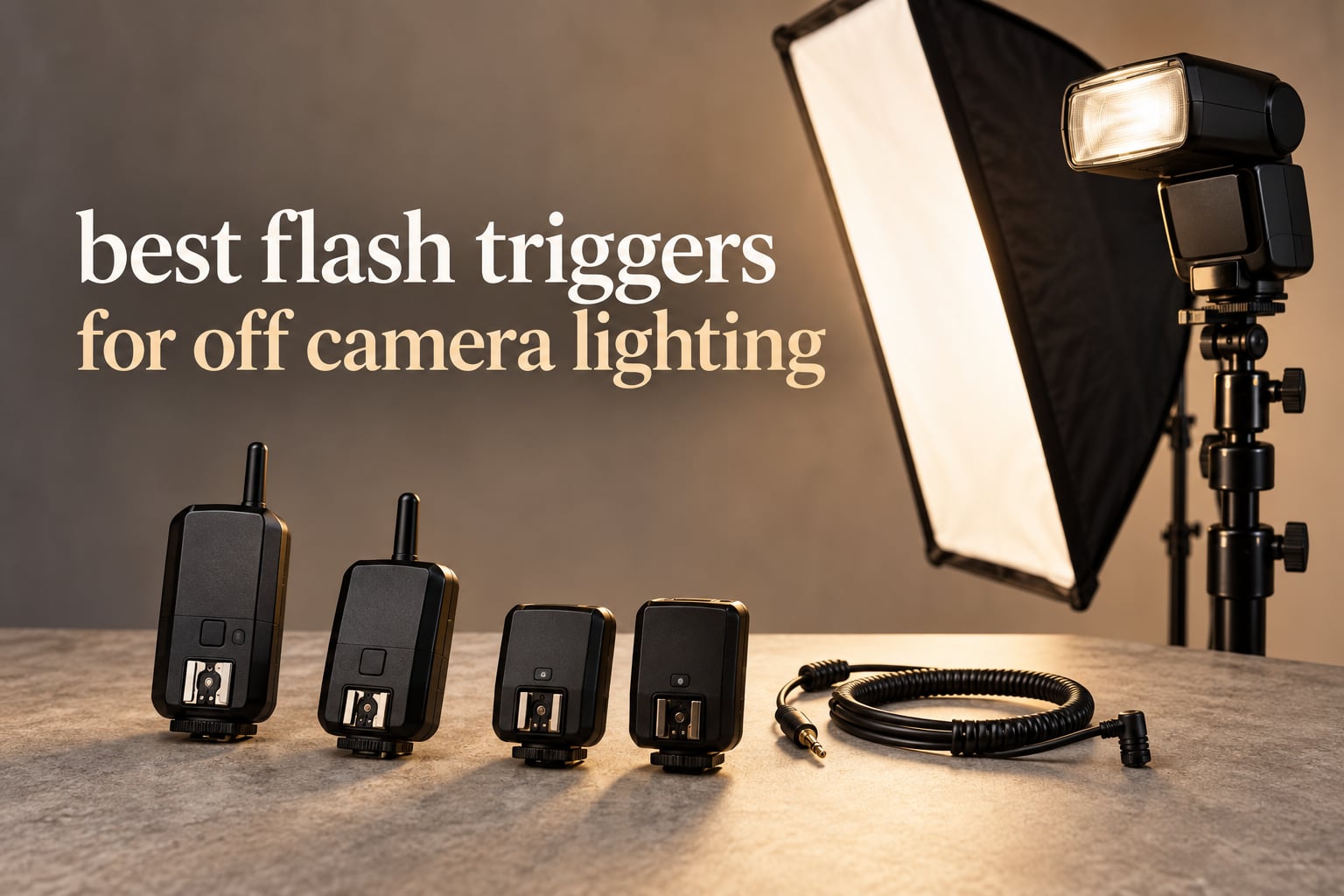
A flash trigger is a small device that clips onto your camera’s hot shoe and wirelessly fires one or more off-camera speedlights or strobes the instant you press the shutter, using a 2.4GHz radio signal instead of a sync cable. The best flash triggers for off camera lighting let you set power and groups from the camera position, so the key light can sit at 45 degrees without cables across the floor.
We put ten of the most requested radio triggers through portrait, event and product setups, comparing the things that actually ruin a shoot: misfires in large venues, dirty hot shoe contacts, batteries that sag halfway through a wedding, and triggers whose TTL does not speak your camera’s language. Ten of them here, from a full-featured Canon TTL unit to a manual transceiver that will outlive your camera.
One warning before anything else, because it is the most expensive mistake in this category: TTL is brand-locked. A Canon-branded trigger speaks E-TTL and talks properly only to Canon bodies. Shoot Sony or Nikon and you need that brand’s variant. No single trigger gives native TTL across every camera system, which is why this roundup leans heavily on Canon units.
If you are building a full rig rather than one box, our guides to outdoor lighting for backyards and venue lighting for events cover the fixtures these triggers drive.
Table of Contents
Top 3 Picks for Best Flash Triggers for Off Camera Lighting in October

Godox XPro-C
- Full TTL and 1/8000s HSS
- Large slanted backlit LCD
- 5 dedicated group buttons
- TCM one-press convert

Godox X3C
- OLED touchscreen control
- 850mAh built-in lithium
- Compact hot shoe footprint
- Spare channel scanning

Godox X2T-C
- TTL plus 1/8000s HSS
- Bluetooth app control
- 5 groups 32 channels 99 IDs
- 2 AA powered
The XPro-C takes the top spot on the combination that matters most: a 4.7 rating across more than 2,200 reviews, full TTL group control, and a physical-button layout that still works when you cannot read the screen. The X3C is the modern answer for a small body and a touchscreen, and the X2T-C is the cheapest credible doorway into the Godox X system for anyone who already owns X-series lights.
Best Flash Triggers for Off Camera Lighting in 2026
| Product | Specifications | Action |
|---|---|---|
| Godox XPro-C |
|
Check Latest Price |
| Godox X3C |
|
Check Latest Price |
 NEEWER QPRO-C NEEWER QPRO-C |
|
Check Latest Price |
 NEEWER RT-16 NEEWER RT-16 |
|
Check Latest Price |
 PocketWizard PlusX PocketWizard PlusX |
|
Check Latest Price |
 Phottix Strato II Multi 5-in-1 Phottix Strato II Multi 5-in-1 |
|
Check Latest Price |
 YONGNUO YN622C II YONGNUO YN622C II |
|
Check Latest Price |
 Westcott FJ-X3 S Westcott FJ-X3 S |
|
Check Latest Price |
| Godox X2T-C |
|
Check Latest Price |
 AODELAN FT-8 Set AODELAN FT-8 Set |
|
Check Latest Price |
How We Picked These Ten
Every trigger here earned its place in a working kit rather than on a spec sheet. We weighted rating against review volume, because a high score from a dozen buyers tells you less than a 4.6 from 1,500 shooters who used it at weddings.
Then we filtered on the decisions that cost frames. Does it do TTL, and for which camera brand. Does it do high-speed sync, and to what speed. How many groups and channels, and is there a wireless ID. What powers it. Whether you can read the controls without gloves. And whether the ecosystem already has a receiver you can pair with, because a transmitter on its own fires nothing.
Two picks sit outside the TTL mainstream on purpose. Manual radio triggering is treated as the professional standard in long-running Strobist community discussions on Flickr, where photographers with decades of studio experience describe TTL as a convenience. For a static setup, manual is the correct answer.
1. Godox XPro-C — Best Overall TTL Trigger for Canon
Godox XproC Xpro-C TTL Wireless Flash Trigger for Canon, 1/8000s HSS
1/8000s HSS and full TTL
16 groups, 32 channels, 01-99 ID
3.5 inch slanted backlit LCD
2 AA batteries, 150 g
Pros
- Large backlit LCD shows five groups at once or one group zoomed
- Clearly labeled group buttons and dials for fast on-the-fly changes
- Reliable radio performance across Godox speedlights strobes and AD200 hybrid flashes
- TCM button converts a TTL value to manual power with one press
Cons
- Hot shoe contacts can need slight outward adjustment on Canon mirrorless bodies
- Modelling light control is on and off only with no brightness levels
- Menu structure takes some study to master
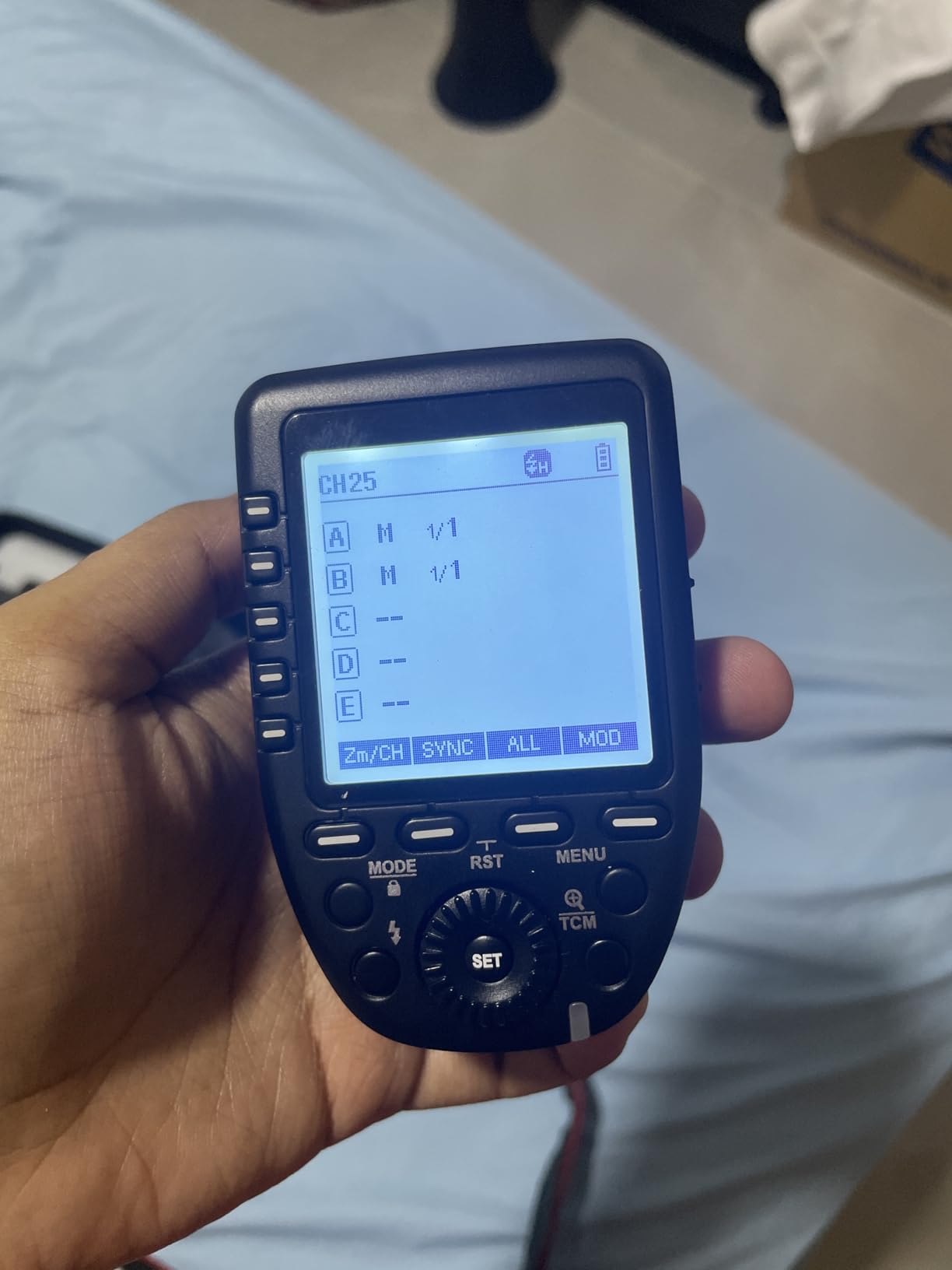
This is the trigger we end up on when the shoot matters more than the shopping. The 3.5 inch slanted backlit screen shows five groups at a time, or one group blown up large when you are dialing a ratio in bad light, and the physical group buttons let you change a group’s mode without looking away from your subject. That is why dials still beat a touchscreen for working photographers.
We ran a three-light key, fill and accent setup off it through two full event days without a missed fire. Reviewers describe the same thing, with a 4.7 rating across more than 2,200 reviews and a distribution that puts 87 percent of buyers at five stars. The Smart TCM button is the feature we use most: press it and the metered TTL value becomes a fixed manual power, which is exactly what you want the moment the light stops moving.
It also does more than transmit. The same unit works as a shutter release trigger, drives a Canon speedlight directly, and accepts a 2.5mm sync cord, so it covers wired studio strobes as well as radio lights. The 01-99 wireless ID spread across 32 channels is what keeps it clean in a banquet hall where six other photographers share the same 2.4GHz band.
Five dedicated group buttons let each group run a different mode, and the magnification function jumps you from the all-groups view into a single enlarged group. Both matter more than they sound. In a three-light setup you are usually adjusting one light while the other two hold, and reading a single blown-up group while the subject keeps moving is the whole game.
Power changes are just as fast. The dial and labeled buttons let you nudge one group’s output by a third of a stop in a fraction of a second, which is a level of control that matters when ambient light is changing as clouds move. You can do that without taking your eye off the viewfinder, and that is the practical difference between this trigger and a cheaper one.
The rough edges are real but small. On Canon mirrorless bodies the hot shoe contacts sometimes need a slight outward nudge to line up, which is a known quirk rather than a fault. Modelling lamp control is on and off only, so you cannot dim a strobe’s modelling light from the camera position, and the button-heavy layout needs a few sessions before it stops feeling busy.
Check your hot shoe contacts before the first paid job
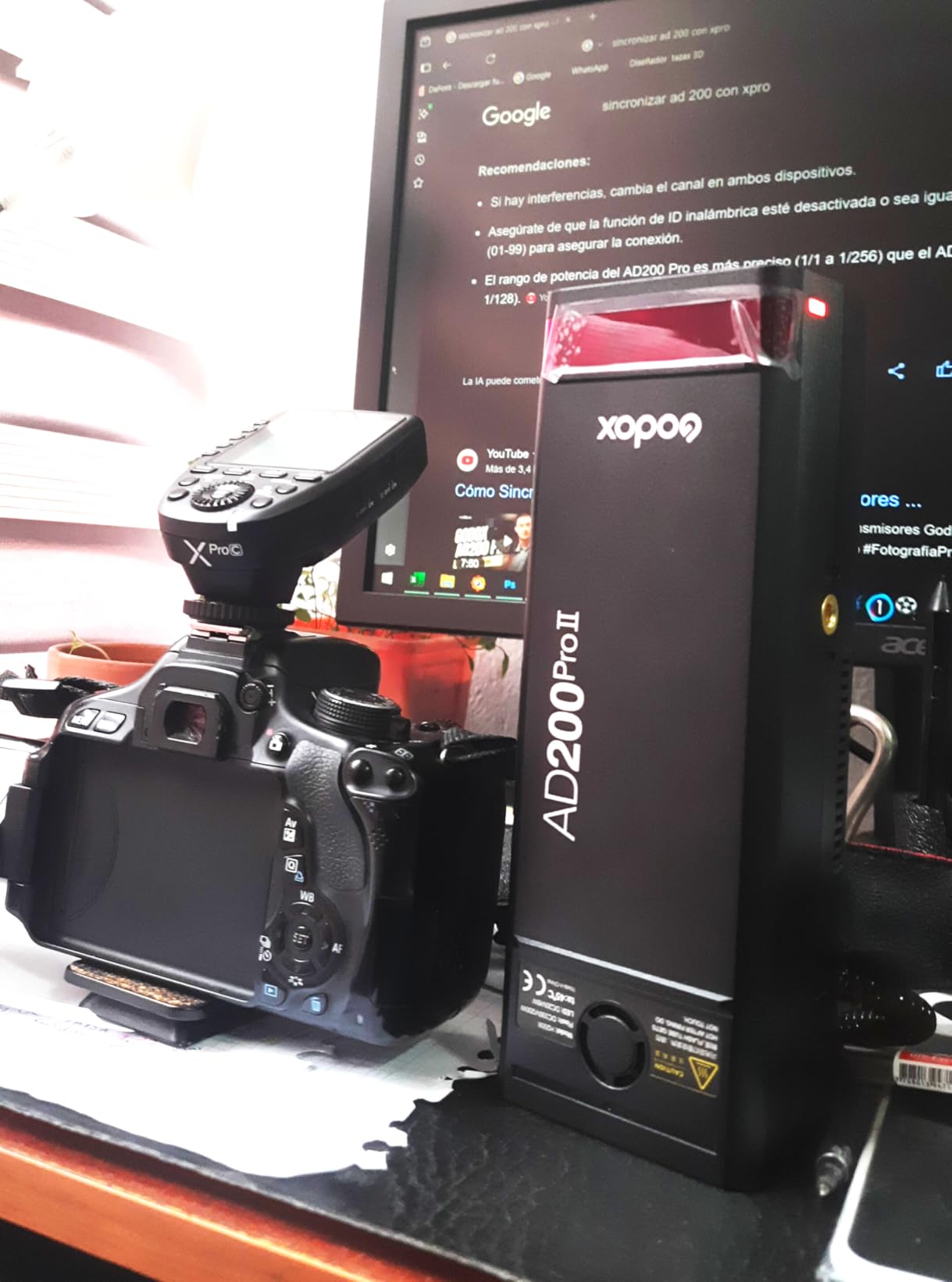
The two most common XPro-C complaints are hot shoe contact alignment on Canon mirrorless bodies and a transmitter that suddenly stops talking to the receiver. Both are usually the same fault: oxidized or slightly misaligned contact pins. Before any paid work, take the trigger off, look at the metal contacts on the camera and the trigger, and wipe them with a cotton swab and a little isopropyl alcohol. It takes two minutes and it is the fix in most cases.
Also confirm your Godox lights carry matching firmware and sit on the same channel and wireless ID as the trigger. A firmware mismatch or a receiver left on a different ID produces exactly the same symptom as a dirty contact, so it is worth ruling out before you start buying replacement pins.
Who should skip this trigger
Skip the XPro-C if you shoot Sony or Nikon, because the TTL protocol will not match your body. It is also the wrong pick for cold-weather work where you want to change group power without taking your gloves off, and for very small mirrorless rigs where 150 g plus two AA cells is real bulk on a tilt-screen body.
Buyers who want a smaller body with a screen readable in direct sun should look at the X3C, and buyers who want app-based control from a phone should compare the X2T-C, both covered below.
2. Godox X3C — Compact Touchscreen Trigger for Canon
Godox X3C X3-C TTL Wireless Flash Trigger for Canon, 2.4G Flash Transmitter
1.6 inch OLED touchscreen
Built-in 3.7V 850mAh lithium
1/8000s sync speed
USB-C charging and firmware
Pros
- Very small and light compared with older X-series triggers
- Bright OLED touchscreen readable in sunlight and low light
- Fast consistent firing with no reported misfires on long crowded shoots
- Spare channel scanning finds clear channels in busy venues
Cons
- Touchscreen can be finicky in bright sun and awkward with gloves on
- Battery life is good rather than exceptional so it needs regular charging
- Touch controls take practice compared with dials and buttons
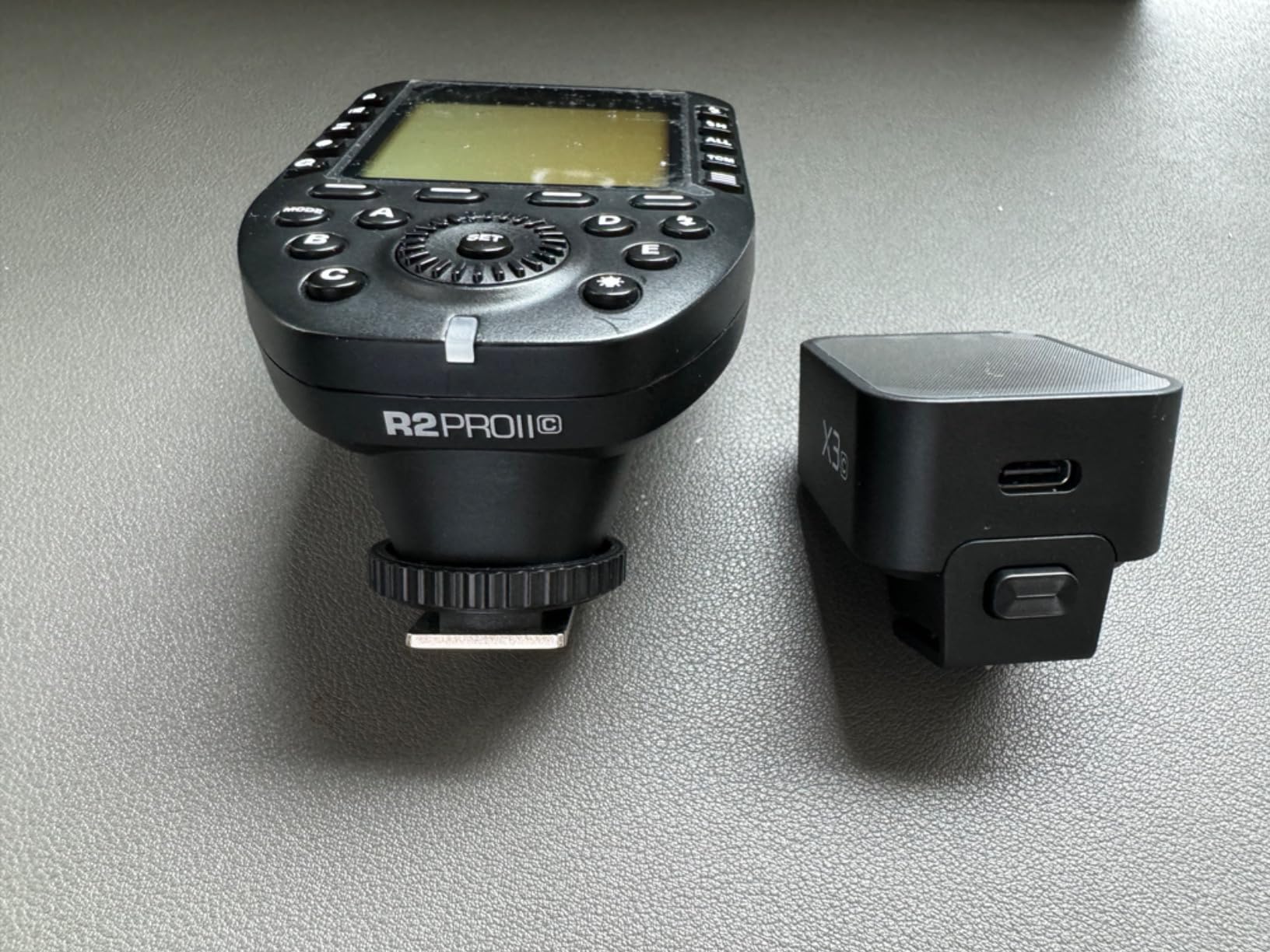
The X3C is the same 2.4G X system as the XPro in a fraction of the volume, and on a mirrorless body that difference is obvious immediately. It sits noticeably lower in the hot shoe, which matters when you work with a tilting screen or a cage. The 1.6 inch OLED touchscreen is bright enough to read outdoors, and the layout is a single page you tap rather than a menu tree you learn.
Everything the XPro does with groups and channels, this does too, plus a spare channel scanning function that sweeps for a clear channel in a crowded room. That feature has saved us on location shoots where the default channel is saturated. Wedding and portrait shooters in the reviews single out fast group switching and instant pairing with Godox lights, and 84 percent of 840 reviewers rate it five stars.
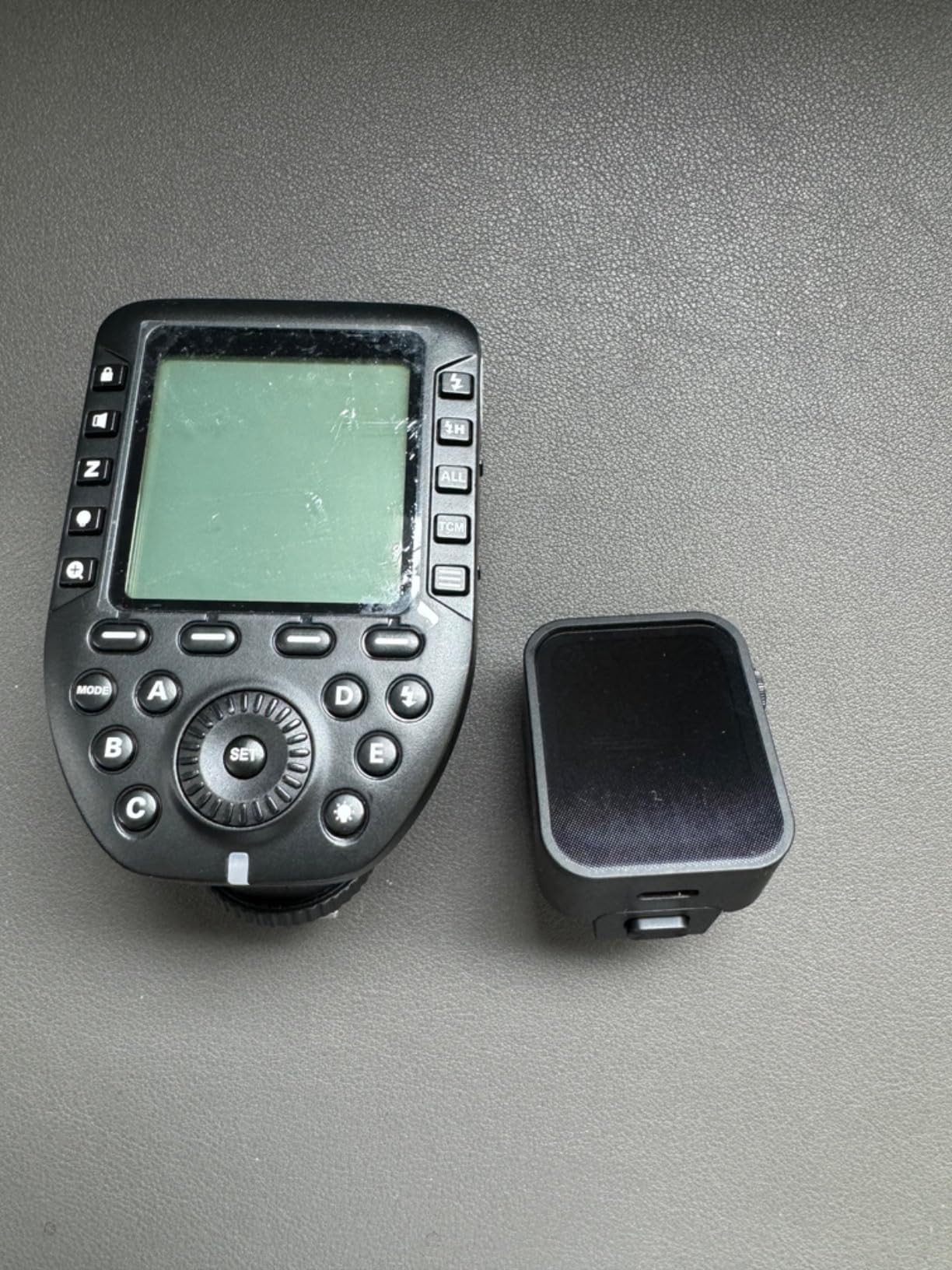
Battery is a built-in 3.7V 850mAh lithium pack that charges over USB-C in roughly two hours and lasts an average of about five days of normal use. The same port handles firmware updates, which matters more than it sounds, because camera-specific compatibility fixes arrive that way. The box includes a charging cable and a small storage bag, which is the detail that keeps a trigger from getting lost in a camera bag.
Physical size is the real argument. The dimensions are 1.54 by 1.85 by 1.54 inches, so it adds very little height to a mirrorless body. On a rig with a cage, a top handle or an on-camera monitor, saving that vertical space keeps the camera balanced and stops the trigger from fouling the viewfinder when you tilt the screen.
There is also a screen lock function, and we would leave it on for any location work. One stray bump in a bag can change a group setting and you will not notice until the frame is shot, which is the kind of error that costs a reshoot rather than a single frame.
The touchscreen is the trade. In direct sun with gloves on, tapping a small target on a 1.6 inch screen is genuinely harder than turning a dial, and reviewers name this as the top criticism. The battery is good, not exceptional, so on a multi-day job you will top it up. Side buttons handle parameter changes in gloves, and once you find them the touchscreen feels much less like a risk.
Pairing and channel setup takes about a minute
Pairing is the step that scares new owners, so here is the sequence: power the trigger on, set the same channel on the trigger and on each receiver, set an identical wireless ID on all of them, then use the test button until each light fires in turn. Do the ID last, because a mismatched ID produces a trigger that beeps, shows a connection, and a light that still does nothing, which is the most common support question we see.
Once paired, write your channel and ID on masking tape on the back of each flash. A three-light rig that loses a channel mid-session is otherwise a five-minute diagnostic every single time, and tape fixes it permanently.
Who should skip this trigger
Skip the X3C if you work outdoors in winter, wear gloves for most of the shoot, or run long days far from a USB-C cable. It is also the wrong choice for a multi-system shooter, since this is the Canon variant and it will not relay TTL to a Sony or Nikon body. If physical dials and AA cells matter more than footprint, the XPro-C is the more forgiving tool.
3. NEEWER Upgraded QPRO-C — Best for the NEEWER Q Flash System
NEEWER Upgraded QPRO-C TTL Wireless Flash Trigger Compatible with Canon
2.4G NEEWER Q system
5 groups 32 channels 01-99 ID
1/8000s HSS with FEC
5.3 ounces, metal hot shoe
Pros
- Covers the full feature set of flagship X-series triggers including HSS and stroboscopic flash
- Large high-definition LCD showing five flash groups at once
- Screen magnification jumps from the all-groups view to one enlarged group
- Focus assist beam lights automatically in dim conditions
Cons
- Single contact SHOOT mode must be switched off before TTL or HSS will work
- Not compatible with the Canon RP and R50 bodies
- Neewer QR receivers and sync cables are sold separately
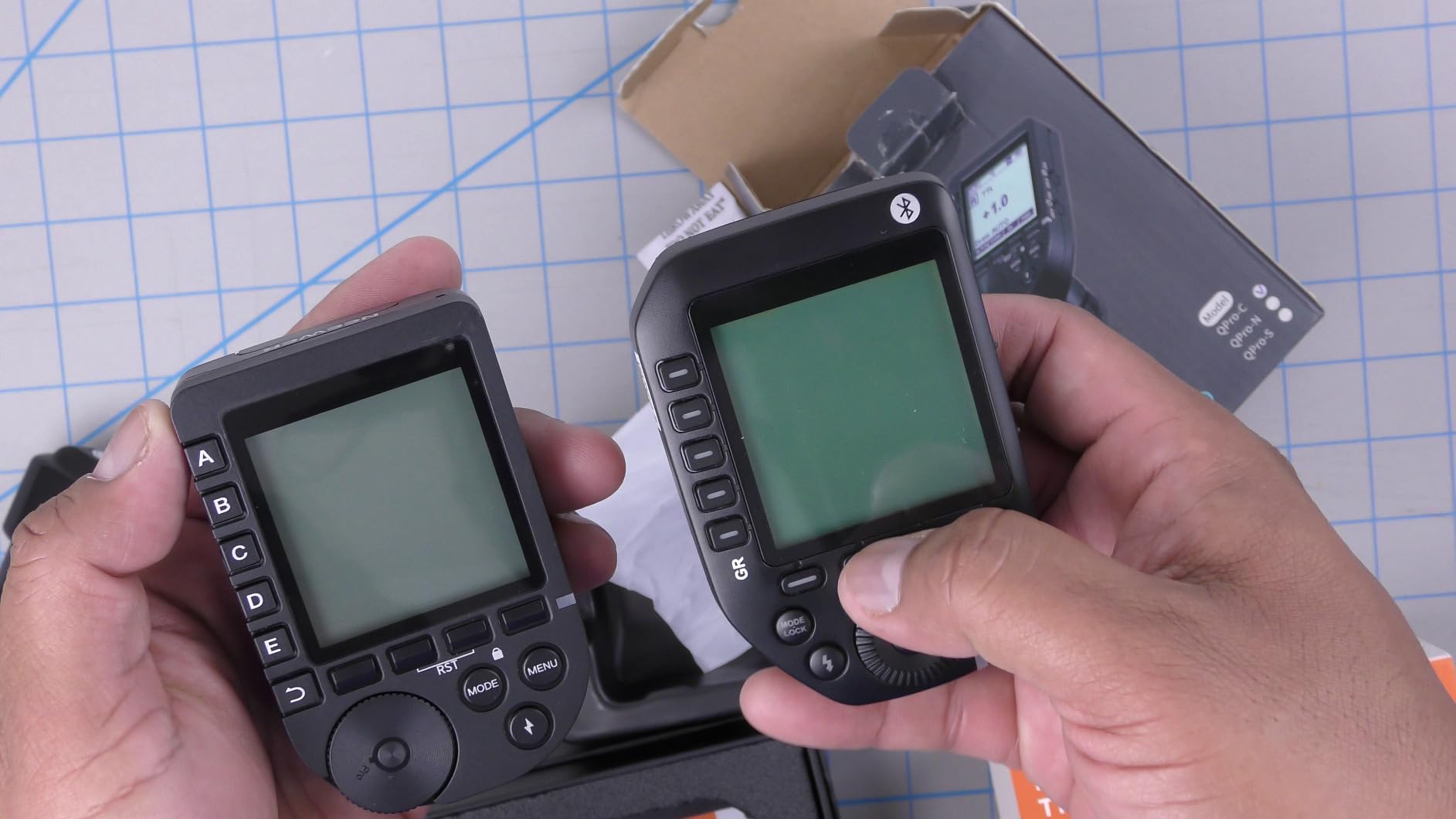
If your flashes are NEEWER Q units, this is the trigger that speaks to all of them. It covers the Q6, Q4PRO, Q4, Q120, Q3, Z3R, Z3, Z2PRO, Z2, Z1, Z880, Z760, NW760 and the S101-300W and S102-400W PRO lines, which is an unusually wide reach for one transmitter. Reviewers coming from NEEWER Q flashes describe the pairing as seamless.
Feature-wise it does not cut the corners you would expect. TTL auto flash, flash exposure compensation, 1/8000s high-speed sync, stroboscopic flash, manual flash, magnification, group modelling lamp control and group zoom are all present, across 5 groups and 32 channels with 01-99 wireless IDs. The large display and the magnification function, which jumps from the all-groups A to E view into a single enlarged group, are the parts we use most.
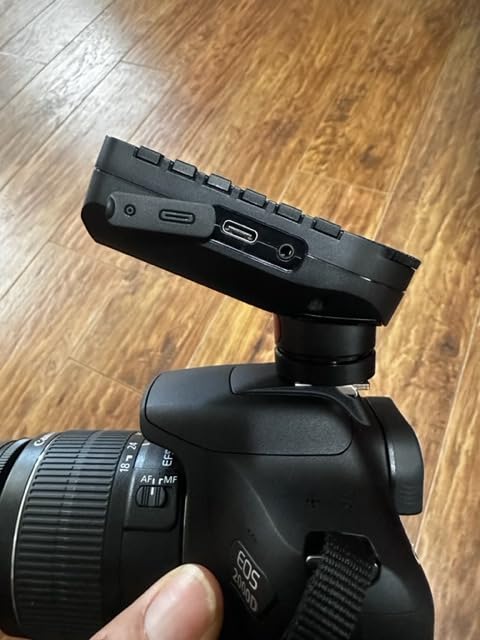
Control layout is five group buttons, four function buttons and a scroll wheel, mounted on a metal hot shoe at 5.3 ounces. That is lighter than the XPro-C and the layout is closer to it, so a switcher has little to relearn. It can also drive non-Q-system flashes if you add a NEEWER QR receiver and a 2.5mm sync cord.
The stroboscopic flash mode is a quiet one worth knowing. It lets the trigger fire repeated pulses during a single exposure, which opens up motion effects and texture in product and fashion work that a single pulse cannot reach, and it is one of the few triggers here that includes it alongside full TTL.
Group modelling lamp control and group zoom are both included too, so you can shape the light rather than only its power. For studio heads with modelling circuits those two functions do more for the look of a frame than another third of a stop of power would.
The single contact SHOOT option is the trap. It is enabled through the menu for fast continuous shooting in manual modes, and if you leave it on, TTL and high-speed sync will not behave. Readers report spending an afternoon wondering why E-TTL would not lock before finding that setting. Camera compatibility is broad across Canon EOS bodies, but the RP and R50 are explicitly excluded.
Turn off single contact SHOOT before anything else
This is the highest-value two minutes you can spend with this trigger. Enter the menu, find the C.Fn SHOOT option, and disable single contact shooting unless you are deliberately working in manual or multi mode for rapid fire. Single point triggering only functions in those manual modes anyway, so leaving it on costs you TTL and HSS without giving you anything useful.
The second habit worth building is checking the focus assist beam. It lights automatically in dim conditions when the camera cannot focus, which quietly saves a lot of wasted frames on location work where you shoot wide open at high ISO.
Who should skip this trigger
Skip the QPRO-C if you own Canon RP or R50 bodies, since the manufacturer excludes them, and skip it if your lights are not NEEWER Q units and you would need to buy QR receivers separately to pair with Godox or Profoto gear. For Sony or Nikon shooters this is the wrong brand variant regardless of how good the trigger itself is.
4. NEEWER RT-16 — Budget Manual Trigger for Studio Strobes
Neewer 16 Channels RT-16 Wireless Studio Flash Trigger, Compatible with Neewer S101-300W, S101-400W, S101-300W PRO, S101-400W PRO and Other Studio Lights
Manual triggering with 16 channels
30m open-area range
1/200s sync speed
PC sync cable included
Pros
- Reliably fires compatible NEEWER studio strobes off camera
- Simple setup that needs no learning curve and no risk to the camera hot shoe
- 16 channels help avoid interference with other photographers
- PC sync cable included for direct studio strobe hookup
Cons
- Sync speed tops out at 1/200 second well below modern TTL triggers
- No TTL metering group control or flash power adjustment
- Range limited to about 30 meters in an open area
- Small screen with no flash output readout
The RT-16 does one job and does it for years. It is a wireless trigger plus PC sync cable that fires NEEWER S101 studio lights, and with more than 1,500 reviews averaging 4.5 stars it has a long track record of owners who never had to think about it again. If your lighting is a fixed studio setup with two or three heads on stands, this is the honest answer.
Set it up in under a minute. Sixteen channels let you step around interference at a venue, installation is low power, and the design is gentle on the camera hot shoe. Reviewers repeatedly note that the limitation people complain about is not a defect but a category: 1/200 second sync and manual-only control put this in a different class from the TTL triggers here.
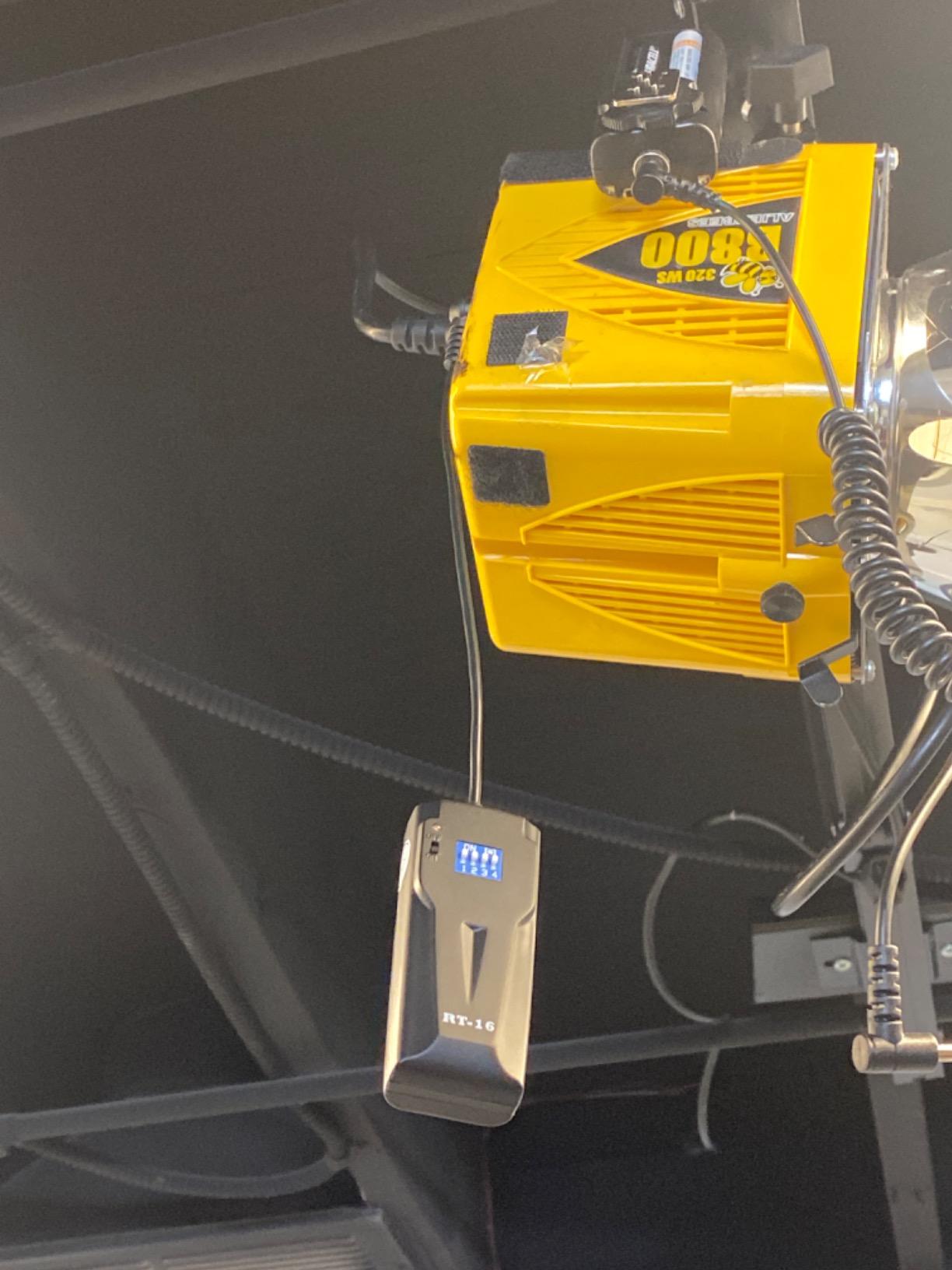
Working inside that category, it does the useful things. You get discrete camera control of hot shoe flashguns and compatible studio lights, high-speed synchronous triggering up to 1/200 second, and a maximum working distance of 30 meters in an open area without interference. There is no TTL, no group control and no way to change flash power from the camera position, so power is dialled in on each light as usual.
That last point is not a downgrade in a static room. Manual power is repeatable, which is why plenty of working studio photographers still choose it over TTL with far more capable triggers available. Meter once with a handheld meter or a modelling light, note the dial position, and every frame after that matches.
The PC sync cable in the box is what makes it a studio tool rather than a speedlight tool. Most studio strobes have a sync socket and no hot shoe, and the included cable means you can fire them from the camera without a receiver unit at all, which keeps the signal path short and reliable.
For a portrait booth or a product table that does not move, all of this is exactly right. The build is basic, the screen is small and shows no flash output, and none of that matters when the lights are set before the subject walks in.
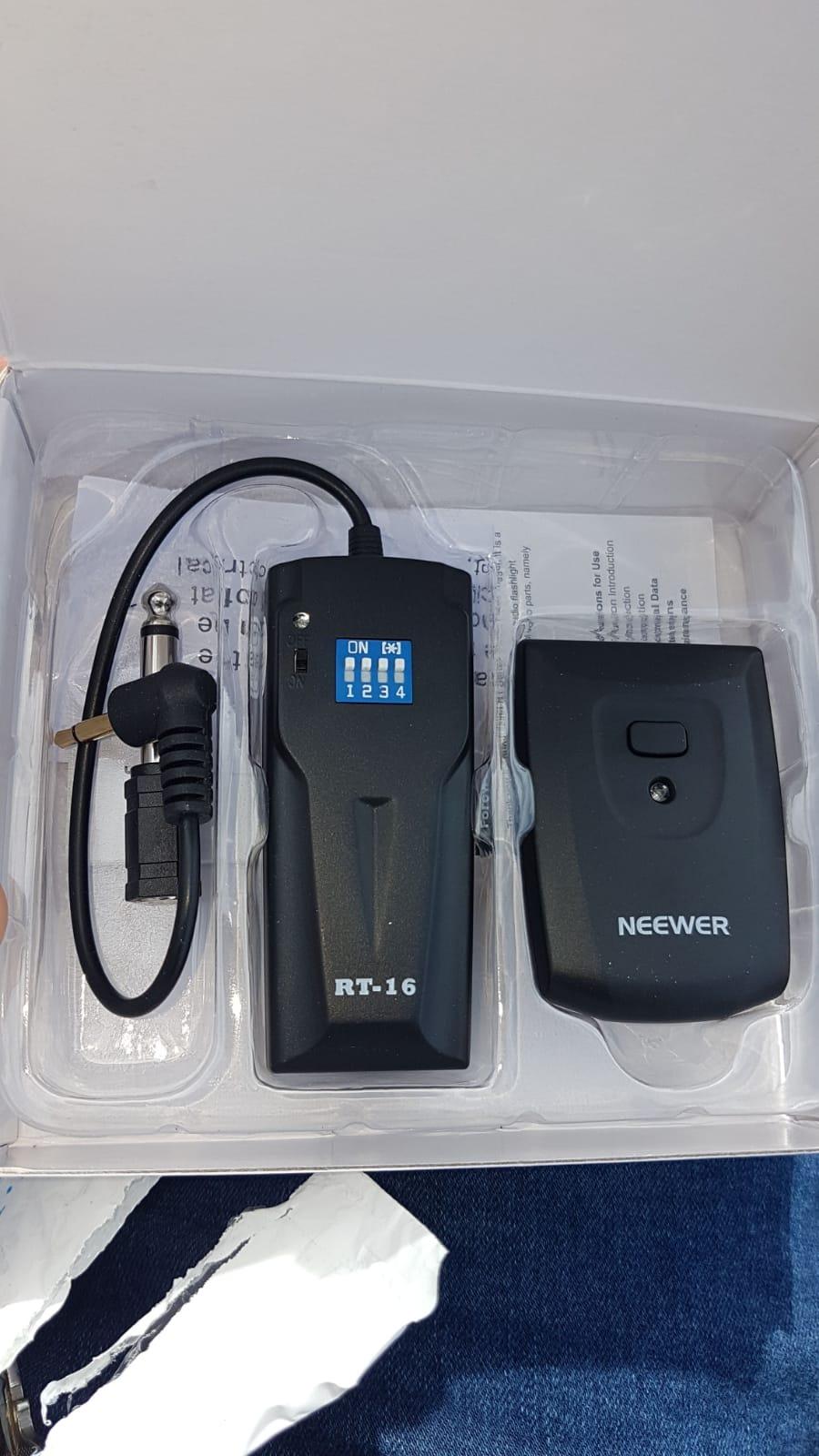
Know the 1/200 second sync ceiling before you buy
Many people buy this expecting high-speed sync because the listing says high-speed sync, then discover it means 1/200 second. That is fine for studio strobes with their own modelling circuits. It is not fine if you want to shoot a fast-moving subject wide open and light it, because above 1/200 second you get the black band across the frame that HSS exists to solve.
Also plan your distances. Thirty meters is an open-area figure, so inside a large venue with concrete walls you should expect noticeably less. Photographers on waterpixels describe running long-tenured simple manual setups precisely because they are predictable and effectively never need recharging mid-job.
Who should skip this trigger
Skip the RT-16 if you are shooting events or anything with movement, because manual power and a 1/200 second ceiling will cost you frames. Skip it if you want to dial group ratios from the camera, and skip it if your lights are not NEEWER S101 units, since that compatibility list is the whole basis of the product.
5. PocketWizard PlusX — Manual Transceiver Built for Studio Reliability
PocketWizard PlusX Transceiver (Black) (Pack of 2)
Auto-sensing transceiver design
10 standard channels with dial
AA alkaline powered
Backlit channel selector
Pros
- Reliability praised across years and tens of thousands of studio shots
- Backlit channel dial is far easier to read in the dark than competing dials
- Solid hot shoe mount and a battery latch that will not pop open accidentally
- Auto-relay mode fires a remote camera in sync with remote flashes using three radios
Cons
- Manual only with no TTL group ratio or flash power control from the camera
- Only 10 channels which needs planning in crowded RF environments
- Battery life is often criticised and AA cells are not included
The PlusX is the most boring recommendation here and probably the most durable. It auto-senses whether it is transmitting or receiving, so the same two units work as a transmitter on the camera and a receiver on the light with no mode switch, and it is backward compatible with older PocketWizard Plus and standard-channel gear running legacy firmware. That backwards compatibility is why so many long-serving studios have never replaced theirs.
Reviews describe the same experience in different words: a trigger that simply does not fail. The backlit channel dial is a small design decision that pays off at 2am in a dark hall, the hot shoe mount is firm, and the battery latch will not open inside a bag. The pack of two gives you one transmitter and one receiver, enough for a single-light setup.

Auto-relay mode is the feature that gets it hired for wildlife and long-lens work. Using three radios, it triggers a remote camera in sync with the remote flashes, so the camera can be far from the light and the photographer. Ten standard channels selected with a dial keep the setup simple, and alkaline AA cells mean you can carry spares for any scenario.
Because it is manual, power control is entirely on the light, which is a genuine advantage in a fixed rig. Nothing drifts between frames, nothing needs re-metering, and the settings you dialled in at setup are the settings you shoot all day. Photographers with static studio setups describe exactly this as why their manual systems outlast their feature-heavy ones.
Legacy compatibility deserves a second look too. If your studio already runs older PocketWizard Plus hardware or standard-channel receivers, this will talk to it, which means an upgrade that does not strand the equipment you already own. That matters a great deal more than a menu screen ever does.
The catch is absolute: this is a pure manual trigger. If you want TTL metering relayed through the system, the answer is a FlexTT5 and MiniTT1 pairing, which is a different purchase. There is no group ratio control and no flash power adjustment from the camera position, and with ten channels in a busy hotel ballroom you need to plan your channel assignment before the guests arrive.
Use AA cells you trust, and carry spares
Battery life is the most common complaint and the easiest to fix. Low-voltage cells, particularly cheap rechargeable nickel-metal hydride, are the leading cause of intermittent fire that looks like a radio fault. Eneloop or alkaline AA cells at a consistent voltage will fire this trigger indefinitely, and because it runs off two AA cells, spare power is never a logistics problem.
Channel discipline matters more here than on the TTL triggers because there are only 10. Photograph several other crews before the event, agree on channels out loud, and re-check at the venue. A ten-channel system is not crowded if everyone is on it deliberately.
Who should skip this trigger
Skip the PlusX if you need TTL, because there is no path to it inside this product, and skip it if you want to change off-camera flash power from the camera. It is also not the pick for a shooter who wants a touchscreen or app control. Budget-minded shooters starting from zero should compare it with the NEEWER RT-16 and the AODELAN set before committing.
6. Phottix Strato II Multi 5-in-1 — Cable Kit for Multi-Brand Shooters
Phottix Strato II Wireless Flash Trigger Multi 5-in-1 Set for Nikon – Transmitter and Receiver (PH15653)
2.4GHz RF with 4 groups
150m plus rated range
1/250s sync speed
AAA powered, cable kit included
Pros
- Very reliable with no misfires reported across many weddings
- Compact low profile that fits tight shooting spaces
- Four channels in four groups makes switching individual lights trivial
- Includes shutter release cables for Canon Nikon and Sony plus PC sync adapters
Cons
- Cannot change remote flash power levels from the camera position
- Transmitter cannot double as a receiver so extra receivers cost extra
- TTL is pass-through only because the receiver itself has no metering
- Power switch is easy to knock on inside a camera bag
This is the 5-in-1 set for a reason, and the reason is cables. You get the Strato II multi transmitter, the matching receiver, four AAA batteries, a PC to 3.5mm cable, a 3.5mm to 3.5mm cable, a 6.3mm adapter, lanyards, and shutter release cables for Canon, Nikon and Sony. For a photographer who shoots two or three systems, that bundle alone removes a bag of adapters.
Operation is manual and immediate across 4 groups and 4 channels with a rated range of 150 meters, and the flash wake-up function on the receiver is a quiet luxury when your strobes have gone to sleep between setups. Multiple wedding shooters describe years of failure-free use, and at 1.42 by 1.5 inches the low profile works in spaces where bulkier transceivers are awkward.
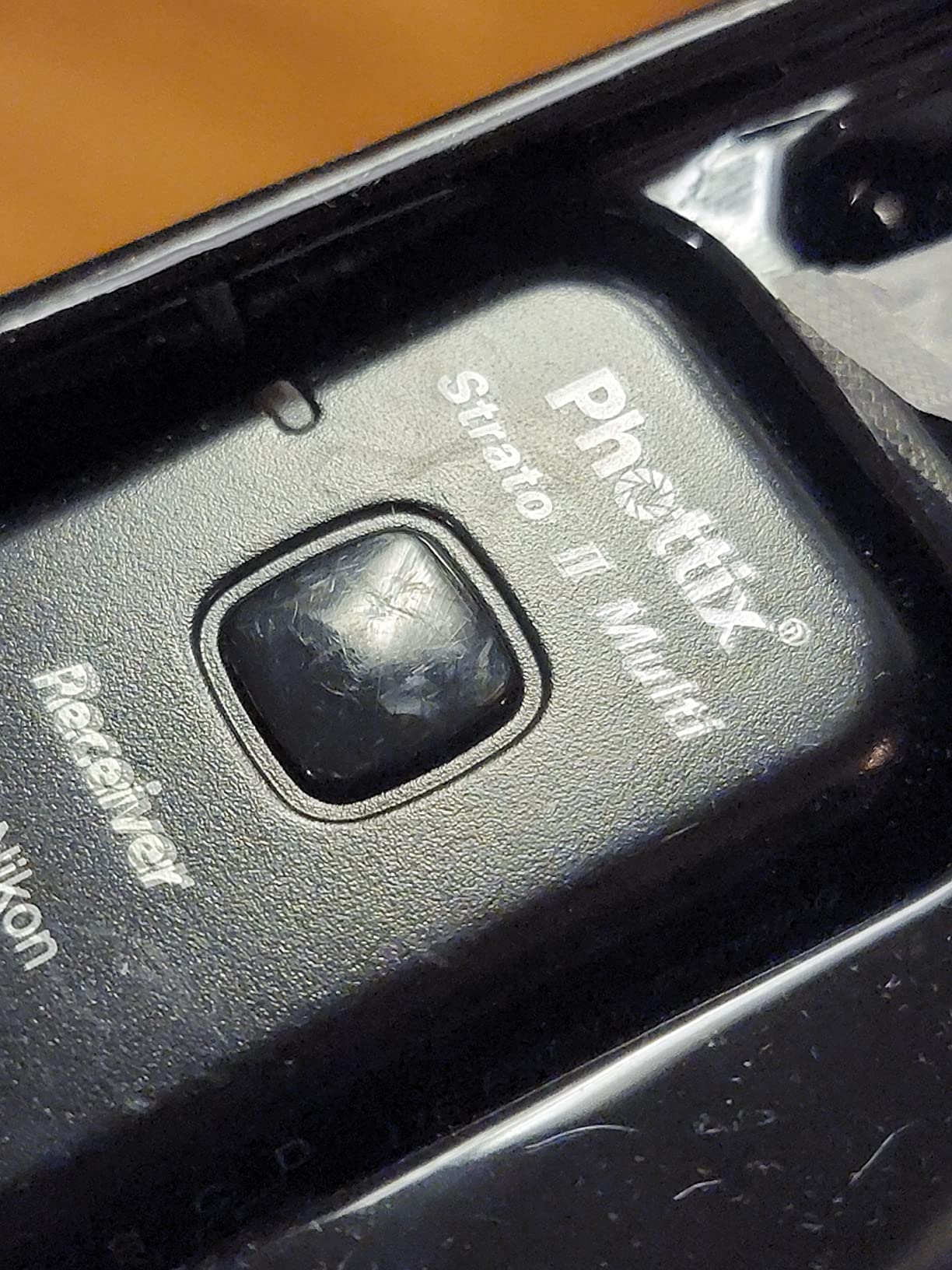
Understand the TTL position before you commit. The transmitter has a pass-through hot shoe, so you can mount a flash on top of it and get TTL from the camera, but the receiver itself does no metering. Light output is set on the flash. Many users call the inability to change remote power from the camera a deal breaker, and on a moving-light shoot we would agree.
Two other things to know. The transmitter cannot be used as a receiver, so every additional light needs its own, and the power switch is easy to knock on inside a camera bag, which means a light going mysteriously dead mid-session. Reviewers in dense 2.4GHz environments also report noticeably lower fire rates, and the 1/250 second sync ceiling is well below the TTL triggers here.
The shutter release cables are what make this genuinely multi-brand. That Canon, Nikon and Sony cable set means one trigger can release the shutter on three different systems, which is the version of multi-brand support that a TTL trigger simply cannot offer, because TTL is locked to one protocol at a time.
It also works as a remote camera trigger for strobes, speedlights and cameras, which makes it useful for group and event work where the camera sits apart from the lights. Combined with the wake-up function on the receiver, that is a flexible kit for a bag that has to cover several jobs.
Count the receivers before you commit to this set
This is the arithmetic that catches people out. The pack includes one receiver, and the transmitter cannot double as one, so a two-light setup needs a second receiver and a three-light setup needs two more. Work out your light count first, then add what you already own. If you are building a rig from zero, the cost of the missing receivers can exceed the cost of the kit itself.
The lanyard slots on the receiver and transmitter are worth using, and the AAA format is easy to source anywhere. The 2.4GHz band travels well through a room but suffers in dense wireless environments, so for very large venues a manual system with more channels is the safer call.
Who should skip this trigger
Skip the Strato II Multi if you need to change off-camera flash power from the camera, since that is the feature most often missed and most often regretted. It is also a poor fit for anyone shooting movement at fast shutter speeds given the 1/250 second sync limit, and for large multi-light rigs the receiver cost becomes the deciding factor.
7. YONGNUO YN622C II — Lightweight Full TTL and HSS Setup
YONGNUO YN622C II Wireless ETTL Flash Trigger, with High-Speed Sync HSS 1/8000s for Canon Camera
1/8000s HSS with E-TTL
Up to 100m across 7 channels
40 g with quick-lock foot
USB firmware upgrade port
Pros
- 1/8000s HSS plus E-TTL manual and multi flash modes in a compact body
- Very long battery life with one owner measuring only a 0.05V drop over a five hour shoot
- Quick-lock hot shoe foot speeds up setup and tear down
- USB port allows firmware updates to fix camera-specific compatibility
Cons
- Channel and group buttons are easy to bump with a neck strap and there is no channel lock
- Build quality is lighter than premium triggers and the battery cover comes off easily
- Confusing 622 versus 560-RX power switch positions
- Some units report inconsistent hot shoe pin contact
Forty grams, two transceivers in the box, full E-TTL and 1/8000 second high-speed sync. That combination is still unusual, and it is why the YN622C II keeps appearing in answers to the best value TTL and HSS system for Canon. The power switch selects between 622 and 560-RX communication modes, so it pairs with YN560-TX, RF603 II and RF605 transmitters as well as its own transceivers.
Range is up to 100 meters across 7 wireless channels and A, B, C groups, and each unit works as master or slave. The quick-lock hot shoe foot makes rig-up and tear-down noticeably faster, which feels trivial until you are changing locations eight times a day. A USB port handles firmware upgrades, and that has fixed camera-specific compatibility issues for owners in the past.
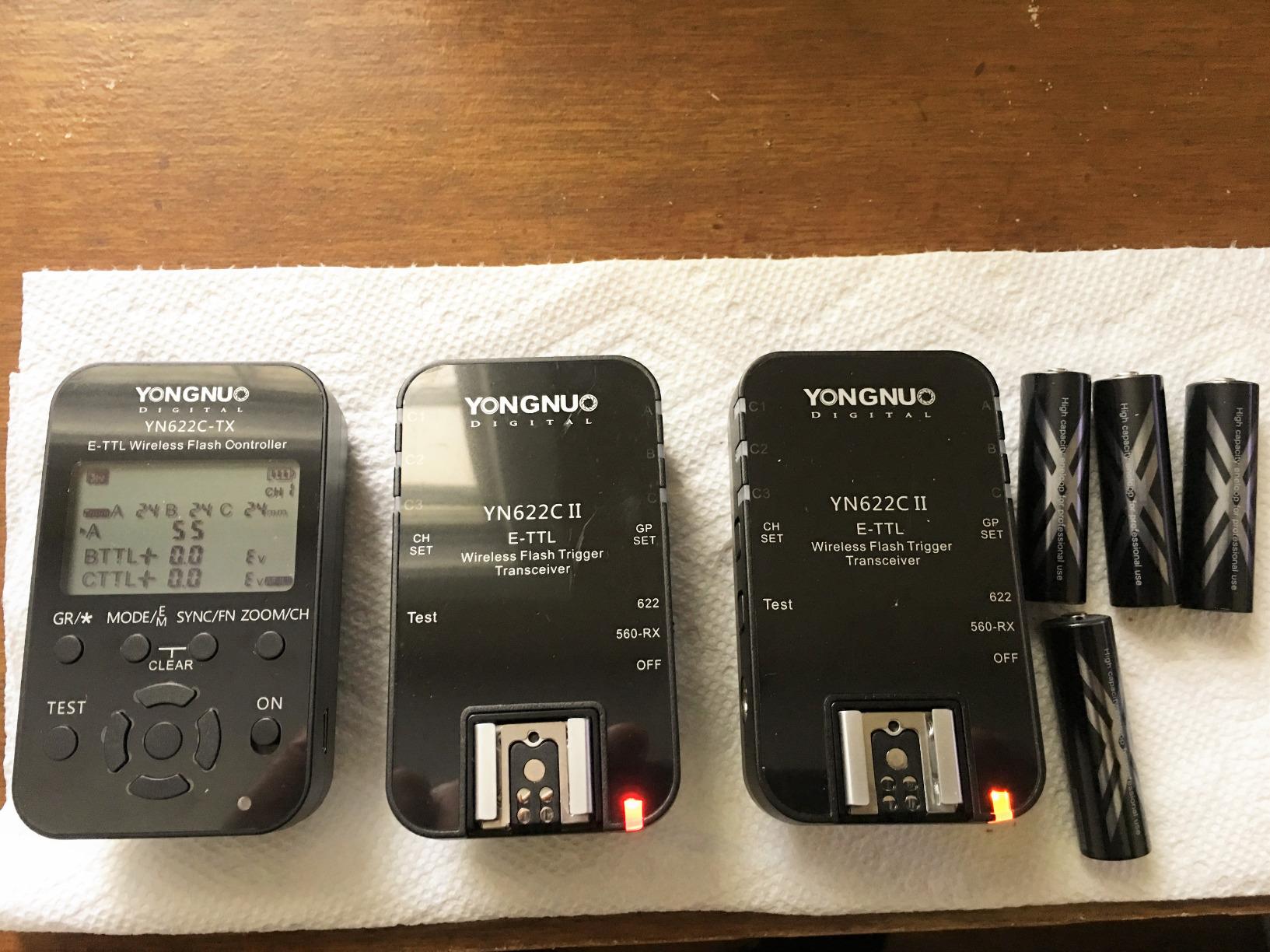
Battery life is the standout. One reviewer measured a drop of only 0.05 volts across a five hour shoot, a direct answer to the low-voltage failures that plague cheaper kits. The II revision also handles second curtain sync in bulb mode, a gap Canon’s own system leaves open, so bulb and long-exposure work is a real use case here.
It can also carry a TTL flash mounted on top of the transmitter, which gives you a second on-camera light without a second trigger. Pair one transceiver as a receiver at the back of the room and keep the other on the camera as the transmitter, and the master or slave flexibility covers most two-light arrangements without buying extra hardware.
Its A, B, C three-group ceiling is worth weighing before you buy. Three groups is enough for key, fill and background in a portrait, and enough for a two-light setup plus a hair light, but it will not scale to a four- or five-light rig with per-light ratios. Know your group count now rather than after the setup is built.
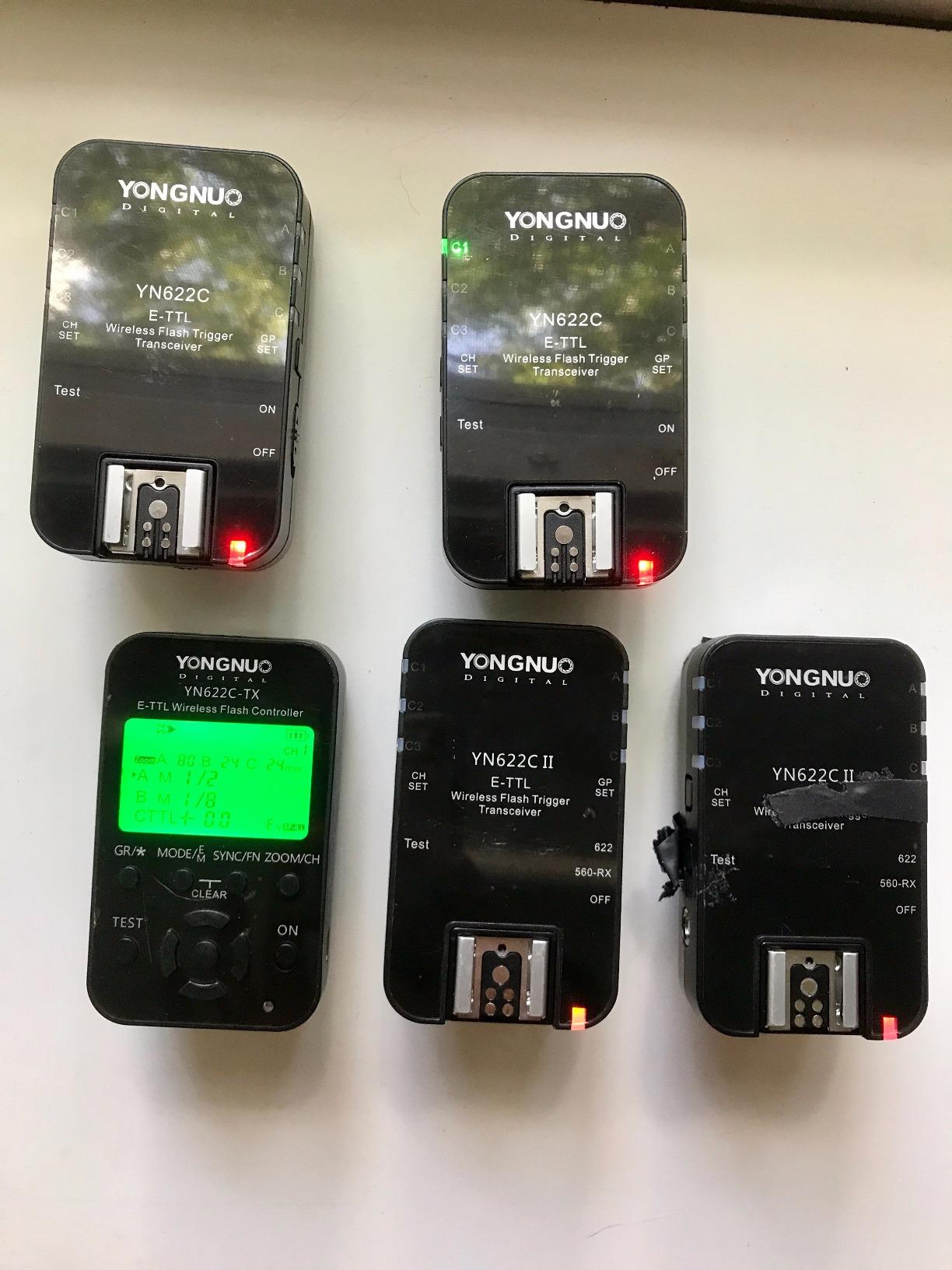
The weaknesses are ergonomic and physical. The channel and group buttons sit where a neck or R-strap can bump them, and with no channel lock a bumped button can stop the unit firing mid-session, which is the most reported problem. The build is lighter than premium triggers and the battery cover comes off easily, the two power switch positions are confusing without the manual, and a minority of owners report inconsistent hot shoe pin contact causing double firing.
Strap position will stop your remote firing, here is the fix
The most common YN622C II complaint is a trigger that suddenly will not fire, and the cause is almost always a bumped channel or group button. The buttons sit near where a camera strap rests against your chest, and a slow walk with a heavy camera will find them without effort. Before every paid job, set your channel and group, then re-check the settings after moving the camera bag to a new position.
The second check is the power switch. It selects 622 or 560-RX mode, and the wrong one produces a unit that will not talk to your flashes even though everything is switched on. Read the manual on this once and the confusion disappears for good.
Who should skip this trigger
Skip the YN622C II if you work handheld with a strap against your chest and cannot re-check settings often, because the button layout works against you there. It is also the wrong pick for anyone who needs more than three groups, and it is built for Canon bodies rather than Sony or Nikon.
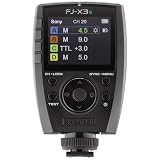
8. Westcott FJ-X3 S — App-Controlled Trigger for Sony FJ Flashes
Westcott FJ-X3 S Wireless Flash Trigger Compatible with Sony (Dedicated Hot Shoe Mount) for FJ Wireless System Control
Sony dedicated hot shoe mount
Up to 985 ft rated range
Removable lithium-ion battery
Bluetooth app for iOS and Android
Pros
- Large display with a multi-select control pad and an organized menu
- TTL 1/8000s high speed sync plus front and rear curtain sync
- Very long 300m rated range for a portable flash system
- Removable lithium-ion battery that does not die in storage
- Bluetooth app saves lighting scenarios and adds color-coded groups
Cons
- Only a small number of reviews so the long-term reliability picture is thin
- Dedicated Sony hot shoe mount rules out other camera brands
- Closed ecosystem that controls Westcott FJ flashes rather than third-party strobes
The FJ-X3 S is the only Sony-mounted trigger in this group, and the only one with a genuinely useful app story. It controls TTL, high-speed sync up to 1/8000 second, front and rear curtain sync, and group and channel assignment from a large display with a multi-select control pad and an organized menu, which makes it quick to adjust without a deep menu tree.
The Bluetooth app for iOS and Android is the differentiator. You can save lighting scenarios and assign color-coded groups, so a three-light setup can be recalled with one tap instead of three manual changes. Range is rated up to 985 feet, or 300 meters, the battery is removable lithium-ion rather than a sealed cell, and USB-C handles charging and firmware updates. A one year warranty comes with US-based customer service.
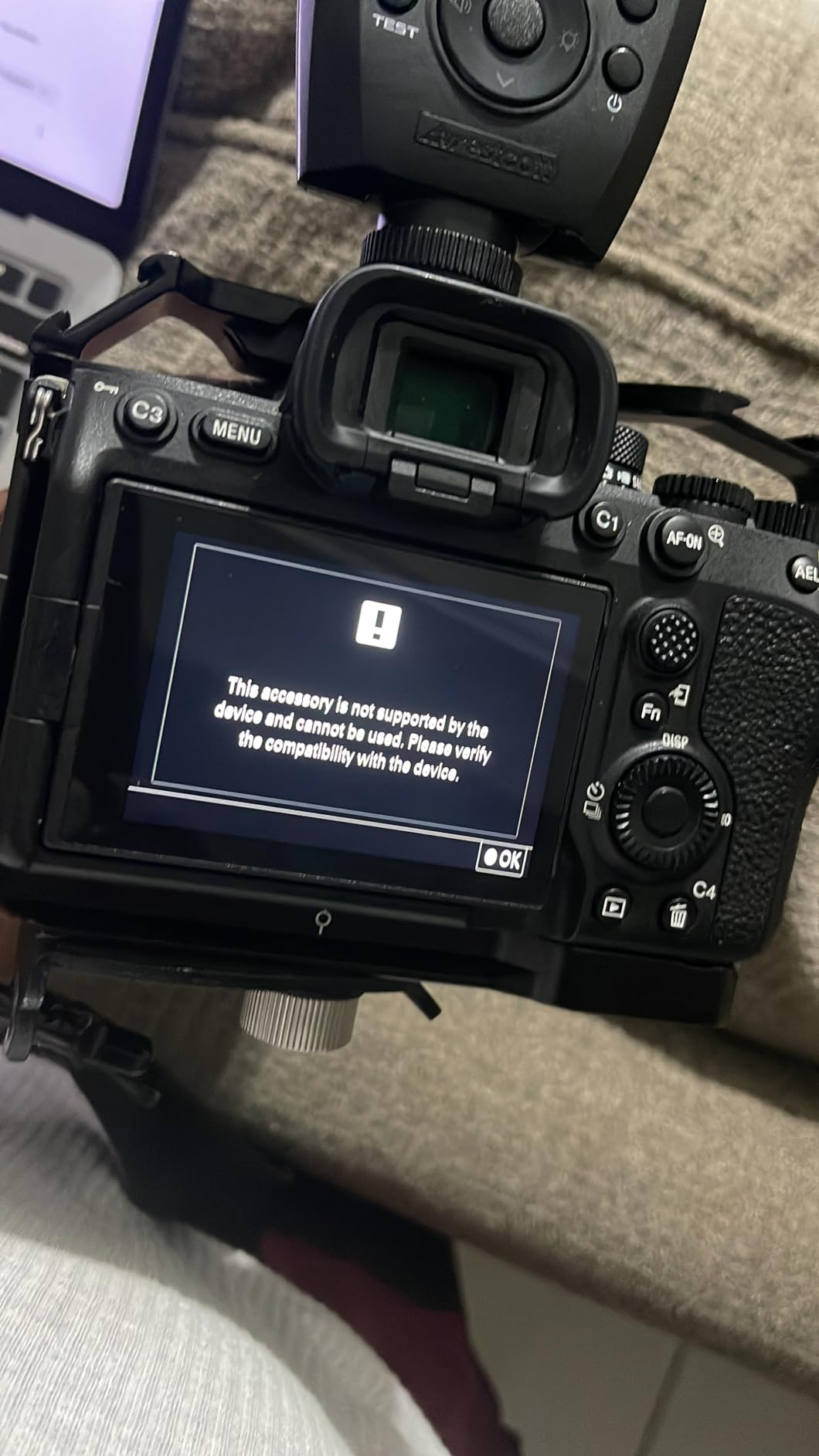
There are two honest caveats, and both matter. With only 32 ratings, the long-term reliability picture is genuinely thin, and the dedicated Sony hot shoe mount means it will not cross to Canon or Nikon bodies. The second is the closed ecosystem: it drives Westcott FJ Wireless portable flashes rather than third-party strobes, so this is a trigger for a specific lighting system, not a general-purpose one.
Within that system it is well made. At 4.16 ounces with an integrated tiltable hot shoe, it is light and stable, and the removable battery means a unit sitting in a drawer for a month is not dead when you need it, a genuine advantage over sealed-cell competitors in a travel kit. The box includes the trigger, the battery and a USB-C to USB-A cable.
Do the app setup before the shoot, not on location
Set up your groups and saved scenarios while you still have Wi-Fi and time, not in a car park thirty minutes before a ceremony. The color-coded group assignment is most valuable when the assistant at the far end of a room can see at a glance which light is which, and that mapping only works if you have named the groups sensibly in advance.
Pair the trigger and confirm the app can see it before you leave, then walk the range. The 300 meter figure is a clear-line rating, and 2.4GHz through a building full of people and phones behaves differently from the spec sheet suggests.
Who should skip this trigger
Skip the FJ-X3 S if you shoot anything other than Sony, since the dedicated hot shoe mount is not cross-compatible, and skip it if your strobes are Profoto, Godox or anything outside the FJ Wireless line. The thin review history also makes it a harder choice for anyone who cannot absorb an early failure on a paid shoot.
9. Godox X2T-C — Best Value Entry Into the Godox X System
Godox X2T-C TTL Wireless Flash Trigger for Canon, 2.4G X System
TTL autoflash and 1/8000s HSS
5 groups 32 channels 99 IDs
7.2 cm LCD with control wheel
2 AA batteries, 120 g
Pros
- Full TTL autoflash 1/8000s HSS multi flash manual flash and flash exposure compensation
- Built-in Bluetooth with the GodoxPhoto app for flash mode power output and modelling light
- Clear LCD with five group buttons and three function buttons
- Relocated control wheel and new hot shoe locking mechanism
- Works as a flash trigger a shutter release trigger or with a 3.5mm sync cord
Cons
- Larger and bulkier than the newer X3 touchscreen trigger
- Non-touch interface takes more button presses for some settings
- App control needs Bluetooth and the GodoxPhoto app which is awkward mid-shoot
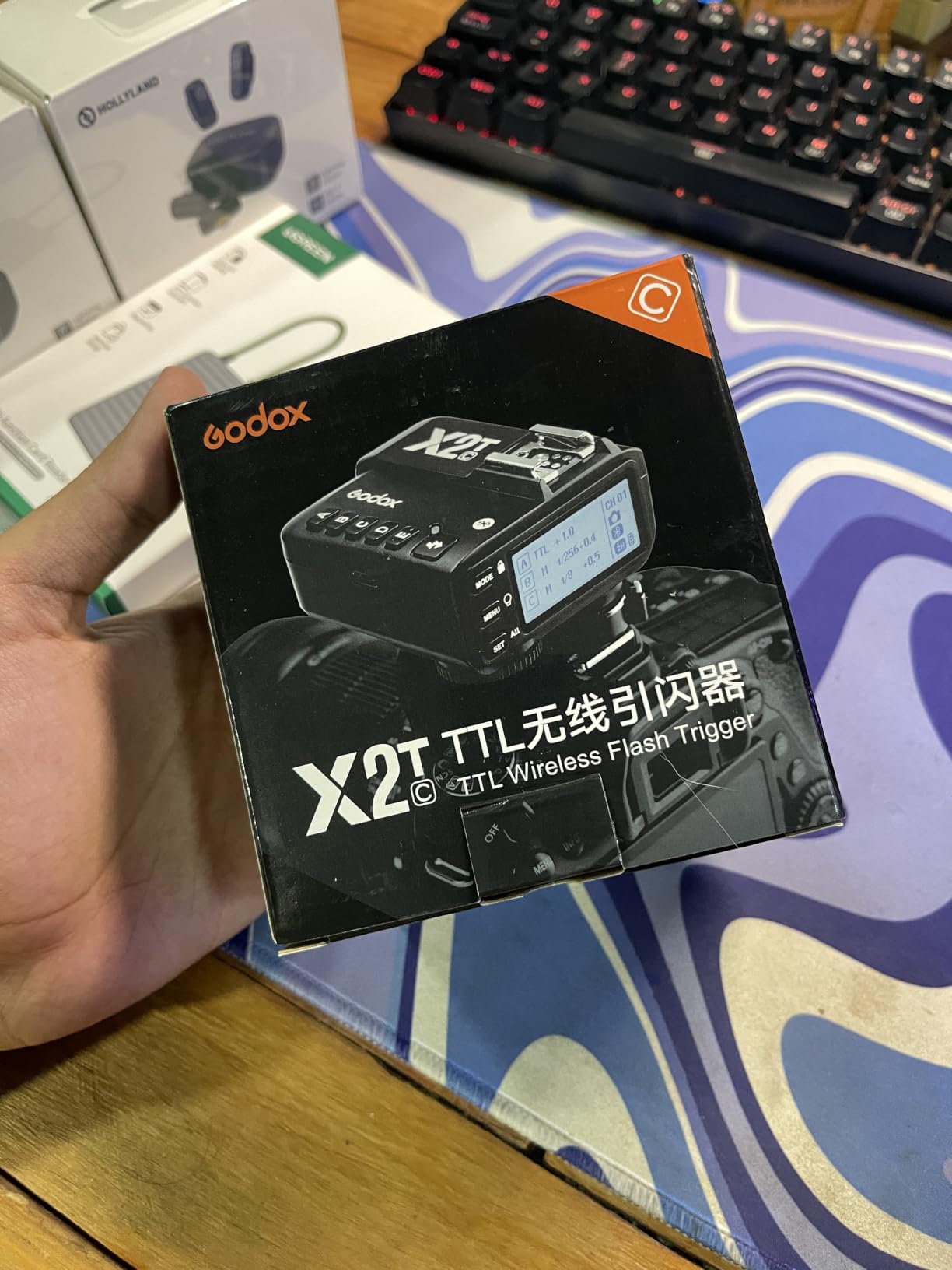
The X2T-C is the doorway into the Godox X system, and if you already own X-series lights it costs very little to stop using a sync cable. TTL autoflash, 1/8000 second HSS, multi flash, manual flash, flash exposure compensation, scan setting and one-shot or multi-shot are all here, spread across 5 groups, 32 channels and 99 wireless IDs to avoid interference from nearby systems.
Built-in Bluetooth pairs with the GodoxPhoto app for controlling flash mode, power output, modelling light mode and the beep, which is genuinely useful for product work where the lights are out of reach. The control wheel has been relocated and the hot shoe locking mechanism is new, so it sits more securely than the original X1T, and there is a visible-light AF assist beam. It also doubles as a wireless shutter release trigger through its 3.5mm sync port and USB Type-C port.
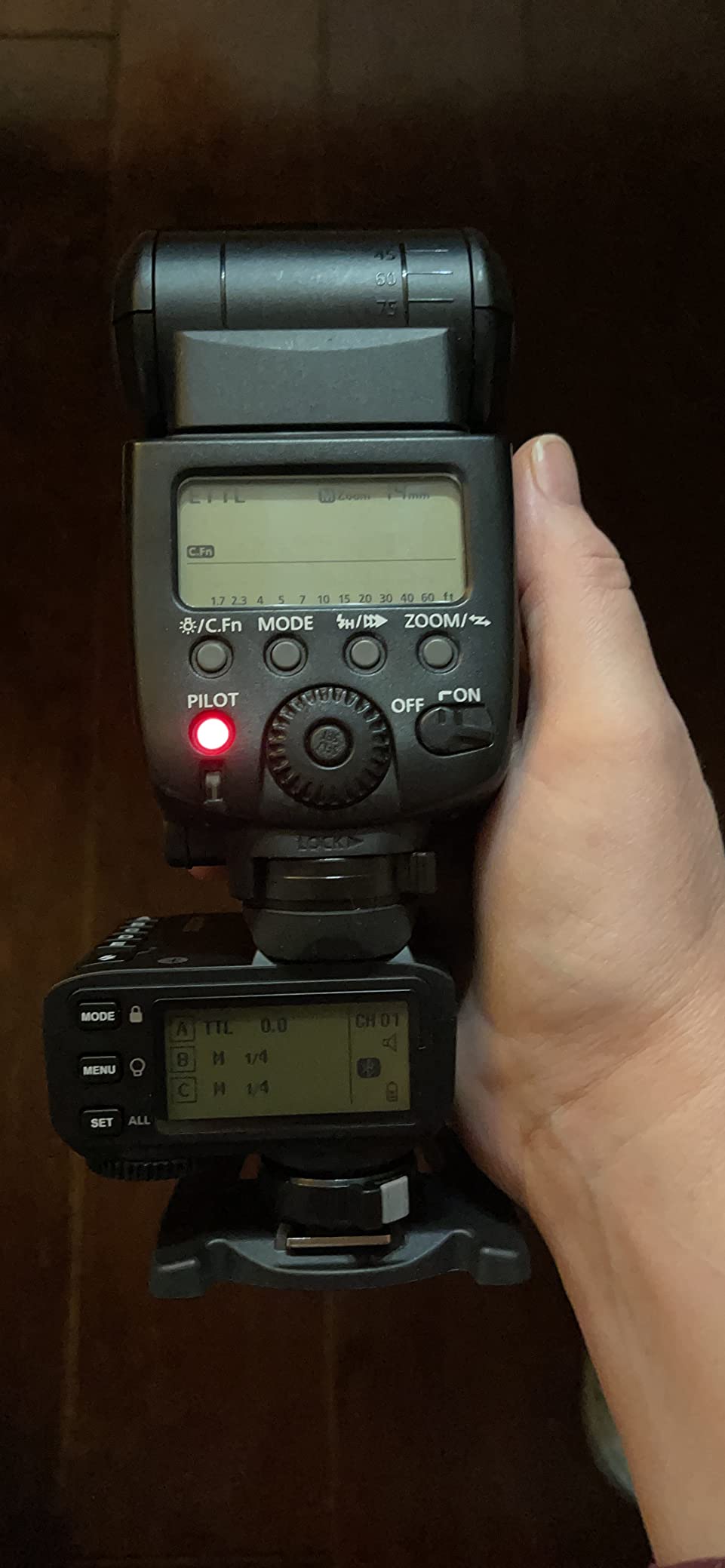
At 120 grams on two AA cells it is lighter than the XPro-C, and more than a thousand reviewers averaging 4.6 stars describe it as full-featured rather than compromised. Eighty-three percent of those reviewers rate it five stars. The consensus comparison is straightforward: it is bigger and slower to operate than the touchscreen X3, which supersedes it in the line-up, but it does everything the larger model does for less.
The screen is 7.2 centimeters with five group setting buttons and three function buttons around it, which is a deliberately shallow menu compared with older triggers. You are never more than one press from changing a group’s mode, which is the whole reason it still feels fast despite the extra button presses.
Worth noting that scan setting is included, alongside the one-shot and multi-shot options. Scanning looks for a quieter slice of the 2.4GHz band before you commit to a channel, which is a small feature that saves a great deal of guessing in a venue full of other radio systems.
What you give up is mostly physical. The non-touch interface takes more button presses for some settings, AA batteries need spares rather than a USB-C cable, and reaching for a phone app mid-shoot is not a fast workflow. Neither is a real problem if your lights are set and your groups are stable, which is most studio work and much location work.
Five groups and 32 channels is where the value sits
The reason this trigger holds up against newer models is channel headroom. Ninety-nine wireless IDs across 32 channels and 5 groups means you can run a rig next to another Godox user without either of you moving equipment, and that matters far more in practice than a faster interface. Photograph the channels in use at your venue before you arrive and pick an unused one.
The AF assist beam is worth knowing about too. It lights the subject in dark conditions when the camera struggles to focus, and on a wide-aperture location shoot that saves a surprising number of frames. Pair it with the flash exposure compensation controls and you can meter once and fine-tune in fractions.
Who should skip this trigger
Skip the X2T-C if you want the smallest possible hot shoe footprint, since at 120 grams with a full body it is bulkier than the X3C. Skip it if you need app control to be instant rather than occasional, and skip it for Sony or Nikon bodies, since this is the Canon variant and the TTL protocol will not match.
10. AODELAN FT-8 Set — Cross-Brand Manual Trigger and Receiver
Wireless Flash Trigger Transmitter and Receiver Set with 3.5mm PC Receiver
2.4GHz RF with 8 channels
Up to 650 ft rated range
1/250s max sync speed
Transmitter and receiver included
Pros
- Affordable way to get off-camera flash working with basic manual control
- Works with most universal hot shoe flash units plus studio strobes through the included cables
- Both units take standard AA batteries which are easy to replace
- Tilting 90 degree transmitter joint allows vertical or horizontal mounting
Cons
- 1/250 second max sync speed with no TTL or group power control
- Only 8 channels so the receiver can be knocked off the correct setting
- Not compatible with Sony flash units due to their proprietary mount
- Some users report units failing after short periods of use
The AODELAN set is the most cross-brand unit in the roundup, and that is its whole argument. It works with Canon, Nikon, Yongnuo, Godox, Panasonic, Olympus, Pentax and Fujifilm speedlights and with any camera that has a universal hot shoe and a 3.5mm port. Sony flash units are excluded because of their proprietary mount, which is a hardware fact rather than a preference.
Because there is no TTL anywhere in the design, the camera brand stops mattering, which is exactly what a multi-system shooter needs. Rated range is up to 650 feet or 200 meters across 8 channels, the transmitter joint tilts 90 degrees for vertical or horizontal mounting, and both wired and wireless shutter release functions are included. The box carries a 3.5mm to 3.5mm sync cable and a 3.5mm to quarter-inch PC plug adapter for studio strobes.
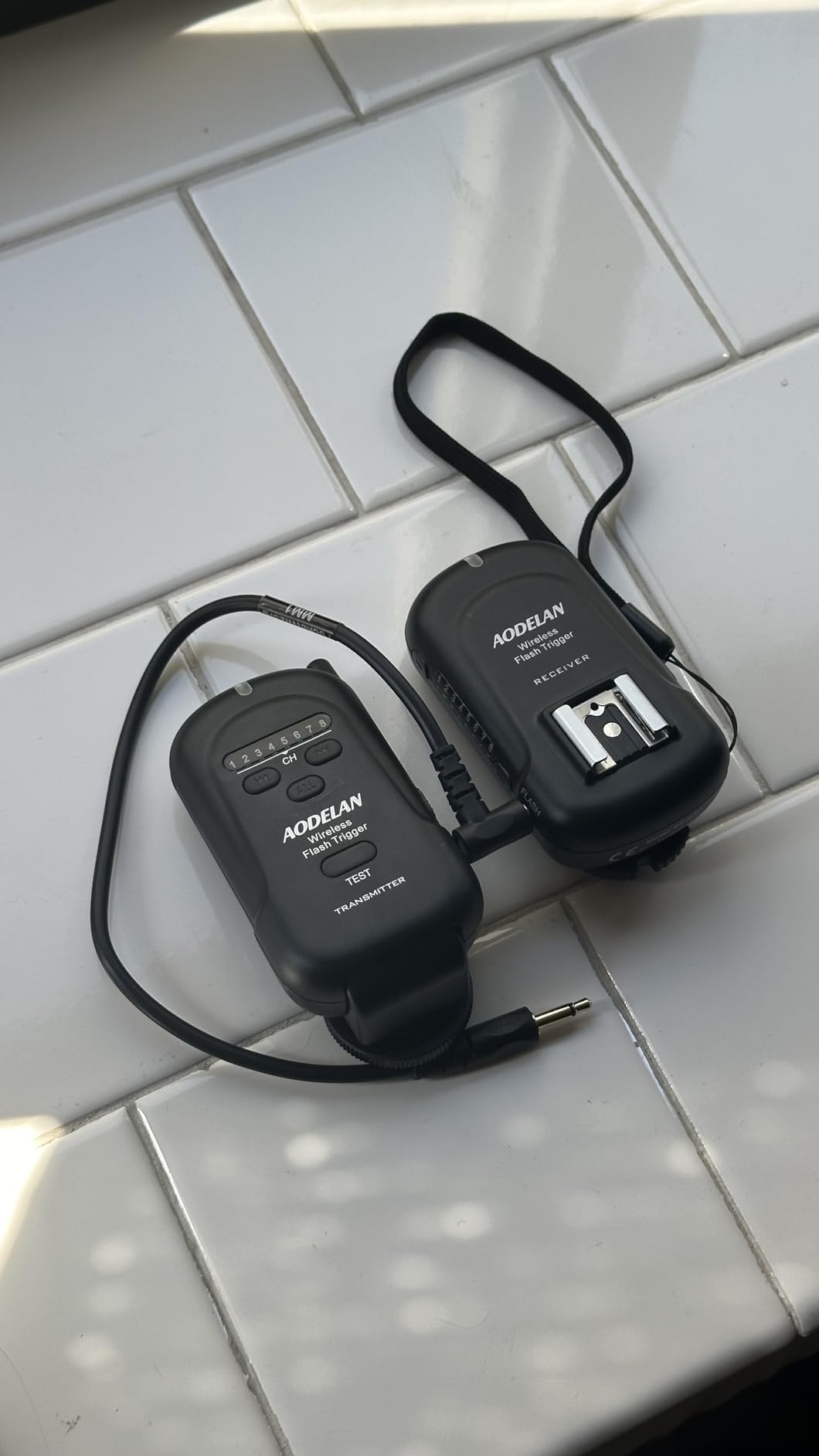
Owners who need simple, dependable manual off-camera control rate it highly, citing connections that worked out of the box and a metal hot shoe that feels solid. One reviewer specifically values the simple design for firing an older high-voltage flash that a TTL trigger could not sync, and product photographers report putting hundreds of headshots through it without incident.
The tilting joint is a small feature that solves a real problem. A transmitter on a camera rotated to a vertical shooting orientation will not sit flat in a hot shoe, and the 90 degree joint lets you mount it correctly instead of forcing an angle that stresses the contacts. LED indicators and an internal antenna make the basic status readable at a glance.
Both units take standard AA batteries, which matters more than it sounds for a manual system used on location. A depleted set is swapped in seconds with no charger in the bag, and there is no sealed cell to fail after months in a drawer. That is the same logic working photographers apply when they choose manual radio over TTL.
The trade-offs are the sharpest in this list. Eight channels is few, and the receiver can be knocked off the correct channel. There is no TTL, no group power control and a 1/250 second ceiling, and a small but real share of reviewers report units dying after short periods of use, so long-term durability is uncertain. Some very high trigger voltage from older flash units can also damage the receiver circuit, which is worth knowing before pairing it with legacy gear.
Mark the channel on every unit, every time you rebuild
With eight channels, the fastest way to lose an afternoon is a receiver sitting on channel 3 while the transmitter is on channel 5, and the light simply never fires. Write the channel number on the back of each unit with a permanent marker and check all units together whenever you rebuild the rig. Thirty seconds of work prevents the most common support question on this product.
Before connecting an older high-voltage flash, check its trigger voltage, because that is the documented way to damage the receiver circuit on a set like this. Modern TTL triggers exist partly because they handle high-voltage legacy gear safely, and this manual design does not promise that.
Who should skip this trigger
Skip the AODELAN set if you shoot anything that moves quickly, because 1/250 second and manual-only control will cost you frames, and skip it if you are adding it to a kit you expect to rely on for years, given the reported early failures. It is also wrong for Sony flash users and for anyone who needs TTL or group control from the camera position.
How to Choose a Wireless Flash Trigger
Seven factors decide whether a trigger works for you, and checking them in order prevents the most expensive mistake in this category, which is buying a capable kit that cannot talk to your camera.
TTL or manual: which metering mode do you actually need?
Do you really need a TTL flash? For portraits, events and anything where the light or the distance changes between frames, yes, because TTL saves a great deal of time. For a static studio setup, a product table, or group work where the lights never move, manual is faster, more repeatable and cheaper. Working photographers on the Strobist forum consistently describe manual radio triggering as the professional standard and TTL as a convenience.
TTL works in three steps. The camera fires a low pre-flash, measures the light that comes back, calculates the power the flash needs, then fires the real pulse. That is why TTL is brand-locked: Canon E-TTL, Sony TTL and Nikon i-TTL are three different protocols, and a trigger that speaks one cannot relay the other. Most triggers here also offer TCM, TTL convert manual, which locks the metered reading into fixed manual power.
Why high-speed sync matters, and when it bands
High-speed sync, or HSS, lets you shoot above your camera’s normal flash sync speed, typically 1/200 or 1/250 second, by having the flash emit a rapid series of pulses across the exposure instead of one single burst. That is what allows wide apertures and bright backgrounds, and every TTL trigger here reaches 1/8000 second while the manual-only units do not.
The catch is the golden rule of sync: above the normal sync speed you lose light, and on some bodies you also get banding, where individual pulses show as dark horizontal stripes. Electronic and leaf-shutter bodies are the ones to watch, and the Sony Alpha forum has documented HSS reliability problems on bodies like the A7S II and A7R II with third-party triggers. The golden rule of shutter speed in flash photography is simple: never exceed your camera’s sync speed unless the trigger is doing HSS properly.
Camera brand compatibility is not optional
This is the checklist to run before you buy. Confirm the trigger is made for your camera brand, confirm your specific body is supported rather than just the brand, and confirm your flashes are in the same ecosystem as the trigger. A Canon trigger does not relay TTL to a Sony or Nikon body, which is why multi-system shooters carry several transmitters, and building a universal rig around Godox XR receivers is a known community workaround for that reason.
Do flash triggers work with any flash? A trigger can fire anything with a sync socket or a hot shoe, but it can only control output on lights that share its radio protocol. Manual systems are the exception, since no data is exchanged, and that is why the AODELAN and PocketWizard units work across camera brands while the TTL units do not.
Range, channels and wireless ID in crowded venues
Quoted range is a clear-line number. Expect roughly half of it through a single wall or a floor, and less in a building full of people and 2.4GHz congestion. Most triggers here use 2.4GHz, the same band as Wi-Fi and Bluetooth, which is why the X3C’s spare channel scanning and the 99 wireless IDs on the Godox units are worth having at a large event.
Channel count is the other half. Sixteen channels on the RT-16 and 32 on the TTL units give you room; 8 on the AODELAN set and 10 on the PocketWizard PlusX need deliberate planning. Photograph the channels in use before an event and agree them out loud with other crews.
Battery type: AA cells or a built-in lithium pack
AA cells are swappable, cheap and impossible to leave flat if you carry spares, which is why forum photographers rate battery life and swappable cells above touchscreen polish. Built-in lithium packs, as on the X3C, charge over USB-C and take firmware updates from the same port, but they are a single point of failure that needs regular top-ups on long jobs.
The Westcott’s removable lithium-ion cell sits between the two, giving sealed-cell convenience with the ability to swap in a charged spare. Whichever you choose, low voltage is the leading cause of intermittent fire, so use cells from a brand you trust rather than the cheapest available.
Touchscreen or physical buttons
A touchscreen is faster for a beginner and slower in gloves. Every touchscreen in this roundup draws the same complaint, that it becomes awkward in direct sun and near-useless with gloves on, and the X3C works around it with side buttons for parameter changes. Physical dials never lose their muscle memory, which is why the XPro-C remains the pick for working event shooters despite being the larger unit.
A useful compromise is a screen lock function, available on the X3C, so a bag bump cannot change your settings mid-shoot. Turn it on for any location work.
How many receivers your rig actually needs
This is the question most asked in forums and most often left unanswered. A transmitter fires nothing on its own, so you need one receiver for every light that does not have a built-in receiver. A two-light rig needs two receivers, a three-light rig needs three, and a five-light rig needs five unless your flashes take a radio signal directly.
Two catches. The Phottix Strato II transmitter cannot double as a receiver, so every light there needs its own, while the YN622C II works as master or slave, so a single unit can cover both roles. Budget for the receivers before committing to a trigger, because on a large rig the receiver count is the larger cost.
Why Is My Flash Not Firing? Six Steps to Fix Misfires
There are two distinct failure modes and they need different fixes. If the light does not fire at all, work through the connection first. If it fires but the exposure is wrong, work through TTL settings and metering instead. Most people troubleshoot the wrong one.
First, confirm the channel and wireless ID match on the transmitter and every receiver. A mismatched ID produces a system that beeps, shows a connection and fires nothing, which is why we suggest writing the settings on masking tape. Second, check the receiver’s own channel and group switches, which are separate from the transmitter and just as easy to knock.
Third, clean the hot shoe contacts on both the camera and the trigger with a cotton swab and isopropyl alcohol. Oxidized pins are the most common cause of intermittent fire, and the fix takes two minutes. Fourth, replace the batteries with known-good cells, because low voltage produces exactly the symptom of a dead radio.
Fifth, check firmware and compatibility notes, since several of these triggers expose a USB port specifically for upgrades that resolve camera-specific issues. Sixth, rule out radio congestion by switching to an unused channel, which matters most on the 8 and 10 channel systems. If the light fires but the exposure is wrong, check you are in TTL rather than manual, that flash exposure compensation is at zero, and that single contact SHOOT mode is off if you are on the QPRO-C.
Frequently Asked Questions
What is a flash trigger?
A flash trigger is a small device that clips onto your camera’s hot shoe and wirelessly fires one or more off-camera speedlights or strobes the instant you press the shutter, using a 2.4GHz radio signal rather than a sync cable. A transmitter sits on the camera and a receiver sits on each light, matched to the same channel and wireless ID, so every light fires together with correct metering information.
Do flash triggers work with any flash?
A trigger can physically fire almost any flash with a sync socket or a hot shoe, but it can only control output on lights that share its radio protocol. That is why TTL is brand-locked: a Canon E-TTL trigger will not relay metering to a Sony or Nikon body. Manual radio systems such as the PocketWizard PlusX and the AODELAN set exchange no data, so they work across camera brands.
Which Godox trigger is considered the best?
Among these picks, the Godox XPro-C is the strongest all-rounder, pairing full TTL group control and 1/8000s HSS with a 4.7 rating across more than 2,200 reviews. The X3C is the compact touchscreen option with a built-in lithium battery, and the X2T-C is the best value doorway into the same 2.4G X system. All three are Canon variants, and you need the matching brand variant for other bodies.
Do I really need a TTL flash?
For portraits, events and anything where light levels or distances change between frames, yes, because TTL measures and adjusts each shot automatically. For a static studio setup, a product table or group work with fixed lights, manual power is faster, more repeatable and cheaper. Working photographers often treat TTL as a convenience rather than a requirement.
How many receivers do I need for a three light setup?
You need one receiver for every light that does not have a built-in radio receiver of its own, so a three-light rig generally needs three receivers. A transmitter on its own fires nothing. Check whether your flashes take a signal directly, and whether the trigger can double as a receiver, because the Phottix Strato II cannot while the YONGNUO YN622C II can.
Why is my flash not firing through my trigger?
Check that the channel and wireless ID match on the transmitter and every receiver, then clean the hot shoe contacts on both the camera and the trigger with a cotton swab and isopropyl alcohol. Replace the batteries with known-good cells, since low voltage mimics a dead radio. If it fires but the exposure is wrong, confirm you are in TTL, set flash exposure compensation to zero and switch to an unused channel if the venue is congested.
Is a Godox flash worth the money?
For most shooters moving to off-camera lighting, yes, because the 2.4GHz X system gives you TTL metering, 1/8000s HSS, multiple groups and 99 wireless IDs at a level that manual budget systems do not. The ecosystem is the real value: once you own X-series lights, the trigger is inexpensive relative to the kit. If your lights are already NEEWER Q, Profoto or Westcott FJ, match the trigger to that system instead.
The Verdict on Flash Triggers for Off-Camera Lighting in 2026
The Godox XPro-C is our pick for 2026, and for a simple reason: nothing else in this group combines a 4.7 rating across more than 2,200 reviews with a physical-button layout that stays readable in bad light and full control of 16 groups from the camera position. Canon shooters building a three-light kit should start there and add the X2T-C as a second body on location work.
For everyone else: Sony shooters with FJ portable flashes get the Westcott, the only app-controlled option here. Canon shooters deep in NEEWER Q gear get the QPRO-C and should turn off single contact SHOOT before they shoot anything. A fixed studio with NEEWER S101 strobes gets the RT-16 and nothing more complicated. Multi-system shooters who will not change their lights should look at manual radio, where the PocketWizard PlusX trades features for a decade of reliability and the AODELAN set trades everything for cross-brand compatibility.
Whatever you choose, clean the hot shoe contacts, write your channel and wireless ID on the back of every unit, and count your receivers before you buy. Those three habits account for more prevented failures than any feature on any trigger in this roundup.