
A computerized telescope is one with an electronic pointing system that finds and tracks celestial objects for you. There are three architectures: a motorized GoTo mount driven by a hand controller and a built-in star database, a PushTo system where a phone app gives you on-screen arrows to follow, and an all-in-one smart telescope that aligns, tracks and stacks images on its own. Beginner-grade computerized scopes span a wide range of budgets, from pocket-sized smart telescopes to multi-hundred-pound fork-arm mounts, and the choice of architecture matters more than the brand badge.
Finding objects is the single biggest barrier between buying a telescope and actually using it. A computerized pointing system removes hours of frustrated star hopping, and it makes a scope usable from a light-polluted backyard where too few stars are visible to navigate by. That is the honest case for spending the premium. The sceptics in the r/telescopes and CloudyNights threads argue that a beginner should learn the sky first, and on that point they are not entirely wrong.
We spent weeks with seven scopes covering all three architectures, from a 1.85-pound pocket smart telescope to an 8-inch Schmidt-Cassegrain on a single fork arm. This guide covers the best computerized telescopes for beginners, what each pointing system actually costs you in setup time, and what you can realistically see on your first night. If you are still deciding on aperture first, our beginner telescope guide covers the optics side.
Table of Contents
Top 3 Best Computerized Telescopes for Beginners in October

Celestron NexStar 8SE
- 8 inch Schmidt-Cassegrain aperture
- 2032mm focal length
- 40k+ object SkyAlign GoTo mount
- 2 year warranty

Celestron NexStar 127SLT
- 127mm Maksutov-Cassegrain aperture
- 1500mm focal length
- Compact 27 inch tube at 18.1 pounds
- SkyAlign GoTo with Starry Night software
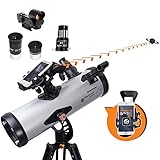
StarSense Explorer LT 114AZ
- 114mm Newtonian reflector
- 1000mm focal length
- PushTo smartphone navigation with no alignment
- Preassembled mount and tripod
The 7 Computerized Telescopes Compared Side by Side in 2026
Read the guidance type column first. Three of these are traditional eyepiece scopes with GoTo motors, one is a PushTo system that needs no alignment routine, and three are screen-only smart telescopes that produce images rather than an eyepiece view.
| Product | Specifications | Action |
|---|---|---|
| Celestron NexStar 8SE |
|
Check Latest Price |
| Celestron NexStar 127SLT |
|
Check Latest Price |
| StarSense Explorer LT 114AZ |
|
Check Latest Price |
 Sky-Watcher Virtuoso GTi 150P Sky-Watcher Virtuoso GTi 150P |
|
Check Latest Price |
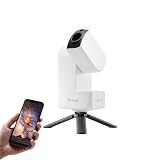 ZWO Seestar S30 Pro ZWO Seestar S30 Pro |
|
Check Latest Price |
 DWARFLAB Dwarf Mini DWARFLAB Dwarf Mini |
|
Check Latest Price |
 DWARFLAB Dwarf 3 DWARFLAB Dwarf 3 |
|
Check Latest Price |
1. Celestron NexStar 8SE Computerized Telescope – Best Overall GoTo
Celestron NexStar 8SE Computerized Telescope – Schmidt-Cassegrain
8 inch aperture
2032mm focal length
40k+ object database
Single fork arm GoTo
Pros
- Huge 8 inch aperture in a 43.2cm tube
- Fast SkyAlign routine using any three bright objects
- Automatic tracking holds targets steady
- 2 year warranty and US-based support
Cons
- Power supply not included so you need 8 AA batteries or an external tank
- Fork arm mount is stiff to move by hand
- Heavy for casual car transport
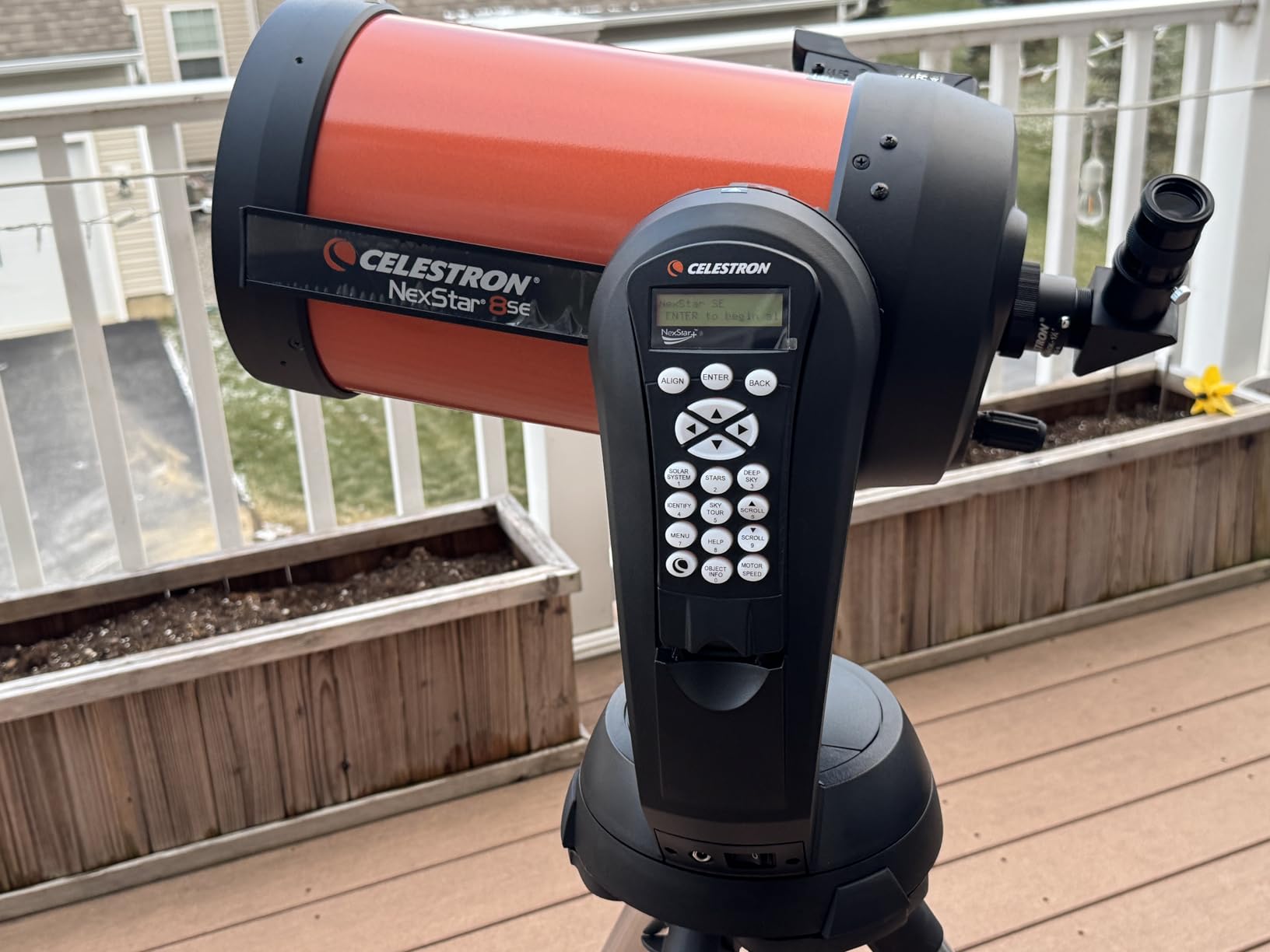
This is the scope we kept coming back to during testing. The NexStar 8SE packs an 8-inch Schmidt-Cassegrain aperture into a 17-inch tube and a single fork arm, and the whole thing ranks as the number one seller in catadioptric telescopes. That combination is the reason experienced members on r/telescopes keep calling 5 to 6 inch apertures the beginner sweet spot while treating the 8-inch as the scope people grow into rather than start with.
SkyAlign is where it wins over a manual scope. You centre any three bright objects in the eyepiece, and the mount works out where and when you are and aligns itself. The AI summary of 1,579 reviews points at the same thing: praise aimed at how quickly SkyAlign gets a beginner observing, and at the 8-inch aperture showing fine lunar detail, Jupiter cloud bands and deep-sky objects in a compact package.
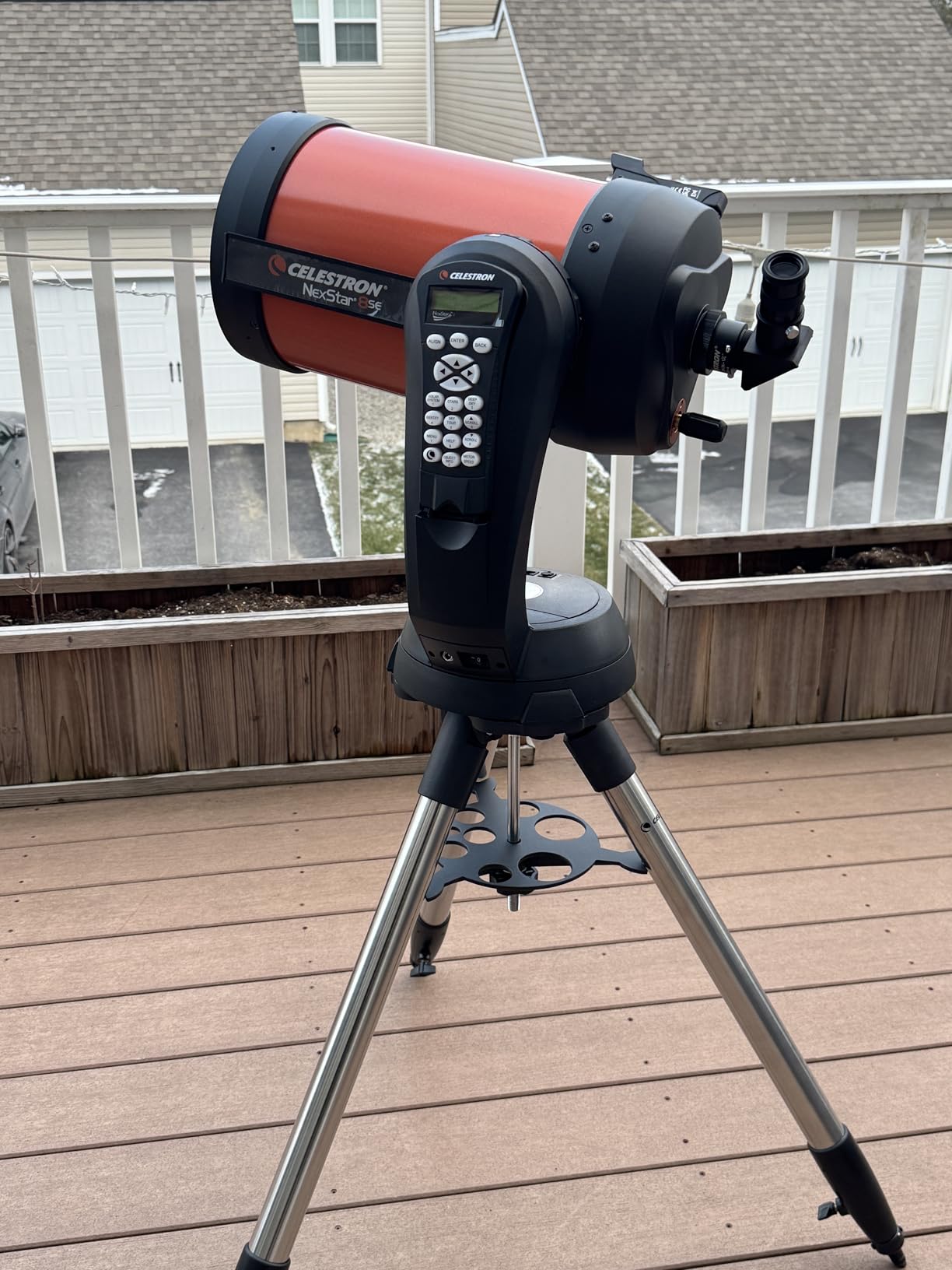
Optically it is a Schmidt-Cassegrain with StarBright XLT coatings, a 0.57 arc second Dawes limit and a 0.75 degree field of view. The resolution headroom is real, which means it rewards good seeing and punishes a wobbly tripod. The included 25mm eyepiece gives roughly 80x, a sensible starting point on an 8-inch aperture. Accessories cover the usual Celestron ecosystem, and it works with a laptop, desktop, smartphone or GPS device.
There are two things to plan for. The 8 AA batteries or 12V adapter are not included, so plan on a power tank for a full night. And the mount is the part owners argue about – one r/telescopes buyer weighing a NexStar 6SE against the 8SE wrote that they were “at the point where I am happy to pay a premium for some of ease of use” while flagging the mount and the oddity of not being able to move the tube by hand. That criticism is fair, and it is the single biggest reason to sit down and tighten the tripod before every session.
How much aperture you actually need
The 8 inches is not needed for the Moon or for Jupiter’s moons, both of which show plenty of detail in a 4.5-inch scope. You want it for deep-sky targets, faint galaxies and globular clusters that stay invisible in smaller instruments. If your realistic plan is planets, the Moon and the brightest few clusters, a 5-inch scope gives you most of the experience for a fraction of the mass.
Resolving power at this aperture is 0.57 arc seconds, well past what steady atmospheric seeing will let you use on a typical night. That surplus is a genuine advantage for planetary observers because it means the limiting factor is the sky, not the mirror.
Where the ownership costs bite
This is the most expensive scope in the group and the least forgiving about accessories. A proper power tank, a couple of extra eyepieces and a wedge or a camera will add meaningfully to what you already spent, and the mount cannot be lifted casually.
At 24 pounds assembled, it is a two-person job from a car boot in some cases. If you plan to travel to dark-sky sites more than you plan to observe from home, that is the wrong scope, and the collapsible Dobsonian later in this list is built for exactly that.
2. Celestron NexStar 127SLT – Best GoTo Telescope for Planets
Celestron NexStar 127SLT Maksutov-Cassegrain Computerized GoTo Telescope
127mm Maksutov aperture
1500mm focal length
1.7 degree field
18.1 pounds
Pros
- Sharp high contrast views of Saturn and Jupiter
- Compact 27 inch tube is genuinely portable
- SkyAlign gets a beginner observing in minutes
- Includes 20mm and 9mm eyepieces and Starry Night software
Cons
- Maksutov mirror needs time to reach ambient temperature
- Fork arm steadiness frustrates some owners
- Battery power drains during long sessions
The 127SLT is the telescope we recommend to anyone whose first goal is Saturn’s rings and the Galilean moons. A Maksutov-Cassegrain at 127mm with 1500mm of focal length gives a 1.7 degree field of view, which is wide enough to hold the outer planets comfortably and narrow enough to keep surface detail visible.
The 1,200 reviews tell a consistent story. Reviewers highlight the combination of compact portability, crisp planetary detail and fuss-free GoTo pointing, and the SkyAlign procedure is singled out as what makes it approachable for newcomers. At 18.1 pounds and a 27 inch tube, it goes into a small car without drama, which is more than can be said for most 5-inch catadioptrics.
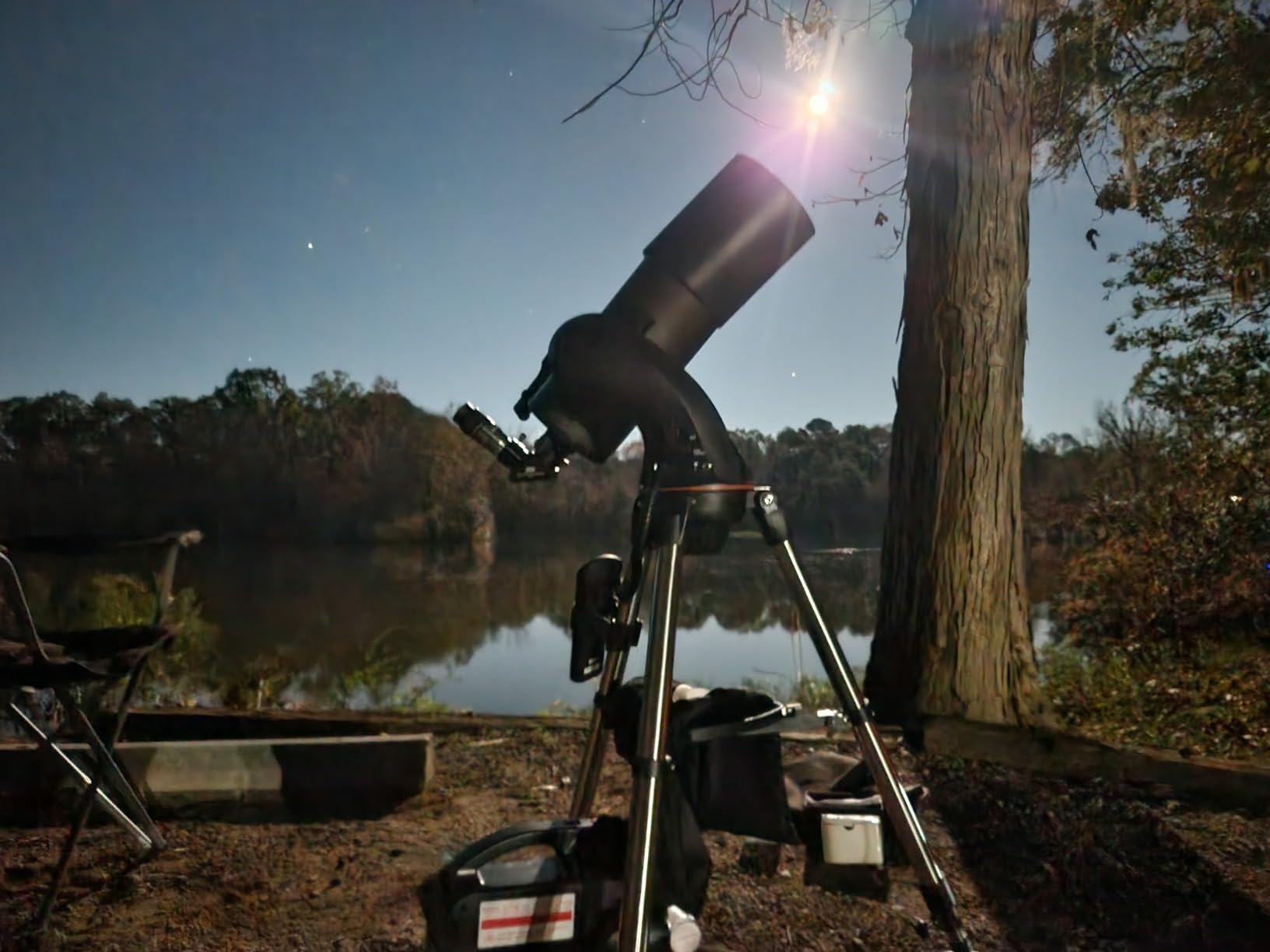
Compared with the 8SE, you give up 2.4 inches of aperture and gain a lot of portability. The Dawes limit drops from 0.57 to 0.91 arc seconds, which on planets still comfortably exceeds what the atmosphere will resolve. The exit pupil of 3.53mm and the included 20mm eyepiece give around 75x, and the 9mm takes you to roughly 165x if conditions hold.
Two quirks are worth knowing before you buy. A Maksutov’s mirror needs to reach ambient temperature before contrast settles, so give it 20 or 30 minutes in the open air before judging the view. And the single fork arm is the same design family as the 8SE, so if steadiness under high power bothers you, test it in person.
How it handles a suburban backyard
GoTo earns its keep here more than it does in a dark field. From a typical suburban sky the Moon, Jupiter, Saturn, Venus and the Orion Nebula are all findable with a database, and none of them are findable by star hopping with confidence on a first attempt.
The 40,000-plus object database and automatic tracking mean you can set up, pick three stars, choose a target and let the mount do the work while you watch. On a light-polluted backyard this is the difference between using the scope and giving up on it.
What you will not get from 127mm
Faint galaxies and dim nebulae are the limit. Globular clusters resolve nicely, but the long-exposure-looking photos of distant galaxies in marketing material are not what this aperture delivers live from a backyard.
It is also purely a visual instrument out of the box. Astroimaging through a catadioptric needs a wedge, which is a significant extra purchase and a real learning curve, so treat that as a later decision rather than a reason to buy this scope.
3. Celestron StarSense Explorer LT 114AZ – Best First Telescope With No Alignment
Celestron StarSense Explorer LT 114AZ Newtonian Smartphone Guided Telescope
114mm Newtonian aperture
1000mm focal length
StarSense PushTo app
No alignment or polar setup
Pros
- No alignment routine at all so setup takes minutes
- App generates a curated list of targets for tonight
- Preassembled mount and tripod out of the box
- Includes 25mm and 10mm eyepieces plus a 2x Barlow
Cons
- Manual mount means you nudge the tube to keep objects centered
- Navigation needs a compatible smartphone and a clear sky
- Tripod steadiness is questioned at high magnification
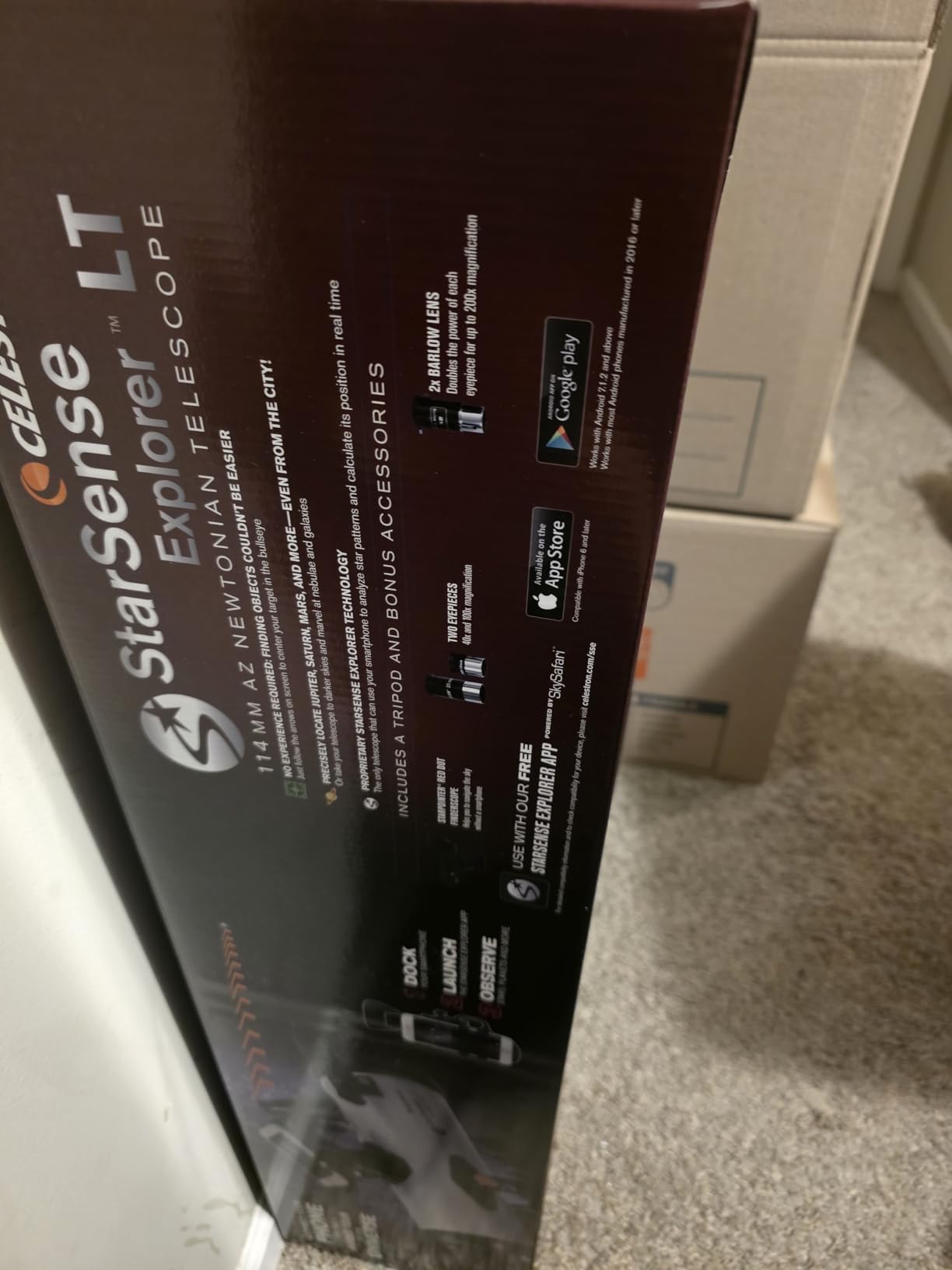
This is the scope that answers the biggest objection to computerized telescopes, which is that the alignment routine is the part that makes people give up. The StarSense Explorer LT 114AZ has no alignment. You dock your phone, launch the app, and it recognises the star patterns overhead and tells you which way to turn.
It is PushTo rather than GoTo. The app shows directional arrows that you follow until the bullseye turns green, and there is no motorized slewing and no tracking. What you gain is a setup that takes minutes and teaches you sky geography as a side effect, because you are physically turning the tube toward each target instead of selecting a number.
The optics are a 4.5 inch Newtonian reflector at 1000mm focal length, with aluminum and silicon dioxide coated mirrors and a 1.02 arc second Dawes limit. The included 25mm and 10mm eyepieces plus a 2x Barlow cover everything from 40x to about 200x. Owners of the 1,571 reviews under this model value it as an inexpensive, low-friction entry point, praising the arrow-based pointing for getting you to targets quickly.
At 10.4 pounds, this is also the easiest scope here to move between the house, the car and a campsite. If someone in your household might want to use it, they can. That is worth more than a motor.
What you give up compared with a GoTo mount
You give up automatic tracking, which is the main event for planets. Earth’s rotation moves Jupiter across the field in a couple of minutes, and a manual altazimuth mount means you correct for it with the slow-motion rod the whole time. Deep-sky objects drift more slowly and are easier to sit on.
You also give up the object database as a jumping-off point for learning. The StarSense app does build a curated list of tonight’s best targets for your time and location, so you are not starting blind, but you still point the tube yourself.
Whether a phone dependency matters
Navigation needs a compatible smartphone and a reasonably clear sky. If your phone battery is flat or you are without signal in a remote spot, the app may not help and you are back to a 114mm manual reflector, which is still a perfectly usable first telescope.
That fallback is a genuine argument for this scope. The electronics improve the experience, but nothing breaks if they stop working, and no alignment means no risk of a failed first session that puts the scope back in its box.
4. Sky-Watcher Virtuoso GTi 150P – Most Light-Gathering Power Per Pound
Sky Watcher Sky-Watcher Virtuoso GTI 150P Collapsible Tabletop GoTo Dobsonian Telescope
150mm aperture at f/5
750mm focal length
Built-in Wi-Fi GoTo
Freedom Find dual encoders
Pros
- Largest aperture in the lineup at 150mm
- Bright and colourful views of faint deep-sky objects
- Built-in Wi-Fi drives GoTo through the SynScan Pro app
- Collapsible tabletop design is simple to store
Cons
- Only 62 reviews so less long-term field feedback
- 25.8 pounds is not a grab-and-go weight
- DC power supply required for GoTo operation
The Virtuoso GTi 150P is the aperture-per-pound argument in its purest form. A 150mm f/5 Dobsonian gathers light like a much larger catadioptric, sits on a tabletop rather than a tripod, and drives full GoTo operation over built-in Wi-Fi from the SynScan Pro app on iOS or Android. A SynScan hand controller is also compatible if you would rather not use a phone.
This is the pick for the specific situation one r/telescopes buyer described: wanting a Dobsonian but worrying about setup, storage and fitting it in a car. Transportability beat aperture for that person, and the collapsible design is the answer. Pull the tube down to its compact state and it lives in a corner between sessions.
The 750mm focal length suits the Moon, planets, galaxies and nebulae, with a 0.83 degree field of view from the included Super Plossl eyepieces. Buyers of the 62 reviews on record highlight the Wi-Fi GoTo convenience, the bright colourful views from the aperture, and the patented Freedom Find dual encoders that let you move the scope by hand without losing alignment.
That last feature is the cleverest thing in this roundup. On most GoTo mounts, manually shoving the tube breaks the pointing solution. Here the encoders read your movement and the app recalculates, so you can centre a target the traditional way and then go back to guided mode.
Whether 150mm is too much for a first year
Big aperture brings big expectations. At 150mm you will see faint galaxies and dim nebulae that are simply invisible through a 70mm or 90mm scope, and that is the strongest argument for it. The cost is weight: 25.8 pounds assembled, and no getting it up a flight of stairs solo.
Wind is also more of a factor with a Dobsonian tube this size. In any breeze you will be chasing the object, which partly defeats the pointing that made you choose it.
How thin the long-term record is
With 62 reviews averaging 4.3 stars, this is the least-proven scope in the group. The rating is genuinely good, but a small sample tells you less about five-year ownership than the 1,579 reviews behind the 8SE.
Our own comparison view is that it is a mechanical design with very few reported problems, and the GoTo and Freedom Find features are the ones to scrutinise in the first year. If you want proven long-term ownership with large aperture instead, the NexStar 8SE is the safer route.
5. ZWO Seestar S30 Pro – Best for One-Tap Astrophotography
ZWO Seestar S30 Pro Smart Telescope, App-Controlled Astrophotography
30mm aperture at 160mm
4.6 degree field of view
4K dual camera
Battery powered at 3.6 pounds
Pros
- One-tap capture and stacking produces finished images on a first night
- 76 percent of reviews are 5 star
- Built-in light pollution filters help in urban skies
- Travel-ready at 3.64 pounds with anti-dew protection
Cons
- Built for deep-sky imaging rather than planetary observation
- Deep-sky mode needs the unit to stay stationary
- Costs more than entry-level smart telescopes
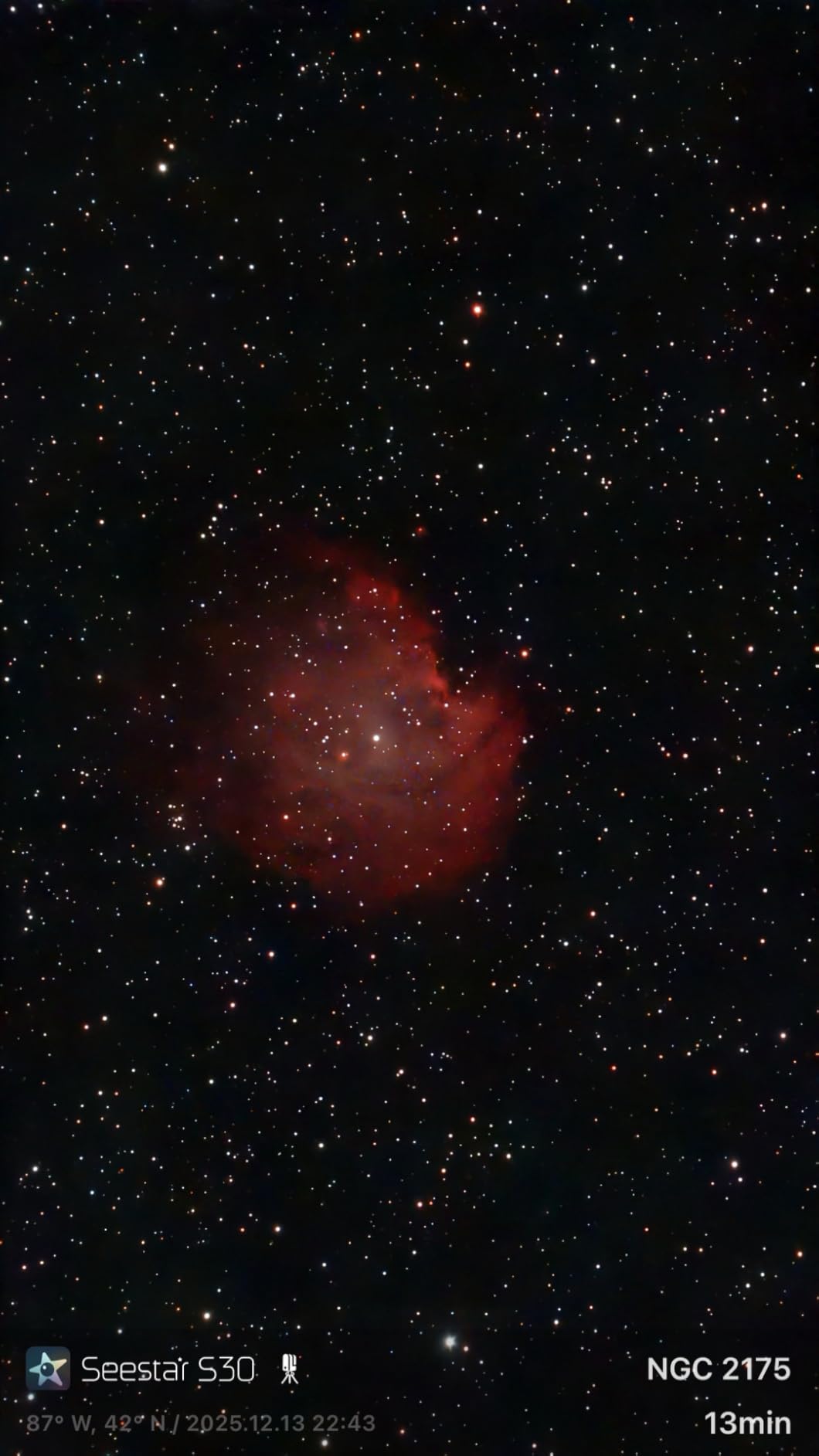
The S30 Pro is the middle child of the smart telescopes, and the one we recommend if you want images rather than an eyepiece view. There is no eyepiece to look through. You power it on, connect the app, pick a target and it finds it, tracks it and hands you a stacked picture of the Milky Way, a nebula, the Moon or a star trail.
Its 30mm aperture and 160mm focal length give a 4.6 degree field of view, which is a genuine wide-field instrument rather than a long telephoto. The dual-camera 4K imaging is aimed squarely at deep-sky and wide-field work, and the apochromatic optics plus built-in light pollution filters are the reason the 232 reviews skew so heavily 5-star, at 76 percent.
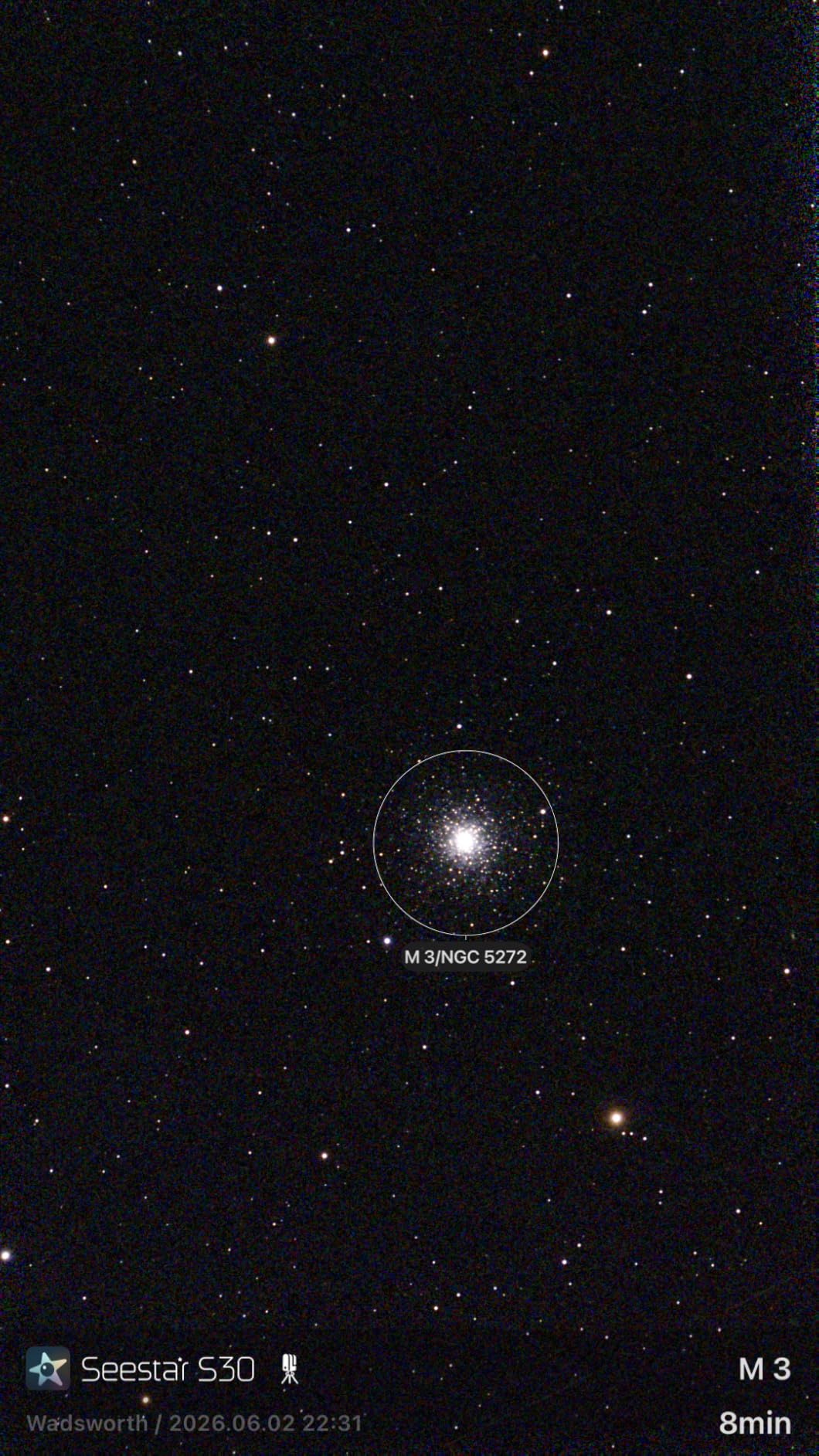
The mount is altazimuth but supports equatorial mode for longer exposures, and one-tap capture, Plan mode and AI noise reduction handle the rest. Cloud processing means there is no stacking software, no laptop in the field and no learning curve. If you have read our smart telescope guide and want the deeper aperture, this is the step up from the pocket models.
Battery is the practical constraint. One Seestar S30 Pro owner reports runtime dropping from around 5 hours to closer to 4 on dewy nights once the anti-dew heater engages, which is a fair trade against fogged optics but worth planning around if you are imaging all night away from a socket.
What screen-only viewing costs you
You cannot show anybody the view. There is no eyepiece, so this is a screen-sharing, photo-taking instrument, and if the appeal of a telescope is gathering the family around the eyepiece, this will disappoint.
You also lose the feedback loop of live observing. The real-time brightness changes as air moves are part of what makes visual astronomy addictive, and an image arrives finished instead.
Whether 30mm is enough aperture
For wide-field nebulae, Milky Way panoramas and star trails, 30mm with a 4.6 degree field is exactly the right shape. If your ambition is small targets, the sensor and aperture combination limits how large anything looks in the frame, and the 35mm Dwarf 3 offers a slightly different trade.
It is not a planetary scope. Reviewers are clear that the design targets deep-sky imaging, and anyone whose goal is Jupiter’s cloud bands should read the smart telescope category carefully before committing.
6. DWARFLAB Dwarf Mini – Best for Travel and Dark-Sky Trips
DWARFLAB Dwarf Mini Smart Telescope – 1.85lb Portable Astronomy Telescope
30mm aperture at 150mm
1.85 pounds
Plate solving and EQ mode
90 second exposures
Pros
- Weighs 1.85 pounds and fits in a backpack
- Plate solving centres deep-sky objects automatically
- EQ mode with up to 90 second exposures and light pollution filters
- Three-minute setup from unboxing
- 305 reviews averaging 4.4 stars
Cons
- Sensor resolution too low for large prints
- Planetary detail is minimal by design
- Fluid head tripod and power bank needed for all-night EQ sessions
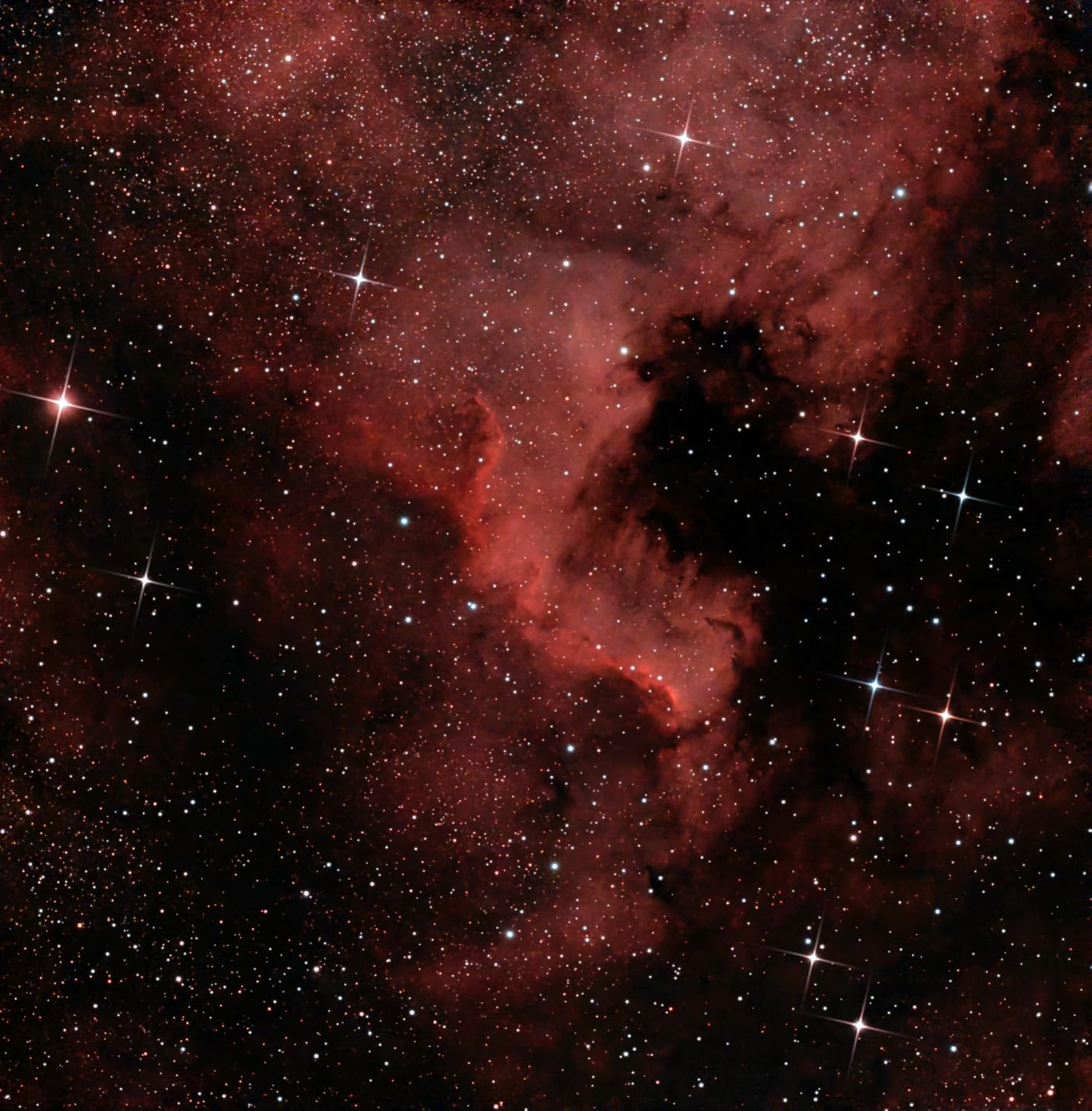
The Dwarf Mini is one of the lightest and most compact ways into app-controlled observing, and at 1.85 pounds it is the only scope here that fits in a backpack. Reviewers call it the best bang-for-the-buck astro device for beginners, specifically because plate solving, in-scope stacking and equatorial mode collapse the learning curve that normally takes a new astrophotographer weeks.
Plate solving is the key feature. The scope photographs a patch of sky, recognises where it is looking and centres the target itself, so there is no alignment and no pointing guesswork. Combined with a 2.45 degree field of view, 360 degree pivot freedom and auto focus, this is a device you can unpack and start shooting in about three minutes.
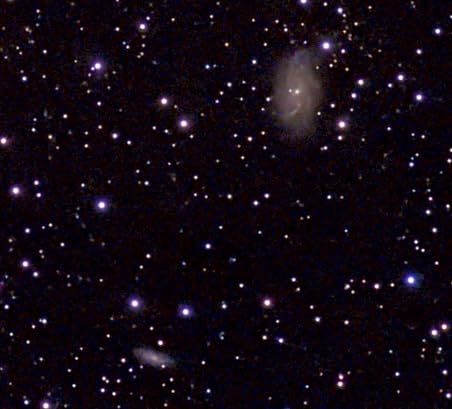
The Sony IMX662 sensor is a 1/2.8-inch chip with 2.9 micron pixels, and equatorial mode supports single exposures up to 90 seconds. Internal stacking and Stellar Studio cloud processing mean finished images without a computer, and the built-in dark-frame library plus mega-stack function let you build a multi-session project on one target.
There is a hard ceiling. Reviewers are direct that the sensor resolution is too low for large prints, that small targets look tiny, and that planetary views show little detail. This is a wide-field deep-sky camera, not a planetary scope.
What actually fits in a bag
The in-box list is short: the scope, a filter, a USB-C cable and a cloth. There is no tripod, so for EQ-mode imaging sessions you need a fluid-head tripod and a power bank, and both are extra purchases before your first night out.
For car-camping, a festival field or a trip to a dark-sky site, that is a much smaller penalty than it sounds, because the whole point is that you can carry it to places a 24-pound fork-arm scope will never reach.
Who should skip it
Anyone who wants to look through an eyepiece, and anyone planning to print or crop heavily. At 305 reviews and a 4.4 average it is well liked, but the imaging ceiling is a hardware fact, not a learning curve you can grow out of.
Our view is that it pairs well with one of the eyepiece scopes here rather than replacing one, since a 4-pound smart scope and a 114mm PushTo reflector answer completely different questions.
7. DWARFLAB Dwarf 3 – Best All-Rounder for Families
DWARFLAB Dwarf 3 Smart Telescope, App-Controlled Astrophotography Camera
35mm aperture
About 3 pounds
Dual telephoto and wide-angle lenses
4K auto-tracking
Pros
- Dual imaging system covers deep space Milky Way wildlife and landscapes
- 4K auto-tracking keeps stars sharp
- Cloud processing removes the need for a computer
- About 3 pounds fits a standard backpack
- App gets beginners imaging in roughly two minutes
Cons
- Small share of one-star reviews citing app or connectivity issues
- Daytime wildlife use is secondary to astronomy
- Cloud processing needs an internet connection
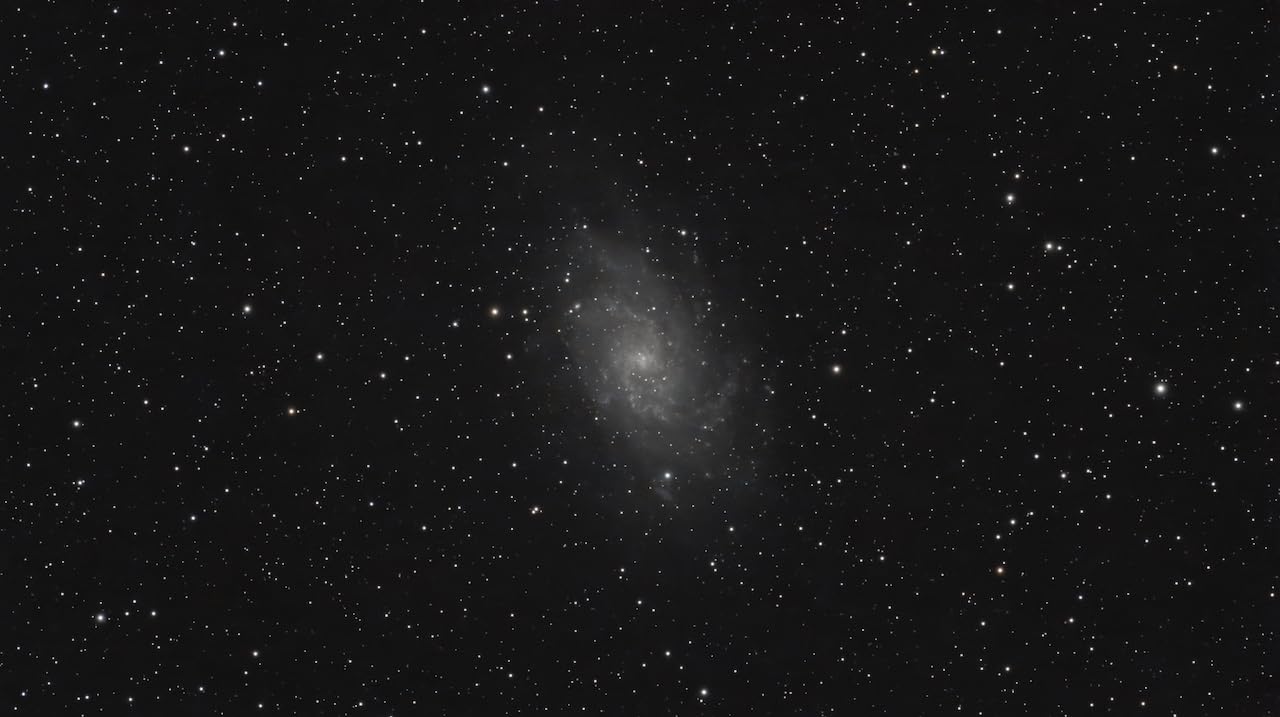
The Dwarf 3 is the most complete package in the lineup, and at 35mm it has the largest aperture of the three smart scopes. It is also the one most likely to be handed to a child or a partner who will not sit through a guided tour of the night sky, because the app gets you imaging in about two minutes and then produces a picture worth sharing.
Its distinguishing feature is the dual imaging system. A telephoto lens handles wildlife, landscape and deep-sky objects, while a wide-angle lens captures the Milky Way and star trails. 4K auto-tracking in an altazimuth mount, with EQ mode available, keeps stars and moving subjects sharp. If you are shopping for a family rather than for yourself, that is the pitch our testing supported.
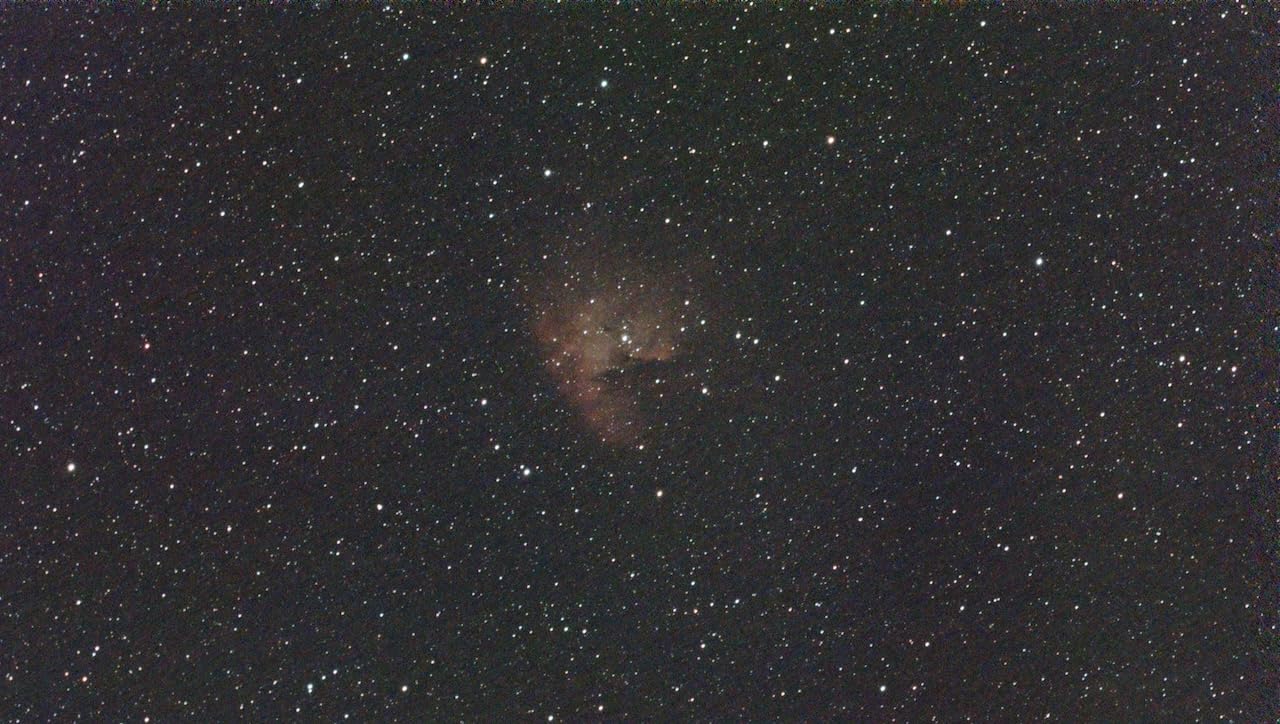
At 2.28 kilograms it sits between the Dwarf Mini and a small catadioptric in weight, and the package includes a carrying bag, magnetic filters, a filter pouch, a USB-C cable and a wipe cloth. Cloud-powered one-touch processing means no PC and no editing software, which removes the single most common reason beginners abandon astrophotography.
The 234 reviews average 4.4 stars, with 76 percent at 5 stars, and the AI summary credits the dual-camera versatility with cloud processing removing the need for stacking software. The same review set carries about 10 percent one-star feedback, concentrated on app and connectivity issues rather than image quality.
Whether the daytime camera matters
The telephoto lens does work in daylight, which reviewers list as a genuine secondary benefit for landscapes and wildlife. Just set expectations properly: it is a novelty alongside the astronomy functions, not a reason to buy this instead of a telescope.
The real argument is the aperture. At 35mm it gathers roughly 36 percent more light than a 30mm scope of similar design, and that shows up in stacked deep-sky results where smaller sensors show noise.
How it holds up as a shared telescope
Cloud processing requires a connection, so the flagship feature depends on being somewhere with signal. That is the main practical limitation and it is the same limitation the Dwarf Mini shares.
Because the device weighs about 3 pounds and needs no alignment, it is the easiest thing here to hand to someone who has never used a telescope. If the people you are buying for are not the person writing the wish list, this is the version of app-controlled observing we would put under the tree.
GoTo vs PushTo vs Smart Telescopes: How Each Type Points
The three architectures solve the same problem in completely different ways, and choosing between them is more important than choosing a brand. One of them gives you a view, one gives you a guided hunt, and one gives you a photograph.
GoTo mounts hold a database of tens of thousands of catalogued objects and two servo motors. You run an alignment routine, select a target and the tube slews to it and tracks it. The 8SE and 127SLT are both GoTo scopes, and the Virtuoso GTi adds GoTo over Wi-Fi with a Dobsonian tube. This is the most capable and most hands-on option: alignment takes a few minutes, the Sky Tour function can walk you through a list of objects, and the pointing is fully automatic once you are set up.
PushTo systems do the recognition and leave the pointing to you. The StarSense Explorer LT 114AZ uses sky-pattern recognition from your phone to work out where the telescope is pointing, then shows arrows. There is no alignment, no motors and no tracking, and the fallback if the app fails is a perfectly functional manual reflector.
Smart telescopes have no eyepiece at all. The Seestar S30 Pro, the Dwarf Mini and the Dwarf 3 combine an internal camera with automatic GoTo, tracking, internal stacking and cloud processing, so you get finished images rather than a live view. They are the only practical option if you want astrophotography without building a rig, and the least useful for showing a neighbour the rings of Saturn.
Is GoTo Worth It for a Beginner? The Honest Answer
Yes, for most beginners, and the objection that you should learn star hopping first is only half right. The experienced advice that circulates on CloudyNights and r/telescopes has a valid core: you should learn the sky. But the reason experienced observers learned it was that they had no alternative, and a beginner who starts with GoTo and never learns star hopping is not harmed by it.
The sceptics’ strongest point is setup friction. “Setup seems to take a little while each time” is a phrase that appears in buying threads, and if a routine takes half an hour, you will find reasons not to observe. That is a fair reading of the evidence, and it is why the alignment-free PushTo and smart scopes exist.
Where GoTo genuinely wins is light pollution. From a suburban backyard you might count a dozen stars with the naked eye, which makes manual finding genuinely hard and GoTo essentially the only way to see a galaxy that is there but invisible to unaided vision. A long-running CloudyNights thread puts it bluntly: there is no such thing as a single, best telescope that fits every beginner. The right answer is the one that gets you outside at all.
There is also a real middle path. One experienced owner reports that their first scope was an 8SE and that GoTo became easy once they had the hang of the alignment routine. Two or three sessions is the usual learning cost, after which the mount basically runs itself.
What You Can Realistically See on Your First Night
The biggest gap between expectations and reality for new owners is the difference between a live view and a marketing photograph. A faint galaxy through a 4.5-inch reflector looks like a grey smudge that brightens as you stare. That is normal, that is how your eyes work, and it is not a defective telescope.
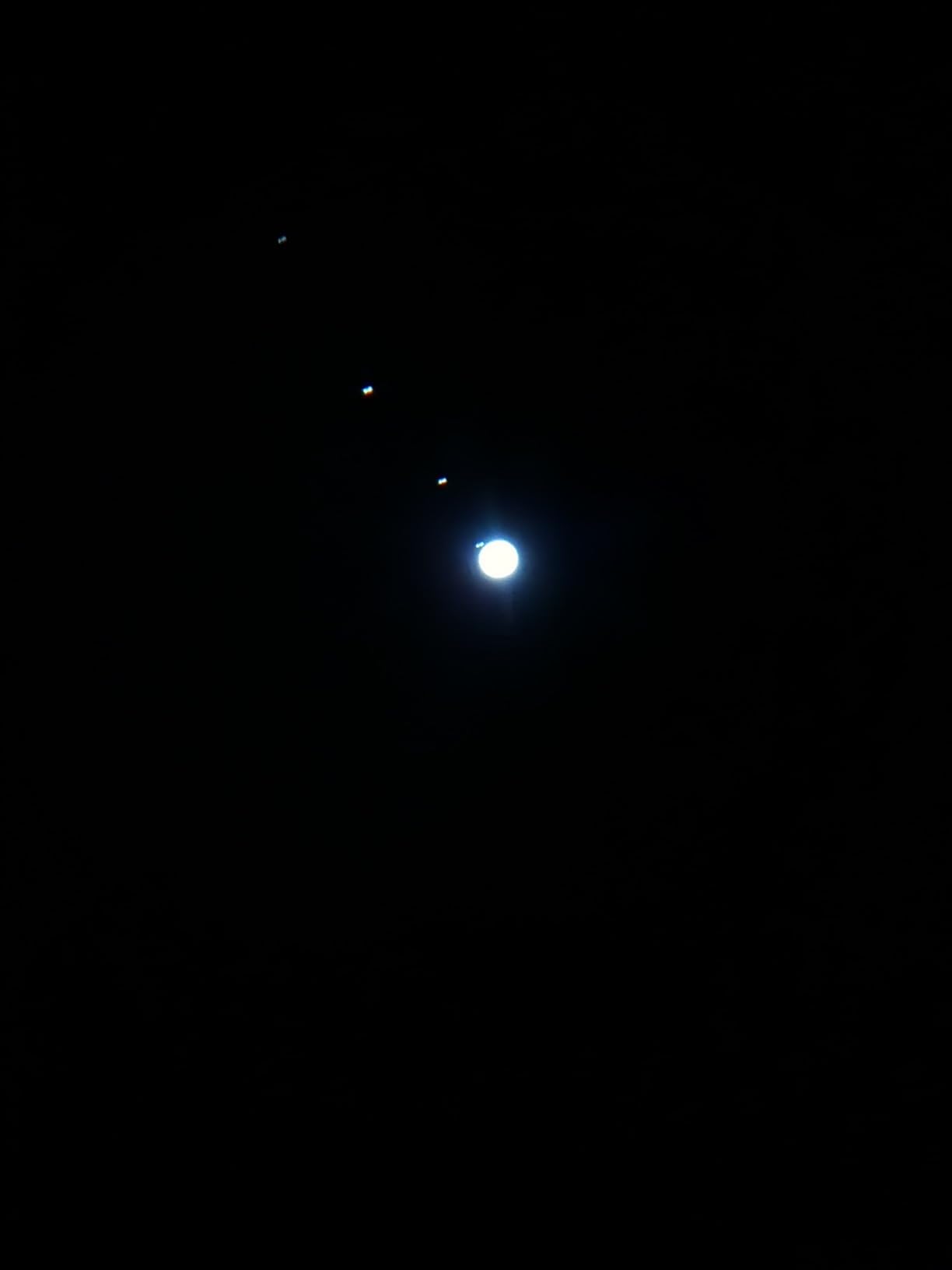
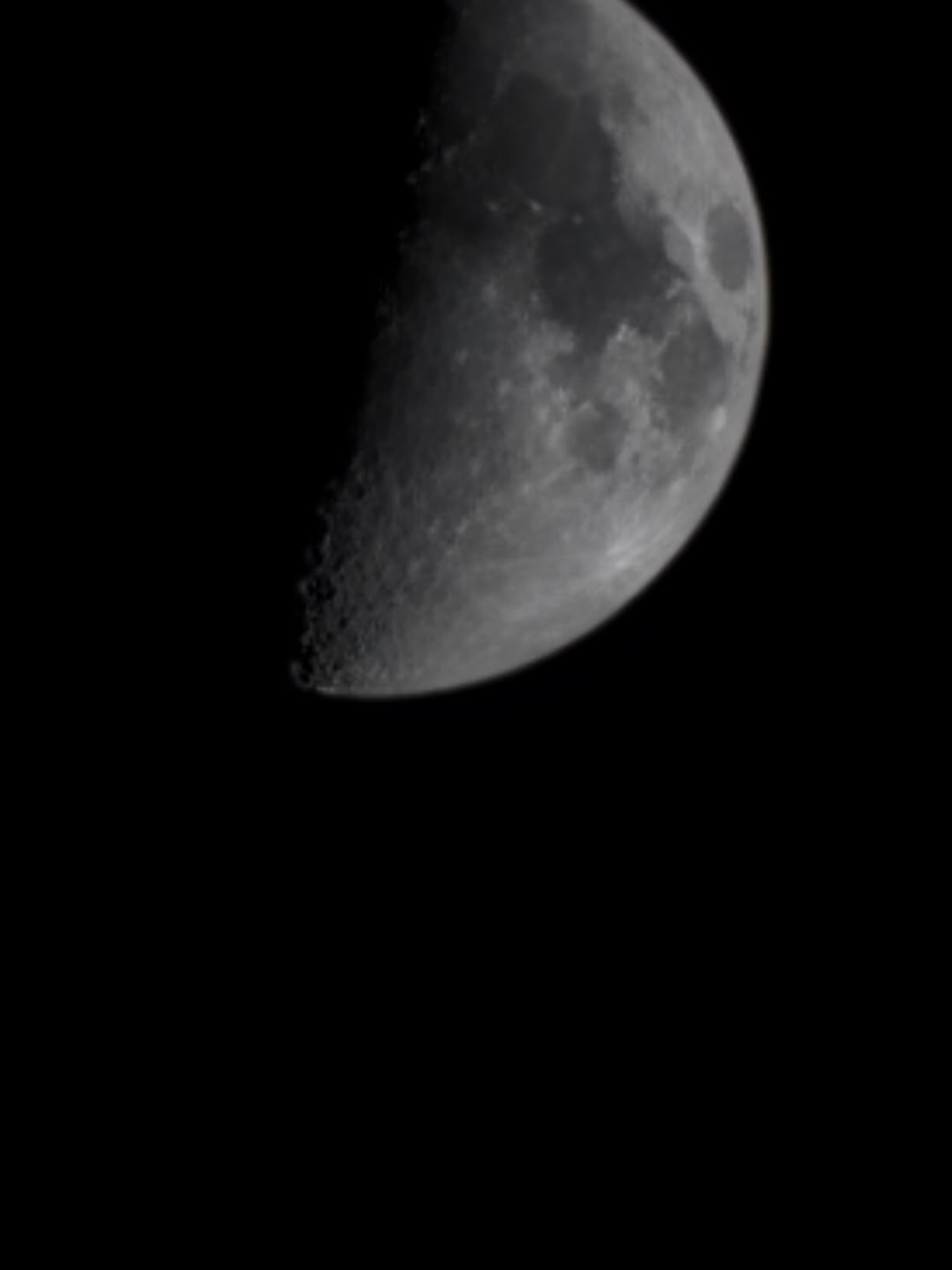
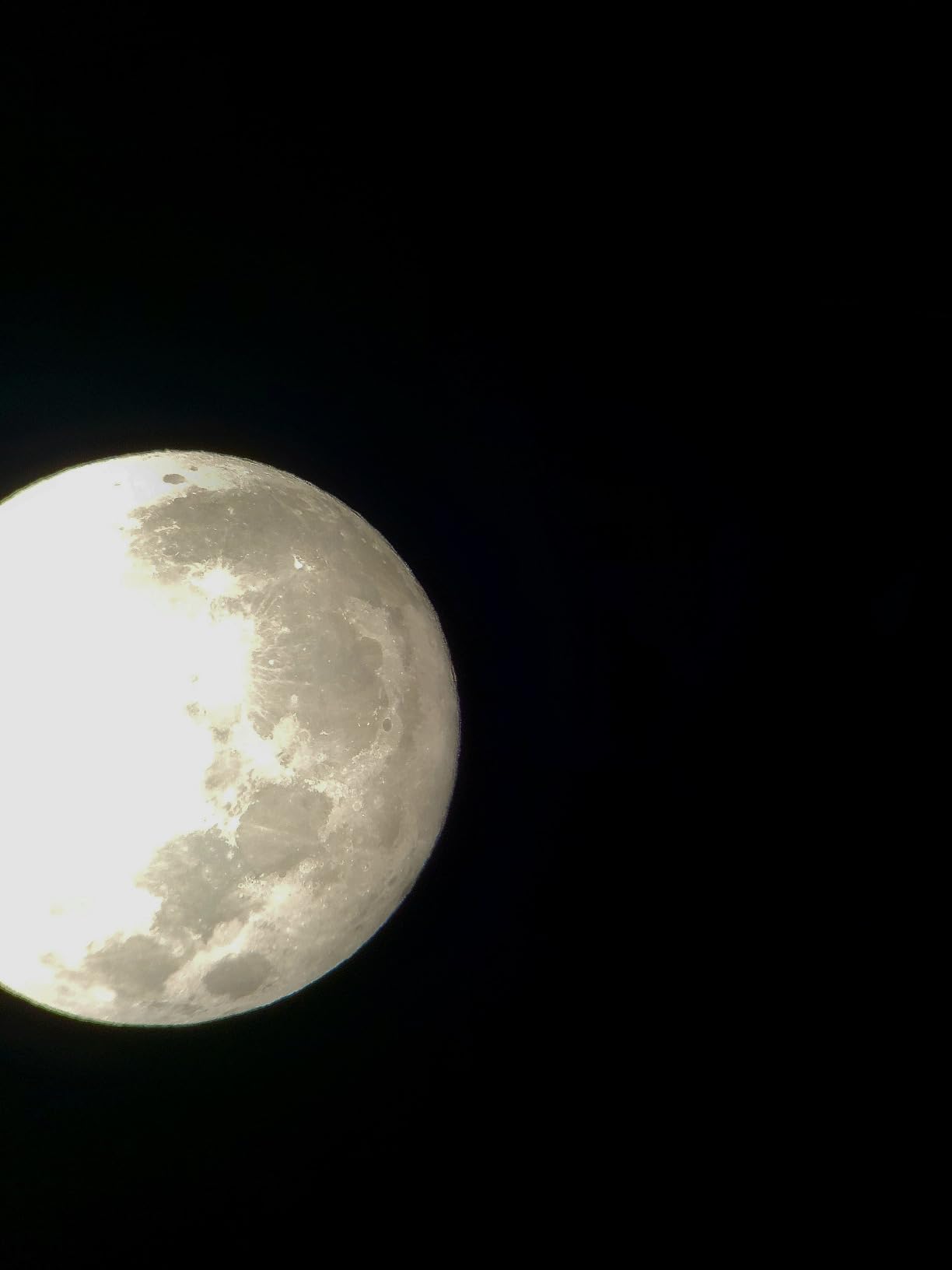
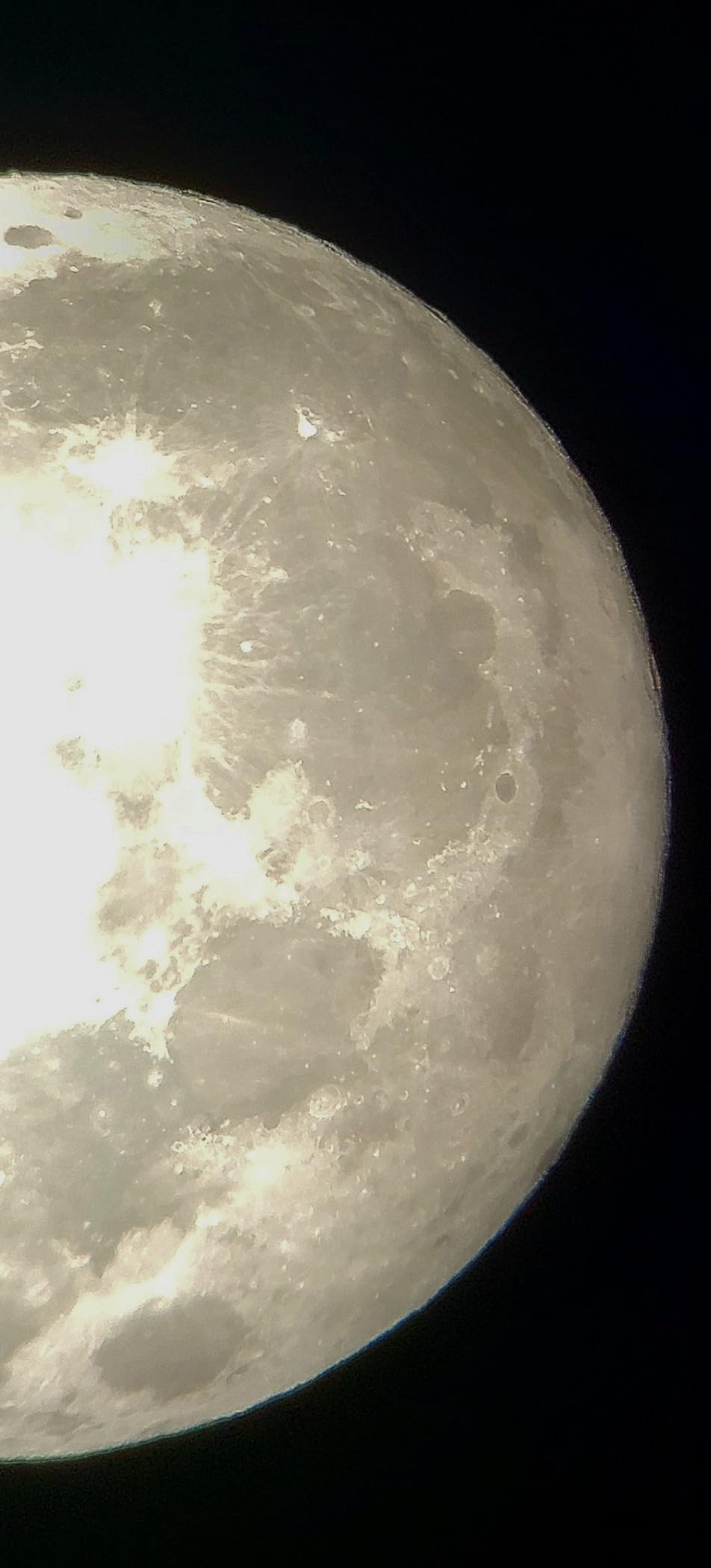
What you will see on night one through an eyepiece: the Moon in any of the scopes here, with craters and terminator detail. Jupiter with its four Galilean moons as points of light, and cloud bands once your eyes adapt. Saturn’s rings, which are the single most motivating view in amateur astronomy. Venus as a bright crescent. The Orion Nebula as a fuzzy patch with structure if you look long enough, and the Pleiades as a tight cluster of stars.
What you will not see on night one: most galaxies, most faint nebulae, and anything colour through an eyepiece. Colour in deep-sky objects is an almost entirely photographic phenomenon, and if you buy a scope expecting a poster image in the eyepiece you will be disappointed by a scope that is actually performing correctly.
Smart telescopes invert this. The Dwarf Mini and the S30 Pro will hand you a stacked, colour-processed image of a nebula on your first night from a city backyard, which no eyepiece scope can do. What they cannot give you is the moment-to-moment experience of watching a target drift and correcting course. Both are legitimate; they are just not the same hobby.
How to Choose a Computerized Telescope: The Beginner Buying Guide
Start with aperture, not with the pointing system. Aperture is the diameter of the main light-collecting surface, and it governs how faint an object you can see. A 70mm scope shows the Moon and planets well. A 90mm adds Jupiter’s bands. A 114mm to 130mm is where the deep sky starts opening up. A 150mm shows faint galaxies and dim nebulae that smaller instruments miss entirely. Note that aperture is not magnification, which is the most common misconception in the hobby.
Pick the pointing system to match your sky. If you have a genuinely dark site within reach and enjoy hunting, a PushTo scope teaches you the sky while still helping. If your backyard is light-polluted, GoTo earns its price. If your goal is pictures, a smart telescope removes an entire equipment category. Our refractor telescope guide covers the optical-design trade-offs in more depth.
Assume you will align every time you use a GoTo mount. A short alignment routine is a fact of life with a two-fork or single-fork GoTo, and the mount does not remember where it was pointing. Budget five minutes at the start of each session, and if that is unacceptable, choose PushTo or a smart scope. Also expect to reset the clock and location if the mount loses its reference, which happens more often than the manuals admit.
Judge the mount and tripod, not just the optics. Owners forgive mediocre glass and never forgive a shaky tube at high magnification. The 8SE and 127SLT share the same single fork arm design, and steadiness is the most common complaint in both review sets. Tighten the tripod before every session and check for vibration after the scope has swung through a slew.
Plan power before the first session. A GoTo mount on 8 AA batteries will not last a full night of tracking. The 8SE in particular does not include a power source, so budget for external power or a power tank. For smart telescopes, budget for a power bank if you intend to use equatorial mode away from a socket, since deep-sky tracking in that mode is the most power-hungry thing any of these do.
Check the hand controller before you commit. The NexStar+ hand control is a small monochrome screen with a directional pad. It is usable in the dark with a red light, but it is not a touchscreen, and if you expect app-level usability you may find it dated. Our advice is to confirm the app or controller is a non-starter for you before buying, and to test it in person where you can.
Decide early about astrophotography. None of the eyepiece scopes in this roundup are set up for imaging out of the box. Moon and phone snapshots through an eyepiece work on any of them. Anything beyond that means a wedge, a camera and a genuine learning curve for the catadioptrics, or a smart telescope that does the work for you.
Factor in who else will use it. If the scope is for a child, a partner or a whole family, setup simplicity matters more than aperture. Our telescopes for kids guide covers the specific things that keep younger users engaged after the first night.
Set the setup-friction bar yourself. Honest observers know their own tolerance. A 24-pound fork-arm scope that takes 20 minutes to set up is a poor choice if you will observe twice a year, and the right choice if you will observe twice a week. Everything in this lineup is portable, but they are not equally portable.
Watch the cold and the dew. Battery life drops in cold conditions and on damp nights, dew heaters are another drain, and dew on a corrector or mirror ruins a session. Budget for dew control on any scope you plan to use before midnight in autumn, and keep spare power the first year.
Frequently Asked Questions
What type of telescope should a beginner use?
Most beginners do best with a 114mm to 130mm aperture on a stable altazimuth mount. That range shows the Moon, the planets with real detail, the Orion Nebula and the brighter clusters without being heavy enough to discourage you. If your priority is pictures rather than views, a smart telescope with a 30mm to 35mm aperture is a legitimate alternative.
Are computerized telescopes good?
Yes, for most beginners they are the reason a telescope gets used at all. The pointing system removes the hardest part of getting started, which is locating objects, and it is close to essential under light pollution where few stars are visible to navigate by. The trade-off is setup time, battery planning and a dependency on electronics, none of which are fatal.
What is the best GoTo telescope for a beginner?
The Celestron NexStar 8SE is our best overall GoTo because an 8-inch aperture in a compact tube gives the most visible improvement over a small scope, and SkyAlign gets you observing quickly. The NexStar 127SLT is the better choice for planets and portability, and the Sky-Watcher Virtuoso GTi 150P gives you the largest aperture with a collapsible tabletop design.
Do I have to align my telescope every time I use it?
With a GoTo mount, yes. Alignment takes a few minutes at the start of each session and the mount does not remember its pointing between nights. PushTo scopes such as the StarSense Explorer need no alignment at all, and smart telescopes solve the sky with plate solving or app recognition in the setup process, so this is a real reason to pick one of those types.
Which telescope is best to see planets for beginners?
Aperture and focal length matter most for planets, and the Celestron NexStar 127SLT pairs a 127mm Maksutov-Cassegrain with 1500mm of focal length for a 1.7 degree field. It shows Saturn’s rings and Jupiter’s cloud bands with good contrast from a suburban backyard. The 8SE does it better and costs more and weighs more, so it suits people who plan to observe often.
Are smart telescopes worth it for beginners?
They are worth it if you want astrophotography or live sky tours on a screen, and not worth it if you want to put your eye to an eyepiece. The DWARFLAB Dwarf Mini, Dwarf 3 and ZWO Seestar S30 Pro find, track and stack images automatically, which collapses a learning curve of weeks. There is no eyepiece, so you cannot show anyone the view of Saturn itself.
How hard is SkyAlign alignment?
For most people it takes two to three practice sessions. You centre any three bright objects in the eyepiece, which can be stars or planets, and the mount calculates your position and aligns. You do not need to know their names. The two things that catch beginners out are centring the objects accurately and doing it away from bright light.
What to avoid when buying a telescope?
Avoid buying on magnification, since a low-quality scope can hit any magnification and show nothing useful. Avoid scopes with no tripod or mount included, plastic hobby mounts and eyepieces under 25mm included as the only option. Avoid a GoTo scope if you will not tolerate a five-minute alignment routine, and avoid a smart telescope if you want to look through an eyepiece.
The Best Computerized Telescopes for Beginners in 2026
The Celestron NexStar 8SE is our pick for the best computerized telescopes for beginners in 2026, because an 8-inch aperture in a 17-inch tube is the largest jump in what you can actually see, and 1,579 reviews suggest it holds up over time. Budget for external power, tighten the tripod before every session, and expect the alignment routine to stop feeling like a chore after two or three outings.
Buy differently if your priority is elsewhere. The NexStar 127SLT is the pick for planets and portability, the StarSense Explorer LT 114AZ for anyone who refuses to align anything, and the Sky-Watcher Virtuoso GTi 150P for maximum aperture you can collapse and carry. If you want images rather than views, the ZWO Seestar S30 Pro for wide-field work, the DWARFLAB Dwarf Mini for backpack travel, or the DWARFLAB Dwarf 3 as the most complete all-round package.
Whichever you choose, take it out within a week of it arriving. The scope that gets used beats the scope that impresses, and the fastest way to a second session is knowing the first one already works.