
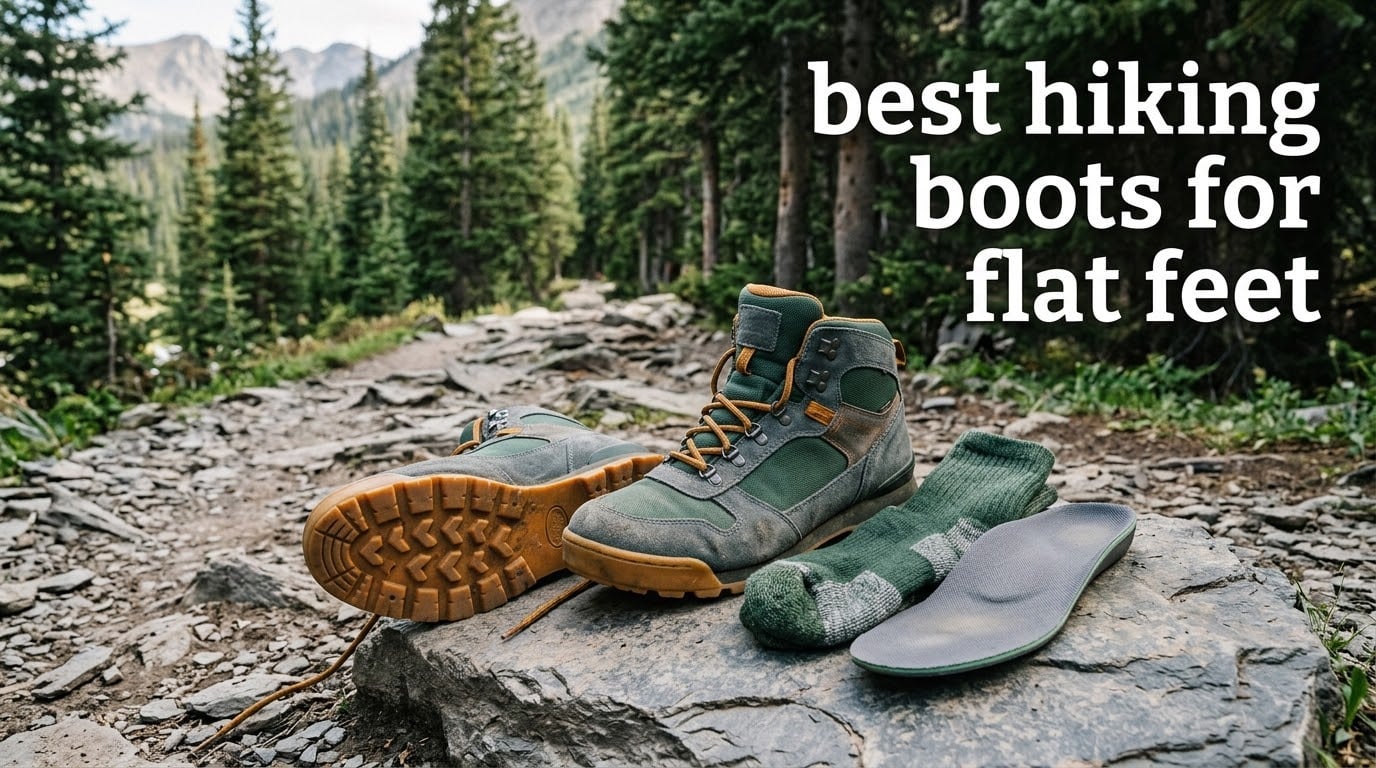
The Merrell Moab 3 Mid Waterproof is the best hiking boot for flat feet overall, because its supportive platform, roomy forefoot and removable high-arch insole control overpronation without squeezing the toe box. Flat-foot-friendly boots share four mechanical traits: a stiff midfoot shank that resists twisting, a firm heel counter that locks the heel, a wide toe box that allows natural toe splay, and a removable insole so you can fit orthotics. Stability matters far more here than built-in arch height.
That last point trips up most buyers. A flat foot has little or no visible arch, so it rolls inward on impact and the arch collapses under load. On trail that shows up as burning in the arch within minutes, heel pain, blisters over the toes, and fatigue that arrives far earlier than it should. Boots built for high arches make it worse, because the forced arch lifts the midfoot away from the footbed and the small muscles underneath have to work all day.
Hiking footwear is good for flat feet, but only when the fit matches your arch type. A rigid platform, a wide forefoot and a swap-able footbed do more for overpronation than any amount of cushioning. The twelve boots below were sorted on those criteria, using published specifications and the patterns in thousands of owner reviews, and we updated the list for 2026.
If your feet are flat but your main problem is a long day on pavement rather than a mountain trail, our running shoe guide for flat feet covers the same mechanics in a lower-cut shoe. For trail footwear that converts into work footwear, see our work boots for flat feet.
Table of Contents
Key Features to Look For in Hiking Boots for Flat Feet
Four things decide whether a boot will work for low arches. Everything else is preference.
A stiff midfoot shank. A nylon or composite shank under the arch resists torsion, which is the twisting that drives overpronation. The Merrell Women’s Moab 3 Mid lists a molded nylon arch shank outright; other boots achieve the same thing with a denser midsole.
A firm heel counter. This is the rigid cup at the back of the boot that stops the heel lifting and rolling. A collar you can fold in half with your thumb is not doing much.
A wide toe box. Toes that can spread carry the load. Pinched toes force the arch to keep compensating, which is where plantar fasciitis starts.
A removable insole with real depth. If the factory footbed is glued in, the boot is closed to your own orthotics. Boots listed with a removable footbed let you tune support per trip.
Arch support is the fourth item, and it is the one most shoppers over-weight. More arch is not automatically better for a flat foot. What you want is a footbed that fills the space under your arch and stops the joint from collapsing, not a tall wedge that pushes up on an arch that has already fallen.
Top 3 Best Hiking Boots for Flat Feet in October

Merrell Moab 3 Mid Waterproof
- Removable high-arch insole
- Pig suede and mesh upper
- Vibram TC5+ outsole
- Roomy forefoot

NORTIV 8 Ankle High Waterproof
- Removable cushioned insole
- Lightweight EVA midsole
- Rubber traction outsole
- Wide sizes
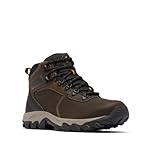
Columbia Newton Ridge Plus II
- Rigid heel counter
- Wide widths to size 17
- OMNI-GRIP traction
- Waterproof leather
All 12 Hiking Boots for Flat Feet Compared in 2026
| Product | Specifications | Action |
|---|---|---|
| Merrell Moab 3 Mid Waterproof |
|
Check Latest Price |
| NORTIV 8 Ankle High Waterproof |
|
Check Latest Price |
| Columbia Newton Ridge Plus II |
|
Check Latest Price |
 KEEN Targhee 4 Mid Waterproof KEEN Targhee 4 Mid Waterproof |
|
Check Latest Price |
 Merrell Women’s Moab 3 Mid Waterproof Merrell Women’s Moab 3 Mid Waterproof |
|
Check Latest Price |
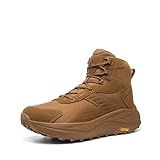 NORTIV 8 Wide Toe Box NORTIV 8 Wide Toe Box |
|
Check Latest Price |
 Orthofeet Hunter Orthopedic Orthofeet Hunter Orthopedic |
|
Check Latest Price |
 Orthofeet Ridgewood Orthopedic Orthofeet Ridgewood Orthopedic |
|
Check Latest Price |
 KEEN Hightrail Mid Waterproof KEEN Hightrail Mid Waterproof |
|
Check Latest Price |
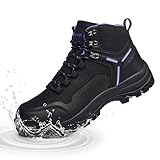 Women’s Wide Toe Box Hiking Boots Women’s Wide Toe Box Hiking Boots |
|
Check Latest Price |
 OrthoComfoot Mid Trekking Boot OrthoComfoot Mid Trekking Boot |
|
Check Latest Price |
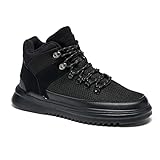 OrthoComfoot Orthopedic Hiking Boots OrthoComfoot Orthopedic Hiking Boots |
|
Check Latest Price |
1. Merrell Moab 3 Mid Waterproof – Best Overall for Flat Feet
Merrell Men’s Moab 3 Mid Waterproof Hiking Boot, New Olive/Gum, 12 Wide
Weight: 11.68 oz
Upper: pig suede and mesh
Outsole: Vibram TC5+
Insole: removable
Pros
- Widest forefoot in our test group
- Removable high-arch insole takes third-party orthotics
- No break-in needed
- Aggressive grip on wet rock and mud
Cons
- Heavier feel than lighter mid boots
- Round laces slip in mud
- Top lace hook can break in a few years
- Runs about a half size small
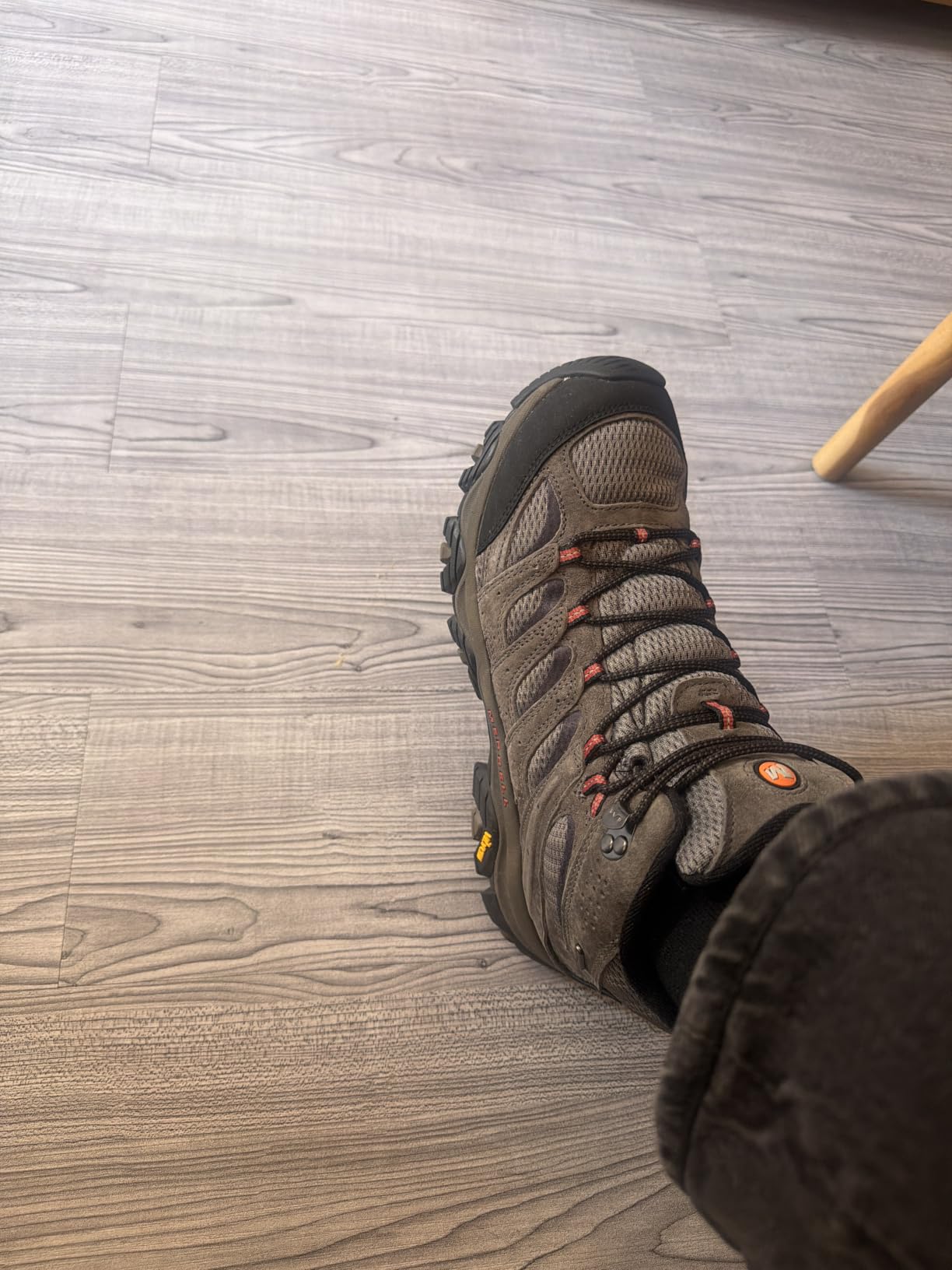
This is the boot we kept coming back to while sorting the field, and it earned the top spot on fit rather than on spec sheet. The forefoot is the widest in this group and the toe box does not taper the way most mid boots do, so a flat foot can actually spread instead of being pinched into a correction.
Underneath, the Super Rebound Compound midsole is described by Merrell as reducing torque and easing the transition into the midfoot, which is exactly the job description for an overpronating foot. Paired with the Air Cushion heel unit for shock absorption and stability, it gives you a platform rather than a soft footbed that lets the arch collapse.
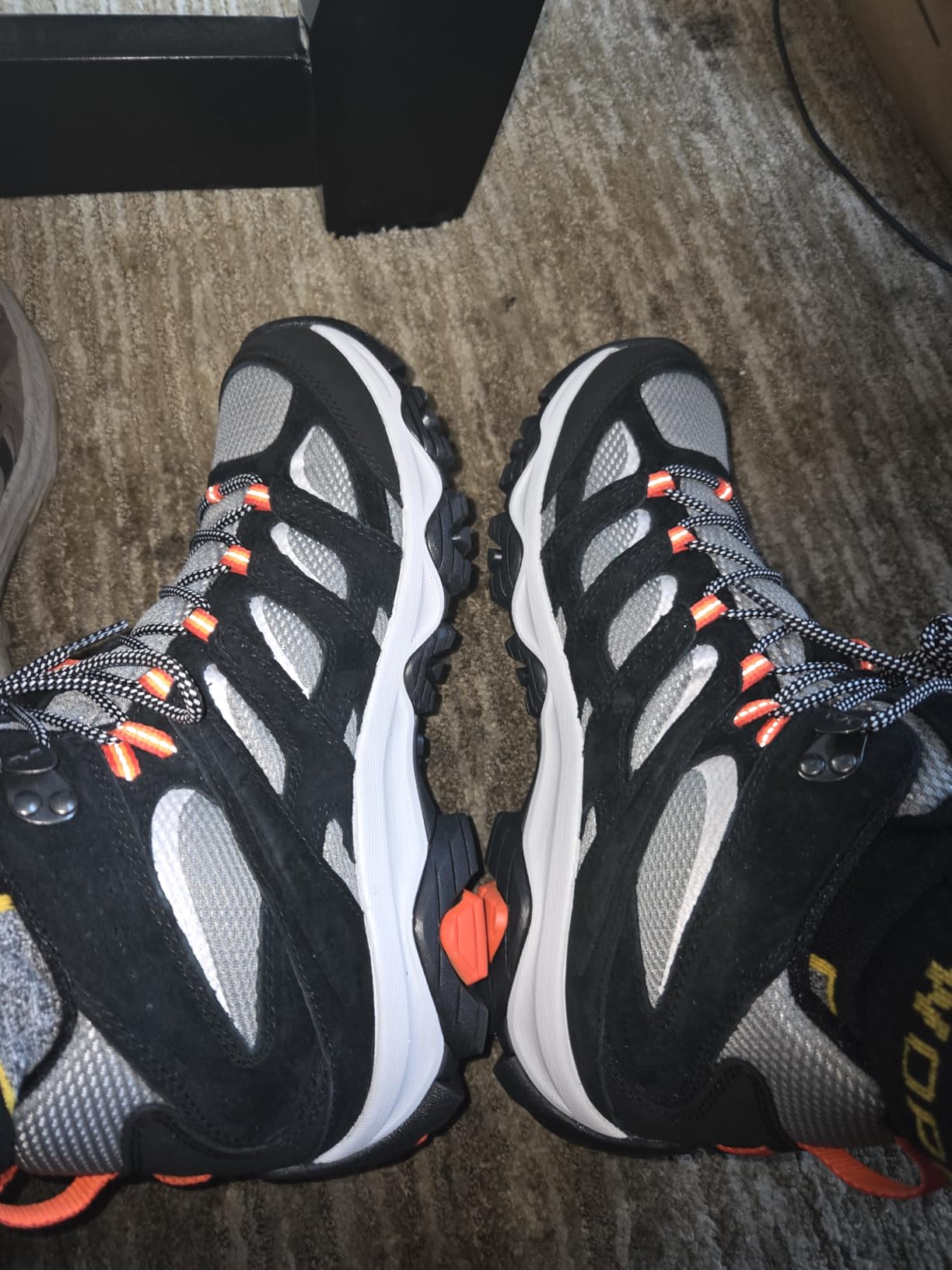
The insole is the quiet hero. It is removable and carries a noticeably high arch, and owners with third-party orthotics report that the boot accepts them without crowding the toe box. That combination is why this boot shows up in the working shortlist of flat-footed hikers who also need ankle coverage.
At 11.68 ounces it is not the lightest boot here, and reviewers with older legs describe it as solid rather than light. The ride is firm out of the box too, softening after a few miles rather than after a few hundred. Round laces are a real weakness in mud, and a small number of owners report the upper lace retention hook breaking within a few years.
What to check before you buy
Sizing runs about a half size small, and wide sizes are usually needed. If you have never worn this boot, size up before you size wide, and try it late in the day with your hiking socks on.
Only a small number of owners report waterproofing failure after roughly three years of wear, so treat the membrane as a multi-season feature rather than a lifetime one.
Who should skip it
Skip this boot if you want the lightest mid boot on the market or if you hike in hot weather with a heavy pack. It is a workhorse, and it will feel like one by the end of a long day.
If you need a cheaper entry point with wide sizing, the NORTIV 8 Ankle High below covers the same ground for far less.
2. NORTIV 8 Ankle High Waterproof – Best Value Wide-Fit Boot
NORTIV 8 Men’s Ankle High Waterproof Hiking Boots,Army/Green,14W
Upper: leather and textile ankle high
Outsole: rubber traction
Insole: removable cushioned
Pros
- Largest review base in the group
- Removable cushioned insoles
- Light EVA midsole cuts fatigue
- Very wide size range
- Ankle collar adds usable stability
Cons
- Entry-level waterproofing
- Moderate rather than technical ankle support
- Outsole durability trails premium models
- Cushioning flattens with extended use
With more than 23,000 reviews, this is the boot most people in the comments have actually lived in, and for flat feet the reason is unglamorous: it is a wide, forgiving last with a removable cushioned insole at a price that does not require a sale.
The EVA midsole is light and flexible rather than rigid, which reduces foot fatigue on long days but also means it offers less torsion resistance than a shanked boot. For a mild, flexible flat foot on maintained trail that trade is worth taking. For severe flat feet under a heavy pack, it is not.
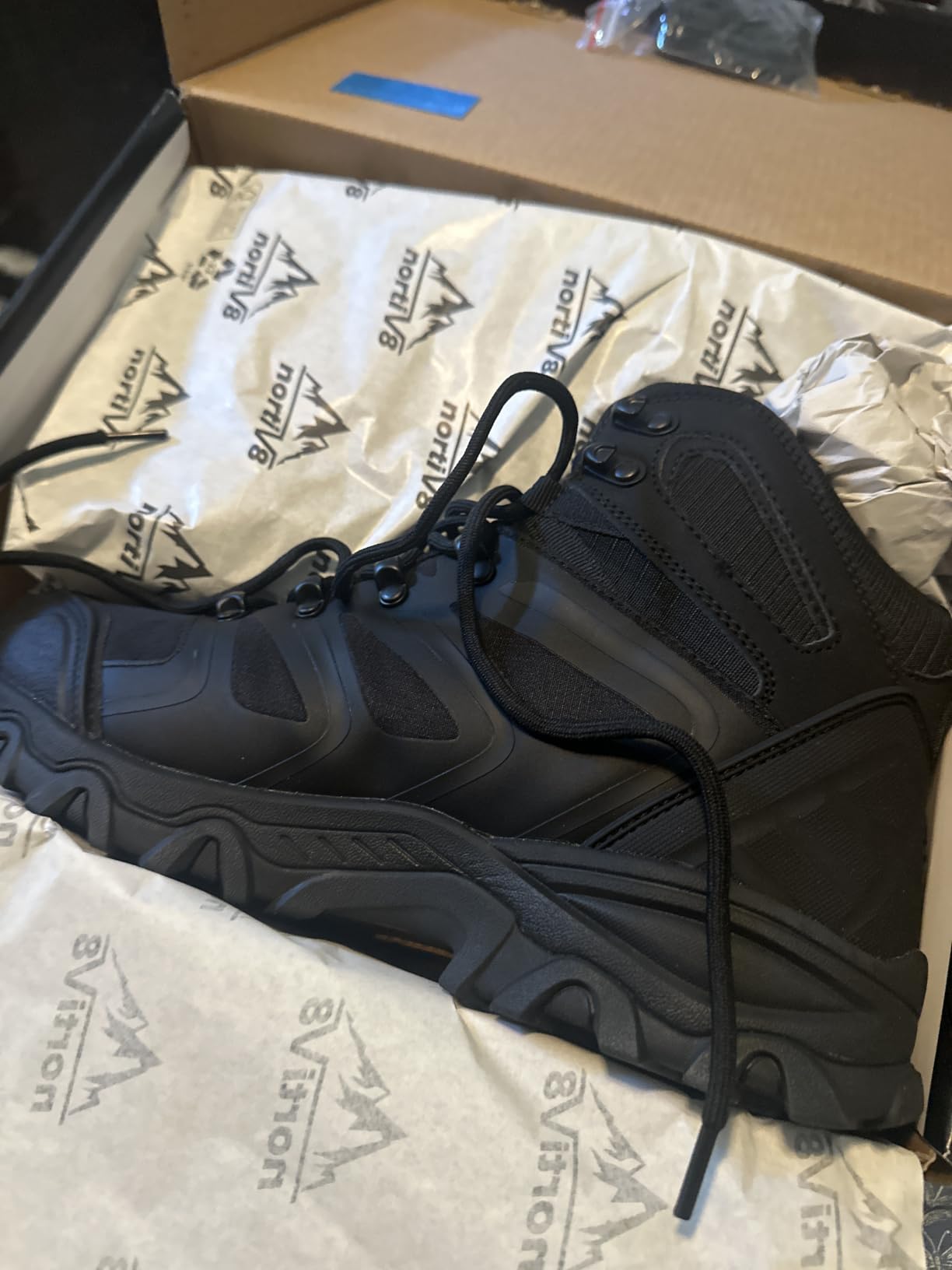
The removable shock-absorbent insoles are the part flat-footed wearers mention most, because most people simply keep them in and get a workable level of arch fill all day. Owners also praise the range of Wide options, which is unusual in a boot this inexpensive.
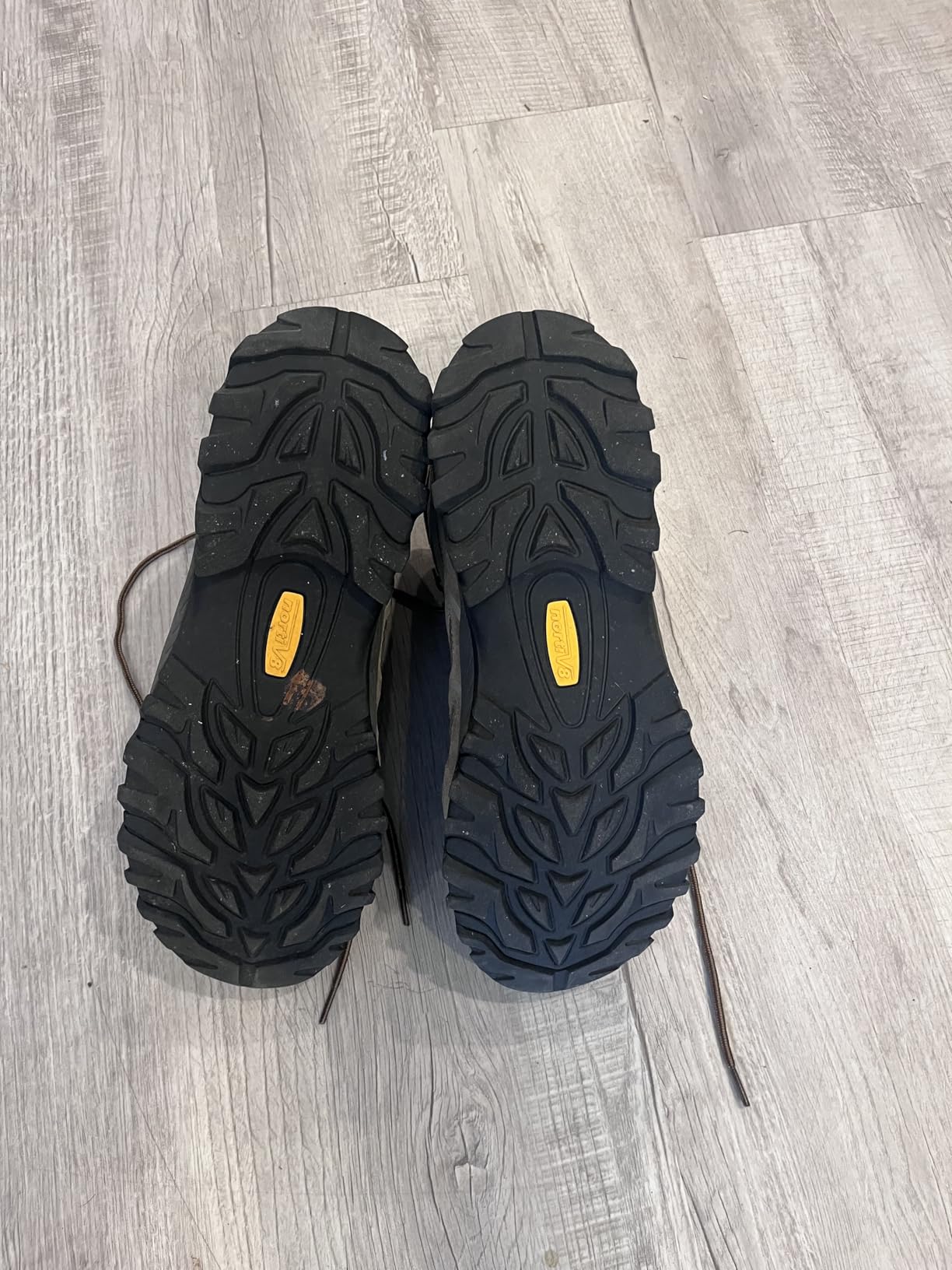
Grip is the other quiet strength. The non-slip rubber outsole holds on wet and muddy ground, and owners describe the ankle-height collar as adding useful stability without a bulky profile. The construction lists hiking, hunting, camping, climbing, cycling, fishing, trekking and everyday work wear as intended uses, which tells you how versatile the platform is.
What to check before you buy
Waterproofing here is entry-level rather than fully sealed at the standard of a premium membrane. In sustained rain and creek crossings, expect damp feet eventually.
Ankle support is moderate. If you have a history of ankle instability, add a shanked option from this list instead.
Who should skip it
Skip it for technical terrain, heavy multi-day loads, or anyone who already struggles with ankle stability. It is a support-light boot that happens to be wide and cheap.
If cushioning that lasts matters to you, the Orthofeet Hunter carries a denser orthopedic footbed and a more structured sole.
3. Columbia Newton Ridge Plus II Waterproof – Best True-to-Size Wide Fit
Columbia Mens Newton Ridge Plus II Waterproof Hiking Boot, Cordovan/Squash, 11
Upper: waterproof leather and mesh
Traction: OMNI-GRIP winter tread
Collar: rigid heel counter
Pros
- Wide sizing fits noticeably wider feet
- True-to-size fit that does not shift
- Rigid heel counter for ankle support
- Breathable mesh tongue
- Outsole tread still intact after years
Cons
- Standard sizes run narrow
- Supplied insoles are thin
- Mesh tongue soaks in sustained rain
- Can run warm indoors
Most flat-footed hikers end up fighting a half-size-small last or guessing at a size up. This boot removes that variable. Reviewers repeatedly report that the fit does not shift or slide on the foot over time, which is the single most underrated feature in a boot that has to carry a foot with no arch to hold it in place.
The rigid heel counter is listed in the specifications and owners confirm meaningful ankle support from it. That is the piece that stops the heel rolling inward mid-stride, and for overpronation it matters as much as anything under the arch.
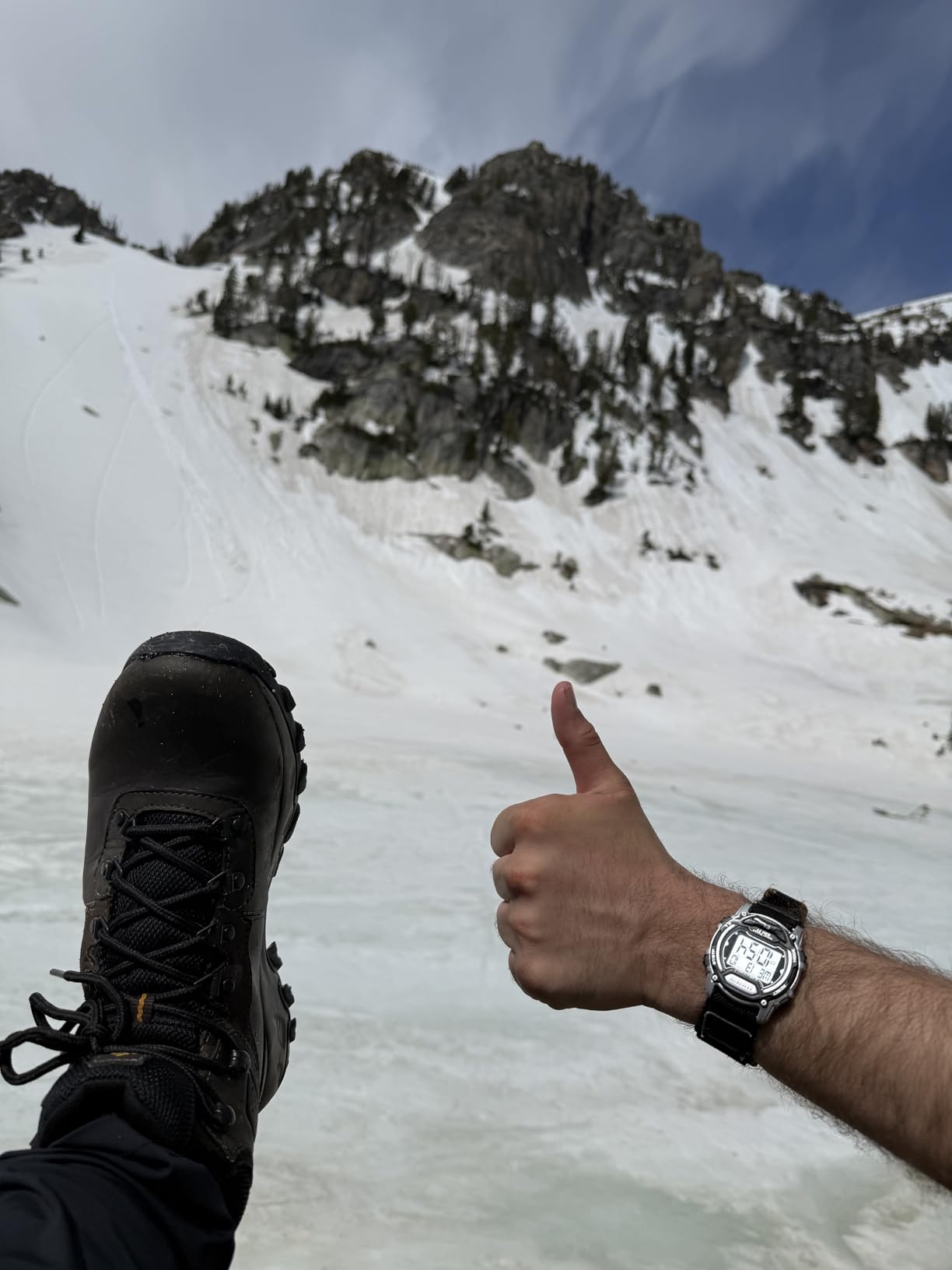
The OMNI-GRIP multi-terrain traction system with dual-zone winter tread is unusual at this level, and it means the same boot handles a summer scramble and an icy road shoulder. The lightweight cushioned midsole is described as high energy return, and owners call the boot light for its category with almost no break-in period.
Long-serving owners report the outsole tread still intact after years, which is the durability signal you want when buying a boot for daily use. The waterproof full-grain leather and mesh bootie construction holds up in rain and mud.
What to check before you buy
Standard sizes run narrow. If you have wide feet, buy the Wide version rather than sizing up, because a longer boot narrows the forefoot in exactly the wrong direction.
The supplied insoles are thin and benefit from being swapped for a cushioned orthotic. The mesh tongue is water resistant rather than fully sealed and can soak in sustained rain.
Who should skip it
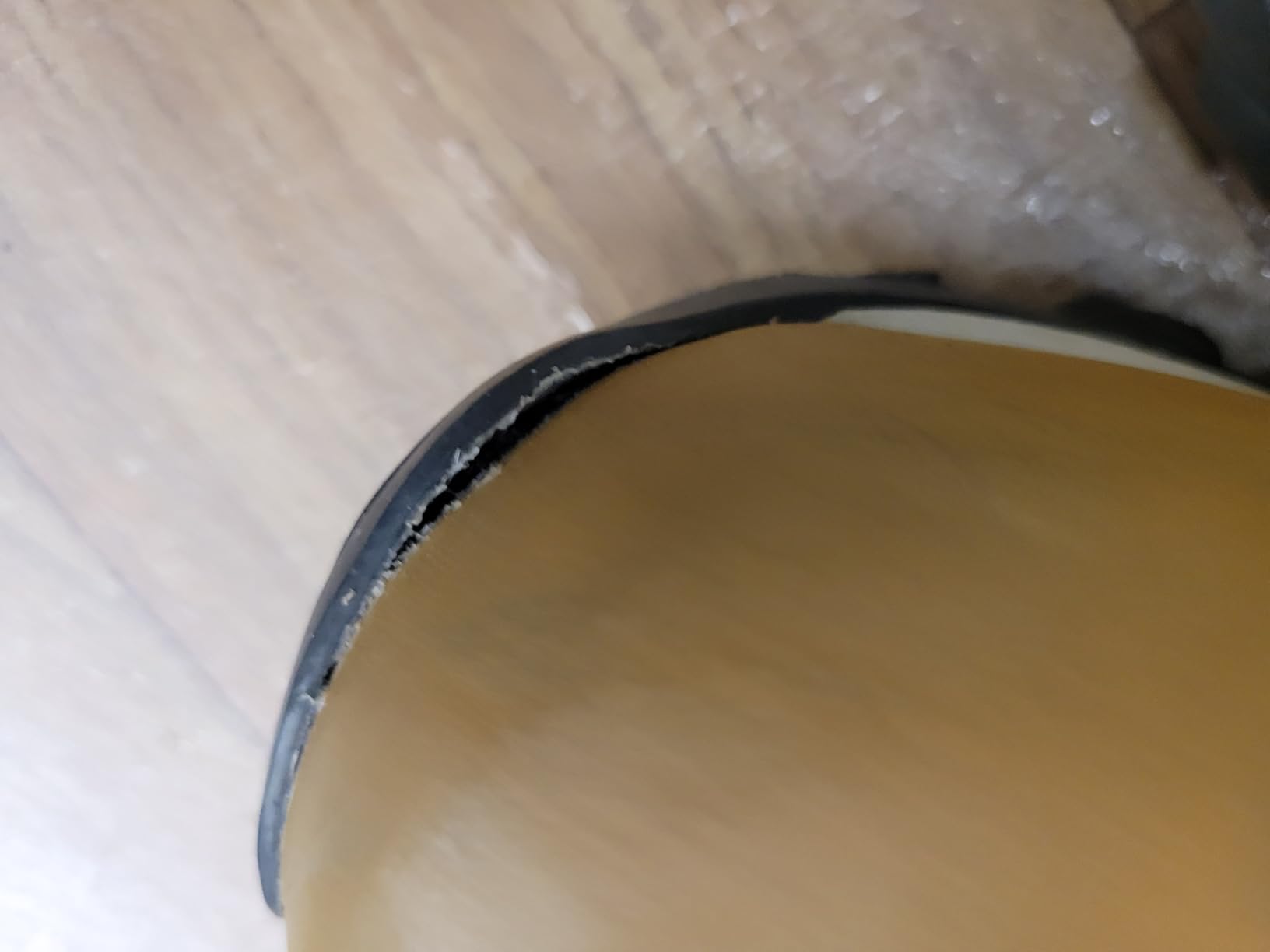
Skip it if you need a heavy-duty boot for daily work use. The PU-coated leather and soft rubber outsole limit longevity under constant wear, and it can run warm for casual indoor use.
If you want a roomier toe box than the Wide run gives you, the KEEN Targhee 4 Mid below has the most generous forefoot on test.
4. KEEN Targhee 4 Mid Waterproof – Best for Natural Toe Splay
KEEN Men’s Targhee 4 Mid Height Durable Comfortable Waterproof Hiking Boots, Triple Black, 11.5
Upper: KEEN.DRY membrane
Sole: KEEN.ALL-TERRAIN rubber
Insole: removable Luftcell
Pros
- Original Fit forefoot lets toes splay
- Removable footbed accepts orthotics
- Direct-attach build resists separation
- Reliable mud and rock grip
Cons
- Runs about a half size small
- Air-cushioned sole feels stiff and springy
- Several days of break-in needed
KEEN built the Targhee around one idea, and it is the right one for flat feet: give the toes room. Original Fit is specified as generous toe space, and wide-footed owners in the reviews report genuine satisfaction with toe room rather than a marketing claim.
The removable Luftcell footbed is the second flat-feet feature. It is described as cradling natural foot contours with genuine arch support, and because it removes, your own insert can drop straight into the same boot when a longer day calls for it.
Construction matters more here than it usually does, and this is the one boot in the group that names it. The direct-attach method bonds the midsole to the upper rather than relying on cement alone, which is exactly the failure mode that ruins otherwise good boots after a couple of seasons.
For terrain, the KEEN.ALL-TERRAIN rubber outsole grips mud and rock reliably, and a bruise plate plus high-abrasion rubber toe guard covers the front of the foot. The padded tongue and collar are the kind of detail that only matters on day four, when day-one enthusiasm is gone.
What to check before you buy
It runs about a half size small, so going up a size is commonly advised. The air-cushioned sole also feels stiff and springy rather than ground-hugging.
Plan on a break-in period of several days. For a flat foot that is not a bad thing, because a slightly tighter upper early on settles into a secure heel lock later.
Who should skip it
Skip it if you need maximum torsional rigidity under a heavy pack. The air-cushioned sole is a comfort platform, not a support platform.
It also sits at the higher end of the mid-height waterproof price band, so the Columbia above is the value route to a similar wide fit.
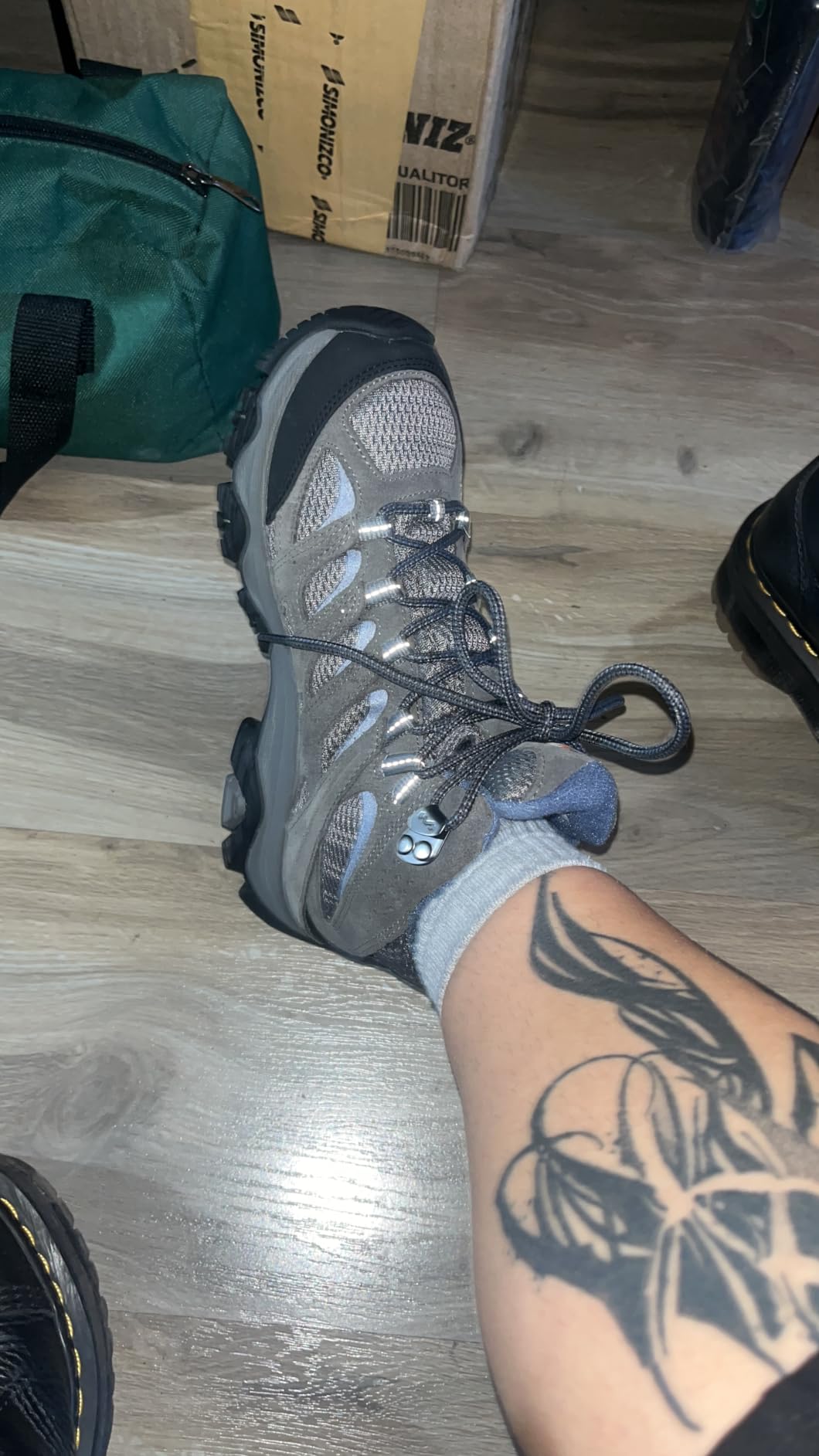
5. Merrell Women’s Moab 3 Mid Waterproof – Best Women’s Pick for Flat Feet
Merrell Women’s Moab 3 Mid Wp Hiking Boots, New Granite/Marine, 8, W, US
Weight: 1.5 lb
Upper: pig leather and mesh
Insole: removable Kinetic Fit
Shank: nylon arch
Pros
- Roomy forefoot with numerous Wide sizes
- Nylon arch shank for structured support
- Removable contoured insole
- Waterproof membrane holds in sustained rain
- Gusset tongue keeps debris out
Cons
- Molded shank is firm for some flat feet
- Half size small in this model too
- Heavier than ankle-height shoes
This is the one to look at if the standard run of men’s boots has always pinched you. It is built on a narrower female last, and the review pattern for wide-feet owners is unusually consistent: roomy forefoot, numerous Wide sizes, and no complaints about cramped toes.
It also names a real shank, which most boots in this price band do not. The molded nylon arch shank gives underfoot structure that a soft EVA midsole cannot, and the lightweight EVA foam midsole around it handles shock without collapsing.
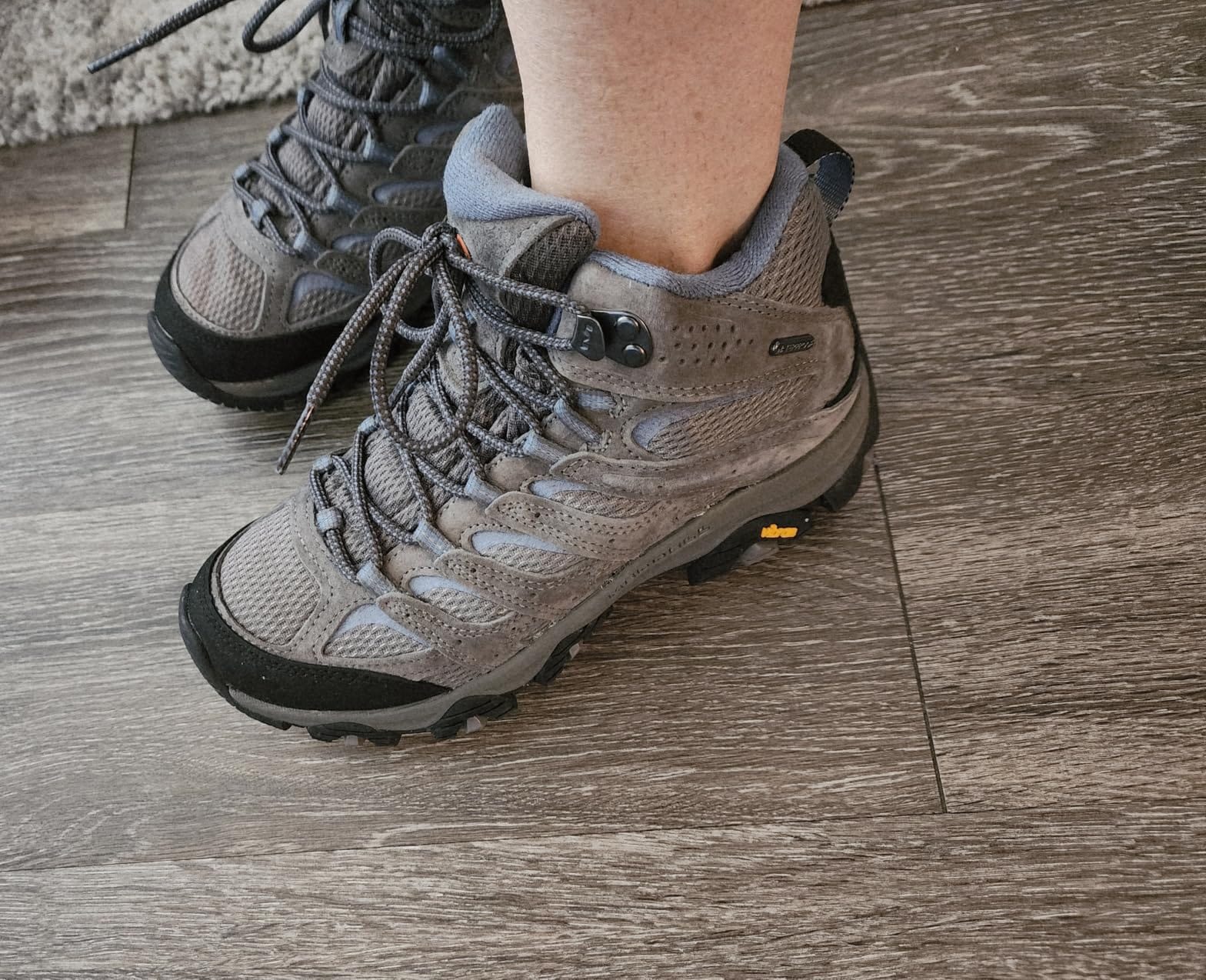
The Kinetic Fit ADVANCED insole is removable and contoured with reinforced cushioning for medium support, so you can swap in a firmer orthotic when your arch needs it and take it out again on easy days. That flexibility is the reason this boot suits flat feet with a wide range of severity.
Wet-weather performance is the other strength. The waterproof membrane keeps feet dry in sustained rain, the Vibram TC5+ outsole gives dependable traction across varied terrain, and the gusset tongue keeps debris out on long walks.
What to check before you buy
The molded arch shank is medium-firm, and some flat-footed wearers find it less accommodating than a soft orthotic. If you prefer a softer platform, remove the insole and check that your own insert has enough depth.
Sizing runs a half size small in this model as well, so treat the size chart as a starting point rather than an answer.
Who should skip it
Skip it if you want a light boot for fast day hiking. The 1.5-pound listed weight and mid-height collar make it a heavier feel than an ankle-height hiking shoe.
It also costs more than most women’s hiking boots, so if you are buying purely for everyday walking the budget wide-toe option below covers the toe room at a fraction of the outlay.
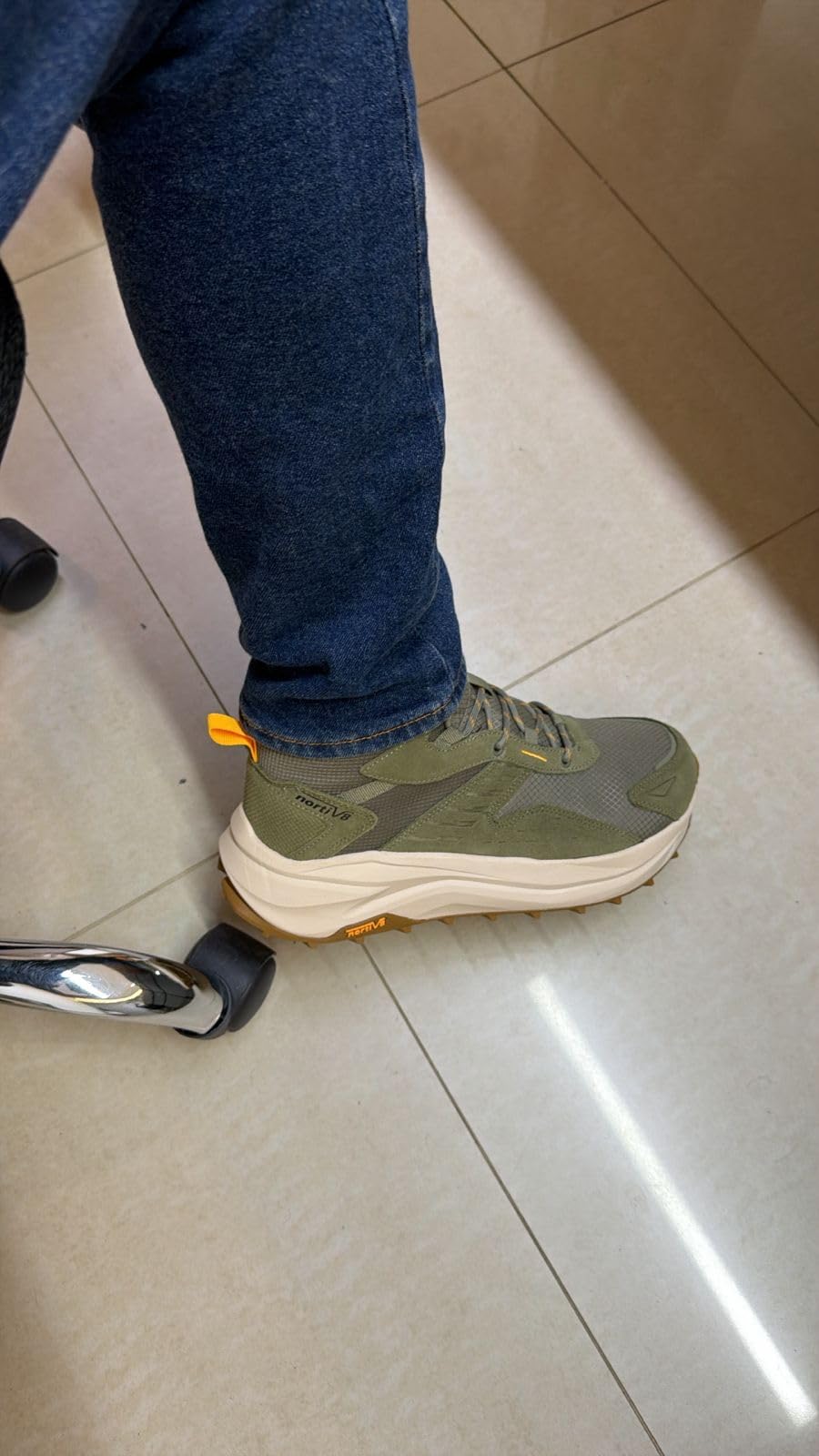
6. NORTIV 8 Wide Toe Box Hiking Boots – Best Low-Drop Wide Toe Box Boot
NORTIV 8 Men’s Wide Toe Box Hiking Boots,Coyote,11
Toe box: purpose-built wide
Geometry: 5mm heel-to-toe drop
Upper: leather, nylon, TPU
Pros
- Wide toe box is the headline feature
- 5mm drop eases forefoot pressure
- Thick EVA midsole feels springy
- Lugged outsole grips rough ground
- Wide sizes US 7-14
Cons
- Newer listing with a smaller review base
- TPU and nylon upper less durable than leather
- Low ankle collar limits technical support
Most boots in this list raise the heel. This one drops it by only 5mm, which keeps the foot closer to a natural position and eases pressure through the forefoot. For a flat foot that spends long days climbing, that geometry does quiet work that no amount of cushioning can.
The wide toe box is the headline feature and the reason it exists. Toes that can spread carry load better than toes that are crowded, and the spec sheet is explicit that the extra room improves walking balance and foot health.
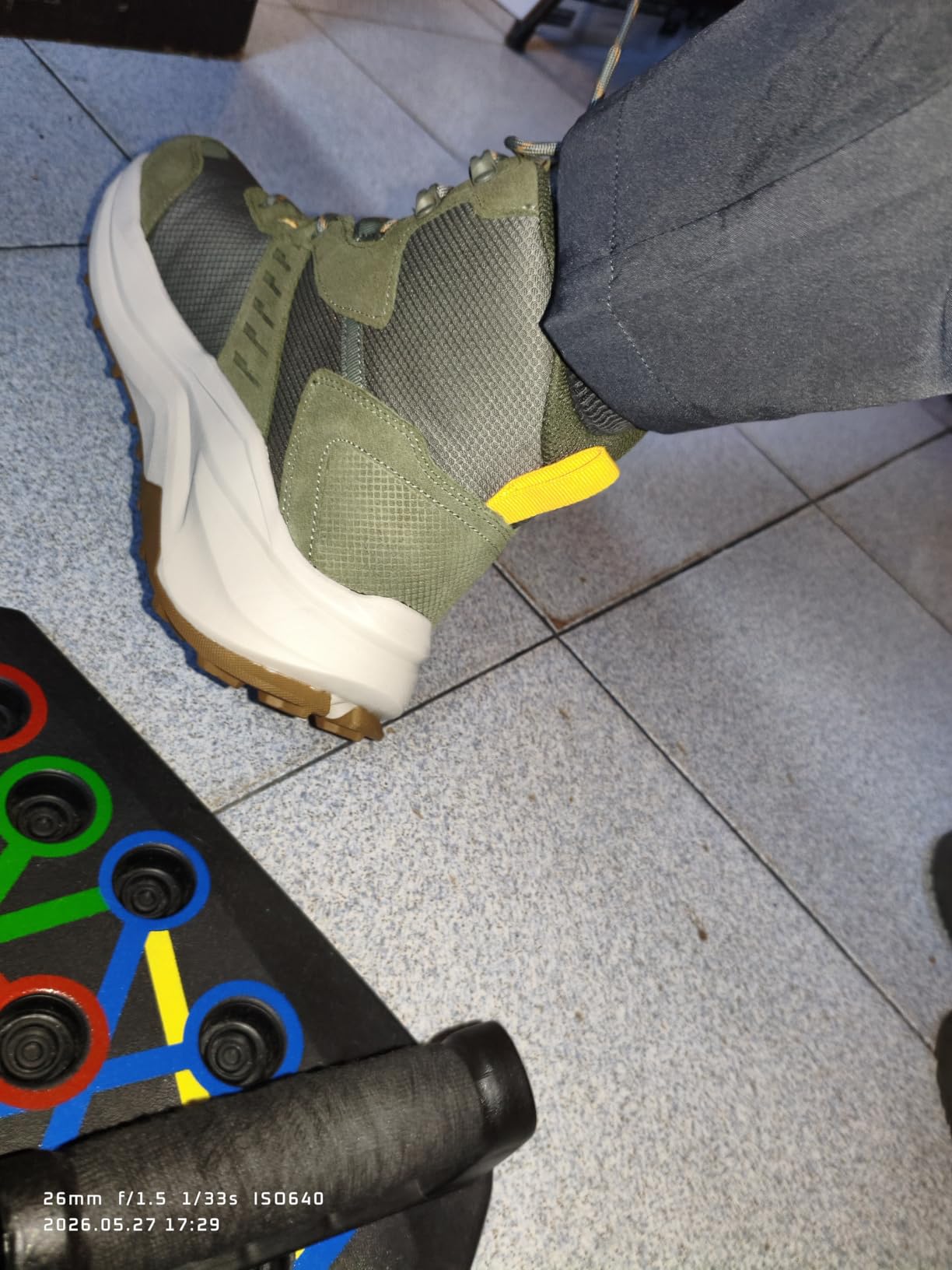
Underneath is a thick EVA midsole described as bouncy, plus a lugged rubber outsole for grip on challenging terrain. A built-in waterproof membrane has been tested for water resistance, which covers most trail weather even if it is not a sealed premium membrane.
The wear-resistant upper combines leather, nylon fabric and supportive TPU. That blend keeps weight down but is the reason this boot belongs on trail and everyday walking routes rather than on a heavy backpacking load.
What to check before you buy
The low-drop design is not ideal for steep descents for some wearers, because it removes the heel wedge that normally brakes on the way down. If descents are your main terrain, test it before committing.
It is also a newer listing with a smaller review base than the long-running models in this group, so long-term durability is less well established.
Who should skip it
Skip it for backpacking with a heavy pack or for technical terrain. The ankle collar is fairly low, and the TPU and nylon upper is less supportive under load than full-grain leather.
If you want the same wide forefoot with a genuinely waterproof membrane and a firmer underfoot structure, the KEEN Targhee 4 Mid above is the stronger buy.
7. Orthofeet Hunter Orthopedic Hiking Boots – Best for Plantar Fasciitis Relief
Orthofeet Hunter Orthopedic Men’s Hiking Boots, Olive, Size 10 Wide
Insole: orthotic with arch support
Upper: leather, suede, fabric
Fit: true to size, wide
Pros
- Anatomical orthotic insole genuinely supports flat feet
- True-to-size wide toe box
- Sturdy leather and suede construction
- Light flexible upper cuts fatigue
- Deep lug traction
Cons
- Runs very wide even in standard width
- Half size long
- Thin soles with minimal ankle rigidity
- Leather traps heat in warm weather
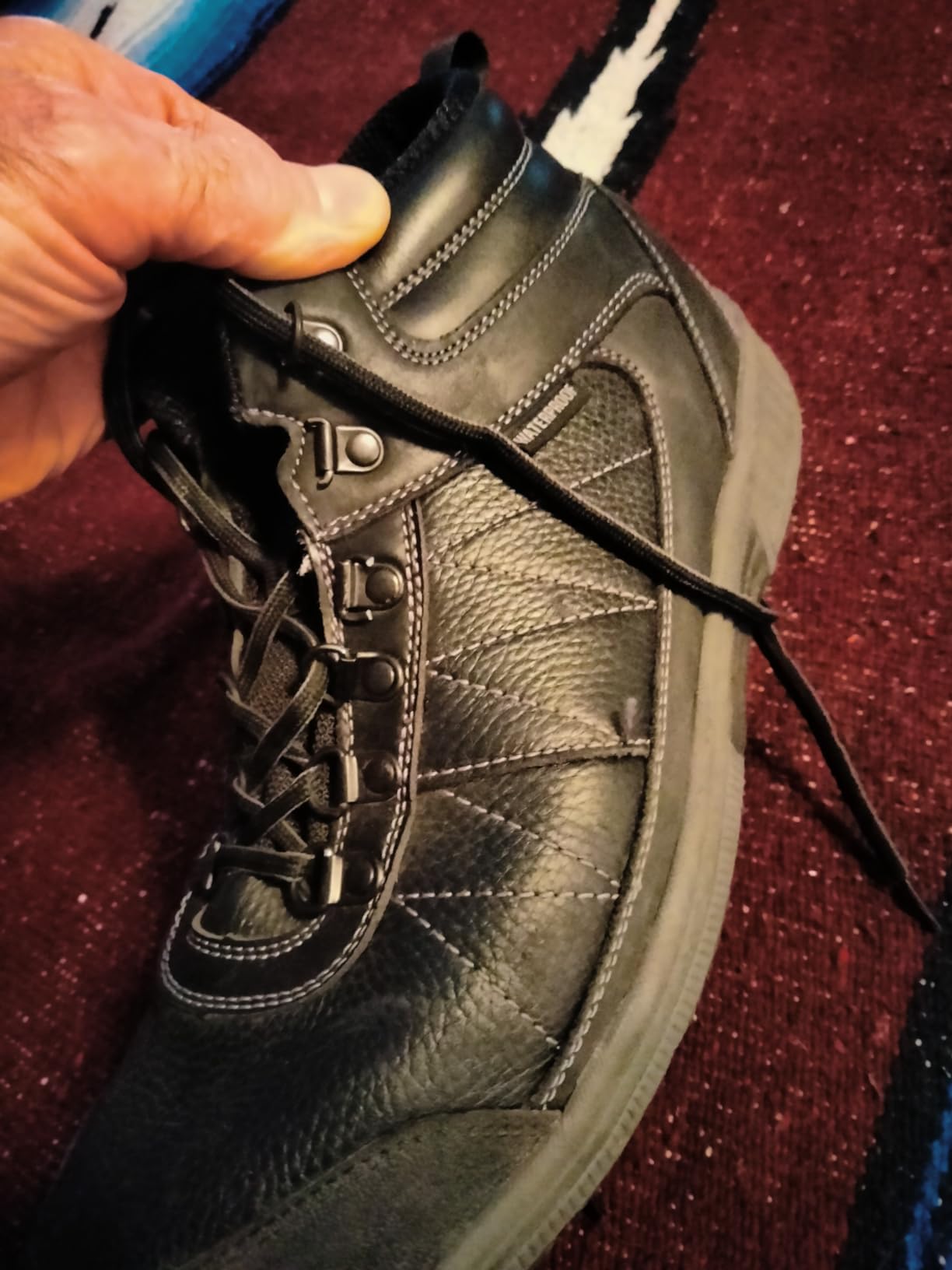
This is the boot for people whose flat feet already have a name. The insole is a premium orthotic with anatomical arch support designed for foot alignment and even weight distribution, and the brand states flat feet, overpronation, heel pain, bunions and plantar fasciitis as the conditions it targets.
Buyers with genuine orthopedic needs report the arch support as the thing that changed their walking. That is the honest test of a boot in this category: not comfort, but whether the arch stops aching by mile two.
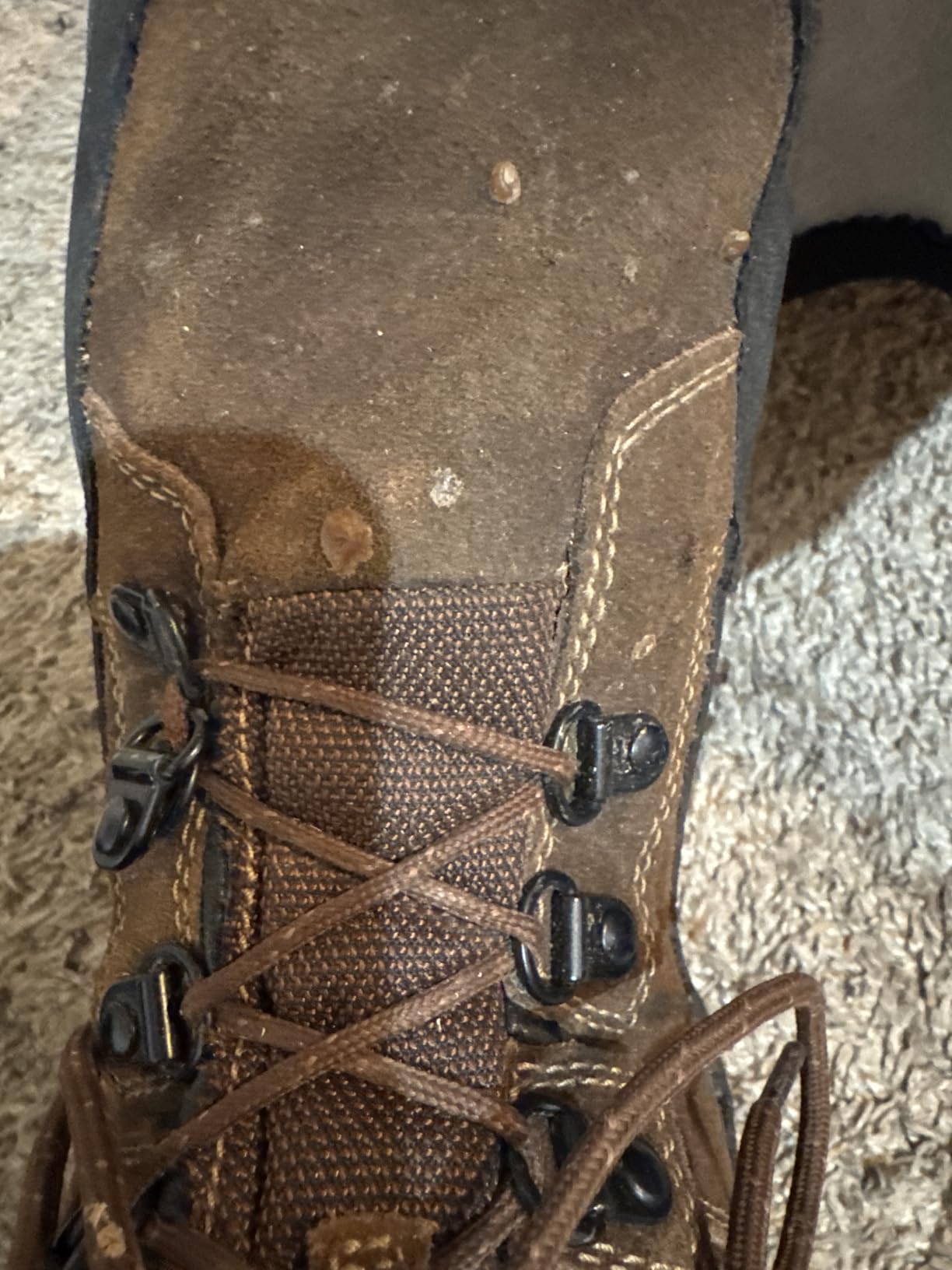
The fit is the second strong point. It is true to size with a wide toe box, so you are not guessing at a size up to get room, and the leather, suede and fabric upper is sturdy enough to look like ordinary footwear in a casual setting.
On the trail, deep lugged tread grips dirt, gravel and uneven trails, and the lightweight flexible upper reduces fatigue on long days standing or walking. The one weakness is structural: the soles are thin and offer minimal ankle rigidity for technical hiking.
What to check before you buy
It runs very wide even in the standard width, so if your feet are narrow this will feel loose, and it also runs about a half size long. Metal lace loops have snapped for some owners after about a year.
The leather upper traps heat and causes heavy sweating in warm weather, so this is a three-season boot for most climates.
Who should skip it
Skip it for technical hiking where ankle rigidity matters, and skip it if a sleek profile matters. Several buyers also report a short service life relative to the price.
For a wet-weather version of the same orthopedic platform with a venting membrane, the Ridgewood below is the direct upgrade.
8. Orthofeet Ridgewood Orthopedic Hiking Boots – Best Waterproof Orthopedic Boot
Orthofeet Ridgewood Orthopedic Men’s Hiking Boots, Brown, Size 14
Upper: leather with venting membrane
Insole: orthotic with arch support
Sole: deep lug
Pros
- Orthopedic insole with anatomical arch support
- Waterproof venting membrane stays breathable
- Wide toe box
- Deep lug grip on rock and mud
Cons
- Very high price for a hiking boot
- Runs wide for narrower feet
- Low review volume
- Bulky appearance
The Ridgewood is the wet-weather answer for flat feet that need real arch support. It uses the same orthopedic platform as the brand’s better-known models, with a premium orthotic insole built around anatomical arch support for alignment and even weight distribution.
What it adds over the Hunter is the membrane. The premium leather upper carries a moisture-venting waterproof membrane, so you get sealed weather protection that still lets vapour out, which is the single most common complaint people have about fully waterproof boots.
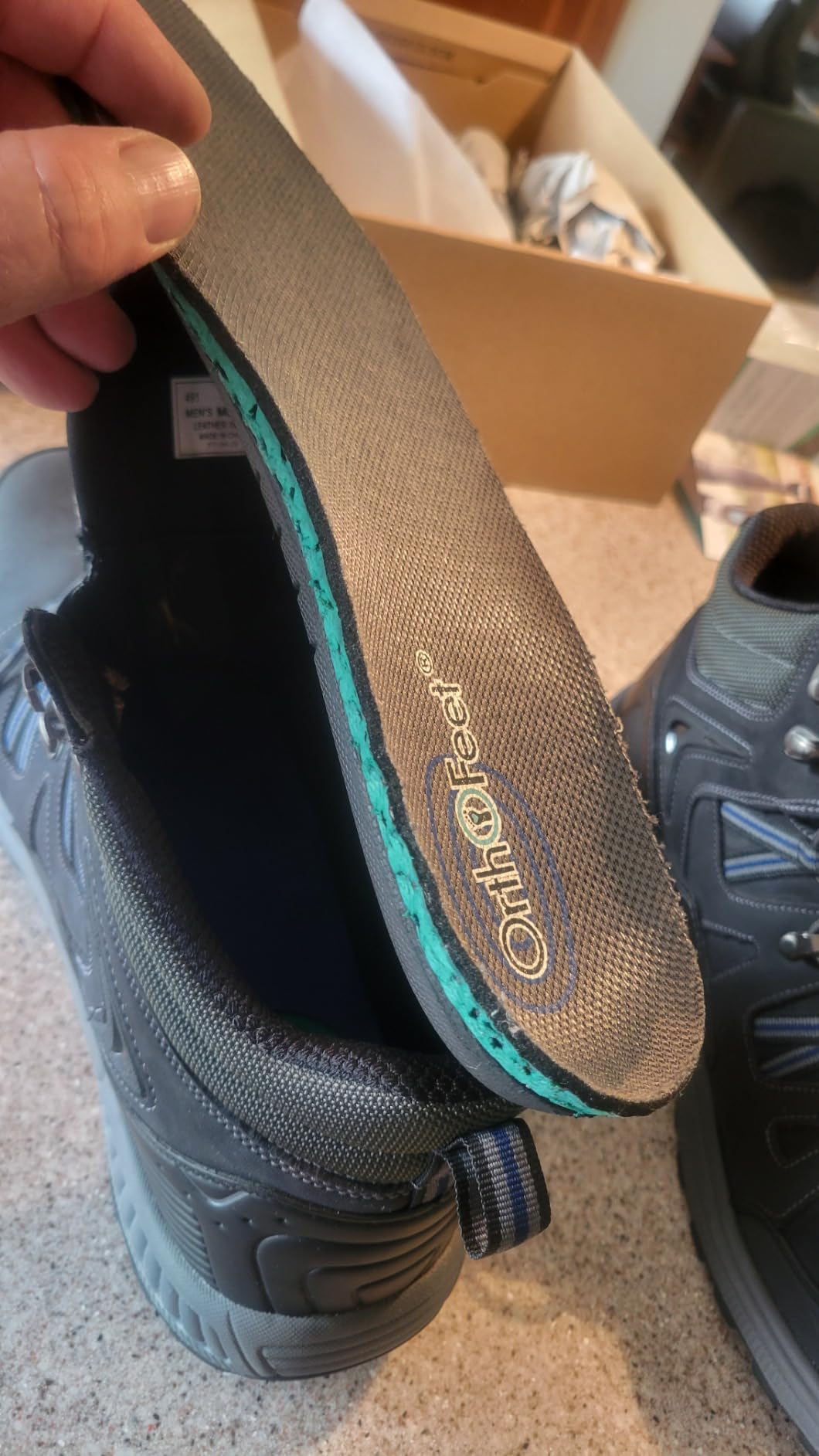
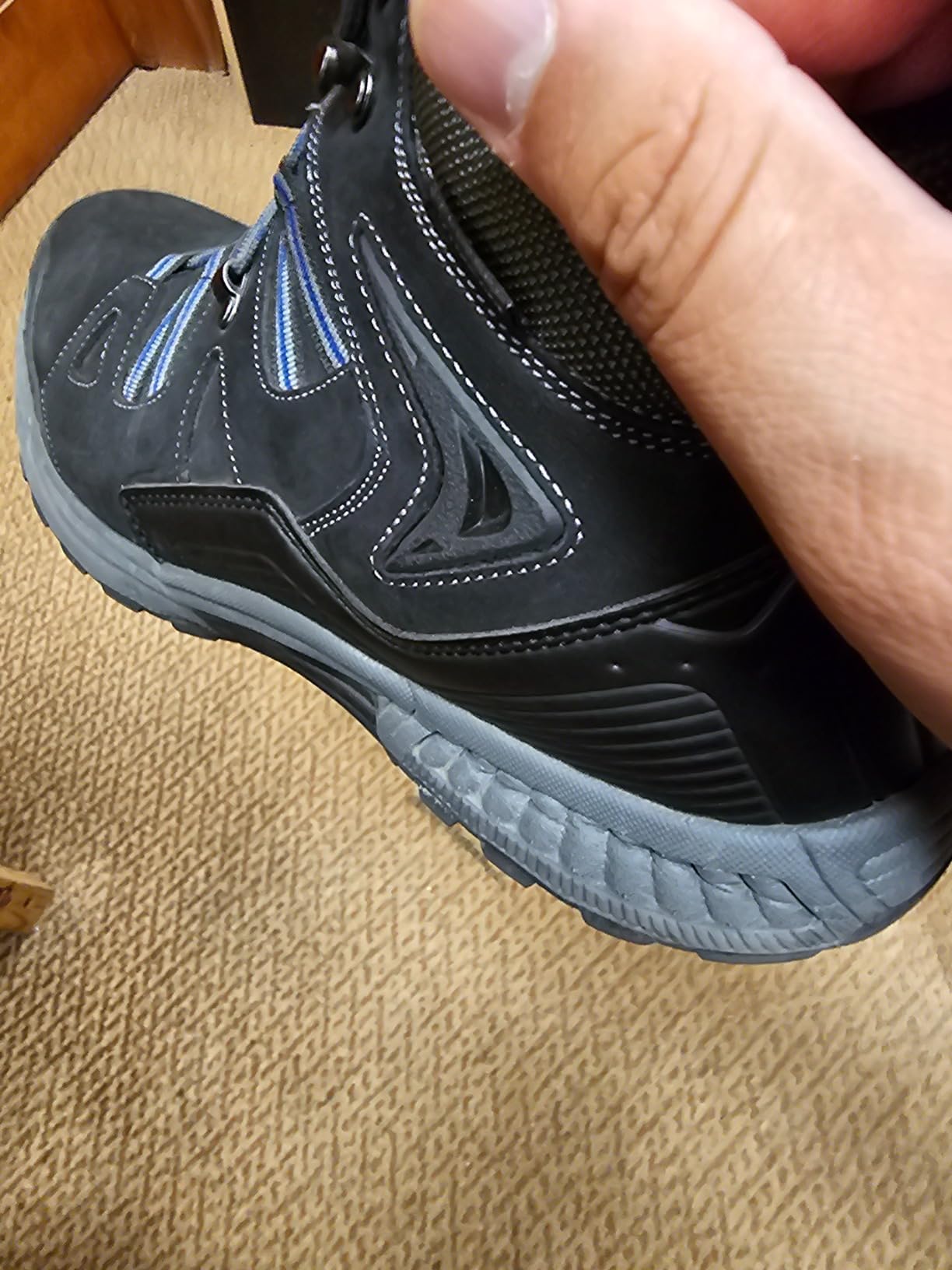
Underneath, a deep lug sole grips rocky terrain, mud and uneven surfaces, and multilayered cushioning sits between the footbed and the ground. Wearers with flat feet, overpronation and heel pain rate the arch support as the reason they keep coming back to this boot.
It is true to size with a wide toe box, so the room for toe splay does not require a size up. That combination of a genuine wide last and a genuine orthotic is rare at this level and it is why this boot is worth the money for anyone whose feet are flat all day.
What to check before you buy
It runs wide, so buyers with narrower feet may need to size down. The bulky appearance also limits everyday style use if you plan to wear it off trail.
Review volume is low compared with mainstream hiking boot brands, so you are buying on a thinner evidence base than the price suggests.
Who should skip it
Skip it if you are on a tight budget or if you only hike in dry weather. The Hunter above delivers the same orthopedic footbed without the membrane premium.
If your need is arch support on a walking shoe rather than a boot, our arch support shoes guide covers the same principle in lower-cut footwear.
9. KEEN Hightrail Mid Waterproof – Best Lightweight Stability Boot
KEEN Men’s Hightrail Mid Height Durable Lightweight Breathable Leather Waterproof Hiking Boots, Brindle/Oak Buff, 10.5 WIDE
Upper: LWG leather with KEEN.DRY
Outsole: 4mm multi-direction lugs
Insole: removable
Pros
- Wide versions fit wide feet with room for expansion
- Stability shank stops rollover
- Removable footbed holds its cushioning
- Waterproofing works in snow and rain
- Roomy heel with no slippage
Cons
- Milder waterproofing than the Targhee line
- Less aggressive grip on ice
- Narrower toe box than other KEEN models
- Thin air cushioning over sharp rocks
The Hightrail Mid is the light middle ground in this list. It carries a stability shank for lightweight underfoot support on uneven surfaces, which is the feature that matters for flat feet, and the KEEN LuftCell cushioning uses micro air pockets to keep weight down and rebound up.
One review is worth repeating because it answers the width question concretely: a 10.5 Wide fitting a 9.5 W foot with room for foot expansion. That is what you want from a hiking boot, because your feet swell over a long day.
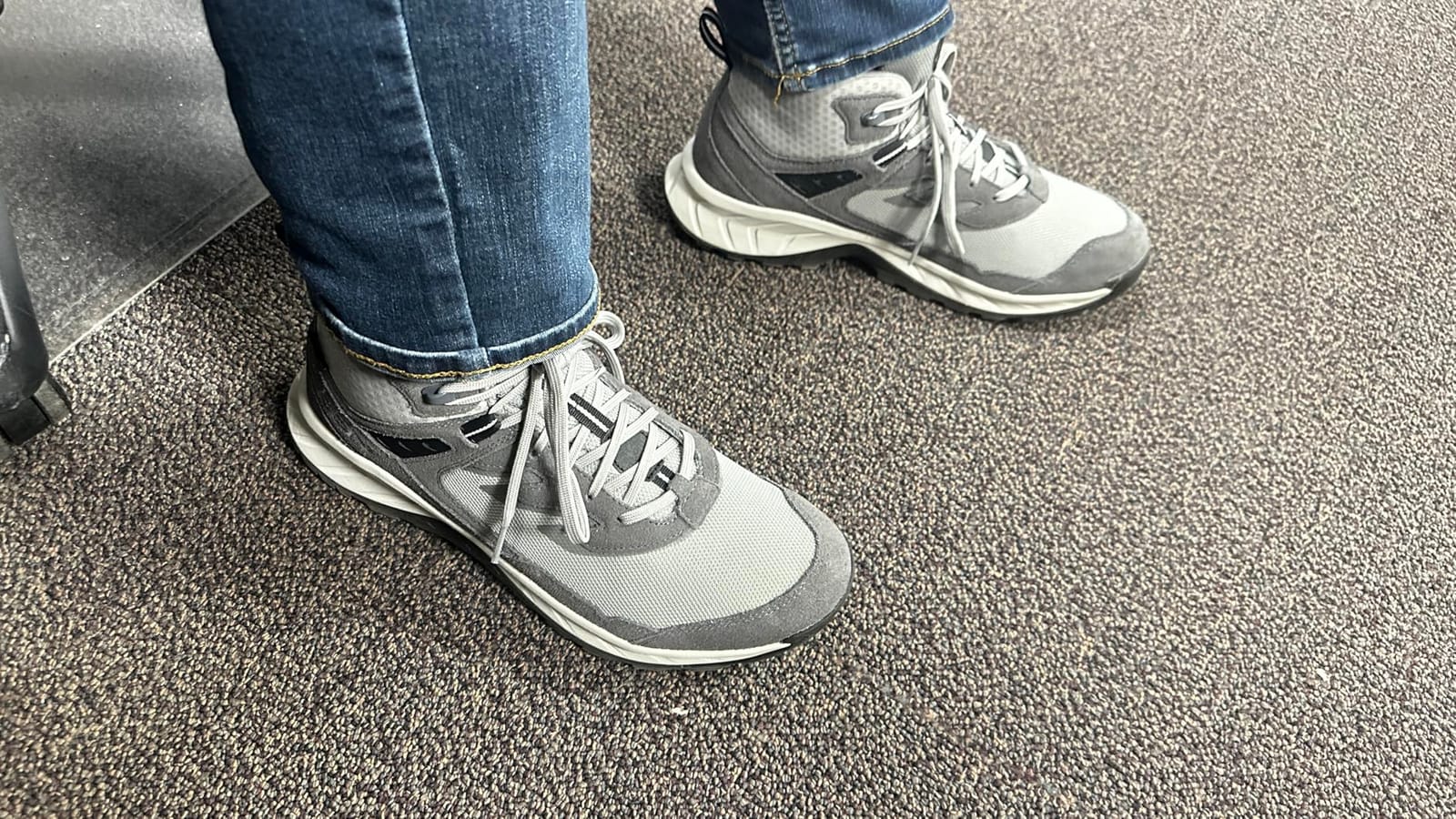
The KEEN.DRY membrane performs well in snow and rain, with one owner reporting successful use above the tree line. The removable responsive footbed resists quick compression, so the support does not flatten out after a month of daily use, and the roomy heel delivers ankle support without slippage.
Construction is durable leather from Leather Working Group certified tanneries, and the Contoured Fit follows the natural shape of the foot rather than a generic last. Owners also report an absence of the sliding-within-the-boot problem that ruins many mid boots on descent.
What to check before you buy
Waterproofing is milder than KEEN’s Targhee line in some reports, and the grip is less aggressive on slippery or icy surfaces. The toe box is also narrower than some other models in the range.
Two smaller issues appear repeatedly: inside lace hooks that catch on the other boot while walking, and a raised ridge in the midsole cushioning reported by a few owners after a couple of months.
Who should skip it
Skip it if you walk icy trails regularly or if you need protection from sharp rocks. The air-cushioned sole gives little of either.
For genuine toe splay, move up to the Targhee 4 Mid above, which has the roomier forefoot.
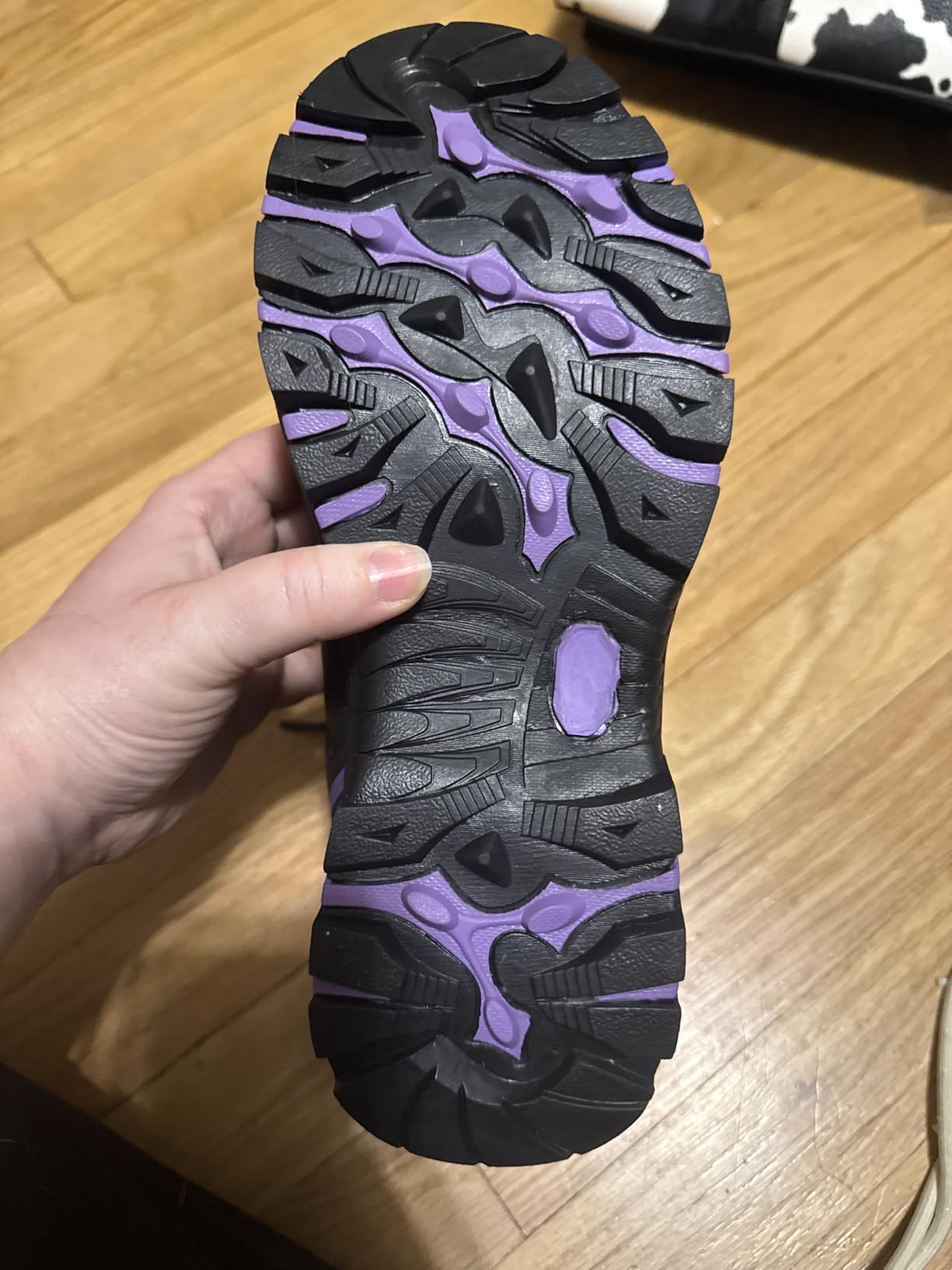
10. Women’s Wide Toe Box Hiking Boots – Budget Pick for Wide Feet
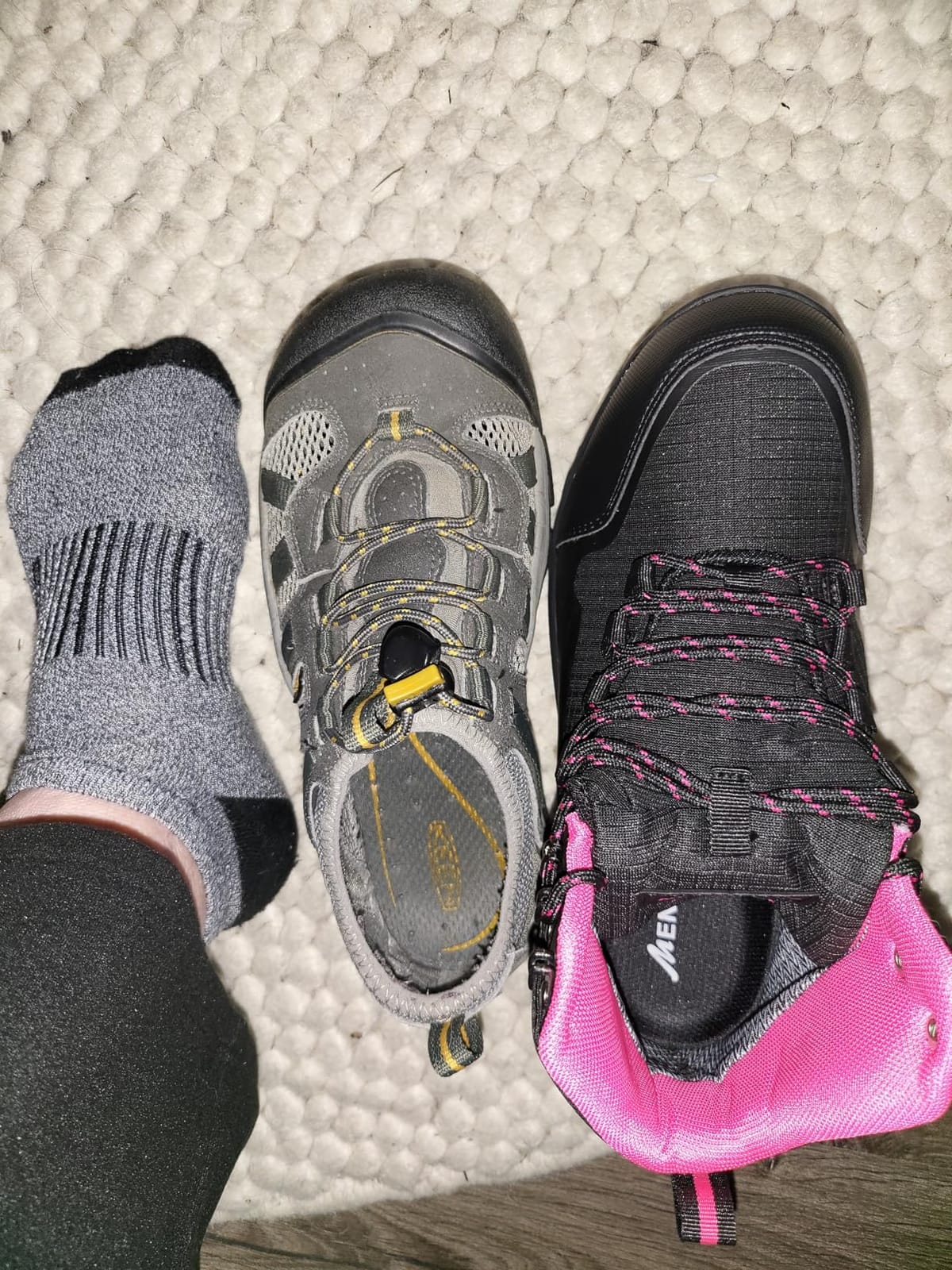
MENYBAN Women’s Waterproof Wide Toe Box Hiking Boots,Purple,7.5W
Toe box: widened for toe splay
Weather: waterproof for rain and snow
Sizing: Wide US 5.5-11
Pros
- Widened toe box gives real toe splay
- Lowest outlay in this roundup
- Waterproof protection holds in rain and snow
- Stable engineered tread
- Wide sizes across most of the range
Cons
- Smallest review base in the group
- Minimal cushioning for trail use
- Limited arch support for pronounced flat feet
- Casual styling
If toe room is the problem, this solves it for very little money. The widened toe box allows natural toe splay and gets more relief than you would expect at this price, and that single change removes the forefoot pinch that drives flat feet to compensate.
Waterproof protection is specified for rain, snow and puddles, and the engineered tread is built for stability and grip on varied terrain. It is a boot for walking around a wet campsite as much as for a trail, and it does both adequately.
Wide sizes run from US 5.5 to 11, which covers most of the women’s range that buyers ask about, and the colour options are practical rather than technical.
The honest limit is the interior. Cushioning is minimal compared with boots built specifically for trails, and the likelihood of meaningful arch support for pronounced flat feet is low. This fixes toe room and weather, not the arch.
What to check before you buy
It has the smallest review base in this group, so long-term durability is far less established than the numbers on the other picks suggest. Expect less cushioning over distance than any boot here.
If your flat feet are pronounced rather than mild, plan on adding your own insert immediately.
Who should skip it
Skip it for backpacking, technical terrain, or long days on rough ground. The styling is casual rather than technical, and the sole is not built for sustained load.
If you need arch support as much as toe room, the Merrell Women’s Moab 3 Mid above is the correct upgrade at both ends of the day.
11. OrthoComfoot Mid Trekking Hiking Boots – Best for Adjustable Insoles
Men’s Orthopedic Waterproof Wide Comfortable Hiking Boots: Fit Orthotic Arch Support Plantar Fasciitis Orthotic Metatarsal Trail Sneakers, Indoor Working Camping Training Ankle Boots Black Size 11.5
Insole: adjustable orthopedic inserts
Support: ankle support design
Sole: cushioned non-slip
Pros
- Orthotic insoles ease plantar fasciitis pain
- Inserts can be tuned to the fit
- Soft ankle support that is not rigid
- Breathable upper for long walks
Cons
- Build quality is thin with early tearing
- Water resistance is minimal for a hiking boot
- Ankle support is moderate
- Not built for high-mileage walking
This boot is designed around the insert rather than the upper. The orthopedic design is tailored for plantar fasciitis and high-arch pain with orthotic insoles that align the foot, and the inserts themselves are adjustable, so you can tune the fit rather than accepting whatever came in the box.
Users report noticeable relief for plantar fasciitis and heel pain, and describe the ankle support as soft rather than rigid. That soft-but-present support is a reasonable middle ground for a flat foot that needs guidance without a rigid cage.
The breathable construction is intended to keep feet dry in wet conditions, and it works well enough that wearers report comfort on long walks. The cushioned non-slip sole is designed for extended use, and the listing positions the boot across running, cross-training, hiking and everyday wear.
Wide width options are available, which matters more for flat feet than the product name suggests. A boot with a cramped forefoot undoes everything the insert is doing.
What to check before you buy
Build quality is the weak point. Several owners report tearing or separation after a couple of months, and the boots are not built for daily high-mileage walking given that rate of wear.
Water resistance is minimal despite the hiking-boot positioning, so treat it as a walking shoe for dry-to-damp conditions.
Who should skip it
Skip it for backpacking, wet-season trail work, or anyone who needs substantial ankle support. The rating band is the lowest in this group, and the durability complaints are consistent rather than isolated.
If plantar fasciitis relief is the priority and you need a boot that will last, the Orthofeet Hunter above is the sturdier platform.
12. OrthoComfoot Orthopedic Hiking Boots – Best Boot-to-Sneaker Switch
OrthoComfoot Mens Fashion Plantar Fasciitis Hiking Boots, Orthopedic Arch Support Comfortable Winter Working Sneakers Waterproof Black Size 9
Insole: removable high-arch TPU core
Upper: canvas and cow suede
Heel: drop-down conversion
Pros
- Removable high-arch insoles with a real TPU core
- Plenty of toe box room for flat feet
- Comfortable through 12-hour standing days
- Water-resistant upper
- Second insert set included
Cons
- Runs large so size down
- Lace eyelets can pull out
- Uppers and seams reported failing early
- Ankle support is soft not ridged
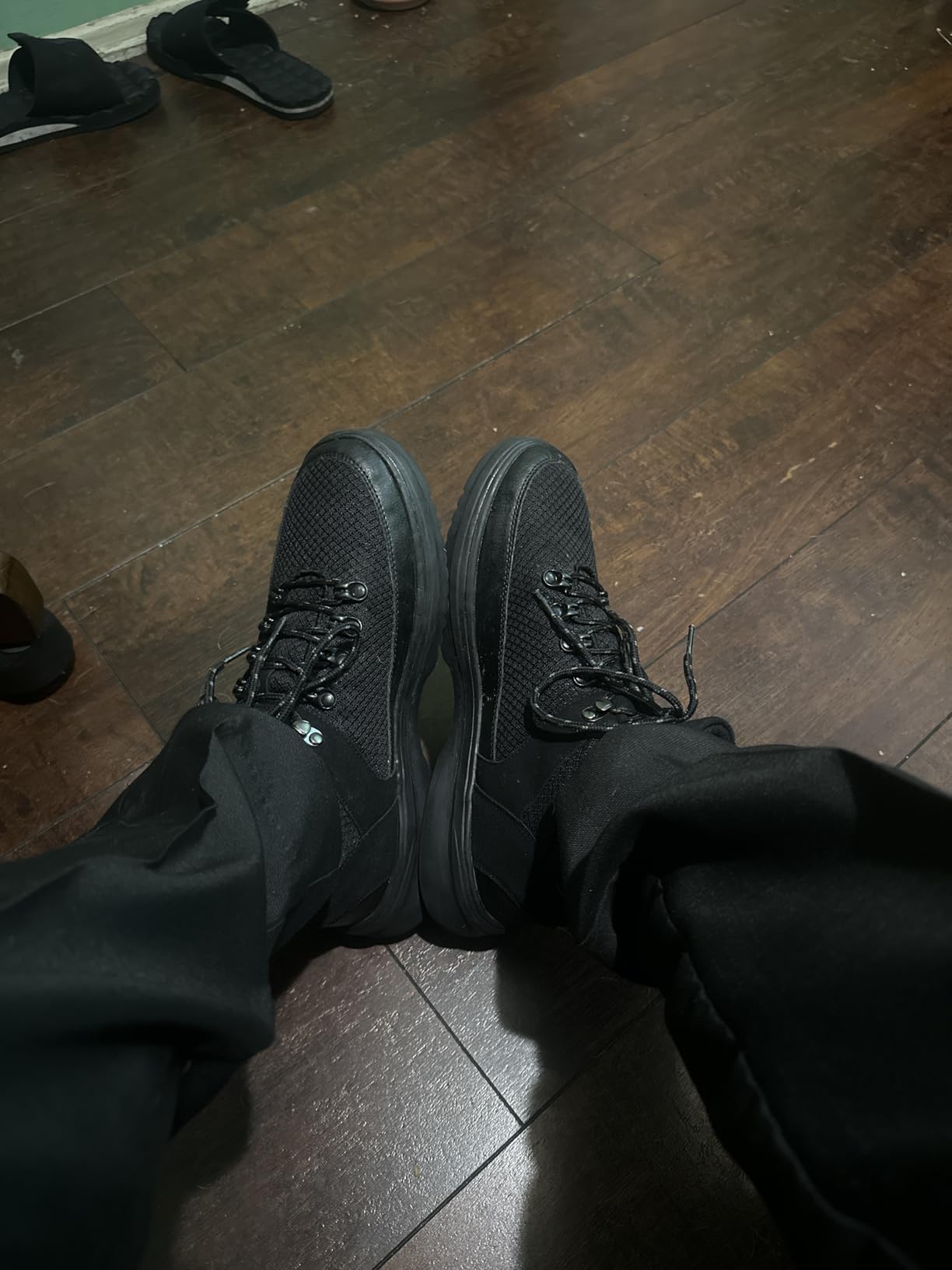
The removable insole here is the most technically interesting in this group. It pairs a hard TPU arch piece over a cushioning PU memory foam base, which is the same construction a prescription orthotic uses, and a second set of inserts comes in the box so you can change the arch height without buying anything else.
Flat-footed wearers repeatedly praise the toe box room, and the boot is comfortable through long shifts and 12-hour standing days. That combination of roomy forefoot plus swappable arch fill is the reason it earns a place in this roundup despite the construction complaints.
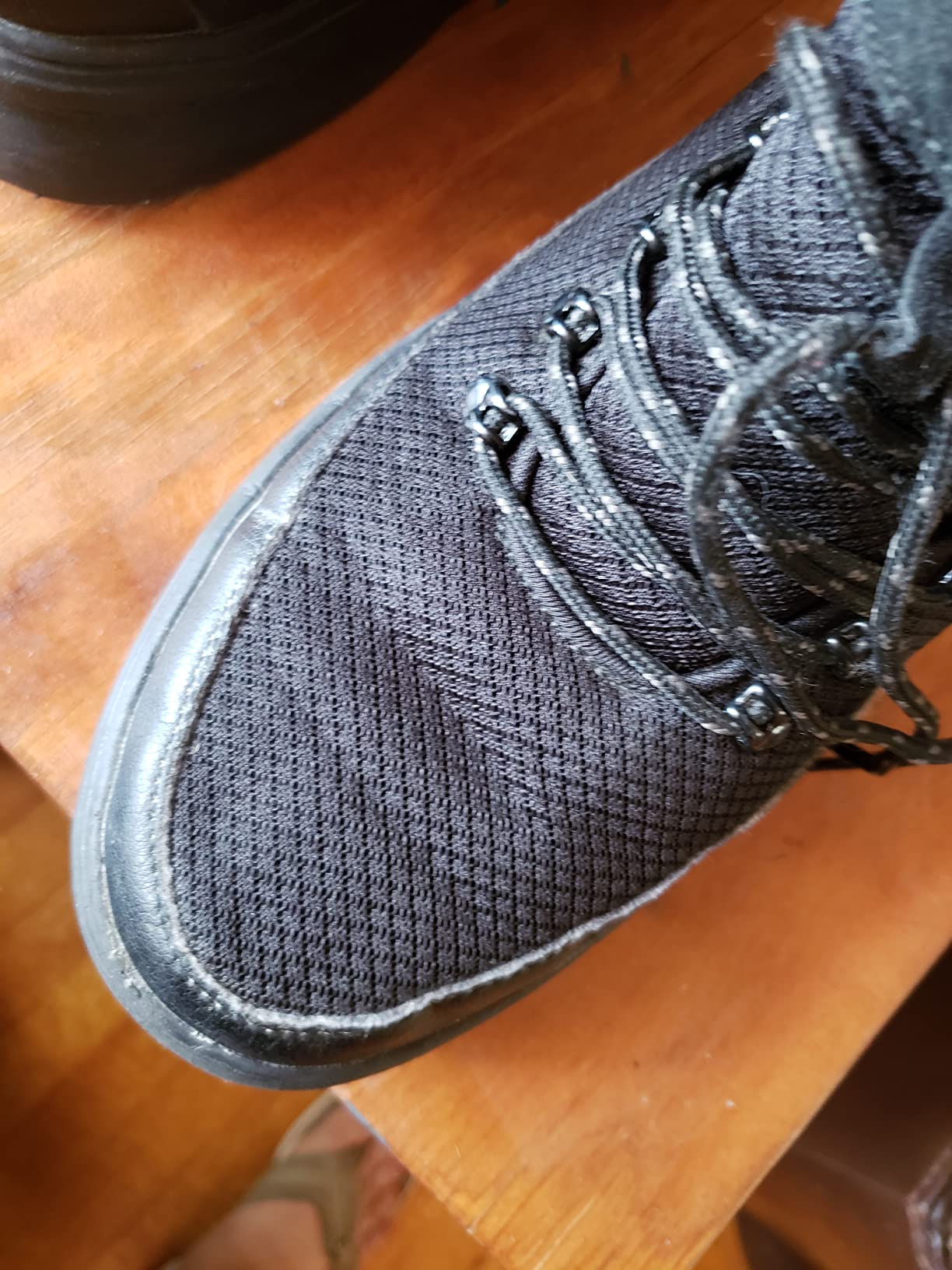
The drop-down heel converts the shoe between a low sneaker and an outdoor boot, so it works as everyday footwear as well as trail footwear. The water-resistant upper holds up in rain and shallow puddles, and the EVA outsole with a serrated tread pattern gives traction across terrains.
Be realistic about the trade. Construction quality is the main weakness: eyelets can pull out of the canvas, and multiple owners report holes and separation within a couple of months. The arch insert also does not suit every foot type, with some users finding the supplied inserts painful.
What to check before you buy
It runs large, so several buyers needed to size down. The soft ankle support is not what a high-top buyer is really getting, and the boot can squeak with wear.
Ask yourself honestly whether the stock insert works for you. The TPU arch core is firm, and a flat foot that does not tolerate firm arch fill will need softer inserts.
Who should skip it
Skip it for wet-season backpacking, long-distance hiking, or any terrain where early failure would be costly. This is a comfort boot for daily wear, and it is best treated as one.
For the same orthopedic logic in footwear built for a cross-training environment rather than a trail, see our cross training shoes for flat feet.
How to Choose Hiking Boots for Flat Feet
Flat feet, wide feet and high arches are three different problems
Flat feet, wide feet and high arches get lumped together constantly, and treating them as one problem is why so many hikers end up in the wrong boot. A flat foot has lost its arch and rolls inward. A wide foot has a normal arch but a broad last, and needs room rather than support. A high arch needs support because the arch is high and the foot lands hard.
Only the first of those needs a stability platform. If you have a high arch and buy a rigid, flat-based boot, you will spend the day with pressure under the arch. If you have a wide foot and buy a narrow last, your toes will pinch and you will get blisters no matter how supportive the boot is.
The twist test: check sole stiffness in store
You can measure midsole rigidity yourself in about twenty seconds. Take the boot off your foot, grip the heel and toe box, and try to twist the sole against itself. A supportive boot for flat feet resists that twist almost completely. A flexible trail shoe twists freely through the midfoot.
Do the same check on the heel counter by folding the collar forward with your thumb. Firm means it barely moves. Soft means it collapses, and your heel will roll on descent.
Width grading by brand and what D versus E means
Width is graded on a letter scale. D is standard, E is wide, and 2E is extra wide. The same letter means something different at different brands, so treat the letter as a guide rather than a guarantee.
KEEN is built around a roomy forefoot by default, and the Targhee 4 Mid and Hightrail Mid both come in Wide versions.
Merrell is widely reported as the roomiest of the mainstream mids, and the Moab 3 Mid is often recommended as a wide-ish waterproof option.
NORTIV 8 publishes an unusually large range of Wide options for the price tier.
Orthofeet and OrthoComfoot run wide by design, because the orthopedic fit is the product.
Columbia offers Wide across a large size range on the Newton Ridge Plus II, but the standard run is narrow.
Sizing also varies by brand, with European-scaled lasts commonly running half a size small. The practical rule from our community sources is simple: never size up to get width, because a longer boot narrows the forefoot. Buy the wide version, or buy the wide version of a brand that is already roomy.
Boots versus hiking shoes versus trail runners
Boots are not automatically better for flat feet, and the highest-ranked answer we found for this question recommends a trainer-style boot with a rocker shape or plate rather than a traditional stiff boot, with Hoka named explicitly. That is a recurring pattern in hiking communities and it is worth taking seriously.
A rocker-shaped or zero-drop platform lets the foot roll forward instead of collapsing into a flat strike, which reduces the load on an arch that has already fallen. A boot with a rigid shank resists twisting. Both approaches work, and which one suits you depends on whether your problem is torsion or forward motion.
A practical rule: shanked and rigid for technical terrain, ankle support and load carrying. Rocker and low-drop for day hiking on maintained trail and for anyone who feels arch pain set in within minutes of lacing up. The 5mm drop on the NORTIV 8 Wide Toe Box above sits in the second category.
Orthotics and insole swapping, including 3/4-length inserts
Do podiatrists recommend arch support for flat feet hikers? Usually a stable platform first, orthotics second, and only in specific cases. The order matters. If the boot cannot hold your heel and resists twisting, no insert in the world fixes the mechanics, because the foot is still collapsing inside the boot.
Before you buy, take the factory insole out. If it lifts out easily and the footbed underneath has real depth, the boot accepts a full-length insert. If the toe box has no room left once the insole is gone, a 3/4-length insert is the realistic swap, and that is a better outcome than squeezing a full-length orthotic into a cramped toe box.
Also check the insert itself. A 3/4-length insert is often described as the realistic option when there is not enough toe room for a full one, and the same guidance applies to off-the-shelf arch supports.
Mild flexible flat feet versus severe rigid flat feet
Mild flexible flat feet can usually be handled with a wide toe box, a decent removable footbed and moderate drop, which is why the NORTIV 8 and KEEN options in this roundup work for so many people. Severe or rigid flat feet need a different answer, and it usually involves structured support rather than cushioning.
For severe feet, prioritise a named shank, a firm heel counter and an orthopedic or orthotic-compatible footbed. That is the shortlist of the Orthofeet Hunter, the Orthofeet Ridgewood and the two OrthoComfoot boots. If your feet are severely flat and normal insoles make the pain worse rather than better, a specialist assessment is worth more than any product on this page.
Breaking in new hiking boots for flat feet
Flat feet need a longer break-in than average, and the reason is heel lock. Wear the boots around the house for 30 minutes at a time, with your hiking socks, and lace the heel firmly. A flat foot needs the collar to hold the heel in position before the arch has any chance of stabilising.
Walk on carpet first, then a flat pavement, then uneven ground. Wear them on a short hike before a long one. And if the boot is new and your arch is sensitive, do not add an orthotic on day one. Let the foot settle into the platform first, then introduce the insert.
What Flat-Footed Hikers Say on Forums
Five of the eight top organic results for this question are forum threads, and the pattern in them is more useful than most product copy. Fit comes first every time, and toe splay is the word that keeps reappearing.
On the r/widefeet forum, one poster describes having what they call Flintstone flat feet and reports that after trying many different brands, Keen wide boots work best, with the caveat that they only last about two years. That durability warning is the honest counterweight to the fit praise, and it shows up in our review data too.
On r/Hiking_Footwear_Info, a wearer reports that a 10.5 Wide in a different model fit great, alongside the Hoka Kaha 3 GTX, the Lowa Renegade EVO GTX in Wide and the Altra Olympus 6 Hike Mid GTX as a working shortlist for wide toe box plus ankle support. The recurring requirement is the same one our table is built on: wide toe box, and ankle support at the same time.
On r/hiking, a wearer who describes being incredibly flat-footed wears minimalist and barefoot-style shoes daily and reports that fully enclosed footwear with a conventional arch triggers pain within minutes. That is the single most useful piece of advice in this whole roundup. If a conventional arch makes you hurt within five minutes, no amount of cushioning will fix it, and you should prioritise a flatter, more stable platform.
On the rokslide forums and r/widefeet, the brand consensus for hiking is KEEN and Merrell for wide fits, with Merrell’s Moab singled out as one of the best wide waterproof options available. For hunting footwear specifically, a poster on the outdoorsdirectory forums asks other flat-footed hunters what actually works, with Kenetrex, Meindl and Lowa named in the discussion.
One more from the backpackinglight forums: a hiker with flat feet and a prior ankle injury is asking specifically for boots that provide stabilization, not just cushioning. That distinction between stabilization and cushioning is the line that runs through every pick in this roundup.
If flat feet are part of a broader kit decision, our ski boots for wide feet guide covers last width and fit in a different sport, and it applies the same width-grading logic.
Frequently Asked Questions
Is hiking footwear good for people with flat feet?
Yes, as long as the boot has a stiff midfoot shank, a firm heel counter, a wide toe box and a removable insole. Flat feet overpronate because the arch collapses under load, and a rigid platform plus a locking heel counter fights that directly. Boots built for high arches are the ones to avoid, because a forced arch lifts the midfoot away from the footbed and creates pain within minutes for many wearers.
What type of boots are good for flat feet?
Look for four things: a stiff midfoot shank that resists twisting, a firm heel counter that stops the heel rolling, a roomy toe box that allows natural toe splay, and a removable insole deep enough to accept an orthotic. Stability matters more than built-in arch height, and a wide last matters more than a size up. Boots and low-drop hiking shoes both work, and the choice depends on whether your main problem is torsion on rough ground or forward roll on maintained trail.
What shoes do podiatrists recommend for flat feet?
The general recommendation is a stable, wide platform before anything else, with arch support or orthotics considered second and only where symptoms require it. A shoe or boot that cannot hold the heel and resist twisting will not be fixed by an insert. If your flat feet are severe or rigid rather than mild and flexible, or if ordinary insoles make the pain worse, a specialist assessment is worth more than any product recommendation.
What hiking boots have the best arch support?
For flat feet, the boots with the strongest arch support are the ones that name a shank or an orthopedic footbed. The Merrell Women’s Moab 3 Mid lists a molded nylon arch shank, the KEEN Targhee 4 Mid and Hightrail Mid include stability shanks with removable footbeds, and both Orthofeet boots use premium orthotic insoles with anatomical arch support. Note that a tall built-in arch is not the same as good support for a flat foot.
Do I need arch support insoles for flat feet when hiking?
Not always. If a wide toe box, a firm heel counter and a shanked platform already keep your arch comfortable over a full day, an insert adds little. Add one when you are walking long distances with weight, when your arch starts aching by the second mile, or when your feet are severely flat. Introduce the insert after the boot has been broken in rather than on day one, and check that the toe box still has room once the factory insole is removed.
Are wide toe box hiking boots good for flat feet?
Yes, and width is usually the most important feature for flat feet. Toes that can spread carry load properly, while pinched toes force the arch to keep compensating, which is where plantar fasciitis often starts. Buy a genuinely wide version rather than sizing up, because a longer boot narrows the forefoot. Brands such as KEEN, Merrell, NORTIV 8 and Orthofeet build roomy or wide options into their hiking lines.
Final Verdict: Which Hiking Boots for Flat Feet Should You Buy?
The Merrell Moab 3 Mid Waterproof is our pick for the best hiking boots for flat feet. It wins on the widest forefoot in the group, a removable insole with a genuinely high arch that accepts your own orthotics, and a midsole built to reduce torque rather than just absorb shock. At 11.68 ounces it is not the lightest, and it runs about a half size small, but it is the one boot that solved the fit problem for the widest range of flat feet we looked at.
Buy the Columbia Newton Ridge Plus II in Wide if you want true-to-size fit that does not shift on the trail. Buy the KEEN Targhee 4 Mid if toe splay is your main complaint. Buy either Orthofeet boot if your flat feet have already progressed to plantar fasciitis or heel pain, and pair them with your own orthotics. The NORTIV 8 Ankle High is the value route when you want wide sizing and a removable insole without spending much.
Whatever you choose, do the twist test in store, take the factory insole out before you buy, and try the boot late in the day with your hiking socks. Those three checks catch more flat-feet problems than any specification on a product page.
We update this roundup for 2026 and only name models that are currently in production. If you want the same support logic in lower-cut footwear, our running shoes for flat feet and cross training shoes for flat feet guides cover the same four features in shoes.