
The best gas range for most home cooks is the GE JGBS30DEKBB 30-Inch Freestanding Gas Range — four sealed burners, a 4.8 cu. ft. oven and plain knob controls that a repair technician can service without a laptop. It is the one model in this roundup that gets the fundamentals right at a price most kitchens can absorb. If your cooking leans on baking and big roasting pans, the Kenmore 5.6 cu. ft. front control range is the better oven. If you sear and deglaze nightly, look at the burner spread on the VEVOR and the Rangaire instead.
Gas still wins for home cooks who need instant flame response and real high heat. Nothing else on a residential cooktop puts a 21000 BTU burner under a steak and then drops it to a whisper for a sauce without waiting for an element to cycle. That responsiveness is the whole argument, and it is why these eight ranges made the cut for 2026.
This roundup covers 30-inch gas ranges in freestanding and slide-in form factors, plus what changes when you move up in width. Every pick came with a spec sheet we could verify and a set of owner reviews we read line by line, including the complaints. Where reviewers report failures, we say so. A range is a fifteen-year appliance, and the part that decides your experience is not the brochure.
Before you read further, know the one installation fact that kills more gas range purchases than any other: measure your clearance. A slide-in range sits flush between cabinets and needs a full 30 inch opening, while a freestanding model with back-guard controls can tuck into a narrower slot with a guard rail behind it. If your oven currently sits too close to a wall, a front-control model is often the fix. Forum discussions about gas ranges surface that problem constantly, and no amount of burner quality compensates for a range that will not fit.
Table of Contents
Top 3 Best Gas Ranges for Home Cooks in 2026

GE JGBS30DEKBB Freestanding
- 4.8 cu ft oven
- Sealed burners
- Front control knobs
- 30 inch freestanding

Kenmore 5.6 cu ft Front Control
- True convection with air fry
- 5.6 cu ft oven
- Five burners with wok ring
- Dishwasher-safe grates

VEVOR 30 Inch Four Burner
- 3500 to 18000 BTU spread
- 4.8 cu ft convection oven
- Cast iron grates
- Natural gas and propane
The Best Gas Ranges at a Glance in October
| Product | Specifications | Action |
|---|---|---|
| GE JGBS30DEKBB 30-Inch Freestanding Gas Range |
|
Check Latest Price |
| Kenmore 5.6 cu. ft. Front Control Gas Range |
|
Check Latest Price |
| VEVOR 30-Inch Gas Range with Four Sealed Burners |
|
Check Latest Price |
 Bosch 800 Series 30-Inch Slide-In Gas Range Bosch 800 Series 30-Inch Slide-In Gas Range |
|
Check Latest Price |
 GE GGS600AVFS 30-Inch Slide-In Gas Convection Range GE GGS600AVFS 30-Inch Slide-In Gas Convection Range |
|
Check Latest Price |
 Empava 30-Inch True Convection Gas Range Empava 30-Inch True Convection Gas Range |
|
Check Latest Price |
 Rangaire RRG303TS 30-Inch Gas Range Rangaire RRG303TS 30-Inch Gas Range |
|
Check Latest Price |
 Cosmo Haven 30-Inch 4.8 cu. ft. Gas Range Cosmo Haven 30-Inch 4.8 cu. ft. Gas Range |
|
Check Latest Price |
Two things jump out. First, only four of these eight have enough owner reviews to judge long-term behaviour with any confidence — 31, 34, 15 and 174 respectively. The rest have thin histories, and we flag that where it matters. Second, the burner layouts differ more than the price tags suggest: a 3500 BTU simmer burner at the bottom of the range and an 18000 BTU sear burner at the top are not the same cooking experience, no matter what the range costs.
1. GE JGBS30DEKBB 30-Inch Freestanding Gas Range
GE 30-Inch Freestanding Gas Range with 4 Sealed Burners, Standard Clean Oven, Black
4.8 cu ft oven
Sealed gas burners
Front control knobs
30 inch freestanding
Pros
- Fits standard 30 inch kitchen openings
- Sealed burners contain spills and wipe clean
- Knob controls are simple to operate
- 4.8 cu ft oven handles family size meals
Cons
- Standard clean oven needs manual scrubbing
- Open bake element means spills reach the element
- Limited 1 year warranty
My pick for most kitchens. The JGBS30DEKBB is 149 pounds of alloy steel with four sealed burners and a 4.8 cu. ft. oven, and it does not try to be anything other than a well-proportioned 30-inch gas range. Owners rate it 4.5 out of 5 across 31 reviews, which is the strongest combination of rating and owner volume in this group. The sealed burners keep spills from reaching the valve stack, which is the single biggest reason gas cooktop maintenance gets unpleasant on cheaper units.
Dimensions are 28.75 inches deep by 30 inches wide by 46.25 inches tall, so it drops into the same opening as the range you probably already own. The front-mounted knobs mean you are not reaching over a hot pan to turn down a burner, and the polished black finish hides fingerprints better than brushed stainless. The oven runs on a manual dial, and there is a broiler below rather than a storage drawer — a trade you should accept, because a gas broiler drawer at this level is a maintenance headache and a poor griller.
Here is the honest part. This oven is standard clean, not self-cleaning, and the bake element is open rather than concealed. That means a good-sized family dinner leaves you with a wipe-down job after a bake, and any spill that lands on the element has to be cleaned while the oven is cool. The 1-year limited warranty is also the shortest coverage on this list. If you bake four nights a week and hate scrubbing, this is the wrong oven and the Kenmore below is the right one.
Against that, the 4.8 cu. ft. cavity takes a full sheet pan plus a second rack comfortably, and the model is listed as ADA and Star-K compliant, which matters if you are planning for an accessible kitchen later. Sealed gas burners, front controls and a large oven in a package with no electronics on the cooktop: that is a fifteen-year appliance, not a gadget.
Good for cooks who want a range that just works
This is the model to buy if you sear meat, roast a chicken on Sundays and occasionally bake a tray of cookies. Four burners is enough for a real weeknight meal, and the sealed burner layout means a knocked-over pot does not become a valve cleaning job. For most households the 4.8 cu. ft. oven is genuinely large — it is the same class of cavity you would pay extra for on a European range.
It is also the right answer for anyone who wants a gas range that can be repaired. Knob controls and a standard bake element are parts any appliance technician carries. There is no control board to order, no firmware to flash and no app that stops working when a server is down.
Poor for frequent bakers and griddle cooks
Skip it if baking is a hobby you practise weekly. A manual-clean cavity with an open element after a pie or a lasagna is a real time cost, and the Kenmore in slot two or the Bosch in slot four both handle that job better.
It is also the wrong pick for a large family that roasts two birds at once, and there is no griddle surface in the box. If you griddle pancakes on Sunday mornings, the integrated griddle on the GE slide-in is a much better use of your money.
2. Kenmore 5.6 cu. ft. Front Control Gas Range
Kenmore 5.6 cu. ft. Front Control Gas Range Oven – Stainless Steel
5.6 cu ft oven
True convection with air fry
Five burners incl. wok ring
LP kit included
Pros
- True convection with air fry mode and basket
- Five burners with Turbo Boil Plus and wok ring
- Dishwasher-safe cast iron grates
- Hidden bake element wipes down easily
- Oven temperature control proved accurate
Cons
- Timer and cook time settings take practice
- LP conversion kit is needed for propane hookup
Highest owner rating in this roundup at 4.9 out of 5. The Kenmore 2276853 is the oven you buy when the baking cavity matters more than the cooktop branding. It carries 5.6 cu. ft. — the largest cavity in the group — with true convection, an air-fry mode and the air-fry basket in the box. Owners describe it as a big upgrade over a factory range, and at 150 pounds with stainless construction it feels like one.
The cooktop is the more interesting half. Five burners include a Turbo Boil Plus burner, a dedicated gas simmer burner and a wok ring, and the grates are dishwasher-safe cast iron rather than the thin steel grids you find at the entry tier. The grates lift out and go in the dishwasher, which removes the single most irritating chore of gas cooking. The LP conversion kit is included, which matters enormously if you are outside a natural gas utility area.
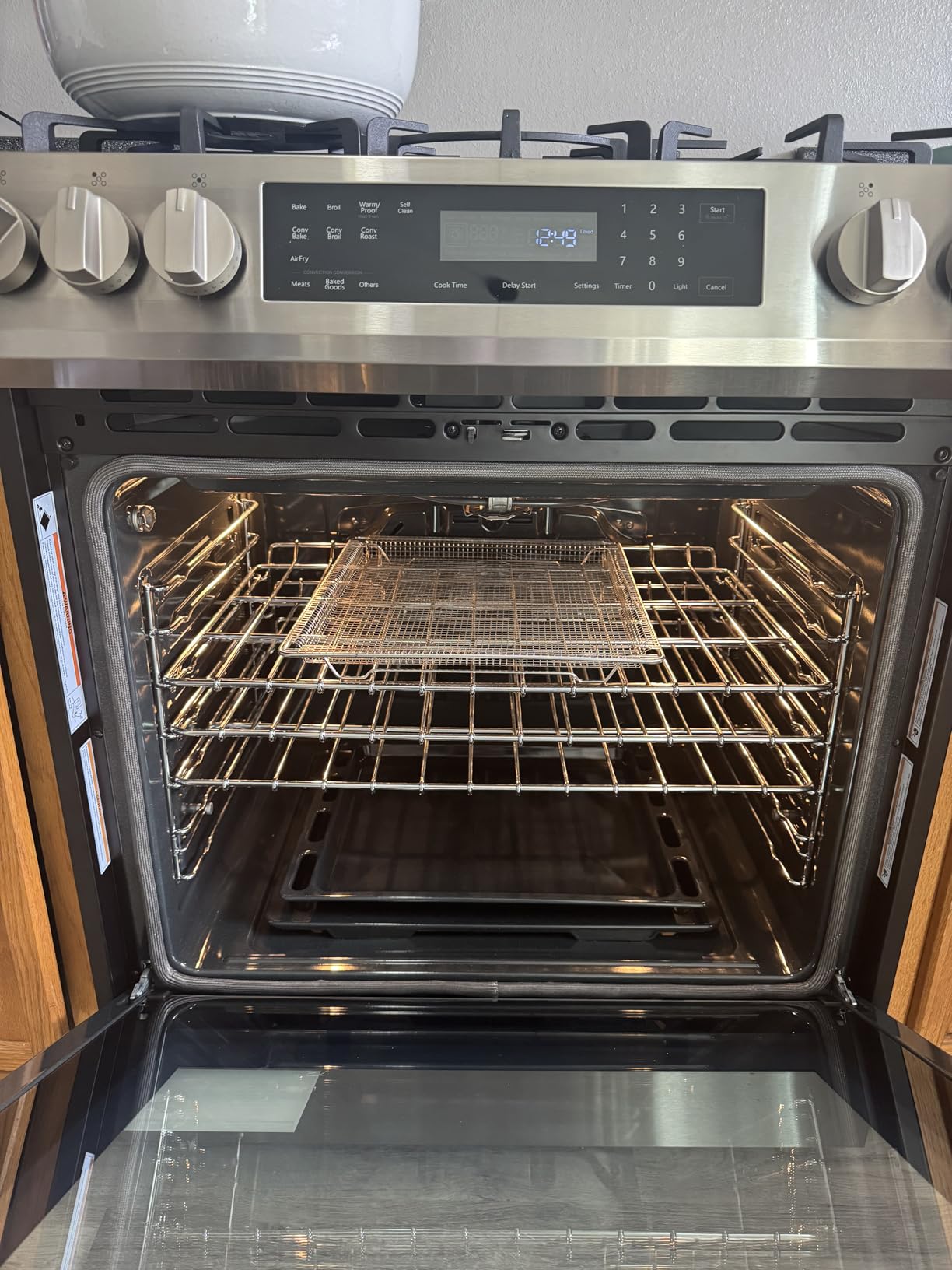
Convection plus air fry is the real headline here. Owners switch on the air-fry mode and get crisp results without a countertop air fryer taking up the only free cabinet. The hidden bake element means the oven floor wipes down in a minute instead of twenty. A large oven window and halogen light mean you are not opening the door to check on a roast, which is the habit that dries out most holiday birds.
It is worth knowing that the 4.9 rating rests on 11 reviews. That is a small base, and small review counts move easily. What those 11 reviews agree on is consistent: accurate oven temperature, even burner heat, easy cleaning. Nothing in them describes a durability problem. Treat the rating as encouraging rather than settled.
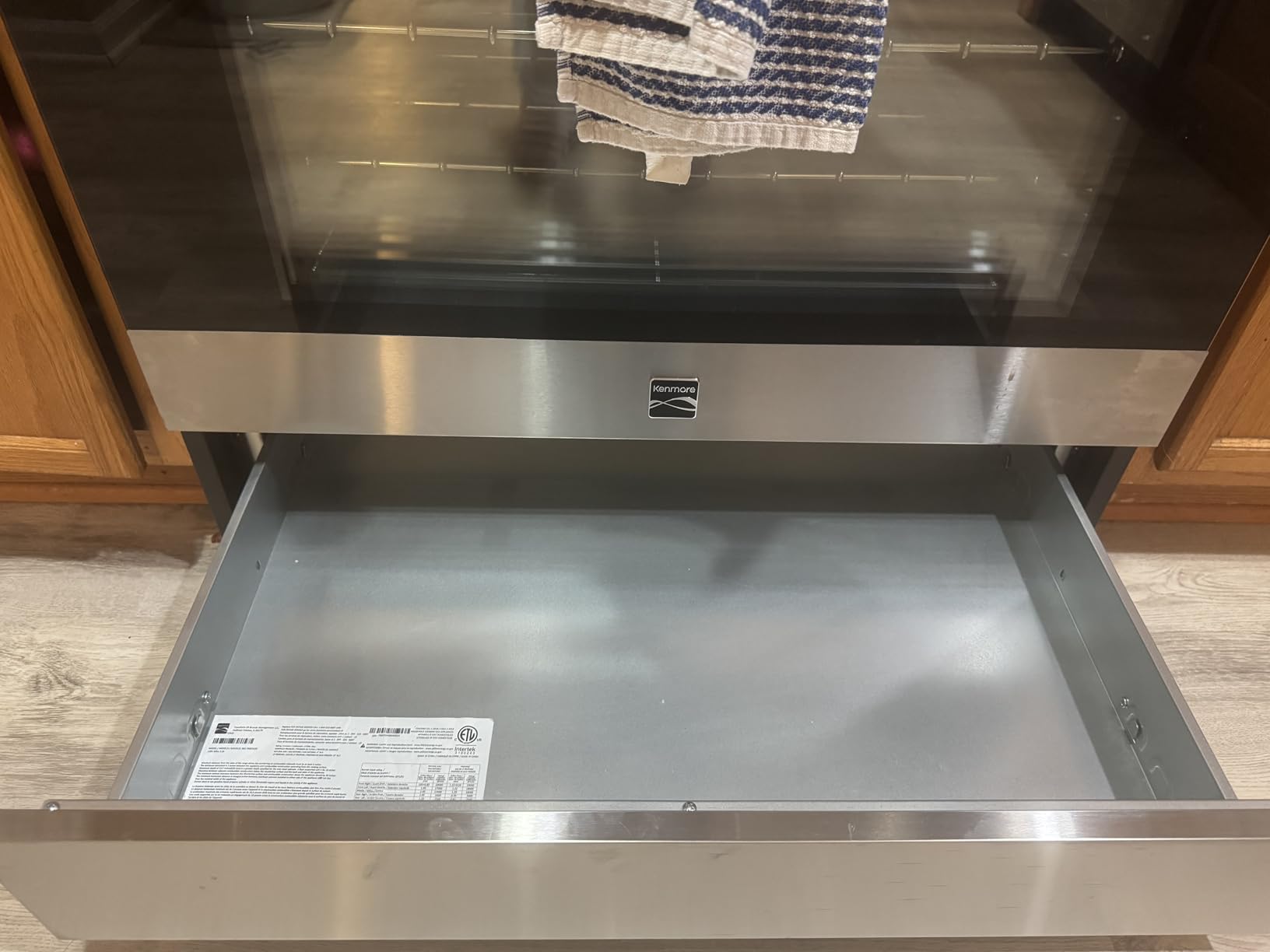
The learning curve is real, but it is narrow. Owners report the timer and cook-time settings need practice to learn, and that is genuinely the only friction they describe. Once the interface clicks, this is a set-and-forget oven. For a baker, an offset oven thermometer makes the first dozen attempts smoother.
Good for bakers and big-batch cooks
Buy this if you roast a turkey every holiday, bake bread weekly or run a sheet pan of cookies through convection most weeks. A 5.6 cu. ft. cavity with true convection and a fan is the correct tool, and the air-fry basket removes a second appliance from your counter. The oven temperature accuracy owners report matters most for pastry, where a 25 degree error ruins a tart.
It is also a strong pick for anyone moving from a basic gas range and wanting visible, felt improvement on day one. Air fry, dishwasher-safe grates and a concealed element are the three upgrades you will touch every week.
Poor for anyone who wants a gas oven with a broiler drawer
The trade-off is the drawer. You get a storage drawer rather than a gas broiler drawer, so you sacrifice the last commercial-style broiling temperatures. If you sear-torch a steak under the broiler or finish a casserole with hard top heat, the built-in broil in slot one or the higher-BTU cooktops in slots three and seven suit you better.
Second caution: with only 11 owner reviews and a 1-year on-appliance warranty, this is not a buy-it-for-lifetime range. It is a buy-it-if-you-bake range.
3. VEVOR 30-Inch Gas Range with Four Sealed Burners
VEVOR Gas Range Oven, 30 Inches Width, Freestanding Stainless Steel Stove and Oven with 4 Sealed Cooktop Burners, Easy Reach Racks, Halogen Light, 4.8 Cu. Ft. Capacity, for Home Apartment Kitchen
3500 to 18000 BTU burners
4.8 cu ft convection oven
Cast iron grates
No burner electronics
Pros
- Widest burner spread from 3500 to 18000 BTU
- No burner electronics to fail
- Oven holds 100 to 550F accurately
- Works on natural gas or propane
- Fits a 30 inch layout without professional setup
Cons
- Some owners received damaged units and slow service response
- Oven cavity is wider but shallower than expected
- Only two racks provided
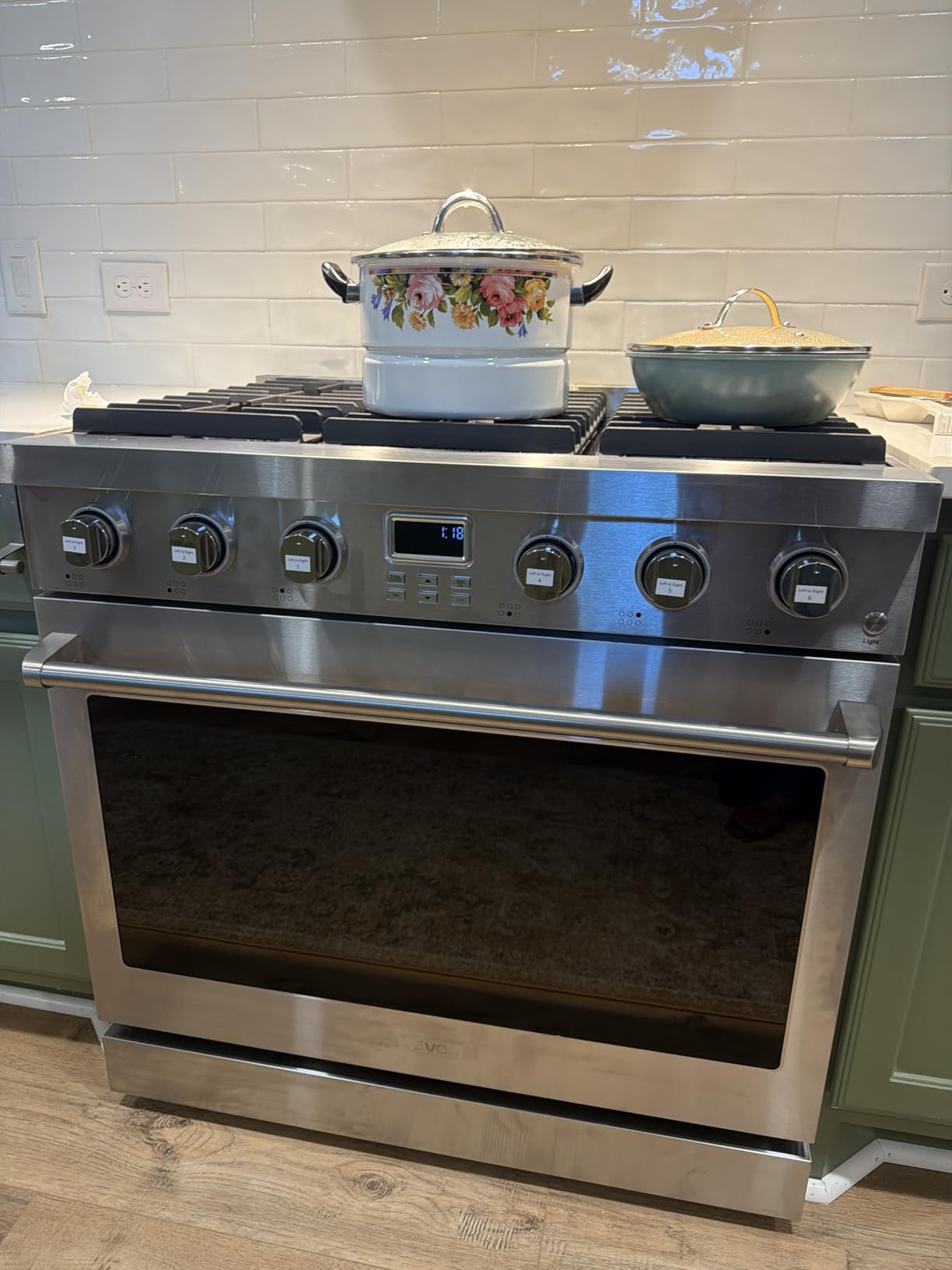
The best burner spread in this group and the reason sear-and-simmer cooks should look here first. The VEVOR GR36C-V runs four sealed aluminum burners at 12000, 18000, 9000 and 3500 BTU. That 3500 BTU burner is a genuine low simmer — the setting where most cheap ranges jump straight from flame off to a boil. Owners who cook sauces and low-and-slow dishes specifically call out the range of sizes as the reason the cooktop feels adjustable.
The oven is a 4.8 cu. ft. cavity with bake, broil, convection bake and convection roast, driven by an 18500 BTU lower burner and a 13500 BTU upper burner. That oven output is substantial, and owners report the temperature holding accurately across a 100 to 550F range. There is a halogen light, a three-layer enamel glass door, cast iron grates and a digital display, and the range is listed at 189.6 pounds.
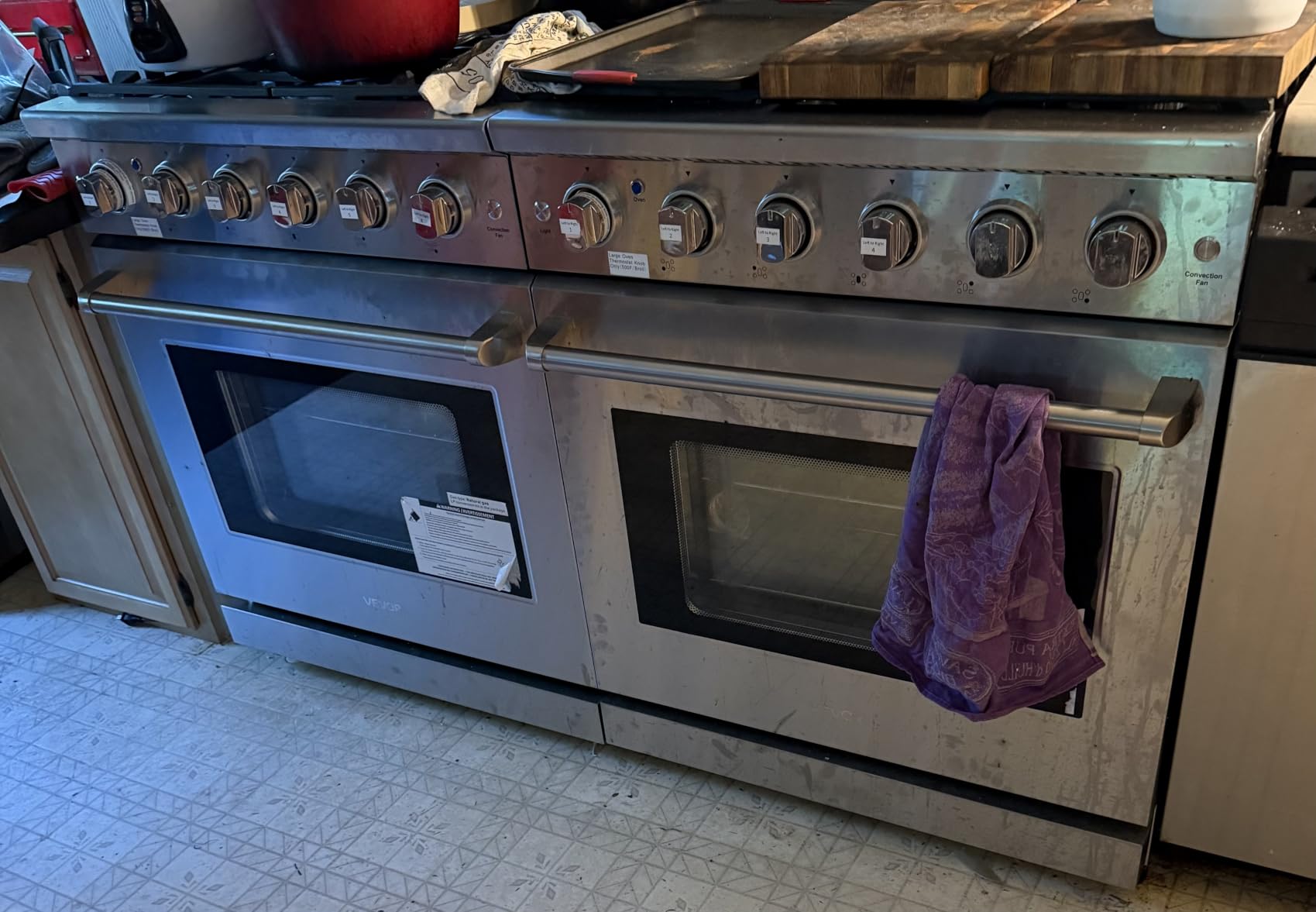
What makes this range unusual is what it does not have: electronics on the cooktop. There is no control board driving the burners, so the most common failure mode in modern gas ranges simply does not apply here. Owners who have been burned by a dead control board notice this. It is the same logic that drives the manual-knob argument on the Cosmo and the Rangaire, just carried into a range that otherwise looks commercial.
Installation is straightforward. It fits a 30-inch layout as freestanding or slide-in, and it hooks up to either natural gas or liquid propane. That flexibility is genuinely useful in a rental, an ADU or a rural property where the gas supply is the question, not the appliance.
Now the caveats, and they are real. A minority of owners report receiving a damaged unit and a difficult time getting it resolved, and customer service responsiveness is the most common complaint in the reviews. This is a brand without the service footprint of a major US appliance maker, and for a fifteen-year appliance that gap matters. If something fails in year four, your options are narrower than they would be with a GE.
Second, the oven cavity is wide but shallower than some buyers expect at 4.8 cu. ft., and only two detachable chrome racks are included, on six adjustable positions. If you routinely roast a large turkey, check the interior depth against your pan before committing. The other weakness is the 4.2 rating across 15 reviews — good, not outstanding.
Good for cooks who live on the stovetop
This is the range for someone who cooks two or three times a night, sears often and makes their own sauces. A 3500 BTU burner and an 18000 BTU burner on the same cooktop means you can go from a hard sear to a low simmer without waiting for a pot to cool. The absence of burner electronics is the durability bonus you rarely see advertised.
It is also a good fit for anyone building in a rental or a secondary kitchen where a service technician may not be within a day’s drive, because there is less that can fail.
Poor for buyers who need a national service network
Skip it if you want a brand with a deep technician bench and easy parts. The complaints about damaged units going unresolved point directly at that. A fifteen-year appliance is a bet on the service network as much as the appliance, and this is a thinner one than GE, Bosch or Kenmore.
Also check your roasting pans against the shallower cavity if a large turkey is your annual ritual. For flatter, wide baking trays, the Kenmore cavity in slot two has more room.
4. Bosch 800 Series 30-Inch Slide-In Gas Range
800 Series 30 in. 5 Burner Slide-in Gas Range in Stainless Steel with 4.8 cu. Ft. True Convection and Self-Cleaning Oven
30 inch slide-in
Five sealed burners
True convection self-clean oven
Warming drawer
Pros
- Five sealed burners on a 30 inch slide-in frame
- True convection with a self-cleaning cycle
- Fits a standard 30 inch cutout
- Warming drawer and touch controls
Cons
- Several owners report the oven running 50 to 100F low
- Control board failures in the first year or two
- Service diagnostics charged before any work starts
The aspirational pick, and the one forum buyers name most often when they want the best gas cooking range at a higher tier. The Bosch HGI8056UC is a 30-inch slide-in with five sealed burners, a 5 cu. ft. true convection oven and a self-cleaning cycle, in stainless steel with a warming drawer underneath. Slide-in means the controls are on the front, so the oven sits flush with your cabinetry and there is no back guard eating counter depth.
On the cooktop, owners report burners that boil water quickly and simmer liquid evenly. That is the honest cooktop verdict: it is good, and it is more consistently praised than the oven in the same reviews. The true convection oven with three racks is a genuinely capable baking cavity, and the self-clean cycle is the feature the GE in slot one does not have.
Worth understanding the reviews here are sharply split. Some owners love the cooktop and find the oven easy to wipe clean. Others report the oven running well below the dial temperature, a convection fan loud enough to be heard throughout the home, and repeated electrical or control-board failures in the first year or two. The 4.2 rating across 13 reviews reflects that split rather than a middle ground.
Good for cooks building a designed kitchen
This is the one to buy when the range is part of the cabinetry design rather than a functional appliance. A slide-in front-control frame with a warming drawer underneath looks like a built-in, and it frees counter depth by removing the back guard. If your design is moving toward an integrated look, this is the one in the group that delivers it.
It is also a defensible choice for someone who bakes and wants a self-cleaning convection cavity on a gas cooktop, which is a combination that is genuinely hard to find at mainstream prices. The warming drawer is a quiet luxury for holiday mornings.
Poor for buyers sensitive to repair cost or noise
Here is what should stop you. Multiple owners report the oven running 50 to 100F below the set point, which is a large enough error to affect baking unless you calibrate with an oven thermometer. Several reviews cite oven or control-board failures inside the first year or two. And service and repair run expensive here, with diagnostic fees charged before any work begins — a bad pairing with a range that also has touch controls and a convection fan as potential failure points.
If reliability is your first priority rather than styling, the GE in slot one is a steadier bet. If the loud fan would bother you in an open-plan kitchen, look elsewhere.
5. GE GGS600AVFS 30-Inch Slide-In Gas Convection Range
GE GGS600AVFS 30 inch Slide-In Gas Convection Range with Steam Cleaning and EasyWash Tray, Stainless Steel
Integrated non-stick griddle
5.3 cu ft convection oven
Steam clean and EasyWash tray
Fingerprint resistant steel
Pros
- Integrated non-stick griddle on the cooktop
- 5.3 cu ft convection oven
- Steam clean with EasyWash oven tray
- Fingerprint resistant stainless finish
- Slide-in sits flush between cabinets
Cons
- Very few owner reviews so far
- Touch controls need adjusting if you prefer knobs
- No high-heat self-clean cycle
The griddle range. The GE GGS600AVFS ships with an integrated non-stick griddle that sits in the cooktop, so you get a flat cooking surface without buying a separate accessory plate or sacrificing a burner to a griddle. For people who cook a serious breakfast — eggs, bacon, hash browns, a stack of pancakes — that is worth more than another 5000 BTU burner.
Underneath, it is a properly specified 5.3 cu. ft. convection oven, the second largest cavity here, with steam cleaning and an EasyWash oven tray. The tray is the part that quietly improves oven life: grease and sugar from a week of roasting get washed away rather than carbonised onto enamel. The finish is fingerprint-resistant stainless steel, which in a real kitchen is the difference between a range that looks new in three years and one that does not.
Dimensions are 28.63 inches deep by 30 inches wide by 37.13 inches tall at 157 pounds, and the slide-in frame fits flush between cabinets with the front controls facing you. The listing is CSA certified and the burners are sealed. There is a storage drawer beneath the oven, plus two racks.
Good for cooks who griddle and roast in equal measure
Buy this if Sunday breakfast is a griddle affair. Bacon and eggs on a non-stick surface with no pan to wash afterwards changes the morning routine completely, and the griddle does not cannibalise one of your burners. The steam clean and EasyWash tray mean the oven is close to self-maintaining, which matters if you roast weekly.
The slide-in format is the other argument. If your current range is jammed under a low overhang, a front-control model with no back guard is often the only gas option that fits, and that is a real problem people hit constantly.
Poor for anyone who needs an established reliability record
Only three owner reviews exist for this model. That is not enough history to judge long-term durability, and we will not pretend otherwise. Buying a fifteen-year appliance on three ratings is a gamble, even when the feature set is right.
Touch controls are the other adjustment. If you cook with wet or greasy hands and want to turn a burner off by feel without looking, the knob-controlled models in slots one, three, six, seven and eight are a better fit. And there is no high-heat self-clean cycle here — the maintenance story is steam plus an easy-wash tray, which is less work but not equivalent.
6. Empava 30-Inch True Convection Gas Range
Empava 30 Inch Gas Range with True Convection, 4.55 Cu. Ft Oven
18000 BTU power burner
True convection 4.55 cu ft oven
Cast iron grates
2 year US warranty
Pros
- 18000 BTU burner sears and boils quickly
- Oven temperature calibration proved accurate
- True convection with no cold spots
- Cast iron grates and triple-pane door
- 2 year US based manufacturer warranty
Cons
- Propane conversion kit may be missing from the box
- One owner reported a loose oven handle
- Knobs sit close to the wall in tight installations
The baking specialist here. The Empava EMPV-30GR10 pairs an 18000 BTU burner with a true convection oven that circulates heat through the full cavity, and owners switching from an electric range report excellent results for bread and yogurt specifically. Even convection with no cold spots is exactly what an oven needs for a high-rising sourdough loaf or a tall layer cake, and that is the report we hear most often.
Oven temperature accuracy is the other headline. Owners running their own thermometers find the calibration holds, which matters enormously for pastry. True convection is a real third heating element plus a fan rather than a fan with borrowed heat, and the difference shows in recovery time when you open the door mid-roast. Cast iron grates and a triple-pane glass door give it the feel of a heavier machine at 205 pounds.
It is CSA certified, convertible from natural gas to propane, and has flame-failure safety. The 2-year manufacturer warranty from a US-based company is the longest coverage in this roundup, which is a genuine plus for a range designed to last. It fits either as a freestanding or slide-in unit at 29 inches deep by 30 inches wide.
Good for bread bakers and anyone converting from electric
If you make bread, this is the range to shortlist. True convection with accurate temperature control and no cold spots is precisely the combination that turns an oven into a proofing and baking chamber, and owners coming off an electric range describe the change as an upgrade. Yogurt makers get the same benefit — even ambient heat with a fan.
The 2-year US warranty is also the best protection on this list, and convertible fuel plus flame-failure safety make it a practical choice for a property without a natural gas line.
Poor for buyers who want a deep service network or a tight install
Two setup issues appear repeatedly. Some units ship without the propane conversion kit even when it is advertised, and the LPG orifices can be hard to identify, so verify the kit before you need it. One owner also reported an oven handle that loosened after a few uses — a single report, but the part is simple to replace and worth checking at delivery.
The install geometry is the bigger caution. Manual knob controls sit close to the wall, so in a tight installation a pipe connection can leave the range standing well proud of the cabinet face. Measure your clearance carefully. At 4.55 cu. ft. the cavity is also the second smallest here, so check your roasting pan size too.
7. Rangaire RRG303TS 30-Inch Gas Range
Rangaire RRG303TS 30″ Gas Range Oven with Timer – Stainless Steel, Sealed Burners, Convection Fan, Easy Reach Racks
21000 BTU dual-ring burner
Manual knob controls
AireCook convection
Silent glow-plug ignition
Pros
- 21000 BTU dual-ring burner with two valves
- Manual knobs instead of an electronic control board
- Silent glow-plug ignition
- CleanSeal sealed burners
- Responsive warranty service on shipping damage
Cons
- Oven temperature can drift from the dial setting
- Knobs are easy to bump in tight kitchens
- Temperature gauge sits low at the front
Highest single-burner output in this roundup. The Rangaire RRG303TS has a FlameMaster dual-ring, dual-valve burner rated at 21000 BTU, and having two valves means you control the inner and outer rings separately. That is how you get hard sear heat and a small flame on the same burner. The included wok grate attachment and the AirFry basket in the box round out a well-equipped package.
Controls are manual knobs, and that is the entire design philosophy. Owners specifically note that the manual layout avoids the electronic control boards that fail on competing models, and the silent glow-plug ignition replaces the loud clicking igniter you get on cheaper ranges. CleanSeal sealed burners keep spills from reaching the base. A PerfectCook glass touch timer and clock with automatic oven shutoff handles the timing without putting a computer in the burner path.
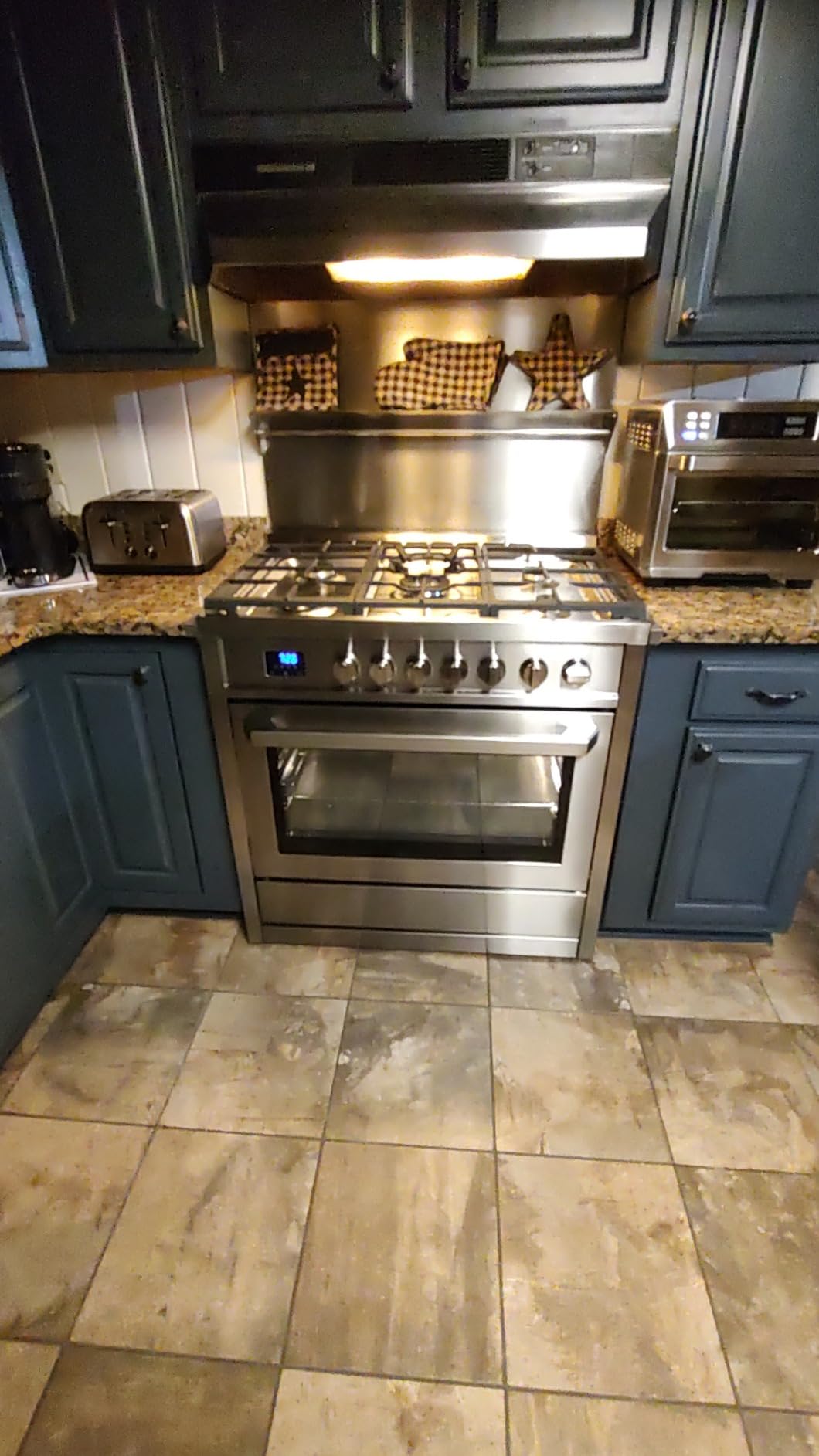
At 197.5 pounds with cast iron grates and a stainless top that wipes clean, the build is described as solid, and several owners report customer service resolving damaged-unit and warranty issues quickly. The AireCook convection mode and telescoping EasyReach racks are the oven-side features, with three racks in a 5.1 cu. ft. cavity. The 1-year limited parts and labour warranty is standard rather than generous.
One detail worth planning around: this model is listed in 24 inch, 30 inch and 36 inch widths, so the same family covers a small kitchen, a standard opening and a wider pro-style layout. For anyone who is not sure how much room they will have in five years, that flexibility is unusual.
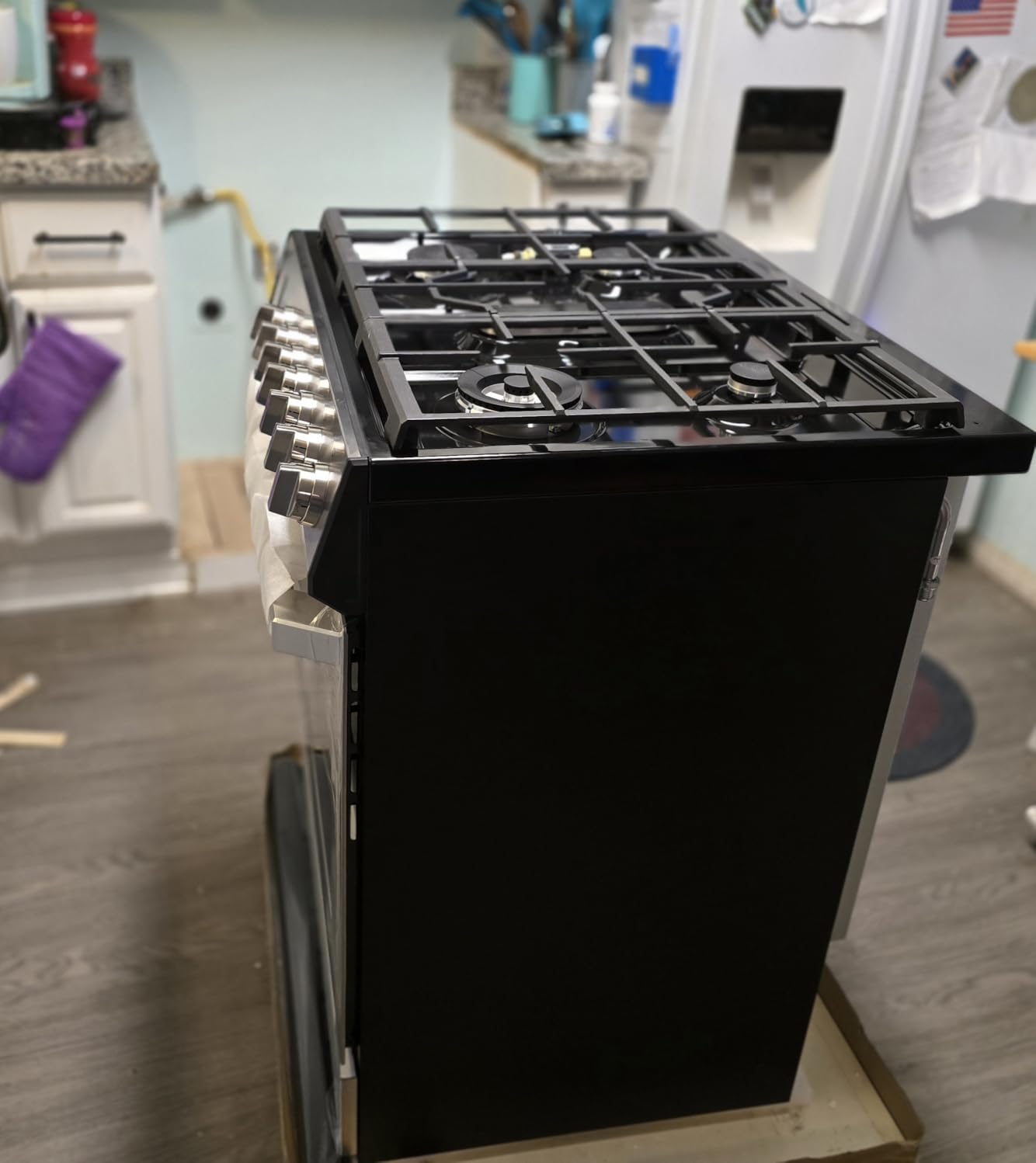
The recurring complaint is temperature accuracy against the dial. Owners report the oven running off the set point and recommend an independent thermometer, which is a small, cheap fix but you should know it going in. A cooling-fan wiring fault produced a loud rattle on at least one unit until the fan was replaced, and the knobs are easy to bump and turn on accidentally in a tight kitchen. The temperature gauge is also mounted low at the front, so you will be crouching to set it.
Some units arrive with scratches on the casing, and the LPG conversion orifices are hard to identify. At 4.1 across 34 reviews, this is a well-liked range with real, fixable annoyances rather than a problem machine.
Good for high-heat cooks who distrust electronics
Buy this if searing on high heat is your primary activity and you would rather not have a control board in the path. The 21000 BTU dual-ring burner is the strongest single burner here, and the two-valve control lets you drop to a low flame without swapping burners. Manual knobs also work with wet hands and keep working in a power cut, which is a real advantage if you live somewhere with unreliable grid supply.
Silent glow-plug ignition is an underrated quality. No clicking, no repeated ignition attempts while you stand there holding a pan.
Poor for cooks who need a tight temperature dial or a tidy fit
Skip it if you bake to the degree and trust the oven. Run an independent thermometer or pick the model in slot six, where owners report accurate calibration. The drift complaints are the single most repeated issue in these reviews.
It is also a poor match for a narrow galley kitchen, where the front knobs are easy to catch with a hip and turn a burner on. And if the flush built-in look is the goal, this is a slide-in frame, not a designed front-control panel like the Bosch.
8. Cosmo Haven 30-Inch 4.8 cu. ft. Gas Range
30 in. Haven Coll 4.8 cu ft 5 Burner Gas Range, Convection, Stainless Steel
18000 BTU top burner
45000 BTU combined
Continuous cast iron grates
24 to 48 inch widths
Pros
- Most owner reviews of any range in this group
- 45000 BTU combined across five burners
- Heavy cast iron grates on a continuous cooktop
- No digital electronics and no motherboard to fail
- Five years of spare parts availability
Cons
- Oven igniters burn out repeatedly on some units
- Oven door does not latch tightly and the storage drawer feels cheap
- Needs a dedicated 110V outlet
The most reviewed range in this roundup by a wide margin — 174 owner reviews — and the lowest rating at 3.9. That combination is not a contradiction. It means a lot of people bought this Cosmo, lived with it for years, and told the truth about it. Read the 174 reviews and you get a genuinely useful picture of what a fifteen-year budget range does and does not survive.
On the cooktop, the burners run 18000, 9000, 8000, 6000 and 4000 BTU for roughly 45000 BTU combined on a black porcelain cooktop with heavy cast iron grates. Because the grates are continuous, you can slide a pot from a high burner to a low one without lifting it, which is the whole argument for cast iron over individual steel grids. Owners consistently call the grates heavy and well built.
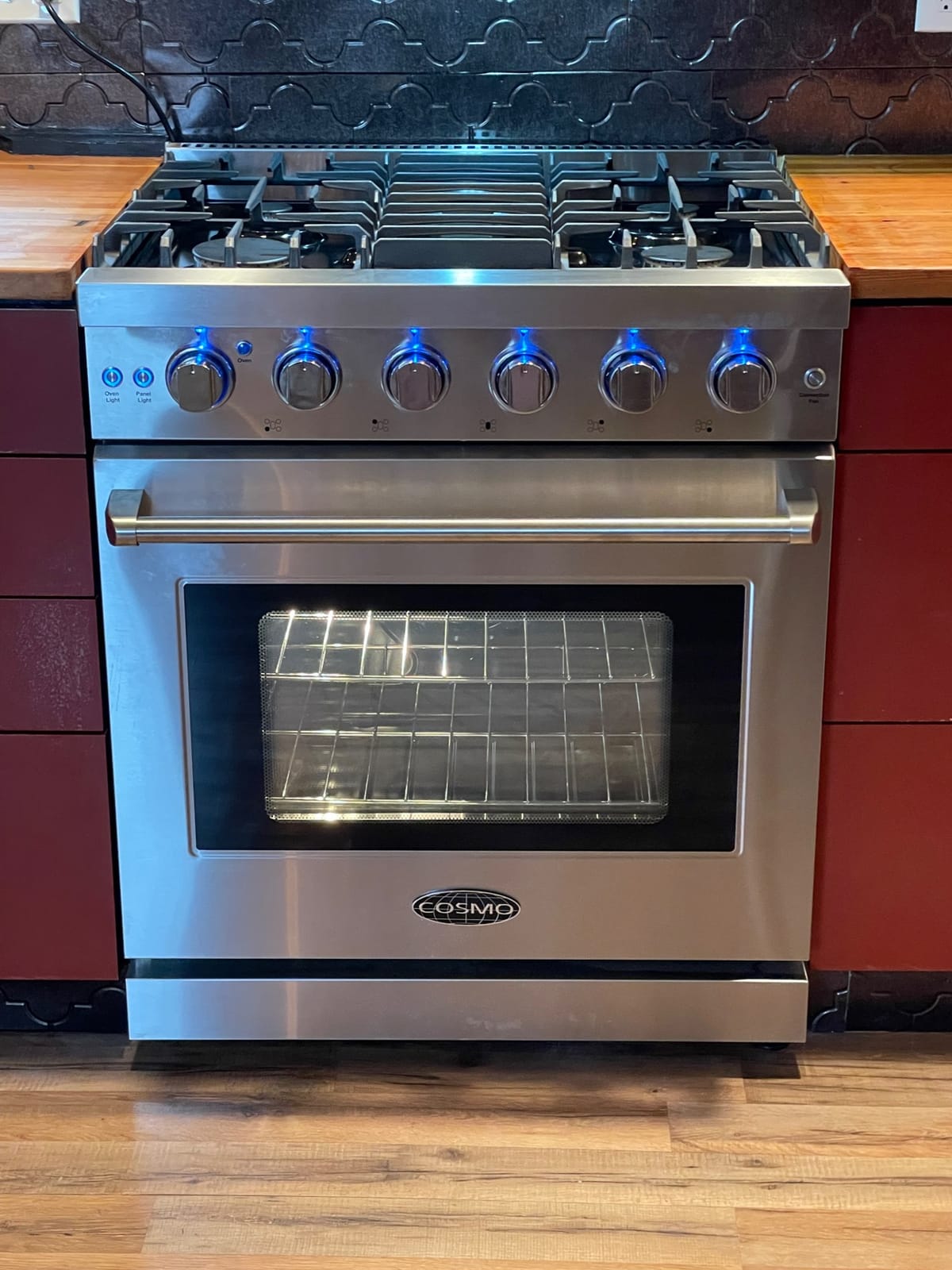
The oven is 4.8 cu. ft. convection with a storage drawer, a cool-to-touch handle, cavity cooling ventilation, overheat protection and triple-thick oven glass. Control is by knob with LED indicators and mirror-finished knobs, and there is no digital electronics to fail. A black porcelain cooktop plus stainless body at 215 pounds is substantial for the money, and owners describe the range as sturdy and good looking.
Two details stand out for a long-term buyer. The line is available in 24, 30, 36 and 48 inch widths, so a single design language covers a small kitchen through to a pro-style layout. And spare parts are listed as available for five years, which is exactly what a repairable appliance should offer.
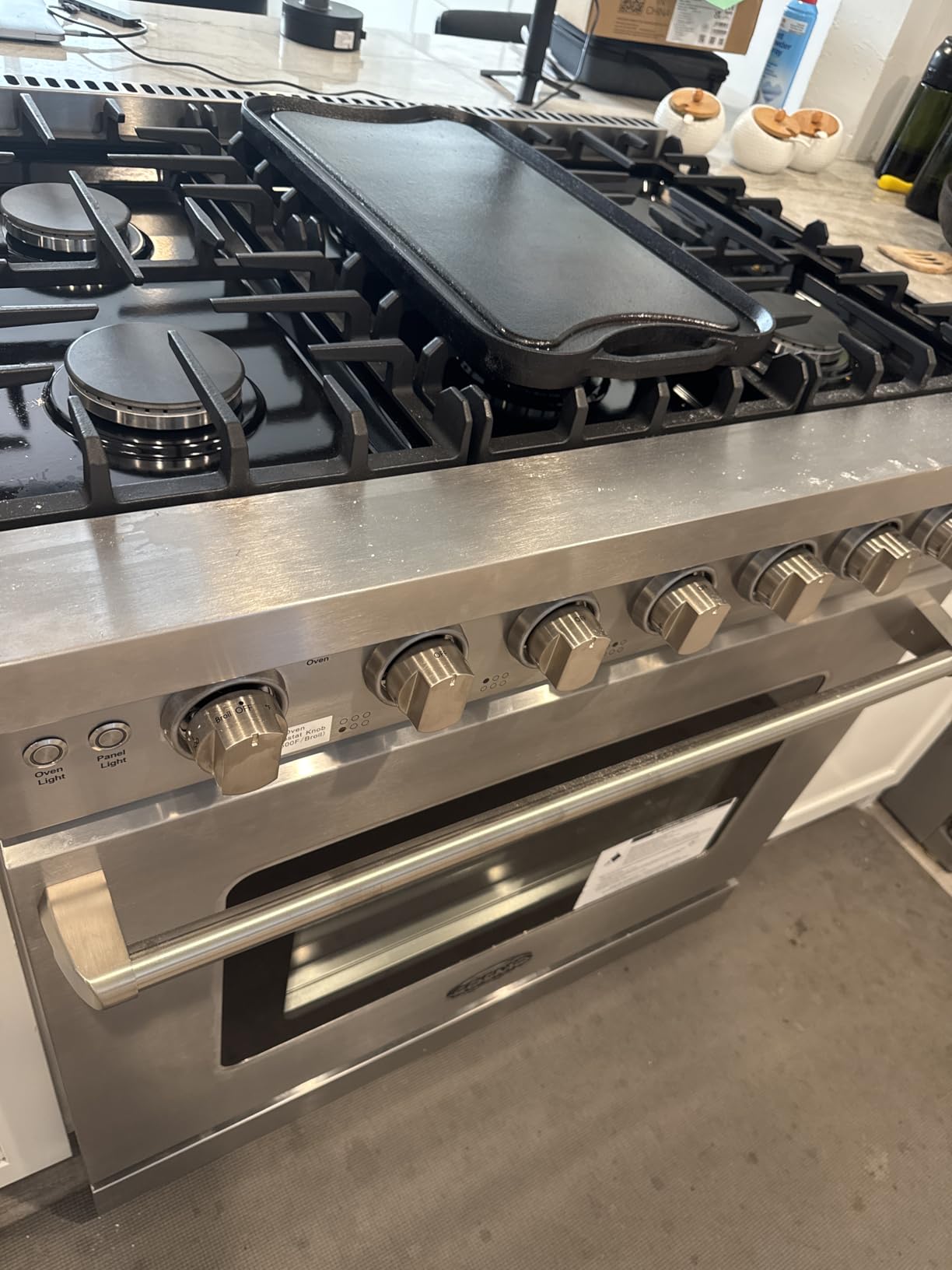
Now the honest list, and it is long enough to matter. Oven igniters are a recurring failure, with some owners replacing them repeatedly over several years. The oven door does not latch tightly and leaks heat, and the storage drawer is built from cheap material. The knob caps are foil over plastic and peel with use. Arriving on a pallet that can be sheared is a recurring theme, and cleaning a cast iron cooktop is more labour intensive than wiping a glass top.
There is also a practical gotcha: this range asks for 110 volts and needs a dedicated outlet, which is unusual for a gas range. If your kitchen has a standard 220V circuit and nothing else, plan for an electrician. The 1-year limited parts and labour warranty is the briefest coverage here despite the 3.9 rating.
Good for value buyers who plan to keep it a long time
This is the pick if you want the most range for the money and you intend to service it yourself when parts fail. The 174-review base means the failure patterns are documented, which is unusual and valuable: you know the igniter is the part most likely to go, you know how to get it, and parts are listed for five years. A stove you understand is a stove you keep.
The continuous cast iron grates and 45000 BTU combined cooktop also make it the strongest choice here for a high-output kitchen that will not spend four times the money. If a family of five eats dinner there every night, that cooktop does real work.
Poor for anyone who wants a turnkey oven and a plug-and-play install
The igniter and door-latch complaints are the deal-breakers. An oven that does not hold its door shut and an igniter you replace every couple of years is an ongoing project, and this is not the range for a household that wants the appliance to be invisible. The low 3.9 rating across 174 reviews reflects exactly that split.
Skip it on the install side if you do not have a 110V outlet available, and skip it if you want a sealed self-cleaning cycle — this oven is manual clean. What you get instead is repairability, and that is a trade you should make deliberately.
How We Picked These Eight Gas Ranges
Every range here was read against the same checklist. First, cooktop: the spread between the smallest and largest burner, whether the small burner can genuinely hold a low simmer, whether the burners are sealed, and whether there is a control board in the burner path. A range with 4000 BTU as its minimum and 18000 BTU as its maximum gives you more usable control than a range with three similar-sized burners at any price.
Second, oven: cavity volume, whether convection is true convection with its own heating element or a fan borrowing heat, cleaning method, rack count and how the racks adjust. Third, form factor and fit, because a range you cannot install is not a recommendation. Fourth, the service question, which is where the owner reviews earn their keep — we counted reports of igniter failures, control boards, temperature drift and unresponsive support rather than ignoring them.
On reliability, the owner consensus in appliance forums names GE as one of the most reliable and straightforward gas range brands, and that view is widespread enough that repair technicians see those models constantly. Forum buyers repeatedly single out manual ignition during a power outage as a real differentiator, which is why the all-mechanical models in this list are ranked the way they are. Forum discussion also positions the Bosch 800 series as the aspirational pick at the higher tier. We used all of this as context, not as a substitute for reading the reviews on the specific model in front of us.
Consumer Reports publishes its own tested recommendations behind a paywall, and readers often ask whether our list matches. Where the two overlap you will recognise the models; where it diverges, the difference is usually form factor. Our list deliberately spans slide-in, freestanding, griddle-equipped and wide-width options rather than sticking to one category.
How to Choose a Gas Range: Burners, Oven and Form Factor
Burner spread decides more than brand
A useful home cooktop pairs a high-output burner for searing with a genuinely small burner for simmering. Look for a spread from roughly 5000 BTU up to 18000 or 21000 BTU. Below 4000 BTU you are not simmering, you are hoping. The VEVOR at 3500 to 18000 BTU and the Cosmo at 4000 to 18000 BTU both give you that range; a range whose burners all sit between 8000 and 12000 BTU will boil fast and frustrate you at the low end.
Grates matter as much as burner numbers. Continuous cast iron grates let you slide a pot between burners without lifting it, which is the single biggest quality-of-life difference on a cooktop. Dishwasher-safe grates remove the chore entirely. Thin individual steel grates are the thing to avoid, because you will lift hot pans more often and the grates warp over time.
Sealed burners versus open burners is the other cooktop call. Sealed burners contain spills, clean faster and are the standard in home ranges. Open burners deliver more heat per BTU and are the hallmark of commercial models, but a dropped pan lid reaches the burner base and every cleanup becomes a chore. For a home kitchen cooking most nights, sealed is the right answer.
Oven capacity and convection type
Cavity volume is the number that changes your cooking. Around 4.5 to 4.8 cu. ft. handles a holiday turkey and a full sheet pan. At 5.3 to 5.6 cu. ft. you can roast at two temperatures at once, or fit a party tray without improvising. Below 4.5 cu. ft. you will feel the limit at Thanksgiving.
True convection adds a dedicated third heating element behind the back wall and circulates heat with a fan. Basic convection uses the same fan with borrowed heat, so recovery after opening the door is slower. The difference is obvious in baking: true convection gives you even colour, faster recovery and no cold spots, which is why it is the single most requested oven feature among the cooks we hear from. All eight ranges here offer convection of some kind; five run true convection.
Cleaning method is a lifestyle decision. Steam cleaning and a high-heat self-clean cycle save an hour a month but turn your oven into a 500 degree oven for an hour. Manual clean with a concealed or dishwasher-safe element is the low-tech alternative. The GE in slot one is manual clean with an open element, the harshest combination; the GE in slot five uses steam plus an EasyWash tray, the mildest.
Form factor, clearance and footprint
Freestanding ranges have back-guard controls and slide into a 30-inch slot with a guard rail behind them. Slide-in ranges put the controls on the front, sit flush between cabinets, need a full 30-inch opening with no guard, and usually include a warming or storage drawer. Front-control models need more vertical clearance above because the oven door drops toward you — typically you want 15 inches of clearance above the cooking surface, and that is the number most people forget when they are measuring a tight alcove.
Width is the next decision. Thirty inches is the standard in most US kitchens. Thirty-six inches gives you an extra burner or a wider oven, and 48 inches is a pro-style layout that needs a dedicated 30A or 40A circuit and often a custom hood. If you have ever had a 30-inch range that felt cramped for a weeknight dinner for six, a 36-inch model is the answer. The Cosmo line covers 24 through 48 inch widths, which makes it the easiest family to size-match if your kitchen is undecided.
Reliability, service and repairability
This is the section most roundups skip, and it should not be skipped. A gas range is a fifteen-to-twenty-year purchase. What matters is not the failure rate in year one but whether a part exists in year ten and whether anyone will come and fit it. Brands with large US service networks and models technicians see every day are cheaper to own, and forum users make this point constantly — some brands are well regarded by owners but weak on repairs and support once something breaks.
Mechanical controls score well here. A knob-controlled range has no control board, no display to fail and no firmware to go stale, and it can be lit during a power cut. The Rangaire, the Cosmo and the VEVOR all lean into that. Electronic ranges are not bad, but they add failure points and a diagnostic fee when something goes wrong. Bosch is the cautionary example in this group: owners love the cooktop and report control-board failures plus diagnostic fees charged before any work begins.
Check recalls before you buy, and again a year later. Appliance recalls are published by the CPSC and manufacturers, and a small number of gas ranges have been recalled for ignition faults. Look your model number up directly rather than assuming the brand is enough.
Ventilation, fuel and the hood pairing
A gas range needs a working hood, and a recirculating microwave hood is not one. Size the hood to the burner total, not the room. Ranges in this group run from roughly 27000 BTU combined to 45000 BTU combined, and a 600 to 900 CFM ducted hood is the sensible range for a 30 to 36 inch gas cooktop with that much burner output. Make sure it vents outdoors; a recirculating unit captures grease but not combustion gases.
Propane versus natural gas is decided by your supply, not by preference. Many of these ranges convert between the two — the VEVOR and the Cosmo are listed for both, the Rangaire is listed for gas and liquefied petroleum gas, and the Kenmore includes an LP conversion kit. A conversion changes the orifices, and it is a job for someone who knows what they are doing. If your home has no gas line at all, that is a plumber conversation before it is an appliance conversation.
What the appliance alone cannot tell you
If you want a second appliance opinion while you narrow the field, our guides to gas grills for home cooks and electric skillets for home cooks cover the cookware that pairs with a range like this. And if the oven is going to do more work than the cooktop, the ceramic cookware sets we tested handle a convection oven better than most.
Should You Actually Go Gas in 2026?
Honest roundups answer this, because some kitchens should not buy a gas range at all. The strongest case for gas is heat. A gas burner reaches sear temperature instantly and drops to a low flame under the same knob, and that responsiveness is genuinely unmatched by a glass cooktop. If you sear, stir-fry, char or grill indoors, gas earns its space.
The case against is indoor air quality. Burning gas produces nitrogen dioxide, and unburned gas and combustion byproducts are associated in published research with childhood asthma risk and other respiratory effects. The countermeasure is straightforward and non-negotiable: a working hood vented outdoors, used every time you cook. People who move from gas to induction frequently describe the air quality change as the decisive upgrade, and others report the cooking adjustment as a real adjustment.
Then there is the direction of travel. Gas appliances are being phased out by some local governments, and new construction increasingly arrives electric-only. If you are buying in a rental or planning to move within a decade, an induction range removes that risk entirely and adds a faster, cooler, easier-to-clean cooktop. You give up open-flame cooking and wok technique, and you keep searing performance at high heat.
Our view: if you have a gas line, cook with flame most nights, and a hood that vents outside, gas is the right tool. If any one of those is missing, read our electric skillets guide before you commit, and check whether your utility offers an induction conversion rebate — those have grown a lot in recent years.
Frequently Asked Questions
What is the best gas range for a home chef?
The GE JGBS30DEKBB is the best all-round gas range for a home cook, with four sealed burners, a 4.8 cu. ft. oven and knob controls a technician can service without a laptop. If you bake most nights, choose the Kenmore 5.6 cu. ft. front control range for true convection and air fry. If searing is the priority, the Rangaire and VEVOR offer the widest burner spread.
What brand makes the most reliable gas range?
Owner consensus in appliance forums repeatedly names GE as one of the most reliable and straightforward gas range brands, and repair technicians see those models constantly, which keeps parts and service knowledge deep. Whirlpool and Maytag also have large US service networks. What matters as much as the brand is the design: manual knob controls and burner assemblies without a control board have far fewer points of failure.
Why are gas ovens being phased out?
Three forces are behind it. Combustion produces nitrogen dioxide and unburned gas, and published research links gas cooking in the home to respiratory effects, which pushes cities toward building codes that restrict or ban gas hookups in new buildings. Utilities and appliance makers are shifting investment toward electric and induction, and rebates increasingly favour conversion. The cooking performance is not the objection; the emissions are.
What are the best gas ranges according to Consumer Reports?
Consumer Reports publishes its own tested recommendations, and where our list overlaps you will recognise the mainstream 30-inch freestanding models. The main divergence is scope: we deliberately cover slide-in, griddle-equipped and wider pro-style options rather than testing one category. Treat any roundup, paid or free, as a starting point, then check the recall record and the service footprint for your own model number before buying.
How hot should gas range burners be for home cooking?
For most home cooking you want a spread, not a maximum. Around 15000 to 18000 BTU handles searing and rapid boiling, and a small burner of 3500 to 5000 BTU is what lets you hold a genuine simmer without the pot jumping. Ranges in this group deliver between roughly 27000 and 45000 BTU combined, so the total is adequate; the spread between the smallest and largest burner is the number that decides how well you cook.
Is a slide-in range better than a freestanding range?
A slide-in gives you flush cabinetry, more usable counter depth because there is no back guard, and usually a warming or storage drawer. A freestanding range is cheaper, easier to fit into a narrow opening and often includes a back guard rail. Slide-in models need a full 30 inch opening and more vertical clearance above the cooktop, so measure your alcove before choosing.
The Best Gas Range for Your Kitchen in 2026
For most home cooks, the GE JGBS30DEKBB is the pick: sealed burners, a 4.8 cu. ft. oven, front knobs and no electronics on the cooktop, backed by 31 owner reviews averaging 4.5. It is the range we would put in a kitchen without another agenda.
If your cooking is oven-led, the Kenmore 5.6 cu. ft. front control range is better, with true convection, air fry and the largest cavity here. If you sear nightly, the VEVOR and the Rangaire give you the widest burner spread, and the Rangaire’s 21000 BTU dual-ring burner is the single hottest burner in the group. If you griddle, the GE GGS600AVFS has the integrated non-stick plate. If you want the built-in look, the Bosch 800 Series is the slide-in that delivers it — with the service and temperature caveats above.
And if you want to keep it a long time and fix it yourself, the Cosmo is the one with 174 reviews, five years of listed spare parts and no motherboard to fail, at the cost of a higher complaint rate than anything else here. Measure your clearance first, confirm the recall record, and use a hood that vents outdoors. Then cook.