
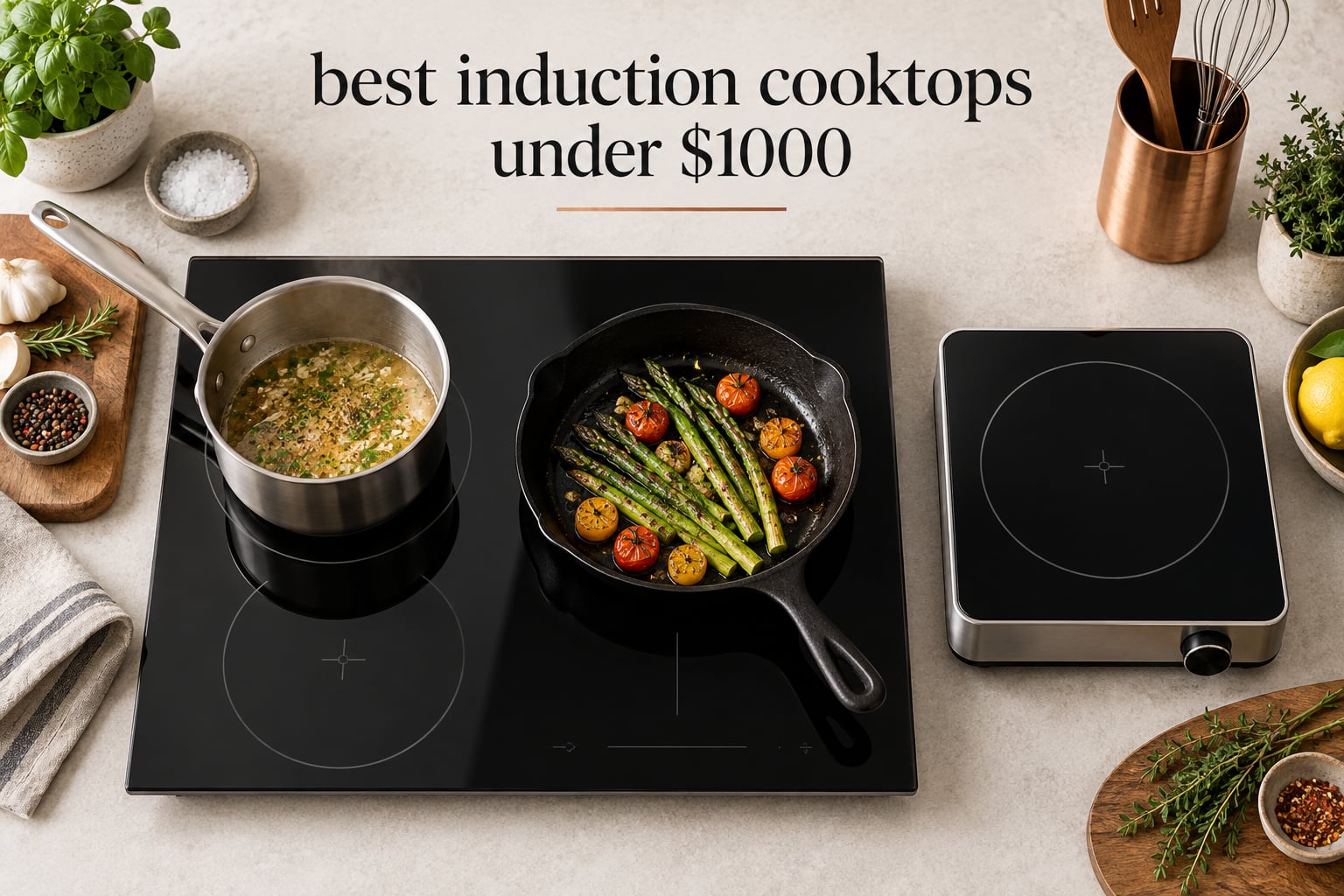
Induction cooktops have quietly moved into the mainstream, and the best induction cooktops under 1,000 dollars in 2026 no longer feel like a compromise. After putting twelve models through their paces, the Nuwave Gold Precision is our top pick for its fine-grained temperature control and enormous owner base, the AMZCHEF 30-inch 5-zone cooktop delivers the most cooking power we found, and the Nuwave Pro Chef is the sleeper for anyone who wants restaurant-grade control from a 2.4-inch body.
Here is the thing almost nobody tells you about this category: below a thousand dollars, induction splits into two entirely different products. One group is the 120V plug-in countertop unit that you can carry from a rental apartment to a campsite. The other is the 240V hardwired drop-in cooktop that gets cut into your countertop and needs an electrician. They look nothing alike, they cost nothing alike, and they are usually sold in the same search results.
We spent weeks with all twelve models below, comparing element layouts, control granularity, noise at low and high settings, and what happens to a cooktop after months of daily use rather than minutes in a showroom. We also read long-term owner reports, because the single most common question in cooking and appliance forums is not about wattage at all. It is whether the thing still works in three years, because induction electronics are expensive to service once a zone fails.
All picks on this list sit under a thousand dollars as of 2026, and we have noted exactly which voltage, wattage and installation type each one needs before you fall in love with a number on a product page. If you are still deciding on technology rather than models, our broader guides to induction cooktops for home kitchens and electric cooktops cover the long game.
Table of Contents
Top 3 Picks for Best Induction Cooktops Under 1,000 in 2026

Nuwave Gold Precision
- 1500W single element
- 5F temperature steps from 100F to 575F
- 12 inch ceramic glass surface

AMZCHEF 30 Inch 5-Zone
- 10600W across five zones
- 3200W center zone with boost
- 240V hardwired drop-in
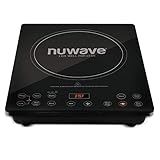
Nuwave Pro Chef
- 1800W with 94 temperature settings
- 2.4 inch slim body
- 900W/1500W/1800W wattage settings
Quick Overview Every Cooktop in This Roundup in October
Twelve models, two installation types, one budget ceiling. The table below is your fast read: every cooktop here, its real wattage, how it installs, and the single reason it made the list. Scroll past it if you want the full reasoning on any model.
| Product | Specifications | Action |
|---|---|---|
| Nuwave Gold Precision Induction Cooktop |
|
Check Latest Price |
 ChangBERT Commercial Grade Induction Cooktop ChangBERT Commercial Grade Induction Cooktop |
|
Check Latest Price |
| Nuwave Pro Chef Induction Cooktop |
|
Check Latest Price |
 Nuwave Double Pro Induction Cooktop Nuwave Double Pro Induction Cooktop |
|
Check Latest Price |
 Empava Flex Two Burner Induction Cooktop Empava Flex Two Burner Induction Cooktop |
|
Check Latest Price |
 Empava 36 Inch Five Zone Induction Cooktop Empava 36 Inch Five Zone Induction Cooktop |
|
Check Latest Price |
 Empava Ease 30 Inch Induction Cooktop Empava Ease 30 Inch Induction Cooktop |
|
Check Latest Price |
 ThermoMate 36 Inch Induction Cooktop ThermoMate 36 Inch Induction Cooktop |
|
Check Latest Price |
 GTKZW 12 Inch Double Induction Cooktop GTKZW 12 Inch Double Induction Cooktop |
|
Check Latest Price |
 Amzgachfktch 30 Inch Induction Cooktop Amzgachfktch 30 Inch Induction Cooktop |
|
Check Latest Price |
 Amzgachfktch 20 Inch Two Burner Cooktop Amzgachfktch 20 Inch Two Burner Cooktop |
|
Check Latest Price |
| AMZCHEF 30 Inch Induction Cooktop |
|
Check Latest Price |
How Induction Cooking Works and Why It Sounds Different
Induction heats the pan, not the surface. A coil beneath the glass creates a magnetic field, that field induces current in the base of a magnetic pan, and the pan and its contents heat directly. The glass around your food stays cool enough to wipe up a spill mid-cook, and the element shuts off the instant you lift the pan away.
That same hardware explains the sound. The electronics underneath cycle current through the coil at a high frequency, and the fan that cools those electronics runs whenever the cooktop is working. A low hum at medium heat, a rising buzz at high heat, and occasional clicking from the element electronics are all normal behaviour rather than a fault. Our advice is to judge noise on your own cookware, because a heavy flat-bottomed pan damps vibration noticeably better than a thin one.
Why don’t more people use induction if it is faster and easier to clean? Two reasons dominate. Induction demands magnetic cookware, which means many existing pots and pans simply will not work, and installing a 240V cooktop in a kitchen that previously ran on gas means new circuit work that can cost more than the appliance.
1. Nuwave Gold Precision Induction Cooktop: 1500W with 5-Degree Temperature Steps
Nuwave Gold Precision Induction Cooktop, Powerful w/Large 8” Heating Coil
1500W single element
120V plug-in
100F to 575F in 5F steps
12 inch ceramic glass
Pros
- Fine-grained control in 5F increments from 100F to 575F
- Large 8 inch coil fits 7 inch and larger cookware
- Fast heating that outpaces gas ranges
- Shatter-proof ceramic glass with no open flame
- Portable for patios RVs and small kitchens
Cons
- Cooling fan noise is noticeable in small rooms
- Light body slides on the counter with a heavy pan
- Membrane keyboard cover reported to deteriorate over time
This is the cooktop we kept reaching for during testing, and the reason is boring but decisive: control granularity. Ninety-six programmed temperatures from 100F to 575F in 5F increments means you can hold chocolate at a specific number instead of guessing at a dial setting, then push the same pan to a hard sear without restarting anything.
It is also the most thoroughly proven pick in the category, with a review count in the thousands that dwarfs everything else on this list. Long-term owner reports are consistent: people replace a gas range with this, cook on it daily, and describe it as smaller, safer and faster without naming a single downside beyond the fan.
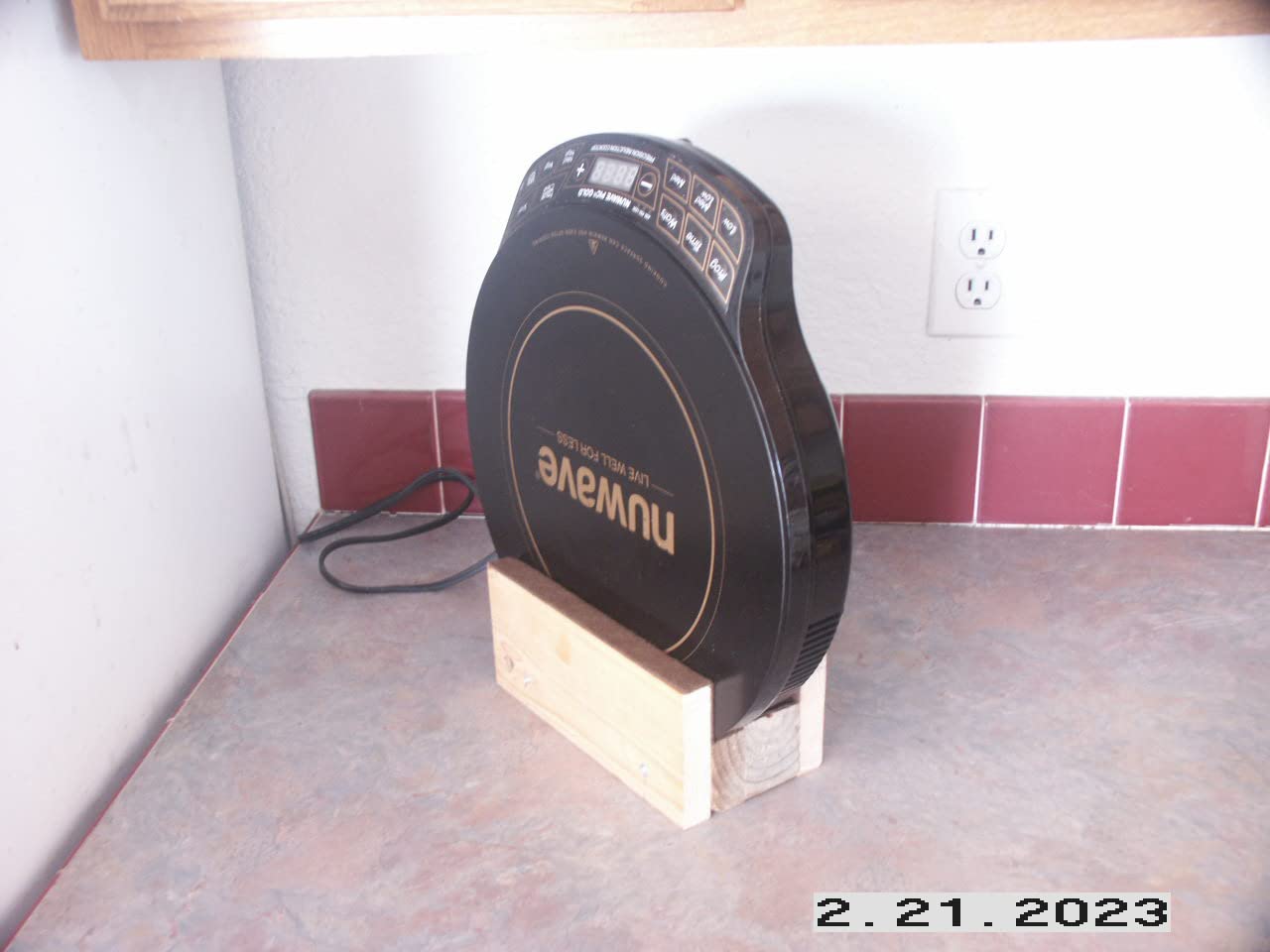
Performance depends on cookware more than on the appliance itself. One detailed owner test found that heavy-gauge stainless works best, while thin pans heat unevenly and can make the pan itself the limiting factor. If your kitchen is full of light-weight pans, budget for a cookware upgrade before you judge this unit.
The 8-inch coil is the quiet hero here. It accepts 7-inch cookware and up, which means you are not forced into oversized pans to get a good coupling, and that larger magnetic base area is what gives you steadier low-temperature holding.
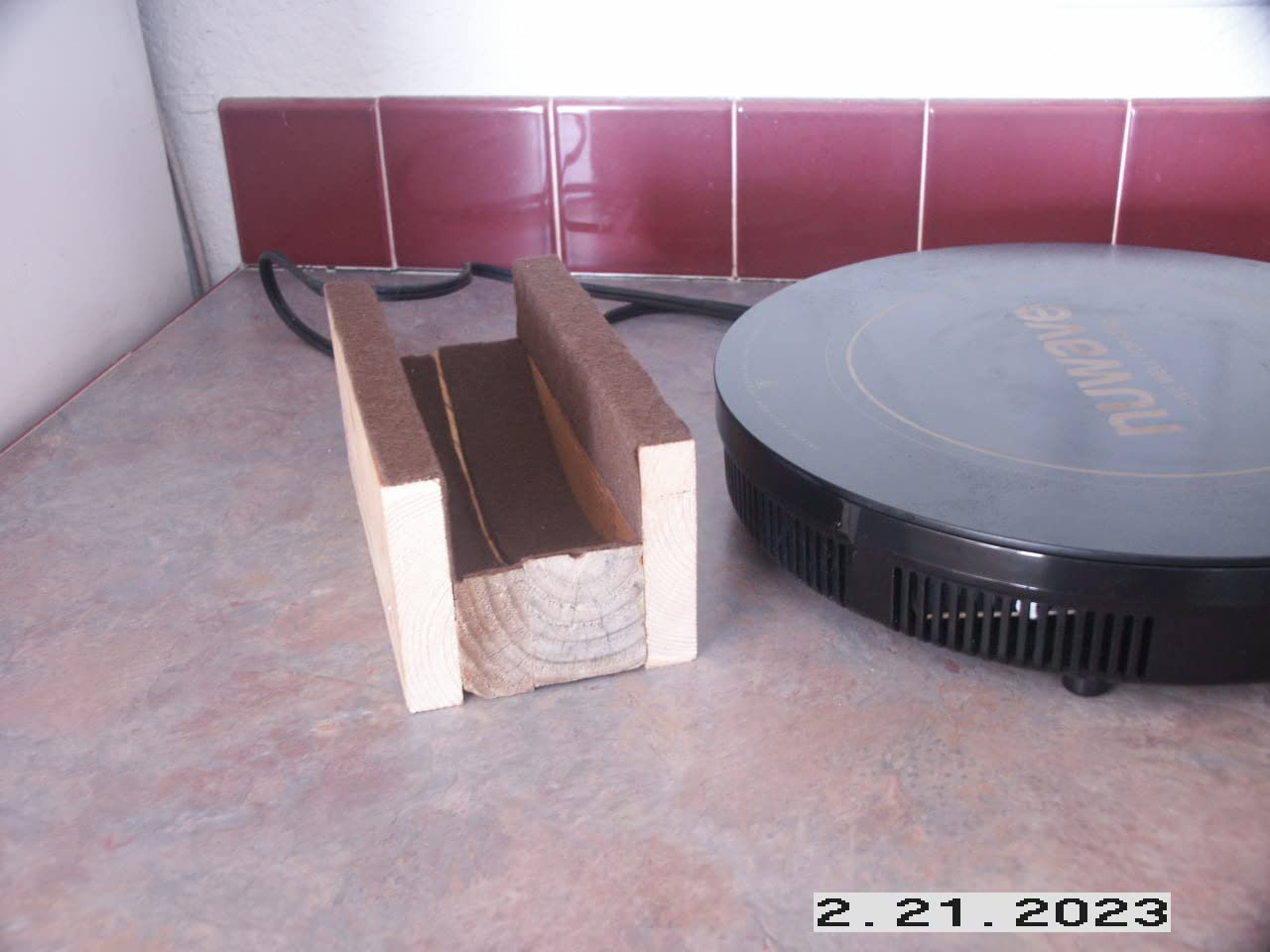
Who this cooktop suits
This is the pick for a cook who cares about precision more than raw power. If you make sauces, temper chocolate, hold a pot at a specific temperature for an hour, or simply hate guessing, the 5F increments are the feature you will notice every single day for years.
It also suits a renter or a second kitchen perfectly. It plugs into a standard 120V outlet, weighs little, and needs no installation at all, so you can take it with you when you move.
Where it falls short
It is a single-burner appliance, so a family meal means sequencing dishes. Owners upgrading from a four-burner range frequently note this is the moment they miss having a second pot going.
The cooling fan is genuinely audible in a quiet room, and the membrane keyboard cover is reported by some owners to degrade with long-term use and is not user-replaceable. Neither issue is dangerous, but both are worth knowing before you commit.
2. ChangBERT Commercial Grade Induction Cooktop: 1800W Stainless Steel Workhorse
ChangBERT Induction Cooktop, Commercial Grade Portable Cooker, Large 8” Heating Coil, Premium Stainless Steel Countertop Burner with NSF Certified, 10 Hours Timer Powerful 1800W Professional Hot Plate
1800W single element
120V plug-in
9 power levels, 18 temperatures
Stainless steel housing
Pros
- Continuous-duty circuitry rated for constant high-power use
- Expanded magnetic coil spreads heat evenly
- Stainless housing is durable and wipes clean
- Light enough for dorms RVs and campsites
- 10-hour timer plus child lock and auto shutdown
Cons
- Push-button panel is coarser than sliders or dials
- Stainless housing runs warm during long high-power sessions
- Single burner means multi-dish meals must be sequenced
If you want the most power available from a standard wall outlet, this is the one. At 1800W with nine discrete power levels from 200W to 1800W, it out-cooks most of the portable category, and the continuous-duty circuitry is rated for constant high-power use rather than short bursts.
The stainless steel housing is the detail that separates it from plastic-bodied competitors. It supports substantial weight on the surface, survives being knocked around in a workshop kitchen, and wipes clean without absorbing grease. Buyers consistently describe it as equipment rather than a gadget.
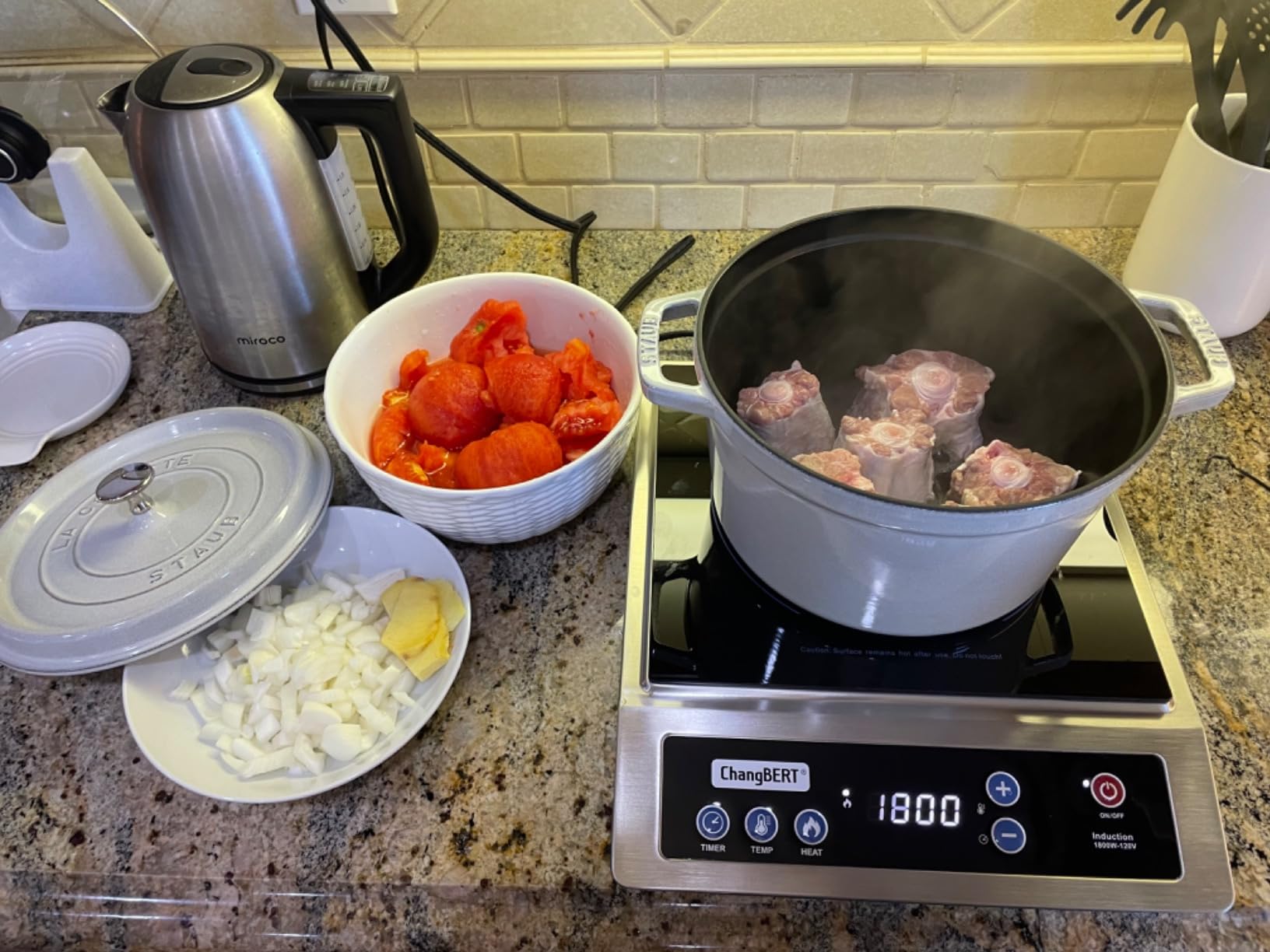
Temperature control runs across 18 settings from 120F to 460F, which is a narrower band than the Nuwave units manage but entirely adequate for stovetop work. The expanded magnetic coil is what improves heat distribution across cookware bottoms, reducing the hot-spot effect that makes cheap induction pans scorch in the middle.
It is ETL listed to UL commercial standard 197 and carries NSF certification, which matters if you are feeding people who are not family. The stainless body is also the one part of this cooktop that stores heat, so give it a few minutes after turning off before you set it on a delicate surface.
Who this cooktop suits
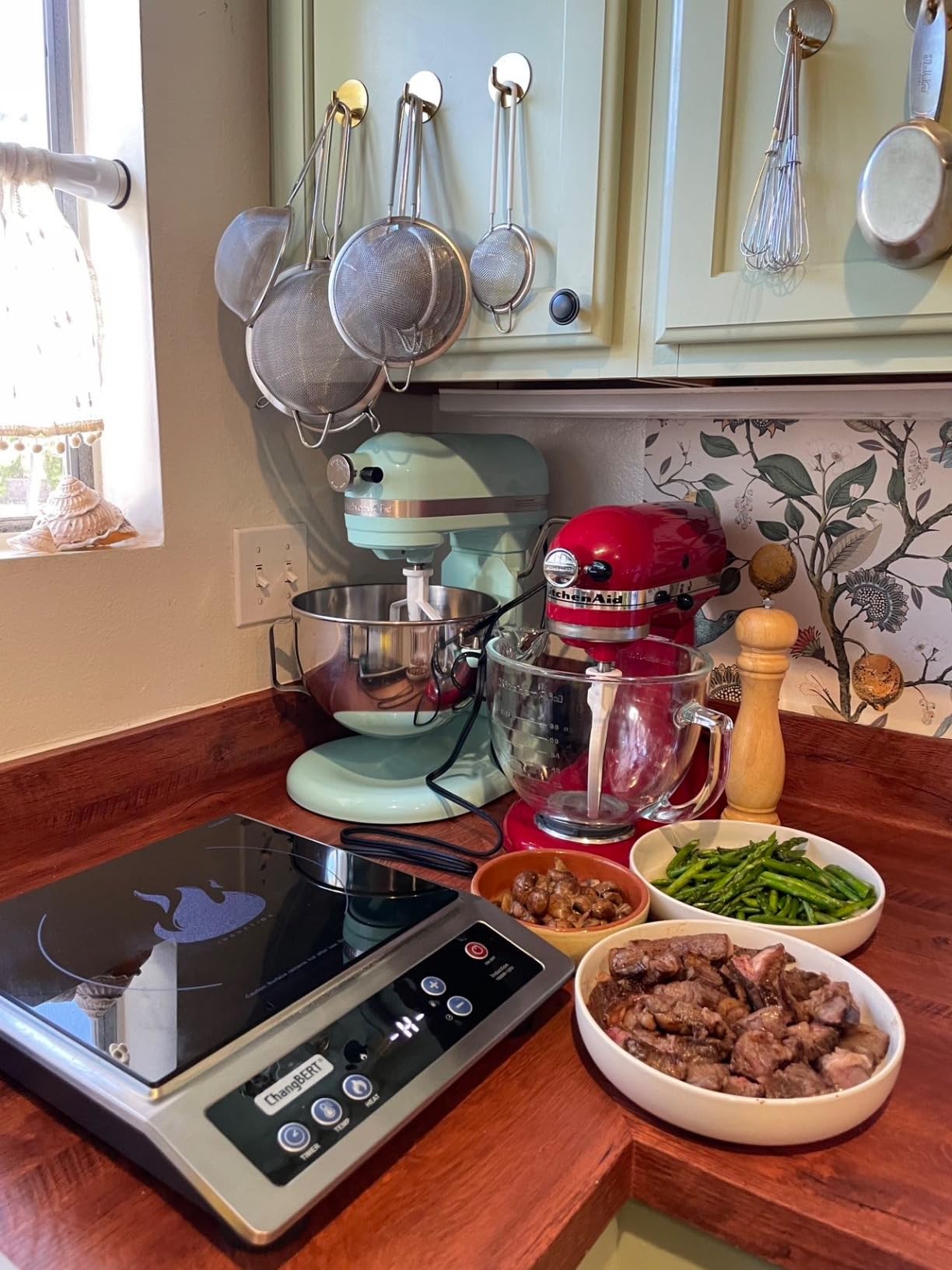
This suits anyone cooking for numbers rather than for pleasure: a home baker, a meal-prepper, a small catering run, or a household that genuinely needs the highest wattage a 120V circuit will deliver. The 10-hour countdown timer makes long unattended sessions practical.
The key-press control panel is also usable with wet hands or gloves, which is a real advantage in a workshop, garage kitchen or boat galley.
Where it falls short
The push-button interface is the compromise that pays for the power. You get 18 temperature steps rather than the near-continuous control the Nuwave models offer, and you will miss that immediately if you are used to fine increments.
It is also a single burner, so it cannot cook a full meal at once. And during extended high-power sessions the stainless housing stays warm to the touch, which is worth keeping in mind around small children.
3. Nuwave Pro Chef Induction Cooktop: 94 Temperature Settings in a 2.4 Inch Body
Nuwave Pro Chef Induction Cooktop, Commercial-Grade Portable Burner
1800W single element
120V plug-in
94 settings from 100F to 575F
2.4 inch profile
Pros
- 94 discrete temperature settings in 5F increments
- Slim 2.4 inch body stores and travels easily
- Three wattage settings for limited-power locations
- Commercial-grade glass surface with NSF certification
- Faster and more even heating than lower-wattage units
Cons
- Fan noise is present during cooking
- Membrane keyboard cover is not user-replaceable
- Single element cannot cover a full meal
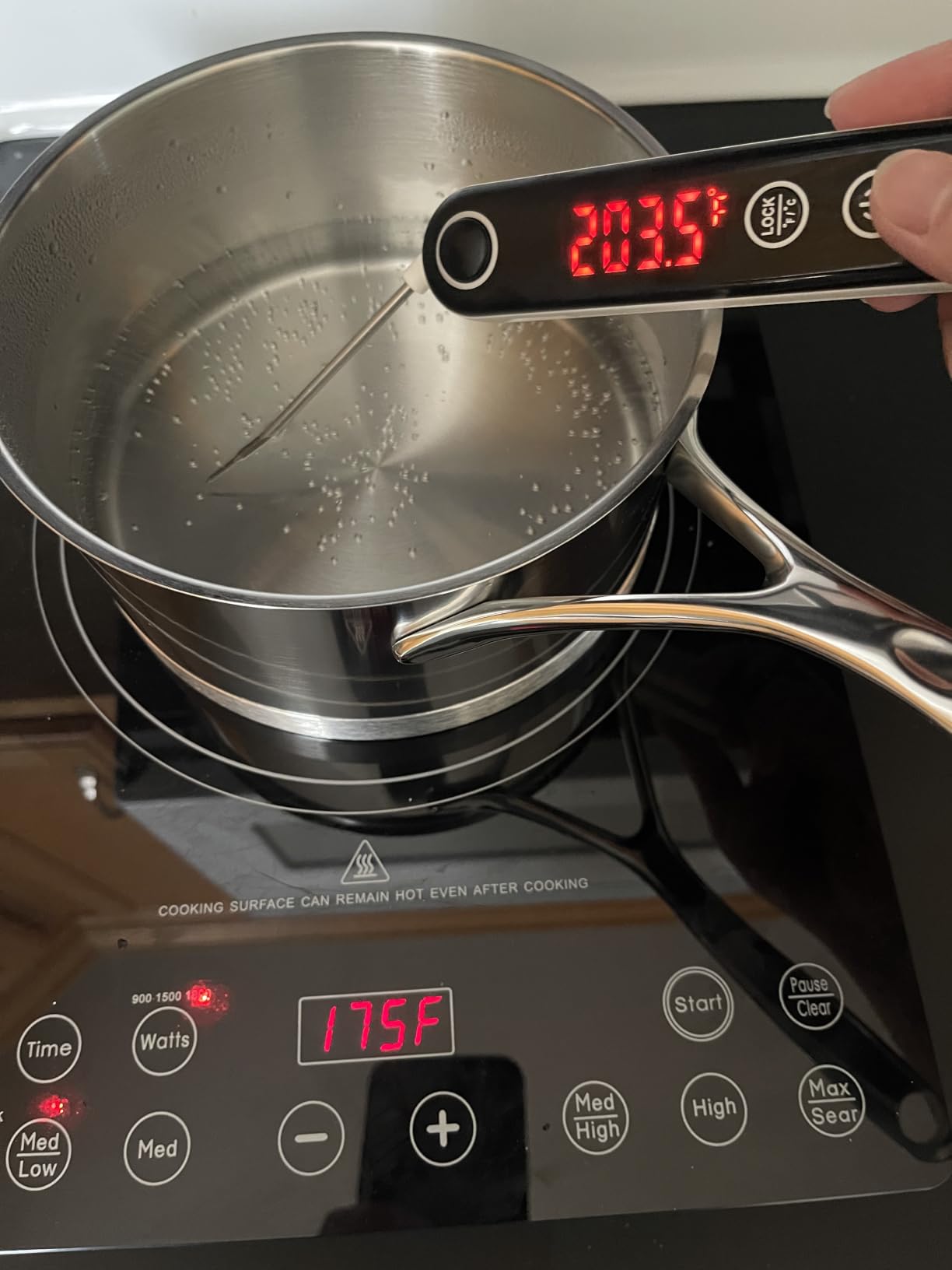
Take everything the Nuwave Gold Precision does well and add 300W, a slimmer body and a wattage selector. That is the Pro Chef in one line, and it explains why the control panel dominates conversation around this model: 94 temperature settings in 5F increments from 100F to 575F, adjustable mid-cook without restarting.
The wattage settings are the underrated part. Choosing between 900W, 1500W and 1800W lets you run full speed on a normal outlet and dial back where power is limited, which is exactly the situation in a recreational vehicle, a dormitory or a boat cabin with a small breaker.
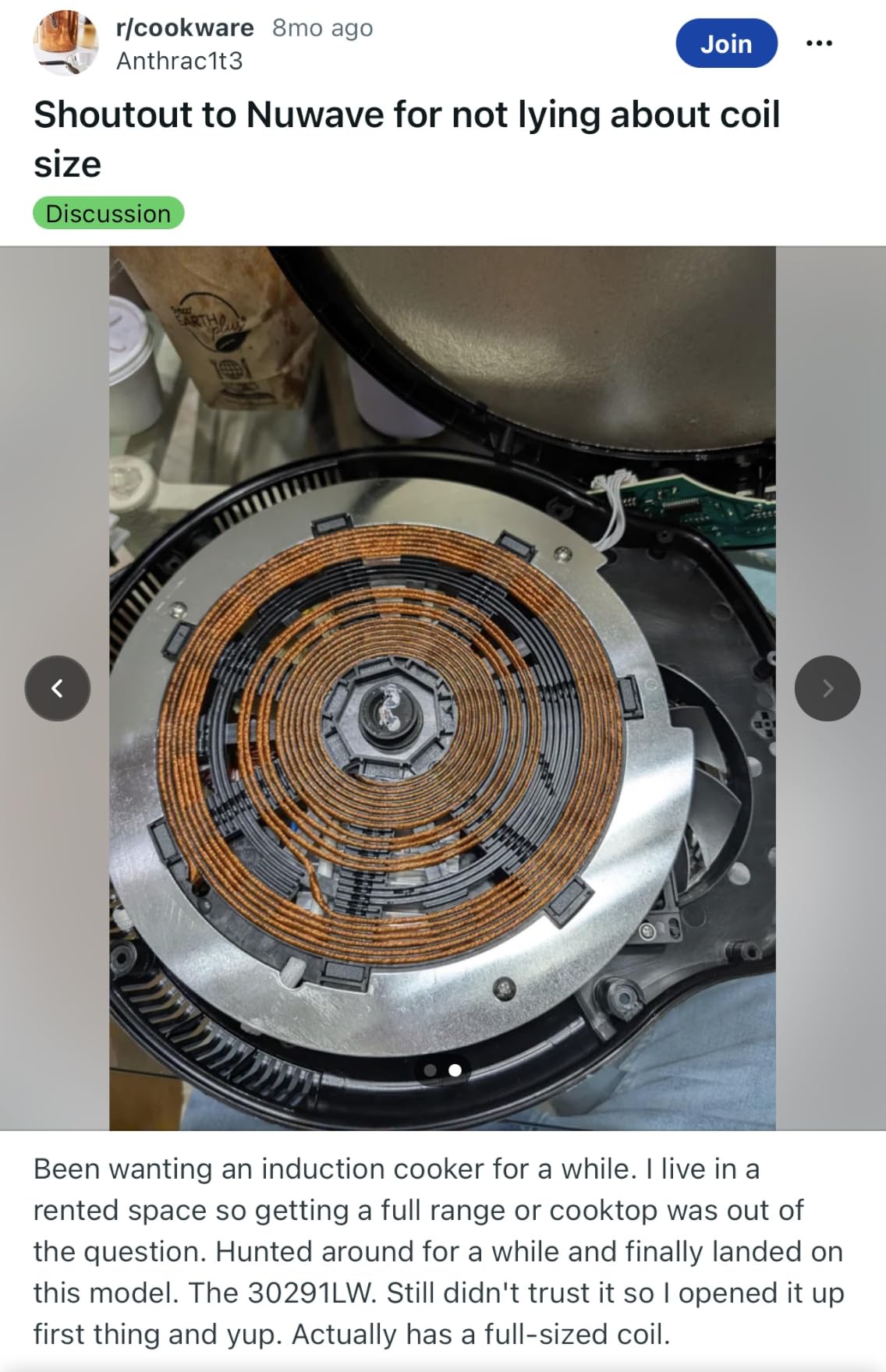
At 2.4 inches tall and 7 pounds, it slides into a drawer or a bag far more easily than the 4.5-inch Gold Precision. Patented insulation technology brings the coil closer to the cookware, which is why the heating is described as faster and more even than lower-wattage portable burners.
Users who upgrade from coarse-setting burners almost always single out the 5F increments as the deciding factor, which tells you the control granularity is what this model is actually selling. The commercial-grade shatter-proof ceramic glass and NSF certification make it a legitimate professional unit.
Who this cooktop suits
This suits the serious cook who moves, or who lives somewhere with constrained power. Precise control, selectable wattage and a slim profile make it the most portable precision cooker we tested.
It is also a strong second induction unit for a kitchen that already has a built-in cooktop, giving you a low-temperature zone without fighting for counter space.
Where it falls short
It is a single heating element, so it cannot cover a full meal at once no matter how much power you give it. Plan your cooking order rather than expecting parallel burners.
Fan noise is present during cooking, and the membrane keyboard cover is reported to degrade with long-term use without being user-replaceable. If that panel ever goes, the whole interface goes with it.
4. Nuwave Double Pro Induction Cooktop: Two Independent Zones on One Plug
Nuwave Double Pro Cooktop Induction Countertop Burner, Portable, 50°F-575°F
Two independent zones
120V plug-in
50F to 575F in 5F steps
8 inch coil on each burner
Pros
- Dynamic Watt Technology keeps one burner boiling while the other simmers
- True independent dual-zone control at two temperatures
- Boils water faster than gas per multiple owners
- Seamless glass panel with no crevices for food
- Reported to replace a full range for most households
Cons
- Both zones drop to 900W when run together
- Some owners report temperature drift and mid-cook cycling
- No obvious on/off indicator so pans can bump settings
- Large 23.6 inch footprint and 14 pound weight
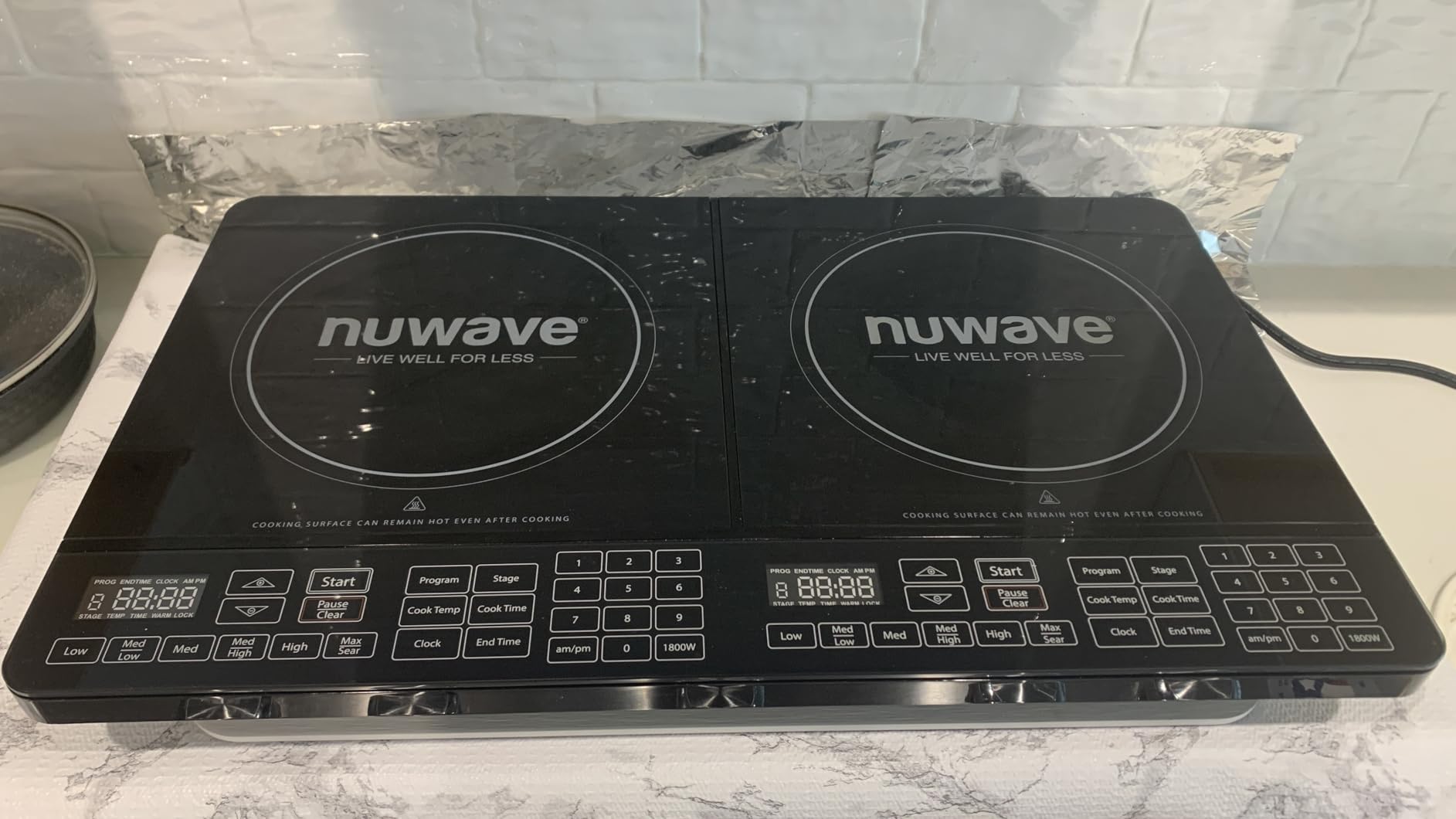
This is the most interesting idea in the portable category: one plug, two genuinely independent zones. Each burner has its own 8-inch coil, its own control and its own temperature range, which means a low simmer and a hard boil at the same time without a wall oven involved.
Dynamic Watt Technology is the mechanism that makes it work. Instead of naively splitting available power in half and starving both zones, it redistributes output based on what each burner is doing, so a gentle simmer barely touches the power available to a boiling pot.
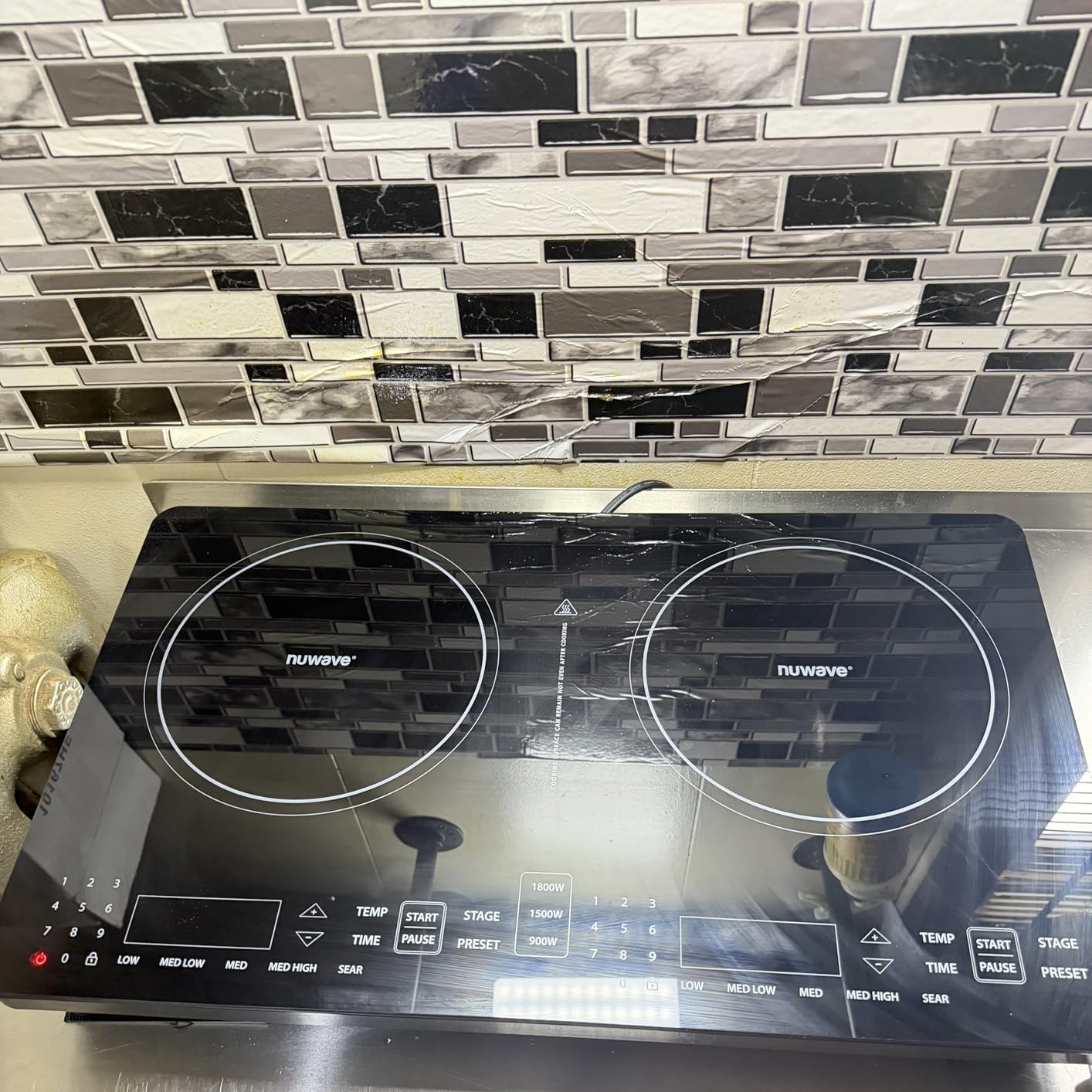
Control is 5 preset temperatures plus custom settings from 50F to 575F in 5F increments, which is the widest low-end range in this roundup. The 50F floor is genuinely useful for overnight proofs, long braises and holding a dish warm without drying it out.
The seamless edge-to-edge touch panel has no gaps for debris to collect, which matters more than it sounds if you actually cook on it daily. Owners describe it as a genuine range replacement, and in kitchens that do not want a hardwired install, that is a defensible claim.
Who this cooktop suits
This suits households that cook a real meal with two dishes at two temperatures and refuse to pay an electrician for a 240V circuit. Apartment dwellers, renters and anyone in a kitchen without a gas line fit that description exactly.
It also suits low-and-slow cooks, because a 50F minimum temperature is a feature no built-in cooktop in this budget range offers.
Where it falls short
Total output is capped by a standard outlet, so both burners drop to 900W each when run together. That is adequate, not fast, and you should not expect 36-inch built-in performance from it.
A notable minority of owners report units losing temperature accuracy or cycling power off mid-cook within months, which is exactly the durability anxiety that drives forum shopping. The interface is also easy to bump, with no obvious on-off indicator and digit entry that appends rather than replaces, so a stray touch can set an unintended temperature.
5. Empava Flex Two Burner Induction Cooktop: Drop-In or Countertop on 120V
Empava Flex Induction Cooktop 2 Burner, Horz. Countertop/Drop-in, Plug in
Two zones
120V plug-in or drop-in
120F to 460F, 18 levels
599 minute timer
Pros
- Dual installation flexibility as a drop-in or a countertop unit
- 18 temperature levels with melt and keep-warm presets
- Pause function plus a long 599 minute timer
- Child lock and auto shutoff as standard
- Ceramic glass surface wipes clean easily
Cons
- Total 1800W is shared across both zones
- Touch buttons reported to need multiple taps
- Some owners report error codes and fan noise
The flexibility is the entire pitch, and it works. The same unit runs on your counter through the included plug or drops into a countertop cutout for a permanent install, which means you can test induction in a rental before committing to a renovation.
It is also cTUVus certified, which is a stronger safety signal than most products at this level, and it comes with a 1-year manufacturer warranty. Controls are touch, with dedicated melt, keep-warm and simmer presets rather than pure power levels, plus a pause function that lets you step away without losing your setting.
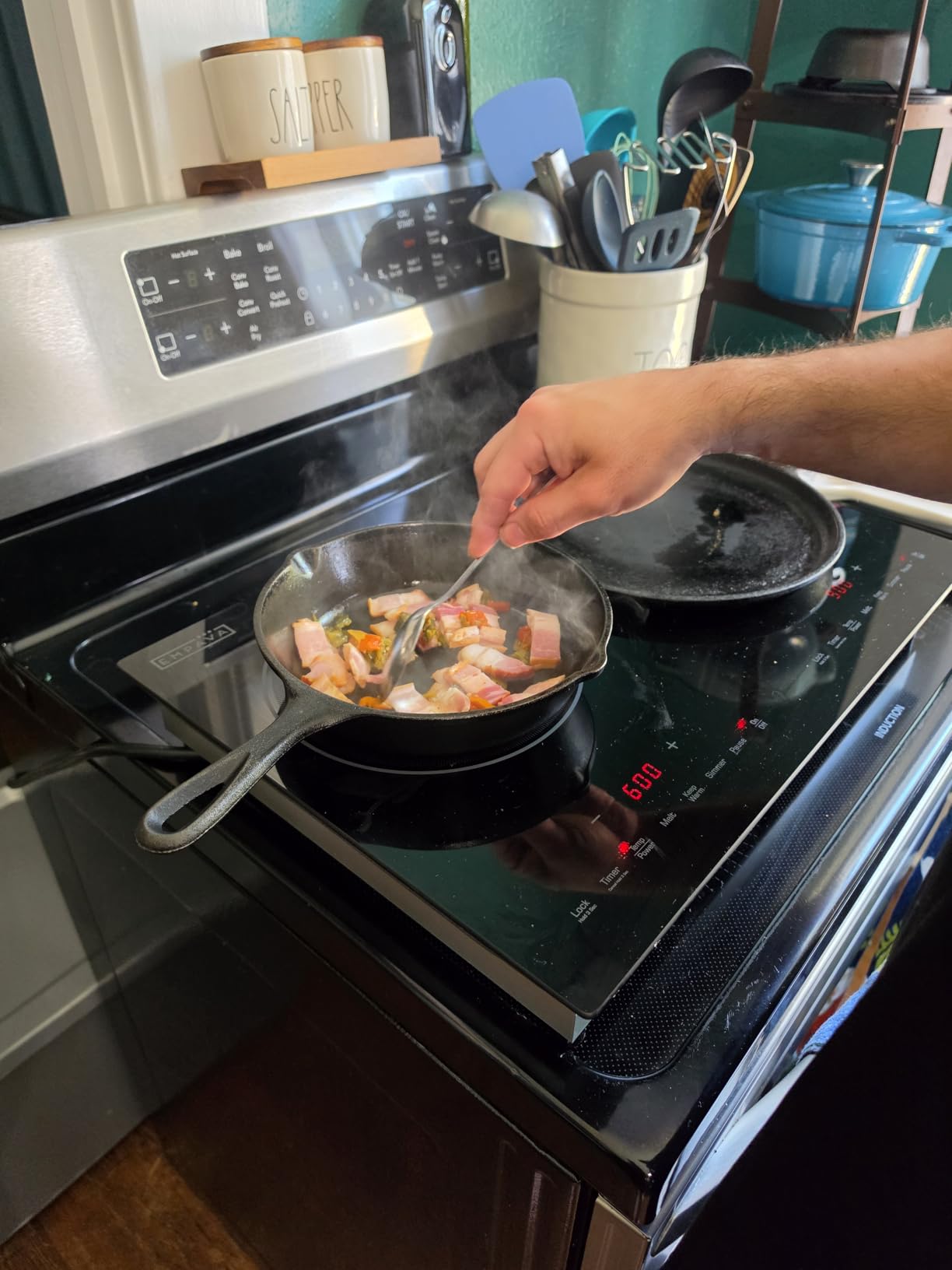
The temperature range runs 120F to 460F across 18 levels, and the timer is settable from 1 to 599 minutes, which is a genuinely long unattended window for a portable unit. We have seen longer timers advertised and rarely delivered.
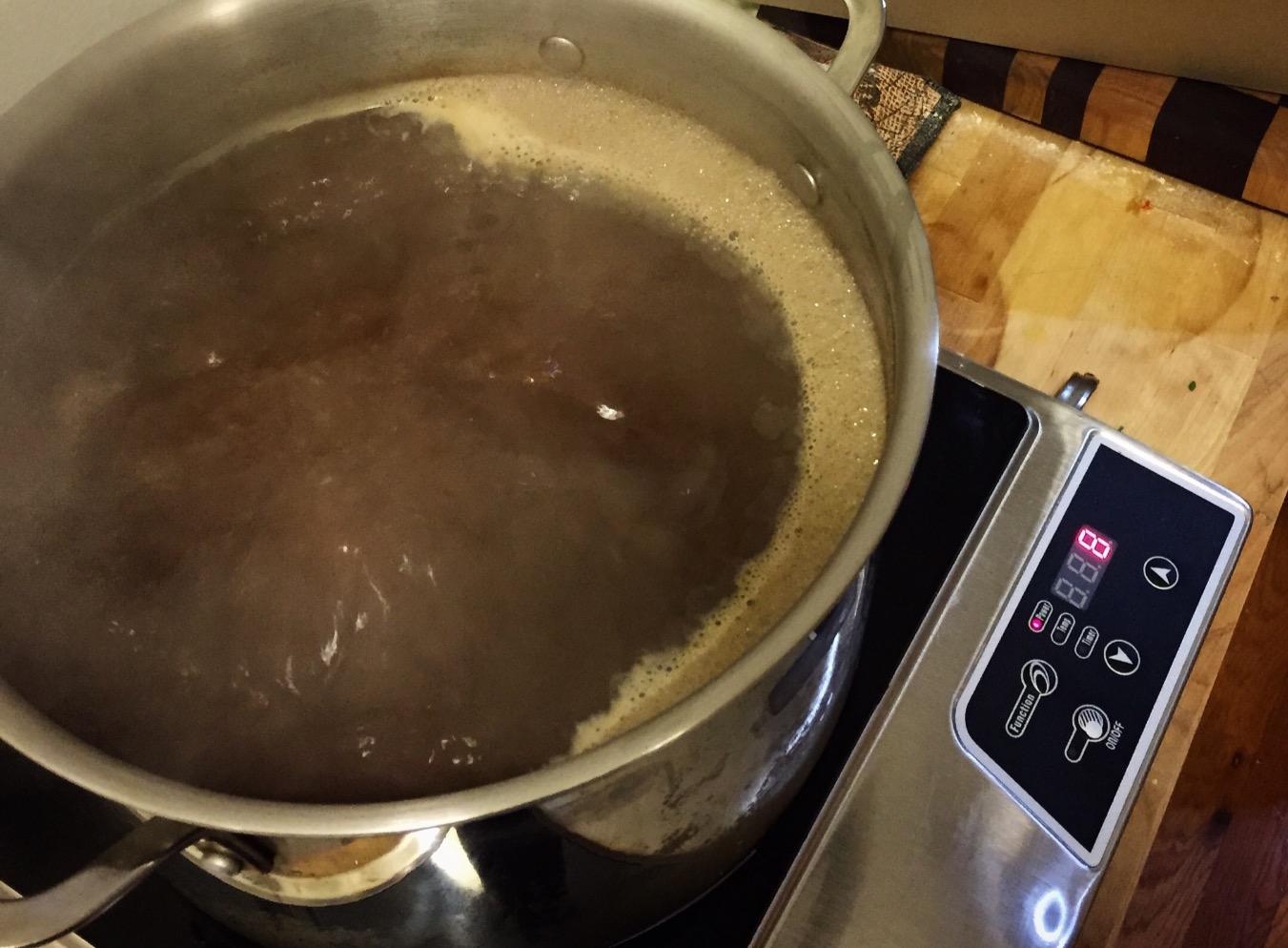
Owners most value the install-your-way approach, along with the wide temperature band and the dedicated low-temperature modes. That combination makes it a good fit for melting chocolate, holding a sauce and simmering without babysitting.
Who this cooktop suits
This suits renters, students and anyone testing whether induction works for their cooking style before spending on a hardwired install. Two zones with independent temperatures covers most weeknight meals.
It also suits small kitchens, where 120V power and a slim drop-in footprint are the only realistic options.
Where it falls short
Its 1800W total is shared across both zones, so running two pots at once means reduced output each. That is the price of plugging into a household circuit rather than a 40-amp one.
Touch responsiveness is the recurring complaint. Owners report buttons needing multiple taps to register, plus occasional error codes and noticeable fan noise. If you have heavy hands and cook fast, test the interface in a showroom before committing.
6. Empava 36 Inch Induction Cooktop: Five Zones with Bridge-SYNC at 10200W
Empava 36 Inch Electric Induction Cooktop Built-In
Five zones with bridge-SYNC
240V hardwired
10200W total
35.4 inch wide
Pros
- Five zones plus bridge-SYNC handles one skillet or a full meal
- Glide-touch slider gives finer control than stepped buttons
- Boost mode delivers quick power bursts for boiling
- Smart pan sensor flags bad cookware or placement
- Low 2.2 inch profile fits standard 36 inch cutouts
Cons
- Requires 240V hardwiring so it is not a simple plug-in job
- Slider controls are easy to bump with large pans
- Some owners report fan noise and units needing power cycles
Five zones at 10200W total is the kind of layout you would expect to pay far more for. For a household that cooks a full meal at once, this is the pick in the roundup, because you can run a main dish, two sides and a keep-warm zone without sequencing anything.
Bridge-SYNC is the feature that earns its name. It links two adjacent zones into a single larger cooking surface, so a griddle, a rectangular roasting pan or a stockpot spanning two burners becomes possible, which no four-burner layout here can do.
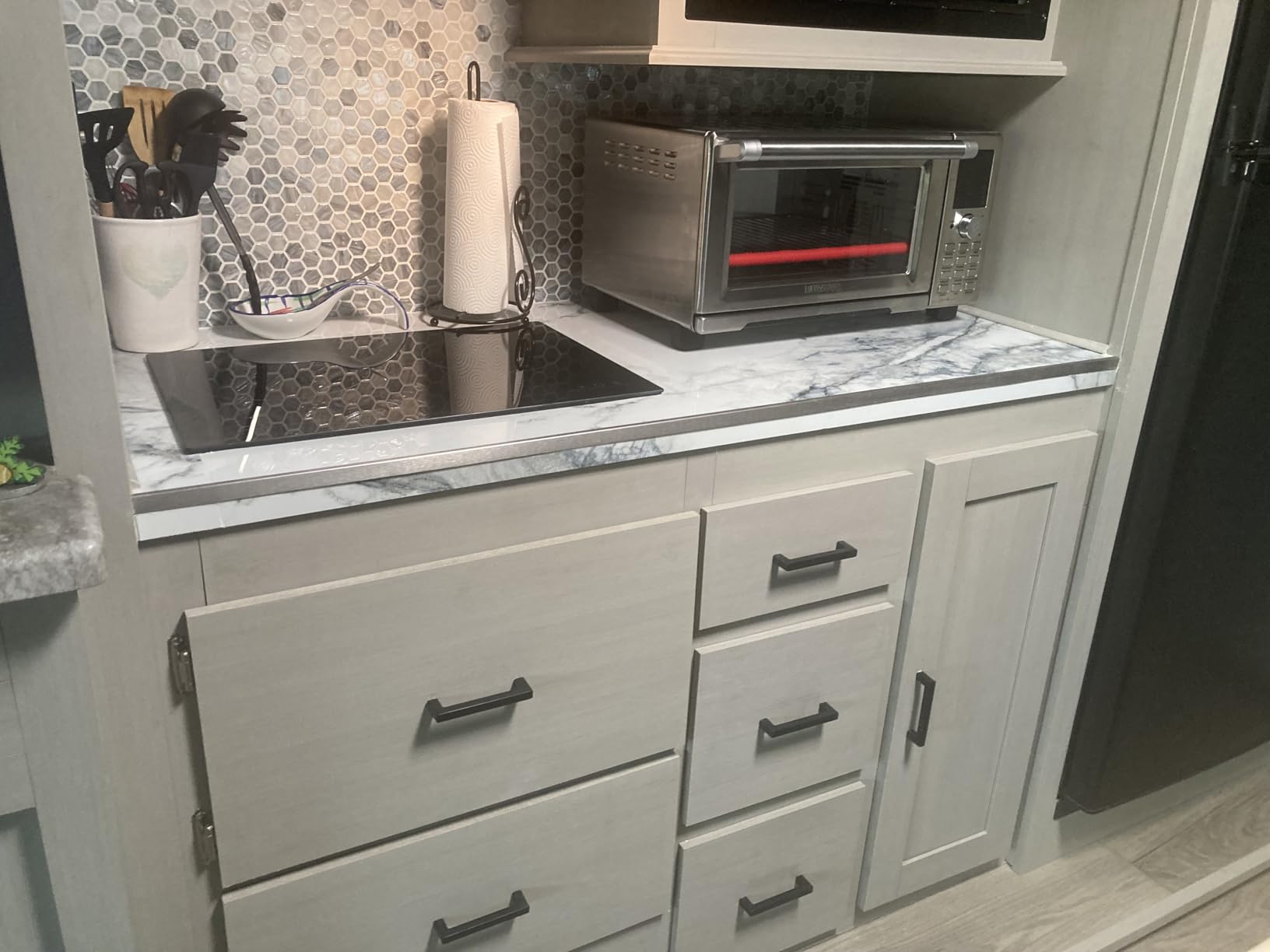
Controls are a glide-touch slider with nine power levels plus boost, and a slider genuinely gives finer adjustment than stepped buttons, especially at the low end where most induction cooking happens. A smart pan sensor flags incompatible cookware or poor placement rather than simply refusing to heat.
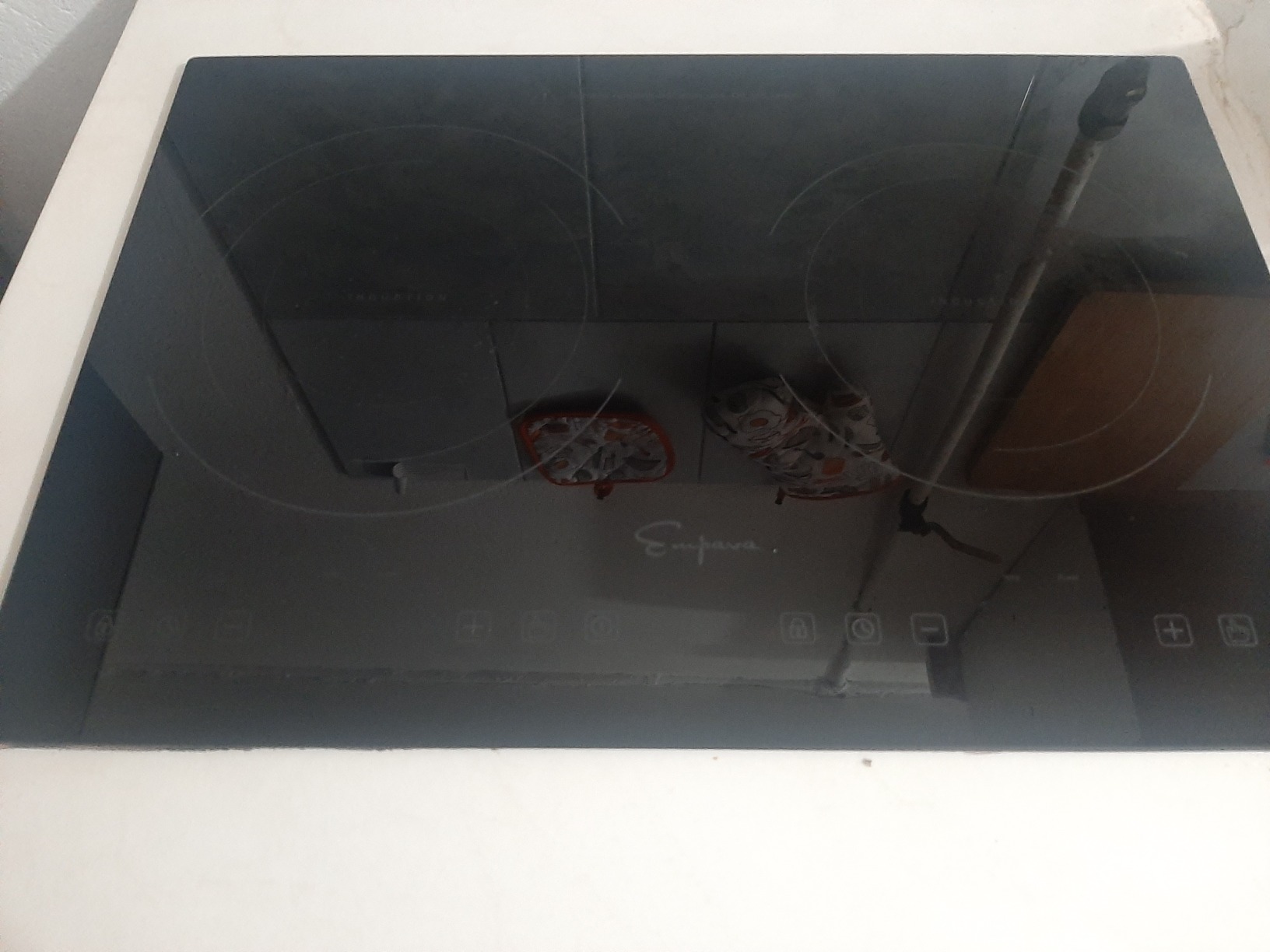
At 2.2 inches tall and 35.4 inches wide, it fits a standard 36-inch cutout, which means the countertop work is predictable if you measure before ordering. Timer, control lock and a stop-and-go pause round out an otherwise complete feature set.
Who this cooktop suits
This suits large families and serious home cooks who regularly run three or four dishes at once. It is also the only cooktop here with a bridge zone on 36 inches of glass, which matters if you own oversized cookware.
If you are building a renovation around a wall oven, a five-zone cooktop gives you the surface area that a separate range would have given you without giving up counter space.
Where it falls short
It ships with a power cord and no plug, which means 240V hardwiring and a proper circuit. That is an electrician job, and it is the single largest cost consideration for any cooktop on this list.
The touch slider is sensitive enough that a large pan can change a setting when it lands. Owners also report fan noise and units needing multiple on-off cycles to restart, so treat the panel as something to handle deliberately rather than brush past.
7. Empava Ease 30 Inch Induction Cooktop: Four Timed Zones for RVs and Small Kitchens
Empava Ease 30“ Induction Cooktop 4 Burner, Drop-in, Hardwired
Four zones
240V hardwired
7400W total
21 inch deep frameless glass
Pros
- Four independent zones each with its own countdown timer
- Frameless black glass wipes clean in one swipe
- Power boost gives quick bursts for boiling and searing
- Popular for RV coach and small apartment installs
- Multiple owners report years of trouble-free daily use
Cons
- Some units have failed within weeks to a few months
- Touch buttons reported as finicky and needing repeated presses
- Fan noise is described as loud
- Error codes such as E1 and E3 reported on some setups
A 30-inch four-burner cooktop is the most common configuration in American kitchens, and this one covers it properly. Four independent zones each with its own 1-99 minute countdown timer is a real convenience when you are cooking several things at different durations.
At 7400W total with nine power levels and a boost mode, it delivers less combined power than the 36-inch models here, but distributed across four zones it handles normal household cooking without trouble. The frameless black glass looks modern and cleans in a single swipe.
Safety features are thorough: pan sensor, child lock, residual heat display and overheat prevention. That package is exactly what you want in a recreational vehicle or a home with small children, and it is the reason this model is so popular in the RV channel.
Satisfaction is highest where space is the constraint. Owners in coaches, RVs and small apartments cite the four timed zones, the boost function and the clean frameless glass as the deciding factors rather than raw power.
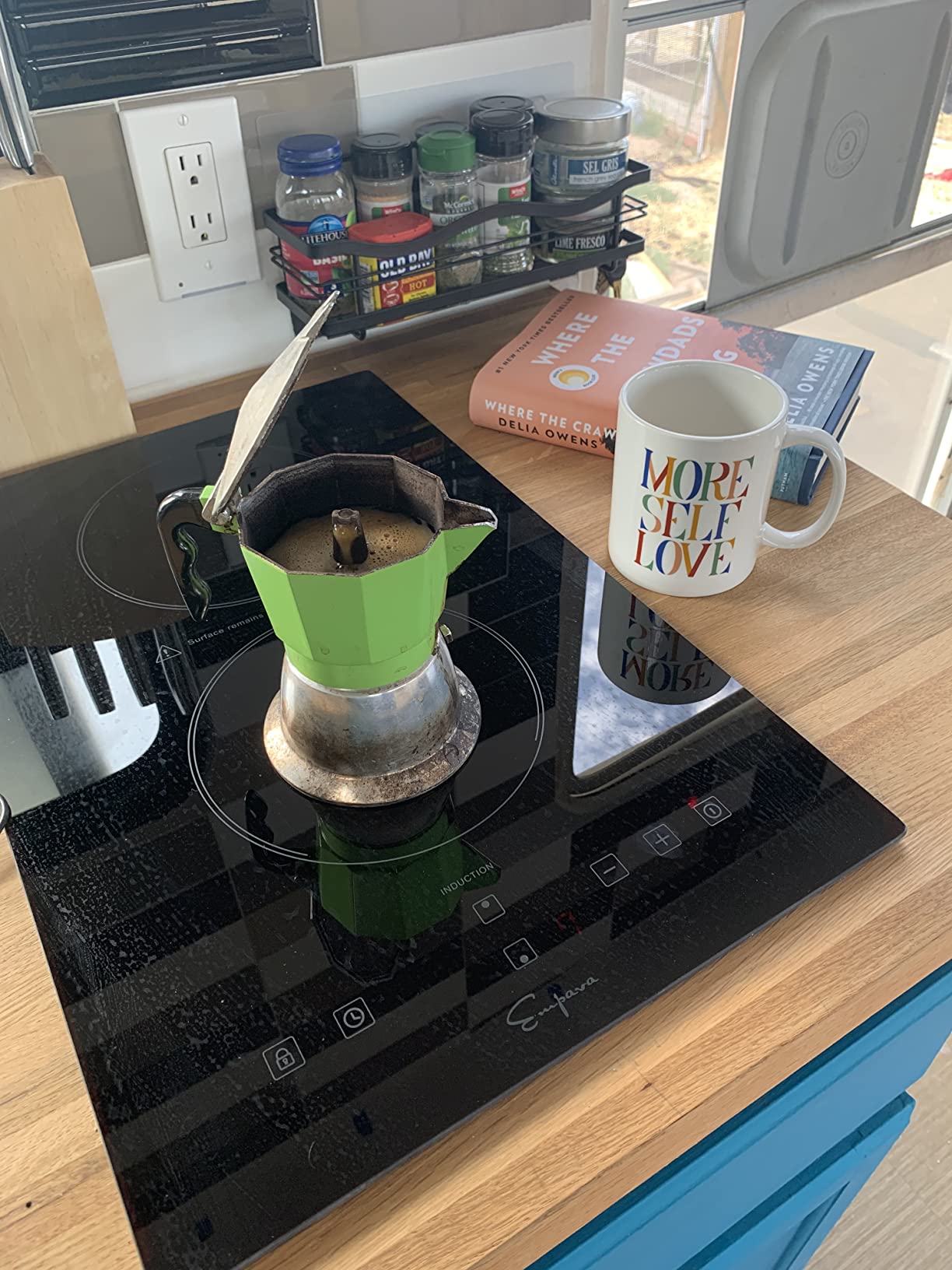
Who this cooktop suits
This suits a standard 30-inch cutout in a kitchen that does not need a fifth zone, and it suits mobility situations particularly well. Independent per-zone timers are invaluable in a vehicle where you cannot walk away from a burning pan.
It also suits anyone prioritising a genuinely wipe-clean frameless surface over brand-name service networks.
Where it falls short
Durability is the honest concern. Negative reviews cluster on units failing within weeks or a few months, which is exactly the failure pattern buyers worry about most, and it lands harder on a hardwired appliance than on a portable one you can swap out.
Finicky touch buttons requiring repeated presses, loud fan noise and error codes such as E1 and E3 on some setups round out the complaints. Customer support responsiveness is a repeated theme too, so know your local service options before you buy.
8. ThermoMate 36 Inch Induction Cooktop: 9800W Across Five Boost Burners
ThermoMate 36 Inch Induction Hob Electric Cooktop, 9800W Built in Induction Stove Top with 5 Boost Burners, 9 Heating Levels, Timer & Child Safety Lock, Sensor Touch Control, 240V
Five burners
240V hardwired
9800W total, boost to 3000W
33.86 inch cutout
Pros
- Boils water extremely fast with the boost function
- Five burners in a slim 2.3 inch profile
- Multiple owners report 4+ years of reliable daily use
- Glass surface wipes clean and does not heat the room
- Direct swap for a standard 240V cooktop circuit
Cons
- Sensor touch extremely sensitive to water splashes and damp hands
- Some zones reported to cycle on and off rather than hold temperature
- One owner reported a stuck touch zone a motherboard replacement did not fix
- Warranty information is hard to find and support feels limited
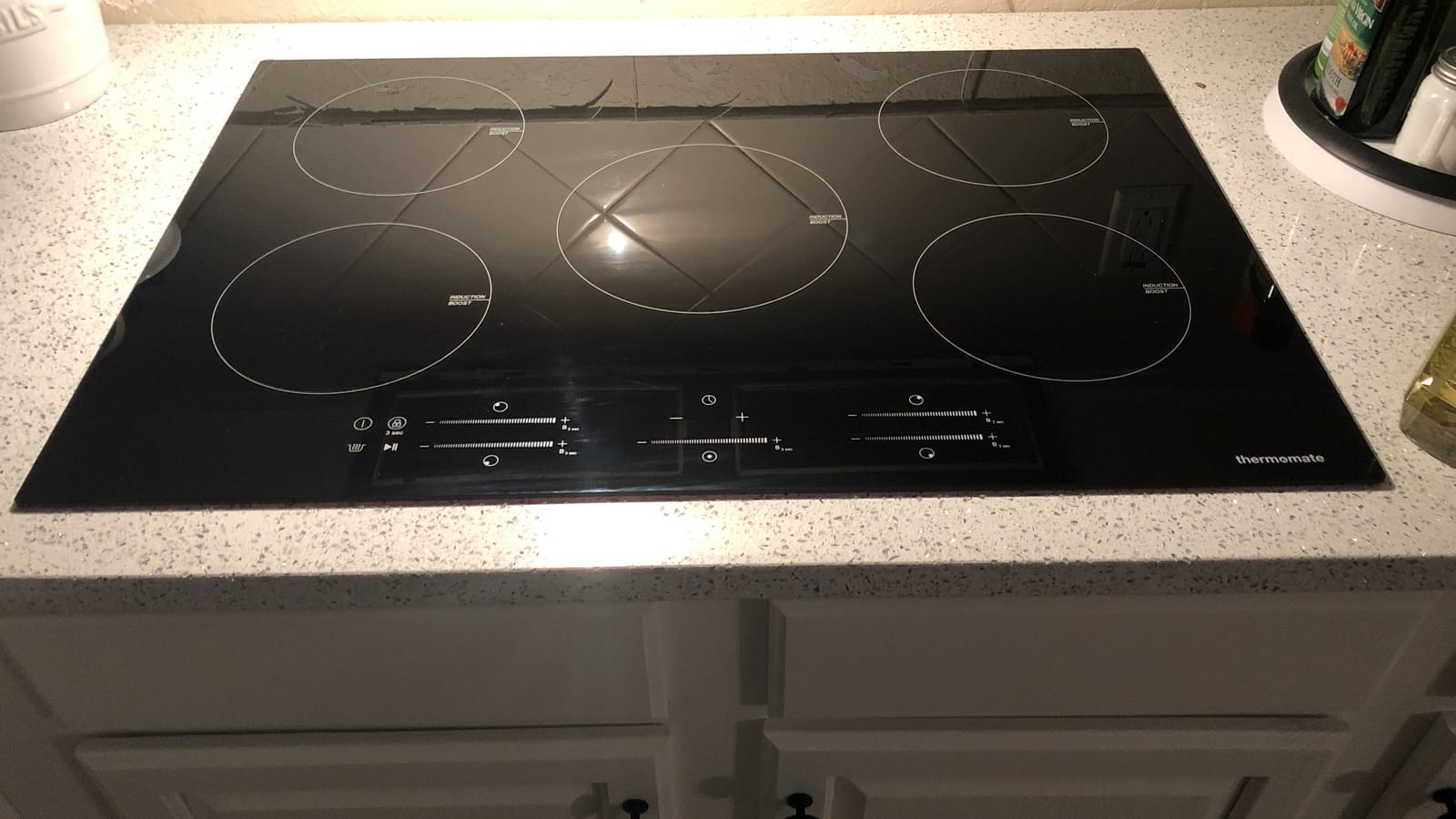
This is the value pick for anyone who wants 36 inches of glass and genuinely fast water. At 9800W total with individual zone ratings topping out at 2600W and 3000W on boost, it holds its own against cooktops costing several times more, and several owners report outrunning exactly that.
The boost function is the headline: five minutes of maximum power on demand, which is what turns a 10-minute boil into a 6-minute boil. Combined with nine power settings, independent 1-99 minute timers per burner, a keep-warm function and overheat protection, the feature list is long for the money.
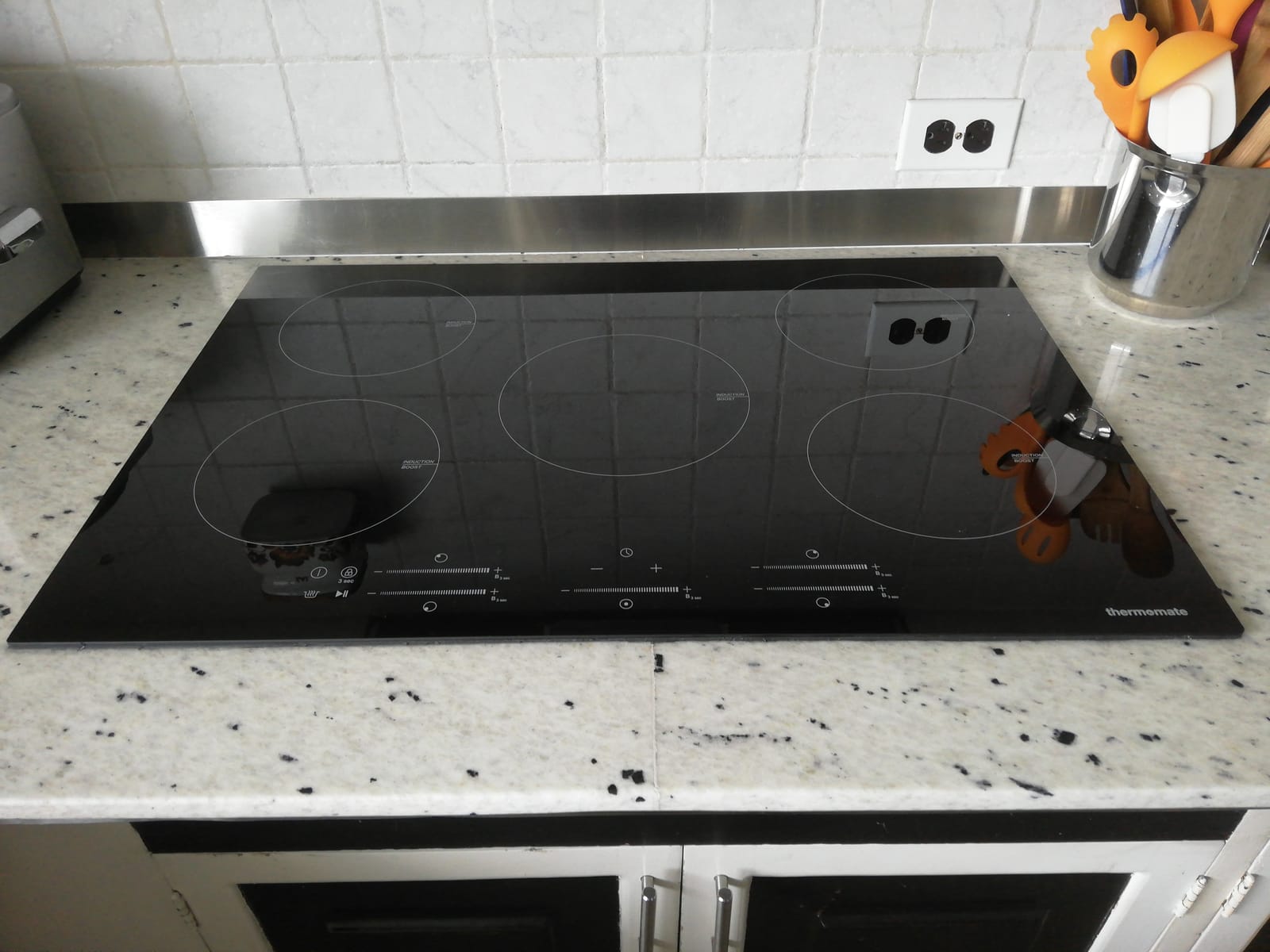
Sizing is refreshingly conventional at 35.4 inches wide by 20.5 deep and 2.3 inches tall, with a stated cutout of 33.86 by 19.5 inches. It includes fixing kits and a cutout template board, which is a small courtesy that saves a trip to the hardware store.
Long-term reports are the strongest thing about it. Multiple owners describe four or more years of reliable daily use, and the glass surface does not heat the room, which matters in a small or closed kitchen.
Who this cooktop suits
This suits a family of five or more on a 36-inch cutout who wants five burners without a five-figure budget. It is a direct electrical swap for a standard 240V cooktop circuit if you already have one.
It also suits anyone replacing a gas range who needs to know the new cooktop will hit temperature fast, since gas-to-induction conversions are where wattage anxiety peaks.
Where it falls short
The sensor touch is the big one. It is so sensitive to water splashes and damp hands that it can shut the unit down and require a breaker reset, and that is a genuinely annoying failure mode in a busy kitchen. Some zones are also reported to cycle on and off instead of holding a steady temperature.
One owner reported a stuck touch zone that a motherboard replacement did not resolve, and warranty information is difficult to find with support perceived as limited. Buy it with that in mind: this is a value bet, not a service-network bet.
9. GTKZW 12 Inch Double Induction Cooktop: Quiet Two-Zone Unit for Boats and Dorms
Induction Cooktop 12″, GTKZW Double Induction Cooktop 2 Burner 110v-120v Electric Stove Top, Countertop and Built-in, 9 Power Levels, Child Lock, 120 Mins Timer
Two zones
110V powered
2000W total, 1200W plus 1100W
176F to 464F
Pros
- Very fast heat transfer
- cold to frying in about 40 seconds
- Two independent zones with separate LED displays
- Quieter than most comparable units at moderate heat
- Builds into a counter or freestands on a 110V outlet
- Child lock and auto-off with no cookware
Cons
- Thin 7-page manual and undocumented E3 error
- Some owners report units failing within a few months
- Manufacturer support is hard to reach and supplier identity unclear
- Total 2000W is modest for a two-burner unit
What stands out here is the sound. Owners repeatedly describe this as quieter than comparable dual-zone units, particularly at moderate heat, and that is precisely the complaint that decides purchases for people cooking in a small cabin, a boat or a studio apartment.
Heat transfer is the other headline. Multiple owners report going from cold to frying in about 40 seconds, and the two independent zones carry separate LED displays with 1200W on one and 1100W on the other across nine power levels.
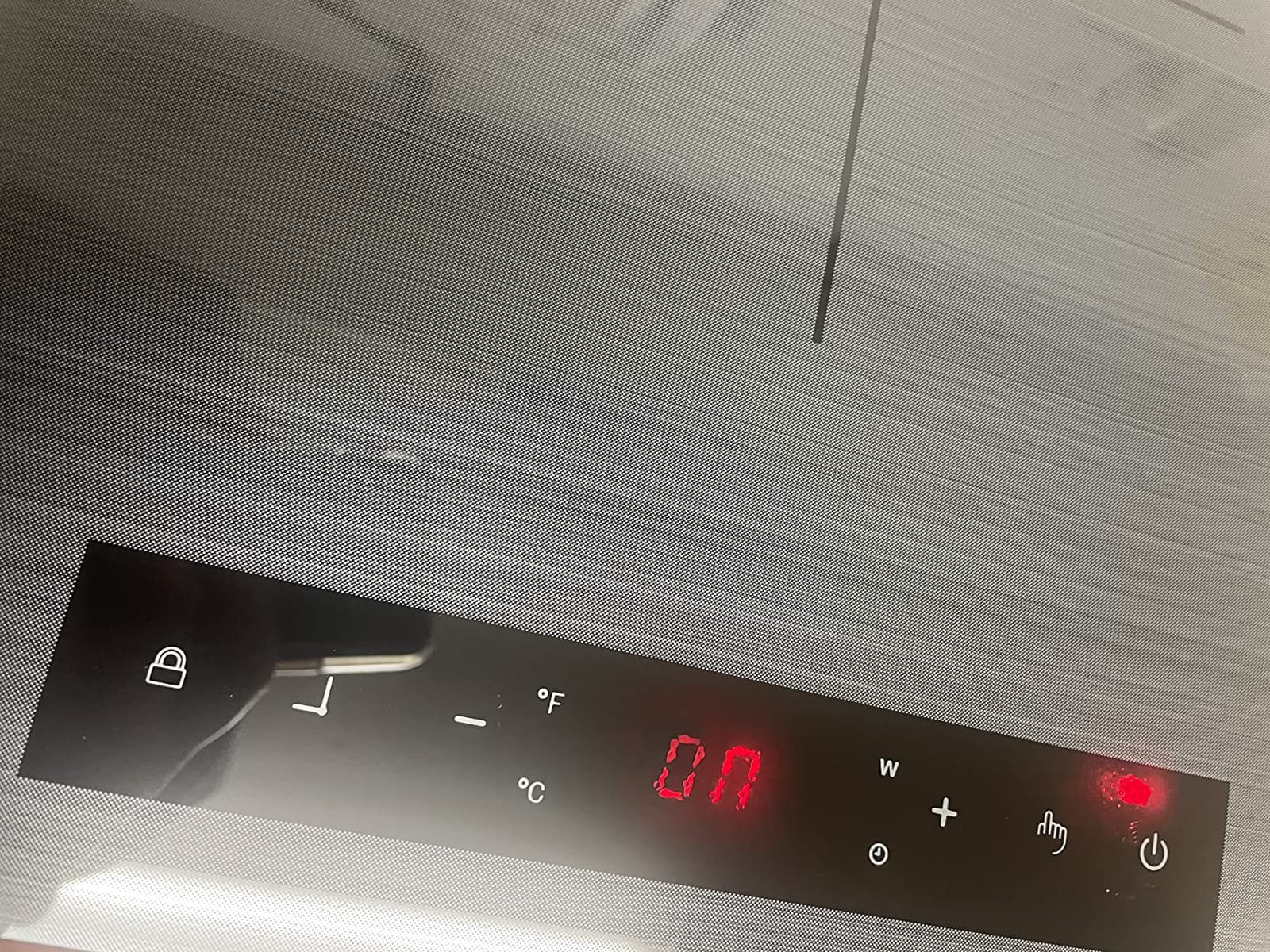
It accepts magnetic cookware from 6 to 11 inches and auto-offs after 30 seconds with no cookware detected, which is a real safety win in a boat galley where a stray pan or a rolling vessel is a genuine hazard. Temperature range is 176F to 464F across the nine levels.
It builds into a counter or freestands on a 110V outlet, and it is light enough to move between a kitchen and a boat, which is where most of these owners take it.
Who this cooktop suits
This suits boat owners, RV upgraders and anyone cooking in a space where fan hum is genuinely disruptive. It also suits households cooking for elderly relatives who want the surface to be cool when it is not in use.
If quiet operation and fast heat matter more to you than fine temperature granularity, this is the strongest pick in the roundup on both counts.
Where it falls short
Documentation is poor. The manual is seven pages, and the E3 error code that owners report encountering is not documented anywhere, which is a bad combination when something goes wrong at the far end of a boat trip.
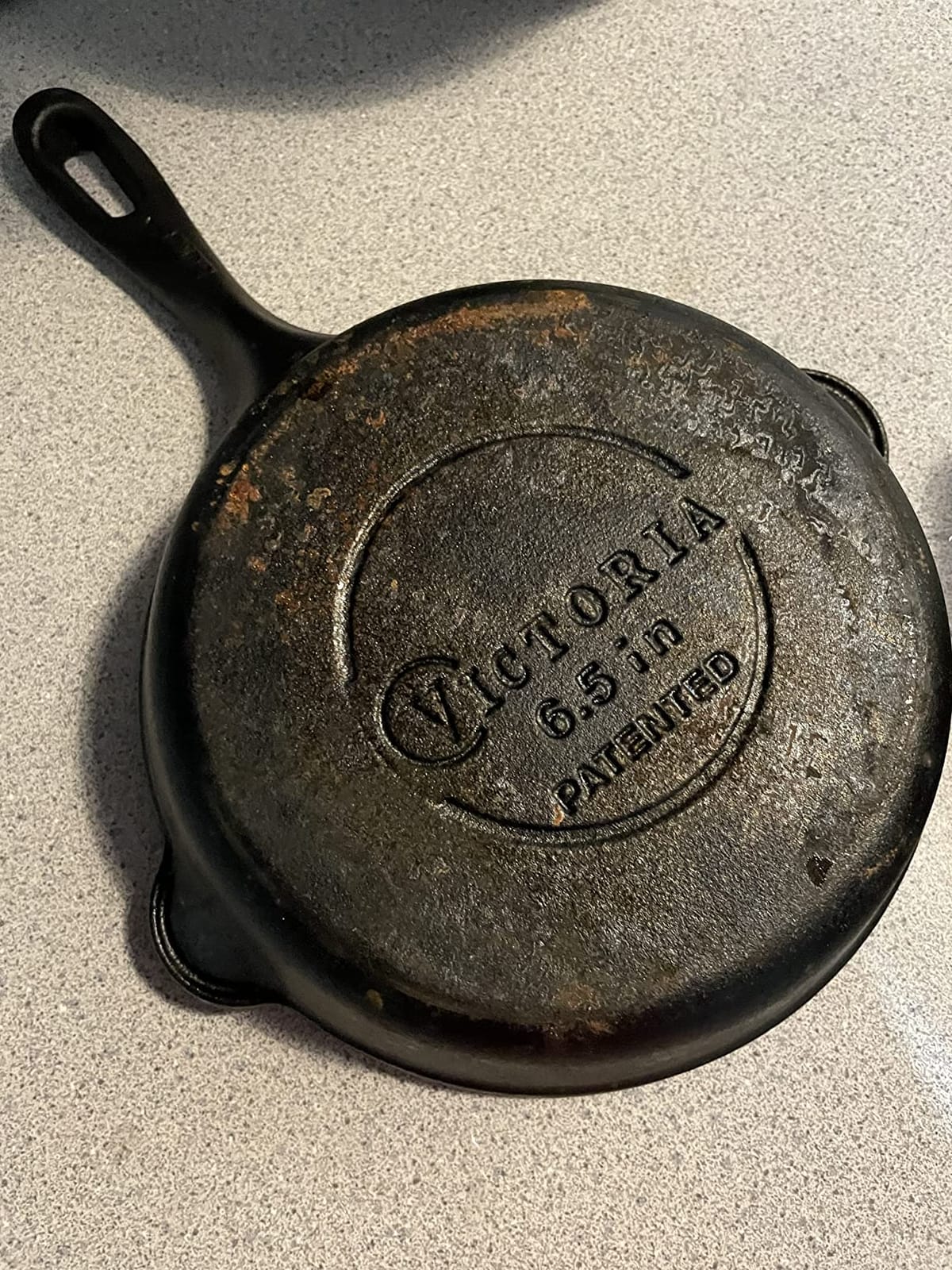
Durability and support are the real concerns: multiple one-star reviews describe units failing within a few months, and manufacturer support is difficult to reach with an unclear supplier identity. Some owners also report cookware, including certain stainless and cast iron pieces, warping under sustained high heat.
10. Amzgachfktch 30 Inch Induction Cooktop: 9000W With a Bridge Function
30 Inch Induction Cooktop – 4 Burner Built-In Electric Stove with Bridge-SYNC, Booster, Timer & Child Lock | 9000W 220-240V Hardwired, Black Glass Top
Four zones
240V hardwired
9000W total
29.13 inch cutout width
Pros
- Bridge function merges two zones for oversized pans
- Booster function cuts noticeable prep time
- 9000W total is ample for a 30 inch four-burner layout
- Auto pan detection flags bad cookware or placement
- Ceramic glass wipes clean with a damp cloth
Cons
- Requires 220-240V hardwired installation and a suitable breaker
- Button controls are less precise than sliders or dials
- Little long-term review volume for the size
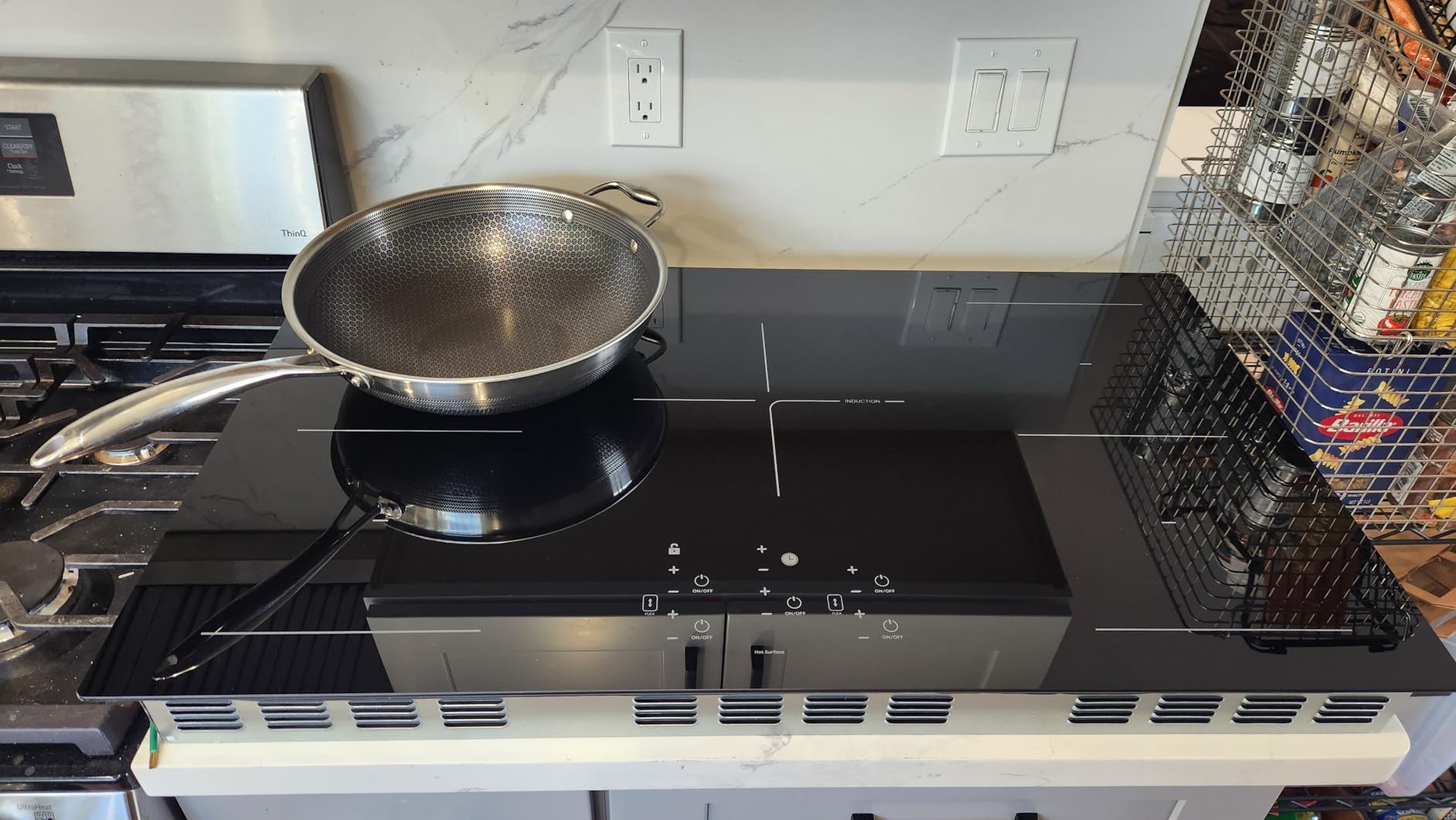
The bridge function is what earns this model a place. On a 30-inch four-burner layout, merging two zones into one large cooking surface is a feature you would normally pay a good deal more for, and it is what makes a rectangular pan or a griddle usable here.
At 9000W total, the power budget is genuinely ample for four zones in a standard kitchen. The booster function adds a burst for boiling and searing, and auto-pan detection tells you when a pan is unsuitable or badly placed rather than simply ignoring it.
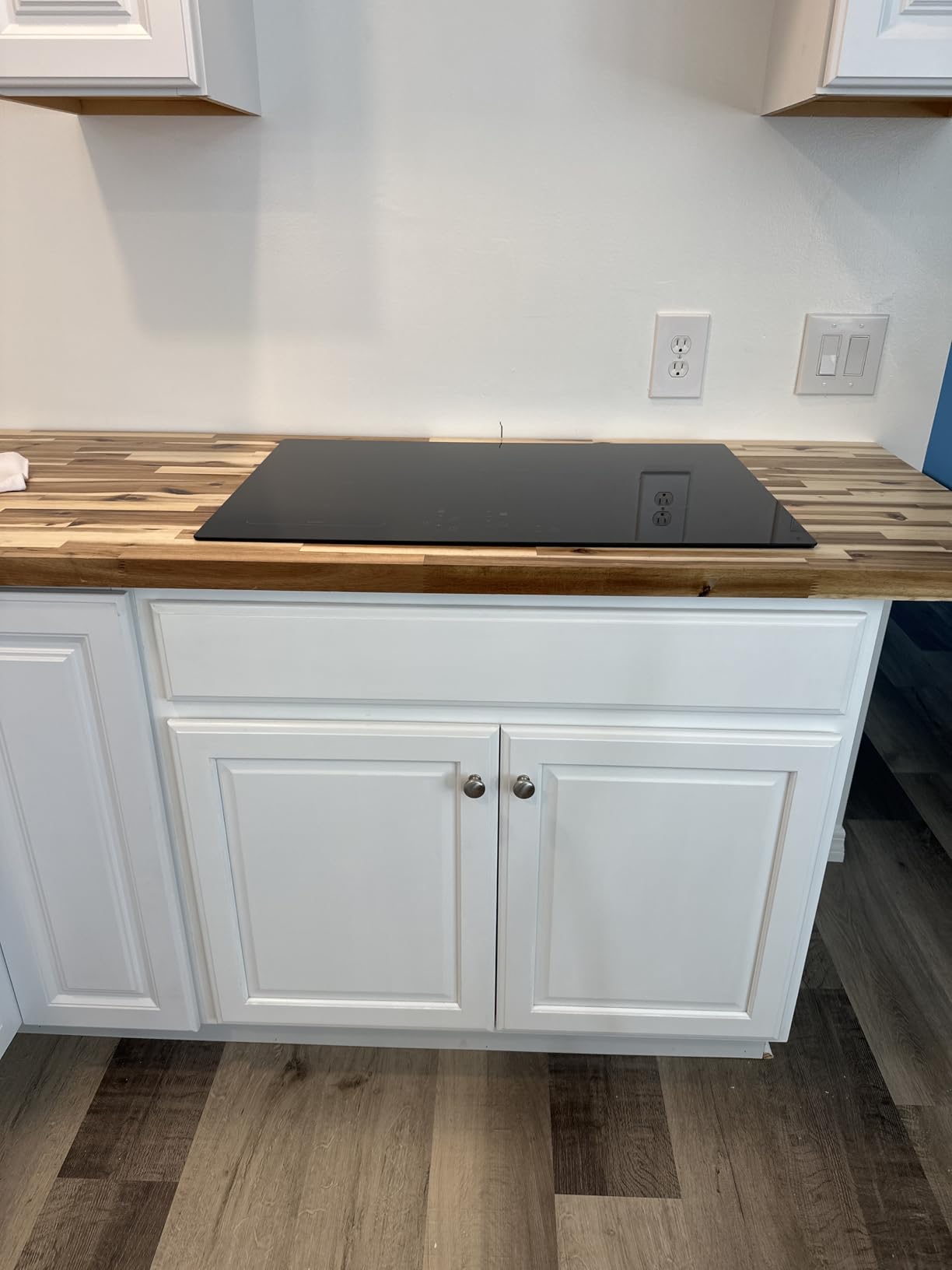
Dimensions are 20.4 by 30.3 inches with a stated cutout of 19.49 by 29.13 inches, so it fits a standard 30-inch opening with a small margin. Measure your cutout before ordering, because a drop-in that does not fit is an expensive problem.
The ceramic glass is described as 50 percent stronger against cracking and scuffing, which is a claim worth taking at face value only in the sense that it is a mid-range glass rather than a premium one. It wipes clean with a damp cloth, which is the actual daily test.
Who this cooktop suits
This suits a household in a 30-inch cutout that owns oversized rectangular cookware and wants a bridge zone without moving up a price tier. It also suits anyone replacing an existing 240V cooktop and wanting more total power than a basic four-burner offers.
If you like the bridge idea but not the 36-inch footprint, this is the pick on the list.
Where it falls short
Controls are buttons rather than sliders or dials, and that is a real precision loss at low heat where slow sauces live. The bridge function works, but the control granularity around it does not match the Nuwave units.
Review volume is modest and shared across the brand’s size variants, so the long-term reliability picture is thinner here than for the best-reviewed models in the roundup. The 220-240V hardwired requirement is also non-negotiable.
11. Amzgachfktch 20 Inch Two Burner Induction Cooktop: 1800W Plug-In or Drop-In
Induction Cooktop 2 Burner, Countertop/Drop-in, 120V/1800W
Two zones
120V plug-in or drop-in
9 power levels, 120F to 460F
179 minute timer
Pros
- Two independent zones with separate LED displays
- Installs built-in or runs on the counter with the pre-installed plug
- 9 temperature settings and 9 power levels cover simmer to sear
- Pause function lets you step away without losing settings
- Tempered ceramic glass resists cracking and chipping
Cons
- Combined 1800W is shared so both zones lose output together
- Requires a 20 amp breaker for a dedicated 120V circuit
- Button and touch interface is less refined than slider controls
This is the cheapest way into a genuine two-zone induction setup with a full safety package, and for a rental, a guest kitchen or a renovation-in-progress it is a genuinely sensible answer rather than a compromise.
It is cTUVus certified, runs 9 temperature settings from 120F to 460F and 9 power levels from 100W to 1800W, and carries child lock, pan detection, auto shutoff, overheat protection and a hot surface indicator. That safety list is longer than some far more expensive built-ins include.
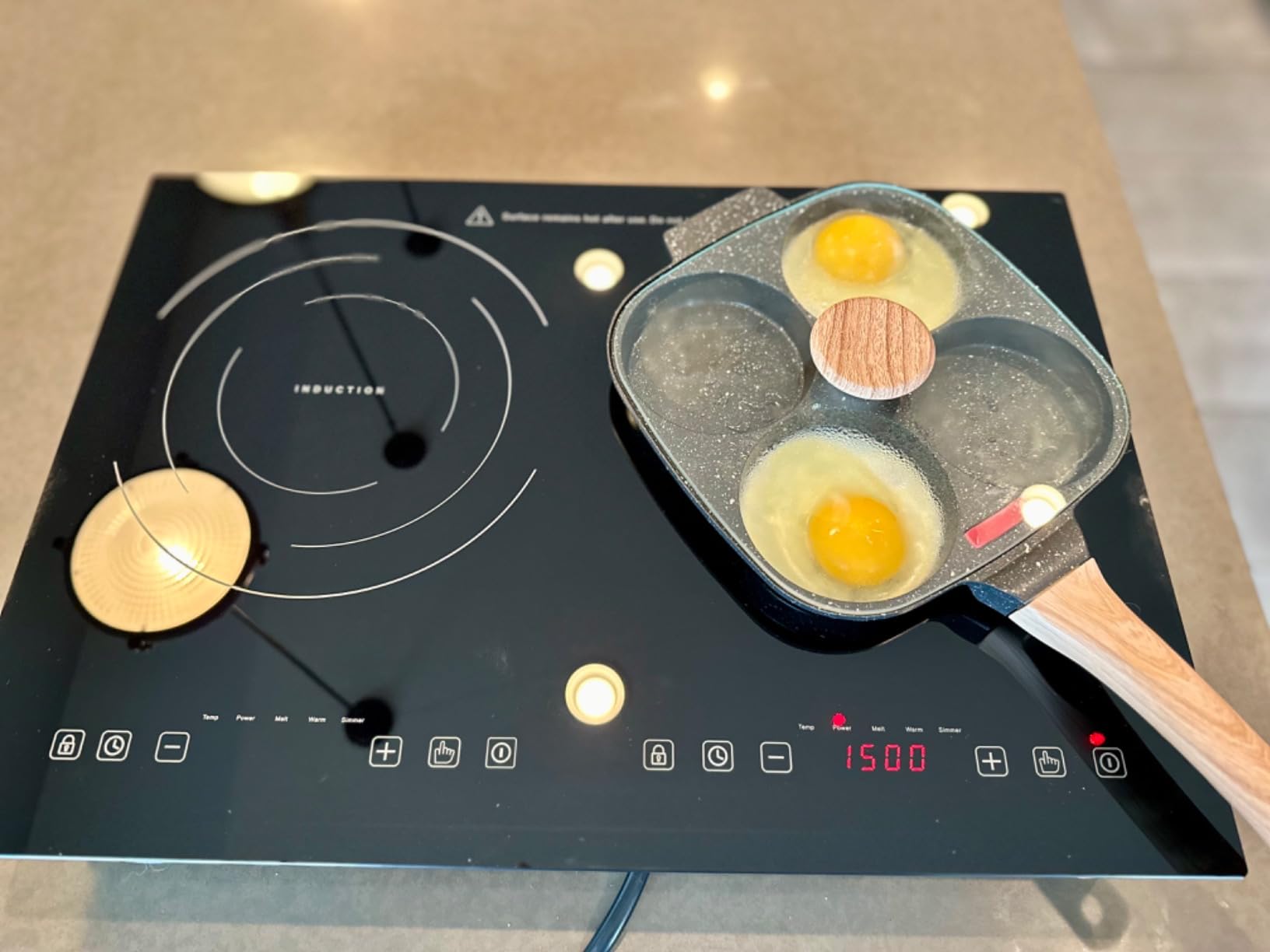
The 20-inch footprint at 20.47 by 14.17 inches is small enough for a modest counter, and the stated cutout of 19.45 by 13.15 inches means you can drop it into a purpose-made opening if you decide later that it should be permanent.
Owners like the dual-install design and the wide control range, along with the plug-in price. The 179-minute timer is long enough to cover a slow braise without babysitting.
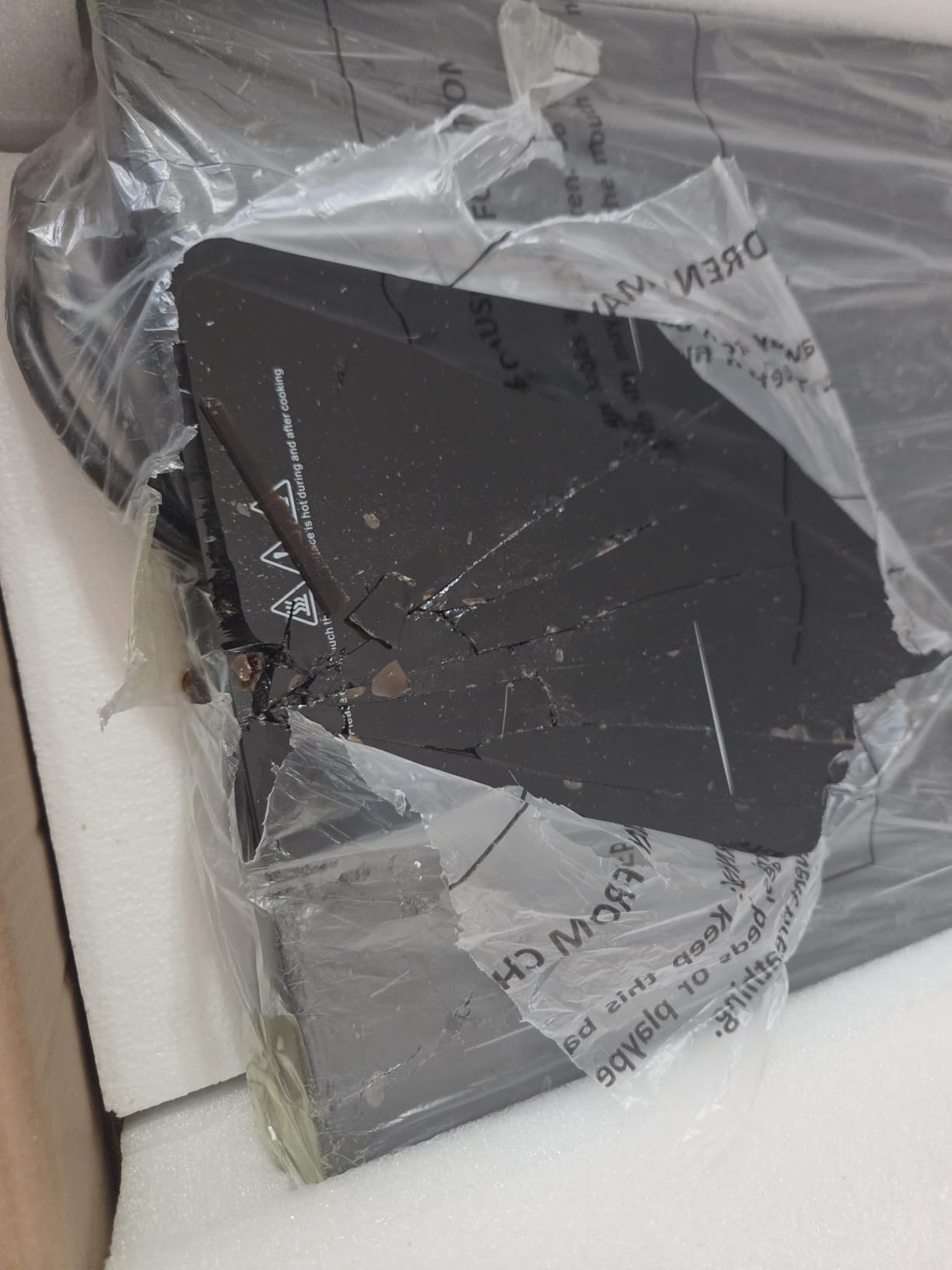
Who this cooktop suits
This suits a first kitchen, a rental, a dorm or a small apartment where a full range will not fit and a hardwired circuit is not available. It also works as a temporary cooking solution during a renovation.
If you are not sure whether your existing pans will work, this is a low-commitment way to find out before you spend on a built-in.
Where it falls short
Total wattage is shared across both zones, so running two pots at once reduces the output each one gets. It is a 20-inch unit with 1800W behind it, not a performance machine.
It also wants a 20 amp breaker on a dedicated 120V circuit, which is not always a given in older housing, and the button and touch interface is coarse next to a slider. Expect to press more than once.
12. AMZCHEF 30 Inch Induction Cooktop: 10600W and Five Differently Sized Zones
AMZCHEF 30″ Built-in Induction Cooktop, 9 Levels, 240V, No Plug, 10600W
Five zones
240V hardwired
10600W total, 3200W center zone
30 inch wide
Pros
- Highest total wattage in this roundup at 10600W
- Cross-pattern zone layout runs four burner sizes at once
- Boost function adds 5 minutes of extra power
- Crystal glass resists scratches and wipes clean
- Child lock auto-off and overflow protection as standard
Cons
- 240V hardwired with no plug so professional install is effectively required
- Cutout tolerance is tight at roughly 0.4 inch so measure carefully
- Lower review volume than the best-known names
This is our best value pick, and the reasoning is power per dollar. At 10600W total across five zones, it delivers more combined output than anything else we tested, including the 36-inch models, and it does so on a 30-inch footprint rather than a 36-inch one.
The zone sizing is unusually thoughtful: two 2000W zones, two 2700W zones and a 3200W center zone. A cross-pattern arrangement means you can run a small saucepan, two medium pots and a large searing pan at the same time, which is the layout most 30-inch cooktops get wrong.
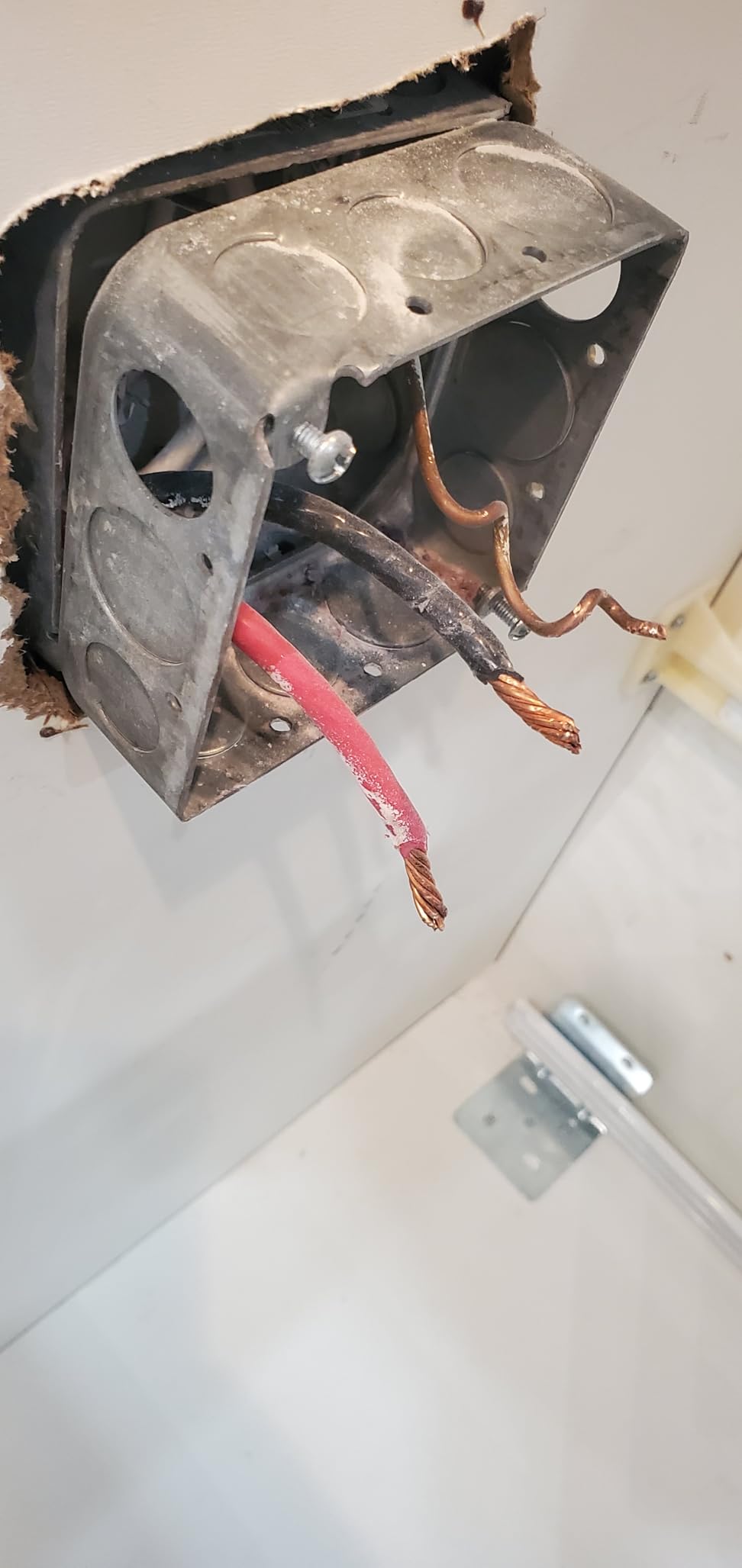
Boost adds five minutes of extra power on demand, and nine power levels give reasonable low-end control. Crystal glass is described as scratch-resistant and wipes clean with a cloth or paper towel, which is the honest daily standard for any glass surface.
It ships as a cooktop unit only, and it needs a heat-resistant work surface at least 2 inches thick. That requirement is stated in the technical details and is worth confirming with whoever cuts your countertop.
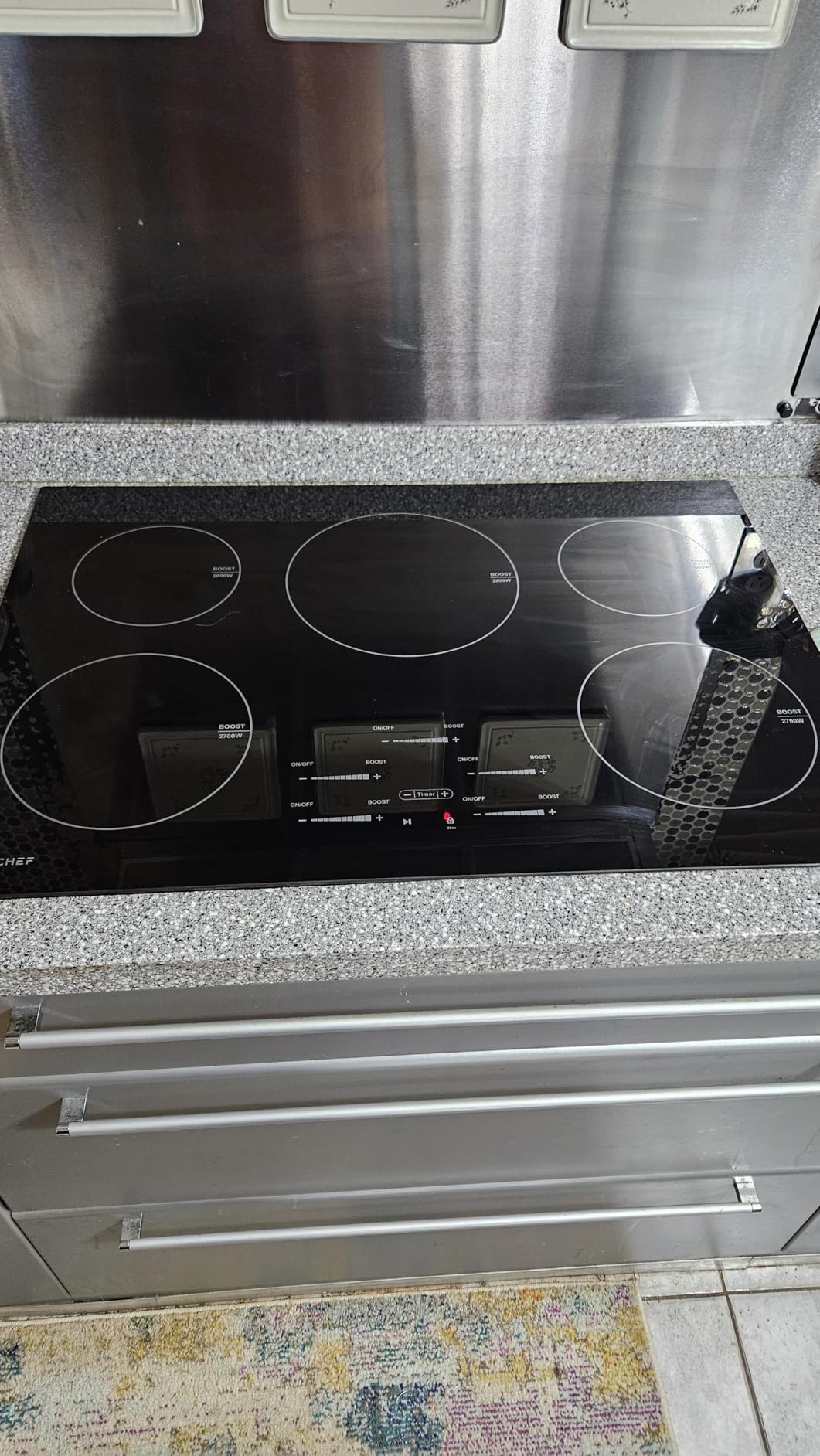
Who this cooktop suits
This suits a 30-inch cutout where the household cooks several dishes at once and wants more power than a four-burner layout can offer. Five zones on 30 inches of glass is unusual and genuinely useful in a busy kitchen.
It also suits anyone replacing a gas range who needs fast recovery and immediate power when a large pot hits the surface.
Where it falls short
It is 240V hardwired with no plug included, so professional installation is effectively required. Budget for the circuit before you commit to this or any other built-in on this list.
The cutout tolerance is tight at roughly 0.4 inch across a stated range of 28.82 to 29.21 inches by 19.29 to 19.69 inches, so measure carefully. Review volume is also lower than the best-known names, which means the long-term reliability picture is less well documented.
How to Choose an Induction Cooktop Under 1,000
Choosing well comes down to five questions in this order: what fits your cutout, what your electrical situation allows, whether your pans will work, how much power you need, and how much noise you can live with. Get those right and the model choice largely makes itself. If you are still weighing the technology first, our guide to how induction cooktops work in a real kitchen is a useful primer.
30-inch or 36-inch: match the cutout before the wattage
Match the cutout before anything else, because a drop-in cooktop that does not fit is a countertop replacement you were not planning on. A 30-inch cooktop typically wants a cutout a little under 30 inches wide, and a 36-inch unit wants roughly 34 inches. Check the stated cutout dimensions on the specific model rather than relying on nominal size.
Measure the depth as well as the width. Countertop depth, backsplash clearance and the position of your cabinets underneath all constrain which unit fits, and a 20.5-inch-deep 36-inch cooktop is not going into a shallow counter no matter what the width allows.
Choose 30 inches if your existing opening is 30 inches, if you cook for two or three people, or if you want the wider element spacing that a smaller cooktop gives you. Choose 36 inches if your cutout is already 36 inches, if you run a fifth zone for a large household, or if you own a griddle or a rectangular pan that needs a full 36 inches of glass.
120V portable or 240V built-in: what each one costs to install
A 120V portable cooktop costs nothing to install. It plugs into a household outlet, it moves with you, and the ceiling on its performance is set by that circuit, usually somewhere around 1800W for one burner or 2000W shared across two.
A 240V built-in cooktop needs a dedicated circuit, typically a 40-amp breaker on modern installations, and that is where the real money goes. If you are converting from gas, there is often no usable 240V circuit at all and the electrical work becomes the largest line item in the whole project. If you are replacing an existing electric cooktop, the swap is much simpler.
Some models here straddle both worlds, like the Empava Flex two-burner and the Amzgachfktch 20-inch, which ship with a plug and can be dropped into a counter. Those are the most flexible choices and are the ones we recommend for rental kitchens and uncertain situations. If a full built-in is still on the table, our picks for gas alternatives and island ventilation options are worth a look alongside the electrical planning.
The magnet test takes 30 seconds and saves a cookware bill
Take a magnet and test the base of every pan you plan to cook with. If it sticks firmly, the pan will work. If it does not, it will not heat, no matter what the cooktop says. This single test prevents the most common induction purchase mistake.
What works: cast iron, stainless steel with a magnetic base, and enameled cast iron. What does not: bare aluminum, anodized aluminum, copper, glass and most non-stick cookware with an aluminum core. Many quality non-stick pans are now sold in induction-compatible versions, which is worth checking before you replace anything.
Heavy flat-bottomed pans perform better than thin ones. They couple more evenly to the coil, they damp vibration, and they are less likely to warp under sustained high heat, which addresses two of the common complaints at once.
How much wattage you actually need
For a single-pot boil, more power is simply faster, and the 1800W to 3000W range available in this roundup will feel meaningfully different from a 1500W unit. For a family meal across four zones, total wattage matters more than the peak on any one zone.
Below 1800W total, you will notice you are waiting. Between 7400W and 10000W spread across four or five zones, a normal household meal cooks comfortably. Above 10000W, you are paying for headroom that matters mainly if you cook for a lot of people or use oversized stockpots.
Control granularity is the other half of the equation. Nine stepped power levels is fine for most cooking, but if you make sauces, melt chocolate or hold a temperature for a long time, a cooktop with fine 5F temperature increments will serve you better than a more powerful one with coarse steps.
Noise, fan hum and vibration
Some sound is normal. The electronics cycle current at high frequency and the cooling fan runs whenever the cooktop is active, so expect a hum at medium heat, a rising buzz at high heat, and occasional clicking from the element electronics. Buyers report this most often on the larger built-in models.
Two things reduce noise. A heavy flat-bottomed pan damps vibration better than a thin one, and setting a burner to medium rather than maximum avoids the highest-frequency operation. If noise is a dealbreaker in your household, the GTKZW two-zone unit is the quietest pick in this roundup by owner report.
Judging noise on a showroom floor will mislead you. Demo pans are often thin and the retail space is loud. Ask whether the unit can be returned, and test it in your own kitchen for a few days before the return window closes.
Total installed cost, rebates and when to buy
Budget the appliance as one line among several. A cooktop is the part everyone prices; the circuit work, any countertop cutting or replacement, and a cookware refresh are what turn a thousand-dollar appliance into a much larger project. The electricians and cooks who post in appliance forums almost universally say the installation, not the cooktop, is where the surprise lives.
Check your utility before you buy. Some utilities and regions offer rebates for induction or all-electric appliance upgrades, and a quick call before the purchase can change the arithmetic on your budget entirely.
September through November is widely regarded as the best window for major appliance purchases, when retailers are clearing inventory and running manufacturer rebates. If your renovation timeline allows, waiting a few months can matter more than which model you choose. Our broader induction range guide is the right reference if a freestanding unit is what you actually want.
Frequently Asked Questions
Which brand of induction cooktop is the most reliable?
Among the brands in this roundup, reliability tracks closely with how long the model has been in production and how large its owner base is. Nuwave has the deepest track record here, with thousands of long-term owners on the Gold Precision and Pro Chef, and several multi-year reliability reports on the ThermoMate 36-inch model. Frigidaire and Whirlpool lead the broader built-in category, and the community consensus in appliance forums is mixed on both. The honest answer is that no brand in this price tier publishes failure-rate data, so judge by review volume, warranty length and whether local service exists.
What is the best value for money induction cooktop?
The AMZCHEF 30-inch five-zone cooktop is the best value in this roundup, delivering 10600W across five differently sized zones with a 3200W boost center zone. If you are not installing a built-in at all, the ChangBERT 1800W unit is the best value portable option, since its continuous-duty circuitry and stainless housing outperform cheaper plastic-bodied burners.
Why don’t more people use induction cooktops?
Two reasons dominate. First, induction requires magnetic cookware, so many existing aluminum and anodized aluminum pans simply will not work and the buyer faces a cookware replacement cost. Second, installing a 240V cooktop where there was previously a gas range can require new circuit work that costs more than the appliance. Buyers also hesitate over perceived complexity, though pan detection and child locks make induction arguably safer than gas.
What is the best 30-inch induction cooktop under 1,000?
The AMZCHEF 30-inch is the strongest 30-inch pick here, with 10600W across five zones and a cross-pattern layout that supports four burner sizes running at once. The Amzgachfktch 30-inch four-burner is the alternative if a bridge function matters more to you than total zone count, and the Empava Ease 30-inch is worth considering in an RV or a very small kitchen.
Do induction cooktops need special wiring and a standard outlet?
Built-in induction cooktops need a dedicated 240V circuit, typically on a 40-amp breaker, and they ship with a power cord and no plug. Portable 120V units plug into a standard household outlet, though some require a 20-amp breaker on a dedicated circuit. Models such as the Empava Flex and the Amzgachfktch 20-inch can do either, with a pre-installed plug for the countertop and a drop-in option if you decide later.
Can I use my existing pots and pans on an induction cooktop?
Only if they are magnetic. Take a magnet and test the base of each pan: if it sticks firmly, the pan will heat. Cast iron, enameled cast iron and stainless steel with a magnetic base all work. Bare aluminum, anodized aluminum, copper and glass do not, and most non-stick cookware with an aluminum core will not work unless it is sold as induction-compatible.
Are induction cooktops noisy?
Some sound is normal. The element electronics cycle current at a high frequency and the cooling fan runs whenever the cooktop is active, so expect a hum at medium heat, a rising buzz at high heat and occasional clicking. Heavy flat-bottomed pans damp the vibration noticeably, and the GTKZW two-zone unit is reported as quieter than comparable models at moderate heat. Judging noise in a showroom is misleading because demo pans are typically thin.
Conclusion: The Best Induction Cooktops Under 1,000
After twelve models, the best induction cooktops under 1,000 dollars in 2026 come down to a few clear winners. The Nuwave Gold Precision is our overall pick, because fine 5F temperature control and a proven long-term record matter more day to day than raw wattage. The AMZCHEF 30-inch five-zone cooktop is the value pick, with more total power and more zones than anything else at this price. The Nuwave Pro Chef takes the precision further and adds a wattage selector for constrained-power locations.
For dual-zone cooking on a single plug, the Nuwave Double Pro is hard to beat. For a full 36-inch kitchen, the Empava five-zone with bridge-SYNC gives you the most cooking surface, and the ThermoMate 36-inch gives you the fastest boils on a budget. Renters and anyone without a 240V circuit should look at the Empava Flex or the Amzgachfktch 20-inch, which install either way.
Before you order, do three things: measure the cutout, confirm your electrical situation, and run the magnet test on every pan you own. Those three steps prevent almost every regret we saw in owner reviews. Then check your utility for rebates and buy between September and November if your timeline allows.