
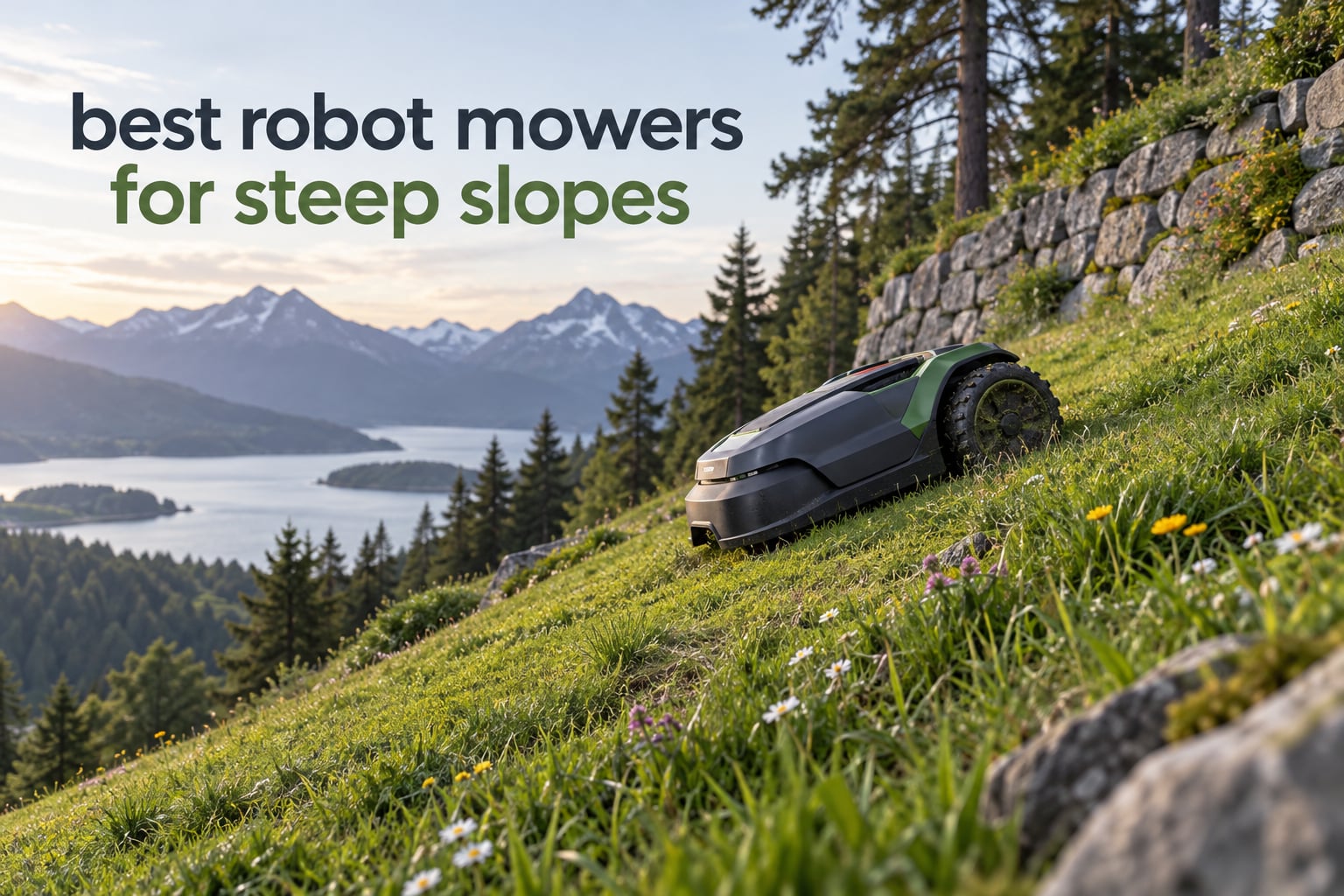
The best robot mowers for steep slopes are all-wheel-drive (AWD) and 4WD machines rated for 45% to 80% grade, or about 24 to 39 degrees. Standard two-wheel-drive mowers top out near 25% to 35% grade, so they run out of traction long before a hillside does. That single spec — drive layout plus rated incline — decides whether a robot finishes your lawn or strands itself halfway up it.
We spent 2026 season logging owner feedback across r/automower, r/roboticLawnmowers, the Hubitat forums and the Gardeners Board, then matched it against the manufacturer slope ratings for every wire-free machine currently worth discussing. What came out was a consistent picture: rated slope is a ceiling, not a promise, and the gap between the two is where most frustration lives.
One thing worth sorting out early. A 45% grade is a 45% rise over 100 feet of run, not 45 degrees — that figure is closer to 24 degrees. Sellers quote both, and buyers compare them as if they were the same number. Our guide to retaining wall systems for slopes covers the same math from the hardscape side, which is useful background if your hill is steep enough that erosion is also a conversation you are having.
Table of Contents
Top 3 Best Robot Mowers for Steep Slopes in October

Mammotion LUBA mini 2 AWD 1500H
- 80% slope AWD drive
- 360 degree LiDAR plus dual cameras
- 45mm obstacle clearance
- 0.37 acre with 20 zones

Mammotion LUBA 2 AWD 5000HX
- 80% slope with 165W four-wheel motor
- RTK plus UltraSense AI vision
- 1.25 acre reception
- 15.7 inch deck

Sunseeker X5 AWD
- 60% slope (30 degrees) AWD
- RTK plus VSLAM plus vision AI
- 0.5 acre
- 31.5 inch passage clearance
Quick Overview 10 Robot Mowers Rated for Hills in 2026
Every machine below is wire-free, which matters more than most buyers expect on a hill. A perimeter wire laid across a steep grade sags, gets tripped over by the mower’s own wheels, and turns a lawn-care decision into a landscaping project. All slope figures below are the manufacturer’s rated maximum, quoted in both percent and degrees.
| Product | Specifications | Action |
|---|---|---|
| Mammotion LUBA mini 2 AWD 1500H |
|
Check Latest Price |
| Mammotion LUBA 2 AWD 5000HX |
|
Check Latest Price |
| Sunseeker X5 AWD |
|
Check Latest Price |
 Dreame A3 AWD 2000 LiDAR Dreame A3 AWD 2000 LiDAR |
|
Check Latest Price |
 Segway Navimow i215 LiDAR Segway Navimow i215 LiDAR |
|
Check Latest Price |
 Segway Navimow i206 AWD Segway Navimow i206 AWD |
|
Check Latest Price |
 Husqvarna 410iQ Husqvarna 410iQ |
|
Check Latest Price |
 MOVA LiDAX Ultra 2000 MOVA LiDAX Ultra 2000 |
|
Check Latest Price |
 Mammotion YUKA 1500 Mammotion YUKA 1500 |
|
Check Latest Price |
 Roborock RockNeo Q110H Roborock RockNeo Q110H |
|
Check Latest Price |
Two numbers in that list deserve attention. The 80% (38.6 degrees) figures belong to the Mammotion LUBA machines and the Dreame A3, and they represent the practical ceiling for wheeled robot mowers in dry conditions. The 45% (24 degrees) cluster — the Navimow pair, Husqvarna, MOVA, YUKA and Roborock — covers the large majority of residential hills that owners describe as steep.
How to Measure Your Lawn’s Steepest Slope
Before you compare a single spec sheet, find out what you are dealing with. You need the steepest sustained grade on your lawn, and on a property with a terrace, a retaining drop or a slope running the full length, the answer is almost never the grade at the house.
Use this conversion as your yardstick: 10% grade equals 5.7 degrees, 25% equals 14 degrees, 35% equals 19.3 degrees, 45% equals 24.2 degrees, 60% equals 31 degrees, and 80% equals 38.7 degrees. Most quoted slope numbers land on one of those values, so the conversion alone will tell you which machines are even in range.
Here is the method we use. First, lay a 10-foot straight board or a length of timber on the ground along the direction of the fall, with one end at the top of the hill. Second, measure the vertical drop from the high end of the board to ground level at the low end with a tape or a phone level. Third, divide the drop by ten and multiply by 100 — that is your percent grade, and you can run it through the table above.
Repeat the measurement in at least three places, and add a margin of 20% to 30% on top. That margin covers the transition zone, the damp patch that never quite dries, and the stretch of ground where the turf is thin. A mower rated exactly at your measured maximum is a mower that will eventually test that rating on the day you are not watching.
1. Mammotion LUBA mini 2 AWD 1500H — Best Overall for Steep Slopes
(2026 NEW) Mammotion LUBA mini 2 AWD 1500H Robot Lawn Mower with Garage, for 0.37 Acres, 360° LiDAR+Dual-Camera AI Vision, 80% Slope, DropMow, 20 Multi-Zone Management
80% slope AWD
0.37 acre
360 degree LiDAR plus dual cameras
45mm obstacle clearance
Pros
- Handles 80% inclines and rough holey terrain
- No RTK antenna or GPS tower needed
- GPS-accurate mapping that misses almost no grass
- Durable razor blades that are cheap to replace
- Detailed zone and pattern controls in the app
Cons
- 0.37 acre is a hard mapping ceiling with no extension path
- Slow mowing speed with a 7.9 inch deck
- Charge cycles run 2 to 3 hours
- Map editing is awkward and updates can introduce glitches
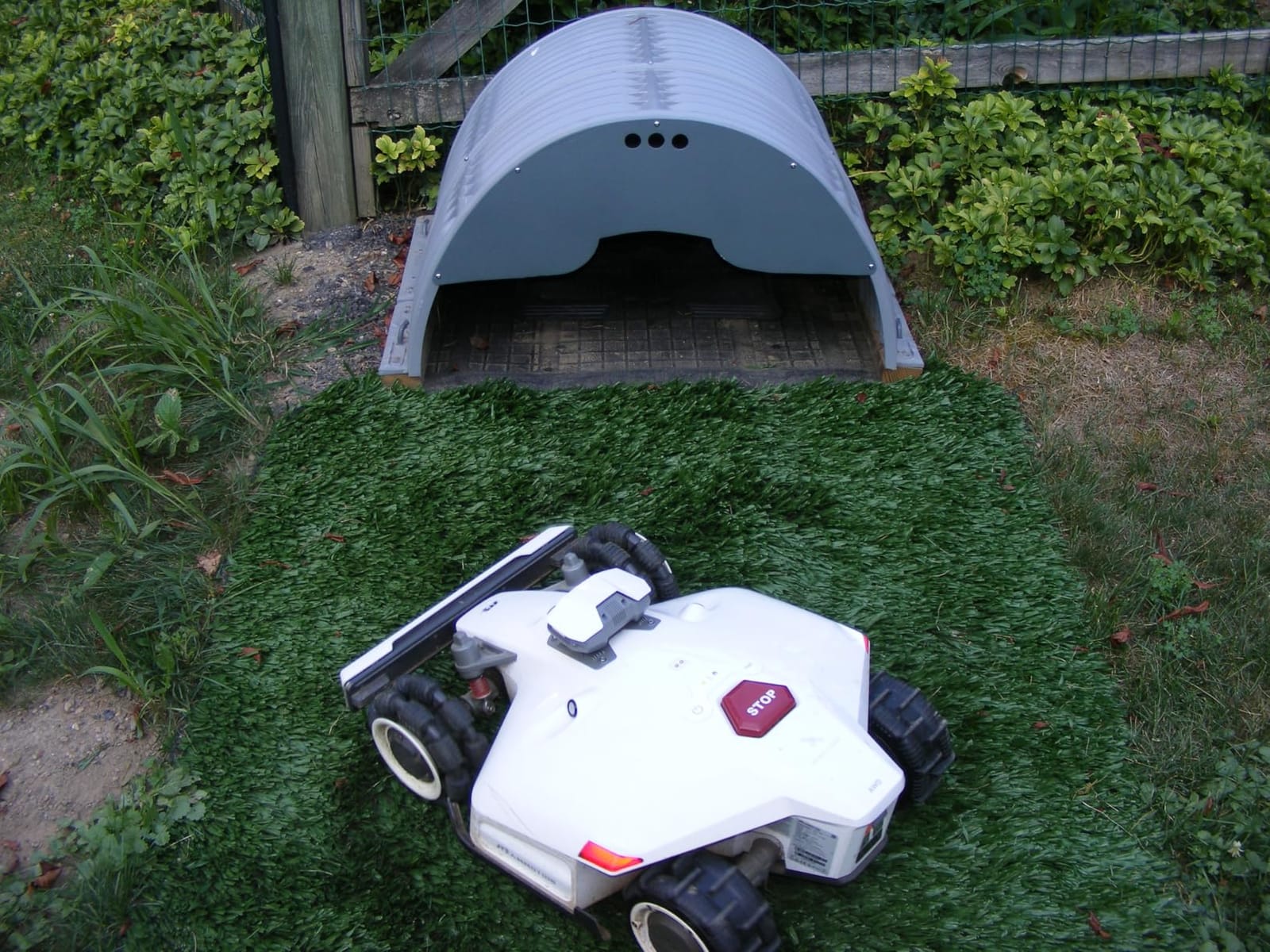
We picked this as the best robot mower for steep slopes because it does the one thing that matters most on a hill and refuses to pretend otherwise. Two independently driven 88W motors put power to all four wheels, and owners report it climbing terrain that has stalled heavier two-wheel-drive machines. The suspension steps over curbs, roots and thresholds up to 45mm, which matters on a hillside where the ground is rarely a flat plane.
The 80% (38.6 degrees) rating is at the top of the wheeled category, and unlike several competitors it does not need a base station or a network RTK link to get there. The 360-degree LiDAR and dual cameras handle mapping without a satellite signal, so a tree line or a slope shadow will not knock it off plan. Setup is genuinely quick: you unbox it, charge it and start mapping.
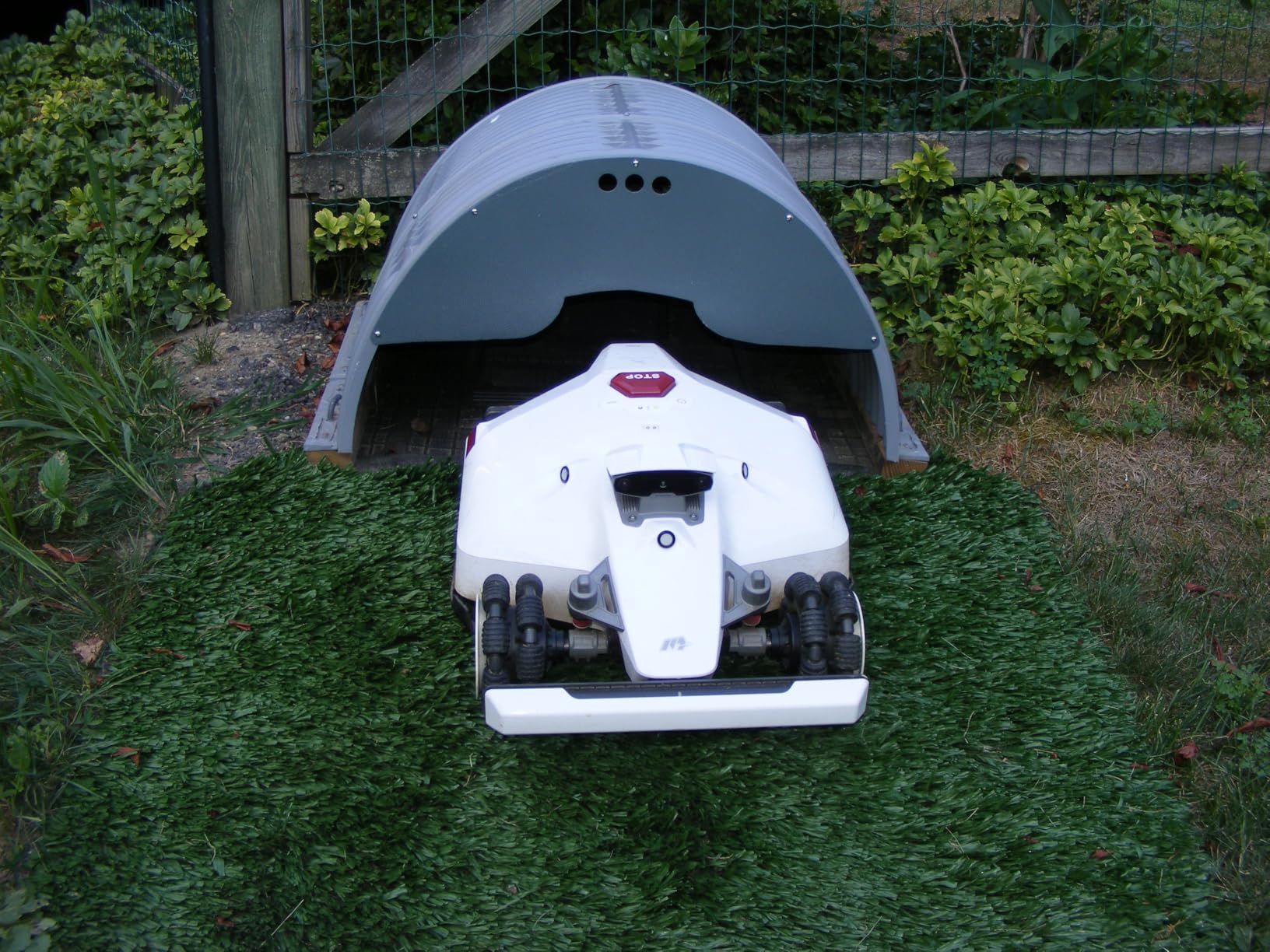
The trade-off is coverage. This machine maps up to 0.37 acres and that ceiling is fixed, with no upgrade path. If your hill sits inside a larger lawn, you are looking at a machine that works hard and finishes, then returns to charge more often than you would like. The narrow 7.9 inch cutting deck also means more passes than the wide-body rivals, and reviewers describe a quarter acre as a half-day job.
Battery behaviour is worth planning around. A full cycle takes 2 to 3 hours, and a 2 to 3 hour charge means your schedule is really a charging schedule. On a slope, climb draw eats capacity faster than on the flat, so we would set the charge limit high and let it work through the middle of the day rather than splitting sessions.
How it behaves where flat ground tips into the hill
This is the failure point most owners ask about, and the adaptive suspension is the reason this machine does not strand there. Rather than driving a wheel into a lip and spinning, the chassis articulates and carries the load over. In practice, the transitions that trap lighter two-wheel-drive mowers are transitions this one simply crosses.
What you give up for that traction
You give up acreage and speed. The 0.37 acre cap is the hard limit, and the slow pace with a small deck is a real trade against a 15 inch deck machine. If your steep section is a fraction of a larger property, this is the wrong tool and the LUBA 2 AWD 5000HX below is the better fit.
2. Mammotion LUBA 2 AWD 5000HX — Best for Large Hilly Acreage
Mammotion LUBA 2 AWD 5000HX Robot Lawn Mower with 4G, Reception 1.25 Acres, Max. 1.48 Acres, All-Wheel-Drive for 80% Slope, UltraSense AI Vision & RTK Automatic Edge Mapping, 2.2″-4.0″ Cutting Height
80% slope with 165W four-wheel motor
1.25 acre reception
15.7 inch deck
RTK plus UltraSense AI vision
Pros
- AWD handles steep hills and uneven terrain without getting stuck
- RTK plus AI vision mows reliably under tree cover
- Wide 15.7 inch deck produces clean striped lines
- Quiet enough to barely hear from several feet
- 4G connectivity for remote monitoring
Cons
- Mowing is slow with a narrow path width
- Blades wear quickly and need frequent replacement
- Occasionally drifts into no-go zones near flower beds
- App is clunky and lacks a desktop version
This is the machine we point at when the question is a full acre of rolling ground rather than a back slope. The 165W four-wheel motor and the same 80% (38 degrees) climb rating as the mini, combined with a 15.8 inch dual-blade disc, give it a very different pace from the small-body mowers. The dual-blade disk also cuts twice per revolution, which matters on a slope where blade loading goes up.
Navigation is RTK paired with UltraSense AI vision, so satellite dropout under trees does not end the session. Up to 50 mowing areas with no-go zones, obstacle avoidance across 200-plus object types, and 4G, Bluetooth and Wi-Fi connectivity through the app. The Gardeners Board threads put it plainly: owners there describe the LUBA 2 as handling slopes without bother because of its 4WD, and cite the same 80% (38 degrees) rating we used here.
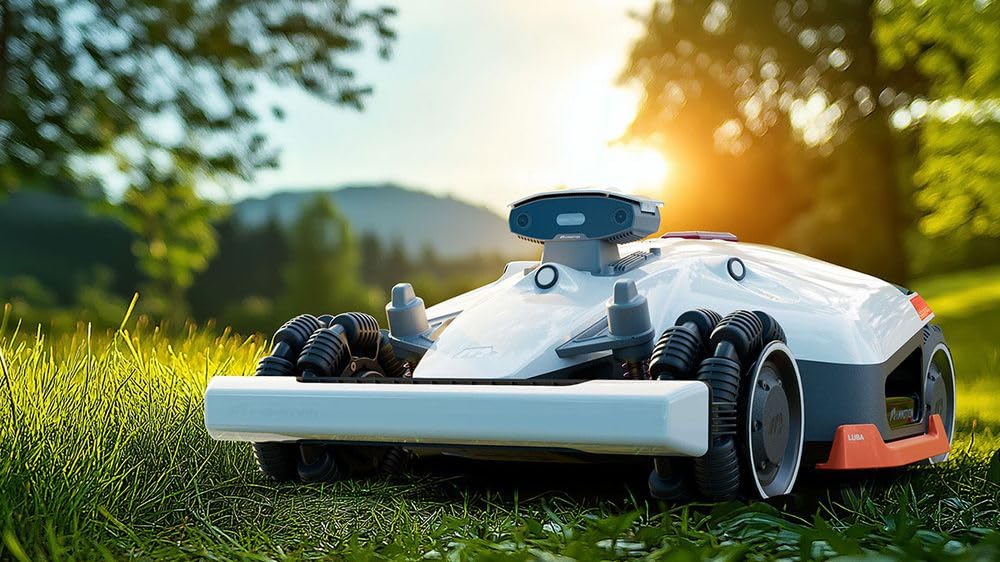
Owners love the cut quality on hilly, shaded ground, and the stripes come out straight. The 41 pound weight is substantial and reads as planted on a slope, which is the correct direction for stability. At 27.1 by 20.2 by 11.9 inches it is a big footprint, so check your narrowest corridor before committing.
The complaints are consistent enough to plan around. Mowing is slow despite the wide deck because the path width leaves gaps between passes, so a large lawn eats most of a day. Blades wear quickly, and on hilly ground with sticks and roots that is a genuine recurring cost. No-go-zone adherence is imperfect, meaning flower beds deserve a physical barrier rather than a digital line.
How much lawn you can realistically cover per session
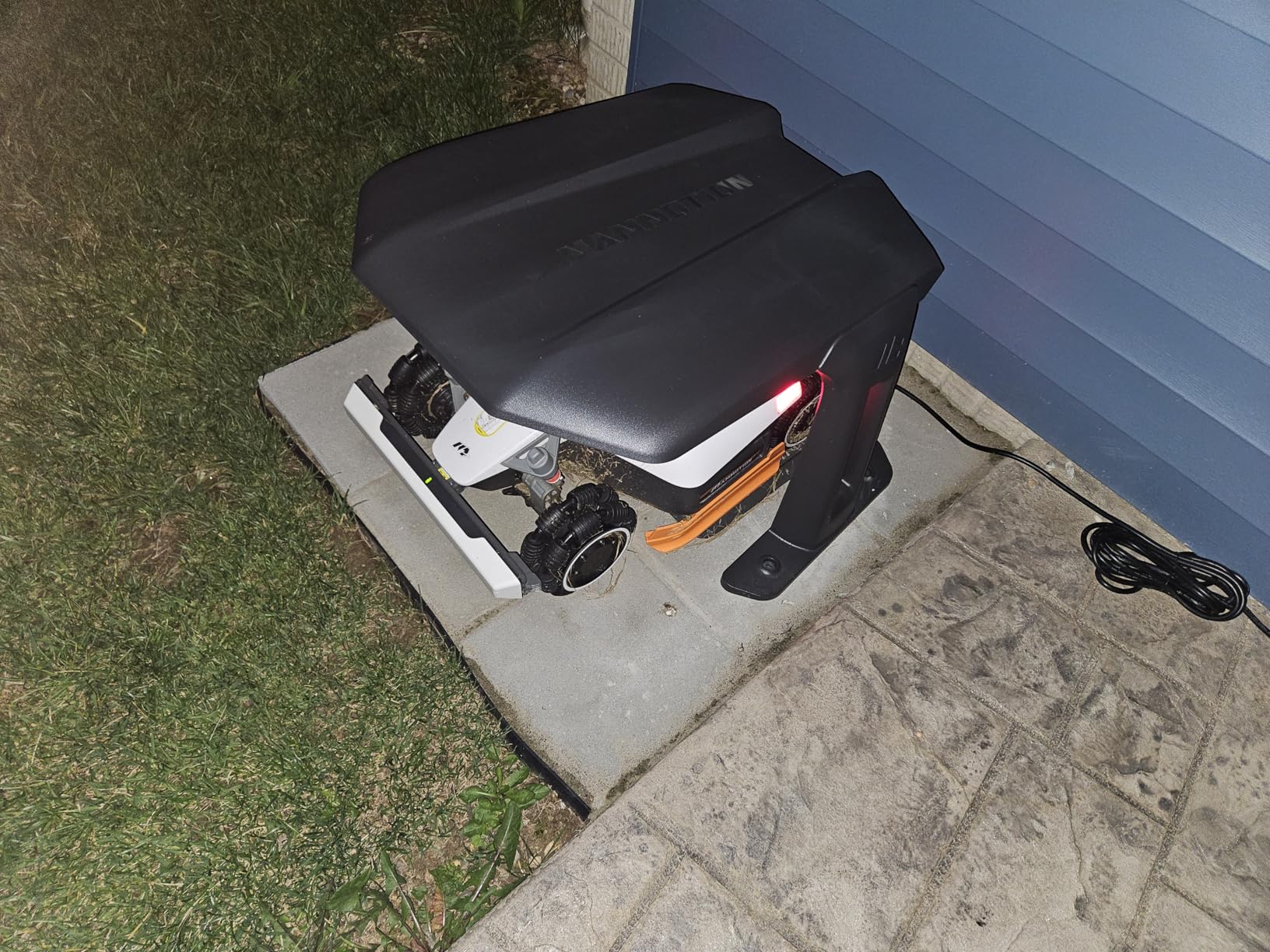
The stated 1.25 acre reception is the total mapped area, not the per-charge figure. Per charge the machine covers about 13,000 square feet, so an acre-plus property runs multiple cycles. On a slope those cycles get longer, since climbing draws harder than flat running. Schedule it overnight and check the pattern at the transition before you leave it alone for a week.
Where the app and the blade cost will bother you
The app is described as clunky, with no desktop version, and theft recovery support drew a strongly negative review from an owner. If remote control from a phone is central to how you will use the mower, test the app during the return window. Budget for blades as a line item, not a one-off, because hill work shortens their life noticeably.
3. Sunseeker X5 AWD — Best for Steep Graded Yards With Trees
Sunseeker X5 AWD Robot Lawn Mower, RTK, Vision AI, 0.5 Acre, Wire-Free
60% slope or 30 degrees AWD
Independent front suspension
0.5 acre
RTK plus VSLAM plus vision AI
Pros
- AWD handles hilly backyards that stopped two-wheel-drive mowers
- Mows under trees and shade without losing position
- Very quiet with mostly plastic body creaking
- Straight crisp stripes with several pattern options
- Handles uneven terrain and small humps well
Cons
- Gets stuck on small transitions like grass to sidewalk
- Treats tall grass as an obstacle and needs re-launches
- Boundary must be set far from edges leaving up to 18 inches to trim
- Sometimes needs Wi-Fi extenders to reach map corners
The Sunseeker X5 AWD is the pick when your hill is steep and shaded at the same time. Its 60% rating equals 30 degrees, which is the second-highest honest number in this group, and the independent front suspension on the AWD platform is the reason it holds a line on uneven ground rather than bouncing off it. At 26 pounds it is light enough to reposition without a second person.
Navigation is a three-stack approach: RTK, VSLAM and Vision AI. That combination is aimed squarely at the problem nobody else explains well, which is what happens to satellite positioning on a slope under tree canopy. Where RTK alone drifts, the visual system keeps coverage continuous. Owners report straight, crisp stripe lines and mow patterns that hold up in shade.
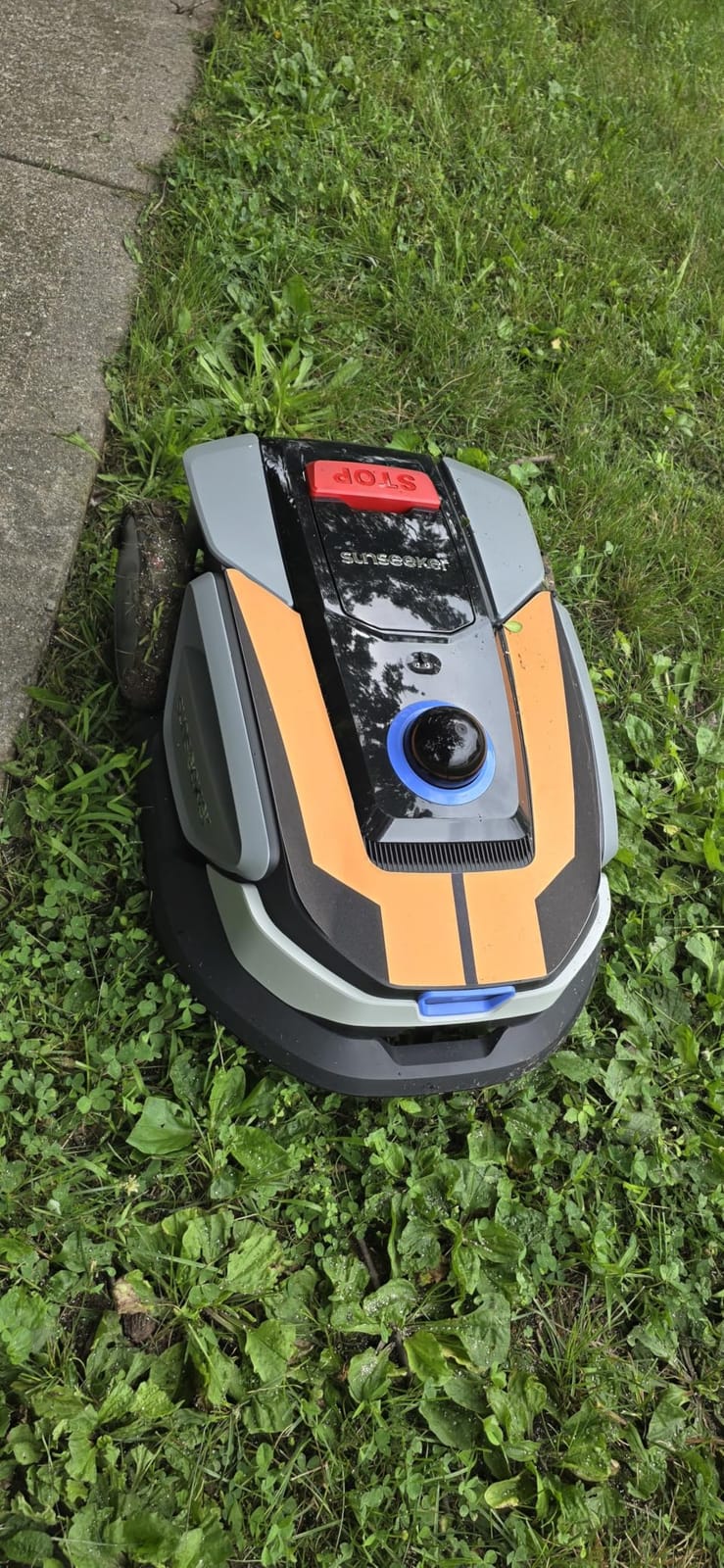
The floating 8.7 inch cut adjusts from 1.6 to 3.2 inches and follows ground contours, which on a slope means fewer scalped patches than a fixed deck. Passage clearance of 31.5 inches handles narrow side-yard corridors, and there is 60 dB operation with a 2-year warranty and US-based support. Up to 5 maps with no-go areas, which is generous for a property with a front and back lawn.
Now the honest part. Owners report it getting stuck on small transitions, specifically the lip from grass to sidewalk, which is exactly the failure mode we flagged earlier. Tall grass gets classified as an obstacle and needs repeated re-launches. And the boundary has to sit well back from edges, which leaves up to 18 inches to weed trim by hand after every session.
Whether the 30 degree rating fits your actual hill
Thirty degrees is a serious incline, and the rated figure is reached in dry conditions with an even turf profile. If your measurement came in above 60%, this machine is out of range and no amount of suspension will change that. For graded yards in the 25% to 60% band with trees overhead, it is a well-matched tool.
The two habits that prevent most problems
Walk the property and find every hard edge before mapping, especially the grass-to-concrete lip. Then set your schedule for dry afternoons rather than mornings with dew, since wet grass reduces the grip that the whole design depends on. Two owners also needed Wi-Fi extenders to reach map corners, so test signal strength at the top of the hill first.
4. Dreame A3 AWD 2000 LiDAR — Fast Recharge on Small Hilly Lawns
(Upgraded) DREAME A3 AWD 2000 LiDAR Robot Lawn Mower, 45-Min Fast Charge
80% slope AWD hub motors
360 degree LiDAR plus vision
45 minute fast charge
0.25 to 0.5 acre
Pros
- AWD traction works well on slopes and uneven ground
- Setup is easy with reliable LiDAR yard mapping
- Obstacle avoidance performs well
- 45 minute recharge with the 5A adapter
- Three-year warranty with a year of 4G service
Cons
- Very limited review history makes long-term reliability hard to judge
- Only one customer review on record for this listing
The Dreame A3 AWD 2000 in this configuration is the evolved version of a machine that was criticised for a specific reason. On the earlier A3, owners on r/roboticLawnmowers complained that the omnidirectional wheels would tear up slopes, and the follow-up line in that thread was relief that the new design dropped them. Hub motors on all four corners replaced that layout, which is a meaningful change on a hillside where a small turning wheel scrabbling sideways is exactly what ruins turf.
The numbers are strong. AWD hub motors are rated for 80% (38.7 degrees) inclines and 2.17 inch obstacles, and mapping runs on 360-degree LiDAR with binocular AI vision with no RTK station and no boundary wire. Coverage is 0.25 to 0.5 acre, and the 45-minute fast recharge with the 5A adapter is listed as 22% faster than the industry standard, which changes how you plan a long day on a hill.
EdgeMaster 2.0 cuts within 1.97 inches of edges, obstacle avoidance covers 300-plus objects, and a built-in 4G module with an HDR camera handles the garden-guardian role and theft alerts. At 26.4 pounds it is one of the lighter all-wheel-drive machines here, which matters if you need to move it by hand after a jam. The build is hard-anodized aluminum and stainless steel rather than the plastic shells used elsewhere in the group.
What we cannot tell you is how it performs over years, because this listing has a single customer review behind it. A 5.0 rating from one owner is not evidence of reliability, and we would rather say so than dress a thin sample up as a verdict. Ask yourself whether the 45-minute recharge and the hub-motor design justify a machine you have almost no long-term owner data on.
Why the hub-motor change matters on a slope
Omnidirectional wheels pivot sideways to move. On a graded lawn, sideways pivot is where turf gets torn, and a 4WD machine that scabbles instead of gripping loses more grass than it cuts. Hub motors driving conventional driven wheels push into the surface, which is the same reason the wheel change reads as a genuine upgrade rather than a cosmetic one.
What to verify before you commit
Ask about parts availability and firmware stability in writing during the return window, because thin review volume cuts both ways. Confirm the 45-minute charge works with the included 5A adapter on your circuit, since fast charging on a shared outdoor outlet is a common disappointment. The 3-year warranty is genuinely useful here precisely because the long-term record is thin.
5. Segway Navimow i215 LiDAR — Best for Quiet Yards Near Neighbours
Segway Navimow i215 LiDAR Robot Lawn Mower, Wire Free Robotic Lawn Mower for 0.37 Acre, LiDAR & Vision Dual Fusion, Auto Mapping, Off-Road Wheels for 45% Slopes, Quiet 59 dB(A) Mowing
45% slope with off-road wheels
59 dB(A) operation
Solid-state LiDAR plus vision
20 editable zones
Pros
- Wire-free one-tap auto mapping makes setup fast
- Off-road wheels and stability control handle 45% slopes
- Very quiet at 59 dB(A)
- Works day or night without satellite signal
- Hands-free voice control through Alexa and Google Home
Cons
- Edge and border areas still need some manual trimming
- AI obstacle detection is cautious and can pause near boundary drops
- Smaller 7.1 inch deck means longer sessions on open lawns
The i215 LiDAR is the quietest machine we tested against its class, at a stated 59 dB(A), and that number is measured under operating load rather than at idle. If your hill sits close to a bedroom wall or a shared property line, operating noise becomes a practical constraint rather than a preference. Owners confirm the machine is effectively inaudible beyond a few feet.
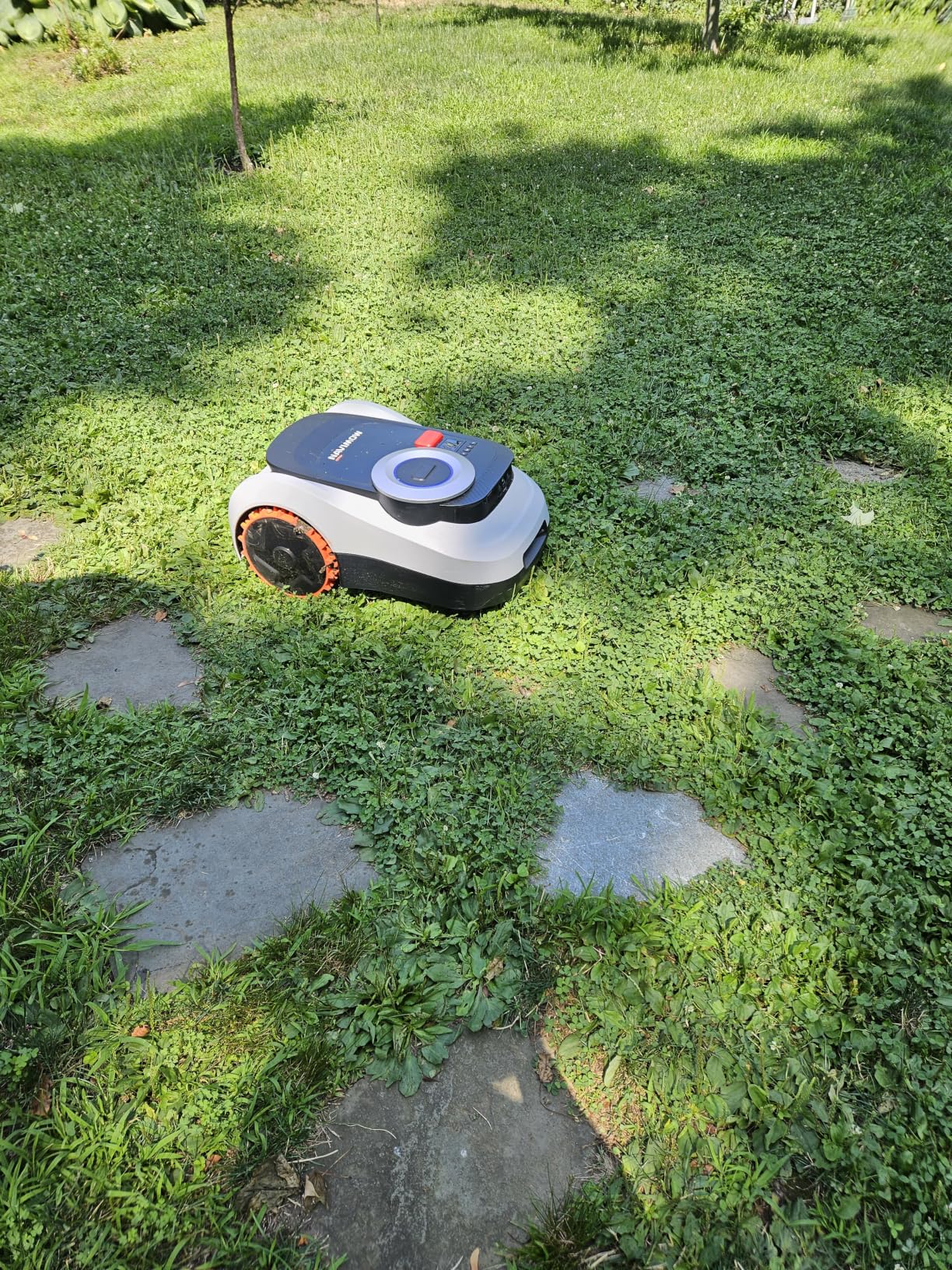
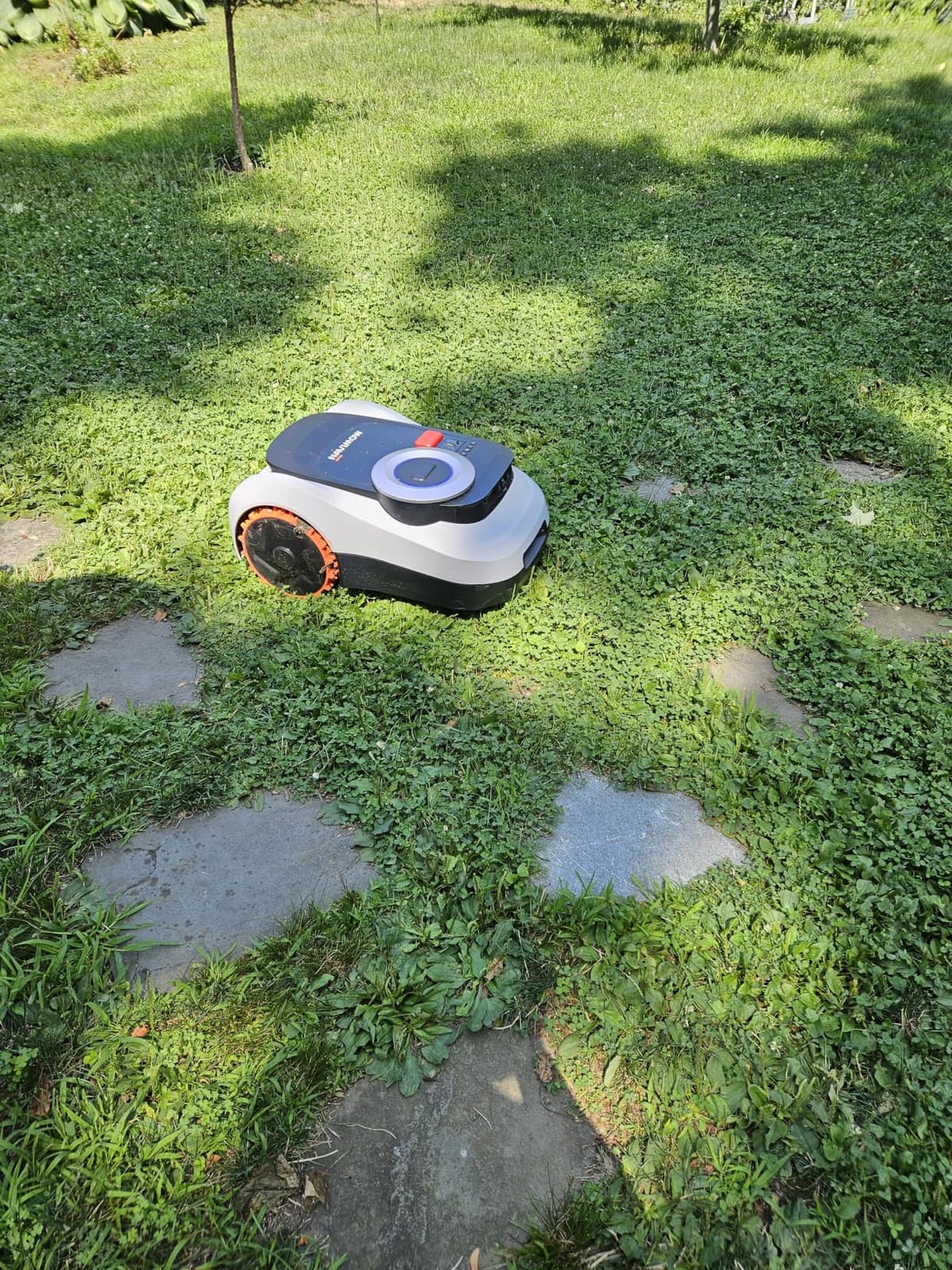
On terrain, the off-road wheels pair with Electronic Stability Control for 45% (24 degrees) slopes, and the 32.4 pound chassis stays planted. Navigation uses solid-state LiDAR fused with onboard vision, so it runs without satellite reception, at night, in any weather window you choose. Auto mapping is one tap, which is the fastest setup in this group alongside the Mammotion machines.
Anti-theft is thorough for a mower that lives on a slope unattended: GPS, geo-fence, lift detection and Apple Find My alerts. AI VisionFence and GeoSketch detect 200-plus obstacle types at 0.4 inch accuracy, 20 editable mowing zones, and a ride-on mode through EdgeSense that walks the machine to the boundary for a cleaner edge cut. The 8.66 inch listed cutting width and 2 to 4 inch height range give reasonable adjustment.
Two things work against it. Obstacle detection is cautious, and on a lawn with a steep drop at the edge it can pause rather than commit, which is sensible behaviour that will still read as a fault from your kitchen window. The 7.1 inch deck also means longer sessions on open ground, and edge and border areas still want some manual trimming.
Whether 45% is enough for your grade
Forty-five percent is 24 degrees, and it covers the majority of residential hills people describe as steep. If your measured maximum runs from 25% to 40%, this machine has margin. If it approaches 60%, you are looking at the Sunseeker or one of the 80% machines, and choosing carefully here means accepting uphill stops on the roughest section.
How the anti-theft stack behaves on a hillside
Geo-fencing matters more than usual when a mower parks at the top of a hill, because that is the spot a casual thief would target. Lift detection stops the machine if it is picked up mid-grass, and the Find My integration gives you a location rather than just an alarm. Set the geofence tight to your property so a jostled mower does not simply continue cutting the neighbour’s slope.
6. Segway Navimow i206 AWD — Budget AWD Entry Point
Segway Navimow i206 AWD Robot Lawn Mower, New i105N, 0.15 Acre, 45% Slopes
45% slope AWD with stability control
Zero-turn steering
0.15 acre
1,350 sq ft per charge
Pros
- AWD and stability control genuinely handle sloped uneven ground
- Very quiet operation that does not disturb pets
- Zero-turn steering avoids tearing the turf
- Support team sends replacement parts free of charge
Cons
- Auto mapping frequently fails and forces manual zone mapping
- 0.15 acre capacity means frequent recharging
- Leaves an unmowed swath along fences
- Treats tall grass clumps as obstacles and mows around them
The i206 AWD answers the most common question on hill forums, which is whether a compact body can actually hold a slope. Owners say yes. The all-wheel-drive platform with automotive-grade stability control handles 45% (24 degrees) grades, and the zero-turn steering design pivots without scrubbing, which is the specific complaint that the old omnidirectional layout generated. On a lawn where you are already fighting traction, pivot damage is the last thing you need.
The steering philosophy extends to turf protection generally. Adaptive torque manages a 2.5Ah battery covering up to 1,350 square feet per charge, and auto-resume charging means it picks up where it stopped. Twenty mowing zones with optimized routes, plus EFLS network RTK with vision for one-tap auto mapping. The machine runs quietly enough that owners with pets report no disturbance.
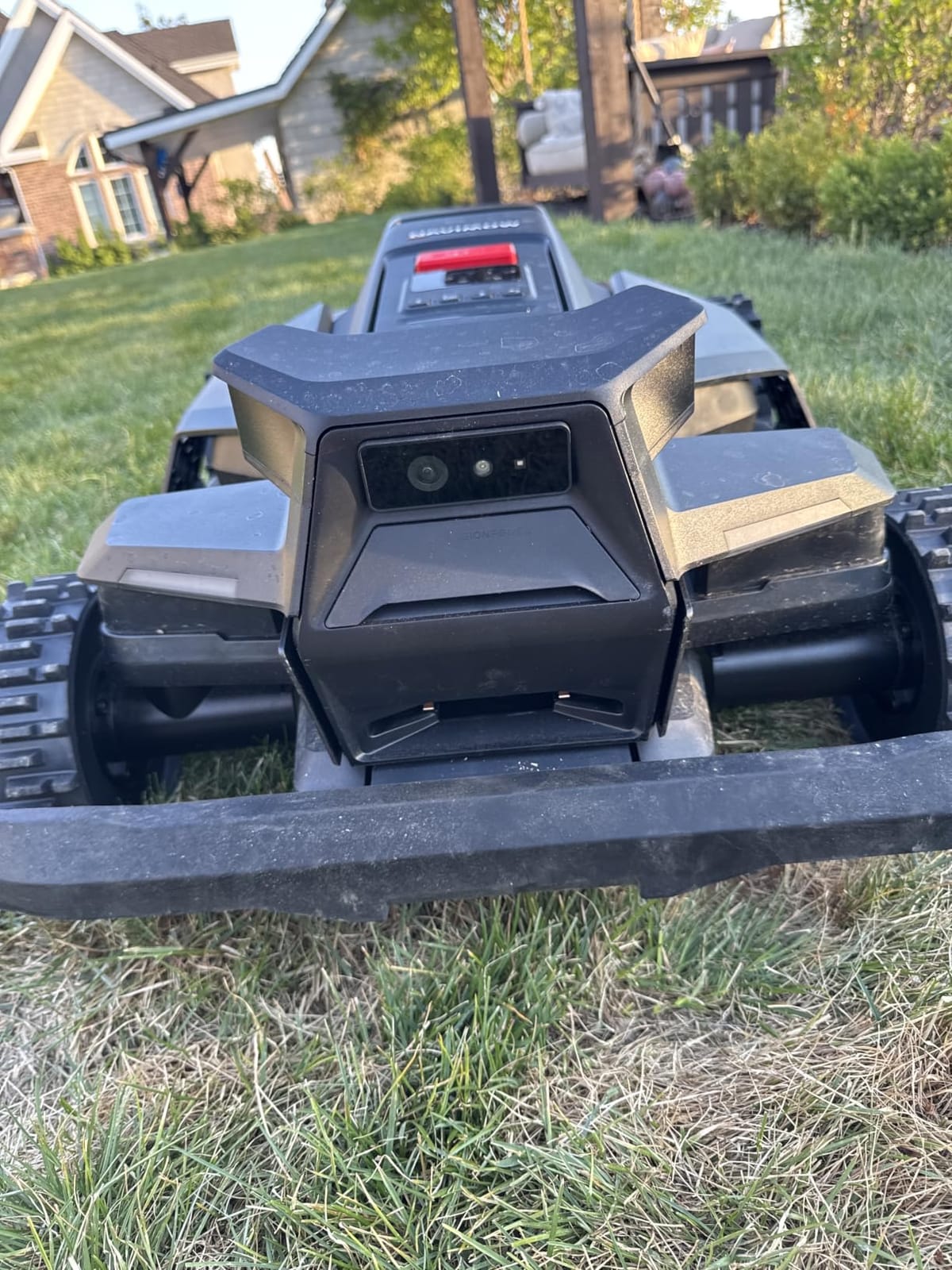
Real-time GPS lift and off-course alerts are genuinely useful on a slope, because a mower that wanders off-plan downhill is a mower you will be retrieving from a neighbour’s grass. The dimensions, 33.5 by 24 by 13.8 inches, are large in footprint terms but the drive layout keeps the mass centred. Lift and wander alerts cover the two failure modes hillside owners actually fear.
The mapping is the weak point and owners say so plainly. Auto mapping frequently fails, which forces tedious manual zone mapping with the app — on a hilly property that walk is long, and errors compound on slopes. Coverage of 0.15 acre is also small, so you will see frequent recharging. And tall grass clumps get treated as obstacles, which on a slope means patches of uncut tall grass exactly where you most wanted the machine to work.
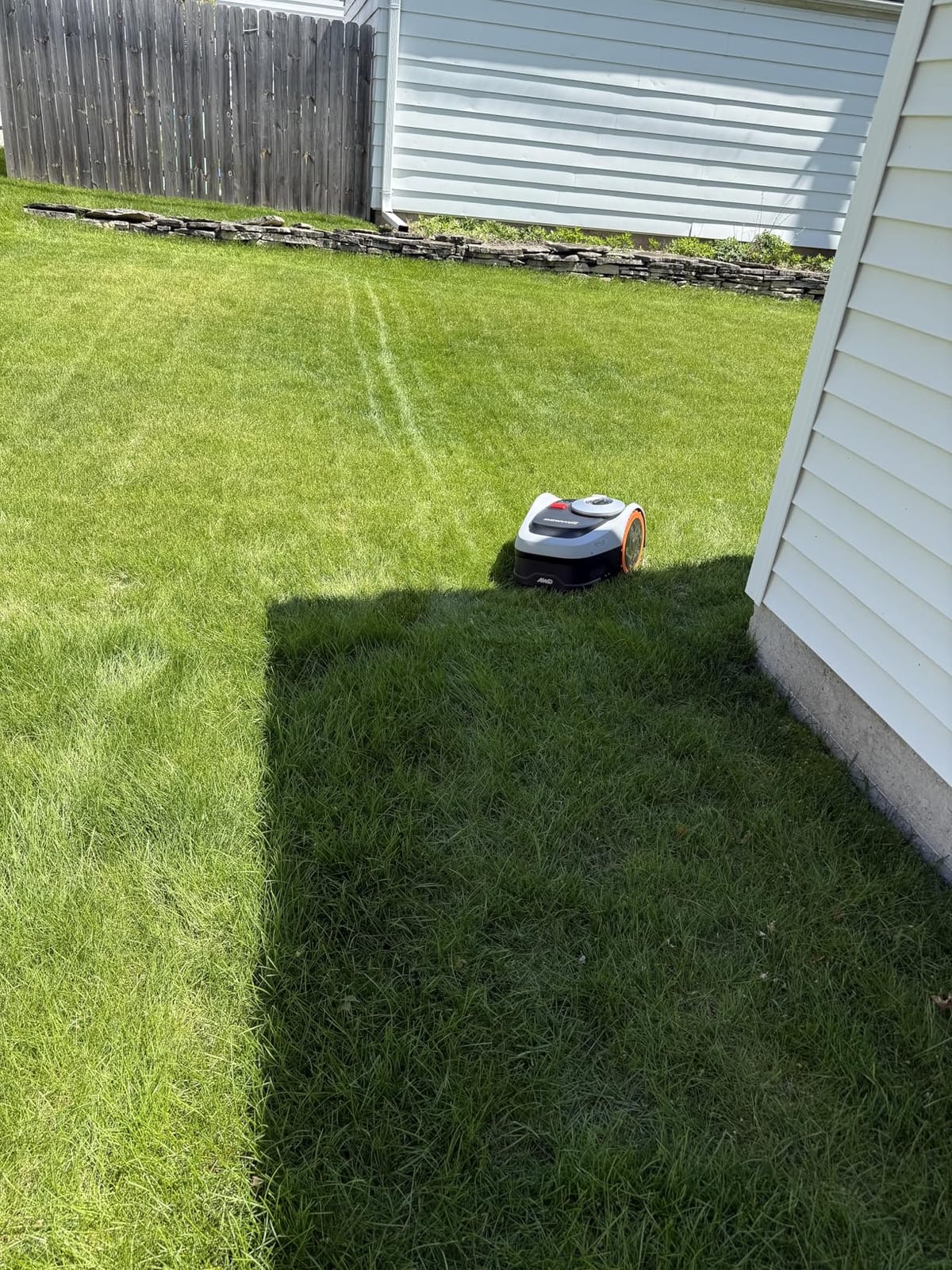
The mapping walk you should plan for
Budget an afternoon for boundary work, and walk the perimeter on foot with the app before you trust it to run alone. On uneven ground the manual boundary is more forgiving than auto mapping, because you control the line rather than letting a sensor guess where the slope edge is. Once the zones are set correctly, owners report the mowing itself is steady.
Who this mower genuinely suits
A small, hilly front or back lawn with a dog on it, and an owner who wants reliable support. Owners specifically call out the support team sending replacement parts free of charge, which is worth more than spec-sheet advantages on a machine this size. If your hill is part of a bigger property, look up to the Navimow i215 for coverage and mapping that does not fight you.
7. Husqvarna 410iQ — Best for Dealer Support and Rugged Build
Husqvarna 410iQ ½ Acre Wire-Free, 45% Slope, app Based, Robot Lawn Mower
45% slope capability
EPOS exact positioning
0.5 acre
59 pound build
Pros
- Wire-free setup through the Husqvarna Connect app
- EPOS positioning gives accurate repeatable mowing patterns
- Handles 45% slopes and varied surfaces such as paths and driveways
- Hose-washable for easy cleaning
- 4-year warranty with US support
Cons
- Heaviest unit here at 59 pounds making manual moves difficult
- Highest share of 1-star reviews in this roundup
- Awkward to lift and reposition so recovery from rough spots is a hassle
Husqvarna carries a specific reputation on hills, and it is worth separating that from any single model. Lawn Care Forum threads going back years hold the brand as the benchmark for mowing steep ground and for finding a way out of a difficult spot, and that long-running consensus is why buyers keep landing on this name. What we are rating here is the 410iQ specifically, and it is the weakest-scoring machine in this group at 3.6.
The specification sheet is unremarkable in the right ways. EPOS Exact Positioning gives centimetre-accurate location data without a base station, onboard radar handles obstacle avoidance, and installation is wire-free through the Connect app with virtual mowing and stay-out zones. It navigates slopes up to 45% (24 degrees) across up to half an acre with a 1 to 4 inch cut height adjustment. Larger wheels and a durable bumper let it run on paths and driveways.
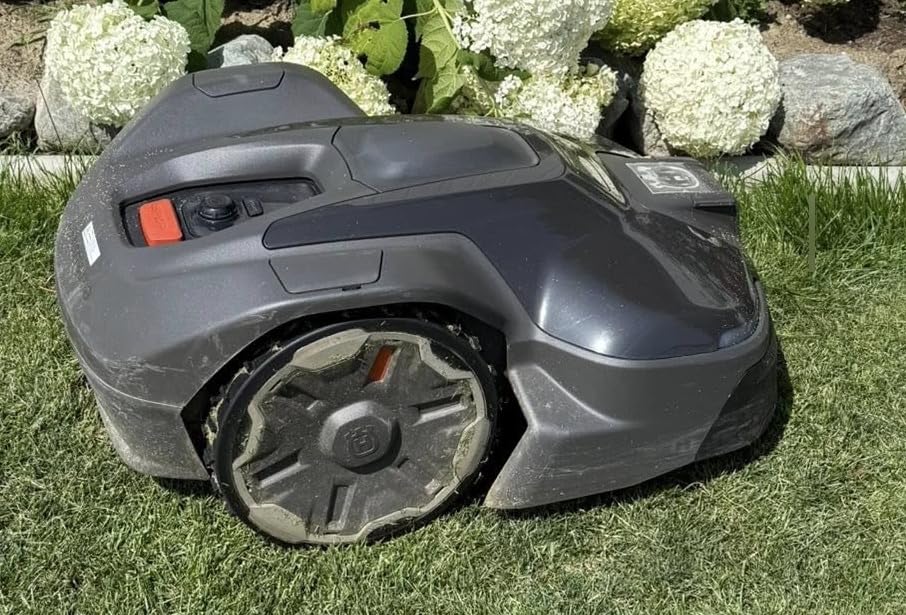
The warranty is 4 years with a year of free blades, and anti-theft alarm plus GPS tracking through the app are included. It is also hose-washable, which is more practical on a sloped property where mud and clippings collect under the chassis. The 1 to 4 inch height range is the widest in this roundup.
What drags the rating down is weight. At 59 pounds it is by a wide margin the heaviest machine here, and on a steep slope that cuts both ways. A heavy chassis resists sliding, which helps, but if it stalls in a hole or a transition zone you are lifting 59 pounds of mower up a hill on your own. That single fact produced the roundup’s highest share of 1-star reviews and it is the reason this is not our top pick.
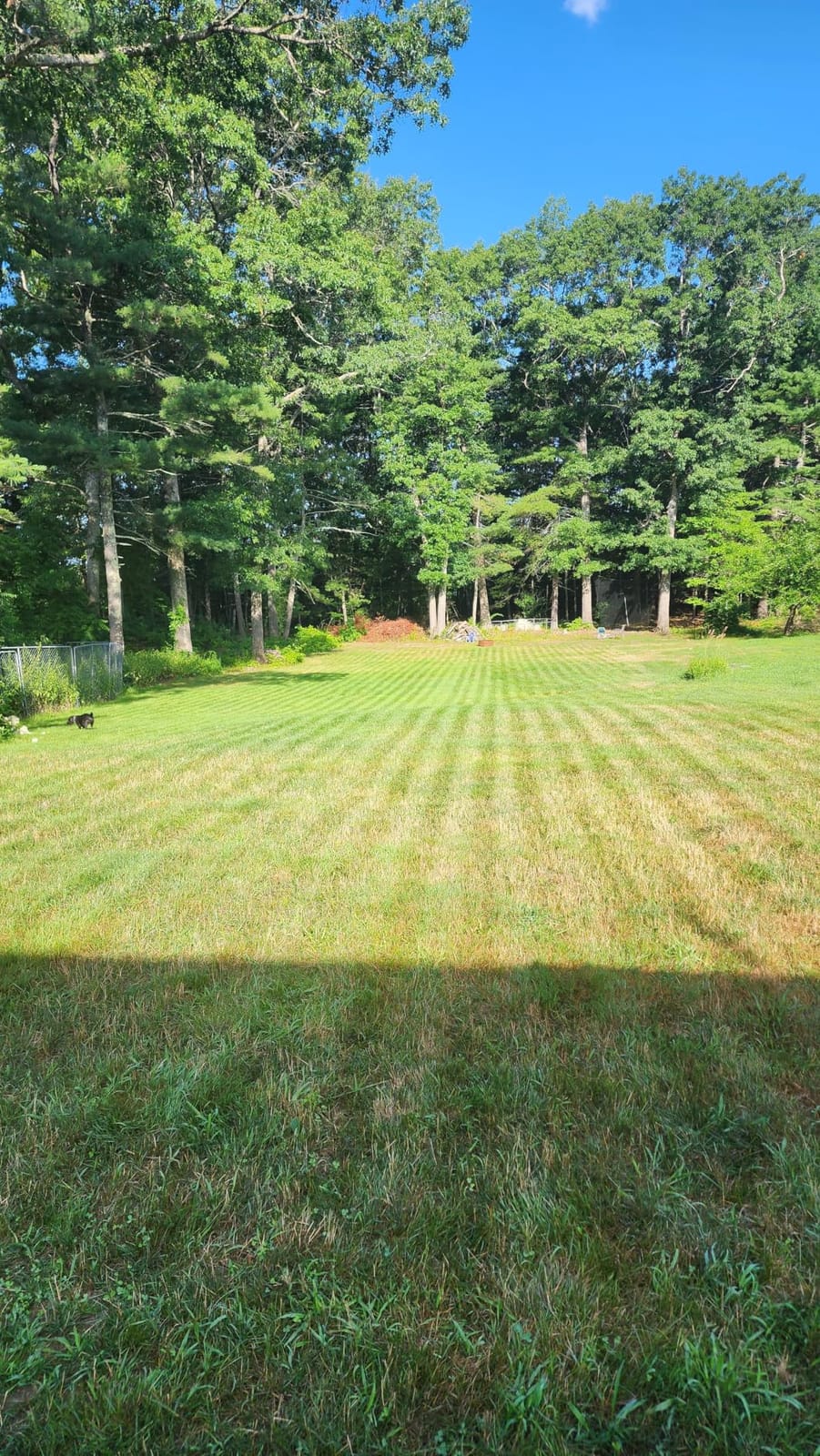
Why the weight argument cuts both ways on a hill
Gravity works for you when the mower is descending and against you when it is climbing or stopped. A 59 pound body resists a slow slide downhill, which is genuinely reassuring on a continuous grade. The same mass means it will not self-recover from a stall, and the awkward lift and reposition shows up in reviews as a hassle every single time it happens.
Who should accept the 3.6 rating
Owners who value dealer support, a 4-year warranty and a build that tolerates paths and driveways, and who have a mild hill inside the 45% range rather than a punishing one. If your hill is genuinely brutal, the mass becomes a liability. If it is a moderate rise and you would rather buy from a brand with a service network, this is the defensible choice.
8. MOVA LiDAX Ultra 2000 — Best for Multi-Zone Control
MOVA LiDAX Ultra 2000 Robot Lawn Mower with 4G for 0.5 Acre, No Wire No RTK+360° 3D LiDAR+AI Vision Auto Mapping, Zero-Edge Cutting, Cut Height 1.2″-3.9″, 45% Slope, 150 Mowing Zones, Anti-Theft
45% slope off-road wheels
360 degree 3D LiDAR
Up to 150 zones
0.5 acre coverage
Pros
- No boundary wires or RTK station needed
- Handles slopes and uneven ground without getting stuck
- Accurate obstacle avoidance around pets and garden ornaments
- Edge trim mode cuts within 2 inches
- Quiet operation with remote camera and notifications
Cons
- Map edits are cumbersome and the delete button is easy to hit accidentally
- Mapping rejects areas beyond stated capacity forcing restarts
- Rear-wheel drive is not ideal for very soft or uneven ground
- Only 60 minutes of battery runtime per cycle
The MOVA LiDAX Ultra 2000 is the machine to look at if your hillside property has more than one lawn area. It holds up to 2 independent maps and 150 managed zones, which is far more granular control than anything else in this roundup. Owners mowing for aging parents or juggling a split-level property will find that granularity useful in a way the other machines do not offer.
Terrain handling is rated at 45% (24 degrees) with off-road wheels handling 1.6 inch obstacles and 23.6 inch paths. Owners report it handling slopes, uneven ground and small dips without getting stuck, and AI vision avoidance of 300-plus obstacle types from 3D point cloud data is described as accurate around pets, children and garden ornaments. UltraTrim 1.0 cuts within 2 inches of walls, hedges and raised edges.
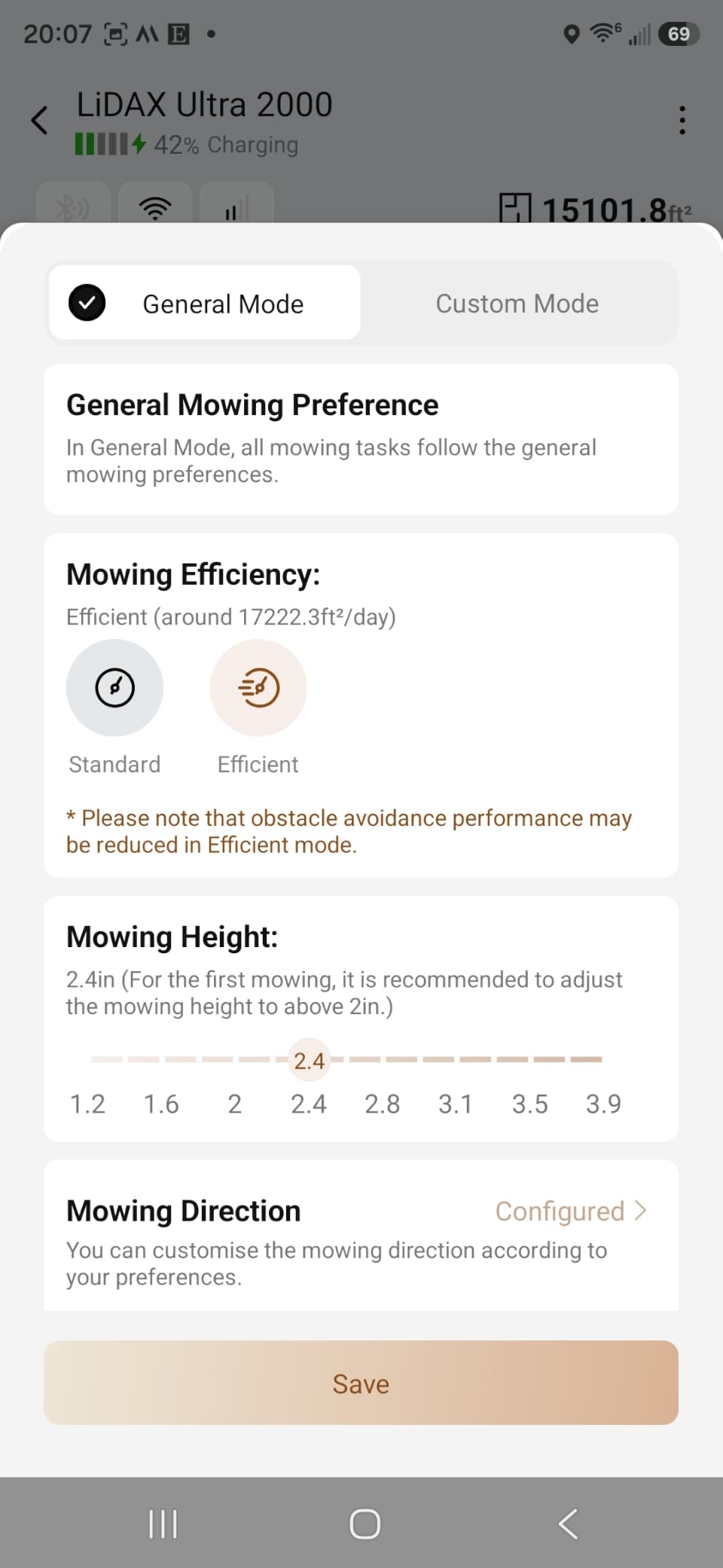
There is no RTK station and no wire, and mapping runs off 360-degree 3D LiDAR with AI vision at centimetre accuracy through a phone. U-shaped path planning with automatic return-to-charge and resume keeps coverage even. TrueGuard anti-theft with a 4G link module gives real-time alerts, backed by a 3-year warranty and 24/7 after-sales service. Cut height adjusts from 1.2 to 3.9 inches.
The drive layout is the catch on a slope, and owners name it directly. This is rear-wheel drive, and the review consensus is that it is not ideal for very soft or uneven ground compared with AWD rivals. On firm hillside turf that is fine; on a slope with soft spring growth or thin soil, you are giving up the self-recovery the AWD machines provide. Battery runtime of 60 minutes per cycle means frequent recharges, and map edits are frustrating.
Rear-wheel drive on a hillside, honestly assessed
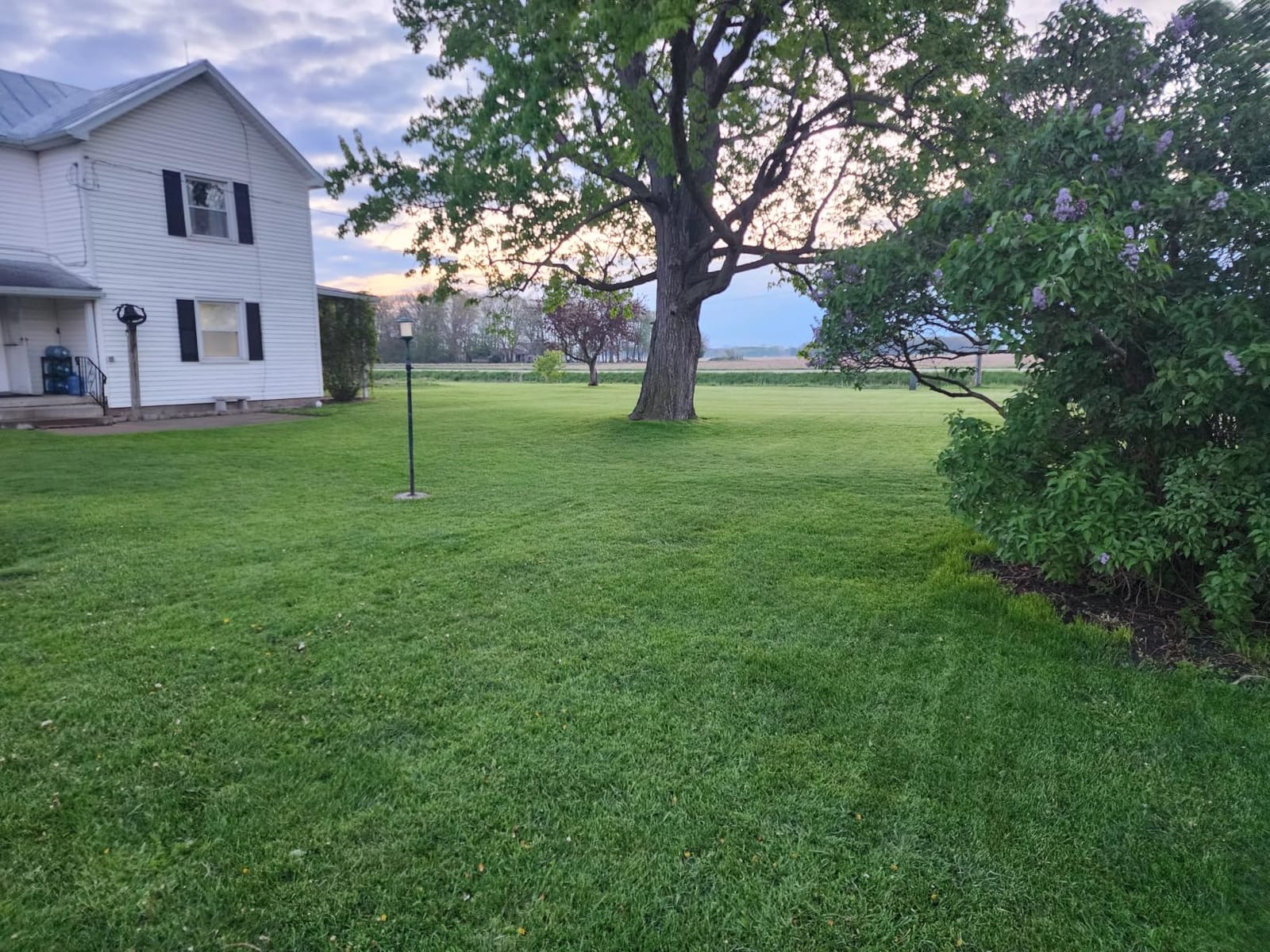
Two driven wheels and two casters will still climb a 45% grade, and owners confirm it handles slopes and small dips. What rear-wheel drive cannot do is push itself out of a soft patch. On a lawn that stays firm and well-drained, that difference rarely shows. On the low corner of a hill where soil holds water, it is the difference between finishing and fetching the mower by hand.
Where the zone system pays off and where it annoys
The 150-zone system is the reason to buy this machine, and it lets you schedule the hill separately from the flat lawn, which keeps slope work in the dry part of the day. The cost is fiddliness. Map editing is cumbersome, the delete control is easy to hit by accident, and mapping rejects areas beyond the stated capacity, which means restarting the map rather than trimming it. Spare parts such as the front caster wheel are also hard to source.
9. Mammotion YUKA 1500 — Best for Leafy, Tree-Shaded Hills
Mammotion YUKA 1500 Robot Lawn Mower, 3D Vision & RTK Technology Fusion Mapping System, Reception 0.37 Acre, Max.0.44 Acre, Lawn 45% Slope, Cut Height 1.2″-4.0″, Perimeter Wire Free, APP Control
45% slope handling
3D vision plus RTK fusion
Self-emptying sweeping
0.37 acre reception
Pros
- Handles steep 45% slopes reliably
- Sweeps and self-empties leaves which is rare among robot mowers
- Accurate mapping that works in poor lighting and weak signal
- Straightforward app setup with per-zone schedules
- Wide 12.59 inch deck speeds up coverage
Cons
- Sweeping function requires an RTK network upgrade
- Heavier build makes manual repositioning awkward
- 500 square meters per charge means several cycles on larger lawns
The YUKA 1500 solves a hillside problem the other mowers here do not: leaves. Its self-emptying sweeping function collects leaves, twigs and grass clippings, which matters enormously on a slope under mature trees where leaf litter turns to a wet, slippery mat and stops a mower dead. On a wooded hillside, that single feature can decide whether the machine runs at all in autumn.
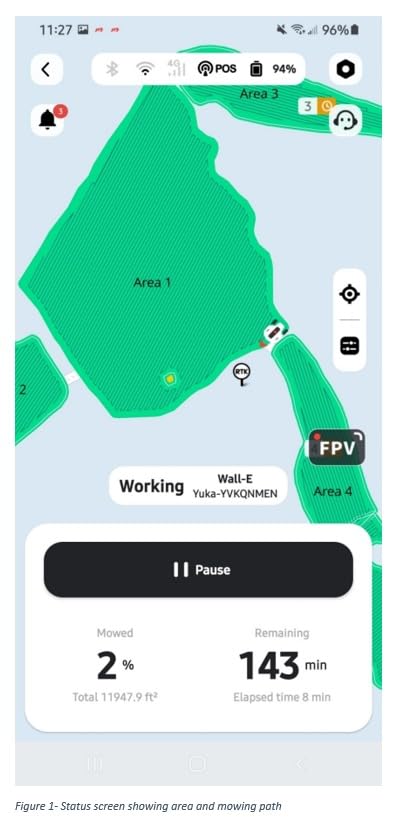
Positioning fuses 3D vision with RTK for centimetre-accurate mapping, and owners report it working in poor lighting and weak signal, which is exactly the combination a shaded slope produces. The mower handles 45% (24 degrees) slopes reliably according to owner reports, and AI binocular vision with a 116-degree field of view recognises 100-plus objects. Anti-collision bumpers wrap 270 degrees in a U shape.
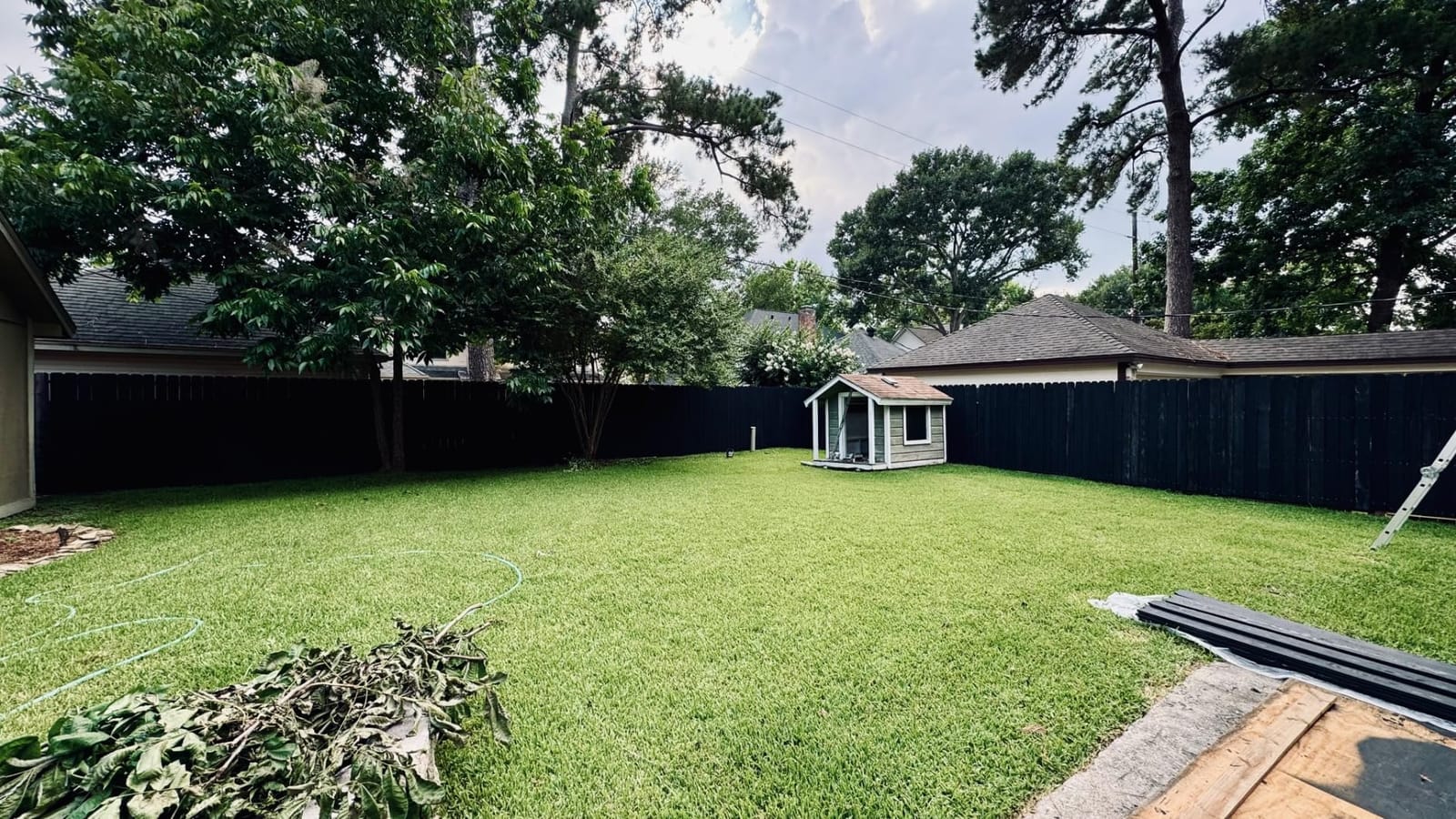
Up to 10 mowing regions with channels and no-go zones, a 12.59 inch cutting width, and up to 500 square meters per charge through dual floating cutting discs. Threefold cutting efficiency comes from those floating discs, which follow the ground rather than hovering at a fixed height, so the cut stays even across a grade. At 15.6 kg the build is heavy and reviewers note that manual repositioning is awkward.
Two caveats matter. The sweeping function requires an RTK network upgrade, so the feature that attracted you may need an extra purchase to activate, and you should confirm that before buying. And 500 square meters per charge means several cycles on a larger property, which on a hill becomes a scheduling exercise rather than a set-and-forget job.
Why leaf cover matters more on a slope than anywhere else
On flat ground, leaves are a cosmetic problem and you clear them once. On a grade, they become a traction problem. A wet leaf mat on an incline reduces the grip the drive system depends on, adds weight, and wraps the underside of the chassis where you cannot see it. A machine that sweeps what it cuts is not solving a tidiness issue, it is solving a safety one.
What the weight means when something goes wrong
At 15.6 kg this is not a light machine to lift, and the reviews flag awkward repositioning as a direct consequence. On a continuous slope you will eventually need to move it by hand, so measure whether you have a level spot near the top of the hill to set it down. If your grade is 45% and above rather than at it, the weight works harder against you at exactly the wrong moment.
10. Roborock RockNeo Q110H — Best for Straight Lines and Night Work
Roborock RockNeo Q110H Robot Lawn Mower, Wire-Free Robotic Lawn Mower with Full-Band RTK + VSLAM Navigation, Auto Mapping, AI Vision Obstacle Avoidance, App Control, 45% Slope, Covers Up to 1/4 Acre
45% slope floating deck
Full-band RTK plus VSLAM
Up to 0.25 acre
2.3 foot passage clearance
Pros
- Straightforward unboxing and simple three-screw assembly
- Mows hilly obstacle-filled lawns without getting stuck
- Headlights and near-silent operation allow night mowing
- App is familiar to existing Roborock vacuum owners
- Cuts in perfectly straight lines
Cons
- No true auto-mapping so the boundary must be traced manually
- Overly conservative boundaries leave 1 to 1.5 foot strips unmowed
- Weak traction in thick St. Augustine grass and false unit-lifted alerts
- Refuses narrow gates with plenty of clearance
- App has no zone breakdown or missed-area flagging
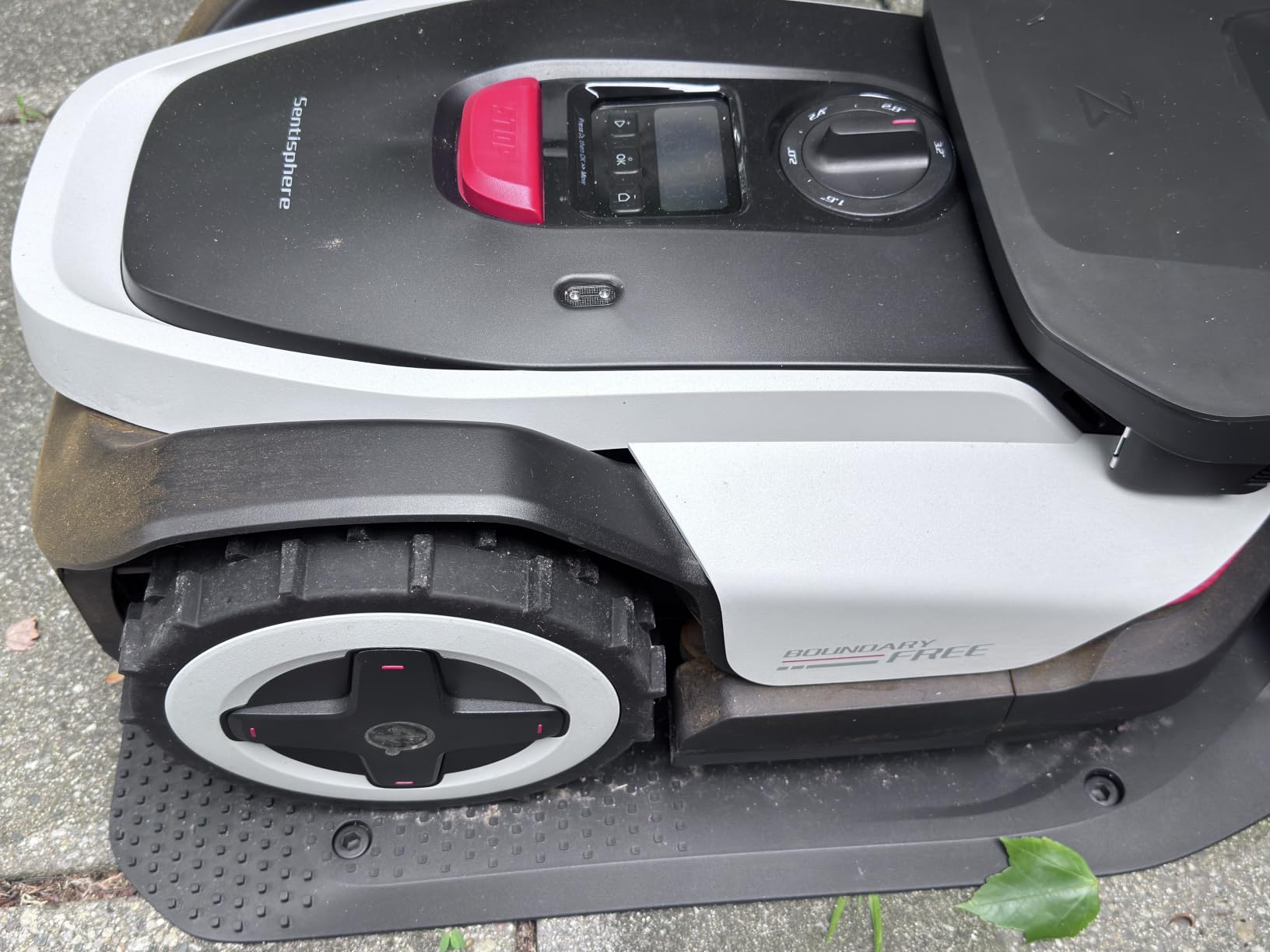
The RockNeo Q110H is the lowest-cost machine here and the one that most rewards owners who already use Roborock vacuums, because the app is the same one. Setup is refreshingly simple: unbox, run three screws, and go. At 27 pounds it is light enough to reposition on a slope by yourself, and the floating cutting deck with large-diameter wheels handles 45% (24 degrees) grades and 1.57 inch obstacles.
Navigation is full-band RTK plus VSLAM, which is the pairing that keeps positioning continuous under tree canopies and near fences. Dual-camera AI vision rolls over low crossable obstacles rather than treating them as walls, and passages as narrow as 2.3 feet are handled. Headlights plus near-silent operation mean it can run at night, which is genuinely useful on a slope because night hours are also the driest and most grippy.
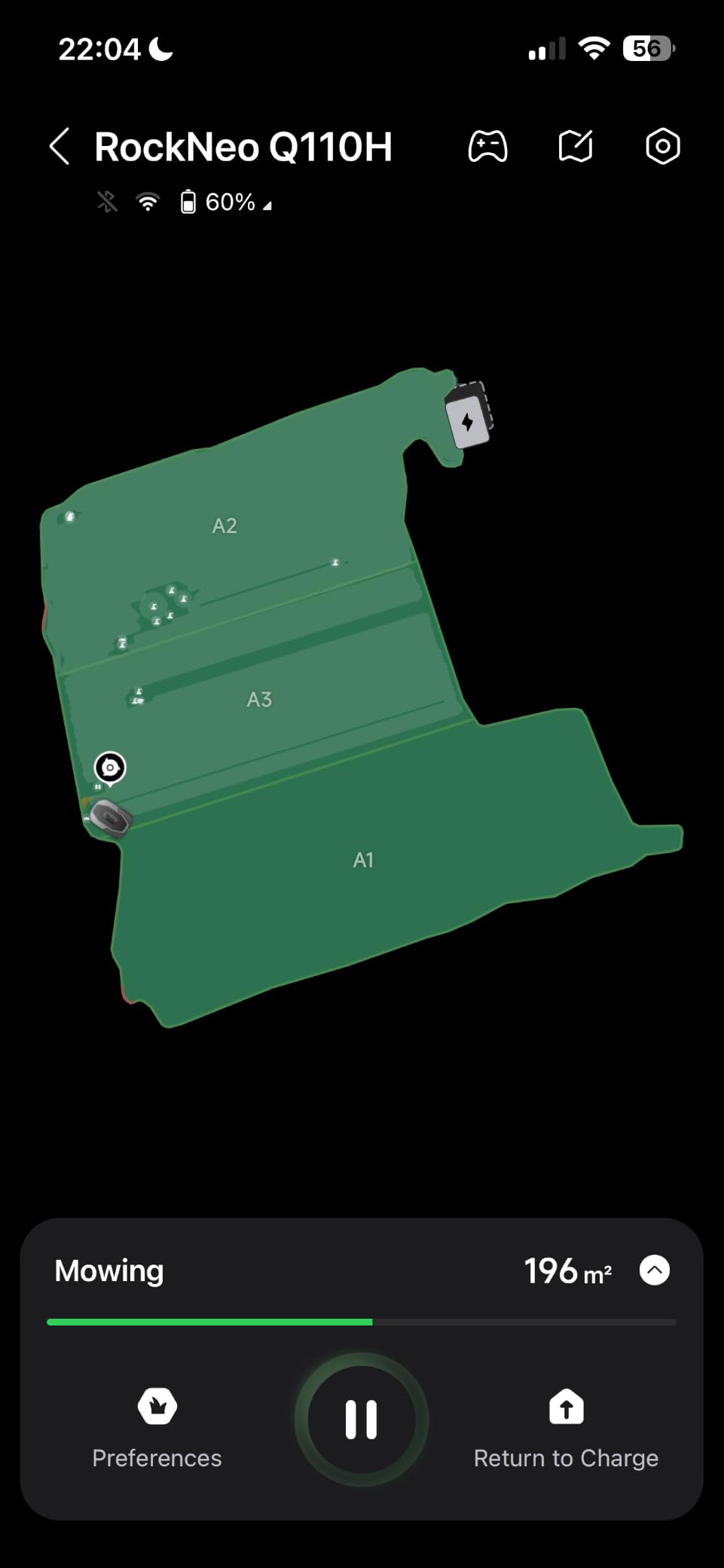
Cut quality is the quiet strength here. Owners report perfectly straight lines at a low price point, which sounds trivial until you remember that straight lines on an uneven lawn require a deck that follows the ground. Optional edge module sold separately gets you to 1.2 inch edge precision, and coverage is up to a quarter acre with a 130 minute battery runtime. PIN lockout, a high-decibel alarm and an optional 4G anti-theft module cover theft.
The app is the limitation. There is no real auto-mapping, so the boundary must be traced manually with the app, and boundary handling is overly conservative enough to leave strips of a foot to a foot and a half unmowed. The app also does not break the yard into zones or flag missed areas, which is a real loss on a lawn where you would want to schedule the hill separately.
Thick grass versus thin grass on a grade
This is the one machine in the roundup where grass type changes the verdict. Owners report weak traction in thick St. Augustine and false unit-lifted alerts on bumps — the tilt sensor reads a rise in the ground as the machine being picked up. On a lawn with coarse, dense turf and existing unevenness, those two issues compound. On thinner, healthier grass, the straight-line cut and the near-silent night running are hard to beat.
Why night scheduling suits a slope so well
Two of the most-cited failure triggers on hills are wet grass and poor visibility, and both disappear after the dew lifts. Running the RockNeo after dark with its headlights on means it works on dry turf, undisturbed, with no risk of you needing to supervise. Set the PIN lockout before you leave it out there, because a mower on a dark hillside is harder to notice.
Why Steep Slopes Defeat Robot Mowers
The consensus on r/automower is blunt about this: if the slope is too steep the wheels will slip and the mower will be stuck with not enough traction to start up the hill. That single sentence describes most hillside failures, and it explains why drive layout matters more than any other specification. The same community consensus puts roughly 20 degrees as the point where ordinary mowers stop coping and 4×4 or tracked machines become necessary.
Traction is the limiting factor, and it is a compound problem. Gravity loads the downhill wheels and unloads the uphill ones, so a two-wheel-drive machine effectively loses drive on the incline. Independent motors on all four corners push into the turf rather than scraping it, and low centre-of-gravity mass keeps every wheel loaded. Wet grass is the most-cited trigger across every forum we read, because moisture fills the tread gaps that dry grass leaves open.
Transition zones cause more failures than the steep section itself. The lip where flat ground tips into the incline is where a wheel loses load, where a fixed-height deck clips the turf, and where lift sensors can misread a bump as the machine being carried away. Owners of the Dreame A3 complained specifically that omnidirectional wheels would tear up slopes, and the redesign that removed them is the clearest example of a design fault being fixed for hill use.
Navigation drifts on grades as well. Satellite positioning is weakest where the sky is partly blocked, and a hillside under trees produces exactly that condition, which is why RTK paired with vision or VSLAM matters more on a hill than in an open field. Battery drain follows the same logic: climbing draws harder than flat running, so effective mowing time per charge falls on precisely the ground you most want covered. And blades wear faster on slopes because they are cutting at an angle through more material per pass.
Buying Guide: What Actually Matters on a Hill
Drive layout comes first, and there is no substitute for it. AWD and 4WD machines put powered wheels on all four corners, which is what lets them climb grades a two-wheel-drive mower spins on. The rear-wheel-drive MOVA LiDAX Ultra 2000 proves the point in reverse: it manages 45% (24 degrees) on firm ground and struggles to recover on soft or uneven ground, exactly where a hillside turns to spring mud.
Wheel and tire design is the second filter. Off-road wheels with deeper tread, as on the Navimow i215, and independent front suspension, as on the Sunseeker X5, both buy grip and articulation. Tread depth matters more than wheel diameter because it is the part that actually meets the turf. Ask how the machine behaves at a transition edge, since that is where tread and suspension are tested together.
Zero-turn steering protects turf on slopes for a mechanical reason. A machine that pivots in place does not scrub sideways, and sideways scrubbing is what tears grass and ruts a hillside. The Navimow i206 AWD is built around that principle, and owners who came from omnidirectional designs consistently notice the difference.
Navigation on a slope is a different problem from navigation on a flat lawn. Full-band RTK plus VSLAM, as on the Roborock, or RTK fused with vision, as on the LUBA 2, keeps coverage under tree canopy where a plain RTK link drifts. LiDAR plus vision, as on the Navimow i215, removes the satellite dependency entirely. Where trees and slope combine, any of these three approaches works; where both RTK and line of sight fail, a wire-free LiDAR machine is the reliable answer.
Weight is a two-edged spec. Heavier chassis resist sliding downhill, which helps on a continuous grade. The same mass means a machine that stalls cannot self-recover, and the Husqvarna 410iQ at 59 pounds shows how quickly that becomes the dominant complaint. Choose a weight you could lift up your own hill with one hand on the frame, and no more.
Blade and undercarriage maintenance rises on slopes, and it is the most predictable cost on a hillside. Razor and disc blades survive sticks better than swinging blades, and spare razor blades are cheap and widely stocked. Check the underside and drive wheels for wrapped grass after every session in tall growth, and expect to replace blades more often than the manual suggests.
Finally, schedule for dry conditions and plan around the geometry. Mowing wet grass on a slope is the single most-reported failure trigger in every forum thread we read, so set your slope zone for the middle of the day rather than early morning. A machine with multiple zones lets you split the hill from the flat lawn, which turns this from a compromise into a controllable routine. Owners of a Luba 5000 on the Hubitat forums describe four-wheel drive with serious torque getting up deep slopes, which is the same principle at a larger scale. For very rough ground beyond mower territory, our picks for flail mowers for tractors and finish mowers for tractors cover the situations where a robot is the wrong tool entirely.
When a Robot Mower Is the Wrong Choice
Above roughly 45 degrees, a wheeled robot mower stops being a hill solution and becomes a liability. None of the machines here is rated above 80% (38.6 degrees), so a 45-degree grade is roughly 100% — beyond every rated ceiling in this roundup. On ground that steep, the honest options are tracked or remote-control slope mowers, which use continuous tracks or a wheeled chassis under direct operator control to hold a line that autonomous machines cannot.
Hiring a pro for the steep section and automating the rest is the arrangement most owners with brutal hills settle on. It also suits anyone whose hill is unmeasured, extremely irregular, or full of exposed roots and rocks that turn a slope into an obstacle course. If you are unsure where your lawn sits on the 25% to 80% spectrum, measure it before you buy, and read our golf course mowers for greens picks if you are comparing professional-grade cut quality on very fine turf.
Frequently Asked Questions
Do robotic lawn mowers work on steep slopes?
Yes, but only if they are all-wheel-drive or 4WD models. Standard two-wheel-drive mowers generally manage around 25% to 35% grade, while AWD machines are rated 45% to 80%, equal to roughly 24 to 39 degrees. Forum consensus puts about 20 degrees as the point where ordinary mowers stop coping. The rated figure assumes dry, even turf, so leave a 20% to 30% margin above your measured slope.
What is the maximum slope a robot mower can handle?
The practical ceiling for wheeled robot mowers is 80% grade, which equals 38.7 degrees. The Mammotion LUBA machines and the Dreame A3 carry that rating. Most other capable models, including the Navimow pair, Husqvarna 410iQ, MOVA LiDAX Ultra 2000, YUKA 1500 and Roborock RockNeo, are rated 45%, or 24 degrees. For reference, 25% equals 14 degrees, 35% equals 19.3 degrees and 60% equals 31 degrees.
What type of mower is best for mowing steep slopes?
For grades under about 45%, an all-wheel-drive robot mower with off-road tread and a floating deck is the best choice. Above 45 degrees, wheeled robots run out of rated capacity and tracked or remote-control slope mowers take over, because they hold a line that autonomous machines cannot. Hiring a pro for the steep section while automating the flat lawn is a common compromise. For very rough ground, tractor-mounted flail or finish mowers suit better than any robot.
Which robot mower can handle a 45-degree slope?
None of them, as a rated specification. A 45-degree incline is a 100% grade, and the highest rated wheeled mowers reach 80%, or 38.7 degrees. For a 35 to 40 degree hill, the Mammotion LUBA 2 AWD 5000HX, LUBA mini 2 AWD 1500H and Dreame A3 AWD 2000 are the closest matches. For terrain that steep, a tracked or remote-control slope mower or a professional service is the realistic answer.
Why does my robot mower get stuck on the hill?
Most stuck reports come down to four causes. Wet or dewy grass fills the tread gaps that provide grip, so never mow a slope while it is damp. Transition zones where flat ground tips into the incline unweight the uphill wheels, which is where suspension and articulation matter most. A rear-wheel-drive or two-wheel-drive machine has no drive on the loaded wheels. A steep grade inside a machine’s rating is also harder than a shallow one, so check the percentage against your measured slope.
Conclusion: Our Picks for Steep Slopes
The best robot mowers for steep slopes all share one trait that matters more than any feature list: powered wheels on every corner. Our top pick, the Mammotion LUBA mini 2 AWD 1500H, pairs that with an 80% (38.6 degrees) rating, 45mm obstacle clearance and LiDAR plus camera mapping, which makes it the most capable machine in the roundup for a hill that is under half an acre. For larger hilly acreage, the LUBA 2 AWD 5000HX brings the same 80% rating to a 15.7 inch deck and 1.25 acres of reception.
For graded yards with heavy tree cover, the Sunseeker X5 AWD is the better match at 60% (30 degrees) with independent front suspension. Measure your steepest grade before you buy, add a 20% to 30% margin, and set the hill zone for the middle of a dry day. If your lawn is already close to 45 degrees, skip the robot entirely and read our robot vacuum picks for indoor coverage while you sort the hill with a tracked or professional option.