
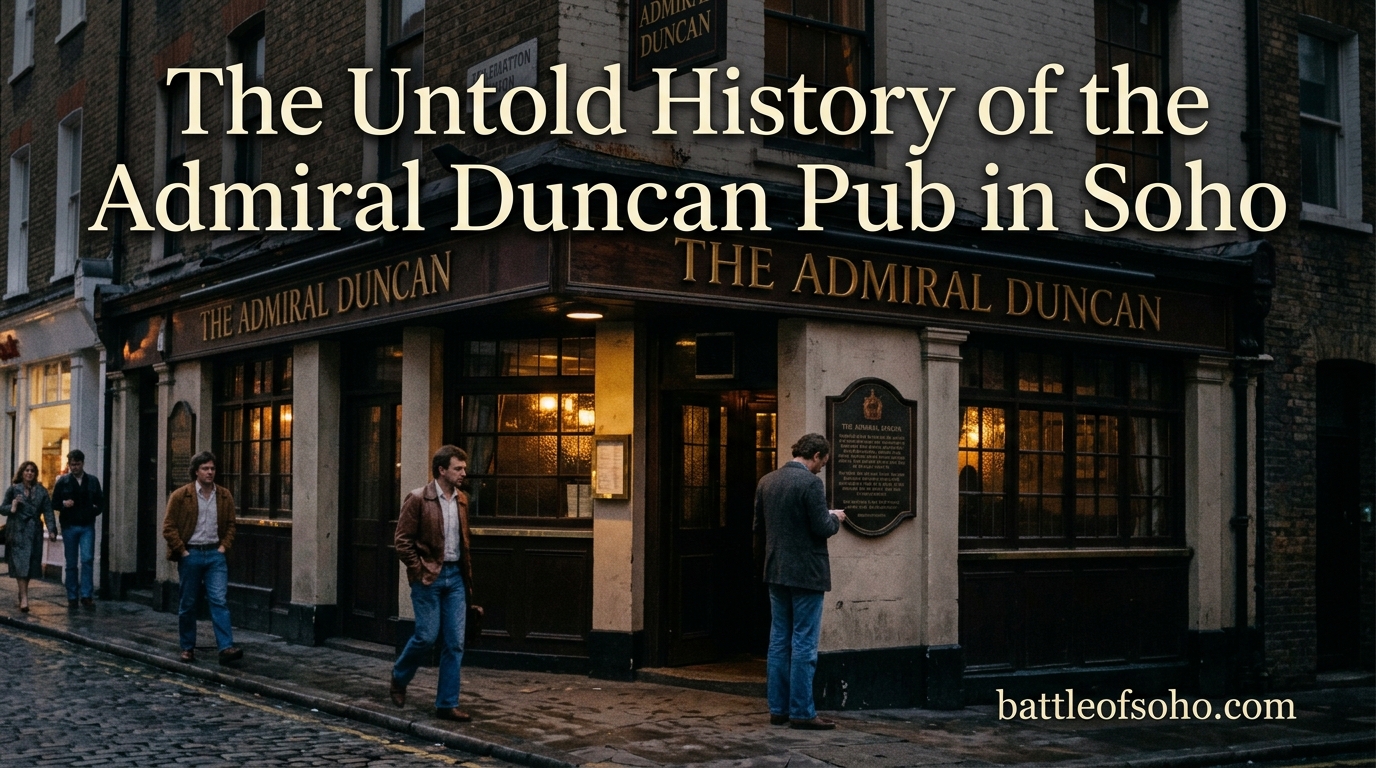
Walk down Old Compton Street on a Friday evening in 2026, and you will hear the Admiral Duncan before you see it. Music spills onto the pavement through doors propped open regardless of the weather. Drag queens pose for photos with passing tourists. Regulars cluster on the corner with pints in hand, watching Soho’s endless human parade shuffle past. The pub looks like any other cheerful gay bar in one of the world’s most famous queer neighborhoods. But these walls hold nearly two centuries of secrets, scandals, violence, survival, and defiance that most patrons never hear about.
The Admiral Duncan is a historic gay pub at 54 Old Compton Street in Soho, London, dating back to at least 1832 and named after Admiral Adam Duncan, the Royal Navy hero who won the Battle of Camperdown in 1797. It is one of Soho’s oldest gay pubs and the site of the worst homophobic attack in British history: the 1999 nail bombing that killed three people and injured 79 more. But the Admiral Duncan pub Soho history stretches far beyond that single tragic night.
Before it became a cornerstone of London’s LGBTQ+ scene, the Admiral Duncan witnessed a high treason trial, gangland shootouts, literary legends, and nearly a hundred years of ordinary Londoners drinking through extraordinary times. Our team spent weeks digging through court records, historical archives, newspaper clippings, and community memories to piece together the stories most accounts skip. What follows is the untold history of a building that has been at the beating heart of Soho for close to 200 years.
Table of Contents
Quick Facts About the Admiral Duncan
- Address: 54 Old Compton Street, Soho, London W1D 4UB
- Established: At least 1832 (possibly earlier)
- Named after: Admiral Adam Duncan (1731-1804), victor of the Battle of Camperdown
- Type: Gay pub and LGBTQ+ venue
- Current owner: Stonegate Pub Company (since 2015)
- Most notorious event: 1999 nail bombing by neo-Nazi David Copeland (3 killed, 79+ injured)
- Historical marker: Erected 2017 by Sexual Avengers
- Memorial: Commemorative chandelier and plaque inside the pub
Who Was Admiral Adam Duncan? The Man Behind the Name
The pub takes its name from Admiral Adam Duncan, one of the most celebrated naval commanders in British history. Born in 1731 in Dundee, Scotland, Duncan joined the Royal Navy as a teenager and rose through the ranks during a period when Britain’s naval supremacy shaped the entire global order. His career spanned the Seven Years’ War and the French Revolutionary Wars, but one battle made him a household name across the British Empire.
On October 11, 1797, Duncan led the British North Sea Fleet against the Batavian Navy off the coast of Camperduin in what is now the Netherlands. The Battle of Camperdown was brutal and decisive. Duncan’s fleet captured or destroyed eleven Dutch ships of the line in one of the most significant naval engagements of the era. The victory prevented a planned French-Batavian invasion of Ireland and cemented British control of the North Sea.
Duncan returned to Britain a national hero. He was showered with honors, including a peerage as Viscount Duncan of Camperdown. When he died in 1804, his name was already being attached to streets, monuments, and drinking establishments across the country. In the early 19th century, naming pubs after naval heroes was practically a civic duty in London. The Battle of Trafalgar, the Battle of the Nile, and Lord Nelson himself inspired countless pub signs. The Admiral Duncan on Old Compton Street was part of this broader tradition of celebrating British naval glory through everyday commercial spaces.
What makes this particular naming interesting is the contrast between Duncan’s conservative naval legacy and the pub’s eventual identity as a sanctuary for the LGBTQ+ community. The same building that honored an 18th-century military establishment figure would, two centuries later, become a target for a neo-Nazi terrorist precisely because it served the queer community. History has a dark sense of irony.
Early Years: A Victorian Soho Drinking Den (1832 and Beyond)
The Admiral Duncan has been serving drinks on Old Compton Street since at least 1832. That is the earliest documented record of a public house trading at this address, during the reign of King William IV. Some historians believe the building may have operated as a drinking establishment even earlier, but 1832 remains the first verifiable date in the pub’s long timeline.
To understand what the Admiral Duncan was like in its early years, you have to picture a very different Soho. In the 1830s, Old Compton Street was a working-class neighborhood mixed with small workshops, cheap lodging houses, and street traders. The grand theatres and upscale restaurants that define modern Soho were still decades away. This was a neighborhood of survival, where a pint of beer was often safer to drink than the water.
London’s pub culture in the early Victorian era was intense and pervasive. Pubs were not just places to drink. They were post offices, hiring halls, meeting rooms, courthouses for informal disputes, and gathering spots for political radicals. The 1830s were a period of enormous social upheaval in Britain. The Reform Act of 1832, which reshaped parliamentary representation, triggered violent debates and public demonstrations across London. Pubs like the Admiral Duncan served as informal headquarters for working-class political organizing.
No competitor writing about the Admiral Duncan has explored what the pub’s Victorian clientele might have looked like. Based on what we know of Old Compton Street in the 1830s and 1840s, the Admiral Duncan would have served a mix of artisans, laborers, market porters from nearby supply routes, and the ever-present swirl of Soho’s immigrant communities. French, Italian, and Greek settlers were already transforming the neighborhood’s character. The beer would have been served in wood-paneled rooms lit by candlelight and oil lamps, with sawdust on the floor and a landlord who knew every regular by name.
The pub survived the massive cholera epidemic that devastated Soho in the mid-19th century. It weathered the construction of new thoroughfares that carved through old neighborhoods. It watched as Soho transformed from a residential backwater into one of the most cosmopolitan districts in the world. Through all of this, the Admiral Duncan kept its doors open on Old Compton Street, adapting to whatever the city threw at it.
The Dennis Collins Treason Trial of 1832
One of the most extraordinary and least-known stories in the Admiral Duncan pub Soho history involves a man named Dennis Collins. In 1832, Collins committed an act that could have cost him his life in the most gruesome way imaginable. He threw stones at King William IV.
The incident occurred as King William IV’s carriage passed through London. Collins, who was reportedly a patron of the Admiral Duncan and lived nearby, hurled stones at the royal carriage in what was either a politically motivated protest or a drunken act of fury. In the political climate of 1832, with reform riots sweeping the country, the authorities took no chances.
Collins was charged with high treason, a crime that at the time carried a mandatory sentence of being hanged, drawn, and quartered. This was the medieval punishment reserved for the most serious offenses against the crown. The convicted person would be partially hanged, disemboweled while still alive, beheaded, and their body cut into four pieces for public display. This was the fate that awaited Dennis Collins for throwing stones.
The trial itself became a minor sensation. Collins was ultimately convicted but spared the death sentence. Instead, he was sentenced to transportation to Australia, joining the thousands of convicts shipped to penal colonies in Van Diemen’s Land and New South Wales. For throwing stones at the King, Collins lost his freedom, his country, and his place in Soho forever.
This story matters because it reveals something deeper about the Admiral Duncan and about Soho pub culture in general. Pubs were never just places for quiet drinking. They were spaces of dissent, radicalism, and confrontation with authority. The man who threw stones at the monarch may well have been sitting in the Admiral Duncan just hours before, working up his courage with the other regulars. The pub was part of a tradition of working-class political resistance that stretched from the Peterloo Massacre to the Chartists and beyond.
No major article about the Admiral Duncan connects this 1832 treason case to the broader theme of pubs as spaces of social and political defiance. But the thread runs straight from Dennis Collins throwing stones at a king to the drag queens defying homophobia nearly two centuries later. The building has always harbored people who refused to conform.
The Sabini Gang and Soho’s Underworld (1920s-1930s)
By the 1920s and 1930s, Soho had developed a reputation as London’s most notorious neighborhood for organized crime, gambling, protection rackets, and after-hours drinking. At the center of this underworld sat Charles “Darby” Sabini, an Italian-English gangster who controlled much of the racecourse betting and protection rackets across southern England.
The Sabini gang, composed largely of men from Italian and English backgrounds, dominated London’s criminal landscape in the interwar period. They controlled betting operations at racecourses like Ascot, Epsom, and Sandown Park. Their rivals included the Hoxton Gang, a Jewish-English criminal outfit from East London. The turf war between these two factions was violent, prolonged, and extensively covered by the press.
The Admiral Duncan pub became entangled in this criminal underworld. In February 1930, the pub was the site of a major brawl between members of the Sabini gang and the Hoxton Gang. According to court records from the era, the fight was brutal. Men were beaten with bottles, chairs, and anything that could serve as a weapon. The violence spilled out of the pub and onto Old Compton Street, drawing police and ambulances to the scene.
The aftermath of the brawl included court proceedings that exposed the extent of Soho’s gang problem to the public. Witnesses described a terrifying scene of coordinated gang violence in a neighborhood where police presence was often compromised or simply outmatched. The Sabini gang’s involvement with the Admiral Duncan was part of a broader pattern of Soho pubs being used as meeting points, territory markers, and occasional battlegrounds by organized crime syndicates.
This era of the pub’s history is almost entirely forgotten in modern accounts. Most people associate the Admiral Duncan with either its LGBTQ+ identity or the 1999 bombing. But for a decade or more, the pub existed within the orbit of some of the most dangerous men in London. The old building on Old Compton Street has witnessed a staggering range of human behavior, from political revolutionaries to mob enforcers to drag queens. Not many pubs in the world can claim that.
Dylan Thomas and the Lost Under Milk Wood Manuscript
One of the strangest stories associated with the Admiral Duncan involves the Welsh poet Dylan Thomas and the manuscript of his famous radio drama, “Under Milk Wood.” The tale, which has been circulating in Soho literary lore for decades, claims that Thomas either lost or left behind pages of the manuscript at the pub during one of his legendary drinking sessions.
Dylan Thomas was a fixture of Soho’s post-war literary scene. He drank in virtually every pub in the neighborhood, and the Admiral Duncan was among his regular haunts. His friend and producer Douglas Cleverdon was the BBC producer who eventually recorded the first full performance of “Under Milk Wood” in 1954, shortly after Thomas’s death in 1953. The idea that pieces of one of the most celebrated works of 20th-century English literature might have been left on a bar counter in a Soho pub is irresistibly romantic.
However, it is important to note that this story is disputed. Some historians and Thomas scholars consider it apocryphal, a piece of Soho mythology rather than documented fact. The manuscript was known to pass through multiple hands during its composition, and Thomas was famously disorganized with his papers. Whether any pages were genuinely lost at the Admiral Duncan or whether this is simply a good story that Soho regulars enjoy telling is impossible to verify with certainty.
What is not disputed is Thomas’s deep connection to Soho’s pub culture and the role that drinking establishments like the Admiral Duncan played in mid-century literary London. Writers, painters, musicians, and BBC staff all rubbed shoulders in these rooms, creating the cross-pollination of ideas that defined post-war British culture. The Admiral Duncan was part of that creative ecosystem long before it became known as a gay venue.
The 1980s: Becoming One of Soho’s Oldest Gay Pubs
The transformation of the Admiral Duncan into a gay pub happened in the 1980s, and it reflected a broader shift in Soho’s identity that had been building for centuries. Soho’s connection to queer culture did not begin with the gay liberation movement of the 1970s. It stretches back to at least the 1600s, when so-called “molly houses” provided gathering spaces for men who had sex with men in an era when such acts carried the death penalty.
Molly houses were the precursors to modern gay pubs. They were often located in private homes or the back rooms of taverns, where men could meet, socialize, and express themselves in ways that were impossible in public. The most famous molly house raid occurred in 1726 when Mother Clap’s establishment in Holborn was busted by the Societies for the Reformation of Manners. Several men were executed following that raid. Soho, with its dense mix of immigrants, sex workers, theater people, and bohemians, was a natural extension of this underground queer geography.
By the 1980s, the LGBTQ+ rights movement had gained enough momentum that gay pubs could operate openly, at least in neighborhoods like Soho. The Admiral Duncan transitioned from a traditional Soho pub into a dedicated gay venue during this period. It joined a growing cluster of LGBTQ+ establishments along Old Compton Street and the surrounding streets that would come to define Soho as London’s gay village.
The 1980s were also the decade of the AIDS crisis, which devastated the gay community and made safe gathering spaces more important than ever. Pubs like the Admiral Duncan became more than just places to drink. They were centers of community support, fundraising, activism, and mourning. In a society that was often hostile or indifferent to the suffering of LGBTQ+ people during the AIDS epidemic, gay pubs were lifelines.
The Admiral Duncan’s identity as one of Soho’s oldest gay pubs is relative. The building is much older than its gay identity. But what matters is that when the pub did become openly gay, it carried with it all the accumulated history of the building. The same walls that had witnessed treason trials and gang fights now witnessed drag shows, first dates, community meetings, and the everyday socializing that sustains a marginalized community.
The 1999 Nail Bombing: The Darkest Day in Soho’s History
On the evening of Friday, April 30, 1999, a man walked into the Admiral Duncan pub carrying a sports bag. Inside the bag was a nail bomb, an explosive device packed with nails and screws designed to cause maximum injury to anyone within range. The man set the bag down, turned, and walked out. Minutes later, at approximately 6:37 PM, the bomb detonated.
The bomber was David Copeland, a 22-year-old self-confessed racist and homophobe with connections to neo-Nazi and white supremacist groups. Copeland had embarked on a terror campaign across London, targeting communities he hated. His bombing spree began on April 17, 1999, with a nail bomb in Electric Avenue, Brixton, which injured 48 people in a predominantly Black neighborhood. On April 24, he planted a second bomb on Brick Lane in Whitechapel, targeting the local Bangladeshi community. Six people were injured.
The Admiral Duncan was his third and final target. Copeland chose it specifically because it was a gay pub. He later told investigators that his goal was to spark a race war in Britain and that targeting minority communities was his way of achieving that. The pub was crowded with the usual Friday evening clientele when the bomb went off. The blast was devastating in the confined space of a traditional London pub interior.
Three people were killed in the attack. Andrea Dykes, 27, was four months pregnant. She had traveled to London from Essex with friends to celebrate a birthday. John Light, 32, was a friend of Dykes who died at the scene. Nicholas Moore, 31, was also killed in the blast. All three were innocent people enjoying a drink on a spring evening. Their lives were ended by a man driven by hatred for who they represented.
Seventy-nine people were injured, many of them catastrophically. Burns, shrapnel wounds, lost limbs, hearing damage, and psychological trauma affected survivors for the rest of their lives. A 2026 Guardian article featured an eyewitness who was inside the pub when the bomb exploded. He described a warm spring evening transformed in an instant into a scene of carnage, saying it “completely changed the course of my life.”
Copeland was arrested within days of the bombing. An alert member of the public who recognized him from CCTV footage contacted police. He was tried, convicted, and received six concurrent life sentences. In 2007, the High Court ruled that he must serve a minimum of 50 years, meaning he will not be eligible for release until 2049 at the earliest, when he will be 73 years old.
The Admiral Duncan bombing remains the worst homophobic attack in British history. It is seared into the collective memory of London’s LGBTQ+ community and stands as a reminder of the violence that hatred can produce when left unchecked.
The Aftermath: Vigils, Justice, and Community Resilience
The response to the bombing was immediate and overwhelming. Within hours, crowds gathered in Soho Square, just a short walk from the Admiral Duncan, for a spontaneous candlelit vigil. Thousands of people attended over the following days. They brought flowers, candles, messages of solidarity, and an unmistakable refusal to be intimidated. The vigil in Soho Square became one of the defining images of London’s LGBTQ+ community in the late 20th century.
A simultaneous candlelit vigil was held in Manchester, in Sackville Park near the Alan Turing memorial. Manchester’s LGBTQ+ community stood in solidarity with London’s, demonstrating that the attack on the Admiral Duncan was felt far beyond the borders of Soho. The grief and outrage were national.
The bombing also forced a reckoning within the Metropolitan Police and other institutions. Before 1999, the relationship between London’s LGBTQ+ community and the police was often fraught, shaped by decades of raids, arrests, and institutional hostility. The Admiral Duncan bombing became a turning point. The Metropolitan Police established dedicated LGBT liaison initiatives, improved hate crime reporting mechanisms, and began the slow process of rebuilding trust with a community that had good reason to be suspicious of law enforcement.
Politically, the bombing galvanized the LGBTQ+ rights movement in the UK. It underscored the vulnerability of queer spaces and the reality of homophobic violence at a time when many believed society had moved beyond such hatred. The attack became a reference point in campaigns for equal marriage, anti-discrimination laws, and hate crime legislation in the years that followed. The Admiral Duncan, a pub that had been a community anchor, became a symbol of both tragedy and resilience.
Memorials Inside and Outside the Pub
Today, the Admiral Duncan contains two permanent memorials to the victims of the 1999 bombing. The first is a commemorative chandelier that hangs inside the pub. It serves as a daily reminder to every patron of what happened in this space. The chandelier was installed as part of the pub’s refurbishment after the attack, and it has become a focal point for remembrance.
The second memorial is a plaque bearing the names of the three people who were killed. Andrea Dykes, John Light, and Nicholas Moore are remembered by name, ensuring that the victims are not reduced to statistics. The plaque transforms the pub from a place of entertainment into a place of memory. People can drink, laugh, and celebrate in the same room where a memorial wall lists the names of those who died simply for being in a gay bar.
Outside the pub, at 54 Old Compton Street, a historical marker was erected in 2017 by an organization called Sexual Avengers. The marker is registered with the Historical Marker Database (HMDB) and provides a concise account of the pub’s history and the 1999 bombing. The marker categorizes the Admiral Duncan under “Queer Heritage” and includes the exact GPS coordinates for visitors and walking tours.
The Admiral Duncan’s location on Old Compton Street puts it within a dense cluster of historical markers. Nearby markers commemorate the 2i’s Coffee Bar, where Britain’s first skiffle and rock-and-roll performances took place. Another marker honors John Logie Baird, the television pioneer, who lived nearby. Yet another celebrates the young Mozart, who composed his first symphony while staying in Soho as a child prodigy. The Admiral Duncan stands at the intersection of Soho’s musical, scientific, literary, and queer histories, all within a few hundred yards of each other.
The Rainbow Flags Controversy of 2005
In 2005, just six years after the bombing, the Admiral Duncan found itself at the center of a different kind of conflict. Westminster City Council ordered the pub to remove rainbow flags from its exterior. The council argued that the flags violated advertising and signage regulations. The LGBTQ+ community saw the order as an attack on visibility and a particularly cruel directive given what had happened at the pub in 1999.
The controversy drew national attention. Ken Livingstone, then Mayor of London, publicly supported the Admiral Duncan and criticized the council’s decision. Livingstone, a long-time ally of London’s LGBTQ+ community, argued that rainbow flags were symbols of identity and solidarity, not commercial advertising. The dispute highlighted the ongoing tension between the LGBTQ+ community and local government authorities in Westminster, a tension that forum discussions on Reddit and elsewhere note continues to this day.
The rainbow flags were eventually restored, but the incident revealed how fragile the visibility of queer spaces can be. Even a pub that had been bombed in a homophobic attack could face bureaucratic challenges to displaying the symbols of its community. The controversy also underscored the importance of political allies in defending LGBTQ+ spaces from institutional overreach.
Ownership Through the Decades
The Admiral Duncan has passed through several corporate owners over the decades, but it has maintained its identity as a gay pub through each transition. For many years, the pub was owned by Scottish and Newcastle, one of Britain’s largest brewing and pub companies. During this period, the pub established itself as a fixture of Soho’s LGBTQ+ scene.
In 2004, the pub was acquired by TCG (Town and Country Gin Palace), a company that operated several LGBTQ+ venues in London. Under TCG’s ownership, the Admiral Duncan continued to function as a gay bar with live entertainment, drag shows, and a loyal local following. The ownership change came just five years after the bombing, and the continuity of the pub’s identity during this transition was itself a form of resilience.
In 2015, the Admiral Duncan was acquired by Stonegate Pub Company, one of the largest pub operators in the United Kingdom. Stonegate owns thousands of venues across the country, ranging from traditional locals to large entertainment bars. Despite being part of a massive corporate portfolio, the Admiral Duncan has retained its character as an LGBTQ+ venue with drag performances, cabaret nights, and a distinctly queer atmosphere.
The fact that the pub has survived multiple ownership changes while maintaining its identity is notable. In an era when LGBTQ+ venues across London are closing at an alarming rate, the Admiral Duncan’s continued operation under each new owner represents a small victory for the community. Each transition was a moment when the pub could have been rebranded, gutted, or sold off. Each time, it remained what it was.
The Admiral Duncan Today: A Living Memorial
Visit the Admiral Duncan in 2026 and you will find a pub that refuses to be defined solely by tragedy. The venue operates as a busy LGBTQ+ bar with regular drag performances, karaoke nights, cabaret shows, and a steady stream of both regulars and tourists. The atmosphere is loud, cheerful, and unapologetically queer. Staff and performers maintain the traditions of Soho drag culture that have made Old Compton Street famous around the world.
The pub’s continued existence is remarkable in the context of what has happened to London’s LGBTQ+ venue scene. Since 2006, more than half of London’s LGBTQ+ venues have closed. Gentrification, rising rents, property redevelopment, and the Crossrail construction project have all contributed to the loss of queer spaces across the city. Iconic venues like Madame Jojo’s and the Candy Bar have disappeared. The Admiral Duncan, against these odds, is still standing.
The pub serves as an informal community anchor for Soho’s remaining LGBTQ+ population. It is a place where people can gather, socialize, and feel safe in a neighborhood that is increasingly dominated by chain restaurants, luxury apartments, and corporate offices. The survival of the Admiral Duncan is not guaranteed indefinitely. But for now, it continues to serve its community just as it has for nearly two centuries.
The 2004 Tragedy: David Morley
The story of the Admiral Duncan has one more heartbreaking chapter that connects the 1999 bombing to ongoing violence against LGBTQ+ people. David Morley survived the nail bombing. He was a barman at the Admiral Duncan and was working on the night of April 30, 1999, when the bomb exploded. He suffered serious burns and injuries but recovered physically.
In 2004, just five years after surviving the bombing, David Morley was murdered in a homophobic attack on London’s South Bank. A gang of youths attacked him and a friend, beating them in what prosecutors described as a violent hate crime. Morley died from his injuries. The connection between surviving the Admiral Duncan bombing and being killed in a separate homophobic attack five years later is almost unbearably cruel.
David Morley’s story is a reminder that the violence visited upon the Admiral Duncan was not an isolated incident. It was part of a continuum of homophobic hatred that continues to affect LGBTQ+ people. Forum discussions on Reddit and in LGBTQ+ communities regularly reference Morley’s death as evidence that the fight for safety and acceptance is far from over.
Why the Admiral Duncan Matters to Soho’s Queer Heritage
The Admiral Duncan matters because it embodies nearly every major theme in the history of Soho. It is a space of community and of conflict. It has been shaped by political radicalism, organized crime, literary culture, and queer liberation. It has been a target of both gang violence and terrorist hatred, and it has survived both. Few buildings in London can claim such a dense and varied history within a single set of walls.
For the LGBTQ+ community, the Admiral Duncan is more than a pub. It is a living memorial to those who were killed and injured in 1999. It is a symbol of the community’s refusal to be driven out of public space by violence. Every drag show, every pint pulled, every night of celebration in this building is an act of defiance against those who would prefer that queer people disappear from public life.
The pub also matters in the context of disappearing queer heritage. As London loses LGBTQ+ venues to redevelopment and economic pressure, every surviving space becomes more precious. The Admiral Duncan is one of the few remaining physical landmarks of Soho’s queer history that is still actively serving the community it was built for. Its loss would be incalculable, which is why its survival matters to anyone who cares about LGBTQ+ history in Britain.
The broader themes of gentrification, community displacement, and the commercial pressures facing independent venues are all visible from the doorstep of the Admiral Duncan. Old Compton Street itself has changed dramatically over the past two decades. The pub stands as a link to a Soho that is rapidly disappearing, a Soho where working-class queer people, artists, performers, and outsiders could afford to live, drink, and build a community.
FAQs
What is the Admiral Duncan pub known for?
The Admiral Duncan is known as one of Soho’s oldest gay pubs, located at 54 Old Compton Street in London. It is most famous as the site of the 1999 nail bombing by neo-Nazi David Copeland, which killed three people and injured 79 more. The pub has been operating since at least 1832 and serves as a memorial space and active LGBTQ+ venue.
Who was Admiral Duncan?
The pub is named after Admiral Adam Duncan (1731-1804), a Royal Navy hero who won the Battle of Camperdown against the Batavian Navy in 1797. Duncan’s victory prevented a planned French invasion of Ireland and made him a national celebrity. Many London pubs were named after naval heroes in the early 19th century.
When was the Admiral Duncan pub established?
The Admiral Duncan has been operating as a public house since at least 1832, during the reign of King William IV. Some historians believe it may have served as a drinking establishment even earlier, but 1832 is the first documented date in its history.
What happened at the Admiral Duncan pub in 1999?
On April 30, 1999, neo-Nazi terrorist David Copeland detonated a nail bomb inside the Admiral Duncan pub. The attack killed three people (Andrea Dykes, John Light, and Nicholas Moore) and injured 79 others. It was the third bomb in Copeland’s campaign targeting Black, Asian, and LGBTQ+ communities in London.
How many people died in the Admiral Duncan bombing?
Three people were killed in the Admiral Duncan bombing: Andrea Dykes, who was four months pregnant; John Light; and Nicholas Moore. Seventy-nine people were injured, many seriously. It remains the worst homophobic attack in British history.
Is the Admiral Duncan pub still open?
Yes, the Admiral Duncan is still open as an LGBTQ+ pub and entertainment venue. It hosts regular drag performances, cabaret nights, and karaoke. The pub is currently owned by Stonegate Pub Company and continues to serve as an important community space in Soho’s gay village.
Who owns the Admiral Duncan pub?
The Admiral Duncan is currently owned by Stonegate Pub Company, one of the largest pub operators in the United Kingdom, which acquired the venue in 2015. Previous owners include TCG (Town and Country Gin Palace) from 2004 and Scottish and Newcastle before that.
When did Soho become gay?
Soho has had queer connections dating back to the 1600s with underground molly houses. However, the neighborhood’s modern identity as London’s gay village began to take shape in the 1970s and 1980s, when pubs like the Admiral Duncan transformed into openly gay venues. By the 1990s, Old Compton Street was the recognized center of London’s LGBTQ+ scene.
Conclusion
Nearly two centuries of history live inside the walls of the Admiral Duncan. From its origins as a Victorian drinking den in 1832 to its current role as one of Soho’s most beloved LGBTQ+ venues, the pub has witnessed almost every chapter of London’s modern story. The Admiral Duncan pub Soho history includes a high treason trial, gang wars, literary legends, the AIDS crisis, and the worst homophobic attack in British history. Few buildings anywhere can match that depth of experience.
What makes the Admiral Duncan extraordinary is not any single event but the accumulation of all of them. This is a building where a man once threw stones at a king and was transported to Australia for his crime. Where gangsters fought turf battles with bottles and chairs. Where Dylan Thomas may or may not have left a literary manuscript. Where three people lost their lives to hatred simply for being in a gay bar. And where, today, drag performers carry on a tradition of defiant joy that stretches back through generations of queer resistance.
If you find yourself on Old Compton Street, step inside. Look at the memorial chandelier. Read the plaque. Buy a drink. The Admiral Duncan is not a museum. It is a living, breathing space where history continues to be made every night. Nearly 200 years after it first opened its doors, the pub remains a cornerstone of Soho’s queer heritage and a testament to the enduring power of community spaces to survive, adapt, and refuse to be erased.