
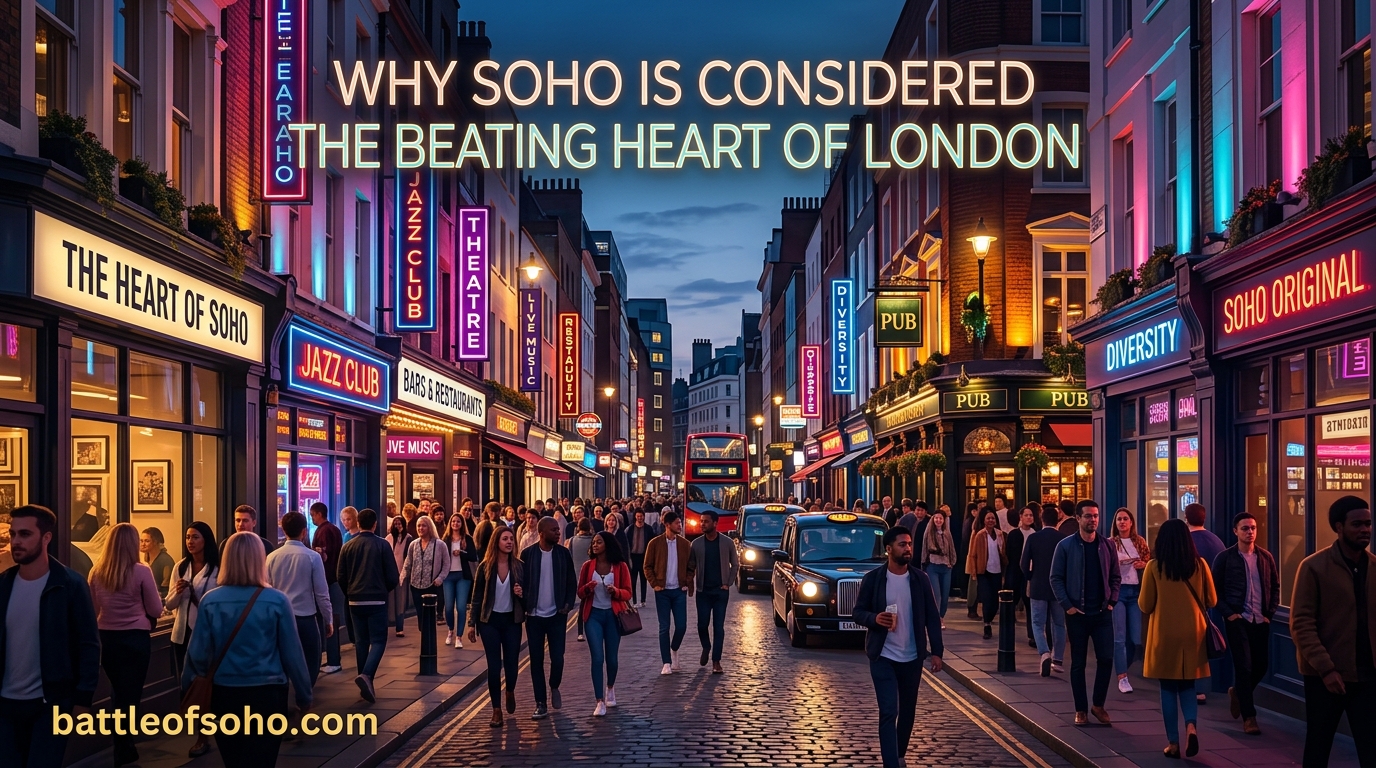
If you have ever wandered through central London and felt the city’s pulse quicken, chances are you were standing somewhere near Soho. This one-square-mile district, tucked into the heart of the West End, has been called the beating heart of London for generations, and for good reason.
Soho packs more energy, culture, and history into its narrow streets than neighbourhoods ten times its size. Theatre lights, late-night kitchens, independent record shops, cocktail bars, art-house cinemas, and a thriving LGBTQ+ scene all share the same postcodes. Walk through it once and you understand the phrase immediately.
So why is Soho considered the beating heart of London? The answer comes down to a rare combination of factors. Its central location, its density of venues, its centuries-old reputation for counterculture, and its ability to reinvent itself decade after decade make it unlike anywhere else in the capital.
In this guide, our team breaks down what makes Soho tick. We cover its history, its key streets, its nightlife, its food scene, its multicultural roots, and its role in London’s LGBTQ+ story. Whether you are a first-time visitor planning a trip or a lifelong Londoner wanting to understand your city better, this is your complete 2026 resource.
Table of Contents
What Makes Soho the Beating Heart of London Today
Soho is the beating heart of London because no other district compresses so much culture, entertainment, and sheer life into such a small footprint. It sits dead centre in the West End, bordered by Oxford Street to the north, Charing Cross Road to the east, Chinatown to the south, and Regent Street to the west. Everything London is famous for can be found within a fifteen-minute walk.
The phrase “beating heart” is not just marketing language. It describes a neighbourhood that genuinely functions as the city’s engine room of creativity and social life. Here are the key reasons Soho holds this title:
- Unrivalled density of venues: More theatres, restaurants, bars, clubs, and independent shops per square mile than anywhere else in London.
- 24/7 atmosphere: Soho rarely sleeps. Early-morning coffee shops, afternoon matinees, evening dinners, and 3 AM club nights all coexist.
- Creative and media hub: Major film agencies, production companies, advertising firms, and recording studios call Soho home.
- Counterculture heritage: Centuries of bohemian, artistic, and progressive tradition that still shape the area’s character.
- LGBTQ+ capital of the UK: Old Compton Street and the surrounding blocks form the country’s most prominent gay village.
- Central accessibility: Four Tube stations (Oxford Circus, Tottenham Court Road, Piccadilly Circus, Leicester Square) ring the district.
As one Reddit user put it when describing the area: “every street feels alive.” That quality is hard to manufacture and impossible to fake. It is what separates Soho from every other central London neighbourhood.
The Origin of the Name Soho
Before it was a nightlife destination, “Soho” was a hunting cry. The name dates back to the 16th century, when the land that now makes up the district was open farmland and royal hunting grounds.
Hunters would shout “so-hoe!” as a rallying call to drive game out of the brush. The cry stuck, and by the time the area began to develop into a recognisable neighbourhood in the late 1500s and early 1600s, the name had already taken hold.
This origin story matters because it hints at how dramatically Soho has transformed. A piece of rural hunting land became, over four centuries, the densest entertainment district in Britain. Few places in the world can claim such a dramatic arc.
The name “Soho” has since been borrowed by districts in cities around the world, most notably SoHo in New York and Soho in Hong Kong. But the original London Soho remains the blueprint.
A Brief History of Soho – From Royal Park to Cultural Hub
Soho’s journey from royal hunting ground to cultural epicentre spans roughly four centuries. Understanding this history helps explain why the area developed the character it has today.
The Early Years: Farmland and Aristocracy
Through the Middle Ages, the land that would become Soho was part of farmland attached to the parish of St Giles. Henry VIII seized it during the dissolution of the monasteries, and it was later used as a royal park for hunting.
In the 1670s, the area began to take shape as a residential district. Wealthy aristocrats built grand homes around Soho Square (laid out in 1681) and Golden Square. For a brief period, Soho was one of the most fashionable addresses in London.
The Great Fire and the Shift in Character
The Great Fire of London in 1666 did not directly destroy Soho, but it reshaped the entire city. As people moved westward away from the devastated old City, Soho’s population grew rapidly. The wealthy gradually drifted further west to Mayfair and St James’s, and Soho began to attract a different crowd.
By the 18th and 19th centuries, the area had become home to waves of immigrants and artists. French Huguenots fleeing persecution arrived in large numbers, followed by Italian and Greek communities. This multicultural influx laid the foundation for the diverse, cosmopolitan character Soho still carries.
The Entertainment Era Begins
Theatres, music halls, and pubs multiplied through the Victorian era. Soho’s reputation as an entertainment district solidified. By the 20th century, it was the centre of London’s bohemian scene, home to writers, jazz musicians, gangsters, and anyone who preferred the margins of respectability.
The 1960s cemented Soho’s cool factor. Carnaby Street became a global fashion phenomenon, swinging London found its centre here, and the area’s counterculture credentials were set in stone.
Soho’s Multicultural Heritage
Soho’s diversity is not a recent development. It is baked into the district’s DNA and dates back centuries. Understanding this heritage is essential to understanding why the area feels so layered and rich today.
The French Huguenot community was among the first major immigrant groups to settle in Soho. Fleeing religious persecution in France, they arrived in the late 17th century and established themselves as silk weavers, watchmakers, and skilled tradespeople. Their influence is still visible in the area’s architecture and street names.
The Italian community followed, particularly in the 19th century. The streets around Frith Street and Old Compton Street became known as “Little Italy.” Italian delis, cafes, and restaurants opened, many of which became institutions in their own right.
Greek immigrants also established a presence, adding another layer to the cultural mix. By the mid-20th century, Soho was one of the most cosmopolitan corners of London, a place where you could hear a dozen languages in a single block.
This multicultural foundation is directly responsible for the food scene Soho is famous for today. The Italian delis, French patisseries, Chinese restaurants spilling over from neighbouring Chinatown, and Japanese noodle bars all trace their roots back to waves of immigration that made Soho home.
The Key Streets That Define Soho
Part of what makes Soho the beating heart of London is that each of its streets has its own distinct personality. You can cross from one block to the next and feel like you have entered a different world. Here are the streets that define the district’s character.
Carnaby Street: The fashion artery of Soho. Famous worldwide since the 1960s for boutique clothing and mod style, Carnaby Street remains a pedestrianised shopping destination. It draws tourists and locals alike with its mix of heritage brands and indie labels.
Old Compton Street: The centre of Soho’s LGBTQ+ scene and the beating heart within the beating heart. Packed with gay bars, cafes, and restaurants, it is one of the most visible and celebrated queer spaces in Europe.
Wardour Street: Once the spine of London’s film industry, Wardour Street is still home to production companies and media offices. It has a slightly more business-oriented energy during the day and a lively bar scene at night.
Frith Street: The culinary anchor of Soho. Frith Street is lined with some of the best restaurants and cafes in the district, ranging from long-standing Italian institutions to acclaimed contemporary kitchens.
Brewer Street: A mix of old Soho and new. Brewer Street has traditional businesses, late-night venues, and a grittier character that hints at the area’s past as a red light district.
Shaftesbury Avenue: The southern boundary of Soho and the main artery of London’s theatre district. Walking along Shaftesbury Avenue places you at the doorstep of some of the most famous West End stages in the world.
Charing Cross Road: The eastern edge of Soho, famous for its bookshops. It connects Soho to the broader West End and remains a magnet for readers and collectors.
Each of these streets contributes something irreplaceable. Together, they create the layered, multifaceted experience that defines Soho.
Soho’s Nightlife and Entertainment Legacy
When people call Soho the beating heart of London, they are often thinking of its nightlife. No other district in the city offers the same concentration and variety of after-dark entertainment.
Soho’s nightlife scene runs the full spectrum. You can start the evening at a traditional pub with centuries of history, move to a cocktail bar where the drinks are treated as an art form, catch live jazz in a basement venue that has hosted legends, and end the night at a club that stays open until dawn.
The area has been a nightlife capital since the Victorian era. Music halls, dance halls, and pubs drew crowds long before the term “nightlife” existed. The jazz clubs of the 1950s put Soho on the map musically, hosting performers who helped define British popular music.
Today, the legacy continues. Comedy clubs, late-night bars, members’ clubs, and music venues are packed into every corner of the district. The Curzon cinema on Shaftesbury Avenue has been screening films since 1934 and remains one of the premier art-house cinemas in the country.
What sets Soho apart is the energy. On a Friday or Saturday night, the streets themselves feel like part of the entertainment. Crowds spill out of venues, music drifts from open doors, and the atmosphere is electric in a way that is genuinely hard to replicate.
The Food and Dining Scene
If nightlife is Soho’s heartbeat after dark, food is its daytime pulse. The dining scene here is one of the best and most diverse in London, spanning everything from cheap eats to Michelin-starred experiences.
The range is staggering. On a single walk through Soho, you can grab a quick bowl of ramen at a Japanese noodle bar, pick up cured meats from an Italian deli that has been trading for decades, eat a proper French meal at a bistro that would not be out of place in Paris, or splurge at a restaurant with a Michelin star.
Soho’s food scene benefits from its history of immigration. The Italian, French, Chinese, and Greek communities that settled here brought their cuisines with them, and many of those original establishments still operate today, alongside a new generation of chefs pushing boundaries.
For visitors, the best approach is to explore on foot and follow your nose. Hidden kitchens, basement restaurants, and easy-to-miss cafes reward curious eaters. As one forum user noted, the quality of dining in Soho spans “from cheap authentic to Michelin-starred,” often within a few steps of each other.
People-watching is half the appeal. Many Soho restaurants offer al fresco seating, turning mealtime into a free show as the city’s characters stream past. Frith Street, Old Compton Street, and Dean Street are prime spots for this uniquely Soho experience.
Soho’s Role in London’s LGBTQ+ History
Any discussion of why Soho is considered the beating heart of London must acknowledge its central role in the city’s LGBTQ+ history. The district is home to the UK’s most prominent gay village, centred on Old Compton Street, and has been a refuge and rallying point for queer London for decades.
The LGBTQ+ community’s connection to Soho grew significantly in the second half of the 20th century. As gay bars and clubs opened and established themselves, the area became known as a place where queer people could gather openly at a time when much of society was hostile.
Old Compton Street became the visible centre of this community. Its bars, cafes, and shops created a sense of safety and belonging that was rare in Britain. The street and the surrounding blocks remain the symbolic heart of LGBTQ+ London today.
Soho’s importance to the queer community goes beyond nightlife. It has been the site of protests, memorials, and celebrations. The area’s history as a counterculture hub made it a natural fit for a community that has always existed at the margins of mainstream society.
Forum users consistently emphasise the LGBTQ+ scene as central to Soho’s identity. The community’s trust in Soho as a safe and welcoming space is one of the district’s most important assets and a key reason it remains the cultural heart of London.
Soho in Literature, Film, and Music
One area almost no competitor covers in depth is Soho’s deep connection to literature, film, and music. This is a significant gap, because Soho has been a muse for British artists for centuries.
In literature, Soho has appeared in works by Charles Dickens, who knew its streets well and used them as settings and atmosphere. Later writers, from Virginia Woolf to contemporary novelists, have continued to draw on Soho’s mix of glamour and grit as a backdrop for stories about London life.
In music, Soho was the centre of the British jazz scene in the 1950s. Clubs on and around Wardour Street and Dean Street hosted performances that helped shape the direction of popular music in Britain. The area’s recording studios and music shops made it a pilgrimage site for musicians throughout the 1960s and beyond.
In film, Soho has been both a setting and an industry hub. The district’s connection to cinema goes back to the early 20th century. Production companies, post-production houses, and screening rooms are still concentrated here, making Soho one of the few places in London where the film industry is genuinely visible on the street.
The Curzon Soho, one of the most respected art-house cinemas in the UK, exemplifies this connection. It has been a fixture of the area since the 1930s and remains a gathering place for cinephiles and filmmakers alike.
This creative legacy is part of what gives Soho its edge. It is not just a place to eat and drink. It is a place where art has been made, debated, and celebrated for generations.
Soho’s Hidden Squares and Courtyards
One of the great pleasures of exploring Soho is discovering its hidden squares and courtyards. These small green spaces and tucked-away pockets offer a counterpoint to the district’s relentless energy.
Soho Square is the most famous. Laid out in 1681, it was once surrounded by the grand homes of aristocrats. Today, it is a public garden where workers eat lunch on benches, students read in the grass, and visitors take a moment of quiet in the middle of the city’s busiest district.
Golden Square, slightly to the southwest, has a quieter, more residential feel. It dates to the same era as Soho Square and retains a sense of the neighbourhood’s 17th-century origins. The statue at its centre and the mature trees around its perimeter make it one of the most pleasant spots in the area.
Beyond the main squares, Soho is full of courtyards and alleyways that reward exploration. These hidden passages, many of which date back centuries, contain independent businesses, small galleries, and quiet corners that feel miles away from the crowds on Shaftesbury Avenue.
As one Reddit user noted, Soho Square serves as a “green space respite” in the middle of a district that can feel overwhelming in its intensity. Knowing where these pockets of calm are is part of learning to love Soho.
Gentrification and the Changing Face of Soho
No honest account of why Soho is considered the beating heart of London can ignore the changes the district is undergoing. Gentrification is reshaping Soho, and the community is actively debating what that means for its future.
The concerns are real and well-documented in forum discussions. Long-time residents and venue owners worry that rising rents and commercial pressures are pushing out the independent businesses and counterculture venues that gave Soho its edge. Chain stores and corporate-owned venues are replacing family-run establishments in some parts of the district.
Safety is another topic of discussion. While Soho is generally safe for visitors, certain streets, including parts of Bateman Street, Greek Street, and Old Compton Street, can feel sketchy between midnight and 3 AM. Local blogs like MySohoTimes offer practical safety advice for nights out, and these concerns are taken seriously by the community.
There is also tension between the residential community and the nightlife economy. People who live in Soho deal with noise, crowds, and disruption that come with being in a 24/7 entertainment district. Westminster Council has at times imposed restrictions on nightlife venues, leading to frustration from owners and patrons.
Despite these challenges, Soho’s core identity remains intact. The district continues to attract creative businesses, diverse communities, and visitors from around the world. The question for 2026 and beyond is whether that identity can survive the pressures working against it.
What gives hope is Soho’s track record. This is a neighbourhood that has reinvented itself repeatedly over four centuries. It has weathered plagues, fires, economic collapses, and cultural shifts. The beating heart of London has proven remarkably resilient.
How to Explore Soho – A Walking Guide
The best way to understand why Soho is considered the beating heart of London is to walk it. The district is compact, roughly one square mile, and every street offers something worth seeing.
Here is a walking route our team recommends for first-time visitors:
Step 1: Start at Oxford Circus. Head south down Regent Street and turn into Carnaby Street. Take in the pedestrianised shopping area and the side alleys that branch off it. This gives you a taste of Soho’s fashion heritage.
Step 2: Cut through to Soho Square. From Carnaby Street, walk east to Soho Square. Spend a few minutes in the garden. Notice the contrast between the calm of the square and the energy of the surrounding streets.
Step 3: Head down Frith Street. Walk south from Soho Square along Frith Street. This is your introduction to Soho’s food scene. Note the restaurants, cafes, and bars that line both sides of the street.
Step 4: Turn onto Old Compton Street. This is the heart of Soho’s LGBTQ+ scene. Walk the full length of the street and take in the atmosphere. The energy here, especially in the evening, is unlike anywhere else in London.
Step 5: Explore Wardour Street. Head north up Wardour Street to see the film and media industry presence. Note the production offices, post-production houses, and independent businesses along the way.
Step 6: End at Shaftesbury Avenue. Finish your walk on Shaftesbury Avenue, the southern boundary of Soho and the spine of the theatre district. If time allows, catch a West End show to cap off the experience.
The best time to walk Soho depends on what you want. Daytime offers a clearer view of the streets, shops, and architecture. Evening reveals the nightlife energy that defines the district. Weekday mornings are the quietest; Friday and Saturday nights are the most intense.
FAQs
Is Soho the heart of London?
Yes, Soho is widely considered the heart of London due to its central West End location, its unmatched density of theatres, restaurants, bars, and clubs, its centuries-old creative and counterculture heritage, and its role as the centre of the city’s LGBTQ+ community. No other single square mile in London contains so much of what defines the city’s character.
What is special about Soho, London?
Soho is special because it compresses an extraordinary range of culture into a tiny area. It is home to the UK’s most prominent gay village, some of London’s best restaurants, historic theatres, independent shops, art-house cinemas, and a creative and media industry hub. Its multicultural heritage, dating back to Huguenot, Italian, and Greek immigration, gives it a layered character found nowhere else in the city.
Is Soho in London still a red light district?
Soho’s days as a prominent red light district are largely in the past. While traces of that history remain on certain streets, decades of redevelopment, changing social attitudes, and commercial shifts have transformed the area. Today Soho is better known for its dining, nightlife, theatre, and LGBTQ+ scene than for its former red light reputation.
Why is Soho House not cool anymore?
This question refers to Soho House, the private members’ club, rather than the Soho district itself. Some feel Soho House has lost its edge as it has expanded globally and become more corporate. However, the Soho neighbourhood itself remains as culturally relevant and energetic as ever, regardless of opinions about any single private club within it.
Why Soho Will Always Be the Beating Heart of London
After walking its streets, eating in its restaurants, and feeling its energy, the question of why Soho is considered the beating heart of London answers itself. This is a district that has spent four centuries becoming the most concentrated expression of everything London is.
Soho is where the city’s diversity, creativity, and appetite for life converge. It is where Huguenot refugees, Italian immigrants, jazz musicians, fashion designers, filmmakers, queer communities, and countless others have each left their mark. Every street carries the weight of that history while remaining fully alive in the present.
It is not perfect. Gentrification, rising costs, and the tension between nightlife and residential life are real challenges that the community grapples with. Some worry that Soho is losing the edge that made it special. But the district has faced existential threats before and reinvented itself every time.
What makes Soho endure is something that cannot be manufactured or franchised. It is the accumulated energy of centuries of human activity, compressed into one square mile, and refreshed every single night by the people who choose to be there. That energy is the heartbeat, and it shows no sign of stopping.
If London has a soul, you will find it in Soho. That is why it remains, in 2026 and for the foreseeable future, the beating heart of the city.