
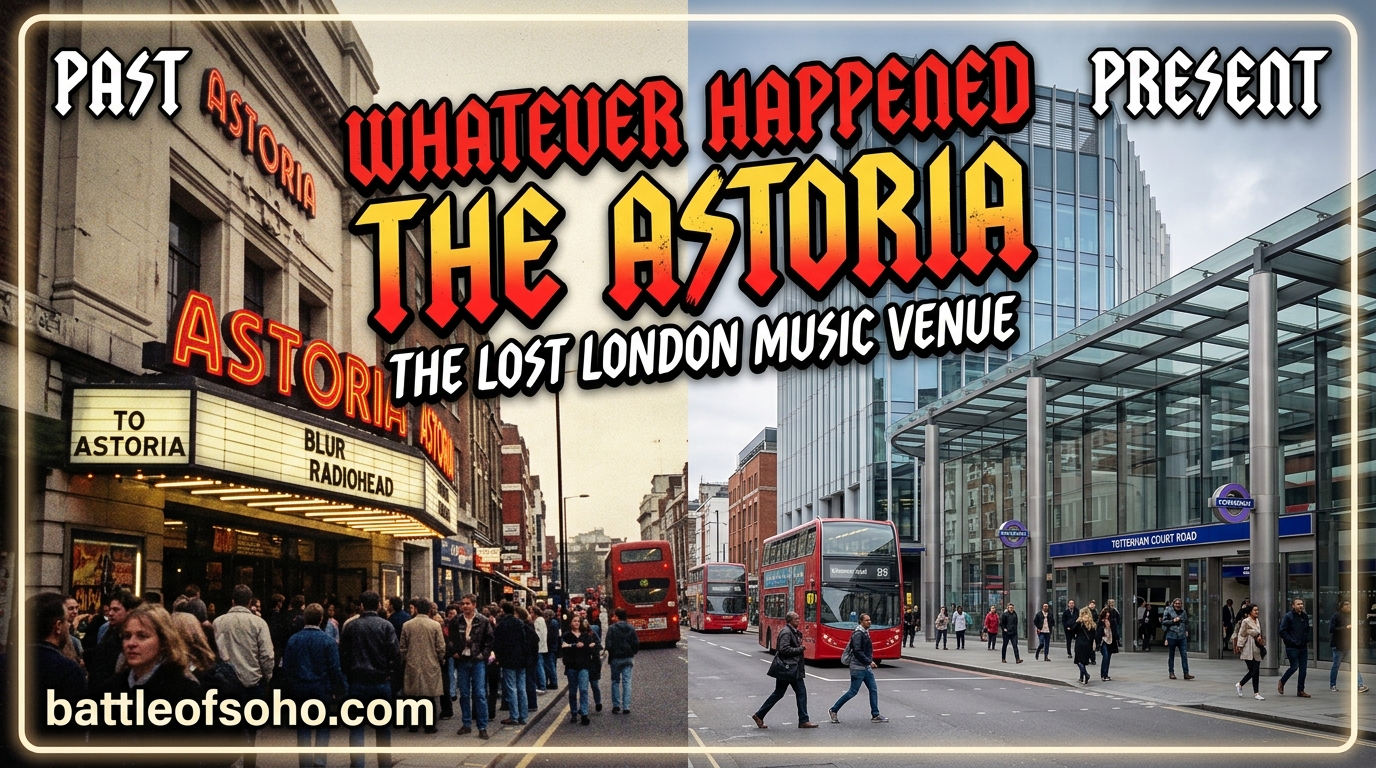
If you stood at the corner of Charing Cross Road and Oxford Street in the late 1990s, you could feel the bass before you saw the marquee. The London Astoria at 157 Charing Cross Road was not just a building. It was a living, breathing monument to three decades of British music history, a place where Nirvana played a secret show, where Radiohead debuted material from OK Computer, and where a generation of Londoners had their first taste of live music in a room that smelled of sweat, stale lager, and pure adrenaline.
Then, on 14 January 2009, the doors closed for the final time.
The Astoria was demolished to make way for the Crossrail project, the massive rail infrastructure scheme that would eventually become the Elizabeth line. A compulsory purchase order sealed the venue’s fate, and despite passionate campaigns to save it, the bulldozers moved in. Today, the site is occupied by @sohoplace, a new West End theatre operated by Nimax Theatres that opened in October 2022.
But for anyone who ever queued around the block on a rainy Soho night, clutching a ticket and buzzing with anticipation, the Astoria is anything but gone. It lives in the memories of millions of gig-goers, in the live albums recorded on its stage, and in the story of a venue that helped define an entire era of British music. Whatever happened to the Astoria, the lost London music venue, is a question that reveals something deeper about how cities change, what we choose to preserve, and what gets lost in the name of progress.
Table of Contents
Quick Answer: What Happened to the London Astoria?
The London Astoria was demolished in 2009 after the UK government issued a compulsory purchase order to clear the site for the Crossrail project (now the Elizabeth line). The venue at 157 Charing Cross Road had operated as a music venue and nightclub since the mid-1980s, hosting legendary performances by bands including Nirvana, Radiohead, Oasis, Blur, and The Rolling Stones. After its closure on 14 January 2009, the site remained a construction zone for over a decade. In October 2022, @sohoplace, a 600-seat theatre operated by Nimax Theatres, opened on the redeveloped site as part of the new Tottenham Court Road station complex.
The Early Years: From Pickle Factory to Cinema (1927-1970s)
The Astoria’s story begins not with music, but with pickles. The building at 157 Charing Cross Road was constructed on the site of a former Crosse & Blackwell warehouse, the company famous for its jams, sauces, and preserved goods that had been a Soho landmark since the nineteenth century. When Crosse & Blackwell relocated their operations, the site was redeveloped into one of London’s most ambitious entertainment venues.
The Astoria opened as a cinema in 1927, designed by the architect Edward A. Stone. Stone was part of a family of cinema architects who designed several Astoria-branded venues across London, including the Astoria cinemas in Brixton, Finsbury Park, and Streatham. The Charing Cross Road Astoria was the flagship of the chain, built with a grand Art Deco interior and a capacity that made it one of the largest cinema venues in the West End.
For decades, the Astoria functioned primarily as a picture house, screening films for Soho and West End audiences. But the building was always more versatile than a single-use cinema. In the 1930s and 1940s, it also hosted live stage shows and variety performances alongside its film programming. The building’s large stage, orchestra pit, and steep raked balcony meant it could adapt to almost any form of entertainment.
By the 1960s, cinema attendance was declining across Britain as television became the dominant entertainment medium. The Astoria, like many large cinemas of its era, began to struggle. The building was too large and too expensive to operate as a simple picture house. Something had to change.
In 1976, the Astoria was converted into a live theatre venue. This was the first major transformation that would set the stage for its eventual life as a music destination. The theatre conversion retained the building’s grand proportions but reconfigured the interior for stage productions. During this period, the venue hosted productions including the lavish musical “Elvis,” which ran in 1977-78 and gave the building a new lease of life.
A person who worked as an electrician at the venue during the “Elvis” production years later recalled the building’s backstage labyrinth: narrow, tunnel-like corridors that seemed to wind endlessly beneath the stage, dressing rooms tucked into unexpected corners, and a steep balcony that offered some of the best sightlines in London but required a head for heights. These physical quirks would become part of the Astoria’s legend when it transformed into a music venue later in the 1980s.
The theatre era lasted roughly a decade. By the mid-1980s, the building was acquired by new management who saw its potential as a live music venue. The conversion from theatre to concert hall was the change that would define the Astoria’s cultural legacy.
Whatever Happened to the Astoria: The Music Venue Era (1976-2009)
The Astoria’s transformation into a music venue began in earnest in the mid-1980s. The building’s configuration was ideal for live music: a large main floor, a steeply raked balcony, a big stage with excellent sightlines, and a capacity of approximately 1,600 people. This put it in a sweet spot that few London venues could match. It was bigger than the Marquee or the 100 Club, but smaller and more intimate than arenas like Hammersmith Odeon or Wembley Arena. For bands on the rise, playing the Astoria was a badge of honour that said you had arrived.
By the late 1980s, the Astoria had established itself as one of London’s premier live music destinations. The venue was operated for much of its music era by the Mean Fiddler organisation, founded by Vince Power, and later by Festival Republic (then part of the MAMA Group). These promoters brought a steady stream of major acts to the Charing Cross Road stage, programming everything from indie rock and Britpop to metal, punk, and electronic music.
The Astoria’s capacity of around 1,600 made it the perfect stepping-stone venue. Bands would play the Astoria when they were too big for club shows but not yet ready to fill arenas. Many of the most important British and international acts of the 1990s and 2000s played career-defining shows on that stage. The venue’s acoustics were not perfect, the bar was expensive, and the backstage area was cramped and confusing. None of that mattered. The room had an energy that turned every gig into an event.
The venue was also a nightlife destination in its own right. Long before and after the gig crowd went home, the Astoria hosted some of London’s most influential club nights.
The Trip: Acid House Comes to Soho
In the late 1980s, the Astoria became ground zero for London’s acid house explosion. “The Trip” was a weekly club night that ran at the Astoria and became one of the defining events of the UK’s dance music revolution. Launched in 1988, The Trip brought the sound of Chicago house and Detroit techno to a central London stage, and it did so with a flair for spectacle that few other venues could match.
The Trip was not just a club night. It was a cultural moment. At a time when acid house was still largely confined to warehouse parties and illegal raves in the countryside, The Trip offered a legal, central, high-production alternative. The Astoria’s large stage became a platform for DJs, the main floor became a dancefloor, and the balcony offered a vantage point for those who needed a breather from the relentless energy below.
The night attracted a mixed crowd of music journalists, fashion students, club kids, and curious newcomers who had heard about this new sound sweeping the nation. It helped establish the Astoria as not just a rock venue but a cultural space that could absorb and amplify any musical movement. No competitor writing about the Astoria has fully explored the significance of The Trip, but it was a defining chapter in the venue’s history and in London’s broader club culture.
G-A-Y: LGBTQ+ Nightlife at the Astoria
For much of the 1990s and 2000s, Saturday nights at the Astoria belonged to G-A-Y, one of London’s most popular LGBTQ+ club nights. Founded and hosted by promoter Jeremy Joseph, G-A-Y turned the Astoria into a fixture of Soho’s queer nightlife scene. The night was famous for its high-energy pop performances, with artists ranging from Kylie Minogue to Madonna making appearances.
G-A-Y was more than a club night. It was an institution that gave the Astoria a second identity on non-gig nights and connected the venue to Soho’s broader LGBTQ+ community. When the Astoria closed, G-A-Y relocated to Heaven, another iconic London venue, but the loss of the Charing Cross Road space was felt deeply by the community that had called it home for over a decade.
Astoria 2 (LA2): The Sister Venue
Many people who attended the Astoria do not realise there was a second venue within the building. Astoria 2, also known as LA2, was a smaller room located within the same complex, with a capacity of around 500. It operated as a distinct venue, hosting smaller gigs, club nights, and late-night events that ran alongside the main room’s programming.
Astoria 2 was where you would see bands before they were big enough for the main stage. It hosted early performances by acts that would go on to headline the main Astoria room, and it served as an after-hours club space when the main venue had finished for the night. The closure of the building in 2009 meant the loss of both venues simultaneously, a double blow to London’s live music infrastructure.
What Famous Bands Played at the Astoria?
Asking what famous bands played at the Astoria is like asking what famous paintings hang in the Louvre. The list is extraordinary, spanning multiple decades and genres. The venue hosted performances by:
- Nirvana – Played a now-legendary show at the Astoria in 1991, just as “Nevermind” was about to make them the biggest band in the world. The gig has become one of the most talked-about performances in the venue’s history.
- Radiohead – Performed at the Astoria multiple times, including early shows that previewed material from “The Bends” and “OK Computer.” A live video recording from their 1994 Astoria show remains a fan favourite.
- Oasis – Played the venue during their rapid ascent in 1994, before “Definitely Maybe” turned them into stadium-fillers.
- Blur – Performed at the Astoria during the Britpop era, part of the vibrant mid-1990s scene that the venue helped sustain.
- The Rolling Stones – Played a surprise warm-up show at the Astoria, demonstrating the venue’s ability to attract the biggest names in music alongside emerging acts.
- David Bowie – Made appearances at the venue that cemented its reputation as a space where legends and newcomers shared the same stage.
- Prince – The enigmatic superstar played intimate Astoria shows that are still discussed years later.
- Madonna – Performed at the venue, adding to its roster of international superstars who chose the intimate room over arenas.
- The Darkness – Famously sold out multiple consecutive nights at the Astoria before they had even signed to a major label, a testament to the venue’s role as a launchpad for British rock acts.
- Manic Street Preachers – Played one of the most culturally significant gigs in the venue’s history on 21 December 1994, which turned out to be the final performance of guitarist Richey Edwards before his disappearance the following February.
- Nine Inch Nails – Played two consecutive nights on The Downward Spiral tour, a memory that still surfaces in fan discussions about the venue’s greatest shows.
- Green Day – Performed at the Astoria during their rise through the 1990s punk revival, a gig still remembered by fans who were there.
These are just the headline acts. The Astoria hosted thousands of gigs over its two-plus decades as a music venue. On any given week, the marquee outside 157 Charing Cross Road might advertise an indie band on Tuesday, a metal night on Wednesday, a DJ set on Thursday, a pop star on Friday, and G-A-Y on Saturday. The venue was a chameleon that adapted to whatever London’s music scene demanded.
Live Albums Recorded at the Astoria
The Astoria was not just a place to see bands. It was a place where music was captured. Several notable live recordings were made at the venue, preserving its unique atmosphere for posterity.
Radiohead’s performance at the Astoria in 1994 was filmed and released as “Live at the Astoria,” a concert video that remains one of the most sought-after documents of the band’s early years. The recording captures the band at a pivotal moment, performing tracks from “Pablo Honey” and debuting material that would appear on “The Bends.” For Radiohead fans, the Astoria recording is essential viewing.
The venue also hosted recordings by numerous other acts across its history. Its natural acoustics, shaped by the building’s origins as a cinema with a large auditorium and steep raked seating, gave live recordings a distinctive sound. The room was large enough to create a sense of scale and atmosphere, but intimate enough to capture the energy of the crowd in a way that arena recordings often cannot.
Wikipedia maintains an extensive list of over 40 live recordings made at the Astoria, a testament to how many bands chose to document their performances at the venue. From punk and indie to electronic and pop, the Astoria’s recorded legacy spans the full spectrum of British and international music from the late 1980s through to 2009.
Why Did the London Astoria Close?
The London Astoria closed because of the Crossrail project. The venue was compulsorily purchased by the UK government to make way for the construction of the new Tottenham Court Road station, which would serve the east-west rail line eventually known as the Elizabeth line.
Crossrail was one of the largest infrastructure projects in European history, a 73-mile railway line running through central London. The route required a major new station at Tottenham Court Road, and the Astoria building sat directly in the path of the planned construction. The government determined that the venue had to be demolished to make way for the station box and associated development.
The decision was not made overnight. The threat of closure had loomed over the Astoria for years before the final order was issued. Transport for London and the Crossrail team had identified the site as necessary for the project as early as the planning stages in the early 2000s. Venue operators, musicians, and fans campaigned vigorously to save the building, arguing that a city of London’s cultural stature should not sacrifice one of its most important music venues for a railway station.
Ken Livingstone, then Mayor of London, confirmed the demolition in March 2008, stating that the construction of Crossrail meant the Astoria could not be saved. His office argued that the transport benefits of Crossrail outweighed the cultural loss, and that the redevelopment of the site would eventually include replacement cultural facilities. The @sohoplace theatre that eventually opened on the site in 2022 was, in part, a fulfilment of that promise, though many in the music community felt it was a poor substitute for what was lost.
The compulsory purchase order was the legal mechanism that sealed the Astoria’s fate. A compulsory purchase order allows government bodies to acquire land and property without the owner’s consent, provided it serves a public benefit. In this case, the public benefit was defined as improved transport infrastructure for millions of London commuters. The order was difficult to challenge, and despite legal efforts and public campaigns, the venue’s demolition proceeded.
The closure prompted a broader conversation about London’s treatment of its cultural venues. The Astoria was not the first music venue lost to development, and it would not be the last. But its prominence, its central location, and the sheer number of people who had a personal connection to the venue made its loss feel like a watershed moment.
The Demolition Ball: The Final Night (14 January 2009)
On 14 January 2009, the Astoria hosted its final night of entertainment. The event was called “The Demolition Ball,” a name that made no attempt to disguise what was coming. It was a farewell party, a wake, and a protest all rolled into one.
The lineup for the final night was curated to reflect the venue’s broad musical legacy rather than focusing on any single genre. Acts included Get Cape Wear Cape Fly (the project of musician Sam Duckworth), who had strong ties to the venue, alongside other performers representing the different musical communities that had called the Astoria home. Billy Bragg, a longtime champion of grassroots music venues, was associated with the broader campaign to save the Astoria and its spirit.
By all accounts, the atmosphere inside the venue that final night was bittersweet. People who had been attending gigs at the Astoria for decades returned for one last visit. The narrow backstage corridors that had confused so many touring bands over the years felt different when you knew you would never walk them again. The steep balcony, which had given generations of gig-goers vertigo and perfect sightlines simultaneously, offered a last panoramic view of a room that was about to disappear.
Many attendees later expressed disappointment that the final night did not feel like a fitting send-off for a venue of the Astoria’s stature. Some felt the lineup could have been more ambitious, that the music industry itself should have done more to mark the passing of one of its most important stages. A Reddit user later captured the prevailing sentiment: “So many great memories in this place. Too many legendary London venues have been demolished or converted to soulless empty husks.”
After the final night, the venue was cleared and prepared for demolition. Photographs from October 2008 and early 2009 show the building wrapped in scaffolding, the iconic Astoria signage removed, and the interior stripped back to its structural bones. By the middle of 2009, the building that had stood at 157 Charing Cross Road for over 80 years was gone.
The Battle to Save the Astoria
The campaign to save the Astoria was passionate but ultimately unsuccessful. Music fans, venue operators, and cultural commentators argued that London was sacrificing too much of its musical heritage in the name of development. The venue was not just a building, they argued, but an ecosystem that supported emerging artists, provided a mid-sized stage for growing bands, and served as a cultural anchor for Soho and the wider West End.
Online communities, including the influential music site Drowned in Sound, became hubs for the campaign to save the venue. Fans shared gig memories, wrote to their MPs, and organised petitions. The broader music industry lent its support, with artists who had played the venue speaking about its importance to their careers.
The campaign ultimately failed because the legal and political machinery behind Crossrail was too powerful to challenge. The compulsory purchase order was upheld, and the demolition proceeded on schedule. But the campaign left a legacy. It raised awareness about the broader crisis facing London’s grassroots music venues and helped galvanise future efforts to protect the city’s cultural infrastructure.
What Replaced the Astoria? The Site Today
The Astoria site today is occupied by @sohoplace, a 600-seat theatre that opened in October 2022 as part of the redeveloped Tottenham Court Road station complex. Operated by Nimax Theatres, @sohoplace is the first new-build West End theatre in 50 years. It sits above the new Crossrail station, directly on the site where the Astoria once stood.
@sohoplace was designed as a flexible, in-the-round performance space, with no fixed stage and seating arranged around all sides of the auditorium. The venue programmes a mix of plays, musicals, and experimental theatre. It is a well-designed and welcome addition to London’s theatre scene, and its arrival was celebrated by the West End community.
But for music fans, @sohoplace is not a replacement for what was lost. The Astoria was a 1,600-capacity music venue that hosted rock concerts, club nights, and the kind of loud, sweaty, transformative live music experiences that a 600-seat theatre cannot replicate. The two venues serve entirely different purposes, and the loss of the Astoria created a gap in London’s live music infrastructure that has never been fully filled.
The broader area around the site has been transformed by the Crossrail development. Tottenham Court Road station is now a major interchange serving both the Elizabeth line and the Central and Northern underground lines. The surrounding streets have been redeveloped with new retail, office, and public spaces. The Soho that surrounded the Astoria has changed, and the venue’s absence is a visible reminder of the cultural cost of that transformation.
Other Lost London Music Venues
The Astoria was not the only iconic London music venue to be lost to redevelopment, financial pressures, or changing tastes. Its closure is part of a broader pattern that has seen many of the city’s most beloved live music spaces disappear over the past few decades.
The Marquee Club, once located on Wardour Street in Soho, was arguably the most famous music venue in 1960s London. It hosted early performances by The Rolling Stones, The Who, David Bowie, and Jimi Hendrix before closing and relocating multiple times, eventually disappearing entirely. The original Marquee building is now a restaurant.
The Hammersmith Palais, immortalised in the song by The Clash, closed in 2007 after decades as a dance hall and live music venue. The building was demolished and replaced with a student accommodation block. The Astoria Brixton, a separate venue that shared the Astoria name but was located in south London, was later rebranded as the Brixton Academy (now simply called O2 Academy Brixton) and continues to operate today, though it has faced its own challenges in recent years.
The Kentish Town Forum, the Koko in Camden, and other venues have survived and adapted, but the overall trajectory has been one of loss. London’s grassroots music venues have been closing at an alarming rate, with rising rents, noise complaints from residential developments, and changing licensing conditions all contributing to the pressure. The Astoria’s demolition for Crossrail remains the highest-profile example of this trend.
The Legacy of the Astoria
More than 15 years after its demolition, the Astoria’s legacy endures. It is remembered not just as a building but as a cultural institution that shaped the careers of countless musicians and the memories of millions of fans. The venue played a role in launching British rock bands that went on to international success, and it provided a stage for international superstars who wanted to play an intimate room in the heart of London.
The Astoria’s closure also marked a turning point in how London thinks about its cultural infrastructure. The grassroots music venue crisis that the Astoria symbolised has only intensified in the years since. Rising costs, including increases in National Insurance and business rates, have pushed many venues to the brink. The average profit margin for a grassroots music venue in the UK is around 2.5 percent, a figure that leaves almost no room for error.
But there is reason for cautious optimism. The loss of the Astoria served as a wake-up call. Organisations like the Music Venue Trust, founded in 2014, have campaigned vigorously to protect remaining grassroots venues and have secured important policy changes. New venues have opened. Communities have mobilised. The conversation about the value of live music spaces has shifted.
Whatever happened to the Astoria, the lost London music venue, is ultimately a story about what cities choose to value. The Astoria was demolished for a railway station that serves millions of people every year. The transport benefits are real. But so is the loss. The venue that hosted Nirvana, Radiohead, Oasis, and thousands of other acts is gone, and no amount of infrastructure can replace the cultural memory of what it felt like to stand on that floor, watching a band tear through a set on the stage at 157 Charing Cross Road.
The Astoria is gone. But the music, the memories, and the lessons learned from its loss continue to shape London’s cultural landscape. That may be the most fitting monument of all.
FAQs
Why did the London Astoria close?
The London Astoria closed in January 2009 because the site was compulsorily purchased for the Crossrail project, now known as the Elizabeth line. The venue at 157 Charing Cross Road sat directly in the path of the planned Tottenham Court Road station expansion, and the UK government determined the building had to be demolished to make way for the rail infrastructure.
What famous bands played at the Astoria?
The Astoria hosted legendary performances by Nirvana in 1991, Radiohead (including their filmed 1994 show), Oasis during their 1994 ascent, Blur, The Rolling Stones, David Bowie, Prince, Madonna, The Darkness, Manic Street Preachers (Richey Edwards’ final gig in December 1994), Nine Inch Nails, and Green Day, among thousands of other acts across more than two decades.
What is the London Astoria now?
The Astoria site is now occupied by @sohoplace, a 600-seat theatre operated by Nimax Theatres that opened in October 2022. The venue sits above the new Tottenham Court Road Crossrail station on the exact site where the Astoria once stood.
Was the Astoria a cinema before a music venue?
Yes. The Astoria opened as a cinema in 1927, built on the site of a former Crosse & Blackwell warehouse and designed by architect Edward A. Stone. It operated as a picture house for decades before being converted into a live theatre venue in 1976 and eventually becoming a music venue in the mid-1980s.
How many people could the Astoria hold?
The London Astoria had a capacity of approximately 1,600 people across its main floor and steep raked balcony. The smaller sister venue, Astoria 2 (LA2), which was located within the same building, had a capacity of around 500.