
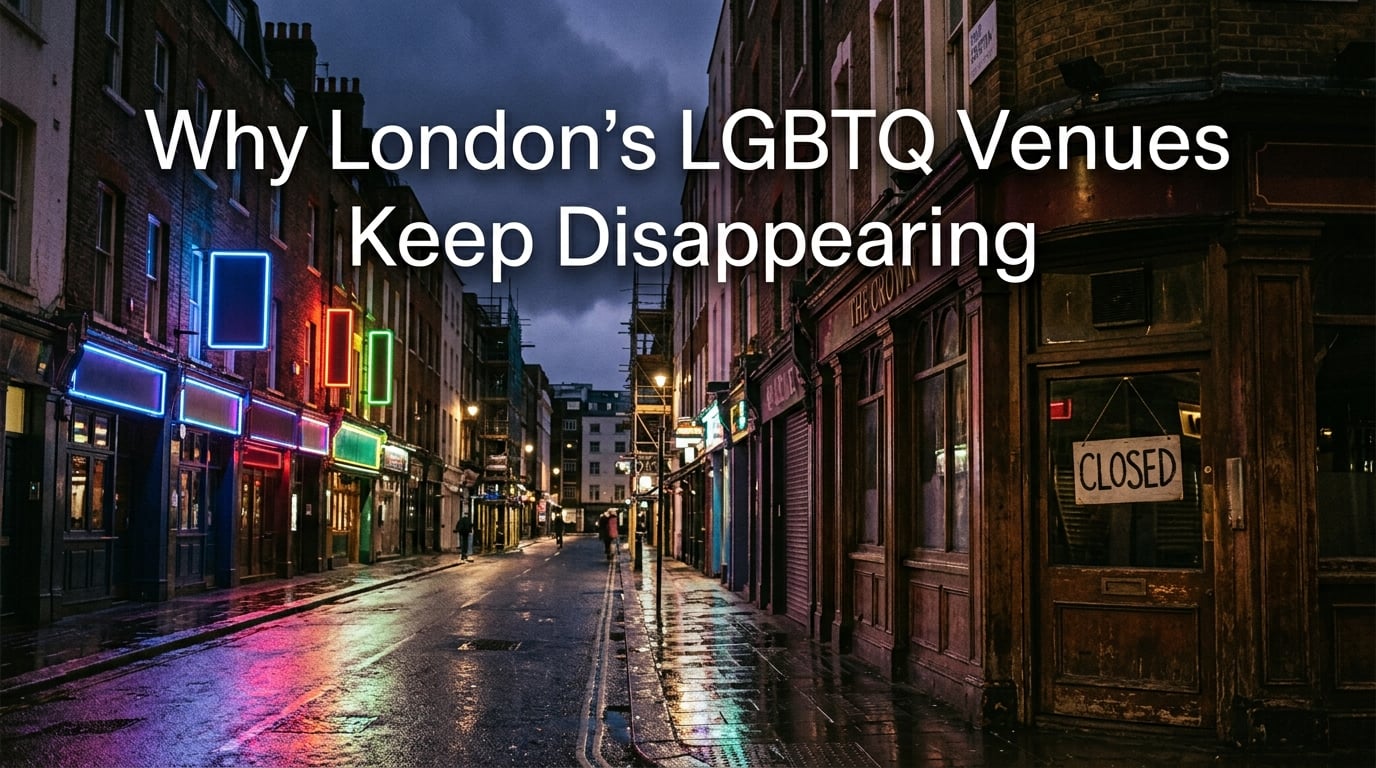
London has lost 60% of its LGBTQ+ venues since 2006. That is not a typo or a gradual drift. The number of queer spaces in the capital fell from 125 to roughly 50 in under two decades, according to data published by the Greater London Authority in 2024. When we talk about why London’s LGBTQ venues keep disappearing, we are talking about one of the most significant cultural shifts in the city’s modern history.
Here at Battle of Soho, we have watched this story unfold from the front row. Soho has been the beating heart of London’s queer nightlife for generations. Old Compton Street was once lined with bars, clubs, and cafes that served as gathering points for a community that had nowhere else to go. Many of those venues are now gone, and the ones that remain are fighting for survival.
This article breaks down the full picture. We will walk through the statistics, trace the history of queer venues in London from the molly houses of the 1700s to the present day, examine each major cause of closures, and look at what communities are doing to fight back. We will also share practical steps for how you can help keep surviving venues alive.
Table of Contents
The Short Answer: Why London’s LGBTQ Venues Keep Disappearing
London’s LGBTQ+ venues are disappearing due to five compounding pressures that have intensified over the past two decades. Here is the quick summary before we dig into the detail:
- Gentrification and skyrocketing rents: Property developers buy buildings in Soho, Vauxhall, and Shoreditch, pushing rents far beyond what independent venues can afford.
- Social assimilation: As mainstream society becomes more accepting, some LGBTQ+ people feel comfortable in straight bars, reducing footfall at dedicated queer spaces.
- Dating apps and online communities: Grindr, Tinder, and other apps replaced in-person socialising for many people, especially for meeting partners.
- Cost of living and changing habits: Rising prices, post-COVID hospitality struggles, and a generation drinking less have all hit venue revenue.
- Planning and licensing pressures: Infrastructure projects like Crossrail demolished historic venues, and business rates have climbed relentlessly.
These forces do not operate in isolation. They compound each other, and they hit LGBTQ+ venues harder than mainstream pubs because there are fewer of them to begin with. When one queer venue closes, the entire community feels the loss.
The Scale of the Problem: London LGBTQ+ Venue Closures by the Numbers
The data tells a stark story. The most comprehensive research comes from UCL Urban Laboratory, which tracked LGBTQ+ venues in London from 2006 onwards. Their findings, updated and confirmed by the Greater London Authority, show a decline that has not slowed.
In 2006, London had approximately 125 LGBTQ+ venues. By 2017, that number had fallen to 53, representing a 58% loss. By 2022, the GLA’s updated figures showed the count had dropped further to around 50 venues, pushing the total decline to 60%. The BBC reported these figures in February 2024, confirming that the trend had not reversed despite years of community campaigning and political promises.
The losses have not been evenly distributed across venue types. UCL’s research broke down the decline by category, and the numbers reveal which types of spaces are most vulnerable:
- Bars: 44% of LGBTQ+ bars closed between 2006 and 2017
- Nightclubs: 34% of queer nightclubs shut their doors
- Pubs: 33% of LGBTQ+ pubs were lost
- Performance venues: 26% of cabaret and performance spaces disappeared
- Cafes: Only 4% remained, making cafes the most devastated category
The geographic pattern is equally revealing. Soho, long the symbolic centre of London’s gay scene, has seen its venue density thin dramatically. Old Compton Street still has queer venues, but far fewer than a decade ago. Vauxhall’s legendary nightclub cluster has contracted. East London hubs like Dalston and Shoreditch have lost venues that once defined their alternative queer identity.
This is not just a London phenomenon. The trend mirrors a global crisis for LGBTQ+ spaces. A third of queer venues in the United States closed during roughly the same period. Canada has seen similar declines. But London’s losses are particularly acute because the city was once home to the most concentrated and historically significant queer nightlife scene in Europe.
The venues we have lost read like a roll call of London’s queer cultural heritage. The Joiners Arms in Tower Hamlets. The Black Cap in Camden. Candy Bar in Soho. First Out cafe near Tottenham Court Road. The George and Dragon in Shoreditch. G-A-Y Late on Old Compton Street. The Astoria, demolished for Crossrail. Each closure erased decades of community memory, activism, and belonging.
From Molly Houses to Old Compton Street: A Brief History of London’s Queer Venues
To understand why these losses matter so deeply, you need to know how long queer people have been carving out spaces in London. The story goes back further than most people realise.
In the early 1700s, Soho and the surrounding areas were home to “molly houses,” informal gathering places where men who loved men could meet, socialise, and exist outside the brutal norms of the era. These were the precursors to modern gay bars, operating in a time when homosexual acts were punishable by death. The most famous raid, at Mother Clap’s molly house in 1726, resulted in executions and remains a chilling reminder of how dangerous it was to gather as a queer person.
Fast forward to 1967, when the Sexual Offences Act partially decriminalised homosexuality in England and Wales. This was a watershed moment. For the first time, queer men could socialise with reduced (though far from eliminated) fear of prosecution. The 1970s and 1980s saw a boom in visible LGBTQ+ venues, particularly in Soho and Vauxhall.
Gay is the Word, Britain’s first dedicated LGBTQ+ bookshop, opened in 1979 on Marchmont Street in Bloomsbury. It became far more than a shop. It was a community hub, a meeting place, and a centre for activism. Lesbians and Gays Support the Miners (LGSM) used the bookshop as a staging ground for their legendary solidarity campaign with striking Welsh miners in 1984 and 1985, a story later immortalised in the film Pride.
The 1980s brought both celebration and crisis. Heaven, the massive Charing Cross nightclub, opened in 1979 and quickly became the largest gay club in Europe. G-A-Y launched as a club night before expanding into its iconic Old Compton Street bar. But the AIDS epidemic devastated the community, and Section 28 in 1988 silenced discussion of homosexuality in schools and public services. Venues became even more critical as spaces where queer people could find information, support, and solidarity when official institutions turned their backs.
The 1990s and 2000s were a golden era for London queer nightlife. Canal Street-style venues proliferated. Drag culture flourished. Vauxhall developed its hardcore clubbing identity. Soho was at its peak density of LGBTQ+ businesses. This is the world that began to unravel after 2006.
A landmark moment in preservation came in 2015, when the Royal Vauxhall Tavern became the first LGBTQ+ venue in the UK to receive Grade II heritage listing. This protected the building itself and recognised its cultural significance. The RVT has hosted queer performance since the 1940s, surviving everything from police raids to the AIDS crisis. Its listing was a hard-won victory by the RVT Future campaign and sent a message that queer heritage deserved formal protection.
Cause One: Gentrification and Skyrocketing Rents
If you ask any queer venue operator in London what is driving closures, the first word out of their mouth will almost certainly be “rent.” Gentrification is the single biggest factor in why London’s LGBTQ venues keep disappearing, and its mechanics are brutal in their simplicity.
London property prices have climbed relentlessly for two decades. Areas that once housed queer venues, Soho, Vauxhall, Shoreditch, Dalston, have become some of the most expensive postcodes in the world. Property developers buy buildings, raise rents, and push out tenants who cannot pay premium commercial rates. Independent queer venues, operating on thin margins, are among the first to go.
The Joiners Arms is a case study in how this works. The beloved Tower Hamlets pub was sold to property developer Regal Homes in 2014. Despite a fierce community campaign and its designation as an Asset of Community Value, the venue was lost. The building was slated for residential redevelopment. Campaigners fought for years to secure a replacement queer venue within the new development, a partial victory that came at enormous emotional and financial cost.
The Black Cap in Camden tells a similar story. This legendary cabaret venue, which had hosted drag performances since the 1960s, was closed by its owners in 2015 and put forward for redevelopment. The community mounted a determined campaign, securing Asset of Community Value status, but the venue has never fully reopened in its original form. The battle drained community resources and demonstrated how difficult it is to fight well-funded developers.
Infrastructure projects have compounded the damage. The construction of Crossrail, now the Elizabeth line, led to the demolition of several Soho venues. The Astoria, a legendary live music and club venue, was torn down to make way for the Tottenham Court Road station expansion. First Out, the iconic queer cafe on Tottenham Court Road, was another casualty of the development. These were not commercial failures. They were viable, loved venues removed by planning decisions.
Business rates add another layer of pressure. Commercial property taxes in London have risen sharply, and venues with prime locations face punishing bills. The British Beer and Pub Association has documented a broader decline in UK pub numbers, but LGBTQ+ venues face a compounded version of this crisis because they serve a specific community. When a straight pub closes, other pubs remain. When a queer venue closes, there may be nothing comparable for miles.
Asset of Community Value (ACV) status has been one of the main tools communities use to fight back. Under the Localism Act 2011, communities can nominate buildings of social value, triggering a moratorium that gives them time to raise funds and bid when the property is sold. But ACV status does not prevent sale or demolition. It only delays it. Communities have used the time to organise, crowdfund, and negotiate, but they have no guarantee of success. The Joiners Arms campaign showed both the power and the limits of this mechanism.
Cause Two: Assimilation and the Integration Paradox
The second major explanation for venue closures is more uncomfortable to discuss. As British society has become more accepting of LGBTQ+ people, some queer individuals feel less need for dedicated spaces. If you can hold your partner’s hand in a mainstream bar without fear, the argument goes, why seek out a gay bar?
This is the assimilation thesis, and it has real evidence behind it. The legalisation of same-sex marriage in 2014, the increasing visibility of LGBTQ+ people in media and public life, and shifts in social attitudes have all changed how queer people socialise. Sociologist Dr Amin Ghaziani has documented this trend extensively, noting that the mainstreaming of LGBTQ+ identity has reduced the perceived urgency of separate spaces.
But this argument is a double-edged sword, and many community members push back hard against it. The idea that acceptance makes queer venues obsolete assumes that the only purpose of these spaces is refuge from a hostile world. That ignores their role as cultural centres, places to meet partners, sites of activism, and spaces for shared identity and joy.
Tourism alone should demonstrate that demand remains. London is one of the top LGBTQ+ tourism destinations in Europe. Visitors come specifically for the queer nightlife scene. If demand were truly evaporating, you would not see international tourists still flocking to Soho and Vauxhall. The problem is not that queer people no longer want spaces. It is that the economics of running those spaces in central London have become unsustainable.
Marriage equality did not end the need for queer spaces. It did not erase homophobia, transphobia, or the experience of growing up queer in a world still shaped by heteronormative defaults. Many LGBTQ+ people, especially those who are newly out, still seek spaces where they are the majority rather than the exception. The need for belonging does not disappear because the law changes.
The assimilation argument also masks who benefits and who loses. Middle-class, cisgender, white gay men may feel comfortable in most central London bars. But trans people, queer people of colour, working-class LGBTQ+ people, and those who do not conform to mainstream norms often do not share that sense of safety. For them, dedicated queer spaces remain essential, not optional.
Cause Three: Dating Apps and the Shift Online
The third factor in why London’s LGBTQ venues keep disappearing is the rise of dating and hookup apps. Grindr launched in 2009 and quickly transformed how queer men connect. London has one of the highest concentrations of Grindr users in the world, and the app fundamentally changed the calculus of going out.
Before apps, gay bars were one of the primary ways to meet other queer people for dating, friendship, or sex. If you wanted to find community, you went to a venue. Apps replaced that function for many people. Why pay for drinks and deal with crowds when you can browse potential connections from your phone?
Tinder, HER, and other dating platforms extended this shift across the LGBTQ+ spectrum. The BBC’s 2015 investigation into venue closures identified dating apps as a significant factor, quoting venue owners who reported declining footfall on nights that once would have been packed.
But the story is more nuanced than “apps killed bars.” Apps have also created community in new ways. Group chats, event pages, and online networks help queer people find each other outside traditional venues. The Lost Spaces Podcast, which documented disappearing queer venues, noted that online communities sometimes serve as gateways to in-person events rather than replacements for them.
The real issue may be that apps have fragmented the community. Instead of everyone gathering at the same bar on a Friday night, queer Londoners now scatter across niche events, private parties, and online spaces. This dispersal makes it harder for any single venue to sustain a consistent crowd. The pie has not necessarily shrunk, but it has been cut into more slices, and many of those slices exist outside commercial venues entirely.
Cause Four: Cost of Living, Changing Habits, and Post-COVID Struggles
The fourth factor is the broad economic and cultural shift that has hit all hospitality businesses, but which hits queer venues disproportionately. The cost of living crisis that intensified from 2022 onwards has squeezed both venue operators and their customers.
Alcohol prices have risen sharply, driven by inflation, supply chain disruption, and tax increases. For venues that rely on bar revenue, this creates a vicious cycle. Higher prices drive away customers. Fewer customers mean less revenue. Less revenue means higher per-customer overhead. Many venues have been forced to raise prices to survive, which only accelerates the loss of footfall.
The trend towards less drinking among younger people is well-documented. Gen Z and younger millennials drink significantly less than previous generations. According to the SW Londoner, this shift has been cited specifically as a factor in the closure of LGBTQ+ cabaret venues. When your business model depends on bar spend and your core audience is drinking less, the maths becomes very difficult.
The COVID-19 pandemic left a lasting scar on hospitality. Lockdowns forced venues to close for months. Even after reopening, social distancing rules, capacity limits, and lingering anxiety about crowded indoor spaces reduced attendance. Many venues survived on government support and accumulated debt that became unsustainable once that support ended. The post-COVID landscape is leaner and more fragile than what came before.
The broader decline of the UK pub trade provides context. The British Beer and Pub Association has tracked a steady fall in pub numbers across the country for years. But while mainstream pubs close at a troubling rate, they are being replaced by new ones in growing areas. LGBTQ+ venues do not benefit from the same churn. When a queer venue closes, it is rarely replaced by another queer venue. The loss is permanent.
The Human Cost: Why These Spaces Matter Beyond Commerce
Statistics and economic analysis can only take us so far. To understand the full weight of why London’s LGBTQ venues keep disappearing, we need to talk about what these spaces actually mean to the people who use them.
Queer venues are not just places to drink. They are where people come out. They are where teenagers who have spent years hiding find others like them for the first time. They are where friendships form, relationships begin, and community is built in the most fundamental sense of the word.
They are also sites of activism. Gay is the Word bookshop was the meeting place for Lesbians and Gays Support the Miners. The Stonewall Inn in New York, which received its own heritage recognition, was the birthplace of the modern LGBTQ+ rights movement. London’s queer venues have hosted benefit nights, political meetings, and community organising for decades. When a venue closes, that infrastructure disappears with it.
For trans and non-binary people, dedicated queer spaces are often the only places where they feel genuinely safe. Hate crime data makes this starkly clear. The Metropolitan Police recorded a 45% rise in trans hate crimes. In a city where violence and harassment against trans people is increasing, the loss of spaces where trans people can exist without fear is not a luxury problem. It is a safety crisis.
Intersectionality matters here. Not all LGBTQ+ people experience the loss of venues the same way. Black and minority ethnic queer people, who already face racism within both mainstream venues and predominantly white queer spaces, lose critical gathering points when queer venues close. Disabled LGBTQ+ people lose accessible community spaces. Working-class queer people lose the few remaining alternatives to expensive, exclusive nightlife.
Lesbian and queer women’s spaces have been disproportionately affected. Candy Bar in Soho, once the city’s most prominent lesbian venue, closed years ago. The Joiners Arms, which had a strong lesbian and bisexual following, is gone. The Dalston Superstore has shifted its identity. Remaining spaces like The Glory in Haggerston and SHE Soho carry enormous responsibility as some of the last venues specifically welcoming to queer women. When someone asks where lesbians hang out in London, the answer has become painfully short.
The mental health impact of these closures is real and measurable. Community spaces reduce isolation. They provide belonging. They offer the simple but profound experience of being around people who understand you. Studies have consistently shown that LGBTQ+ people experience higher rates of anxiety, depression, and loneliness than the general population, and that community connection is one of the most effective protective factors. Losing venues means losing that protection.
Fighting Back: Activism, Heritage Protection, and Community Resistance
The story of London’s queer venues is not only one of loss. Communities have fought back with remarkable determination, creativity, and solidarity. Some of these campaigns have succeeded against the odds, and they offer both inspiration and practical lessons for the future.
The Friends of the Joiners Arms is one of the most significant campaigns. When the Joiners Arms was sold to developers, a community group formed to fight for a replacement queer venue within the new development. They crowdfunded, organised public meetings, navigated the planning system, and negotiated with the developer for years. Their persistence secured a commitment to include an LGBTQ+ venue in the rebuilt site, a partial but meaningful victory that showed what organised community pressure can achieve.
The RVT Future campaign fought a similar battle for the Royal Vauxhall Tavern. When the RVT was threatened with sale and potential redevelopment, campaigners mobilised. They secured Asset of Community Value status and, building on years of advocacy, achieved Grade II listing for the building in 2015. This was the first time a UK LGBTQ+ venue received heritage protection, and it set a precedent that other campaigns have referenced.
Heritage protection has emerged as one of the most effective tools for preserving queer venues. The Royal Vauxhall Tavern’s listing in 2015 was followed by the Stonewall Inn in New York becoming a US national monument in 2016. These designations do more than protect buildings. They formally recognise that queer history and culture are part of the national heritage, worthy of the same protection as any other historic site.
Crowdfunding and community ownership models are also gaining traction. Rather than relying on a single owner who can sell at any time, some communities are exploring models where venues are owned collectively or by community benefit societies. This shifts the power dynamic and makes it far harder for developers to simply buy a building and close a venue.
New grassroots events have emerged to fill the gaps. According to Pink News reporting in late 2025, collectives including INFERNO, Queer House Party, Riposte, RIOT, BUMPAH, Coven, Uhaul, Dyke Rescue, and PLASTYK have called for unified action to protect queer nightlife. These are not traditional fixed venues. They are event producers, pop-up organisers, and community parties that create queer space in borrowed locations. They represent a shift from venue-based to event-based queer socialising, which has both strengths and vulnerabilities.
Pop-up venues and temporary spaces serve as stopgaps, keeping community alive between permanent venues. But they are inherently fragile. Without a fixed location, they cannot build the same accumulated history and sense of place that a venue like the RVT or the Joiners Arms developed over decades. The challenge for the next generation of queer London is finding models that are both economically sustainable and rooted in place.
How to Support Surviving LGBTQ+ Venues in London
Understanding the problem is important, but action is what keeps venues alive. Here are concrete, practical steps you can take to support London’s remaining queer spaces.
1. Visit regularly and spend money. This is the most basic and most important thing you can do. Venues survive on revenue. Go on weeknights, not just busy weekends. Buy drinks, buy food, buy merchandise. If you can afford it, tip generously. A venue that is busy on a Tuesday evening is a venue that can pay its rent.
2. Nominate venues for Asset of Community Value status. If a venue you love does not have ACV status, work with the venue and your local community to nominate it. This provides a layer of protection if the building is put up for sale. Your local council can provide information on the nomination process.
3. Support crowdfunding campaigns. When venues or community groups launch fundraisers, contribute if you can. Share campaigns on social media. The Friends of the Joiners Arms showed that collective small donations can add up to real leverage in negotiations with developers.
4. Attend planning consultations and community meetings. When developers propose projects that affect queer venues, local planning meetings are where decisions get made. Show up. Speak. Make it clear that the community is watching. Councillors and planners respond to visible public pressure.
5. Choose queer-owned businesses for events. If you are organising a birthday, a work social, a hen party, or any group event, book it at an LGBTQ+ venue. Bring your straight friends. Introduce new people to these spaces. Every booking matters to a venue’s bottom line.
6. Follow and amplify venues on social media. Share their events, post about your visits, tag them in your stories. Word of mouth is still one of the most powerful marketing tools for independent venues, and social media amplification costs nothing but helps enormously.
7. Be inclusive inside venues. If you are a regular at a queer venue, welcome newcomers. Make space for trans people, queer people of colour, disabled people, and anyone who might feel uncertain about being there. A venue is only as welcoming as the people inside it.
These actions may seem small individually, but collectively they are the difference between a venue that survives and one that joins the growing list of losses. Every pound spent, every meeting attended, and every campaign supported contributes to keeping London’s queer nightlife alive.
The Future: Is the Decline Reversible?
The question everyone asks is whether this trend can be reversed. The answer is complicated, and it depends on how you define success.
New venues are opening, though not at the rate needed to replace what has been lost. East London, particularly Dalston and Hackney, has seen some new queer spaces emerge, though these tend to be smaller and more ephemeral than the venues they replace. Vauxhall retains its nightclub identity, anchored by venues like the Royal Vauxhall Tavern. Soho, despite its losses, still has the highest concentration of LGBTQ+ venues in the city.
The nature of queer spaces is also evolving. There is a growing movement towards less alcohol-centred models, including queer cafes, community centres, and daytime events. These spaces serve people who want community without the pressures and costs of a bar environment. They also tend to be more accessible to younger people, disabled people, and those in recovery.
Community-led and cooperative ownership models offer a structural alternative to the vulnerability of individually owned venues. If a community owns the building, it cannot be sold out from under them. This model requires significant upfront investment and organisational capacity, but it addresses the root cause of many closures rather than just the symptoms.
Pop-up culture and event collectives have created a vibrant if precarious queer social scene outside traditional venues. These events can move, adapt, and respond to community needs in ways that fixed venues cannot. But they lack the permanence and visibility that make a venue a landmark.
The decline is probably not fully reversible in the sense of returning to 125 venues. London has changed, and the economics that supported that number of venues no longer exist. But a stabilised, sustainable queer venue scene is achievable if communities, policymakers, and venue operators work together with the same determination shown by campaigns like Friends of the Joiners Arms and RVT Future.
What gives hope is that the need for these spaces has not disappeared. People still seek community. They still want places to belong. The challenge is building models that can survive in the economic reality of London in 2026 while serving the community that needs them.
FAQs
How many LGBTQ+ venues are left in London?
As of the most recent Greater London Authority data, London has approximately 50 LGBTQ+ venues remaining, down from 125 in 2006. This represents a 60% decline over roughly 16 years.
What is an Asset of Community Value?
Asset of Community Value (ACV) is a designation under the Localism Act 2011 that allows communities to nominate buildings of social significance. If a building with ACV status is put up for sale, the community is given time to raise funds and bid. It does not prevent sale or demolition but creates a window for community action.
Why do LGBTQ+ people still need gay bars in 2026?
LGBTQ+ venues provide safe spaces, community connection, and cultural continuity that mainstream bars cannot replicate. With hate crimes against trans people rising 45% and many queer people still experiencing discrimination, dedicated spaces remain essential for safety, belonging, and community organising.
Are new LGBTQ+ venues opening in London?
Yes, but not at the rate needed to replace losses. New venues and event collectives are emerging in East London, Dalston, and Vauxhall. Many operate as pop-ups or event series rather than fixed venues, and there is a growing movement towards less alcohol-centred queer spaces like cafes and community centres.
Is Soho still the centre of London gay nightlife?
Soho remains the most concentrated area for LGBTQ+ venues in London, centred on Old Compton Street, but its venue count has declined significantly. Areas like Vauxhall, Dalston, and Hackney have developed their own queer nightlife scenes, making London’s LGBTQ+ landscape more geographically dispersed than it once was.
Where do lesbians and queer women hang out in London?
Lesbian-specific venues have been disproportionately affected by closures. Remaining spaces that welcome queer women include The Glory in Haggerston and SHE Soho. Many queer women now socialise at mixed LGBTQ+ events, pop-up nights, and community gatherings rather than dedicated venues, reflecting both the shortage of lesbian bars and a broader shift in how queer nightlife operates.
What is the most LGBT-friendly city in the UK?
London is widely regarded as the most LGBT-friendly city in the UK, with the highest proportion of adults identifying as LGB at 5.2% according to ONS data. Brighton and Manchester also have significant LGBTQ+ communities, but London’s scale, history, and venue concentration make it the primary hub.
Conclusion: Why This Fight Matters
The question of why London’s LGBTQ venues keep disappearing does not have a single answer. It is the product of gentrification, assimilation, technology, economic crisis, and planning failures, all compounding each other over two decades. The result is a city that has lost more than half of its queer spaces and a community that is poorer for every closure.
But the story is not over. Campaigns like Friends of the Joiners Arms and RVT Future have shown that organised communities can fight back. Heritage protection has created new tools for preservation. New models of community ownership and event-based socialising are emerging. And the fundamental need for spaces where queer people can gather, connect, and be themselves has not gone away.
The fight to save London’s LGBTQ+ venues is a fight for the soul of the city. These spaces hold decades of history, activism, love, loss, and joy. Losing them means losing something that cannot be rebuilt. Supporting them means keeping queer culture alive in the city where it has always thrived. Visit them. Fund them. Fight for them. The venues that survive will be the ones their communities refuse to let go.