
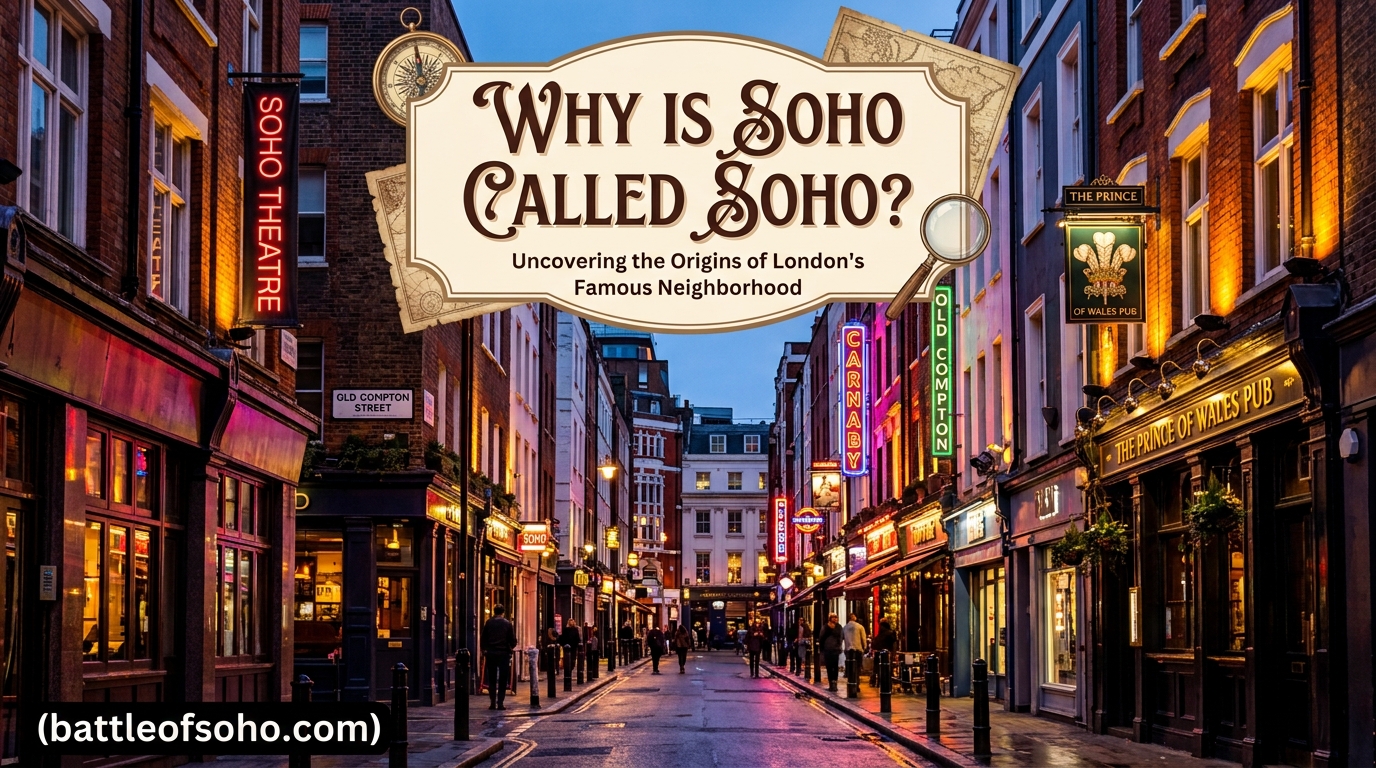
Walk through Soho today and you will find cocktail bars, jazz clubs, film studios, and some of the best restaurants in London. But centuries before any of that existed, the land underneath your feet was an open field where hunters on horseback chased hares through the grass and shouted a two-syllable cry that would eventually give this neighborhood its name.
The question of why Soho is called Soho has fascinated Londoners and historians for generations. The most widely accepted explanation traces the name back to a 16th-century hunting cry, “So-ho!”, shouted by huntsmen as they released their dogs across what was then rural grazing land. But as with many old place names, the story is messier and more debated than a simple answer suggests.
In this guide, I will walk you through the hunting cry theory in detail, examine what the major scholarly sources say, explore the competing theories that have circulated for centuries, and explain why the mystery itself has become part of Soho’s identity. Whether you are a London history enthusiast, an etymology nerd, or simply curious about one of the world’s most famous neighborhoods, you will have a thorough answer by the end.
Table of Contents
The Quick Answer: Is Soho Really a Hunting Cry?
Yes, the name Soho almost certainly comes from an old English hunting cry. In the 1500s, the area we now call Soho was not a dense urban district at all. It was open countryside, fields, and grazing land on the western edge of the City of London. Hunters rode through these fields chasing hares and foxes, and they used distinctive verbal calls to direct their hounds.
The cry “So-ho!” was one of those calls. According to the Survey of London, an authoritative multi-volume historical record compiled by the London County Council, the name derives directly from this shout. The Brewers Dictionary of London Phrase and Fable supports the same explanation. Multiple independent sources converge on the hunting cry as the most credible origin of the name.
However, and this is important, the Oxford English Dictionary never explicitly connects the cry “soho” to the London district. That silence has fueled centuries of speculation and alternative theories. So while the hunting cry explanation is the scholarly consensus, it is technically an educated conclusion rather than a documented fact from the period itself.
Soho as a 16th-Century Hunting Ground
Before the Buildings: Open Fields and Grazing Land
To understand how a hunting cry became a place name, you have to picture what this part of London looked like 500 years ago. In the 16th century, the area west of Charing Cross and north of the Thames was largely rural. There were no rows of townhouses, no theater district, no neon signs. Instead, there were open fields, pastureland, small farms, and the occasional grand estate.
Henry VIII had enclosed nearby land for a royal park, and the surrounding countryside served as hunting grounds for the wealthy. The land that would become Soho was part of the parish of St Martin in the Fields, a name that itself tells you how rural the area was. You literally stood in fields.
London at this time was compressed into a relatively small area around the City and Westminster. Everything in between, including what we now call the West End, was open land where livestock grazed and game animals ran wild. This made it an ideal hunting ground for aristocrats and their entourages.
The urbanization of Soho did not begin in earnest until the 1670s, when developers started laying out streets and squares on the old fields. By that point, the hunting cry associated with the land had already stuck as a local name.
The Hunt: Harrier Dogs and Hare Coursing
The type of hunting that took place in these fields was not the mounted fox hunt you might picture from later centuries. In the 1500s, the common practice involved hare coursing using harrier dogs, a breed of scent hound specifically bred to chase hares over open ground.
Huntsmen would work on foot or horseback, directing packs of harriers across the fields. The dogs were kept on leashes or couplings until the moment came to release them. When a hare bolted from cover, the hunters would shout specific cries to coordinate the chase.
This is where the hunting cry enters the picture. Different cries served different purposes during a hunt, and “So-ho!” was one of the key commands.
The Hunting Cry Theory: Tally-Ho vs So-Ho
What Did the Cry Actually Mean?
Here is the detail that most articles get wrong or skip entirely. “So-ho!” was not just a generic shout. It had a specific meaning within the vocabulary of the hunt, and it was distinct from the more famous cry “Tally-ho!”
According to historical hunting references, “Tally-ho!” was the cry used when a fox broke cover, meaning when the prey suddenly emerged from wherever it was hiding and the chase was on. It was the excitement call, the moment everything kicked into high gear.
“So-ho!” served a different purpose. It was the cry huntsmen used when they uncoupled the dogs, releasing the hounds from their leashes so they could pursue the game. In some accounts, it was also used to call off harrier dogs when they were sent to fetch or retrieve a hare that had been caught.
So in the hunting vocabulary of 16th-century England, “So-ho!” was essentially a release command. You said it when you let the dogs go. And this particular stretch of fields, where huntsmen repeatedly shouted “So-ho!” as they released their hounds, eventually became known by the cry itself.
Think of it as a nickname born from repetition. If you walked past a field where people were constantly yelling “So-ho!” every time they released their dogs, you would start calling it the Soho field. Over time, the name stuck even after the hunting stopped and the buildings went up.
How a Shout Became a Place Name
The transition from hunting cry to permanent place name was gradual. There was no official ceremony or charter that declared the area “Soho.” Instead, the name emerged organically from common usage among the people who lived, worked, and hunted in the area.
By the time development began in the late 17th century, locals were already referring to the area as Soho. The earliest written references to the name appear in property records and legal documents from the period, suggesting it was already well-established in everyday speech.
When the land was parcelled out for development, the informal name carried over into formal use. Streets were laid out, squares were built, and the neighborhood that grew on the old hunting fields retained the name that the huntsmen had given it.
This pattern of naming is not unique to Soho. Many London place names originated from practical descriptions or activities associated with the land. What makes Soho unusual is the vividness of its origin: a word that started as a shout across a field.
Is the Hunting Cry Theory Actually True?
Here is where the story gets genuinely interesting from a scholarly perspective. The hunting cry theory is widely accepted, but it is not without problems, and honest historians acknowledge the uncertainty.
The strongest piece of evidence comes from the Survey of London, the comprehensive architectural and historical record of London published by the London County Council starting in 1900. The Survey treats the hunting cry origin as the established explanation for the name.
The Brewers Dictionary of London Phrase and Fable also supports this derivation. Multiple reference works and historical publications converge on the hunting cry as the best available explanation.
But here is the catch. The Oxford English Dictionary, generally considered the most authoritative English language reference, defines “soho” as an exclamation or hunting cry but never explicitly states that the London district took its name from this cry. The OED’s silence on the direct connection creates a small but notable gap in the documentation.
Soho expert Pete Berthoud, who has studied and written about the district extensively, has offered what might be the most honest assessment. His preferred theory is that “we’ll never know” for certain. The origin of the name predates reliable written records from the area, and no primary source from the 16th century explicitly documents the naming.
This does not mean the hunting cry theory is wrong. It remains the most credible explanation supported by the best available sources. But the lack of a definitive primary source means we are dealing with a well-supported conclusion rather than a proven fact.
The uncertainty itself has become part of Soho’s character. As the team at Londonist noted in their own investigation into the name, the sketchiness of the etymology is part of what makes the place special. A neighborhood known for its bohemian spirit, nightlife, and creative energy having a name that nobody can fully explain feels oddly appropriate.
The Duke of Monmouth and the Battle of Sedgemoor
The hunting cry theory has a fascinating historical subplot involving one of the most dramatic figures in 17th-century English history. James Scott, the 1st Duke of Monmouth, was the illegitimate son of King Charles II and a man whose connection to Soho helped cement the hunting cry theory in popular imagination.
Monmouth built a grand residence called Monmouth House in the area that is now Soho Square. He was a prominent figure in London society and an enthusiastic hunter. According to historical accounts, he was known to use the cry “Soho!” as a personal rallying call.
This detail took on much darker significance in 1685. After Charles II died, Monmouth launched what became known as the Monmouth Rebellion, an attempt to overthrow his uncle James II and seize the throne. At the Battle of Sedgemoor, the final battle of the rebellion, Monmouth reportedly used “Soho!” as his rallying cry as he led his troops into combat.
The rebellion was crushed. Monmouth was captured, executed, and his supporters faced brutal reprisals in the Bloody Assizes. But the cry he used at Sedgemoor reinforced the association between the word “Soho” and the neighborhood where he had lived and hunted.
Some accounts have suggested that the area was actually named because of Monmouth’s use of the cry, rather than the cry predating him. However, most historians believe the name was already in common use before Monmouth’s time. His connection to the cry and the area likely reinforced the name rather than originating it.
Debunking the South of Holborn Myth
One of the most persistent myths about Soho’s name is the claim that it stands for “South of Holborn.” This theory suggests the name is an acronym or abbreviation created from the geographic position of the area south of the Holborn district.
This explanation is almost certainly wrong. It is what etymologists call a false etymology, a retrospective explanation invented to make sense of a name after the fact.
There are several reasons to reject the South of Holborn theory. First, the geographic logic does not hold up well under scrutiny. Second, the practice of creating acronym-based place names was extremely rare in the period when Soho was named. Third, the hunting cry theory is supported by multiple historical sources while the South of Holborn explanation appears to have no scholarly backing.
The South of Holborn myth likely persists because it feels tidy and logical. People like explanations that make sense on a map. But language and place names rarely work that way, especially in a district whose origins stretch back to the 1500s.
A similar false etymology exists for New York’s SoHo, which some people incorrectly assume follows the same pattern as London. In reality, New York’s SoHo has a completely different and well-documented origin, which I will cover shortly.
Other Theories: Footpad Slang and the So Hoe Spelling
Beyond the hunting cry and the South of Holborn myth, a few other theories about Soho’s name have circulated over the centuries. These are less well-known but worth examining for completeness.
The 19th-century historian Walter Thornbury, who wrote extensively about London history, proposed that “soho” might have been footpad slang. A footpad was a type of street robber who operated on foot, and Thornbury suggested that criminals in the area used “soho” as a watchword or signal. This theory is intriguing but lacks supporting evidence and has not been taken seriously by modern historians.
Another minor theory relates to the old spelling of the name. Some historical documents spell the area as “So Hoe,” which has led to speculation that the name relates to agricultural activity. A hoe was a tool, and a “soe” or “so” might have referred to a type of plough or agricultural practice. This reading would make Soho an agricultural place name rather than a hunting one. Again, this theory has minimal scholarly support.
What these alternative theories demonstrate is that the question of Soho’s name has attracted creative speculation for centuries. When a definitive primary source does not exist, people fill the gap with theories that range from plausible to fanciful.
The hunting cry remains the best-supported explanation because it is endorsed by the most authoritative sources and fits the historical context of the area as a hunting ground. But the existence of competing theories adds texture to the story and reminds us that history is rarely as neat as we would like.
Soho Square: From King’s Square to Cultural Landmark
Soho Square sits at the heart of the district and has its own naming story that intersects with the broader history of the area. When the square was originally laid out in the late 17th century, it was called King’s Square, named after Charles II.
A statue of Charles II stood at the center of the square, and the surrounding area was developed as an upscale residential neighborhood. The Duke of Monmouth’s Monmouth House was one of the grandest properties on the square before his fall from grace and execution.
Over time, the name King’s Square fell out of common use, and people began calling it Soho Square, adopting the broader district name. This shift reflects how the name Soho had become so strongly associated with the entire area that it subsumed the original name of its most prominent square.
Today, Soho Square is home to media companies, a small public park, and the residual echo of a royal naming that most Londoners have long forgotten. Charles Dickens even featured the square in A Tale of Two Cities, giving it a literary immortality that adds another layer to its rich history.
The House of St Barnabas, a historic building on the square’s edge, dates from this period and serves as a reminder of the charitable institutions that were established in the neighborhood as it developed from hunting fields into a residential and commercial district.
London Soho vs New York SoHo: Two Different Stories
One of the most common sources of confusion in discussions about Soho’s name is the mix-up between London’s Soho and New York’s SoHo. They share a name but have completely different origins.
London’s Soho, as we have established, most likely comes from a 16th-century hunting cry. New York’s SoHo, on the other hand, is a genuine acronym. It stands for “South of Houston Street,” referring to the Manhattan neighborhood located south of Houston Street.
The New York name was coined in 1962 by urban planner Chester Rapkin in a report that became known as the Rapkin Report. Rapkin needed a shorthand label for the area and created the SoHo abbreviation, which stuck and became one of the most famous neighborhood names in the world.
London’s Soho predates New York’s by roughly four centuries. The two names are entirely unrelated in origin despite their visual similarity. This is worth emphasizing because the confusion leads some people to assume that London’s Soho is also an acronym, which feeds into false etymologies like the South of Holborn theory.
Why Are There So Many Sohos Around the World?
If you travel to different cities around the world, you will find Sohos and SoHos in unexpected places. Buenos Aires has a Palermo Soho. Beijing has a SOHO building complex. Tampa has a SoHo district along South Howard Avenue. Hong Kong has a Soho area near Mid-Levels.
Most of these international Sohos took the name as a reference to either London or New York. The name has become shorthand for a certain type of neighborhood: trendy, creative, nightlife-oriented, culturally mixed. It is a brand as much as a place name.
This global spread is a testament to how a simple two-syllable word, born from a shout across a hunting field in 16th-century London, has traveled the world and taken on meanings its originators could never have imagined.
FAQs
Is Soho a hunting cry?
Yes, the most widely accepted theory is that Soho derives from a 16th-century English hunting cry called ‘So-ho!’ Huntsmen shouted this cry when they uncoupled or released their hounds to chase game across the open fields that later became the Soho district. The companion cry ‘Tally-ho!’ was used when a fox broke cover. The Survey of London and Brewers Dictionary of London Phrase and Fable both support this explanation.
What does Soho stand for?
London’s Soho does not stand for anything. It is not an acronym or abbreviation. The name most likely comes from a hunting cry used in the 16th century. However, New York’s SoHo does stand for something: it is an abbreviation for ‘South of Houston Street,’ coined in 1962 by urban planner Chester Rapkin. The two districts have completely different name origins despite sharing a similar spelling.
Which came first, London Soho or New York SoHo?
London’s Soho came first by approximately 400 years. The name was in use by the late 16th or early 17th century when the area was still open hunting fields. New York’s SoHo was not coined until 1962, when urban planner Chester Rapkin created the abbreviation ‘South of Houston Street’ for a planning report. The two names are entirely unrelated in origin.
Is the Soho hunting cry theory proven?
The hunting cry theory is the most widely supported explanation but it is not definitively proven. The Survey of London and Brewers Dictionary endorse it, and multiple historical sources converge on the same explanation. However, the Oxford English Dictionary defines the cry ‘soho’ without explicitly linking it to the London district, and no primary source from the 1500s documents the naming. Soho expert Pete Berthoud has noted that we will likely never know with absolute certainty.
Conclusion
So why is Soho called Soho? The answer, as we have seen, is that the name almost certainly comes from a 16th-century hunting cry, “So-ho!”, shouted by huntsmen as they released their hounds across open fields on what was then the rural western edge of London. The Survey of London, the Brewers Dictionary, and multiple historical sources support this explanation, making it the scholarly consensus.
The story does not end there. The Duke of Monmouth’s use of the cry at the Battle of Sedgemoor added a dramatic historical chapter. The false South of Holborn etymology continues to circulate despite being debunked. Lesser-known theories about footpad slang and agricultural origins add texture to the debate. And the Oxford English Dictionary’s reticence to explicitly connect the cry to the district leaves just enough room for doubt to keep the question alive.
If there is one takeaway from exploring the etymology of Soho, it is that the uncertainty is part of what makes the neighborhood special. A place known for creativity, reinvention, and a refusal to be easily categorized having a name that nobody can fully explain feels entirely fitting. The hunting cry theory is the best answer we have, and it is a good one. But the mystery itself has become part of the name’s meaning.
Next time you walk through Soho, listen for the echo. Somewhere beneath the cocktail bars and film studios, you are standing on the same fields where huntsmen once shouted “So-ho!” into the open air. The cry became a name, the name became a neighborhood, and the neighborhood became one of the most famous places on earth.