
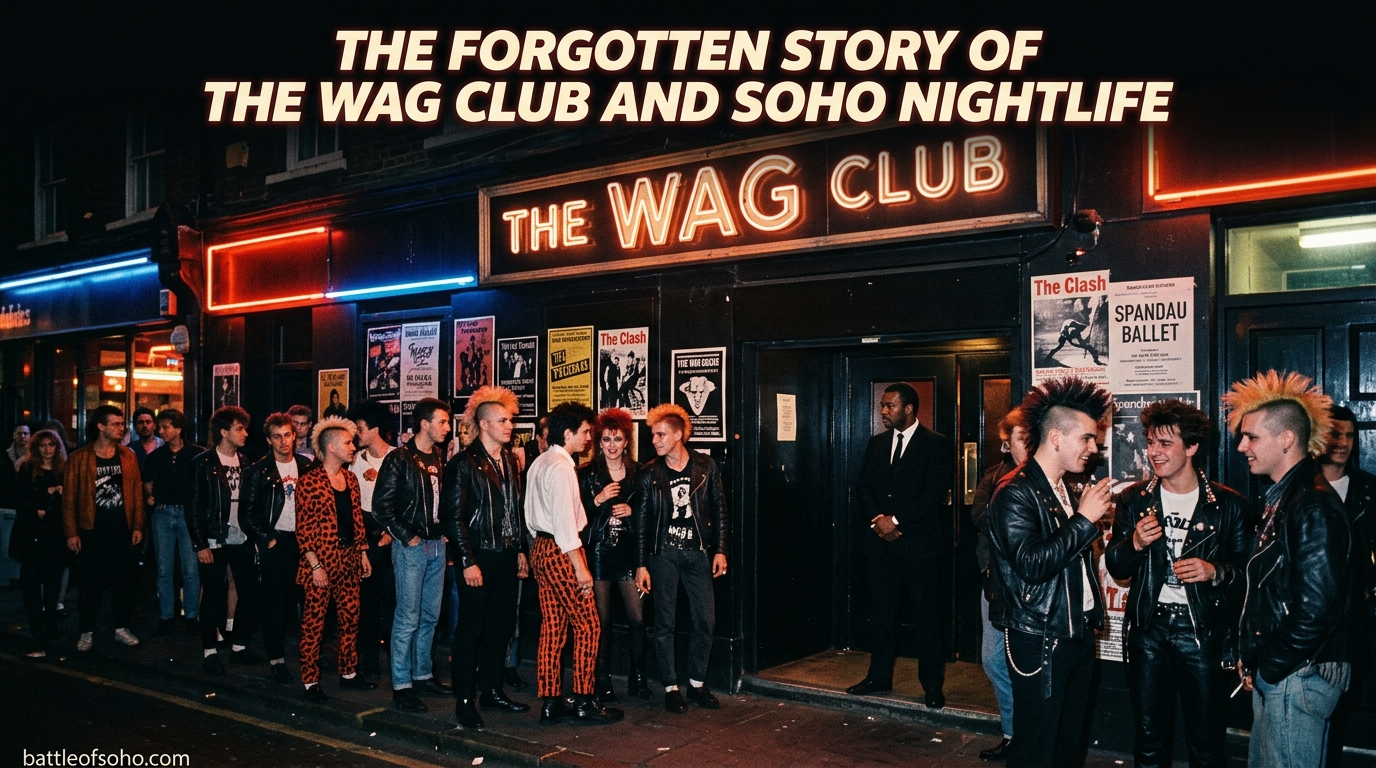
Walk down Wardour Street in Soho today and you will find chain pubs, cocktail bars selling fifteen-pound martinis, and tourists photographing the same stretch of pavement that once hosted the most important nightclub in British history. The Wag Club, which opened its doors at 33 Wardour Street in October 1982, was not just a place to dance. It was a cultural laboratory that introduced hip hop to the United Kingdom, helped birth acid house culture, gave a home to the New Romantic and post-punk generations, and shaped London nightlife history for nearly two decades before closing in 2001.
The Wag Club Soho story is one that deserves to be remembered, not just as nostalgia but as a case study in how a single venue can transform an entire music scene. This was the club where David Bowie danced anonymously on a Saturday night, where John Galliano found inspiration for collections that would later define Paris fashion, where the first British audiences heard records that would become the foundation of rave culture. It was a place that felt both exclusive and welcoming, a contradiction that its founders engineered deliberately.
In this deep dive, we trace the Wag Club from its founding by Chris Sullivan and Ollie O’Donnell through its glory days of genre-blending DJ sets, celebrity regulars, and hedonistic all-night parties, to its eventual closure as gentrification reshaped the Soho that had nurtured it. Whether you lived through the era or are discovering it for the first time, this is the story of a club that proved nightlife could be genuinely revolutionary.
Table of Contents
The State of Soho Nightlife Before the Wag Club
To understand why the Wag Club mattered so much, you have to picture what London nightlife looked like in the late 1970s and early 1980s. The city was emerging from the post-punk era, a time of economic recession, racial tension, and social unrest. Soho itself was a very different place from the polished entertainment district it has become. It was gritty, affordable, and full of characters who would never make it past a modern bouncer. Strip clubs, dive bars, and cheap cafés lined the streets. Rents were low enough that creative people could actually afford to live and socialize in central London.
The clubbing landscape was fragmented. The New Romantic movement had brought spectacle and theatricality to nightlife, with clubs like the Blitz and the Camden Palace attracting a crowd obsessed with fashion, art-school attitude, and synthetic pop. But these venues had a narrow musical focus. If you wanted to hear reggae, you went to one club. If you wanted rare groove or jazz-funk, you went somewhere else entirely. There was no venue that brought together the full spectrum of underground music under one roof.
That fragmentation created a hunger. London’s creative community wanted a place where different subcultures could collide, where a punk kid could dance next to a soul enthusiast, where the boundaries between musical tribes could dissolve on the dance floor. The idea that one club could serve as a home for all these sounds was radical. Nobody had attempted it at scale. The timing was right, the city was ready, and two young men from the capital’s nightlife underground were about to make it happen.
What was missing was someone with the vision, the musical knowledge, and the sheer force of personality to pull all these threads together. That person turned out to be a Welsh-born art student turned club promoter named Chris Sullivan, and his partner Ollie O’Donnell, who together would create something London had never seen before.
How the Wag Club Was Born: 1982, Wardour Street
Chris Sullivan was not your typical nightclub owner. He was a fashion student at St Martin’s School of Art, a musician, a DJ, and a man with an encyclopedic knowledge of music that spanned every genre imaginable. Before the Wag, he had been running nights at other venues, building a reputation as someone who could read a room and keep a dance floor moving for hours. His background in the New Romantic scene gave him an eye for style and spectacle, but his musical taste ranged far wider than the synth-pop that defined that movement.
Ollie O’Donnell brought the operational expertise. Together, they found a venue at 33 Wardour Street, a building that had previously housed the Sphinx Club and would later become one of the most famous addresses in British nightlife history. The location was significant. Wardour Street was the beating heart of Soho, surrounded by the film industry offices, music shops, and the creative energy that defined the area. It was accessible, central, and embedded in the cultural geography of London.
The Wag Club opened in October 1982, and from the very first night, it was clear that something different was happening. The name itself was a statement. “Wag” came from the expression “to wag,” meaning to talk or gossip, and also carried associations with a dog’s tail, suggesting a playful, informal atmosphere. The club was designed to feel like a friend’s living room rather than an exclusive venue, even though its door policy would become legendary in its own right.
Sullivan’s approach to running the club was deeply personal. He curated the music himself, spending hours in record shops hunting for obscure tracks that nobody else in London was playing. He booked live acts that ranged from forgotten jazz legends to emerging hip hop artists. He paid attention to the details of the room, the lighting, the bar, the way people moved through the space. The result was a venue that felt curated from top to bottom, a place where every element served the larger goal of creating an unforgettable night out.
The Music Policy That Changed Everything
What set the Wag Club apart from every other nightclub in London was its music policy. Most clubs in the early 1980s committed to a single genre. You had soul nights, reggae nights, pop nights, and they rarely crossed over. The Wag threw that rulebook out the window. On any given Saturday night, you might hear a block of Latin jazz followed by a Kraftwerk B-side, then a rare groove classic, then a brand-new house record fresh off the boat from Chicago.
This genre-blending approach was not random. It was the product of Chris Sullivan’s deep musical knowledge and his belief that good music transcended category. He understood that a dance floor full of open-minded people would follow a DJ who took them on a journey, as long as every track served the energy of the room. The result was a sound that could not be replicated anywhere else. People came to the Wag not just to dance to their favorite genre but to discover music they had never heard before.
House music found an early British home at the Wag. When the first Chicago house records started arriving in London in the mid-1980s, Sullivan was among the first DJs to play them regularly. The same was true of Detroit techno, Belgian new beat, and the emerging electronic sounds that would eventually define the rave era. The club became a testing ground for new music, a place where records were broken to British audiences before anyone else in the country had heard them.
Rare groove was another Wag Club signature. This was the practice of digging deep into back catalogs to find forgotten soul, funk, and jazz records that deserved a second hearing. Before the internet made every recording instantly accessible, discovering a rare groove track required physical record hunting and the kind of obsessive knowledge that Sullivan possessed. Playing these records alongside the latest underground releases created a temporal dialogue on the dance floor, connecting the musical past with the future.
Latin jazz and Brazilian sounds were woven into the mix as well. Sullivan had a particular love for the rhythms of Tito Puente, Mongo Santamaria, and the salsa tradition, and he played them with the same conviction he brought to the newest electronic tracks. This openness to global music gave the Wag a cosmopolitan flavor that reflected the diversity of London itself. It was not a club for one tribe. It was a club for anyone who loved music enough to follow it wherever it went.
How the Wag Club Brought Hip Hop to Britain
One of the most historically significant aspects of the Wag Club story is its role in introducing hip hop to British audiences. In 1982, hip hop was still a distinctly American phenomenon, concentrated in the Bronx and Harlem and barely known outside New York City. The idea of a London nightclub dedicating a night to hip hop was virtually unheard of.
That changed with the Roxy Road Show. In 1982, the Wag hosted what is widely regarded as the first major hip hop event in London, bringing together DJs, breakers, and graffiti artists for a night that introduced the culture to a British audience. The event was a revelation for many attendees who had never seen breakdancing live or heard DJ scratching in person. It planted a seed that would grow into the vibrant British hip hop scene of the late 1980s and beyond.
The club continued to champion hip hop throughout the decade. Sullivan regularly played early rap records from artists like Grandmaster Flash, Afrika Bambaataa, and Kurtis Blow, introducing them to crowds that might never have encountered the music otherwise. As British hip hop began to develop its own identity, the Wag provided a platform for homegrown artists to perform and build audiences.
One of the most memorable stories from this era involves KRS-One, the legendary Bronx rapper who visited the Wag in the late 1980s. According to accounts from the time, KRS-One was reportedly unimpressed by what he saw, allegedly dismissing the club’s hip hop credentials. The incident became part of Wag Club folklore, a reminder of the cultural gap between the birthplace of hip hop and the British scene that was still finding its feet. But the fact that a figure of KRS-One’s stature was visiting a London nightclub at all speaks volumes about the Wag’s reputation on the international stage.
The hip hop nights at the Wag did more than entertain. They educated. A generation of British DJs, producers, and dancers learned their craft on that Wardour Street dance floor, absorbing the techniques and aesthetics of a culture that had traveled across the Atlantic and was being adapted for a new context. Without the Wag Club’s early commitment to hip hop, the British music landscape might have looked very different.
The Door Policy and the Crowd
No discussion of the Wag Club would be complete without addressing its famous door policy. In an era before guest lists and VIP sections became standard nightclub practice, the Wag pioneered a selective approach that was both controversial and effective. The goal was not to create an exclusive atmosphere for the wealthy or the famous. It was to protect the character of the night.
The door staff were instructed to keep out groups that would disrupt the vibe. That meant no stag parties, no groups of squaddies on leave, no one who looked like they were there to cause trouble rather than to dance. The policy was designed to create a safe space for the regular crowd, a term that encompassed musicians, artists, designers, students, and anyone who understood and respected what the club was trying to do.
This approach created a fiercely loyal community of regulars. The same faces appeared week after week, forming friendships, relationships, and creative collaborations that extended far beyond the dance floor. A Facebook group dedicated to the Wag Club still exists today, with former regulars sharing memories and photographs decades after the club closed. The nostalgia is palpable. People describe the Wag as the best years of their lives, a place where they felt they belonged.
The door policy also contributed to the club’s mystique. Getting in felt like an achievement, a validation that you were part of something special. But once inside, the atmosphere was warm and unpretentious. The Wag did not show itself off. It was, as one former regular described it, “a bit secretive, not exclusive, but it didn’t flaunt itself.” That balance of selectivity and warmth was the magic formula that kept people coming back for nineteen years.
Acid House, Ecstasy, and the Hedonistic Era
By the late 1980s, the Wag Club found itself at the center of a cultural revolution. Acid house had arrived in Britain, and with it came a new wave of hedonism that would transform the nightlife landscape forever. The club was one of the first venues in London to embrace acid house, playing the squelching Roland TB-303 basslines and banging warehouse rhythms that defined the sound.
Ecstasy, the drug that became synonymous with acid house culture, was transforming the way people experienced nightlife. The Wag was not immune to this shift. The dance floor took on a new energy, with crowds dancing for hours in a euphoric state that earlier generations of clubbers would not have recognized. The music got faster, the lights got more intense, and the club’s reputation for hedonism reached its peak.
The connection to rave culture was direct. Many of the DJs and promoters who would go on to organize the massive outdoor raves of the early 1990s cut their teeth at the Wag. The club served as an incubator for the culture that would eventually outgrow the indoor nightclub format entirely. When rave went illegal and moved to warehouses and fields, the spirit of the Wag went with it.
But the hedonistic era also brought challenges. As drug culture became more prominent, the atmosphere of the club shifted. Some longtime regulars drifted away, feeling that the inclusive, music-first spirit of the early years was being diluted. The competition from larger, newer venues that catered specifically to the acid house crowd meant the Wag was no longer the only game in town. The club that had pioneered so much was now part of a much bigger movement, and maintaining its unique identity became increasingly difficult.
Still, the Wag’s contribution to acid house and rave culture cannot be overstated. It was there at the beginning, playing the records before anyone else, educating audiences, and creating the infrastructure of DJs, promoters, and fans that the movement required. The story of British dance music is in many ways the story of the Wag Club, and the club’s role in that story is permanent.
The Celebrities Who Called the Wag Home
The Wag Club’s reputation attracted an extraordinary roster of celebrity regulars, but what made the club special was that famous faces were treated the same as everyone else. There were no VIP areas. David Bowie, one of the most recognizable people on the planet, would dance on the main floor alongside students and shop workers, and nobody bothered him. That egalitarian spirit was central to the club’s appeal.
John Galliano was a regular during his early years as a designer, absorbing the visual culture of the Wag crowd and translating it into the fashion collections that would later make his name at Givenchy and Dior. The club was a runway before fashion week existed, a place where the most adventurous dressers in London competed to outdo each other. Leigh Bowery, the Australian performance artist and fashion provocateur, was another regular who pushed the boundaries of what could be worn on a dance floor.
Neneh Cherry, the Swedish singer whose career would take off in the late 1980s, was part of the Wag family before she became famous. The club’s support for emerging artists meant that performers could develop their craft in front of a sympathetic audience, building the confidence and connections they needed to break through. Many of the musicians, designers, and artists who defined British culture in the late twentieth century passed through the Wag at some point in their journey.
The celebrity clientele was never the point of the club. It was a byproduct of doing something genuinely exciting in a city that was hungry for it. The stars came because the Wag was where the most interesting people in London were spending their Saturday nights. If you wanted to know what was happening in music, fashion, and culture, you went to Wardour Street. The club functioned as a cultural barometer, a place where trends were born before they were named.
Why the Wag Club Closed in 2001
The Wag Club closed its doors on January 1, 2001, ending nearly two decades as one of the most influential nightclubs in British history. The closure was the result of a combination of factors that reflected broader changes in London’s cultural landscape. Rising rents in Soho, shifting demographics, the explosion of larger superclubs, and changing drug laws all contributed to the club’s decline.
Gentrification was perhaps the most significant factor. Soho in the 1980s was affordable enough that a nightclub could operate on the revenue from a single Saturday night. By the late 1990s, property values in central London had skyrocketed, and the economics of running an independent venue had become unsustainable. The creative community that had sustained the Wag was being priced out of the neighborhood, replaced by corporate offices and chain restaurants that had no use for a sweaty dance floor.
The rise of superclubs like Ministry of Sound and Fabric also changed the competitive landscape. These massive venues offered production values and capacity that a 300-person room on Wardour Street simply could not match. The intimacy and community that made the Wag special were the same qualities that made it difficult to compete in a market that increasingly valued scale. Chris Sullivan himself acknowledged that the London that had nurtured the club was disappearing.
After the closure, the venue at 33 Wardour Street changed hands several times. It eventually became an O’Neill’s Irish pub, a transformation that former regulars regard with a mixture of sadness and resignation. The building that once hosted the most important dance floor in Britain now serves pints of Guinness to tourists. But the physical space is less important than what happened there, and the legacy of the Wag Club lives on in the music, fashion, and culture it helped create.
The Legacy of the Wag Club and Soho Nightlife
The Wag Club’s influence on British culture is difficult to overstate. It introduced hip hop to the United Kingdom, helped pioneer acid house and rave culture, and created a template for the genre-blending, community-driven nightclub that has been imitated but never replicated. The DJs who passed through its booth went on to shape the sound of British dance music for decades. The artists who danced on its floor went on to define fashion, film, and music on a global stage.
The club also left a mark on how we think about nightlife as a cultural force. Before the Wag, nightclubs were often dismissed as frivolous entertainment. After the Wag, it was clear that a nightclub could be a site of genuine cultural innovation, a place where new ideas were tested, new sounds were broken, and new communities were formed. The Wag proved that nightlife mattered, and that proof has influenced everyone from club promoters to city planners who now recognize the importance of the night-time economy.
The story of the Wag Club Soho is also a cautionary tale about what happens when gentrification erases the spaces that make a city creative. Soho today is a cleaner, safer, more expensive place than it was in 1982, but it is also a less interesting one. The conditions that allowed the Wag to exist, low rents, a diverse community, a tolerance for noise and chaos, have largely disappeared from central London. The question of whether a club like the Wag could happen again is one that every person who cares about nightlife should be asking.
Chris Sullivan has said that the Wag Club could never happen now, and the evidence supports him. But the spirit of what the club represented, the belief that music can bring people together across boundaries, that nightlife can be a force for cultural good, and that a single room with the right people in it can change the world, that spirit endures. It lives on in the venues that are still fighting to survive, in the DJs who are still searching for the next great record, and in the memories of everyone who was lucky enough to walk through that door on Wardour Street.
FAQs
What is the history of the Wag Club?
The Wag Club was a legendary London nightclub founded in October 1982 at 33 Wardour Street, Soho. Created by Chris Sullivan and Ollie O’Donnell, it operated for nearly two decades and played a pivotal role in shaping 1980s and 1990s UK club and rave culture by introducing hip hop, house music, and acid house to British audiences.
Where was the Wag Club in Soho?
The Wag Club was located at 33 Wardour Street in the heart of Soho, London. The same building had previously housed the Sphinx Club and now operates as an O’Neill’s Irish pub.
When did the Wag Club close?
The Wag Club closed on January 1, 2001, after nearly nineteen years of operation. Rising rents, gentrification of Soho, and competition from larger superclubs all contributed to its closure.
Who ran the Wag Club?
The Wag Club was co-founded and run by Chris Sullivan, a Welsh-born fashion student, DJ, and musician, together with Ollie O’Donnell, who handled operational aspects. Sullivan curated the club’s groundbreaking music policy and served as its primary DJ.
What music did the Wag Club play?
The Wag Club was famous for its genre-blending music policy that included hip hop, house music, acid house, disco, Latin jazz, Brazilian rhythms, rare groove, funk, and soul. It was one of the first UK clubs to play Chicago house records and helped introduce hip hop to British audiences through events like the Roxy Road Show in 1982.
Which celebrities went to the Wag Club?
Celebrity regulars at the Wag Club included David Bowie, fashion designer John Galliano, performance artist Leigh Bowery, singer Neneh Cherry, and many other musicians, designers, and artists who shaped British culture in the 1980s and 1990s. The club had no VIP section, meaning celebrities danced alongside regular club-goers.
What was the famous club in the 80s?
The Wag Club was one of the most famous and influential clubs of the 1980s in London. Alongside venues like the Blitz Club and the Camden Palace, the Wag defined 80s club culture by pioneering new music genres and hosting the most creative crowd in the city. It stood out for its genre-spanning music policy that went far beyond the New Romantic sound of its competitors.
Conclusion: Why We Still Talk About the Wag Club
The forgotten story of the Wag Club and Soho nightlife is not really forgotten at all. It lives on in the records that DJs still play, in the clubs that still try to capture that elusive mix of inclusivity and selectivity, and in the memories of everyone who experienced it firsthand. The club closed its doors over two decades ago, but its cultural footprint remains enormous.
What makes the Wag Club story worth telling in 2026 is that it reminds us what nightlife can be at its best. It can be a space where musical boundaries are broken, where fashion is invented on the dance floor, where communities form around shared love of sound. The Wag was all of these things, and the fact that no venue has quite managed to replicate its formula in the years since only adds to its legend.
Soho has changed beyond recognition since 1982, and not entirely for the better. The independent venues, cheap cafés, and creative communities that made the neighborhood special have been replaced by chains and corporate offices. The lesson of the Wag Club is that when we lose our nightlife spaces, we lose something that cannot be rebuilt. Culture does not survive on infrastructure alone. It needs rooms where things can happen, floors where people can dance, and doors that open wide enough to let everyone in.
If there is one thing to take from the story of the Wag Club, it is that the most important cultural movements often start in small rooms with the right music and the right people. Chris Sullivan did not set out to change British culture. He set out to create a night where he could play the records he loved. Everything else followed from that simple desire. The lesson for anyone trying to build something today is the same. Start with what you love, find your people, and let the culture grow from there. The Wag Club may be gone, but the principles that made it great never went anywhere.