
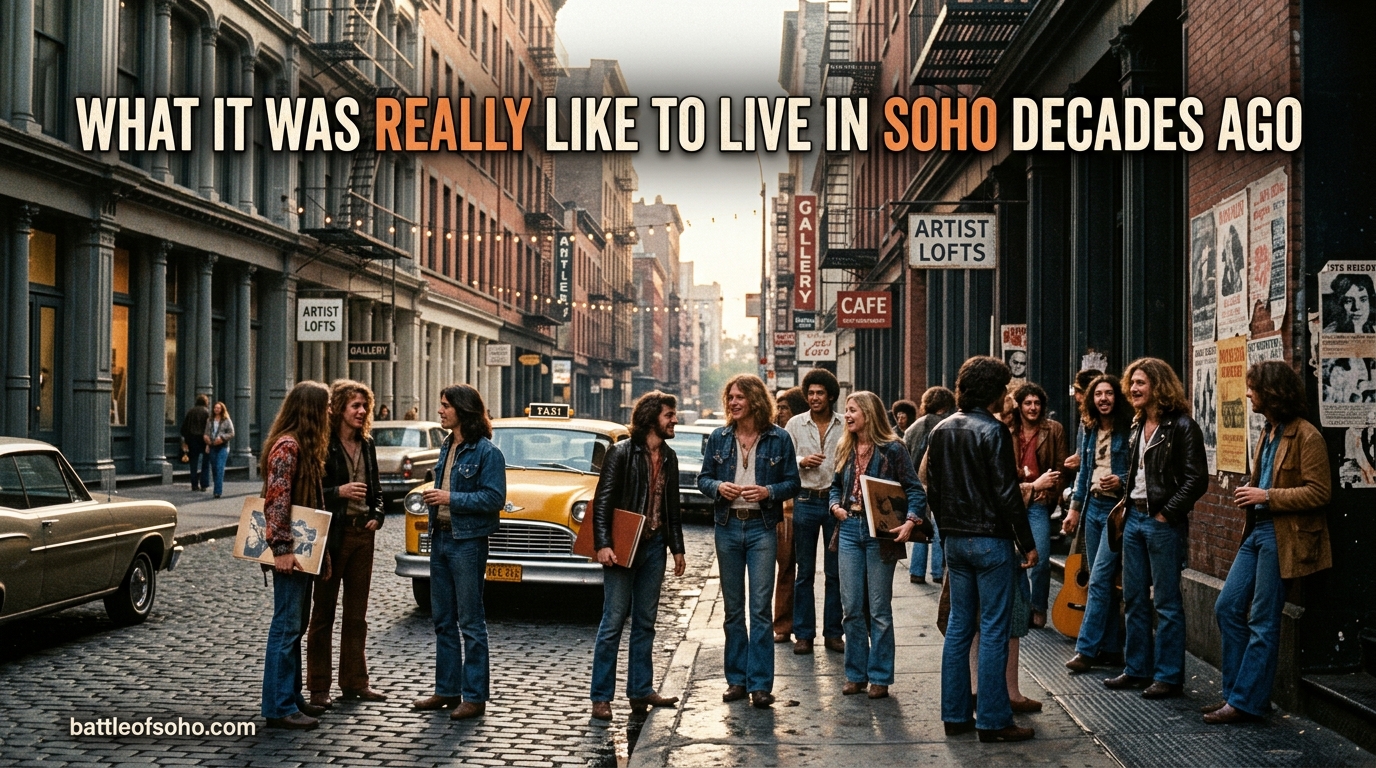
Walk through SoHo today and you will find Prada, Chanel, and tourists lining cobblestone streets with shopping bags. But if you had walked those same blocks fifty years ago, you would have heard freight elevators groaning, smelled printer’s ink and machine oil, and seen children riding bicycles through empty warehouse floors. The neighborhood most people know as a luxury shopping destination was once something else entirely.
If you want to understand what it was really like to live in Soho decades ago, you have to look past the boutiques and the Instagram crowds. You have to picture a place that smelled like industry, echoed with emptiness after sundown, and housed a community of scrappy artists who heat their living spaces with makeshift wood stoves. Our team spent months digging through resident accounts, historical records, and forum threads from people who actually grew up there. What emerges is a portrait of a neighborhood that no longer exists in any physical form.
SoHo’s transformation is one of the most dramatic urban stories in American history. It went from a forgotten industrial wasteland to the epicenter of the art world, and then to a luxury retail district. Each layer of that story left traces. Here is what life was actually like on those cobblestone streets, told through the experiences of the people who called it home.
Table of Contents
From Factories to Forgotten – SoHo’s Industrial Roots
Long before anyone called it SoHo, this slice of Lower Manhattan south of Houston Street was a busy mercantile and manufacturing hub. In the late 1800s and early 1900s, the area filled up with grand cast-iron buildings that housed textile factories, dry goods wholesalers, and printing presses. These were working buildings, not residences. Trucks loaded and unloaded at curbside freight platforms from dawn to dusk.
By the 1950s, the industry had started moving out. Factories relocated to cheaper areas in the outer boroughs and New Jersey. The magnificent cast-iron buildings that once buzzed with activity stood half-empty. Landlords struggled to find commercial tenants. The neighborhood grew quiet, dark, and largely abandoned after business hours. To most New Yorkers, there was no reason to go there.
The few people who did pass through described a ghost town of monumental proportions. Massive warehouses with soaring ceilings and enormous windows sat vacant. The cobblestone streets were empty at night. This is the SoHo that the first wave of artists discovered in the early 1960s. They did not see blight. They saw thousands of square feet of raw, light-filled space that no one else wanted.
What It Was Really Like to Live in Soho Decades Ago – The Artist Invasion of the 1960s and 1970s
The artists who moved into SoHo in the 1960s were not following a trend. They were chasing affordable space. Painters, sculptors, and photographers needed room to work, and Manhattan apartments could not provide it. The empty industrial lofts of SoHo offered exactly what they needed: open floor plans, natural light from massive windows, and ceilings high enough to hang large canvases or build sculptures.
There was one significant problem. These buildings were zoned for commercial and manufacturing use, not residential. Living there was technically illegal. Artists moved in anyway, paying landlords low rents under the table or signing leases for studio use while quietly building sleeping lofts and installing hot plates. The city mostly looked the other way because no one else wanted the space.
By the late 1960s, the artist community had grown large enough to organize. The SoHo Artists Association and the Artists Tenant Association formed to fight eviction attempts and push for legal residency. Their advocacy led to a landmark change. In 1971, New York City passed the Artist in Residence ordinance, which allowed certified artists to live legally in commercial lofts. This was the moment SoHo stopped being a hidden secret and started becoming a neighborhood with a recognized identity.
Living conditions were rough, especially in the early years. Many lofts had no heat, no hot water, and questionable electrical wiring. Artists hauled wood stoves up freight elevators and tapped into steam pipes for warmth. Toilets were sometimes shared between floors. But the tradeoff felt worth it. For a few hundred dollars a month, you could have 3,000 square feet of space in Manhattan. That deal existed nowhere else in the city.
Daily Life in Old SoHo – The Streets, The Lofts, The Sensations
If you were walking through SoHo in the 1970s, the first thing you would notice is the silence. After the last factory workers went home, the streets emptied out completely. There were no restaurants open for dinner, no bars, no retail shops. The neighborhood belonged to the people who lived in the lofts above. Children played in the middle of the street because there was almost no traffic.
The sensory experience of old SoHo was unlike anywhere else in Manhattan. You could smell machine oil and printer’s ink lingering in the stairwells of former factories. The cobblestone streets amplified every sound, from the clatter of a single passing truck to the echo of footsteps. In summer, the massive iron buildings radiated stored heat. In winter, the lofts were bitterly cold and drafty, with wind whistling through poorly sealed windows.
Residents described a peculiar kind of freedom that came from living in a place the rest of the city had forgotten. You could make enormous amounts of noise at 3 AM without a single complaint. You could build a two-story sculpture in your living room. You could ride a bicycle in circles through your apartment because the floor was bigger than a basketball court. The space itself shaped the way people lived and thought.
Loft Living Logistics – Keys, Buzzers, and Freight Elevators
The daily mechanics of living in a SoHo loft involved a set of quirks that bonded residents together. Most buildings did not have normal apartment doors with standard locks. Entry was through massive freight doors or industrial loading entrances. Residents developed elaborate key-sharing systems to deal with the fact that buildings had multiple tenants spread across different floors with a single point of entry.
The most legendary of these systems was the key toss. Because there were rarely intercoms or doorbells connected to individual lofts, visitors would knock or call from the street. The resident would lean out a window and drop their building key down in a sock so the visitor could let themselves in. People who grew up in SoHo describe the sock key as a defining ritual of childhood, something they assumed every kid in the world did.
Freight elevators were another shared challenge. These were enormous, clanking platforms designed for moving furniture and industrial goods, not people. They ran slowly and broke down regularly. Getting groceries up to a fifth-floor loft meant riding a rattling metal box that felt like it might stall between floors at any moment. Everyone had stories about being stuck in the freight elevator, or about the time it finally broke for good and had to be replaced.
Growing Up in SoHo – Childhood on Cobblestone Streets
The children who grew up in SoHo during the 1970s and 1980s had an upbringing that sounds almost fictional today. Their playgrounds were loading docks, abandoned warehouse floors, and empty cobblestone streets. They ran underneath parked tractor trailers. They built fortresses out of discarded cardboard tubes and packing materials left behind by departing businesses. The entire neighborhood functioned as an enormous, unstructured playscape.
A community playgroup formed in the early 1970s, organized by artist parents who needed childcare while they worked. Children made macaroni necklaces on warehouse floors. They napped on paint-spattered mattresses. Their parents traded babysitting shifts and organized loft parties where kids fell asleep in bedrooms carved out of sheetrock while adults socialized in the studio space next door.
Looking back, many of these now-grown children describe their SoHo childhood as magical and strange. They knew the names of every artist in every building. They understood from a young age what a silkscreen print was, what oil paint smelled like, and why their parents needed uninterrupted hours at the workbench. It was a childhood shaped by art, freedom, and a tight-knit community of unconventional families.
Famous Faces – The Artists Who Called SoHo Home
SoHo’s artist community was not just large. It was extraordinarily influential. The neighborhood became a creative laboratory where some of the most important American artists of the 20th century lived, worked, and socialized. Andy Warhol maintained a presence in the area, and his circle of Warhol Superstars moved through SoHo lofts attending parties and openings that lasted until dawn.
Keith Haring and Jean-Michel Basquiat were part of a later wave that came of age in the late 1970s and early 1980s. Their work was shaped by the downtown scene that SoHo helped anchor. Galleries began opening on the ground floors of former warehouses, turning the neighborhood into a destination for collectors and critics. The famous Food restaurant, opened in 1971 by artists including Gordon Matta-Clark, became a gathering place where the creative community ate, argued, and planned collaborations.
But the famous names were only part of the story. Hundreds of lesser-known artists formed the real backbone of SoHo’s community. They were sculptors who needed welding space, painters who needed wall-sized canvases, and photographers who needed darkrooms. They shared tools, traded favors, and created an informal support network that made it possible to survive as a working artist in New York City. That network is one of the things residents miss most when they talk about what SoHo lost.
The Gentrification Wave – When Everything Changed
The same qualities that made SoHo attractive to artists eventually made it attractive to everyone else. By the late 1970s, art galleries had established the neighborhood as a cultural destination. Wealthy collectors who came to buy art started noticing the charm of the cast-iron buildings and the cobblestone streets. Real estate speculation took hold.
A 1988 New York Times article titled “If You’re Thinking of Living in SoHo” reported that the raw loft space which had attracted artists a decade earlier was now rarely for sale. Conversions were happening rapidly. Commercial zoning relaxed further, allowing retail businesses to move in. Boutiques and restaurants followed the galleries, drawn by the foot traffic and the cool factor that the artist community had created.
The 1990s marked a turning point. Rents that had been a few hundred dollars climbed into the thousands. Long-time artist residents faced pressure from landlords who could now charge far more to commercial tenants or wealthier residents. The community that had taken a decade to build began to fracture and disperse. Many artists relocated to cheaper areas like Williamsburg, Bushwick, and the Far East Side. By the early 2000s, SoHo was firmly established as a luxury retail and residential district. The transformation was complete.
What Remains of Old SoHo Today
Despite the dramatic changes, traces of old SoHo survive if you know where to look. The cast-iron buildings that artists fought to preserve are now protected landmarks. The SoHo Cast-Iron Historic District ensures that the architectural character of the neighborhood remains intact even as the businesses inside the buildings have completely changed.
Fanelli’s Cafe, operating since 1847 and a fixture of the neighborhood through every era, still serves customers at the corner of Prince and Mercer. A few artist-owned lofts remain, protected by grandfathered zoning arrangements. The cobblestone streets, though now shared with delivery trucks and tourists, still echo with the same sounds they did fifty years ago. The physical space survives. It is the community that filled it which has largely vanished.
FAQs
What was SoHo like in the 60s?
In the 1960s, SoHo was a largely abandoned industrial district of empty warehouses and cast-iron buildings in Lower Manhattan. A growing community of artists began moving into vacant lofts illegally, attracted by the large open spaces, natural light, and cheap rents. The neighborhood was quiet, gritty, and almost entirely empty after business hours, with no restaurants, bars, or retail shops.
What was SoHo like in the 1950s?
In the 1950s, SoHo was a declining industrial area. Factories and wholesale businesses were moving out, leaving many grand cast-iron warehouse buildings vacant or underused. The neighborhood had no residential population to speak of and was considered a forgotten corner of Lower Manhattan with little reason for anyone to visit.
When did SoHo get gentrified?
SoHo’s gentrification began in earnest in the late 1970s and accelerated through the 1980s and 1990s. The turning point came in 1971 when New York City legalized artist residency in commercial lofts. Galleries, boutiques, and restaurants followed, driving up rents. By the early 2000s, SoHo had transformed from an artists’ enclave into a luxury retail and residential district.
What was SoHo like in the 1920s?
In the 1920s, the area now known as SoHo was a busy commercial and manufacturing district. It was filled with textile factories, dry goods wholesalers, and printing presses operating out of grand cast-iron buildings. The neighborhood was a hub of industrial activity with no residential presence, and trucks loaded goods at curbside freight platforms throughout the day.
What happened to all the artists in SoHo?
As rents rose in the 1980s and 1990s, most artists were priced out of SoHo. Many relocated to cheaper neighborhoods like Williamsburg, Bushwick, and the Far East Side of Manhattan. Some artist-owned lofts remain protected by grandfathered zoning, but the large creative community that defined old SoHo has largely dispersed.
Is SoHo still seedy?
No, SoHo is not seedy at all today. It is one of the most expensive and polished neighborhoods in Manhattan, dominated by luxury retail stores, high-end restaurants, and upscale residential lofts. The gritty, industrial, and bohemian character of old SoHo has been completely replaced by commercial affluence.
Conclusion
Understanding what it was really like to live in Soho decades ago means accepting a story of contradiction. The same neighborhood that gave artists impossible freedom in drafty, illegally occupied warehouses eventually became unaffordable for those very people. The cast-iron buildings they loved and fought to preserve now house designer stores that sell handbags for the price of a year’s rent in 1972.
What remains is the memory of a community that existed because no one else wanted the space. Artists built something extraordinary in the gaps of a city that had abandoned its industrial past. They raised children on cobblestone streets, invented elaborate key-throwing rituals from warehouse windows, and turned empty factory floors into the most exciting creative laboratory in America.
If you want to experience a piece of old SoHo today, walk the side streets off Broadway early on a Sunday morning before the shops open. Stand on the cobblestones and look up at the cast-iron facades. The buildings remember everything, even if the people who gave them life have moved on.